Cambridge IGCSE English - Literature in English (9-1) 0992 — 2021 Oct/Nov Paper 4 · Variant 2
0992/42/O/N/21 · 25 marks · ≈28 min
The question paper and its mark scheme, free to read here and free to download. This is Cambridge’s own paper, exactly as it was sat.
Question paper8 pages



Mark scheme5 pages
Answers below. Sit the paper first if you are practising.
Paper as text
Question paper, page 1
This document has 8 pages. Any blank pages are indicated. DC (SLM) 219480 © UCLES 2021 [Turn over * 1 1 9 3 8 0 9 7 9 2 * Cambridge IGCSE™(9–1) LITERATURE IN ENGLISH 0992/42 Paper 4 Unseen October/November 2021 1 hour 15 minutes You must answer on the enclosed answer booklet. You will need: Answer booklet (enclosed) INSTRUCTIONS ● Answer one question: either Question 1 or Question 2. ● Follow the instructions on the front cover of the answer booklet. If you need additional answer paper, ask the invigilator for a continuation booklet. INFORMATION ● The total mark for this paper is 25. ● All questions are worth equal marks.
Question paper, page 2
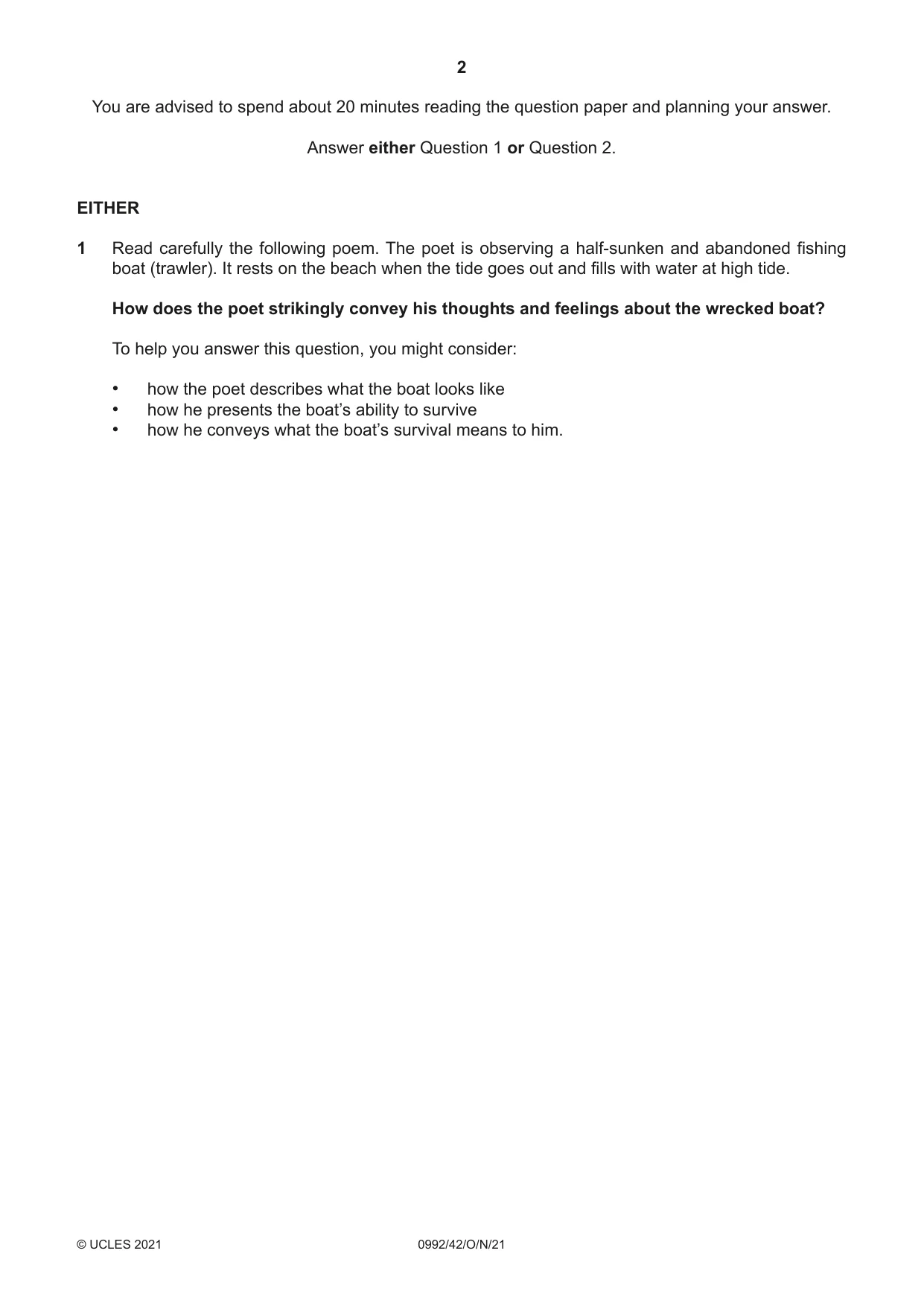
2 0992/42/O/N/21 © UCLES 2021 You are advised to spend about 20 minutes reading the question paper and planning your answer. Answer either Question 1 or Question 2. EITHER 1 Read carefully the following poem. The poet is observing a half‑sunken and abandoned fishing boat (trawler). It rests on the beach when the tide goes out and fills with water at high tide. How does the poet strikingly convey his thoughts and feelings about the wrecked boat? To help you answer this question, you might consider: • how the poet describes what the boat looks like • how he presents the boat’s ability to survive • how he conveys what the boat’s survival means to him.
Question paper, page 3
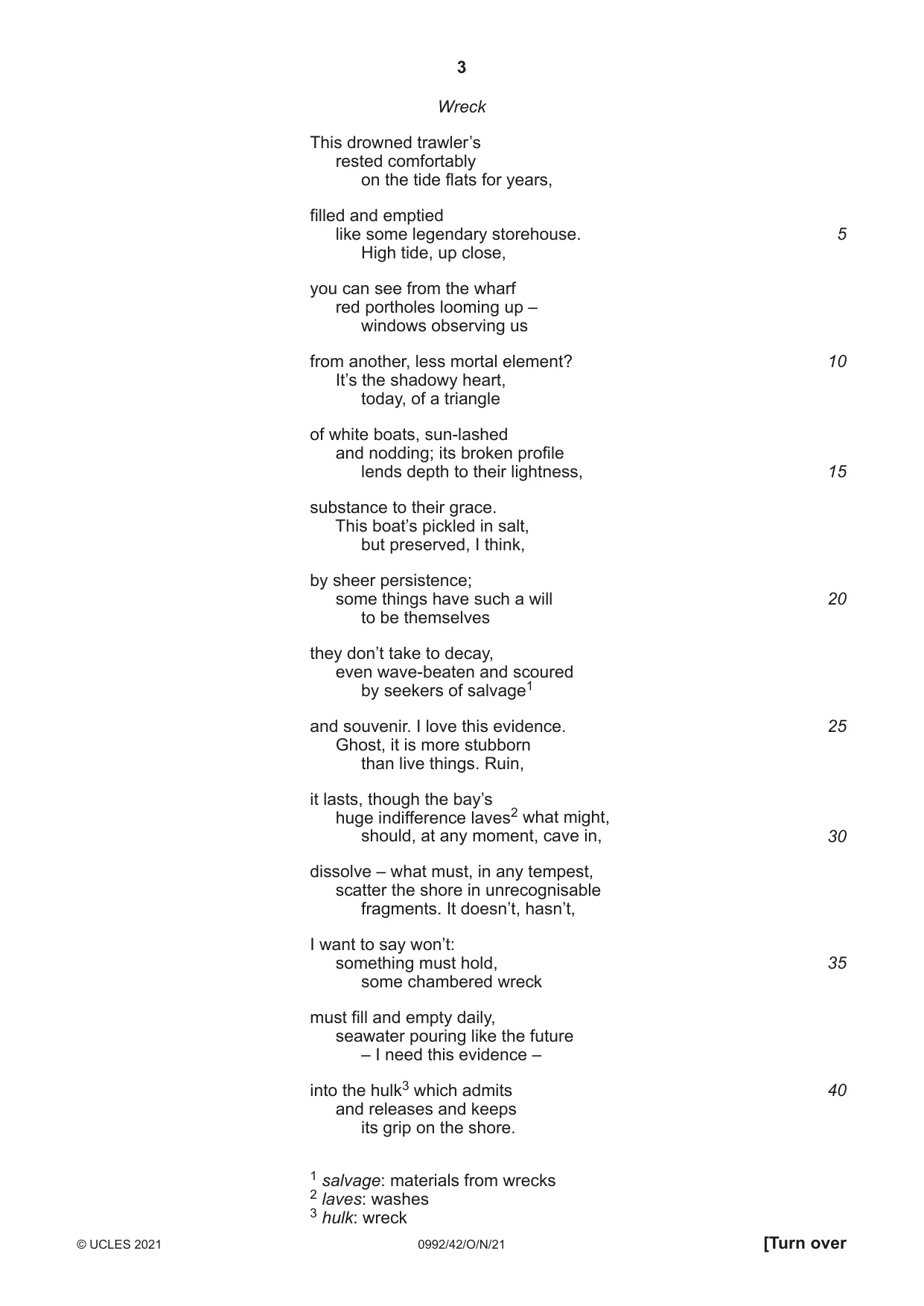
3 0992/42/O/N/21 © UCLES 2021 [Turn over Wreck This drowned trawler’s rested comfortably on the tide flats for years, filled and emptied like some legendary storehouse. High tide, up close, you can see from the wharf red portholes looming up – windows observing us from another, less mortal element? It’s the shadowy heart, today, of a triangle of white boats, sun‑lashed and nodding; its broken profile lends depth to their lightness, substance to their grace. This boat’s pickled in salt, but preserved, I think, by sheer persistence; some things have such a will to be themselves they don’t take to decay, even wave‑beaten and scoured by seekers of salvage1 and souvenir. I love this evidence. Ghost, it is more stubborn than live things. Ruin, it lasts, though the bay’s huge indifference laves2 what might, should, at any moment, cave in, dissolve – what must, in any tempest, scatter the shore in unrecognisable fragments. It doesn’t, hasn’t, I want to say won’t: something must hold, some chambered wreck must fill and empty daily, seawater pouring like the future – I need this evidence – into the hulk3 which admits and releases and keeps its grip on the shore. 1 salvage: materials from wrecks 2 laves: washes 3 hulk: wreck 5 10 15 20 25 30 35 40
Question paper, page 4
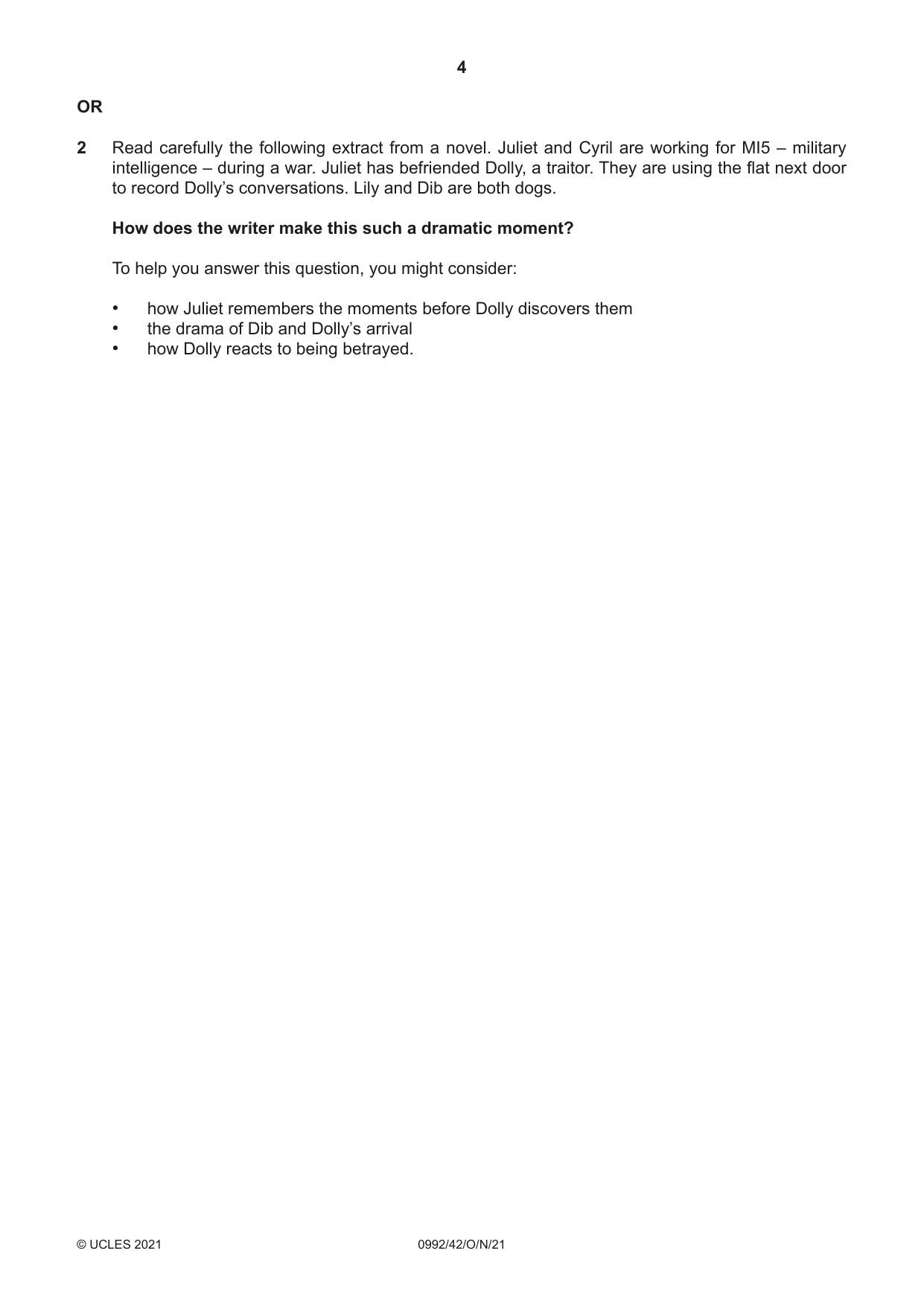
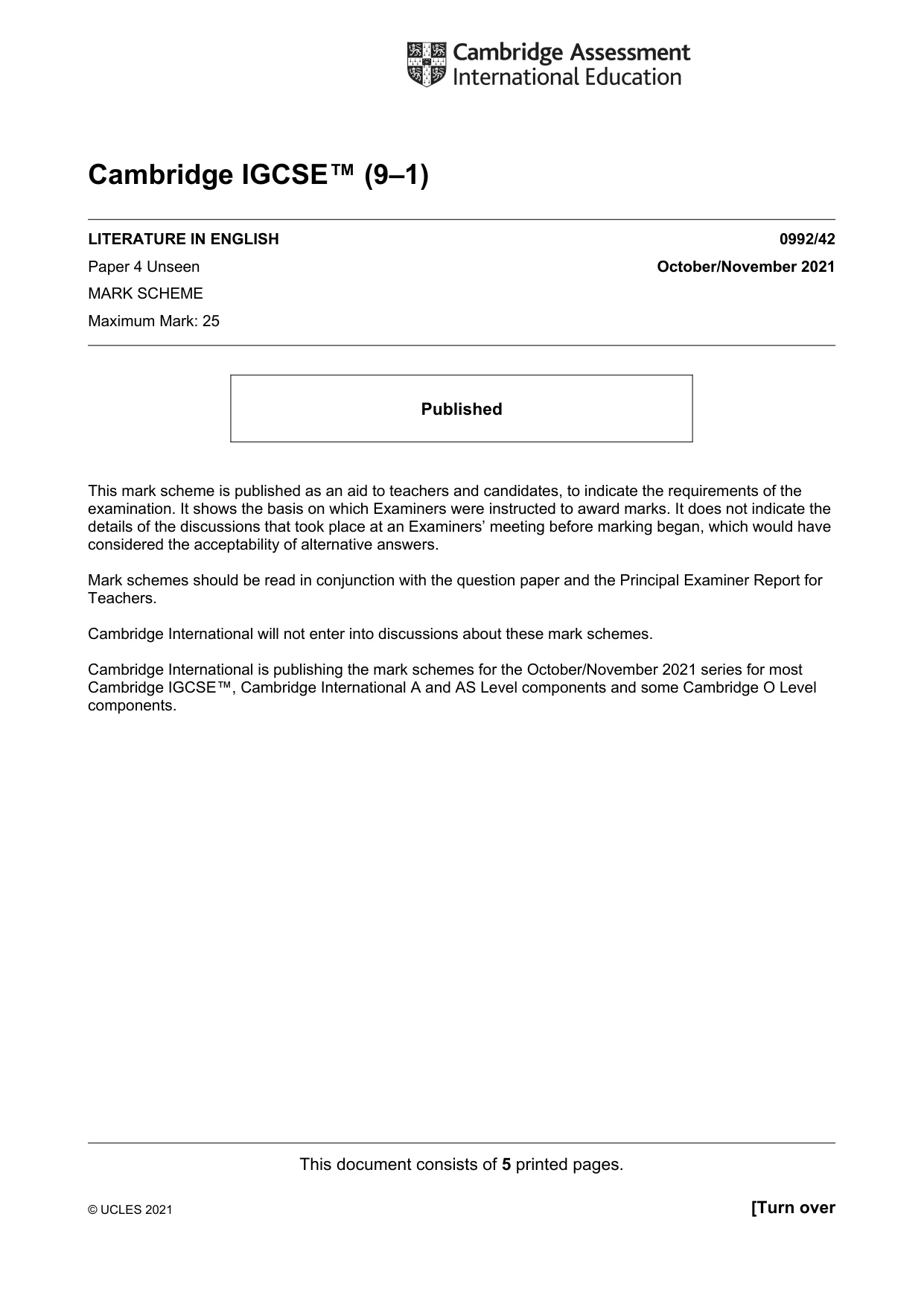
4 0992/42/O/N/21 © UCLES 2021 OR 2 Read carefully the following extract from a novel. Juliet and Cyril are working for MI5 – military intelligence – during a war. Juliet has befriended Dolly, a traitor. They are using the flat next door to record Dolly’s conversations. Lily and Dib are both dogs. How does the writer make this such a dramatic moment? To help you answer this question, you might consider: • how Juliet remembers the moments before Dolly discovers them • the drama of Dib and Dolly’s arrival • how Dolly reacts to being betrayed.
Question paper, page 5
5 0992/42/O/N/21 © UCLES 2021 Afterwards – and there was a long afterwards – Juliet could never be sure how it happened. Perhaps they had grown careless, at ease with the routine of their work, their vigilance blunted by the commonplace. Or perhaps it was the heat that made them drowsily inattentive. Perhaps the clock was slow, although Juliet checked it later and there was nothing wrong with it. Perhaps it was Dolly’s watch that was out of step with time. However it happened, the fact was that they were caught completely off‑guard. Juliet had taken her tea through to drink it in Cyril’s room, where he was busy taking something apart and putting it back together again (his favourite occupation). ‘Biscuit interval?’ she said. They both laughed – it had become one of their shared jokes. They ate the last three biscuits – one each and one for Lily, who had woken up. They chatted about Cyril’s sister, who was trying to arrange a special licence so that she could get married before her fiancé was shipped off to an Army training camp. Cyril was wondering if Perry1 might be able to help in some way when Lily suddenly began to growl. It was not her usual growl, which was little more than a playful grumble – a protest when they played tug of war with one of her knitted toys. This was an angry, frightened rumble deep in her throat, a trace of the ancestral wolf. She was staring fixedly at the door to the living room and Juliet left her tea to find out what was upsetting the little dog so. An intruder! Dib – Dolly’s decrepit poodle. ‘Dib?’ Juliet puzzled to the dog. He acknowledged his name with a dismissive twitch of an ear. ‘What are you doing here?’ ‘How do you know my dog’s name?’ Dolly! ‘Bloody hell,’ Juliet heard Cyril murmur behind her. ‘We’re for it now.’ Dolly was standing on the threshold of the living room. Juliet could see that the front door was ajar – it must have come unlatched somehow, and Dib had come in to investigate and Dolly had pursued him in order to retrieve him. Dolly entered the living room cautiously, a wild animal stepping into a clearing. She gazed around the room in bewilderment. Juliet found herself seeing the flat through Dolly’s eyes – the filing cabinet, the big Imperial typewriter and the two desks, all the paraphernalia that constituted an office. Other people in Dolphin Square worked in their flats – including Godfrey himself – so in itself it wasn’t peculiar, was it? On the other hand, other people didn’t have a room that was full of what was – quite clearly – recording equipment. Nor did they have playback machines and headphones, and, most incriminating of all, files lying around announcing themselves to belong to ‘MI5’ or folders that had ‘Top Secret’ stencilled across them in large red capitals. Dolly regarded all of this in dumbstruck silence. Juliet could almost see the wheels of her brain turning. ‘Dolly,’ Juliet said in a conciliatory voice, desperately trying to think of a reasonable explanation, but all she managed to come up with was a feeble, ‘You’re early.’ Dolly frowned. ‘Early? Early? You know what time I’m due?’ All the cogs finally ratcheted into place. Dolly glared viciously at Cyril, who had taken up a rather pugilistic2 stance in front of Perry’s roll‑top3. ‘You’re MI5,’ Dolly said, her voice coloured with disgust. ‘You’ve been listening to everything we say.’ 1 Perry: Juliet and Cyril’s boss 2 pugilistic: like a fist fighter 3 roll-top: desk 5 10 15 20 25 30 35 40 45
Question paper, page 6
6 0992/42/O/N/21 © UCLES 2021 BLANK PAGE
Question paper, page 7
7 0992/42/O/N/21 © UCLES 2021 BLANK PAGE
Question paper, page 8
8 0992/42/O/N/21 © UCLES 2021 Permission to reproduce items where third‑party owned material protected by copyright is included has been sought and cleared where possible. Every reasonable effort has been made by the publisher (UCLES) to trace copyright holders, but if any items requiring clearance have unwittingly been included, the publisher will be pleased to make amends at the earliest possible opportunity. To avoid the issue of disclosure of answer‑related information to candidates, all copyright acknowledgements are reproduced online in the Cambridge Assessment International Education Copyright Acknowledgements Booklet. This is produced for each series of examinations and is freely available to download at www.cambridgeinternational.org after the live examination series. Cambridge Assessment International Education is part of the Cambridge Assessment Group. Cambridge Assessment is the brand name of the University of Cambridge Local Examinations Syndicate (UCLES), which itself is a department of the University of Cambridge. BLANK PAGE
Mark scheme, page 1
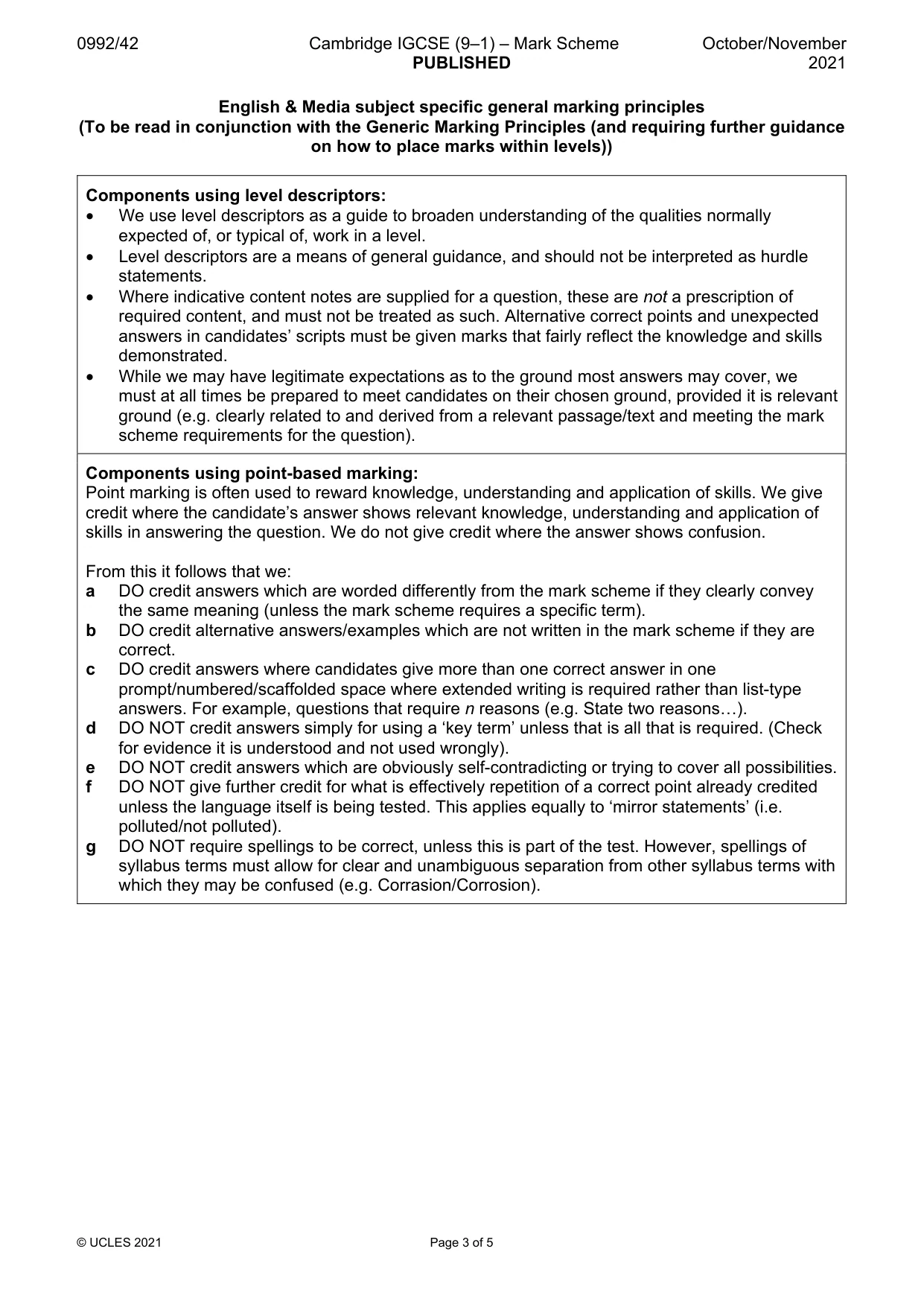
This document consists of 5 printed pages. © UCLES 2021 [Turn over Cambridge IGCSE™ (9–1) LITERATURE IN ENGLISH 0992/42 Paper 4 Unseen October/November 2021 MARK SCHEME Maximum Mark: 25 Published This mark scheme is published as an aid to teachers and candidates, to indicate the requirements of the examination. It shows the basis on which Examiners were instructed to award marks. It does not indicate the details of the discussions that took place at an Examiners’ meeting before marking began, which would have considered the acceptability of alternative answers. Mark schemes should be read in conjunction with the question paper and the Principal Examiner Report for Teachers. Cambridge International will not enter into discussions about these mark schemes. Cambridge International is publishing the mark schemes for the October/November 2021 series for most Cambridge IGCSE™, Cambridge International A and AS Level components and some Cambridge O Level components.
Mark scheme, page 2
0992/42 Cambridge IGCSE (9–1) – Mark Scheme PUBLISHED October/November 2021 © UCLES 2021 Page 2 of 5 Generic Marking Principles These general marking principles must be applied by all examiners when marking candidate answers. They should be applied alongside the specific content of the mark scheme or generic level descriptors for a question. Each question paper and mark scheme will also comply with these marking principles. GENERIC MARKING PRINCIPLE 1: Marks must be awarded in line with: • the specific content of the mark scheme or the generic level descriptors for the question • the specific skills defined in the mark scheme or in the generic level descriptors for the question • the standard of response required by a candidate as exemplified by the standardisation scripts. GENERIC MARKING PRINCIPLE 2: Marks awarded are always whole marks (not half marks, or other fractions). GENERIC MARKING PRINCIPLE 3: Marks must be awarded positively: • marks are awarded for correct/valid answers, as defined in the mark scheme. However, credit is given for valid answers which go beyond the scope of the syllabus and mark scheme, referring to your Team Leader as appropriate • marks are awarded when candidates clearly demonstrate what they know and can do • marks are not deducted for errors • marks are not deducted for omissions • answers should only be judged on the quality of spelling, punctuation and grammar when these features are specifically assessed by the question as indicated by the mark scheme. The meaning, however, should be unambiguous. GENERIC MARKING PRINCIPLE 4: Rules must be applied consistently, e.g. in situations where candidates have not followed instructions or in the application of generic level descriptors. GENERIC MARKING PRINCIPLE 5: Marks should be awarded using the full range of marks defined in the mark scheme for the question (however; the use of the full mark range may be limited according to the quality of the candidate responses seen). GENERIC MARKING PRINCIPLE 6: Marks awarded are based solely on the requirements as defined in the mark scheme. Marks should not be awarded with grade thresholds or grade descriptors in mind.
Mark scheme, page 3
0992/42 Cambridge IGCSE (9–1) – Mark Scheme PUBLISHED October/November 2021 © UCLES 2021 Page 3 of 5 English & Media subject specific general marking principles (To be read in conjunction with the Generic Marking Principles (and requiring further guidance on how to place marks within levels)) Components using level descriptors: • We use level descriptors as a guide to broaden understanding of the qualities normally expected of, or typical of, work in a level. • Level descriptors are a means of general guidance, and should not be interpreted as hurdle statements. • Where indicative content notes are supplied for a question, these are not a prescription of required content, and must not be treated as such. Alternative correct points and unexpected answers in candidates’ scripts must be given marks that fairly reflect the knowledge and skills demonstrated. • While we may have legitimate expectations as to the ground most answers may cover, we must at all times be prepared to meet candidates on their chosen ground, provided it is relevant ground (e.g. clearly related to and derived from a relevant passage/text and meeting the mark scheme requirements for the question). Components using point-based marking: Point marking is often used to reward knowledge, understanding and application of skills. We give credit where the candidate’s answer shows relevant knowledge, understanding and application of skills in answering the question. We do not give credit where the answer shows confusion. From this it follows that we: a DO credit answers which are worded differently from the mark scheme if they clearly convey the same meaning (unless the mark scheme requires a specific term). b DO credit alternative answers/examples which are not written in the mark scheme if they are correct. c DO credit answers where candidates give more than one correct answer in one prompt/numbered/scaffolded space where extended writing is required rather than list-type answers. For example, questions that require n reasons (e.g. State two reasons…). d DO NOT credit answers simply for using a ‘key term’ unless that is all that is required. (Check for evidence it is understood and not used wrongly). e DO NOT credit answers which are obviously self-contradicting or trying to cover all possibilities. f DO NOT give further credit for what is effectively repetition of a correct point already credited unless the language itself is being tested. This applies equally to ‘mirror statements’ (i.e. polluted/not polluted). g DO NOT require spellings to be correct, unless this is part of the test. However, spellings of syllabus terms must allow for clear and unambiguous separation from other syllabus terms with which they may be confused (e.g. Corrasion/Corrosion).
Mark scheme, page 4
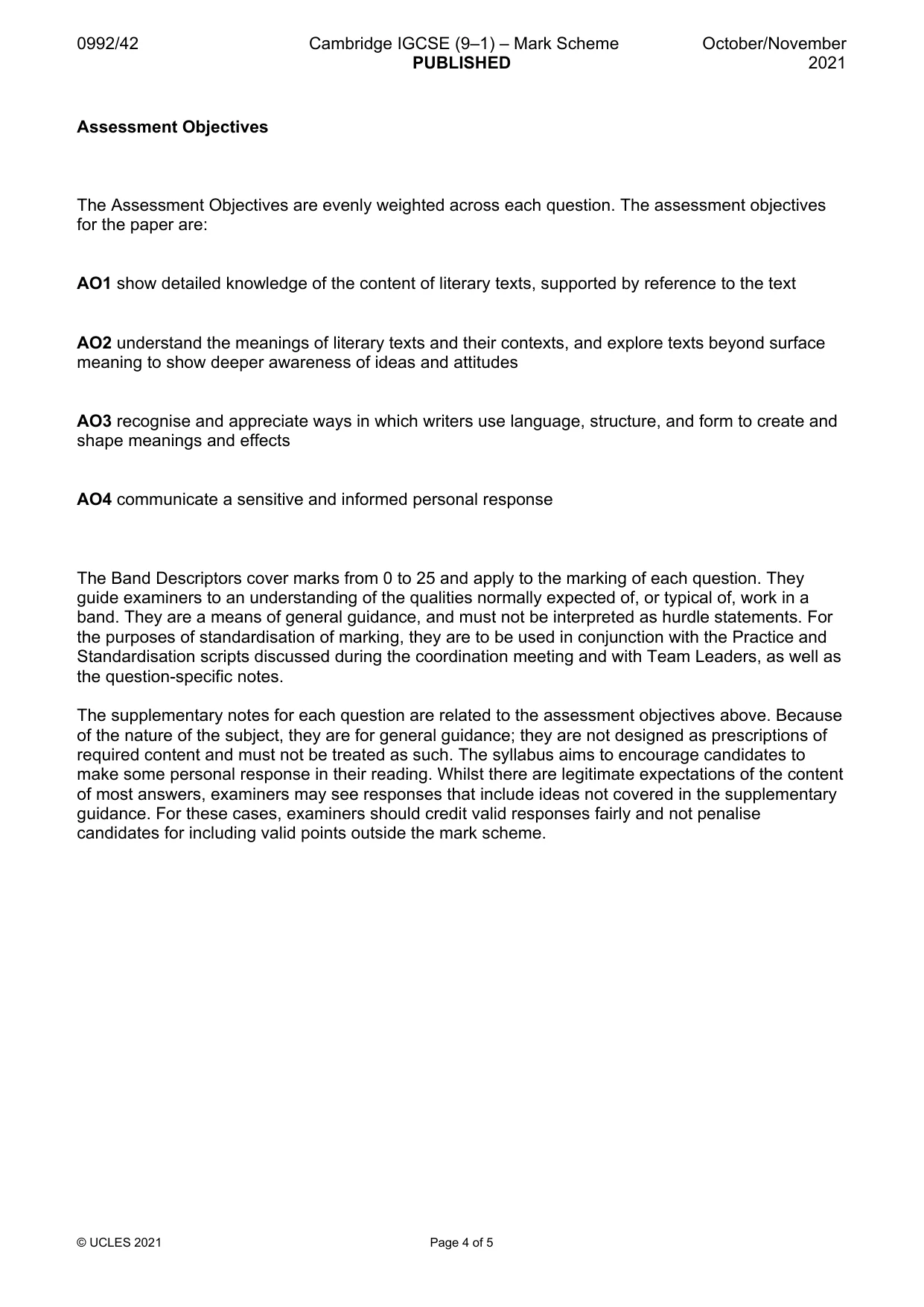
0992/42 Cambridge IGCSE (9–1) – Mark Scheme PUBLISHED October/November 2021 © UCLES 2021 Page 4 of 5 Assessment Objectives The Assessment Objectives are evenly weighted across each question. The assessment objectives for the paper are: AO1 show detailed knowledge of the content of literary texts, supported by reference to the text AO2 understand the meanings of literary texts and their contexts, and explore texts beyond surface meaning to show deeper awareness of ideas and attitudes AO3 recognise and appreciate ways in which writers use language, structure, and form to create and shape meanings and effects AO4 communicate a sensitive and informed personal response The Band Descriptors cover marks from 0 to 25 and apply to the marking of each question. They guide examiners to an understanding of the qualities normally expected of, or typical of, work in a band. They are a means of general guidance, and must not be interpreted as hurdle statements. For the purposes of standardisation of marking, they are to be used in conjunction with the Practice and Standardisation scripts discussed during the coordination meeting and with Team Leaders, as well as the question-specific notes. The supplementary notes for each question are related to the assessment objectives above. Because of the nature of the subject, they are for general guidance; they are not designed as prescriptions of required content and must not be treated as such. The syllabus aims to encourage candidates to make some personal response in their reading. Whilst there are legitimate expectations of the content of most answers, examiners may see responses that include ideas not covered in the supplementary guidance. For these cases, examiners should credit valid responses fairly and not penalise candidates for including valid points outside the mark scheme.
Mark scheme, page 5
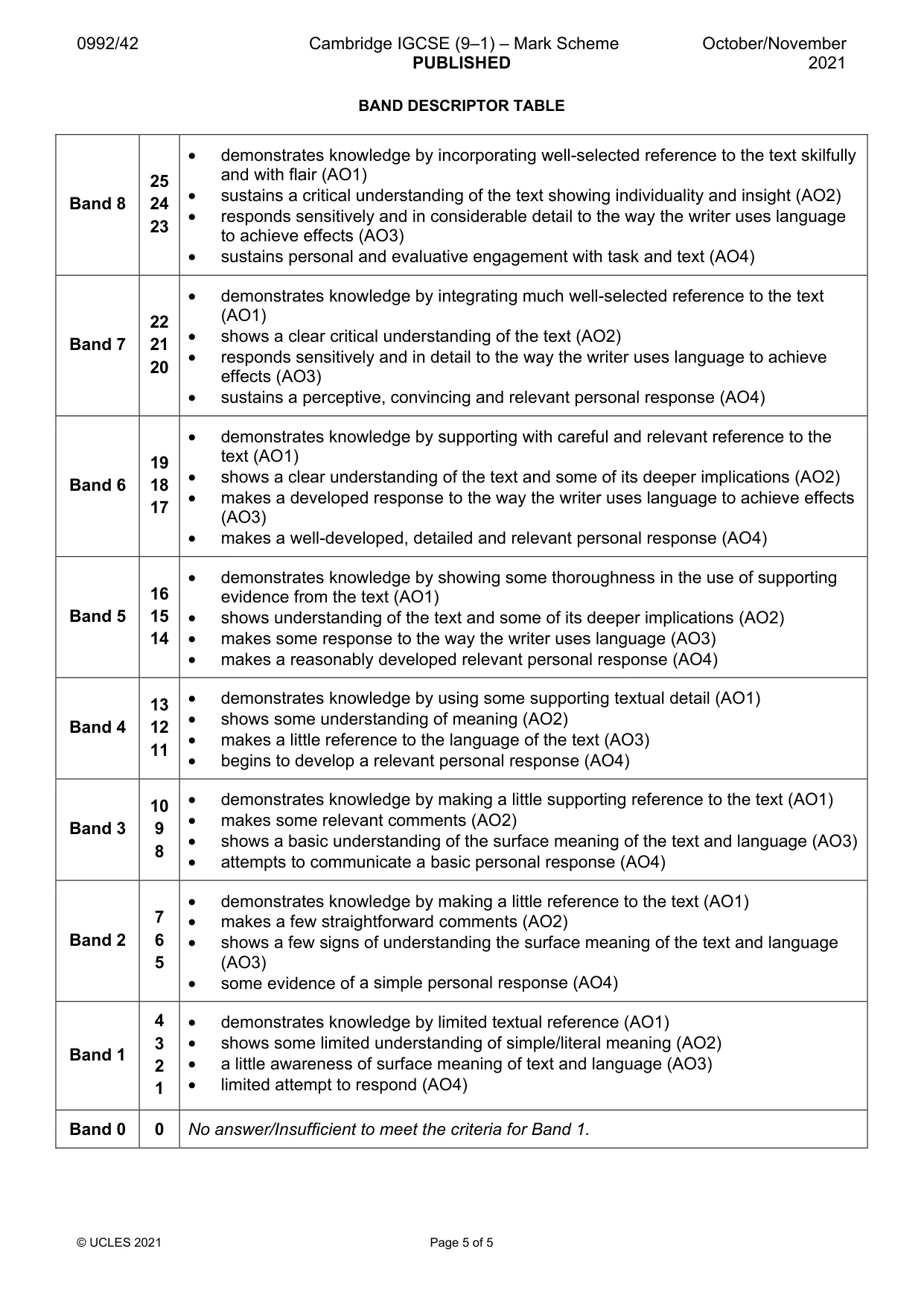
0992/42 Cambridge IGCSE (9–1) – Mark Scheme PUBLISHED October/November 2021 © UCLES 2021 Page 5 of 5 BAND DESCRIPTOR TABLE Band 8 25 24 23 • demonstrates knowledge by incorporating well-selected reference to the text skilfully and with flair (AO1) • sustains a critical understanding of the text showing individuality and insight (AO2) • responds sensitively and in considerable detail to the way the writer uses language to achieve effects (AO3) • sustains personal and evaluative engagement with task and text (AO4) Band 7 22 21 20 • demonstrates knowledge by integrating much well-selected reference to the text (AO1) • shows a clear critical understanding of the text (AO2) • responds sensitively and in detail to the way the writer uses language to achieve effects (AO3) • sustains a perceptive, convincing and relevant personal response (AO4) Band 6 19 18 17 • demonstrates knowledge by supporting with careful and relevant reference to the text (AO1) • shows a clear understanding of the text and some of its deeper implications (AO2) • makes a developed response to the way the writer uses language to achieve effects (AO3) • makes a well-developed, detailed and relevant personal response (AO4) Band 5 16 15 14 • demonstrates knowledge by showing some thoroughness in the use of supporting evidence from the text (AO1) • shows understanding of the text and some of its deeper implications (AO2) • makes some response to the way the writer uses language (AO3) • makes a reasonably developed relevant personal response (AO4) Band 4 13 12 11 • demonstrates knowledge by using some supporting textual detail (AO1) • shows some understanding of meaning (AO2) • makes a little reference to the language of the text (AO3) • begins to develop a relevant personal response (AO4) Band 3 10 9 8 • demonstrates knowledge by making a little supporting reference to the text (AO1) • makes some relevant comments (AO2) • shows a basic understanding of the surface meaning of the text and language (AO3) • attempts to communicate a basic personal response (AO4) Band 2 7 6 5 • demonstrates knowledge by making a little reference to the text (AO1) • makes a few straightforward comments (AO2) • shows a few signs of understanding the surface meaning of the text and language (AO3) • some evidence of a simple personal response (AO4) Band 1 4 3 2 1 • demonstrates knowledge by limited textual reference (AO1) • shows some limited understanding of simple/literal meaning (AO2) • a little awareness of surface meaning of text and language (AO3) • limited attempt to respond (AO4) Band 0 0 No answer/Insufficient to meet the criteria for Band 1.
What you needed in this session
Cambridge’s own grade thresholds for 2021 Oct/Nov, Paper 4 · Variant 2. A higher threshold means an easier paper — the bar moves with how the cohort did.