Cambridge IGCSE English - Literature in English (9-1) 0992 — 2021 Oct/Nov Paper 3 · Variant 2
0992/32/O/N/21 · 25 marks · ≈28 min
The question paper and its mark scheme, free to read here and free to download. This is Cambridge’s own paper, exactly as it was sat.
Question paper12 pages
Mark scheme5 pages
Answers below. Sit the paper first if you are practising.
Paper as text
Question paper, page 1
This document has 12 pages. Any blank pages are indicated. * 0 9 5 7 2 7 6 1 4 1 * Cambridge IGCSE™(9–1) LITERATURE IN ENGLISH 0992/32 Paper 3 Drama (Open Text) October/November 2021 45 minutes You must answer on the enclosed answer booklet. You will need: Answer booklet (enclosed) Candidates may take their set texts into the exam room, but these must NOT contain personal annotations, highlighting or underlining. INSTRUCTIONS ● Answer one question. ● Follow the instructions on the front cover of the answer booklet. If you need additional answer paper, ask the invigilator for a continuation booklet. ● You may take your set text into the exam room, but this must not contain personal annotations, highlighting or underlining. INFORMATION ● The total mark for this paper is 25. ● All questions are worth equal marks. DC (SLM) 219597 © UCLES 2021 [Turn over
Question paper, page 2
2 0992/32/O/N/21 © UCLES 2021 LORRAINE HANSBERRY: A Raisin in the Sun Remember to support your ideas with details from the writing. Either 1(a) Read this passage carefully, and then answer the question that follows it: Walter: I been out talking with people who understand me. Content removed due to copyright restrictions.
Question paper, page 3
3 0992/32/O/N/21 © UCLES 2021 [Turn over Well, it’s all starting to slip away from us … (from Act 2) How does Hansberry movingly portray Walter and Ruth’s relationship at this moment in the play? Or 1(b) Explore the ways in which Hansberry powerfully conveys conflict between Mama and Beneatha. Content removed due to copyright restrictions.
Question paper, page 4
4 0992/32/O/N/21 © UCLES 2021 ARTHUR MILLER: The Crucible Remember to support your ideas with details from the writing. Either 2(a) Read this passage carefully, and then answer the question that follows it: Cheever: I have a warrant for your wife. Content removed due to copyright restrictions.
Question paper, page 5
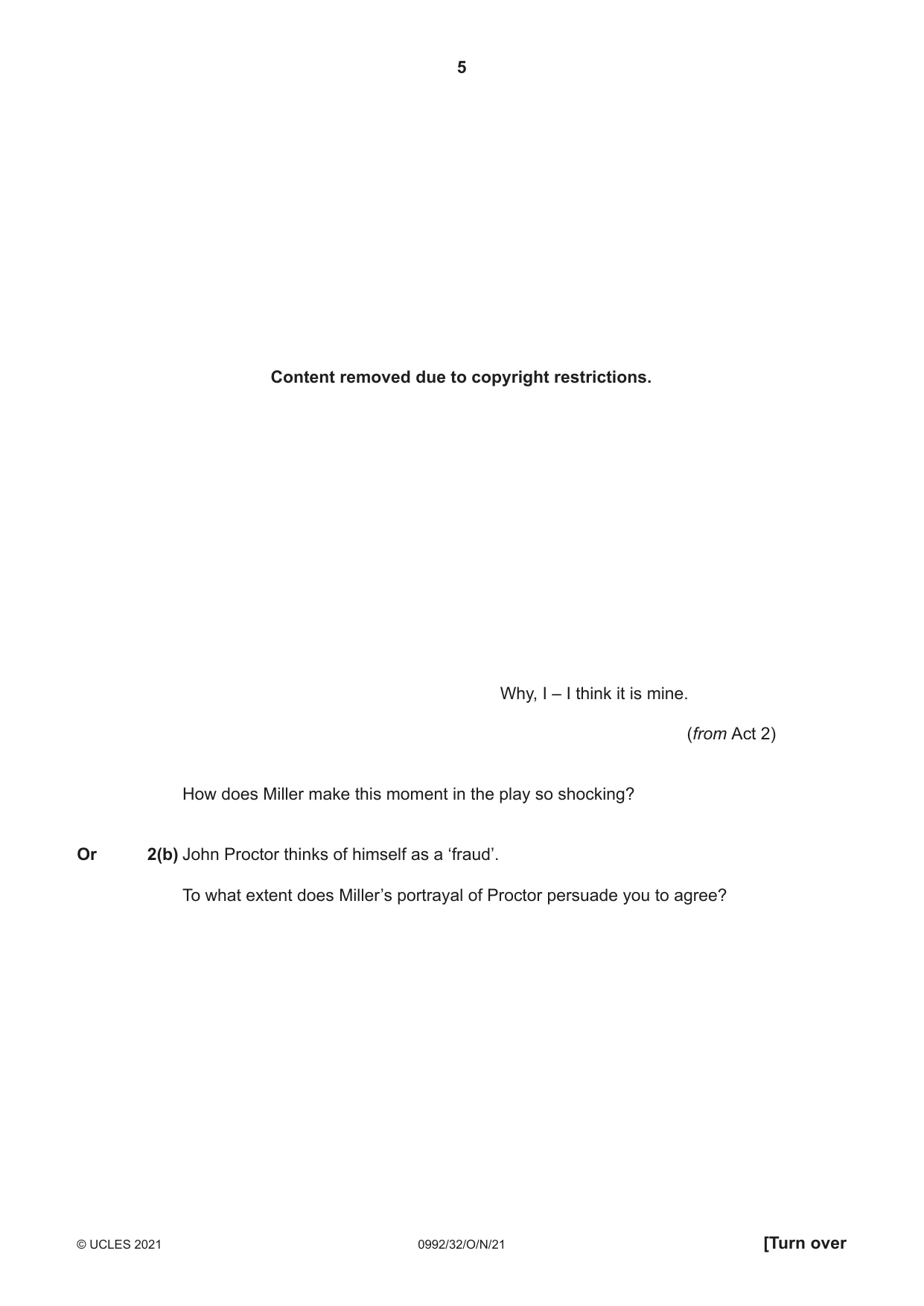
5 0992/32/O/N/21 © UCLES 2021 [Turn over Why, I – I think it is mine. (from Act 2) How does Miller make this moment in the play so shocking? Or 2(b) John Proctor thinks of himself as a ‘fraud’. To what extent does Miller’s portrayal of Proctor persuade you to agree? Content removed due to copyright restrictions.
Question paper, page 6
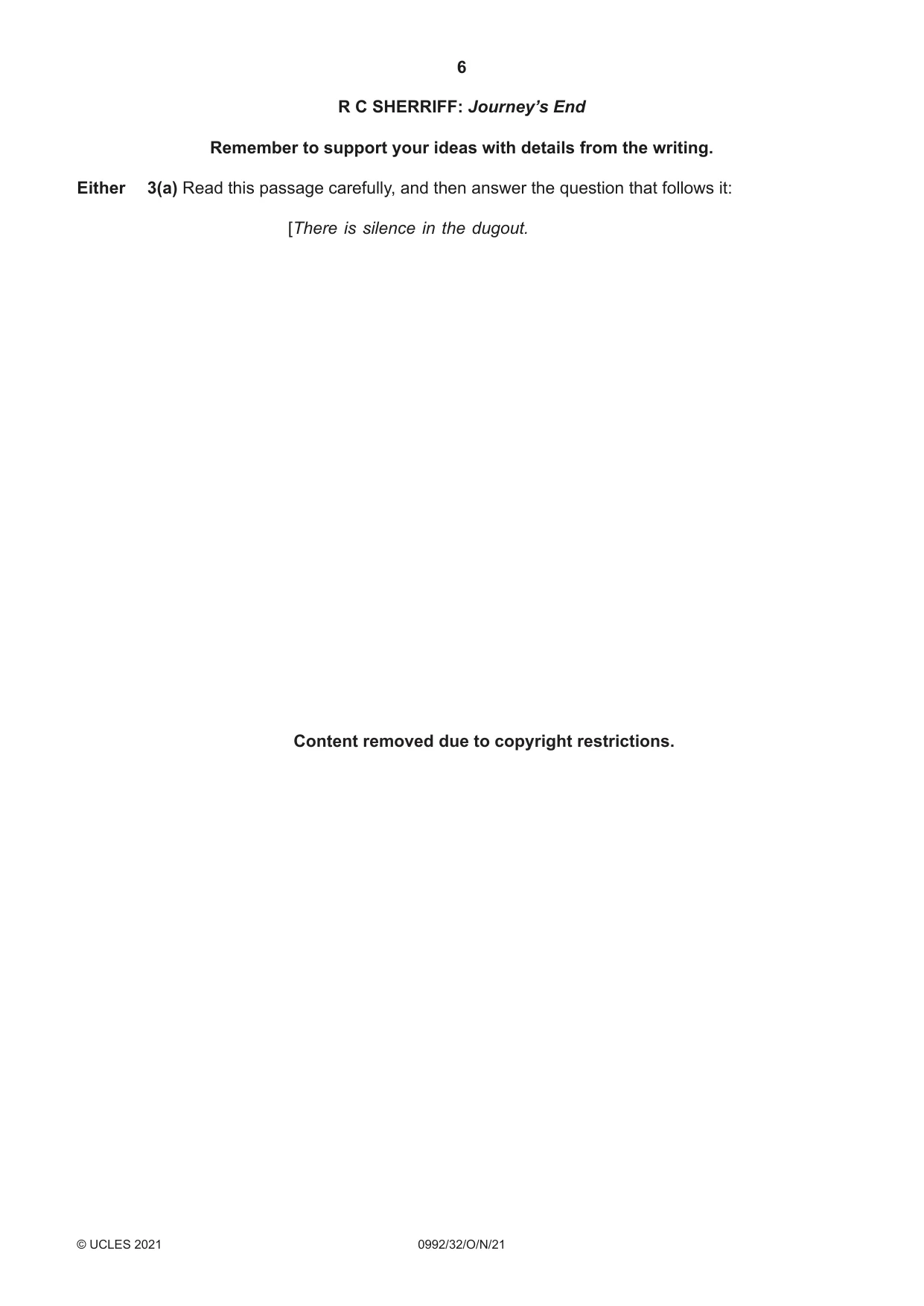
6 0992/32/O/N/21 © UCLES 2021 R C SHERRIFF: Journey’s End Remember to support your ideas with details from the writing. Either 3(a) Read this passage carefully, and then answer the question that follows it: [There is silence in the dugout. Content removed due to copyright restrictions.
Question paper, page 7
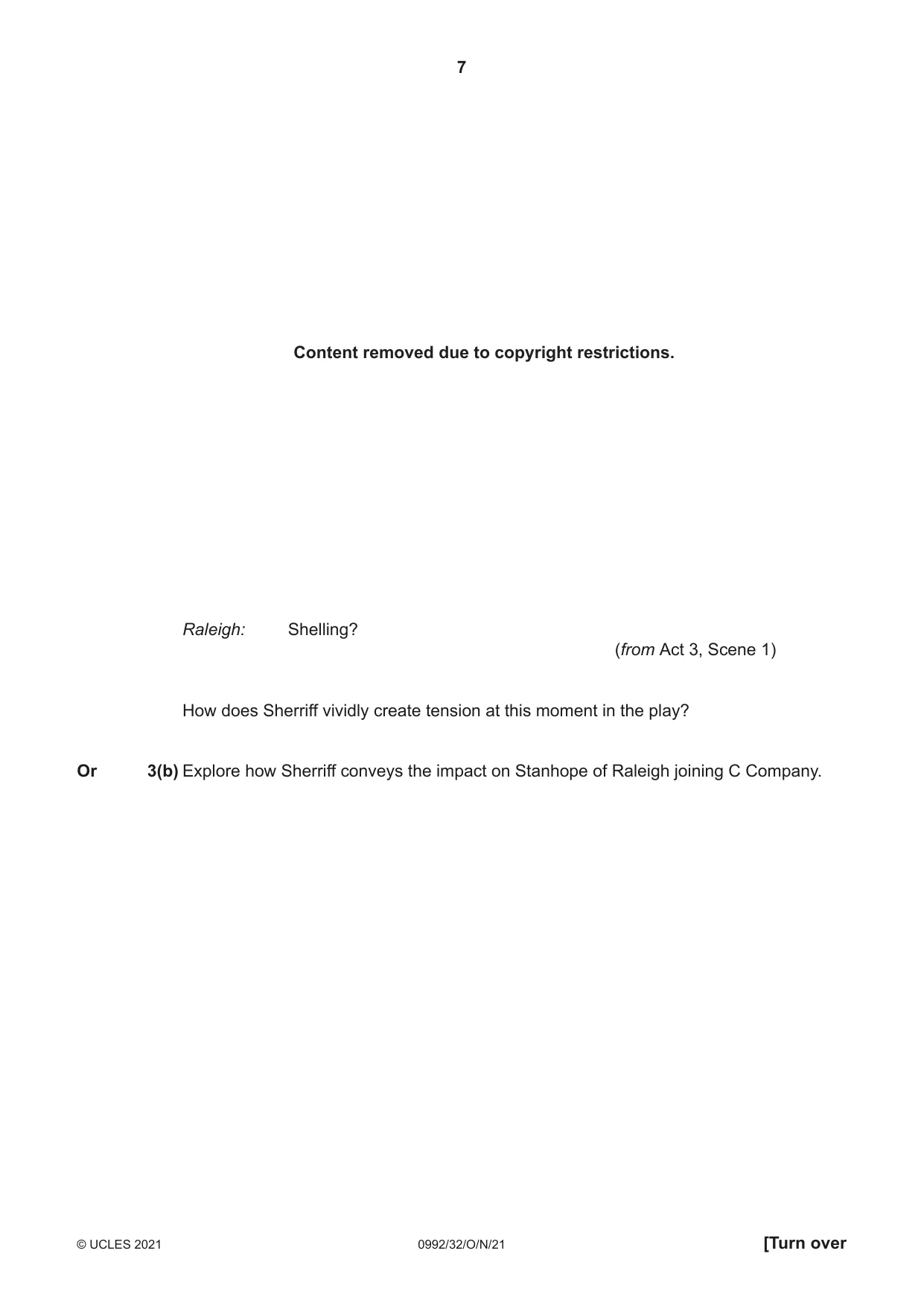
7 0992/32/O/N/21 © UCLES 2021 [Turn over Raleigh: Shelling? (from Act 3, Scene 1) How does Sherriff vividly create tension at this moment in the play? Or 3(b) Explore how Sherriff conveys the impact on Stanhope of Raleigh joining C Company. Content removed due to copyright restrictions.
Question paper, page 8
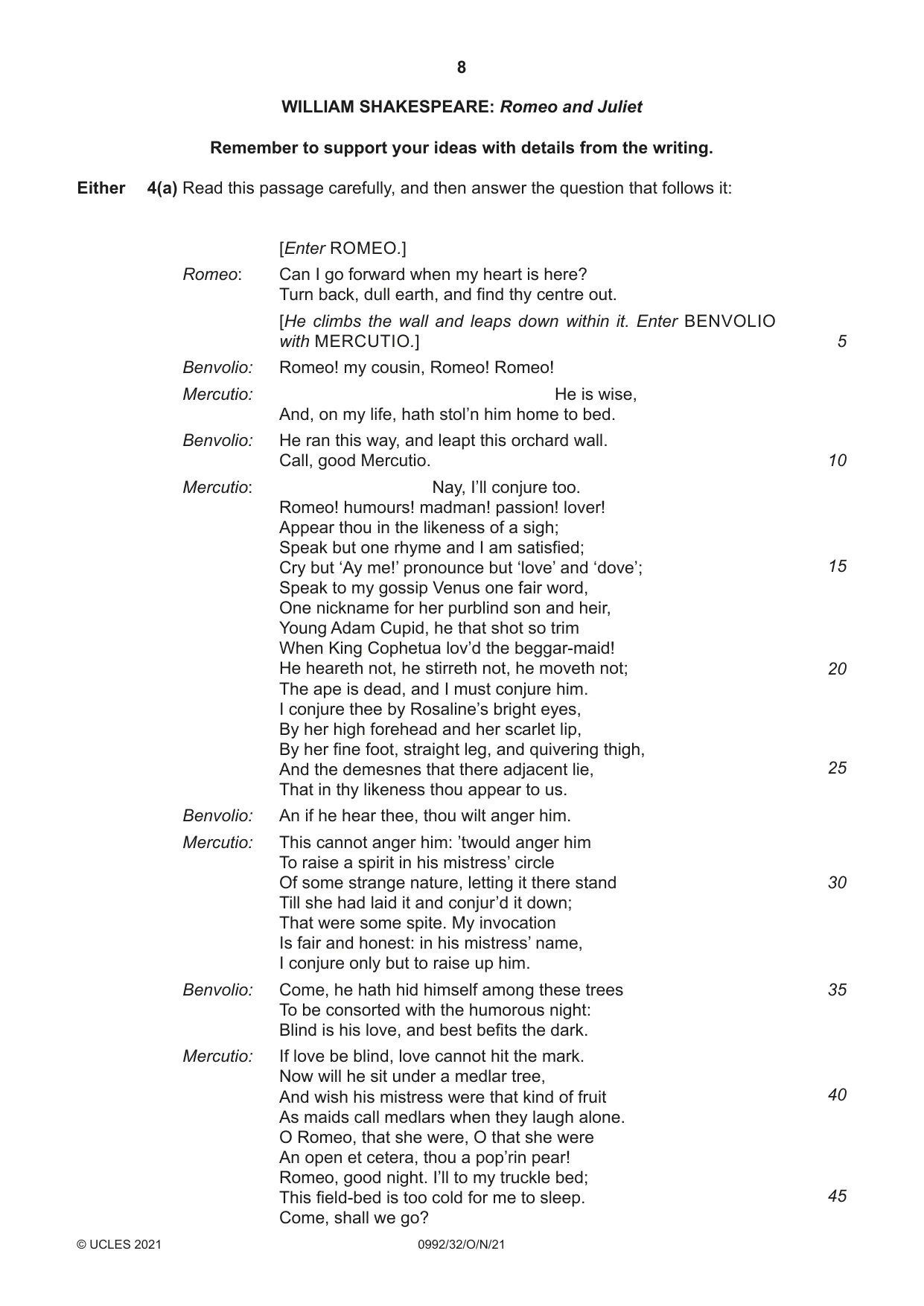
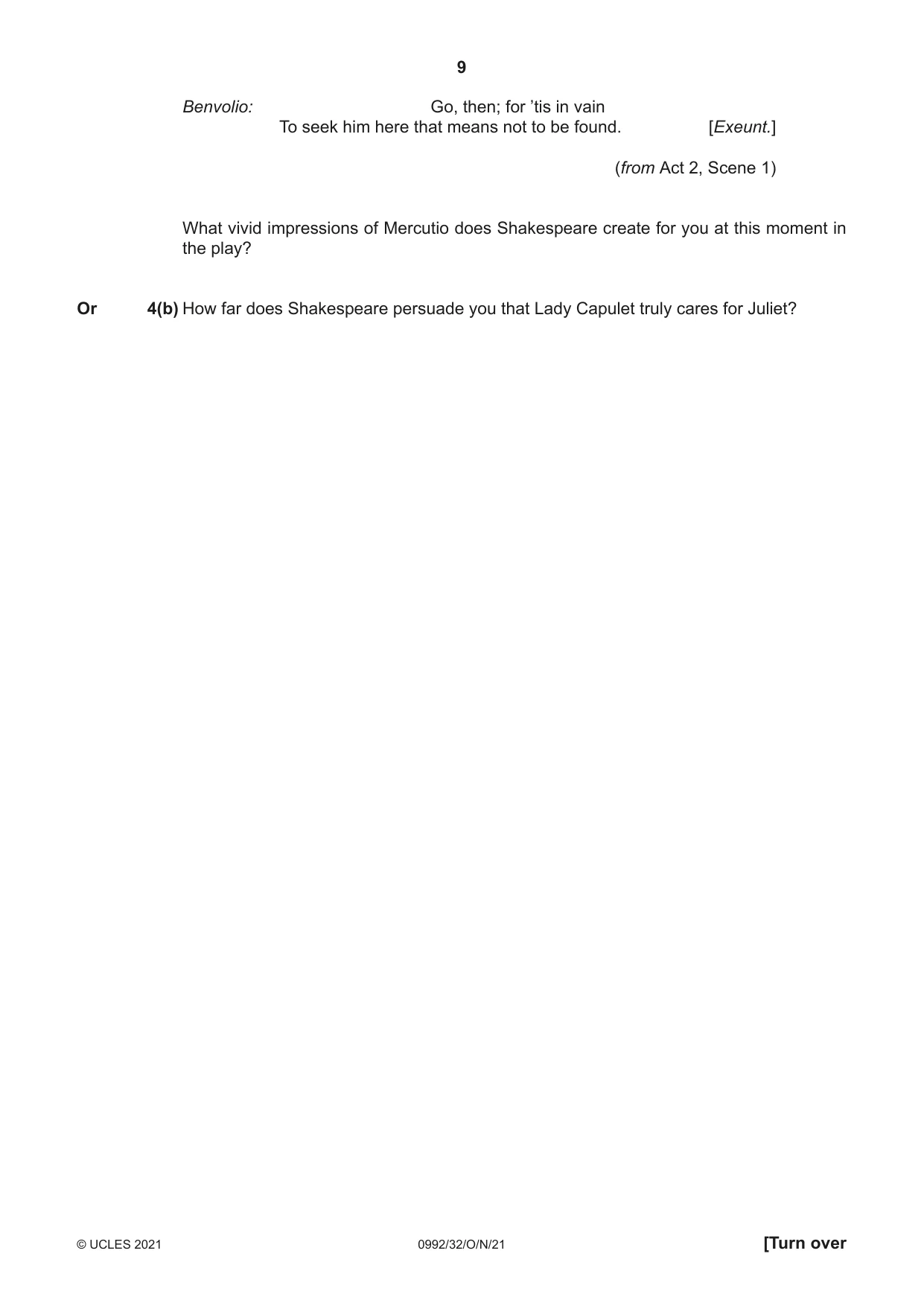
8 0992/32/O/N/21 © UCLES 2021 WILLIAM SHAKESPEARE: Romeo and Juliet Remember to support your ideas with details from the writing. Either 4(a) Read this passage carefully, and then answer the question that follows it: [Enter ROMEO.] Romeo: Can I go forward when my heart is here? Turn back, dull earth, and find thy centre out. [He climbs the wall and leaps down within it. Enter BENVOLIO with MERCUTIO.] Benvolio: Romeo! my cousin, Romeo! Romeo! Mercutio: He is wise, And, on my life, hath stol’n him home to bed. Benvolio: He ran this way, and leapt this orchard wall. Call, good Mercutio. Mercutio: Nay, I’ll conjure too. Romeo! humours! madman! passion! lover! Appear thou in the likeness of a sigh; Speak but one rhyme and I am satisfied; Cry but ‘Ay me!’ pronounce but ‘love’ and ‘dove’; Speak to my gossip Venus one fair word, One nickname for her purblind son and heir, Young Adam Cupid, he that shot so trim When King Cophetua lov’d the beggar-maid! He heareth not, he stirreth not, he moveth not; The ape is dead, and I must conjure him. I conjure thee by Rosaline’s bright eyes, By her high forehead and her scarlet lip, By her fine foot, straight leg, and quivering thigh, And the demesnes that there adjacent lie, That in thy likeness thou appear to us. Benvolio: An if he hear thee, thou wilt anger him. Mercutio: This cannot anger him: ’twould anger him To raise a spirit in his mistress’ circle Of some strange nature, letting it there stand Till she had laid it and conjur’d it down; That were some spite. My invocation Is fair and honest: in his mistress’ name, I conjure only but to raise up him. Benvolio: Come, he hath hid himself among these trees To be consorted with the humorous night: Blind is his love, and best befits the dark. Mercutio: If love be blind, love cannot hit the mark. Now will he sit under a medlar tree, And wish his mistress were that kind of fruit As maids call medlars when they laugh alone. O Romeo, that she were, O that she were An open et cetera, thou a pop’rin pear! Romeo, good night. I’ll to my truckle bed; This field-bed is too cold for me to sleep. Come, shall we go? 5 10 15 20 25 30 35 40 45
Question paper, page 9
9 0992/32/O/N/21 © UCLES 2021 [Turn over Benvolio: Go, then; for ’tis in vain To seek him here that means not to be found. [Exeunt.] (from Act 2, Scene 1) What vivid impressions of Mercutio does Shakespeare create for you at this moment in the play? Or 4(b) How far does Shakespeare persuade you that Lady Capulet truly cares for Juliet?
Question paper, page 10
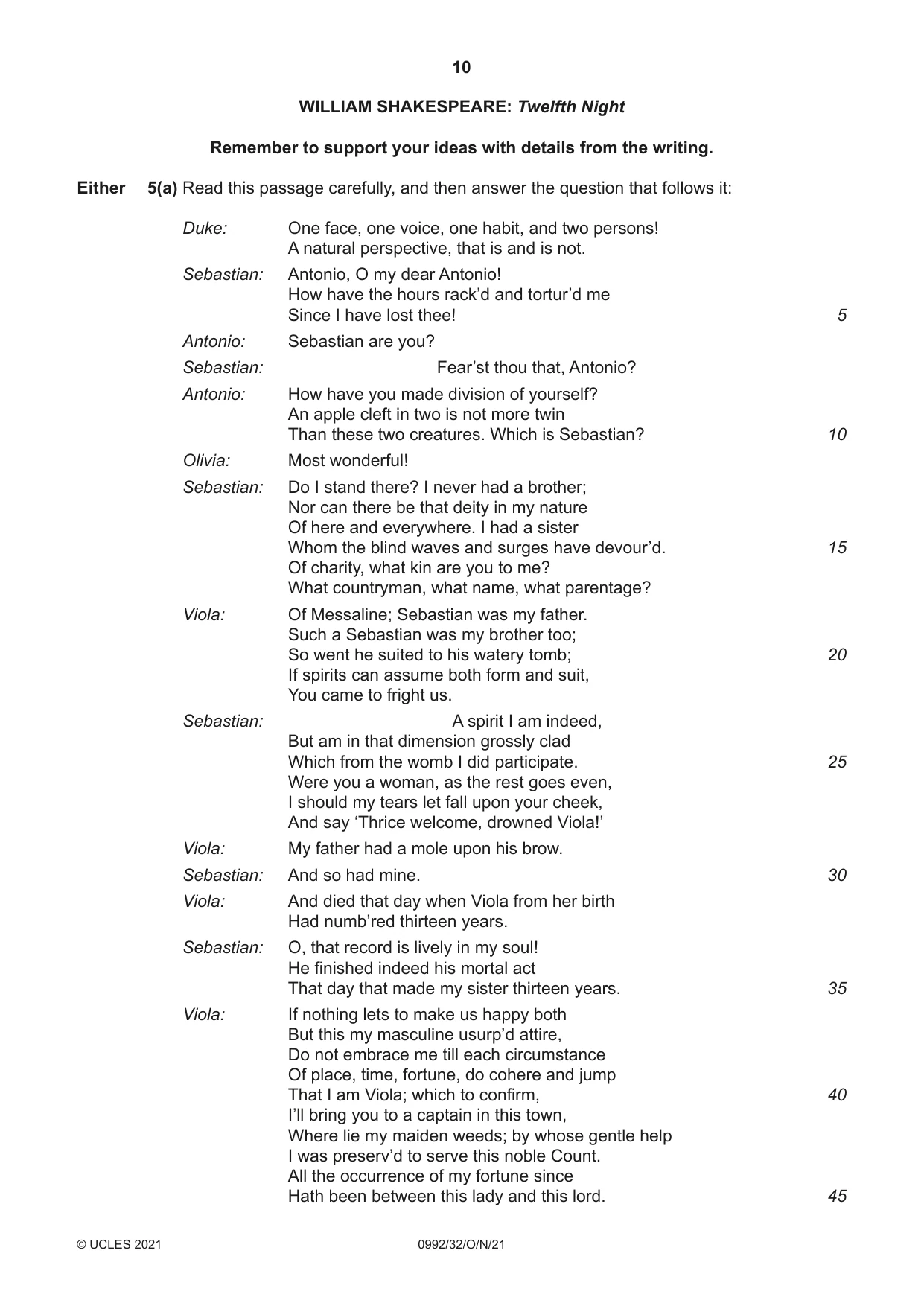
10 0992/32/O/N/21 © UCLES 2021 WILLIAM SHAKESPEARE: Twelfth Night Remember to support your ideas with details from the writing. Either 5(a) Read this passage carefully, and then answer the question that follows it: Duke: One face, one voice, one habit, and two persons! A natural perspective, that is and is not. Sebastian: Antonio, O my dear Antonio! How have the hours rack’d and tortur’d me Since I have lost thee! Antonio: Sebastian are you? Sebastian: Fear’st thou that, Antonio? Antonio: How have you made division of yourself? An apple cleft in two is not more twin Than these two creatures. Which is Sebastian? Olivia: Most wonderful! Sebastian: Do I stand there? I never had a brother; Nor can there be that deity in my nature Of here and everywhere. I had a sister Whom the blind waves and surges have devour’d. Of charity, what kin are you to me? What countryman, what name, what parentage? Viola: Of Messaline; Sebastian was my father. Such a Sebastian was my brother too; So went he suited to his watery tomb; If spirits can assume both form and suit, You came to fright us. Sebastian: A spirit I am indeed, But am in that dimension grossly clad Which from the womb I did participate. Were you a woman, as the rest goes even, I should my tears let fall upon your cheek, And say ‘Thrice welcome, drowned Viola!’ Viola: My father had a mole upon his brow. Sebastian: And so had mine. Viola: And died that day when Viola from her birth Had numb’red thirteen years. Sebastian: O, that record is lively in my soul! He finished indeed his mortal act That day that made my sister thirteen years. Viola: If nothing lets to make us happy both But this my masculine usurp’d attire, Do not embrace me till each circumstance Of place, time, fortune, do cohere and jump That I am Viola; which to confirm, I’ll bring you to a captain in this town, Where lie my maiden weeds; by whose gentle help I was preserv’d to serve this noble Count. All the occurrence of my fortune since Hath been between this lady and this lord. 5 10 15 20 25 30 35 40 45
Question paper, page 11
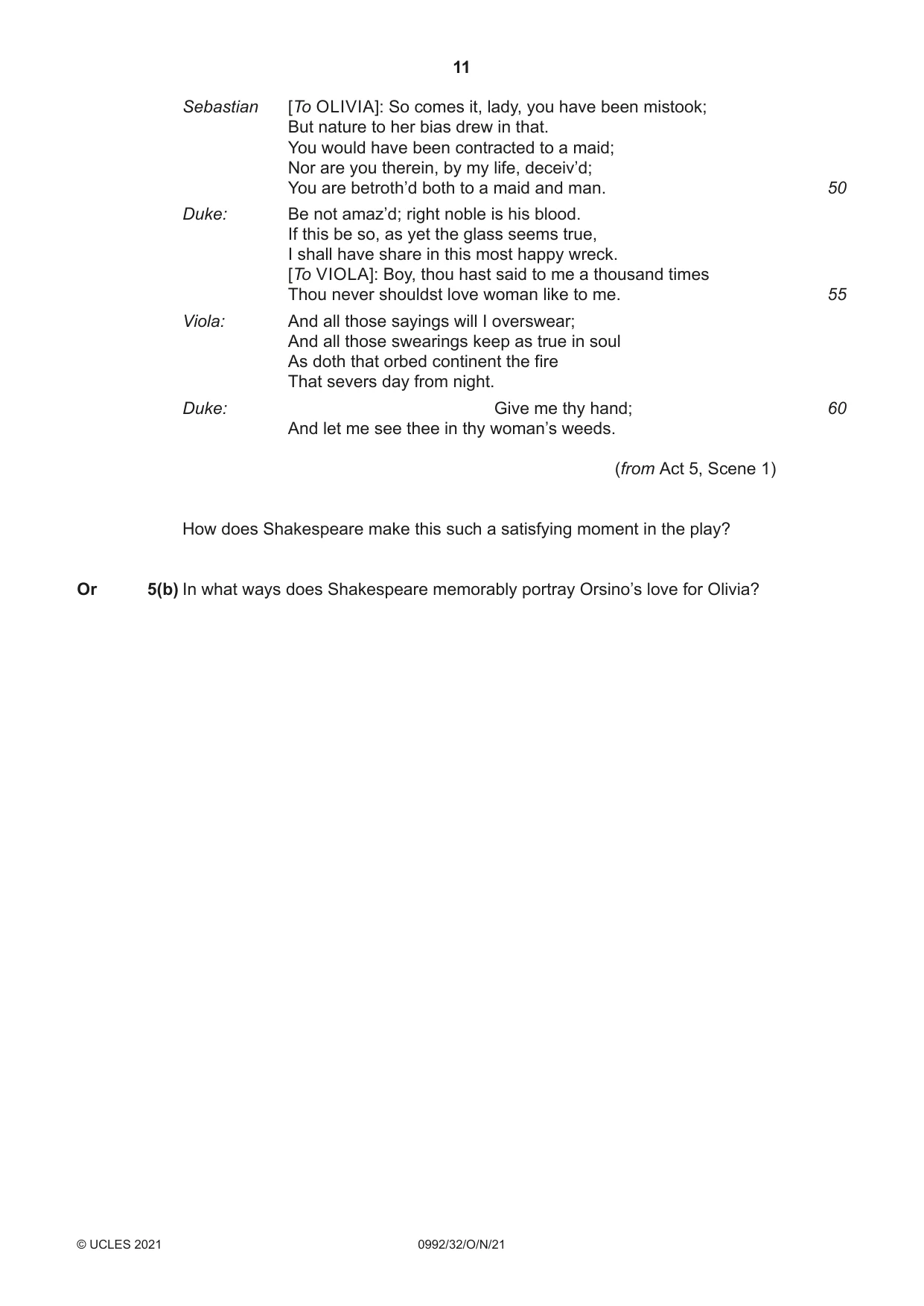
11 0992/32/O/N/21 © UCLES 2021 Sebastian [To OLIVIA]: So comes it, lady, you have been mistook; But nature to her bias drew in that. You would have been contracted to a maid; Nor are you therein, by my life, deceiv’d; You are betroth’d both to a maid and man. Duke: Be not amaz’d; right noble is his blood. If this be so, as yet the glass seems true, I shall have share in this most happy wreck. [To VIOLA]: Boy, thou hast said to me a thousand times Thou never shouldst love woman like to me. Viola: And all those sayings will I overswear; And all those swearings keep as true in soul As doth that orbed continent the fire That severs day from night. Duke: Give me thy hand; And let me see thee in thy woman’s weeds. (from Act 5, Scene 1) How does Shakespeare make this such a satisfying moment in the play? Or 5(b) In what ways does Shakespeare memorably portray Orsino’s love for Olivia? 50 55 60
Question paper, page 12
12 0992/32/O/N/21 © UCLES 2021 Permission to reproduce items where third-party owned material protected by copyright is included has been sought and cleared where possible. Every reasonable effort has been made by the publisher (UCLES) to trace copyright holders, but if any items requiring clearance have unwittingly been included, the publisher will be pleased to make amends at the earliest possible opportunity. To avoid the issue of disclosure of answer-related information to candidates, all copyright acknowledgements are reproduced online in the Cambridge Assessment International Education Copyright Acknowledgements Booklet. This is produced for each series of examinations and is freely available to download at www.cambridgeinternational.org after the live examination series. Cambridge Assessment International Education is part of the Cambridge Assessment Group. Cambridge Assessment is the brand name of the University of Cambridge Local Examinations Syndicate (UCLES), which itself is a department of the University of Cambridge. BLANK PAGE
Mark scheme, page 1
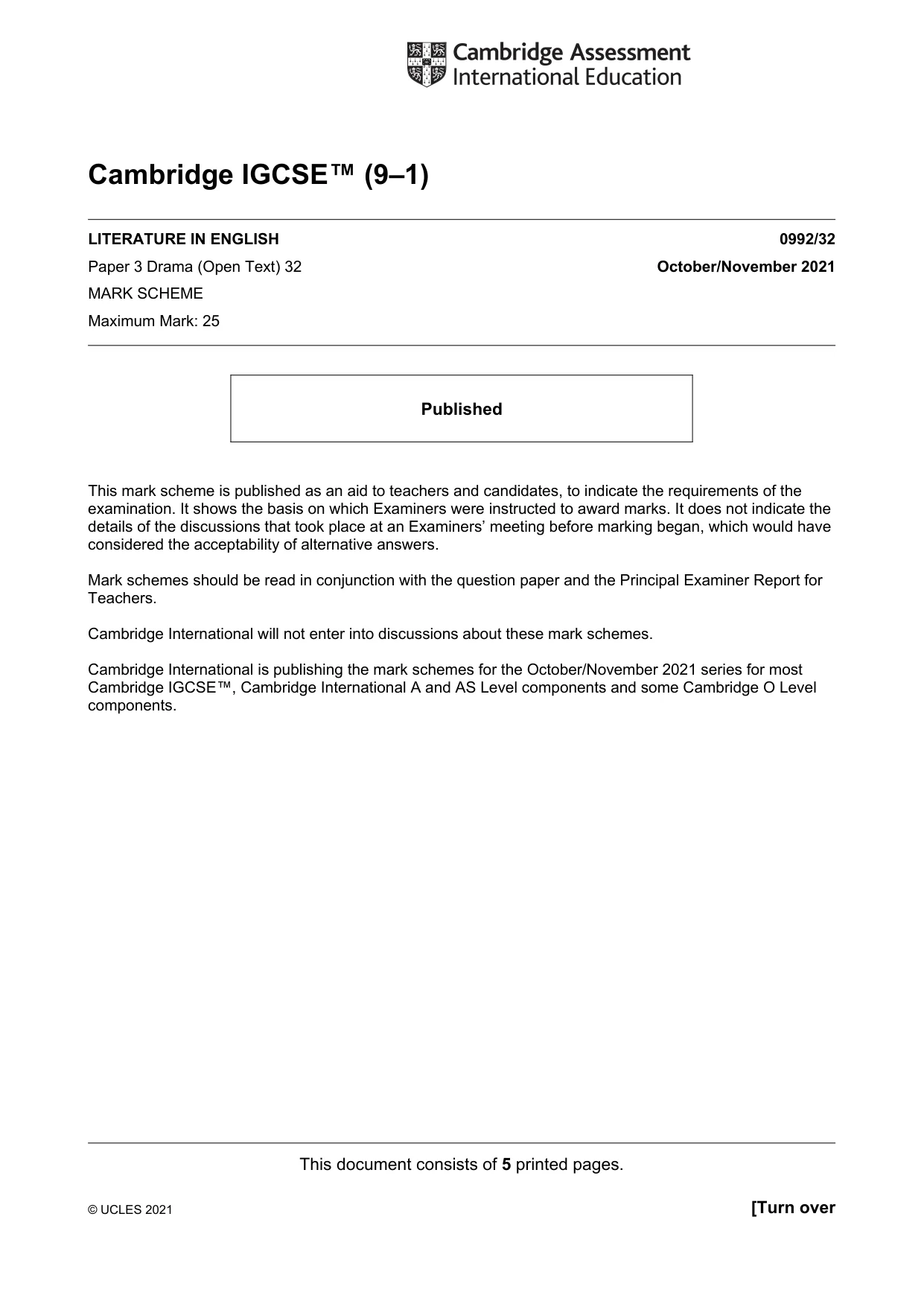
This document consists of 5 printed pages. © UCLES 2021 [Turn over Cambridge IGCSE™ (9–1) LITERATURE IN ENGLISH 0992/32 Paper 3 Drama (Open Text) 32 October/November 2021 MARK SCHEME Maximum Mark: 25 Published This mark scheme is published as an aid to teachers and candidates, to indicate the requirements of the examination. It shows the basis on which Examiners were instructed to award marks. It does not indicate the details of the discussions that took place at an Examiners’ meeting before marking began, which would have considered the acceptability of alternative answers. Mark schemes should be read in conjunction with the question paper and the Principal Examiner Report for Teachers. Cambridge International will not enter into discussions about these mark schemes. Cambridge International is publishing the mark schemes for the October/November 2021 series for most Cambridge IGCSE™, Cambridge International A and AS Level components and some Cambridge O Level components.
Mark scheme, page 2
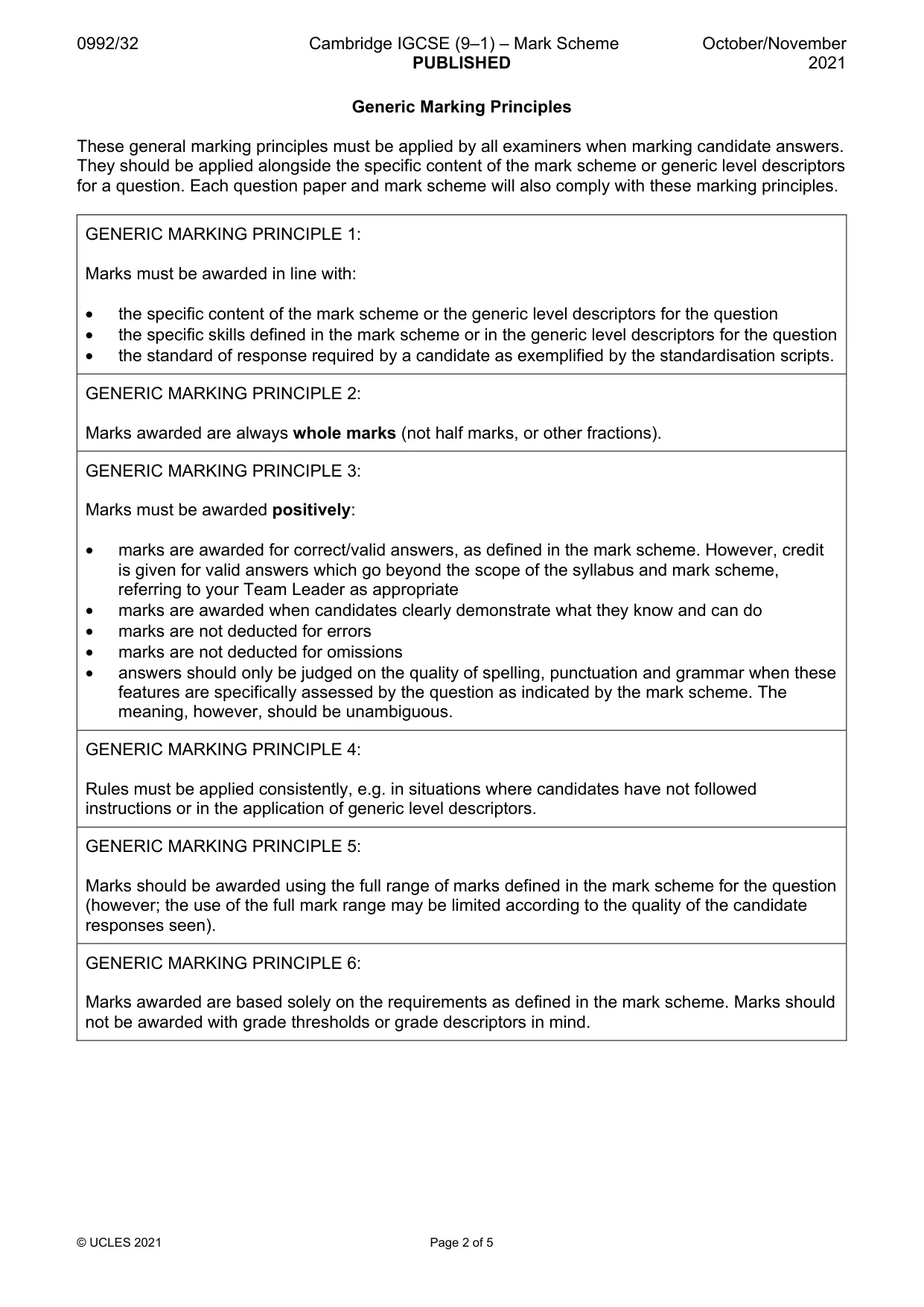
0992/32 Cambridge IGCSE (9–1) – Mark Scheme PUBLISHED October/November 2021 © UCLES 2021 Page 2 of 5 Generic Marking Principles These general marking principles must be applied by all examiners when marking candidate answers. They should be applied alongside the specific content of the mark scheme or generic level descriptors for a question. Each question paper and mark scheme will also comply with these marking principles. GENERIC MARKING PRINCIPLE 1: Marks must be awarded in line with: • the specific content of the mark scheme or the generic level descriptors for the question • the specific skills defined in the mark scheme or in the generic level descriptors for the question • the standard of response required by a candidate as exemplified by the standardisation scripts. GENERIC MARKING PRINCIPLE 2: Marks awarded are always whole marks (not half marks, or other fractions). GENERIC MARKING PRINCIPLE 3: Marks must be awarded positively: • marks are awarded for correct/valid answers, as defined in the mark scheme. However, credit is given for valid answers which go beyond the scope of the syllabus and mark scheme, referring to your Team Leader as appropriate • marks are awarded when candidates clearly demonstrate what they know and can do • marks are not deducted for errors • marks are not deducted for omissions • answers should only be judged on the quality of spelling, punctuation and grammar when these features are specifically assessed by the question as indicated by the mark scheme. The meaning, however, should be unambiguous. GENERIC MARKING PRINCIPLE 4: Rules must be applied consistently, e.g. in situations where candidates have not followed instructions or in the application of generic level descriptors. GENERIC MARKING PRINCIPLE 5: Marks should be awarded using the full range of marks defined in the mark scheme for the question (however; the use of the full mark range may be limited according to the quality of the candidate responses seen). GENERIC MARKING PRINCIPLE 6: Marks awarded are based solely on the requirements as defined in the mark scheme. Marks should not be awarded with grade thresholds or grade descriptors in mind.
Mark scheme, page 3
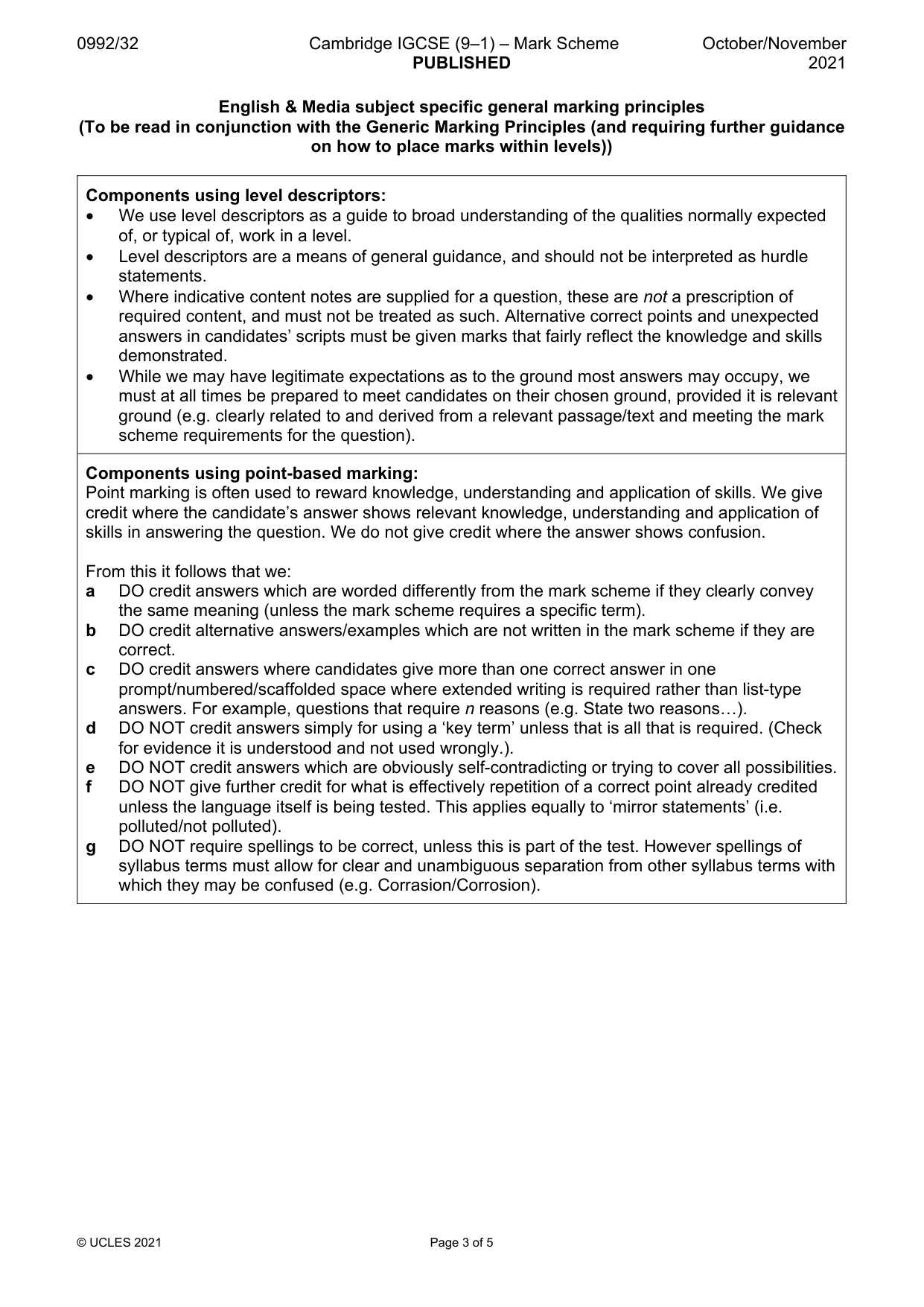
0992/32 Cambridge IGCSE (9–1) – Mark Scheme PUBLISHED October/November 2021 © UCLES 2021 Page 3 of 5 English & Media subject specific general marking principles (To be read in conjunction with the Generic Marking Principles (and requiring further guidance on how to place marks within levels)) Components using level descriptors: • We use level descriptors as a guide to broad understanding of the qualities normally expected of, or typical of, work in a level. • Level descriptors are a means of general guidance, and should not be interpreted as hurdle statements. • Where indicative content notes are supplied for a question, these are not a prescription of required content, and must not be treated as such. Alternative correct points and unexpected answers in candidates’ scripts must be given marks that fairly reflect the knowledge and skills demonstrated. • While we may have legitimate expectations as to the ground most answers may occupy, we must at all times be prepared to meet candidates on their chosen ground, provided it is relevant ground (e.g. clearly related to and derived from a relevant passage/text and meeting the mark scheme requirements for the question). Components using point-based marking: Point marking is often used to reward knowledge, understanding and application of skills. We give credit where the candidate’s answer shows relevant knowledge, understanding and application of skills in answering the question. We do not give credit where the answer shows confusion. From this it follows that we: a DO credit answers which are worded differently from the mark scheme if they clearly convey the same meaning (unless the mark scheme requires a specific term). b DO credit alternative answers/examples which are not written in the mark scheme if they are correct. c DO credit answers where candidates give more than one correct answer in one prompt/numbered/scaffolded space where extended writing is required rather than list-type answers. For example, questions that require n reasons (e.g. State two reasons…). d DO NOT credit answers simply for using a ‘key term’ unless that is all that is required. (Check for evidence it is understood and not used wrongly.). e DO NOT credit answers which are obviously self-contradicting or trying to cover all possibilities. f DO NOT give further credit for what is effectively repetition of a correct point already credited unless the language itself is being tested. This applies equally to ‘mirror statements’ (i.e. polluted/not polluted). g DO NOT require spellings to be correct, unless this is part of the test. However spellings of syllabus terms must allow for clear and unambiguous separation from other syllabus terms with which they may be confused (e.g. Corrasion/Corrosion).
Mark scheme, page 4
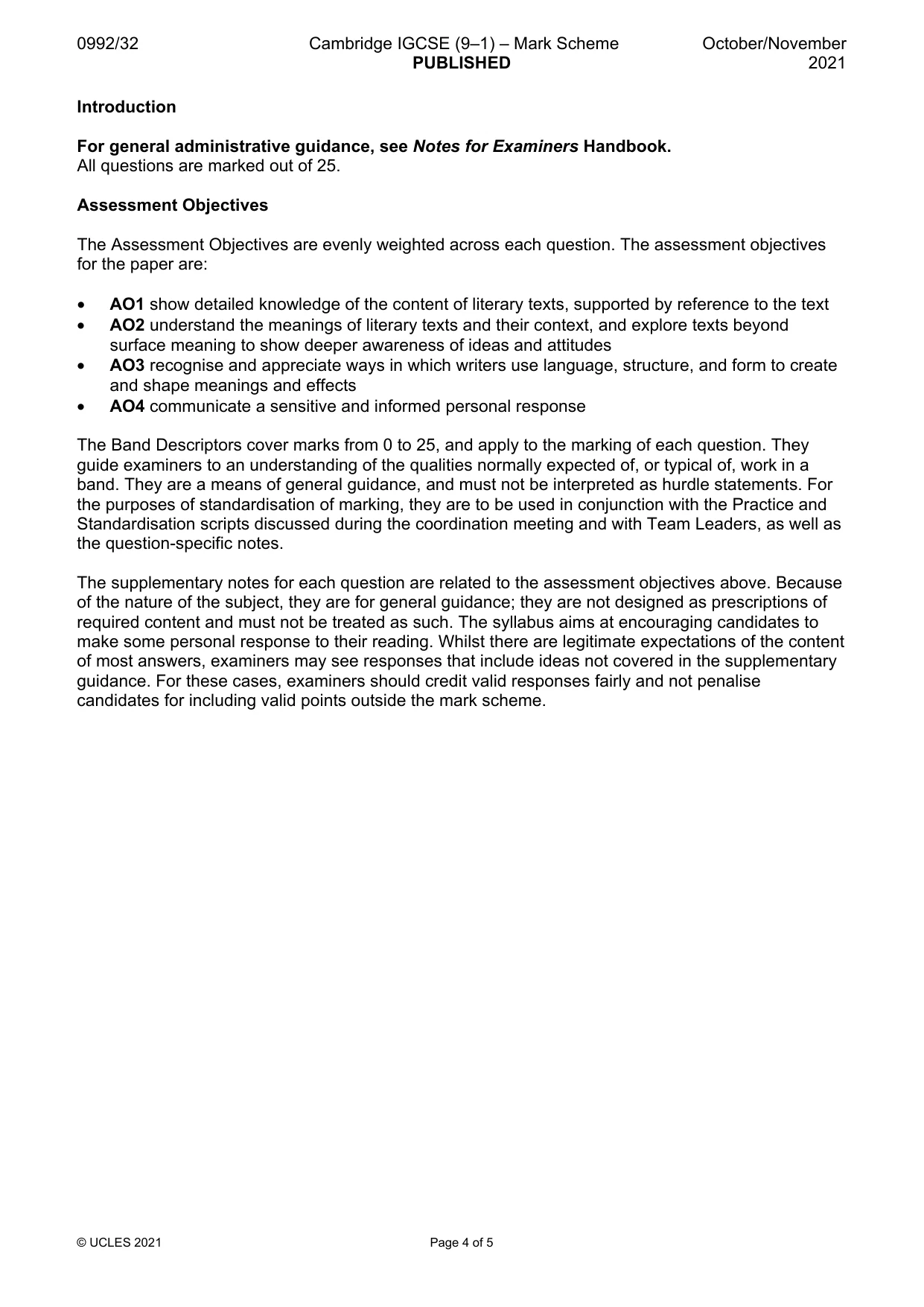
0992/32 Cambridge IGCSE (9–1) – Mark Scheme PUBLISHED October/November 2021 © UCLES 2021 Page 4 of 5 Introduction For general administrative guidance, see Notes for Examiners Handbook. All questions are marked out of 25. Assessment Objectives The Assessment Objectives are evenly weighted across each question. The assessment objectives for the paper are: • AO1 show detailed knowledge of the content of literary texts, supported by reference to the text • AO2 understand the meanings of literary texts and their context, and explore texts beyond surface meaning to show deeper awareness of ideas and attitudes • AO3 recognise and appreciate ways in which writers use language, structure, and form to create and shape meanings and effects • AO4 communicate a sensitive and informed personal response The Band Descriptors cover marks from 0 to 25, and apply to the marking of each question. They guide examiners to an understanding of the qualities normally expected of, or typical of, work in a band. They are a means of general guidance, and must not be interpreted as hurdle statements. For the purposes of standardisation of marking, they are to be used in conjunction with the Practice and Standardisation scripts discussed during the coordination meeting and with Team Leaders, as well as the question-specific notes. The supplementary notes for each question are related to the assessment objectives above. Because of the nature of the subject, they are for general guidance; they are not designed as prescriptions of required content and must not be treated as such. The syllabus aims at encouraging candidates to make some personal response to their reading. Whilst there are legitimate expectations of the content of most answers, examiners may see responses that include ideas not covered in the supplementary guidance. For these cases, examiners should credit valid responses fairly and not penalise candidates for including valid points outside the mark scheme.
Mark scheme, page 5
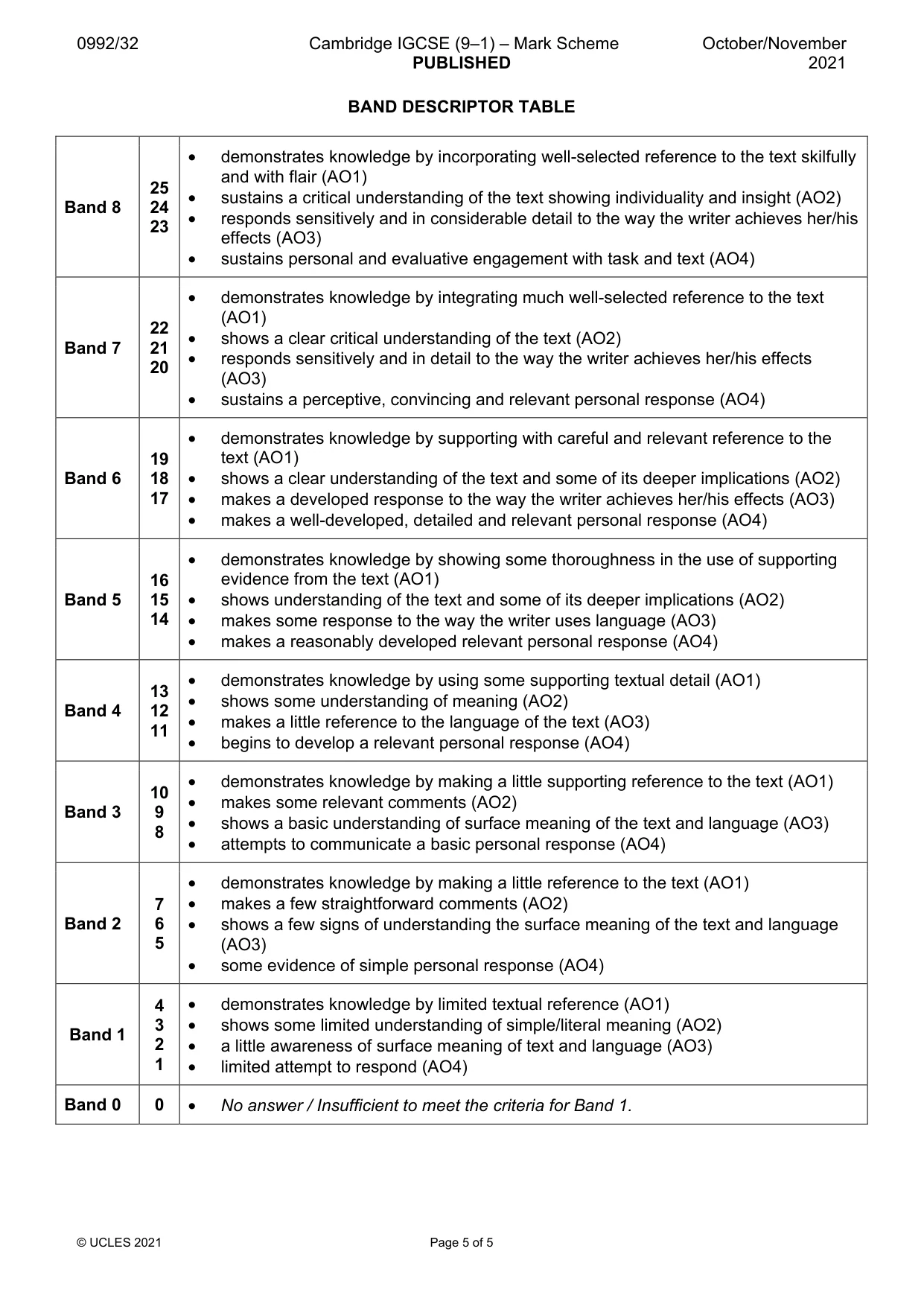
0992/32 Cambridge IGCSE (9–1) – Mark Scheme PUBLISHED October/November 2021 © UCLES 2021 Page 5 of 5 BAND DESCRIPTOR TABLE Band 8 25 24 23 • demonstrates knowledge by incorporating well-selected reference to the text skilfully and with flair (AO1) • sustains a critical understanding of the text showing individuality and insight (AO2) • responds sensitively and in considerable detail to the way the writer achieves her/his effects (AO3) • sustains personal and evaluative engagement with task and text (AO4) Band 7 22 21 20 • demonstrates knowledge by integrating much well-selected reference to the text (AO1) • shows a clear critical understanding of the text (AO2) • responds sensitively and in detail to the way the writer achieves her/his effects (AO3) • sustains a perceptive, convincing and relevant personal response (AO4) Band 6 19 18 17 • demonstrates knowledge by supporting with careful and relevant reference to the text (AO1) • shows a clear understanding of the text and some of its deeper implications (AO2) • makes a developed response to the way the writer achieves her/his effects (AO3) • makes a well-developed, detailed and relevant personal response (AO4) Band 5 16 15 14 • demonstrates knowledge by showing some thoroughness in the use of supporting evidence from the text (AO1) • shows understanding of the text and some of its deeper implications (AO2) • makes some response to the way the writer uses language (AO3) • makes a reasonably developed relevant personal response (AO4) Band 4 13 12 11 • demonstrates knowledge by using some supporting textual detail (AO1) • shows some understanding of meaning (AO2) • makes a little reference to the language of the text (AO3) • begins to develop a relevant personal response (AO4) Band 3 10 9 8 • demonstrates knowledge by making a little supporting reference to the text (AO1) • makes some relevant comments (AO2) • shows a basic understanding of surface meaning of the text and language (AO3) • attempts to communicate a basic personal response (AO4) Band 2 7 6 5 • demonstrates knowledge by making a little reference to the text (AO1) • makes a few straightforward comments (AO2) • shows a few signs of understanding the surface meaning of the text and language (AO3) • some evidence of simple personal response (AO4) Band 1 4 3 2 1 • demonstrates knowledge by limited textual reference (AO1) • shows some limited understanding of simple/literal meaning (AO2) • a little awareness of surface meaning of text and language (AO3) • limited attempt to respond (AO4) Band 0 0 • No answer / Insufficient to meet the criteria for Band 1.
What you needed in this session
Cambridge’s own grade thresholds for 2021 Oct/Nov, Paper 3 · Variant 2. A higher threshold means an easier paper — the bar moves with how the cohort did.