Cambridge IGCSE English - Literature in English (9-1) 0992 — 2021 May/June Paper 3 · Variant 2
0992/32/M/J/21 · 25 marks · ≈28 min
The question paper and its mark scheme, free to read here and free to download. This is Cambridge’s own paper, exactly as it was sat.
Question paper12 pages
Mark scheme5 pages
Answers below. Sit the paper first if you are practising.
Paper as text
Question paper, page 1
Cambridge IGCSE™(9-1) 0992/32 May/June 2021 45 minutes LITERATURE IN ENGLISH Paper 3 Drama (Open Text) You must answer on the enclosed answer booklet. You will need: Answer booklet (enclosed) Candidates may take their set texts into the exam room, but these must NOT contain personal annotations, highlighting or underlining. INSTRUCTIONS • Answer one question. • Follow the instructions on the front cover of the answer booklet. If you need additional answer paper, ask the invigilator for a continuation booklet. • You may take your set text into the exam room, but this must not contain personal annotations, highlighting or underlining. INFORMATION • The total mark for this paper is 25. • All questions are worth equal marks. This document has 12 pages. Any blank pages are indicated. [Turn over 06_0992_32_2021_1.1 © UCLES 2021 *7066399493*
Question paper, page 2
LORRAINE HANSBERRY: A Raisin in the Sun Remember to support your ideas with details from the writing. Either 1(a) Read this passage carefully, and then answer the question that follows it: His sister BENEATHA enters. She is about twenty, as slim and intense as her brother. 06_0992_32_2021_1.1 2021 2 Content removed due to copyright restrictions.
Question paper, page 3
[with fury]: What do you want from me, Brother – that I quit school or just drop dead, which? Beneatha (from Act 1) How does Hansberry make this such a striking introduction to Beneatha? Or 1(b) To what extent do you think that Hansberry portrays the Younger family as victims? [Turn over 06_0992_32_2021_1.1 © UCLES 2021 3 Content removed due to copyright restrictions.
Question paper, page 4
ARTHUR MILLER: The Crucible Remember to support your ideas with details from the writing. Either 2(a) Read this passage carefully, and then answer the question that follows it: And when she put this girl out of your house, she put her out for a harlot? Danforth: 06_0992_32_2021_1.1 © UCLES 2021 4 Content removed due to copyright restrictions.
Question paper, page 5
[faintly]: No, sir. Elizabeth (from Act 3) In what ways does Miller powerfully create tension at this moment in the play? Or 2(b) How does Miller’s portrayal of Mary Warren contribute to the dramatic impact of the play? [Turn over 06_0992_32_2021_1.1 © UCLES 2021 5 Content removed due to copyright restrictions.
Question paper, page 6
R C SHERRIFF: Journey’s End Remember to support your ideas with details from the writing. Either 3(a) Read this passage carefully, and then answer the question that follows it: [over by the right-hand bed]: Will you sleep here? Osborne 06_0992_32_2021_1.1 © UCLES 2021 6 Content removed due to copyright restrictions.
Question paper, page 7
They’re going to take an equal chance – together. Stanhope: (from Act 1) In what ways does Sherriff make this such a striking and revealing moment in the play? Or 3(b) How far does Sherriff portray Trotter as an amusing character? [Turn over 06_0992_32_2021_1.1 © UCLES 2021 7 Content removed due to copyright restrictions.
Question paper, page 8
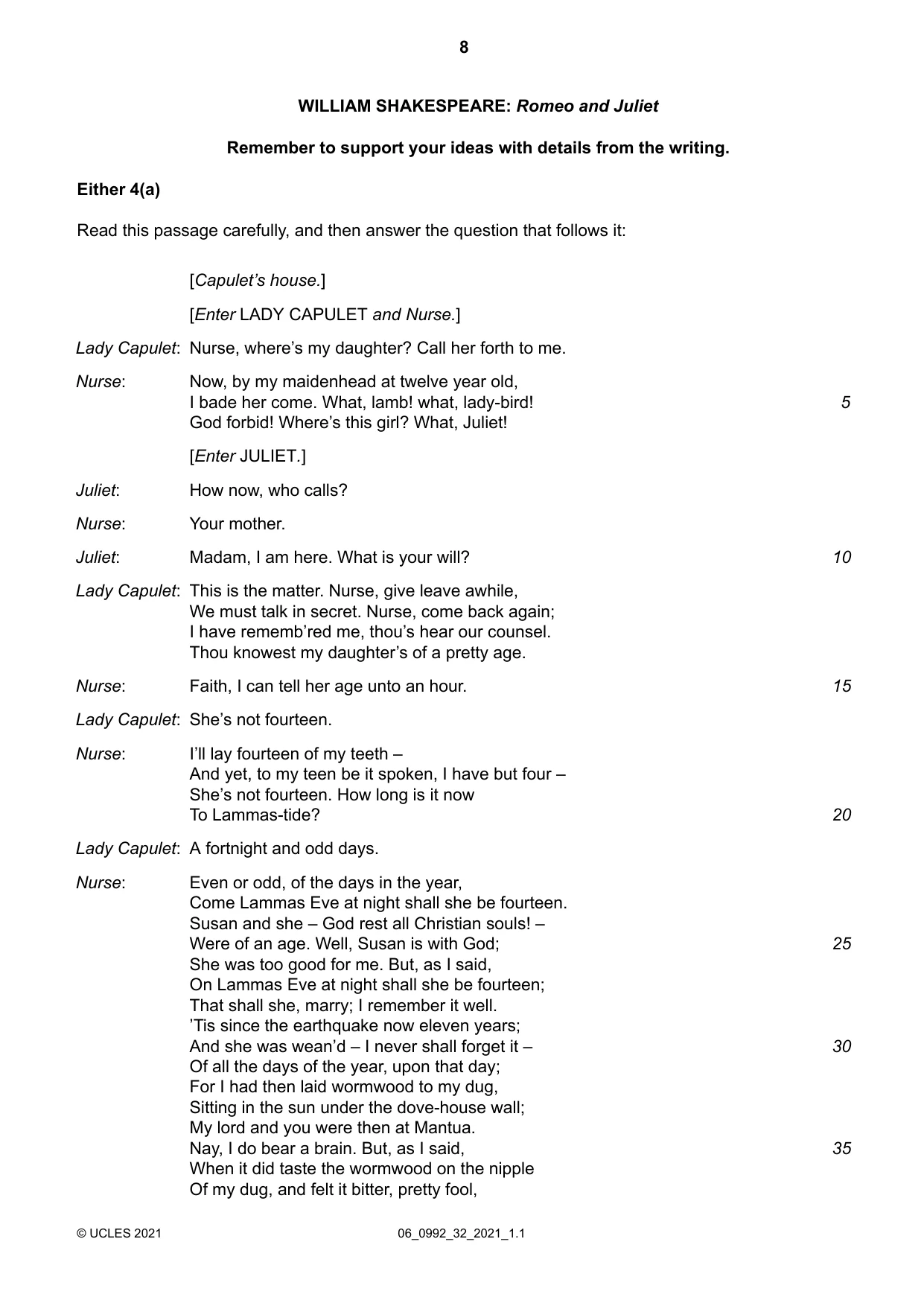
35 30 25 20 15 10 5 WILLIAM SHAKESPEARE: Romeo and Juliet Remember to support your ideas with details from the writing. Either 4(a) Read this passage carefully, and then answer the question that follows it: [Capulet’s house.] [Enter LADY CAPULET and Nurse.] Nurse, where’s my daughter? Call her forth to me. Lady Capulet: Now, by my maidenhead at twelve year old, I bade her come. What, lamb! what, lady-bird! God forbid! Where’s this girl? What, Juliet! Nurse: [Enter JULIET.] How now, who calls? Juliet: Your mother. Nurse: Madam, I am here. What is your will? Juliet: This is the matter. Nurse, give leave awhile, We must talk in secret. Nurse, come back again; I have rememb’red me, thou’s hear our counsel. Thou knowest my daughter’s of a pretty age. Lady Capulet: Faith, I can tell her age unto an hour. Nurse: She’s not fourteen. Lady Capulet: I’ll lay fourteen of my teeth – And yet, to my teen be it spoken, I have but four – She’s not fourteen. How long is it now To Lammas-tide? Nurse: A fortnight and odd days. Lady Capulet: Even or odd, of the days in the year, Come Lammas Eve at night shall she be fourteen. Susan and she – God rest all Christian souls! – Were of an age. Well, Susan is with God; She was too good for me. But, as I said, On Lammas Eve at night shall she be fourteen; That shall she, marry; I remember it well. ’Tis since the earthquake now eleven years; And she was wean’d – I never shall forget it – Of all the days of the year, upon that day; For I had then laid wormwood to my dug, Sitting in the sun under the dove-house wall; My lord and you were then at Mantua. Nay, I do bear a brain. But, as I said, When it did taste the wormwood on the nipple Of my dug, and felt it bitter, pretty fool, Nurse: 06_0992_32_2021_1.1 © UCLES 2021 8
Question paper, page 9
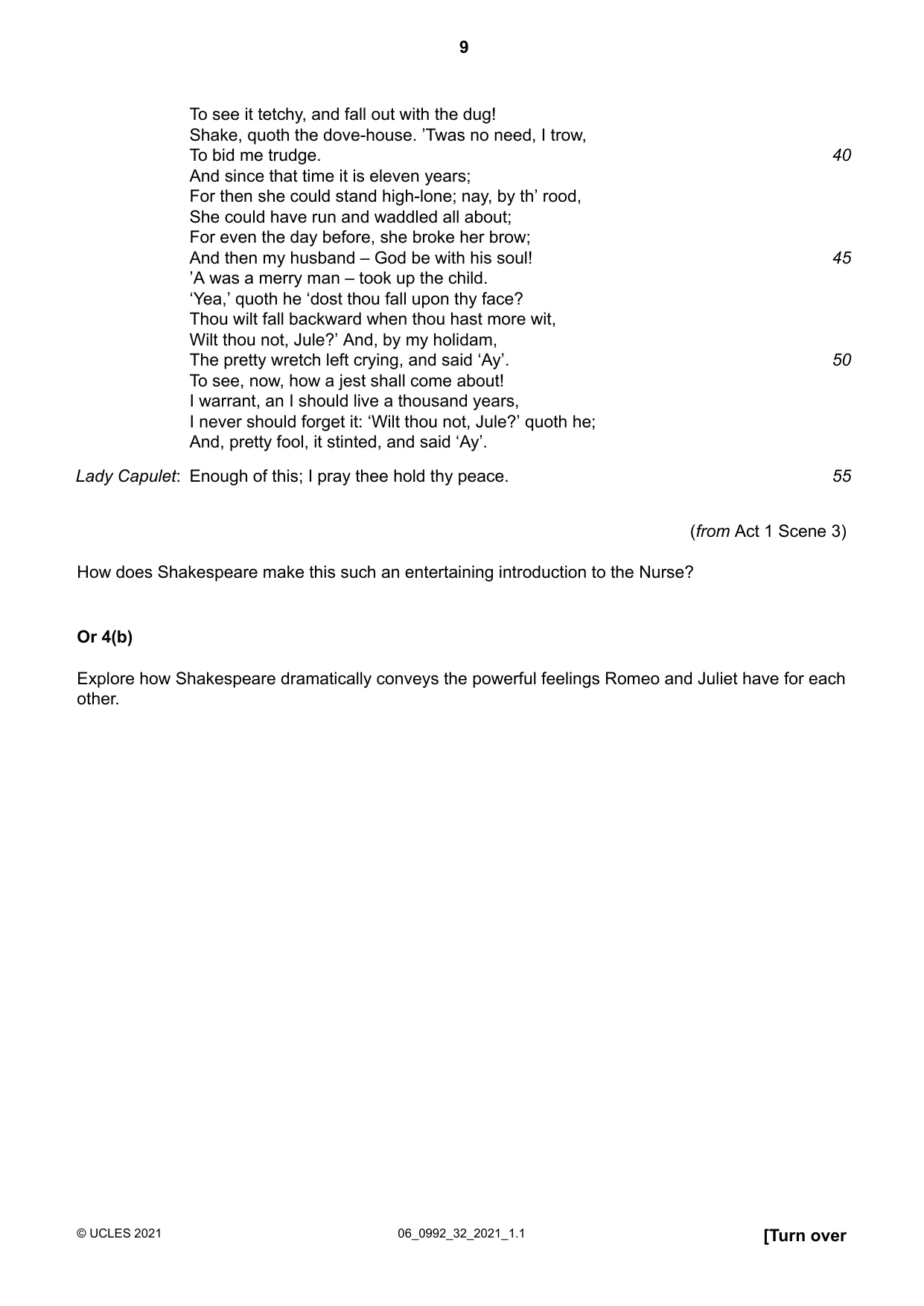
55 50 45 40 To see it tetchy, and fall out with the dug! Shake, quoth the dove-house. ’Twas no need, I trow, To bid me trudge. And since that time it is eleven years; For then she could stand high-lone; nay, by th’ rood, She could have run and waddled all about; For even the day before, she broke her brow; And then my husband – God be with his soul! ’A was a merry man – took up the child. ‘Yea,’ quoth he ‘dost thou fall upon thy face? Thou wilt fall backward when thou hast more wit, Wilt thou not, Jule?’ And, by my holidam, The pretty wretch left crying, and said ‘Ay’. To see, now, how a jest shall come about! I warrant, an I should live a thousand years, I never should forget it: ‘Wilt thou not, Jule?’ quoth he; And, pretty fool, it stinted, and said ‘Ay’. Enough of this; I pray thee hold thy peace. Lady Capulet: (from Act 1 Scene 3) How does Shakespeare make this such an entertaining introduction to the Nurse? Or 4(b) Explore how Shakespeare dramatically conveys the powerful feelings Romeo and Juliet have for each other. [Turn over 06_0992_32_2021_1.1 © UCLES 2021 9
Question paper, page 10
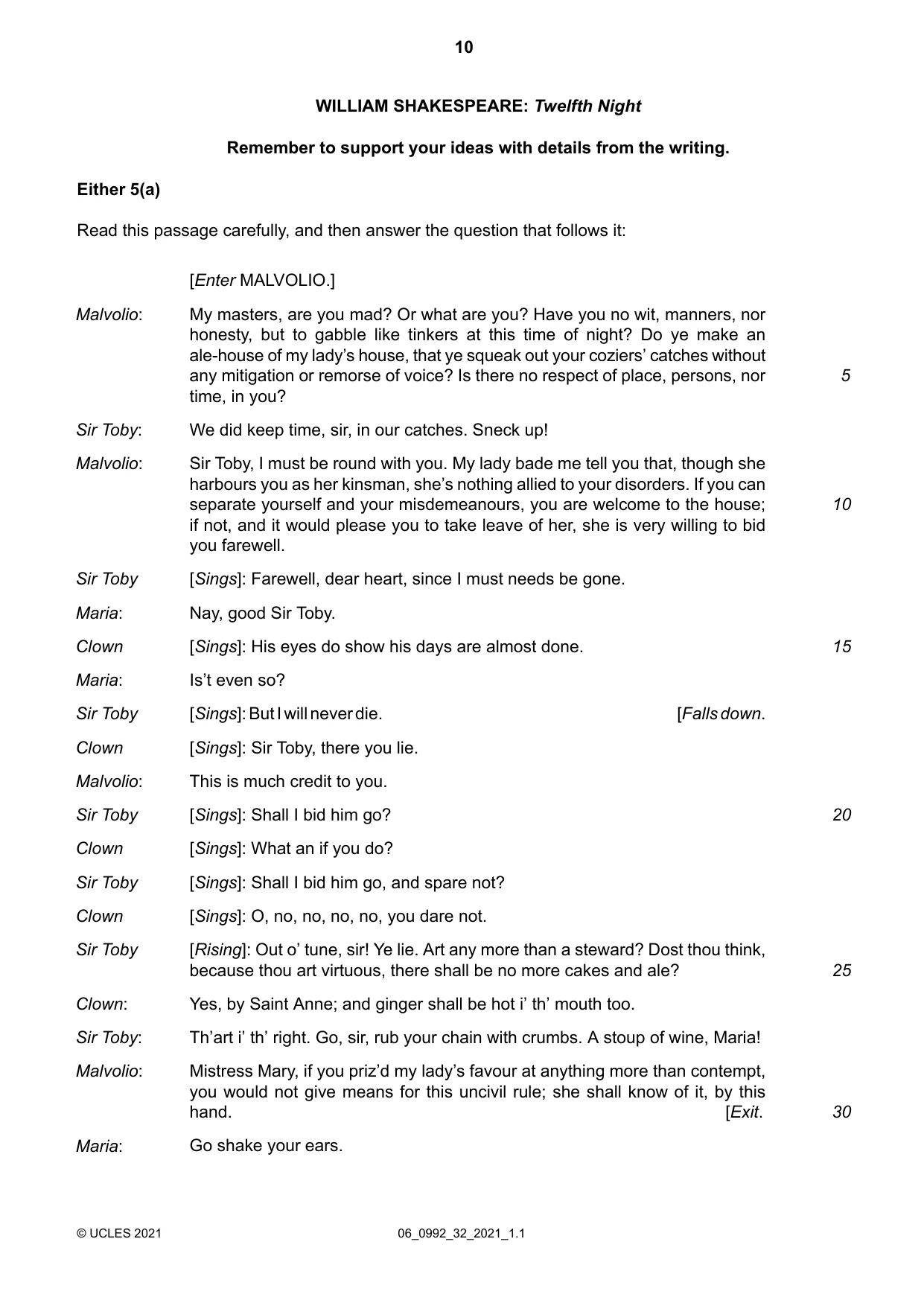
30 25 20 15 10 5 WILLIAM SHAKESPEARE: Twelfth Night Remember to support your ideas with details from the writing. Either 5(a) Read this passage carefully, and then answer the question that follows it: [Enter MALVOLIO.] My masters, are you mad? Or what are you? Have you no wit, manners, nor honesty, but to gabble like tinkers at this time of night? Do ye make an ale-house of my lady’s house, that ye squeak out your coziers’ catches without any mitigation or remorse of voice? Is there no respect of place, persons, nor time, in you? Malvolio: We did keep time, sir, in our catches. Sneck up! Sir Toby: Sir Toby, I must be round with you. My lady bade me tell you that, though she harbours you as her kinsman, she’s nothing allied to your disorders. If you can separate yourself and your misdemeanours, you are welcome to the house; if not, and it would please you to take leave of her, she is very willing to bid you farewell. Malvolio: [Sings]: Farewell, dear heart, since I must needs be gone. Sir Toby Nay, good Sir Toby. Maria: [Sings]: His eyes do show his days are almost done. Clown Is’t even so? Maria: [Sings]:ButIwillneverdie. [Fallsdown. Sir Toby [Sings]: Sir Toby, there you lie. Clown This is much credit to you. Malvolio: [Sings]: Shall I bid him go? Sir Toby [Sings]: What an if you do? Clown [Sings]: Shall I bid him go, and spare not? Sir Toby [Sings]: O, no, no, no, no, you dare not. Clown [Rising]: Out o’ tune, sir! Ye lie. Art any more than a steward? Dost thou think, because thou art virtuous, there shall be no more cakes and ale? Sir Toby Yes, by Saint Anne; and ginger shall be hot i’ th’ mouth too. Clown: Th’art i’ th’ right. Go, sir, rub your chain with crumbs. A stoup of wine, Maria! Sir Toby: Mistress Mary, if you priz’d my lady’s favour at anything more than contempt, you would not give means for this uncivil rule; she shall know of it, by this hand. [Exit. Malvolio: Go shake your ears. Maria: 06_0992_32_2021_1.1 © UCLES 2021 10
Question paper, page 11
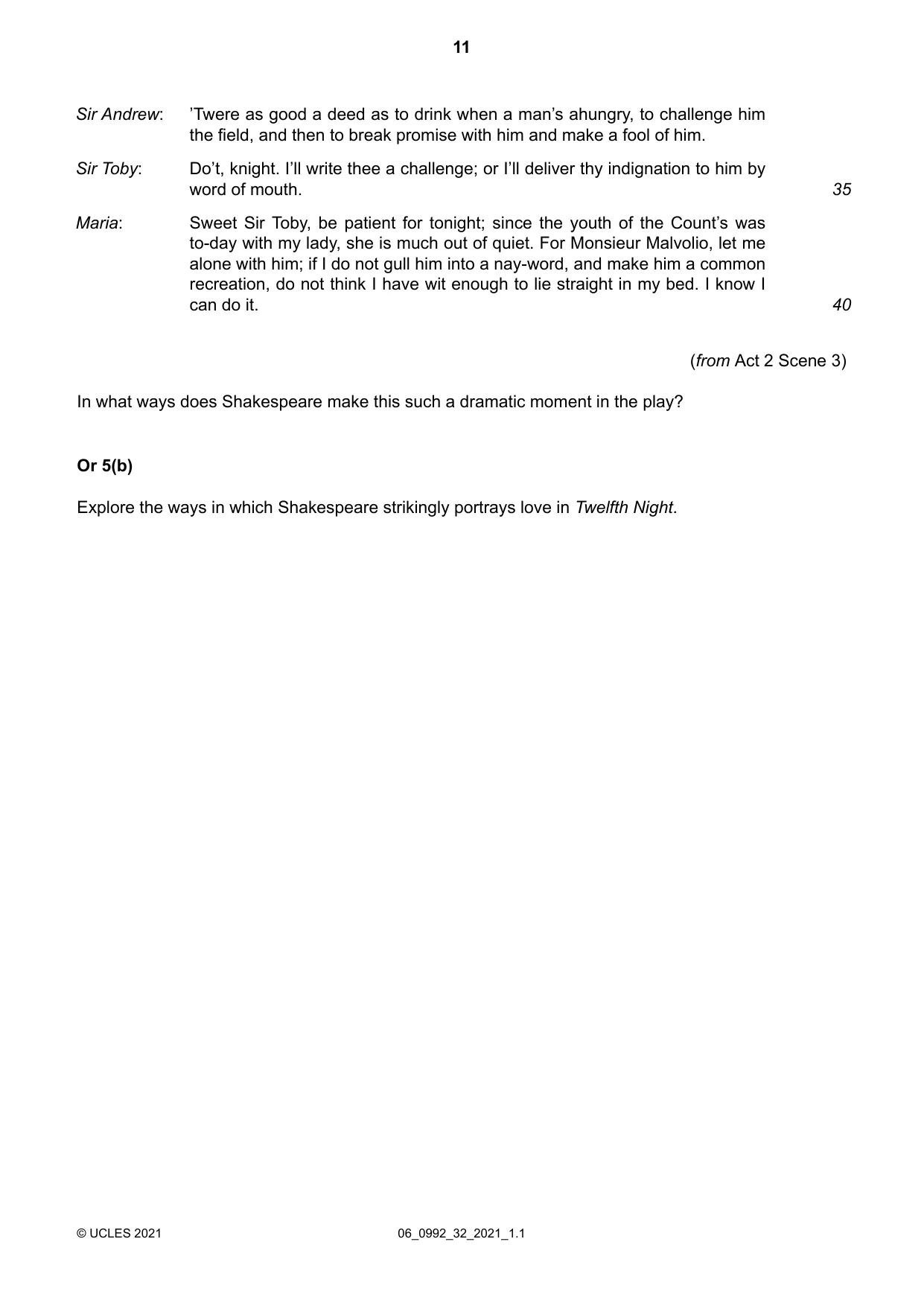
40 35 ’Twere as good a deed as to drink when a man’s ahungry, to challenge him the field, and then to break promise with him and make a fool of him. Sir Andrew: Do’t, knight. I’ll write thee a challenge; or I’ll deliver thy indignation to him by word of mouth. Sir Toby: Sweet Sir Toby, be patient for tonight; since the youth of the Count’s was to-day with my lady, she is much out of quiet. For Monsieur Malvolio, let me alone with him; if I do not gull him into a nay-word, and make him a common recreation, do not think I have wit enough to lie straight in my bed. I know I can do it. Maria: (from Act 2 Scene 3) In what ways does Shakespeare make this such a dramatic moment in the play? Or 5(b) Explore the ways in which Shakespeare strikingly portrays love in Twelfth Night. 06_0992_32_2021_1.1 © UCLES 2021 11
Question paper, page 12
BLANK PAGE Permission to reproduce items where third-party owned material protected by copyright is included has been sought and cleared where possible. Every reasonable effort has been made by he publisher (UCLES) to trace copyright holders, but if any items requiring clearance have unwit ingly been included, the publisher will be pleased to make amends at the earliest possible opportunity. To avoid the issue of disclosure of answer-related information to candidates, all copyright acknowledgements are reproduced online in the Cambridge Assessment International Education Copyright Acknowledgements Booklet. This is produced for each series of examinations and is freely available to download at www.cambridgeinternational.org after the live examination series. Cambridge Assessment International Education is part of the Cambridge Assessment Group. Cambridge Assessment is the brand name of the University of Cambridge Local Examinations Syndicate (UCLES), which itself is a department of the University of Cambridge. 06_0992_32_2021_1.1 © UCLES 2021 12
Mark scheme, page 1
This document consists of 5 printed pages. © UCLES 2021 [Turn over Cambridge IGCSE™ (9–1) LITERATURE IN ENGLISH (9–1) 0992/32 Paper 3 Drama (Open Text) 32 May/June 2021 MARK SCHEME Maximum Mark: 50 Published This mark scheme is published as an aid to teachers and candidates, to indicate the requirements of the examination. It shows the basis on which Examiners were instructed to award marks. It does not indicate the details of the discussions that took place at an Examiners’ meeting before marking began, which would have considered the acceptability of alternative answers. Mark schemes should be read in conjunction with the question paper and the Principal Examiner Report for Teachers. Cambridge International will not enter into discussions about these mark schemes. Cambridge International is publishing the mark schemes for the May/June 2021 series for most Cambridge IGCSE™, Cambridge International A and AS Level components and some Cambridge O Level components.
Mark scheme, page 2
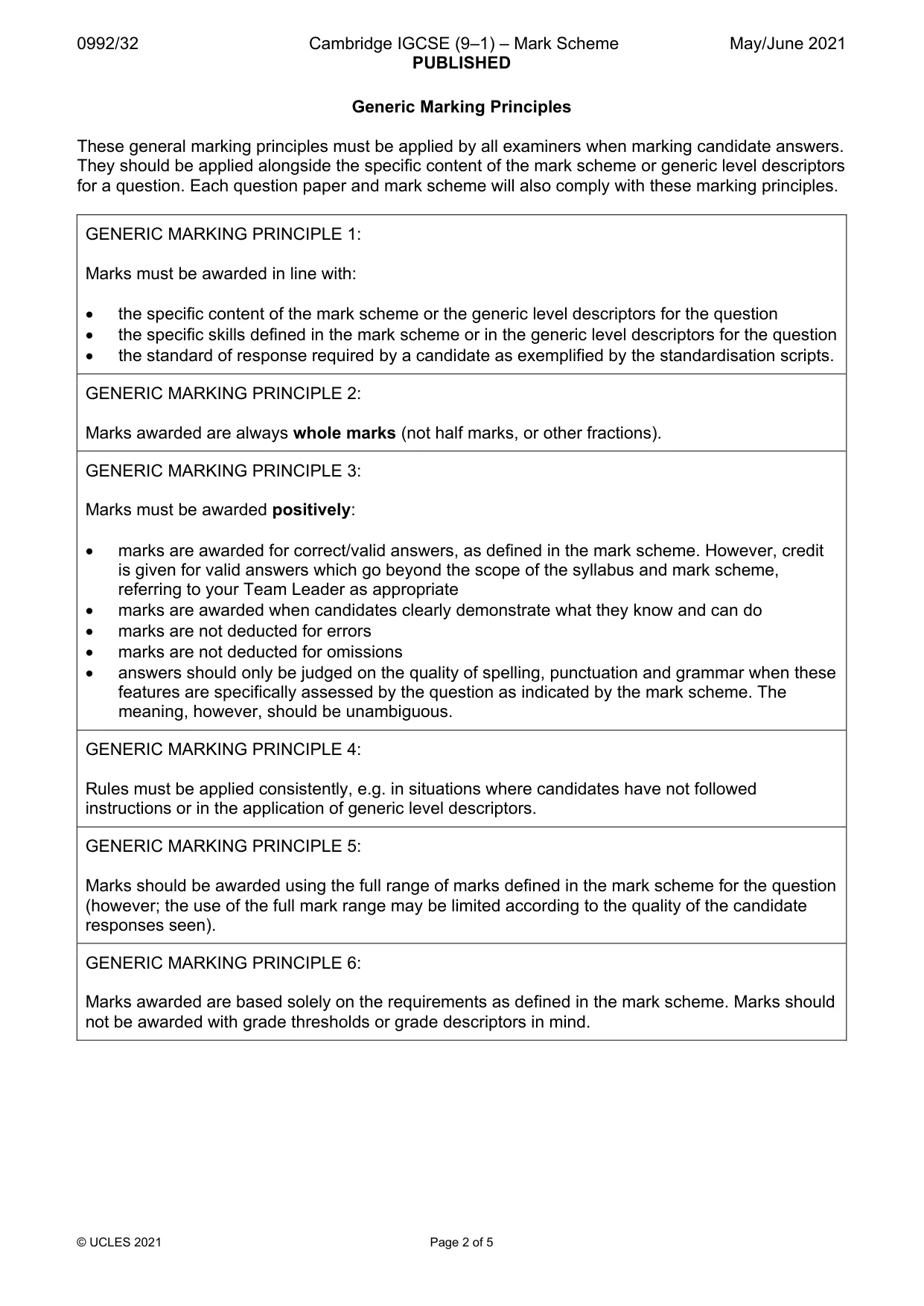
0992/32 Cambridge IGCSE (9–1) – Mark Scheme PUBLISHED May/June 2021 © UCLES 2021 Page 2 of 5 Generic Marking Principles These general marking principles must be applied by all examiners when marking candidate answers. They should be applied alongside the specific content of the mark scheme or generic level descriptors for a question. Each question paper and mark scheme will also comply with these marking principles. GENERIC MARKING PRINCIPLE 1: Marks must be awarded in line with: • the specific content of the mark scheme or the generic level descriptors for the question • the specific skills defined in the mark scheme or in the generic level descriptors for the question • the standard of response required by a candidate as exemplified by the standardisation scripts. GENERIC MARKING PRINCIPLE 2: Marks awarded are always whole marks (not half marks, or other fractions). GENERIC MARKING PRINCIPLE 3: Marks must be awarded positively: • marks are awarded for correct/valid answers, as defined in the mark scheme. However, credit is given for valid answers which go beyond the scope of the syllabus and mark scheme, referring to your Team Leader as appropriate • marks are awarded when candidates clearly demonstrate what they know and can do • marks are not deducted for errors • marks are not deducted for omissions • answers should only be judged on the quality of spelling, punctuation and grammar when these features are specifically assessed by the question as indicated by the mark scheme. The meaning, however, should be unambiguous. GENERIC MARKING PRINCIPLE 4: Rules must be applied consistently, e.g. in situations where candidates have not followed instructions or in the application of generic level descriptors. GENERIC MARKING PRINCIPLE 5: Marks should be awarded using the full range of marks defined in the mark scheme for the question (however; the use of the full mark range may be limited according to the quality of the candidate responses seen). GENERIC MARKING PRINCIPLE 6: Marks awarded are based solely on the requirements as defined in the mark scheme. Marks should not be awarded with grade thresholds or grade descriptors in mind.
Mark scheme, page 3
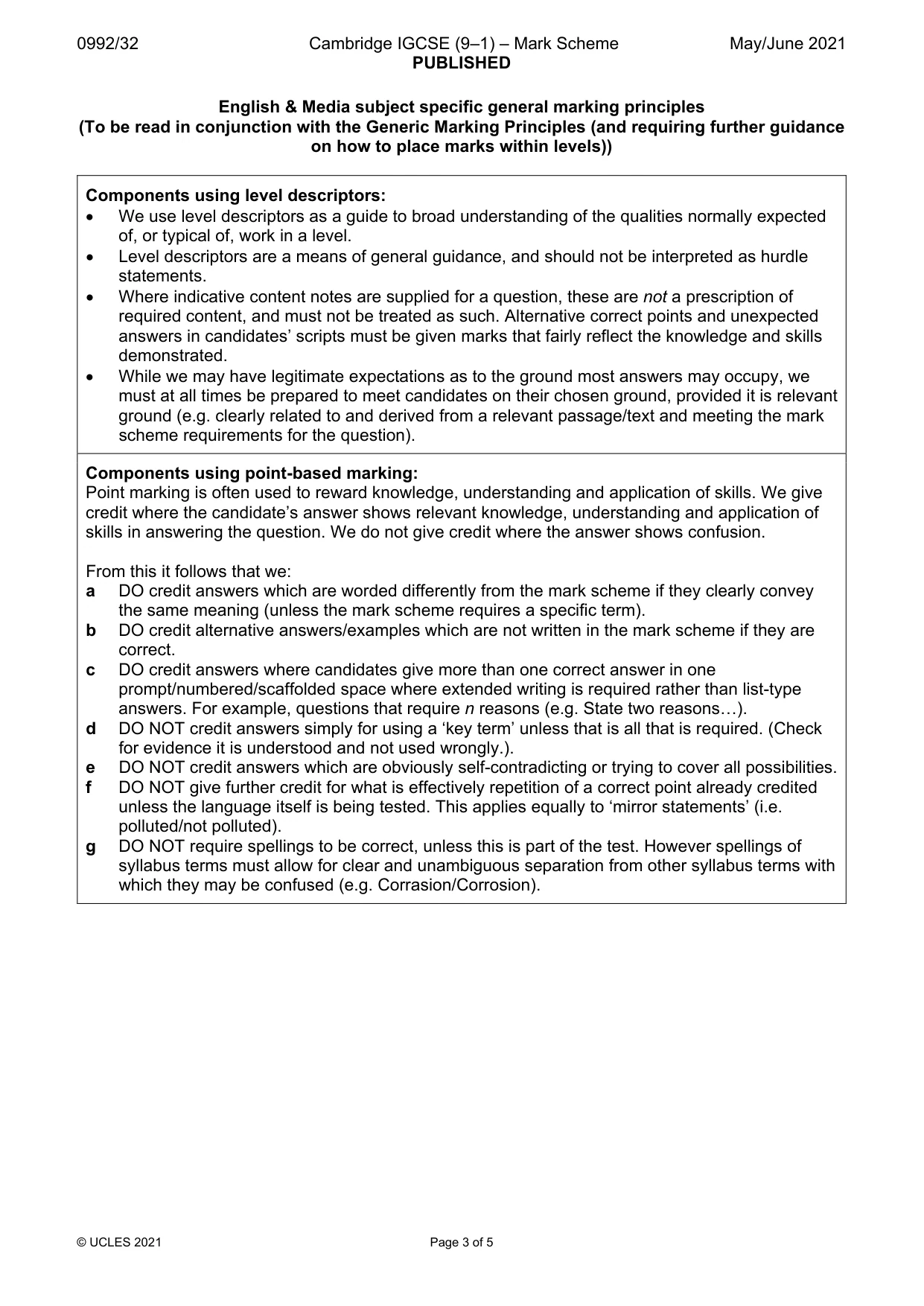
0992/32 Cambridge IGCSE (9–1) – Mark Scheme PUBLISHED May/June 2021 © UCLES 2021 Page 3 of 5 English & Media subject specific general marking principles (To be read in conjunction with the Generic Marking Principles (and requiring further guidance on how to place marks within levels)) Components using level descriptors: • We use level descriptors as a guide to broad understanding of the qualities normally expected of, or typical of, work in a level. • Level descriptors are a means of general guidance, and should not be interpreted as hurdle statements. • Where indicative content notes are supplied for a question, these are not a prescription of required content, and must not be treated as such. Alternative correct points and unexpected answers in candidates’ scripts must be given marks that fairly reflect the knowledge and skills demonstrated. • While we may have legitimate expectations as to the ground most answers may occupy, we must at all times be prepared to meet candidates on their chosen ground, provided it is relevant ground (e.g. clearly related to and derived from a relevant passage/text and meeting the mark scheme requirements for the question). Components using point-based marking: Point marking is often used to reward knowledge, understanding and application of skills. We give credit where the candidate’s answer shows relevant knowledge, understanding and application of skills in answering the question. We do not give credit where the answer shows confusion. From this it follows that we: a DO credit answers which are worded differently from the mark scheme if they clearly convey the same meaning (unless the mark scheme requires a specific term). b DO credit alternative answers/examples which are not written in the mark scheme if they are correct. c DO credit answers where candidates give more than one correct answer in one prompt/numbered/scaffolded space where extended writing is required rather than list-type answers. For example, questions that require n reasons (e.g. State two reasons…). d DO NOT credit answers simply for using a ‘key term’ unless that is all that is required. (Check for evidence it is understood and not used wrongly.). e DO NOT credit answers which are obviously self-contradicting or trying to cover all possibilities. f DO NOT give further credit for what is effectively repetition of a correct point already credited unless the language itself is being tested. This applies equally to ‘mirror statements’ (i.e. polluted/not polluted). g DO NOT require spellings to be correct, unless this is part of the test. However spellings of syllabus terms must allow for clear and unambiguous separation from other syllabus terms with which they may be confused (e.g. Corrasion/Corrosion).
Mark scheme, page 4
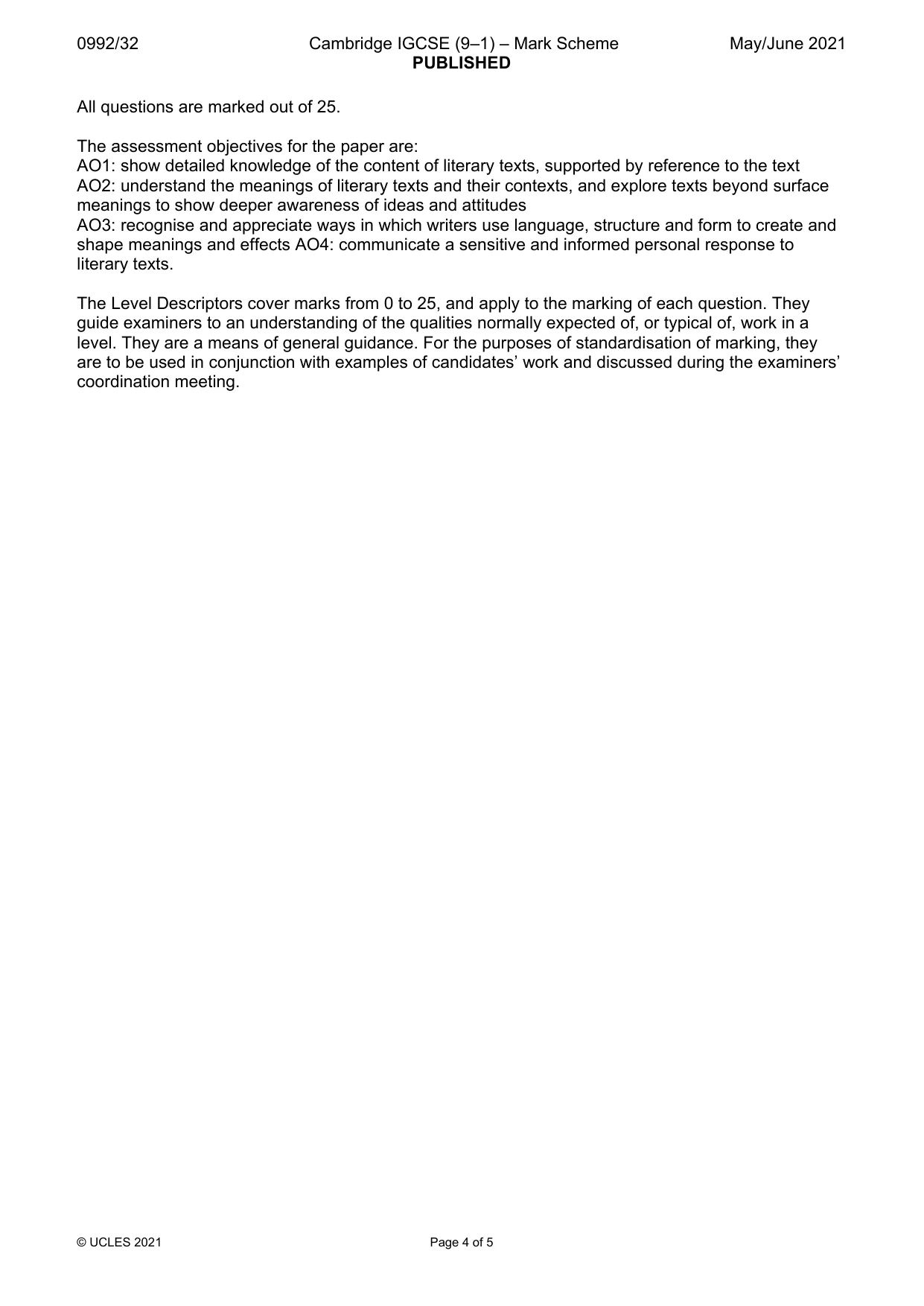
0992/32 Cambridge IGCSE (9–1) – Mark Scheme PUBLISHED May/June 2021 © UCLES 2021 Page 4 of 5 All questions are marked out of 25. The assessment objectives for the paper are: AO1: show detailed knowledge of the content of literary texts, supported by reference to the text AO2: understand the meanings of literary texts and their contexts, and explore texts beyond surface meanings to show deeper awareness of ideas and attitudes AO3: recognise and appreciate ways in which writers use language, structure and form to create and shape meanings and effects AO4: communicate a sensitive and informed personal response to literary texts. The Level Descriptors cover marks from 0 to 25, and apply to the marking of each question. They guide examiners to an understanding of the qualities normally expected of, or typical of, work in a level. They are a means of general guidance. For the purposes of standardisation of marking, they are to be used in conjunction with examples of candidates’ work and discussed during the examiners’ coordination meeting.
Mark scheme, page 5
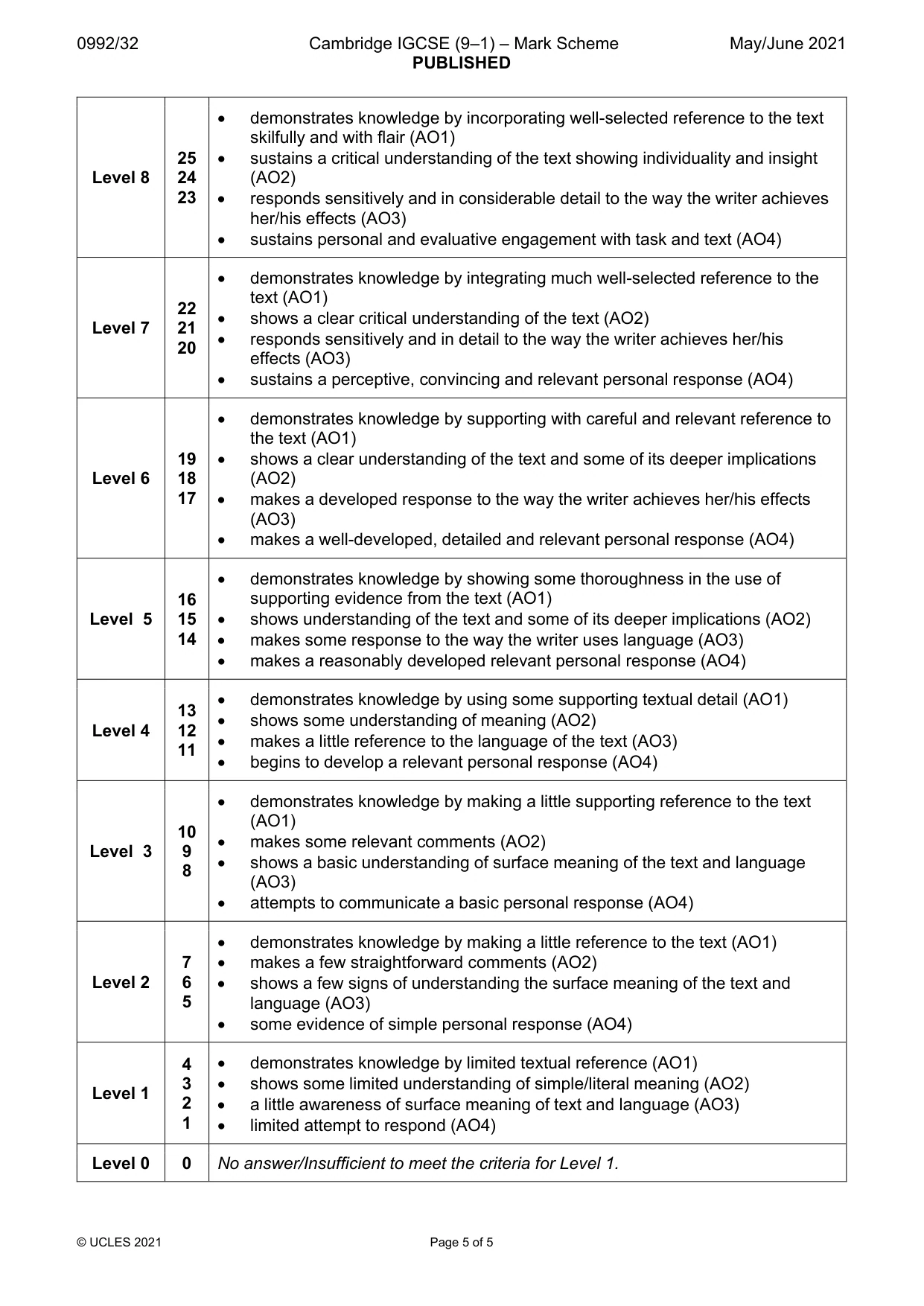
0992/32 Cambridge IGCSE (9–1) – Mark Scheme PUBLISHED May/June 2021 © UCLES 2021 Page 5 of 5 Level 8 25 24 23 • demonstrates knowledge by incorporating well-selected reference to the text skilfully and with flair (AO1) • sustains a critical understanding of the text showing individuality and insight (AO2) • responds sensitively and in considerable detail to the way the writer achieves her/his effects (AO3) • sustains personal and evaluative engagement with task and text (AO4) Level 7 22 21 20 • demonstrates knowledge by integrating much well-selected reference to the text (AO1) • shows a clear critical understanding of the text (AO2) • responds sensitively and in detail to the way the writer achieves her/his effects (AO3) • sustains a perceptive, convincing and relevant personal response (AO4) Level 6 19 18 17 • demonstrates knowledge by supporting with careful and relevant reference to the text (AO1) • shows a clear understanding of the text and some of its deeper implications (AO2) • makes a developed response to the way the writer achieves her/his effects (AO3) • makes a well-developed, detailed and relevant personal response (AO4) Level 5 16 15 14 • demonstrates knowledge by showing some thoroughness in the use of supporting evidence from the text (AO1) • shows understanding of the text and some of its deeper implications (AO2) • makes some response to the way the writer uses language (AO3) • makes a reasonably developed relevant personal response (AO4) Level 4 13 12 11 • demonstrates knowledge by using some supporting textual detail (AO1) • shows some understanding of meaning (AO2) • makes a little reference to the language of the text (AO3) • begins to develop a relevant personal response (AO4) Level 3 10 9 8 • demonstrates knowledge by making a little supporting reference to the text (AO1) • makes some relevant comments (AO2) • shows a basic understanding of surface meaning of the text and language (AO3) • attempts to communicate a basic personal response (AO4) Level 2 7 6 5 • demonstrates knowledge by making a little reference to the text (AO1) • makes a few straightforward comments (AO2) • shows a few signs of understanding the surface meaning of the text and language (AO3) • some evidence of simple personal response (AO4) Level 1 4 3 2 1 • demonstrates knowledge by limited textual reference (AO1) • shows some limited understanding of simple/literal meaning (AO2) • a little awareness of surface meaning of text and language (AO3) • limited attempt to respond (AO4) Level 0 0 No answer/Insufficient to meet the criteria for Level 1.
What you needed in this session
Cambridge’s own grade thresholds for 2021 May/June, Paper 3 · Variant 2. A higher threshold means an easier paper — the bar moves with how the cohort did.