Cambridge IGCSE English - Literature in English (9-1) 0992 — 2020 Oct/Nov Paper 2 · Variant 2
0992/22/O/N/20 · 50 marks · ≈56 min
The question paper and its mark scheme, free to read here and free to download. This is Cambridge’s own paper, exactly as it was sat.
Question paper12 pages
Mark scheme7 pages
Answers below. Sit the paper first if you are practising.
Paper as text
Question paper, page 1
Cambridge IGCSE™(9–1) This document has 12 pages. Blank pages are indicated. LITERATURE IN ENGLISH 0992/22 Paper 2 Drama October/November 2020 1 hour 30 minutes You must answer on the enclosed answer booklet. You will need: Answer booklet (enclosed) INSTRUCTIONS ● Answer two questions. ● Your answers must be on two different set texts. ● You must answer one (a) passage-based question and one (b) essay question. ● Follow the instructions on the front cover of the answer booklet. If you need additional answer paper, ask the invigilator for a continuation booklet. INFORMATION ● The total mark for this paper is 50. ● All questions are worth equal marks. * 1 1 6 9 9 4 6 7 0 2 * DC (SLM) 205879 © UCLES 2020 [Turn over
Question paper, page 2
2 0992/22/O/N/20 © UCLES 2020 LORRAINE HANSBERRY: A Raisin in the Sun Remember to support your ideas with details from the writing. Either 1(a) Read this passage, and then answer the question that follows it: George: O.K. Content removed due to copyright restrictions.
Question paper, page 3
3 0992/22/O/N/20 © UCLES 2020 [Turn over Beneatha: For understanding me this time. [from Act 2 ] What striking impressions of George and Beneatha does Hansberry create at this moment in the play? Or 1(b) How does Hansberry make the Younger family’s apartment such a memorable setting for the play? Content removed due to copyright restrictions.
Question paper, page 4
4 0992/22/O/N/20 © UCLES 2020 ARTHUR MILLER: The Crucible Remember to support your ideas with details from the writing. Either 2(a) Read this passage, and then answer the question that follows it: Abigail [looking up]: Look out! Content removed due to copyright restrictions.
Question paper, page 5
5 0992/22/O/N/20 © UCLES 2020 [Turn over Mr Hale! THE CURTAIN FALLS [from Act 3 ] Explore how Miller makes this such a powerful and dramatic ending to the scene. Or 2(b) In what ways does Miller’s portrayal of Rebecca Nurse contribute to the dramatic impact of the play? Content removed due to copyright restrictions.
Question paper, page 6
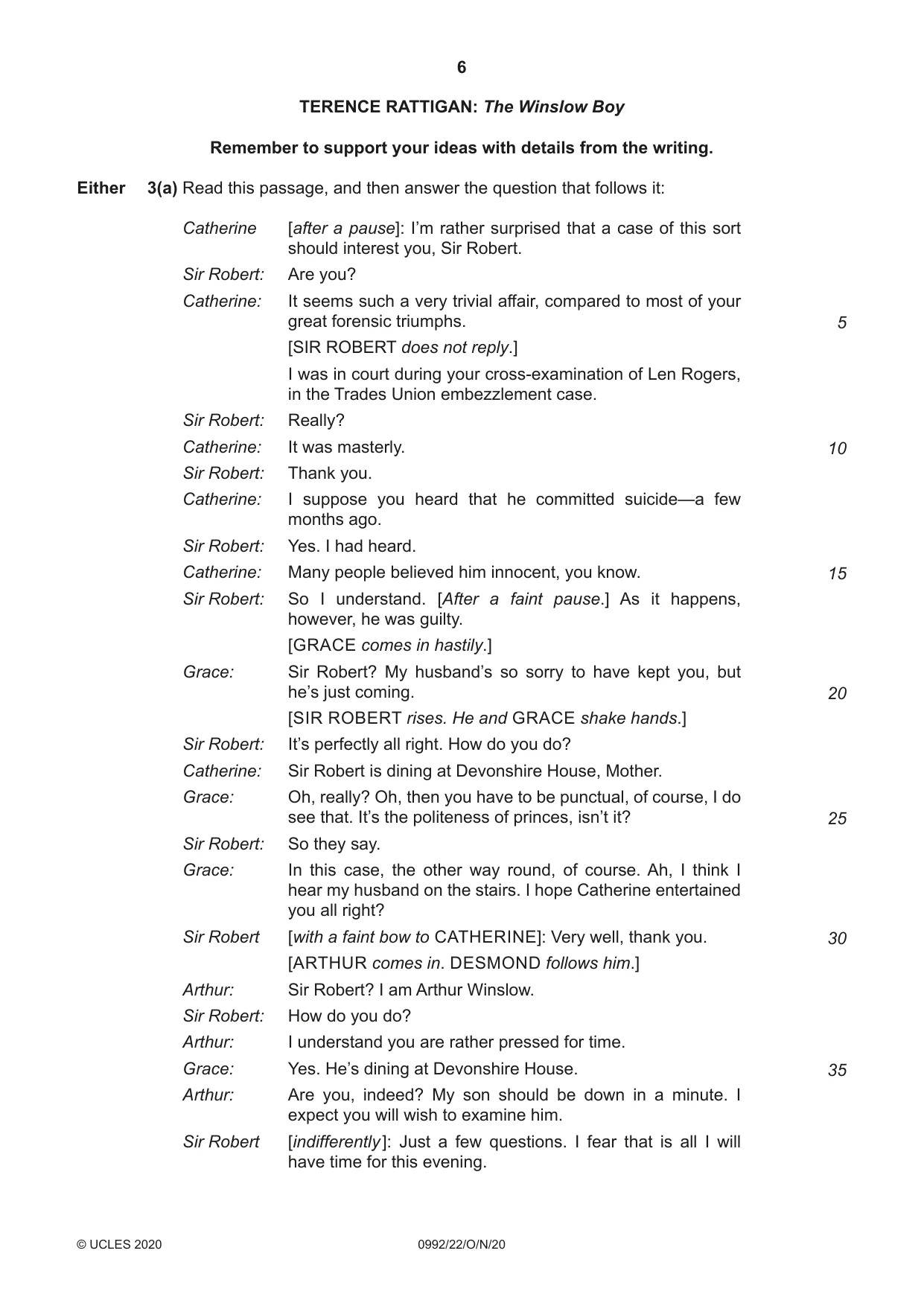
6 0992/22/O/N/20 © UCLES 2020 TERENCE RATTIGAN: The Winslow Boy Remember to support your ideas with details from the writing. Either 3(a) Read this passage, and then answer the question that follows it: Catherine [after a pause]: I’m rather surprised that a case of this sort should interest you, Sir Robert. Sir Robert: Are you? Catherine: It seems such a very trivial affair, compared to most of your great forensic triumphs. [SIR ROBERT does not reply.] I was in court during your cross-examination of Len Rogers, in the Trades Union embezzlement case. Sir Robert: Really? Catherine: It was masterly. Sir Robert: Thank you. Catherine: I suppose you heard that he committed suicide—a few months ago. Sir Robert: Yes. I had heard. Catherine: Many people believed him innocent, you know. Sir Robert: So I understand. [After a faint pause.] As it happens, however, he was guilty. [GRACE comes in hastily.] Grace: Sir Robert? My husband’s so sorry to have kept you, but he’s just coming. [SIR ROBERT rises. He and GRACE shake hands.] Sir Robert: It’s perfectly all right. How do you do? Catherine: Sir Robert is dining at Devonshire House, Mother. Grace: Oh, really? Oh, then you have to be punctual, of course, I do see that. It’s the politeness of princes, isn’t it? Sir Robert: So they say. Grace: In this case, the other way round, of course. Ah, I think I hear my husband on the stairs. I hope Catherine entertained you all right? Sir Robert [with a faint bow to CATHERINE]: Very well, thank you. [ARTHUR comes in. DESMOND follows him.] Arthur: Sir Robert? I am Arthur Winslow. Sir Robert: How do you do? Arthur: I understand you are rather pressed for time. Grace: Yes. He’s dining at Devonshire House. Arthur: Are you, indeed? My son should be down in a minute. I expect you will wish to examine him. Sir Robert [indifferently ]: Just a few questions. I fear that is all I will have time for this evening. 5 10 15 20 25 30 35
Question paper, page 7
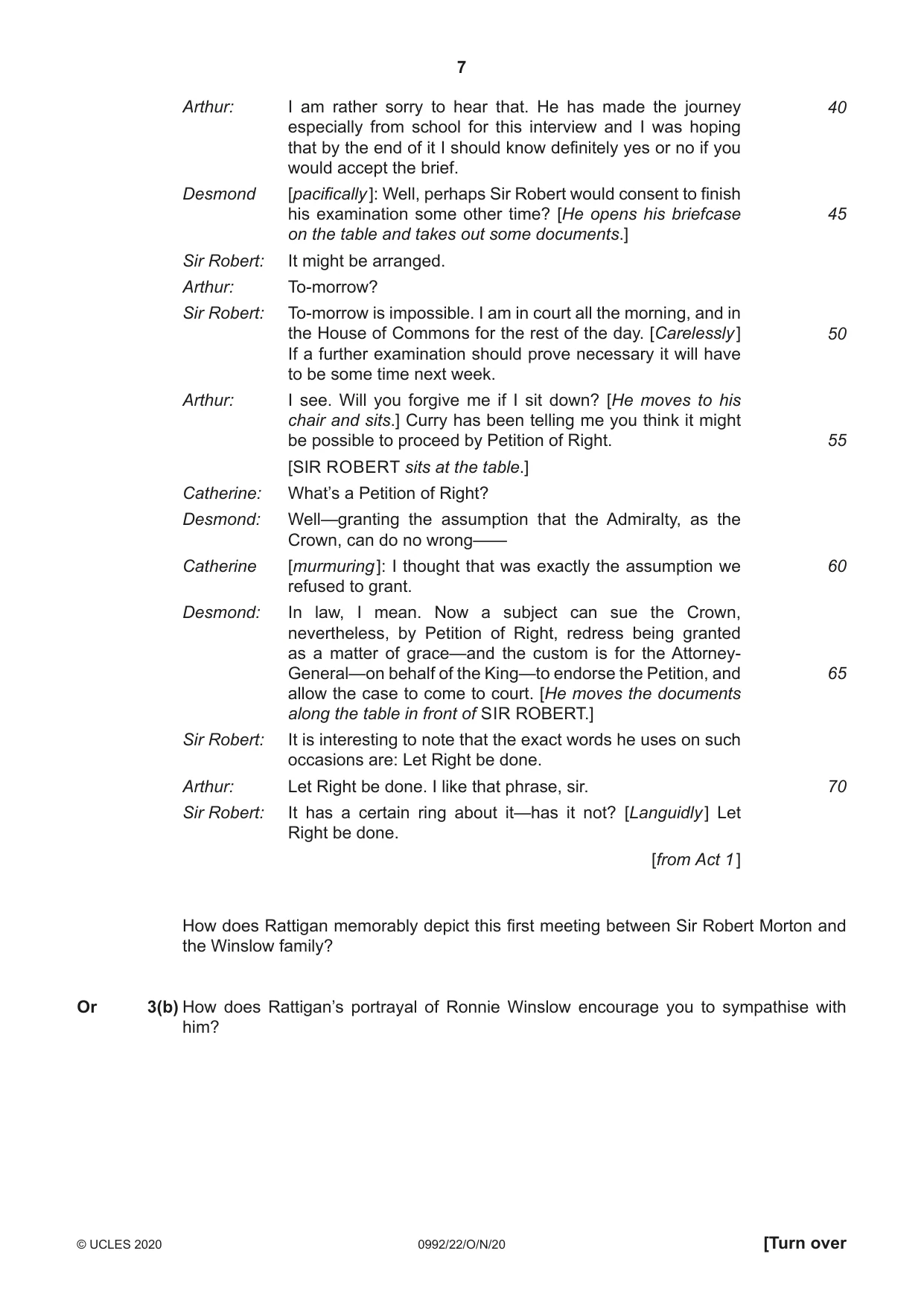
7 0992/22/O/N/20 © UCLES 2020 [Turn over Arthur: I am rather sorry to hear that. He has made the journey especially from school for this interview and I was hoping that by the end of it I should know definitely yes or no if you would accept the brief. Desmond [pacifically ]: Well, perhaps Sir Robert would consent to finish his examination some other time? [He opens his briefcase on the table and takes out some documents.] Sir Robert: It might be arranged. Arthur: To-morrow? Sir Robert: To-morrow is impossible. I am in court all the morning, and in the House of Commons for the rest of the day. [Carelessly ] If a further examination should prove necessary it will have to be some time next week. Arthur: I see. Will you forgive me if I sit down? [He moves to his chair and sits.] Curry has been telling me you think it might be possible to proceed by Petition of Right. [SIR ROBERT sits at the table.] Catherine: What’s a Petition of Right? Desmond: Well—granting the assumption that the Admiralty, as the Crown, can do no wrong—— Catherine [murmuring ]: I thought that was exactly the assumption we refused to grant. Desmond: In law, I mean. Now a subject can sue the Crown, nevertheless, by Petition of Right, redress being granted as a matter of grace—and the custom is for the Attorney- General—on behalf of the King—to endorse the Petition, and allow the case to come to court. [He moves the documents along the table in front of SIR ROBERT.] Sir Robert: It is interesting to note that the exact words he uses on such occasions are: Let Right be done. Arthur: Let Right be done. I like that phrase, sir. Sir Robert: It has a certain ring about it—has it not? [Languidly ] Let Right be done. [from Act 1 ] How does Rattigan memorably depict this first meeting between Sir Robert Morton and the Winslow family? Or 3(b) How does Rattigan’s portrayal of Ronnie Winslow encourage you to sympathise with him? 40 45 50 55 60 65 70
Question paper, page 8
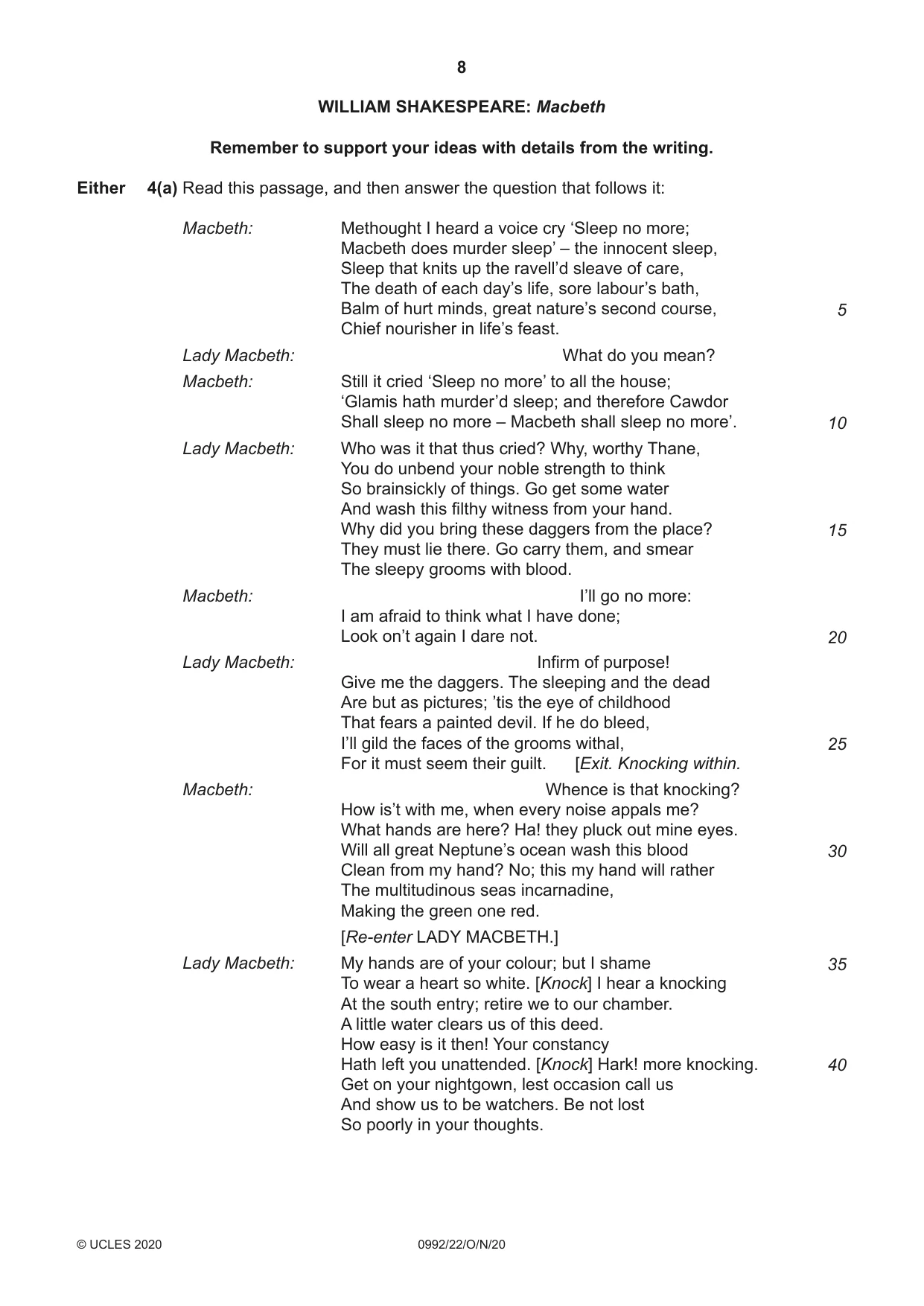
8 0992/22/O/N/20 © UCLES 2020 WILLIAM SHAKESPEARE: Macbeth Remember to support your ideas with details from the writing. Either 4(a) Read this passage, and then answer the question that follows it: Macbeth: Methought I heard a voice cry ‘Sleep no more; Macbeth does murder sleep’ – the innocent sleep, Sleep that knits up the ravell’d sleave of care, The death of each day’s life, sore labour’s bath, Balm of hurt minds, great nature’s second course, Chief nourisher in life’s feast. Lady Macbeth: What do you mean? Macbeth: Still it cried ‘Sleep no more’ to all the house; ‘Glamis hath murder’d sleep; and therefore Cawdor Shall sleep no more – Macbeth shall sleep no more’. Lady Macbeth: Who was it that thus cried? Why, worthy Thane, You do unbend your noble strength to think So brainsickly of things. Go get some water And wash this filthy witness from your hand. Why did you bring these daggers from the place? They must lie there. Go carry them, and smear The sleepy grooms with blood. Macbeth: I’ll go no more: I am afraid to think what I have done; Look on’t again I dare not. Lady Macbeth: Infirm of purpose! Give me the daggers. The sleeping and the dead Are but as pictures; ’tis the eye of childhood That fears a painted devil. If he do bleed, I’ll gild the faces of the grooms withal, For it must seem their guilt. [Exit. Knocking within. Macbeth: Whence is that knocking? How is’t with me, when every noise appals me? What hands are here? Ha! they pluck out mine eyes. Will all great Neptune’s ocean wash this blood Clean from my hand? No; this my hand will rather The multitudinous seas incarnadine, Making the green one red. [Re-enter LADY MACBETH.] Lady Macbeth: My hands are of your colour; but I shame To wear a heart so white. [Knock] I hear a knocking At the south entry; retire we to our chamber. A little water clears us of this deed. How easy is it then! Your constancy Hath left you unattended. [Knock] Hark! more knocking. Get on your nightgown, lest occasion call us And show us to be watchers. Be not lost So poorly in your thoughts. 5 10 15 20 25 30 35 40
Question paper, page 9
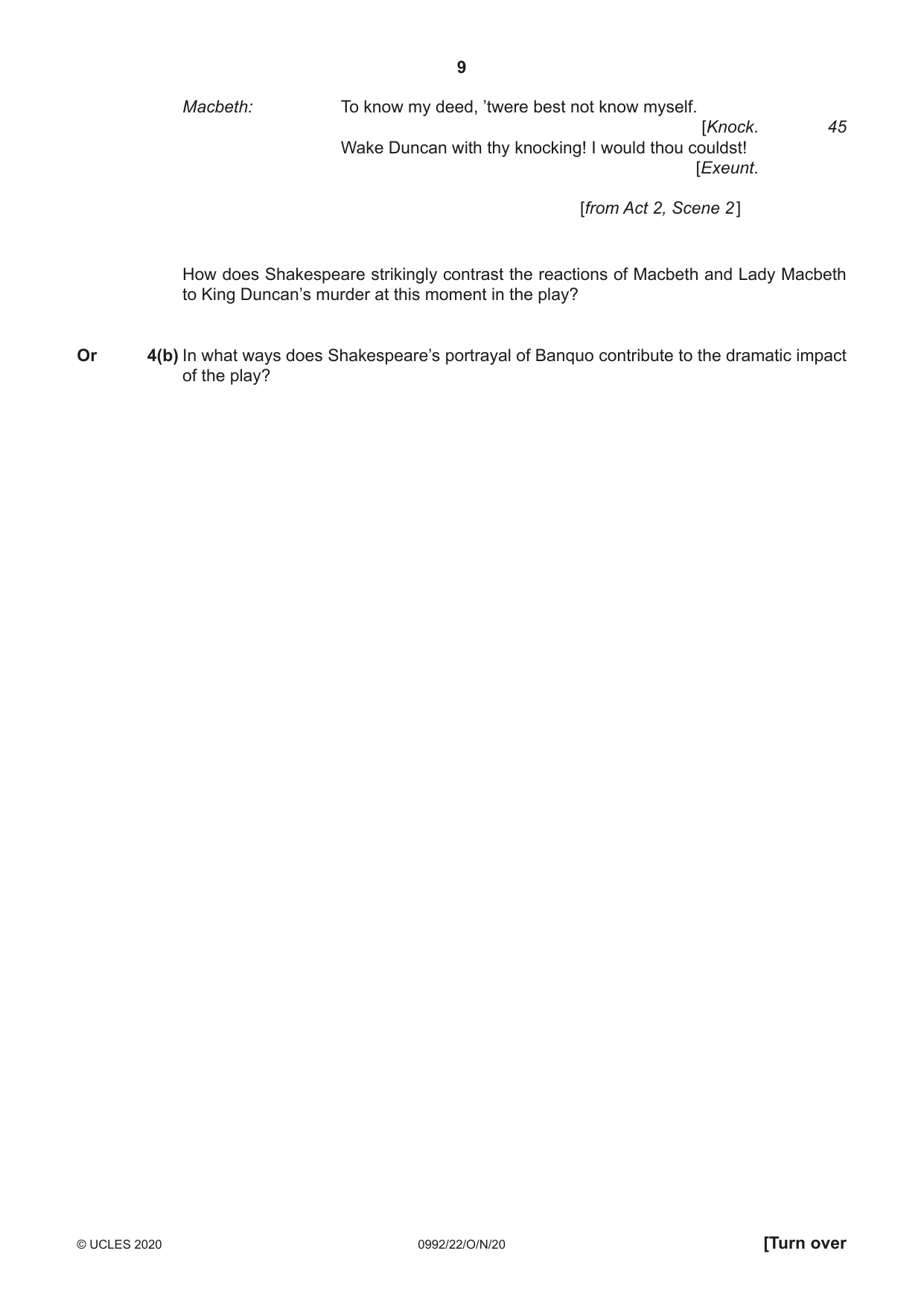
9 0992/22/O/N/20 © UCLES 2020 [Turn over Macbeth: To know my deed, ’twere best not know myself. [Knock. Wake Duncan with thy knocking! I would thou couldst! [Exeunt. [from Act 2, Scene 2 ] How does Shakespeare strikingly contrast the reactions of Macbeth and Lady Macbeth to King Duncan’s murder at this moment in the play? Or 4(b) In what ways does Shakespeare’s portrayal of Banquo contribute to the dramatic impact of the play? 45
Question paper, page 10
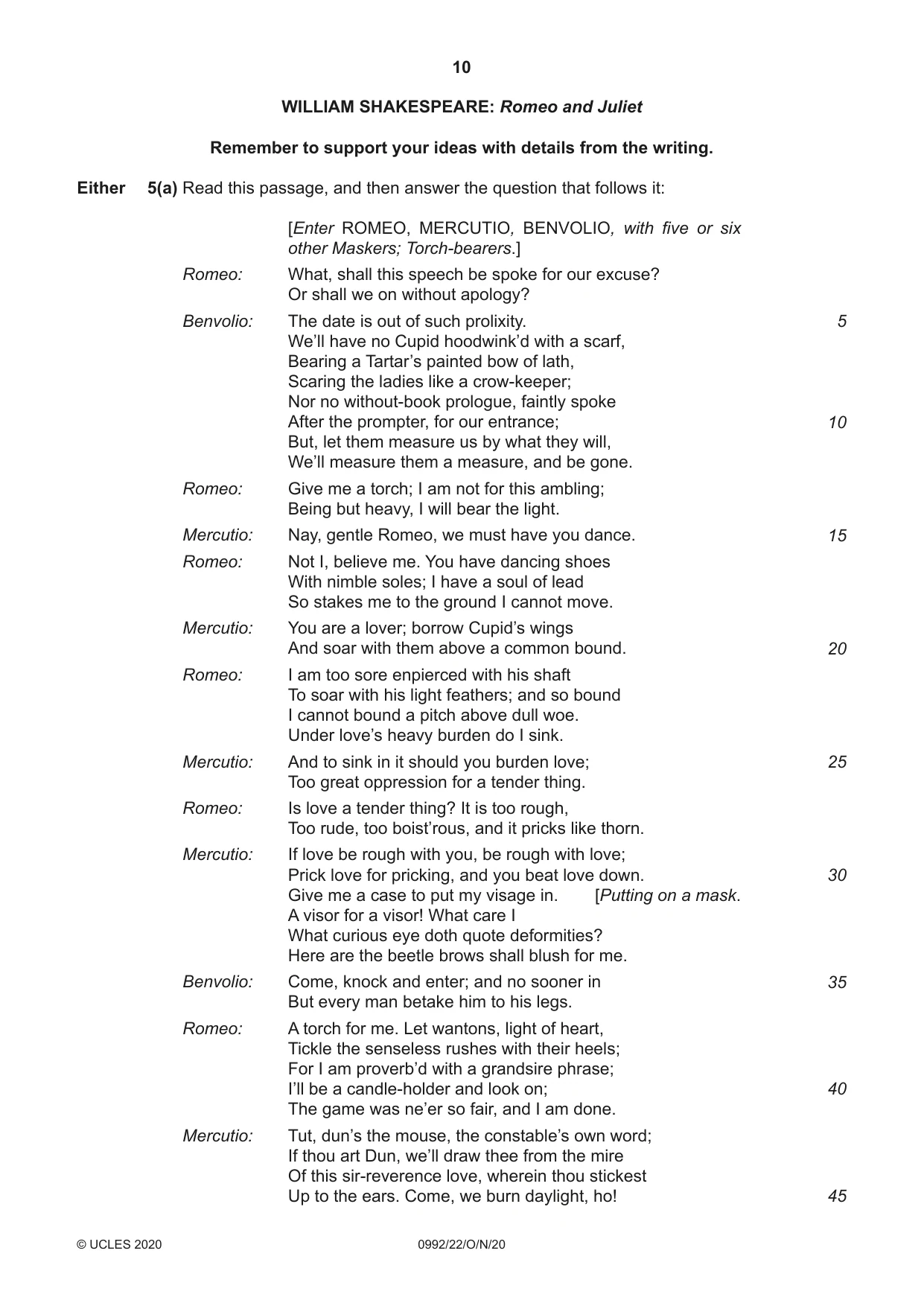
10 0992/22/O/N/20 © UCLES 2020 WILLIAM SHAKESPEARE: Romeo and Juliet Remember to support your ideas with details from the writing. Either 5(a) Read this passage, and then answer the question that follows it: [Enter ROMEO, MERCUTIO, BENVOLIO, with five or six other Maskers; Torch-bearers.] Romeo: What, shall this speech be spoke for our excuse? Or shall we on without apology? Benvolio: The date is out of such prolixity. We’ll have no Cupid hoodwink’d with a scarf, Bearing a Tartar’s painted bow of lath, Scaring the ladies like a crow-keeper; Nor no without-book prologue, faintly spoke After the prompter, for our entrance; But, let them measure us by what they will, We’ll measure them a measure, and be gone. Romeo: Give me a torch; I am not for this ambling; Being but heavy, I will bear the light. Mercutio: Nay, gentle Romeo, we must have you dance. Romeo: Not I, believe me. You have dancing shoes With nimble soles; I have a soul of lead So stakes me to the ground I cannot move. Mercutio: You are a lover; borrow Cupid’s wings And soar with them above a common bound. Romeo: I am too sore enpierced with his shaft To soar with his light feathers; and so bound I cannot bound a pitch above dull woe. Under love’s heavy burden do I sink. Mercutio: And to sink in it should you burden love; Too great oppression for a tender thing. Romeo: Is love a tender thing? It is too rough, Too rude, too boist’rous, and it pricks like thorn. Mercutio: If love be rough with you, be rough with love; Prick love for pricking, and you beat love down. Give me a case to put my visage in. [Putting on a mask. A visor for a visor! What care I What curious eye doth quote deformities? Here are the beetle brows shall blush for me. Benvolio: Come, knock and enter; and no sooner in But every man betake him to his legs. Romeo: A torch for me. Let wantons, light of heart, Tickle the senseless rushes with their heels; For I am proverb’d with a grandsire phrase; I’ll be a candle-holder and look on; The game was ne’er so fair, and I am done. Mercutio: Tut, dun’s the mouse, the constable’s own word; If thou art Dun, we’ll draw thee from the mire Of this sir-reverence love, wherein thou stickest Up to the ears. Come, we burn daylight, ho! 5 10 15 20 25 30 35 40 45
Question paper, page 11
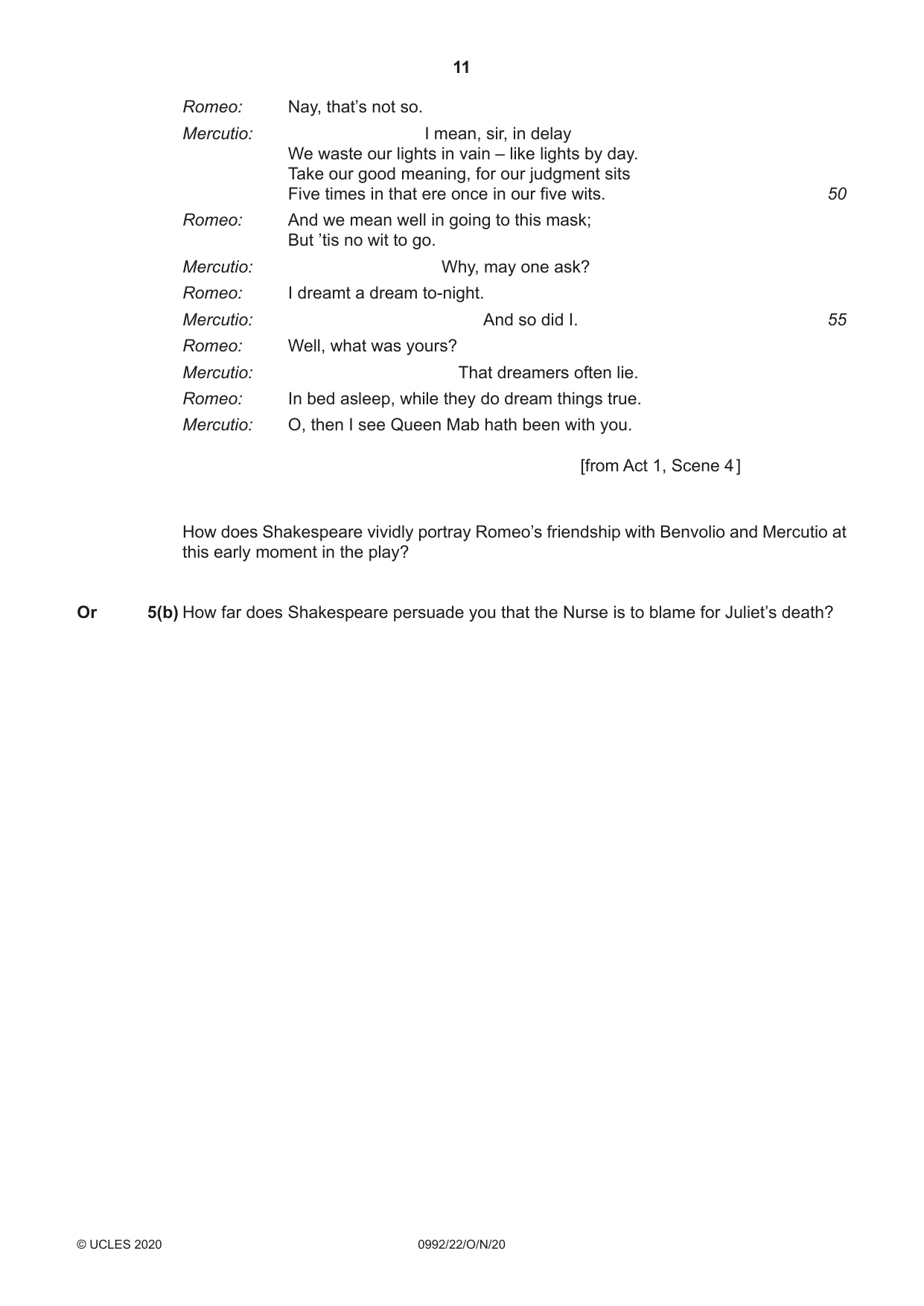
11 0992/22/O/N/20 © UCLES 2020 Romeo: Nay, that’s not so. Mercutio: I mean, sir, in delay We waste our lights in vain – like lights by day. Take our good meaning, for our judgment sits Five times in that ere once in our five wits. Romeo: And we mean well in going to this mask; But ’tis no wit to go. Mercutio: Why, may one ask? Romeo: I dreamt a dream to-night. Mercutio: And so did I. Romeo: Well, what was yours? Mercutio: That dreamers often lie. Romeo: In bed asleep, while they do dream things true. Mercutio: O, then I see Queen Mab hath been with you. [from Act 1, Scene 4 ] How does Shakespeare vividly portray Romeo’s friendship with Benvolio and Mercutio at this early moment in the play? Or 5(b) How far does Shakespeare persuade you that the Nurse is to blame for Juliet’s death? 50 55
Question paper, page 12
12 0992/22/O/N/20 © UCLES 2020 Permission to reproduce items where third-party owned material protected by copyright is included has been sought and cleared where possible. Every reasonable effort has been made by the publisher (UCLES) to trace copyright holders, but if any items requiring clearance have unwittingly been included, the publisher will be pleased to make amends at the earliest possible opportunity. To avoid the issue of disclosure of answer-related information to candidates, all copyright acknowledgements are reproduced online in the Cambridge Assessment International Education Copyright Acknowledgements Booklet. This is produced for each series of examinations and is freely available to download at www.cambridgeinternational.org after the live examination series. Cambridge Assessment International Education is part of the Cambridge Assessment Group. Cambridge Assessment is the brand name of the University of Cambridge Local Examinations Syndicate (UCLES), which itself is a department of the University of Cambridge. BLANK PAGE
Mark scheme, page 1
This document consists of 7 printed pages. © UCLES 2020 [Turn over Cambridge IGCSE™ (9–1) LITERATURE IN ENGLISH 0992/22 Paper 2 Drama 22 October/November 2020 MARK SCHEME Maximum Mark: Published This mark scheme is published as an aid to teachers and candidates, to indicate the requirements of the examination. It shows the basis on which Examiners were instructed to award marks. It does not indicate the details of the discussions that took place at an Examiners’ meeting before marking began, which would have considered the acceptability of alternative answers. Mark schemes should be read in conjunction with the question paper and the Principal Examiner Report for Teachers. Cambridge International will not enter into discussions about these mark schemes. Cambridge International is publishing the mark schemes for the October/November 2020 series for most Cambridge IGCSE™, Cambridge International A and AS Level and Cambridge Pre-U components, and some Cambridge O Level components.
Mark scheme, page 2
0992/22 Cambridge IGCSE (9–1) – Mark Scheme PUBLISHED October/November 2020 © UCLES 2020 Page 2 of 7 Generic Marking Principles These general marking principles must be applied by all examiners when marking candidate answers. They should be applied alongside the specific content of the mark scheme or generic level descriptors for a question. Each question paper and mark scheme will also comply with these marking principles. GENERIC MARKING PRINCIPLE 1: Marks must be awarded in line with: • the specific content of the mark scheme or the generic level descriptors for the question • the specific skills defined in the mark scheme or in the generic level descriptors for the question • the standard of response required by a candidate as exemplified by the standardisation scripts. GENERIC MARKING PRINCIPLE 2: Marks awarded are always whole marks (not half marks, or other fractions). GENERIC MARKING PRINCIPLE 3: Marks must be awarded positively: • marks are awarded for correct/valid answers, as defined in the mark scheme. However, credit is given for valid answers which go beyond the scope of the syllabus and mark scheme, referring to your Team Leader as appropriate • marks are awarded when candidates clearly demonstrate what they know and can do • marks are not deducted for errors • marks are not deducted for omissions • answers should only be judged on the quality of spelling, punctuation and grammar when these features are specifically assessed by the question as indicated by the mark scheme. The meaning, however, should be unambiguous. GENERIC MARKING PRINCIPLE 4: Rules must be applied consistently, e.g. in situations where candidates have not followed instructions or in the application of generic level descriptors. GENERIC MARKING PRINCIPLE 5: Marks should be awarded using the full range of marks defined in the mark scheme for the question (however; the use of the full mark range may be limited according to the quality of the candidate responses seen). GENERIC MARKING PRINCIPLE 6: Marks awarded are based solely on the requirements as defined in the mark scheme. Marks should not be awarded with grade thresholds or grade descriptors in mind.
Mark scheme, page 3
0992/22 Cambridge IGCSE (9–1) – Mark Scheme PUBLISHED October/November 2020 © UCLES 2020 Page 3 of 7 For general administrative guidance, see Notes for Examiners Handbook. All questions are marked out of 25. Assessment Objectives The Assessment Objectives are evenly weighted across each question. The assessment objectives for the paper are: AO1 show detailed knowledge of the content of literary texts, supported by reference to the text AO2 understand the meanings of literary texts and their context, and explore texts beyond surface meaning to show deeper awareness of ideas and attitudes AO3 recognise and appreciate ways in which writers use language, structure, and form to create and shape meanings and effects AO4 communicate a sensitive and informed personal response The Band Descriptors cover marks from 0 to 25 and apply to the marking of each question. They guide examiners to an understanding of the qualities normally expected of, or typical of, work in a band. They are a means of general guidance and must not be interpreted as hurdle statements. For the purposes of standardisation of marking, they are to be used in conjunction with the Practice and Standardisation scripts discussed during the coordination meeting and with Team Leaders, as well as the question-specific notes. The supplementary notes for each question are related to the assessment objectives above. Because of the nature of the subject, they are for general guidance; they are not designed as prescriptions of required content and must not be treated as such. The syllabus aims at encouraging candidates to make some personal response to their reading. While there are legitimate expectations of the content of most answers, examiners may see responses that include ideas not covered in the supplementary guidance. For these cases, examiners should credit valid responses fairly and not penalise candidates for including valid points outside the mark scheme. Do not refer to indicative content notes on scripts.
Mark scheme, page 4
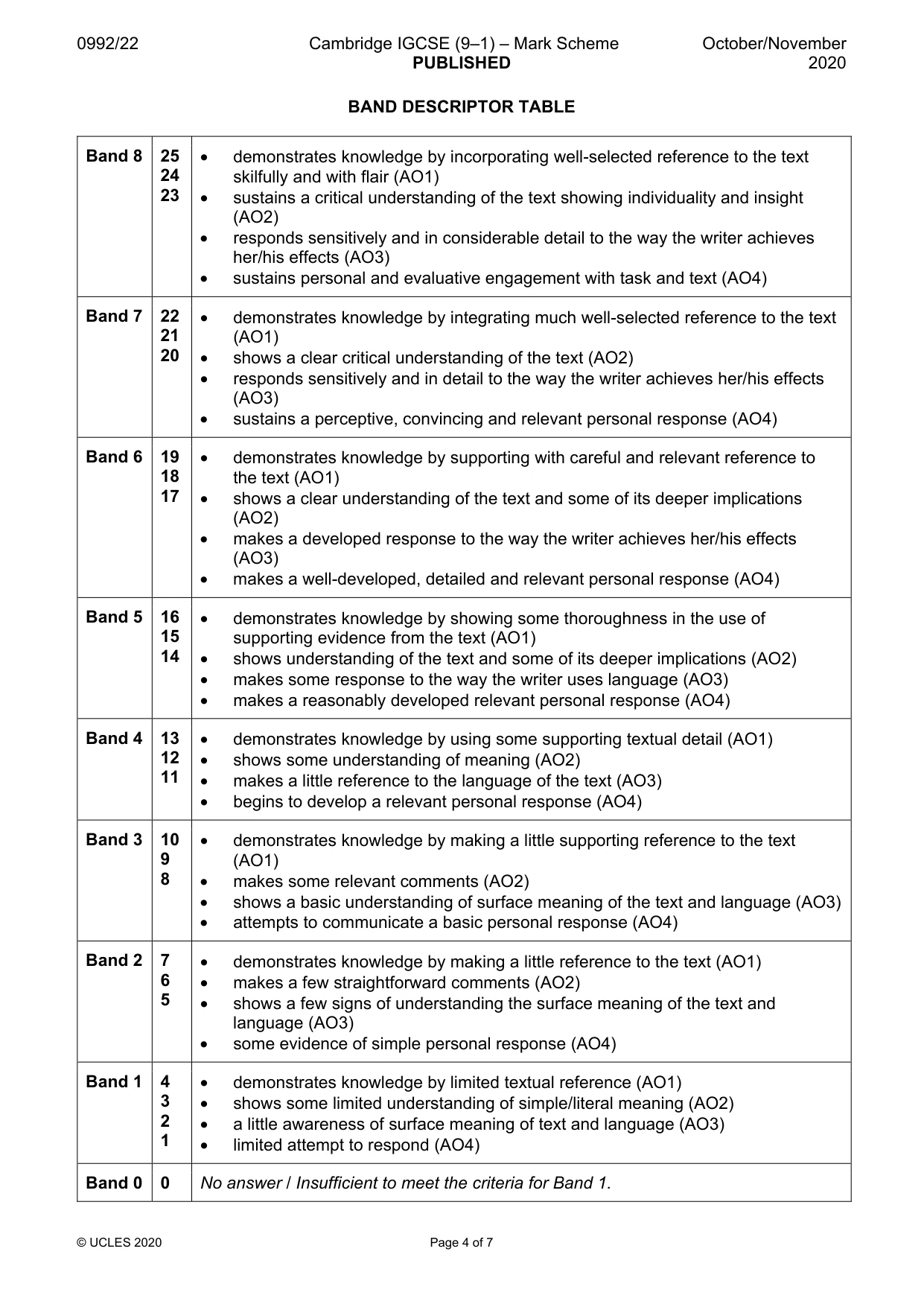
0992/22 Cambridge IGCSE (9–1) – Mark Scheme PUBLISHED October/November 2020 © UCLES 2020 Page 4 of 7 BAND DESCRIPTOR TABLE Band 8 25 24 23 • demonstrates knowledge by incorporating well-selected reference to the text skilfully and with flair (AO1) • sustains a critical understanding of the text showing individuality and insight (AO2) • responds sensitively and in considerable detail to the way the writer achieves her/his effects (AO3) • sustains personal and evaluative engagement with task and text (AO4) Band 7 22 21 20 • demonstrates knowledge by integrating much well-selected reference to the text (AO1) • shows a clear critical understanding of the text (AO2) • responds sensitively and in detail to the way the writer achieves her/his effects (AO3) • sustains a perceptive, convincing and relevant personal response (AO4) Band 6 19 18 17 • demonstrates knowledge by supporting with careful and relevant reference to the text (AO1) • shows a clear understanding of the text and some of its deeper implications (AO2) • makes a developed response to the way the writer achieves her/his effects (AO3) • makes a well-developed, detailed and relevant personal response (AO4) Band 5 16 15 14 • demonstrates knowledge by showing some thoroughness in the use of supporting evidence from the text (AO1) • shows understanding of the text and some of its deeper implications (AO2) • makes some response to the way the writer uses language (AO3) • makes a reasonably developed relevant personal response (AO4) Band 4 13 12 11 • demonstrates knowledge by using some supporting textual detail (AO1) • shows some understanding of meaning (AO2) • makes a little reference to the language of the text (AO3) • begins to develop a relevant personal response (AO4) Band 3 10 9 8 • demonstrates knowledge by making a little supporting reference to the text (AO1) • makes some relevant comments (AO2) • shows a basic understanding of surface meaning of the text and language (AO3) • attempts to communicate a basic personal response (AO4) Band 2 7 6 5 • demonstrates knowledge by making a little reference to the text (AO1) • makes a few straightforward comments (AO2) • shows a few signs of understanding the surface meaning of the text and language (AO3) • some evidence of simple personal response (AO4) Band 1 4 3 2 1 • demonstrates knowledge by limited textual reference (AO1) • shows some limited understanding of simple/literal meaning (AO2) • a little awareness of surface meaning of text and language (AO3) • limited attempt to respond (AO4) Band 0 0 No answer / Insufficient to meet the criteria for Band 1.
Mark scheme, page 5
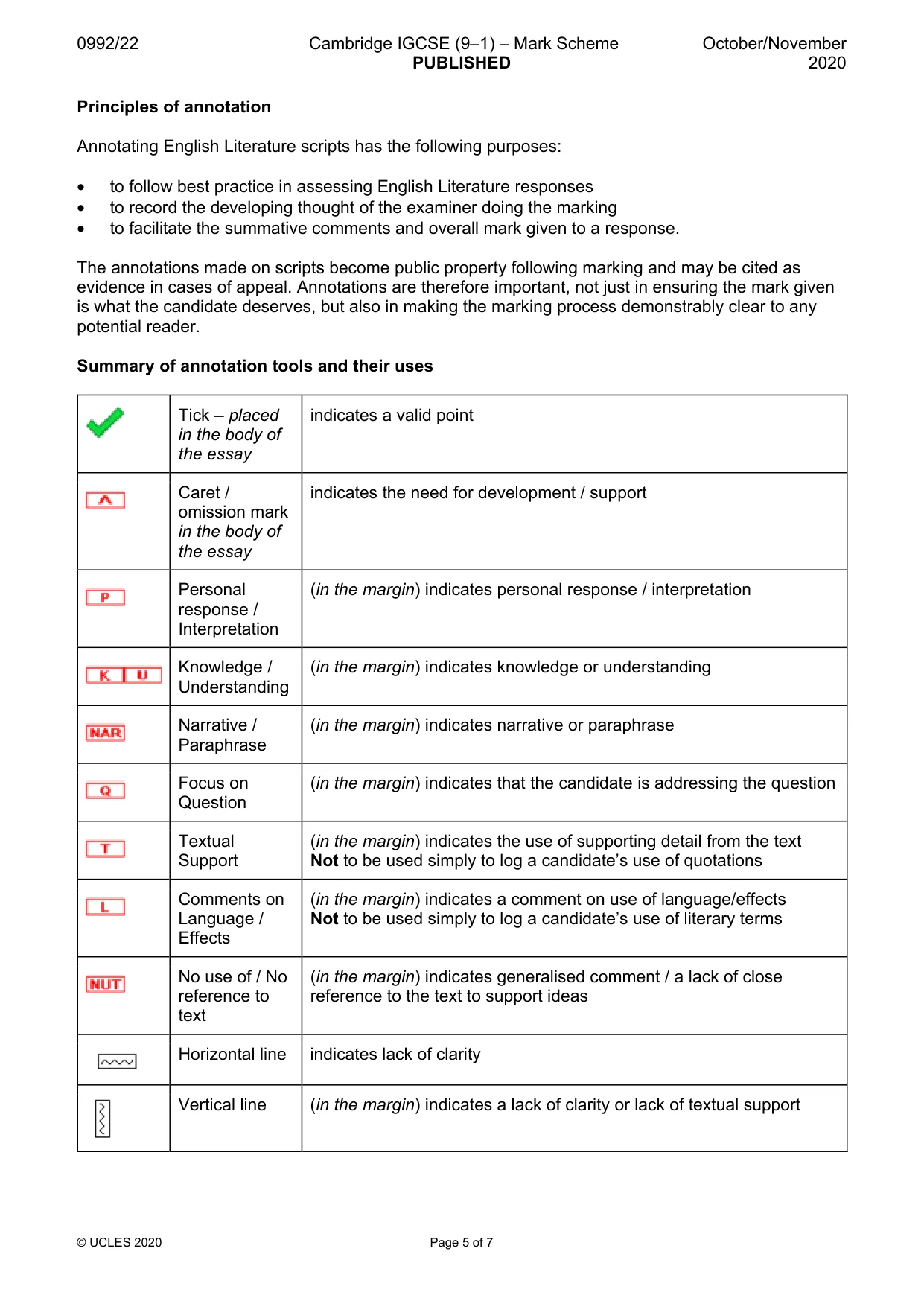
0992/22 Cambridge IGCSE (9–1) – Mark Scheme PUBLISHED October/November 2020 © UCLES 2020 Page 5 of 7 Principles of annotation Annotating English Literature scripts has the following purposes: • to follow best practice in assessing English Literature responses • to record the developing thought of the examiner doing the marking • to facilitate the summative comments and overall mark given to a response. The annotations made on scripts become public property following marking and may be cited as evidence in cases of appeal. Annotations are therefore important, not just in ensuring the mark given is what the candidate deserves, but also in making the marking process demonstrably clear to any potential reader. Summary of annotation tools and their uses Tick – placed in the body of the essay indicates a valid point Caret / omission mark in the body of the essay indicates the need for development / support Personal response / Interpretation (in the margin) indicates personal response / interpretation Knowledge / Understanding (in the margin) indicates knowledge or understanding Narrative / Paraphrase (in the margin) indicates narrative or paraphrase Focus on Question (in the margin) indicates that the candidate is addressing the question Textual Support (in the margin) indicates the use of supporting detail from the text Not to be used simply to log a candidate’s use of quotations Comments on Language / Effects (in the margin) indicates a comment on use of language/effects Not to be used simply to log a candidate’s use of literary terms No use of / No reference to text (in the margin) indicates generalised comment / a lack of close reference to the text to support ideas Horizontal line indicates lack of clarity Vertical line (in the margin) indicates a lack of clarity or lack of textual support
Mark scheme, page 6
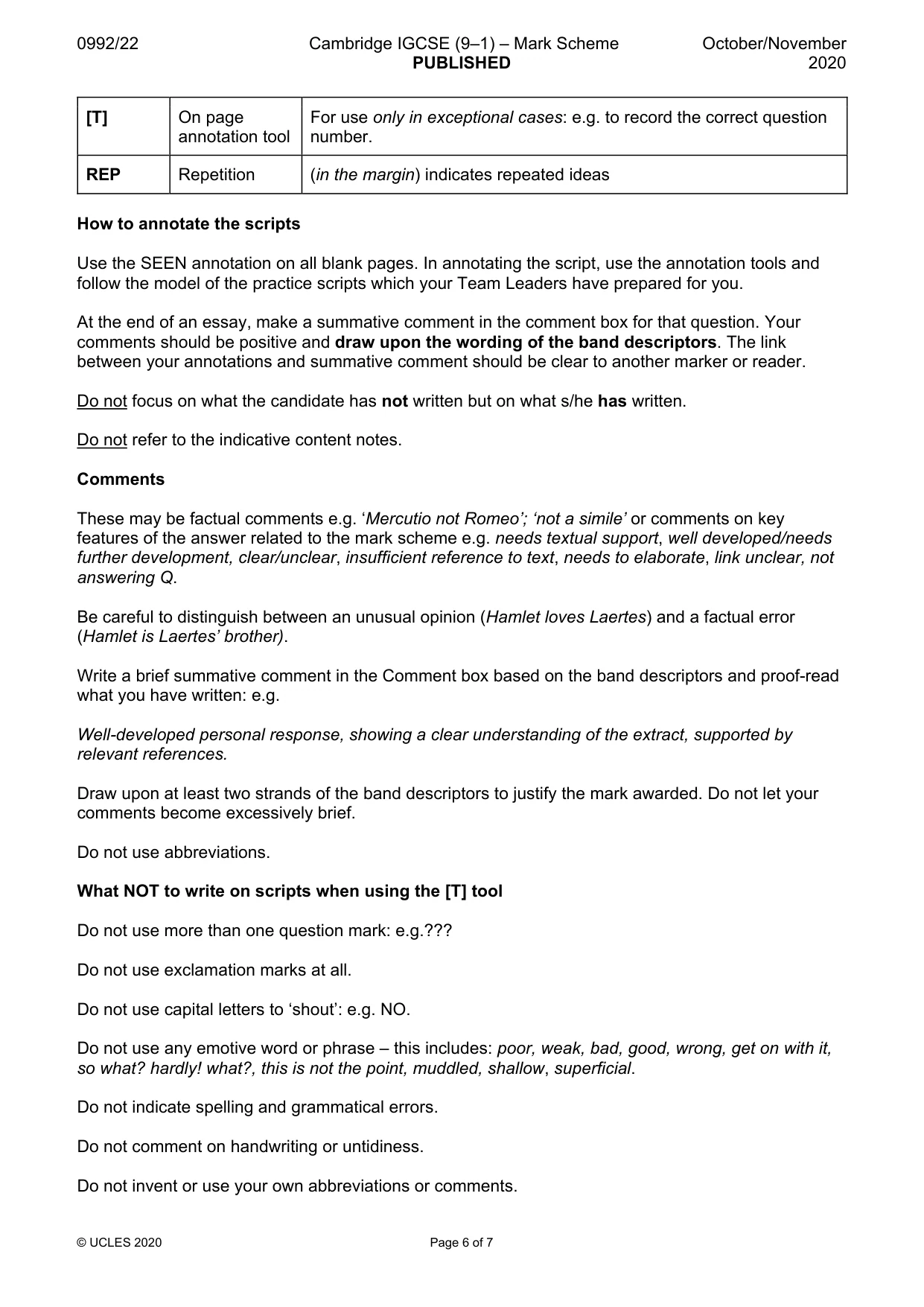
0992/22 Cambridge IGCSE (9–1) – Mark Scheme PUBLISHED October/November 2020 © UCLES 2020 Page 6 of 7 [T] On page annotation tool For use only in exceptional cases: e.g. to record the correct question number. REP Repetition (in the margin) indicates repeated ideas How to annotate the scripts Use the SEEN annotation on all blank pages. In annotating the script, use the annotation tools and follow the model of the practice scripts which your Team Leaders have prepared for you. At the end of an essay, make a summative comment in the comment box for that question. Your comments should be positive and draw upon the wording of the band descriptors. The link between your annotations and summative comment should be clear to another marker or reader. Do not focus on what the candidate has not written but on what s/he has written. Do not refer to the indicative content notes. Comments These may be factual comments e.g. ‘Mercutio not Romeo’; ‘not a simile’ or comments on key features of the answer related to the mark scheme e.g. needs textual support, well developed/needs further development, clear/unclear, insufficient reference to text, needs to elaborate, link unclear, not answering Q. Be careful to distinguish between an unusual opinion (Hamlet loves Laertes) and a factual error (Hamlet is Laertes’ brother). Write a brief summative comment in the Comment box based on the band descriptors and proof-read what you have written: e.g. Well-developed personal response, showing a clear understanding of the extract, supported by relevant references. Draw upon at least two strands of the band descriptors to justify the mark awarded. Do not let your comments become excessively brief. Do not use abbreviations. What NOT to write on scripts when using the [T] tool Do not use more than one question mark: e.g.??? Do not use exclamation marks at all. Do not use capital letters to ‘shout’: e.g. NO. Do not use any emotive word or phrase – this includes: poor, weak, bad, good, wrong, get on with it, so what? hardly! what?, this is not the point, muddled, shallow, superficial. Do not indicate spelling and grammatical errors. Do not comment on handwriting or untidiness. Do not invent or use your own abbreviations or comments.
Mark scheme, page 7
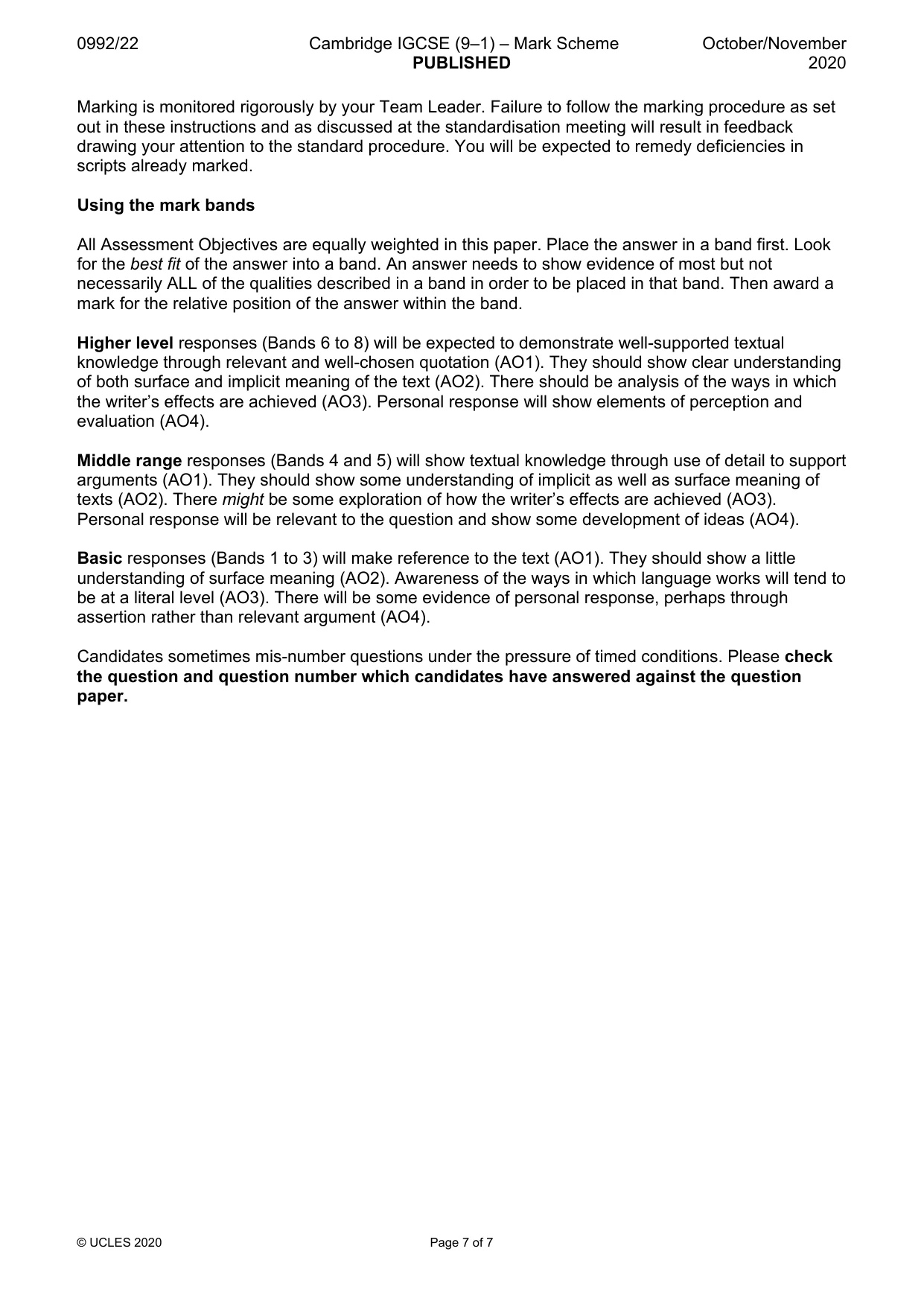
0992/22 Cambridge IGCSE (9–1) – Mark Scheme PUBLISHED October/November 2020 © UCLES 2020 Page 7 of 7 Marking is monitored rigorously by your Team Leader. Failure to follow the marking procedure as set out in these instructions and as discussed at the standardisation meeting will result in feedback drawing your attention to the standard procedure. You will be expected to remedy deficiencies in scripts already marked. Using the mark bands All Assessment Objectives are equally weighted in this paper. Place the answer in a band first. Look for the best fit of the answer into a band. An answer needs to show evidence of most but not necessarily ALL of the qualities described in a band in order to be placed in that band. Then award a mark for the relative position of the answer within the band. Higher level responses (Bands 6 to 8) will be expected to demonstrate well-supported textual knowledge through relevant and well-chosen quotation (AO1). They should show clear understanding of both surface and implicit meaning of the text (AO2). There should be analysis of the ways in which the writer’s effects are achieved (AO3). Personal response will show elements of perception and evaluation (AO4). Middle range responses (Bands 4 and 5) will show textual knowledge through use of detail to support arguments (AO1). They should show some understanding of implicit as well as surface meaning of texts (AO2). There might be some exploration of how the writer’s effects are achieved (AO3). Personal response will be relevant to the question and show some development of ideas (AO4). Basic responses (Bands 1 to 3) will make reference to the text (AO1). They should show a little understanding of surface meaning (AO2). Awareness of the ways in which language works will tend to be at a literal level (AO3). There will be some evidence of personal response, perhaps through assertion rather than relevant argument (AO4). Candidates sometimes mis-number questions under the pressure of timed conditions. Please check the question and question number which candidates have answered against the question paper.
What you needed in this session
Cambridge’s own grade thresholds for 2020 Oct/Nov, Paper 2 · Variant 2. A higher threshold means an easier paper — the bar moves with how the cohort did.