Cambridge IGCSE English - Literature in English (9-1) 0992 — 2020 May/June Paper 2 · Variant 2
0992/22/M/J/20
The question paper and its mark scheme, free to read here and free to download. This is Cambridge’s own paper, exactly as it was sat.
Question paper12 pages
Mark scheme4 pages
Answers below. Sit the paper first if you are practising.
Paper as text
Question paper, page 1
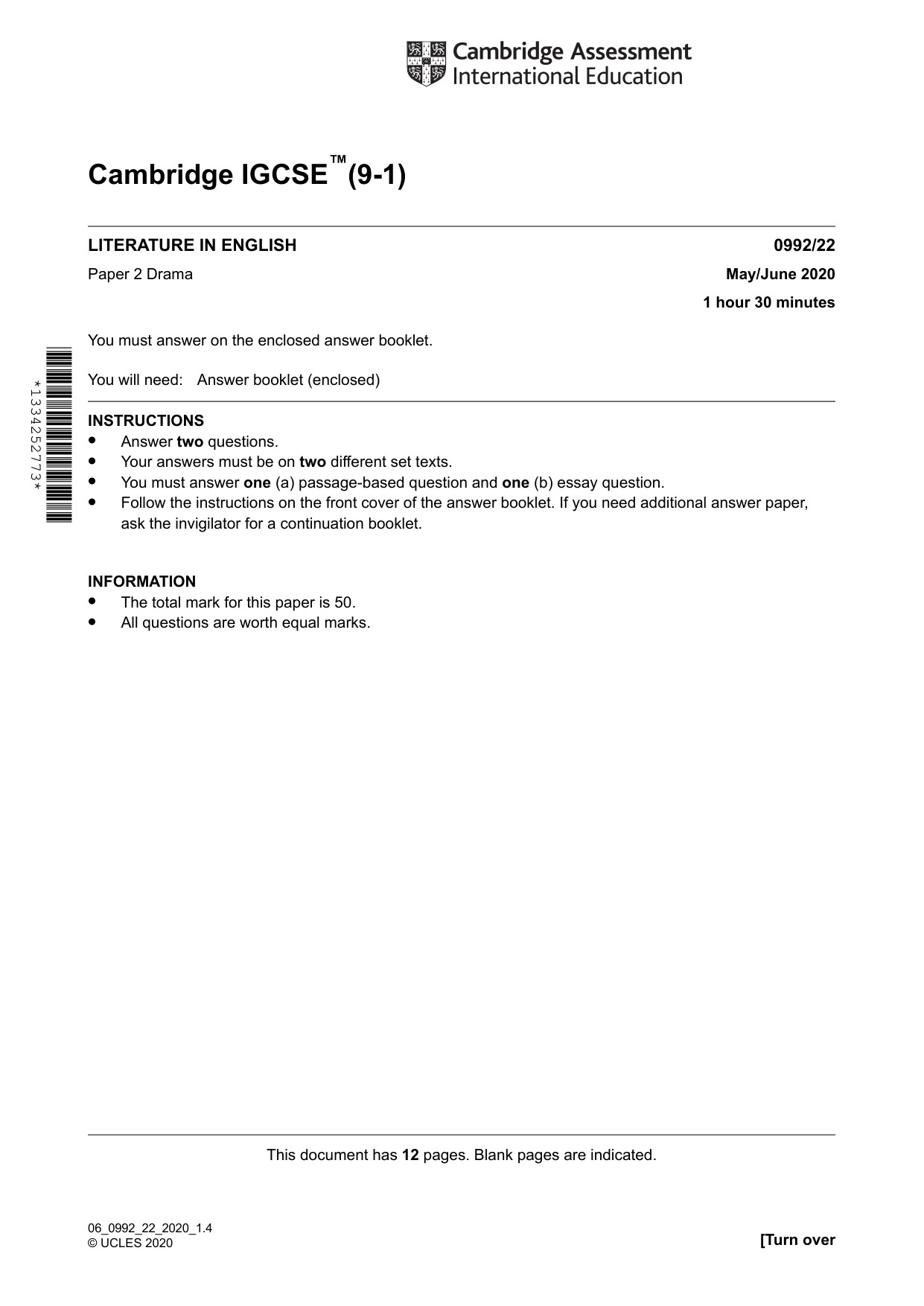
Cambridge IGCSE™(9-1) 0992/22 LITERATURE IN ENGLISH May/June 2020 Paper 2 Drama 1 hour 30 minutes You must answer on the enclosed answer booklet. You will need: Answer booklet (enclosed) INSTRUCTIONS • Answer two questions. • Your answers must be on two different set texts. • You must answer one (a) passage-based question and one (b) essay question. • Follow the instructions on the front cover of the answer booklet. If you need additional answer paper, ask the invigilator for a continuation booklet. INFORMATION • The total mark for this paper is 50. • All questions are worth equal marks. This document has 12 pages. Blank pages are indicated. [Turn over 06_0992_22_2020_1.4 © UCLES 2020 *1334252773*
Question paper, page 2
LORRAINE HANSBERRY: A Raisin in the Sun Remember to support your ideas with details from the text. Either 1(a) Read this passage, and then answer the question that follows it: BENEATHA goes to the door and opens it as WALTER and RUTH go on with the clowning. 06_0992_22_2020_1.4 © UCLES 2020 2 Content removed due to copyright restrictions.
Question paper, page 3
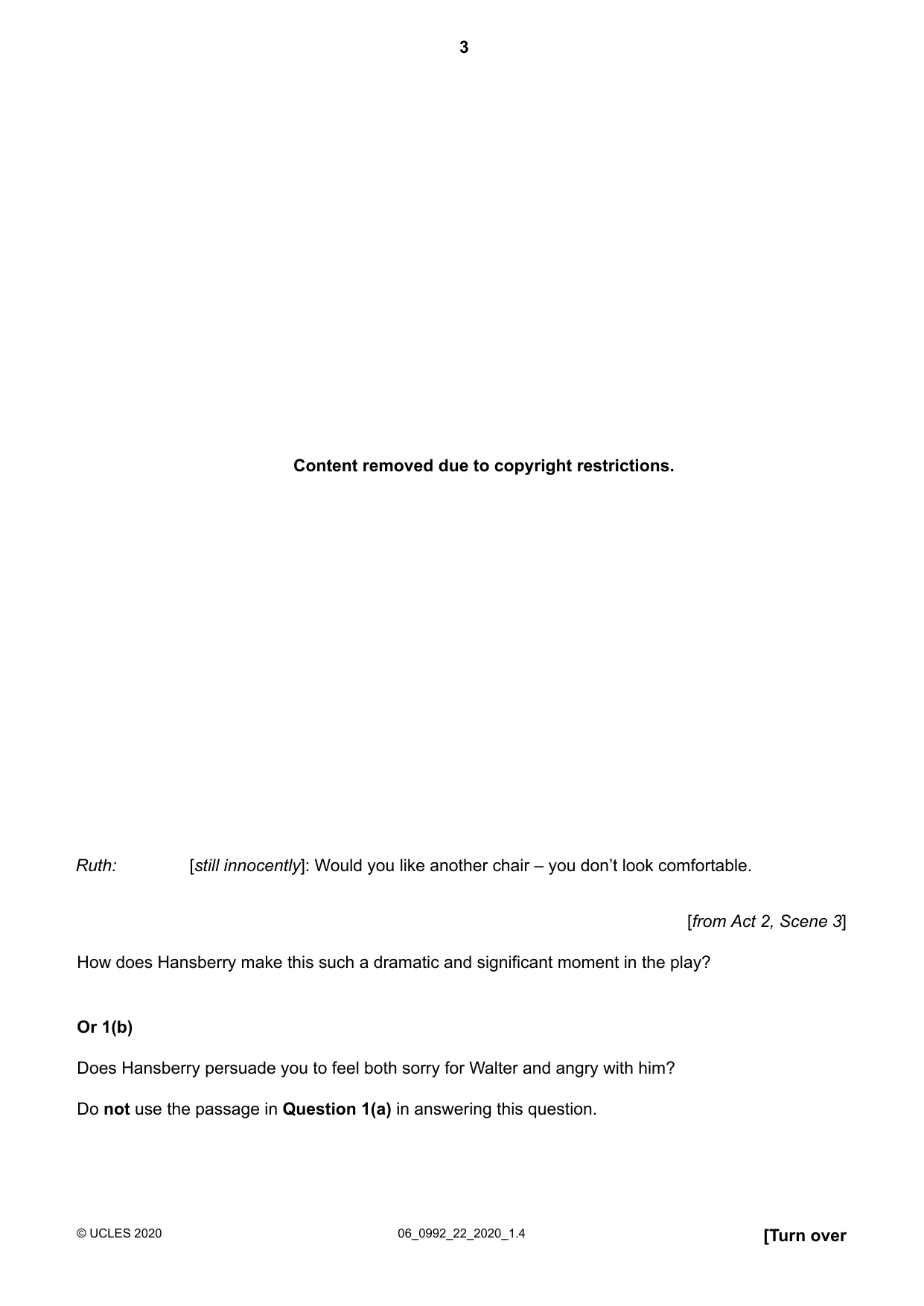
[still innocently]: Would you like another chair – you don’t look comfortable. Ruth: [from Act 2, Scene 3] How does Hansberry make this such a dramatic and significant moment in the play? Or 1(b) Does Hansberry persuade you to feel both sorry for Walter and angry with him? Do not use the passage in Question 1(a) in answering this question. [Turn over 06_0992_22_2020_1.4 © UCLES 2020 3 Content removed due to copyright restrictions.
Question paper, page 4
ARTHUR MILLER: The Crucible Remember to support your ideas with details from the text. Either 2(a) Read this passage, and then answer the question that follows it: Sit you down, sir. Hale: 06_0992_22_2020_1.4 © UCLES 2020 4 Content removed due to copyright restrictions.
Question paper, page 5
What’s your suspicion, Mr Hale? [from Act 2] In what ways does Miller make this such a disturbing moment in the play? Or 2(b) How far does Miller’s portrayal of Abigail Williams make it possible for you to have any sympathy for her? [Turn over 06_0992_22_2020_1.4 © UCLES 2020 5 Content removed due to copyright restrictions.
Question paper, page 6
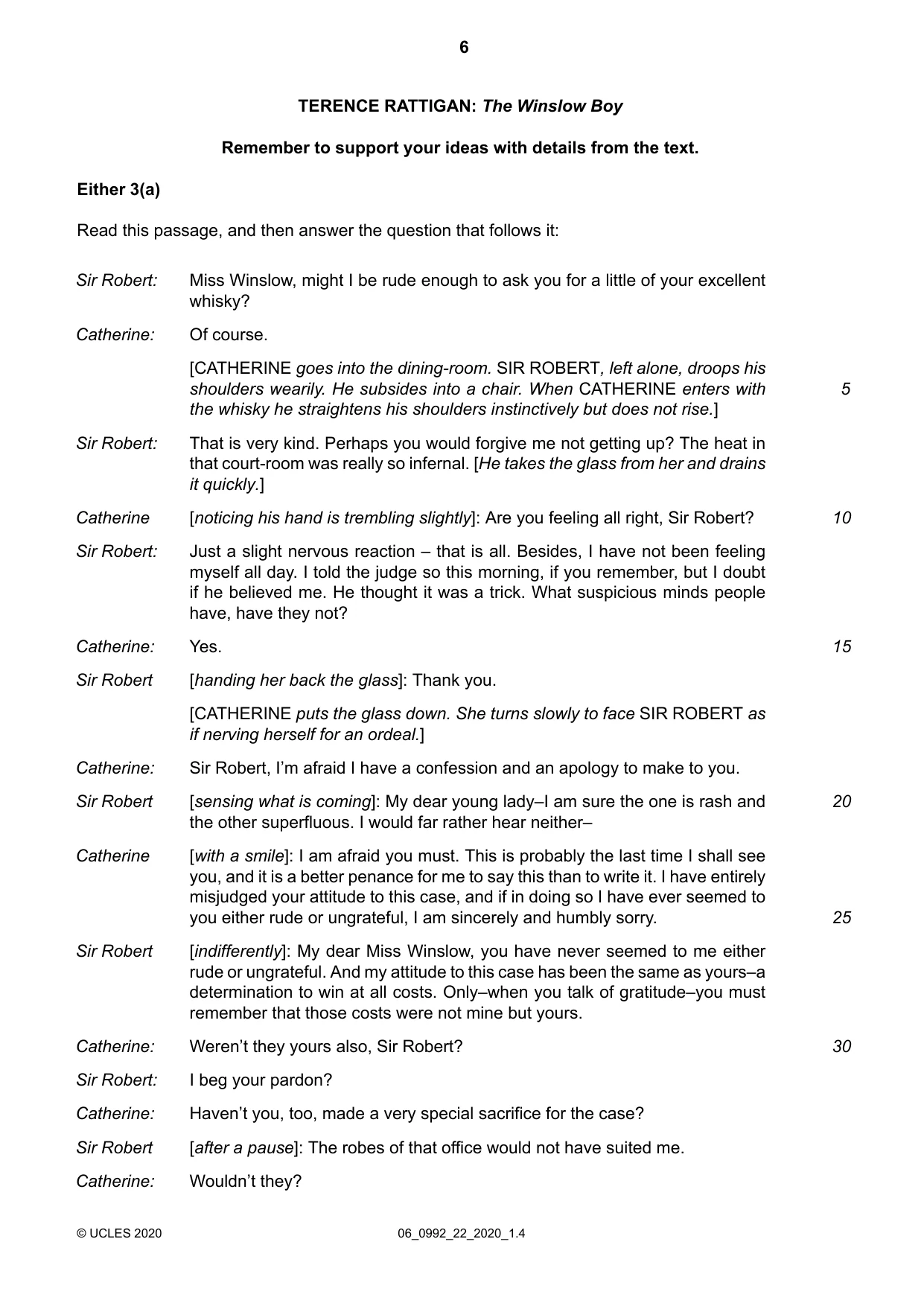
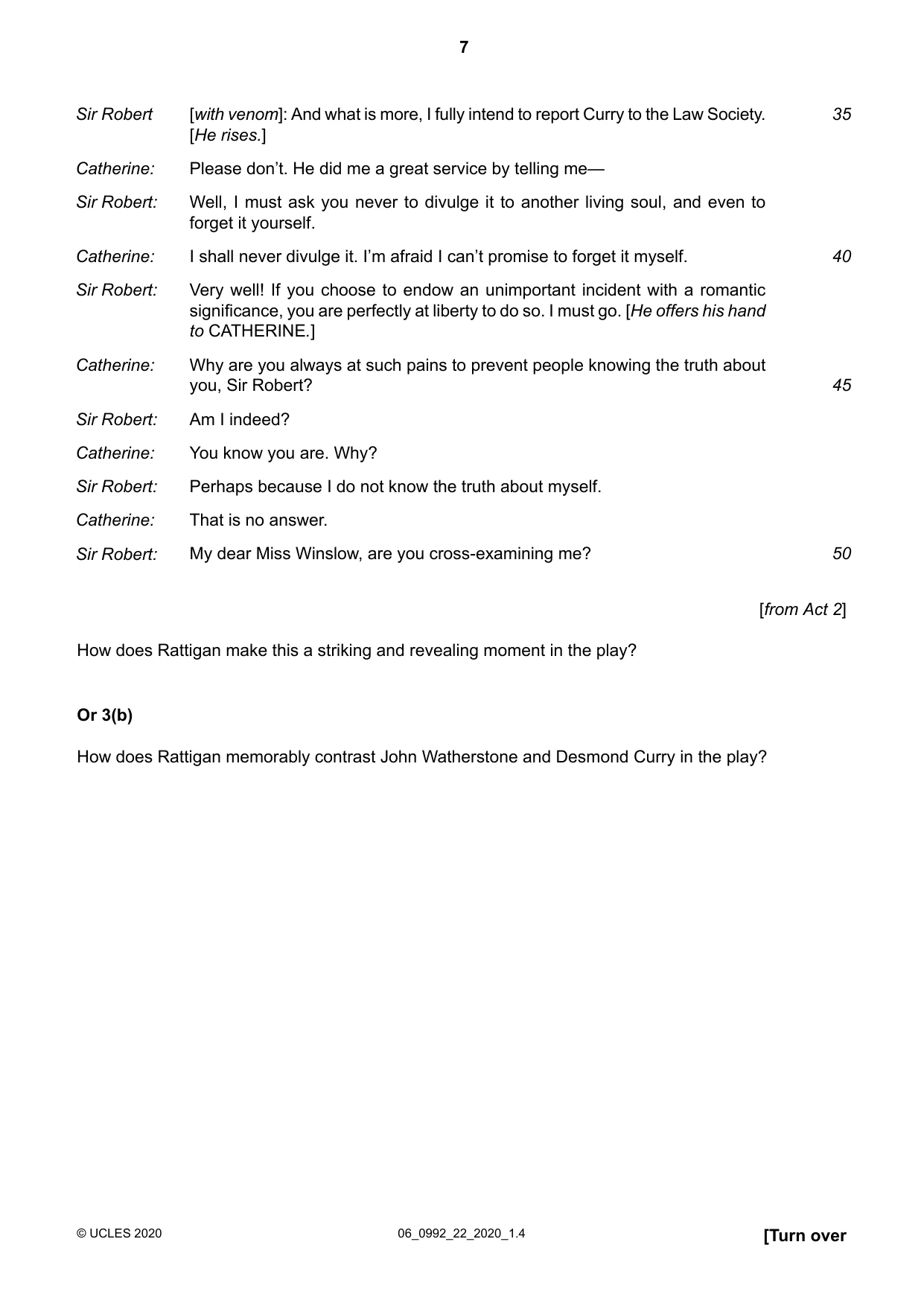
30 25 20 15 10 5 TERENCE RATTIGAN: The Winslow Boy Remember to support your ideas with details from the text. Either 3(a) Read this passage, and then answer the question that follows it: Miss Winslow, might I be rude enough to ask you for a little of your excellent whisky? Sir Robert: Of course. Catherine: [CATHERINE goes into the dining-room. SIR ROBERT, left alone, droops his shoulders wearily. He subsides into a chair. When CATHERINE enters with the whisky he straightens his shoulders instinctively but does not rise.] That is very kind. Perhaps you would forgive me not getting up? The heat in that court-room was really so infernal. [He takes the glass from her and drains it quickly.] Sir Robert: [noticing his hand is trembling slightly]: Are you feeling all right, Sir Robert? Catherine Just a slight nervous reaction – that is all. Besides, I have not been feeling myself all day. I told the judge so this morning, if you remember, but I doubt if he believed me. He thought it was a trick. What suspicious minds people have, have they not? Sir Robert: Yes. Catherine: [handing her back the glass]: Thank you. Sir Robert [CATHERINE puts the glass down. She turns slowly to face SIR ROBERT as if nerving herself for an ordeal.] Sir Robert, I’m afraid I have a confession and an apology to make to you. Catherine: [sensing what is coming]: My dear young lady–I am sure the one is rash and the other superfluous. I would far rather hear neither– Sir Robert [with a smile]: I am afraid you must. This is probably the last time I shall see you, and it is a better penance for me to say this than to write it. I have entirely misjudged your attitude to this case, and if in doing so I have ever seemed to you either rude or ungrateful, I am sincerely and humbly sorry. Catherine [indifferently]: My dear Miss Winslow, you have never seemed to me either rude or ungrateful. And my attitude to this case has been the same as yours–a determination to win at all costs. Only–when you talk of gratitude–you must remember that those costs were not mine but yours. Sir Robert Weren’t they yours also, Sir Robert? Catherine: I beg your pardon? Sir Robert: Haven’t you, too, made a very special sacrifice for the case? Catherine: [after a pause]: The robes of that office would not have suited me. Sir Robert Wouldn’t they? Catherine: 06_0992_22_2020_1.4 © UCLES 2020 6
Question paper, page 7
50 45 40 35 [with venom]: And what is more, I fully intend to report Curry to the Law Society. [He rises.] Sir Robert Please don’t. He did me a great service by telling me— Catherine: Well, I must ask you never to divulge it to another living soul, and even to forget it yourself. Sir Robert: I shall never divulge it. I’m afraid I can’t promise to forget it myself. Catherine: Very well! If you choose to endow an unimportant incident with a romantic significance, you are perfectly at liberty to do so. I must go. [He offers his hand to CATHERINE.] Sir Robert: Why are you always at such pains to prevent people knowing the truth about you, Sir Robert? Catherine: Am I indeed? Sir Robert: You know you are. Why? Catherine: Perhaps because I do not know the truth about myself. Sir Robert: That is no answer. Catherine: My dear Miss Winslow, are you cross-examining me? Sir Robert: [from Act 2] How does Rattigan make this a striking and revealing moment in the play? Or 3(b) How does Rattigan memorably contrast John Watherstone and Desmond Curry in the play? [Turn over 06_0992_22_2020_1.4 © UCLES 2020 7
Question paper, page 8
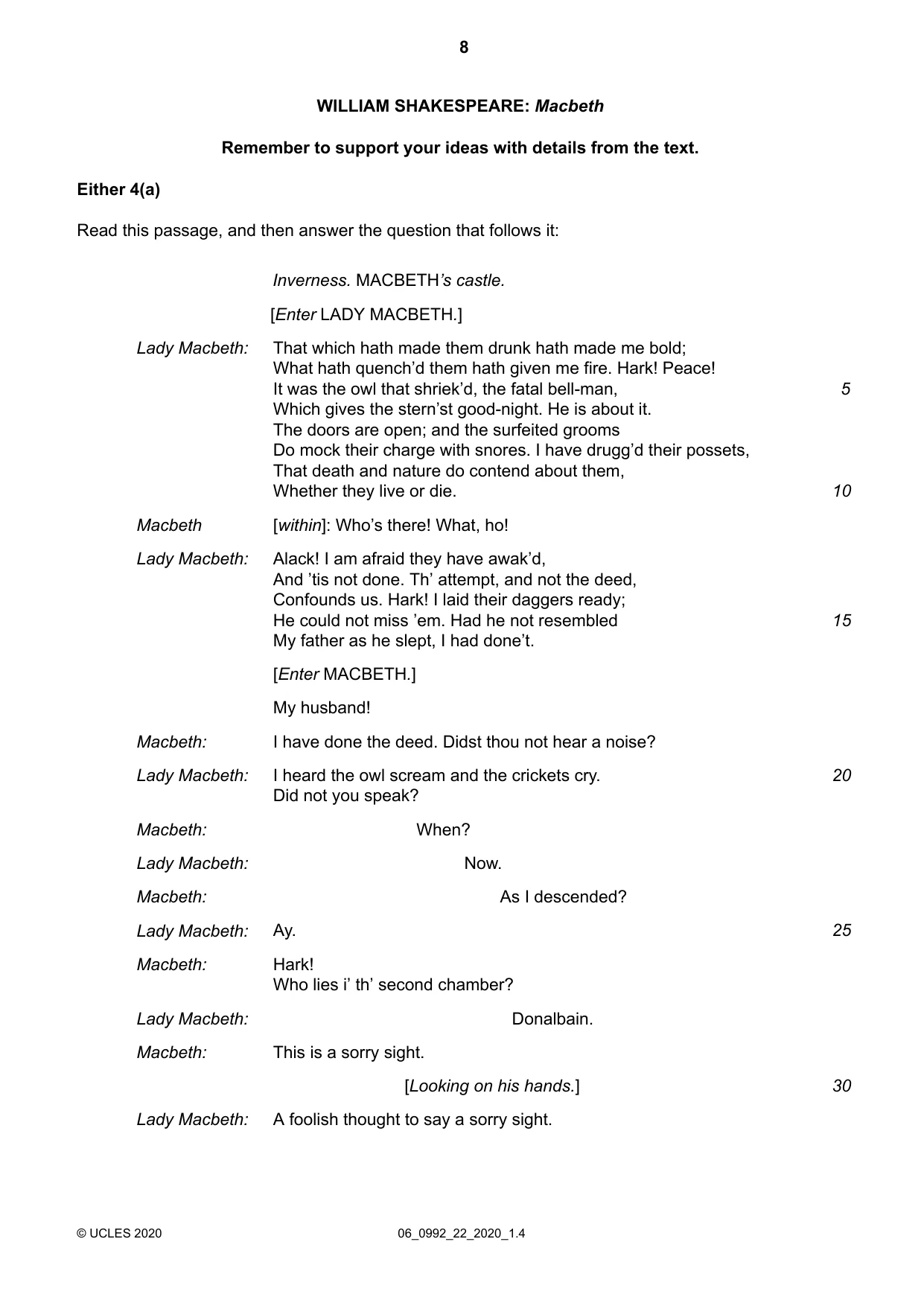
30 25 20 15 10 5 WILLIAM SHAKESPEARE: Macbeth Remember to support your ideas with details from the text. Either 4(a) Read this passage, and then answer the question that follows it: Inverness. MACBETH’s castle. [Enter LADY MACBETH.] That which hath made them drunk hath made me bold; What hath quench’d them hath given me fire. Hark! Peace! It was the owl that shriek’d, the fatal bell-man, Which gives the stern’st good-night. He is about it. The doors are open; and the surfeited grooms Do mock their charge with snores. I have drugg’d their possets, That death and nature do contend about them, Whether they live or die. Lady Macbeth: [within]: Who’s there! What, ho! Macbeth Alack! I am afraid they have awak’d, And ’tis not done. Th’ attempt, and not the deed, Confounds us. Hark! I laid their daggers ready; He could not miss ’em. Had he not resembled My father as he slept, I had done’t. Lady Macbeth: [Enter MACBETH.] My husband! I have done the deed. Didst thou not hear a noise? Macbeth: I heard the owl scream and the crickets cry. Did not you speak? Lady Macbeth: When? Macbeth: Now. Lady Macbeth: As I descended? Macbeth: Ay. Lady Macbeth: Hark! Who lies i’ th’ second chamber? Macbeth: Donalbain. Lady Macbeth: This is a sorry sight. Macbeth: [Looking on his hands.] A foolish thought to say a sorry sight. Lady Macbeth: 06_0992_22_2020_1.4 © UCLES 2020 8
Question paper, page 9
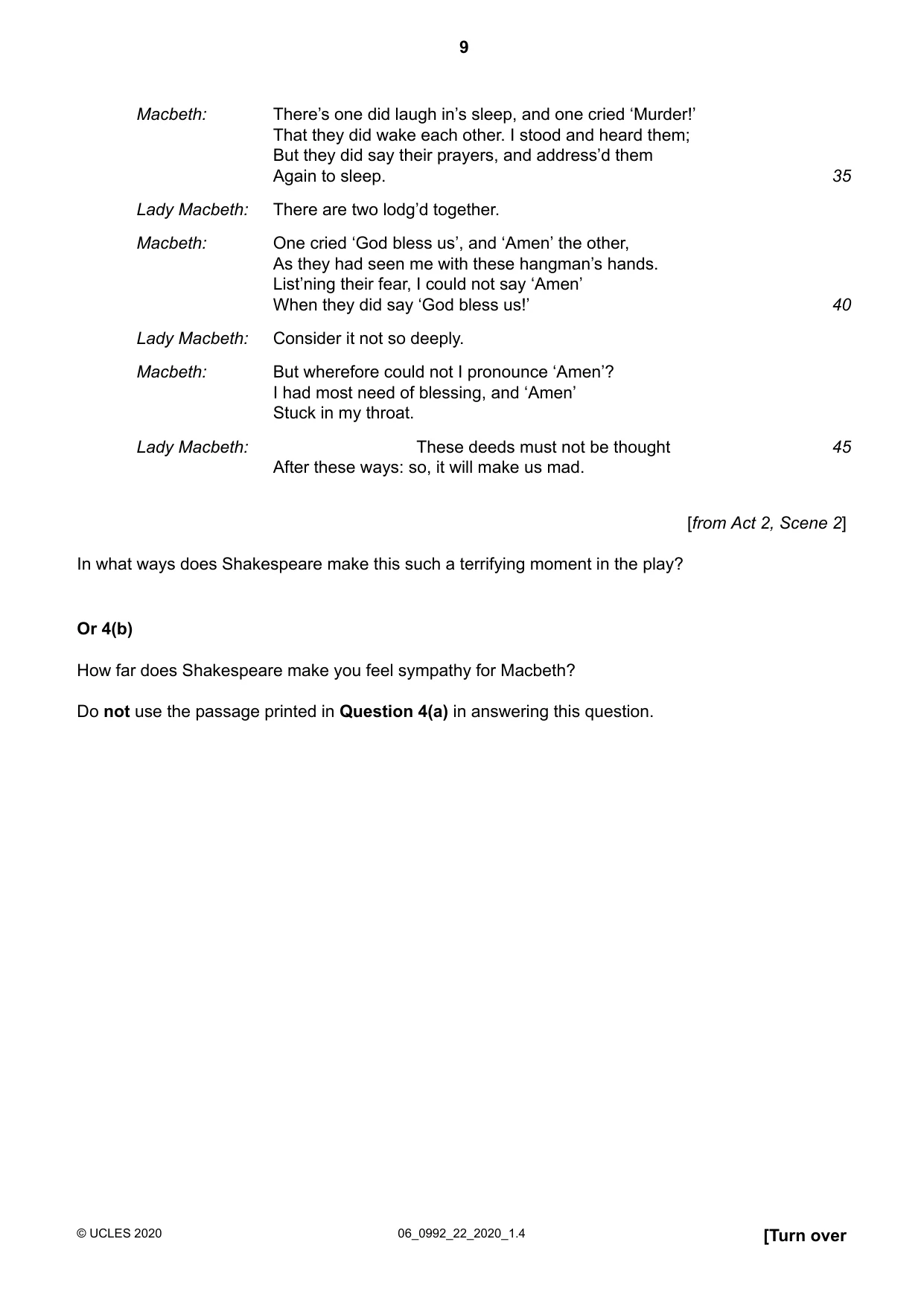
45 40 35 There’s one did laugh in’s sleep, and one cried ‘Murder!’ That they did wake each other. I stood and heard them; But they did say their prayers, and address’d them Again to sleep. Macbeth: There are two lodg’d together. Lady Macbeth: One cried ‘God bless us’, and ‘Amen’ the other, As they had seen me with these hangman’s hands. List’ning their fear, I could not say ‘Amen’ When they did say ‘God bless us!’ Macbeth: Consider it not so deeply. Lady Macbeth: But wherefore could not I pronounce ‘Amen’? I had most need of blessing, and ‘Amen’ Stuck in my throat. Macbeth: These deeds must not be thought After these ways: so, it will make us mad. Lady Macbeth: [from Act 2, Scene 2] In what ways does Shakespeare make this such a terrifying moment in the play? Or 4(b) How far does Shakespeare make you feel sympathy for Macbeth? Do not use the passage printed in Question 4(a) in answering this question. [Turn over 06_0992_22_2020_1.4 © UCLES 2020 9
Question paper, page 10
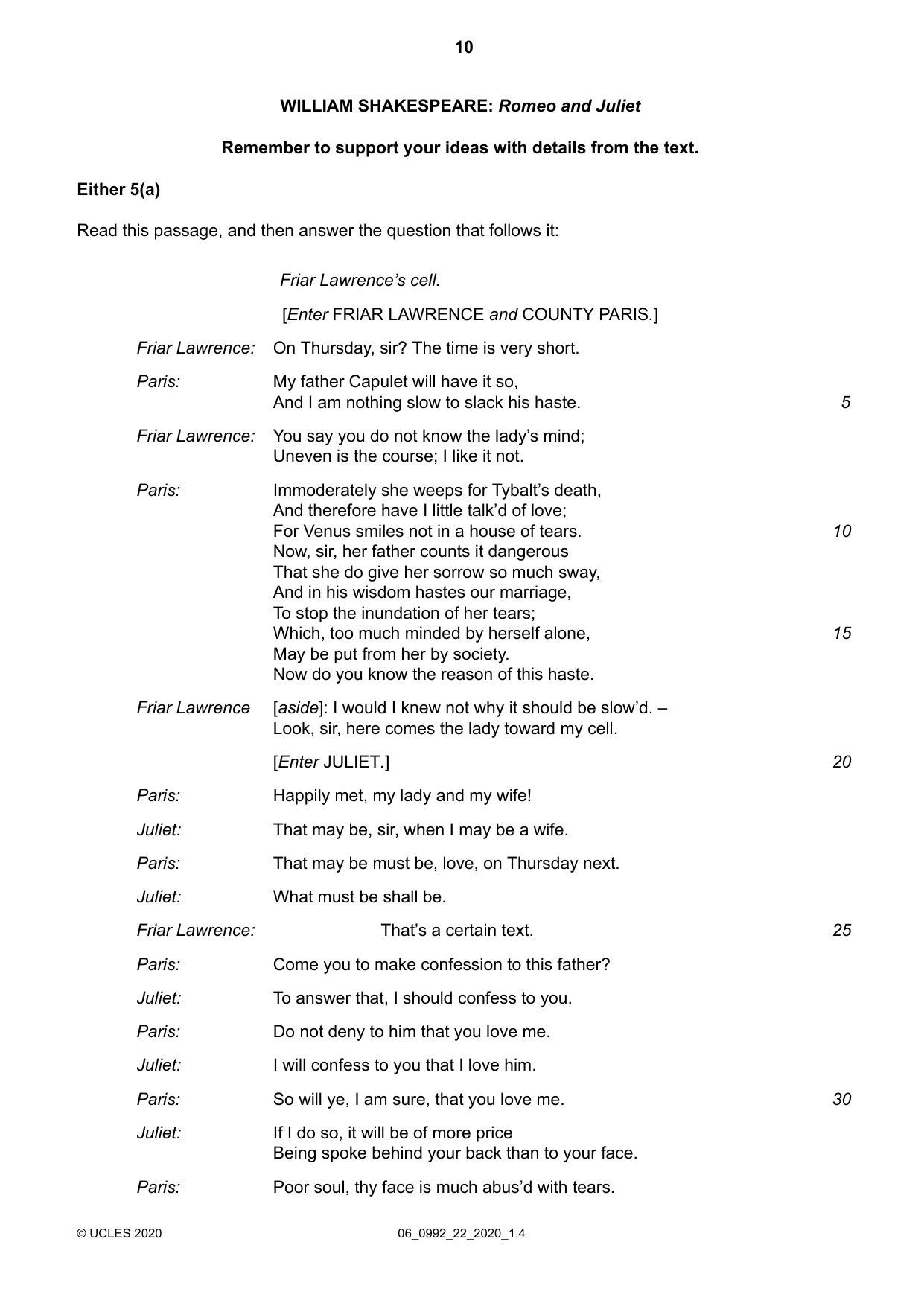
30 25 20 15 10 5 WILLIAM SHAKESPEARE: Romeo and Juliet Remember to support your ideas with details from the text. Either 5(a) Read this passage, and then answer the question that follows it: Friar Lawrence’s cell. [Enter FRIAR LAWRENCE and COUNTY PARIS.] On Thursday, sir? The time is very short. Friar Lawrence: My father Capulet will have it so, And I am nothing slow to slack his haste. Paris: You say you do not know the lady’s mind; Uneven is the course; I like it not. Friar Lawrence: Immoderately she weeps for Tybalt’s death, And therefore have I little talk’d of love; For Venus smiles not in a house of tears. Now, sir, her father counts it dangerous That she do give her sorrow so much sway, And in his wisdom hastes our marriage, To stop the inundation of her tears; Which, too much minded by herself alone, May be put from her by society. Now do you know the reason of this haste. Paris: [aside]: I would I knew not why it should be slow’d. – Look, sir, here comes the lady toward my cell. Friar Lawrence [Enter JULIET.] Happily met, my lady and my wife! Paris: That may be, sir, when I may be a wife. Juliet: That may be must be, love, on Thursday next. Paris: What must be shall be. Juliet: That’s a certain text. Friar Lawrence: Come you to make confession to this father? Paris: To answer that, I should confess to you. Juliet: Do not deny to him that you love me. Paris: I will confess to you that I love him. Juliet: So will ye, I am sure, that you love me. Paris: If I do so, it will be of more price Being spoke behind your back than to your face. Juliet: Poor soul, thy face is much abus’d with tears. Paris: 06_0992_22_2020_1.4 © UCLES 2020 10
Question paper, page 11
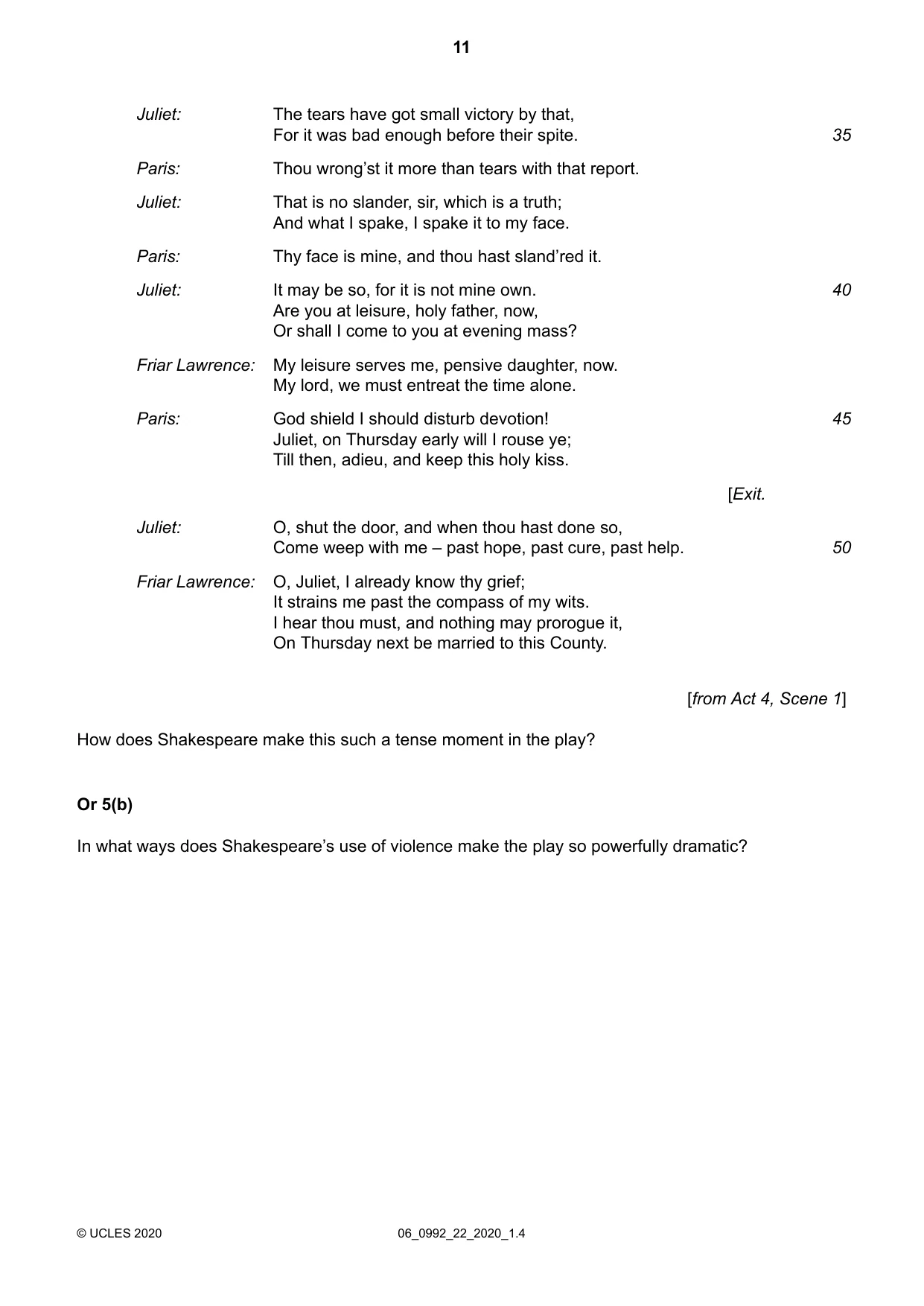
50 45 40 35 The tears have got small victory by that, For it was bad enough before their spite. Juliet: Thou wrong’st it more than tears with that report. Paris: That is no slander, sir, which is a truth; And what I spake, I spake it to my face. Juliet: Thy face is mine, and thou hast sland’red it. Paris: It may be so, for it is not mine own. Are you at leisure, holy father, now, Or shall I come to you at evening mass? Juliet: My leisure serves me, pensive daughter, now. My lord, we must entreat the time alone. Friar Lawrence: God shield I should disturb devotion! Juliet, on Thursday early will I rouse ye; Till then, adieu, and keep this holy kiss. Paris: [Exit. O, shut the door, and when thou hast done so, Come weep with me – past hope, past cure, past help. Juliet: O, Juliet, I already know thy grief; It strains me past the compass of my wits. I hear thou must, and nothing may prorogue it, On Thursday next be married to this County. Friar Lawrence: [from Act 4, Scene 1] How does Shakespeare make this such a tense moment in the play? Or 5(b) In what ways does Shakespeare’s use of violence make the play so powerfully dramatic? 06_0992_22_2020_1.4 © UCLES 2020 11
Question paper, page 12
BLANK PAGE Permission to reproduce items where third-party owned material protected by copyright is included has been sought and cleared where possible. Every reasonable effort has been made by the publisher (UCLES) to trace copyright holders, but if any items requiring clearance have unwittingly been included, the publisher will be pleased to make amends at the earliest possible opportunity. To avoid the issue of disclosure of answer-related information to candidates, all copyright acknowledgements are reproduced online in the Cambridge Assessment International Education Copyright Acknowledgements Booklet. This is produced for each series of examinations and is freely available to download at www.cambridgeinternational.org after the live examination series. Cambridge Assessment International Education is part of the Cambridge Assessment Group. Cambridge Assessment is the brand name of the University of Cambridge Local Examinations Syndicate (UCLES), which itself is a department of the University of Cambridge. 06_0992_22_2020_1.4 © UCLES 2020 12
Mark scheme, page 1
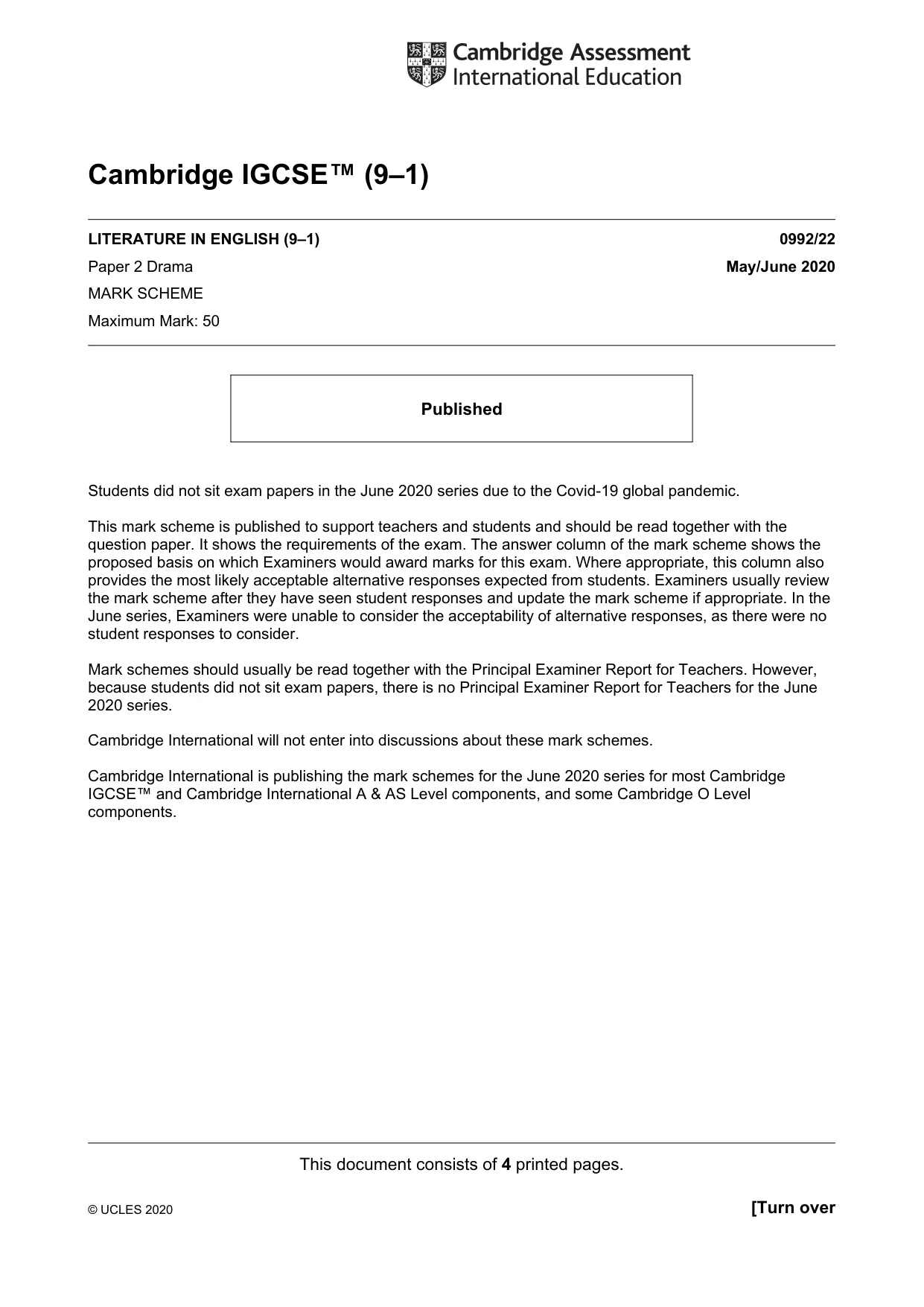
This document consists of 4 printed pages. © UCLES 2020 [Turn over Cambridge IGCSE™ (9–1) LITERATURE IN ENGLISH (9–1) 0992/22 Paper 2 Drama May/June 2020 MARK SCHEME Maximum Mark: 50 Published Students did not sit exam papers in the June 2020 series due to the Covid-19 global pandemic. This mark scheme is published to support teachers and students and should be read together with the question paper. It shows the requirements of the exam. The answer column of the mark scheme shows the proposed basis on which Examiners would award marks for this exam. Where appropriate, this column also provides the most likely acceptable alternative responses expected from students. Examiners usually review the mark scheme after they have seen student responses and update the mark scheme if appropriate. In the June series, Examiners were unable to consider the acceptability of alternative responses, as there were no student responses to consider. Mark schemes should usually be read together with the Principal Examiner Report for Teachers. However, because students did not sit exam papers, there is no Principal Examiner Report for Teachers for the June 2020 series. Cambridge International will not enter into discussions about these mark schemes. Cambridge International is publishing the mark schemes for the June 2020 series for most Cambridge IGCSE™ and Cambridge International A & AS Level components, and some Cambridge O Level components.
Mark scheme, page 2
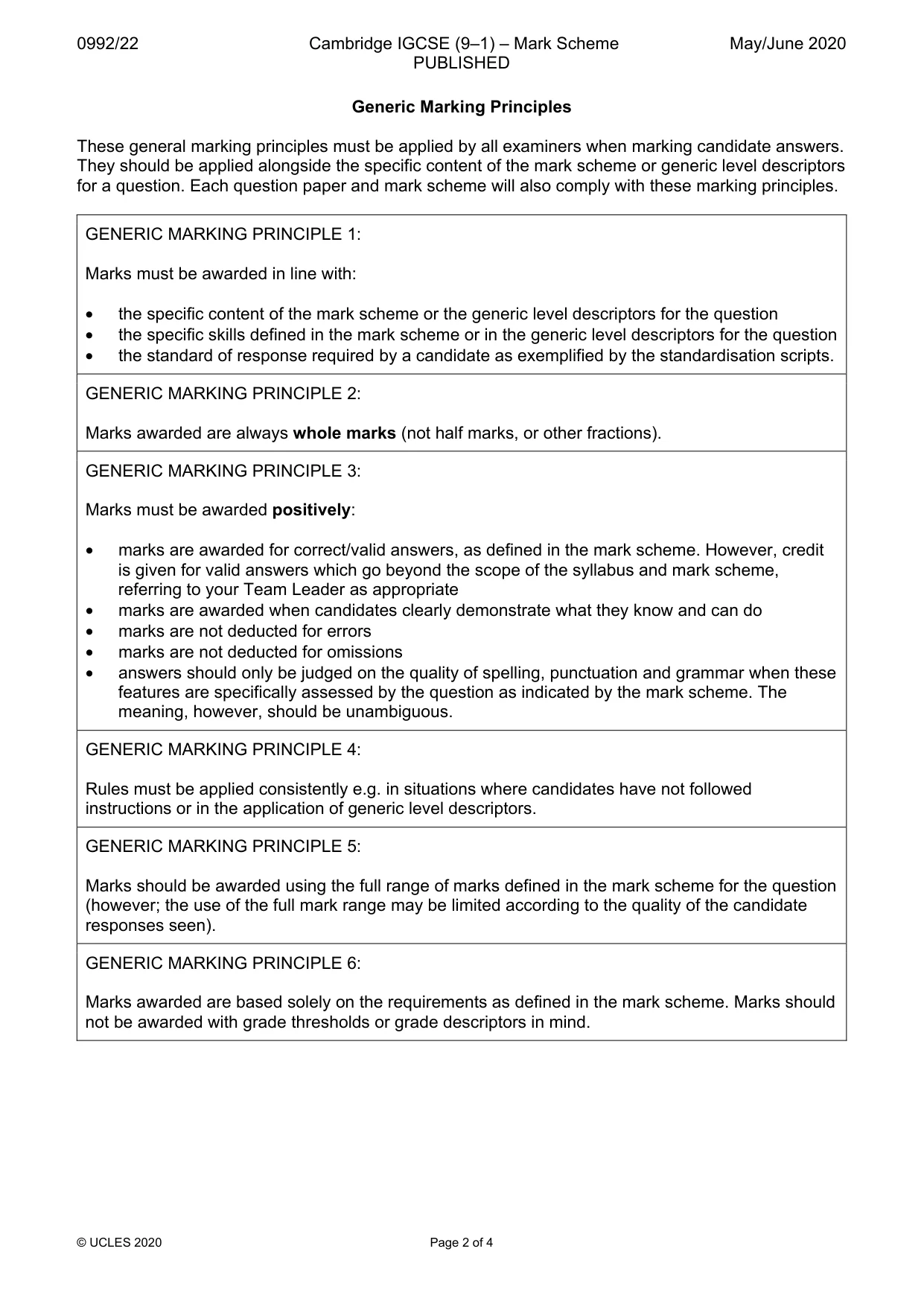
0992/22 Cambridge IGCSE (9–1) – Mark Scheme PUBLISHED May/June 2020 © UCLES 2020 Page 2 of 4 Generic Marking Principles These general marking principles must be applied by all examiners when marking candidate answers. They should be applied alongside the specific content of the mark scheme or generic level descriptors for a question. Each question paper and mark scheme will also comply with these marking principles. GENERIC MARKING PRINCIPLE 1: Marks must be awarded in line with: • the specific content of the mark scheme or the generic level descriptors for the question • the specific skills defined in the mark scheme or in the generic level descriptors for the question • the standard of response required by a candidate as exemplified by the standardisation scripts. GENERIC MARKING PRINCIPLE 2: Marks awarded are always whole marks (not half marks, or other fractions). GENERIC MARKING PRINCIPLE 3: Marks must be awarded positively: • marks are awarded for correct/valid answers, as defined in the mark scheme. However, credit is given for valid answers which go beyond the scope of the syllabus and mark scheme, referring to your Team Leader as appropriate • marks are awarded when candidates clearly demonstrate what they know and can do • marks are not deducted for errors • marks are not deducted for omissions • answers should only be judged on the quality of spelling, punctuation and grammar when these features are specifically assessed by the question as indicated by the mark scheme. The meaning, however, should be unambiguous. GENERIC MARKING PRINCIPLE 4: Rules must be applied consistently e.g. in situations where candidates have not followed instructions or in the application of generic level descriptors. GENERIC MARKING PRINCIPLE 5: Marks should be awarded using the full range of marks defined in the mark scheme for the question (however; the use of the full mark range may be limited according to the quality of the candidate responses seen). GENERIC MARKING PRINCIPLE 6: Marks awarded are based solely on the requirements as defined in the mark scheme. Marks should not be awarded with grade thresholds or grade descriptors in mind.
Mark scheme, page 3
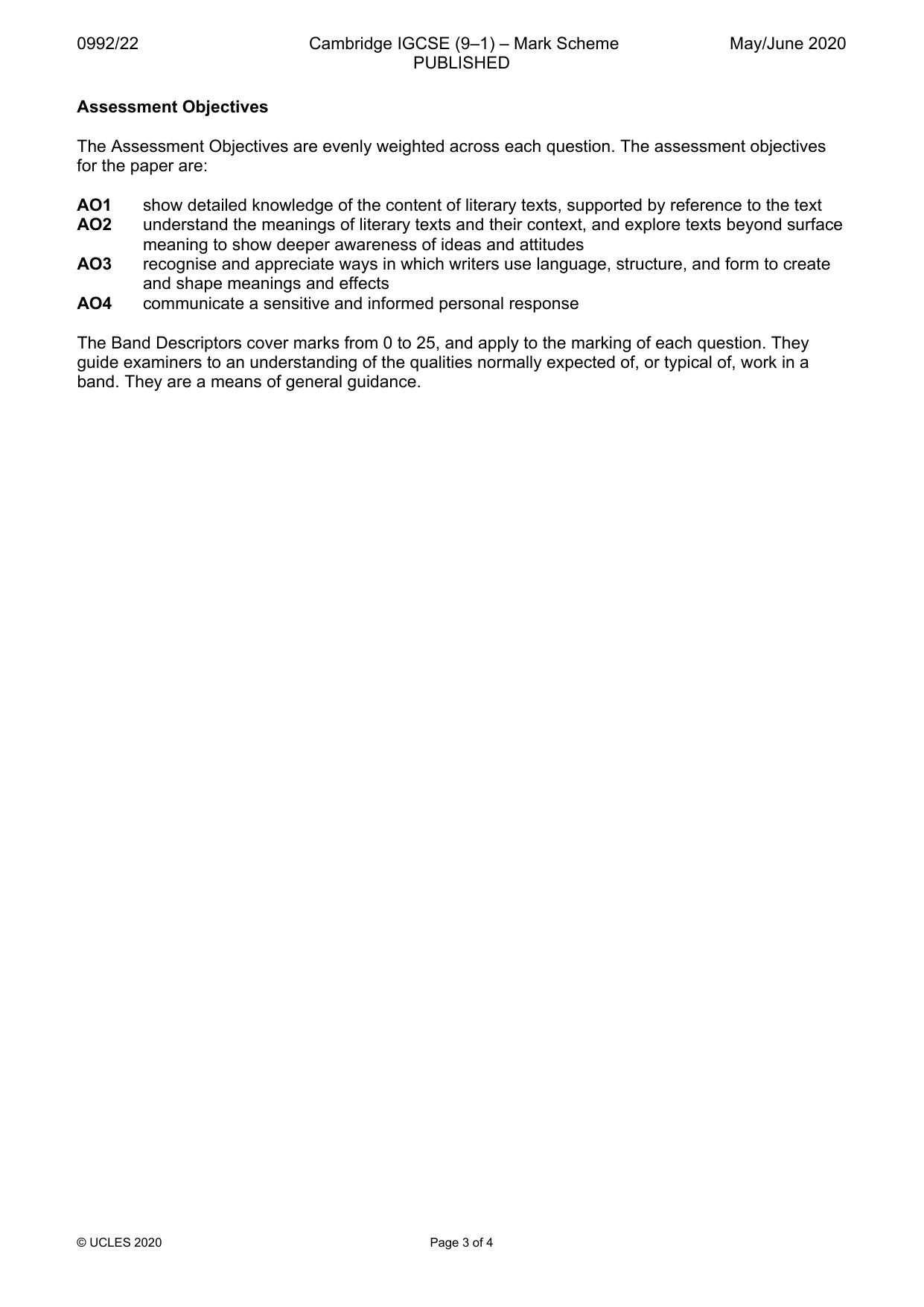
0992/22 Cambridge IGCSE (9–1) – Mark Scheme PUBLISHED May/June 2020 © UCLES 2020 Page 3 of 4 Assessment Objectives The Assessment Objectives are evenly weighted across each question. The assessment objectives for the paper are: AO1 show detailed knowledge of the content of literary texts, supported by reference to the text AO2 understand the meanings of literary texts and their context, and explore texts beyond surface meaning to show deeper awareness of ideas and attitudes AO3 recognise and appreciate ways in which writers use language, structure, and form to create and shape meanings and effects AO4 communicate a sensitive and informed personal response The Band Descriptors cover marks from 0 to 25, and apply to the marking of each question. They guide examiners to an understanding of the qualities normally expected of, or typical of, work in a band. They are a means of general guidance.
Mark scheme, page 4
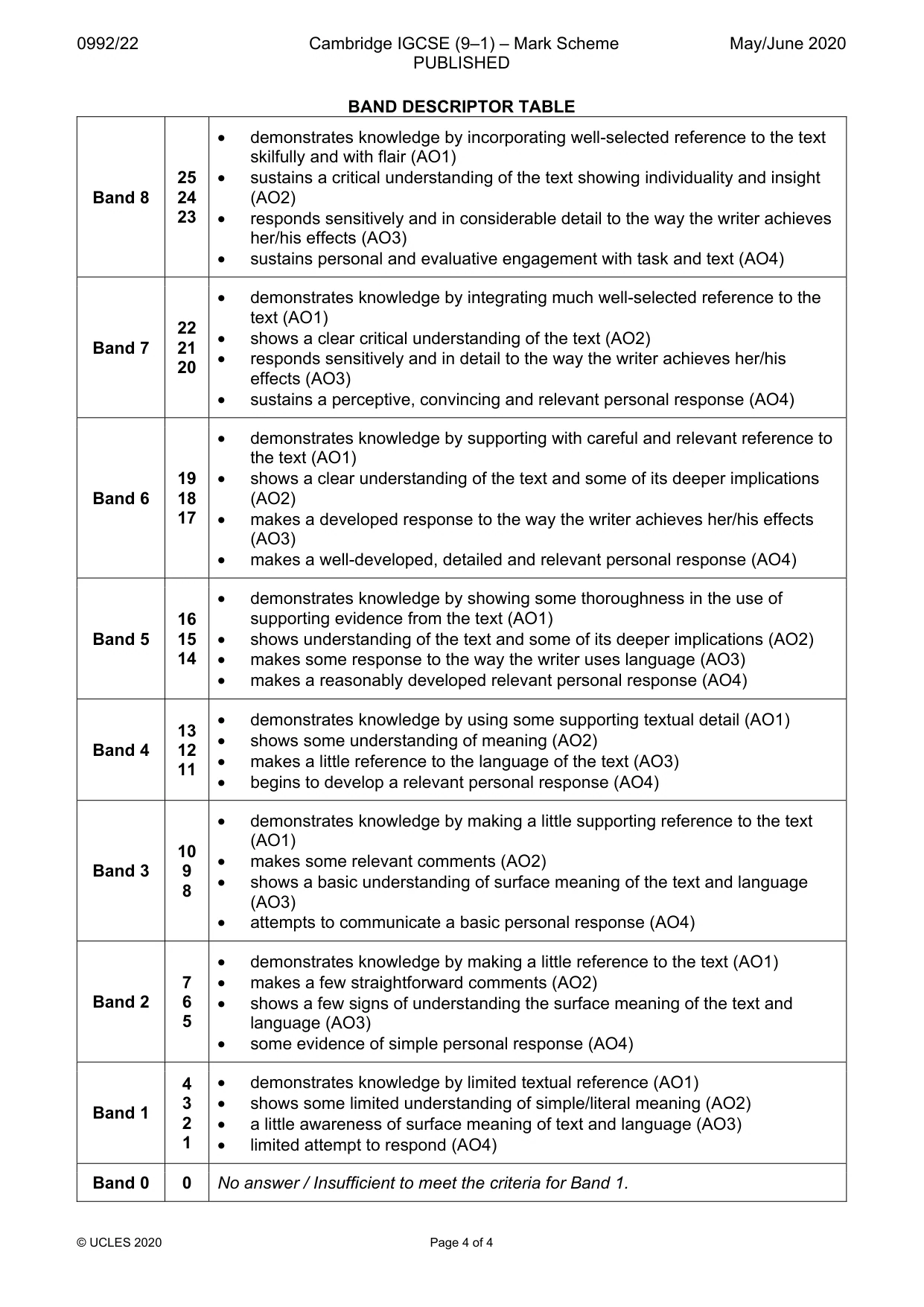
0992/22 Cambridge IGCSE (9–1) – Mark Scheme PUBLISHED May/June 2020 © UCLES 2020 Page 4 of 4 BAND DESCRIPTOR TABLE Band 8 25 24 23 • demonstrates knowledge by incorporating well-selected reference to the text skilfully and with flair (AO1) • sustains a critical understanding of the text showing individuality and insight (AO2) • responds sensitively and in considerable detail to the way the writer achieves her/his effects (AO3) • sustains personal and evaluative engagement with task and text (AO4) Band 7 22 21 20 • demonstrates knowledge by integrating much well-selected reference to the text (AO1) • shows a clear critical understanding of the text (AO2) • responds sensitively and in detail to the way the writer achieves her/his effects (AO3) • sustains a perceptive, convincing and relevant personal response (AO4) Band 6 19 18 17 • demonstrates knowledge by supporting with careful and relevant reference to the text (AO1) • shows a clear understanding of the text and some of its deeper implications (AO2) • makes a developed response to the way the writer achieves her/his effects (AO3) • makes a well-developed, detailed and relevant personal response (AO4) Band 5 16 15 14 • demonstrates knowledge by showing some thoroughness in the use of supporting evidence from the text (AO1) • shows understanding of the text and some of its deeper implications (AO2) • makes some response to the way the writer uses language (AO3) • makes a reasonably developed relevant personal response (AO4) Band 4 13 12 11 • demonstrates knowledge by using some supporting textual detail (AO1) • shows some understanding of meaning (AO2) • makes a little reference to the language of the text (AO3) • begins to develop a relevant personal response (AO4) Band 3 10 9 8 • demonstrates knowledge by making a little supporting reference to the text (AO1) • makes some relevant comments (AO2) • shows a basic understanding of surface meaning of the text and language (AO3) • attempts to communicate a basic personal response (AO4) Band 2 7 6 5 • demonstrates knowledge by making a little reference to the text (AO1) • makes a few straightforward comments (AO2) • shows a few signs of understanding the surface meaning of the text and language (AO3) • some evidence of simple personal response (AO4) Band 1 4 3 2 1 • demonstrates knowledge by limited textual reference (AO1) • shows some limited understanding of simple/literal meaning (AO2) • a little awareness of surface meaning of text and language (AO3) • limited attempt to respond (AO4) Band 0 0 No answer / Insufficient to meet the criteria for Band 1.