Cambridge IGCSE English - Literature in English (9-1) 0992 — 2019 Oct/Nov Paper 4 · Variant 2
0992/42/O/N/19 · 25 marks · ≈28 min
The question paper and its mark scheme, free to read here and free to download. This is Cambridge’s own paper, exactly as it was sat.
Question paper8 pages
Mark scheme4 pages
Answers below. Sit the paper first if you are practising.
Paper as text
Question paper, page 1
This document consists of 5 printed pages, 3 blank pages and 1 insert. DC (PQ) 184083 © UCLES 2019 [Turn over Cambridge Assessment International Education Cambridge International General Certificate of Secondary Education (9–1) * 1 8 0 1 0 3 6 9 6 2 * LITERATURE IN ENGLISH 0992/42 Paper 4 Unseen October/November 2019 1 hour 15 minutes No Additional Materials are required. READ THESE INSTRUCTIONS FIRST An answer booklet is provided inside this question paper. You should follow the instructions on the front cover of the answer booklet. If you need additional answer paper ask the invigilator for a continuation booklet. Answer either Question 1 or Question 2. You are advised to spend about 20 minutes reading the question paper and planning your answer. Both questions in this paper carry equal marks.
Question paper, page 2
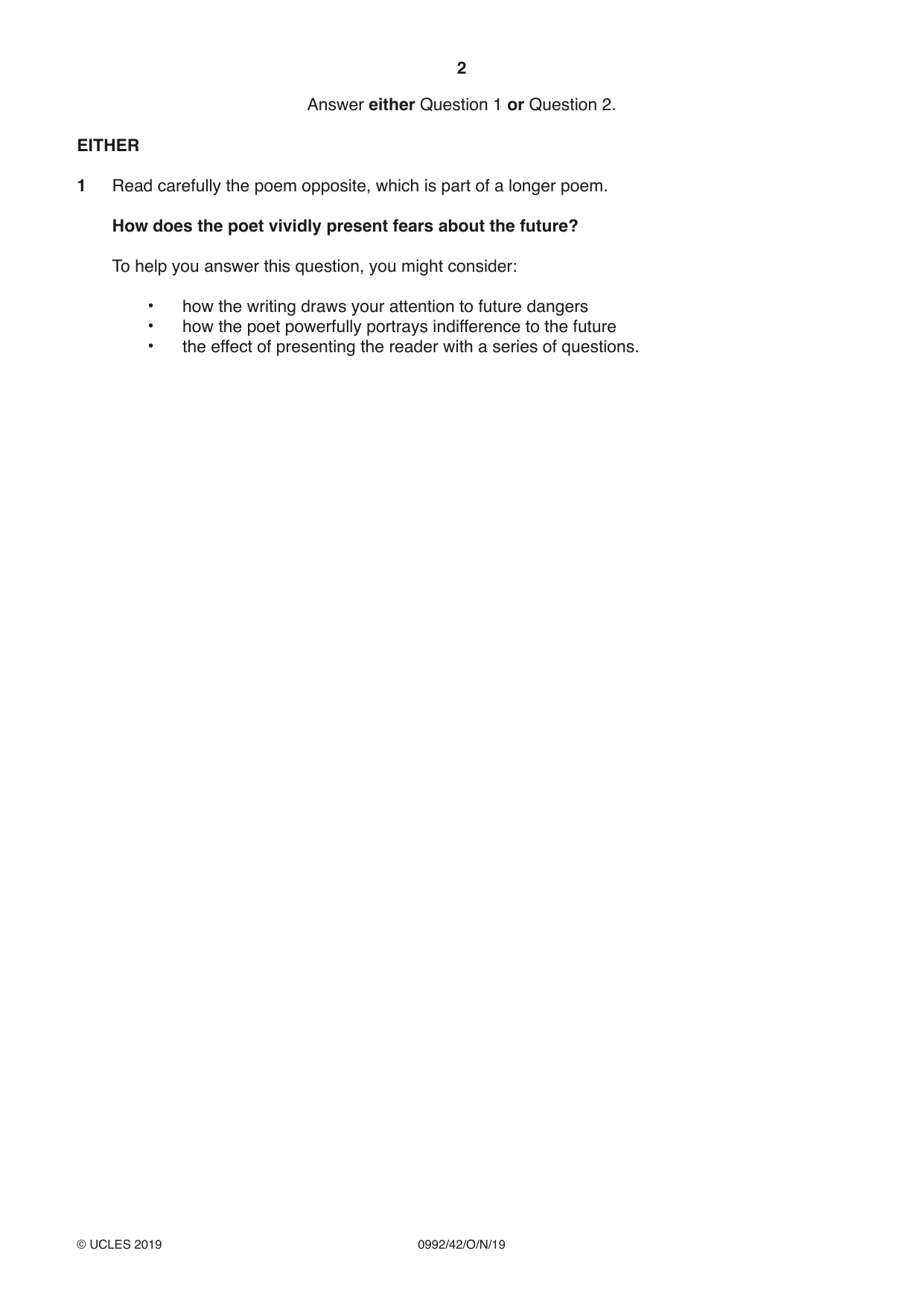
2 0992/42/O/N/19 © UCLES 2019 Answer either Question 1 or Question 2. EITHER 1 Read carefully the poem opposite, which is part of a longer poem. How does the poet vividly present fears about the future? To help you answer this question, you might consider: • how the writing draws your attention to future dangers • how the poet powerfully portrays indifference to the future • the effect of presenting the reader with a series of questions.
Question paper, page 3
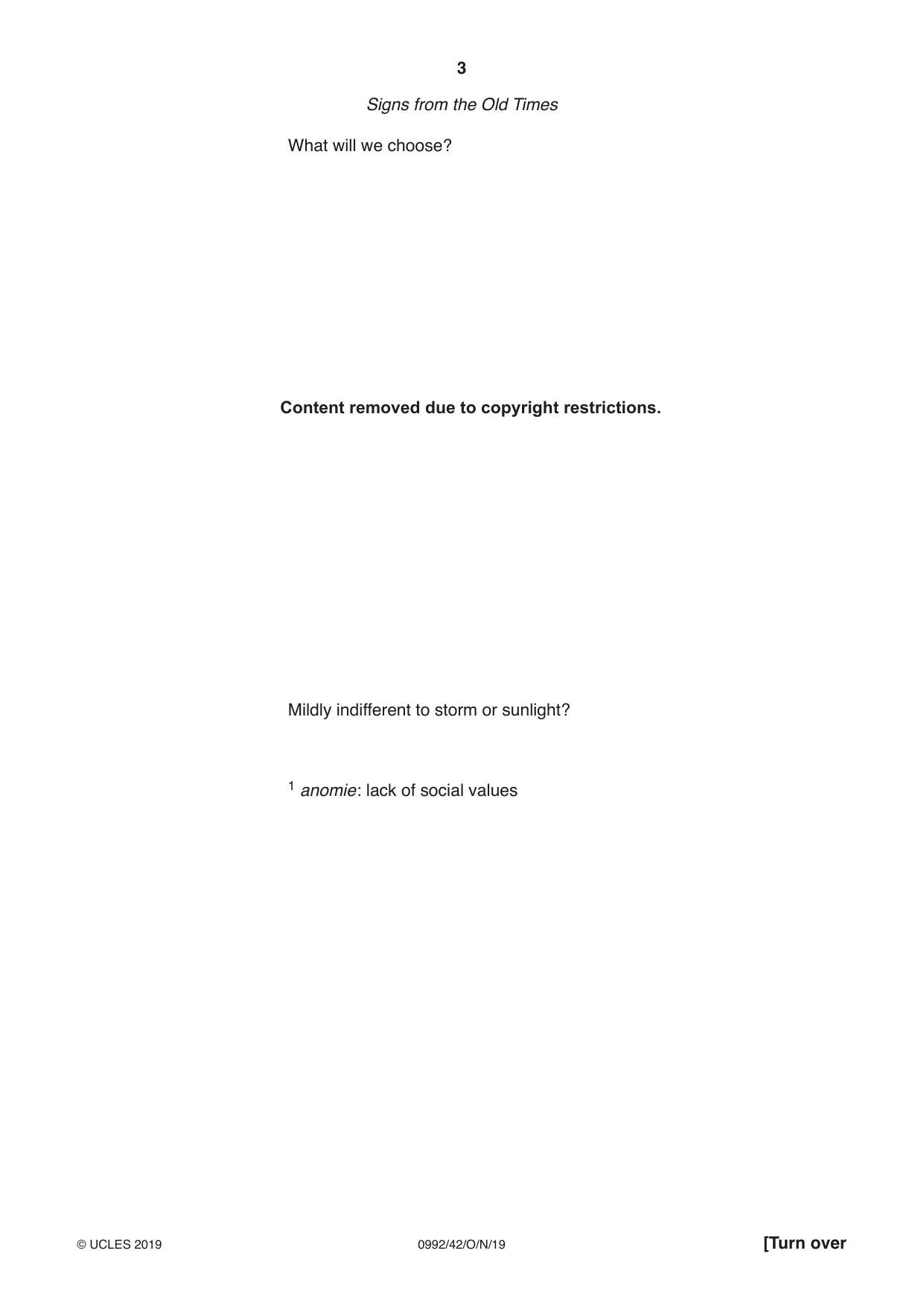
3 0992/42/O/N/19 © UCLES 2019 [Turn over Signs from the Old Times What will we choose? Mildly indifferent to storm or sunlight? 1 anomie: lack of social values Content removed due to copyright restrictions.
Question paper, page 4
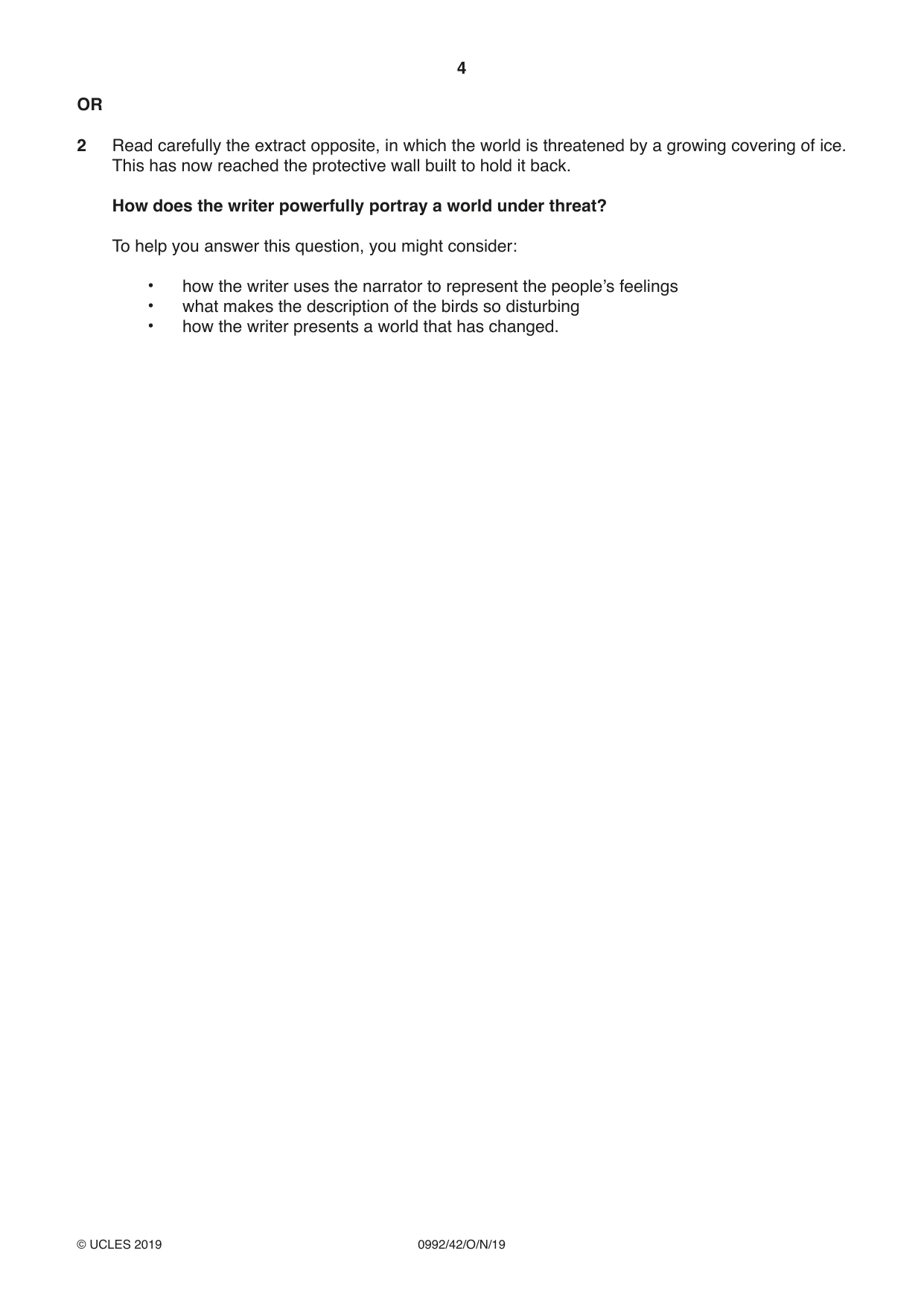
4 0992/42/O/N/19 © UCLES 2019 OR 2 Read carefully the extract opposite, in which the world is threatened by a growing covering of ice. This has now reached the protective wall built to hold it back. How does the writer powerfully portray a world under threat? To help you answer this question, you might consider: • how the writer uses the narrator to represent the people’s feelings • what makes the description of the birds so disturbing • how the writer presents a world that has changed.
Question paper, page 5
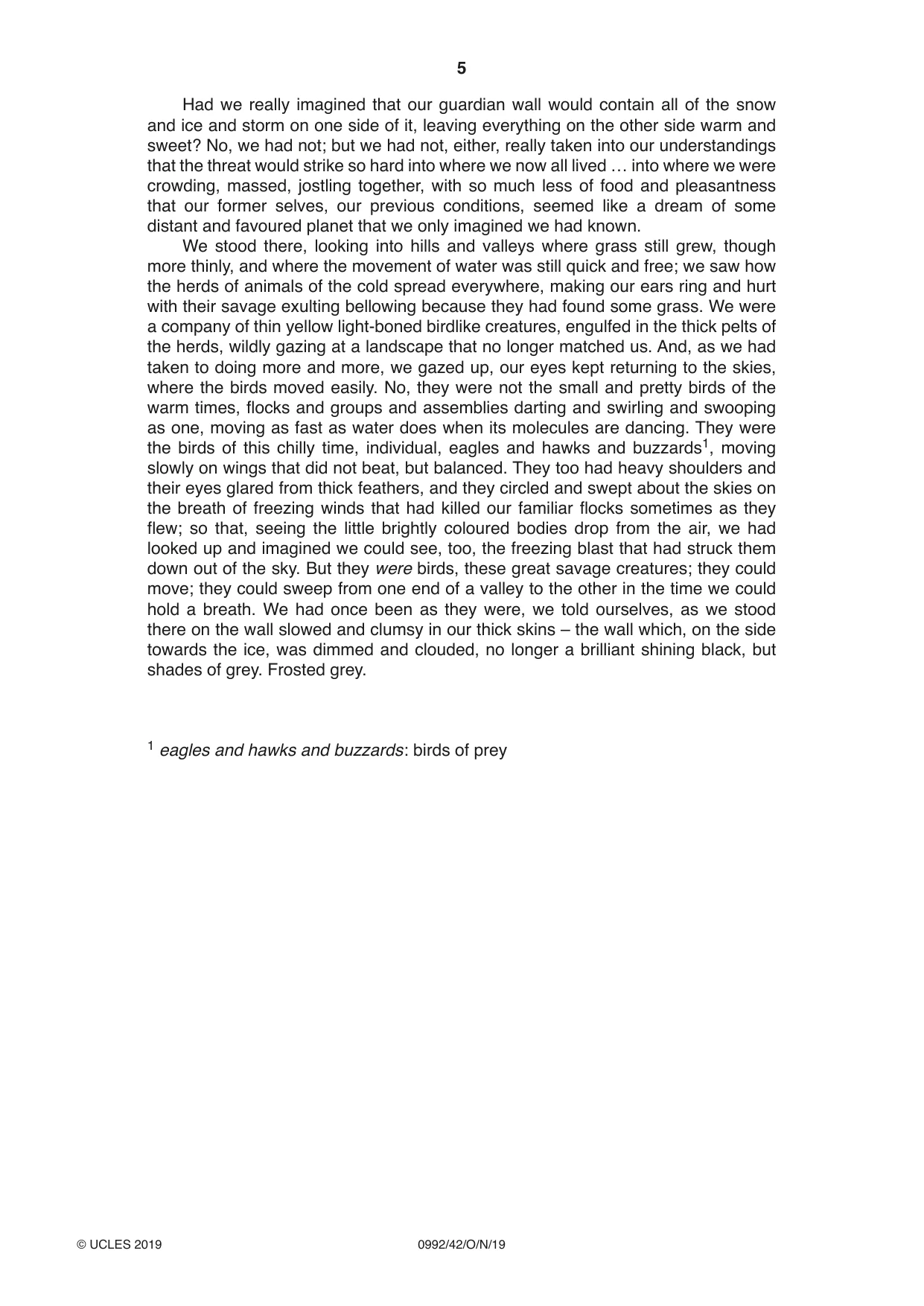
5 0992/42/O/N/19 © UCLES 2019 Had we really imagined that our guardian wall would contain all of the snow and ice and storm on one side of it, leaving everything on the other side warm and sweet? No, we had not; but we had not, either, really taken into our understandings that the threat would strike so hard into where we now all lived … into where we were crowding, massed, jostling together, with so much less of food and pleasantness that our former selves, our previous conditions, seemed like a dream of some distant and favoured planet that we only imagined we had known. We stood there, looking into hills and valleys where grass still grew, though more thinly, and where the movement of water was still quick and free; we saw how the herds of animals of the cold spread everywhere, making our ears ring and hurt with their savage exulting bellowing because they had found some grass. We were a company of thin yellow light-boned birdlike creatures, engulfed in the thick pelts of the herds, wildly gazing at a landscape that no longer matched us. And, as we had taken to doing more and more, we gazed up, our eyes kept returning to the skies, where the birds moved easily. No, they were not the small and pretty birds of the warm times, flocks and groups and assemblies darting and swirling and swooping as one, moving as fast as water does when its molecules are dancing. They were the birds of this chilly time, individual, eagles and hawks and buzzards1, moving slowly on wings that did not beat, but balanced. They too had heavy shoulders and their eyes glared from thick feathers, and they circled and swept about the skies on the breath of freezing winds that had killed our familiar flocks sometimes as they flew; so that, seeing the little brightly coloured bodies drop from the air, we had looked up and imagined we could see, too, the freezing blast that had struck them down out of the sky. But they were birds, these great savage creatures; they could move; they could sweep from one end of a valley to the other in the time we could hold a breath. We had once been as they were, we told ourselves, as we stood there on the wall slowed and clumsy in our thick skins – the wall which, on the side towards the ice, was dimmed and clouded, no longer a brilliant shining black, but shades of grey. Frosted grey. 1 eagles and hawks and buzzards: birds of prey
Question paper, page 6
6 0992/42/O/N/19 © UCLES 2019 BLANK PAGE
Question paper, page 7
7 0992/42/O/N/19 © UCLES 2019 BLANK PAGE
Question paper, page 8
8 0992/42/O/N/19 © UCLES 2019 BLANK PAGE Permission to reproduce items where third-party owned material protected by copyright is included has been sought and cleared where possible. Every reasonable effort has been made by the publisher (UCLES) to trace copyright holders, but if any items requiring clearance have unwittingly been included, the publisher will be pleased to make amends at the earliest possible opportunity. To avoid the issue of disclosure of answer-related information to candidates, all copyright acknowledgements are reproduced online in the Cambridge Assessment International Education Copyright Acknowledgements Booklet. This is produced for each series of examinations and is freely available to download at www.cambridgeinternational.org after the live examination series. Cambridge Assessment International Education is part of the Cambridge Assessment Group. Cambridge Assessment is the brand name of the University of Cambridge Local Examinations Syndicate (UCLES), which itself is a department of the University of Cambridge.
Mark scheme, page 1
This document consists of 4 printed pages. © UCLES 2019 [Turn over Cambridge Assessment International Education Cambridge International General Certificate of Secondary Education (9–1) LITERATURE IN ENGLISH (9–1) 0992/42 Paper 4 Unseen October/November 2019 MARK SCHEME Maximum Mark: 25 Published This mark scheme is published as an aid to teachers and candidates, to indicate the requirements of the examination. It shows the basis on which Examiners were instructed to award marks. It does not indicate the details of the discussions that took place at an Examiners’ meeting before marking began, which would have considered the acceptability of alternative answers. Mark schemes should be read in conjunction with the question paper and the Principal Examiner Report for Teachers. Cambridge International will not enter into discussions about these mark schemes. Cambridge International is publishing the mark schemes for the October/November 2019 series for most Cambridge IGCSE™, Cambridge International A and AS Level components and some Cambridge O Level components.
Mark scheme, page 2
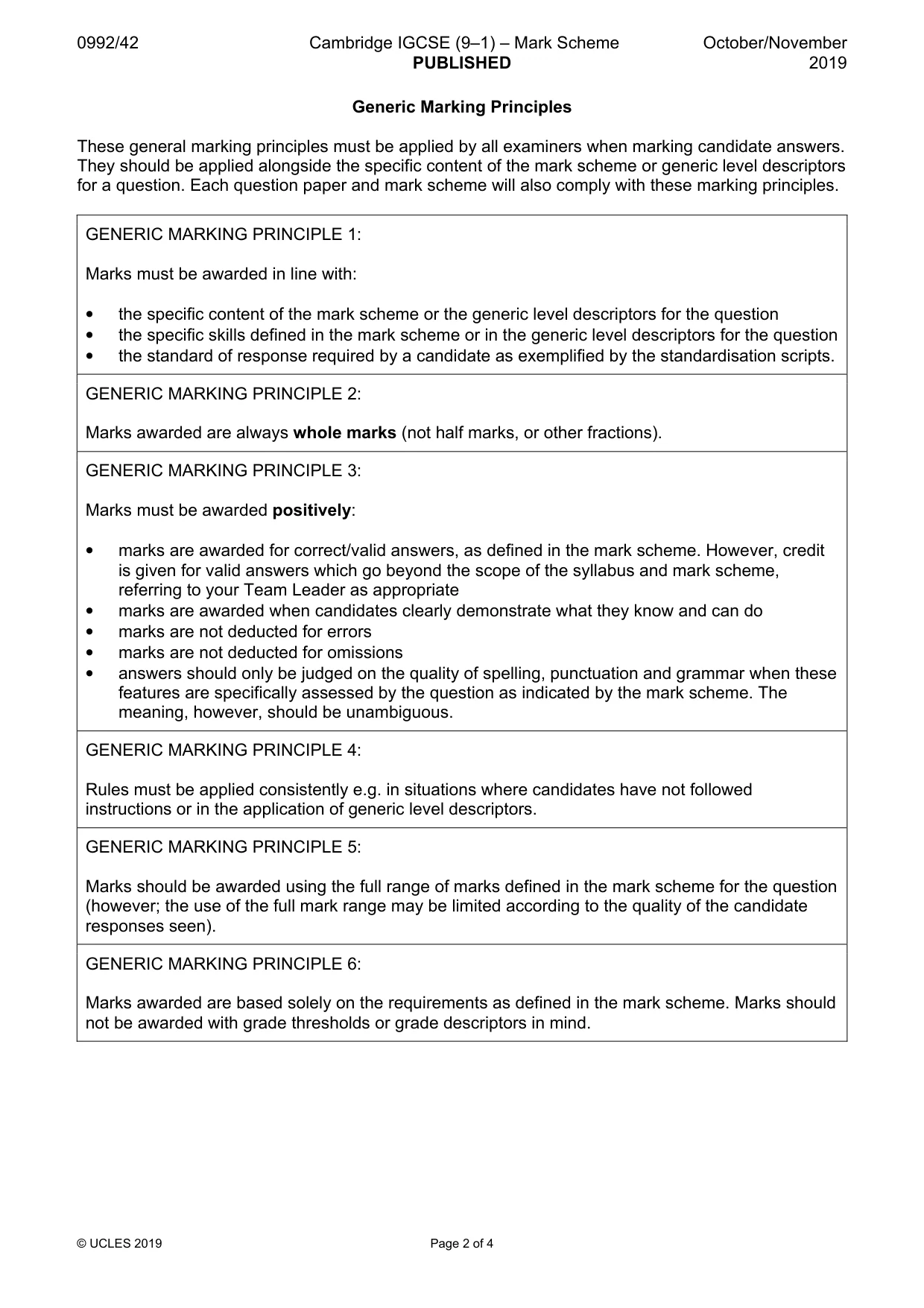
0992/42 Cambridge IGCSE (9–1) – Mark Scheme PUBLISHED October/November 2019 © UCLES 2019 Page 2 of 4 Generic Marking Principles These general marking principles must be applied by all examiners when marking candidate answers. They should be applied alongside the specific content of the mark scheme or generic level descriptors for a question. Each question paper and mark scheme will also comply with these marking principles. GENERIC MARKING PRINCIPLE 1: Marks must be awarded in line with: • the specific content of the mark scheme or the generic level descriptors for the question • the specific skills defined in the mark scheme or in the generic level descriptors for the question • the standard of response required by a candidate as exemplified by the standardisation scripts. GENERIC MARKING PRINCIPLE 2: Marks awarded are always whole marks (not half marks, or other fractions). GENERIC MARKING PRINCIPLE 3: Marks must be awarded positively: • marks are awarded for correct/valid answers, as defined in the mark scheme. However, credit is given for valid answers which go beyond the scope of the syllabus and mark scheme, referring to your Team Leader as appropriate • marks are awarded when candidates clearly demonstrate what they know and can do • marks are not deducted for errors • marks are not deducted for omissions • answers should only be judged on the quality of spelling, punctuation and grammar when these features are specifically assessed by the question as indicated by the mark scheme. The meaning, however, should be unambiguous. GENERIC MARKING PRINCIPLE 4: Rules must be applied consistently e.g. in situations where candidates have not followed instructions or in the application of generic level descriptors. GENERIC MARKING PRINCIPLE 5: Marks should be awarded using the full range of marks defined in the mark scheme for the question (however; the use of the full mark range may be limited according to the quality of the candidate responses seen). GENERIC MARKING PRINCIPLE 6: Marks awarded are based solely on the requirements as defined in the mark scheme. Marks should not be awarded with grade thresholds or grade descriptors in mind.
Mark scheme, page 3
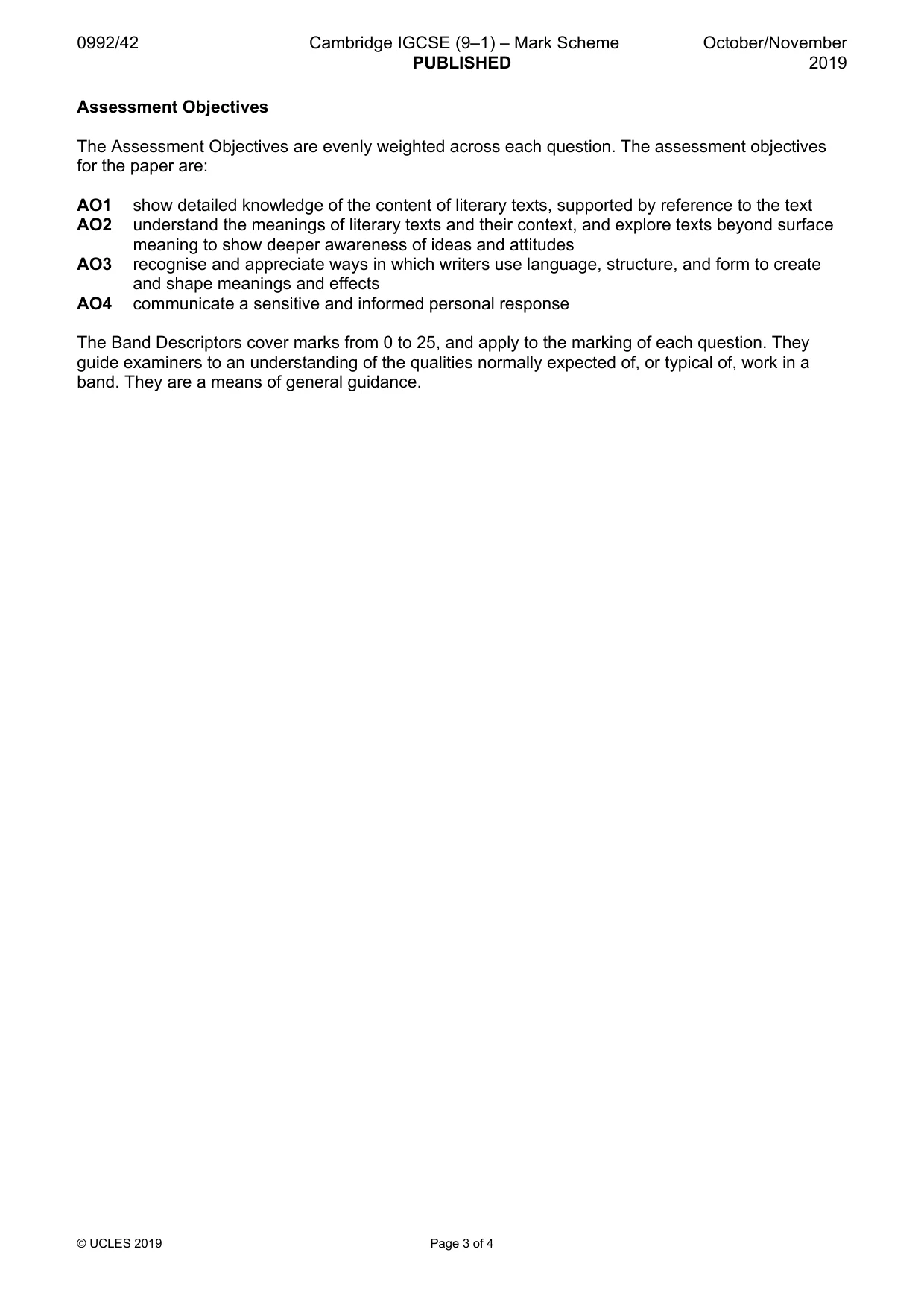
0992/42 Cambridge IGCSE (9–1) – Mark Scheme PUBLISHED October/November 2019 © UCLES 2019 Page 3 of 4 Assessment Objectives The Assessment Objectives are evenly weighted across each question. The assessment objectives for the paper are: AO1 show detailed knowledge of the content of literary texts, supported by reference to the text AO2 understand the meanings of literary texts and their context, and explore texts beyond surface meaning to show deeper awareness of ideas and attitudes AO3 recognise and appreciate ways in which writers use language, structure, and form to create and shape meanings and effects AO4 communicate a sensitive and informed personal response The Band Descriptors cover marks from 0 to 25, and apply to the marking of each question. They guide examiners to an understanding of the qualities normally expected of, or typical of, work in a band. They are a means of general guidance.
Mark scheme, page 4
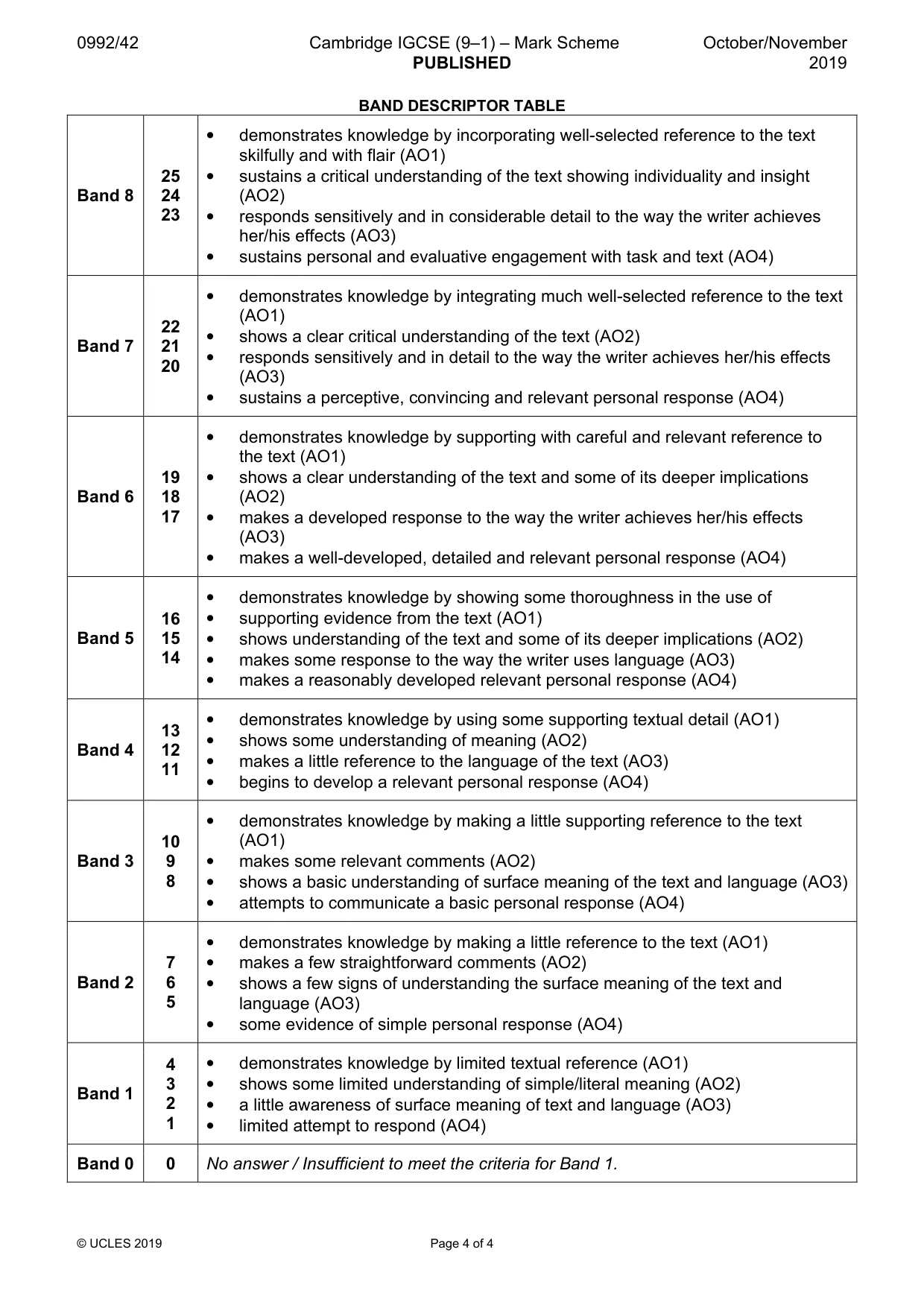
0992/42 Cambridge IGCSE (9–1) – Mark Scheme PUBLISHED October/November 2019 © UCLES 2019 Page 4 of 4 BAND DESCRIPTOR TABLE Band 8 25 24 23 • demonstrates knowledge by incorporating well-selected reference to the text skilfully and with flair (AO1) • sustains a critical understanding of the text showing individuality and insight (AO2) • responds sensitively and in considerable detail to the way the writer achieves her/his effects (AO3) • sustains personal and evaluative engagement with task and text (AO4) Band 7 22 21 20 • demonstrates knowledge by integrating much well-selected reference to the text (AO1) • shows a clear critical understanding of the text (AO2) • responds sensitively and in detail to the way the writer achieves her/his effects (AO3) • sustains a perceptive, convincing and relevant personal response (AO4) Band 6 19 18 17 • demonstrates knowledge by supporting with careful and relevant reference to the text (AO1) • shows a clear understanding of the text and some of its deeper implications (AO2) • makes a developed response to the way the writer achieves her/his effects (AO3) • makes a well-developed, detailed and relevant personal response (AO4) Band 5 16 15 14 • demonstrates knowledge by showing some thoroughness in the use of • supporting evidence from the text (AO1) • shows understanding of the text and some of its deeper implications (AO2) • makes some response to the way the writer uses language (AO3) • makes a reasonably developed relevant personal response (AO4) Band 4 13 12 11 • demonstrates knowledge by using some supporting textual detail (AO1) • shows some understanding of meaning (AO2) • makes a little reference to the language of the text (AO3) • begins to develop a relevant personal response (AO4) Band 3 10 9 8 • demonstrates knowledge by making a little supporting reference to the text (AO1) • makes some relevant comments (AO2) • shows a basic understanding of surface meaning of the text and language (AO3) • attempts to communicate a basic personal response (AO4) Band 2 7 6 5 • demonstrates knowledge by making a little reference to the text (AO1) • makes a few straightforward comments (AO2) • shows a few signs of understanding the surface meaning of the text and language (AO3) • some evidence of simple personal response (AO4) Band 1 4 3 2 1 • demonstrates knowledge by limited textual reference (AO1) • shows some limited understanding of simple/literal meaning (AO2) • a little awareness of surface meaning of text and language (AO3) • limited attempt to respond (AO4) Band 0 0 No answer / Insufficient to meet the criteria for Band 1.
What you needed in this session
Cambridge’s own grade thresholds for 2019 Oct/Nov, Paper 4 · Variant 2. A higher threshold means an easier paper — the bar moves with how the cohort did.