Cambridge IGCSE English - Literature in English (9-1) 0992 — 2019 May/June Paper 4 · Variant 2
0992/42/M/J/19 · 25 marks · ≈28 min
The question paper and its mark scheme, free to read here and free to download. This is Cambridge’s own paper, exactly as it was sat.
Question paper8 pages


Mark scheme4 pages
Answers below. Sit the paper first if you are practising.
Paper as text
Question paper, page 1
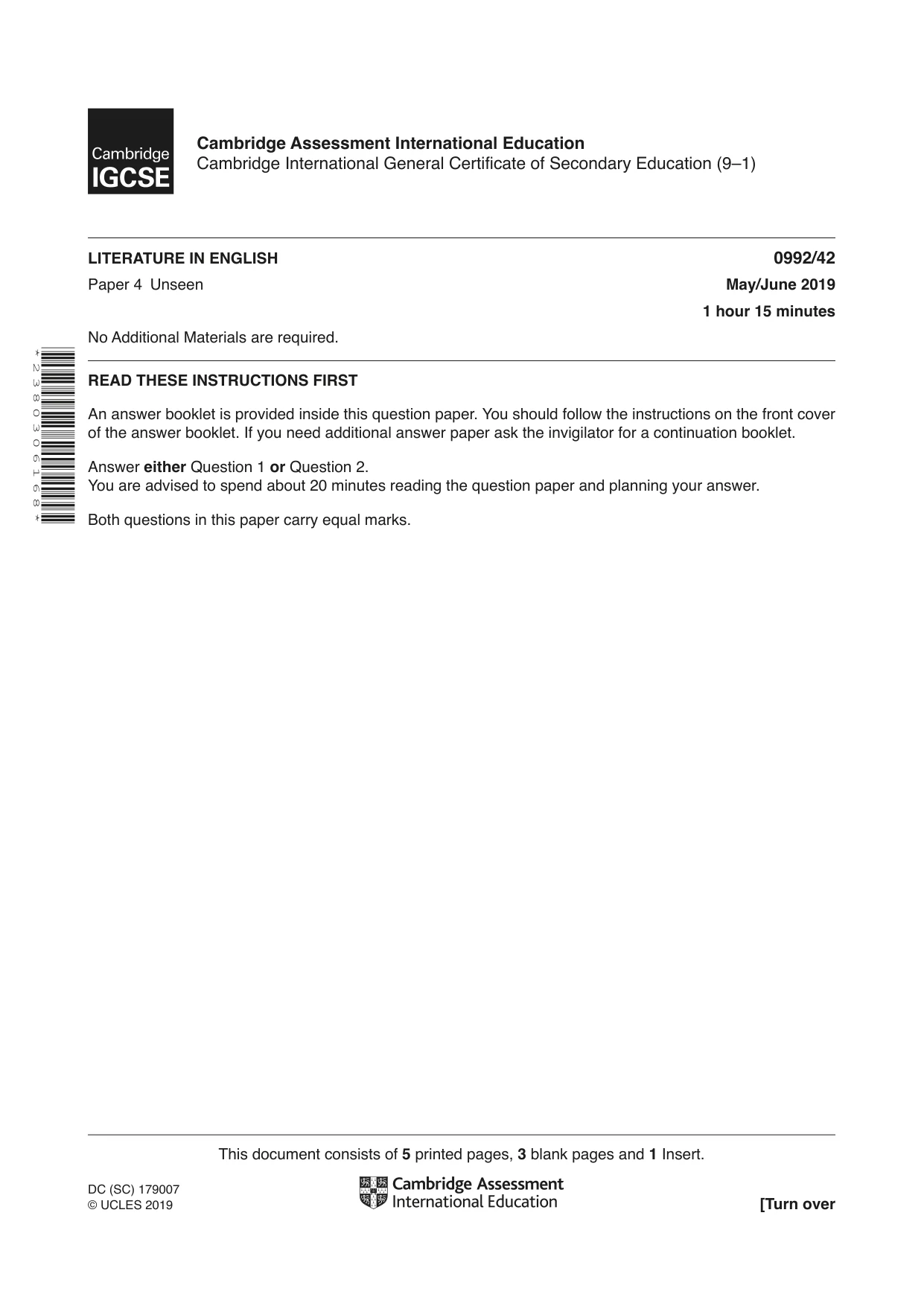
This document consists of 5 printed pages, 3 blank pages and 1 Insert. DC (SC) 179007 © UCLES 2019 [Turn over Cambridge Assessment International Education Cambridge International General Certificate of Secondary Education (9–1) * 2 3 8 0 3 0 6 1 6 8 * LITERATURE IN ENGLISH 0992/42 Paper 4 Unseen May/June 2019 1 hour 15 minutes No Additional Materials are required. READ THESE INSTRUCTIONS FIRST An answer booklet is provided inside this question paper. You should follow the instructions on the front cover of the answer booklet. If you need additional answer paper ask the invigilator for a continuation booklet. Answer either Question 1 or Question 2. You are advised to spend about 20 minutes reading the question paper and planning your answer. Both questions in this paper carry equal marks.
Question paper, page 2
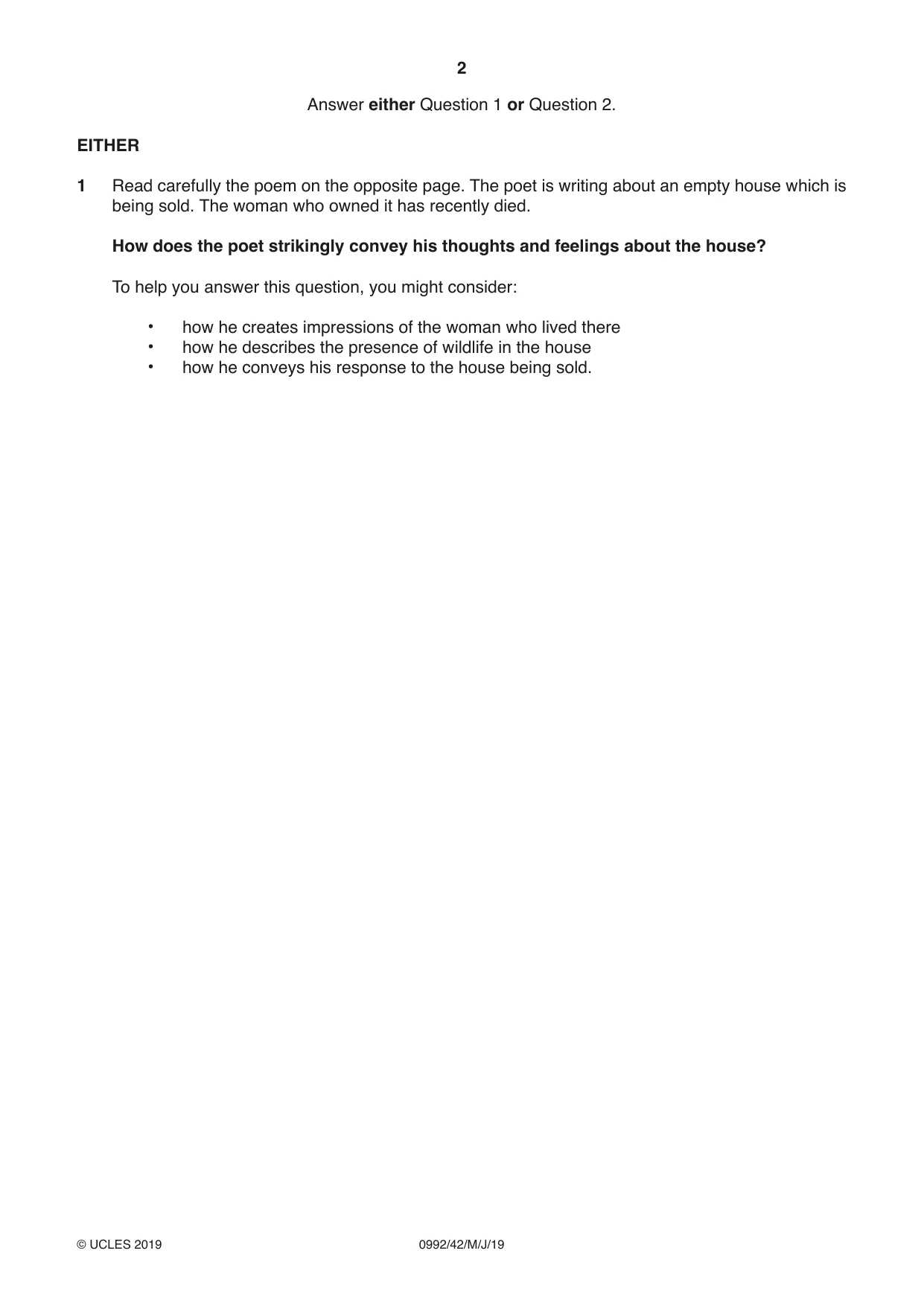
2 0992/42/M/J/19 © UCLES 2019 Answer either Question 1 or Question 2. EITHER 1 Read carefully the poem on the opposite page. The poet is writing about an empty house which is being sold. The woman who owned it has recently died. How does the poet strikingly convey his thoughts and feelings about the house? To help you answer this question, you might consider: • how he creates impressions of the woman who lived there • how he describes the presence of wildlife in the house • how he conveys his response to the house being sold.
Question paper, page 3
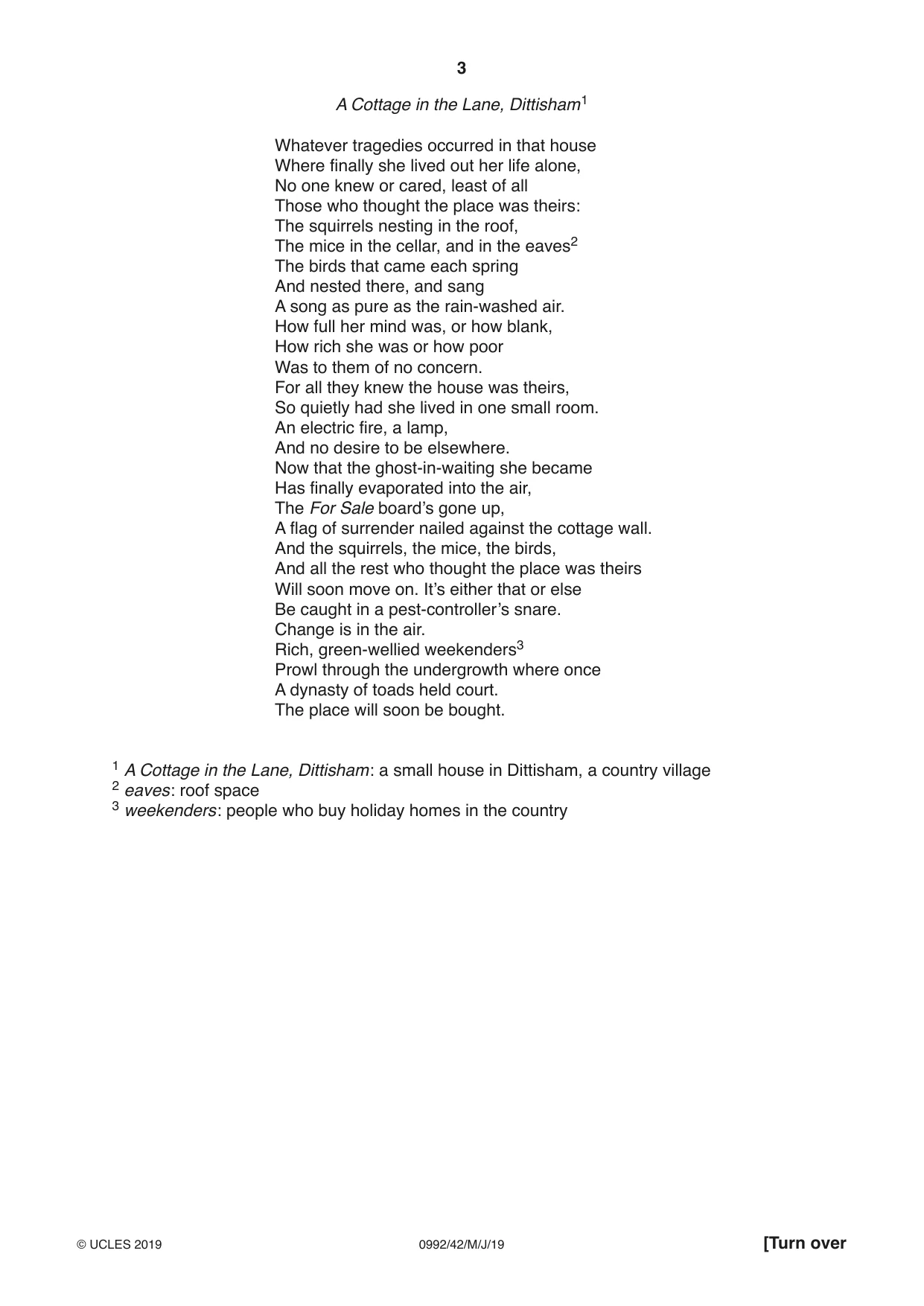
3 0992/42/M/J/19 © UCLES 2019 [Turn over A Cottage in the Lane, Dittisham1 Whatever tragedies occurred in that house Where finally she lived out her life alone, No one knew or cared, least of all Those who thought the place was theirs: The squirrels nesting in the roof, The mice in the cellar, and in the eaves2 The birds that came each spring And nested there, and sang A song as pure as the rain-washed air. How full her mind was, or how blank, How rich she was or how poor Was to them of no concern. For all they knew the house was theirs, So quietly had she lived in one small room. An electric fire, a lamp, And no desire to be elsewhere. Now that the ghost-in-waiting she became Has finally evaporated into the air, The For Sale board’s gone up, A flag of surrender nailed against the cottage wall. And the squirrels, the mice, the birds, And all the rest who thought the place was theirs Will soon move on. It’s either that or else Be caught in a pest-controller’s snare. Change is in the air. Rich, green-wellied weekenders3 Prowl through the undergrowth where once A dynasty of toads held court. The place will soon be bought. 1 A Cottage in the Lane, Dittisham: a small house in Dittisham, a country village 2 eaves: roof space 3 weekenders: people who buy holiday homes in the country
Question paper, page 4
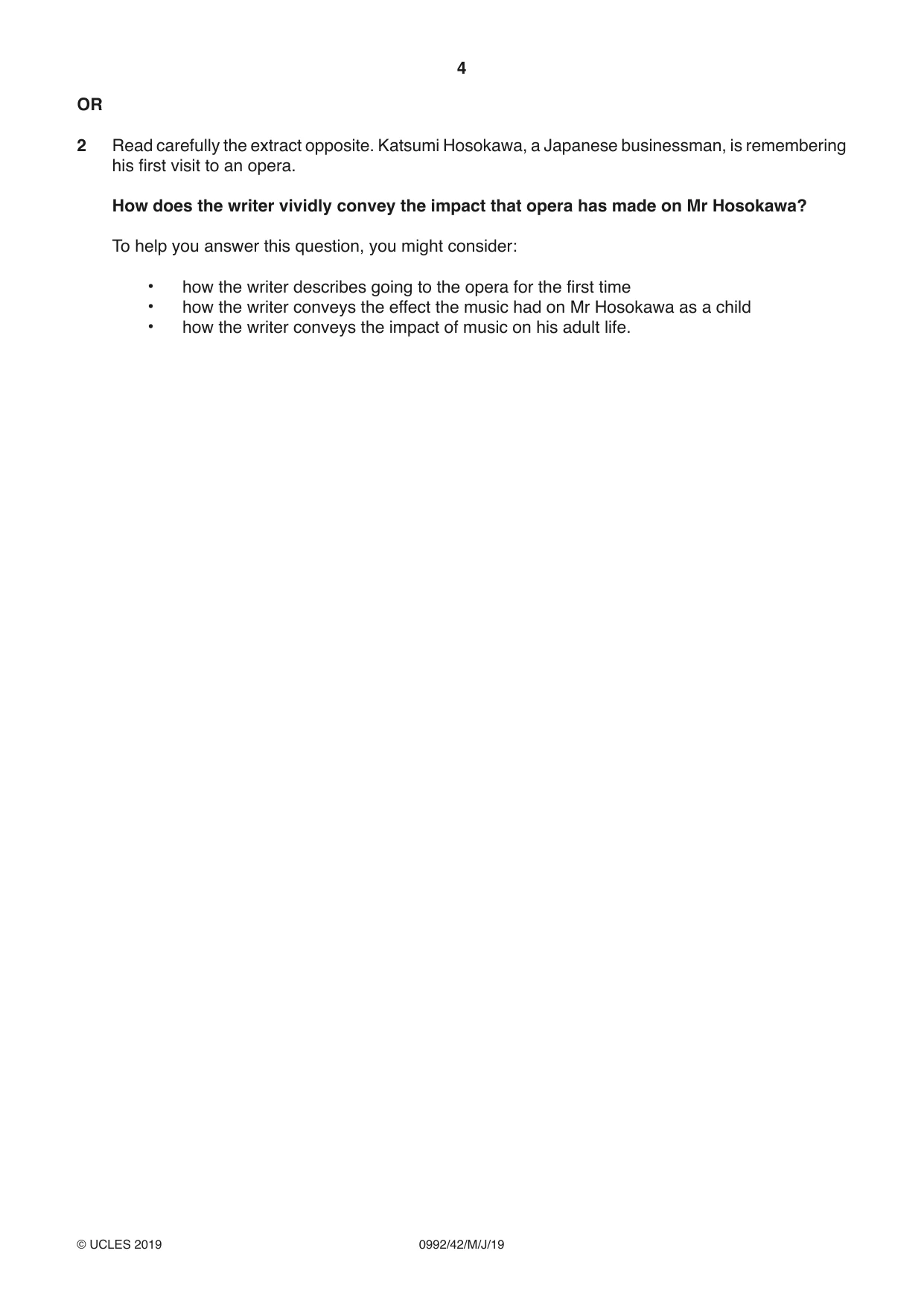
4 0992/42/M/J/19 © UCLES 2019 OR 2 Read carefully the extract opposite. Katsumi Hosokawa, a Japanese businessman, is remembering his first visit to an opera. How does the writer vividly convey the impact that opera has made on Mr Hosokawa? To help you answer this question, you might consider: • how the writer describes going to the opera for the first time • how the writer conveys the effect the music had on Mr Hosokawa as a child • how the writer conveys the impact of music on his adult life.
Question paper, page 5
5 0992/42/M/J/19 © UCLES 2019 But first remember another birthday, his eleventh, the birthday on which Katsumi Hosokawa first heard opera, Verdi’s Rigoletto. His father had taken him to Tokyo by train and together they walked to the theatre in a steady downpour. It was October 22 and so it was a cold autumn rain and the streets were waxed in a paper- thin layer of wet red leaves. When they arrived at the Tokyo Metropolitan Festival Hall, their undershirts were wet beneath coats and sweaters. The tickets waiting inside Katsumi Hosokawa’s father’s billfold1 were wet and discoloured. They did not have especially good seats, but their view was unobstructed. In 1954, money was precious; train tickets and operas were unimaginable things. In a different time, such a production would have seemed too complicated for a child, but this was only a handful of years after the war and children then were much more likely to understand a whole host of things that might seem impossible for children now. They climbed the long set of stairs to their row, careful not to look down into the dizzying void beneath them. They bowed and begged to be excused by every person who stood to let them pass into their seats, and then they unfolded their seats and slipped inside. They were early, but other people were earlier, as part of the luxury that came with the ticket price was the right to sit quietly in this beautiful place and wait. They waited, father and son, without speaking, until finally the darkness fell and the first breath of music stirred from someplace far below them. Tiny people, insects, really, slipped out from behind the curtains, opened their mouths, and with their voices gilded the walls with their yearning, their grief, their boundless, reckless love that would lead each one to separate ruin. It was during that performance of Rigoletto that opera imprinted itself on Katsumi Hosokawa, a message written on the pink undersides of his eyelids that he read to himself while he slept. Many years later, when everything was business, when he worked harder than anyone in a country whose values are structured on hard work, he believed that life, true life, was something that was stored in music. True life was kept safe in the lines of Tchaikovsky’s Eugene Onegin2 while you went out into the world and met the obligations required of you. Certainly he knew (though did not completely understand) that opera wasn’t for everyone, but for everyone he hoped there was something. The records he cherished, the rare opportunities to see a live performance, those were the marks by which he gauged his ability to love. Not his wife, his daughters, or his work. He never thought that he had somehow transferred what should have filled his daily life into opera. Instead he knew that without opera, this part of himself would have vanished altogether. It was early in the second act, when Rigoletto and Gilda sang together, their voices twining, leaping, that he reached out for his father’s hand. He had no idea what they were saying, nor did he know that they played the parts of father and daughter, he only knew that he needed to hold to something. The pull they had on him was so strong he could feel himself falling forward out of the high and distant seats. 1 billfold: wallet 2 Eugene Onegin: an opera by Tchaikovsky
Question paper, page 6
6 0992/42/M/J/19 © UCLES 2019 BLANK PAGE
Question paper, page 7
7 0992/42/M/J/19 © UCLES 2019 BLANK PAGE
Question paper, page 8
8 0992/42/M/J/19 © UCLES 2019 Permission to reproduce items where third-party owned material protected by copyright is included has been sought and cleared where possible. Every reasonable effort has been made by the publisher (UCLES) to trace copyright holders, but if any items requiring clearance have unwittingly been included, the publisher will be pleased to make amends at the earliest possible opportunity. To avoid the issue of disclosure of answer-related information to candidates, all copyright acknowledgements are reproduced online in the Cambridge Assessment International Education Copyright Acknowledgements Booklet. This is produced for each series of examinations and is freely available to download at www.cambridgeinternational.org after the live examination series. Cambridge Assessment International Education is part of the Cambridge Assessment Group. Cambridge Assessment is the brand name of the University of Cambridge Local Examinations Syndicate (UCLES), which itself is a department of the University of Cambridge. BLANK PAGE
Mark scheme, page 1
This document consists of 4 printed pages. © UCLES 2019 [Turn over Cambridge Assessment International Education Cambridge International General Certificate of Secondary Education (9–1) LITERATURE IN ENGLISH (9–1) 0992/42 Paper 4 Unseen May/June 2019 MARK SCHEME Maximum Mark: 25 Published This mark scheme is published as an aid to teachers and candidates, to indicate the requirements of the examination. It shows the basis on which Examiners were instructed to award marks. It does not indicate the details of the discussions that took place at an Examiners’ meeting before marking began, which would have considered the acceptability of alternative answers. Mark schemes should be read in conjunction with the question paper and the Principal Examiner Report for Teachers. Cambridge International will not enter into discussions about these mark schemes. Cambridge International is publishing the mark schemes for the May/June 2019 series for most Cambridge IGCSE™, Cambridge International A and AS Level and Cambridge Pre-U components, and some Cambridge O Level components.
Mark scheme, page 2
0992/42 Cambridge IGCSE (9–1) – Mark Scheme PUBLISHED May/June 2019 © UCLES 2019 Page 2 of 4 Generic Marking Principles These general marking principles must be applied by all examiners when marking candidate answers. They should be applied alongside the specific content of the mark scheme or generic level descriptors for a question. Each question paper and mark scheme will also comply with these marking principles. GENERIC MARKING PRINCIPLE 1: Marks must be awarded in line with: • the specific content of the mark scheme or the generic level descriptors for the question • the specific skills defined in the mark scheme or in the generic level descriptors for the question • the standard of response required by a candidate as exemplified by the standardisation scripts. GENERIC MARKING PRINCIPLE 2: Marks awarded are always whole marks (not half marks, or other fractions). GENERIC MARKING PRINCIPLE 3: Marks must be awarded positively: • marks are awarded for correct/valid answers, as defined in the mark scheme. However, credit is given for valid answers which go beyond the scope of the syllabus and mark scheme, referring to your Team Leader as appropriate • marks are awarded when candidates clearly demonstrate what they know and can do • marks are not deducted for errors • marks are not deducted for omissions • answers should only be judged on the quality of spelling, punctuation and grammar when these features are specifically assessed by the question as indicated by the mark scheme. The meaning, however, should be unambiguous. GENERIC MARKING PRINCIPLE 4: Rules must be applied consistently e.g. in situations where candidates have not followed instructions or in the application of generic level descriptors. GENERIC MARKING PRINCIPLE 5: Marks should be awarded using the full range of marks defined in the mark scheme for the question (however; the use of the full mark range may be limited according to the quality of the candidate responses seen). GENERIC MARKING PRINCIPLE 6: Marks awarded are based solely on the requirements as defined in the mark scheme. Marks should not be awarded with grade thresholds or grade descriptors in mind.
Mark scheme, page 3
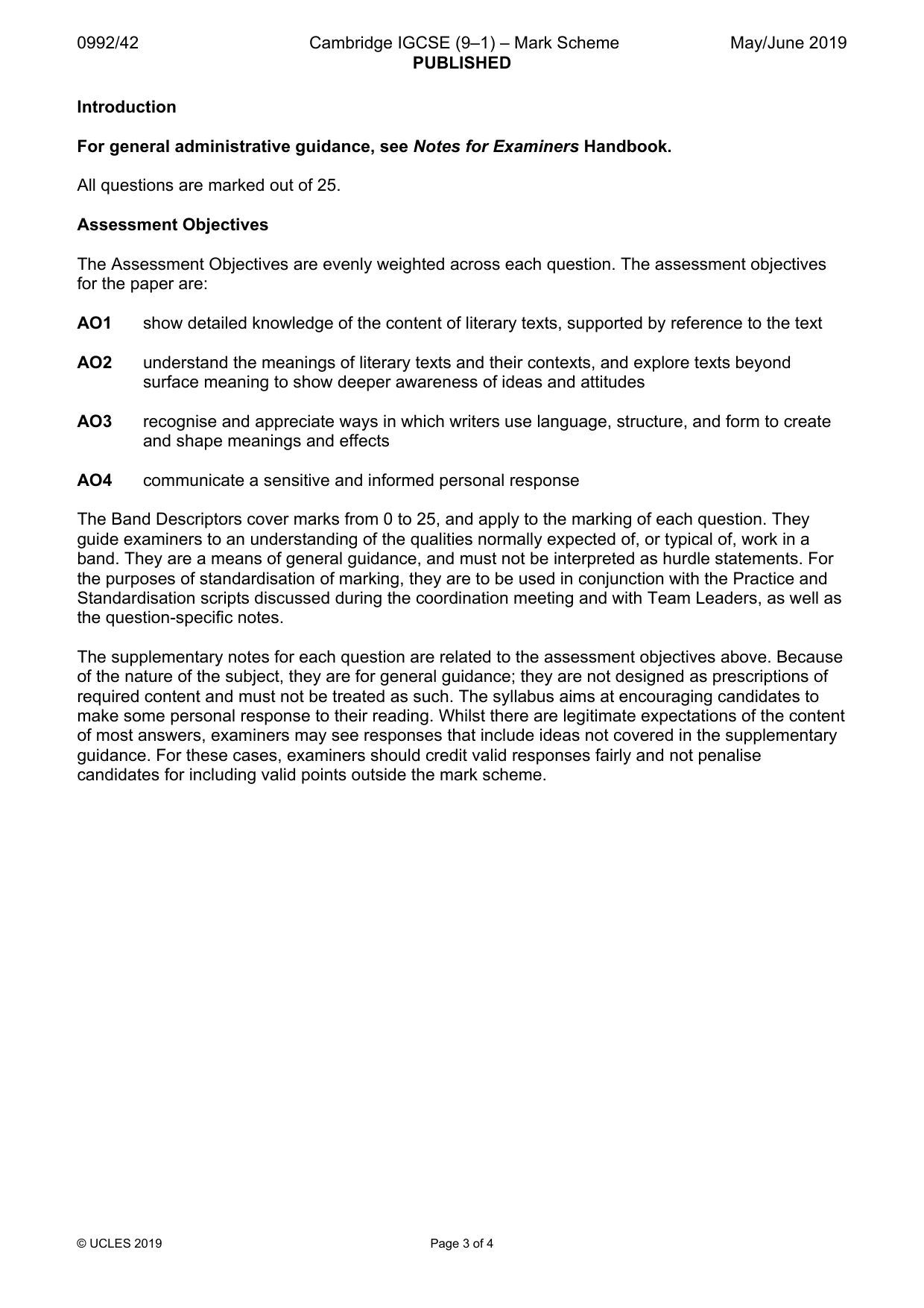
0992/42 Cambridge IGCSE (9–1) – Mark Scheme PUBLISHED May/June 2019 © UCLES 2019 Page 3 of 4 Introduction For general administrative guidance, see Notes for Examiners Handbook. All questions are marked out of 25. Assessment Objectives The Assessment Objectives are evenly weighted across each question. The assessment objectives for the paper are: AO1 show detailed knowledge of the content of literary texts, supported by reference to the text AO2 understand the meanings of literary texts and their contexts, and explore texts beyond surface meaning to show deeper awareness of ideas and attitudes AO3 recognise and appreciate ways in which writers use language, structure, and form to create and shape meanings and effects AO4 communicate a sensitive and informed personal response The Band Descriptors cover marks from 0 to 25, and apply to the marking of each question. They guide examiners to an understanding of the qualities normally expected of, or typical of, work in a band. They are a means of general guidance, and must not be interpreted as hurdle statements. For the purposes of standardisation of marking, they are to be used in conjunction with the Practice and Standardisation scripts discussed during the coordination meeting and with Team Leaders, as well as the question-specific notes. The supplementary notes for each question are related to the assessment objectives above. Because of the nature of the subject, they are for general guidance; they are not designed as prescriptions of required content and must not be treated as such. The syllabus aims at encouraging candidates to make some personal response to their reading. Whilst there are legitimate expectations of the content of most answers, examiners may see responses that include ideas not covered in the supplementary guidance. For these cases, examiners should credit valid responses fairly and not penalise candidates for including valid points outside the mark scheme.
Mark scheme, page 4
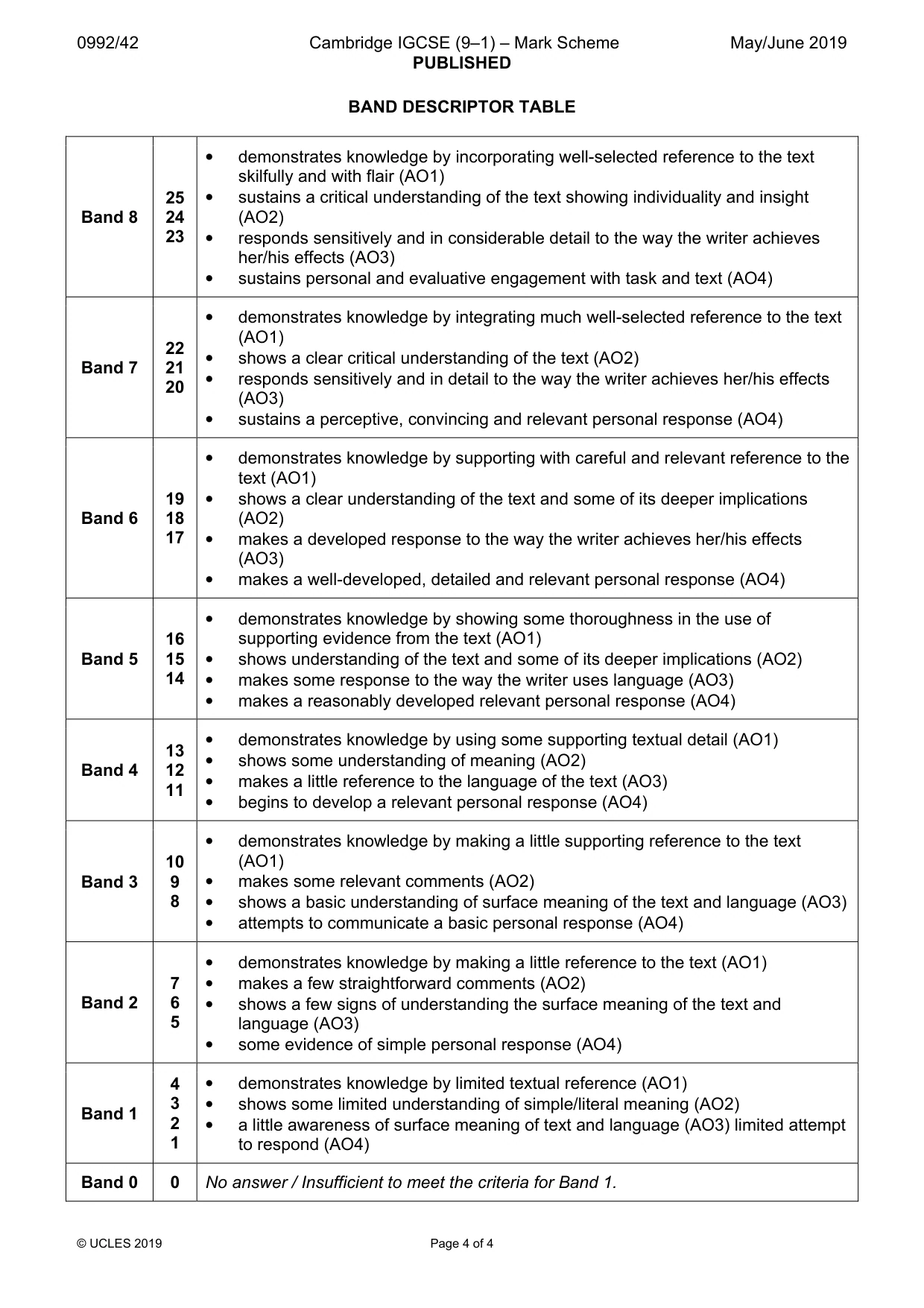
0992/42 Cambridge IGCSE (9–1) – Mark Scheme PUBLISHED May/June 2019 © UCLES 2019 Page 4 of 4 BAND DESCRIPTOR TABLE Band 8 25 24 23 • demonstrates knowledge by incorporating well-selected reference to the text skilfully and with flair (AO1) • sustains a critical understanding of the text showing individuality and insight (AO2) • responds sensitively and in considerable detail to the way the writer achieves her/his effects (AO3) • sustains personal and evaluative engagement with task and text (AO4) Band 7 22 21 20 • demonstrates knowledge by integrating much well-selected reference to the text (AO1) • shows a clear critical understanding of the text (AO2) • responds sensitively and in detail to the way the writer achieves her/his effects (AO3) • sustains a perceptive, convincing and relevant personal response (AO4) Band 6 19 18 17 • demonstrates knowledge by supporting with careful and relevant reference to the text (AO1) • shows a clear understanding of the text and some of its deeper implications (AO2) • makes a developed response to the way the writer achieves her/his effects (AO3) • makes a well-developed, detailed and relevant personal response (AO4) Band 5 16 15 14 • demonstrates knowledge by showing some thoroughness in the use of supporting evidence from the text (AO1) • shows understanding of the text and some of its deeper implications (AO2) • makes some response to the way the writer uses language (AO3) • makes a reasonably developed relevant personal response (AO4) Band 4 13 12 11 • demonstrates knowledge by using some supporting textual detail (AO1) • shows some understanding of meaning (AO2) • makes a little reference to the language of the text (AO3) • begins to develop a relevant personal response (AO4) Band 3 10 9 8 • demonstrates knowledge by making a little supporting reference to the text (AO1) • makes some relevant comments (AO2) • shows a basic understanding of surface meaning of the text and language (AO3) • attempts to communicate a basic personal response (AO4) Band 2 7 6 5 • demonstrates knowledge by making a little reference to the text (AO1) • makes a few straightforward comments (AO2) • shows a few signs of understanding the surface meaning of the text and language (AO3) • some evidence of simple personal response (AO4) Band 1 4 3 2 1 • demonstrates knowledge by limited textual reference (AO1) • shows some limited understanding of simple/literal meaning (AO2) • a little awareness of surface meaning of text and language (AO3) limited attempt to respond (AO4) Band 0 0 No answer / Insufficient to meet the criteria for Band 1.
What you needed in this session
Cambridge’s own grade thresholds for 2019 May/June, Paper 4 · Variant 2. A higher threshold means an easier paper — the bar moves with how the cohort did.