Cambridge IGCSE English - Literature (BES) 0427 — 2019 Oct/Nov Paper 2 · Variant 1
0427/21/O/N/19 · 25 marks · ≈28 min
The question paper and its mark scheme, free to read here and free to download. This is Cambridge’s own paper, exactly as it was sat.
Question paper8 pages
Mark scheme4 pages
Answers below. Sit the paper first if you are practising.
Paper as text
Question paper, page 1
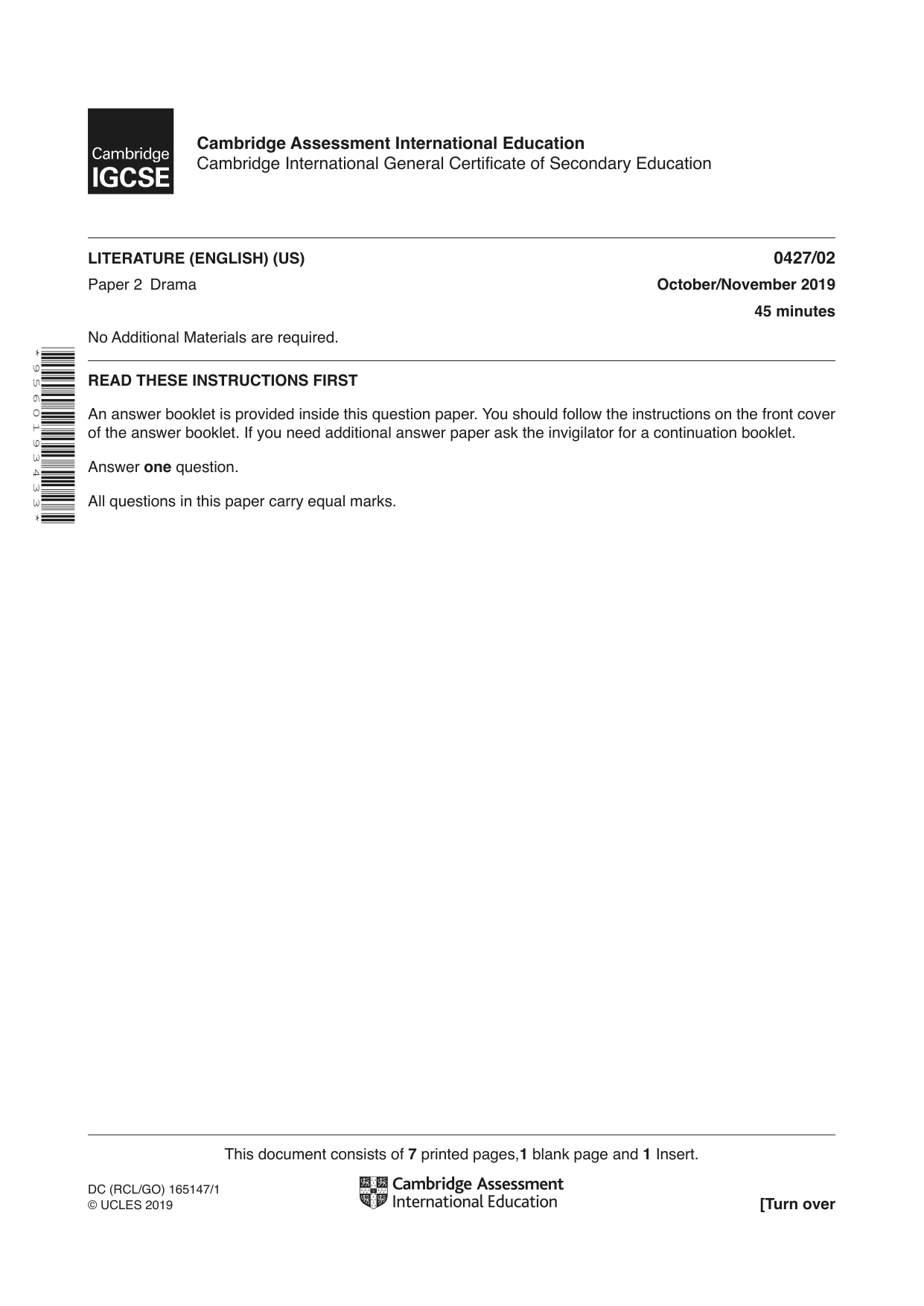
This document consists of 7 printed pages,1 blank page and 1 Insert. DC (RCL/GO) 165147/1 © UCLES 2019 [Turn over Cambridge Assessment International Education Cambridge International General Certificate of Secondary Education LITERATURE (ENGLISH) (US) 0427/02 Paper 2 Drama October/November 2019 45 minutes No Additional Materials are required. READ THESE INSTRUCTIONS FIRST An answer booklet is provided inside this question paper. You should follow the instructions on the front cover of the answer booklet. If you need additional answer paper ask the invigilator for a continuation booklet. Answer one question. All questions in this paper carry equal marks. * 9 5 6 0 1 9 3 4 3 3 *
Question paper, page 2
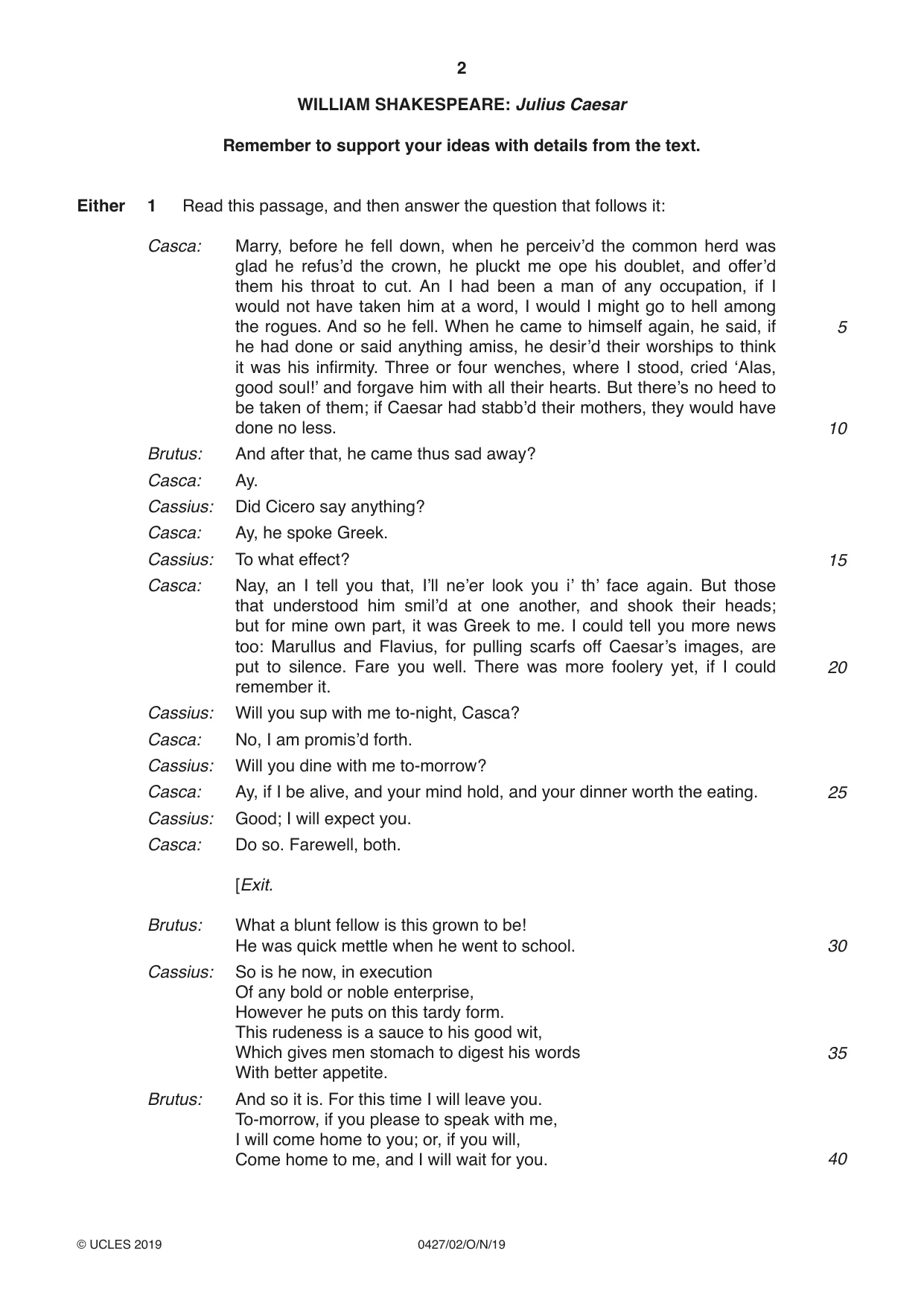
2 0427/02/O/N/19 © UCLES 2019 WILLIAM SHAKESPEARE: Julius Caesar Remember to support your ideas with details from the text. Either 1 Read this passage, and then answer the question that follows it: Casca: Marry, before he fell down, when he perceiv’d the common herd was glad he refus’d the crown, he pluckt me ope his doublet, and offer’d them his throat to cut. An I had been a man of any occupation, if I would not have taken him at a word, I would I might go to hell among the rogues. And so he fell. When he came to himself again, he said, if he had done or said anything amiss, he desir’d their worships to think it was his infirmity. Three or four wenches, where I stood, cried ‘Alas, good soul!’ and forgave him with all their hearts. But there’s no heed to be taken of them; if Caesar had stabb’d their mothers, they would have done no less. Brutus: And after that, he came thus sad away? Casca: Ay. Cassius: Did Cicero say anything? Casca: Ay, he spoke Greek. Cassius: To what effect? Casca: Nay, an I tell you that, I’ll ne’er look you i’ th’ face again. But those that understood him smil’d at one another, and shook their heads; but for mine own part, it was Greek to me. I could tell you more news too: Marullus and Flavius, for pulling scarfs off Caesar’s images, are put to silence. Fare you well. There was more foolery yet, if I could remember it. Cassius: Will you sup with me to-night, Casca? Casca: No, I am promis’d forth. Cassius: Will you dine with me to-morrow? Casca: Ay, if I be alive, and your mind hold, and your dinner worth the eating. Cassius: Good; I will expect you. Casca: Do so. Farewell, both. [Exit. Brutus: What a blunt fellow is this grown to be! He was quick mettle when he went to school. Cassius: So is he now, in execution Of any bold or noble enterprise, However he puts on this tardy form. This rudeness is a sauce to his good wit, Which gives men stomach to digest his words With better appetite. Brutus: And so it is. For this time I will leave you. To-morrow, if you please to speak with me, I will come home to you; or, if you will, Come home to me, and I will wait for you. 5 10 15 20 25 30 35 40
Question paper, page 3
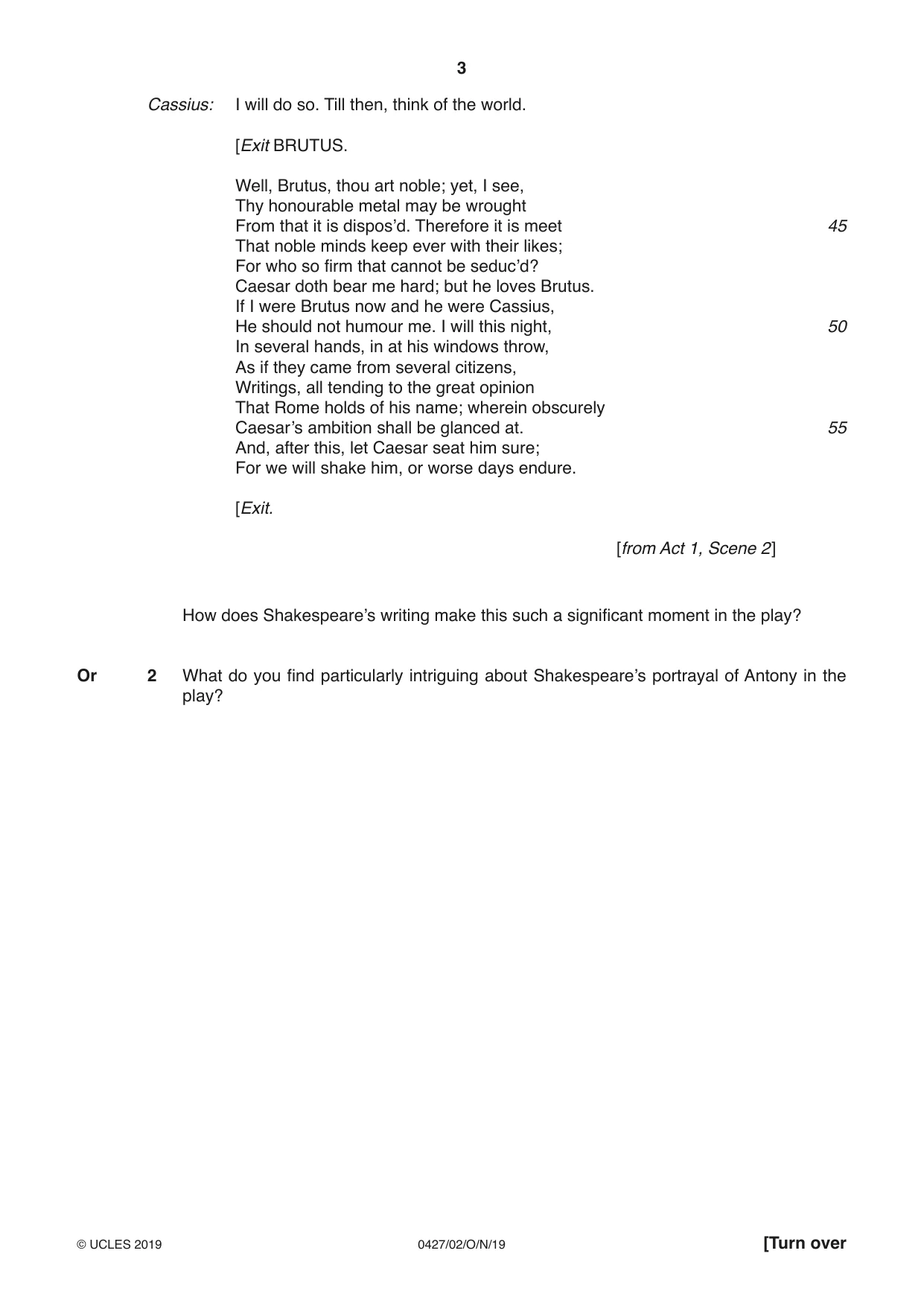
3 0427/02/O/N/19 © UCLES 2019 [Turn over Cassius: I will do so. Till then, think of the world. [Exit BRUTUS. Well, Brutus, thou art noble; yet, I see, Thy honourable metal may be wrought From that it is dispos’d. Therefore it is meet That noble minds keep ever with their likes; For who so firm that cannot be seduc’d? Caesar doth bear me hard; but he loves Brutus. If I were Brutus now and he were Cassius, He should not humour me. I will this night, In several hands, in at his windows throw, As if they came from several citizens, Writings, all tending to the great opinion That Rome holds of his name; wherein obscurely Caesar’s ambition shall be glanced at. And, after this, let Caesar seat him sure; For we will shake him, or worse days endure. [Exit. [from Act 1, Scene 2] How does Shakespeare’s writing make this such a significant moment in the play? Or 2 What do you find particularly intriguing about Shakespeare’s portrayal of Antony in the play? 45 50 55
Question paper, page 4
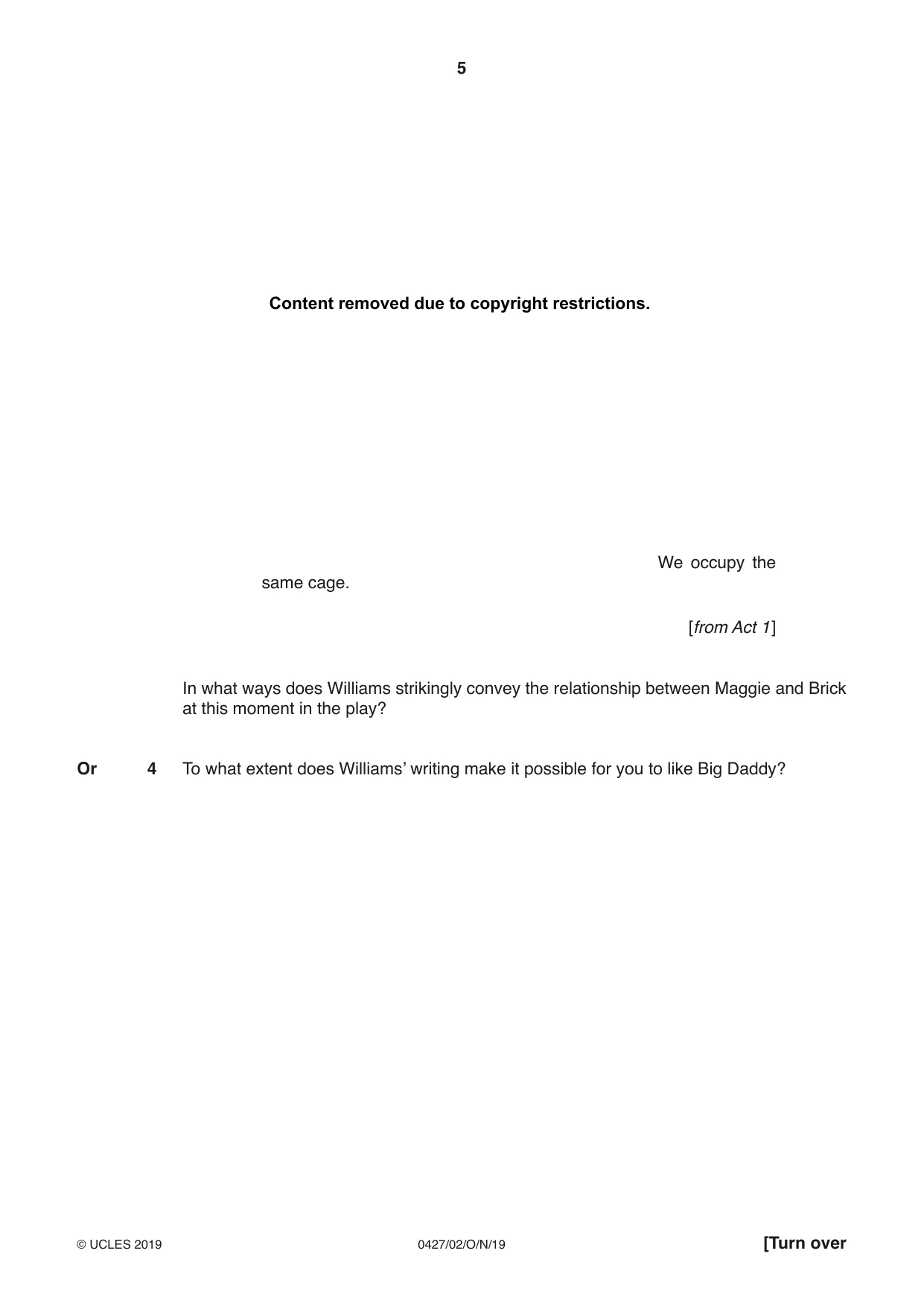
4 0427/02/O/N/19 © UCLES 2019 TENNESSEE WILLIAMS: Cat on a Hot Tin Roof Remember to support your ideas with details from the text. Either 3 Read this passage, and then answer the question that follows it: Maggie: Get dressed, Brick. Content removed due to copyright restrictions.
Question paper, page 5
5 0427/02/O/N/19 © UCLES 2019 [Turn over We occupy the same cage. [from Act 1] In what ways does Williams strikingly convey the relationship between Maggie and Brick at this moment in the play? Or 4 To what extent does Williams’ writing make it possible for you to like Big Daddy? Content removed due to copyright restrictions.
Question paper, page 6
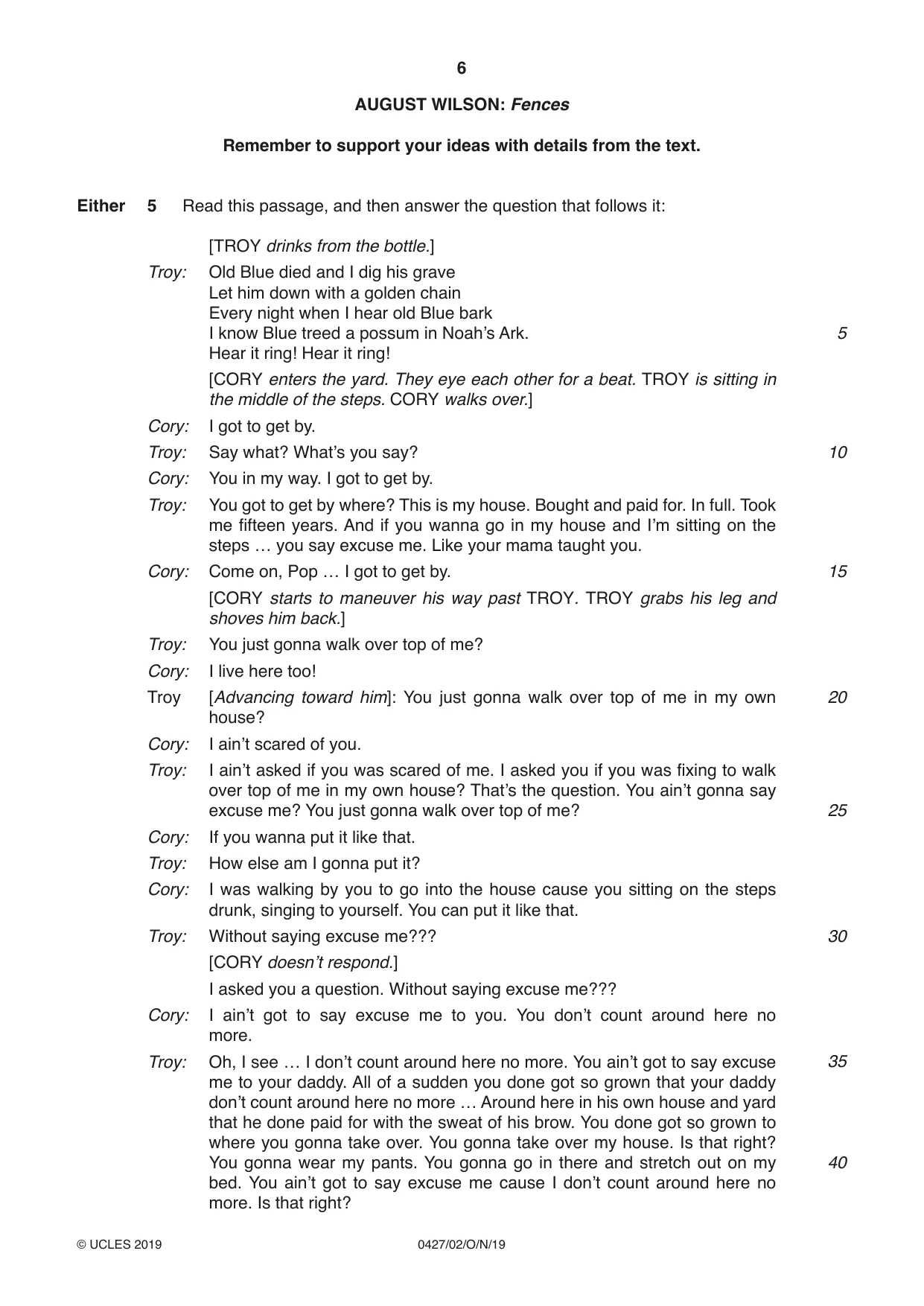
6 0427/02/O/N/19 © UCLES 2019 AUGUST WILSON: Fences Remember to support your ideas with details from the text. Either 5 Read this passage, and then answer the question that follows it: [TROY drinks from the bottle.] Troy: Old Blue died and I dig his grave Let him down with a golden chain Every night when I hear old Blue bark I know Blue treed a possum in Noah’s Ark. Hear it ring! Hear it ring! [CORY enters the yard. They eye each other for a beat. TROY is sitting in the middle of the steps. CORY walks over.] Cory: I got to get by. Troy: Say what? What’s you say? Cory: You in my way. I got to get by. Troy: You got to get by where? This is my house. Bought and paid for. In full. Took me fifteen years. And if you wanna go in my house and I’m sitting on the steps … you say excuse me. Like your mama taught you. Cory: Come on, Pop … I got to get by. [CORY starts to maneuver his way past TROY. TROY grabs his leg and shoves him back.] Troy: You just gonna walk over top of me? Cory: I live here too! Troy [Advancing toward him]: You just gonna walk over top of me in my own house? Cory: I ain’t scared of you. Troy: I ain’t asked if you was scared of me. I asked you if you was fixing to walk over top of me in my own house? That’s the question. You ain’t gonna say excuse me? You just gonna walk over top of me? Cory: If you wanna put it like that. Troy: How else am I gonna put it? Cory: I was walking by you to go into the house cause you sitting on the steps drunk, singing to yourself. You can put it like that. Troy: Without saying excuse me??? [CORY doesn’t respond.] I asked you a question. Without saying excuse me??? Cory: I ain’t got to say excuse me to you. You don’t count around here no more. Troy: Oh, I see … I don’t count around here no more. You ain’t got to say excuse me to your daddy. All of a sudden you done got so grown that your daddy don’t count around here no more … Around here in his own house and yard that he done paid for with the sweat of his brow. You done got so grown to where you gonna take over. You gonna take over my house. Is that right? You gonna wear my pants. You gonna go in there and stretch out on my bed. You ain’t got to say excuse me cause I don’t count around here no more. Is that right? 5 10 15 20 25 30 35 40
Question paper, page 7
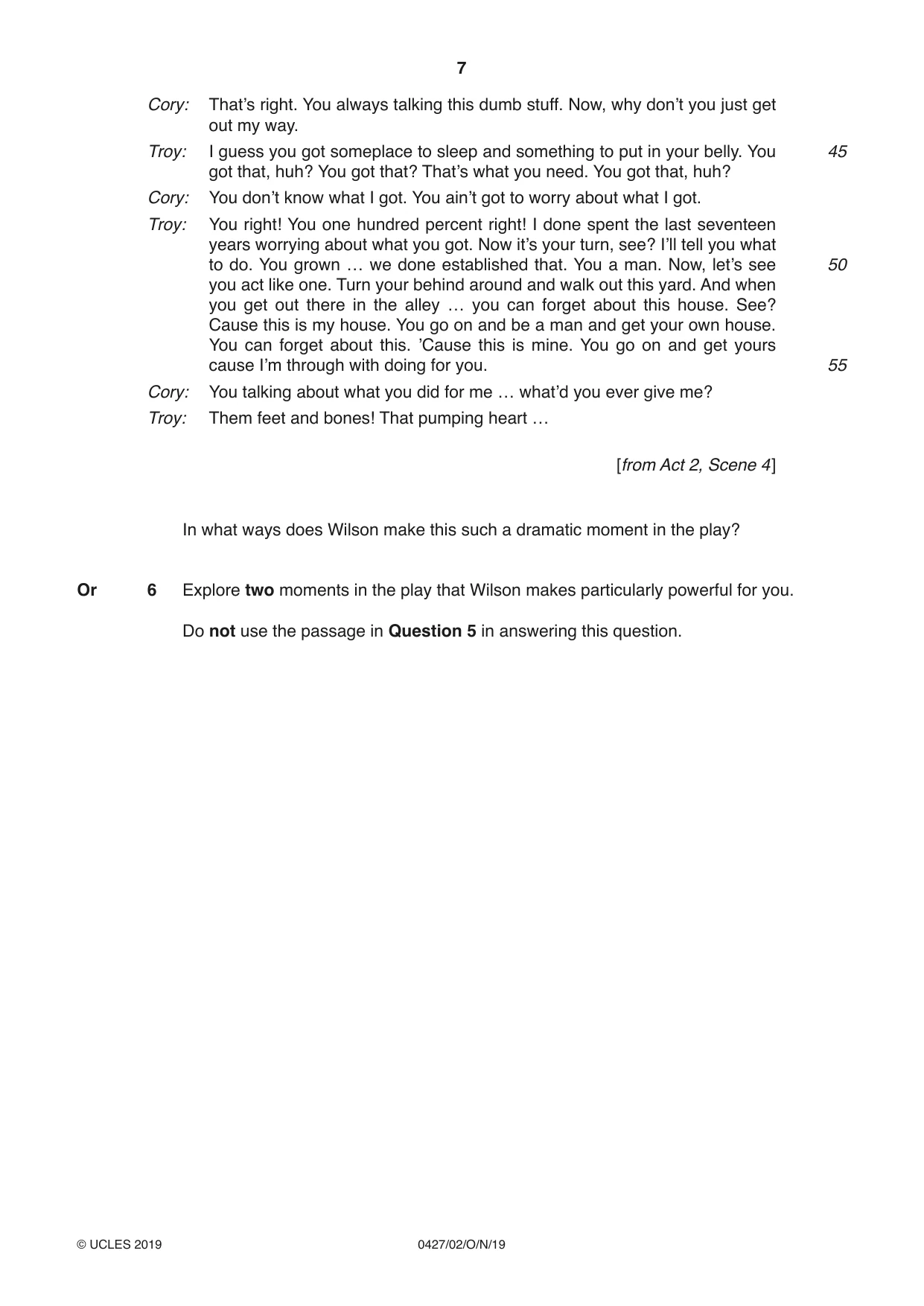
7 0427/02/O/N/19 © UCLES 2019 Cory: That’s right. You always talking this dumb stuff. Now, why don’t you just get out my way. Troy: I guess you got someplace to sleep and something to put in your belly. You got that, huh? You got that? That’s what you need. You got that, huh? Cory: You don’t know what I got. You ain’t got to worry about what I got. Troy: You right! You one hundred percent right! I done spent the last seventeen years worrying about what you got. Now it’s your turn, see? I’ll tell you what to do. You grown … we done established that. You a man. Now, let’s see you act like one. Turn your behind around and walk out this yard. And when you get out there in the alley … you can forget about this house. See? Cause this is my house. You go on and be a man and get your own house. You can forget about this. ’Cause this is mine. You go on and get yours cause I’m through with doing for you. Cory: You talking about what you did for me … what’d you ever give me? Troy: Them feet and bones! That pumping heart … [from Act 2, Scene 4] In what ways does Wilson make this such a dramatic moment in the play? Or 6 Explore two moments in the play that Wilson makes particularly powerful for you. Do not use the passage in Question 5 in answering this question. 45 50 55
Question paper, page 8
8 0427/02/O/N/19 © UCLES 2019 BLANK PAGE Permission to reproduce items where third-party owned material protected by copyright is included has been sought and cleared where possible. Every reasonable effort has been made by the publisher (UCLES) to trace copyright holders, but if any items requiring clearance have unwittingly been included, the publisher will be pleased to make amends at the earliest possible opportunity. To avoid the issue of disclosure of answer-related information to candidates, all copyright acknowledgements are reproduced online in the Cambridge Assessment International Education Copyright Acknowledgements Booklet. This is produced for each series of examinations and is freely available to download at www.cambridgeinternational.org after the live examination series. Cambridge Assessment International Education is part of the Cambridge Assessment Group. Cambridge Assessment is the brand name of the University of Cambridge Local Examinations Syndicate (UCLES), which itself is a department of the University of Cambridge.
Mark scheme, page 1
This document consists of 4 printed pages. © UCLES 2019 [Turn over Cambridge Assessment International Education Cambridge International General Certificate of Secondary Education LITERATURE (ENGLISH) (US) 0427/02 Paper 2 Drama October/November 2019 MARK SCHEME Maximum Mark: 25 Published This mark scheme is published as an aid to teachers and candidates, to indicate the requirements of the examination. It shows the basis on which Examiners were instructed to award marks. It does not indicate the details of the discussions that took place at an Examiners’ meeting before marking began, which would have considered the acceptability of alternative answers. Mark schemes should be read in conjunction with the question paper and the Principal Examiner Report for Teachers. Cambridge International will not enter into discussions about these mark schemes. Cambridge International is publishing the mark schemes for the October/November 2019 series for most Cambridge IGCSE™, Cambridge International A and AS Level components and some Cambridge O Level components.
Mark scheme, page 2
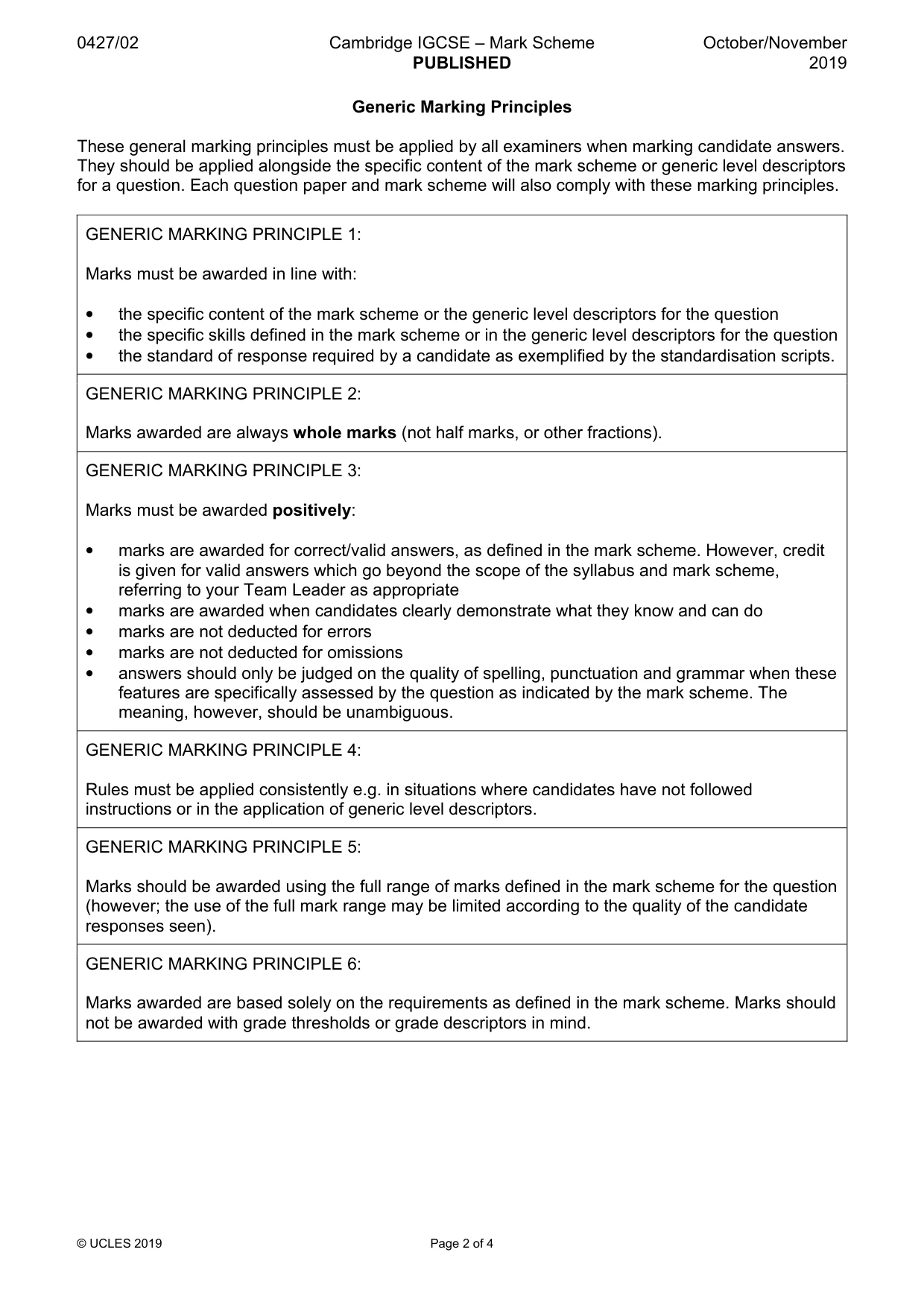
0427/02 Cambridge IGCSE – Mark Scheme PUBLISHED October/November 2019 © UCLES 2019 Page 2 of 4 Generic Marking Principles These general marking principles must be applied by all examiners when marking candidate answers. They should be applied alongside the specific content of the mark scheme or generic level descriptors for a question. Each question paper and mark scheme will also comply with these marking principles. GENERIC MARKING PRINCIPLE 1: Marks must be awarded in line with: • the specific content of the mark scheme or the generic level descriptors for the question • the specific skills defined in the mark scheme or in the generic level descriptors for the question • the standard of response required by a candidate as exemplified by the standardisation scripts. GENERIC MARKING PRINCIPLE 2: Marks awarded are always whole marks (not half marks, or other fractions). GENERIC MARKING PRINCIPLE 3: Marks must be awarded positively: • marks are awarded for correct/valid answers, as defined in the mark scheme. However, credit is given for valid answers which go beyond the scope of the syllabus and mark scheme, referring to your Team Leader as appropriate • marks are awarded when candidates clearly demonstrate what they know and can do • marks are not deducted for errors • marks are not deducted for omissions • answers should only be judged on the quality of spelling, punctuation and grammar when these features are specifically assessed by the question as indicated by the mark scheme. The meaning, however, should be unambiguous. GENERIC MARKING PRINCIPLE 4: Rules must be applied consistently e.g. in situations where candidates have not followed instructions or in the application of generic level descriptors. GENERIC MARKING PRINCIPLE 5: Marks should be awarded using the full range of marks defined in the mark scheme for the question (however; the use of the full mark range may be limited according to the quality of the candidate responses seen). GENERIC MARKING PRINCIPLE 6: Marks awarded are based solely on the requirements as defined in the mark scheme. Marks should not be awarded with grade thresholds or grade descriptors in mind.
Mark scheme, page 3
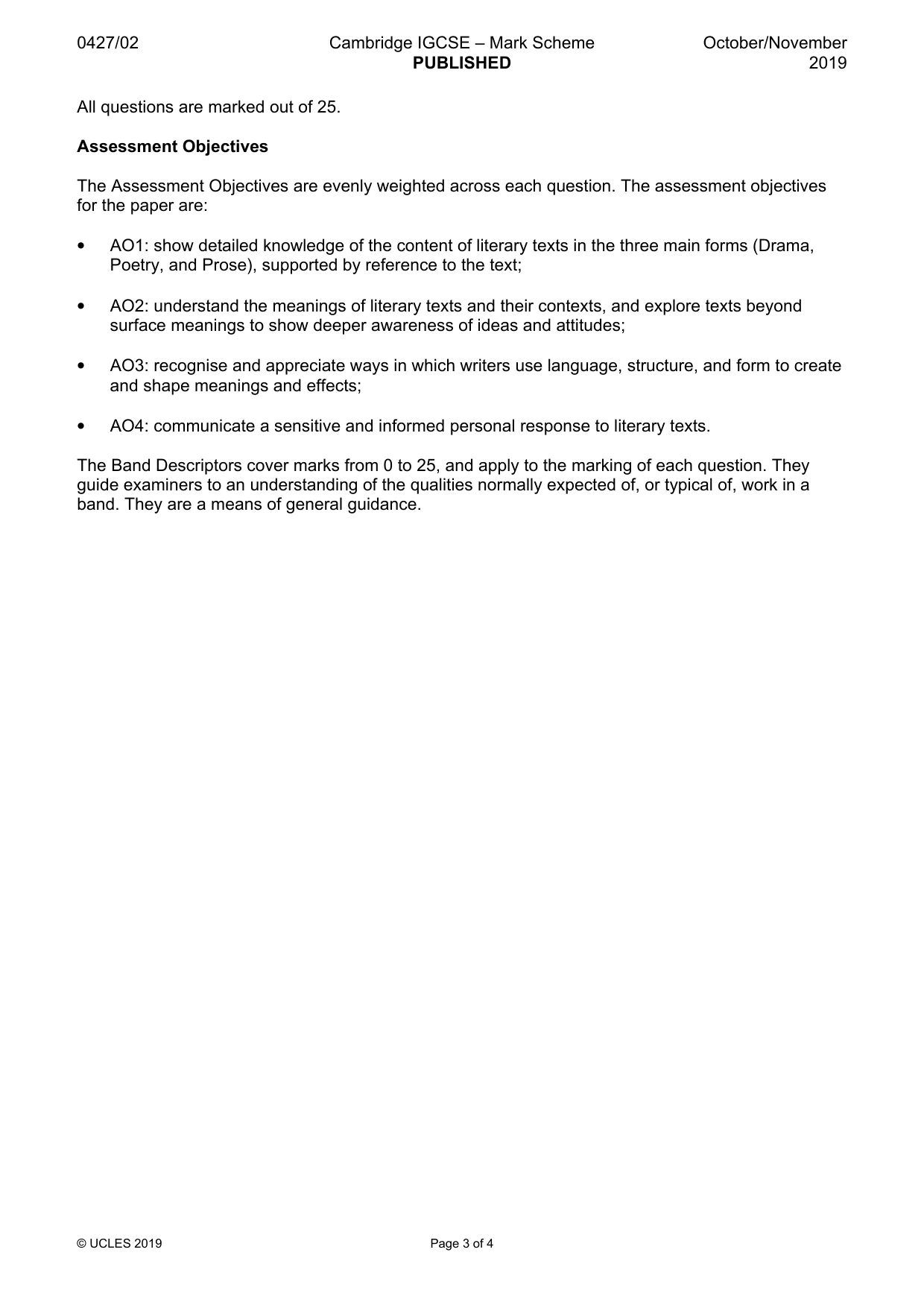
0427/02 Cambridge IGCSE – Mark Scheme PUBLISHED October/November 2019 © UCLES 2019 Page 3 of 4 All questions are marked out of 25. Assessment Objectives The Assessment Objectives are evenly weighted across each question. The assessment objectives for the paper are: • AO1: show detailed knowledge of the content of literary texts in the three main forms (Drama, Poetry, and Prose), supported by reference to the text; • AO2: understand the meanings of literary texts and their contexts, and explore texts beyond surface meanings to show deeper awareness of ideas and attitudes; • AO3: recognise and appreciate ways in which writers use language, structure, and form to create and shape meanings and effects; • AO4: communicate a sensitive and informed personal response to literary texts. The Band Descriptors cover marks from 0 to 25, and apply to the marking of each question. They guide examiners to an understanding of the qualities normally expected of, or typical of, work in a band. They are a means of general guidance.
Mark scheme, page 4
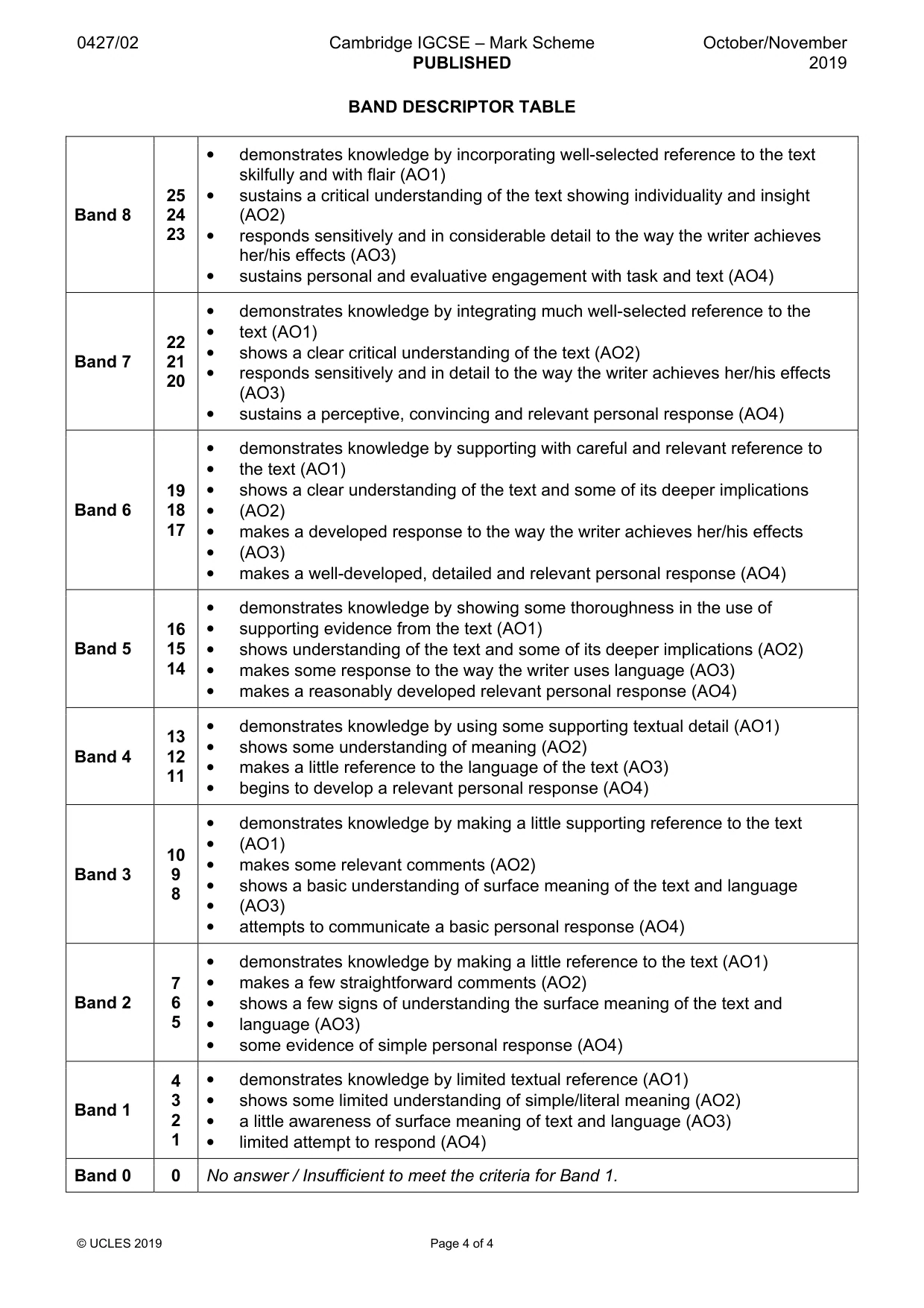
0427/02 Cambridge IGCSE – Mark Scheme PUBLISHED October/November 2019 © UCLES 2019 Page 4 of 4 BAND DESCRIPTOR TABLE Band 8 25 24 23 • demonstrates knowledge by incorporating well-selected reference to the text skilfully and with flair (AO1) • sustains a critical understanding of the text showing individuality and insight (AO2) • responds sensitively and in considerable detail to the way the writer achieves her/his effects (AO3) • sustains personal and evaluative engagement with task and text (AO4) Band 7 22 21 20 • demonstrates knowledge by integrating much well-selected reference to the • text (AO1) • shows a clear critical understanding of the text (AO2) • responds sensitively and in detail to the way the writer achieves her/his effects (AO3) • sustains a perceptive, convincing and relevant personal response (AO4) Band 6 19 18 17 • demonstrates knowledge by supporting with careful and relevant reference to • the text (AO1) • shows a clear understanding of the text and some of its deeper implications • (AO2) • makes a developed response to the way the writer achieves her/his effects • (AO3) • makes a well-developed, detailed and relevant personal response (AO4) Band 5 16 15 14 • demonstrates knowledge by showing some thoroughness in the use of • supporting evidence from the text (AO1) • shows understanding of the text and some of its deeper implications (AO2) • makes some response to the way the writer uses language (AO3) • makes a reasonably developed relevant personal response (AO4) Band 4 13 12 11 • demonstrates knowledge by using some supporting textual detail (AO1) • shows some understanding of meaning (AO2) • makes a little reference to the language of the text (AO3) • begins to develop a relevant personal response (AO4) Band 3 10 9 8 • demonstrates knowledge by making a little supporting reference to the text • (AO1) • makes some relevant comments (AO2) • shows a basic understanding of surface meaning of the text and language • (AO3) • attempts to communicate a basic personal response (AO4) Band 2 7 6 5 • demonstrates knowledge by making a little reference to the text (AO1) • makes a few straightforward comments (AO2) • shows a few signs of understanding the surface meaning of the text and • language (AO3) • some evidence of simple personal response (AO4) Band 1 4 3 2 1 • demonstrates knowledge by limited textual reference (AO1) • shows some limited understanding of simple/literal meaning (AO2) • a little awareness of surface meaning of text and language (AO3) • limited attempt to respond (AO4) Band 0 0 No answer / Insufficient to meet the criteria for Band 1.
What you needed in this session
Cambridge’s own grade thresholds for 2019 Oct/Nov, Paper 2 · Variant 1. A higher threshold means an easier paper — the bar moves with how the cohort did.