Cambridge IGCSE English - Literature (BES) 0427 — 2019 May/June Paper 1 · Variant 1
0427/11/M/J/19 · 50 marks · ≈56 min
The question paper and its mark scheme, free to read here and free to download. This is Cambridge’s own paper, exactly as it was sat.
Question paper16 pages

Mark scheme4 pages
Answers below. Sit the paper first if you are practising.
Paper as text
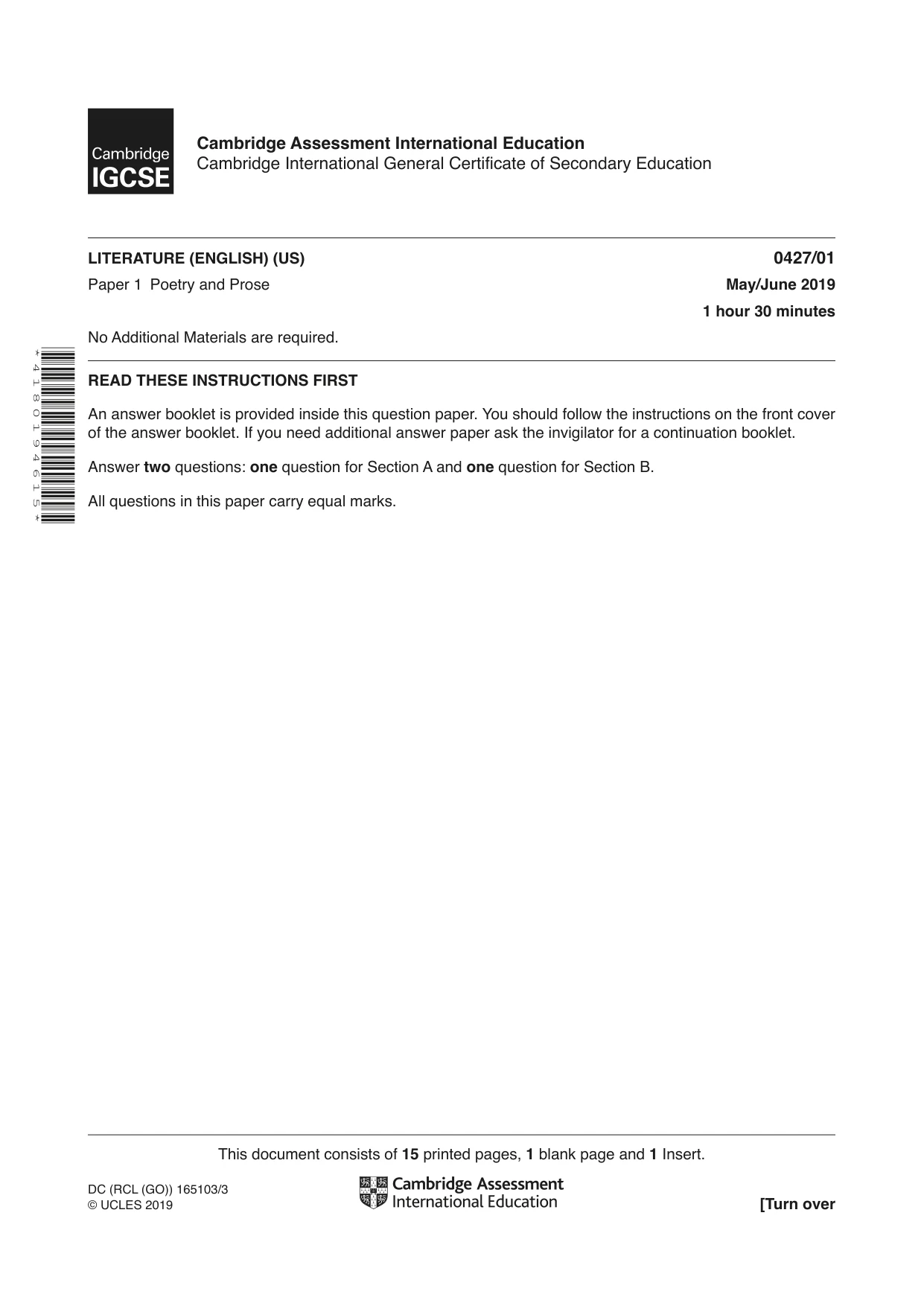
Question paper, page 1
This document consists of 15 printed pages, 1 blank page and 1 Insert. DC (RCL (GO)) 165103/3 © UCLES 2019 [Turn over Cambridge Assessment International Education Cambridge International General Certificate of Secondary Education * 4 1 8 0 1 9 4 6 1 5 * LITERATURE (ENGLISH) (US) 0427/01 Paper 1 Poetry and Prose May/June 2019 1 hour 30 minutes No Additional Materials are required. READ THESE INSTRUCTIONS FIRST An answer booklet is provided inside this question paper. You should follow the instructions on the front cover of the answer booklet. If you need additional answer paper ask the invigilator for a continuation booklet. Answer two questions: one question for Section A and one question for Section B. All questions in this paper carry equal marks.
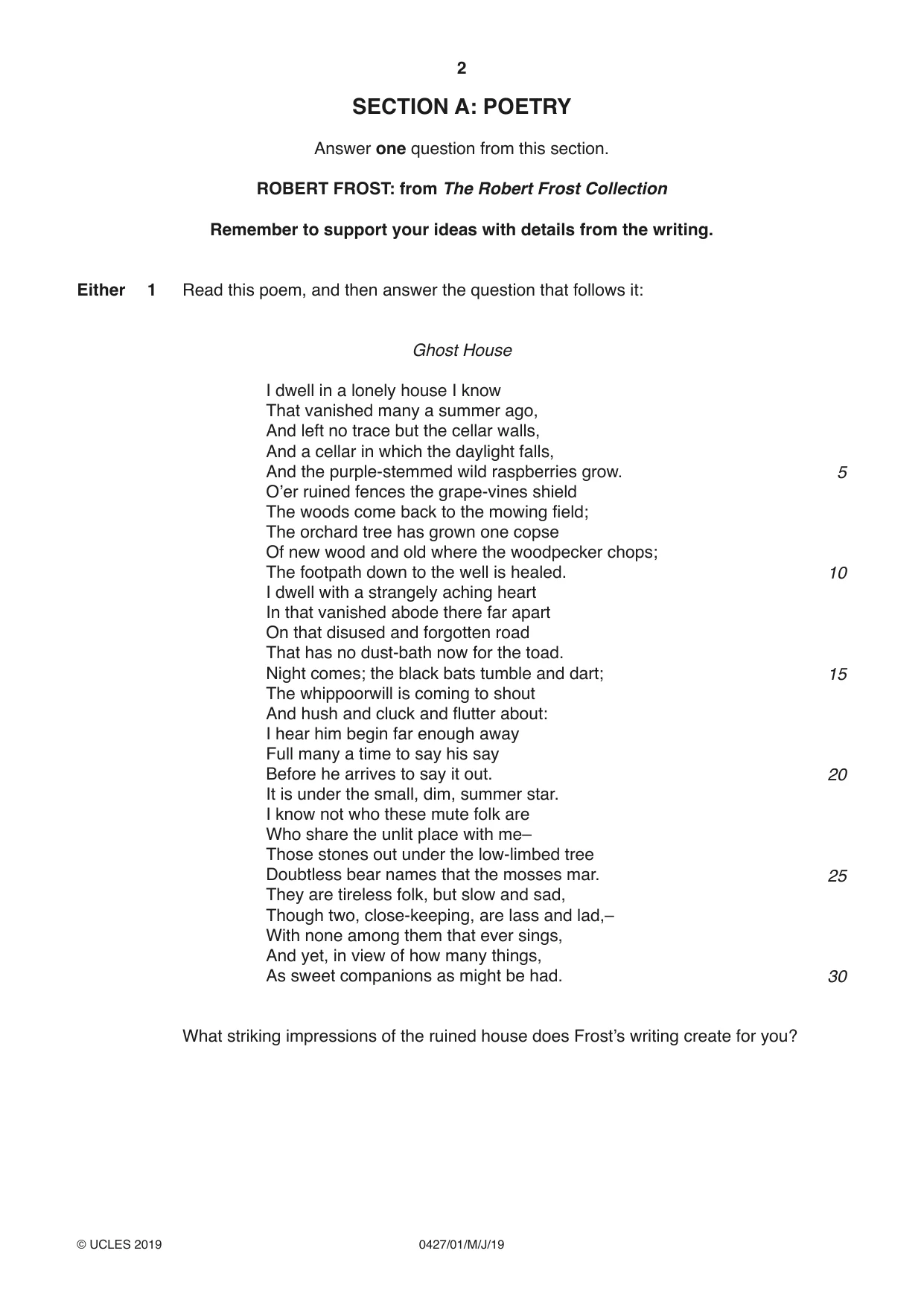
Question paper, page 2
2 0427/01/M/J/19 © UCLES 2019 SECTION A: POETRY Answer one question from this section. ROBERT FROST: from The Robert Frost Collection Remember to support your ideas with details from the writing. Either 1 Read this poem, and then answer the question that follows it: Ghost House I dwell in a lonely house I know That vanished many a summer ago, And left no trace but the cellar walls, And a cellar in which the daylight falls, And the purple-stemmed wild raspberries grow. O’er ruined fences the grape-vines shield The woods come back to the mowing field; The orchard tree has grown one copse Of new wood and old where the woodpecker chops; The footpath down to the well is healed. I dwell with a strangely aching heart In that vanished abode there far apart On that disused and forgotten road That has no dust-bath now for the toad. Night comes; the black bats tumble and dart; The whippoorwill is coming to shout And hush and cluck and flutter about: I hear him begin far enough away Full many a time to say his say Before he arrives to say it out. It is under the small, dim, summer star. I know not who these mute folk are Who share the unlit place with me– Those stones out under the low-limbed tree Doubtless bear names that the mosses mar. They are tireless folk, but slow and sad, Though two, close-keeping, are lass and lad,– With none among them that ever sings, And yet, in view of how many things, As sweet companions as might be had. What striking impressions of the ruined house does Frost’s writing create for you? 5 10 15 20 25 30
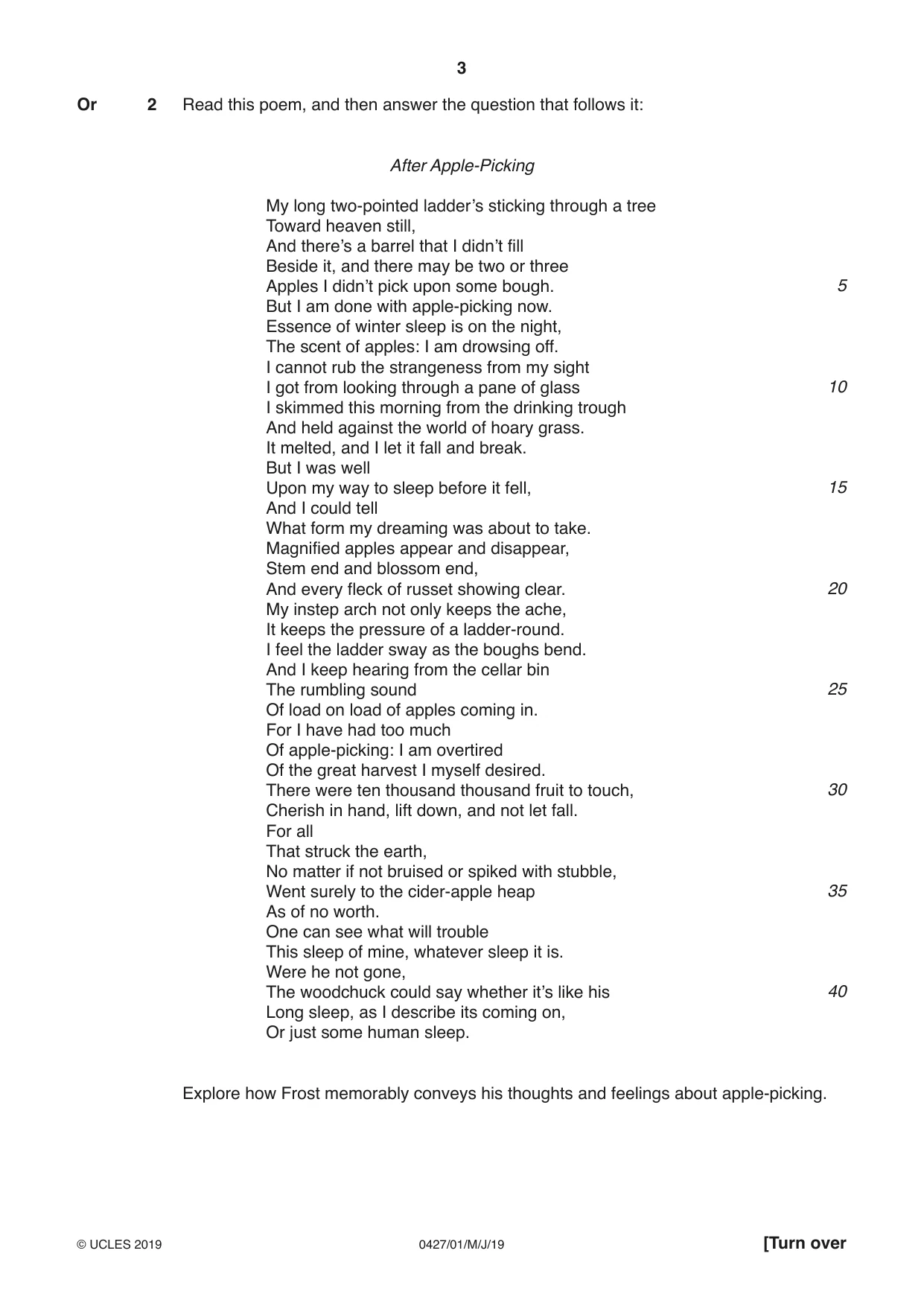
Question paper, page 3
3 0427/01/M/J/19 © UCLES 2019 [Turn over Or 2 Read this poem, and then answer the question that follows it: After Apple-Picking My long two-pointed ladder’s sticking through a tree Toward heaven still, And there’s a barrel that I didn’t fill Beside it, and there may be two or three Apples I didn’t pick upon some bough. But I am done with apple-picking now. Essence of winter sleep is on the night, The scent of apples: I am drowsing off. I cannot rub the strangeness from my sight I got from looking through a pane of glass I skimmed this morning from the drinking trough And held against the world of hoary grass. It melted, and I let it fall and break. But I was well Upon my way to sleep before it fell, And I could tell What form my dreaming was about to take. Magnified apples appear and disappear, Stem end and blossom end, And every fleck of russet showing clear. My instep arch not only keeps the ache, It keeps the pressure of a ladder-round. I feel the ladder sway as the boughs bend. And I keep hearing from the cellar bin The rumbling sound Of load on load of apples coming in. For I have had too much Of apple-picking: I am overtired Of the great harvest I myself desired. There were ten thousand thousand fruit to touch, Cherish in hand, lift down, and not let fall. For all That struck the earth, No matter if not bruised or spiked with stubble, Went surely to the cider-apple heap As of no worth. One can see what will trouble This sleep of mine, whatever sleep it is. Were he not gone, The woodchuck could say whether it’s like his Long sleep, as I describe its coming on, Or just some human sleep. Explore how Frost memorably conveys his thoughts and feelings about apple-picking. 5 10 15 20 25 30 35 40
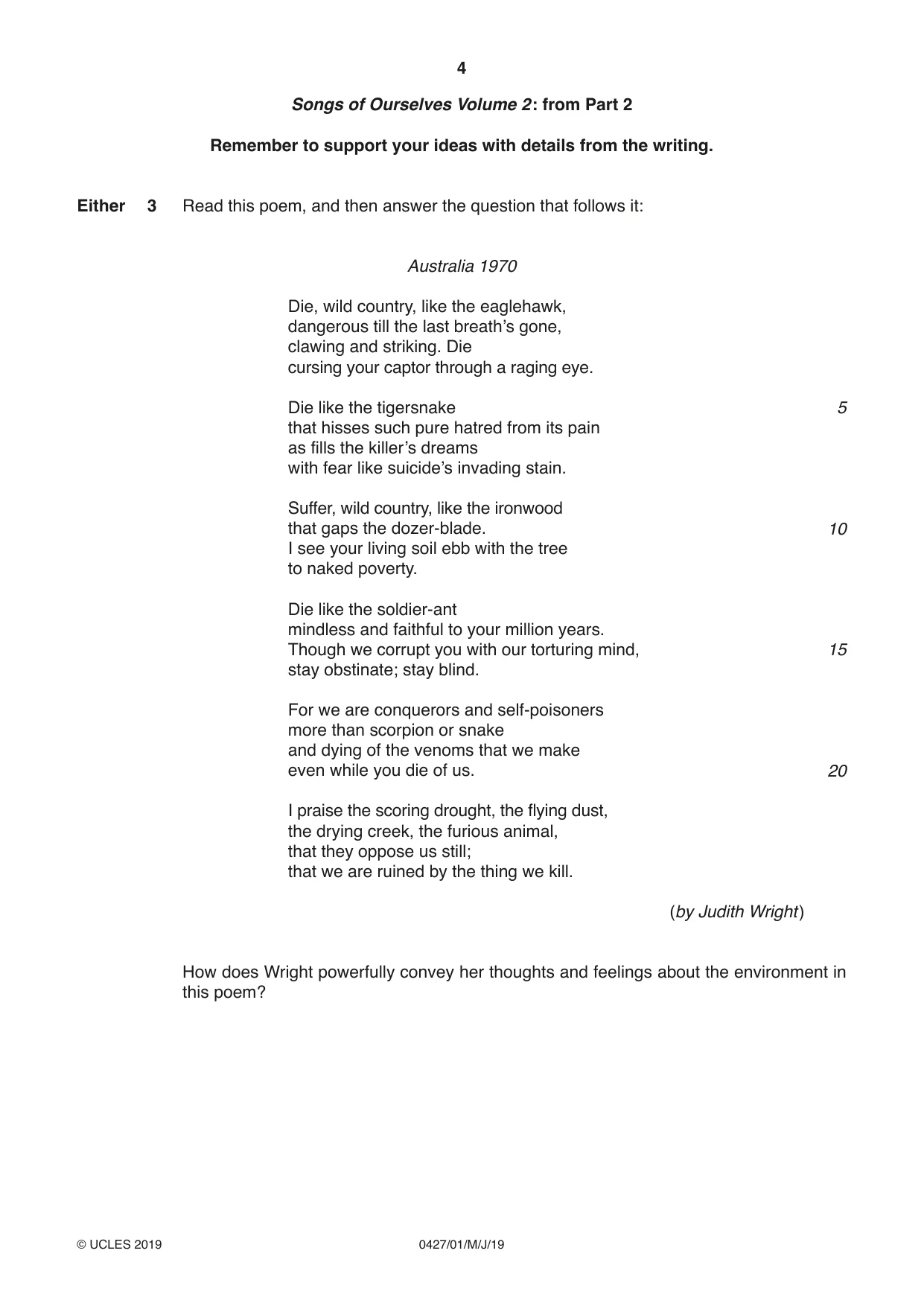
Question paper, page 4
4 0427/01/M/J/19 © UCLES 2019 Songs of Ourselves Volume 2: from Part 2 Remember to support your ideas with details from the writing. Either 3 Read this poem, and then answer the question that follows it: Australia 1970 Die, wild country, like the eaglehawk, dangerous till the last breath’s gone, clawing and striking. Die cursing your captor through a raging eye. Die like the tigersnake that hisses such pure hatred from its pain as fills the killer’s dreams with fear like suicide’s invading stain. Suffer, wild country, like the ironwood that gaps the dozer-blade. I see your living soil ebb with the tree to naked poverty. Die like the soldier-ant mindless and faithful to your million years. Though we corrupt you with our torturing mind, stay obstinate; stay blind. For we are conquerors and self-poisoners more than scorpion or snake and dying of the venoms that we make even while you die of us. I praise the scoring drought, the flying dust, the drying creek, the furious animal, that they oppose us still; that we are ruined by the thing we kill. (by Judith Wright) How does Wright powerfully convey her thoughts and feelings about the environment in this poem? 5 10 15 20
Question paper, page 5
5 0427/01/M/J/19 © UCLES 2019 [Turn over Or 4 Read this poem, and then answer the question that follows it: Eel Tail sometimes you see mudfish, those short lead lengths of eels that hide at low tide those roping and wagging, preliminary, pre-world creatures, cousins of the moon, who love blackness, aloofness, always move under cover of the unmoon and then as soon as you see them gone untranslatable hissed interruptions unspeakable wide chapped lips it’s the wind again cursing the water and when it clears you keep looking and looking for those underlurkers, uncontrolled little eddies, when you lever their rooves up they lie limbless hairless like the bends of some huge plumbing system sucking and sucking the marshes and sometimes its just a smirk of ripples and then as soon as you see them gone untranslatable hissed interruptions unspeakable wide chapped lips it’s the wind again bothering the reeds and when it clears you keep looking and looking for those backlashes waterwicks you keep finding those sea-veins still flowing, little cables of shadow, vanishing dream-lines long roots of the penumbra but they just drill down into gravel and dwindle as quick as drips and then as soon as you see them gone untranslatable hissed interruptions unspeakable wide chapped lips it’s the wind again pushing on your ears and when it clears sometimes you see that whip-thin tail of a waning moon start burrowing back into blackness and then as soon as you see her and then as soon as you say so gone (by Alice Oswald) In what ways does Oswald vividly portray the eels in this poem? 5 10 15 20 25 30 35 40 45
Question paper, page 6
6 0427/01/M/J/19 © UCLES 2019 SECTION B: PROSE Answer one question from this section. JENNIFER DONNELLY: A Northern Light Remember to support your ideas with details from the writing. Either 5 Read this passage, and then answer the question that follows it: ‘Don’t you think you’re rushing things a bit, Aunt Josie? It was just a ride home.’ ‘Now, Mattie, I understand your reluctance to make too much of this, honestly I do. You’re very levelheaded and you’re probably thinking that attention from a boy like Royal Loomis is a bit more than a plain girl like you should expect. But it doesn’t do to be too shy. If he’s showing interest, you’d do well to pursue it. You might not get another chance with a boy like Royal.’ I felt my face turn red. I know I have too many freckles and lank brown hair. Mamma used to call it chestnut, but it’s not; it’s just plain brown like my eyes. I know that my hands are rough and knobby and my body is small and sturdy. I know I do not look like Belinda Becker or Martha Miller—all blond and pale and airy, with ribbons in their hair. I know all this and I do not need my aunt to remind me. ‘Oh, Mattie, dear, I didn’t mean to make you blush! This has been bothering you, hasn’t it? I could tell something was. You needn’t be so modest! I know this must all be very new to you, and I know it must be hard—having lost your dear mother. But please don’t fret, dear. I understand a mother’s duty toward her daughter, and since your own mamma is gone, I will fulfill it for her. Is there anything you want to know, dear? Anything you need to ask me?’ I clutched the figurine I was polishing. ‘Yes, Aunt Josie, there is.’ ‘Go ahead, dear.’ I meant to be slow and sensible in my speech, but my words came out of me in a big, desperate gush. ‘Aunt Josie, can you…would you…I want to go to college, Aunt Josie. If you were going to give me money for china and silver, would you give it to me for books and train fare instead? I’ve been accepted. To Barnard College. In New York City. I applied over the winter and I got in. I want to study literature, but I haven’t the money to go and Pa won’t let me work at the Glenmore like I want to, and I thought that maybe if you…if Uncle Vernon…’ Everything changed as I spoke. Aunt Josie’s smile slid off her face like ice off a tin roof. ‘…you wouldn’t have to give it to me if you didn’t…if you didn’t want to. You could loan it to me. I’d pay it all back…every penny of it. Please, Aunt Josie?’ I spoke those last words in a whisper. My aunt didn’t reply right away; she just looked at me in such a way that I suddenly knew just how Hester Prynne felt when she had to stand on that scaffold. ‘You are just as bad as your no-account brother,’ she finally said. ‘Selfish and thoughtless. It must come from the Gokey side, because it doesn’t come from the Robertsons. What on earth can you be thinking? Leaving your sisters when they need you? And for a terrible place like New York!’ She nodded at the figurine I was clutching. ‘Pride. That’s very fitting. 5 10 15 20 25 30 35 40
Question paper, page 7
7 0427/01/M/J/19 © UCLES 2019 [Turn over Pride goeth before a fall. You’re on a very high horse, Mathilda. I don’t know who put you there, but you’d best get down off it. And fast.’ The lecture would have gone on, but there was a sudden smell of smoke. It had my aunt up and out of her chair in no time, waddling off to the kitchen to check on the pie she had baking. For an invalid, she moves faster than a water snake when she has a mind to. I remained on the ladder, looking at the figurine in my hand. You’re wrong, Aunt Josie, I thought. It’s not pride I’m feeling. It’s another sin. Worse than all the other ones, which are immediate, violent, and hot. This one sits inside you quietly and eats you from the inside out like the trichina worms the pigs get. It’s the Eighth Deadly Sin. The one God left out. Hope. [from ‘Uri-ah the Hit-tite, stink-pot, wart-hog’ ] What does Donnelly’s writing make you feel at this moment in the novel? Or 6 In what ways does Donnelly make Emily Wilcox (Baxter) such a significant character in the novel? 45 50 55
Question paper, page 8
8 0427/01/M/J/19 © UCLES 2019 F SCOTT FITZGERALD: The Great Gatsby Remember to support your ideas with details from the writing. Either 7 Read this passage, and then answer the question that follows it: The only building in sight was a small block of yellow brick sitting on the edge of the waste land, a sort of compact Main Street ministering to it, and contiguous to absolutely nothing. She nodded and moved away from him just as George Wilson emerged with two chairs from his office door. [from Chapter 2] Content removed due to copyright restrictions.
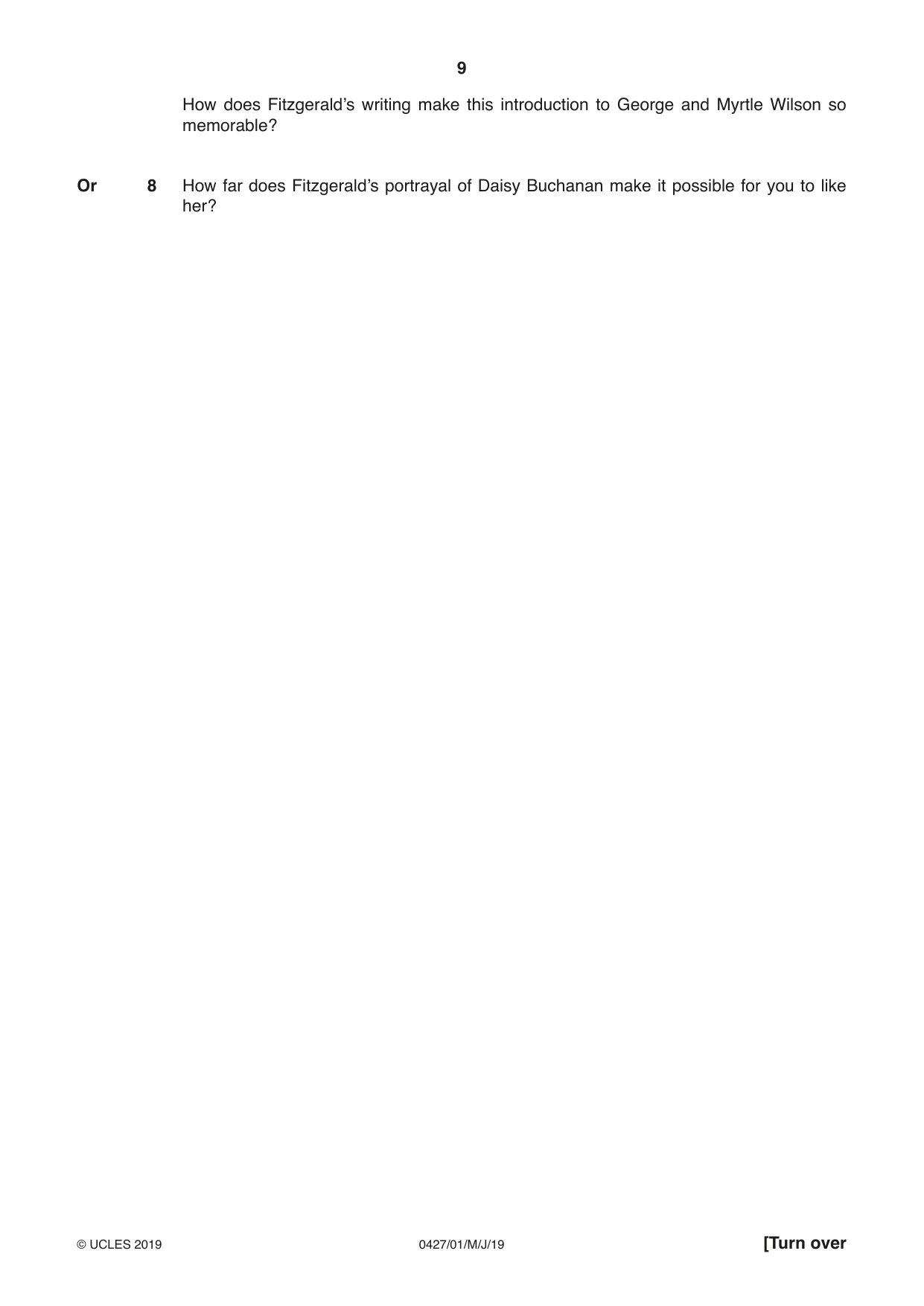
Question paper, page 9
9 0427/01/M/J/19 © UCLES 2019 [Turn over How does Fitzgerald’s writing make this introduction to George and Myrtle Wilson so memorable? Or 8 How far does Fitzgerald’s portrayal of Daisy Buchanan make it possible for you to like her?
Question paper, page 10
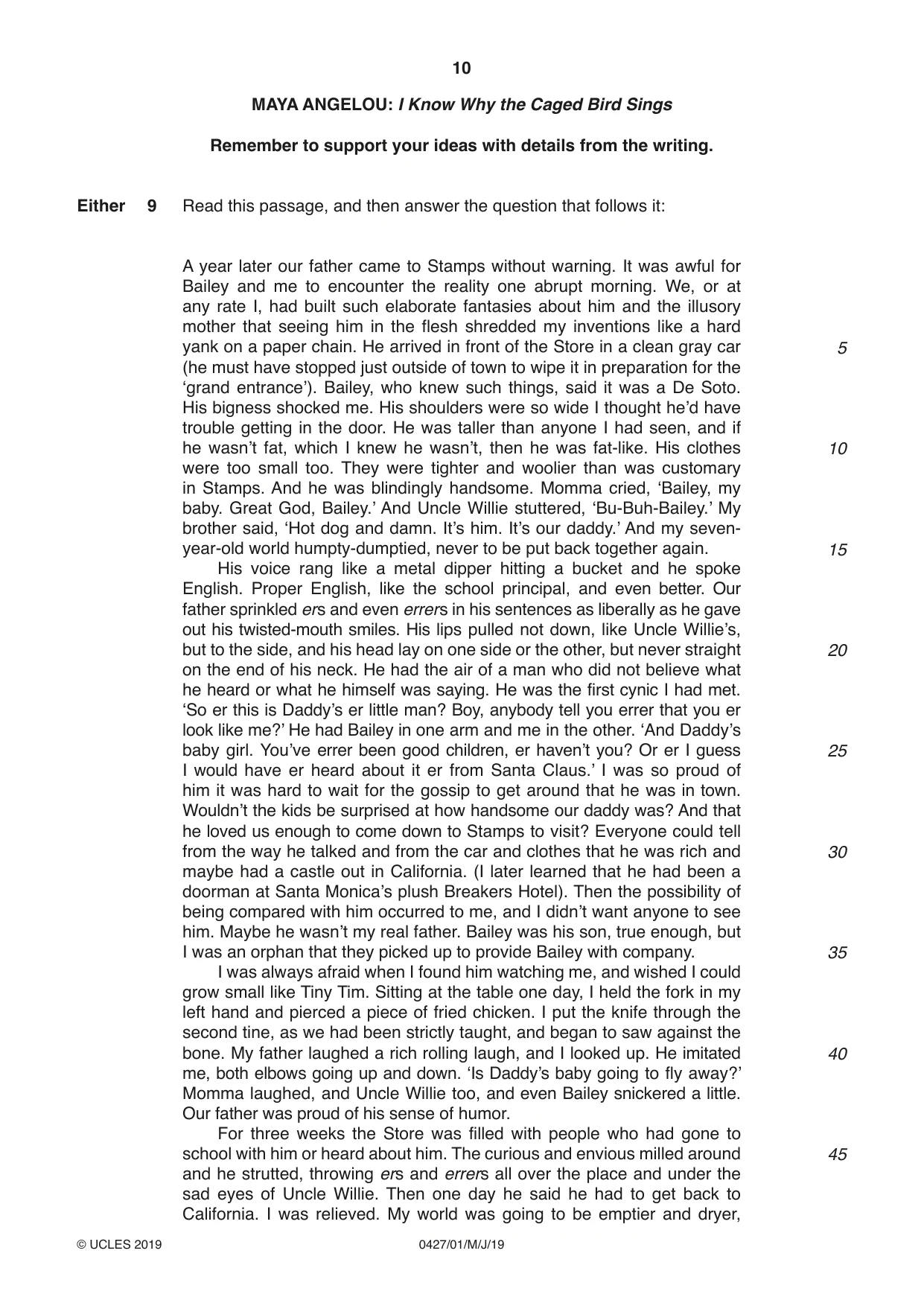
10 0427/01/M/J/19 © UCLES 2019 MAYA ANGELOU: I Know Why the Caged Bird Sings Remember to support your ideas with details from the writing. Either 9 Read this passage, and then answer the question that follows it: A year later our father came to Stamps without warning. It was awful for Bailey and me to encounter the reality one abrupt morning. We, or at any rate I, had built such elaborate fantasies about him and the illusory mother that seeing him in the flesh shredded my inventions like a hard yank on a paper chain. He arrived in front of the Store in a clean gray car (he must have stopped just outside of town to wipe it in preparation for the ‘grand entrance’). Bailey, who knew such things, said it was a De Soto. His bigness shocked me. His shoulders were so wide I thought he’d have trouble getting in the door. He was taller than anyone I had seen, and if he wasn’t fat, which I knew he wasn’t, then he was fat-like. His clothes were too small too. They were tighter and woolier than was customary in Stamps. And he was blindingly handsome. Momma cried, ‘Bailey, my baby. Great God, Bailey.’ And Uncle Willie stuttered, ‘Bu-Buh-Bailey.’ My brother said, ‘Hot dog and damn. It’s him. It’s our daddy.’ And my seven- year-old world humpty-dumptied, never to be put back together again. His voice rang like a metal dipper hitting a bucket and he spoke English. Proper English, like the school principal, and even better. Our father sprinkled ers and even errers in his sentences as liberally as he gave out his twisted-mouth smiles. His lips pulled not down, like Uncle Willie’s, but to the side, and his head lay on one side or the other, but never straight on the end of his neck. He had the air of a man who did not believe what he heard or what he himself was saying. He was the first cynic I had met. ‘So er this is Daddy’s er little man? Boy, anybody tell you errer that you er look like me?’ He had Bailey in one arm and me in the other. ‘And Daddy’s baby girl. You’ve errer been good children, er haven’t you? Or er I guess I would have er heard about it er from Santa Claus.’ I was so proud of him it was hard to wait for the gossip to get around that he was in town. Wouldn’t the kids be surprised at how handsome our daddy was? And that he loved us enough to come down to Stamps to visit? Everyone could tell from the way he talked and from the car and clothes that he was rich and maybe had a castle out in California. (I later learned that he had been a doorman at Santa Monica’s plush Breakers Hotel). Then the possibility of being compared with him occurred to me, and I didn’t want anyone to see him. Maybe he wasn’t my real father. Bailey was his son, true enough, but I was an orphan that they picked up to provide Bailey with company. I was always afraid when I found him watching me, and wished I could grow small like Tiny Tim. Sitting at the table one day, I held the fork in my left hand and pierced a piece of fried chicken. I put the knife through the second tine, as we had been strictly taught, and began to saw against the bone. My father laughed a rich rolling laugh, and I looked up. He imitated me, both elbows going up and down. ‘Is Daddy’s baby going to fly away?’ Momma laughed, and Uncle Willie too, and even Bailey snickered a little. Our father was proud of his sense of humor. For three weeks the Store was filled with people who had gone to school with him or heard about him. The curious and envious milled around and he strutted, throwing ers and errers all over the place and under the sad eyes of Uncle Willie. Then one day he said he had to get back to California. I was relieved. My world was going to be emptier and dryer, 5 10 15 20 25 30 35 40 45
Question paper, page 11
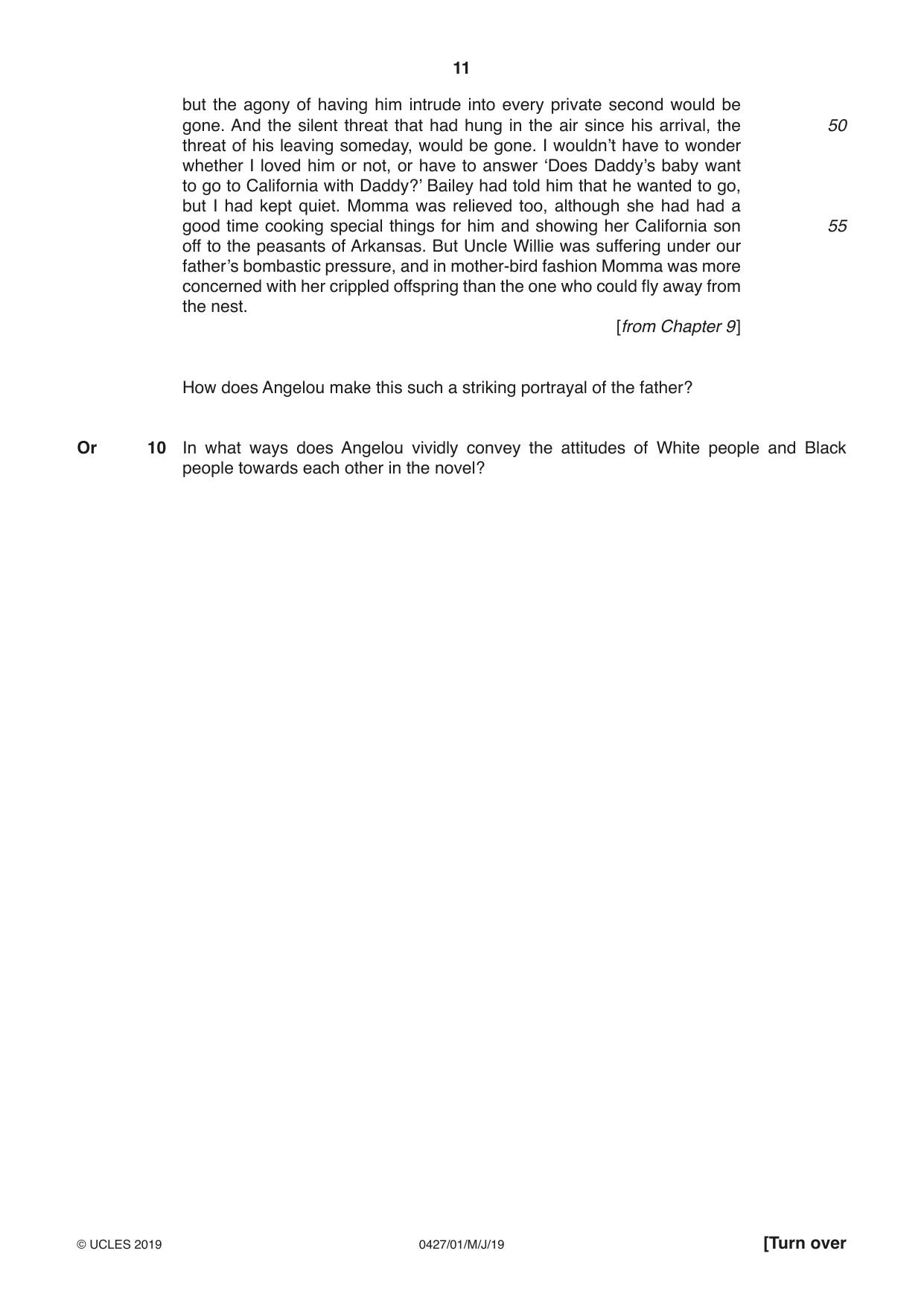
11 0427/01/M/J/19 © UCLES 2019 [Turn over but the agony of having him intrude into every private second would be gone. And the silent threat that had hung in the air since his arrival, the threat of his leaving someday, would be gone. I wouldn’t have to wonder whether I loved him or not, or have to answer ‘Does Daddy’s baby want to go to California with Daddy?’ Bailey had told him that he wanted to go, but I had kept quiet. Momma was relieved too, although she had had a good time cooking special things for him and showing her California son off to the peasants of Arkansas. But Uncle Willie was suffering under our father’s bombastic pressure, and in mother-bird fashion Momma was more concerned with her crippled offspring than the one who could fly away from the nest. [from Chapter 9] How does Angelou make this such a striking portrayal of the father? Or 10 In what ways does Angelou vividly convey the attitudes of White people and Black people towards each other in the novel? 50 55
Question paper, page 12
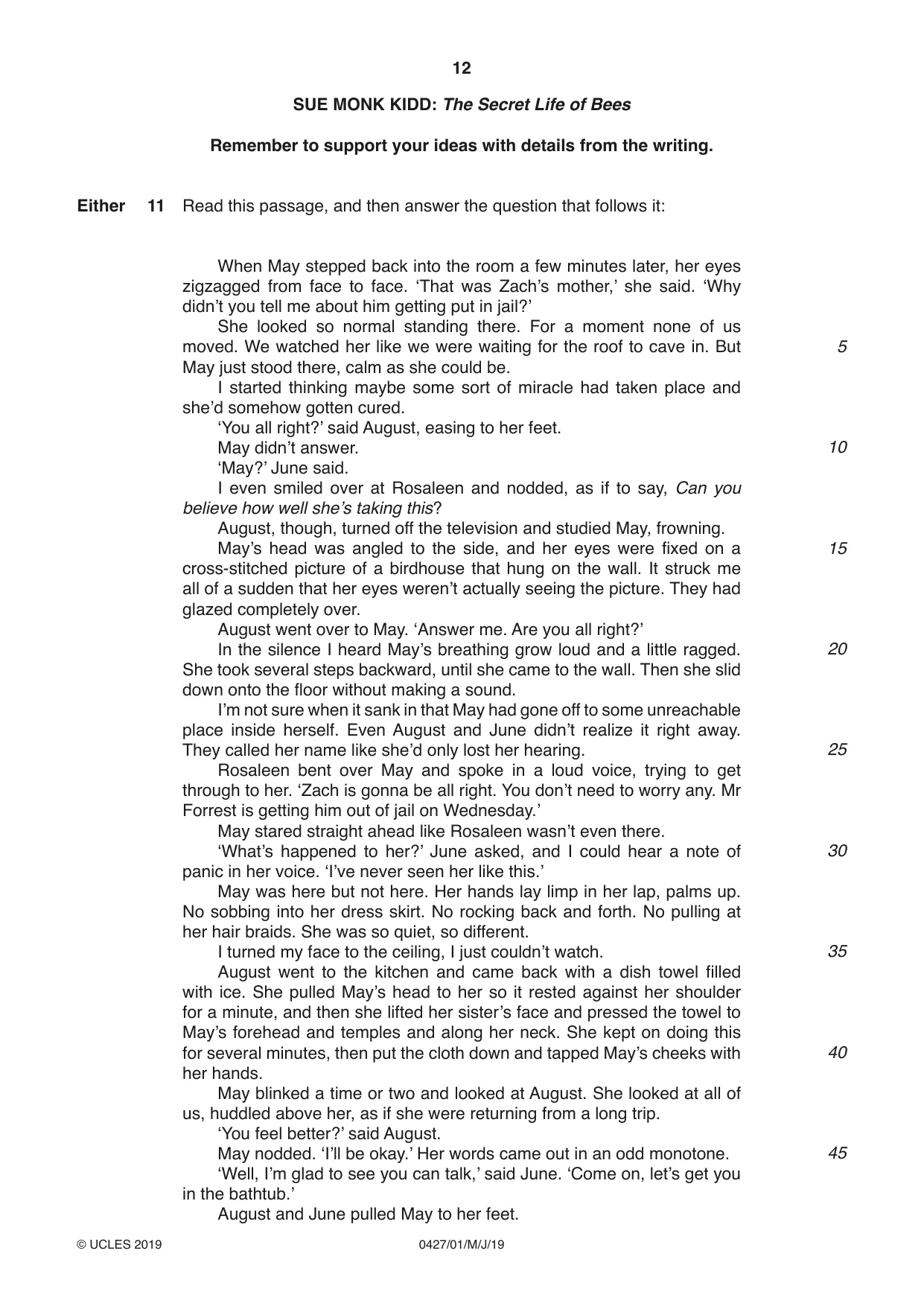
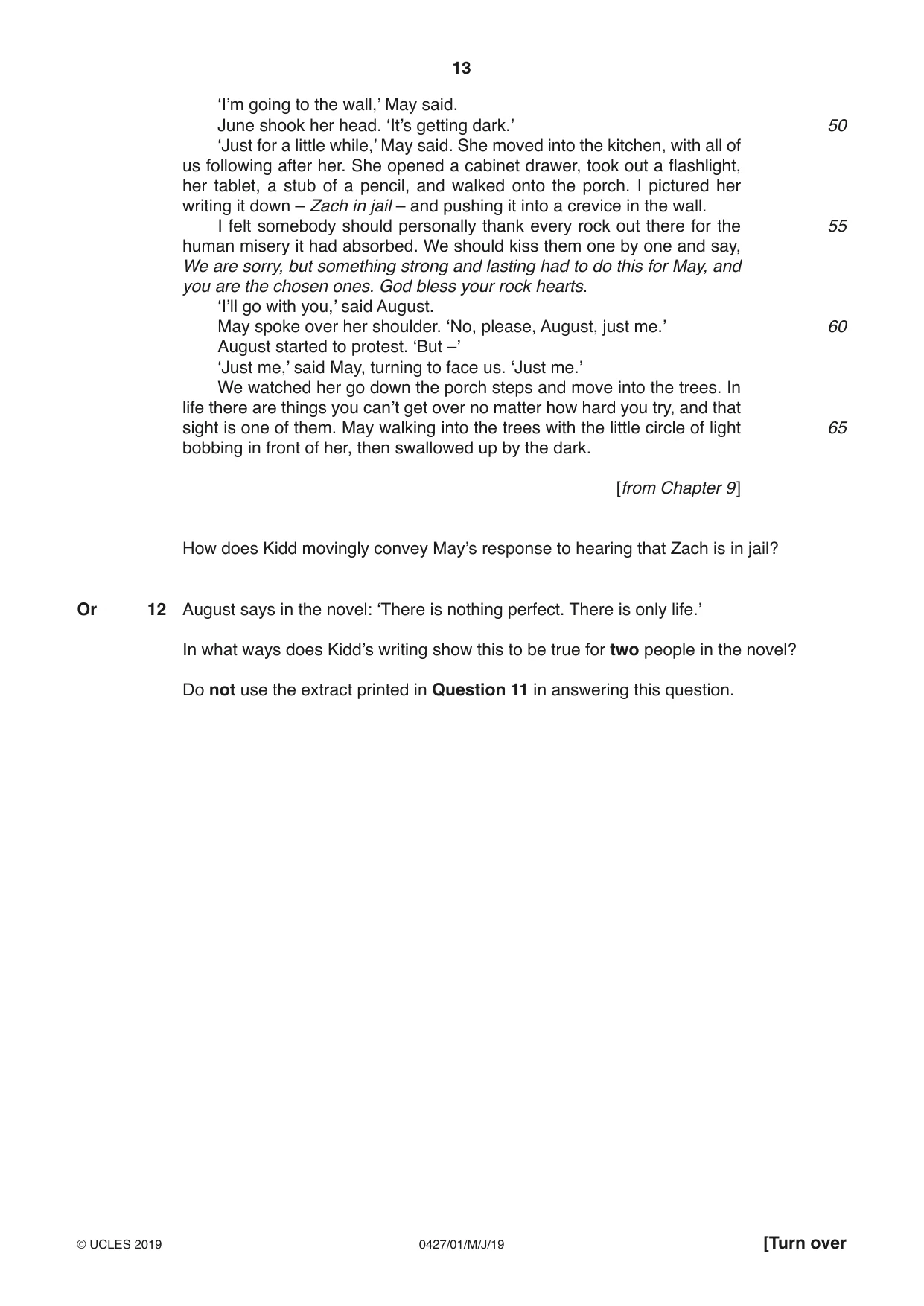
12 0427/01/M/J/19 © UCLES 2019 SUE MONK KIDD: The Secret Life of Bees Remember to support your ideas with details from the writing. Either 11 Read this passage, and then answer the question that follows it: When May stepped back into the room a few minutes later, her eyes zigzagged from face to face. ‘That was Zach’s mother,’ she said. ‘Why didn’t you tell me about him getting put in jail?’ She looked so normal standing there. For a moment none of us moved. We watched her like we were waiting for the roof to cave in. But May just stood there, calm as she could be. I started thinking maybe some sort of miracle had taken place and she’d somehow gotten cured. ‘You all right?’ said August, easing to her feet. May didn’t answer. ‘May?’ June said. I even smiled over at Rosaleen and nodded, as if to say, Can you believe how well she’s taking this? August, though, turned off the television and studied May, frowning. May’s head was angled to the side, and her eyes were fixed on a cross-stitched picture of a birdhouse that hung on the wall. It struck me all of a sudden that her eyes weren’t actually seeing the picture. They had glazed completely over. August went over to May. ‘Answer me. Are you all right?’ In the silence I heard May’s breathing grow loud and a little ragged. She took several steps backward, until she came to the wall. Then she slid down onto the floor without making a sound. I’m not sure when it sank in that May had gone off to some unreachable place inside herself. Even August and June didn’t realize it right away. They called her name like she’d only lost her hearing. Rosaleen bent over May and spoke in a loud voice, trying to get through to her. ‘Zach is gonna be all right. You don’t need to worry any. Mr Forrest is getting him out of jail on Wednesday.’ May stared straight ahead like Rosaleen wasn’t even there. ‘What’s happened to her?’ June asked, and I could hear a note of panic in her voice. ‘I’ve never seen her like this.’ May was here but not here. Her hands lay limp in her lap, palms up. No sobbing into her dress skirt. No rocking back and forth. No pulling at her hair braids. She was so quiet, so different. I turned my face to the ceiling, I just couldn’t watch. August went to the kitchen and came back with a dish towel filled with ice. She pulled May’s head to her so it rested against her shoulder for a minute, and then she lifted her sister’s face and pressed the towel to May’s forehead and temples and along her neck. She kept on doing this for several minutes, then put the cloth down and tapped May’s cheeks with her hands. May blinked a time or two and looked at August. She looked at all of us, huddled above her, as if she were returning from a long trip. ‘You feel better?’ said August. May nodded. ‘I’ll be okay.’ Her words came out in an odd monotone. ‘Well, I’m glad to see you can talk,’ said June. ‘Come on, let’s get you in the bathtub.’ August and June pulled May to her feet. 5 10 15 20 25 30 35 40 45
Question paper, page 13
13 0427/01/M/J/19 © UCLES 2019 [Turn over ‘I’m going to the wall,’ May said. June shook her head. ‘It’s getting dark.’ ‘Just for a little while,’ May said. She moved into the kitchen, with all of us following after her. She opened a cabinet drawer, took out a flashlight, her tablet, a stub of a pencil, and walked onto the porch. I pictured her writing it down – Zach in jail – and pushing it into a crevice in the wall. I felt somebody should personally thank every rock out there for the human misery it had absorbed. We should kiss them one by one and say, We are sorry, but something strong and lasting had to do this for May, and you are the chosen ones. God bless your rock hearts. ‘I’ll go with you,’ said August. May spoke over her shoulder. ‘No, please, August, just me.’ August started to protest. ‘But –’ ‘Just me,’ said May, turning to face us. ‘Just me.’ We watched her go down the porch steps and move into the trees. In life there are things you can’t get over no matter how hard you try, and that sight is one of them. May walking into the trees with the little circle of light bobbing in front of her, then swallowed up by the dark. [from Chapter 9] How does Kidd movingly convey May’s response to hearing that Zach is in jail? Or 12 August says in the novel: ‘There is nothing perfect. There is only life.’ In what ways does Kidd’s writing show this to be true for two people in the novel? Do not use the extract printed in Question 11 in answering this question. 50 55 60 65
Question paper, page 14
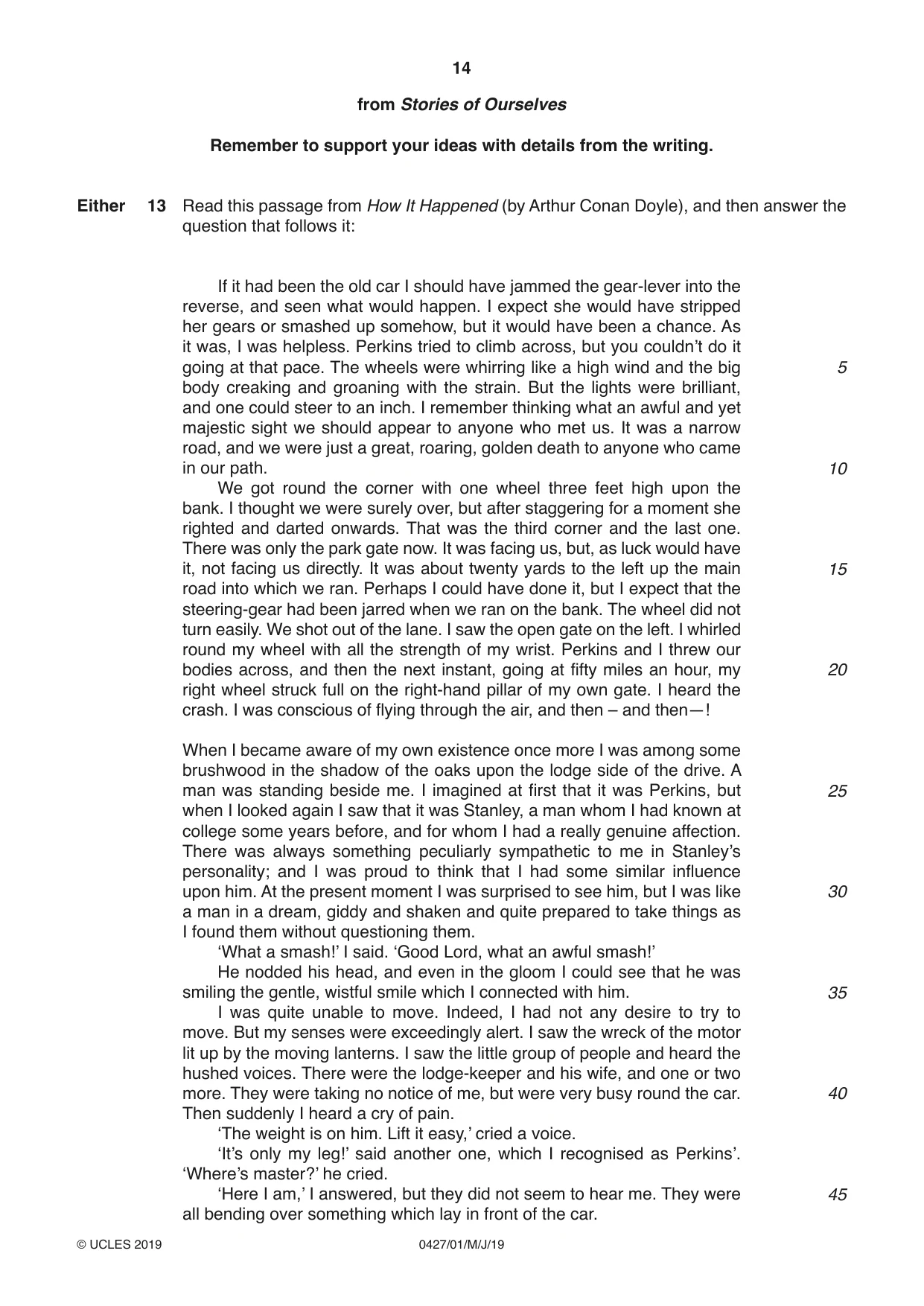
14 0427/01/M/J/19 © UCLES 2019 from Stories of Ourselves Remember to support your ideas with details from the writing. Either 13 Read this passage from How It Happened (by Arthur Conan Doyle), and then answer the question that follows it: If it had been the old car I should have jammed the gear-lever into the reverse, and seen what would happen. I expect she would have stripped her gears or smashed up somehow, but it would have been a chance. As it was, I was helpless. Perkins tried to climb across, but you couldn’t do it going at that pace. The wheels were whirring like a high wind and the big body creaking and groaning with the strain. But the lights were brilliant, and one could steer to an inch. I remember thinking what an awful and yet majestic sight we should appear to anyone who met us. It was a narrow road, and we were just a great, roaring, golden death to anyone who came in our path. We got round the corner with one wheel three feet high upon the bank. I thought we were surely over, but after staggering for a moment she righted and darted onwards. That was the third corner and the last one. There was only the park gate now. It was facing us, but, as luck would have it, not facing us directly. It was about twenty yards to the left up the main road into which we ran. Perhaps I could have done it, but I expect that the steering-gear had been jarred when we ran on the bank. The wheel did not turn easily. We shot out of the lane. I saw the open gate on the left. I whirled round my wheel with all the strength of my wrist. Perkins and I threw our bodies across, and then the next instant, going at fifty miles an hour, my right wheel struck full on the right-hand pillar of my own gate. I heard the crash. I was conscious of flying through the air, and then – and then—! When I became aware of my own existence once more I was among some brushwood in the shadow of the oaks upon the lodge side of the drive. A man was standing beside me. I imagined at first that it was Perkins, but when I looked again I saw that it was Stanley, a man whom I had known at college some years before, and for whom I had a really genuine affection. There was always something peculiarly sympathetic to me in Stanley’s personality; and I was proud to think that I had some similar influence upon him. At the present moment I was surprised to see him, but I was like a man in a dream, giddy and shaken and quite prepared to take things as I found them without questioning them. ‘What a smash!’ I said. ‘Good Lord, what an awful smash!’ He nodded his head, and even in the gloom I could see that he was smiling the gentle, wistful smile which I connected with him. I was quite unable to move. Indeed, I had not any desire to try to move. But my senses were exceedingly alert. I saw the wreck of the motor lit up by the moving lanterns. I saw the little group of people and heard the hushed voices. There were the lodge-keeper and his wife, and one or two more. They were taking no notice of me, but were very busy round the car. Then suddenly I heard a cry of pain. ‘The weight is on him. Lift it easy,’ cried a voice. ‘It’s only my leg!’ said another one, which I recognised as Perkins’. ‘Where’s master?’ he cried. ‘Here I am,’ I answered, but they did not seem to hear me. They were all bending over something which lay in front of the car. 5 10 15 20 25 30 35 40 45
Question paper, page 15
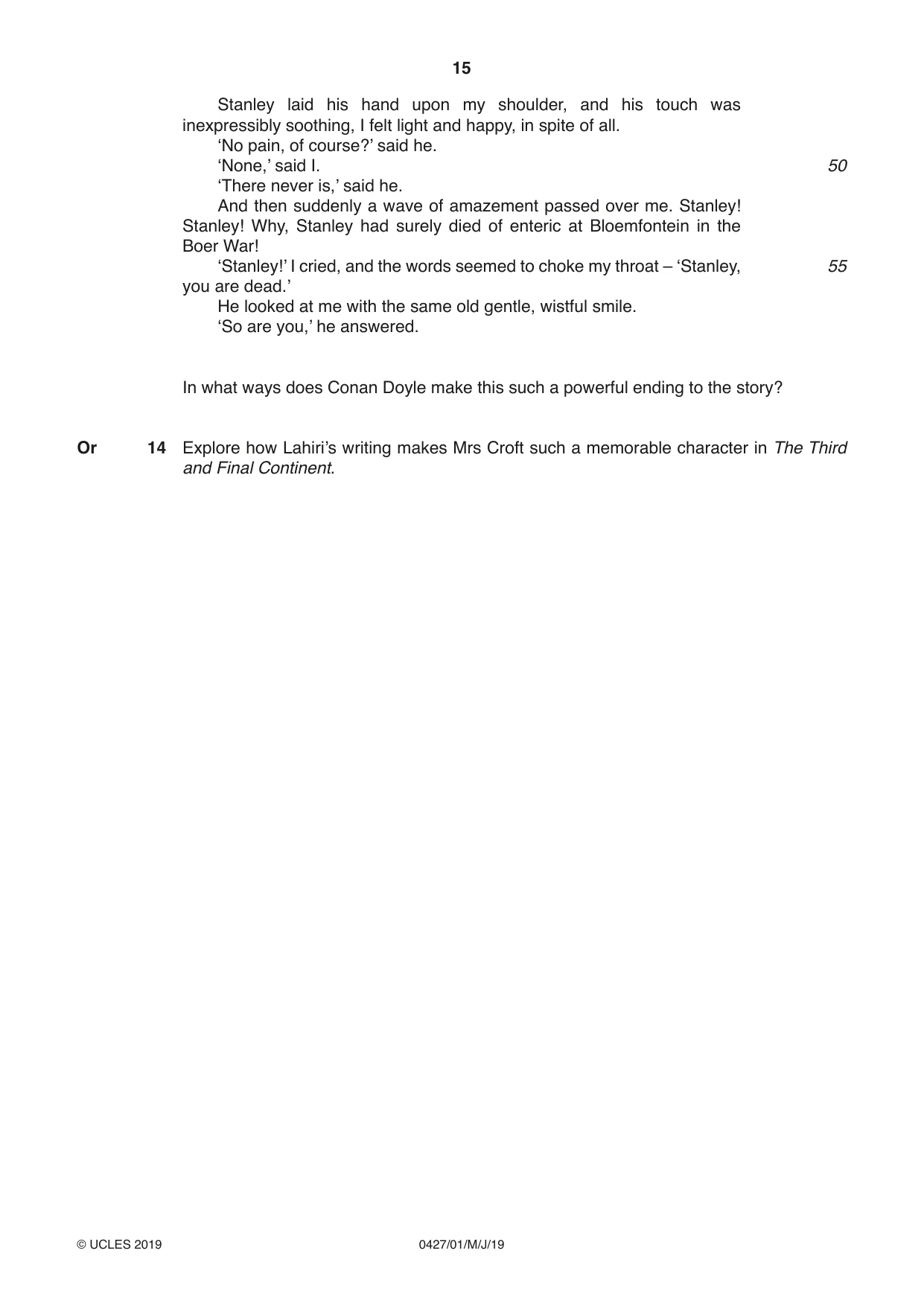
15 0427/01/M/J/19 © UCLES 2019 Stanley laid his hand upon my shoulder, and his touch was inexpressibly soothing, I felt light and happy, in spite of all. ‘No pain, of course?’ said he. ‘None,’ said I. ‘There never is,’ said he. And then suddenly a wave of amazement passed over me. Stanley! Stanley! Why, Stanley had surely died of enteric at Bloemfontein in the Boer War! ‘Stanley!’ I cried, and the words seemed to choke my throat – ‘Stanley, you are dead.’ He looked at me with the same old gentle, wistful smile. ‘So are you,’ he answered. In what ways does Conan Doyle make this such a powerful ending to the story? Or 14 Explore how Lahiri’s writing makes Mrs Croft such a memorable character in The Third and Final Continent. 50 55
Question paper, page 16
16 0427/01/M/J/19 © UCLES 2019 BLANK PAGE Permission to reproduce items where third-party owned material protected by copyright is included has been sought and cleared where possible. Every reasonable effort has been made by the publisher (UCLES) to trace copyright holders, but if any items requiring clearance have unwittingly been included, the publisher will be pleased to make amends at the earliest possible opportunity. To avoid the issue of disclosure of answer-related information to candidates, all copyright acknowledgements are reproduced online in the Cambridge Assessment International Education Copyright Acknowledgements Booklet. This is produced for each series of examinations and is freely available to download at www.cambridgeinternational.org after the live examination series. Cambridge Assessment International Education is part of the Cambridge Assessment Group. Cambridge Assessment is the brand name of the University of Cambridge Local Examinations Syndicate (UCLES), which itself is a department of the University of Cambridge.
Mark scheme, page 1
This document consists of 4 printed pages. © UCLES 2019 [Turn over Cambridge Assessment International Education Cambridge International General Certificate of Secondary Education LITERATURE (ENGLISH) (US) 0427/01 Paper 1 Poetry and Prose May/June 2019 MARK SCHEME Maximum Mark: 50 Published This mark scheme is published as an aid to teachers and candidates, to indicate the requirements of the examination. It shows the basis on which Examiners were instructed to award marks. It does not indicate the details of the discussions that took place at an Examiners’ meeting before marking began, which would have considered the acceptability of alternative answers. Mark schemes should be read in conjunction with the question paper and the Principal Examiner Report for Teachers. Cambridge International will not enter into discussions about these mark schemes. Cambridge International is publishing the mark schemes for the May/June 2019 series for most Cambridge IGCSE™, Cambridge International A and AS Level and Cambridge Pre-U components, and some Cambridge O Level components.
Mark scheme, page 2
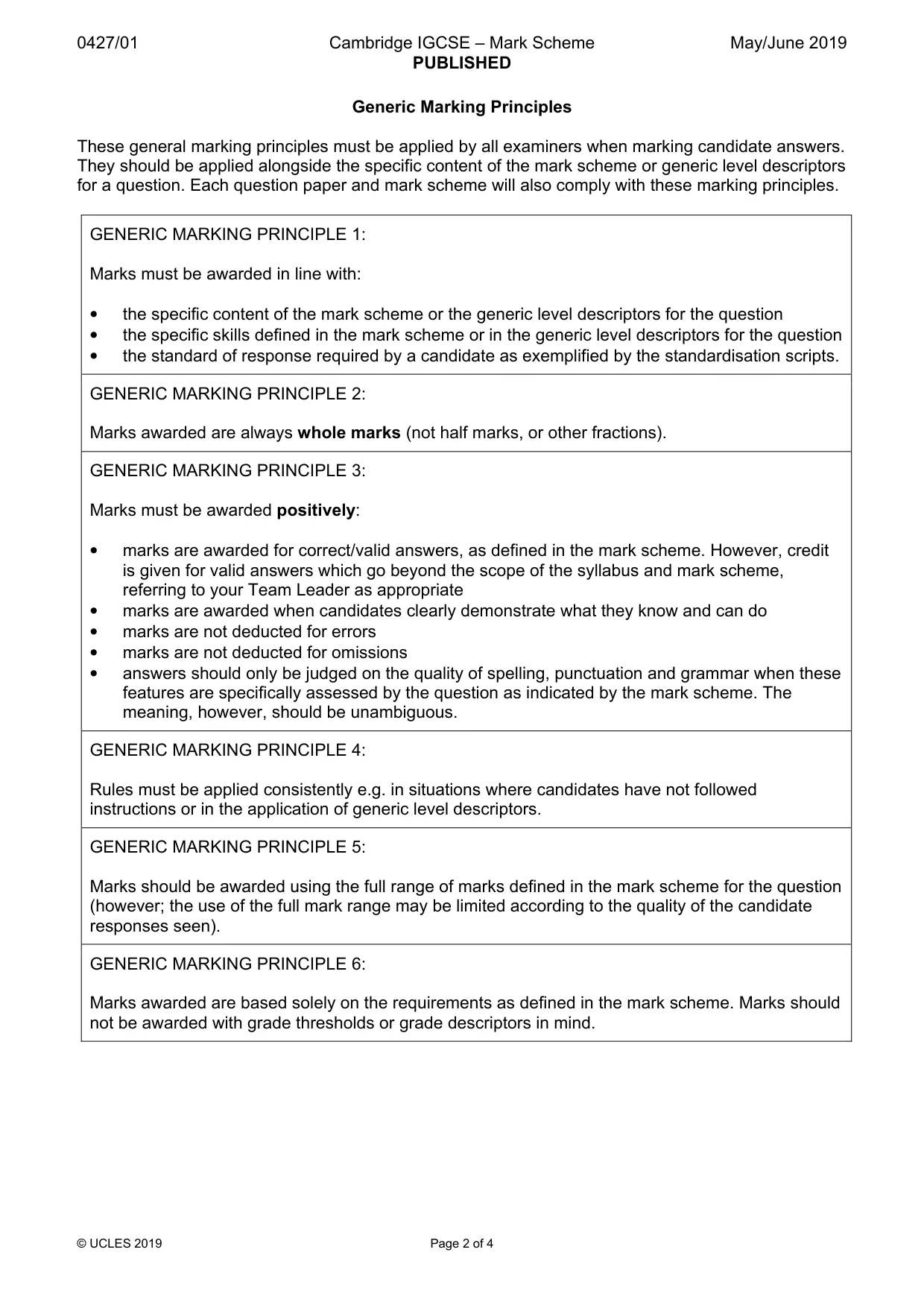
0427/01 Cambridge IGCSE – Mark Scheme PUBLISHED May/June 2019 © UCLES 2019 Page 2 of 4 Generic Marking Principles These general marking principles must be applied by all examiners when marking candidate answers. They should be applied alongside the specific content of the mark scheme or generic level descriptors for a question. Each question paper and mark scheme will also comply with these marking principles. GENERIC MARKING PRINCIPLE 1: Marks must be awarded in line with: • the specific content of the mark scheme or the generic level descriptors for the question • the specific skills defined in the mark scheme or in the generic level descriptors for the question • the standard of response required by a candidate as exemplified by the standardisation scripts. GENERIC MARKING PRINCIPLE 2: Marks awarded are always whole marks (not half marks, or other fractions). GENERIC MARKING PRINCIPLE 3: Marks must be awarded positively: • marks are awarded for correct/valid answers, as defined in the mark scheme. However, credit is given for valid answers which go beyond the scope of the syllabus and mark scheme, referring to your Team Leader as appropriate • marks are awarded when candidates clearly demonstrate what they know and can do • marks are not deducted for errors • marks are not deducted for omissions • answers should only be judged on the quality of spelling, punctuation and grammar when these features are specifically assessed by the question as indicated by the mark scheme. The meaning, however, should be unambiguous. GENERIC MARKING PRINCIPLE 4: Rules must be applied consistently e.g. in situations where candidates have not followed instructions or in the application of generic level descriptors. GENERIC MARKING PRINCIPLE 5: Marks should be awarded using the full range of marks defined in the mark scheme for the question (however; the use of the full mark range may be limited according to the quality of the candidate responses seen). GENERIC MARKING PRINCIPLE 6: Marks awarded are based solely on the requirements as defined in the mark scheme. Marks should not be awarded with grade thresholds or grade descriptors in mind.
Mark scheme, page 3
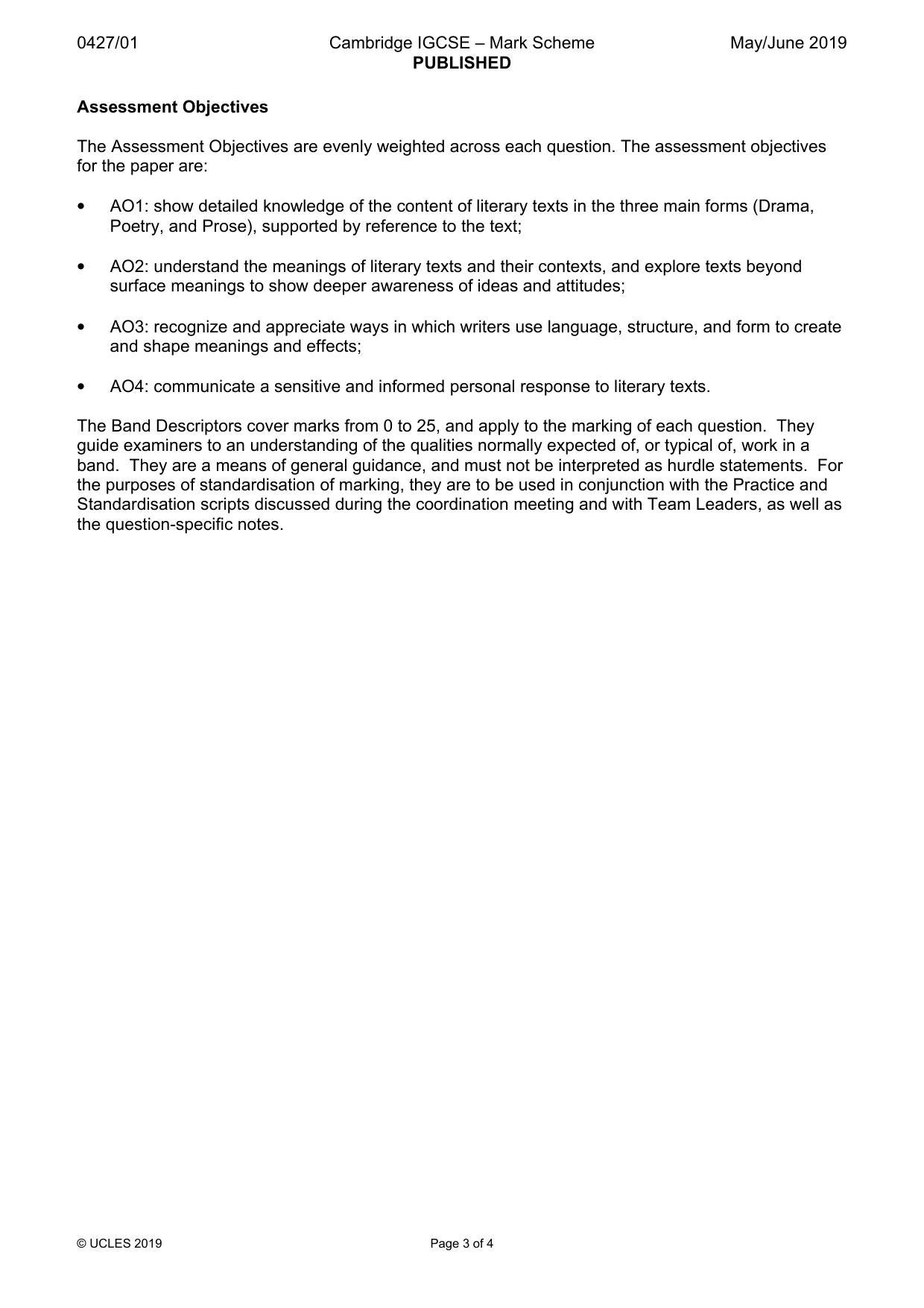
0427/01 Cambridge IGCSE – Mark Scheme PUBLISHED May/June 2019 © UCLES 2019 Page 3 of 4 Assessment Objectives The Assessment Objectives are evenly weighted across each question. The assessment objectives for the paper are: • AO1: show detailed knowledge of the content of literary texts in the three main forms (Drama, Poetry, and Prose), supported by reference to the text; • AO2: understand the meanings of literary texts and their contexts, and explore texts beyond surface meanings to show deeper awareness of ideas and attitudes; • AO3: recognize and appreciate ways in which writers use language, structure, and form to create and shape meanings and effects; • AO4: communicate a sensitive and informed personal response to literary texts. The Band Descriptors cover marks from 0 to 25, and apply to the marking of each question. They guide examiners to an understanding of the qualities normally expected of, or typical of, work in a band. They are a means of general guidance, and must not be interpreted as hurdle statements. For the purposes of standardisation of marking, they are to be used in conjunction with the Practice and Standardisation scripts discussed during the coordination meeting and with Team Leaders, as well as the question-specific notes.
Mark scheme, page 4
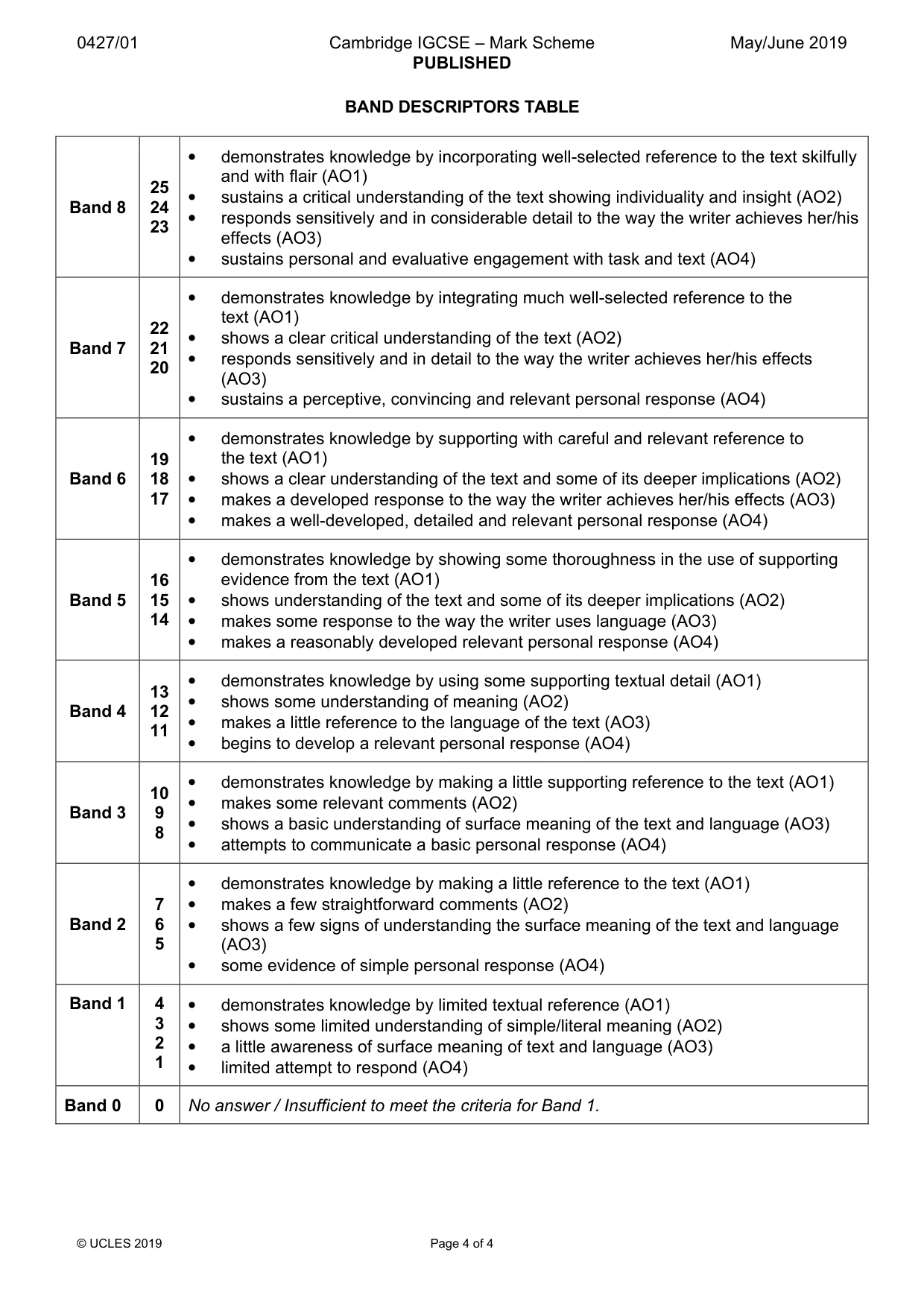
0427/01 Cambridge IGCSE – Mark Scheme PUBLISHED May/June 2019 © UCLES 2019 Page 4 of 4 BAND DESCRIPTORS TABLE Band 8 25 24 23 • demonstrates knowledge by incorporating well-selected reference to the text skilfully and with flair (AO1) • sustains a critical understanding of the text showing individuality and insight (AO2) • responds sensitively and in considerable detail to the way the writer achieves her/his effects (AO3) • sustains personal and evaluative engagement with task and text (AO4) Band 7 22 21 20 • demonstrates knowledge by integrating much well-selected reference to the text (AO1) • shows a clear critical understanding of the text (AO2) • responds sensitively and in detail to the way the writer achieves her/his effects (AO3) • sustains a perceptive, convincing and relevant personal response (AO4) Band 6 19 18 17 • demonstrates knowledge by supporting with careful and relevant reference to the text (AO1) • shows a clear understanding of the text and some of its deeper implications (AO2) • makes a developed response to the way the writer achieves her/his effects (AO3) • makes a well-developed, detailed and relevant personal response (AO4) Band 5 16 15 14 • demonstrates knowledge by showing some thoroughness in the use of supporting evidence from the text (AO1) • shows understanding of the text and some of its deeper implications (AO2) • makes some response to the way the writer uses language (AO3) • makes a reasonably developed relevant personal response (AO4) Band 4 13 12 11 • demonstrates knowledge by using some supporting textual detail (AO1) • shows some understanding of meaning (AO2) • makes a little reference to the language of the text (AO3) • begins to develop a relevant personal response (AO4) Band 3 10 9 8 • demonstrates knowledge by making a little supporting reference to the text (AO1) • makes some relevant comments (AO2) • shows a basic understanding of surface meaning of the text and language (AO3) • attempts to communicate a basic personal response (AO4) Band 2 7 6 5 • demonstrates knowledge by making a little reference to the text (AO1) • makes a few straightforward comments (AO2) • shows a few signs of understanding the surface meaning of the text and language (AO3) • some evidence of simple personal response (AO4) Band 1 4 3 2 1 • demonstrates knowledge by limited textual reference (AO1) • shows some limited understanding of simple/literal meaning (AO2) • a little awareness of surface meaning of text and language (AO3) • limited attempt to respond (AO4) Band 0 0 No answer / Insufficient to meet the criteria for Band 1.
What you needed in this session
Cambridge’s own grade thresholds for 2019 May/June, Paper 1 · Variant 1. A higher threshold means an easier paper — the bar moves with how the cohort did.