Cambridge IGCSE English - Literature (9-1) (UK only) 0477 — 2019 Oct/Nov Paper 2 · Variant 0
0477/20/O/N/19
The question paper and its mark scheme, free to read here and free to download. This is Cambridge’s own paper, exactly as it was sat.
Question paper12 pages


Mark scheme
No mark scheme is in the library for this paper.
Paper as text
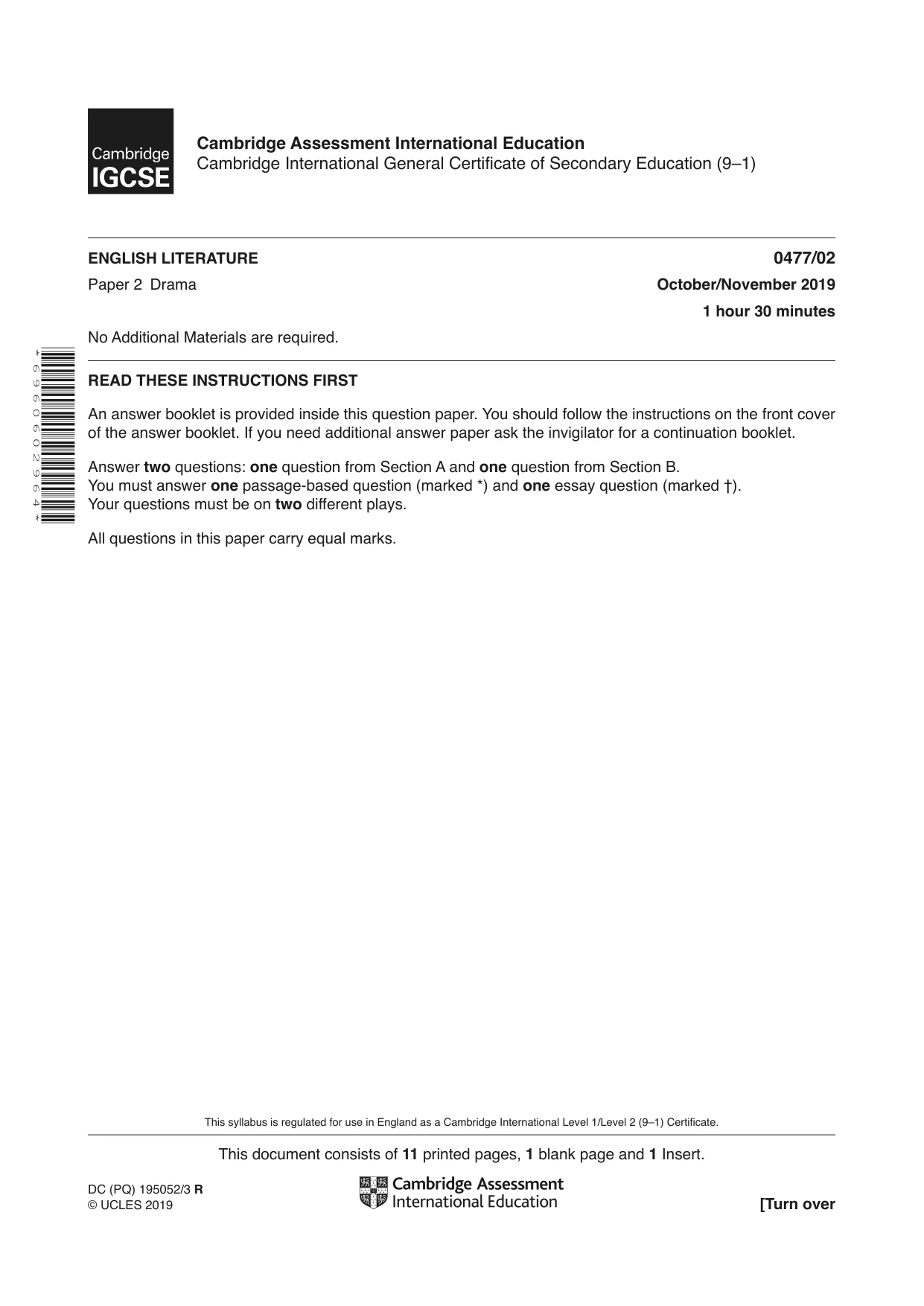
Question paper, page 1
This document consists of 11 printed pages, 1 blank page and 1 Insert. DC (PQ) 195052/3 R © UCLES 2019 [Turn over Cambridge Assessment International Education Cambridge International General Certificate of Secondary Education (9–1) * 6 9 6 0 6 0 2 9 6 4 * ENGLISH LITERATURE 0477/02 Paper 2 Drama October/November 2019 1 hour 30 minutes No Additional Materials are required. READ THESE INSTRUCTIONS FIRST An answer booklet is provided inside this question paper. You should follow the instructions on the front cover of the answer booklet. If you need additional answer paper ask the invigilator for a continuation booklet. Answer two questions: one question from Section A and one question from Section B. You must answer one passage-based question (marked *) and one essay question (marked †). Your questions must be on two different plays. All questions in this paper carry equal marks. This syllabus is regulated for use in England as a Cambridge International Level 1/Level 2 (9–1) Certificate.
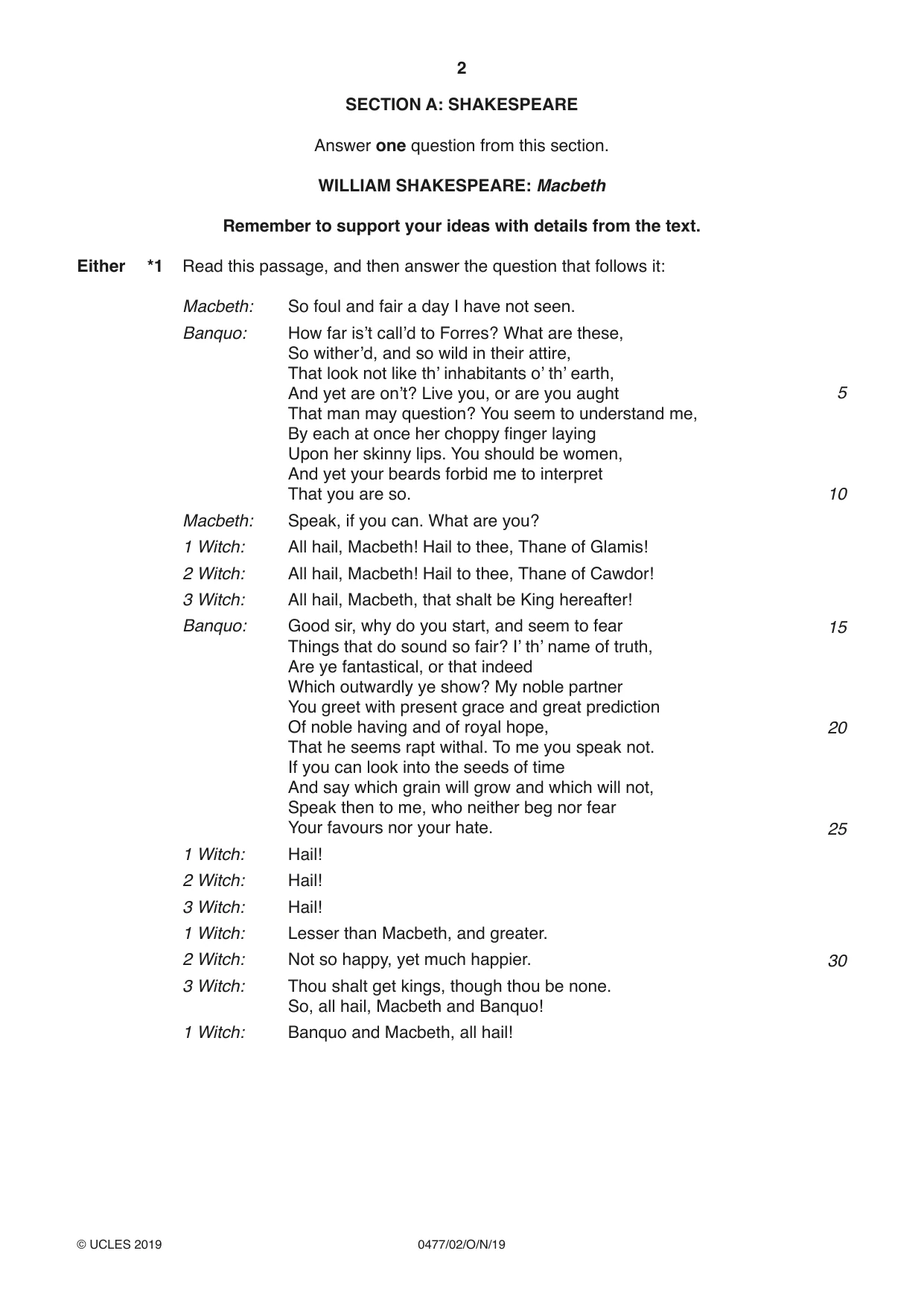
Question paper, page 2
2 0477/02/O/N/19 © UCLES 2019 SECTION A: SHAKESPEARE Answer one question from this section. WILLIAM SHAKESPEARE: Macbeth Remember to support your ideas with details from the text. Either *1 Read this passage, and then answer the question that follows it: Macbeth: So foul and fair a day I have not seen. Banquo: How far is’t call’d to Forres? What are these, So wither’d, and so wild in their attire, That look not like th’ inhabitants o’ th’ earth, And yet are on’t? Live you, or are you aught That man may question? You seem to understand me, By each at once her choppy finger laying Upon her skinny lips. You should be women, And yet your beards forbid me to interpret That you are so. Macbeth: Speak, if you can. What are you? 1 Witch: All hail, Macbeth! Hail to thee, Thane of Glamis! 2 Witch: All hail, Macbeth! Hail to thee, Thane of Cawdor! 3 Witch: All hail, Macbeth, that shalt be King hereafter! Banquo: Good sir, why do you start, and seem to fear Things that do sound so fair? I’ th’ name of truth, Are ye fantastical, or that indeed Which outwardly ye show? My noble partner You greet with present grace and great prediction Of noble having and of royal hope, That he seems rapt withal. To me you speak not. If you can look into the seeds of time And say which grain will grow and which will not, Speak then to me, who neither beg nor fear Your favours nor your hate. 1 Witch: Hail! 2 Witch: Hail! 3 Witch: Hail! 1 Witch: Lesser than Macbeth, and greater. 2 Witch: Not so happy, yet much happier. 3 Witch: Thou shalt get kings, though thou be none. So, all hail, Macbeth and Banquo! 1 Witch: Banquo and Macbeth, all hail! 5 10 15 20 25 30
Question paper, page 3
3 0477/02/O/N/19 © UCLES 2019 [Turn over Macbeth: Stay, you imperfect speakers, tell me more. By Sinel’s death I know I am Thane of Glamis; But how of Cawdor? The Thane of Cawdor lives, A prosperous gentleman; and to be King Stands not within the prospect of belief, No more than to be Cawdor. Say from whence You owe this strange intelligence, or why Upon this blasted heath you stop our way With such prophetic greeting? Speak, I charge you. [WITCHES vanish. Banquo: The earth hath bubbles, as the water has, And these are of them. Whither are they vanish’d? Macbeth: Into the air; and what seem’d corporal melted As breath into the wind. Would they had stay’d! Banquo: Were such things here as we do speak about? Or have we eaten on the insane root That takes the reason prisoner? Macbeth: Your children shall be kings. Banquo: You shall be King. Macbeth: And Thane of Cawdor too; went it not so? Banquo: To th’ self-same tune and words. [from Act 1, Scene 3] How does Shakespeare make this early moment in the play so disturbing? Or †2 To what extent does Shakespeare’s portrayal of Lady Macbeth encourage you to feel pity for her? 35 40 45 50
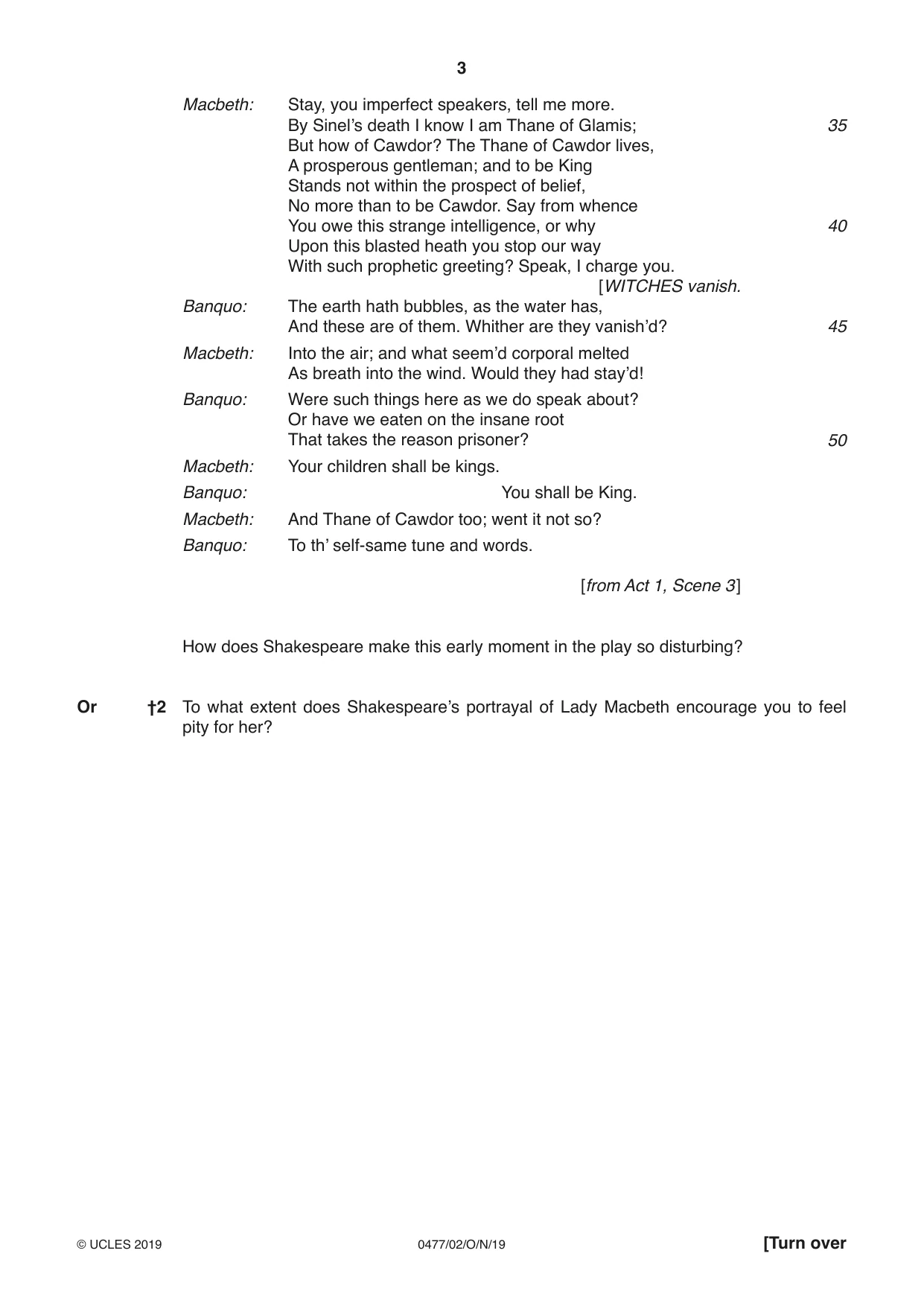
Question paper, page 4
4 0477/02/O/N/19 © UCLES 2019 WILLIAM SHAKESPEARE: Romeo and Juliet Remember to support your ideas with details from the text. Either *3 Read this passage, and then answer the question that follows it: [Enter NURSE.] Nurse: Mistress! What, mistress! Juliet! Fast, I warrant her, she. Why, lamb! Why, lady! Fie, you slug-a-bed! Why, love, I say! madam! sweetheart! Why, bride! What, not a word? You take your penny-worths now Sleep for a week; for the next night, I warrant, The County Paris hath set up his rest That you shall rest but little. God forgive me! Marry, and amen. How sound is she asleep! I needs must wake her. Madam, madam, madam! Ay, let the County take you in your bed; He’ll fright you up, i’ faith. Will it not be? [Draws the curtains. What, dress’d, and in your clothes, and down again! I must needs wake you. Lady! lady! lady! Alas, alas! Help, help! my lady’s dead! O well-a-day that ever I was born! Some aqua-vitae, ho! My lord! My lady! [Enter LADY CAPULET.] Lady Capulet: What noise is here? Nurse: O lamentable day! Lady Capulet: What is the matter? Nurse: Look, look! O heavy day! Lady Capulet: O me, O me! My child, my only life, Revive, look up, or I will die with thee! Help, help! Call help. [Enter CAPULET.] Capulet: For shame, bring Juliet forth; her lord is come. Nurse: She’s dead, deceas’d, she’s dead; alack the day! Lady Capulet: Alack the day, she’s dead, she’s dead, she’s dead! Capulet: Ha! let me see her. Out, alas! she’s cold; Her blood is settled, and her joints are stiff. Life and these lips have long been separated. Death lies on her like an untimely frost Upon the sweetest flower of all the field. Nurse: O lamentable day! Lady Capulet: O woeful time! Capulet: Death, that hath ta’en her hence to make me wail, Ties up my tongue and will not let me speak. [Enter FRIAR LAWRENCE and COUNTY PARIS, with Musicians.] Friar Lawrence: Come, is the bride ready to go to church? 5 10 15 20 25 30 35 40
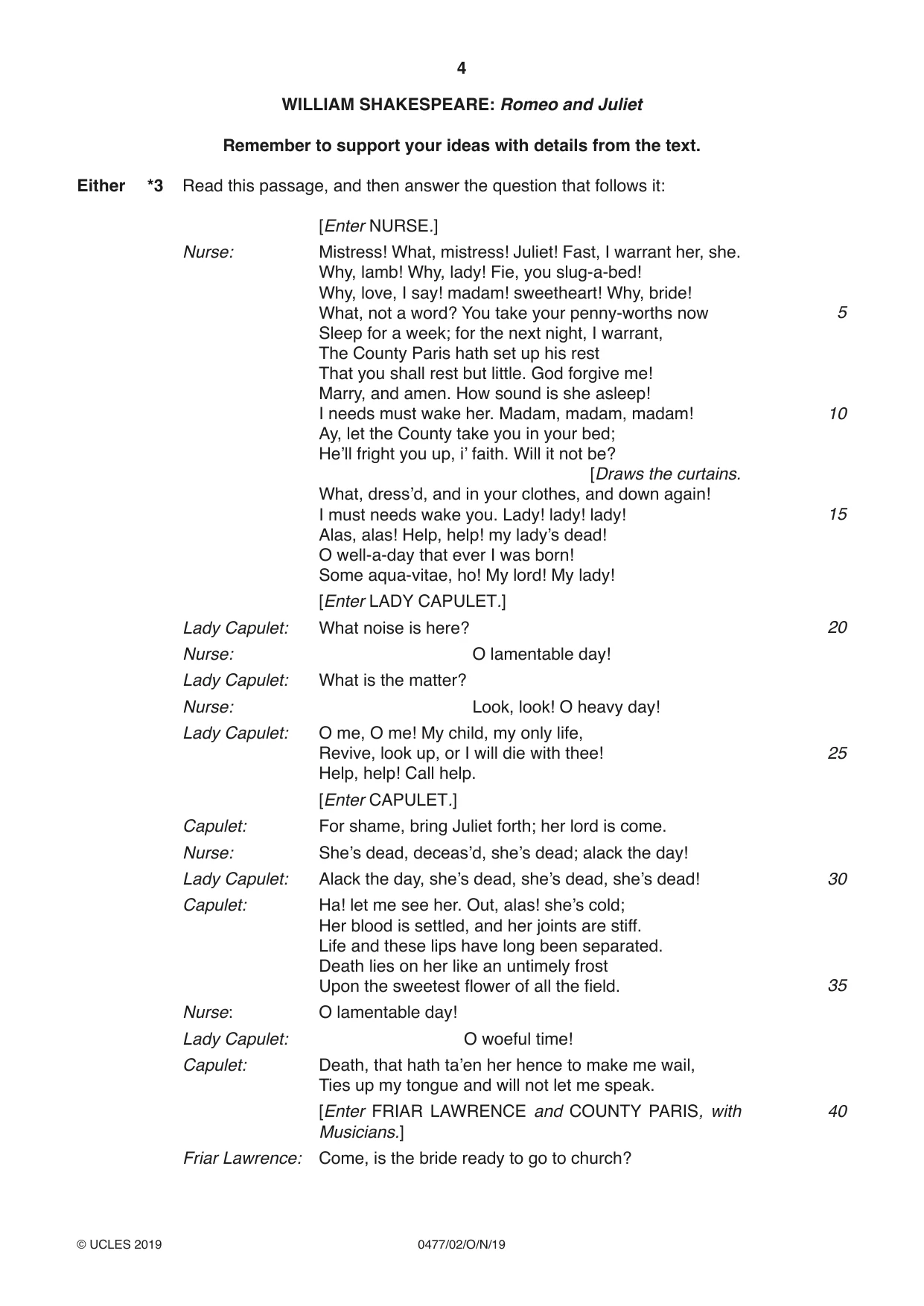
Question paper, page 5
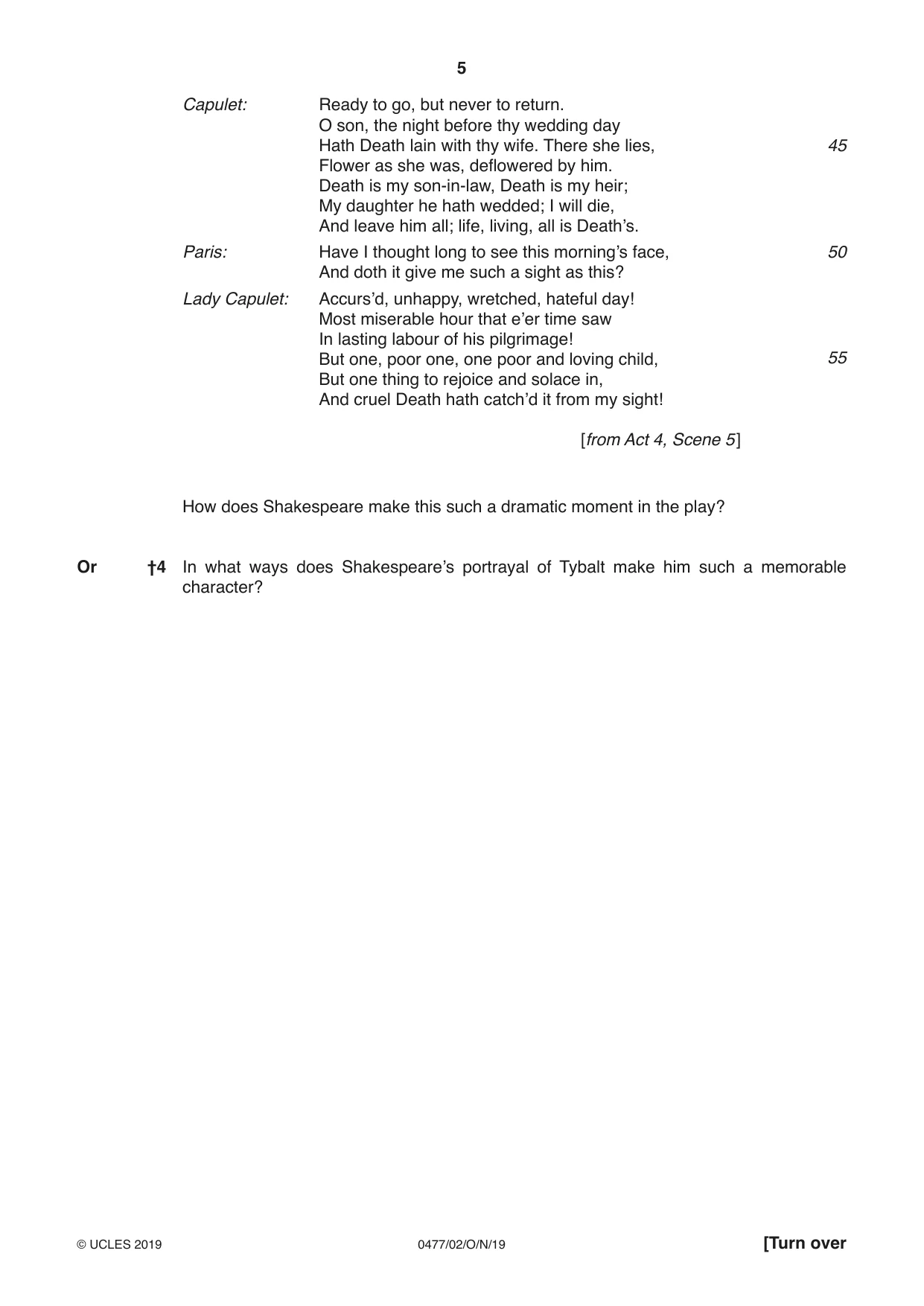
5 0477/02/O/N/19 © UCLES 2019 [Turn over Capulet: Ready to go, but never to return. O son, the night before thy wedding day Hath Death lain with thy wife. There she lies, Flower as she was, deflowered by him. Death is my son-in-law, Death is my heir; My daughter he hath wedded; I will die, And leave him all; life, living, all is Death’s. Paris: Have I thought long to see this morning’s face, And doth it give me such a sight as this? Lady Capulet: Accurs’d, unhappy, wretched, hateful day! Most miserable hour that e’er time saw In lasting labour of his pilgrimage! But one, poor one, one poor and loving child, But one thing to rejoice and solace in, And cruel Death hath catch’d it from my sight! [from Act 4, Scene 5] How does Shakespeare make this such a dramatic moment in the play? Or †4 In what ways does Shakespeare’s portrayal of Tybalt make him such a memorable character? 45 50 55
Question paper, page 6
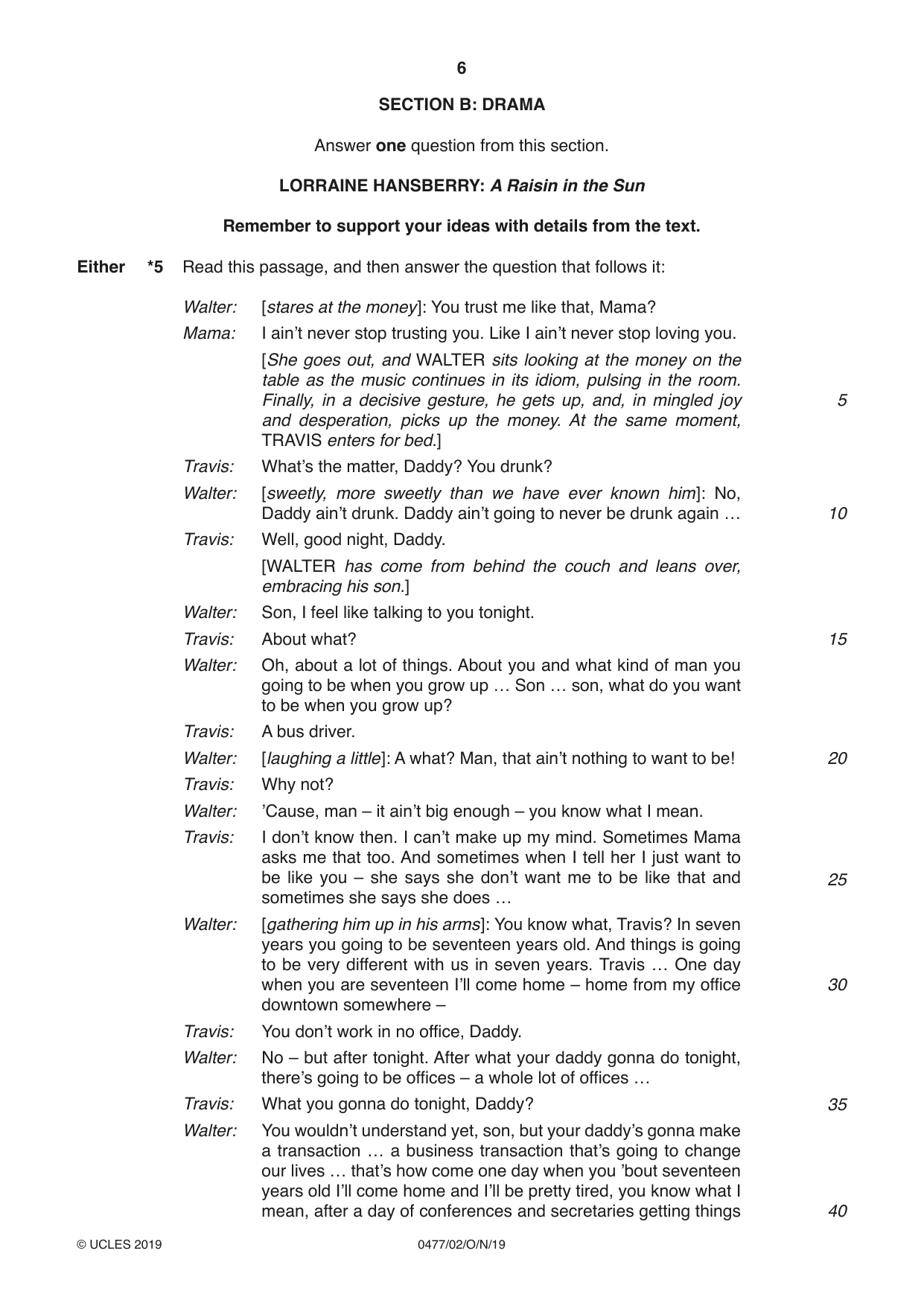
6 0477/02/O/N/19 © UCLES 2019 SECTION B: DRAMA Answer one question from this section. LORRAINE HANSBERRY: A Raisin in the Sun Remember to support your ideas with details from the text. Either *5 Read this passage, and then answer the question that follows it: Walter: [stares at the money]: You trust me like that, Mama? Mama: I ain’t never stop trusting you. Like I ain’t never stop loving you. [She goes out, and WALTER sits looking at the money on the table as the music continues in its idiom, pulsing in the room. Finally, in a decisive gesture, he gets up, and, in mingled joy and desperation, picks up the money. At the same moment, TRAVIS enters for bed.] Travis: What’s the matter, Daddy? You drunk? Walter: [sweetly, more sweetly than we have ever known him]: No, Daddy ain’t drunk. Daddy ain’t going to never be drunk again … Travis: Well, good night, Daddy. [WALTER has come from behind the couch and leans over, embracing his son.] Walter: Son, I feel like talking to you tonight. Travis: About what? Walter: Oh, about a lot of things. About you and what kind of man you going to be when you grow up … Son … son, what do you want to be when you grow up? Travis: A bus driver. Walter: [laughing a little]: A what? Man, that ain’t nothing to want to be! Travis: Why not? Walter: ’Cause, man – it ain’t big enough – you know what I mean. Travis: I don’t know then. I can’t make up my mind. Sometimes Mama asks me that too. And sometimes when I tell her I just want to be like you – she says she don’t want me to be like that and sometimes she says she does … Walter: [gathering him up in his arms]: You know what, Travis? In seven years you going to be seventeen years old. And things is going to be very different with us in seven years. Travis … One day when you are seventeen I’ll come home – home from my office downtown somewhere – Travis: You don’t work in no office, Daddy. Walter: No – but after tonight. After what your daddy gonna do tonight, there’s going to be offices – a whole lot of offices … Travis: What you gonna do tonight, Daddy? Walter: You wouldn’t understand yet, son, but your daddy’s gonna make a transaction … a business transaction that’s going to change our lives … that’s how come one day when you ’bout seventeen years old I’ll come home and I’ll be pretty tired, you know what I mean, after a day of conferences and secretaries getting things 5 10 15 20 25 30 35 40
Question paper, page 7
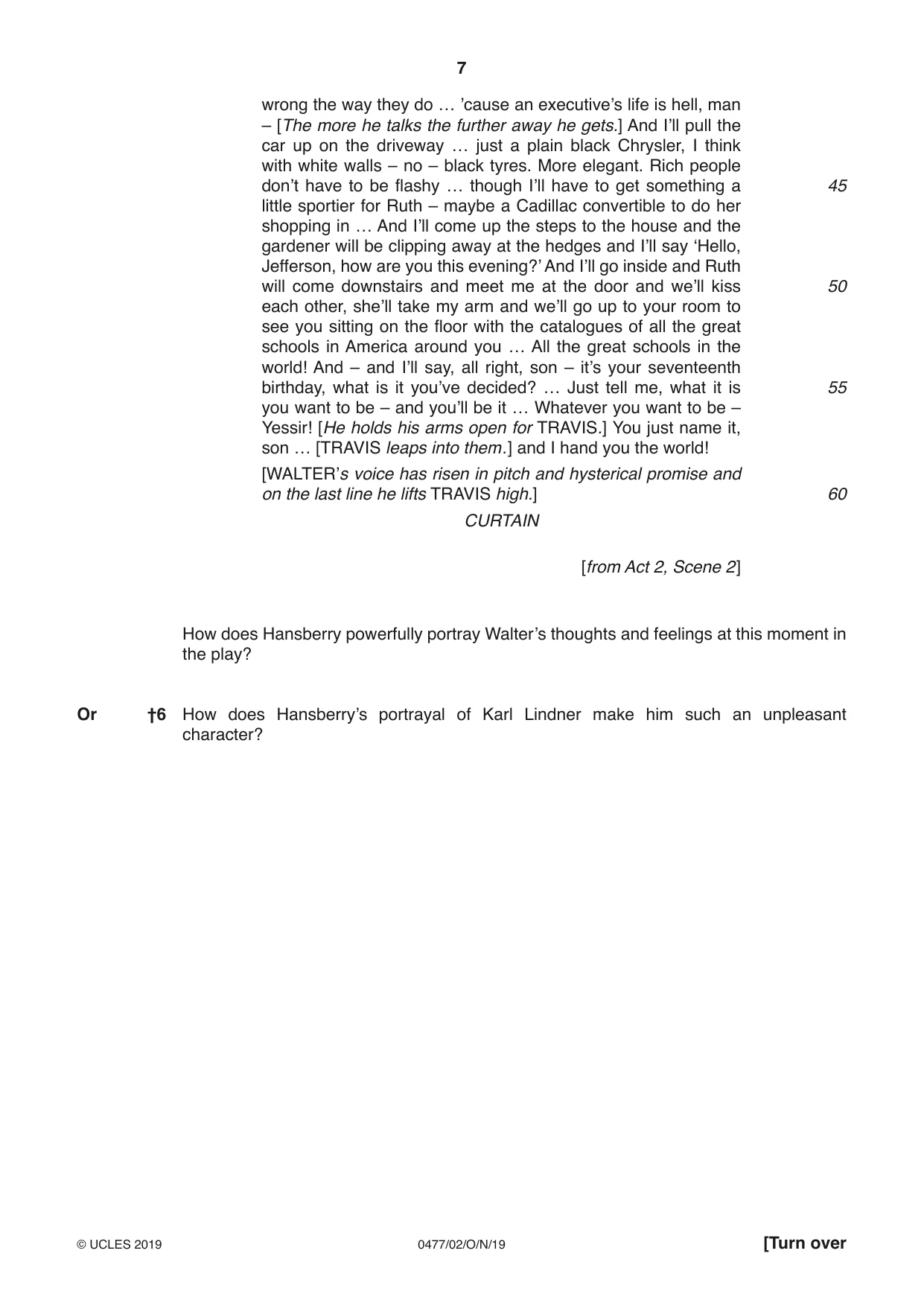
7 0477/02/O/N/19 © UCLES 2019 [Turn over wrong the way they do … ’cause an executive’s life is hell, man – [The more he talks the further away he gets.] And I’ll pull the car up on the driveway … just a plain black Chrysler, I think with white walls – no – black tyres. More elegant. Rich people don’t have to be flashy … though I’ll have to get something a little sportier for Ruth – maybe a Cadillac convertible to do her shopping in … And I’ll come up the steps to the house and the gardener will be clipping away at the hedges and I’ll say ‘Hello, Jefferson, how are you this evening?’ And I’ll go inside and Ruth will come downstairs and meet me at the door and we’ll kiss each other, she’ll take my arm and we’ll go up to your room to see you sitting on the floor with the catalogues of all the great schools in America around you … All the great schools in the world! And – and I’ll say, all right, son – it’s your seventeenth birthday, what is it you’ve decided? … Just tell me, what it is you want to be – and you’ll be it … Whatever you want to be – Yessir! [He holds his arms open for TRAVIS.] You just name it, son … [TRAVIS leaps into them.] and I hand you the world! [WALTER’s voice has risen in pitch and hysterical promise and on the last line he lifts TRAVIS high.] CURTAIN [from Act 2, Scene 2] How does Hansberry powerfully portray Walter’s thoughts and feelings at this moment in the play? Or †6 How does Hansberry’s portrayal of Karl Lindner make him such an unpleasant character? 45 50 55 60
Question paper, page 8
8 0477/02/O/N/19 © UCLES 2019 ARTHUR MILLER: A View from the Bridge Remember to support your ideas with details from the text. Either *7 Read this passage, and then answer the question that follows it: Eddie: You used to be different, Beatrice. Content removed due to copyright restrictions.
Question paper, page 9
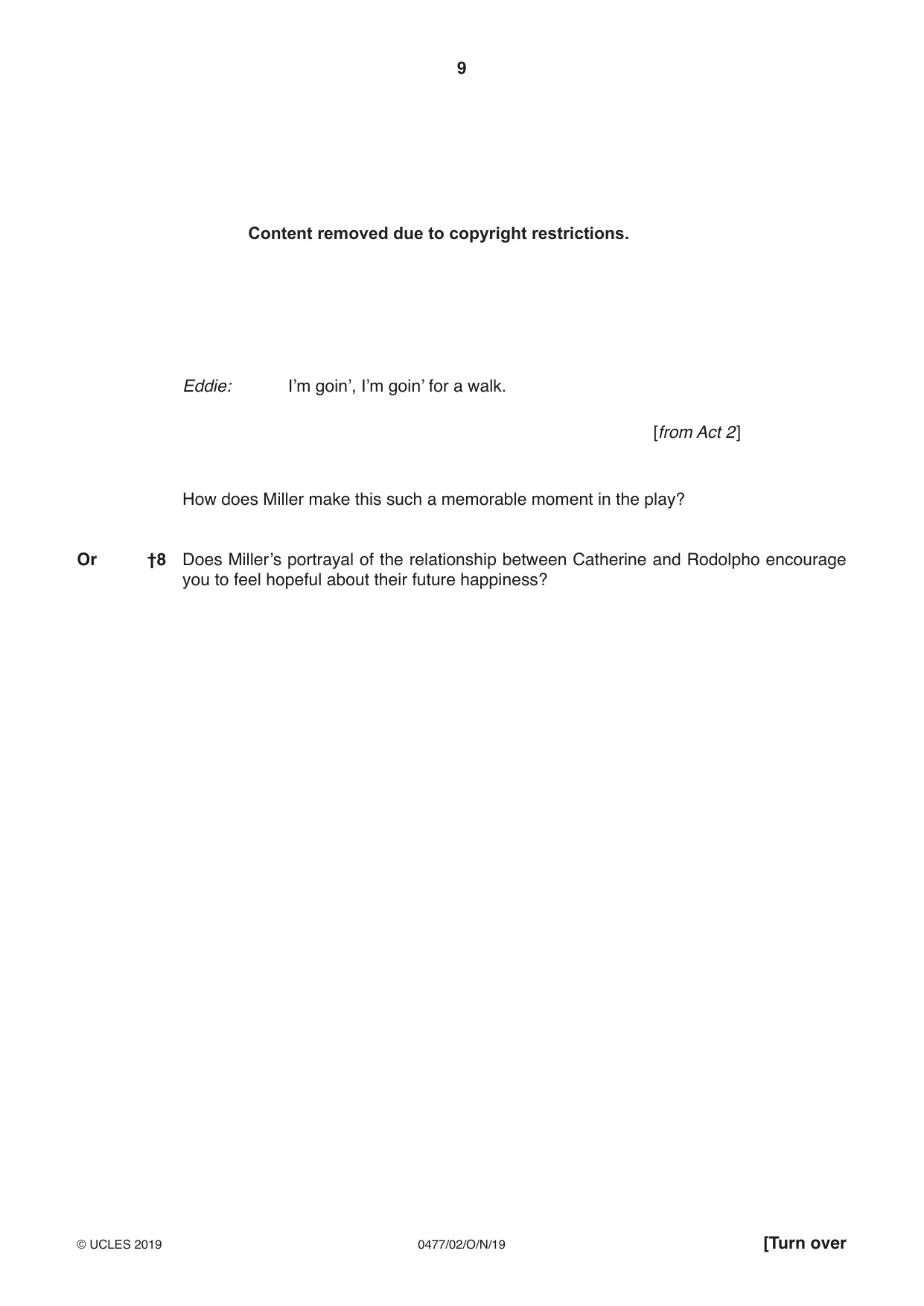
9 0477/02/O/N/19 © UCLES 2019 [Turn over Eddie: I’m goin’, I’m goin’ for a walk. [from Act 2] How does Miller make this such a memorable moment in the play? Or †8 Does Miller’s portrayal of the relationship between Catherine and Rodolpho encourage you to feel hopeful about their future happiness? Content removed due to copyright restrictions.
Question paper, page 10
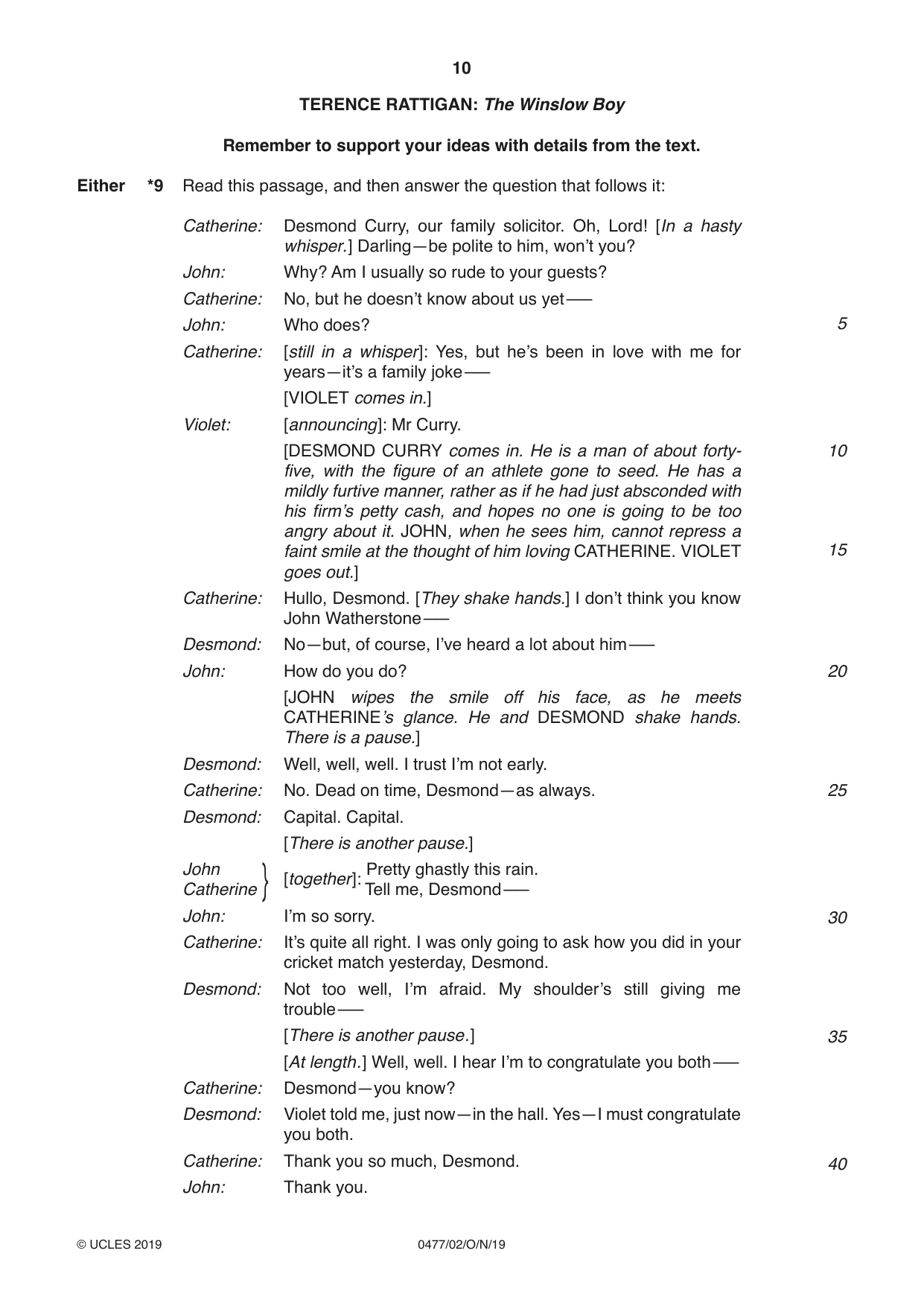
10 0477/02/O/N/19 © UCLES 2019 TERENCE RATTIGAN: The Winslow Boy Remember to support your ideas with details from the text. Either *9 Read this passage, and then answer the question that follows it: Catherine: Desmond Curry, our family solicitor. Oh, Lord! [In a hasty whisper.] Darling—be polite to him, won’t you? John: Why? Am I usually so rude to your guests? Catherine: No, but he doesn’t know about us yet—— John: Who does? Catherine: [still in a whisper]: Yes, but he’s been in love with me for years—it’s a family joke—— [VIOLET comes in.] Violet: [announcing]: Mr Curry. [DESMOND CURRY comes in. He is a man of about forty- five, with the figure of an athlete gone to seed. He has a mildly furtive manner, rather as if he had just absconded with his firm’s petty cash, and hopes no one is going to be too angry about it. JOHN, when he sees him, cannot repress a faint smile at the thought of him loving CATHERINE. VIOLET goes out.] Catherine: Hullo, Desmond. [They shake hands.] I don’t think you know John Watherstone—— Desmond: No—but, of course, I’ve heard a lot about him—— John: How do you do? [JOHN wipes the smile off his face, as he meets CATHERINE’s glance. He and DESMOND shake hands. There is a pause.] Desmond: Well, well, well. I trust I’m not early. Catherine: No. Dead on time, Desmond—as always. Desmond: Capital. Capital. [There is another pause.] John } [together]: Pretty ghastly this rain. Catherine Tell me, Desmond—— John: I’m so sorry. Catherine: It’s quite all right. I was only going to ask how you did in your cricket match yesterday, Desmond. Desmond: Not too well, I’m afraid. My shoulder’s still giving me trouble—— [There is another pause.] [At length.] Well, well. I hear I’m to congratulate you both—— Catherine: Desmond—you know? Desmond: Violet told me, just now—in the hall. Yes—I must congratulate you both. Catherine: Thank you so much, Desmond. John: Thank you. 5 10 15 20 25 30 35 40
Question paper, page 11
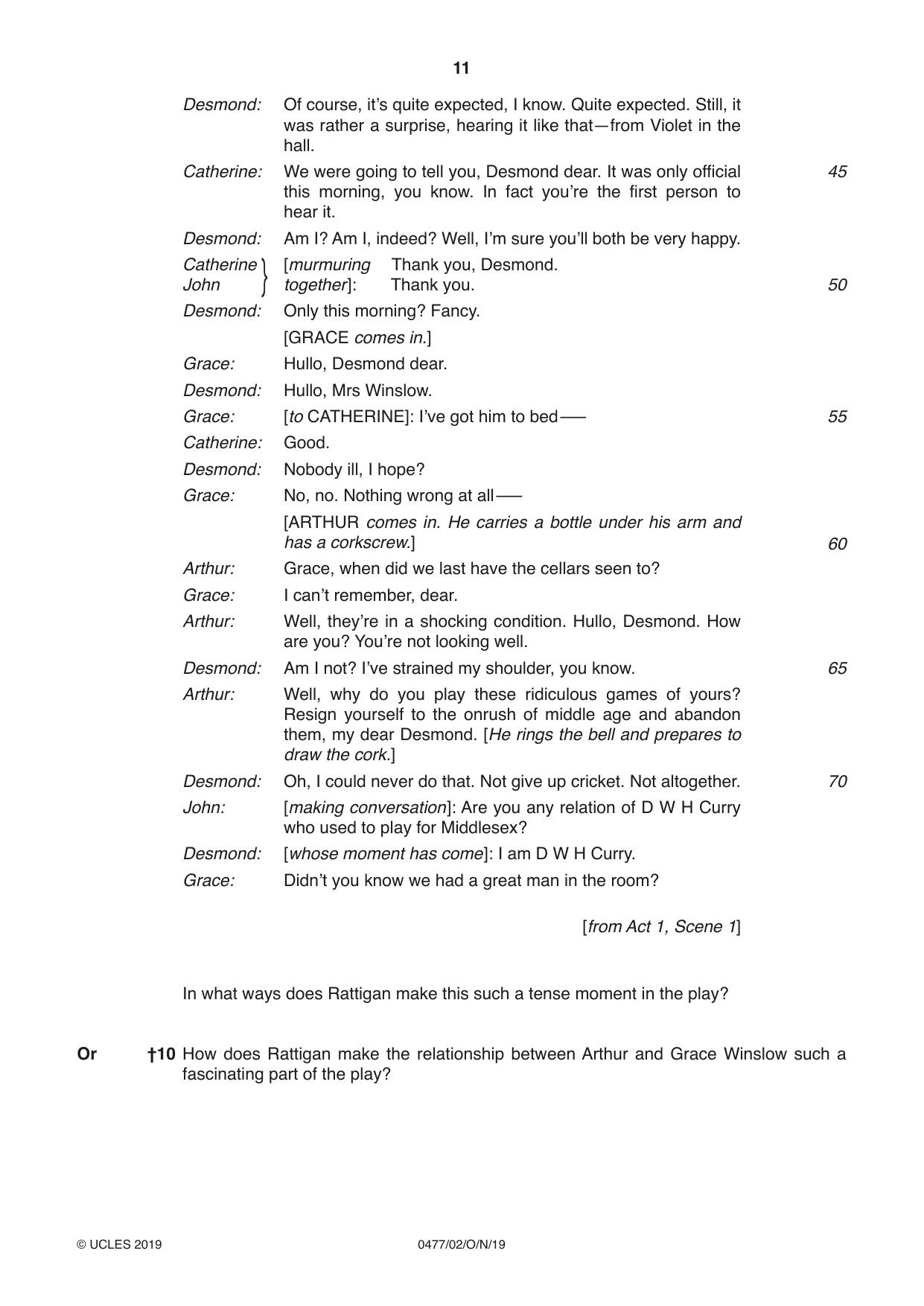
11 0477/02/O/N/19 © UCLES 2019 Desmond: Of course, it’s quite expected, I know. Quite expected. Still, it was rather a surprise, hearing it like that—from Violet in the hall. Catherine: We were going to tell you, Desmond dear. It was only official this morning, you know. In fact you’re the first person to hear it. Desmond: Am I? Am I, indeed? Well, I’m sure you’ll both be very happy. Catherine } [murmuring Thank you, Desmond. John together]: Thank you. Desmond: Only this morning? Fancy. [GRACE comes in.] Grace: Hullo, Desmond dear. Desmond: Hullo, Mrs Winslow. Grace: [to CATHERINE]: I’ve got him to bed—— Catherine: Good. Desmond: Nobody ill, I hope? Grace: No, no. Nothing wrong at all—— [ARTHUR comes in. He carries a bottle under his arm and has a corkscrew.] Arthur: Grace, when did we last have the cellars seen to? Grace: I can’t remember, dear. Arthur: Well, they’re in a shocking condition. Hullo, Desmond. How are you? You’re not looking well. Desmond: Am I not? I’ve strained my shoulder, you know. Arthur: Well, why do you play these ridiculous games of yours? Resign yourself to the onrush of middle age and abandon them, my dear Desmond. [He rings the bell and prepares to draw the cork.] Desmond: Oh, I could never do that. Not give up cricket. Not altogether. John: [making conversation]: Are you any relation of D W H Curry who used to play for Middlesex? Desmond: [whose moment has come]: I am D W H Curry. Grace: Didn’t you know we had a great man in the room? [from Act 1, Scene 1] In what ways does Rattigan make this such a tense moment in the play? Or †10 How does Rattigan make the relationship between Arthur and Grace Winslow such a fascinating part of the play? 45 50 55 60 65 70
Question paper, page 12
12 0477/02/O/N/19 © UCLES 2019 BLANK PAGE Permission to reproduce items where third-party owned material protected by copyright is included has been sought and cleared where possible. Every reasonable effort has been made by the publisher (UCLES) to trace copyright holders, but if any items requiring clearance have unwittingly been included, the publisher will be pleased to make amends at the earliest possible opportunity. To avoid the issue of disclosure of answer-related information to candidates, all copyright acknowledgements are reproduced online in the Cambridge Assessment International Education Copyright Acknowledgements Booklet. This is produced for each series of examinations and is freely available to download at www.cambridgeinternational.org after the live examination series. Cambridge Assessment International Education is part of the Cambridge Assessment Group. Cambridge Assessment is the brand name of the University of Cambridge Local Examinations Syndicate (UCLES), which itself is a department of the University of Cambridge.