Cambridge IGCSE English - Literature 0486 — 2019 Feb/March Paper 2 · Variant 2
0486/22/F/M/19 · 50 marks · ≈56 min
The question paper and its mark scheme, free to read here and free to download. This is Cambridge’s own paper, exactly as it was sat.
Question paper12 pages
Mark scheme4 pages
Answers below. Sit the paper first if you are practising.
Paper as text
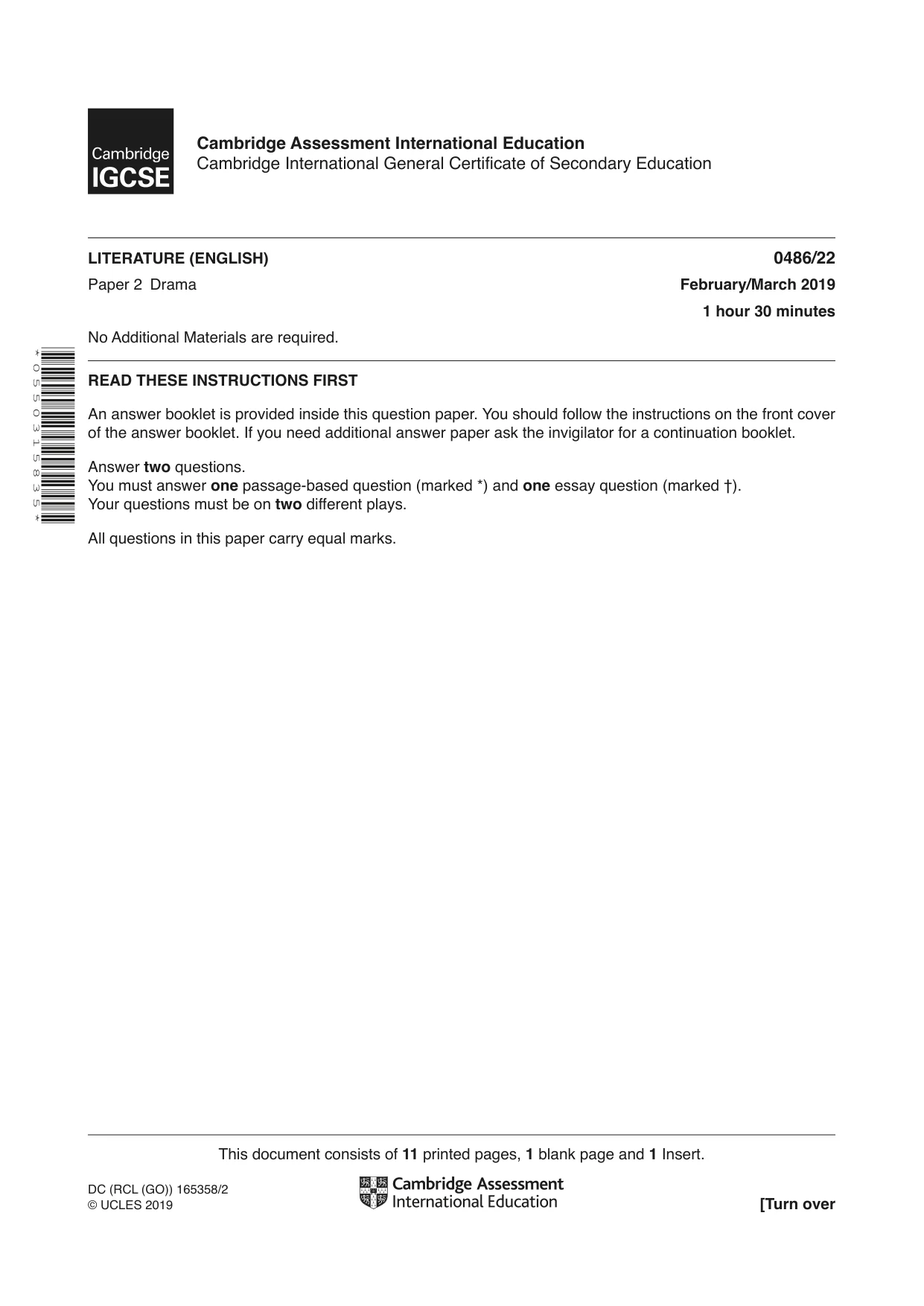
Question paper, page 1
This document consists of 11 printed pages, 1 blank page and 1 Insert. DC (RCL (GO)) 165358/2 © UCLES 2019 [Turn over Cambridge Assessment International Education Cambridge International General Certificate of Secondary Education * 0 5 5 0 3 1 5 8 3 5 * LITERATURE (ENGLISH) 0486/22 Paper 2 Drama February/March 2019 1 hour 30 minutes No Additional Materials are required. READ THESE INSTRUCTIONS FIRST An answer booklet is provided inside this question paper. You should follow the instructions on the front cover of the answer booklet. If you need additional answer paper ask the invigilator for a continuation booklet. Answer two questions. You must answer one passage-based question (marked *) and one essay question (marked †). Your questions must be on two different plays. All questions in this paper carry equal marks.
Question paper, page 2
2 0486/22/F/M/19 © UCLES 2019 LORRAINE HANSBERRY: A Raisin in the Sun Remember to support your ideas with details from the writing. Either *1 Read this passage carefully, and then answer the question that follows it: Travis [in the face of love, new aggressiveness]: Mama, could I please go carry groceries? Content removed due to copyright restrictions.
Question paper, page 3
3 0486/22/F/M/19 © UCLES 2019 [Turn over Ruth: Walter, please leave me alone. [from Act 1, Scene 1] How does Hansberry dramatically convey conflict between Ruth and Walter at this moment in the play? Or †2 How far does Hansberry encourage you to admire Beneatha? Content removed due to copyright restrictions.
Question paper, page 4
4 0486/22/F/M/19 © UCLES 2019 ARTHUR MILLER: A View from the Bridge Remember to support your ideas with details from the writing. Either *3 Read this passage carefully, and then answer the question that follows it: [Enter RODOLPHO.] Rodolpho: Eddie? Content removed due to copyright restrictions.
Question paper, page 5
5 0486/22/F/M/19 © UCLES 2019 [Turn over You will kill a family! [from Act 2] In what ways does Miller make this moment in the play so powerful? Or †4 To what extent does Miller make you feel sympathy for Marco? Do not use the passage printed in Question *3 in answering this question. Content removed due to copyright restrictions.
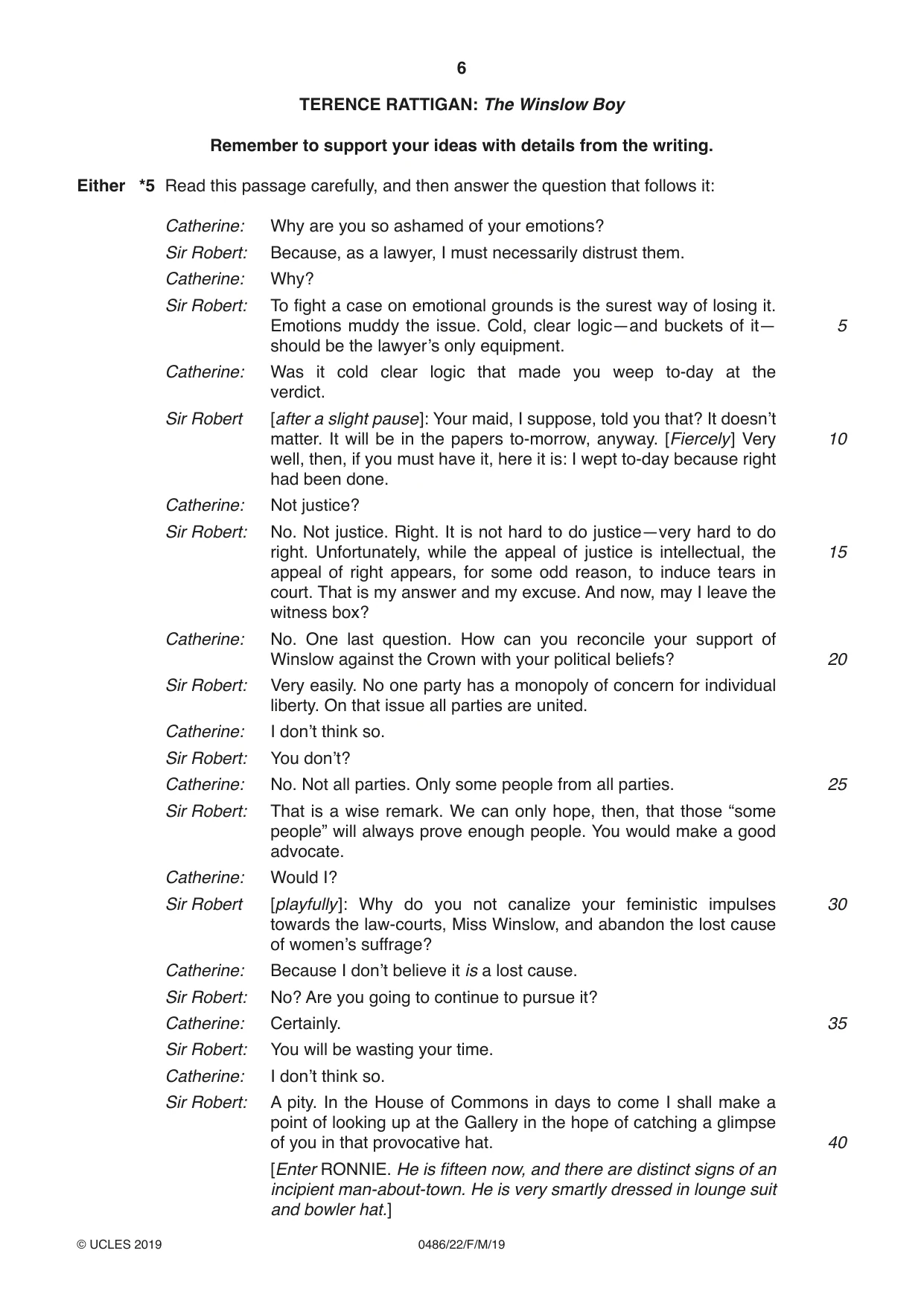
Question paper, page 6
6 0486/22/F/M/19 © UCLES 2019 TERENCE RATTIGAN: The Winslow Boy Remember to support your ideas with details from the writing. Either *5 Read this passage carefully, and then answer the question that follows it: Catherine: Why are you so ashamed of your emotions? Sir Robert: Because, as a lawyer, I must necessarily distrust them. Catherine: Why? Sir Robert: To fight a case on emotional grounds is the surest way of losing it. Emotions muddy the issue. Cold, clear logic—and buckets of it— should be the lawyer’s only equipment. Catherine: Was it cold clear logic that made you weep to-day at the verdict. Sir Robert [after a slight pause]: Your maid, I suppose, told you that? It doesn’t matter. It will be in the papers to-morrow, anyway. [Fiercely] Very well, then, if you must have it, here it is: I wept to-day because right had been done. Catherine: Not justice? Sir Robert: No. Not justice. Right. It is not hard to do justice—very hard to do right. Unfortunately, while the appeal of justice is intellectual, the appeal of right appears, for some odd reason, to induce tears in court. That is my answer and my excuse. And now, may I leave the witness box? Catherine: No. One last question. How can you reconcile your support of Winslow against the Crown with your political beliefs? Sir Robert: Very easily. No one party has a monopoly of concern for individual liberty. On that issue all parties are united. Catherine: I don’t think so. Sir Robert: You don’t? Catherine: No. Not all parties. Only some people from all parties. Sir Robert: That is a wise remark. We can only hope, then, that those “some people” will always prove enough people. You would make a good advocate. Catherine: Would I? Sir Robert [playfully]: Why do you not canalize your feministic impulses towards the law-courts, Miss Winslow, and abandon the lost cause of women’s suffrage? Catherine: Because I don’t believe it is a lost cause. Sir Robert: No? Are you going to continue to pursue it? Catherine: Certainly. Sir Robert: You will be wasting your time. Catherine: I don’t think so. Sir Robert: A pity. In the House of Commons in days to come I shall make a point of looking up at the Gallery in the hope of catching a glimpse of you in that provocative hat. [Enter RONNIE. He is fifteen now, and there are distinct signs of an incipient man-about-town. He is very smartly dressed in lounge suit and bowler hat.] 5 10 15 20 25 30 35 40
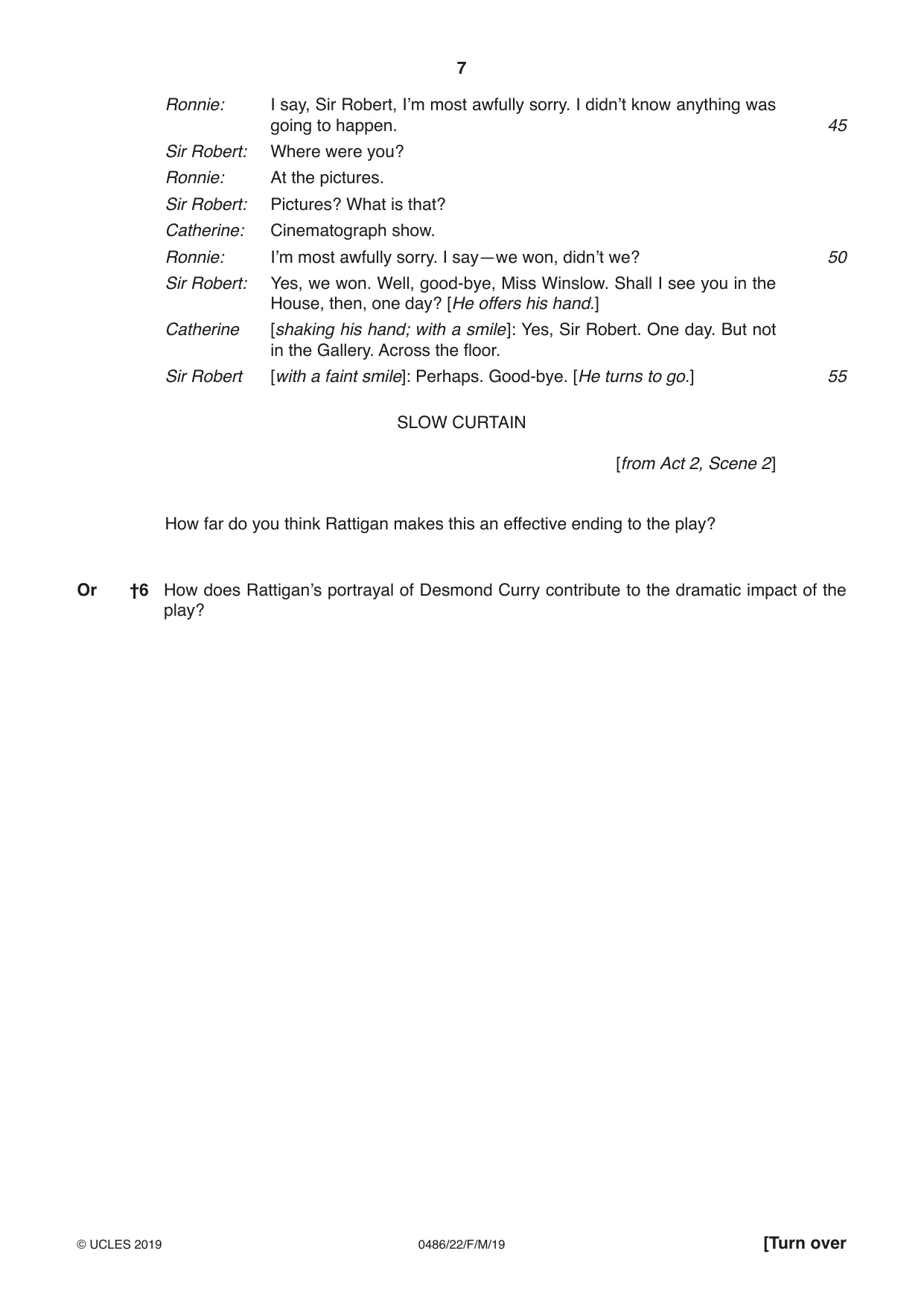
Question paper, page 7
7 0486/22/F/M/19 © UCLES 2019 [Turn over Ronnie: I say, Sir Robert, I’m most awfully sorry. I didn’t know anything was going to happen. Sir Robert: Where were you? Ronnie: At the pictures. Sir Robert: Pictures? What is that? Catherine: Cinematograph show. Ronnie: I’m most awfully sorry. I say—we won, didn’t we? Sir Robert: Yes, we won. Well, good-bye, Miss Winslow. Shall I see you in the House, then, one day? [He offers his hand.] Catherine [shaking his hand; with a smile]: Yes, Sir Robert. One day. But not in the Gallery. Across the floor. Sir Robert [with a faint smile]: Perhaps. Good-bye. [He turns to go.] SLOW CURTAIN [from Act 2, Scene 2] How far do you think Rattigan makes this an effective ending to the play? Or †6 How does Rattigan’s portrayal of Desmond Curry contribute to the dramatic impact of the play? 45 50 55
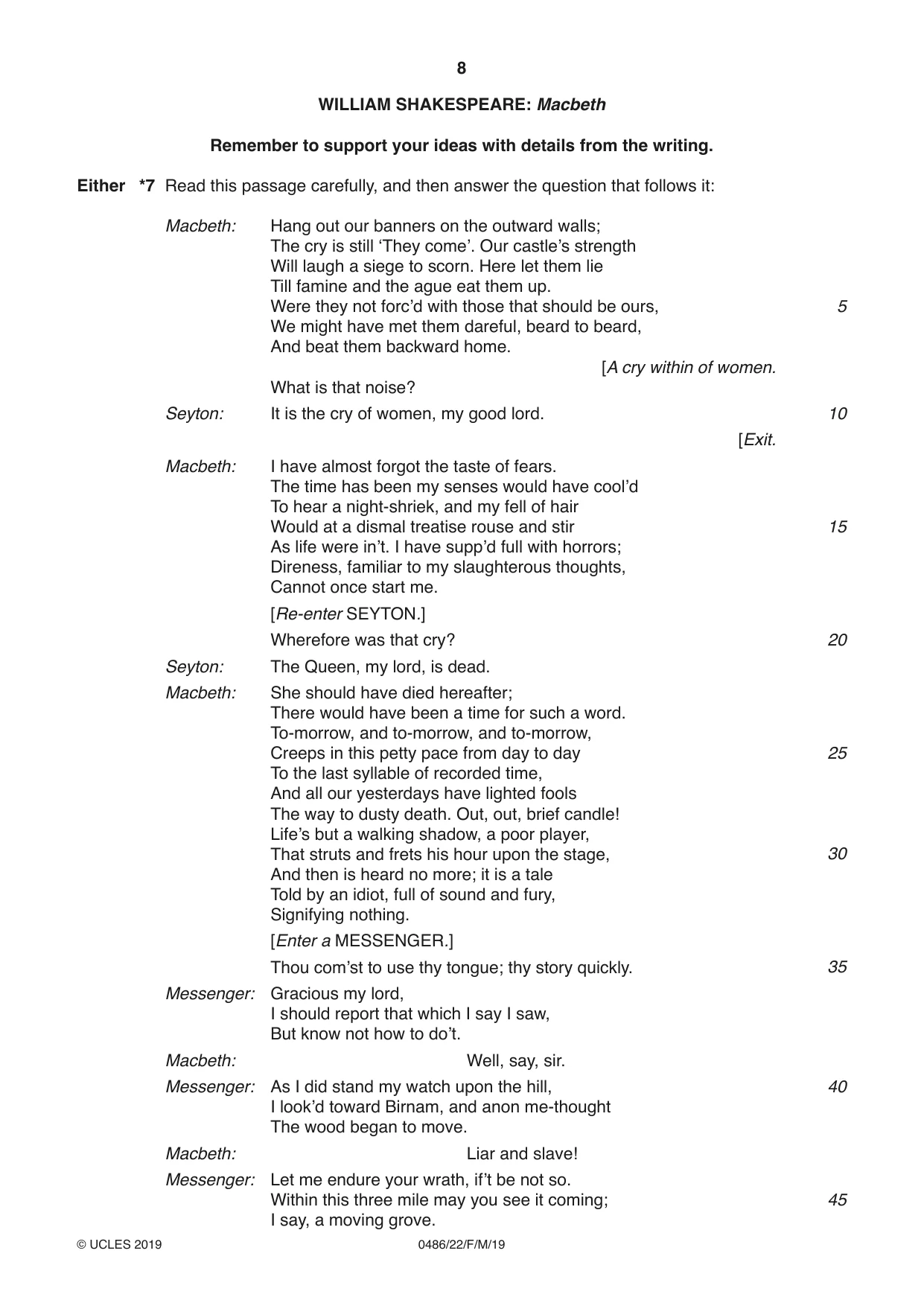
Question paper, page 8
8 0486/22/F/M/19 © UCLES 2019 WILLIAM SHAKESPEARE: Macbeth Remember to support your ideas with details from the writing. Either *7 Read this passage carefully, and then answer the question that follows it: Macbeth: Hang out our banners on the outward walls; The cry is still ‘They come’. Our castle’s strength Will laugh a siege to scorn. Here let them lie Till famine and the ague eat them up. Were they not forc’d with those that should be ours, We might have met them dareful, beard to beard, And beat them backward home. [A cry within of women. What is that noise? Seyton: It is the cry of women, my good lord. [Exit. Macbeth: I have almost forgot the taste of fears. The time has been my senses would have cool’d To hear a night-shriek, and my fell of hair Would at a dismal treatise rouse and stir As life were in’t. I have supp’d full with horrors; Direness, familiar to my slaughterous thoughts, Cannot once start me. [Re-enter SEYTON.] Wherefore was that cry? Seyton: The Queen, my lord, is dead. Macbeth: She should have died hereafter; There would have been a time for such a word. To-morrow, and to-morrow, and to-morrow, Creeps in this petty pace from day to day To the last syllable of recorded time, And all our yesterdays have lighted fools The way to dusty death. Out, out, brief candle! Life’s but a walking shadow, a poor player, That struts and frets his hour upon the stage, And then is heard no more; it is a tale Told by an idiot, full of sound and fury, Signifying nothing. [Enter a MESSENGER.] Thou com’st to use thy tongue; thy story quickly. Messenger: Gracious my lord, I should report that which I say I saw, But know not how to do’t. Macbeth: Well, say, sir. Messenger: As I did stand my watch upon the hill, I look’d toward Birnam, and anon me-thought The wood began to move. Macbeth: Liar and slave! Messenger: Let me endure your wrath, if’t be not so. Within this three mile may you see it coming; I say, a moving grove. 5 10 15 20 25 30 35 40 45
Question paper, page 9
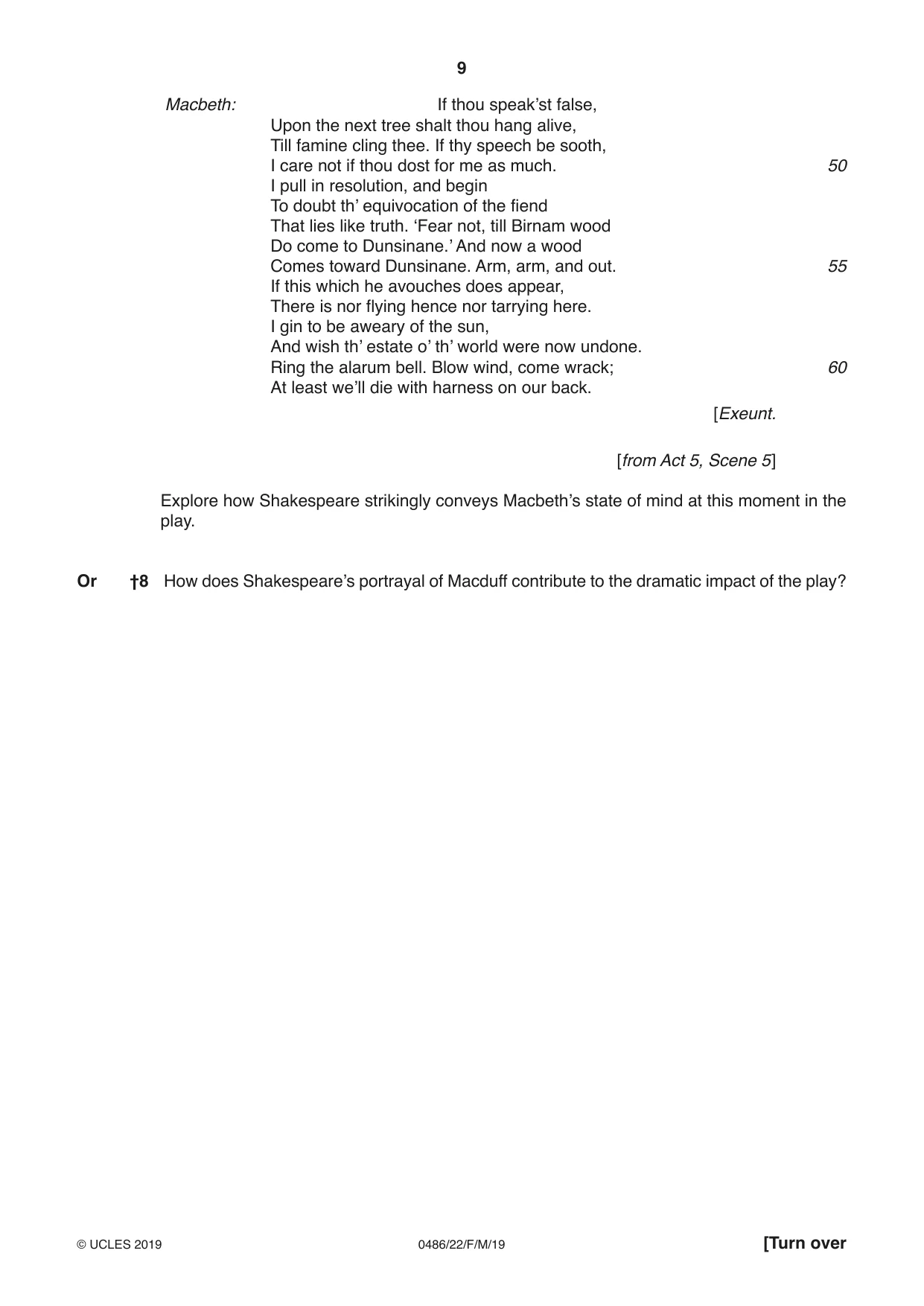
9 0486/22/F/M/19 © UCLES 2019 [Turn over Macbeth: If thou speak’st false, Upon the next tree shalt thou hang alive, Till famine cling thee. If thy speech be sooth, I care not if thou dost for me as much. I pull in resolution, and begin To doubt th’ equivocation of the fiend That lies like truth. ‘Fear not, till Birnam wood Do come to Dunsinane.’ And now a wood Comes toward Dunsinane. Arm, arm, and out. If this which he avouches does appear, There is nor flying hence nor tarrying here. I gin to be aweary of the sun, And wish th’ estate o’ th’ world were now undone. Ring the alarum bell. Blow wind, come wrack; At least we’ll die with harness on our back. [Exeunt. [from Act 5, Scene 5] Explore how Shakespeare strikingly conveys Macbeth’s state of mind at this moment in the play. Or †8 How does Shakespeare’s portrayal of Macduff contribute to the dramatic impact of the play? 50 55 60
Question paper, page 10
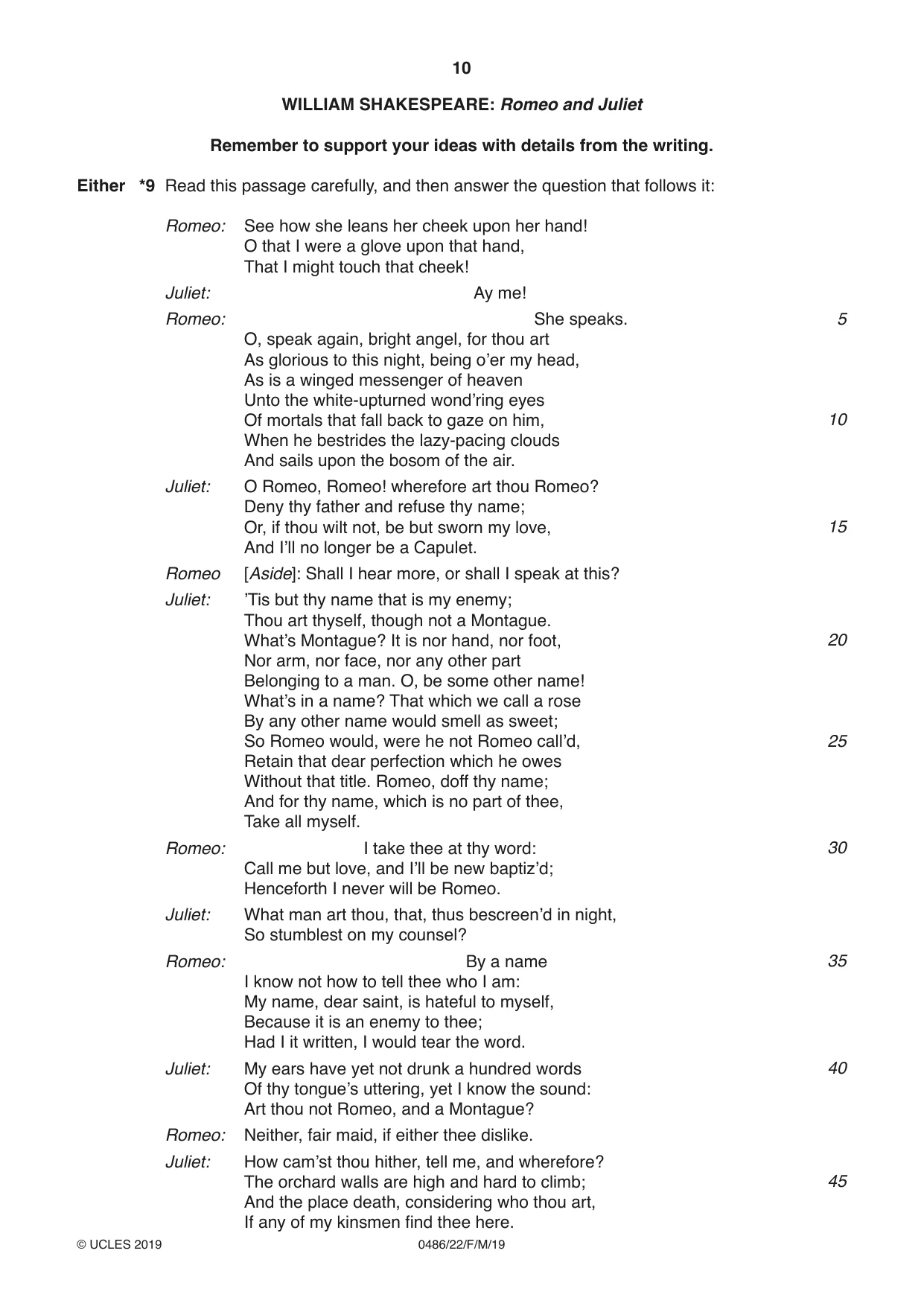
10 0486/22/F/M/19 © UCLES 2019 WILLIAM SHAKESPEARE: Romeo and Juliet Remember to support your ideas with details from the writing. Either *9 Read this passage carefully, and then answer the question that follows it: Romeo: See how she leans her cheek upon her hand! O that I were a glove upon that hand, That I might touch that cheek! Juliet: Ay me! Romeo: She speaks. O, speak again, bright angel, for thou art As glorious to this night, being o’er my head, As is a winged messenger of heaven Unto the white-upturned wond’ring eyes Of mortals that fall back to gaze on him, When he bestrides the lazy-pacing clouds And sails upon the bosom of the air. Juliet: O Romeo, Romeo! wherefore art thou Romeo? Deny thy father and refuse thy name; Or, if thou wilt not, be but sworn my love, And I’ll no longer be a Capulet. Romeo [Aside]: Shall I hear more, or shall I speak at this? Juliet: ’Tis but thy name that is my enemy; Thou art thyself, though not a Montague. What’s Montague? It is nor hand, nor foot, Nor arm, nor face, nor any other part Belonging to a man. O, be some other name! What’s in a name? That which we call a rose By any other name would smell as sweet; So Romeo would, were he not Romeo call’d, Retain that dear perfection which he owes Without that title. Romeo, doff thy name; And for thy name, which is no part of thee, Take all myself. Romeo: I take thee at thy word: Call me but love, and I’ll be new baptiz’d; Henceforth I never will be Romeo. Juliet: What man art thou, that, thus bescreen’d in night, So stumblest on my counsel? Romeo: By a name I know not how to tell thee who I am: My name, dear saint, is hateful to myself, Because it is an enemy to thee; Had I it written, I would tear the word. Juliet: My ears have yet not drunk a hundred words Of thy tongue’s uttering, yet I know the sound: Art thou not Romeo, and a Montague? Romeo: Neither, fair maid, if either thee dislike. Juliet: How cam’st thou hither, tell me, and wherefore? The orchard walls are high and hard to climb; And the place death, considering who thou art, If any of my kinsmen find thee here. 5 10 15 20 25 30 35 40 45
Question paper, page 11
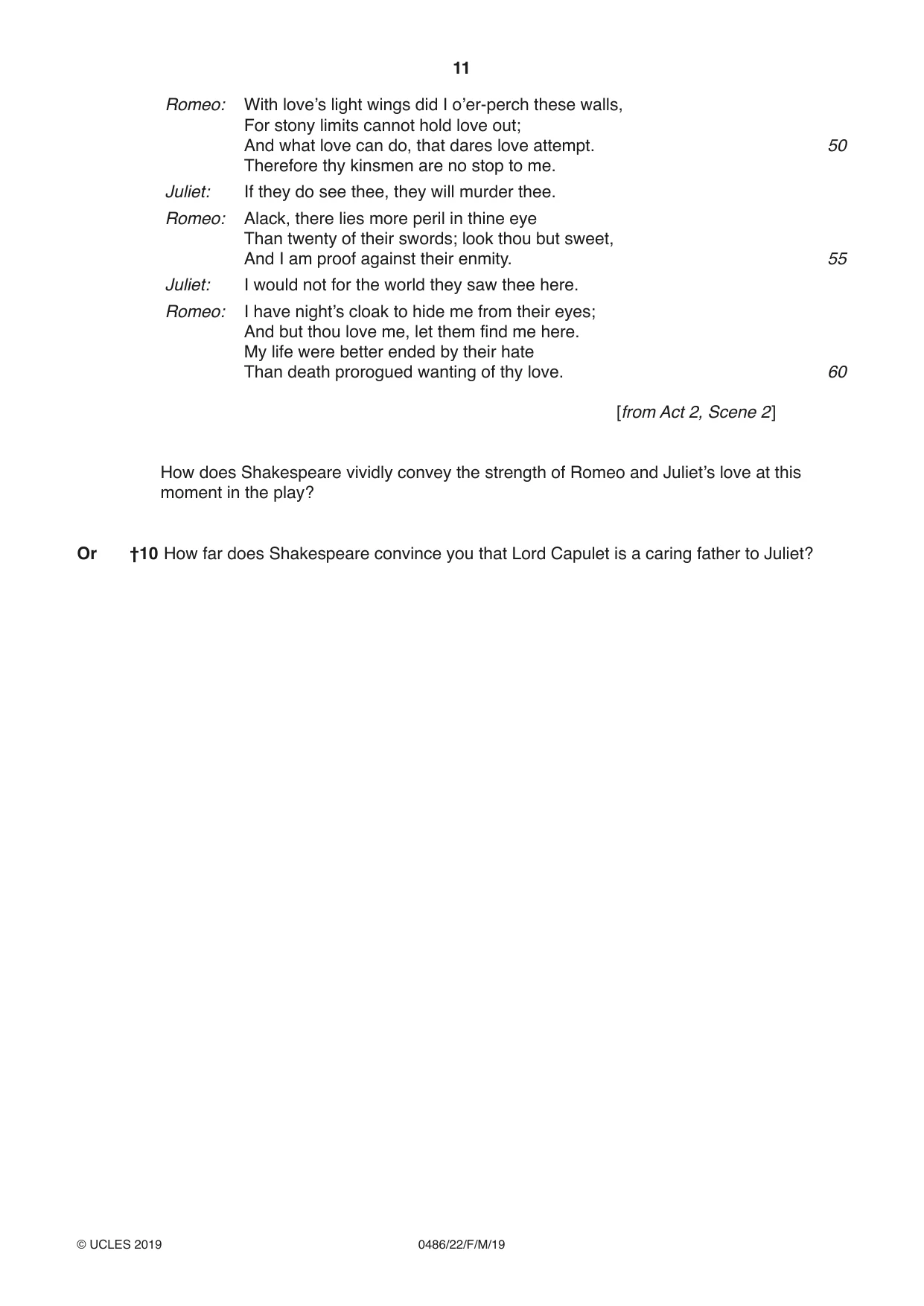
11 0486/22/F/M/19 © UCLES 2019 Romeo: With love’s light wings did I o’er-perch these walls, For stony limits cannot hold love out; And what love can do, that dares love attempt. Therefore thy kinsmen are no stop to me. Juliet: If they do see thee, they will murder thee. Romeo: Alack, there lies more peril in thine eye Than twenty of their swords; look thou but sweet, And I am proof against their enmity. Juliet: I would not for the world they saw thee here. Romeo: I have night’s cloak to hide me from their eyes; And but thou love me, let them find me here. My life were better ended by their hate Than death prorogued wanting of thy love. [from Act 2, Scene 2] How does Shakespeare vividly convey the strength of Romeo and Juliet’s love at this moment in the play? Or †10 How far does Shakespeare convince you that Lord Capulet is a caring father to Juliet? 50 55 60
Question paper, page 12
12 0486/22/F/M/19 © UCLES 2019 Permission to reproduce items where third-party owned material protected by copyright is included has been sought and cleared where possible. Every reasonable effort has been made by the publisher (UCLES) to trace copyright holders, but if any items requiring clearance have unwittingly been included, the publisher will be pleased to make amends at the earliest possible opportunity. To avoid the issue of disclosure of answer-related information to candidates, all copyright acknowledgements are reproduced online in the Cambridge Assessment International Education Copyright Acknowledgements Booklet. This is produced for each series of examinations and is freely available to download at www.cambridgeinternational.org after the live examination series. Cambridge Assessment International Education is part of the Cambridge Assessment Group. Cambridge Assessment is the brand name of the University of Cambridge Local Examinations Syndicate (UCLES), which itself is a department of the University of Cambridge. BLANK PAGE
Mark scheme, page 1
This document consists of 4 printed pages. © UCLES 2019 [Turn over Cambridge Assessment International Education Cambridge International General Certificate of Secondary Education LITERATURE (ENGLISH) 0486/22 Paper 2 Drama March 2019 MARK SCHEME Maximum Mark: 50 Published This mark scheme is published as an aid to teachers and candidates, to indicate the requirements of the examination. It shows the basis on which Examiners were instructed to award marks. It does not indicate the details of the discussions that took place at an Examiners’ meeting before marking began, which would have considered the acceptability of alternative answers. Mark schemes should be read in conjunction with the question paper and the Principal Examiner Report for Teachers. Cambridge International will not enter into discussions about these mark schemes. Cambridge International is publishing the mark schemes for the March 2019 series for most Cambridge IGCSE™, Cambridge International A and AS Level components and some Cambridge O Level components.
Mark scheme, page 2
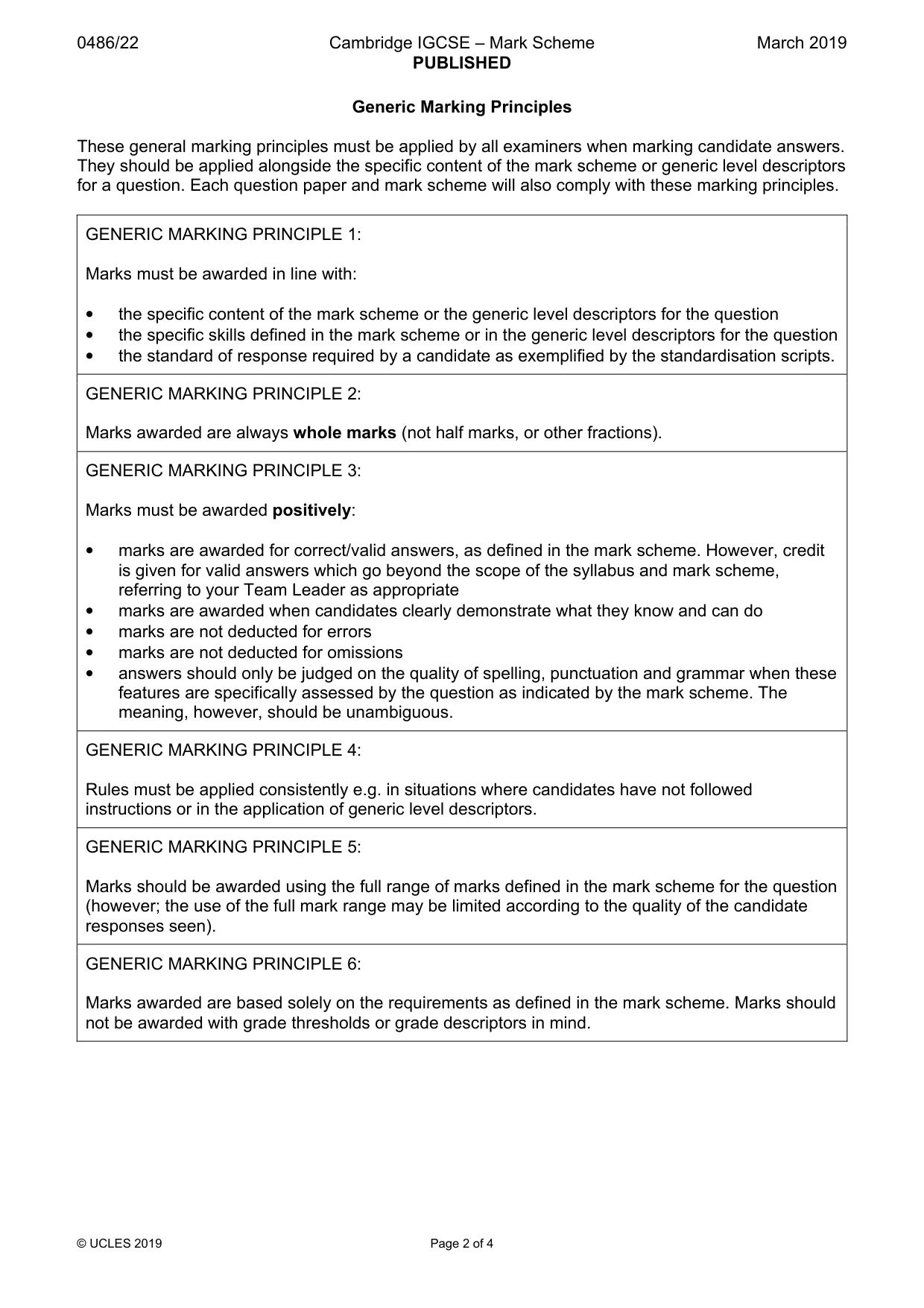
0486/22 Cambridge IGCSE – Mark Scheme PUBLISHED March 2019 © UCLES 2019 Page 2 of 4 Generic Marking Principles These general marking principles must be applied by all examiners when marking candidate answers. They should be applied alongside the specific content of the mark scheme or generic level descriptors for a question. Each question paper and mark scheme will also comply with these marking principles. GENERIC MARKING PRINCIPLE 1: Marks must be awarded in line with: • the specific content of the mark scheme or the generic level descriptors for the question • the specific skills defined in the mark scheme or in the generic level descriptors for the question • the standard of response required by a candidate as exemplified by the standardisation scripts. GENERIC MARKING PRINCIPLE 2: Marks awarded are always whole marks (not half marks, or other fractions). GENERIC MARKING PRINCIPLE 3: Marks must be awarded positively: • marks are awarded for correct/valid answers, as defined in the mark scheme. However, credit is given for valid answers which go beyond the scope of the syllabus and mark scheme, referring to your Team Leader as appropriate • marks are awarded when candidates clearly demonstrate what they know and can do • marks are not deducted for errors • marks are not deducted for omissions • answers should only be judged on the quality of spelling, punctuation and grammar when these features are specifically assessed by the question as indicated by the mark scheme. The meaning, however, should be unambiguous. GENERIC MARKING PRINCIPLE 4: Rules must be applied consistently e.g. in situations where candidates have not followed instructions or in the application of generic level descriptors. GENERIC MARKING PRINCIPLE 5: Marks should be awarded using the full range of marks defined in the mark scheme for the question (however; the use of the full mark range may be limited according to the quality of the candidate responses seen). GENERIC MARKING PRINCIPLE 6: Marks awarded are based solely on the requirements as defined in the mark scheme. Marks should not be awarded with grade thresholds or grade descriptors in mind.
Mark scheme, page 3
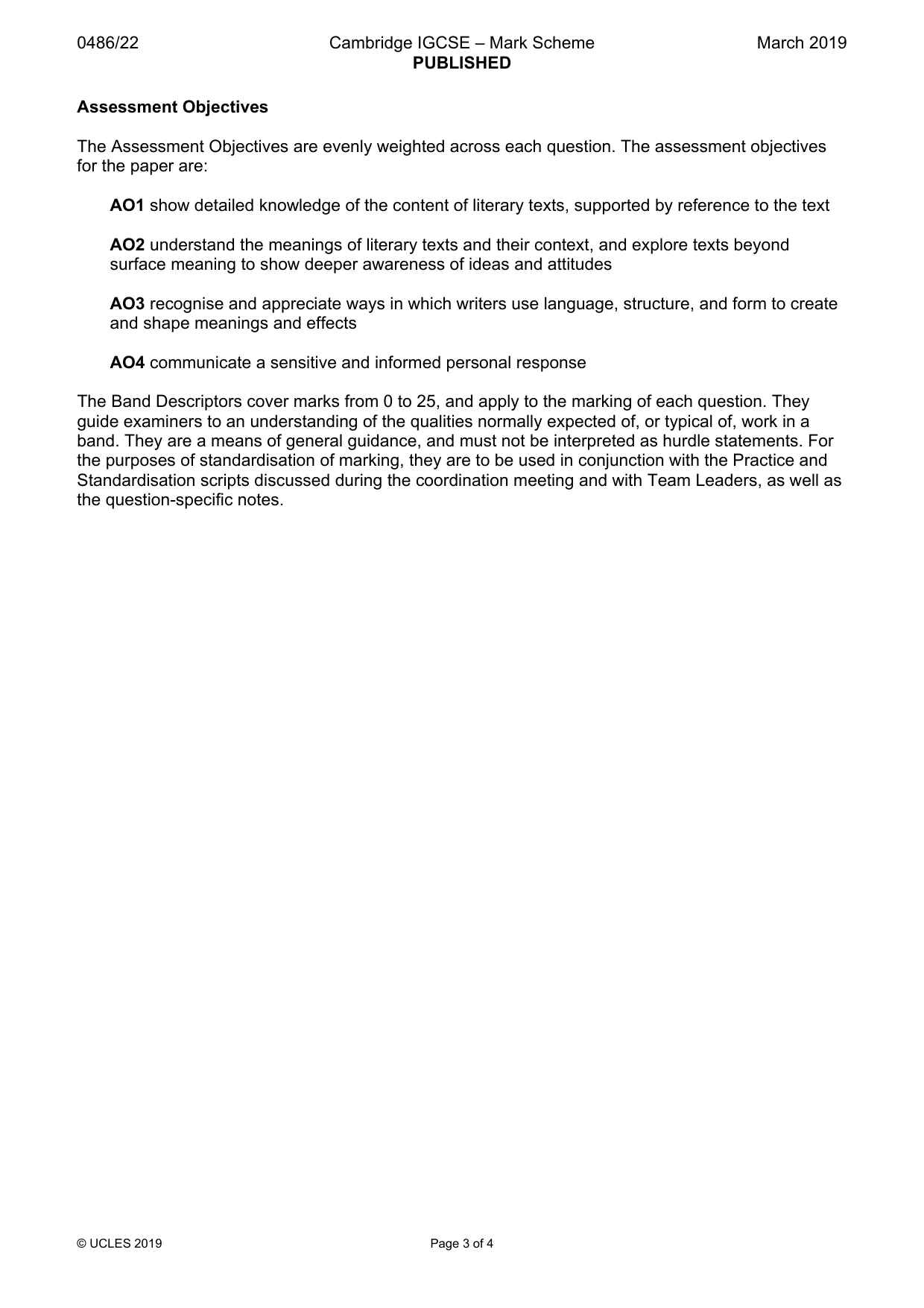
0486/22 Cambridge IGCSE – Mark Scheme PUBLISHED March 2019 © UCLES 2019 Page 3 of 4 Assessment Objectives The Assessment Objectives are evenly weighted across each question. The assessment objectives for the paper are: AO1 show detailed knowledge of the content of literary texts, supported by reference to the text AO2 understand the meanings of literary texts and their context, and explore texts beyond surface meaning to show deeper awareness of ideas and attitudes AO3 recognise and appreciate ways in which writers use language, structure, and form to create and shape meanings and effects AO4 communicate a sensitive and informed personal response The Band Descriptors cover marks from 0 to 25, and apply to the marking of each question. They guide examiners to an understanding of the qualities normally expected of, or typical of, work in a band. They are a means of general guidance, and must not be interpreted as hurdle statements. For the purposes of standardisation of marking, they are to be used in conjunction with the Practice and Standardisation scripts discussed during the coordination meeting and with Team Leaders, as well as the question-specific notes.
Mark scheme, page 4
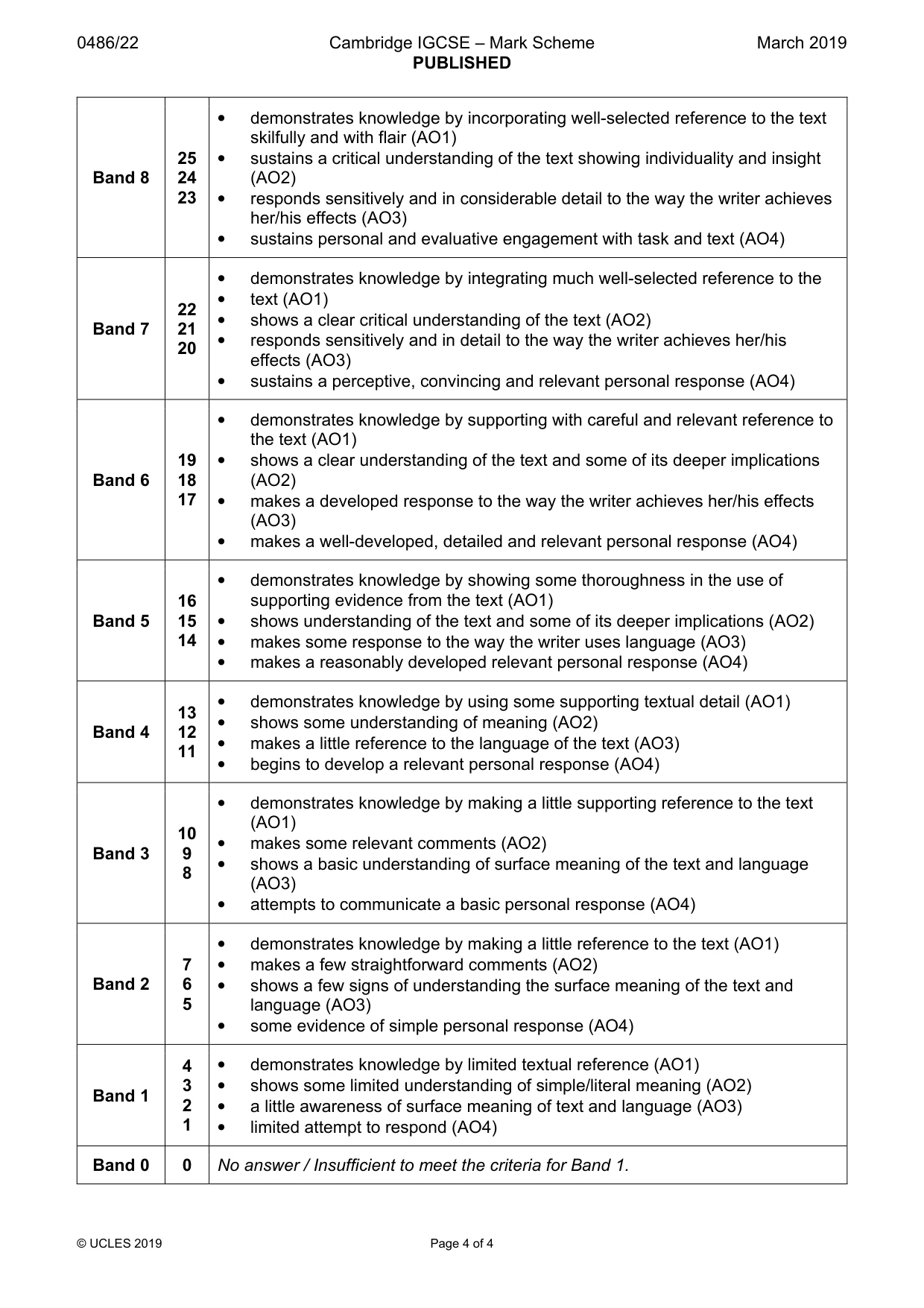
0486/22 Cambridge IGCSE – Mark Scheme PUBLISHED March 2019 © UCLES 2019 Page 4 of 4 Band 8 25 24 23 • demonstrates knowledge by incorporating well-selected reference to the text skilfully and with flair (AO1) • sustains a critical understanding of the text showing individuality and insight (AO2) • responds sensitively and in considerable detail to the way the writer achieves her/his effects (AO3) • sustains personal and evaluative engagement with task and text (AO4) Band 7 22 21 20 • demonstrates knowledge by integrating much well-selected reference to the • text (AO1) • shows a clear critical understanding of the text (AO2) • responds sensitively and in detail to the way the writer achieves her/his effects (AO3) • sustains a perceptive, convincing and relevant personal response (AO4) Band 6 19 18 17 • demonstrates knowledge by supporting with careful and relevant reference to the text (AO1) • shows a clear understanding of the text and some of its deeper implications (AO2) • makes a developed response to the way the writer achieves her/his effects (AO3) • makes a well-developed, detailed and relevant personal response (AO4) Band 5 16 15 14 • demonstrates knowledge by showing some thoroughness in the use of supporting evidence from the text (AO1) • shows understanding of the text and some of its deeper implications (AO2) • makes some response to the way the writer uses language (AO3) • makes a reasonably developed relevant personal response (AO4) Band 4 13 12 11 • demonstrates knowledge by using some supporting textual detail (AO1) • shows some understanding of meaning (AO2) • makes a little reference to the language of the text (AO3) • begins to develop a relevant personal response (AO4) Band 3 10 9 8 • demonstrates knowledge by making a little supporting reference to the text (AO1) • makes some relevant comments (AO2) • shows a basic understanding of surface meaning of the text and language (AO3) • attempts to communicate a basic personal response (AO4) Band 2 7 6 5 • demonstrates knowledge by making a little reference to the text (AO1) • makes a few straightforward comments (AO2) • shows a few signs of understanding the surface meaning of the text and language (AO3) • some evidence of simple personal response (AO4) Band 1 4 3 2 1 • demonstrates knowledge by limited textual reference (AO1) • shows some limited understanding of simple/literal meaning (AO2) • a little awareness of surface meaning of text and language (AO3) • limited attempt to respond (AO4) Band 0 0 No answer / Insufficient to meet the criteria for Band 1.
What you needed in this session
Cambridge’s own grade thresholds for 2019 Feb/March, Paper 2 · Variant 2. A higher threshold means an easier paper — the bar moves with how the cohort did.