Cambridge IGCSE English - Literature 0486 — 2011 May/June Paper 1 · Variant 1
0486/11/M/J/11 · 75 marks · ≈84 min
The question paper and its mark scheme, free to read here and free to download. This is Cambridge’s own paper, exactly as it was sat.
Question paper8 pages
Mark scheme3 pages
Answers below. Sit the paper first if you are practising.
Paper as text
Question paper, page 1
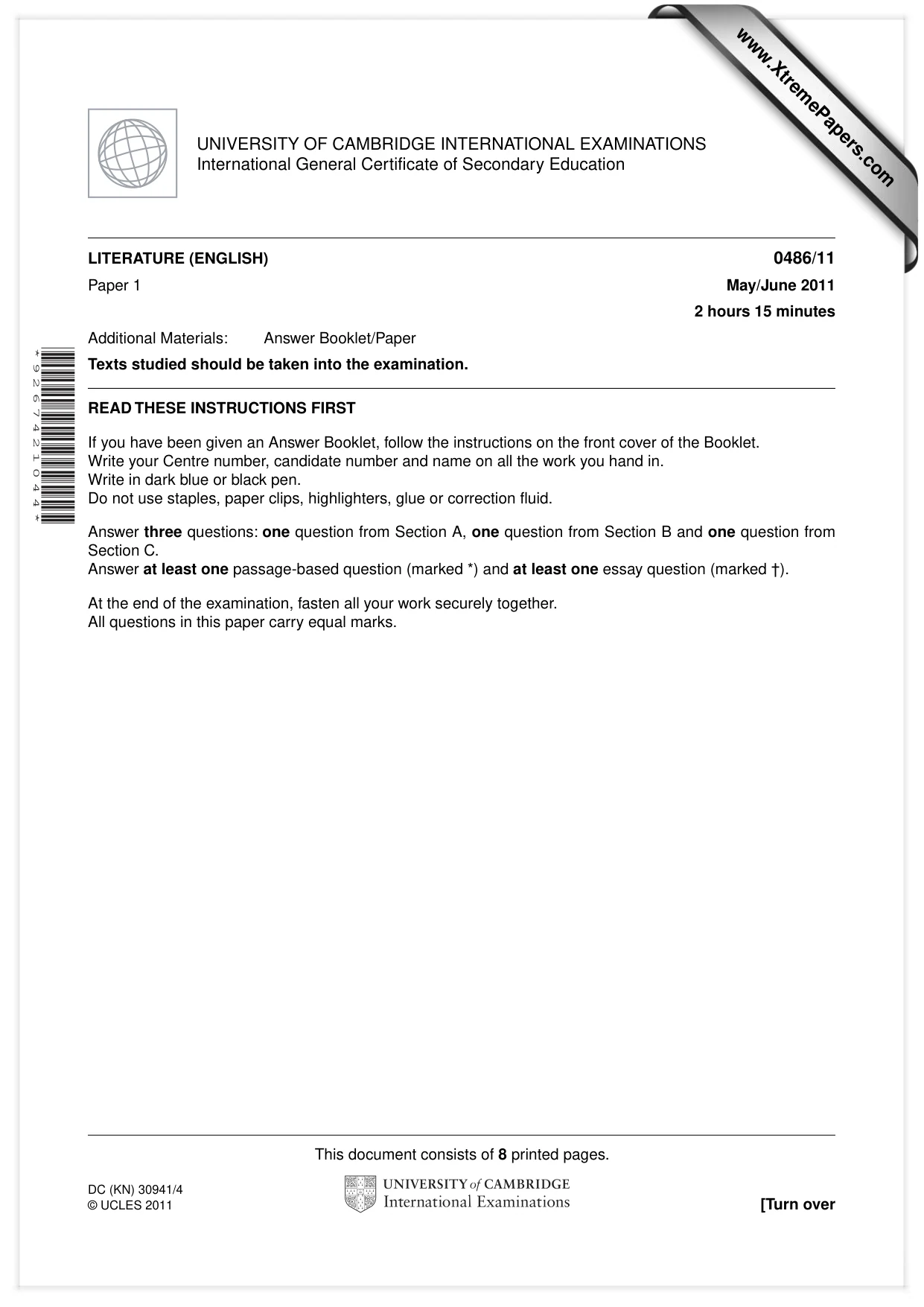
This document consists of 8 printed pages. DC (KN) 30941/4 © UCLES 2011 [Turn over UNIVERSITY OF CAMBRIDGE INTERNATIONAL EXAMINATIONS International General Certificate of Secondary Education READ THESE INSTRUCTIONS FIRST If you have been given an Answer Booklet, follow the instructions on the front cover of the Booklet. Write your Centre number, candidate number and name on all the work you hand in. Write in dark blue or black pen. Do not use staples, paper clips, highlighters, glue or correction fluid. Answer three questions: one question from Section A, one question from Section B and one question from Section C. Answer at least one passage-based question (marked *) and at least one essay question (marked †). At the end of the examination, fasten all your work securely together. All questions in this paper carry equal marks. LITERATURE (ENGLISH) 0486/11 Paper 1 May/June 2011 2 hours 15 minutes Additional Materials: Answer Booklet/Paper Texts studied should be taken into the examination. * 9 2 6 7 4 2 1 0 4 4 * www.XtremePapers.com
Question paper, page 2
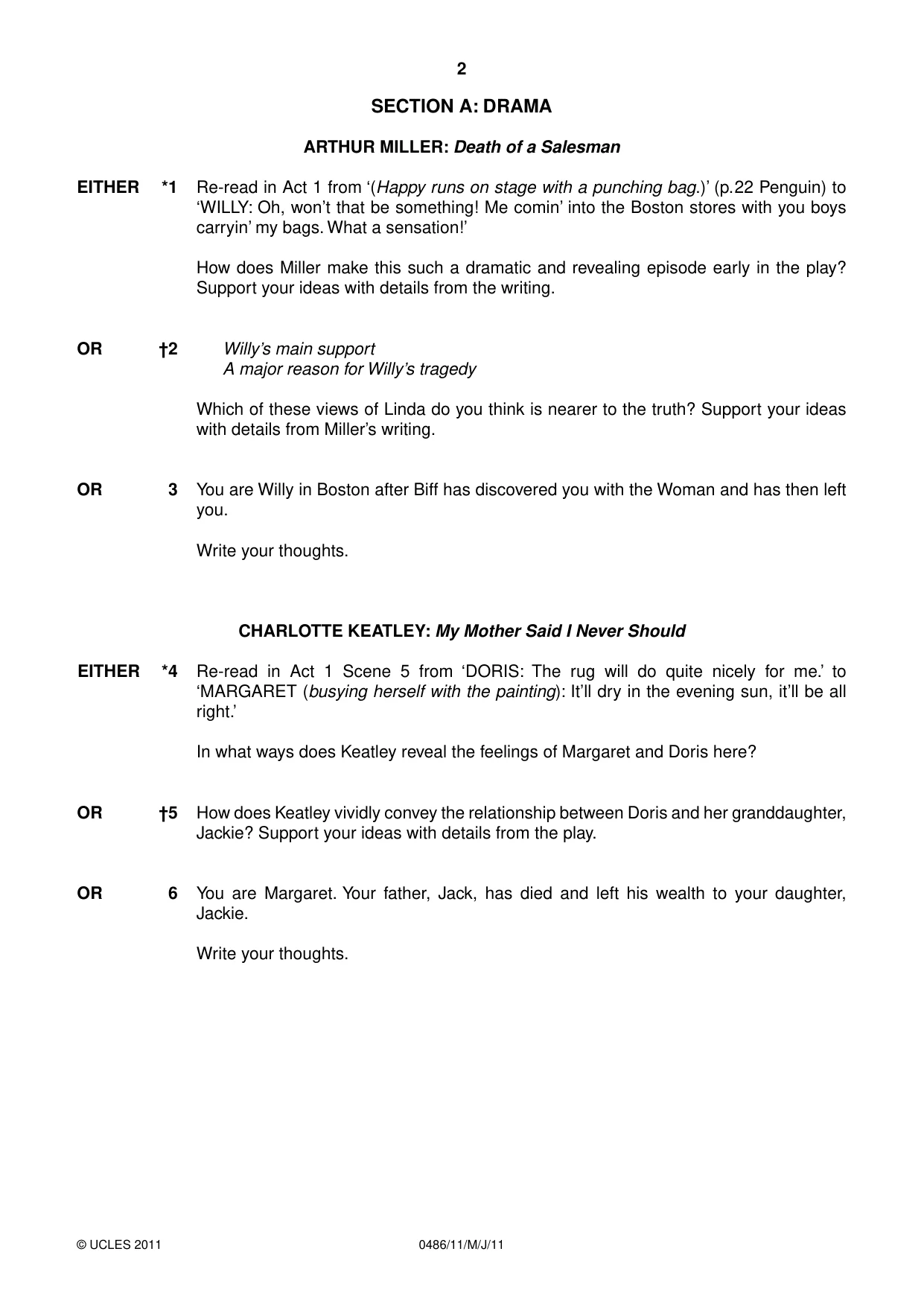
2 0486/11/M/J/11 © UCLES 2011 SECTION A: DRAMA ARTHUR MILLER: Death of a Salesman EITHER *1 Re-read in Act 1 from ‘(Happy runs on stage with a punching bag.)’ (p. 22 Penguin) to ‘WILLY: Oh, won’t that be something! Me comin’ into the Boston stores with you boys carryin’ my bags. What a sensation!’ How does Miller make this such a dramatic and revealing episode early in the play? Support your ideas with details from the writing. OR †2 Willy’s main support A major reason for Willy’s tragedy Which of these views of Linda do you think is nearer to the truth? Support your ideas with details from Miller’s writing. OR 3 You are Willy in Boston after Biff has discovered you with the Woman and has then left you. Write your thoughts. CHARLOTTE KEATLEY: My Mother Said I Never Should EITHER *4 Re-read in Act 1 Scene 5 from ‘DORIS: The rug will do quite nicely for me.’ to ‘MARGARET (busying herself with the painting): It’ll dry in the evening sun, it’ll be all right.’ In what ways does Keatley reveal the feelings of Margaret and Doris here? OR †5 How does Keatley vividly convey the relationship between Doris and her granddaughter, Jackie? Support your ideas with details from the play. OR 6 You are Margaret. Your father, Jack, has died and left his wealth to your daughter, Jackie. Write your thoughts.
Question paper, page 3
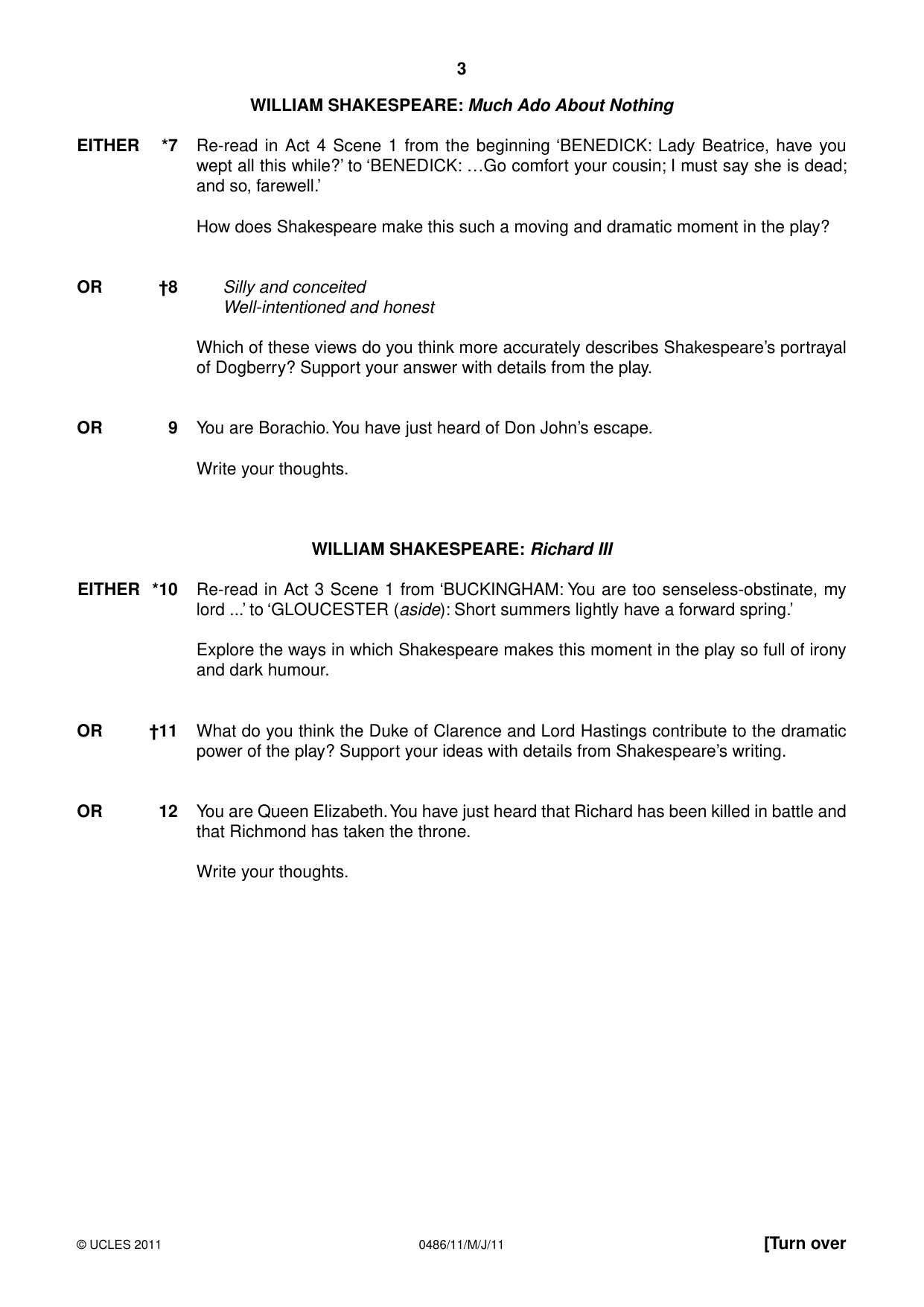
3 0486/11/M/J/11 © UCLES 2011 [Turn over WILLIAM SHAKESPEARE: Much Ado About Nothing EITHER *7 Re-read in Act 4 Scene 1 from the beginning ‘BENEDICK: Lady Beatrice, have you wept all this while?’ to ‘BENEDICK: …Go comfort your cousin; I must say she is dead; and so, farewell.’ How does Shakespeare make this such a moving and dramatic moment in the play? OR †8 Silly and conceited Well-intentioned and honest Which of these views do you think more accurately describes Shakespeare’s portrayal of Dogberry? Support your answer with details from the play. OR 9 You are Borachio. You have just heard of Don John’s escape. Write your thoughts. WILLIAM SHAKESPEARE: Richard III EITHER *10 Re-read in Act 3 Scene 1 from ‘BUCKINGHAM: You are too senseless-obstinate, my lord ...’ to ‘GLOUCESTER (aside): Short summers lightly have a forward spring.’ Explore the ways in which Shakespeare makes this moment in the play so full of irony and dark humour. OR †11 What do you think the Duke of Clarence and Lord Hastings contribute to the dramatic power of the play? Support your ideas with details from Shakespeare’s writing. OR 12 You are Queen Elizabeth. You have just heard that Richard has been killed in battle and that Richmond has taken the throne. Write your thoughts.
Question paper, page 4
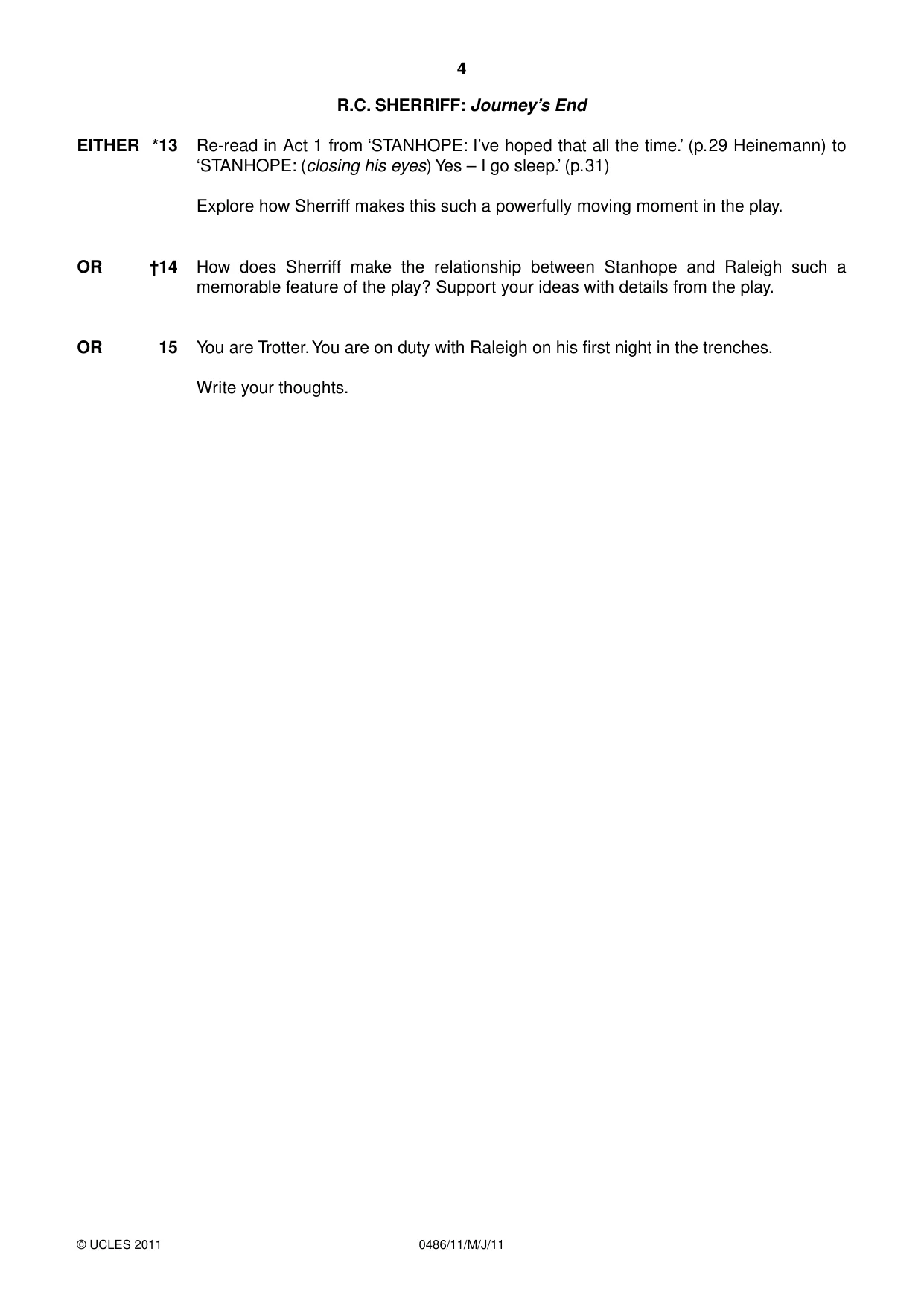
4 0486/11/M/J/11 © UCLES 2011 R.C. SHERRIFF: Journey’s End EITHER *13 Re-read in Act 1 from ‘STANHOPE: I’ve hoped that all the time.’ (p. 29 Heinemann) to ‘STANHOPE: (closing his eyes) Yes – I go sleep.’ (p. 31) Explore how Sherriff makes this such a powerfully moving moment in the play. OR †14 How does Sherriff make the relationship between Stanhope and Raleigh such a memorable feature of the play? Support your ideas with details from the play. OR 15 You are Trotter. You are on duty with Raleigh on his first night in the trenches. Write your thoughts.
Question paper, page 5
5 0486/11/M/J/11 © UCLES 2011 [Turn over SECTION B: POETRY ALFRED, LORD TENNYSON: Poems EITHER *16 Re-read the closing lines in Ulysses from ‘There lies the port; the vessel puffs her sail;’ to ‘To strive, to seek, to find, and not to yield.’ In what ways does Tennyson strikingly convey the optimism and determination of Ulysses in these lines? OR †17 How does Tennyson make clear for you his thoughts and feelings in the extract CXV from In Memoriam (beginning ‘Now fades the long last streak of snow’)? OR †18 What does Tennyson make you feel about the Lady in his poem The Lady of Shalott? Support your ideas with details from the poem. SONGS OF OURSELVES: from Part 3 EITHER *19 Re-read Marrysong (by Dennis Scott). Explore the ways in which Scott beautifully portrays a relationship in this poem. OR †20 Explore how the poet powerfully communicates the pain of loss in either The Voice (by Thomas Hardy) or Sonnet 29 (‘Pity me not because the light of day’) (by Edna St Vincent Millay). OR †21 In two of the following poems explore in detail lines which you find particularly striking. Full Moon and Little Frieda (by Ted Hughes) The Flower-Fed Buffaloes (by Vachel Lindsay) Sonnet 43 (‘How do I love thee? Let me count the ways!’) (by Elizabeth Barrett Browning)
Question paper, page 6
6 0486/11/M/J/11 © UCLES 2011 SECTION C: PROSE EMILY BRONTË: Wuthering Heights EITHER *22 Re-read in Volume 2 Chapter 3 (or in some editions Chapter 17) from ‘ “I might as well have struggled with a bear...” ’ to ‘There he tore off the sleeve of Earnshaw’s coat, and bound up the wound with brutal roughness, spitting and cursing, during the operation, as energetically as he had kicked before.’ How does Brontë make Isabella’s narration here such a dramatic part of the novel? OR †23 Explore the ways in which Brontë makes Nelly Dean such a memorable character in the novel. Support your views with details from Brontë’s writing. OR 24 You are Heathcliff. You are on your way back to Wuthering Heights after your three-year absence. Write your thoughts. ANITA DESAI: Games at Twilight and Other Stories EITHER *25 Re-read in Games at Twilight from ‘Then, perhaps roused by the shrieks of the children, a band of parrots suddenly fell out of the eucalyptus tree.’ (p. 2 Penguin) to ‘...and then stalked off in search of worthier prey, whistling spiritedly so that the hiders should hear and tremble.’ (p. 4) Explore how Desai memorably portrays the actions and feelings of children at play in this passage. OR †26 How far do you think Desai makes it possible to sympathise with Harish in Surface Textures? Support your views with details from the writing. OR 27 You are Pat at the end of Scholar and Gypsy. You are walking off into the moonlight. Write your thoughts.
Question paper, page 7
7 0486/11/M/J/11 © UCLES 2011 [Turn over BESSIE HEAD: When Rain Clouds Gather EITHER *28 Re-read in Chapter 1 from ‘The wail of the approaching sirens sounded again’ to ‘...nothing, however odd and perverse, need be feared if it was human.’ How does Head make this introduction to Makhaya so dramatic and intriguing? OR †29 How does Head make Chief Matenge such a horrible character? Support your ideas with details from Head’s writing. OR 30 You are Dinorego at the end of the novel, reflecting on the changes in Golema Mmidi. Write your thoughts. F. SCOTT FITZGERALD: The Great Gatsby EITHER *31 Re-read the beginning of Chapter 3 from ‘There was music from my neighbour’s house...’ to ‘...the erroneous news goes around that she is Gilda Gray’s understudy from the Follies. The party has begun.’ What striking impressions of Gatsby’s grand party does Fitzgerald’s writing convey to you in this passage? OR †32 How does Fitzgerald make Tom Buchanan such an unpleasant character? Support your answer by close reference to Fitzgerald’s writing. OR 33 You are Daisy. You have just returned home after your surprise meeting with Jay Gatsby. Write your thoughts. EDITH WHARTON: Ethan Frome EITHER *34 Re-read the end of Chapter 2 from ‘He was still kneeling when his eyes, on a level with the lower panel of the door, caught a faint ray beneath it.’ to ‘…followed her across the threshold of her room.’ Explore how Wharton memorably conveys the tension between the three people at this moment in the novel. OR †35 How far do you think Wharton makes it possible to sympathise with Zeena? Support your ideas with details from Wharton’s writing. OR 36 You are Mattie, alone in your room. You have just had supper with Ethan in Zeena’s absence. Write your thoughts.
Question paper, page 8
8 0486/11/M/J/11 © UCLES 2011 Stories of Ourselves EITHER *37 Re-read in The Third and Final Continent (by Jhumpa Lahiri) from ‘At the end of our first week, on Friday, I suggested going out.’ to ‘But Mala had heard, and, for the first time, we looked at each other and smiled.’ How does Lahiri make this such a moving moment in the story? OR †38 How does the writer make you sympathise with one of the following characters? Mr Wills (in The Taste of Watermelon by Borden Deal) The narrator/wife (in The Yellow Wallpaper by Charlotte Perkins Gilman) The Signalman (The Signalman by Charles Dickens) Support your ideas with details from your chosen story. OR 39 You are the leader of the gang in The Lemon Orchard (by Alex La Guma). You have just left the orchard at the end of the story. Write your thoughts. Permission to reproduce items where third-party owned material protected by copyright is included has been sought and cleared where possible. Every reasonable effort has been made by the publisher (UCLES) to trace copyright holders, but if any items requiring clearance have unwittingly been included, the publisher will be pleased to make amends at the earliest possible opportunity. University of Cambridge International Examinations is part of the Cambridge Assessment Group. Cambridge Assessment is the brand name of University of Cambridge Local Examinations Syndicate (UCLES), which is itself a department of the University of Cambridge.
Mark scheme, page 1
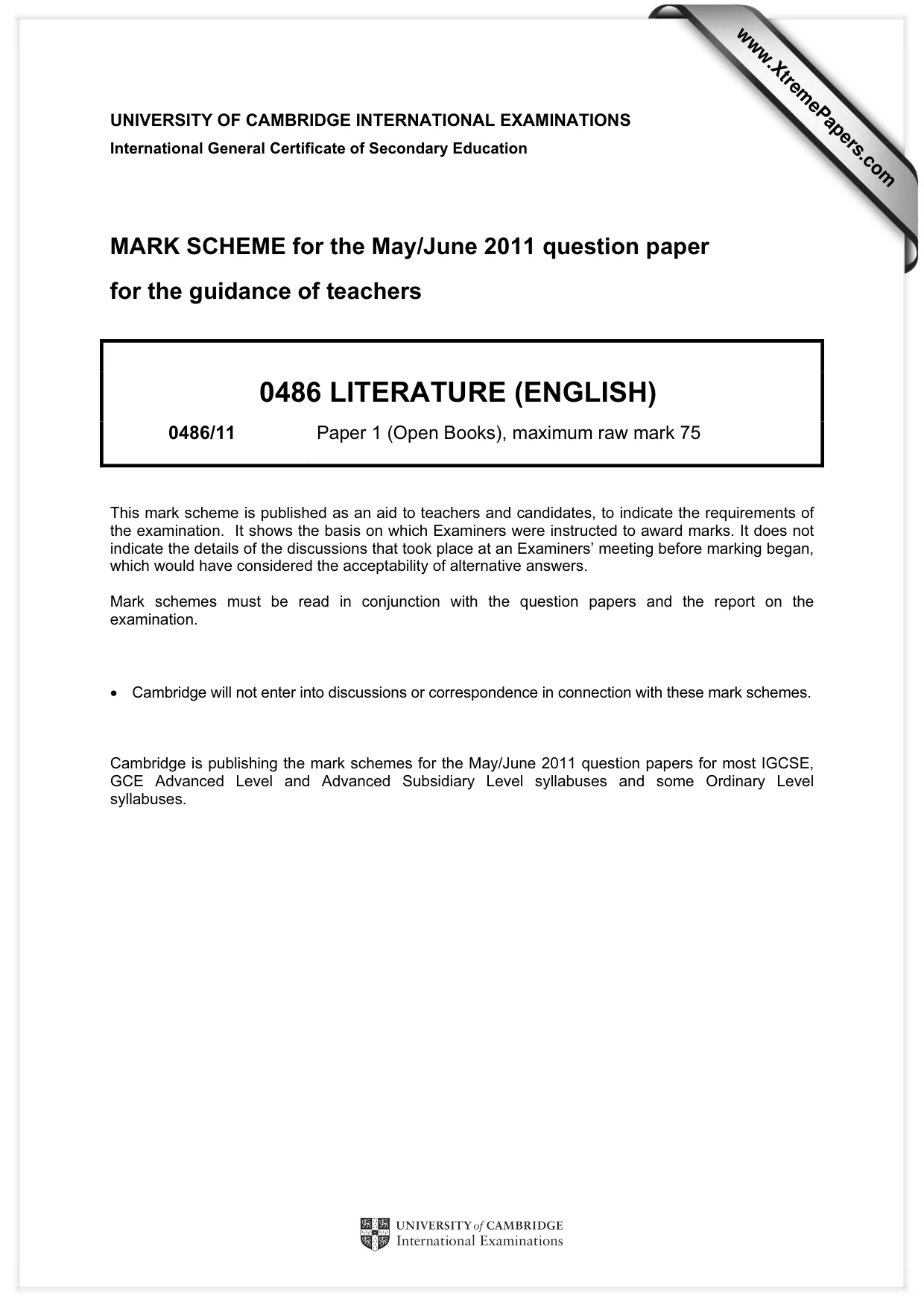
UNIVERSITY OF CAMBRIDGE INTERNATIONAL EXAMINATIONS International General Certificate of Secondary Education MARK SCHEME for the May/June 2011 question paper for the guidance of teachers 0486 LITERATURE (ENGLISH) 0486/11 Paper 1 (Open Books), maximum raw mark 75 This mark scheme is published as an aid to teachers and candidates, to indicate the requirements of the examination. It shows the basis on which Examiners were instructed to award marks. It does not indicate the details of the discussions that took place at an Examiners’ meeting before marking began, which would have considered the acceptability of alternative answers. Mark schemes must be read in conjunction with the question papers and the report on the examination. • Cambridge will not enter into discussions or correspondence in connection with these mark schemes. Cambridge is publishing the mark schemes for the May/June 2011 question papers for most IGCSE, GCE Advanced Level and Advanced Subsidiary Level syllabuses and some Ordinary Level syllabuses. www.XtremePapers.com
Mark scheme, page 2
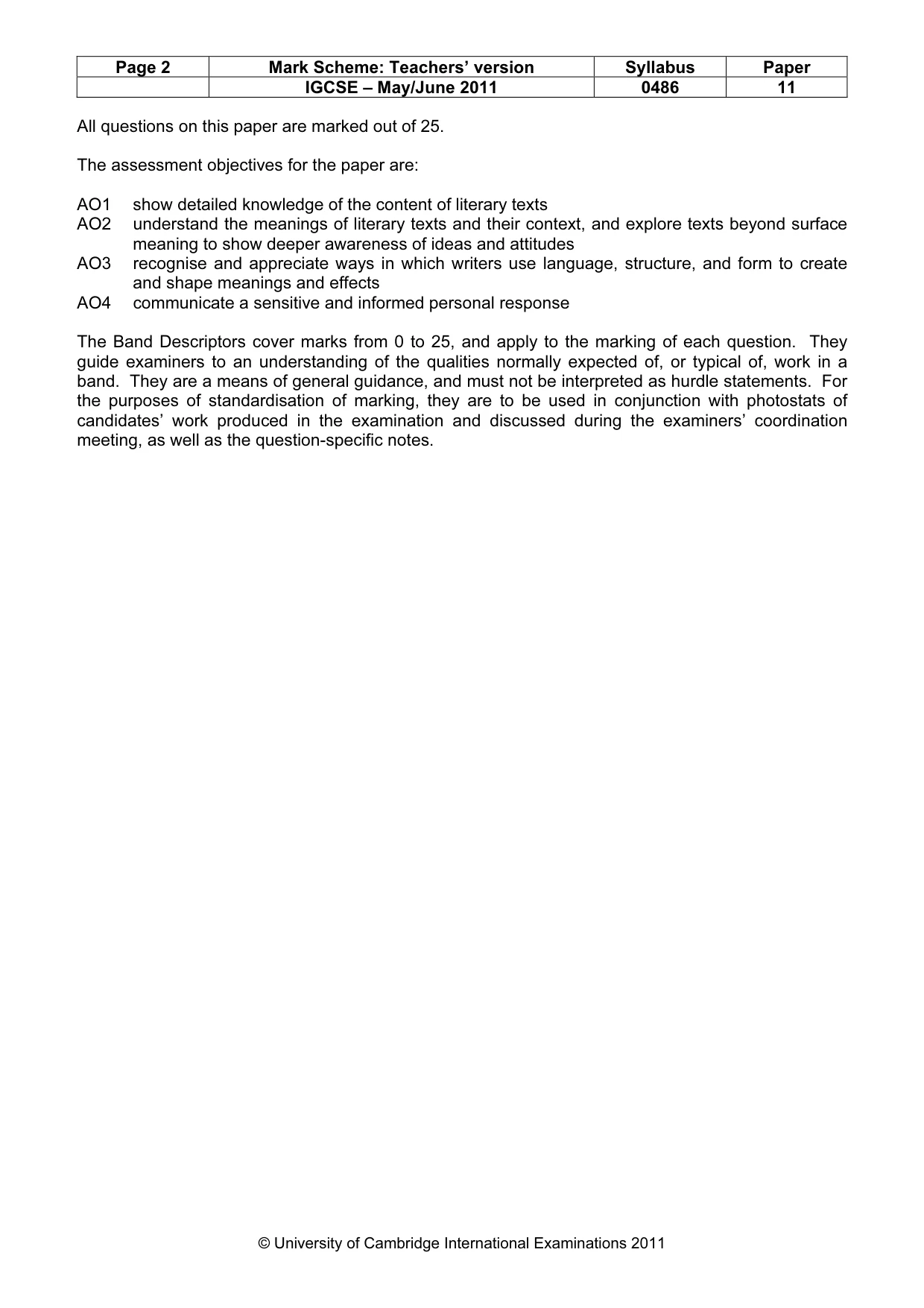
Page 2 Mark Scheme: Teachers’ version Syllabus Paper IGCSE – May/June 2011 0486 11 © University of Cambridge International Examinations 2011 All questions on this paper are marked out of 25. The assessment objectives for the paper are: AO1 show detailed knowledge of the content of literary texts AO2 understand the meanings of literary texts and their context, and explore texts beyond surface meaning to show deeper awareness of ideas and attitudes AO3 recognise and appreciate ways in which writers use language, structure, and form to create and shape meanings and effects AO4 communicate a sensitive and informed personal response The Band Descriptors cover marks from 0 to 25, and apply to the marking of each question. They guide examiners to an understanding of the qualities normally expected of, or typical of, work in a band. They are a means of general guidance, and must not be interpreted as hurdle statements. For the purposes of standardisation of marking, they are to be used in conjunction with photostats of candidates’ work produced in the examination and discussed during the examiners’ coordination meeting, as well as the question-specific notes.
Mark scheme, page 3
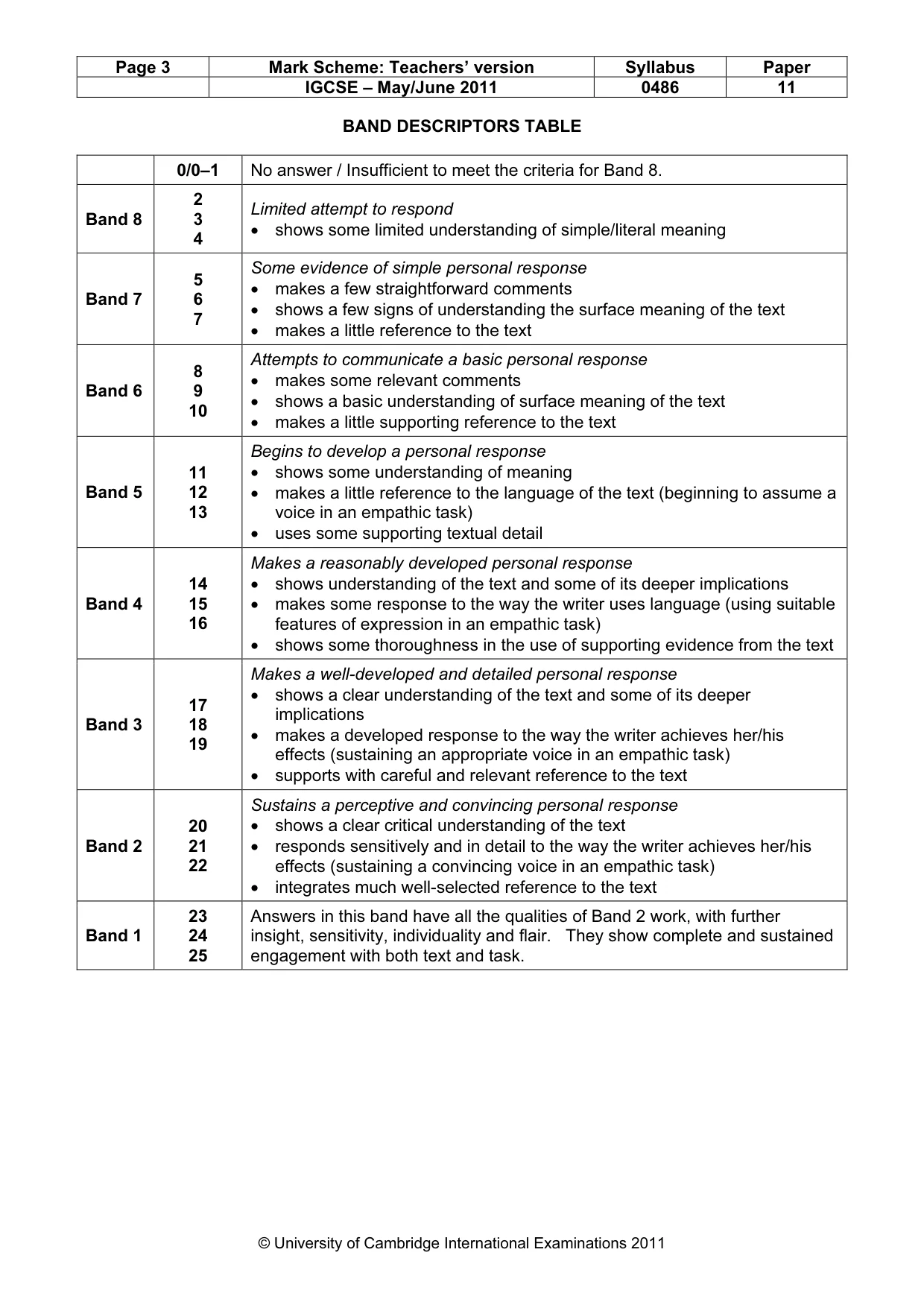
Page 3 Mark Scheme: Teachers’ version Syllabus Paper IGCSE – May/June 2011 0486 11 © University of Cambridge International Examinations 2011 BAND DESCRIPTORS TABLE 0/0–1 No answer / Insufficient to meet the criteria for Band 8. Band 8 2 3 4 Limited attempt to respond • shows some limited understanding of simple/literal meaning Band 7 5 6 7 Some evidence of simple personal response • makes a few straightforward comments • shows a few signs of understanding the surface meaning of the text • makes a little reference to the text Band 6 8 9 10 Attempts to communicate a basic personal response • makes some relevant comments • shows a basic understanding of surface meaning of the text • makes a little supporting reference to the text Band 5 11 12 13 Begins to develop a personal response • shows some understanding of meaning • makes a little reference to the language of the text (beginning to assume a voice in an empathic task) • uses some supporting textual detail Band 4 14 15 16 Makes a reasonably developed personal response • shows understanding of the text and some of its deeper implications • makes some response to the way the writer uses language (using suitable features of expression in an empathic task) • shows some thoroughness in the use of supporting evidence from the text Band 3 17 18 19 Makes a well-developed and detailed personal response • shows a clear understanding of the text and some of its deeper implications • makes a developed response to the way the writer achieves her/his effects (sustaining an appropriate voice in an empathic task) • supports with careful and relevant reference to the text Band 2 20 21 22 Sustains a perceptive and convincing personal response • shows a clear critical understanding of the text • responds sensitively and in detail to the way the writer achieves her/his effects (sustaining a convincing voice in an empathic task) • integrates much well-selected reference to the text Band 1 23 24 25 Answers in this band have all the qualities of Band 2 work, with further insight, sensitivity, individuality and flair. They show complete and sustained engagement with both text and task.
What you needed in this session
Cambridge’s own grade thresholds for 2011 May/June, Paper 1 · Variant 1. A higher threshold means an easier paper — the bar moves with how the cohort did.