Cambridge IGCSE English - Literature 0486 — 2010 May/June Paper 1 · Variant 1
0486/11/M/J/10 · 75 marks · ≈84 min
The question paper and its mark scheme, free to read here and free to download. This is Cambridge’s own paper, exactly as it was sat.
Question paper8 pages
Mark scheme17 pages
Answers below. Sit the paper first if you are practising.
Paper as text
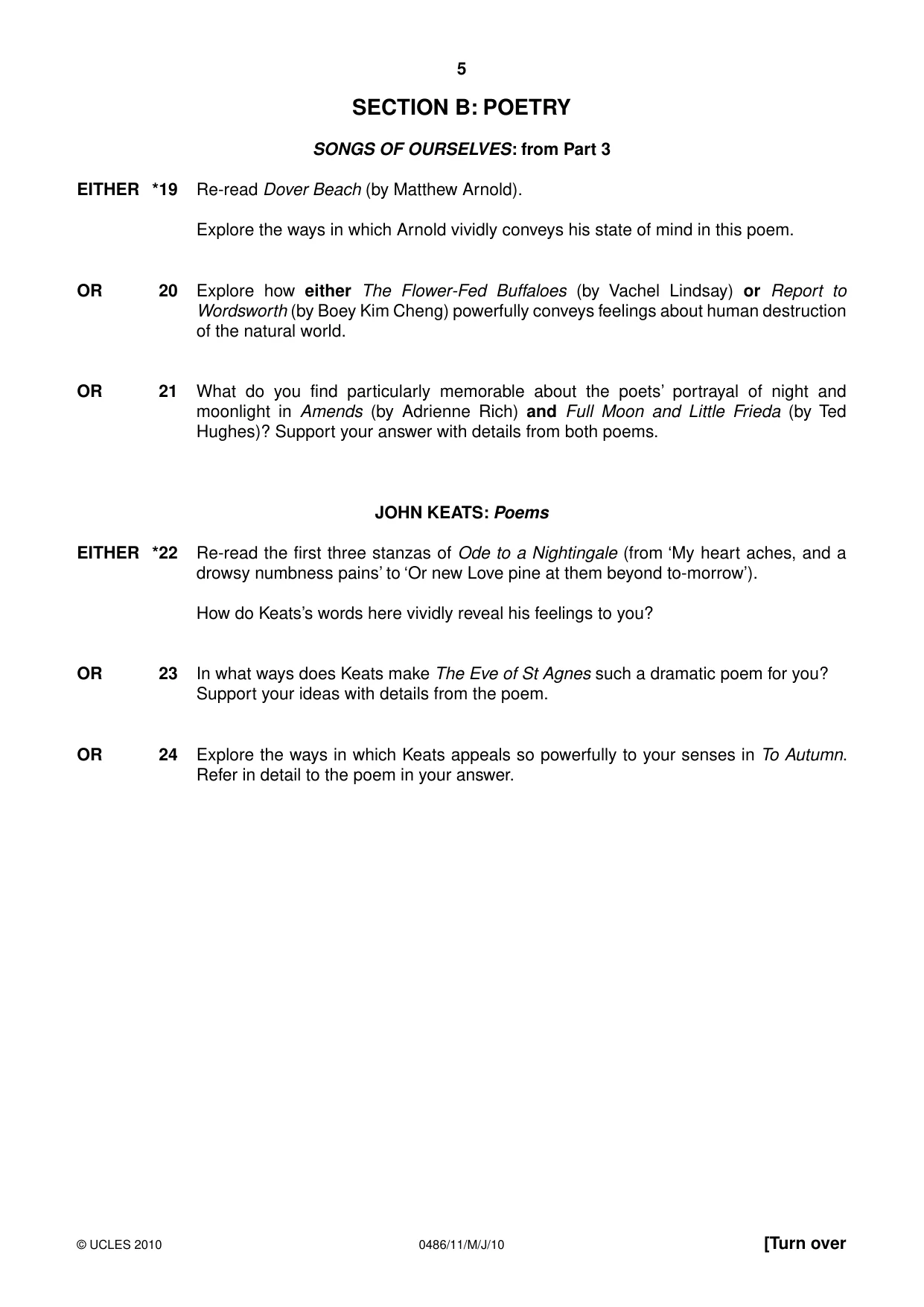
Question paper, page 1
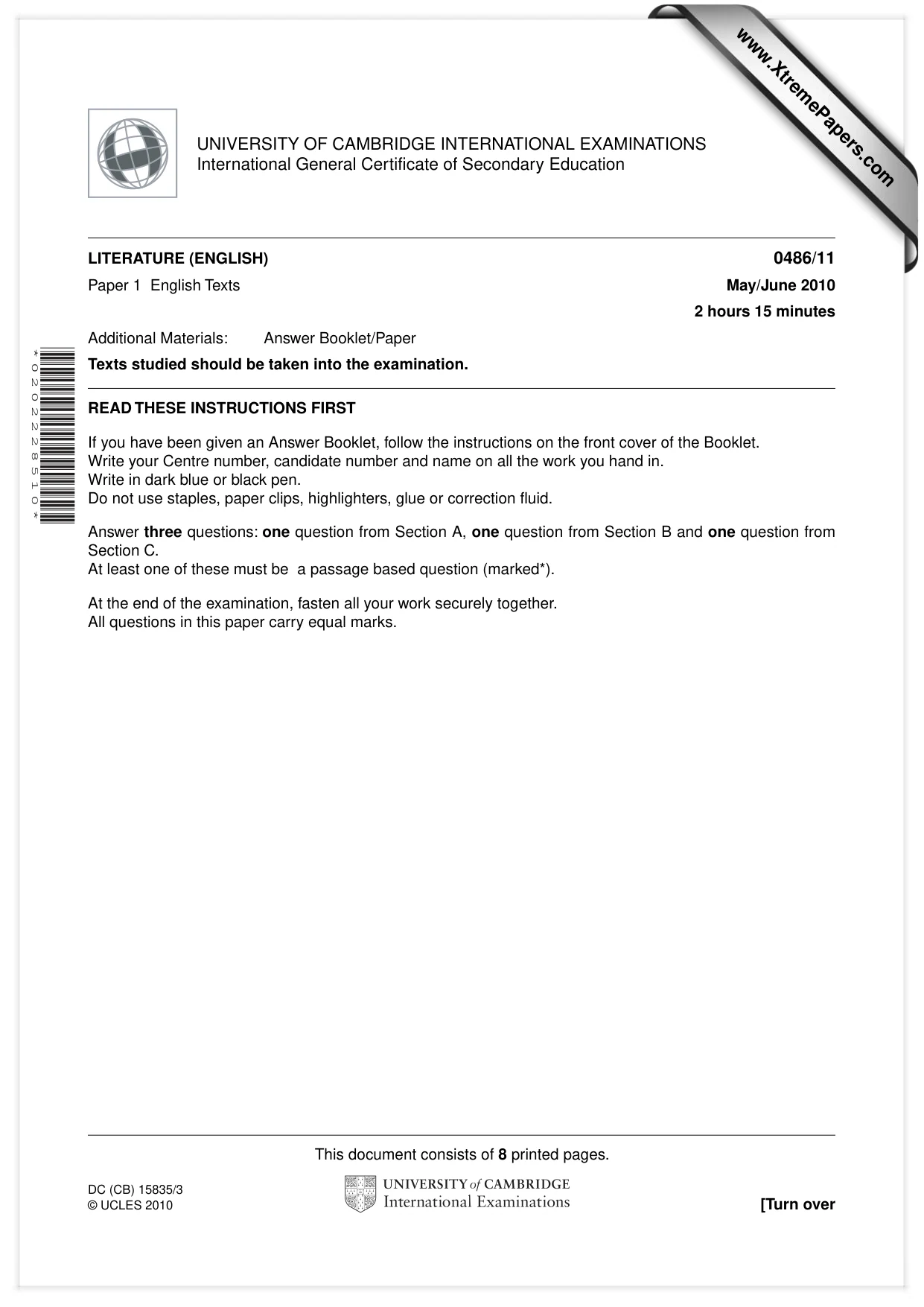
This document consists of 8 printed pages. DC (CB) 15835/3 © UCLES 2010 [Turn over UNIVERSITY OF CAMBRIDGE INTERNATIONAL EXAMINATIONS International General Certificate of Secondary Education READ THESE INSTRUCTIONS FIRST If you have been given an Answer Booklet, follow the instructions on the front cover of the Booklet. Write your Centre number, candidate number and name on all the work you hand in. Write in dark blue or black pen. Do not use staples, paper clips, highlighters, glue or correction fluid. Answer three questions: one question from Section A, one question from Section B and one question from Section C. At least one of these must be a passage based question (marked*). At the end of the examination, fasten all your work securely together. All questions in this paper carry equal marks. LITERATURE (ENGLISH) 0486/11 Paper 1 English Texts May/June 2010 2 hours 15 minutes Additional Materials: Answer Booklet/Paper Texts studied should be taken into the examination. * 0 2 0 2 2 2 8 5 1 0 * www.XtremePapers.com
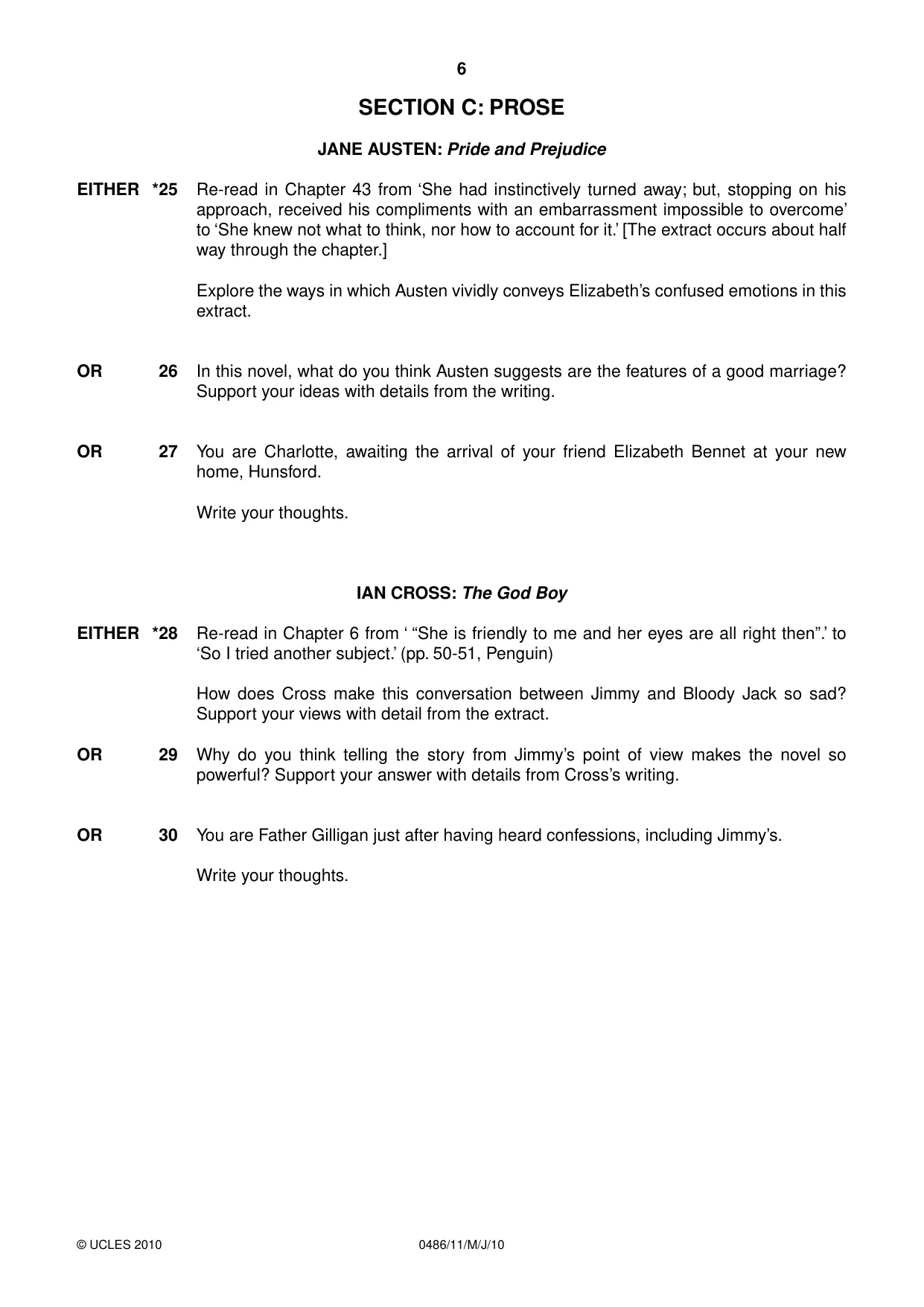
Question paper, page 2
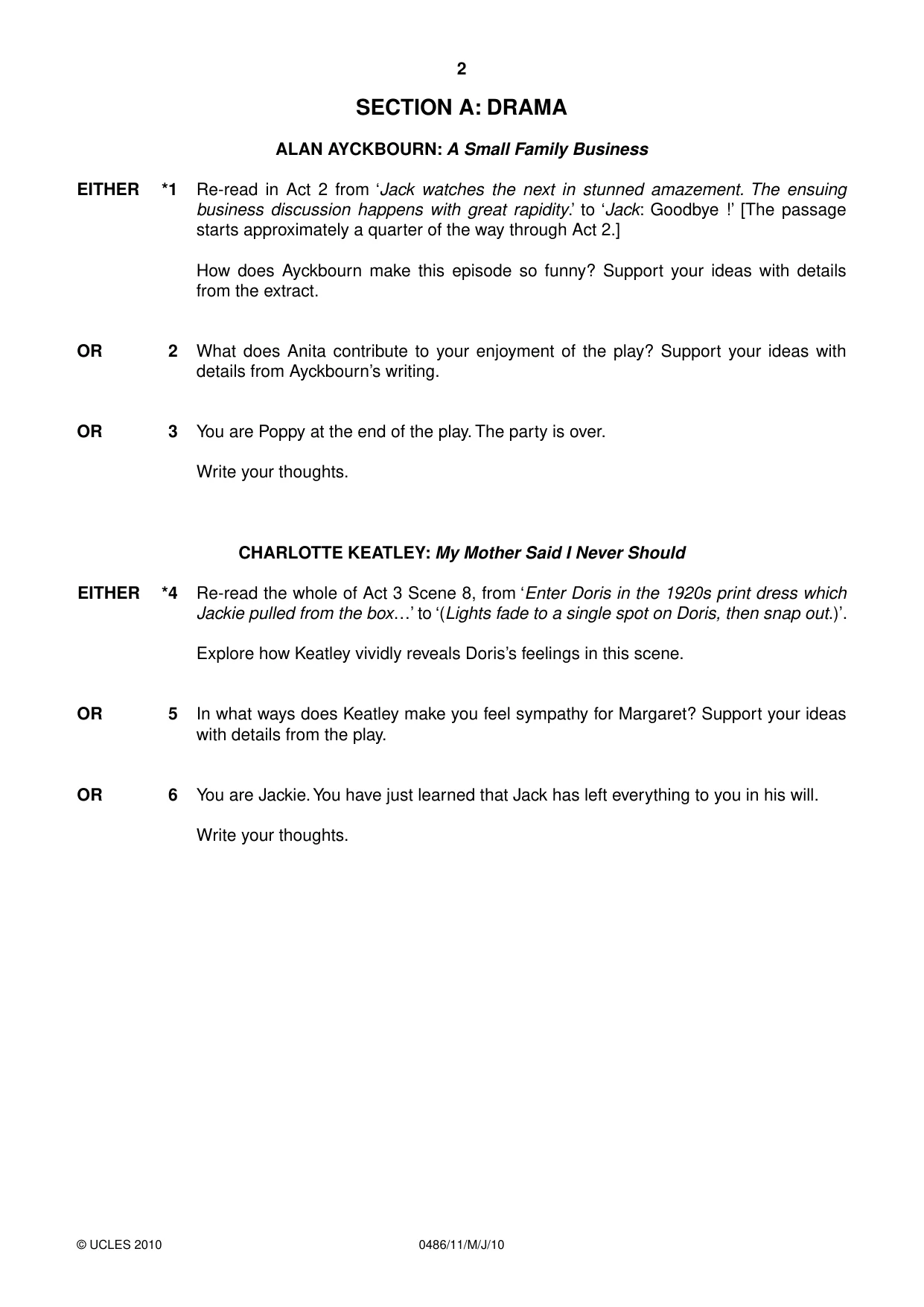
2 0486/11/M/J/10 © UCLES 2010 SECTION A: DRAMA ALAN AYCKBOURN: A Small Family Business EITHER *1 Re-read in Act 2 from ‘Jack watches the next in stunned amazement. The ensuing business discussion happens with great rapidity.’ to ‘Jack: Goodbye !’ [The passage starts approximately a quarter of the way through Act 2.] How does Ayckbourn make this episode so funny? Support your ideas with details from the extract. OR 2 What does Anita contribute to your enjoyment of the play? Support your ideas with details from Ayckbourn’s writing. OR 3 You are Poppy at the end of the play. The party is over. Write your thoughts. CHARLOTTE KEATLEY: My Mother Said I Never Should EITHER *4 Re-read the whole of Act 3 Scene 8, from ‘Enter Doris in the 1920s print dress which Jackie pulled from the box…’ to ‘(Lights fade to a single spot on Doris, then snap out.)’. Explore how Keatley vividly reveals Doris’s feelings in this scene. OR 5 In what ways does Keatley make you feel sympathy for Margaret? Support your ideas with details from the play. OR 6 You are Jackie. You have just learned that Jack has left everything to you in his will. Write your thoughts.
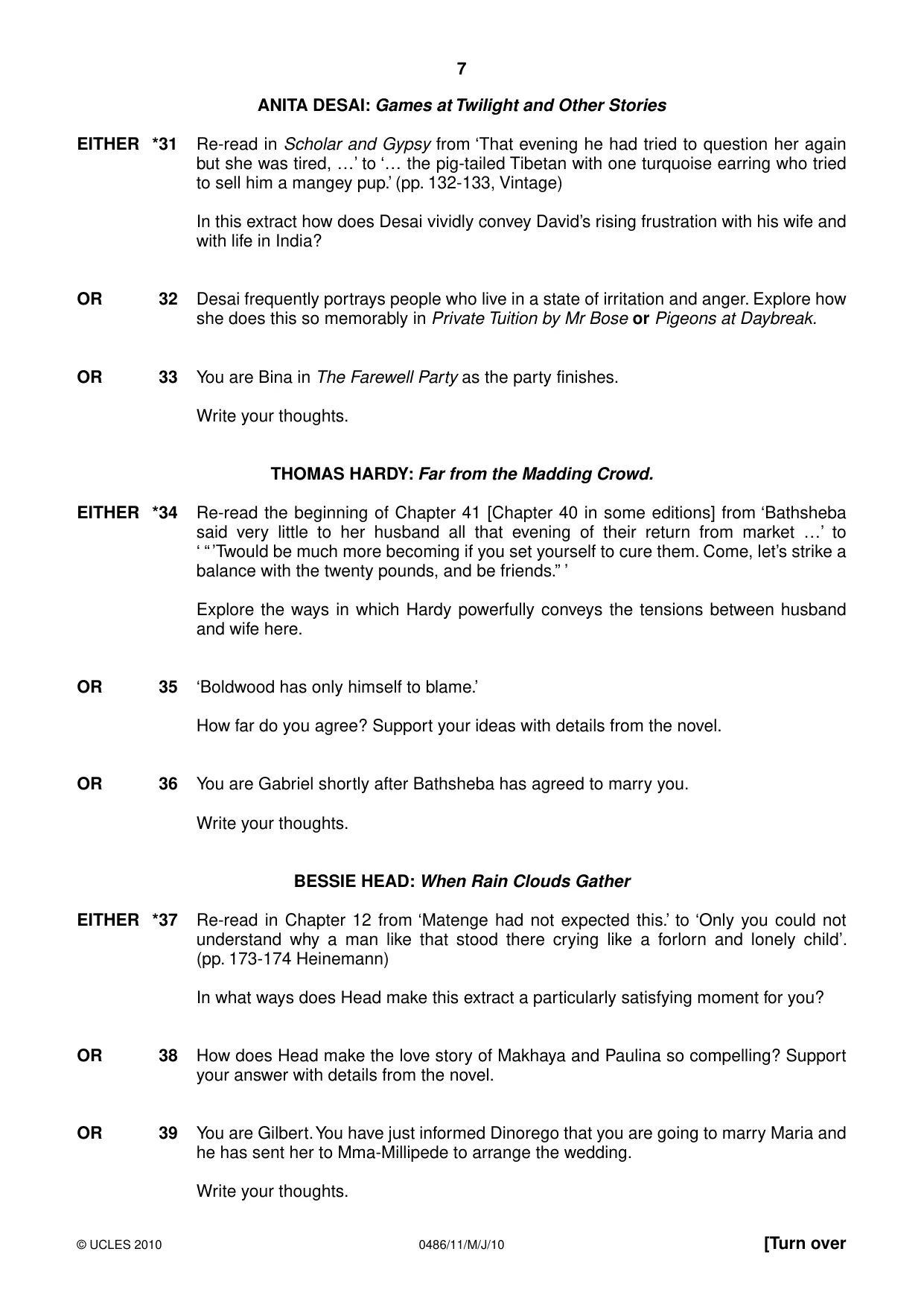
Question paper, page 3
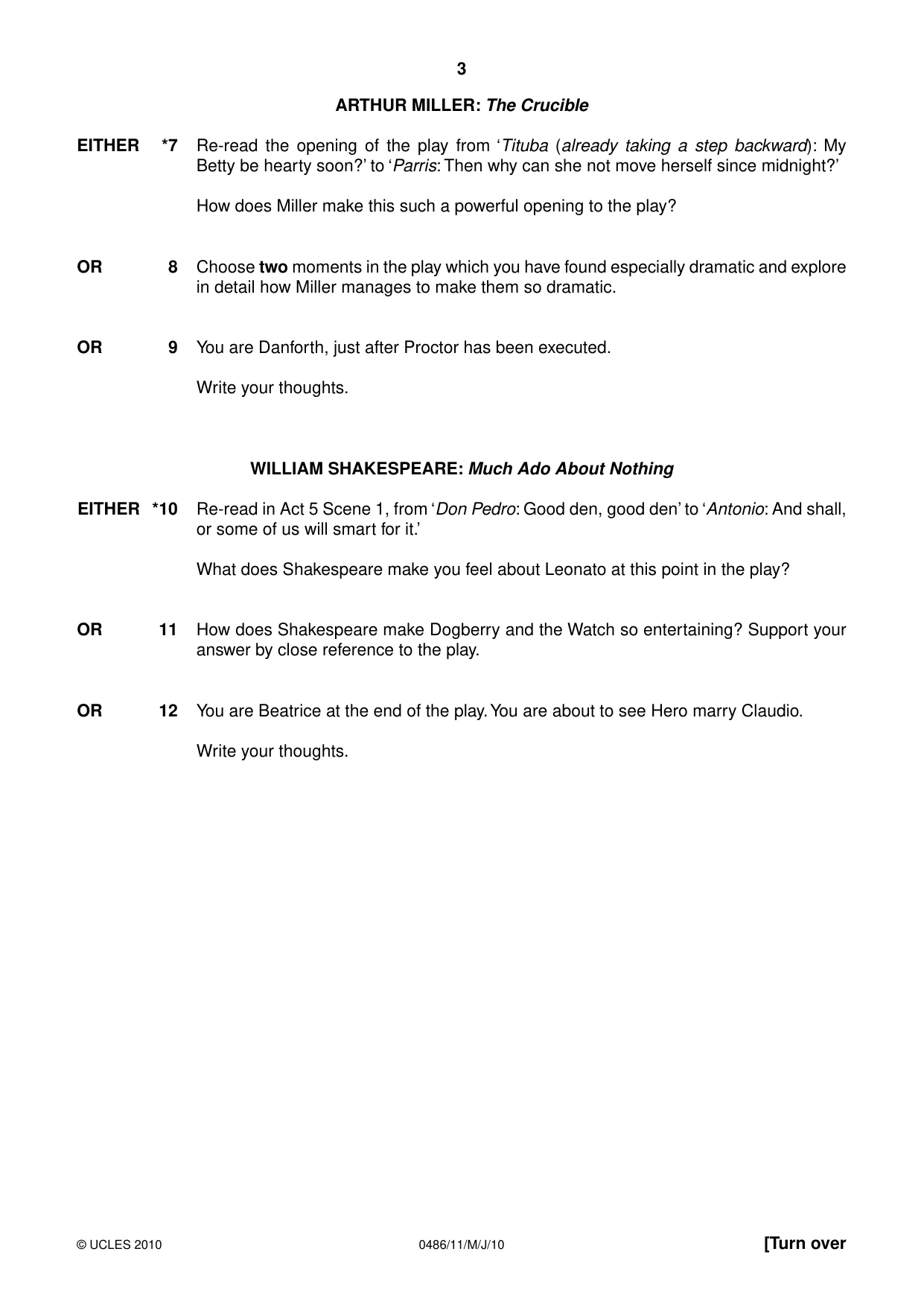
3 0486/11/M/J/10 © UCLES 2010 [Turn over ARTHUR MILLER: The Crucible EITHER *7 Re-read the opening of the play from ‘Tituba (already taking a step backward): My Betty be hearty soon?’ to ‘Parris: Then why can she not move herself since midnight?’ How does Miller make this such a powerful opening to the play? OR 8 Choose two moments in the play which you have found especially dramatic and explore in detail how Miller manages to make them so dramatic. OR 9 You are Danforth, just after Proctor has been executed. Write your thoughts. WILLIAM SHAKESPEARE: Much Ado About Nothing EITHER *10 Re-read in Act 5 Scene 1, from ‘Don Pedro: Good den, good den’ to ‘Antonio: And shall, or some of us will smart for it.’ What does Shakespeare make you feel about Leonato at this point in the play? OR 11 How does Shakespeare make Dogberry and the Watch so entertaining? Support your answer by close reference to the play. OR 12 You are Beatrice at the end of the play. You are about to see Hero marry Claudio. Write your thoughts.
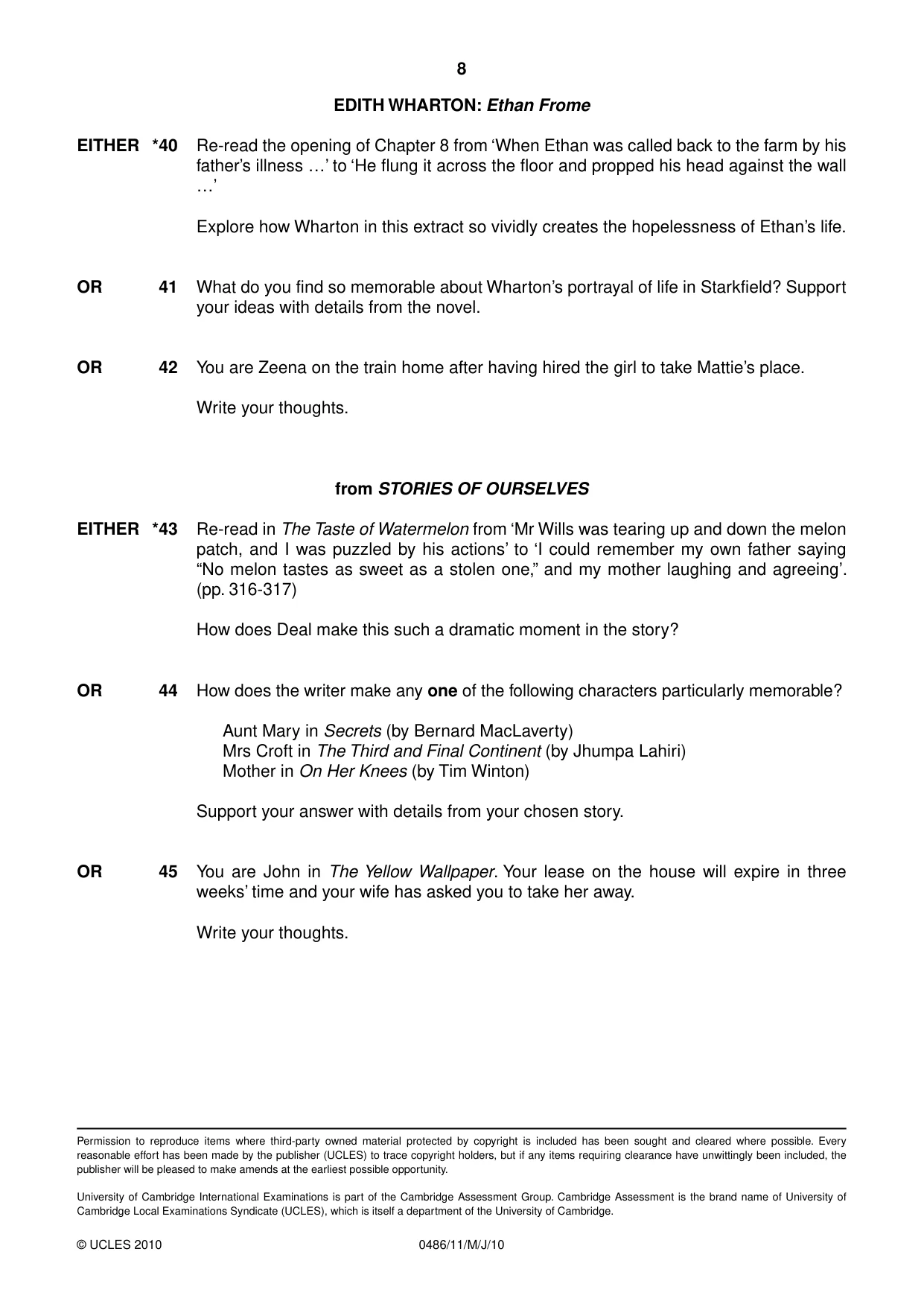
Question paper, page 4
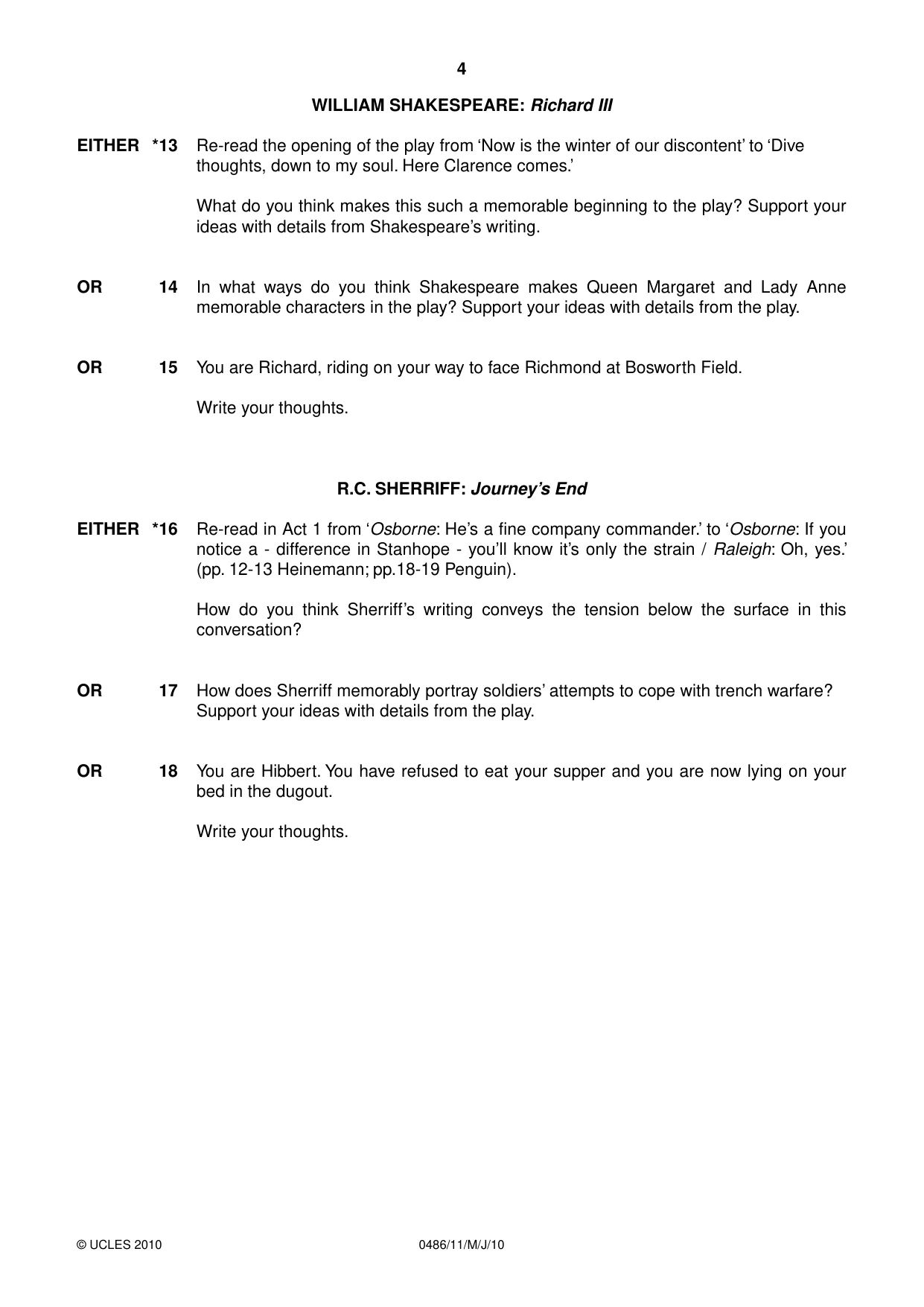
4 0486/11/M/J/10 © UCLES 2010 WILLIAM SHAKESPEARE: Richard III EITHER *13 Re-read the opening of the play from ‘Now is the winter of our discontent’ to ‘Dive thoughts, down to my soul. Here Clarence comes.’ What do you think makes this such a memorable beginning to the play? Support your ideas with details from Shakespeare’s writing. OR 14 In what ways do you think Shakespeare makes Queen Margaret and Lady Anne memorable characters in the play? Support your ideas with details from the play. OR 15 You are Richard, riding on your way to face Richmond at Bosworth Field. Write your thoughts. R.C. SHERRIFF: Journey’s End EITHER *16 Re-read in Act 1 from ‘Osborne: He’s a fine company commander.’ to ‘Osborne: If you notice a - difference in Stanhope - you’ll know it’s only the strain / Raleigh: Oh, yes.’ (pp. 12-13 Heinemann; pp.18-19 Penguin). How do you think Sherriff’s writing conveys the tension below the surface in this conversation? OR 17 How does Sherriff memorably portray soldiers’ attempts to cope with trench warfare? Support your ideas with details from the play. OR 18 You are Hibbert. You have refused to eat your supper and you are now lying on your bed in the dugout. Write your thoughts.
Question paper, page 5
5 0486/11/M/J/10 © UCLES 2010 [Turn over SECTION B: POETRY SONGS OF OURSELVES: from Part 3 EITHER *19 Re-read Dover Beach (by Matthew Arnold). Explore the ways in which Arnold vividly conveys his state of mind in this poem. OR 20 Explore how either The Flower-Fed Buffaloes (by Vachel Lindsay) or Report to Wordsworth (by Boey Kim Cheng) powerfully conveys feelings about human destruction of the natural world. OR 21 What do you find particularly memorable about the poets’ portrayal of night and moonlight in Amends (by Adrienne Rich) and Full Moon and Little Frieda (by Ted Hughes)? Support your answer with details from both poems. JOHN KEATS: Poems EITHER *22 Re-read the first three stanzas of Ode to a Nightingale (from ‘My heart aches, and a drowsy numbness pains’ to ‘Or new Love pine at them beyond to-morrow’). How do Keats’s words here vividly reveal his feelings to you? OR 23 In what ways does Keats make The Eve of St Agnes such a dramatic poem for you? Support your ideas with details from the poem. OR 24 Explore the ways in which Keats appeals so powerfully to your senses in To Autumn. Refer in detail to the poem in your answer.
Question paper, page 6
6 0486/11/M/J/10 © UCLES 2010 SECTION C: PROSE JANE AUSTEN: Pride and Prejudice EITHER *25 Re-read in Chapter 43 from ‘She had instinctively turned away; but, stopping on his approach, received his compliments with an embarrassment impossible to overcome’ to ‘She knew not what to think, nor how to account for it.’ [The extract occurs about half way through the chapter.] Explore the ways in which Austen vividly conveys Elizabeth’s confused emotions in this extract. OR 26 In this novel, what do you think Austen suggests are the features of a good marriage? Support your ideas with details from the writing. OR 27 You are Charlotte, awaiting the arrival of your friend Elizabeth Bennet at your new home, Hunsford. Write your thoughts. IAN CROSS: The God Boy EITHER *28 Re-read in Chapter 6 from ‘ “She is friendly to me and her eyes are all right then”.’ to ‘So I tried another subject.’ (pp. 50-51, Penguin) How does Cross make this conversation between Jimmy and Bloody Jack so sad? Support your views with detail from the extract. OR 29 Why do you think telling the story from Jimmy’s point of view makes the novel so powerful? Support your answer with details from Cross’s writing. OR 30 You are Father Gilligan just after having heard confessions, including Jimmy’s. Write your thoughts.
Question paper, page 7
7 0486/11/M/J/10 © UCLES 2010 [Turn over ANITA DESAI: Games at Twilight and Other Stories EITHER *31 Re-read in Scholar and Gypsy from ‘That evening he had tried to question her again but she was tired, …’ to ‘… the pig-tailed Tibetan with one turquoise earring who tried to sell him a mangey pup.’ (pp. 132-133, Vintage) In this extract how does Desai vividly convey David’s rising frustration with his wife and with life in India? OR 32 Desai frequently portrays people who live in a state of irritation and anger. Explore how she does this so memorably in Private Tuition by Mr Bose or Pigeons at Daybreak. OR 33 You are Bina in The Farewell Party as the party finishes. Write your thoughts. THOMAS HARDY: Far from the Madding Crowd. EITHER *34 Re-read the beginning of Chapter 41 [Chapter 40 in some editions] from ‘Bathsheba said very little to her husband all that evening of their return from market …’ to ‘ “ ’Twould be much more becoming if you set yourself to cure them. Come, let’s strike a balance with the twenty pounds, and be friends.” ’ Explore the ways in which Hardy powerfully conveys the tensions between husband and wife here. OR 35 ‘Boldwood has only himself to blame.’ How far do you agree? Support your ideas with details from the novel. OR 36 You are Gabriel shortly after Bathsheba has agreed to marry you. Write your thoughts. BESSIE HEAD: When Rain Clouds Gather EITHER *37 Re-read in Chapter 12 from ‘Matenge had not expected this.’ to ‘Only you could not understand why a man like that stood there crying like a forlorn and lonely child’. (pp. 173-174 Heinemann) In what ways does Head make this extract a particularly satisfying moment for you? OR 38 How does Head make the love story of Makhaya and Paulina so compelling? Support your answer with details from the novel. OR 39 You are Gilbert. You have just informed Dinorego that you are going to marry Maria and he has sent her to Mma-Millipede to arrange the wedding. Write your thoughts.
Question paper, page 8
8 0486/11/M/J/10 © UCLES 2010 EDITH WHARTON: Ethan Frome EITHER *40 Re-read the opening of Chapter 8 from ‘When Ethan was called back to the farm by his father’s illness …’ to ‘He flung it across the floor and propped his head against the wall …’ Explore how Wharton in this extract so vividly creates the hopelessness of Ethan’s life. OR 41 What do you find so memorable about Wharton’s portrayal of life in Starkfield? Support your ideas with details from the novel. OR 42 You are Zeena on the train home after having hired the girl to take Mattie’s place. Write your thoughts. from STORIES OF OURSELVES EITHER *43 Re-read in The Taste of Watermelon from ‘Mr Wills was tearing up and down the melon patch, and I was puzzled by his actions’ to ‘I could remember my own father saying “No melon tastes as sweet as a stolen one,” and my mother laughing and agreeing’. (pp. 316-317) How does Deal make this such a dramatic moment in the story? OR 44 How does the writer make any one of the following characters particularly memorable? Aunt Mary in Secrets (by Bernard MacLaverty) Mrs Croft in The Third and Final Continent (by Jhumpa Lahiri) Mother in On Her Knees (by Tim Winton) Support your answer with details from your chosen story. OR 45 You are John in The Yellow Wallpaper. Your lease on the house will expire in three weeks’ time and your wife has asked you to take her away. Write your thoughts. Permission to reproduce items where third-party owned material protected by copyright is included has been sought and cleared where possible. Every reasonable effort has been made by the publisher (UCLES) to trace copyright holders, but if any items requiring clearance have unwittingly been included, the publisher will be pleased to make amends at the earliest possible opportunity. University of Cambridge International Examinations is part of the Cambridge Assessment Group. Cambridge Assessment is the brand name of University of Cambridge Local Examinations Syndicate (UCLES), which is itself a department of the University of Cambridge.
Mark scheme, page 1
UNIVERSITY OF CAMBRIDGE INTERNATIONAL EXAMINATIONS International General Certificate of Secondary Education MARK SCHEME for the May/June 2010 question paper for the guidance of teachers 0486 LITERATURE (ENGLISH) 0486/11 Paper 11 (Open Books), maximum raw mark 75 This mark scheme is published as an aid to teachers and candidates, to indicate the requirements of the examination. It shows the basis on which Examiners were instructed to award marks. It does not indicate the details of the discussions that took place at an Examiners’ meeting before marking began, which would have considered the acceptability of alternative answers. Mark schemes must be read in conjunction with the question papers and the report on the examination. • CIE will not enter into discussions or correspondence in connection with these mark schemes. CIE is publishing the mark schemes for the May/June 2010 question papers for most IGCSE, GCE Advanced Level and Advanced Subsidiary Level syllabuses and some Ordinary Level syllabuses. www.XtremePapers.com
Mark scheme, page 2
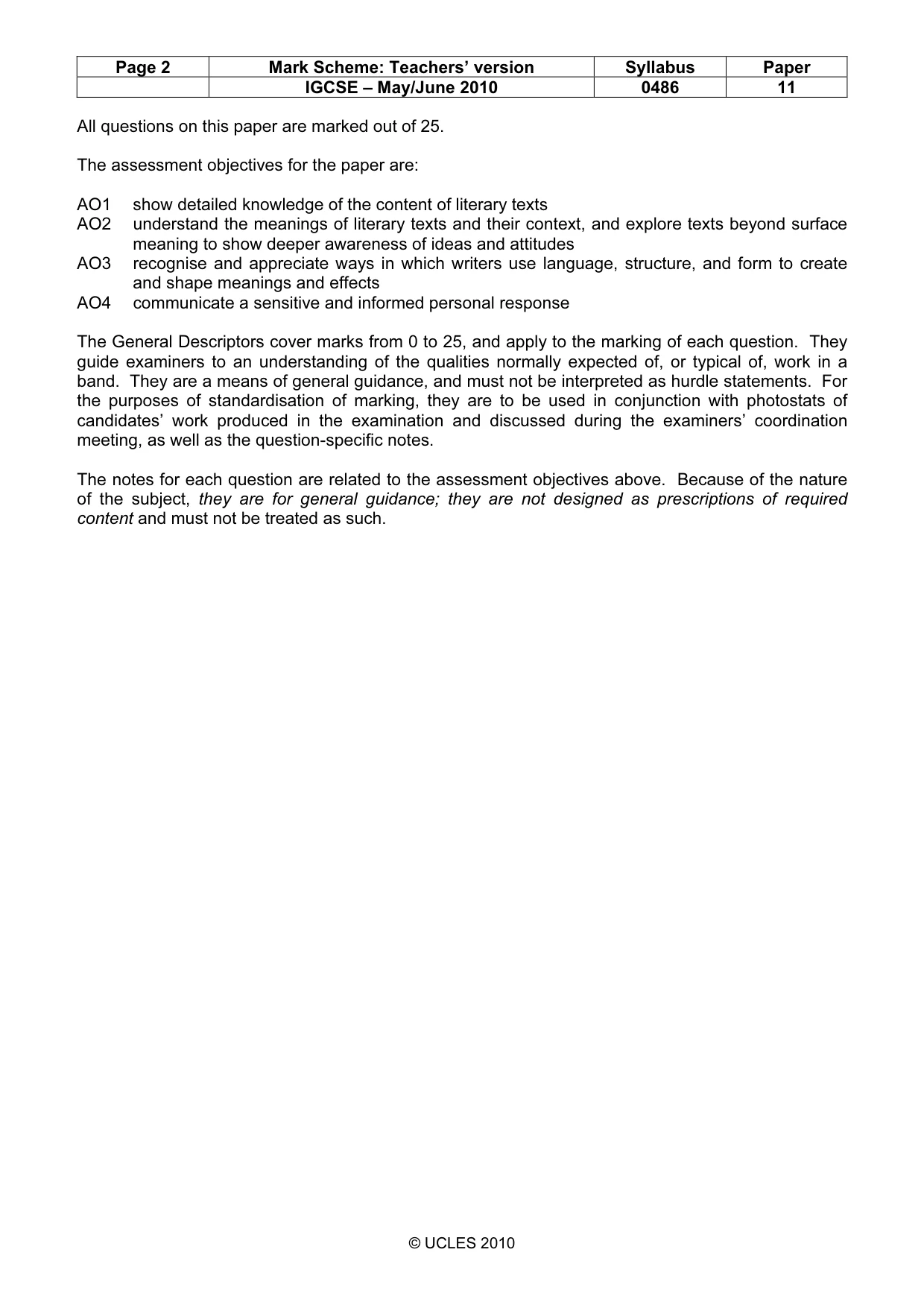
Page 2 Mark Scheme: Teachers’ version Syllabus Paper IGCSE – May/June 2010 0486 11 © UCLES 2010 All questions on this paper are marked out of 25. The assessment objectives for the paper are: AO1 show detailed knowledge of the content of literary texts AO2 understand the meanings of literary texts and their context, and explore texts beyond surface meaning to show deeper awareness of ideas and attitudes AO3 recognise and appreciate ways in which writers use language, structure, and form to create and shape meanings and effects AO4 communicate a sensitive and informed personal response The General Descriptors cover marks from 0 to 25, and apply to the marking of each question. They guide examiners to an understanding of the qualities normally expected of, or typical of, work in a band. They are a means of general guidance, and must not be interpreted as hurdle statements. For the purposes of standardisation of marking, they are to be used in conjunction with photostats of candidates’ work produced in the examination and discussed during the examiners’ coordination meeting, as well as the question-specific notes. The notes for each question are related to the assessment objectives above. Because of the nature of the subject, they are for general guidance; they are not designed as prescriptions of required content and must not be treated as such.
Mark scheme, page 3
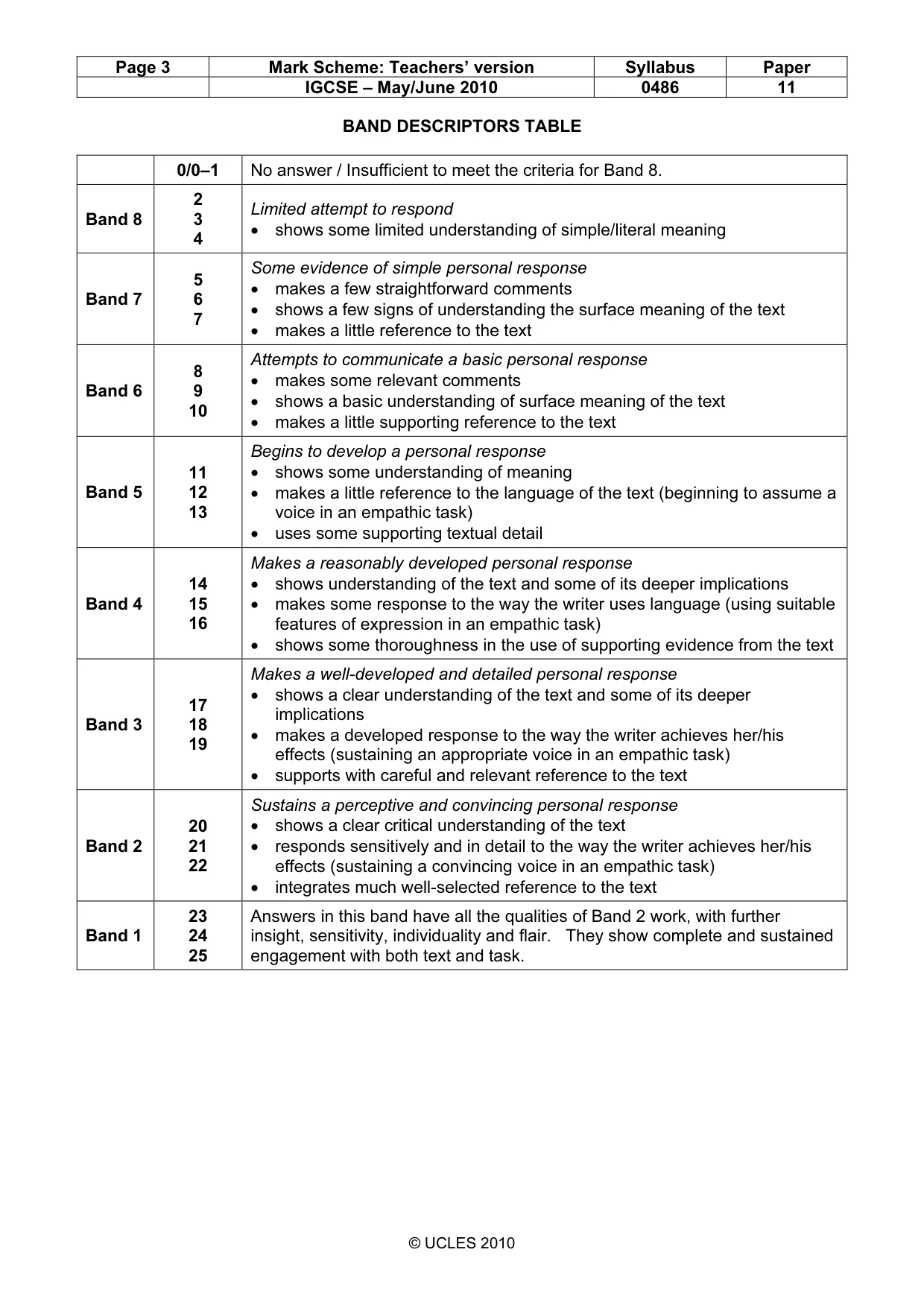
Page 3 Mark Scheme: Teachers’ version Syllabus Paper IGCSE – May/June 2010 0486 11 © UCLES 2010 BAND DESCRIPTORS TABLE 0/0–1 No answer / Insufficient to meet the criteria for Band 8. Band 8 2 3 4 Limited attempt to respond • shows some limited understanding of simple/literal meaning Band 7 5 6 7 Some evidence of simple personal response • makes a few straightforward comments • shows a few signs of understanding the surface meaning of the text • makes a little reference to the text Band 6 8 9 10 Attempts to communicate a basic personal response • makes some relevant comments • shows a basic understanding of surface meaning of the text • makes a little supporting reference to the text Band 5 11 12 13 Begins to develop a personal response • shows some understanding of meaning • makes a little reference to the language of the text (beginning to assume a voice in an empathic task) • uses some supporting textual detail Band 4 14 15 16 Makes a reasonably developed personal response • shows understanding of the text and some of its deeper implications • makes some response to the way the writer uses language (using suitable features of expression in an empathic task) • shows some thoroughness in the use of supporting evidence from the text Band 3 17 18 19 Makes a well-developed and detailed personal response • shows a clear understanding of the text and some of its deeper implications • makes a developed response to the way the writer achieves her/his effects (sustaining an appropriate voice in an empathic task) • supports with careful and relevant reference to the text Band 2 20 21 22 Sustains a perceptive and convincing personal response • shows a clear critical understanding of the text • responds sensitively and in detail to the way the writer achieves her/his effects (sustaining a convincing voice in an empathic task) • integrates much well-selected reference to the text Band 1 23 24 25 Answers in this band have all the qualities of Band 2 work, with further insight, sensitivity, individuality and flair. They show complete and sustained engagement with both text and task.
Mark scheme, page 4
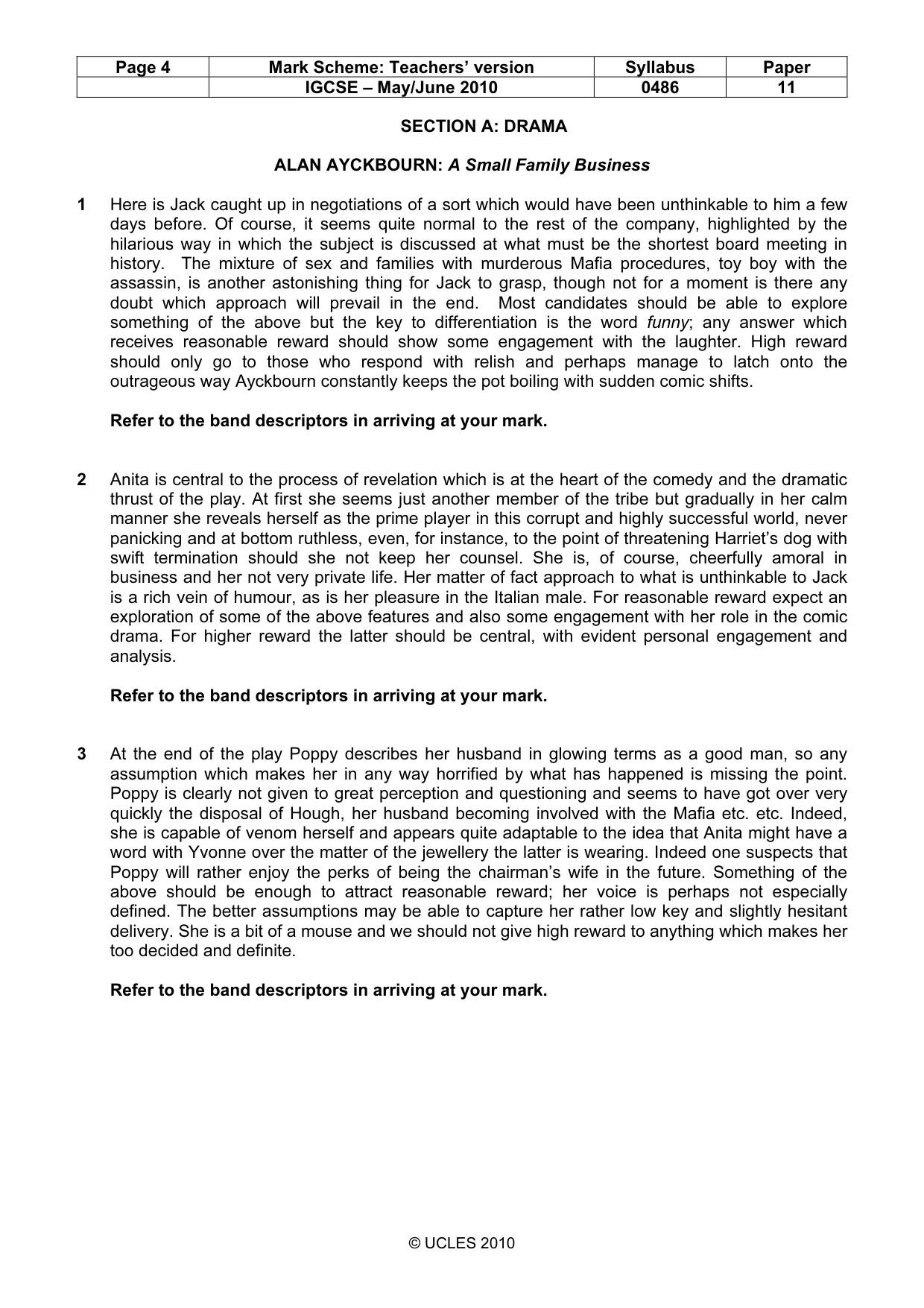
Page 4 Mark Scheme: Teachers’ version Syllabus Paper IGCSE – May/June 2010 0486 11 © UCLES 2010 SECTION A: DRAMA ALAN AYCKBOURN: A Small Family Business 1 Here is Jack caught up in negotiations of a sort which would have been unthinkable to him a few days before. Of course, it seems quite normal to the rest of the company, highlighted by the hilarious way in which the subject is discussed at what must be the shortest board meeting in history. The mixture of sex and families with murderous Mafia procedures, toy boy with the assassin, is another astonishing thing for Jack to grasp, though not for a moment is there any doubt which approach will prevail in the end. Most candidates should be able to explore something of the above but the key to differentiation is the word funny; any answer which receives reasonable reward should show some engagement with the laughter. High reward should only go to those who respond with relish and perhaps manage to latch onto the outrageous way Ayckbourn constantly keeps the pot boiling with sudden comic shifts. Refer to the band descriptors in arriving at your mark. 2 Anita is central to the process of revelation which is at the heart of the comedy and the dramatic thrust of the play. At first she seems just another member of the tribe but gradually in her calm manner she reveals herself as the prime player in this corrupt and highly successful world, never panicking and at bottom ruthless, even, for instance, to the point of threatening Harriet’s dog with swift termination should she not keep her counsel. She is, of course, cheerfully amoral in business and her not very private life. Her matter of fact approach to what is unthinkable to Jack is a rich vein of humour, as is her pleasure in the Italian male. For reasonable reward expect an exploration of some of the above features and also some engagement with her role in the comic drama. For higher reward the latter should be central, with evident personal engagement and analysis. Refer to the band descriptors in arriving at your mark. 3 At the end of the play Poppy describes her husband in glowing terms as a good man, so any assumption which makes her in any way horrified by what has happened is missing the point. Poppy is clearly not given to great perception and questioning and seems to have got over very quickly the disposal of Hough, her husband becoming involved with the Mafia etc. etc. Indeed, she is capable of venom herself and appears quite adaptable to the idea that Anita might have a word with Yvonne over the matter of the jewellery the latter is wearing. Indeed one suspects that Poppy will rather enjoy the perks of being the chairman’s wife in the future. Something of the above should be enough to attract reasonable reward; her voice is perhaps not especially defined. The better assumptions may be able to capture her rather low key and slightly hesitant delivery. She is a bit of a mouse and we should not give high reward to anything which makes her too decided and definite. Refer to the band descriptors in arriving at your mark.
Mark scheme, page 5
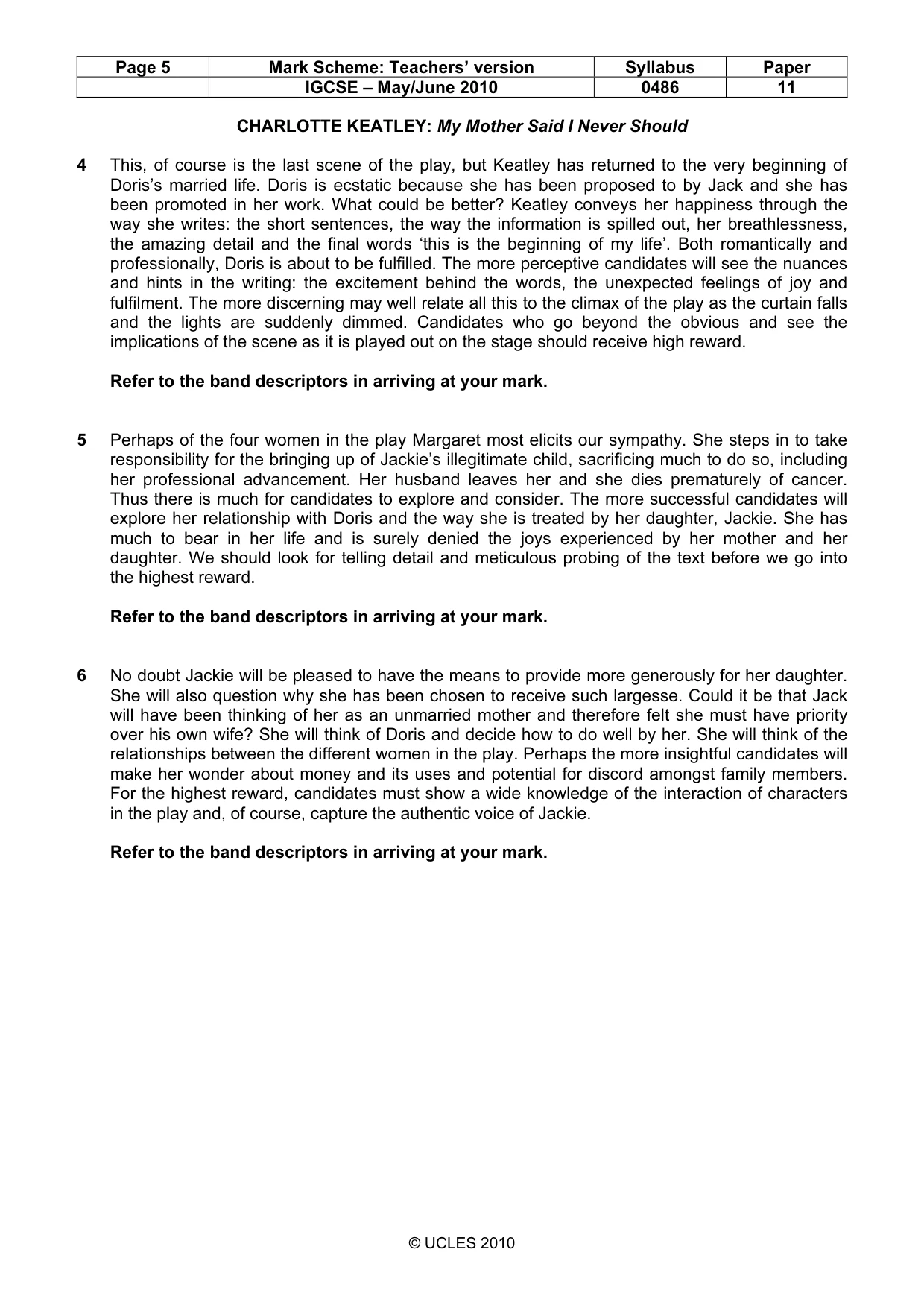
Page 5 Mark Scheme: Teachers’ version Syllabus Paper IGCSE – May/June 2010 0486 11 © UCLES 2010 CHARLOTTE KEATLEY: My Mother Said I Never Should 4 This, of course is the last scene of the play, but Keatley has returned to the very beginning of Doris’s married life. Doris is ecstatic because she has been proposed to by Jack and she has been promoted in her work. What could be better? Keatley conveys her happiness through the way she writes: the short sentences, the way the information is spilled out, her breathlessness, the amazing detail and the final words ‘this is the beginning of my life’. Both romantically and professionally, Doris is about to be fulfilled. The more perceptive candidates will see the nuances and hints in the writing: the excitement behind the words, the unexpected feelings of joy and fulfilment. The more discerning may well relate all this to the climax of the play as the curtain falls and the lights are suddenly dimmed. Candidates who go beyond the obvious and see the implications of the scene as it is played out on the stage should receive high reward. Refer to the band descriptors in arriving at your mark. 5 Perhaps of the four women in the play Margaret most elicits our sympathy. She steps in to take responsibility for the bringing up of Jackie’s illegitimate child, sacrificing much to do so, including her professional advancement. Her husband leaves her and she dies prematurely of cancer. Thus there is much for candidates to explore and consider. The more successful candidates will explore her relationship with Doris and the way she is treated by her daughter, Jackie. She has much to bear in her life and is surely denied the joys experienced by her mother and her daughter. We should look for telling detail and meticulous probing of the text before we go into the highest reward. Refer to the band descriptors in arriving at your mark. 6 No doubt Jackie will be pleased to have the means to provide more generously for her daughter. She will also question why she has been chosen to receive such largesse. Could it be that Jack will have been thinking of her as an unmarried mother and therefore felt she must have priority over his own wife? She will think of Doris and decide how to do well by her. She will think of the relationships between the different women in the play. Perhaps the more insightful candidates will make her wonder about money and its uses and potential for discord amongst family members. For the highest reward, candidates must show a wide knowledge of the interaction of characters in the play and, of course, capture the authentic voice of Jackie. Refer to the band descriptors in arriving at your mark.
Mark scheme, page 6
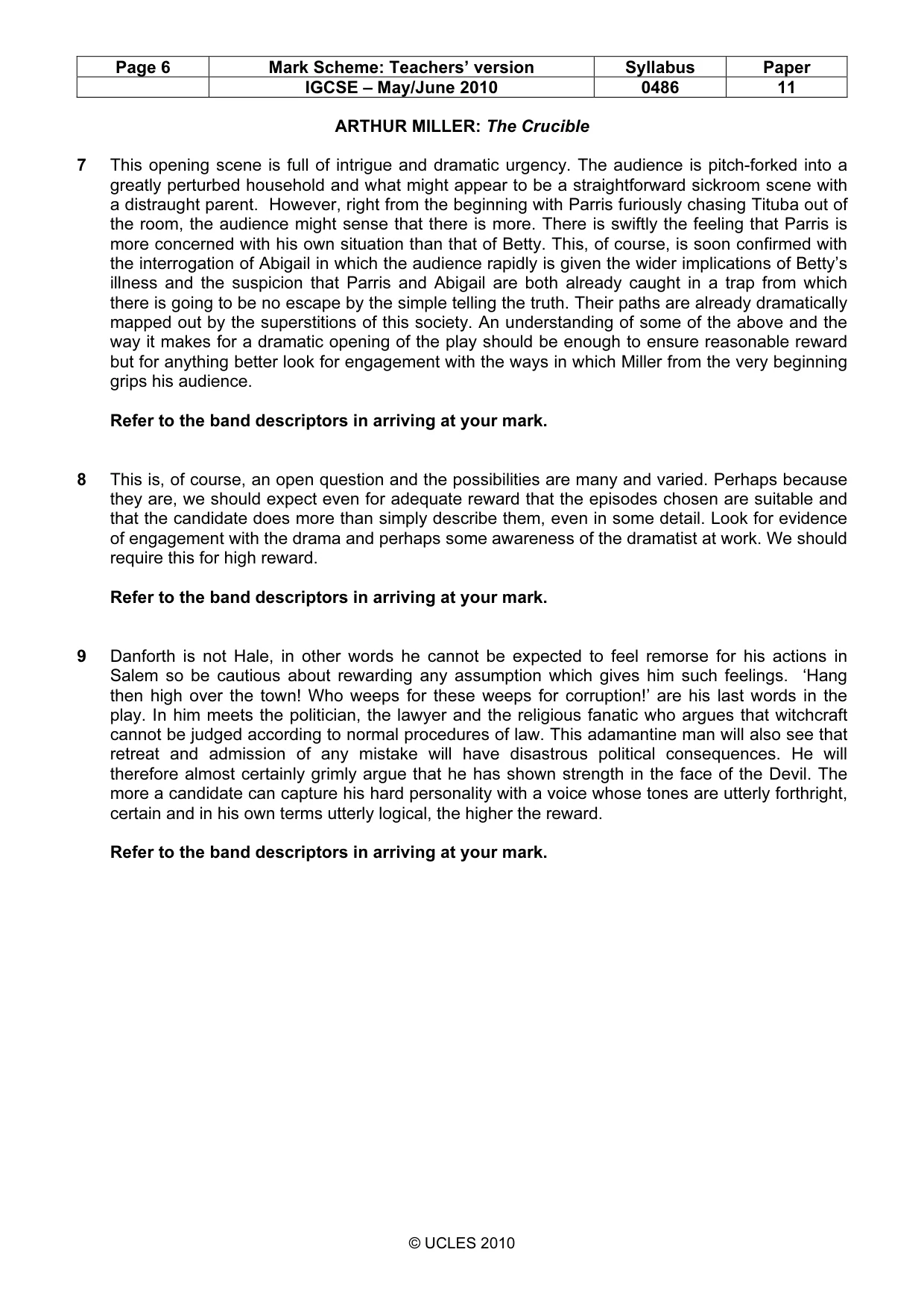
Page 6 Mark Scheme: Teachers’ version Syllabus Paper IGCSE – May/June 2010 0486 11 © UCLES 2010 ARTHUR MILLER: The Crucible 7 This opening scene is full of intrigue and dramatic urgency. The audience is pitch-forked into a greatly perturbed household and what might appear to be a straightforward sickroom scene with a distraught parent. However, right from the beginning with Parris furiously chasing Tituba out of the room, the audience might sense that there is more. There is swiftly the feeling that Parris is more concerned with his own situation than that of Betty. This, of course, is soon confirmed with the interrogation of Abigail in which the audience rapidly is given the wider implications of Betty’s illness and the suspicion that Parris and Abigail are both already caught in a trap from which there is going to be no escape by the simple telling the truth. Their paths are already dramatically mapped out by the superstitions of this society. An understanding of some of the above and the way it makes for a dramatic opening of the play should be enough to ensure reasonable reward but for anything better look for engagement with the ways in which Miller from the very beginning grips his audience. Refer to the band descriptors in arriving at your mark. 8 This is, of course, an open question and the possibilities are many and varied. Perhaps because they are, we should expect even for adequate reward that the episodes chosen are suitable and that the candidate does more than simply describe them, even in some detail. Look for evidence of engagement with the drama and perhaps some awareness of the dramatist at work. We should require this for high reward. Refer to the band descriptors in arriving at your mark. 9 Danforth is not Hale, in other words he cannot be expected to feel remorse for his actions in Salem so be cautious about rewarding any assumption which gives him such feelings. ‘Hang then high over the town! Who weeps for these weeps for corruption!’ are his last words in the play. In him meets the politician, the lawyer and the religious fanatic who argues that witchcraft cannot be judged according to normal procedures of law. This adamantine man will also see that retreat and admission of any mistake will have disastrous political consequences. He will therefore almost certainly grimly argue that he has shown strength in the face of the Devil. The more a candidate can capture his hard personality with a voice whose tones are utterly forthright, certain and in his own terms utterly logical, the higher the reward. Refer to the band descriptors in arriving at your mark.
Mark scheme, page 7
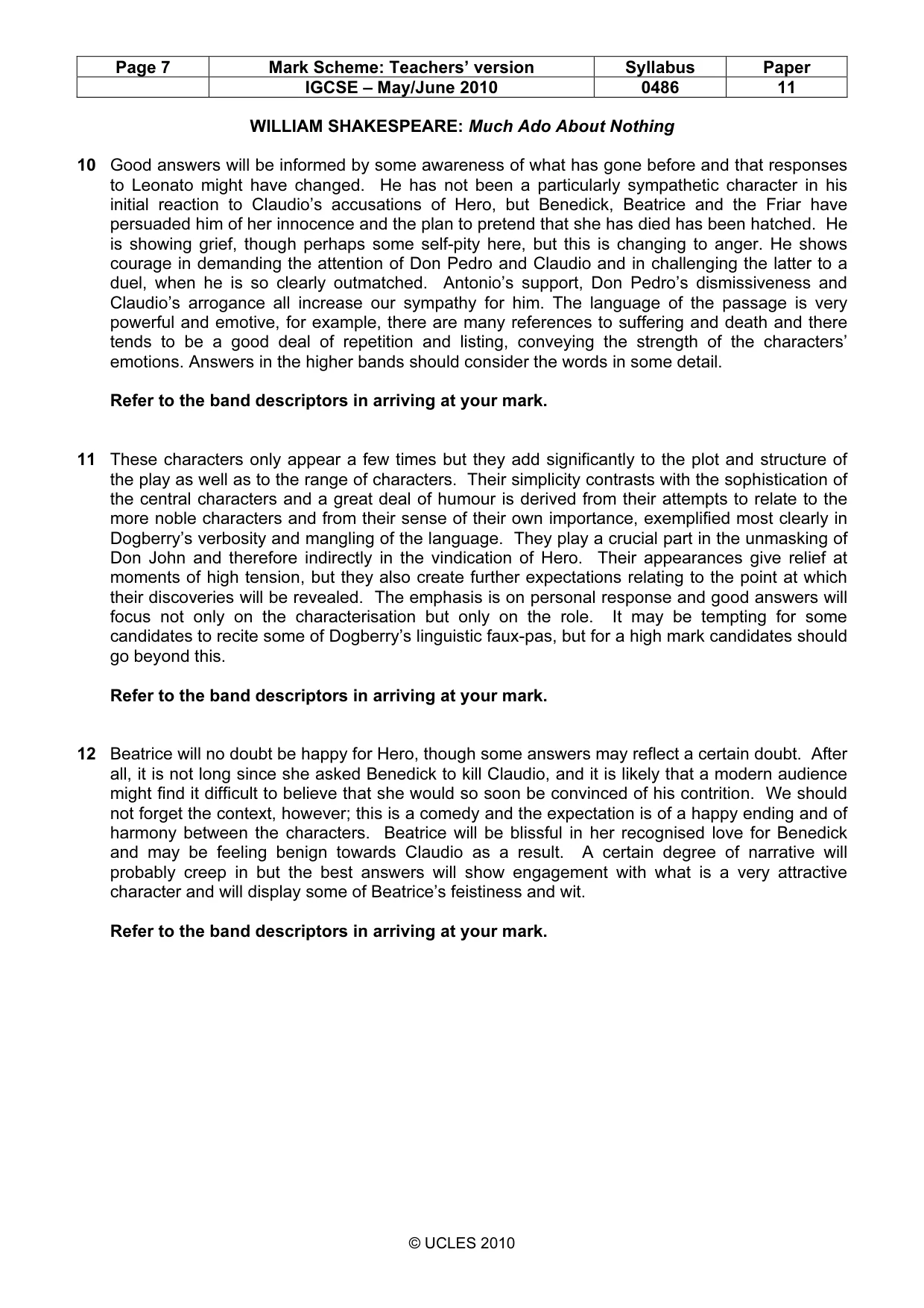
Page 7 Mark Scheme: Teachers’ version Syllabus Paper IGCSE – May/June 2010 0486 11 © UCLES 2010 WILLIAM SHAKESPEARE: Much Ado About Nothing 10 Good answers will be informed by some awareness of what has gone before and that responses to Leonato might have changed. He has not been a particularly sympathetic character in his initial reaction to Claudio’s accusations of Hero, but Benedick, Beatrice and the Friar have persuaded him of her innocence and the plan to pretend that she has died has been hatched. He is showing grief, though perhaps some self-pity here, but this is changing to anger. He shows courage in demanding the attention of Don Pedro and Claudio and in challenging the latter to a duel, when he is so clearly outmatched. Antonio’s support, Don Pedro’s dismissiveness and Claudio’s arrogance all increase our sympathy for him. The language of the passage is very powerful and emotive, for example, there are many references to suffering and death and there tends to be a good deal of repetition and listing, conveying the strength of the characters’ emotions. Answers in the higher bands should consider the words in some detail. Refer to the band descriptors in arriving at your mark. 11 These characters only appear a few times but they add significantly to the plot and structure of the play as well as to the range of characters. Their simplicity contrasts with the sophistication of the central characters and a great deal of humour is derived from their attempts to relate to the more noble characters and from their sense of their own importance, exemplified most clearly in Dogberry’s verbosity and mangling of the language. They play a crucial part in the unmasking of Don John and therefore indirectly in the vindication of Hero. Their appearances give relief at moments of high tension, but they also create further expectations relating to the point at which their discoveries will be revealed. The emphasis is on personal response and good answers will focus not only on the characterisation but only on the role. It may be tempting for some candidates to recite some of Dogberry’s linguistic faux-pas, but for a high mark candidates should go beyond this. Refer to the band descriptors in arriving at your mark. 12 Beatrice will no doubt be happy for Hero, though some answers may reflect a certain doubt. After all, it is not long since she asked Benedick to kill Claudio, and it is likely that a modern audience might find it difficult to believe that she would so soon be convinced of his contrition. We should not forget the context, however; this is a comedy and the expectation is of a happy ending and of harmony between the characters. Beatrice will be blissful in her recognised love for Benedick and may be feeling benign towards Claudio as a result. A certain degree of narrative will probably creep in but the best answers will show engagement with what is a very attractive character and will display some of Beatrice’s feistiness and wit. Refer to the band descriptors in arriving at your mark.
Mark scheme, page 8
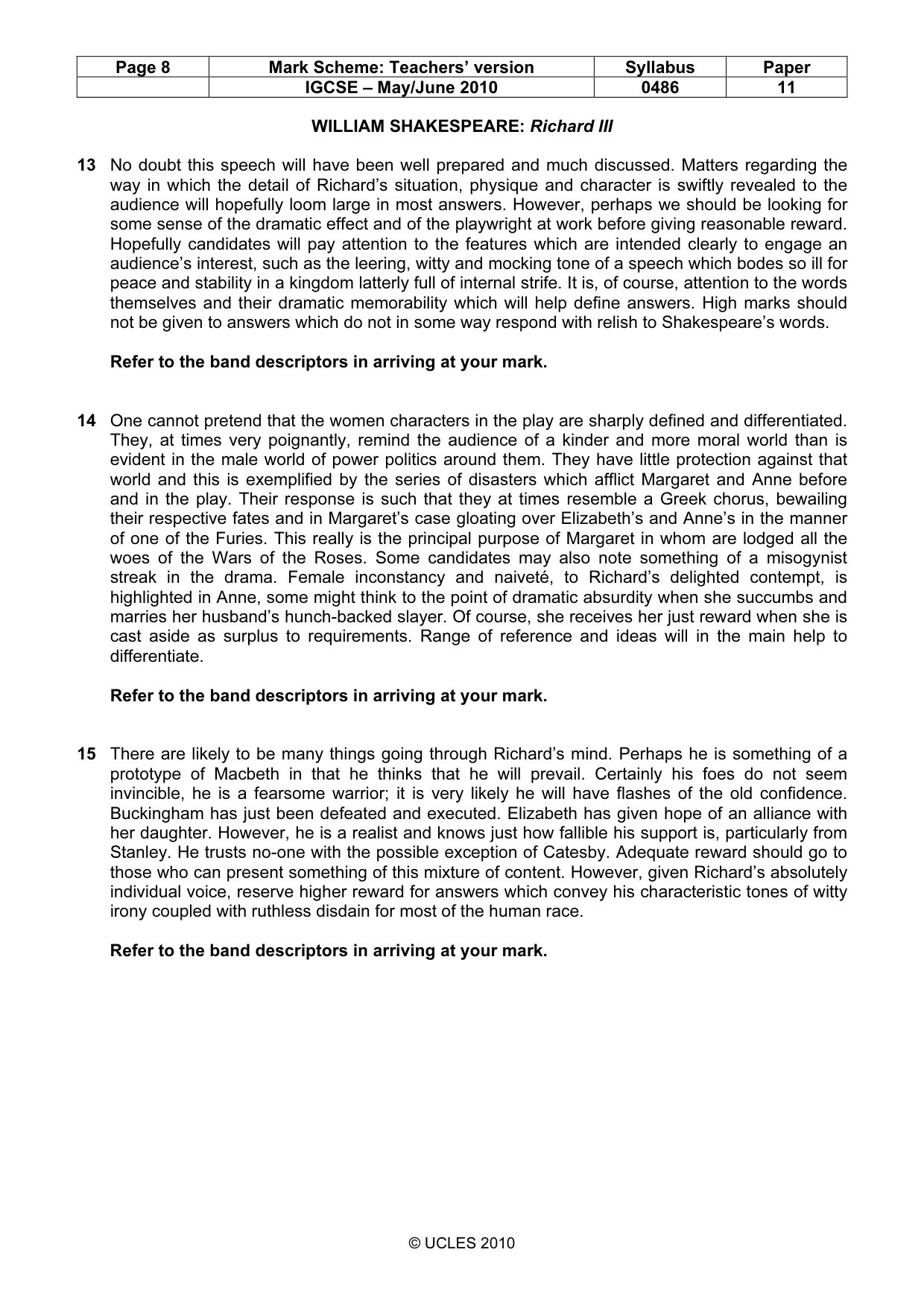
Page 8 Mark Scheme: Teachers’ version Syllabus Paper IGCSE – May/June 2010 0486 11 © UCLES 2010 WILLIAM SHAKESPEARE: Richard III 13 No doubt this speech will have been well prepared and much discussed. Matters regarding the way in which the detail of Richard’s situation, physique and character is swiftly revealed to the audience will hopefully loom large in most answers. However, perhaps we should be looking for some sense of the dramatic effect and of the playwright at work before giving reasonable reward. Hopefully candidates will pay attention to the features which are intended clearly to engage an audience’s interest, such as the leering, witty and mocking tone of a speech which bodes so ill for peace and stability in a kingdom latterly full of internal strife. It is, of course, attention to the words themselves and their dramatic memorability which will help define answers. High marks should not be given to answers which do not in some way respond with relish to Shakespeare’s words. Refer to the band descriptors in arriving at your mark. 14 One cannot pretend that the women characters in the play are sharply defined and differentiated. They, at times very poignantly, remind the audience of a kinder and more moral world than is evident in the male world of power politics around them. They have little protection against that world and this is exemplified by the series of disasters which afflict Margaret and Anne before and in the play. Their response is such that they at times resemble a Greek chorus, bewailing their respective fates and in Margaret’s case gloating over Elizabeth’s and Anne’s in the manner of one of the Furies. This really is the principal purpose of Margaret in whom are lodged all the woes of the Wars of the Roses. Some candidates may also note something of a misogynist streak in the drama. Female inconstancy and naiveté, to Richard’s delighted contempt, is highlighted in Anne, some might think to the point of dramatic absurdity when she succumbs and marries her husband’s hunch-backed slayer. Of course, she receives her just reward when she is cast aside as surplus to requirements. Range of reference and ideas will in the main help to differentiate. Refer to the band descriptors in arriving at your mark. 15 There are likely to be many things going through Richard’s mind. Perhaps he is something of a prototype of Macbeth in that he thinks that he will prevail. Certainly his foes do not seem invincible, he is a fearsome warrior; it is very likely he will have flashes of the old confidence. Buckingham has just been defeated and executed. Elizabeth has given hope of an alliance with her daughter. However, he is a realist and knows just how fallible his support is, particularly from Stanley. He trusts no-one with the possible exception of Catesby. Adequate reward should go to those who can present something of this mixture of content. However, given Richard’s absolutely individual voice, reserve higher reward for answers which convey his characteristic tones of witty irony coupled with ruthless disdain for most of the human race. Refer to the band descriptors in arriving at your mark.
Mark scheme, page 9
Page 9 Mark Scheme: Teachers’ version Syllabus Paper IGCSE – May/June 2010 0486 11 © UCLES 2010 R. C. SHERRIFF: Journey’s End 16 On the surface this is a pleasant conversation between the new boy and a welcoming veteran. However, as the conversation develops, so does the tension below the surface. As Raleigh describes how he got to the Company, his embarrassment becomes quite evident and it also becomes apparent that Osborne’s unease is mounting. His comment on the coincidence of Raleigh’s posting is as near as he ever gets in the play to possible sarcasm. However, clearly much more concerning to him is the emerging hero worship which has impelled the young man to pull strings so outrageously. In addition he is presented with knowledge of Stanhope’s life back home. He struggles to prepare Raleigh for the shock of seeing Stanhope and what he surmises is likely to be the latter’s reaction to having his fiancé’s brother foisted on him. He handles this with characteristic tact but the concern is evident, most obviously in the way the pauses in mid sentence suggest an attempt to let the young man down lightly. Reasonable reward should go to those who grasp the underlying reasons for the tension and manage some detailed support for their ideas. Higher reward will go to those who show how Sherriff shapes the dialogue to mirror thoughts below the surface. Refer to the band descriptors in arriving at your mark. 17 There is much material here which the candidate could use and we must not be prescriptive. Many probably will call to mind a number of stratagems which the characters use to make life at the front at least bearable, ranging, for instance, from Stanhope’s drinking to Trotter’s chart. Suffusing much of it is understated and wry humour. Give reasonable reward to an answer which isolates a number of instances and offers some detailed support. An answer that moves into the writing’s effect on the audience in which the candidate can show what makes the chosen examples memorable dramatically, should almost certainly be in the region of high reward. Refer to the band descriptors in arriving at your mark. 18 Hibbert is quite clearly a weak reed and has convinced himself that he is at the end of his tether. The question is the degree to which he is conscious of playing the neuralgia card to get himself out of the trenches. Probably he has convinced himself that he is unfit for battle and there are moments later in the play when he responds to encouragement as well as threats. However, it must be doubtful how much sympathy Sherriff intends the audience to have for this man and often it seems that we are expected to see him with Stanhope’ eyes, in other words with barely concealed contempt. In which case, probably we must accept an assumption which suggests that he is consciously faking his condition. Either way, differentiation should come from the degree to which candidates can capture the man’s melodramatic and whining tones. Refer to the band descriptors in arriving at your mark.
Mark scheme, page 10
Page 10 Mark Scheme: Teachers’ version Syllabus Paper IGCSE – May/June 2010 0486 11 © UCLES 2010 SECTION B: POETRY 19–24 Poetry is literary language at its most intense. A poem in a short space creates a multiplicity of resonances and hence possible meanings. We must expect that candidates will offer a very wide variety of responses and interpretations and as examiners must at all times keep a totally open mind when assessing work on a poem. In the exercise of our judgment, we shall, of course, read work which shows manifestly little or no understanding of a poem and we will mark that accordingly. However, it should also be a regular experience to find answers which offer valid perspectives new to the examiner and which, just as manifestly, deserve to be given high reward. We will differentiate first of all according to how directly the candidates answer the question. Where questions prescribe the poems from which the candidates should choose this is to ensure that the candidate is writing on a poem appropriate to the question. It is also designed to send a strong signal to candidates that they are taking a large risk going into the examination with only one or two poems which they are determined to fit to a question. The problem can be that some will choose a question because the poem they wish to write about appears in the list rather than because they can answer the question. We must be very careful not to give much reward for answers which manifestly are not addressing the question, even if they show a convincing grasp of the poem. Do not over-reward such run throughs and do not forget that all the tasks demand that the candidate engage with the poem through a specific route; they are never simple invitations to write about a poem. We should think very hard before putting such work in Band 3. Beyond focus on the question, we will also assess according to how well candidates convince us that they have engaged with the pleasure and excitement of good poetry. This means in effect that we do NOT give high reward to any explanation of "meaning" which shows little response to the words and how they create meaning. In all of the questions there is an explicit requirement to make a response to the words and it will be difficult for any work which fails to engage in this way to progress beyond Band 3. In addition, examiners should be careful not to over-reward comment which is able to isolate vivid features of a poem’s language but which is unable to probe the reasons for their vividness. For instance, the noting of rhyme, sound and movement, the listing of significant words and figures of speech is only a very small first step to insightful personal response. Work given high reward should show the ability of the candidate to analyse how such features of a poem’s language achieve their effect. Refer to the band descriptors in arriving at your mark.
Mark scheme, page 11
Page 11 Mark Scheme: Teachers’ version Syllabus Paper IGCSE – May/June 2010 0486 11 © UCLES 2010 SECTION C: PROSE JANE AUSTEN: Pride and Prejudice 25 It should not be too difficult for most candidates to be able to chart something of Elizabeth’s feelings in this passage. The key here is the word confusion. We should expect even for reasonable reward that the candidates show themselves aware of the conflict of responses. She is struck at times by how different this Darcy is to the one she rejected, though a good deal of the extract is about what she sees as her humiliation at having been found on his property. Her pride is still hard at work. Yet she is bewildered by his manner, quite unlike anything she has encountered in him before. For high reward we shall look for the ability to see in detail how this confusion is conveyed, for instance in the way the writing rises to a crescendo of exclamations as Elizabeth’s suppressed and, she believes, hopeless feelings for him rise to an agonised climax of bewilderment. Refer to the band descriptors in arriving at your mark. 26 There is no easy answer to this so be prepared to accept a wide range of possibilities. Clearly at the centre of the novel is the union of Elizabeth and Darcy and from that it is easy to argue that loves conquers all. Jane Austen seems equally approving of Jane’s steady and loyal love for Bingley. However, it is to be noted that both pairs have ample funds and she never condones the romantic notion that love conquers all and removes the need to consider day to day living. The starry-eyed Lydia is portrayed as a silly wilful girl who pays the price for her unthinking and lustful actions. Conversely we do not seem to be encouraged to dismiss Charlotte’s choice of a comfortable existence over feeling. At least Mrs. Bennet is not wrong about one thing; in this society it is highly desirable for a girl to marry. However, comfortable is all that Charlotte’s life is and she pays a heavy price in human terms. Compare her dreary daily existence with the vivacity of Elizabeth’s life with her new husband at the end of the novel. She cannot respect her husband and on another plane her opportunism is contrasted with Elizabeth’s clear grasp of the moral principles which she demands in a husband. Hopefully there should be many who can make some basic sensible comments and it should not be difficult to discern those who range widely enough to see that ultimately the novelist declines to offer simple answers. Refer to the band descriptors in arriving at your mark. 27 Charlotte must live with the consequences of her actions and there is much evidence that she is aware of that. She does not invite Elizabeth to visit to boast about her married status. She is too aware and sensible a person to know that Elizabeth is hardly likely to envy her much. There seems to be a real desire to ensure that their friendship does not end voiced at the marriage itself. Perhaps she also does want to show that she can make a life for herself which does not involve too much crossing of paths with her husband. She will just have to put up with being condescended to by the de Bourghs. She will probably wonder though in what frame of mind Elizabeth will be coming and be suitably nervous. She cannot fail to be concerned about how her husband is likely to behave. Assumptions which cover some of these areas should receive reasonable reward and perhaps higher. The voice may be difficult to capture since Charlotte is an undemonstrative character. Her voice is restrained; she is not given to drama. Those who catch that should be highly rewarded. Refer to the band descriptors in arriving at your mark.
Mark scheme, page 12
Page 12 Mark Scheme: Teachers’ version Syllabus Paper IGCSE – May/June 2010 0486 11 © UCLES 2010 IAN CROSS: The God Boy 28 There are many things to which the candidate might respond in this extract and we should not be prescriptive. This is a poignant moment, in some ways quite rare in the novel in that here the generations speak openly to one another, sharing experiences of alienation and travail. Both have been let down by those that are/were near to them and Cross makes you feel the bond between them. To no other adult does Jimmy relate so deeply. In some ways the very fact that Jimmy feels able to talk about his problems is a temporary relief. Some detailed investigation of ideas like this should be enough for reasonable reward. However, perhaps it could be said that paradoxically Jimmy’s isolation is underlined by the advice offered. It hasn’t enabled Jack to live a happy and fulfilled life. He lives his life as a recluse avoiding most human contact. Neither can it work for Jimmy. A child cannot cut himself off from his parents and their lives, much as Jimmy tries, and the comparison between the dead of Albertsville and his parents does not stand up, as Jimmy realises. The more there is a grasp of the subtleties and implications of the passage, the greater evidence there is of personal involvement with the writing, the higher the mark. Remember to refer to the photostats and band descriptors to arrive at your mark. Refer to the band descriptors in arriving at your mark. 29 One fairly obvious point will probably be widely advanced in response to this proposition. It is likely to be that the reader finds everything more vivid and immediate because the novel is told in the first person which puts the reader in the centre of Jimmy’s mind. However, it might turn out to be something of cul-de-sac for candidates, not least because there is no reason to believe that the novelist’s voice might not have delivered something equally memorable. Answers might simply become a list of ‘compelling’ moments in the novel, though Examiners should, of course, reward these examples if they are apt. A better argument is that Jimmy’s lack of understanding is often the reader’s as well and it is this that gives narrative impetus to the novel as the reader struggles to find the truth. Conversely, where adult characters and events establish truth, the effect is often striking. Sometimes the contrast between adult and child perception is very amusing, sometimes it is intensely moving and shocking. Whatever the nature of the argument, even for reasonable reward expect some attempt to describe the compelling nature of the results. This should be central to any answer considered for higher reward. Remember to refer to the photostats and band descriptors to arrive at your mark. Refer to the band descriptors in arriving at your mark. 30 Father Gilligan is one example in the novel of the self-important, ineffectual, largely well meaning and amiable Roman Catholic clergy. He has not detected that there is anything seriously wrong with Jimmy’s life and one wonders whether he would have done anything about had he. He will probably remember with laughter the sins that Jimmy has made up in order to grab his attention. His bland advice at the end of confession is of no use to a young boy like Jimmy and, whilst kindly meant, only indicates his inability to engage with the young and indeed understand family life, celibate that he is. Avoid giving much reward to assumptions which show him deeply concerned about Jimmy’s situation, though he might turn it over briefly in his mind. Such things as his good humoured relief at having got confessions over for another period show candidates to be nearer to the real man. Refer to the band descriptors in arriving at your mark.
Mark scheme, page 13
Page 13 Mark Scheme: Teachers’ version Syllabus Paper IGCSE – May/June 2010 0486 11 © UCLES 2010 ANITA DESAI: Games at Twilight 31 There is ample evidence of the husband’s waning patience. He hardly gets any response from his wife and when he does it is not what he wants to hear. He clearly has come to detest the noise, poverty and dirt of India. The ability to pick out a number of instances in the extract is the first requirement but the main element in the differentiation will be centred on the engagement with the writing. The task explicitly asks how Desai vividly conveys the husband’s frustration and we shall expect even for reasonable reward some detailed comment about the words. For high reward this should be central. Refer to the band descriptors in arriving at your mark. 32 Mr. Bose, a man of deep sensibility, lives in a state of perpetual irritation as he attempts to make a very basic living as a tutor, constantly faced by the lazy, the dim, the socially superior and the sexually alluring. Mr. Basu is a memorable picture of the terrors of an asthmatic whose illness has led him into making constant demands on those around him. As usual the key word in the task is memorable. Hopefully most candidates will be able to chart some of the relevant detail of their chosen story but even for reasonable reward candidates should offer more than description. We should be able to discern some understanding of how the writer’s words bring to life the frustrations of these lives, frustrations which breed such anger. The more that is central to the answer, the higher the reward. Refer to the band descriptors in arriving at your mark. 33 Bina has been a woman utterly taken up with ministering to her family and particularly to her infirm son. She has had few if any social contacts and, she thought, even fewer friends. Yet the party has revealed to her for the first time, and to her great surprise, that her apparently solitary and austere personality had actually accorded her considerable respect within the community. She has discovered warmth around her and not just because it is a farewell party. This is exemplified by the doctors who take over at the end and who reveal their attitudes towards her as being much more than the cool professionalism she had imagined. Something of these thoughts will be enough to ensure reasonable reward. For higher marks, hopefully the candidates will be able to convey in the voice her great pleasure and enjoyment at how well the party has gone, perhaps with a degree of sadness that she has discovered her standing in this society too late to take advantage. Still her self-confidence will no doubt have been given a boost. Refer to the band descriptors in arriving at your mark.
Mark scheme, page 14
Page 14 Mark Scheme: Teachers’ version Syllabus Paper IGCSE – May/June 2010 0486 11 © UCLES 2010 THOMAS HARDY: Far from the Madding Crowd 34 Throughout the extract it is clear that as far as Troy is concerned the gilt has worn off his feelings for Bathsheba. Hardy conveys this with such comments as: ‘Had the woman not been his wife, Troy would have succumbed instantly’; ‘He did not love her enough to allow himself to be carried too far by her ways’; ‘All romances end in marriage’. Hardy presents Bathsheba as caring for him and loving him and wanting to be loved in return. She sees herself being used as merely a source of income for his hobbies and interests. She seeks to rekindle their love; he has decided it is already over. Almost every line in the extract shows the differences in their feelings for one another. The language Hardy uses suggests these differences. Thus, candidates who probe the words and recognise and comment on their underlying inferences should score well and the level of their reward will depend on the depth of their insight. The key is the ability to get into Hardy’s mind through his writing. Refer to the band descriptors in arriving at your mark. 35 More prescient candidates will recognise that fate treats Boldwood badly: the arrival of Troy – his disappearance and his unexpected return, Bathsheba’s foolishness in sending the Valentine. But Boldwood is impetuous and acts without thinking; he fails to control his feelings and doesn’t seek advice. He is stubborn. Thus to a degree, his misfortunes are self-inflicted. We should look for evidence that candidates have sifted the relevant incidents in the novel and reached supported conclusions with detail from the text before rewarding highly. Refer to the band descriptors in arriving at your mark. 36 Gabriel has had considerable experience of personal relationships since the beginning of the novel and his first encounter with Bathsheba. Candidates will be expected to bear this in mind as they take on the role. He will not be starry-eyed or a clichéd romantic hero. He will surely reflect maturely on his past dealings with Bathsheba and perhaps comment on the vicissitudes of life they have both endured. This will be a mature, measured and reflective Gabriel who will feel the joy of happiness finally attained. He may well consider their working together in the estate and using their knowledge and interests to create a fulfilling life with each other. Authenticity of voice will be crucial in deciding the level of reward to be awarded. Textual echoes and familiarity with the detail from the novel will contribute significantly. Refer to the band descriptors in arriving at your mark.
Mark scheme, page 15
Page 15 Mark Scheme: Teachers’ version Syllabus Paper IGCSE – May/June 2010 0486 11 © UCLES 2010 BESSIE HEAD: When Rain Clouds Gather 37 Though there is no direct requirement to go outside the passage here, it will be difficult for candidates to score very highly unless they makes some reference to the impressions of Matenge that are built up in the earlier parts of the novel. In fact Bessie Head gives us a good summary here of his evilness and tyranny and of how this is representative of his type. In this extract the village has at last united to move against him and he is afraid for his life, though there is no specific indication that the villagers intend violence, in fact there is an atmosphere of exultation amongst them that they are finally going to face him and stand firm. It is impossible to feel pity for him in his panic and despair, in fact it is contemptible that he reacts as a ‘frightened lonely child’, who does not seem to understand what he has done or to take responsibility for it. Candidates may well go on to refer to his suicide, which follows very quickly and before anyone from the village has the chance to speak to him – perhaps the ultimate cowardly act. Good answers will refer very closely to the passage and will consider the way in which Head uses language to vividly convey Matenge’s state of mind, and to reflect on the reasons why he is as he is. Refer to the band descriptors in arriving at your mark. 38 The relationship between Makhaya and Paulina is fascinating because they are two very strong and independent characters. Makhaya is mysterious. We know nothing much about his past except that it has not apparently been good (‘the terrors of rape, murder and bloodshed in a city slum’); he has a great deal of bitterness and resentment in him though he is trying to put his life to a useful purpose. Paulina too has a good deal of ‘baggage’ (‘she had travelled a longer way too, on the road of life’) but she is ambitious and passionate. She makes a dramatic first impression when she comes to the village as she is nothing like the other women. She is immediately attracted to Makhaya but he is slow to respond and for a long time keeps his feelings to himself. The episode of her son finally brings them together and there is every indication that the relationship will be a rewarding one. Candidates will take their own line but should focus on the ups and downs of the relationship rather than on merely giving character sketches. Refer to the band descriptors in arriving at your mark. 39 There are certain characteristics of Gilbert that candidates should be conscious of in trying to create and authentic voice: he is ‘practical’, ‘down-to-earth’, his mind is like ‘one gigantic storage house of facts’ and ‘like a stop watch’ and he prides himself on being well-informed’. Maria has been cooking for him during the period that he has been giving Tswana and English lessons and a relationship has obviously developed since Makhaya is conscious of some hostility from Maria when he eats with them, presumably because she feels the intrusion. Gilbert seems rather oblivious to this though it is clear that he and Maria enjoy a lively and communicative relationship. He will have been conscious that Maria leaves him and Makhaya alone and obviously misses her on these occasions. On the evening that they have their discussion about the thornbush seeds he reveals that he is in love with Maria and asks Makhaya whether he is too. In the absence of an answer, he is spurred into action and goes to ask Dinorego for Maria’s hand, so he has obviously been afraid of losing her. He will be reflecting on what has happened and on Dinorego’s and Maria’s responses and also on the fact that the marriage is to be the next day. He may also be speculating on the future. Refer to the band descriptors in arriving at your mark.
Mark scheme, page 16
Page 16 Mark Scheme: Teachers’ version Syllabus Paper IGCSE – May/June 2010 0486 11 © UCLES 2010 EDITH WHARTON: Ethan Frome 40 There are a number of things which hopefully most candidates will bring to notice in this poignant extract. It is the first time that the reader is afforded a view of Ethan’s ‘study’ and how unbearably indicative it is of the death of youthful aspirations. It is more so when set against the reality of his present thralldom to the dreadful Zeena. What it has reduced him to is shown by the pathetic importance which a simple scrap of paper takes on at this moment in his life. There is much else. For instance, he would sooner rest his head against the wall than against Zeena’s cushion. For reasonable reward one would expect candidates at least to register in some way the ways in which the writing communicates his turmoil. As usual the more attention to the detail of the writing, the higher the reward. Refer to the band descriptors in arriving at your mark. 41 There are, of course, two Starkfields separated by 25 years during which time modern amenities have reached the community. However, life there is always tough and there is the wry comment that it is essentially a place to escape from. Frome’s tragedy is not the only one in the town and most struggle to make a living, sometimes perhaps because there is hardly an excess of imagination in the inhabitants. The Eady’s, for instance, do well. The detail of the hardness of life is something which we should expect from any answer deserving of reasonable reward. The events of the novel are acted out almost entirely in the New England winter which serves as a suitably unforgiving background. However, it is also beautiful and life can have its good moments as well. Besides conducting an argument with wide-ranging detail, possibly the better candidates will show themselves by being alert to the few scenes where the joyous possibilities of life rise to the surface. Refer to the band descriptors in arriving at your mark. 42 There is much scope for sheer nastiness here. This is the moment that Zeena has been waiting for. She has been watching the growing attraction of her husband to the flighty young miss that she thinks Mattie to be and she’s determined to have no more of it. She has done her duty and no doubt in her usual whine she will congratulate herself on her godliness and use the fact that she has had a more serious diagnosis as a perfect excuse for throwing the girl out. She may even think a bit of vengeance against her husband to be her due. Reasonable reward should go to those who demonstrate some of the above but we should expect for more reward candidates to capture this woman’s hard and unlovely tones. Refer to the band descriptors in arriving at your mark.
Mark scheme, page 17
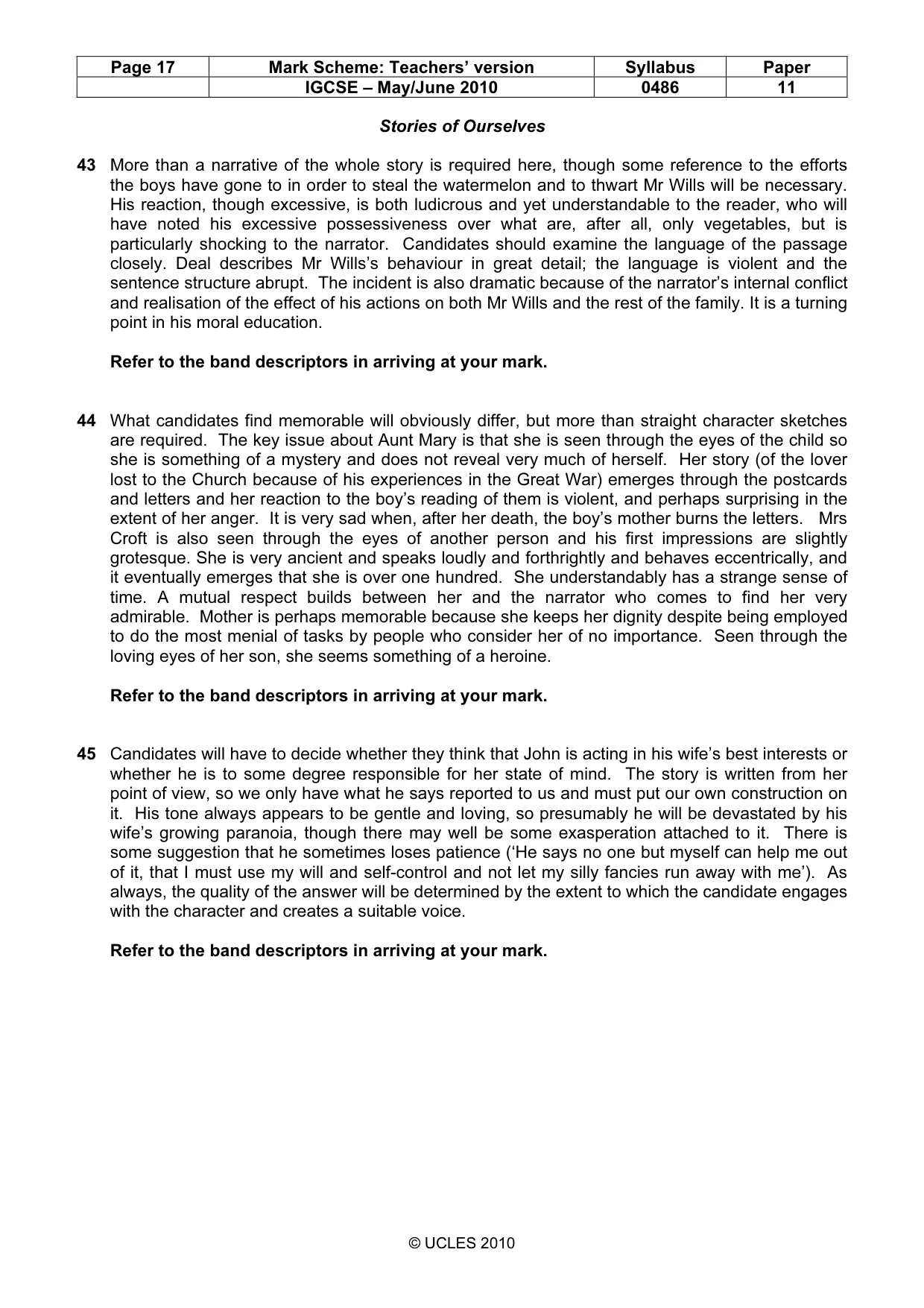
Page 17 Mark Scheme: Teachers’ version Syllabus Paper IGCSE – May/June 2010 0486 11 © UCLES 2010 Stories of Ourselves 43 More than a narrative of the whole story is required here, though some reference to the efforts the boys have gone to in order to steal the watermelon and to thwart Mr Wills will be necessary. His reaction, though excessive, is both ludicrous and yet understandable to the reader, who will have noted his excessive possessiveness over what are, after all, only vegetables, but is particularly shocking to the narrator. Candidates should examine the language of the passage closely. Deal describes Mr Wills’s behaviour in great detail; the language is violent and the sentence structure abrupt. The incident is also dramatic because of the narrator’s internal conflict and realisation of the effect of his actions on both Mr Wills and the rest of the family. It is a turning point in his moral education. Refer to the band descriptors in arriving at your mark. 44 What candidates find memorable will obviously differ, but more than straight character sketches are required. The key issue about Aunt Mary is that she is seen through the eyes of the child so she is something of a mystery and does not reveal very much of herself. Her story (of the lover lost to the Church because of his experiences in the Great War) emerges through the postcards and letters and her reaction to the boy’s reading of them is violent, and perhaps surprising in the extent of her anger. It is very sad when, after her death, the boy’s mother burns the letters. Mrs Croft is also seen through the eyes of another person and his first impressions are slightly grotesque. She is very ancient and speaks loudly and forthrightly and behaves eccentrically, and it eventually emerges that she is over one hundred. She understandably has a strange sense of time. A mutual respect builds between her and the narrator who comes to find her very admirable. Mother is perhaps memorable because she keeps her dignity despite being employed to do the most menial of tasks by people who consider her of no importance. Seen through the loving eyes of her son, she seems something of a heroine. Refer to the band descriptors in arriving at your mark. 45 Candidates will have to decide whether they think that John is acting in his wife’s best interests or whether he is to some degree responsible for her state of mind. The story is written from her point of view, so we only have what he says reported to us and must put our own construction on it. His tone always appears to be gentle and loving, so presumably he will be devastated by his wife’s growing paranoia, though there may well be some exasperation attached to it. There is some suggestion that he sometimes loses patience (‘He says no one but myself can help me out of it, that I must use my will and self-control and not let my silly fancies run away with me’). As always, the quality of the answer will be determined by the extent to which the candidate engages with the character and creates a suitable voice. Refer to the band descriptors in arriving at your mark.
What you needed in this session
Cambridge’s own grade thresholds for 2010 May/June, Paper 1 · Variant 1. A higher threshold means an easier paper — the bar moves with how the cohort did.