Cambridge IGCSE English - Literature 0486 — 2009 May/June Paper 1 · Variant 1
0486/11/M/J/09 · 60 marks · ≈68 min
The question paper and its mark scheme, free to read here and free to download. This is Cambridge’s own paper, exactly as it was sat.
Question paper8 pages
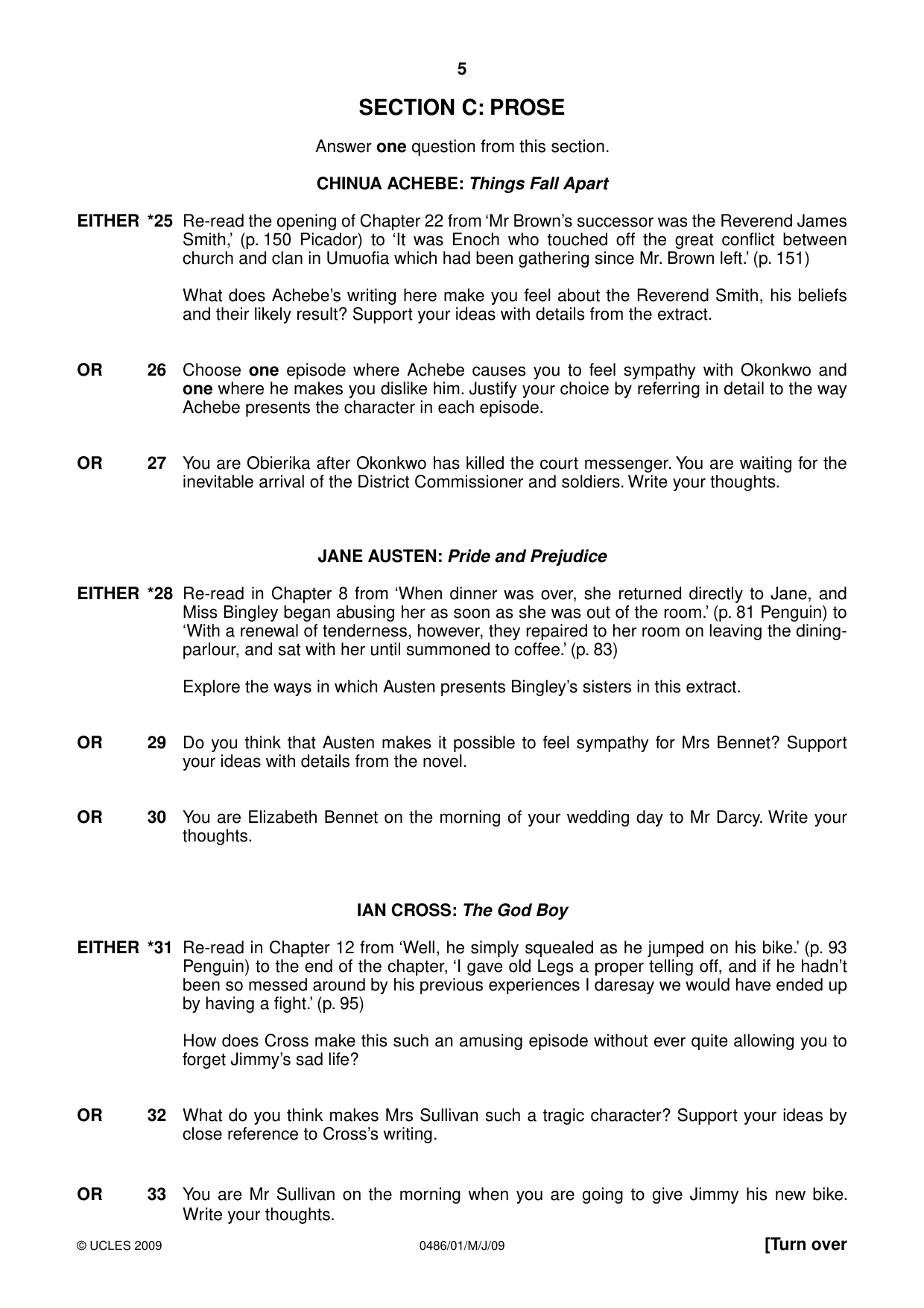
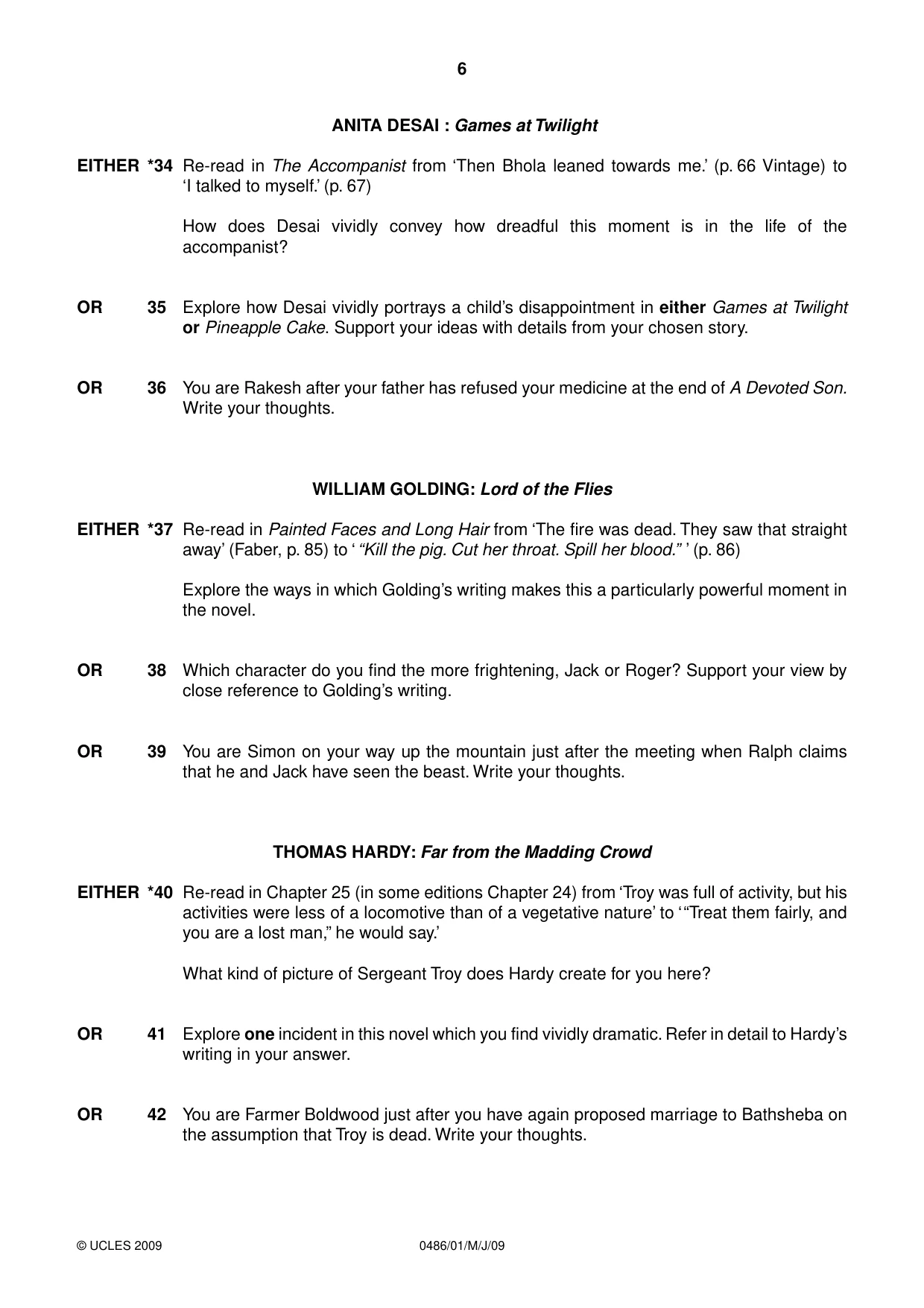
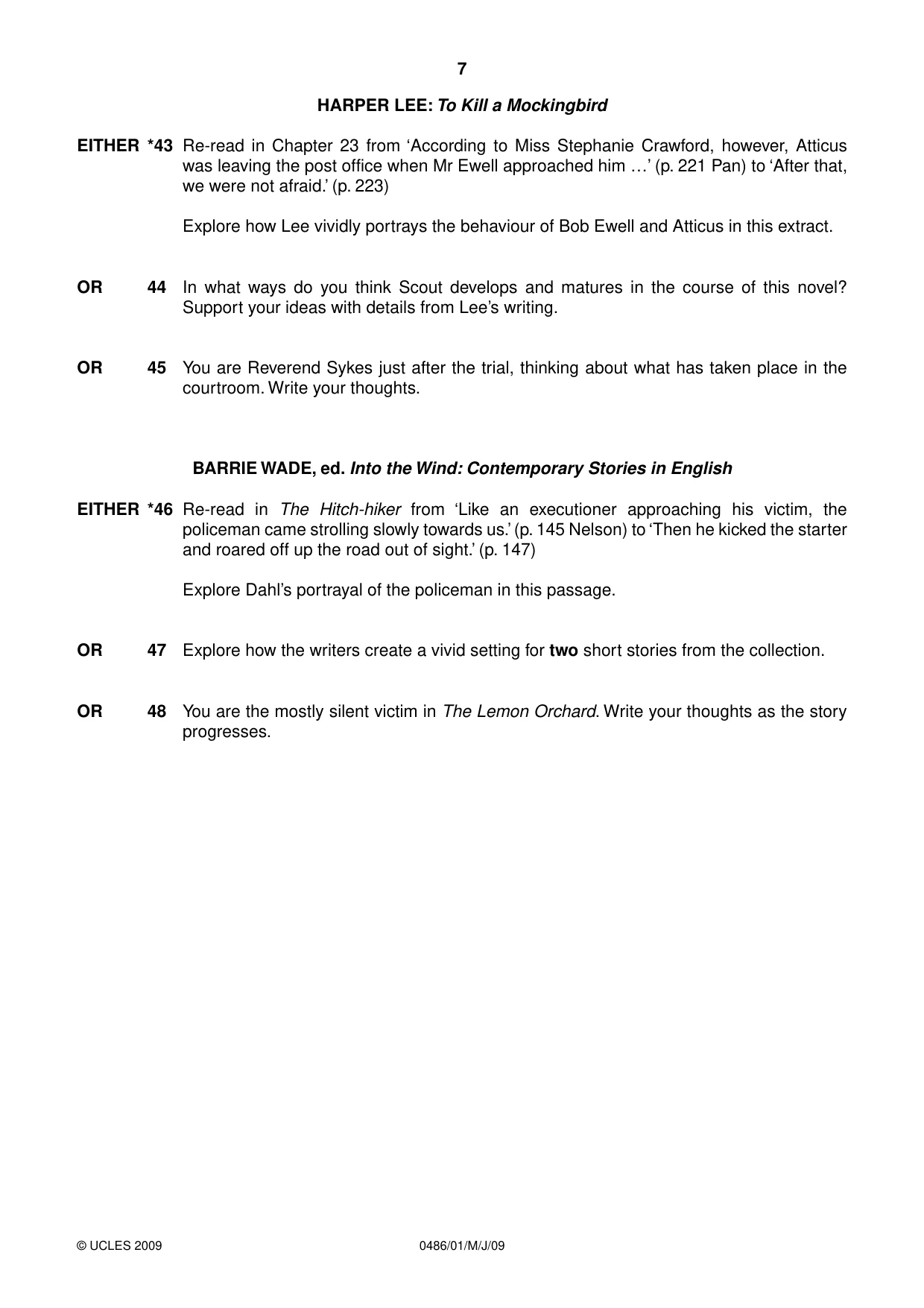

Mark scheme18 pages
Answers below. Sit the paper first if you are practising.
Paper as text
Question paper, page 1
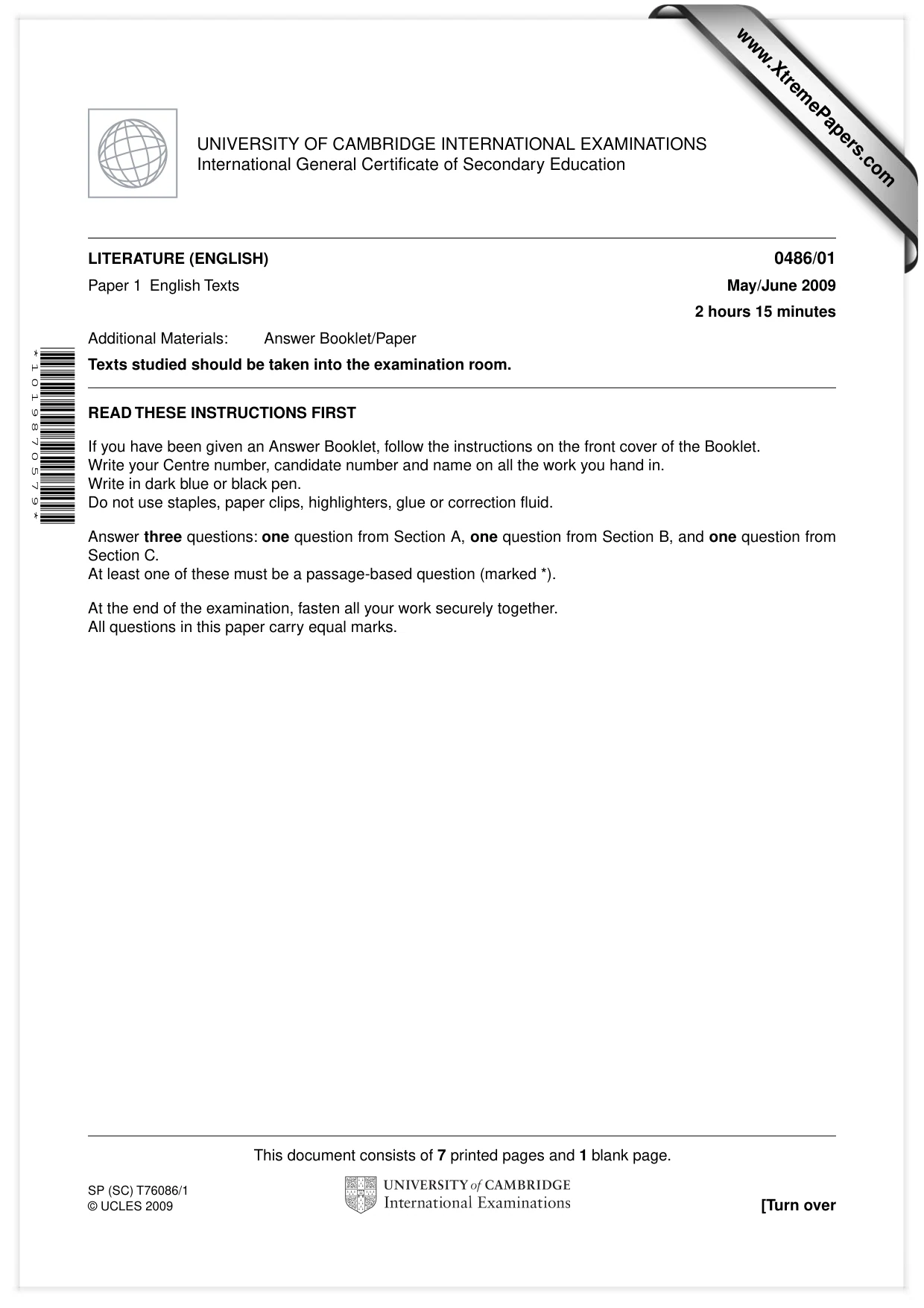
This document consists of 7 printed pages and 1 blank page. SP (SC) T76086/1 © UCLES 2009 [Turn over UNIVERSITY OF CAMBRIDGE INTERNATIONAL EXAMINATIONS International General Certificate of Secondary Education READ THESE INSTRUCTIONS FIRST If you have been given an Answer Booklet, follow the instructions on the front cover of the Booklet. Write your Centre number, candidate number and name on all the work you hand in. Write in dark blue or black pen. Do not use staples, paper clips, highlighters, glue or correction fluid. Answer three questions: one question from Section A, one question from Section B, and one question from Section C. At least one of these must be a passage-based question (marked *). At the end of the examination, fasten all your work securely together. All questions in this paper carry equal marks. * 1 0 1 9 8 7 0 5 7 9 * LITERATURE (ENGLISH) 0486/01 Paper 1 English Texts May/June 2009 2 hours 15 minutes Additional Materials: Answer Booklet/Paper Texts studied should be taken into the examination room. www.XtremePapers.com
Question paper, page 2
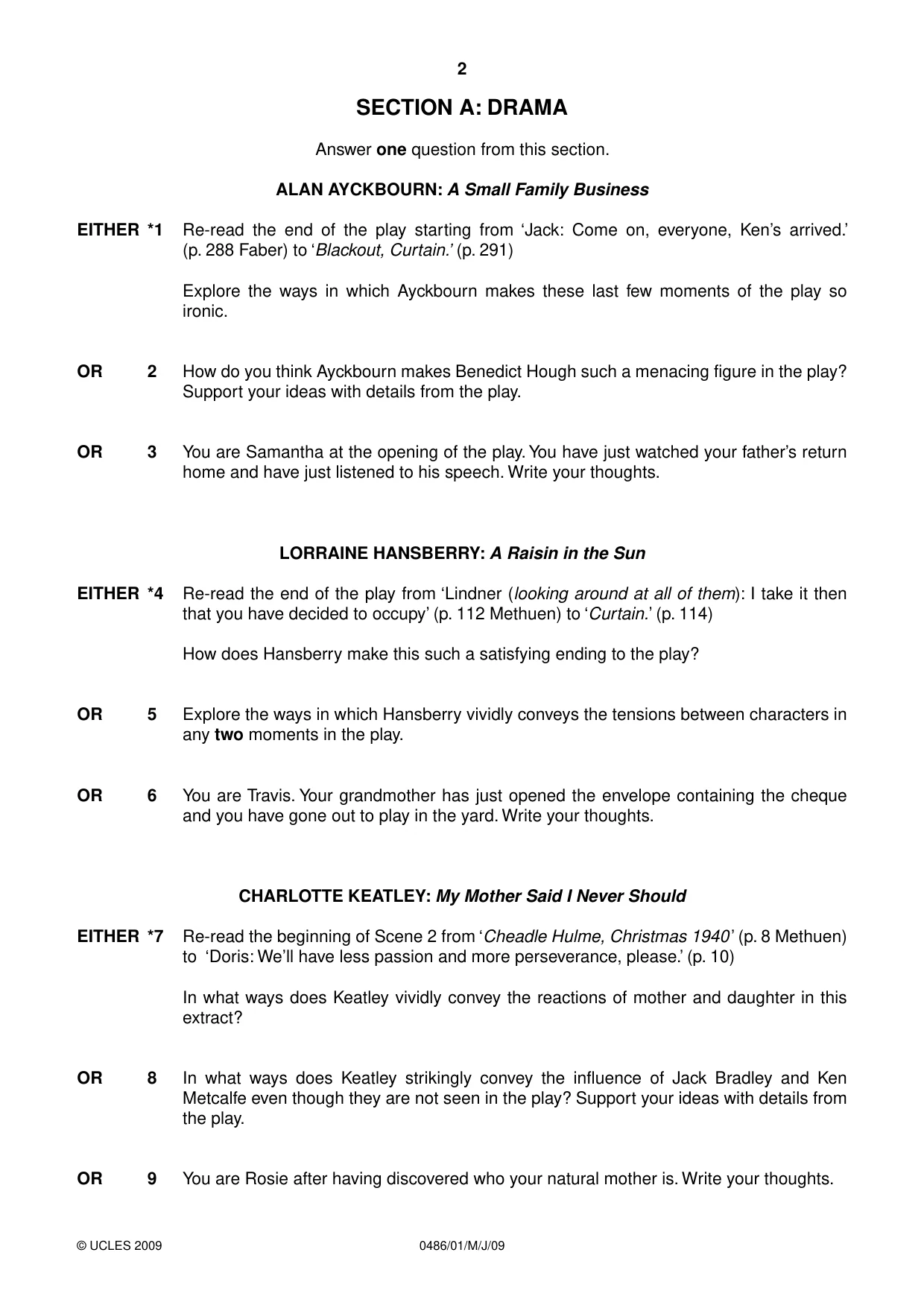
2 0486/01/M/J/09 © UCLES 2009 SECTION A: DRAMA Answer one question from this section. ALAN AYCKBOURN: A Small Family Business EITHER *1 Re-read the end of the play starting from ‘Jack: Come on, everyone, Ken’s arrived.’ (p. 288 Faber) to ‘Blackout, Curtain.’ (p. 291) Explore the ways in which Ayckbourn makes these last few moments of the play so ironic. OR 2 How do you think Ayckbourn makes Benedict Hough such a menacing figure in the play? Support your ideas with details from the play. OR 3 You are Samantha at the opening of the play. You have just watched your father’s return home and have just listened to his speech. Write your thoughts. LORRAINE HANSBERRY: A Raisin in the Sun EITHER *4 Re-read the end of the play from ‘Lindner (looking around at all of them): I take it then that you have decided to occupy’ (p. 112 Methuen) to ‘Curtain.’ (p. 114) How does Hansberry make this such a satisfying ending to the play? OR 5 Explore the ways in which Hansberry vividly conveys the tensions between characters in any two moments in the play. OR 6 You are Travis. Your grandmother has just opened the envelope containing the cheque and you have gone out to play in the yard. Write your thoughts. CHARLOTTE KEATLEY: My Mother Said I Never Should EITHER *7 Re-read the beginning of Scene 2 from ‘Cheadle Hulme, Christmas 1940 ’ (p. 8 Methuen) to ‘Doris: We’ll have less passion and more perseverance, please.’ (p. 10) In what ways does Keatley vividly convey the reactions of mother and daughter in this extract? OR 8 In what ways does Keatley strikingly convey the influence of Jack Bradley and Ken Metcalfe even though they are not seen in the play? Support your ideas with details from the play. OR 9 You are Rosie after having discovered who your natural mother is. Write your thoughts.
Question paper, page 3
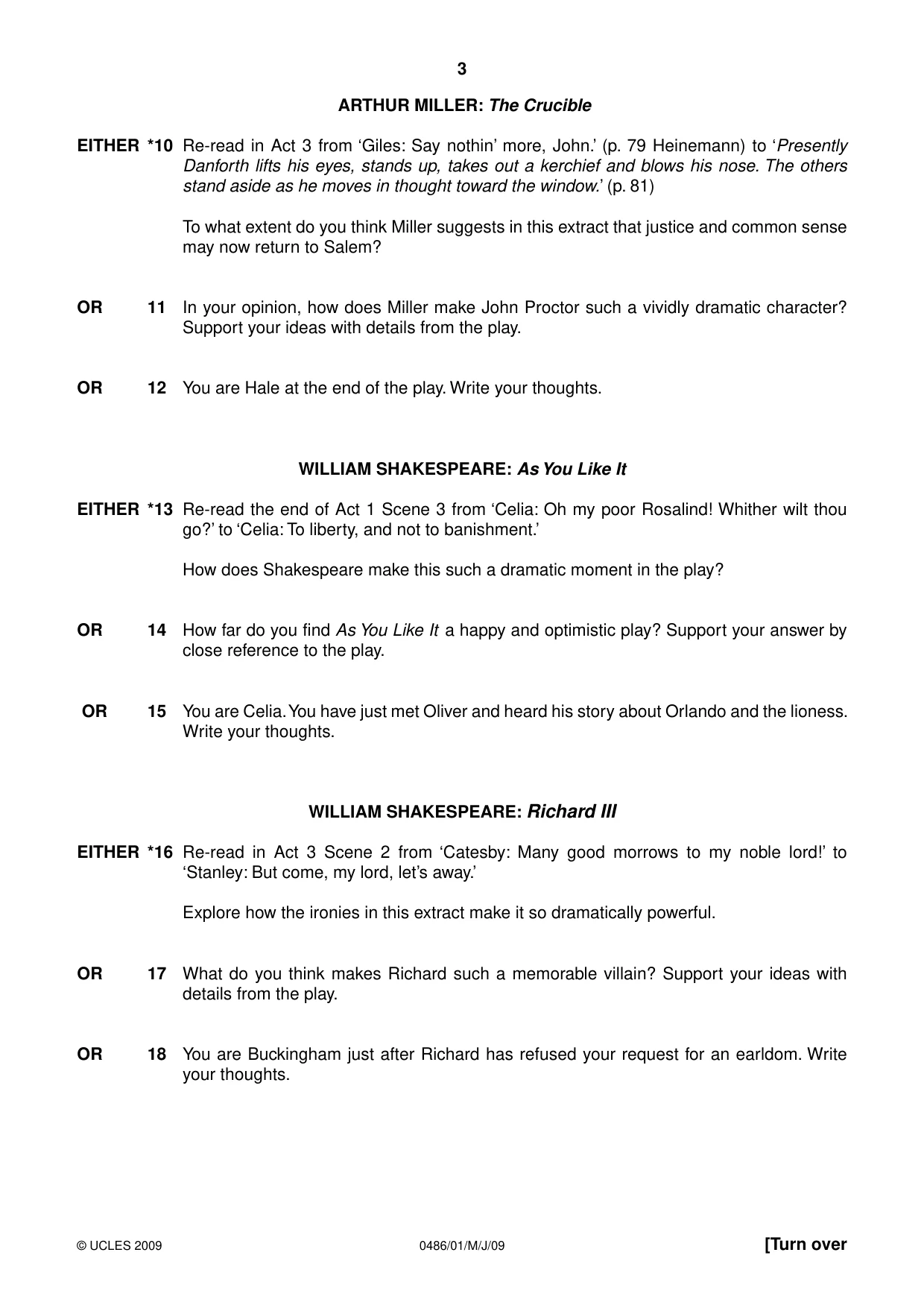
3 0486/01/M/J/09 © UCLES 2009 [Turn over ARTHUR MILLER: The Crucible EITHER *10 Re-read in Act 3 from ‘Giles: Say nothin’ more, John.’ (p. 79 Heinemann) to ‘Presently Danforth lifts his eyes, stands up, takes out a kerchief and blows his nose. The others stand aside as he moves in thought toward the window.’ (p. 81) To what extent do you think Miller suggests in this extract that justice and common sense may now return to Salem? OR 11 In your opinion, how does Miller make John Proctor such a vividly dramatic character? Support your ideas with details from the play. OR 12 You are Hale at the end of the play. Write your thoughts. WILLIAM SHAKESPEARE: As You Like It EITHER *13 Re-read the end of Act 1 Scene 3 from ‘Celia: Oh my poor Rosalind! Whither wilt thou go?’ to ‘Celia: To liberty, and not to banishment.’ How does Shakespeare make this such a dramatic moment in the play? OR 14 How far do you find As You Like It a happy and optimistic play? Support your answer by close reference to the play. OR 15 You are Celia. You have just met Oliver and heard his story about Orlando and the lioness. Write your thoughts. WILLIAM SHAKESPEARE: Richard III EITHER *16 Re-read in Act 3 Scene 2 from ‘Catesby: Many good morrows to my noble lord!’ to ‘Stanley: But come, my lord, let’s away.’ Explore how the ironies in this extract make it so dramatically powerful. OR 17 What do you think makes Richard such a memorable villain? Support your ideas with details from the play. OR 18 You are Buckingham just after Richard has refused your request for an earldom. Write your thoughts.
Question paper, page 4
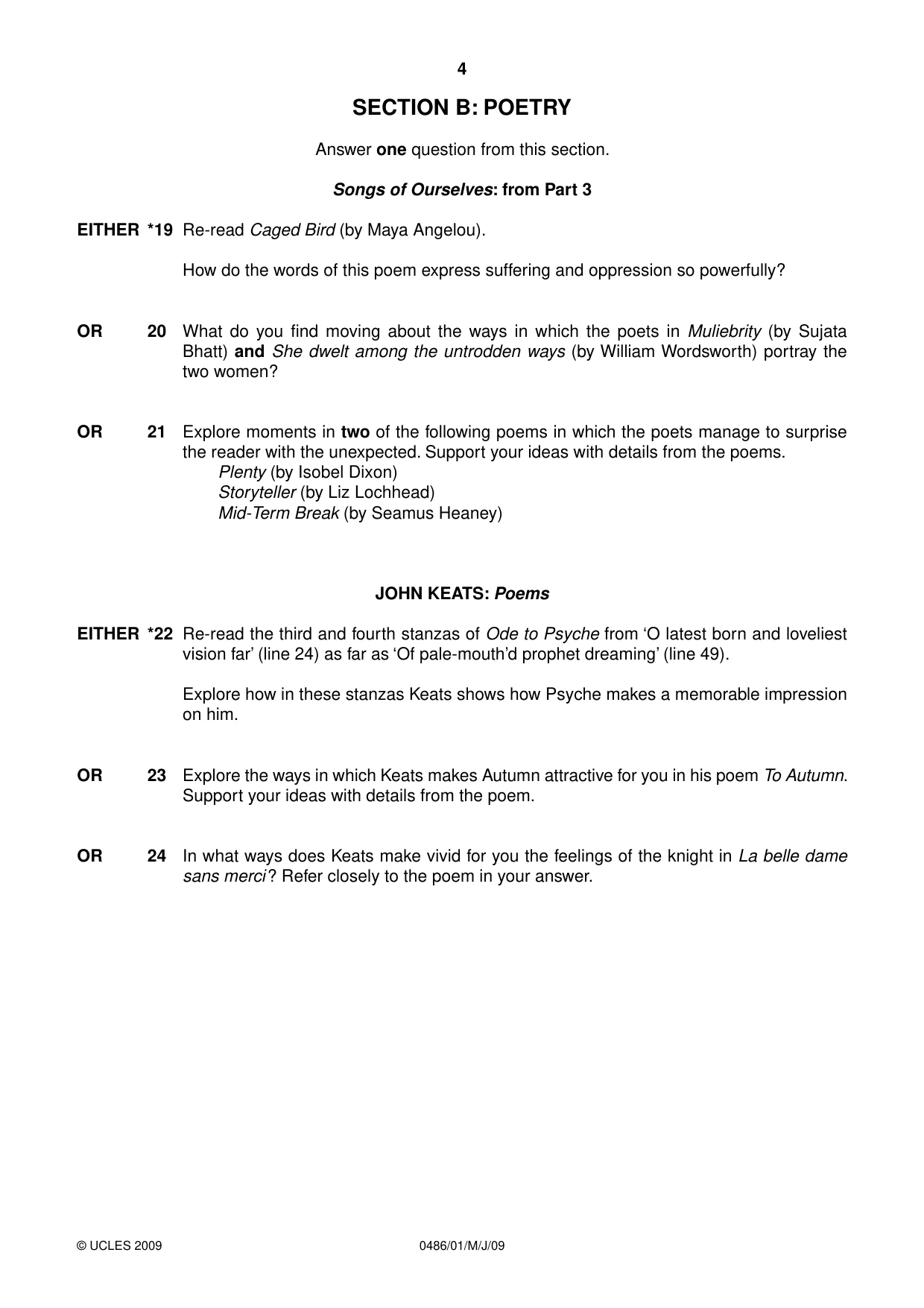
4 0486/01/M/J/09 © UCLES 2009 SECTION B: POETRY Answer one question from this section. Songs of Ourselves: from Part 3 EITHER *19 Re-read Caged Bird (by Maya Angelou). How do the words of this poem express suffering and oppression so powerfully? OR 20 What do you find moving about the ways in which the poets in Muliebrity (by Sujata Bhatt) and She dwelt among the untrodden ways (by William Wordsworth) portray the two women? OR 21 Explore moments in two of the following poems in which the poets manage to surprise the reader with the unexpected. Support your ideas with details from the poems. Plenty (by Isobel Dixon) Storyteller (by Liz Lochhead) Mid-Term Break (by Seamus Heaney) JOHN KEATS: Poems EITHER *22 Re-read the third and fourth stanzas of Ode to Psyche from ‘O latest born and loveliest vision far’ (line 24) as far as ‘Of pale-mouth’d prophet dreaming’ (line 49). Explore how in these stanzas Keats shows how Psyche makes a memorable impression on him. OR 23 Explore the ways in which Keats makes Autumn attractive for you in his poem To Autumn. Support your ideas with details from the poem. OR 24 In what ways does Keats make vivid for you the feelings of the knight in La belle dame sans merci ? Refer closely to the poem in your answer.
Question paper, page 5
5 0486/01/M/J/09 © UCLES 2009 [Turn over SECTION C: PROSE Answer one question from this section. CHINUA ACHEBE: Things Fall Apart EITHER *25 Re-read the opening of Chapter 22 from ‘Mr Brown’s successor was the Reverend James Smith,’ (p. 150 Picador) to ‘It was Enoch who touched off the great conflict between church and clan in Umuofia which had been gathering since Mr. Brown left.’ (p. 151) What does Achebe’s writing here make you feel about the Reverend Smith, his beliefs and their likely result? Support your ideas with details from the extract. OR 26 Choose one episode where Achebe causes you to feel sympathy with Okonkwo and one where he makes you dislike him. Justify your choice by referring in detail to the way Achebe presents the character in each episode. OR 27 You are Obierika after Okonkwo has killed the court messenger. You are waiting for the inevitable arrival of the District Commissioner and soldiers. Write your thoughts. JANE AUSTEN: Pride and Prejudice EITHER *28 Re-read in Chapter 8 from ‘When dinner was over, she returned directly to Jane, and Miss Bingley began abusing her as soon as she was out of the room.’ (p. 81 Penguin) to ‘With a renewal of tenderness, however, they repaired to her room on leaving the dining- parlour, and sat with her until summoned to coffee.’ (p. 83) Explore the ways in which Austen presents Bingley’s sisters in this extract. OR 29 Do you think that Austen makes it possible to feel sympathy for Mrs Bennet? Support your ideas with details from the novel. OR 30 You are Elizabeth Bennet on the morning of your wedding day to Mr Darcy. Write your thoughts. IAN CROSS: The God Boy EITHER *31 Re-read in Chapter 12 from ‘Well, he simply squealed as he jumped on his bike.’ (p. 93 Penguin) to the end of the chapter, ‘I gave old Legs a proper telling off, and if he hadn’t been so messed around by his previous experiences I daresay we would have ended up by having a fight.’ (p. 95) How does Cross make this such an amusing episode without ever quite allowing you to forget Jimmy’s sad life? OR 32 What do you think makes Mrs Sullivan such a tragic character? Support your ideas by close reference to Cross’s writing. OR 33 You are Mr Sullivan on the morning when you are going to give Jimmy his new bike. Write your thoughts.
Question paper, page 6
6 0486/01/M/J/09 © UCLES 2009 ANITA DESAI : Games at Twilight EITHER *34 Re-read in The Accompanist from ‘Then Bhola leaned towards me.’ (p. 66 Vintage) to ‘I talked to myself.’ (p. 67) How does Desai vividly convey how dreadful this moment is in the life of the accompanist? OR 35 Explore how Desai vividly portrays a child’s disappointment in either Games at Twilight or Pineapple Cake. Support your ideas with details from your chosen story. OR 36 You are Rakesh after your father has refused your medicine at the end of A Devoted Son. Write your thoughts. WILLIAM GOLDING: Lord of the Flies EITHER *37 Re-read in Painted Faces and Long Hair from ‘The fire was dead. They saw that straight away’ (Faber, p. 85) to ‘ “Kill the pig. Cut her throat. Spill her blood.” ’ (p. 86) Explore the ways in which Golding’s writing makes this a particularly powerful moment in the novel. OR 38 Which character do you find the more frightening, Jack or Roger? Support your view by close reference to Golding’s writing. OR 39 You are Simon on your way up the mountain just after the meeting when Ralph claims that he and Jack have seen the beast. Write your thoughts. THOMAS HARDY: Far from the Madding Crowd EITHER *40 Re-read in Chapter 25 (in some editions Chapter 24) from ‘Troy was full of activity, but his activities were less of a locomotive than of a vegetative nature’ to ‘ “Treat them fairly, and you are a lost man,” he would say.’ What kind of picture of Sergeant Troy does Hardy create for you here? OR 41 Explore one incident in this novel which you find vividly dramatic. Refer in detail to Hardy’s writing in your answer. OR 42 You are Farmer Boldwood just after you have again proposed marriage to Bathsheba on the assumption that Troy is dead. Write your thoughts.
Question paper, page 7
7 0486/01/M/J/09 © UCLES 2009 HARPER LEE: To Kill a Mockingbird EITHER *43 Re-read in Chapter 23 from ‘According to Miss Stephanie Crawford, however, Atticus was leaving the post office when Mr Ewell approached him …’ (p. 221 Pan) to ‘After that, we were not afraid.’ (p. 223) Explore how Lee vividly portrays the behaviour of Bob Ewell and Atticus in this extract. OR 44 In what ways do you think Scout develops and matures in the course of this novel? Support your ideas with details from Lee’s writing. OR 45 You are Reverend Sykes just after the trial, thinking about what has taken place in the courtroom. Write your thoughts. BARRIE WADE, ed. Into the Wind: Contemporary Stories in English EITHER *46 Re-read in The Hitch-hiker from ‘Like an executioner approaching his victim, the policeman came strolling slowly towards us.’ (p. 145 Nelson) to ‘Then he kicked the starter and roared off up the road out of sight.’ (p. 147) Explore Dahl’s portrayal of the policeman in this passage. OR 47 Explore how the writers create a vivid setting for two short stories from the collection. OR 48 You are the mostly silent victim in The Lemon Orchard. Write your thoughts as the story progresses.
Question paper, page 8
8 0486/01/M/J/09 BLANK PAGE Permission to reproduce items where third-party owned material protected by copyright is included has been sought and cleared where possible. Every reasonable effort has been made by the publisher (UCLES) to trace copyright holders, but if any items requiring clearance have unwittingly been included, the publisher will be pleased to make amends at the earliest possible opportunity. University of Cambridge International Examinations is part of the Cambridge Assessment Group. Cambridge Assessment is the brand name of University of Cambridge Local Examinations Syndicate (UCLES), which is itself a department of the University of Cambridge.
Mark scheme, page 1
UNIVERSITY OF CAMBRIDGE INTERNATIONAL EXAMINATIONS International General Certificate of Secondary Education MARK SCHEME for the May/June 2009 question paper for the guidance of teachers 0486 LITERATURE (ENGLISH) 0486/01 Paper 1 (Open Books), maximum raw mark 60 This mark scheme is published as an aid to teachers and candidates, to indicate the requirements of the examination. It shows the basis on which Examiners were instructed to award marks. It does not indicate the details of the discussions that took place at an Examiners’ meeting before marking began, which would have considered the acceptability of alternative answers. Mark schemes must be read in conjunction with the question papers and the report on the examination. • CIE will not enter into discussions or correspondence in connection with these mark schemes. CIE is publishing the mark schemes for the May/June 2009 question papers for most IGCSE, GCE Advanced Level and Advanced Subsidiary Level syllabuses and some Ordinary Level syllabuses. www.XtremePapers.com
Mark scheme, page 2
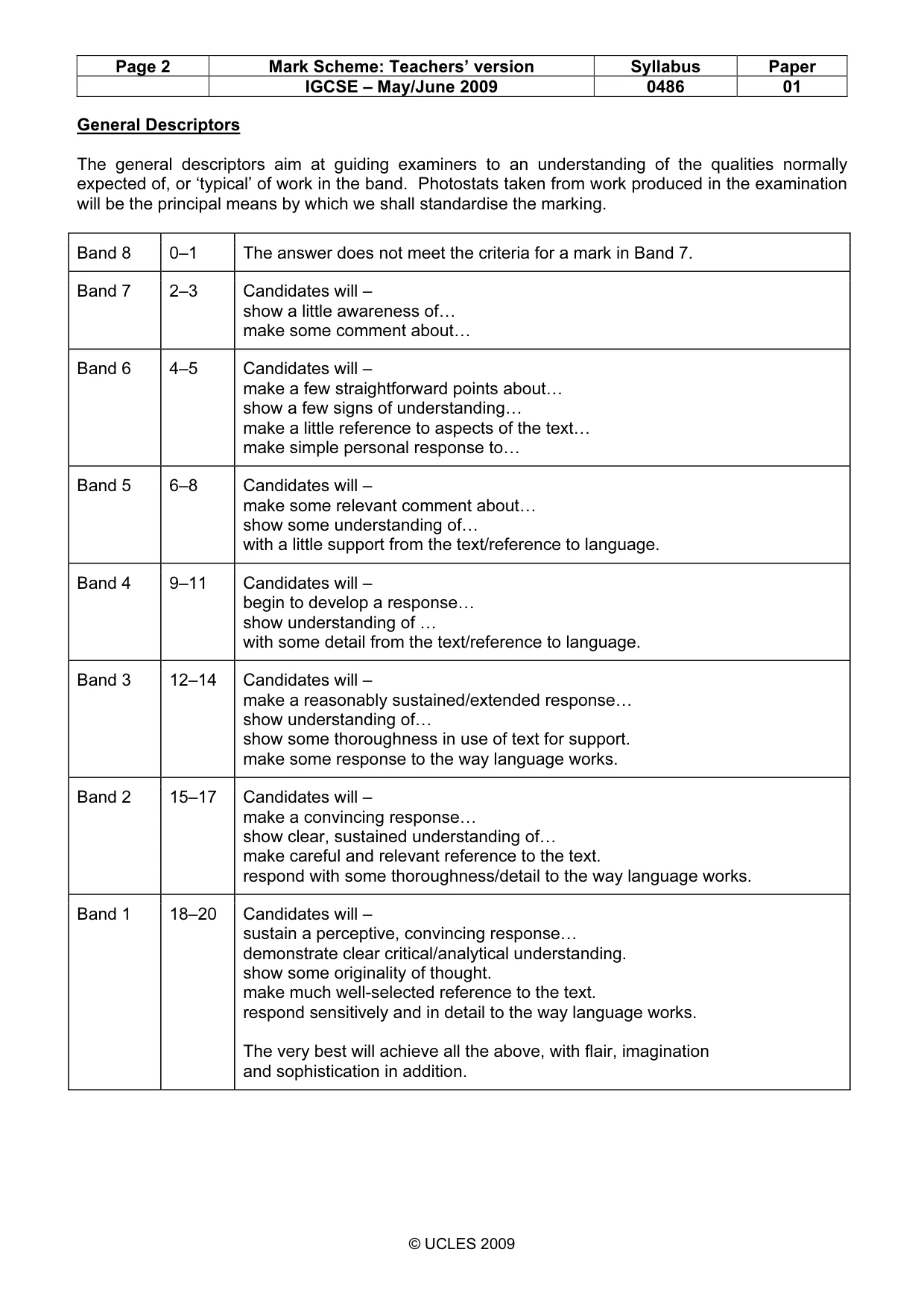
Page 2 Mark Scheme: Teachers’ version Syllabus Paper IGCSE – May/June 2009 0486 01 © UCLES 2009 General Descriptors The general descriptors aim at guiding examiners to an understanding of the qualities normally expected of, or ‘typical’ of work in the band. Photostats taken from work produced in the examination will be the principal means by which we shall standardise the marking. Band 8 0–1 The answer does not meet the criteria for a mark in Band 7. Band 7 2–3 Candidates will – show a little awareness of… make some comment about… Band 6 4–5 Candidates will – make a few straightforward points about… show a few signs of understanding… make a little reference to aspects of the text… make simple personal response to… Band 5 6–8 Candidates will – make some relevant comment about… show some understanding of… with a little support from the text/reference to language. Band 4 9–11 Candidates will – begin to develop a response… show understanding of … with some detail from the text/reference to language. Band 3 12–14 Candidates will – make a reasonably sustained/extended response… show understanding of… show some thoroughness in use of text for support. make some response to the way language works. Band 2 15–17 Candidates will – make a convincing response… show clear, sustained understanding of… make careful and relevant reference to the text. respond with some thoroughness/detail to the way language works. Band 1 18–20 Candidates will – sustain a perceptive, convincing response… demonstrate clear critical/analytical understanding. show some originality of thought. make much well-selected reference to the text. respond sensitively and in detail to the way language works. The very best will achieve all the above, with flair, imagination and sophistication in addition.
Mark scheme, page 3
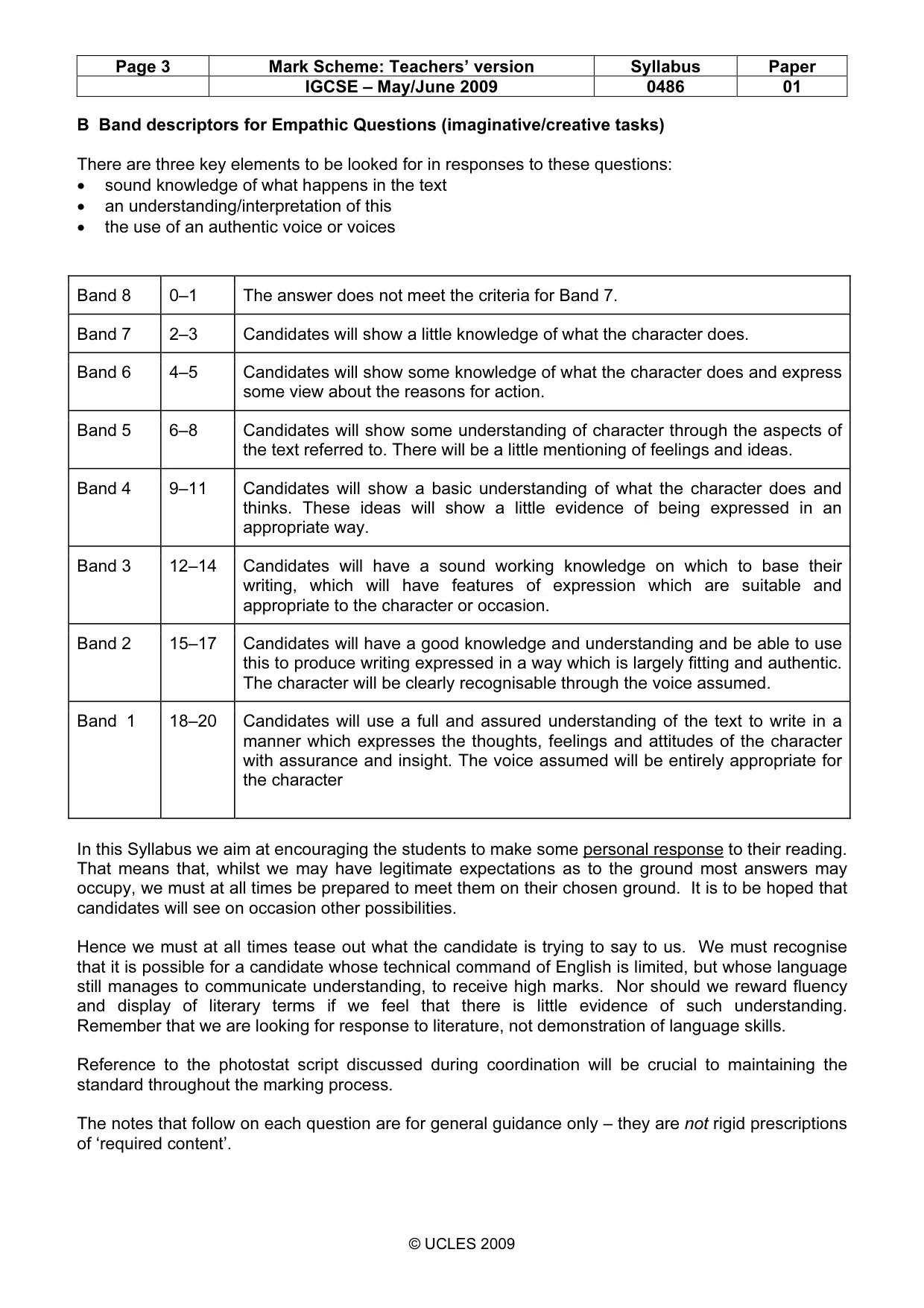
Page 3 Mark Scheme: Teachers’ version Syllabus Paper IGCSE – May/June 2009 0486 01 © UCLES 2009 B Band descriptors for Empathic Questions (imaginative/creative tasks) There are three key elements to be looked for in responses to these questions: • sound knowledge of what happens in the text • an understanding/interpretation of this • the use of an authentic voice or voices Band 8 0–1 The answer does not meet the criteria for Band 7. Band 7 2–3 Candidates will show a little knowledge of what the character does. Band 6 4–5 Candidates will show some knowledge of what the character does and express some view about the reasons for action. Band 5 6–8 Candidates will show some understanding of character through the aspects of the text referred to. There will be a little mentioning of feelings and ideas. Band 4 9–11 Candidates will show a basic understanding of what the character does and thinks. These ideas will show a little evidence of being expressed in an appropriate way. Band 3 12–14 Candidates will have a sound working knowledge on which to base their writing, which will have features of expression which are suitable and appropriate to the character or occasion. Band 2 15–17 Candidates will have a good knowledge and understanding and be able to use this to produce writing expressed in a way which is largely fitting and authentic. The character will be clearly recognisable through the voice assumed. Band 1 18–20 Candidates will use a full and assured understanding of the text to write in a manner which expresses the thoughts, feelings and attitudes of the character with assurance and insight. The voice assumed will be entirely appropriate for the character In this Syllabus we aim at encouraging the students to make some personal response to their reading. That means that, whilst we may have legitimate expectations as to the ground most answers may occupy, we must at all times be prepared to meet them on their chosen ground. It is to be hoped that candidates will see on occasion other possibilities. Hence we must at all times tease out what the candidate is trying to say to us. We must recognise that it is possible for a candidate whose technical command of English is limited, but whose language still manages to communicate understanding, to receive high marks. Nor should we reward fluency and display of literary terms if we feel that there is little evidence of such understanding. Remember that we are looking for response to literature, not demonstration of language skills. Reference to the photostat script discussed during coordination will be crucial to maintaining the standard throughout the marking process. The notes that follow on each question are for general guidance only – they are not rigid prescriptions of ‘required content’.
Mark scheme, page 4
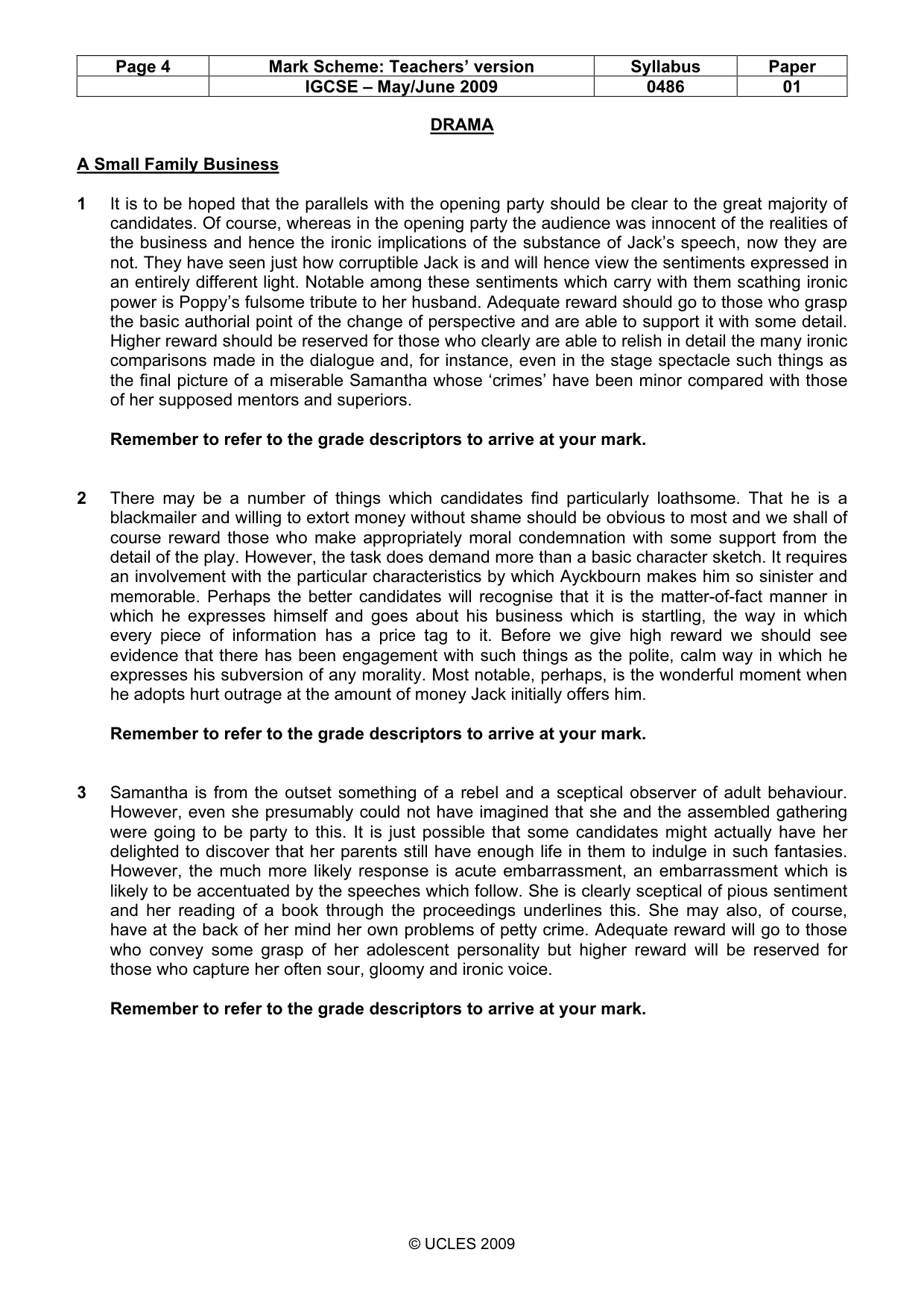
Page 4 Mark Scheme: Teachers’ version Syllabus Paper IGCSE – May/June 2009 0486 01 © UCLES 2009 DRAMA A Small Family Business 1 It is to be hoped that the parallels with the opening party should be clear to the great majority of candidates. Of course, whereas in the opening party the audience was innocent of the realities of the business and hence the ironic implications of the substance of Jack’s speech, now they are not. They have seen just how corruptible Jack is and will hence view the sentiments expressed in an entirely different light. Notable among these sentiments which carry with them scathing ironic power is Poppy’s fulsome tribute to her husband. Adequate reward should go to those who grasp the basic authorial point of the change of perspective and are able to support it with some detail. Higher reward should be reserved for those who clearly are able to relish in detail the many ironic comparisons made in the dialogue and, for instance, even in the stage spectacle such things as the final picture of a miserable Samantha whose ‘crimes’ have been minor compared with those of her supposed mentors and superiors. Remember to refer to the grade descriptors to arrive at your mark. 2 There may be a number of things which candidates find particularly loathsome. That he is a blackmailer and willing to extort money without shame should be obvious to most and we shall of course reward those who make appropriately moral condemnation with some support from the detail of the play. However, the task does demand more than a basic character sketch. It requires an involvement with the particular characteristics by which Ayckbourn makes him so sinister and memorable. Perhaps the better candidates will recognise that it is the matter-of-fact manner in which he expresses himself and goes about his business which is startling, the way in which every piece of information has a price tag to it. Before we give high reward we should see evidence that there has been engagement with such things as the polite, calm way in which he expresses his subversion of any morality. Most notable, perhaps, is the wonderful moment when he adopts hurt outrage at the amount of money Jack initially offers him. Remember to refer to the grade descriptors to arrive at your mark. 3 Samantha is from the outset something of a rebel and a sceptical observer of adult behaviour. However, even she presumably could not have imagined that she and the assembled gathering were going to be party to this. It is just possible that some candidates might actually have her delighted to discover that her parents still have enough life in them to indulge in such fantasies. However, the much more likely response is acute embarrassment, an embarrassment which is likely to be accentuated by the speeches which follow. She is clearly sceptical of pious sentiment and her reading of a book through the proceedings underlines this. She may also, of course, have at the back of her mind her own problems of petty crime. Adequate reward will go to those who convey some grasp of her adolescent personality but higher reward will be reserved for those who capture her often sour, gloomy and ironic voice. Remember to refer to the grade descriptors to arrive at your mark.
Mark scheme, page 5
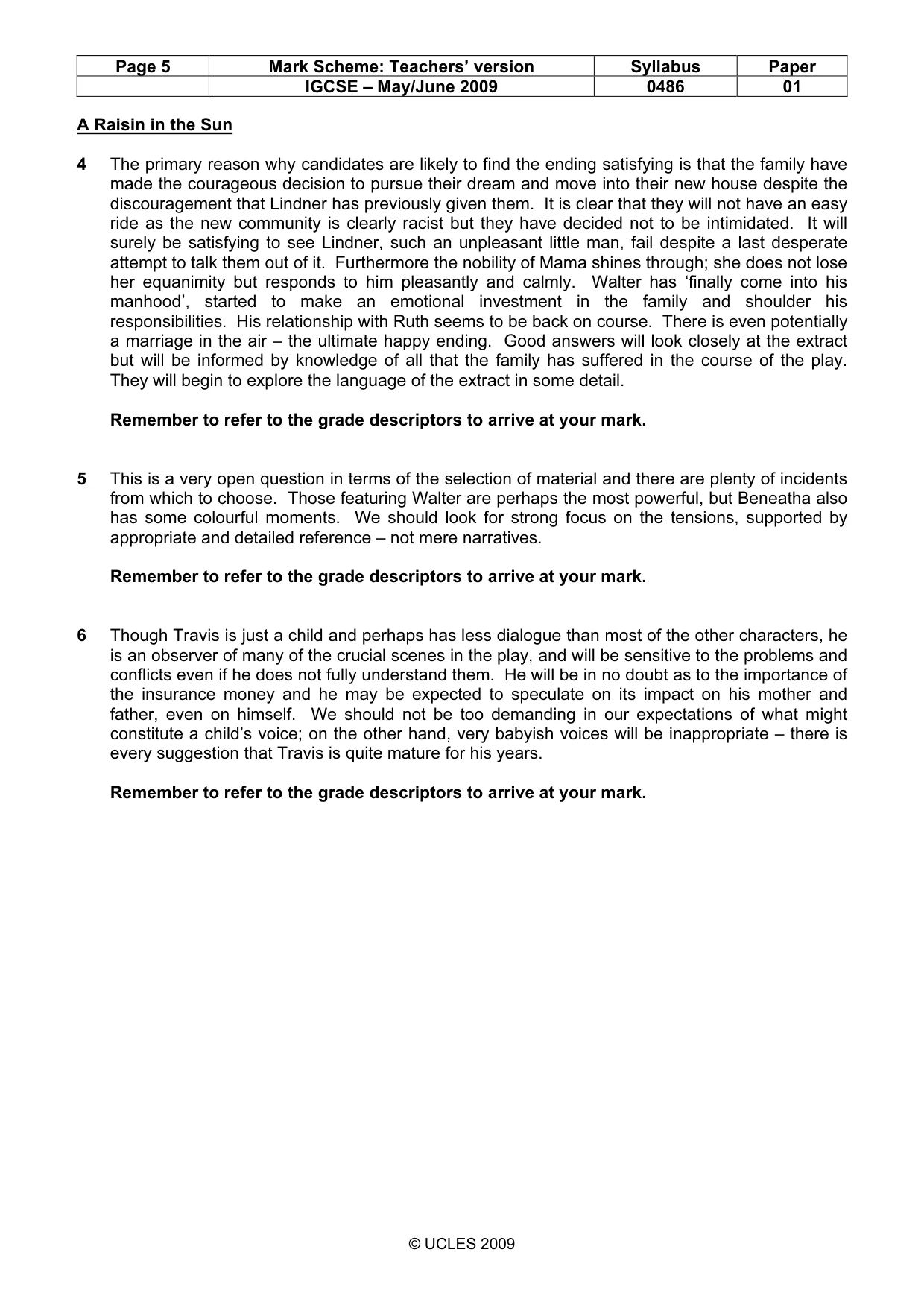
Page 5 Mark Scheme: Teachers’ version Syllabus Paper IGCSE – May/June 2009 0486 01 © UCLES 2009 A Raisin in the Sun 4 The primary reason why candidates are likely to find the ending satisfying is that the family have made the courageous decision to pursue their dream and move into their new house despite the discouragement that Lindner has previously given them. It is clear that they will not have an easy ride as the new community is clearly racist but they have decided not to be intimidated. It will surely be satisfying to see Lindner, such an unpleasant little man, fail despite a last desperate attempt to talk them out of it. Furthermore the nobility of Mama shines through; she does not lose her equanimity but responds to him pleasantly and calmly. Walter has ‘finally come into his manhood’, started to make an emotional investment in the family and shoulder his responsibilities. His relationship with Ruth seems to be back on course. There is even potentially a marriage in the air – the ultimate happy ending. Good answers will look closely at the extract but will be informed by knowledge of all that the family has suffered in the course of the play. They will begin to explore the language of the extract in some detail. Remember to refer to the grade descriptors to arrive at your mark. 5 This is a very open question in terms of the selection of material and there are plenty of incidents from which to choose. Those featuring Walter are perhaps the most powerful, but Beneatha also has some colourful moments. We should look for strong focus on the tensions, supported by appropriate and detailed reference – not mere narratives. Remember to refer to the grade descriptors to arrive at your mark. 6 Though Travis is just a child and perhaps has less dialogue than most of the other characters, he is an observer of many of the crucial scenes in the play, and will be sensitive to the problems and conflicts even if he does not fully understand them. He will be in no doubt as to the importance of the insurance money and he may be expected to speculate on its impact on his mother and father, even on himself. We should not be too demanding in our expectations of what might constitute a child’s voice; on the other hand, very babyish voices will be inappropriate – there is every suggestion that Travis is quite mature for his years. Remember to refer to the grade descriptors to arrive at your mark.
Mark scheme, page 6
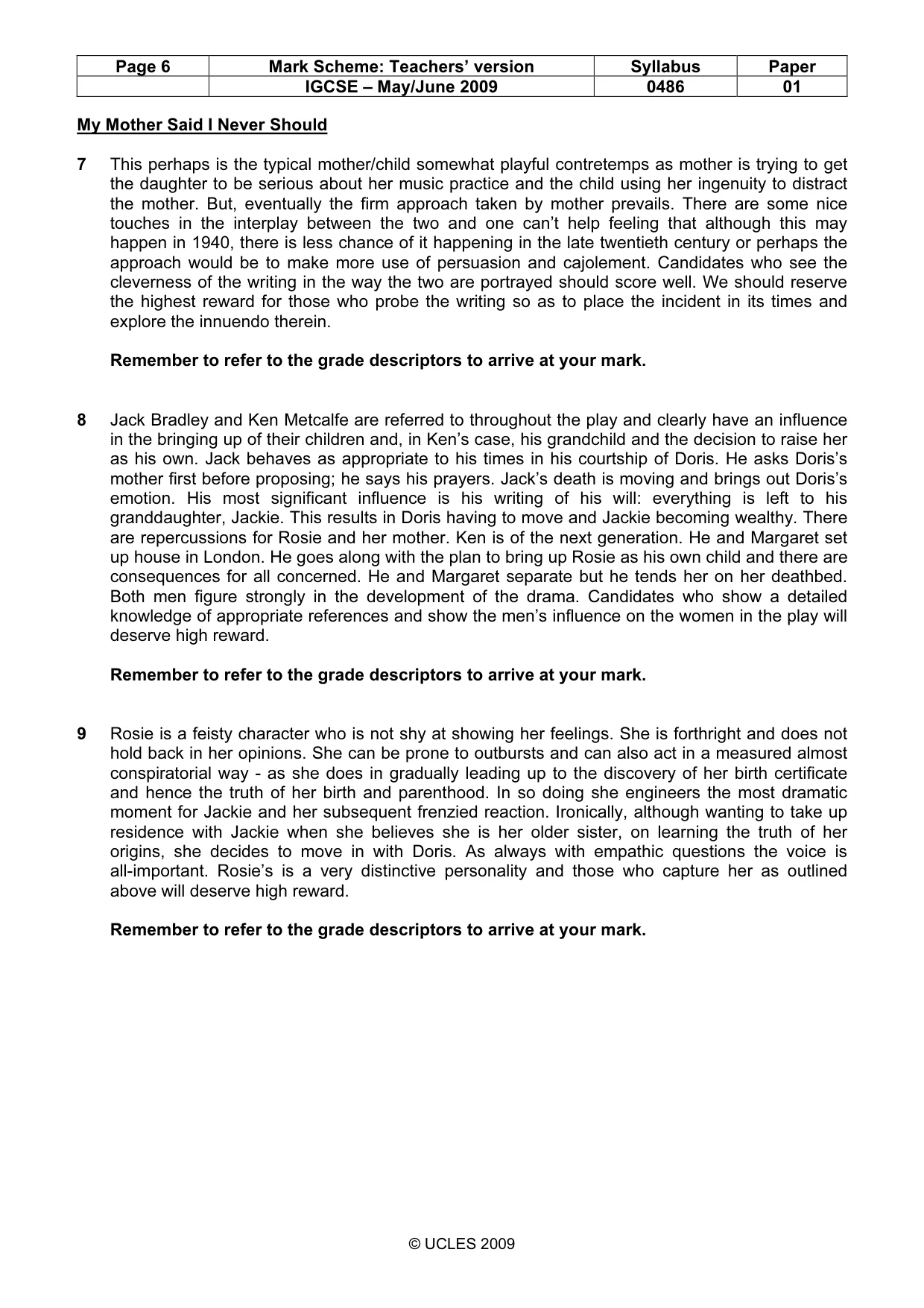
Page 6 Mark Scheme: Teachers’ version Syllabus Paper IGCSE – May/June 2009 0486 01 © UCLES 2009 My Mother Said I Never Should 7 This perhaps is the typical mother/child somewhat playful contretemps as mother is trying to get the daughter to be serious about her music practice and the child using her ingenuity to distract the mother. But, eventually the firm approach taken by mother prevails. There are some nice touches in the interplay between the two and one can’t help feeling that although this may happen in 1940, there is less chance of it happening in the late twentieth century or perhaps the approach would be to make more use of persuasion and cajolement. Candidates who see the cleverness of the writing in the way the two are portrayed should score well. We should reserve the highest reward for those who probe the writing so as to place the incident in its times and explore the innuendo therein. Remember to refer to the grade descriptors to arrive at your mark. 8 Jack Bradley and Ken Metcalfe are referred to throughout the play and clearly have an influence in the bringing up of their children and, in Ken’s case, his grandchild and the decision to raise her as his own. Jack behaves as appropriate to his times in his courtship of Doris. He asks Doris’s mother first before proposing; he says his prayers. Jack’s death is moving and brings out Doris’s emotion. His most significant influence is his writing of his will: everything is left to his granddaughter, Jackie. This results in Doris having to move and Jackie becoming wealthy. There are repercussions for Rosie and her mother. Ken is of the next generation. He and Margaret set up house in London. He goes along with the plan to bring up Rosie as his own child and there are consequences for all concerned. He and Margaret separate but he tends her on her deathbed. Both men figure strongly in the development of the drama. Candidates who show a detailed knowledge of appropriate references and show the men’s influence on the women in the play will deserve high reward. Remember to refer to the grade descriptors to arrive at your mark. 9 Rosie is a feisty character who is not shy at showing her feelings. She is forthright and does not hold back in her opinions. She can be prone to outbursts and can also act in a measured almost conspiratorial way - as she does in gradually leading up to the discovery of her birth certificate and hence the truth of her birth and parenthood. In so doing she engineers the most dramatic moment for Jackie and her subsequent frenzied reaction. Ironically, although wanting to take up residence with Jackie when she believes she is her older sister, on learning the truth of her origins, she decides to move in with Doris. As always with empathic questions the voice is all-important. Rosie’s is a very distinctive personality and those who capture her as outlined above will deserve high reward. Remember to refer to the grade descriptors to arrive at your mark.
Mark scheme, page 7
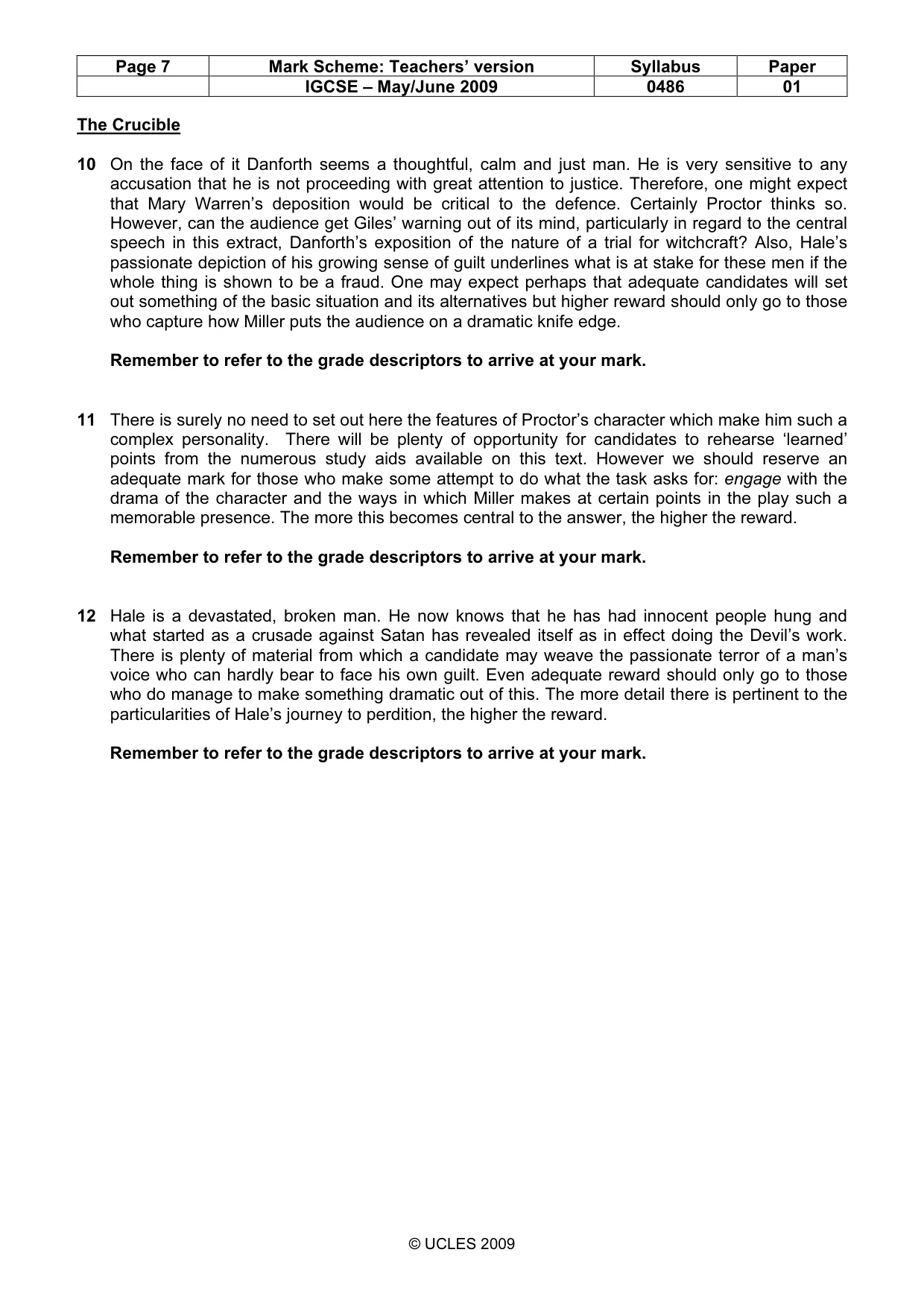
Page 7 Mark Scheme: Teachers’ version Syllabus Paper IGCSE – May/June 2009 0486 01 © UCLES 2009 The Crucible 10 On the face of it Danforth seems a thoughtful, calm and just man. He is very sensitive to any accusation that he is not proceeding with great attention to justice. Therefore, one might expect that Mary Warren’s deposition would be critical to the defence. Certainly Proctor thinks so. However, can the audience get Giles’ warning out of its mind, particularly in regard to the central speech in this extract, Danforth’s exposition of the nature of a trial for witchcraft? Also, Hale’s passionate depiction of his growing sense of guilt underlines what is at stake for these men if the whole thing is shown to be a fraud. One may expect perhaps that adequate candidates will set out something of the basic situation and its alternatives but higher reward should only go to those who capture how Miller puts the audience on a dramatic knife edge. Remember to refer to the grade descriptors to arrive at your mark. 11 There is surely no need to set out here the features of Proctor’s character which make him such a complex personality. There will be plenty of opportunity for candidates to rehearse ‘learned’ points from the numerous study aids available on this text. However we should reserve an adequate mark for those who make some attempt to do what the task asks for: engage with the drama of the character and the ways in which Miller makes at certain points in the play such a memorable presence. The more this becomes central to the answer, the higher the reward. Remember to refer to the grade descriptors to arrive at your mark. 12 Hale is a devastated, broken man. He now knows that he has had innocent people hung and what started as a crusade against Satan has revealed itself as in effect doing the Devil’s work. There is plenty of material from which a candidate may weave the passionate terror of a man’s voice who can hardly bear to face his own guilt. Even adequate reward should only go to those who do manage to make something dramatic out of this. The more detail there is pertinent to the particularities of Hale’s journey to perdition, the higher the reward. Remember to refer to the grade descriptors to arrive at your mark.
Mark scheme, page 8
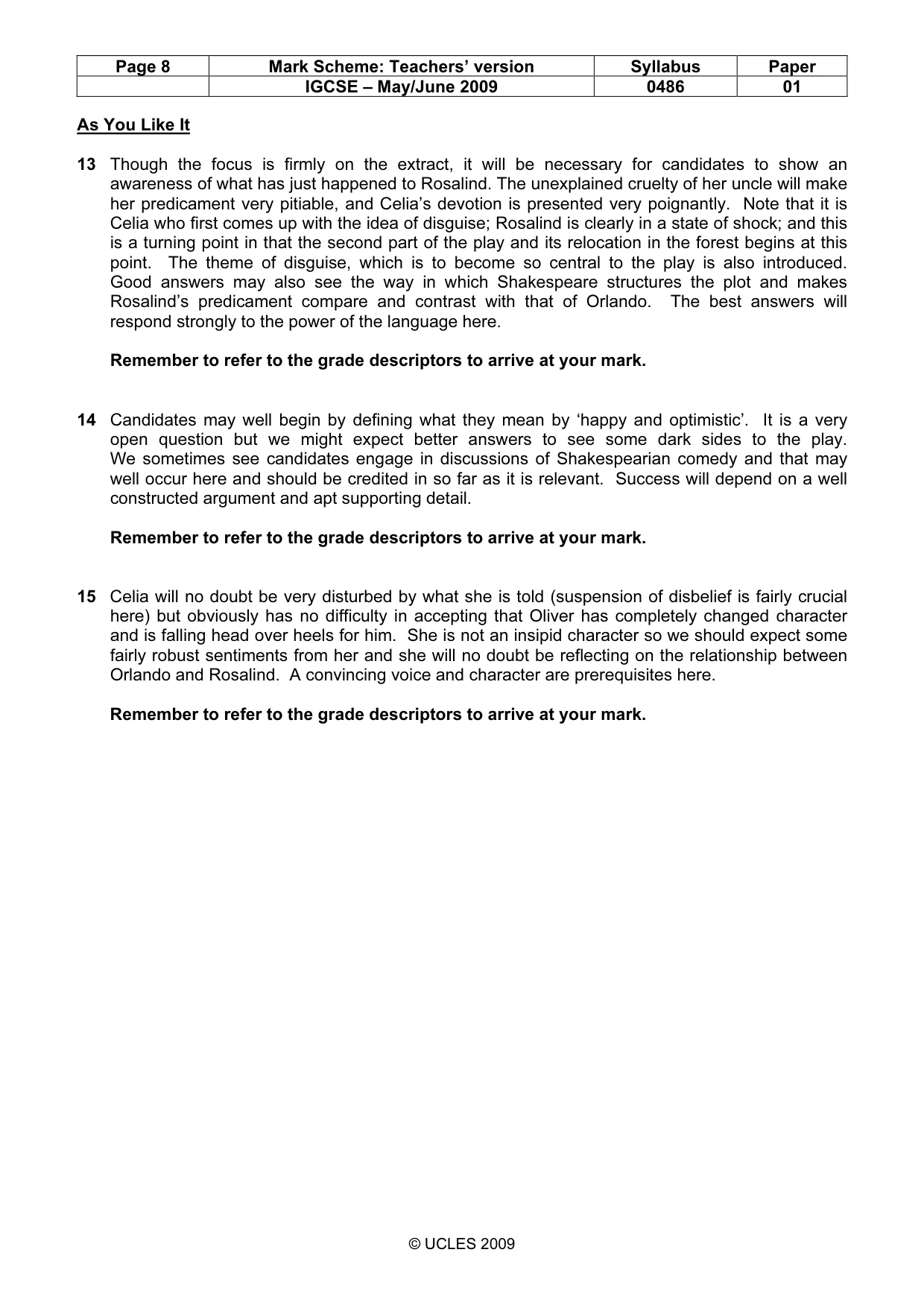
Page 8 Mark Scheme: Teachers’ version Syllabus Paper IGCSE – May/June 2009 0486 01 © UCLES 2009 As You Like It 13 Though the focus is firmly on the extract, it will be necessary for candidates to show an awareness of what has just happened to Rosalind. The unexplained cruelty of her uncle will make her predicament very pitiable, and Celia’s devotion is presented very poignantly. Note that it is Celia who first comes up with the idea of disguise; Rosalind is clearly in a state of shock; and this is a turning point in that the second part of the play and its relocation in the forest begins at this point. The theme of disguise, which is to become so central to the play is also introduced. Good answers may also see the way in which Shakespeare structures the plot and makes Rosalind’s predicament compare and contrast with that of Orlando. The best answers will respond strongly to the power of the language here. Remember to refer to the grade descriptors to arrive at your mark. 14 Candidates may well begin by defining what they mean by ‘happy and optimistic’. It is a very open question but we might expect better answers to see some dark sides to the play. We sometimes see candidates engage in discussions of Shakespearian comedy and that may well occur here and should be credited in so far as it is relevant. Success will depend on a well constructed argument and apt supporting detail. Remember to refer to the grade descriptors to arrive at your mark. 15 Celia will no doubt be very disturbed by what she is told (suspension of disbelief is fairly crucial here) but obviously has no difficulty in accepting that Oliver has completely changed character and is falling head over heels for him. She is not an insipid character so we should expect some fairly robust sentiments from her and she will no doubt be reflecting on the relationship between Orlando and Rosalind. A convincing voice and character are prerequisites here. Remember to refer to the grade descriptors to arrive at your mark.
Mark scheme, page 9
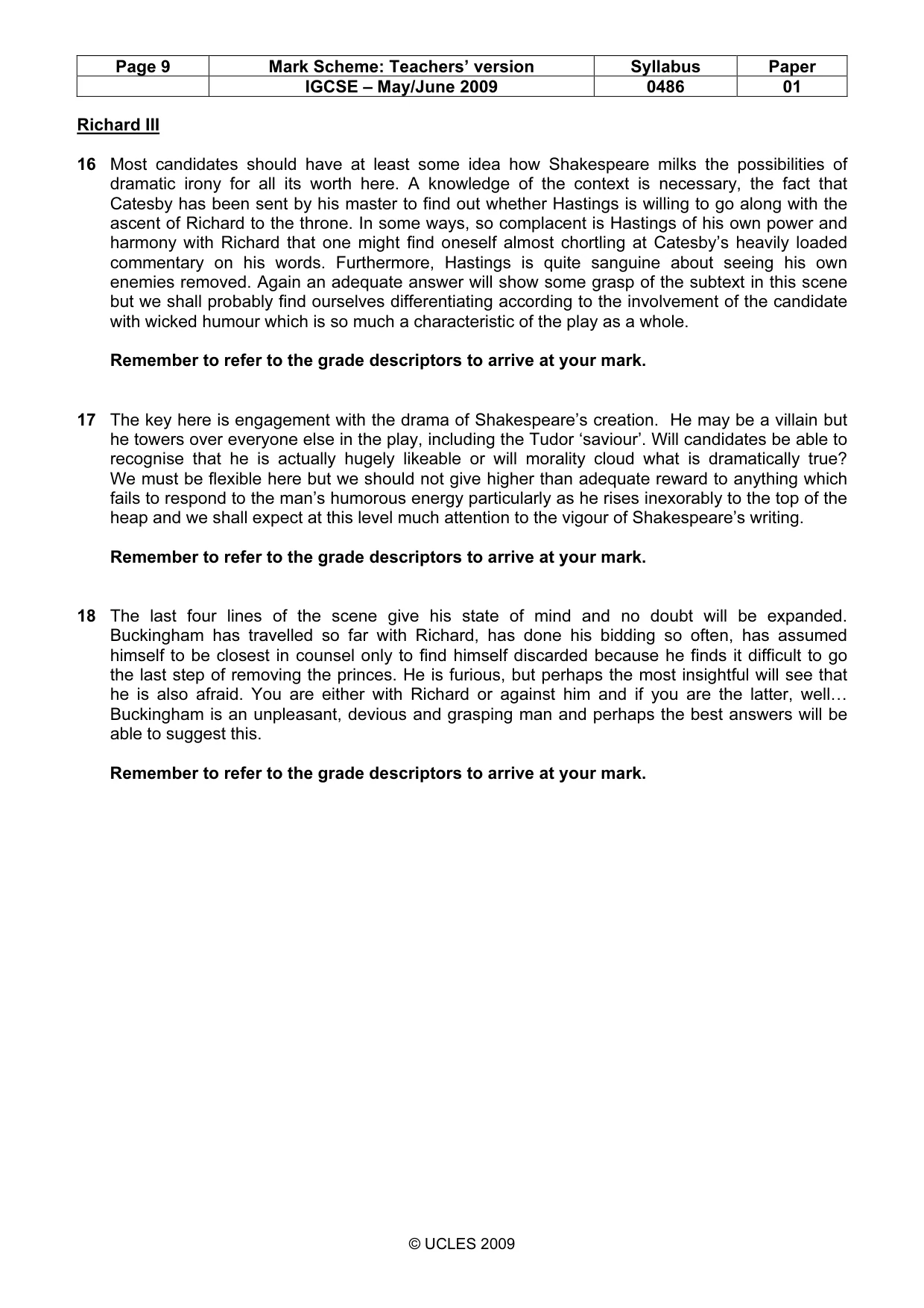
Page 9 Mark Scheme: Teachers’ version Syllabus Paper IGCSE – May/June 2009 0486 01 © UCLES 2009 Richard III 16 Most candidates should have at least some idea how Shakespeare milks the possibilities of dramatic irony for all its worth here. A knowledge of the context is necessary, the fact that Catesby has been sent by his master to find out whether Hastings is willing to go along with the ascent of Richard to the throne. In some ways, so complacent is Hastings of his own power and harmony with Richard that one might find oneself almost chortling at Catesby’s heavily loaded commentary on his words. Furthermore, Hastings is quite sanguine about seeing his own enemies removed. Again an adequate answer will show some grasp of the subtext in this scene but we shall probably find ourselves differentiating according to the involvement of the candidate with wicked humour which is so much a characteristic of the play as a whole. Remember to refer to the grade descriptors to arrive at your mark. 17 The key here is engagement with the drama of Shakespeare’s creation. He may be a villain but he towers over everyone else in the play, including the Tudor ‘saviour’. Will candidates be able to recognise that he is actually hugely likeable or will morality cloud what is dramatically true? We must be flexible here but we should not give higher than adequate reward to anything which fails to respond to the man’s humorous energy particularly as he rises inexorably to the top of the heap and we shall expect at this level much attention to the vigour of Shakespeare’s writing. Remember to refer to the grade descriptors to arrive at your mark. 18 The last four lines of the scene give his state of mind and no doubt will be expanded. Buckingham has travelled so far with Richard, has done his bidding so often, has assumed himself to be closest in counsel only to find himself discarded because he finds it difficult to go the last step of removing the princes. He is furious, but perhaps the most insightful will see that he is also afraid. You are either with Richard or against him and if you are the latter, well… Buckingham is an unpleasant, devious and grasping man and perhaps the best answers will be able to suggest this. Remember to refer to the grade descriptors to arrive at your mark.
Mark scheme, page 10
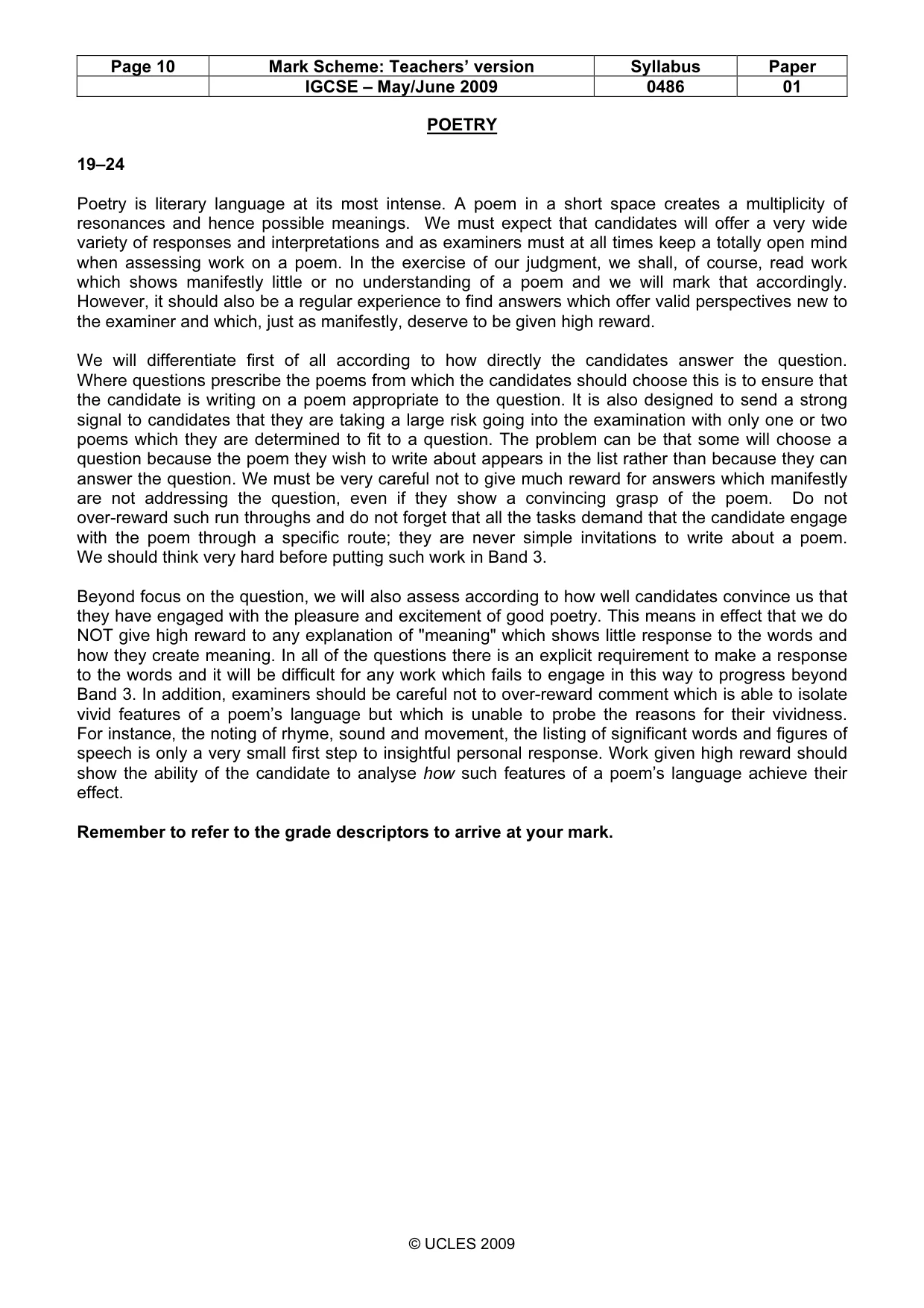
Page 10 Mark Scheme: Teachers’ version Syllabus Paper IGCSE – May/June 2009 0486 01 © UCLES 2009 POETRY 19–24 Poetry is literary language at its most intense. A poem in a short space creates a multiplicity of resonances and hence possible meanings. We must expect that candidates will offer a very wide variety of responses and interpretations and as examiners must at all times keep a totally open mind when assessing work on a poem. In the exercise of our judgment, we shall, of course, read work which shows manifestly little or no understanding of a poem and we will mark that accordingly. However, it should also be a regular experience to find answers which offer valid perspectives new to the examiner and which, just as manifestly, deserve to be given high reward. We will differentiate first of all according to how directly the candidates answer the question. Where questions prescribe the poems from which the candidates should choose this is to ensure that the candidate is writing on a poem appropriate to the question. It is also designed to send a strong signal to candidates that they are taking a large risk going into the examination with only one or two poems which they are determined to fit to a question. The problem can be that some will choose a question because the poem they wish to write about appears in the list rather than because they can answer the question. We must be very careful not to give much reward for answers which manifestly are not addressing the question, even if they show a convincing grasp of the poem. Do not over-reward such run throughs and do not forget that all the tasks demand that the candidate engage with the poem through a specific route; they are never simple invitations to write about a poem. We should think very hard before putting such work in Band 3. Beyond focus on the question, we will also assess according to how well candidates convince us that they have engaged with the pleasure and excitement of good poetry. This means in effect that we do NOT give high reward to any explanation of "meaning" which shows little response to the words and how they create meaning. In all of the questions there is an explicit requirement to make a response to the words and it will be difficult for any work which fails to engage in this way to progress beyond Band 3. In addition, examiners should be careful not to over-reward comment which is able to isolate vivid features of a poem’s language but which is unable to probe the reasons for their vividness. For instance, the noting of rhyme, sound and movement, the listing of significant words and figures of speech is only a very small first step to insightful personal response. Work given high reward should show the ability of the candidate to analyse how such features of a poem’s language achieve their effect. Remember to refer to the grade descriptors to arrive at your mark.
Mark scheme, page 11
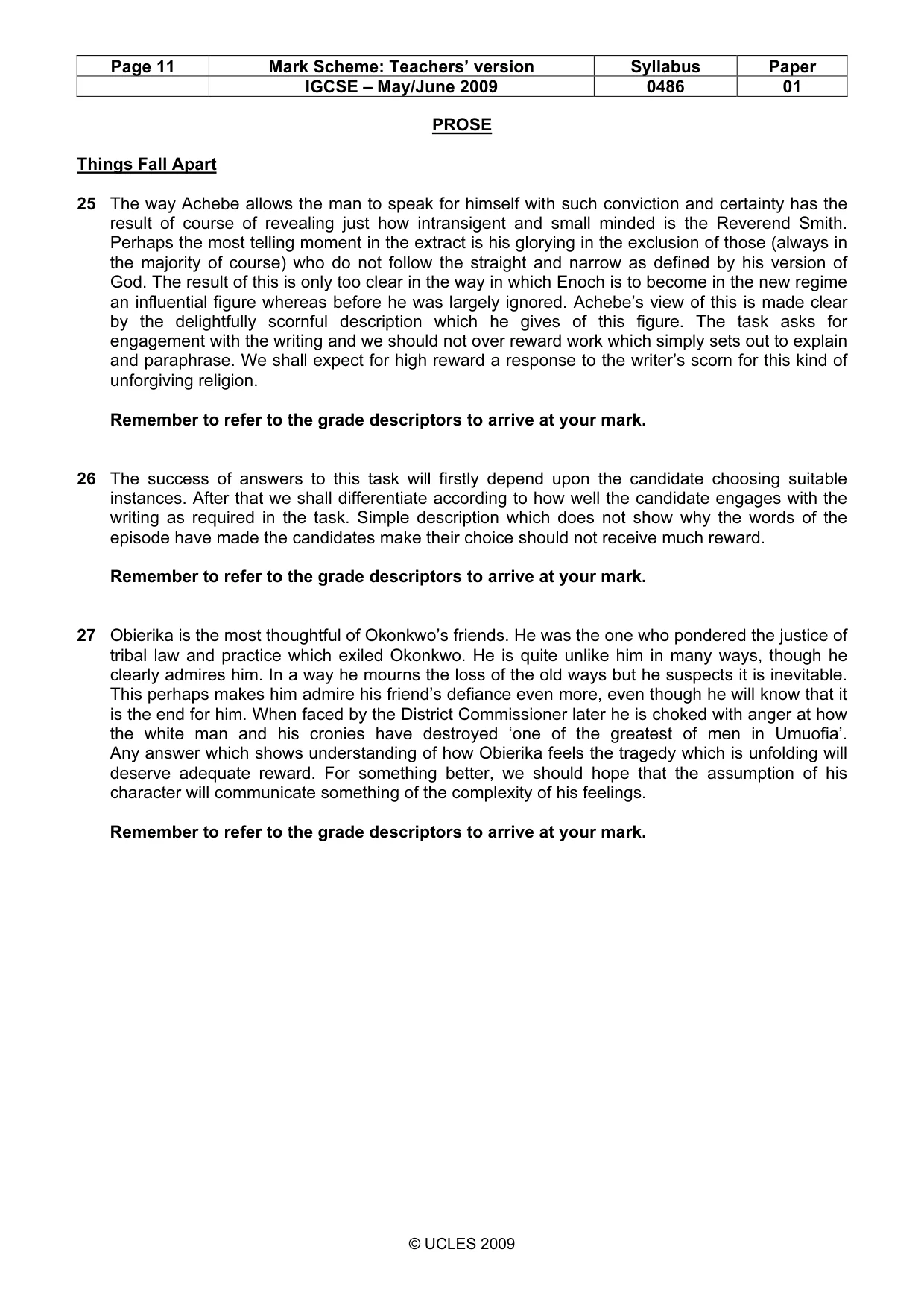
Page 11 Mark Scheme: Teachers’ version Syllabus Paper IGCSE – May/June 2009 0486 01 © UCLES 2009 PROSE Things Fall Apart 25 The way Achebe allows the man to speak for himself with such conviction and certainty has the result of course of revealing just how intransigent and small minded is the Reverend Smith. Perhaps the most telling moment in the extract is his glorying in the exclusion of those (always in the majority of course) who do not follow the straight and narrow as defined by his version of God. The result of this is only too clear in the way in which Enoch is to become in the new regime an influential figure whereas before he was largely ignored. Achebe’s view of this is made clear by the delightfully scornful description which he gives of this figure. The task asks for engagement with the writing and we should not over reward work which simply sets out to explain and paraphrase. We shall expect for high reward a response to the writer’s scorn for this kind of unforgiving religion. Remember to refer to the grade descriptors to arrive at your mark. 26 The success of answers to this task will firstly depend upon the candidate choosing suitable instances. After that we shall differentiate according to how well the candidate engages with the writing as required in the task. Simple description which does not show why the words of the episode have made the candidates make their choice should not receive much reward. Remember to refer to the grade descriptors to arrive at your mark. 27 Obierika is the most thoughtful of Okonkwo’s friends. He was the one who pondered the justice of tribal law and practice which exiled Okonkwo. He is quite unlike him in many ways, though he clearly admires him. In a way he mourns the loss of the old ways but he suspects it is inevitable. This perhaps makes him admire his friend’s defiance even more, even though he will know that it is the end for him. When faced by the District Commissioner later he is choked with anger at how the white man and his cronies have destroyed ‘one of the greatest of men in Umuofia’. Any answer which shows understanding of how Obierika feels the tragedy which is unfolding will deserve adequate reward. For something better, we should hope that the assumption of his character will communicate something of the complexity of his feelings. Remember to refer to the grade descriptors to arrive at your mark.
Mark scheme, page 12
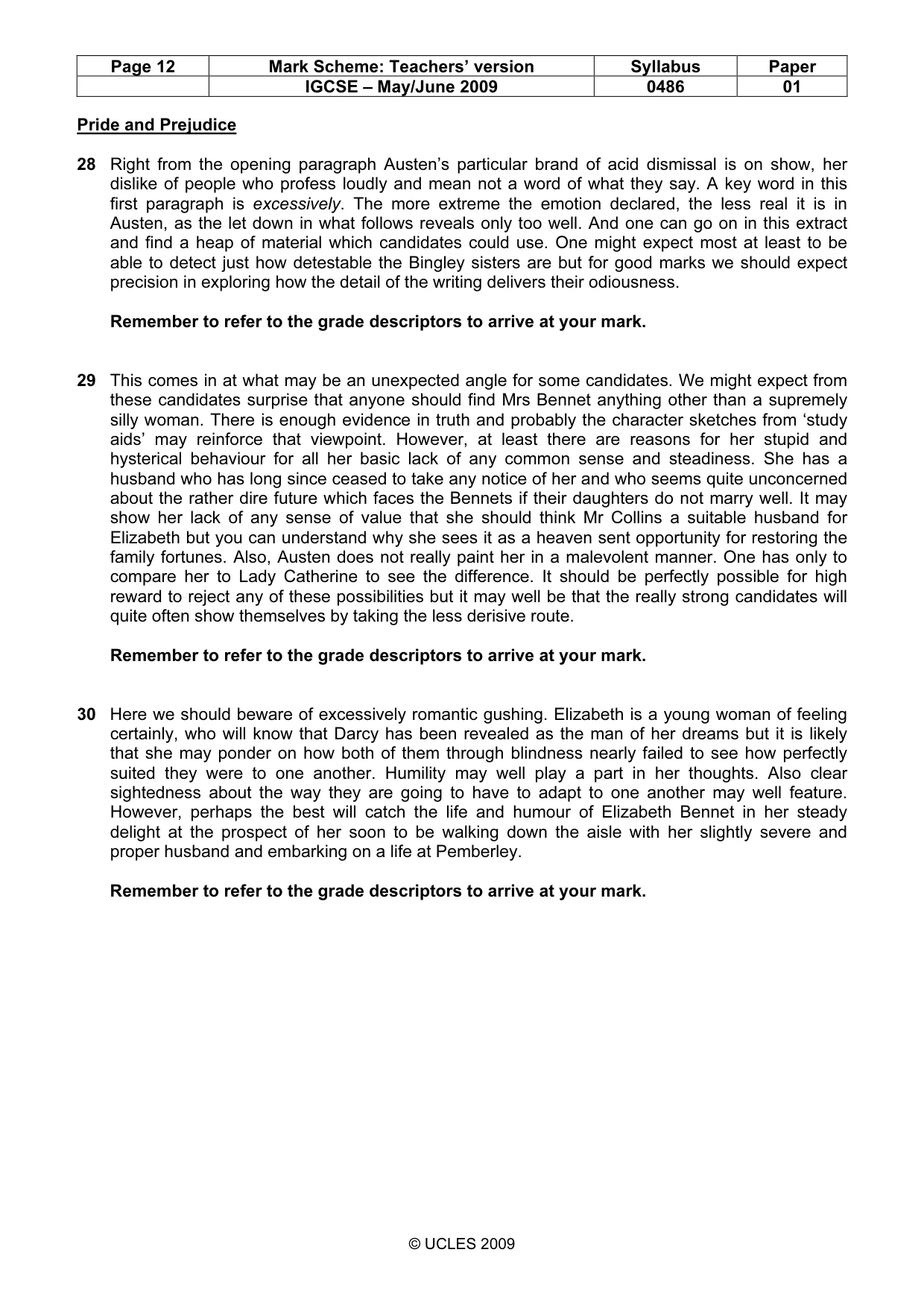
Page 12 Mark Scheme: Teachers’ version Syllabus Paper IGCSE – May/June 2009 0486 01 © UCLES 2009 Pride and Prejudice 28 Right from the opening paragraph Austen’s particular brand of acid dismissal is on show, her dislike of people who profess loudly and mean not a word of what they say. A key word in this first paragraph is excessively. The more extreme the emotion declared, the less real it is in Austen, as the let down in what follows reveals only too well. And one can go on in this extract and find a heap of material which candidates could use. One might expect most at least to be able to detect just how detestable the Bingley sisters are but for good marks we should expect precision in exploring how the detail of the writing delivers their odiousness. Remember to refer to the grade descriptors to arrive at your mark. 29 This comes in at what may be an unexpected angle for some candidates. We might expect from these candidates surprise that anyone should find Mrs Bennet anything other than a supremely silly woman. There is enough evidence in truth and probably the character sketches from ‘study aids’ may reinforce that viewpoint. However, at least there are reasons for her stupid and hysterical behaviour for all her basic lack of any common sense and steadiness. She has a husband who has long since ceased to take any notice of her and who seems quite unconcerned about the rather dire future which faces the Bennets if their daughters do not marry well. It may show her lack of any sense of value that she should think Mr Collins a suitable husband for Elizabeth but you can understand why she sees it as a heaven sent opportunity for restoring the family fortunes. Also, Austen does not really paint her in a malevolent manner. One has only to compare her to Lady Catherine to see the difference. It should be perfectly possible for high reward to reject any of these possibilities but it may well be that the really strong candidates will quite often show themselves by taking the less derisive route. Remember to refer to the grade descriptors to arrive at your mark. 30 Here we should beware of excessively romantic gushing. Elizabeth is a young woman of feeling certainly, who will know that Darcy has been revealed as the man of her dreams but it is likely that she may ponder on how both of them through blindness nearly failed to see how perfectly suited they were to one another. Humility may well play a part in her thoughts. Also clear sightedness about the way they are going to have to adapt to one another may well feature. However, perhaps the best will catch the life and humour of Elizabeth Bennet in her steady delight at the prospect of her soon to be walking down the aisle with her slightly severe and proper husband and embarking on a life at Pemberley. Remember to refer to the grade descriptors to arrive at your mark.
Mark scheme, page 13
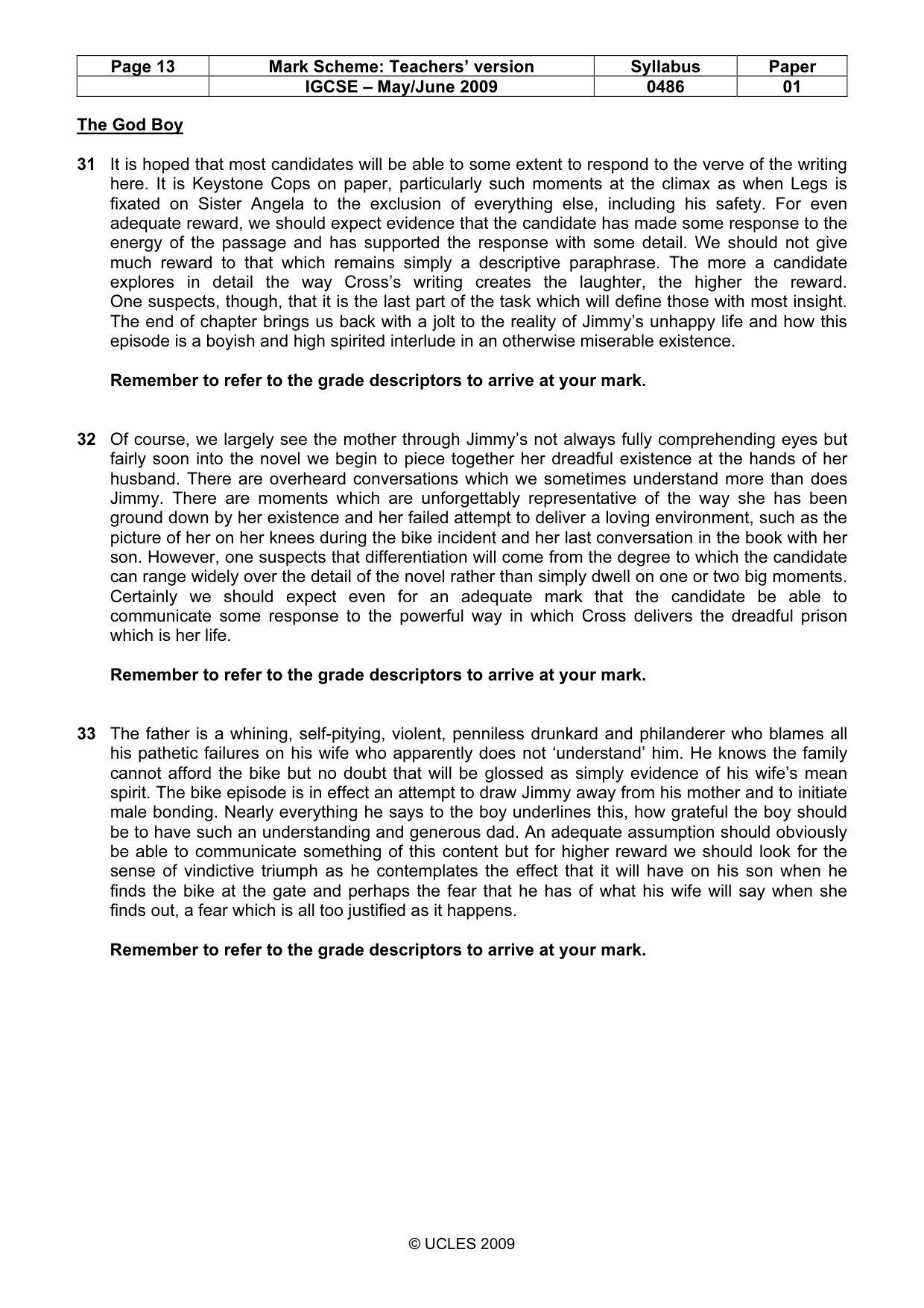
Page 13 Mark Scheme: Teachers’ version Syllabus Paper IGCSE – May/June 2009 0486 01 © UCLES 2009 The God Boy 31 It is hoped that most candidates will be able to some extent to respond to the verve of the writing here. It is Keystone Cops on paper, particularly such moments at the climax as when Legs is fixated on Sister Angela to the exclusion of everything else, including his safety. For even adequate reward, we should expect evidence that the candidate has made some response to the energy of the passage and has supported the response with some detail. We should not give much reward to that which remains simply a descriptive paraphrase. The more a candidate explores in detail the way Cross’s writing creates the laughter, the higher the reward. One suspects, though, that it is the last part of the task which will define those with most insight. The end of chapter brings us back with a jolt to the reality of Jimmy’s unhappy life and how this episode is a boyish and high spirited interlude in an otherwise miserable existence. Remember to refer to the grade descriptors to arrive at your mark. 32 Of course, we largely see the mother through Jimmy’s not always fully comprehending eyes but fairly soon into the novel we begin to piece together her dreadful existence at the hands of her husband. There are overheard conversations which we sometimes understand more than does Jimmy. There are moments which are unforgettably representative of the way she has been ground down by her existence and her failed attempt to deliver a loving environment, such as the picture of her on her knees during the bike incident and her last conversation in the book with her son. However, one suspects that differentiation will come from the degree to which the candidate can range widely over the detail of the novel rather than simply dwell on one or two big moments. Certainly we should expect even for an adequate mark that the candidate be able to communicate some response to the powerful way in which Cross delivers the dreadful prison which is her life. Remember to refer to the grade descriptors to arrive at your mark. 33 The father is a whining, self-pitying, violent, penniless drunkard and philanderer who blames all his pathetic failures on his wife who apparently does not ‘understand’ him. He knows the family cannot afford the bike but no doubt that will be glossed as simply evidence of his wife’s mean spirit. The bike episode is in effect an attempt to draw Jimmy away from his mother and to initiate male bonding. Nearly everything he says to the boy underlines this, how grateful the boy should be to have such an understanding and generous dad. An adequate assumption should obviously be able to communicate something of this content but for higher reward we should look for the sense of vindictive triumph as he contemplates the effect that it will have on his son when he finds the bike at the gate and perhaps the fear that he has of what his wife will say when she finds out, a fear which is all too justified as it happens. Remember to refer to the grade descriptors to arrive at your mark.
Mark scheme, page 14
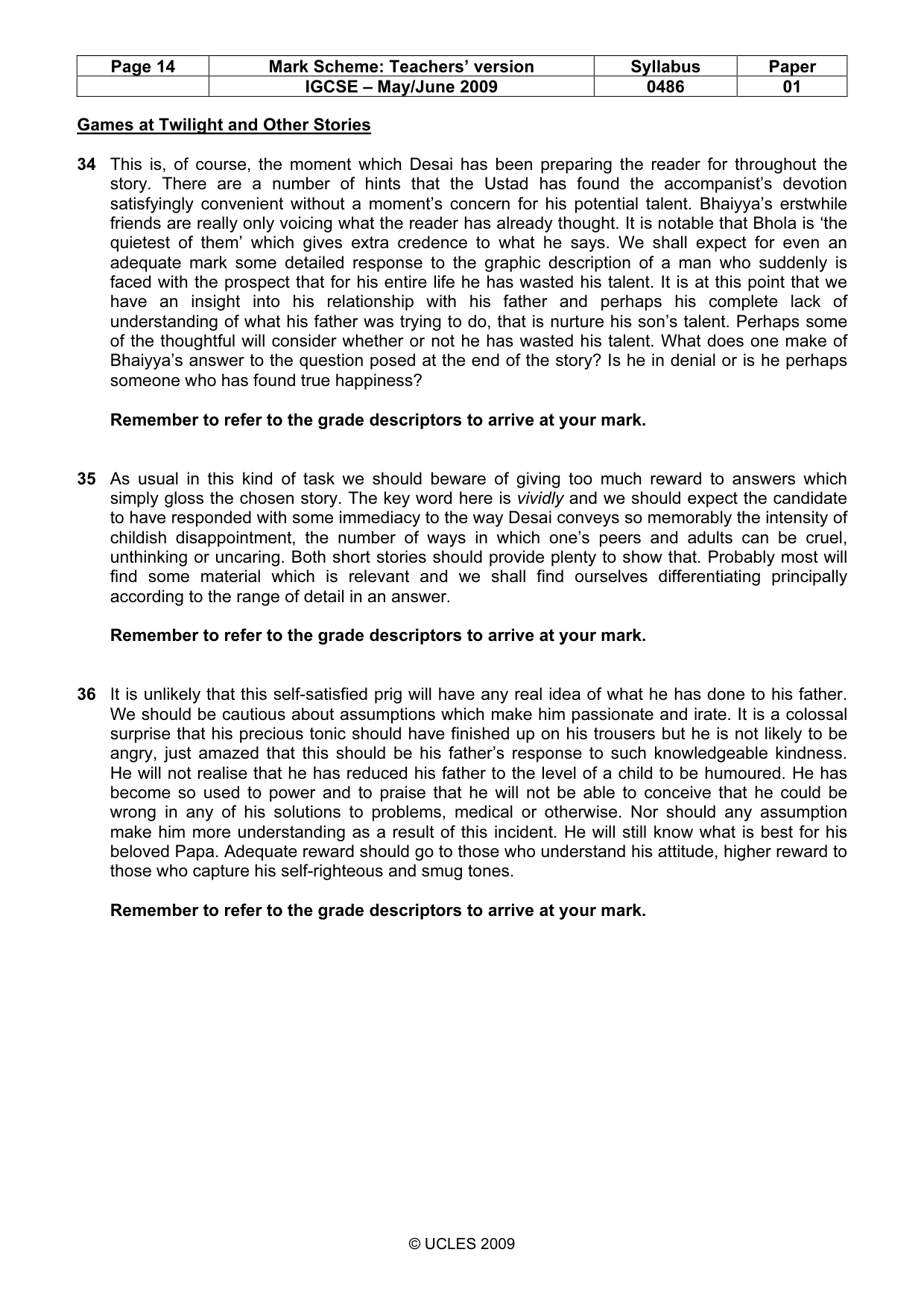
Page 14 Mark Scheme: Teachers’ version Syllabus Paper IGCSE – May/June 2009 0486 01 © UCLES 2009 Games at Twilight and Other Stories 34 This is, of course, the moment which Desai has been preparing the reader for throughout the story. There are a number of hints that the Ustad has found the accompanist’s devotion satisfyingly convenient without a moment’s concern for his potential talent. Bhaiyya’s erstwhile friends are really only voicing what the reader has already thought. It is notable that Bhola is ‘the quietest of them’ which gives extra credence to what he says. We shall expect for even an adequate mark some detailed response to the graphic description of a man who suddenly is faced with the prospect that for his entire life he has wasted his talent. It is at this point that we have an insight into his relationship with his father and perhaps his complete lack of understanding of what his father was trying to do, that is nurture his son’s talent. Perhaps some of the thoughtful will consider whether or not he has wasted his talent. What does one make of Bhaiyya’s answer to the question posed at the end of the story? Is he in denial or is he perhaps someone who has found true happiness? Remember to refer to the grade descriptors to arrive at your mark. 35 As usual in this kind of task we should beware of giving too much reward to answers which simply gloss the chosen story. The key word here is vividly and we should expect the candidate to have responded with some immediacy to the way Desai conveys so memorably the intensity of childish disappointment, the number of ways in which one’s peers and adults can be cruel, unthinking or uncaring. Both short stories should provide plenty to show that. Probably most will find some material which is relevant and we shall find ourselves differentiating principally according to the range of detail in an answer. Remember to refer to the grade descriptors to arrive at your mark. 36 It is unlikely that this self-satisfied prig will have any real idea of what he has done to his father. We should be cautious about assumptions which make him passionate and irate. It is a colossal surprise that his precious tonic should have finished up on his trousers but he is not likely to be angry, just amazed that this should be his father’s response to such knowledgeable kindness. He will not realise that he has reduced his father to the level of a child to be humoured. He has become so used to power and to praise that he will not be able to conceive that he could be wrong in any of his solutions to problems, medical or otherwise. Nor should any assumption make him more understanding as a result of this incident. He will still know what is best for his beloved Papa. Adequate reward should go to those who understand his attitude, higher reward to those who capture his self-righteous and smug tones. Remember to refer to the grade descriptors to arrive at your mark.
Mark scheme, page 15
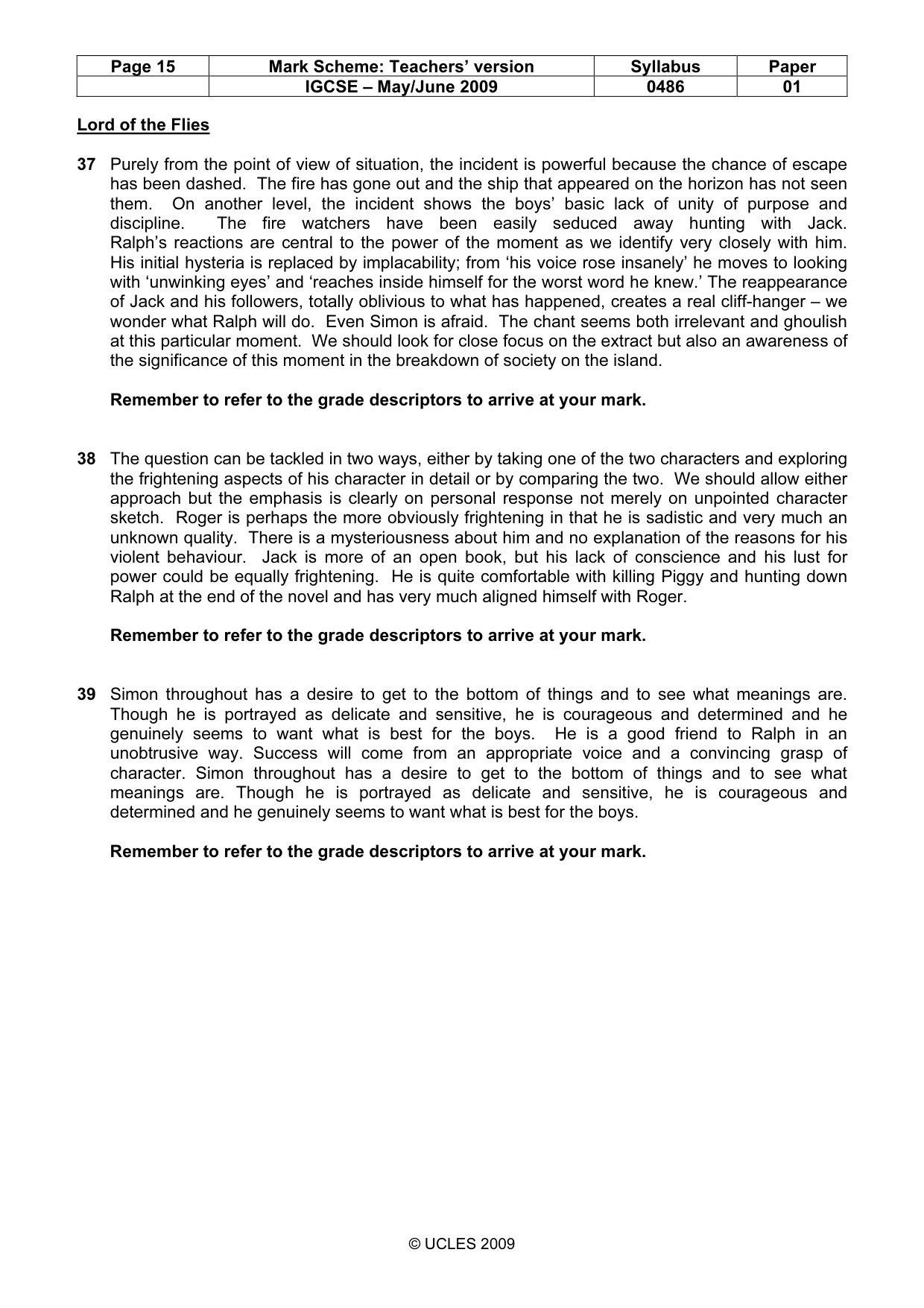
Page 15 Mark Scheme: Teachers’ version Syllabus Paper IGCSE – May/June 2009 0486 01 © UCLES 2009 Lord of the Flies 37 Purely from the point of view of situation, the incident is powerful because the chance of escape has been dashed. The fire has gone out and the ship that appeared on the horizon has not seen them. On another level, the incident shows the boys’ basic lack of unity of purpose and discipline. The fire watchers have been easily seduced away hunting with Jack. Ralph’s reactions are central to the power of the moment as we identify very closely with him. His initial hysteria is replaced by implacability; from ‘his voice rose insanely’ he moves to looking with ‘unwinking eyes’ and ‘reaches inside himself for the worst word he knew.’ The reappearance of Jack and his followers, totally oblivious to what has happened, creates a real cliff-hanger – we wonder what Ralph will do. Even Simon is afraid. The chant seems both irrelevant and ghoulish at this particular moment. We should look for close focus on the extract but also an awareness of the significance of this moment in the breakdown of society on the island. Remember to refer to the grade descriptors to arrive at your mark. 38 The question can be tackled in two ways, either by taking one of the two characters and exploring the frightening aspects of his character in detail or by comparing the two. We should allow either approach but the emphasis is clearly on personal response not merely on unpointed character sketch. Roger is perhaps the more obviously frightening in that he is sadistic and very much an unknown quality. There is a mysteriousness about him and no explanation of the reasons for his violent behaviour. Jack is more of an open book, but his lack of conscience and his lust for power could be equally frightening. He is quite comfortable with killing Piggy and hunting down Ralph at the end of the novel and has very much aligned himself with Roger. Remember to refer to the grade descriptors to arrive at your mark. 39 Simon throughout has a desire to get to the bottom of things and to see what meanings are. Though he is portrayed as delicate and sensitive, he is courageous and determined and he genuinely seems to want what is best for the boys. He is a good friend to Ralph in an unobtrusive way. Success will come from an appropriate voice and a convincing grasp of character. Simon throughout has a desire to get to the bottom of things and to see what meanings are. Though he is portrayed as delicate and sensitive, he is courageous and determined and he genuinely seems to want what is best for the boys. Remember to refer to the grade descriptors to arrive at your mark.
Mark scheme, page 16
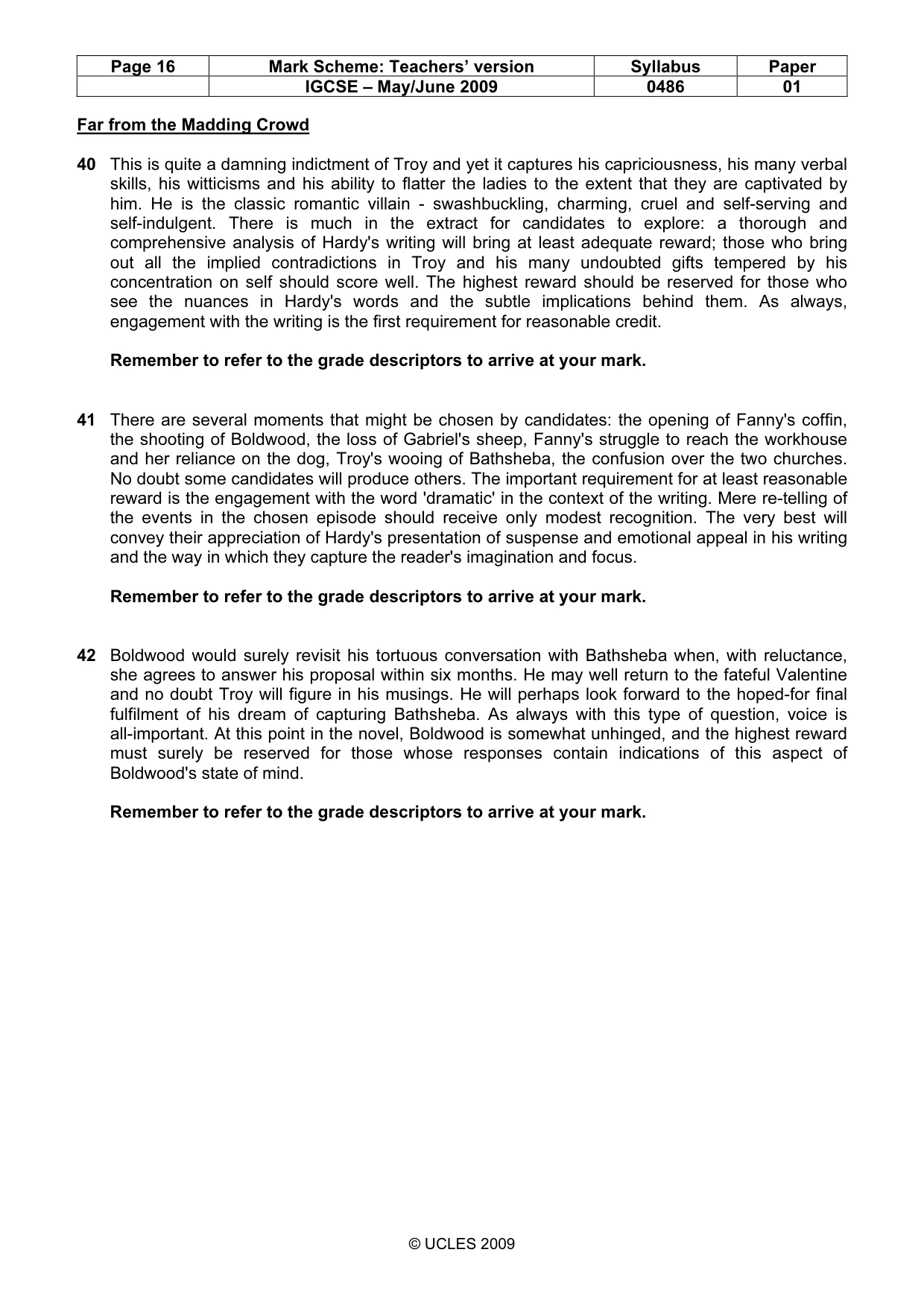
Page 16 Mark Scheme: Teachers’ version Syllabus Paper IGCSE – May/June 2009 0486 01 © UCLES 2009 Far from the Madding Crowd 40 This is quite a damning indictment of Troy and yet it captures his capriciousness, his many verbal skills, his witticisms and his ability to flatter the ladies to the extent that they are captivated by him. He is the classic romantic villain - swashbuckling, charming, cruel and self-serving and self-indulgent. There is much in the extract for candidates to explore: a thorough and comprehensive analysis of Hardy's writing will bring at least adequate reward; those who bring out all the implied contradictions in Troy and his many undoubted gifts tempered by his concentration on self should score well. The highest reward should be reserved for those who see the nuances in Hardy's words and the subtle implications behind them. As always, engagement with the writing is the first requirement for reasonable credit. Remember to refer to the grade descriptors to arrive at your mark. 41 There are several moments that might be chosen by candidates: the opening of Fanny's coffin, the shooting of Boldwood, the loss of Gabriel's sheep, Fanny's struggle to reach the workhouse and her reliance on the dog, Troy's wooing of Bathsheba, the confusion over the two churches. No doubt some candidates will produce others. The important requirement for at least reasonable reward is the engagement with the word 'dramatic' in the context of the writing. Mere re-telling of the events in the chosen episode should receive only modest recognition. The very best will convey their appreciation of Hardy's presentation of suspense and emotional appeal in his writing and the way in which they capture the reader's imagination and focus. Remember to refer to the grade descriptors to arrive at your mark. 42 Boldwood would surely revisit his tortuous conversation with Bathsheba when, with reluctance, she agrees to answer his proposal within six months. He may well return to the fateful Valentine and no doubt Troy will figure in his musings. He will perhaps look forward to the hoped-for final fulfilment of his dream of capturing Bathsheba. As always with this type of question, voice is all-important. At this point in the novel, Boldwood is somewhat unhinged, and the highest reward must surely be reserved for those whose responses contain indications of this aspect of Boldwood's state of mind. Remember to refer to the grade descriptors to arrive at your mark.
Mark scheme, page 17
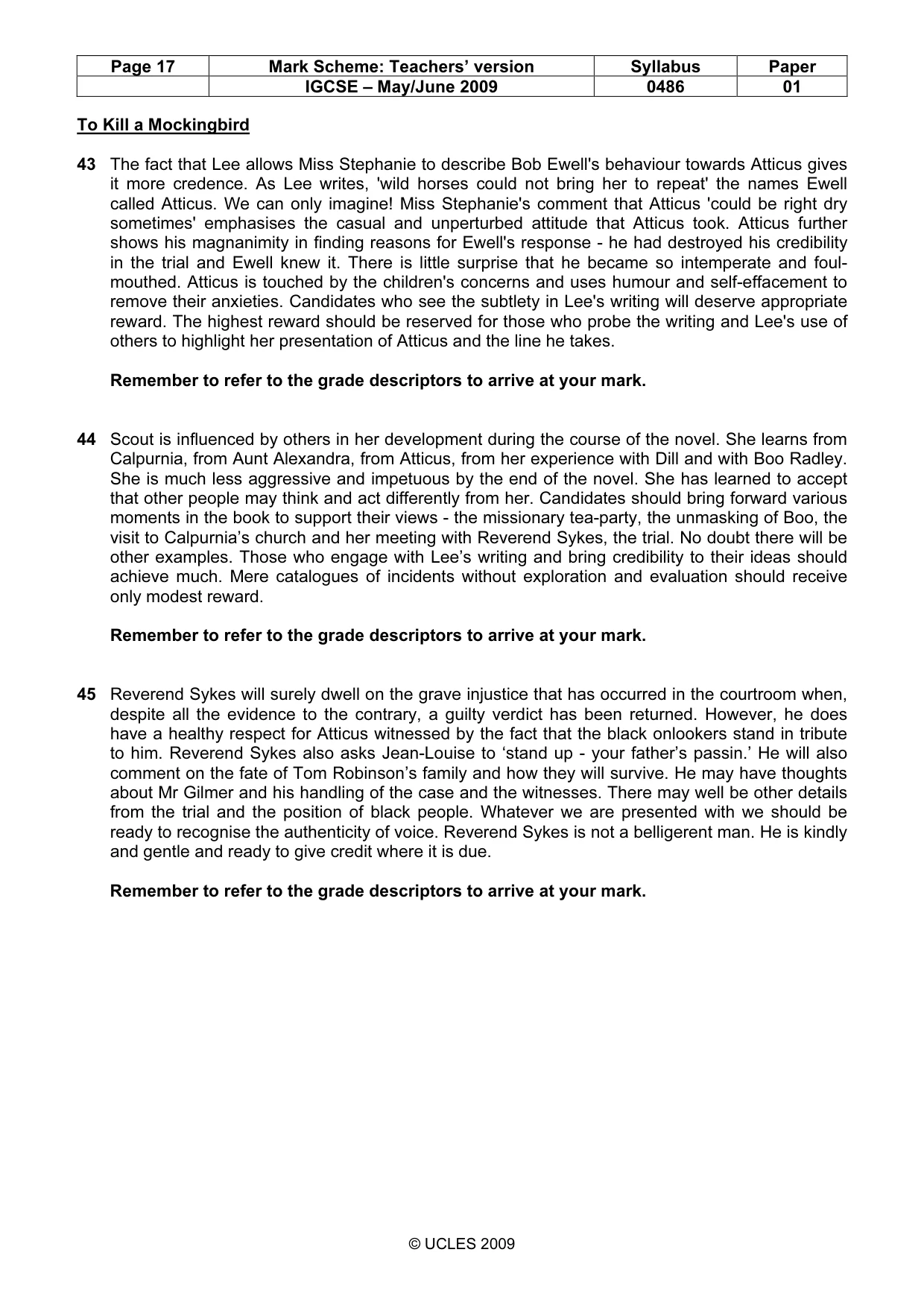
Page 17 Mark Scheme: Teachers’ version Syllabus Paper IGCSE – May/June 2009 0486 01 © UCLES 2009 To Kill a Mockingbird 43 The fact that Lee allows Miss Stephanie to describe Bob Ewell's behaviour towards Atticus gives it more credence. As Lee writes, 'wild horses could not bring her to repeat' the names Ewell called Atticus. We can only imagine! Miss Stephanie's comment that Atticus 'could be right dry sometimes' emphasises the casual and unperturbed attitude that Atticus took. Atticus further shows his magnanimity in finding reasons for Ewell's response - he had destroyed his credibility in the trial and Ewell knew it. There is little surprise that he became so intemperate and foul- mouthed. Atticus is touched by the children's concerns and uses humour and self-effacement to remove their anxieties. Candidates who see the subtlety in Lee's writing will deserve appropriate reward. The highest reward should be reserved for those who probe the writing and Lee's use of others to highlight her presentation of Atticus and the line he takes. Remember to refer to the grade descriptors to arrive at your mark. 44 Scout is influenced by others in her development during the course of the novel. She learns from Calpurnia, from Aunt Alexandra, from Atticus, from her experience with Dill and with Boo Radley. She is much less aggressive and impetuous by the end of the novel. She has learned to accept that other people may think and act differently from her. Candidates should bring forward various moments in the book to support their views - the missionary tea-party, the unmasking of Boo, the visit to Calpurnia’s church and her meeting with Reverend Sykes, the trial. No doubt there will be other examples. Those who engage with Lee’s writing and bring credibility to their ideas should achieve much. Mere catalogues of incidents without exploration and evaluation should receive only modest reward. Remember to refer to the grade descriptors to arrive at your mark. 45 Reverend Sykes will surely dwell on the grave injustice that has occurred in the courtroom when, despite all the evidence to the contrary, a guilty verdict has been returned. However, he does have a healthy respect for Atticus witnessed by the fact that the black onlookers stand in tribute to him. Reverend Sykes also asks Jean-Louise to ‘stand up - your father’s passin.’ He will also comment on the fate of Tom Robinson’s family and how they will survive. He may have thoughts about Mr Gilmer and his handling of the case and the witnesses. There may well be other details from the trial and the position of black people. Whatever we are presented with we should be ready to recognise the authenticity of voice. Reverend Sykes is not a belligerent man. He is kindly and gentle and ready to give credit where it is due. Remember to refer to the grade descriptors to arrive at your mark.
Mark scheme, page 18
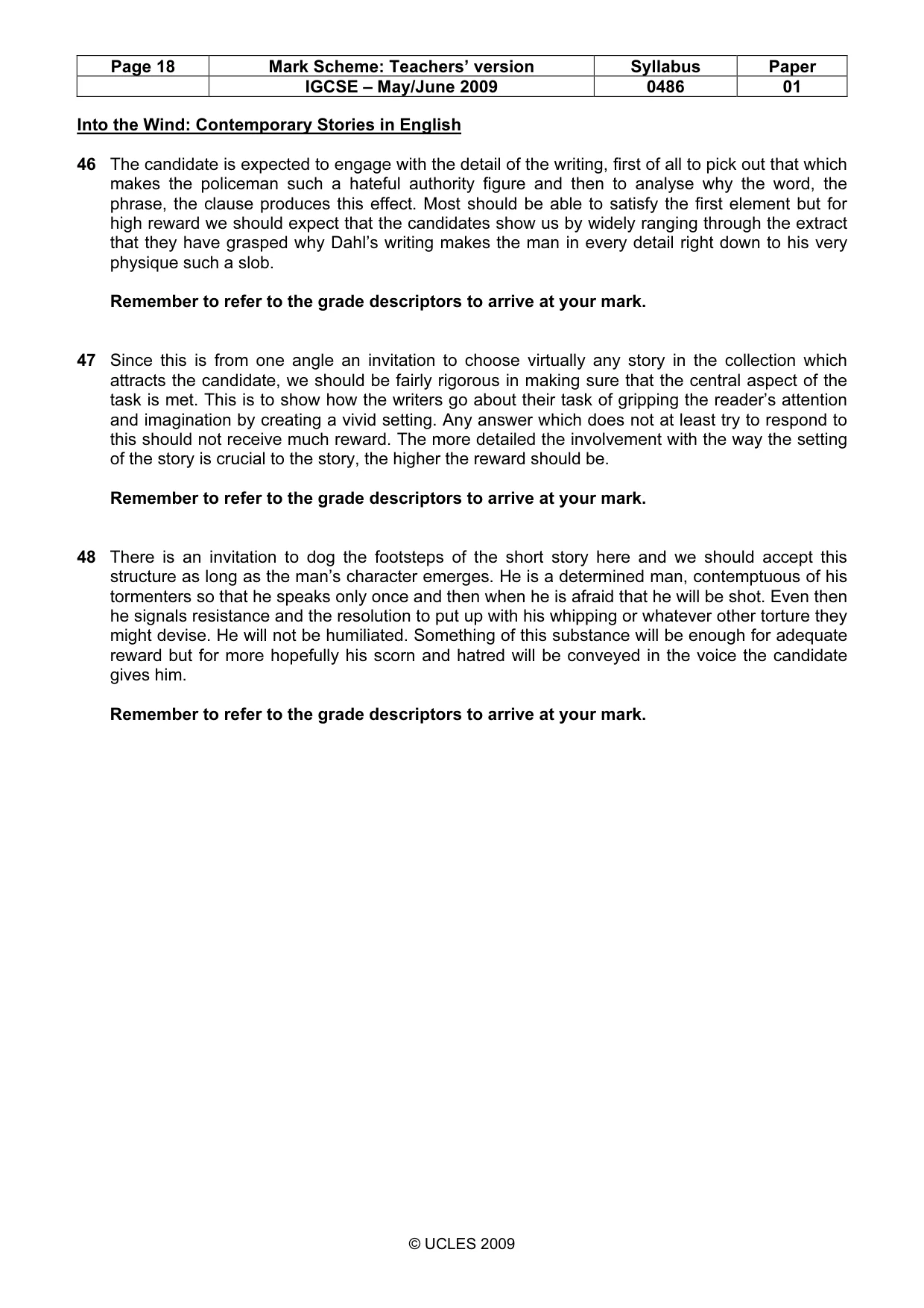
Page 18 Mark Scheme: Teachers’ version Syllabus Paper IGCSE – May/June 2009 0486 01 © UCLES 2009 Into the Wind: Contemporary Stories in English 46 The candidate is expected to engage with the detail of the writing, first of all to pick out that which makes the policeman such a hateful authority figure and then to analyse why the word, the phrase, the clause produces this effect. Most should be able to satisfy the first element but for high reward we should expect that the candidates show us by widely ranging through the extract that they have grasped why Dahl’s writing makes the man in every detail right down to his very physique such a slob. Remember to refer to the grade descriptors to arrive at your mark. 47 Since this is from one angle an invitation to choose virtually any story in the collection which attracts the candidate, we should be fairly rigorous in making sure that the central aspect of the task is met. This is to show how the writers go about their task of gripping the reader’s attention and imagination by creating a vivid setting. Any answer which does not at least try to respond to this should not receive much reward. The more detailed the involvement with the way the setting of the story is crucial to the story, the higher the reward should be. Remember to refer to the grade descriptors to arrive at your mark. 48 There is an invitation to dog the footsteps of the short story here and we should accept this structure as long as the man’s character emerges. He is a determined man, contemptuous of his tormenters so that he speaks only once and then when he is afraid that he will be shot. Even then he signals resistance and the resolution to put up with his whipping or whatever other torture they might devise. He will not be humiliated. Something of this substance will be enough for adequate reward but for more hopefully his scorn and hatred will be conveyed in the voice the candidate gives him. Remember to refer to the grade descriptors to arrive at your mark.
What you needed in this session
Cambridge’s own grade thresholds for 2009 May/June, Paper 1 · Variant 1. A higher threshold means an easier paper — the bar moves with how the cohort did.