Cambridge IGCSE English - Literature 0486 — 2008 May/June Paper 1 · Variant 1
0486/11/M/J/08 · 60 marks · ≈68 min
The question paper and its mark scheme, free to read here and free to download. This is Cambridge’s own paper, exactly as it was sat.
Question paper8 pages

Mark scheme18 pages
Answers below. Sit the paper first if you are practising.
Paper as text
Question paper, page 1
This document consists of 7 printed pages and 1 blank page. SP (NH) T50031/5 © UCLES 2008 [Turn over UNIVERSITY OF CAMBRIDGE INTERNATIONAL EXAMINATIONS International General Certificate of Secondary Education READ THESE INSTRUCTIONS FIRST If you have been given an Answer Booklet, follow the instructions on the front cover of the Booklet. Write your Centre number, candidate number and name on all the work you hand in. Write in dark blue or black pen. Do not use staples, paper clips, highlighters, glue or correction fluid. Answer three questions: one question from Section A, one question from Section B, and one question from Section C. At least one of these must be a passage-based question (marked *). At the end of the examination, fasten all your work securely together. All questions in this paper carry equal marks. * 0 4 0 5 6 5 4 9 4 6 * LITERATURE (ENGLISH) 0486/01 Paper 1 English Texts May/June 2008 2 hours 15 minutes Additional Materials: Answer Booklet/Paper Texts studied should be taken into the examination room. www.XtremePapers.com
Question paper, page 2
2 0486/01/M/J/08 © UCLES 2008 SECTION A: DRAMA Answer one question from this section. ALAN AYCKBOURN: A Small Family Business EITHER *1 Re-read in Act 1 from Jack: [a horrid thought ] We’re not meant to be going out?’ (p. 137 Faber) to ‘Jack: … Oh, for crying out loud!’ (p. 140). How do you think Ayckbourn makes this extract, towards the beginning of the play, so amusing? Support your ideas with details from the extract. OR 2 In what ways does Ayckbourn amusingly show how easy it is for decent people to become criminals? Support your ideas with details from the writing. OR 3 You are Jack at the end of the play. Write your thoughts. LORRAINE HANSBERRY: A Raisin in the Sun EITHER *4 Re-read in Act 2, Scene 3 (Methuen pages 93–95) from ‘Bobo: This deal that me and Walter went into with Willy’ to ‘Bobo: … I had my life staked on this deal, too.’ What makes this such a powerfully dramatic moment in the play? OR 5 How does Hansberry make it clear to you that Asagai is a better partner for Beneatha than George is? Support your answer with details from the play. OR 6 You are Ruth. Mama has just told Walter that you are expecting another baby. Write your thoughts. ARTHUR MILLER: The Crucible EITHER *7 Re-read in Act 2 from ‘Proctor (wide-eyed): Oh, it is a black mischief.’ (p. 44 Heinemann) to ‘Proctor (laughing bitterly): Oh, Elizabeth, your justice would freeze beer!’ How does Miller make you sympathise here with these two unhappily married people? Support your ideas with details from the writing. OR 8 How does Miller make vivid the triumph of superstition over reason and common sense in Salem? Support your ideas with details from the play. OR 9 You are Abigail as you make your escape from Salem. Write your thoughts.
Question paper, page 3
3 0486/01/M/J/08 © UCLES 2008 [Turn over WILLIAM SHAKESPEARE: As You Like It EITHER *10 Re-read the beginning of Act 1, lines 1–52, from ‘Orlando: As I remember, Adam, it was upon this fashion bequeathed me by will’ to ‘Orlando: I am no villain; I am the youngest son of Sir Rowland de Boys’. What makes this such a striking opening to the play? OR 11 How does Shakespeare make Rosalind such an attractive heroine? Support your answer by close reference to the play. OR 12 You are Duke Senior at the end of the play, reflecting on your time in the Forest. Write your thoughts. WILLIAM SHAKESPEARE: Macbeth EITHER *13 Re-read in Act 2 Scene 2 from ‘Macbeth: I have done the deed’ to ‘Macbeth: Wake Duncan with thy knocking! I would thou couldst!’ How does Shakespeare make the horror of this scene so memorable for you? OR 14 Explore the ways in which Shakespeare makes Macbeth’s brutality as a king so terrifying. Support your ideas with details from the play. OR 15 You are Lady Macbeth just after the banquet has come to such a disastrous end. You are now alone. Write your thoughts. TENNESSEE WILLIAMS: A Streetcar Named Desire EITHER *16 Re-read from Scene 9 page 204 (Penguin) from ‘Blanche: I’ll tell you what I want’ to page 205 ‘Blanche: Never inside, I didn’t lie in my heart …’ What does Williams make you feel about Blanche in this extract? OR 17 A loving and loyal wife A weak woman, easily led and naive How far do you think both these descriptions apply to Stella? Refer to details in the play in your answer. OR 18 You are Stanley, the day after hearing Blanche refer to you as acting ‘like an animal’, ‘a survivor of the Stone Age’, and ‘sub-human’. Write your thoughts.
Question paper, page 4
4 0486/01/M/J/08 © UCLES 2008 SECTION B: POETRY Answer one question from this section. Songs of Ourselves: Section 3 EITHER *19 Re-read Farmhand (by James K. Baxter). How do you think the poet’s words make this man such a moving figure? OR 20 Explore the ways in which the poet vividly conveys a child’s experiences in either Rising Five (by Norman Nicholson) or Little Boy Crying (by Mervyn Morris). OR 21 Explore some of the descriptions which you find particularly effective in Carpet Weavers, Morocco (by Carol Rumens) and Muliebrity (by Sujata Bhatt). JOHN KEATS: Poems EITHER *22 Re-read stanzas 1–3 (lines 1–30) of Ode on a Grecian Urn. Explore the ways in which Keats brings to life for you the figures on the urn in these stanzas. OR 23 Show how, in the extract from Endymion (lines 1–33), Keats finds beauty in the world. OR 24 Explore Keats’s presentation of melancholy in his Ode on Melancholy.
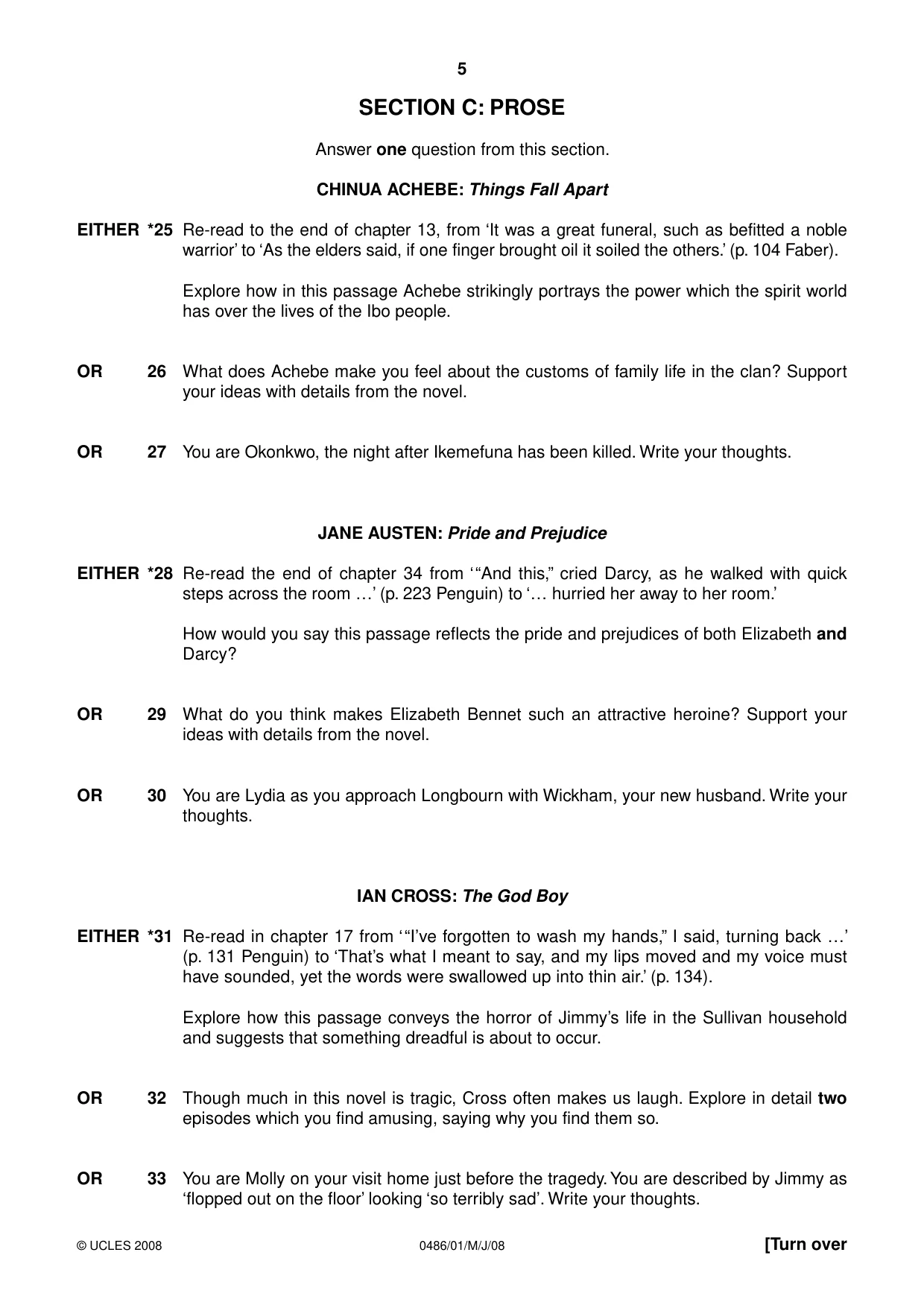
Question paper, page 5
5 0486/01/M/J/08 © UCLES 2008 [Turn over SECTION C: PROSE Answer one question from this section. CHINUA ACHEBE: Things Fall Apart EITHER *25 Re-read to the end of chapter 13, from ‘It was a great funeral, such as befitted a noble warrior’ to ‘As the elders said, if one finger brought oil it soiled the others.’ (p. 104 Faber). Explore how in this passage Achebe strikingly portrays the power which the spirit world has over the lives of the Ibo people. OR 26 What does Achebe make you feel about the customs of family life in the clan? Support your ideas with details from the novel. OR 27 You are Okonkwo, the night after Ikemefuna has been killed. Write your thoughts. JANE AUSTEN: Pride and Prejudice EITHER *28 Re-read the end of chapter 34 from ‘ “And this,” cried Darcy, as he walked with quick steps across the room …’ (p. 223 Penguin) to ‘… hurried her away to her room.’ How would you say this passage reflects the pride and prejudices of both Elizabeth and Darcy? OR 29 What do you think makes Elizabeth Bennet such an attractive heroine? Support your ideas with details from the novel. OR 30 You are Lydia as you approach Longbourn with Wickham, your new husband. Write your thoughts. IAN CROSS: The God Boy EITHER *31 Re-read in chapter 17 from ‘ “I’ve forgotten to wash my hands,” I said, turning back …’ (p. 131 Penguin) to ‘That’s what I meant to say, and my lips moved and my voice must have sounded, yet the words were swallowed up into thin air.’ (p. 134). Explore how this passage conveys the horror of Jimmy’s life in the Sullivan household and suggests that something dreadful is about to occur. OR 32 Though much in this novel is tragic, Cross often makes us laugh. Explore in detail two episodes which you find amusing, saying why you find them so. OR 33 You are Molly on your visit home just before the tragedy. You are described by Jimmy as ‘flopped out on the floor’ looking ‘so terribly sad’. Write your thoughts.
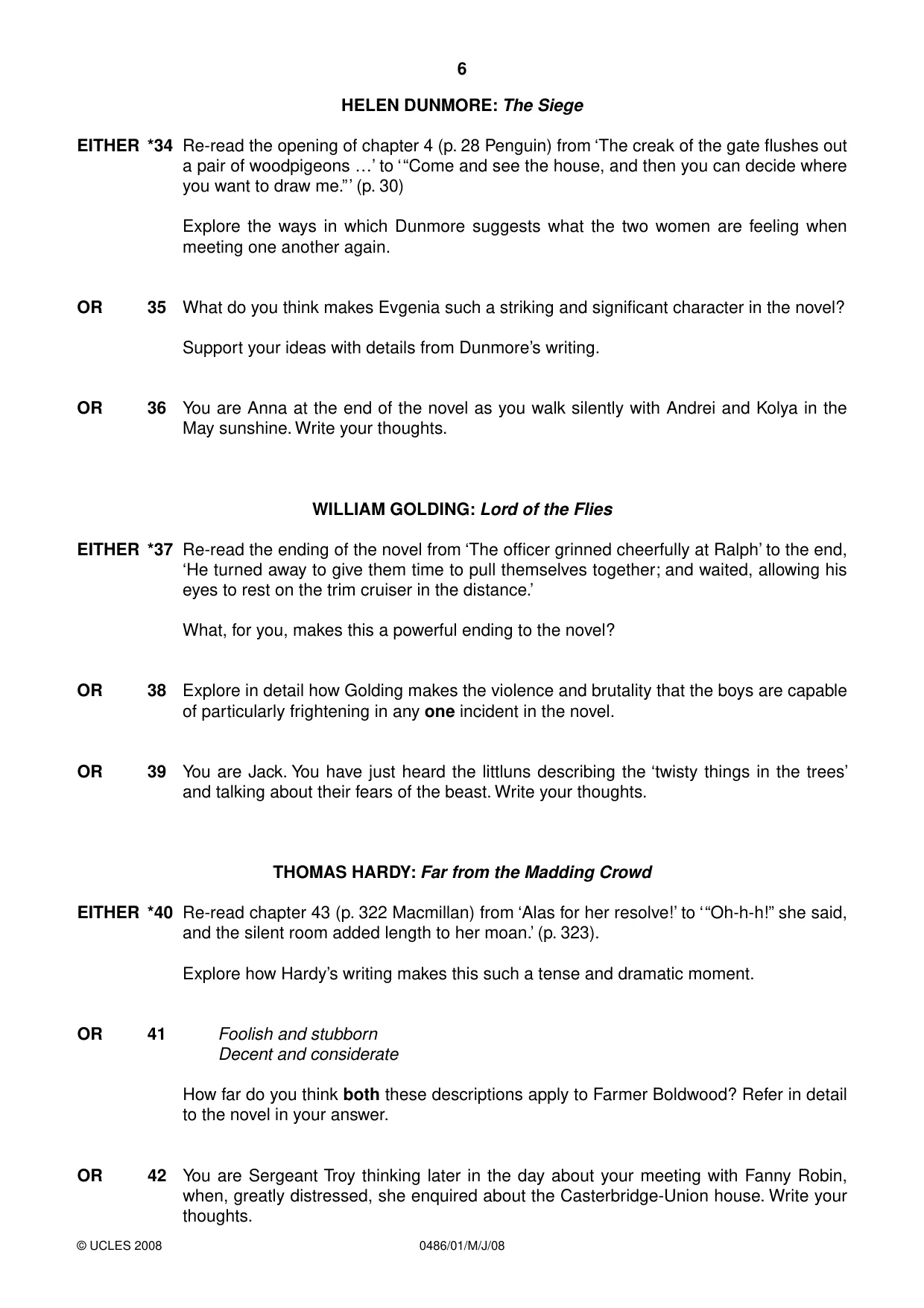
Question paper, page 6
6 0486/01/M/J/08 © UCLES 2008 HELEN DUNMORE: The Siege EITHER *34 Re-read the opening of chapter 4 (p. 28 Penguin) from ‘The creak of the gate flushes out a pair of woodpigeons …’ to ‘ “Come and see the house, and then you can decide where you want to draw me.” ’ (p. 30) Explore the ways in which Dunmore suggests what the two women are feeling when meeting one another again. OR 35 What do you think makes Evgenia such a striking and significant character in the novel? Support your ideas with details from Dunmore’s writing. OR 36 You are Anna at the end of the novel as you walk silently with Andrei and Kolya in the May sunshine. Write your thoughts. WILLIAM GOLDING: Lord of the Flies EITHER *37 Re-read the ending of the novel from ‘The officer grinned cheerfully at Ralph’ to the end, ‘He turned away to give them time to pull themselves together; and waited, allowing his eyes to rest on the trim cruiser in the distance.’ What, for you, makes this a powerful ending to the novel? OR 38 Explore in detail how Golding makes the violence and brutality that the boys are capable of particularly frightening in any one incident in the novel. OR 39 You are Jack. You have just heard the littluns describing the ‘twisty things in the trees’ and talking about their fears of the beast. Write your thoughts. THOMAS HARDY: Far from the Madding Crowd EITHER *40 Re-read chapter 43 (p. 322 Macmillan) from ‘Alas for her resolve!’ to ‘ “Oh-h-h!” she said, and the silent room added length to her moan.’ (p. 323). Explore how Hardy’s writing makes this such a tense and dramatic moment. OR 41 Foolish and stubborn Decent and considerate How far do you think both these descriptions apply to Farmer Boldwood? Refer in detail to the novel in your answer. OR 42 You are Sergeant Troy thinking later in the day about your meeting with Fanny Robin, when, greatly distressed, she enquired about the Casterbridge-Union house. Write your thoughts.
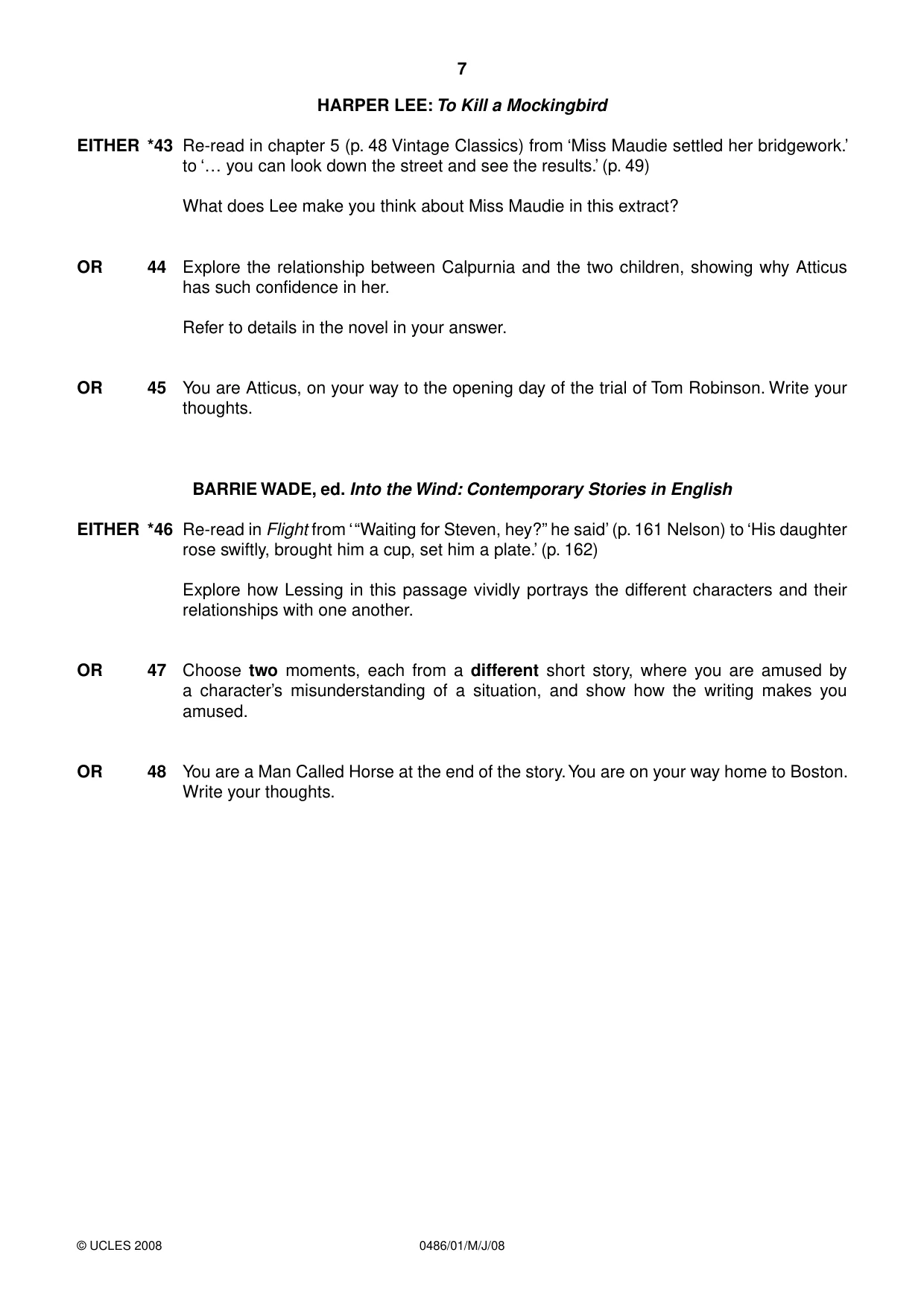
Question paper, page 7
7 0486/01/M/J/08 © UCLES 2008 HARPER LEE: To Kill a Mockingbird EITHER *43 Re-read in chapter 5 (p. 48 Vintage Classics) from ‘Miss Maudie settled her bridgework.’ to ‘… you can look down the street and see the results.’ (p. 49) What does Lee make you think about Miss Maudie in this extract? OR 44 Explore the relationship between Calpurnia and the two children, showing why Atticus has such confidence in her. Refer to details in the novel in your answer. OR 45 You are Atticus, on your way to the opening day of the trial of Tom Robinson. Write your thoughts. BARRIE WADE, ed. Into the Wind: Contemporary Stories in English EITHER *46 Re-read in Flight from ‘ “Waiting for Steven, hey?” he said’ (p. 161 Nelson) to ‘His daughter rose swiftly, brought him a cup, set him a plate.’ (p. 162) Explore how Lessing in this passage vividly portrays the different characters and their relationships with one another. OR 47 Choose two moments, each from a different short story, where you are amused by a character’s misunderstanding of a situation, and show how the writing makes you amused. OR 48 You are a Man Called Horse at the end of the story. You are on your way home to Boston. Write your thoughts.
Question paper, page 8
8 0486/01/M/J/08 © UCLES 2008 BLANK PAGE Permission to reproduce items where third-party owned material protected by copyright is included has been sought and cleared where possible. Every reasonable effort has been made by the publisher (UCLES) to trace copyright holders, but if any items requiring clearance have unwittingly been included, the publisher will be pleased to make amends at the earliest possible opportunity. University of Cambridge International Examinations is part of the Cambridge Assessment Group. Cambridge Assessment is the brand name of University of Cambridge Local Examinations Syndicate (UCLES), which is itself a department of the University of Cambridge.
Mark scheme, page 1
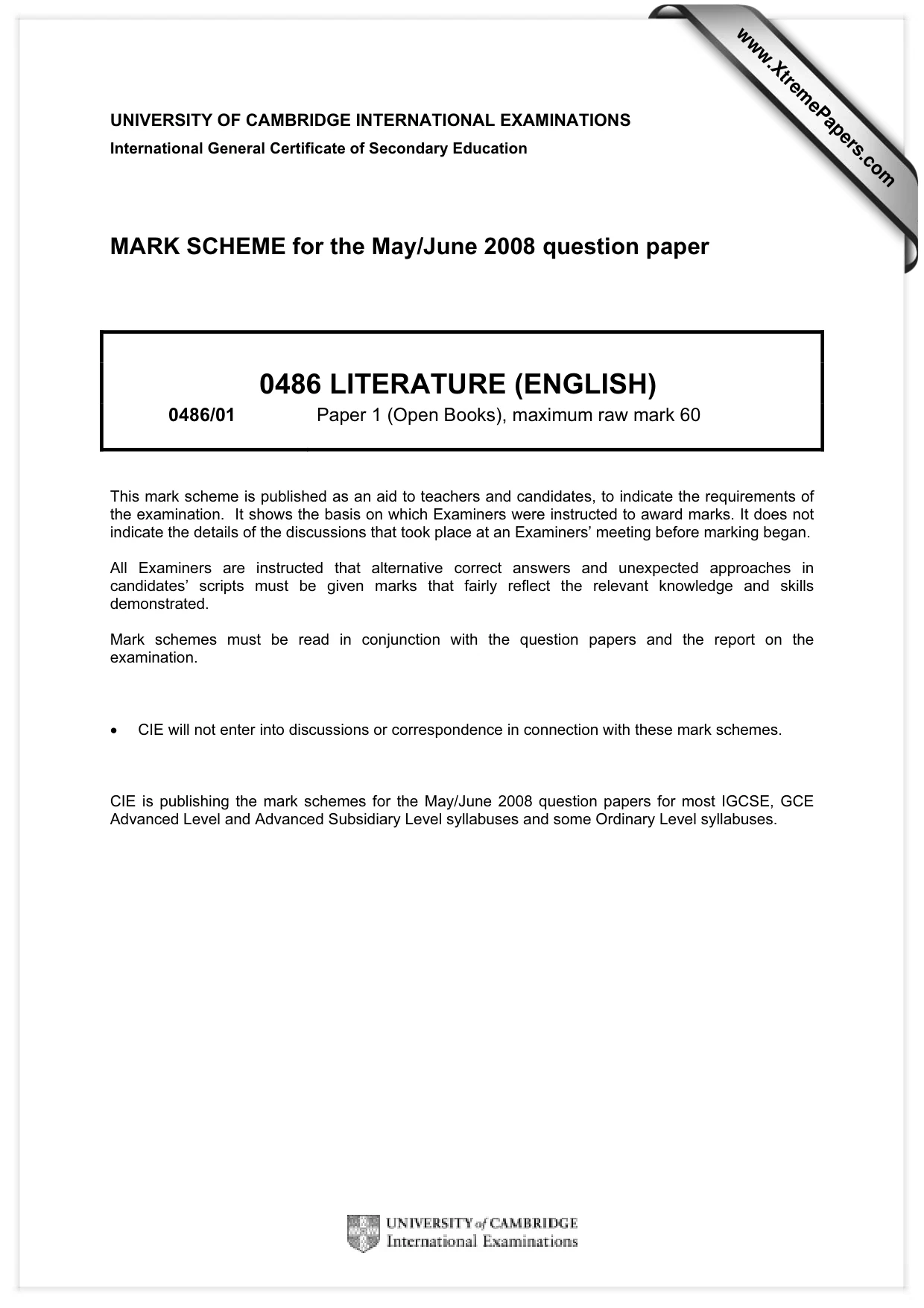
UNIVERSITY OF CAMBRIDGE INTERNATIONAL EXAMINATIONS International General Certificate of Secondary Education MARK SCHEME for the May/June 2008 question paper 0486 LITERATURE (ENGLISH) 0486/01 Paper 1 (Open Books), maximum raw mark 60 This mark scheme is published as an aid to teachers and candidates, to indicate the requirements of the examination. It shows the basis on which Examiners were instructed to award marks. It does not indicate the details of the discussions that took place at an Examiners’ meeting before marking began. All Examiners are instructed that alternative correct answers and unexpected approaches in candidates’ scripts must be given marks that fairly reflect the relevant knowledge and skills demonstrated. Mark schemes must be read in conjunction with the question papers and the report on the examination. • CIE will not enter into discussions or correspondence in connection with these mark schemes. CIE is publishing the mark schemes for the May/June 2008 question papers for most IGCSE, GCE Advanced Level and Advanced Subsidiary Level syllabuses and some Ordinary Level syllabuses. www.XtremePapers.com
Mark scheme, page 2
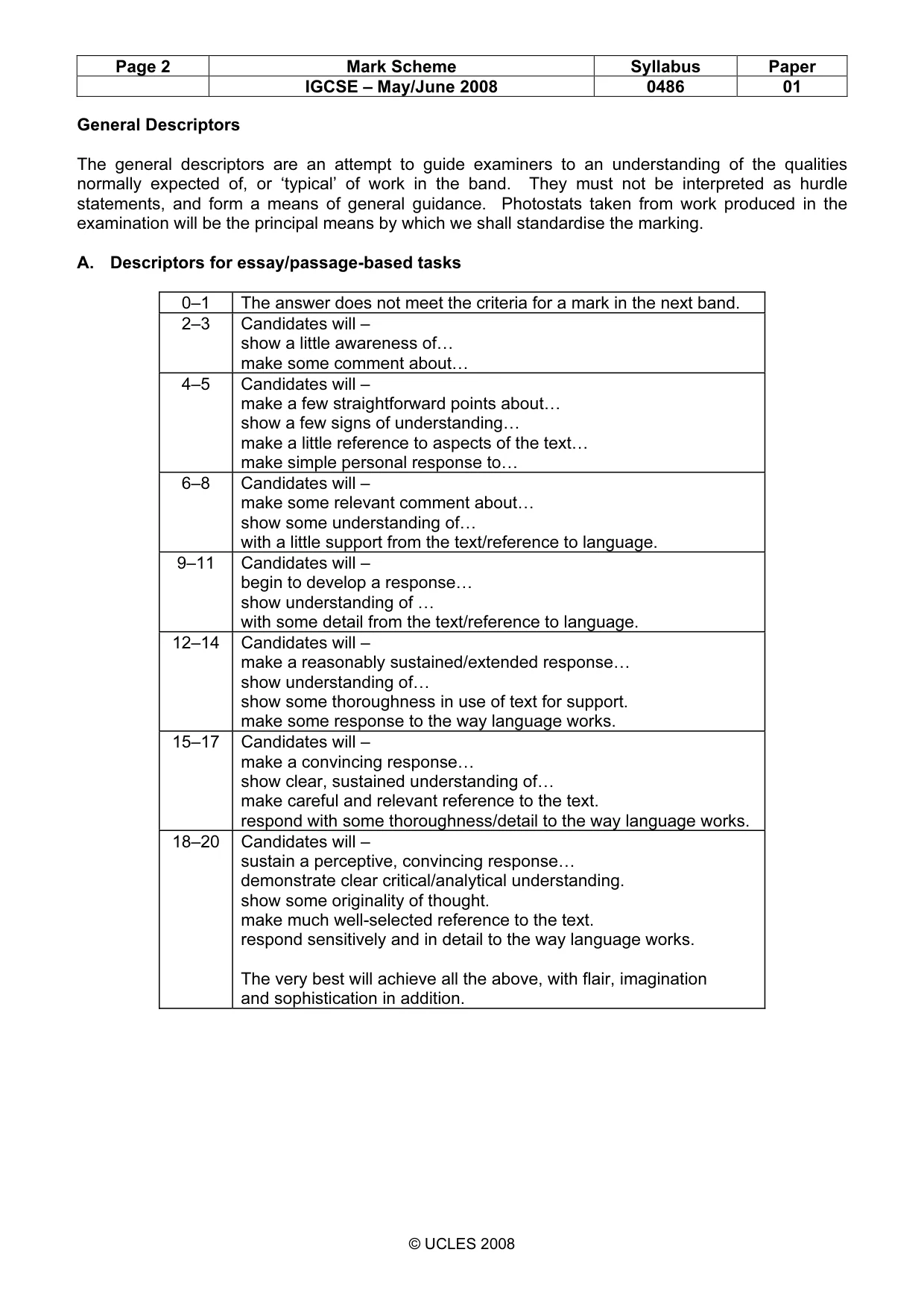
Page 2 Mark Scheme Syllabus Paper IGCSE – May/June 2008 0486 01 © UCLES 2008 General Descriptors The general descriptors are an attempt to guide examiners to an understanding of the qualities normally expected of, or ‘typical’ of work in the band. They must not be interpreted as hurdle statements, and form a means of general guidance. Photostats taken from work produced in the examination will be the principal means by which we shall standardise the marking. A. Descriptors for essay/passage-based tasks 0–1 The answer does not meet the criteria for a mark in the next band. 2–3 Candidates will – show a little awareness of… make some comment about… 4–5 Candidates will – make a few straightforward points about… show a few signs of understanding… make a little reference to aspects of the text… make simple personal response to… 6–8 Candidates will – make some relevant comment about… show some understanding of… with a little support from the text/reference to language. 9–11 Candidates will – begin to develop a response… show understanding of … with some detail from the text/reference to language. 12–14 Candidates will – make a reasonably sustained/extended response… show understanding of… show some thoroughness in use of text for support. make some response to the way language works. 15–17 Candidates will – make a convincing response… show clear, sustained understanding of… make careful and relevant reference to the text. respond with some thoroughness/detail to the way language works. 18–20 Candidates will – sustain a perceptive, convincing response… demonstrate clear critical/analytical understanding. show some originality of thought. make much well-selected reference to the text. respond sensitively and in detail to the way language works. The very best will achieve all the above, with flair, imagination and sophistication in addition.
Mark scheme, page 3
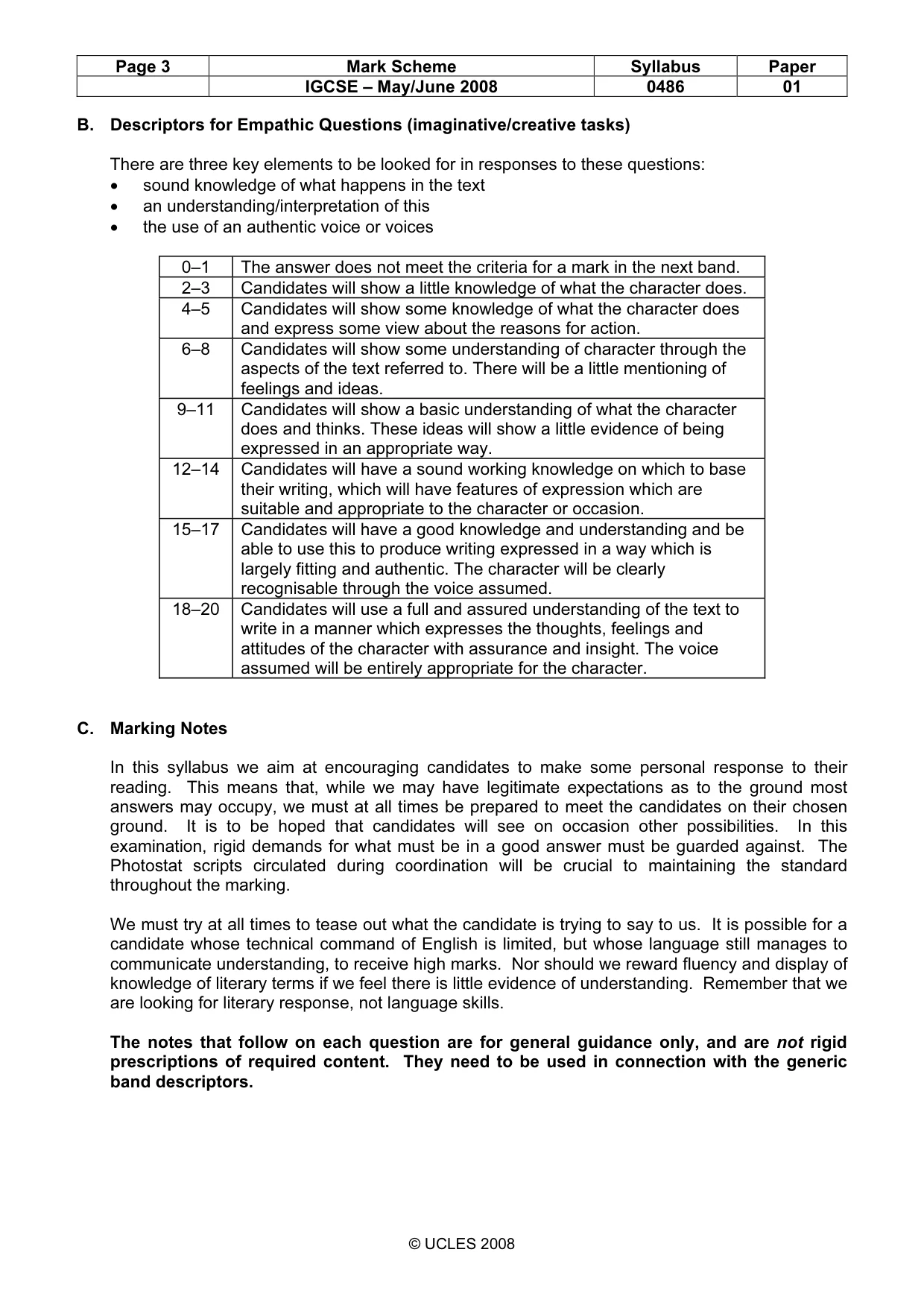
Page 3 Mark Scheme Syllabus Paper IGCSE – May/June 2008 0486 01 © UCLES 2008 B. Descriptors for Empathic Questions (imaginative/creative tasks) There are three key elements to be looked for in responses to these questions: • sound knowledge of what happens in the text • an understanding/interpretation of this • the use of an authentic voice or voices 0–1 The answer does not meet the criteria for a mark in the next band. 2–3 Candidates will show a little knowledge of what the character does. 4–5 Candidates will show some knowledge of what the character does and express some view about the reasons for action. 6–8 Candidates will show some understanding of character through the aspects of the text referred to. There will be a little mentioning of feelings and ideas. 9–11 Candidates will show a basic understanding of what the character does and thinks. These ideas will show a little evidence of being expressed in an appropriate way. 12–14 Candidates will have a sound working knowledge on which to base their writing, which will have features of expression which are suitable and appropriate to the character or occasion. 15–17 Candidates will have a good knowledge and understanding and be able to use this to produce writing expressed in a way which is largely fitting and authentic. The character will be clearly recognisable through the voice assumed. 18–20 Candidates will use a full and assured understanding of the text to write in a manner which expresses the thoughts, feelings and attitudes of the character with assurance and insight. The voice assumed will be entirely appropriate for the character. C. Marking Notes In this syllabus we aim at encouraging candidates to make some personal response to their reading. This means that, while we may have legitimate expectations as to the ground most answers may occupy, we must at all times be prepared to meet the candidates on their chosen ground. It is to be hoped that candidates will see on occasion other possibilities. In this examination, rigid demands for what must be in a good answer must be guarded against. The Photostat scripts circulated during coordination will be crucial to maintaining the standard throughout the marking. We must try at all times to tease out what the candidate is trying to say to us. It is possible for a candidate whose technical command of English is limited, but whose language still manages to communicate understanding, to receive high marks. Nor should we reward fluency and display of knowledge of literary terms if we feel there is little evidence of understanding. Remember that we are looking for literary response, not language skills. The notes that follow on each question are for general guidance only, and are not rigid prescriptions of required content. They need to be used in connection with the generic band descriptors.
Mark scheme, page 4
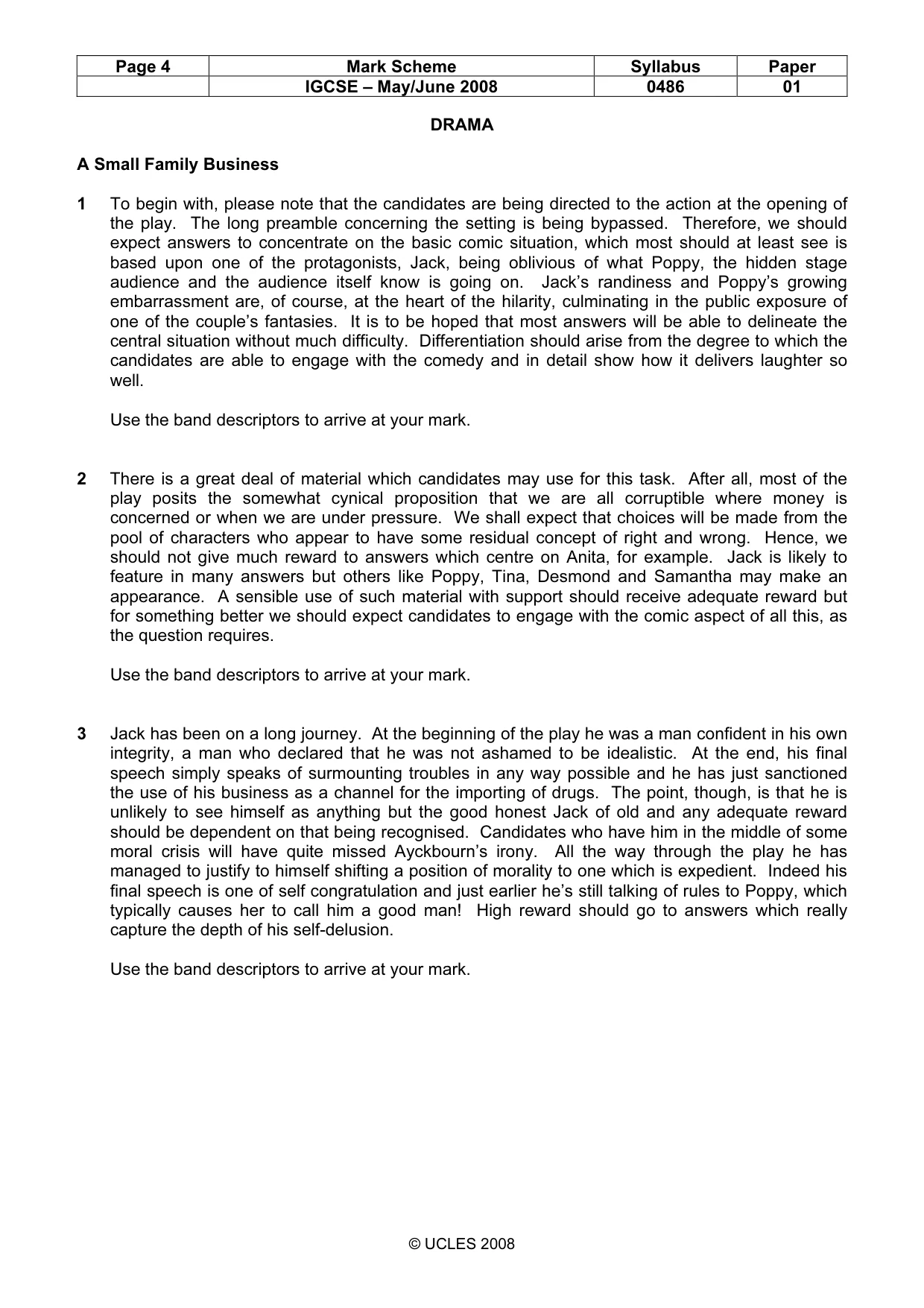
Page 4 Mark Scheme Syllabus Paper IGCSE – May/June 2008 0486 01 © UCLES 2008 DRAMA A Small Family Business 1 To begin with, please note that the candidates are being directed to the action at the opening of the play. The long preamble concerning the setting is being bypassed. Therefore, we should expect answers to concentrate on the basic comic situation, which most should at least see is based upon one of the protagonists, Jack, being oblivious of what Poppy, the hidden stage audience and the audience itself know is going on. Jack’s randiness and Poppy’s growing embarrassment are, of course, at the heart of the hilarity, culminating in the public exposure of one of the couple’s fantasies. It is to be hoped that most answers will be able to delineate the central situation without much difficulty. Differentiation should arise from the degree to which the candidates are able to engage with the comedy and in detail show how it delivers laughter so well. Use the band descriptors to arrive at your mark. 2 There is a great deal of material which candidates may use for this task. After all, most of the play posits the somewhat cynical proposition that we are all corruptible where money is concerned or when we are under pressure. We shall expect that choices will be made from the pool of characters who appear to have some residual concept of right and wrong. Hence, we should not give much reward to answers which centre on Anita, for example. Jack is likely to feature in many answers but others like Poppy, Tina, Desmond and Samantha may make an appearance. A sensible use of such material with support should receive adequate reward but for something better we should expect candidates to engage with the comic aspect of all this, as the question requires. Use the band descriptors to arrive at your mark. 3 Jack has been on a long journey. At the beginning of the play he was a man confident in his own integrity, a man who declared that he was not ashamed to be idealistic. At the end, his final speech simply speaks of surmounting troubles in any way possible and he has just sanctioned the use of his business as a channel for the importing of drugs. The point, though, is that he is unlikely to see himself as anything but the good honest Jack of old and any adequate reward should be dependent on that being recognised. Candidates who have him in the middle of some moral crisis will have quite missed Ayckbourn’s irony. All the way through the play he has managed to justify to himself shifting a position of morality to one which is expedient. Indeed his final speech is one of self congratulation and just earlier he’s still talking of rules to Poppy, which typically causes her to call him a good man! High reward should go to answers which really capture the depth of his self-delusion. Use the band descriptors to arrive at your mark.
Mark scheme, page 5
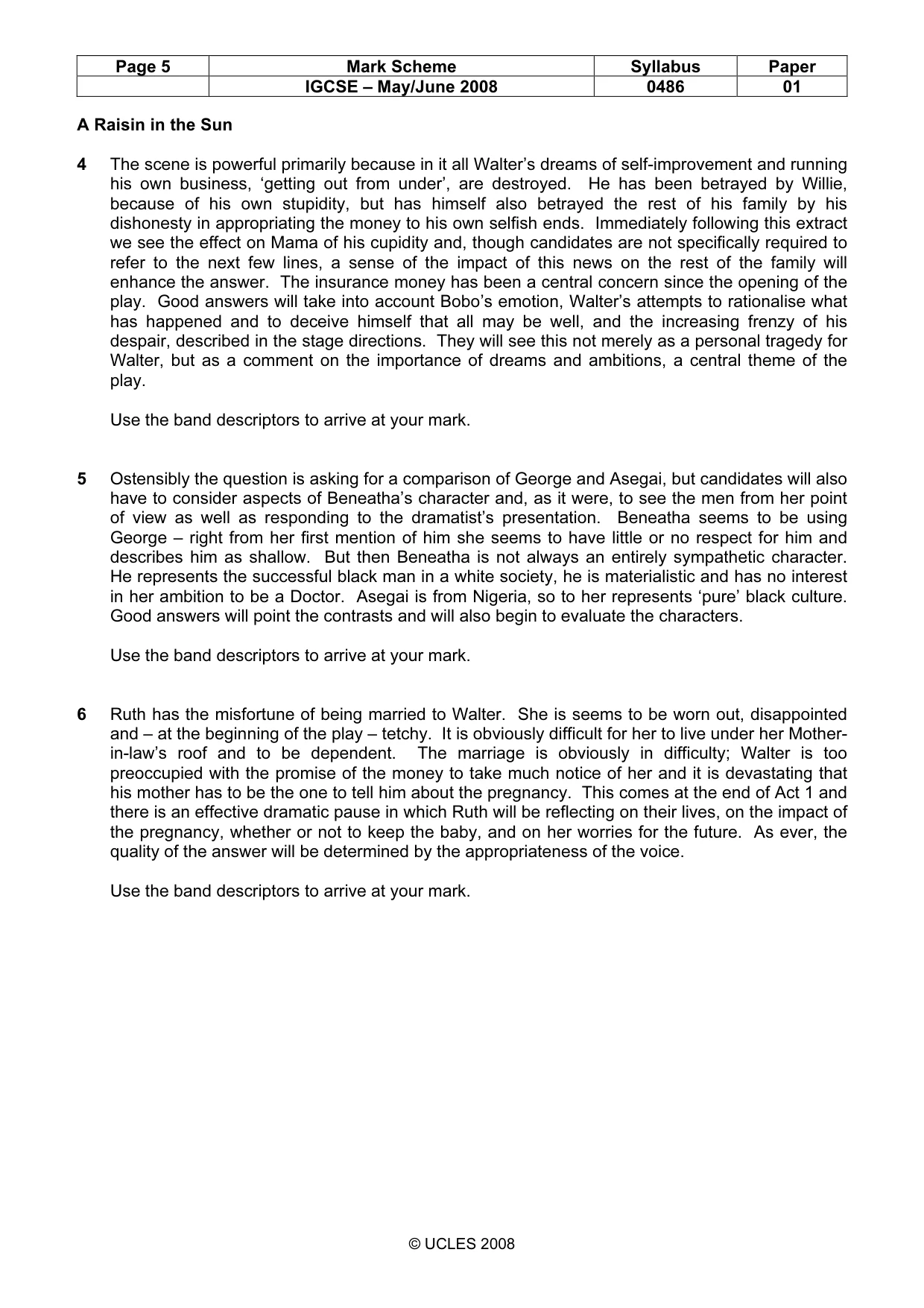
Page 5 Mark Scheme Syllabus Paper IGCSE – May/June 2008 0486 01 © UCLES 2008 A Raisin in the Sun 4 The scene is powerful primarily because in it all Walter’s dreams of self-improvement and running his own business, ‘getting out from under’, are destroyed. He has been betrayed by Willie, because of his own stupidity, but has himself also betrayed the rest of his family by his dishonesty in appropriating the money to his own selfish ends. Immediately following this extract we see the effect on Mama of his cupidity and, though candidates are not specifically required to refer to the next few lines, a sense of the impact of this news on the rest of the family will enhance the answer. The insurance money has been a central concern since the opening of the play. Good answers will take into account Bobo’s emotion, Walter’s attempts to rationalise what has happened and to deceive himself that all may be well, and the increasing frenzy of his despair, described in the stage directions. They will see this not merely as a personal tragedy for Walter, but as a comment on the importance of dreams and ambitions, a central theme of the play. Use the band descriptors to arrive at your mark. 5 Ostensibly the question is asking for a comparison of George and Asegai, but candidates will also have to consider aspects of Beneatha’s character and, as it were, to see the men from her point of view as well as responding to the dramatist’s presentation. Beneatha seems to be using George – right from her first mention of him she seems to have little or no respect for him and describes him as shallow. But then Beneatha is not always an entirely sympathetic character. He represents the successful black man in a white society, he is materialistic and has no interest in her ambition to be a Doctor. Asegai is from Nigeria, so to her represents ‘pure’ black culture. Good answers will point the contrasts and will also begin to evaluate the characters. Use the band descriptors to arrive at your mark. 6 Ruth has the misfortune of being married to Walter. She is seems to be worn out, disappointed and – at the beginning of the play – tetchy. It is obviously difficult for her to live under her Mother- in-law’s roof and to be dependent. The marriage is obviously in difficulty; Walter is too preoccupied with the promise of the money to take much notice of her and it is devastating that his mother has to be the one to tell him about the pregnancy. This comes at the end of Act 1 and there is an effective dramatic pause in which Ruth will be reflecting on their lives, on the impact of the pregnancy, whether or not to keep the baby, and on her worries for the future. As ever, the quality of the answer will be determined by the appropriateness of the voice. Use the band descriptors to arrive at your mark.
Mark scheme, page 6
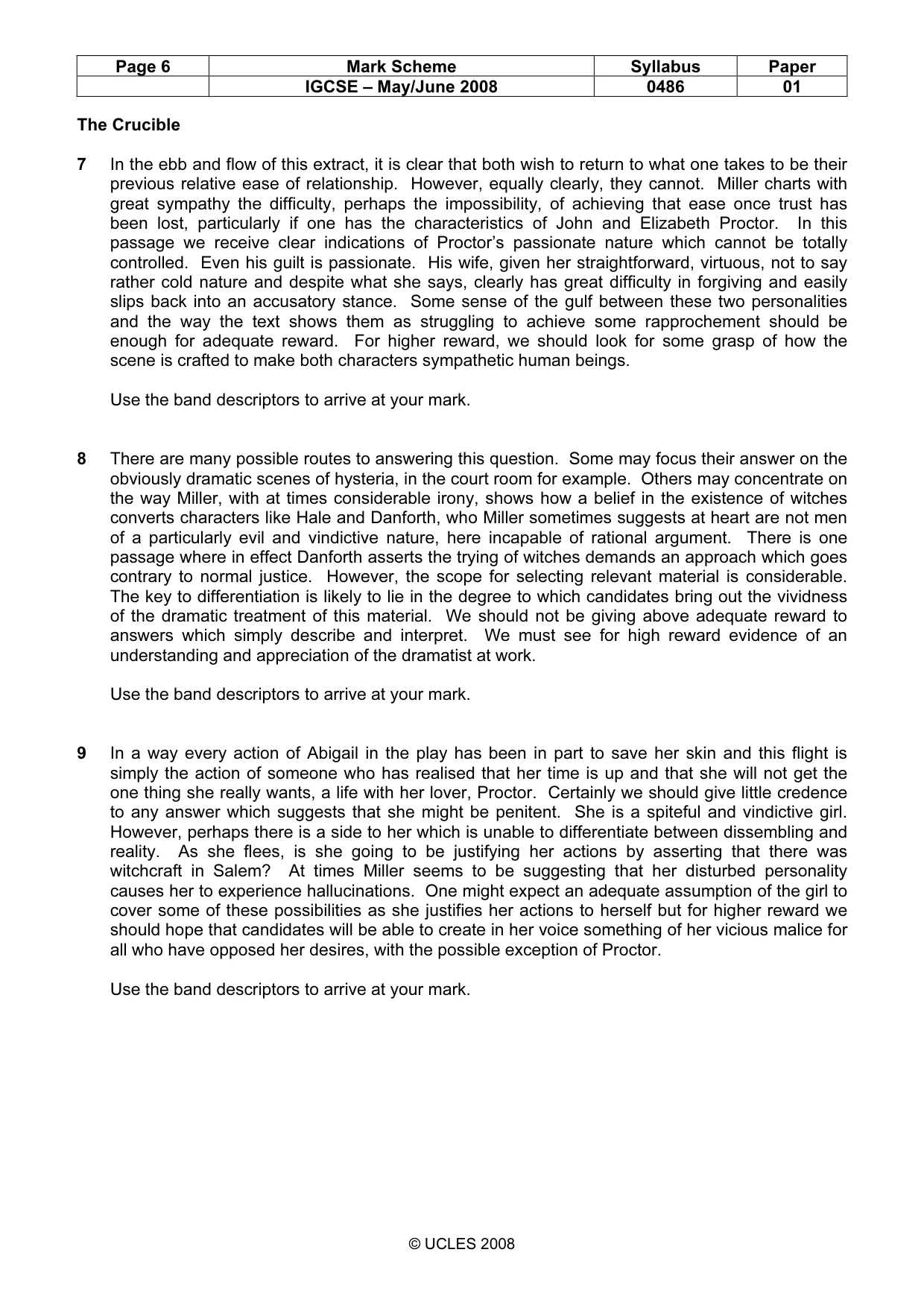
Page 6 Mark Scheme Syllabus Paper IGCSE – May/June 2008 0486 01 © UCLES 2008 The Crucible 7 In the ebb and flow of this extract, it is clear that both wish to return to what one takes to be their previous relative ease of relationship. However, equally clearly, they cannot. Miller charts with great sympathy the difficulty, perhaps the impossibility, of achieving that ease once trust has been lost, particularly if one has the characteristics of John and Elizabeth Proctor. In this passage we receive clear indications of Proctor’s passionate nature which cannot be totally controlled. Even his guilt is passionate. His wife, given her straightforward, virtuous, not to say rather cold nature and despite what she says, clearly has great difficulty in forgiving and easily slips back into an accusatory stance. Some sense of the gulf between these two personalities and the way the text shows them as struggling to achieve some rapprochement should be enough for adequate reward. For higher reward, we should look for some grasp of how the scene is crafted to make both characters sympathetic human beings. Use the band descriptors to arrive at your mark. 8 There are many possible routes to answering this question. Some may focus their answer on the obviously dramatic scenes of hysteria, in the court room for example. Others may concentrate on the way Miller, with at times considerable irony, shows how a belief in the existence of witches converts characters like Hale and Danforth, who Miller sometimes suggests at heart are not men of a particularly evil and vindictive nature, here incapable of rational argument. There is one passage where in effect Danforth asserts the trying of witches demands an approach which goes contrary to normal justice. However, the scope for selecting relevant material is considerable. The key to differentiation is likely to lie in the degree to which candidates bring out the vividness of the dramatic treatment of this material. We should not be giving above adequate reward to answers which simply describe and interpret. We must see for high reward evidence of an understanding and appreciation of the dramatist at work. Use the band descriptors to arrive at your mark. 9 In a way every action of Abigail in the play has been in part to save her skin and this flight is simply the action of someone who has realised that her time is up and that she will not get the one thing she really wants, a life with her lover, Proctor. Certainly we should give little credence to any answer which suggests that she might be penitent. She is a spiteful and vindictive girl. However, perhaps there is a side to her which is unable to differentiate between dissembling and reality. As she flees, is she going to be justifying her actions by asserting that there was witchcraft in Salem? At times Miller seems to be suggesting that her disturbed personality causes her to experience hallucinations. One might expect an adequate assumption of the girl to cover some of these possibilities as she justifies her actions to herself but for higher reward we should hope that candidates will be able to create in her voice something of her vicious malice for all who have opposed her desires, with the possible exception of Proctor. Use the band descriptors to arrive at your mark.
Mark scheme, page 7
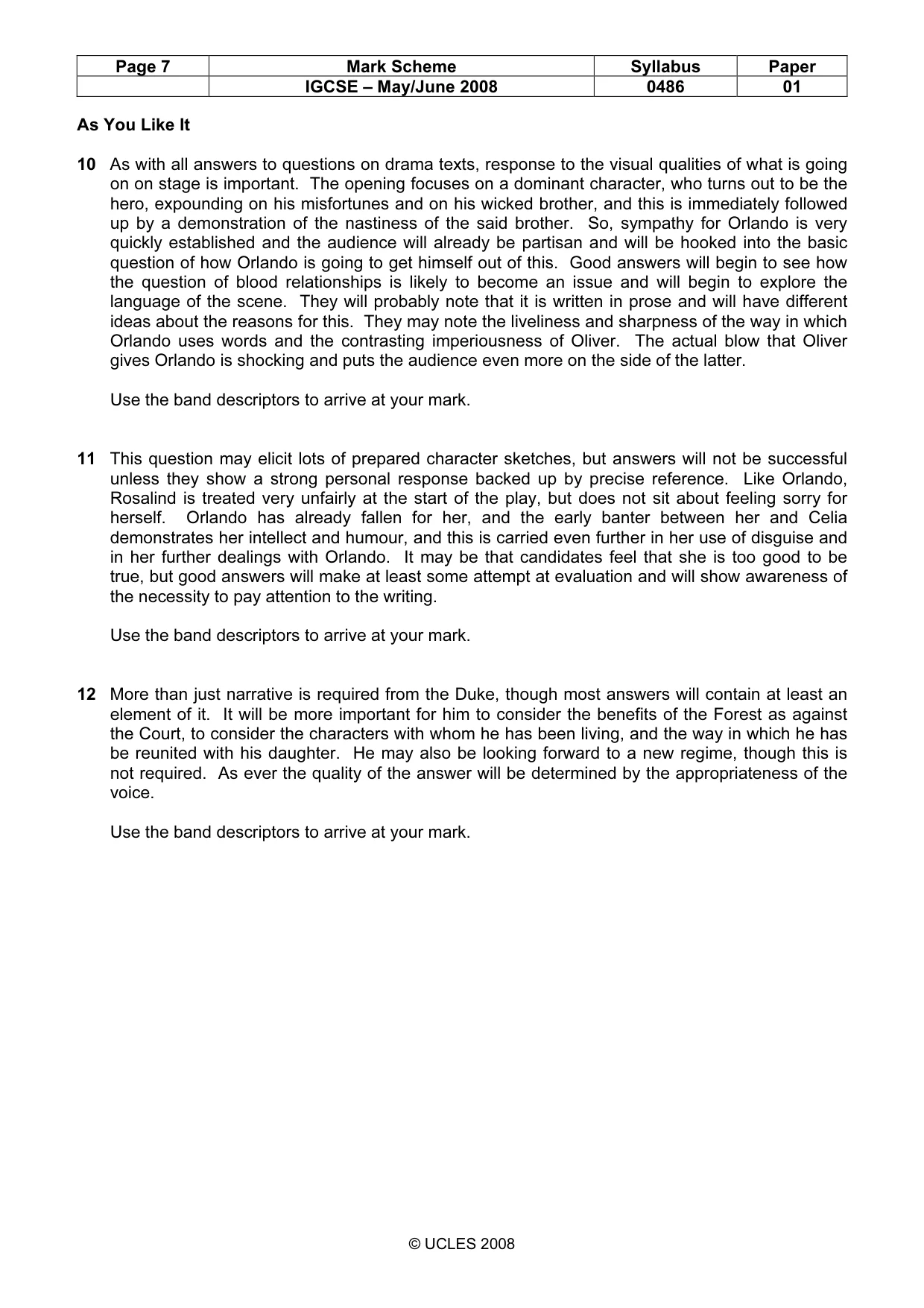
Page 7 Mark Scheme Syllabus Paper IGCSE – May/June 2008 0486 01 © UCLES 2008 As You Like It 10 As with all answers to questions on drama texts, response to the visual qualities of what is going on on stage is important. The opening focuses on a dominant character, who turns out to be the hero, expounding on his misfortunes and on his wicked brother, and this is immediately followed up by a demonstration of the nastiness of the said brother. So, sympathy for Orlando is very quickly established and the audience will already be partisan and will be hooked into the basic question of how Orlando is going to get himself out of this. Good answers will begin to see how the question of blood relationships is likely to become an issue and will begin to explore the language of the scene. They will probably note that it is written in prose and will have different ideas about the reasons for this. They may note the liveliness and sharpness of the way in which Orlando uses words and the contrasting imperiousness of Oliver. The actual blow that Oliver gives Orlando is shocking and puts the audience even more on the side of the latter. Use the band descriptors to arrive at your mark. 11 This question may elicit lots of prepared character sketches, but answers will not be successful unless they show a strong personal response backed up by precise reference. Like Orlando, Rosalind is treated very unfairly at the start of the play, but does not sit about feeling sorry for herself. Orlando has already fallen for her, and the early banter between her and Celia demonstrates her intellect and humour, and this is carried even further in her use of disguise and in her further dealings with Orlando. It may be that candidates feel that she is too good to be true, but good answers will make at least some attempt at evaluation and will show awareness of the necessity to pay attention to the writing. Use the band descriptors to arrive at your mark. 12 More than just narrative is required from the Duke, though most answers will contain at least an element of it. It will be more important for him to consider the benefits of the Forest as against the Court, to consider the characters with whom he has been living, and the way in which he has be reunited with his daughter. He may also be looking forward to a new regime, though this is not required. As ever the quality of the answer will be determined by the appropriateness of the voice. Use the band descriptors to arrive at your mark.
Mark scheme, page 8
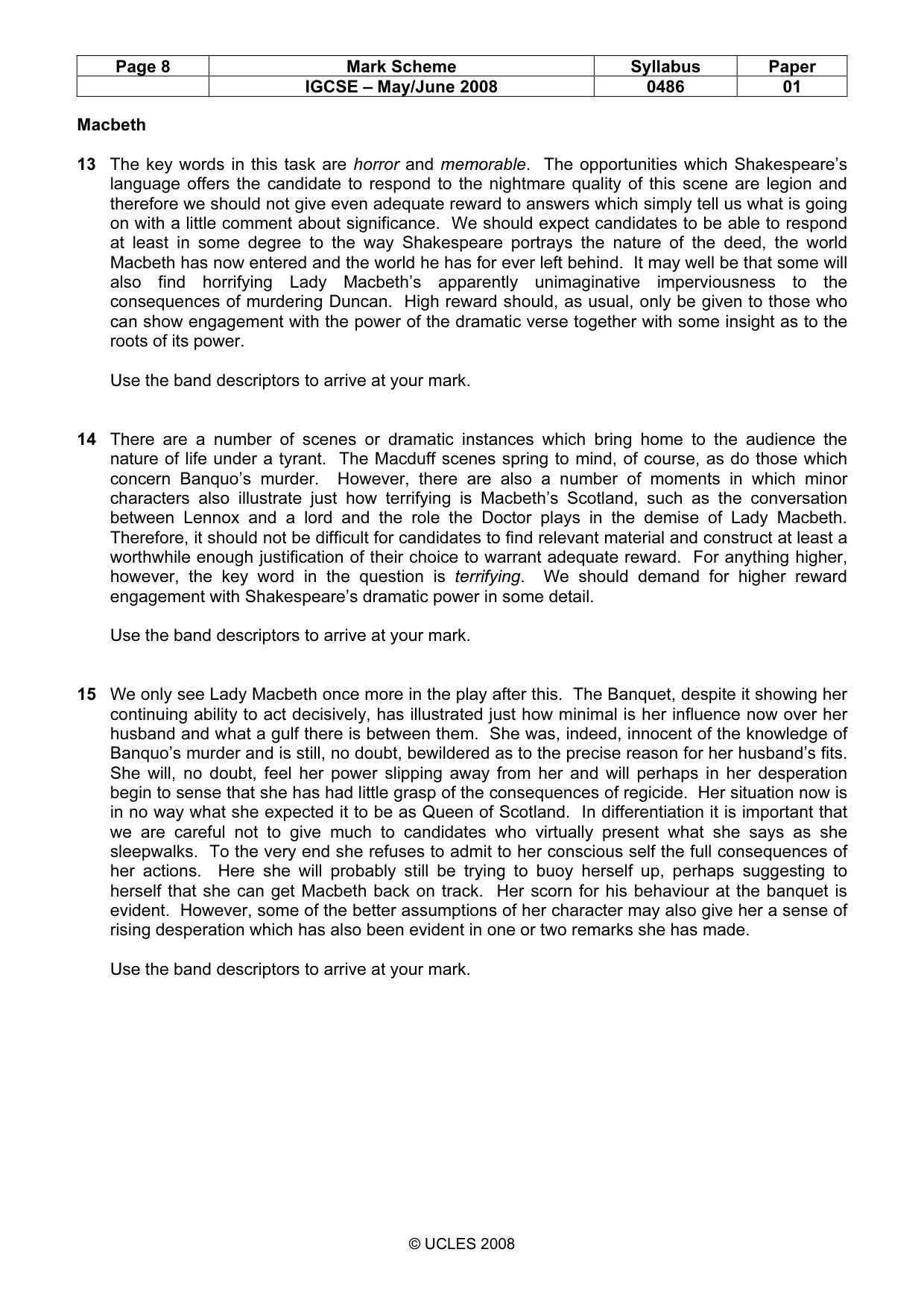
Page 8 Mark Scheme Syllabus Paper IGCSE – May/June 2008 0486 01 © UCLES 2008 Macbeth 13 The key words in this task are horror and memorable. The opportunities which Shakespeare’s language offers the candidate to respond to the nightmare quality of this scene are legion and therefore we should not give even adequate reward to answers which simply tell us what is going on with a little comment about significance. We should expect candidates to be able to respond at least in some degree to the way Shakespeare portrays the nature of the deed, the world Macbeth has now entered and the world he has for ever left behind. It may well be that some will also find horrifying Lady Macbeth’s apparently unimaginative imperviousness to the consequences of murdering Duncan. High reward should, as usual, only be given to those who can show engagement with the power of the dramatic verse together with some insight as to the roots of its power. Use the band descriptors to arrive at your mark. 14 There are a number of scenes or dramatic instances which bring home to the audience the nature of life under a tyrant. The Macduff scenes spring to mind, of course, as do those which concern Banquo’s murder. However, there are also a number of moments in which minor characters also illustrate just how terrifying is Macbeth’s Scotland, such as the conversation between Lennox and a lord and the role the Doctor plays in the demise of Lady Macbeth. Therefore, it should not be difficult for candidates to find relevant material and construct at least a worthwhile enough justification of their choice to warrant adequate reward. For anything higher, however, the key word in the question is terrifying. We should demand for higher reward engagement with Shakespeare’s dramatic power in some detail. Use the band descriptors to arrive at your mark. 15 We only see Lady Macbeth once more in the play after this. The Banquet, despite it showing her continuing ability to act decisively, has illustrated just how minimal is her influence now over her husband and what a gulf there is between them. She was, indeed, innocent of the knowledge of Banquo’s murder and is still, no doubt, bewildered as to the precise reason for her husband’s fits. She will, no doubt, feel her power slipping away from her and will perhaps in her desperation begin to sense that she has had little grasp of the consequences of regicide. Her situation now is in no way what she expected it to be as Queen of Scotland. In differentiation it is important that we are careful not to give much to candidates who virtually present what she says as she sleepwalks. To the very end she refuses to admit to her conscious self the full consequences of her actions. Here she will probably still be trying to buoy herself up, perhaps suggesting to herself that she can get Macbeth back on track. Her scorn for his behaviour at the banquet is evident. However, some of the better assumptions of her character may also give her a sense of rising desperation which has also been evident in one or two remarks she has made. Use the band descriptors to arrive at your mark.
Mark scheme, page 9
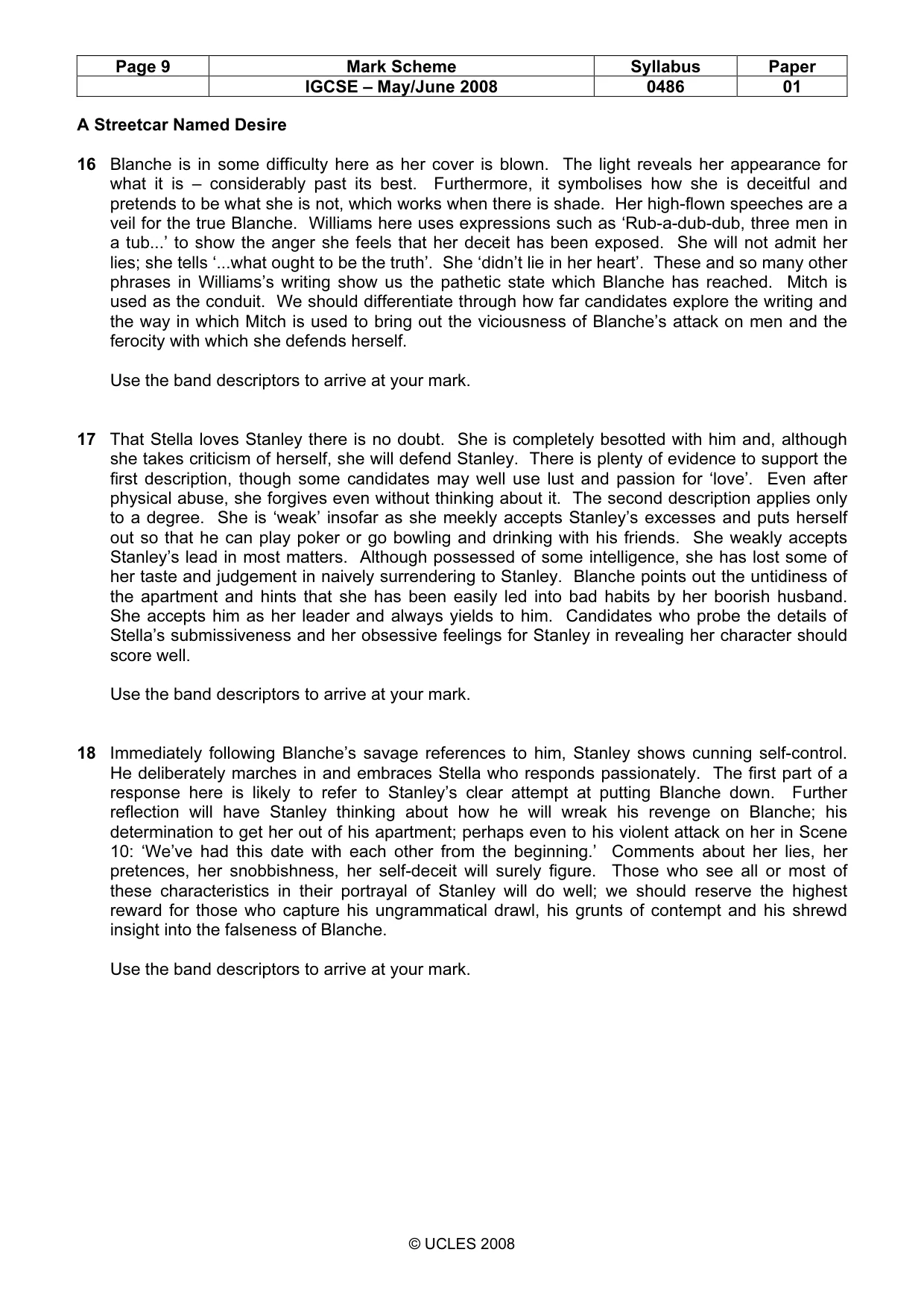
Page 9 Mark Scheme Syllabus Paper IGCSE – May/June 2008 0486 01 © UCLES 2008 A Streetcar Named Desire 16 Blanche is in some difficulty here as her cover is blown. The light reveals her appearance for what it is – considerably past its best. Furthermore, it symbolises how she is deceitful and pretends to be what she is not, which works when there is shade. Her high-flown speeches are a veil for the true Blanche. Williams here uses expressions such as ‘Rub-a-dub-dub, three men in a tub...’ to show the anger she feels that her deceit has been exposed. She will not admit her lies; she tells ‘...what ought to be the truth’. She ‘didn’t lie in her heart’. These and so many other phrases in Williams’s writing show us the pathetic state which Blanche has reached. Mitch is used as the conduit. We should differentiate through how far candidates explore the writing and the way in which Mitch is used to bring out the viciousness of Blanche’s attack on men and the ferocity with which she defends herself. Use the band descriptors to arrive at your mark. 17 That Stella loves Stanley there is no doubt. She is completely besotted with him and, although she takes criticism of herself, she will defend Stanley. There is plenty of evidence to support the first description, though some candidates may well use lust and passion for ‘love’. Even after physical abuse, she forgives even without thinking about it. The second description applies only to a degree. She is ‘weak’ insofar as she meekly accepts Stanley’s excesses and puts herself out so that he can play poker or go bowling and drinking with his friends. She weakly accepts Stanley’s lead in most matters. Although possessed of some intelligence, she has lost some of her taste and judgement in naively surrendering to Stanley. Blanche points out the untidiness of the apartment and hints that she has been easily led into bad habits by her boorish husband. She accepts him as her leader and always yields to him. Candidates who probe the details of Stella’s submissiveness and her obsessive feelings for Stanley in revealing her character should score well. Use the band descriptors to arrive at your mark. 18 Immediately following Blanche’s savage references to him, Stanley shows cunning self-control. He deliberately marches in and embraces Stella who responds passionately. The first part of a response here is likely to refer to Stanley’s clear attempt at putting Blanche down. Further reflection will have Stanley thinking about how he will wreak his revenge on Blanche; his determination to get her out of his apartment; perhaps even to his violent attack on her in Scene 10: ‘We’ve had this date with each other from the beginning.’ Comments about her lies, her pretences, her snobbishness, her self-deceit will surely figure. Those who see all or most of these characteristics in their portrayal of Stanley will do well; we should reserve the highest reward for those who capture his ungrammatical drawl, his grunts of contempt and his shrewd insight into the falseness of Blanche. Use the band descriptors to arrive at your mark.
Mark scheme, page 10
Page 10 Mark Scheme Syllabus Paper IGCSE – May/June 2008 0486 01 © UCLES 2008 POETRY 19–24 Refer to the photostats and the grade descriptors when arriving at your mark. Poetry is literary language at its most intense. A poem in a short space can create a multiplicity of resonances and hence possible meanings. We must expect that candidates will offer a very wide variety of responses and interpretations, and it is appropriate to emphasise that we as examiners must at all times keep a totally open mind when assessing work on a poem. In the exercise of our judgment, we shall, of course, read work which shows manifestly little or no understanding of a poem and we will mark that accordingly. However, it is also a regular experience to find answers which offer valid perspectives new to the examiner and which, just as manifestly, deserve to be given high reward. We will differentiate first of all according to how directly the candidates answer the question. Examiners will notice that all the questions prescribe the poems from which the candidates should choose. This is to ensure that the candidate is writing on a poem appropriate to the question. It is also designed to send a strong signal to candidates that they are taking a large risk going into the examination with only one or two poems which they are determined to fit to one of the questions. The problem can be that some will choose a question because the poem they wish to write about appears in the list rather than because they can answer the question. We must be very careful not to give much reward for answers which manifestly are not addressing the question, even if they show a convincing grasp of the poem. Also, examiners should guard against over-rewarding run throughs and always remember that all the tasks demand that the candidate engage with the poem in a specific way. They are never simple invitations just to write about a poem. We should think very hard before putting such work in Band 3. Beyond focus on the question, we will also assess according to how well candidates convince us that they have engaged with the pleasure and excitement of poetry. This means in effect that we do NOT give high reward to any explanation of "meaning" which shows little response to the words and how they create meaning. In all of the questions there is an explicit requirement to make a response to the words and it will be difficult for any work which fails to engage in this way to progress beyond Band 3. In addition, examiners should be careful not to over-reward comment which is able to isolate vivid features of a poem’s language but which is unable to probe the reasons for their vividness. For instance, the noting of rhyme, sound and movement, the listing of significant words and figures of speech is only a very small first step to insightful personal response. Work given high reward should show the ability of the candidate to analyse how such features of a poem’s language achieve their effect.
Mark scheme, page 11
Page 11 Mark Scheme Syllabus Paper IGCSE – May/June 2008 0486 01 © UCLES 2008 PROSE Things Fall Apart 25 There are a number of things which will no doubt feature in the answers. Firstly, there is in the description of the funeral the sense of the closeness of the spirit world in the people’s minds to their everyday life. Secondly, there is, of course, the fear which overwhelms the tribe if something like the accidental killing of the youth occurs, the fear of offending the deities and bringing down catastrophe upon the tribe. Hence, the offending individual must be removed from the society and thus Okonkwo’s life in a moment is ruined. Of course, Okonkwo does not for a moment question the ‘justice’ of this, though significantly at the end of the chapter the thoughtful Obereika does ponder the barbarities which are taken as necessary to appease the spirit world. Any answer which ranges over some of this material should receive adequate reward but for something better once again we should expect some response to the striking qualities of the extract and Achebe’s writing. Use the band descriptors to arrive at your mark. 26 This is an open question, as it tends to be in the novel. Many candidates are likely to feel critical of the profoundly subordinate role of women in this culture of polygamy. At least in Okonkwo’s case, the man’s word is absolute and beatings appear a regular feature. Indeed, there is one instance of the wife becoming a convenient scapegoat simply for a bad mood. Children, it goes without saying, are expected even more to hang upon the man’s every word and desire. All of that is clear. What is not so clear is the author’s attitude. Irony only occasionally surfaces and it is notable that there is no evidence in the novel that any woman sees this as other than the natural order of things. Does Achebe hint that such a culture, particularly when the man is as strong a personality as Okonkwo, gives the wives security and even pride in their role in the family community? Whatever the interpretation of Achebe’s intentions, differentiation is likely to occur from the range of reference offered in the answer in support of the argument. Use the band descriptors to arrive at your mark. 27 The important thing here is that of its nature this is the internal Okonkwo, who is somewhat different to his public persona. Not that it would be that different. For him tribal law is absolute and there is no possibility that it can be questioned. The elders have spoken and any real man does what needs to be done, and perhaps more. Typically for him, of course, his pride makes him go one step further than necessary in that he takes a prominent part in the sacrifice. Is that a way of illustrating that he the great warrior is not prey to personal sentiment? The central question is to what degree he would admit to his inner self the dreadfulness of his loss, of a boy who was becoming almost his own son. It is difficult to believe that he would entirely blot that out and for an adequate reward we might expect an assumption which depicts turmoil and sorrow. However, perhaps the better candidates will show themselves by setting a limit on that and recognising that even to himself Okonkwo cannot admit anything which might suggest weakness. Use the band descriptors to arrive at your mark.
Mark scheme, page 12
Page 12 Mark Scheme Syllabus Paper IGCSE – May/June 2008 0486 01 © UCLES 2008 Pride and Prejudice 28 There is such a wealth of material pertinent to the task that we must be prepared to accept a variety of responses, at least as far as the supporting detail is concerned. Darcy’s astonishment that this young woman from such an inferior family should first of all make him fall in love and then turn him down speaks volumes about his hauteur. Therefore, in part at least, the reader delights in the vehemence of Elizabeth’s rejection of him. However, like much in Austen, things are never that simple. Most candidates will no doubt see the obvious nature of Darcy’s pride but perhaps fewer might wonder whether there is some justice in his appraisal of most of the Bennet family and may also question whether the very strength of Elizabeth’s response does not suggest that pride and prejudice are playing a part in her response and that she is not being completely true to herself. The penultimate paragraph has her getting near to recognising what her true feelings might be before she buoys herself up once more by giving herself a pat on the back for doing the moral thing. Therefore it may be by candidates showing an awareness of the complexity of her reactions that we sort the good from the average. Use the band descriptors to arrive at your mark. 29 As usual, it is important to note that this task is not encouraging candidates to write their character sketch of Elizabeth Bennet. The key word is attractive and answers which show little engagement with features of her personality which do attract should receive only mediocre reward. We should expect even average candidates to be able to convey their enjoyment of this feisty young woman who, even in her failings, radiates an energetic independence, a ready eye for human absurdity and a fierce devotion to principle. Even her tendency to rush to judgment suggests a disarming absence of cold calculation. For higher reward we should look to candidates to show in some detail how Austen’s writing conveys this delightful young woman’s personality. Use the band descriptors to arrive at your mark. 30 This task should provide ample opportunity for the imaginative candidate to assume a characteristic voice; Lydia’s mode of speech is so memorable. For adequate reward we should expect the candidate as a starting point to recognise the mood in which she is returning to Longbourn. Limited reward only should go to those who think that she is apprehensive of visiting the family she has so nearly disgraced. Penitence is unknown to Lydia; for her it is a triumphant return. She is the first of Mrs Bennet’s offspring to have captured a husband and she is sufficiently like her mother to know that by her at least she will be welcomed with open arms. For Lydia it has been a jolly escapade, it has demonstrated her adult independence and resulted in marriage to the most handsome of men, her Wickham – one in the eye for her tiresome, and unmarried, elder sisters. Hopefully the better candidates will be able to capture something of her flighty language. Use the band descriptors to arrive at your mark.
Mark scheme, page 13
Page 13 Mark Scheme Syllabus Paper IGCSE – May/June 2008 0486 01 © UCLES 2008 The God Boy 31 The dreadfulness of the father’s speeches is obviously one of the features of this extract. His pathetic attempts to bolster his ego and the viciousness of his references to Jimmy’s mother make him out to be a despicable creature. This is also the one place in the novel where there is an explicit reference to what is about to happen as we see the mother at the end of her tether. Underpinning it all, though, is Jimmy’s unbearably poignant attempt to distance himself from what is happening and what is being said by pretending that he is elsewhere and happy. It should be possible for most candidates to mine some of the material and make a case for its horror but we should reserve high reward as usual for those who really engage with the detail of the writing and show how that horror is conveyed. Use the band descriptors to arrive at your mark. 32 There are many instances of humour in the book, some very obvious. One which might well prove popular is the wonderful description of the bicycle race which Jimmy has with Legs. Another is the almost surreal conversation Jimmy has with Sister Angela about the state of his soul. There is, of course, much pertinent material to be found in other episodes which tends to sit side by side with things of serious import, like the lies which Jimmy feels he has to invent about his family when he is visiting Joe’s family. Jimmy’s naivety is a constant source of amusement as well. However, whatever the choice made, the key to differentiation will lie in candidate’s ability to bring out how the writing makes the reader laugh. For high reward we should expect more than an apt choice and some description of the episode. We should look for engagement. Use the band descriptors to arrive at your mark. 33 In a way Molly’s life is another tragedy waiting to be written, a life which we can only guess at through the distortions of her younger brother’s understanding. However, by the end of the novel the reader has been able to piece together a picture of a girl/young woman in despair and desperate to escape. She has known the truth about her parents’ marriage for years; she has been sent off to boarding school; she probably knew or guessed about the abortion; she understands the hatred at the centre of her family and she can do nothing about it. Such was her despair that she tried when she was younger to take Jimmy with her on a suicide mission. Now she is nearly a grown woman and clearly determined to be independent. However, she is also desperately sorry for the brother who cannot escape and this presumably brings back all her anguish. We might presume that her sympathies lie with the mother but we have no evidence of this. She may well blame her as much as the father for her terrible childhood. For an adequate reward we should expect the girl’s wretched memories to emerge, together with her feelings of powerlessness. However, some ability to put into telling words her anguish will be necessary for higher reward. Use the band descriptors to arrive at your mark.
Mark scheme, page 14
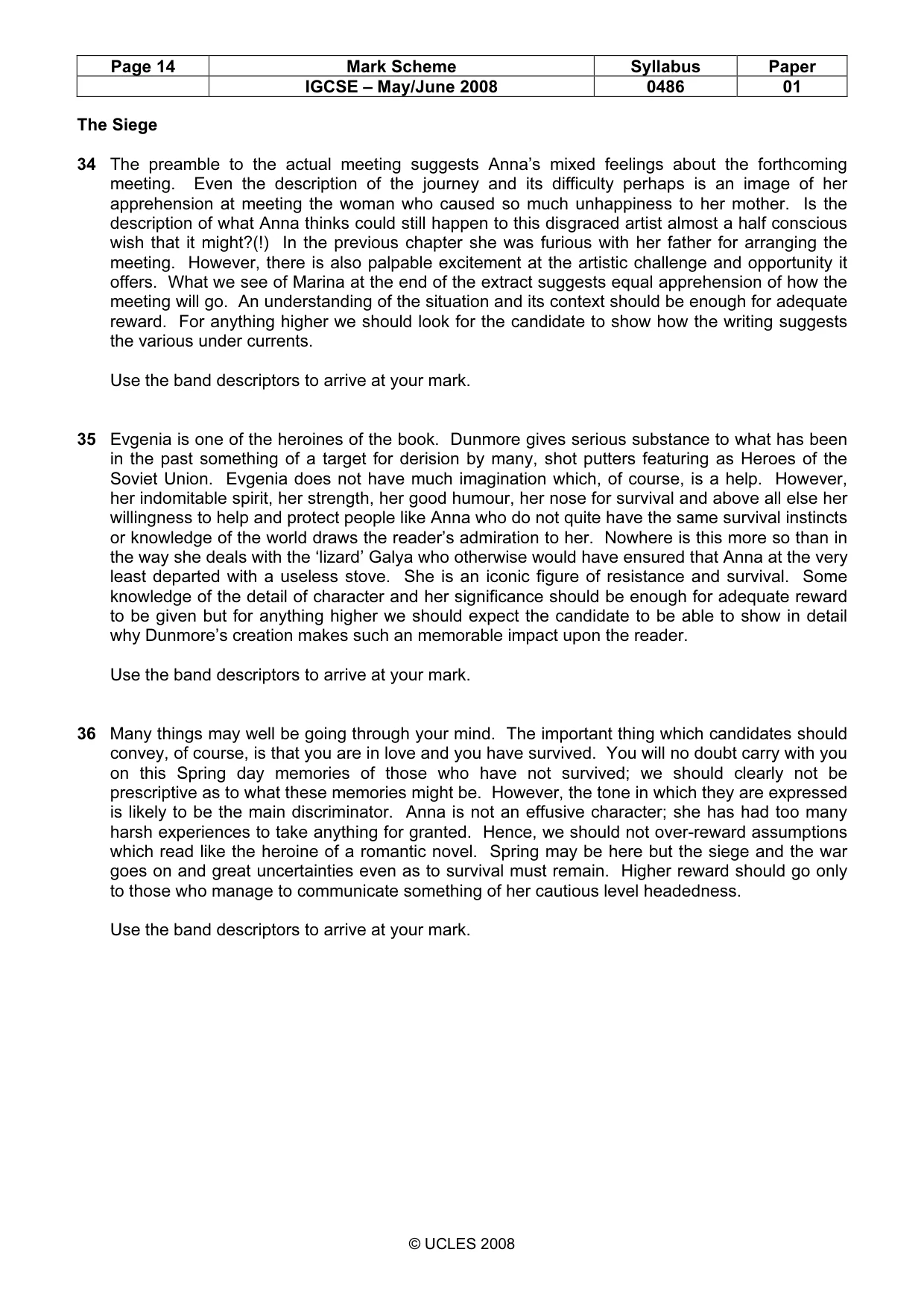
Page 14 Mark Scheme Syllabus Paper IGCSE – May/June 2008 0486 01 © UCLES 2008 The Siege 34 The preamble to the actual meeting suggests Anna’s mixed feelings about the forthcoming meeting. Even the description of the journey and its difficulty perhaps is an image of her apprehension at meeting the woman who caused so much unhappiness to her mother. Is the description of what Anna thinks could still happen to this disgraced artist almost a half conscious wish that it might?(!) In the previous chapter she was furious with her father for arranging the meeting. However, there is also palpable excitement at the artistic challenge and opportunity it offers. What we see of Marina at the end of the extract suggests equal apprehension of how the meeting will go. An understanding of the situation and its context should be enough for adequate reward. For anything higher we should look for the candidate to show how the writing suggests the various under currents. Use the band descriptors to arrive at your mark. 35 Evgenia is one of the heroines of the book. Dunmore gives serious substance to what has been in the past something of a target for derision by many, shot putters featuring as Heroes of the Soviet Union. Evgenia does not have much imagination which, of course, is a help. However, her indomitable spirit, her strength, her good humour, her nose for survival and above all else her willingness to help and protect people like Anna who do not quite have the same survival instincts or knowledge of the world draws the reader’s admiration to her. Nowhere is this more so than in the way she deals with the ‘lizard’ Galya who otherwise would have ensured that Anna at the very least departed with a useless stove. She is an iconic figure of resistance and survival. Some knowledge of the detail of character and her significance should be enough for adequate reward to be given but for anything higher we should expect the candidate to be able to show in detail why Dunmore’s creation makes such an memorable impact upon the reader. Use the band descriptors to arrive at your mark. 36 Many things may well be going through your mind. The important thing which candidates should convey, of course, is that you are in love and you have survived. You will no doubt carry with you on this Spring day memories of those who have not survived; we should clearly not be prescriptive as to what these memories might be. However, the tone in which they are expressed is likely to be the main discriminator. Anna is not an effusive character; she has had too many harsh experiences to take anything for granted. Hence, we should not over-reward assumptions which read like the heroine of a romantic novel. Spring may be here but the siege and the war goes on and great uncertainties even as to survival must remain. Higher reward should go only to those who manage to communicate something of her cautious level headedness. Use the band descriptors to arrive at your mark.
Mark scheme, page 15
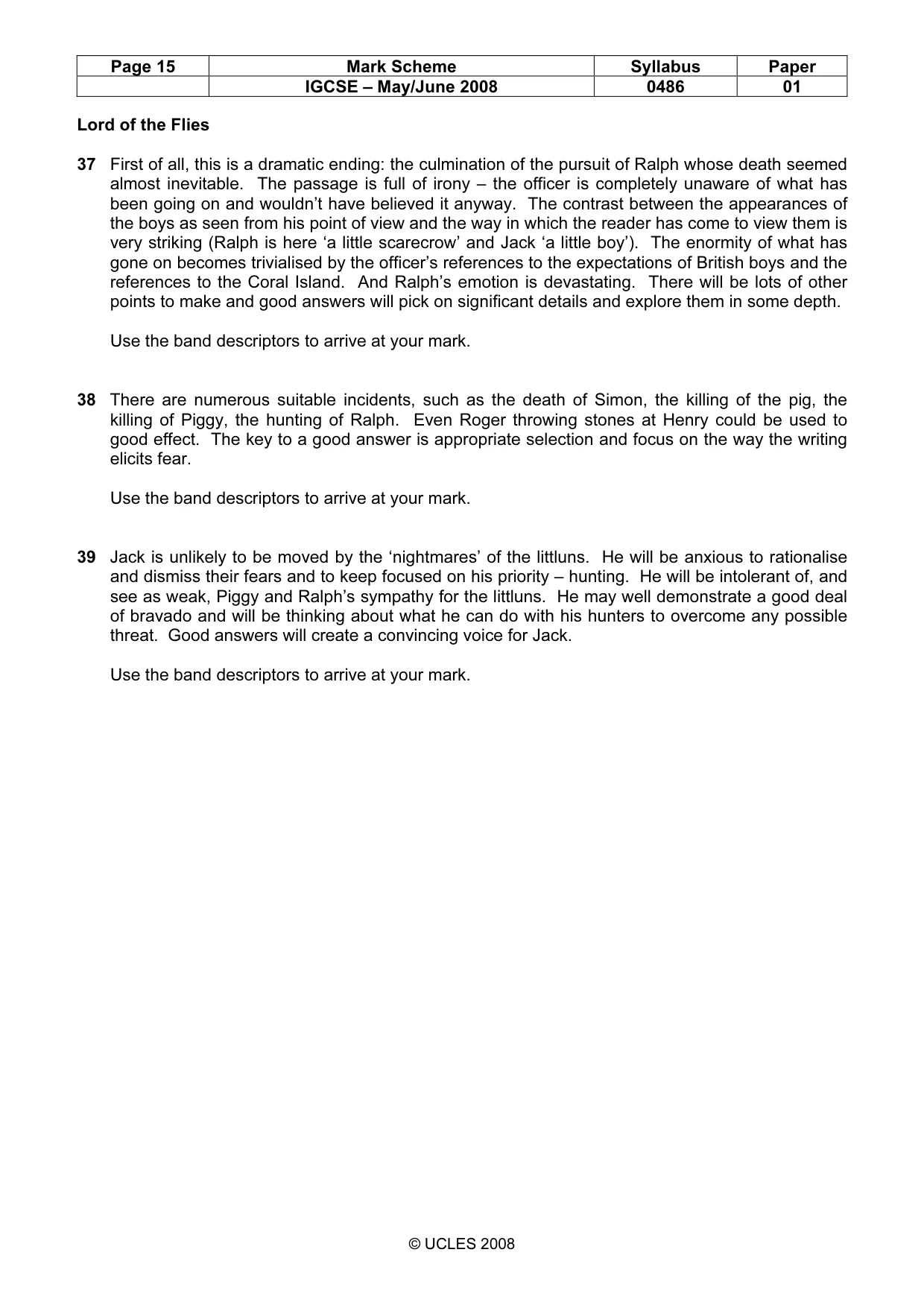
Page 15 Mark Scheme Syllabus Paper IGCSE – May/June 2008 0486 01 © UCLES 2008 Lord of the Flies 37 First of all, this is a dramatic ending: the culmination of the pursuit of Ralph whose death seemed almost inevitable. The passage is full of irony – the officer is completely unaware of what has been going on and wouldn’t have believed it anyway. The contrast between the appearances of the boys as seen from his point of view and the way in which the reader has come to view them is very striking (Ralph is here ‘a little scarecrow’ and Jack ‘a little boy’). The enormity of what has gone on becomes trivialised by the officer’s references to the expectations of British boys and the references to the Coral Island. And Ralph’s emotion is devastating. There will be lots of other points to make and good answers will pick on significant details and explore them in some depth. Use the band descriptors to arrive at your mark. 38 There are numerous suitable incidents, such as the death of Simon, the killing of the pig, the killing of Piggy, the hunting of Ralph. Even Roger throwing stones at Henry could be used to good effect. The key to a good answer is appropriate selection and focus on the way the writing elicits fear. Use the band descriptors to arrive at your mark. 39 Jack is unlikely to be moved by the ‘nightmares’ of the littluns. He will be anxious to rationalise and dismiss their fears and to keep focused on his priority – hunting. He will be intolerant of, and see as weak, Piggy and Ralph’s sympathy for the littluns. He may well demonstrate a good deal of bravado and will be thinking about what he can do with his hunters to overcome any possible threat. Good answers will create a convincing voice for Jack. Use the band descriptors to arrive at your mark.
Mark scheme, page 16
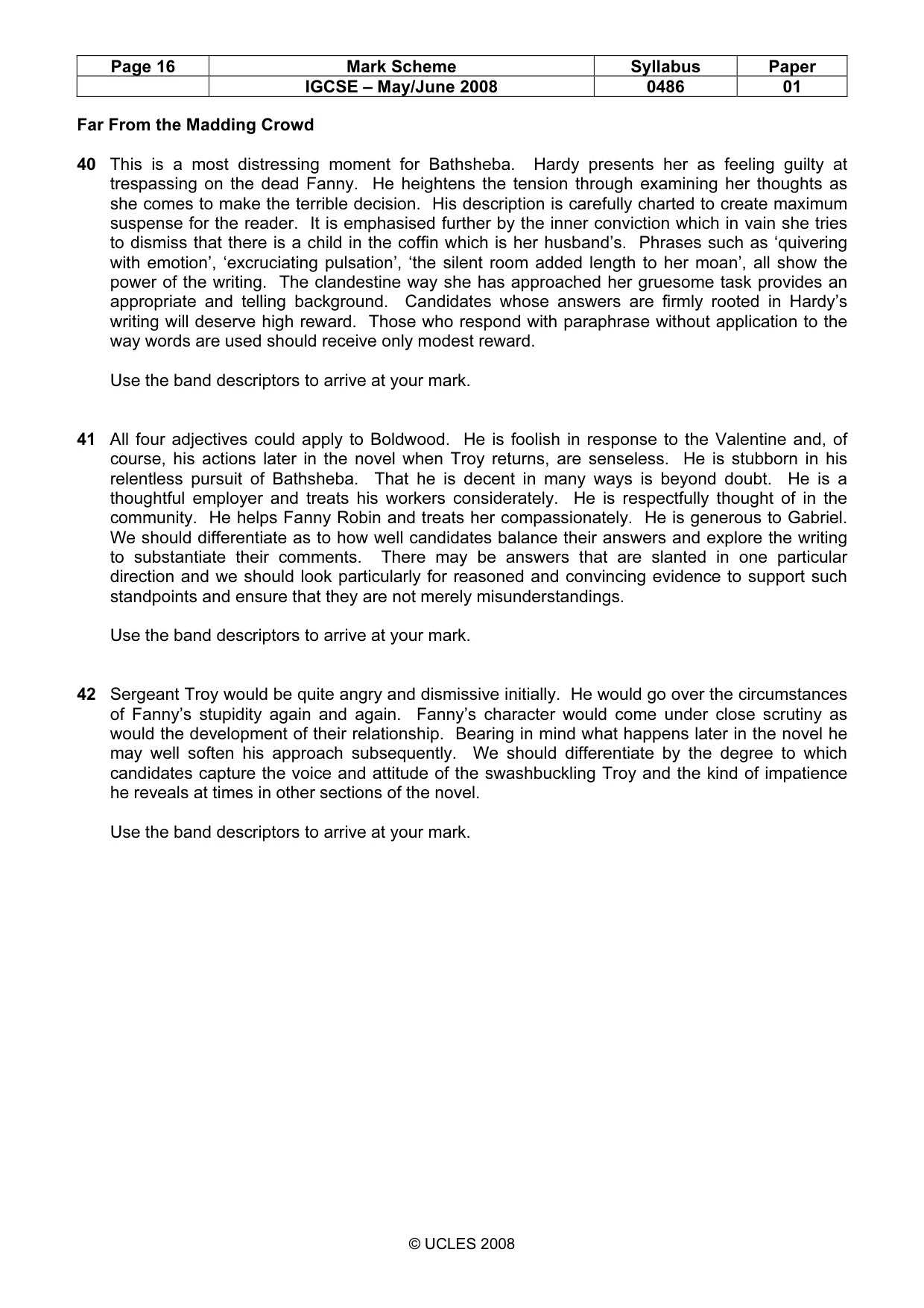
Page 16 Mark Scheme Syllabus Paper IGCSE – May/June 2008 0486 01 © UCLES 2008 Far From the Madding Crowd 40 This is a most distressing moment for Bathsheba. Hardy presents her as feeling guilty at trespassing on the dead Fanny. He heightens the tension through examining her thoughts as she comes to make the terrible decision. His description is carefully charted to create maximum suspense for the reader. It is emphasised further by the inner conviction which in vain she tries to dismiss that there is a child in the coffin which is her husband’s. Phrases such as ‘quivering with emotion’, ‘excruciating pulsation’, ‘the silent room added length to her moan’, all show the power of the writing. The clandestine way she has approached her gruesome task provides an appropriate and telling background. Candidates whose answers are firmly rooted in Hardy’s writing will deserve high reward. Those who respond with paraphrase without application to the way words are used should receive only modest reward. Use the band descriptors to arrive at your mark. 41 All four adjectives could apply to Boldwood. He is foolish in response to the Valentine and, of course, his actions later in the novel when Troy returns, are senseless. He is stubborn in his relentless pursuit of Bathsheba. That he is decent in many ways is beyond doubt. He is a thoughtful employer and treats his workers considerately. He is respectfully thought of in the community. He helps Fanny Robin and treats her compassionately. He is generous to Gabriel. We should differentiate as to how well candidates balance their answers and explore the writing to substantiate their comments. There may be answers that are slanted in one particular direction and we should look particularly for reasoned and convincing evidence to support such standpoints and ensure that they are not merely misunderstandings. Use the band descriptors to arrive at your mark. 42 Sergeant Troy would be quite angry and dismissive initially. He would go over the circumstances of Fanny’s stupidity again and again. Fanny’s character would come under close scrutiny as would the development of their relationship. Bearing in mind what happens later in the novel he may well soften his approach subsequently. We should differentiate by the degree to which candidates capture the voice and attitude of the swashbuckling Troy and the kind of impatience he reveals at times in other sections of the novel. Use the band descriptors to arrive at your mark.
Mark scheme, page 17
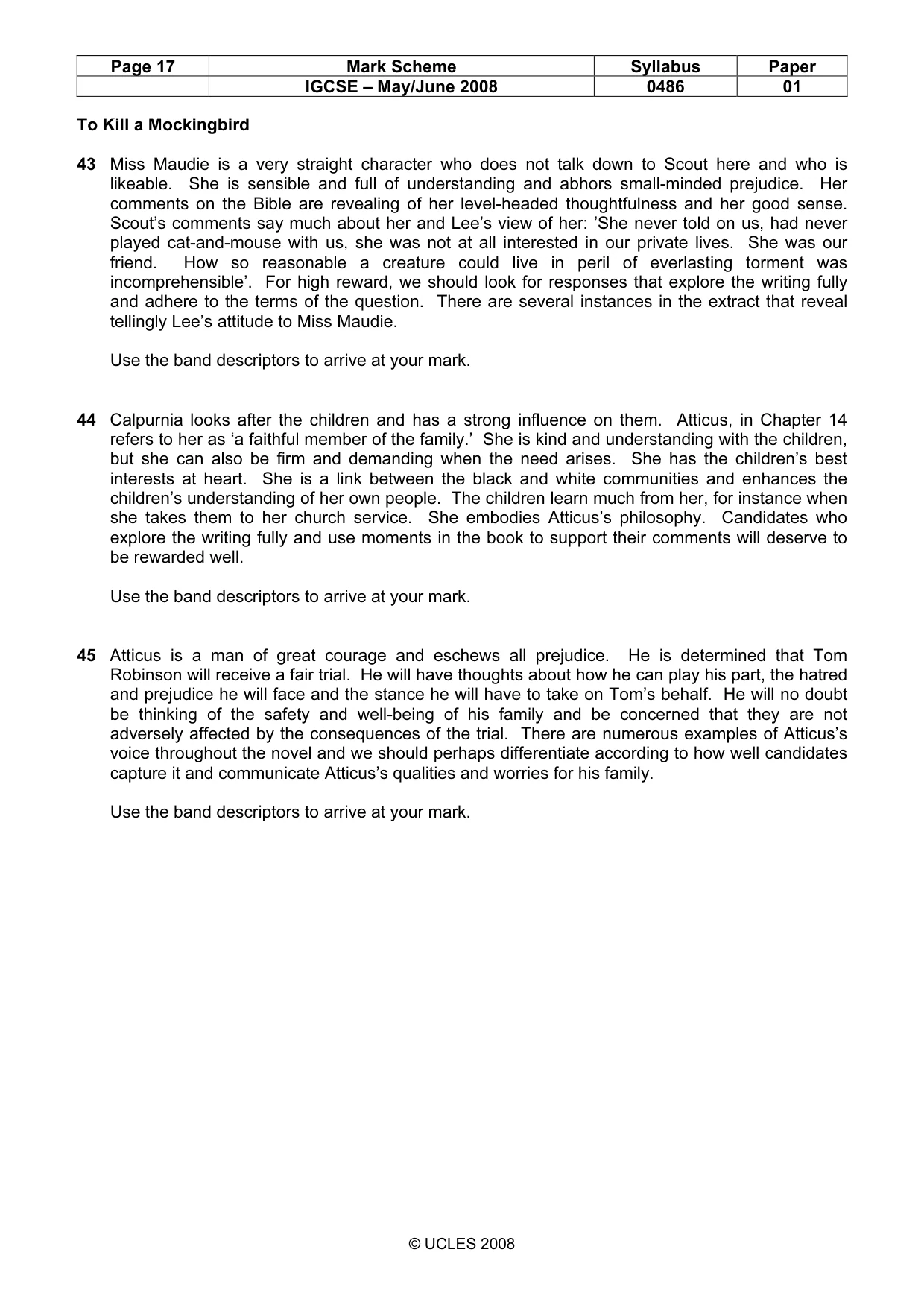
Page 17 Mark Scheme Syllabus Paper IGCSE – May/June 2008 0486 01 © UCLES 2008 To Kill a Mockingbird 43 Miss Maudie is a very straight character who does not talk down to Scout here and who is likeable. She is sensible and full of understanding and abhors small-minded prejudice. Her comments on the Bible are revealing of her level-headed thoughtfulness and her good sense. Scout’s comments say much about her and Lee’s view of her: ’She never told on us, had never played cat-and-mouse with us, she was not at all interested in our private lives. She was our friend. How so reasonable a creature could live in peril of everlasting torment was incomprehensible’. For high reward, we should look for responses that explore the writing fully and adhere to the terms of the question. There are several instances in the extract that reveal tellingly Lee’s attitude to Miss Maudie. Use the band descriptors to arrive at your mark. 44 Calpurnia looks after the children and has a strong influence on them. Atticus, in Chapter 14 refers to her as ‘a faithful member of the family.’ She is kind and understanding with the children, but she can also be firm and demanding when the need arises. She has the children’s best interests at heart. She is a link between the black and white communities and enhances the children’s understanding of her own people. The children learn much from her, for instance when she takes them to her church service. She embodies Atticus’s philosophy. Candidates who explore the writing fully and use moments in the book to support their comments will deserve to be rewarded well. Use the band descriptors to arrive at your mark. 45 Atticus is a man of great courage and eschews all prejudice. He is determined that Tom Robinson will receive a fair trial. He will have thoughts about how he can play his part, the hatred and prejudice he will face and the stance he will have to take on Tom’s behalf. He will no doubt be thinking of the safety and well-being of his family and be concerned that they are not adversely affected by the consequences of the trial. There are numerous examples of Atticus’s voice throughout the novel and we should perhaps differentiate according to how well candidates capture it and communicate Atticus’s qualities and worries for his family. Use the band descriptors to arrive at your mark.
Mark scheme, page 18
Page 18 Mark Scheme Syllabus Paper IGCSE – May/June 2008 0486 01 © UCLES 2008 Into the Wind 46 The first and perhaps central thing to note is that there is love or at least deep affection between all three. However, of course the grandfather’s is a poignantly possessive love. One suspects that Lucy, the youngest, is his favourite (she certainly comes across as lively, loveable and loving although now in urgent love with another) and he cannot bear to think of what the household will be like with her departure. Hence, he erects all manner of reasons why it should not be encouraged. In the fact the real reason for these feelings is that it will be almost as if all laughter and pleasure will be gone from the household since certainly his commonsensical square-fronted daughter seems merely to humour him and treat him almost like a child to be indulged. An understanding of the basic situation and reasons for the feelings of the three people with some support from the extract will be enough for adequate reward but deeper engagement with the way Lessing conveys the sadness of this moment of passage is needed for anything higher. Use the band descriptors to arrive at your mark. 47 Many of the stories offer some relevant material for an answer. The key word here is, of course, amused. It is repeated so there is no excuse for the candidate firstly not to choose an instance which is comic and secondly not to attempt to bring out the things in the writing which make it so. Use the band descriptors to arrive at your mark. 48 This man is now supremely confident in himself. No doubt he will be recalling the process by which he thinks he has grown to a kind of manhood which would not have been possible had he stayed in his life of luxury in Boston in a discontent he could not even define. Now he can define it as not feeling equal to many men. His experiences with the Crows have made him confident he is the equal of any man on earth and that is why the discontent has gone. No doubt he will ponder the events that resulted in this confidence and it is important even at this level that candidates should have him determined to be reticent over his history. He has no need boast or even tell anyone about what has made him such a man. Those who manage to communicate something of this state of mind should receive adequate reward. Something better should be reserved, however, for those who capture the way this is likely to be voiced. He is likely to embellish nothing. His life with the Crows has not been one of speech but one of action. Use the band descriptors to arrive at your mark.
What you needed in this session
Cambridge’s own grade thresholds for 2008 May/June, Paper 1 · Variant 1. A higher threshold means an easier paper — the bar moves with how the cohort did.