Cambridge IGCSE English - First Language (UK) 0522 — 2013 Oct/Nov Paper 1 · Variant 1
0522/11/O/N/13 · 50 marks · ≈56 min
The question paper and its mark scheme, free to read here and free to download. This is Cambridge’s own paper, exactly as it was sat.
Question paper12 pages
Mark scheme8 pages
Answers below. Sit the paper first if you are practising.
Paper as text
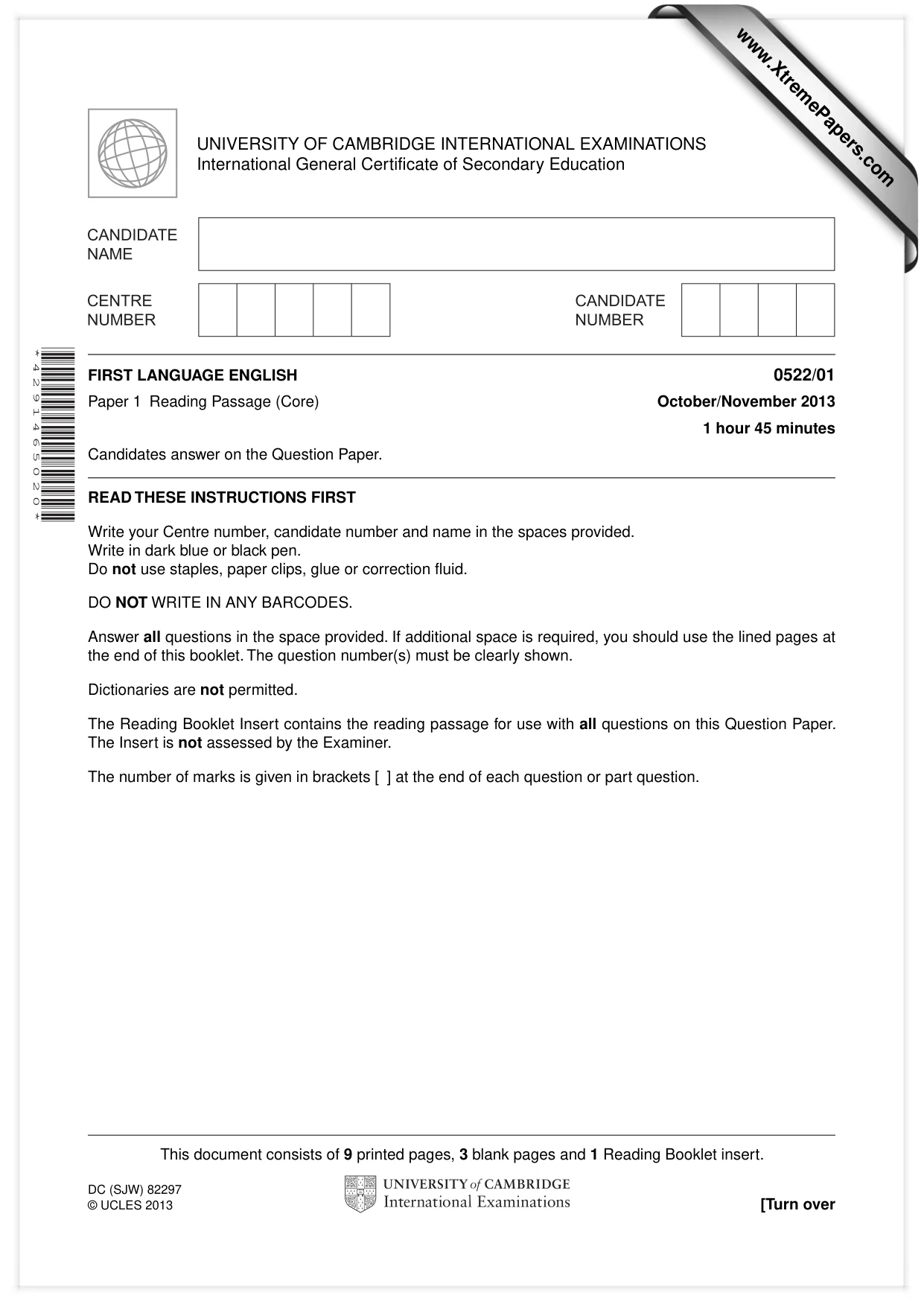
Question paper, page 1
This document consists of 9 printed pages, 3 blank pages and 1 Reading Booklet insert. DC (SJW) 82297 © UCLES 2013 [Turn over UNIVERSITY OF CAMBRIDGE INTERNATIONAL EXAMINATIONS International General Certificate of Secondary Education * 4 2 9 1 4 6 5 0 2 0 * FIRST LANGUAGE ENGLISH 0522/01 Paper 1 Reading Passage (Core) October/November 2013 1 hour 45 minutes Candidates answer on the Question Paper. READ THESE INSTRUCTIONS FIRST Write your Centre number, candidate number and name in the spaces provided. Write in dark blue or black pen. Do not use staples, paper clips, glue or correction fluid. DO NOT WRITE IN ANY BARCODES. Answer all questions in the space provided. If additional space is required, you should use the lined pages at the end of this booklet. The question number(s) must be clearly shown. Dictionaries are not permitted. The Reading Booklet Insert contains the reading passage for use with all questions on this Question Paper. The Insert is not assessed by the Examiner. The number of marks is given in brackets [ ] at the end of each question or part question. www.XtremePapers.com
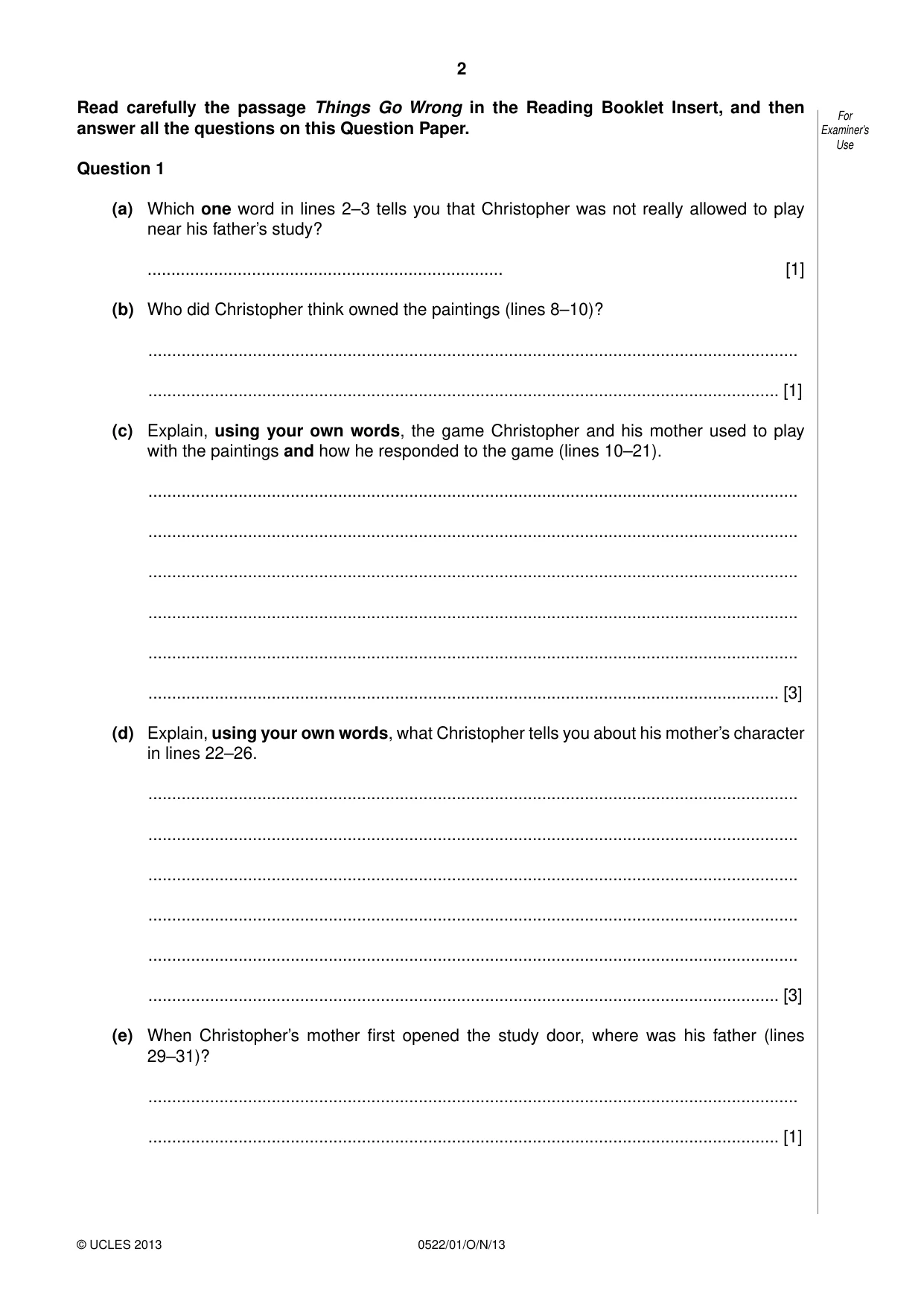
Question paper, page 2
2 0522/01/O/N/13 © UCLES 2013 For Examiner’s Use Read carefully the passage Things Go Wrong in the Reading Booklet Insert, and then answer all the questions on this Question Paper. Question 1 (a) Which one word in lines 2–3 tells you that Christopher was not really allowed to play near his father’s study? … [1] (b) Who did Christopher think owned the paintings (lines 8–10)? … … [1] (c) Explain, using your own words, the game Christopher and his mother used to play with the paintings and how he responded to the game (lines 10–21). … … … … … … [3] (d) Explain, using your own words, what Christopher tells you about his mother’s character in lines 22–26. … … … … … … [3] (e) When Christopher’s mother first opened the study door, where was his father (lines 29–31)? … … [1]
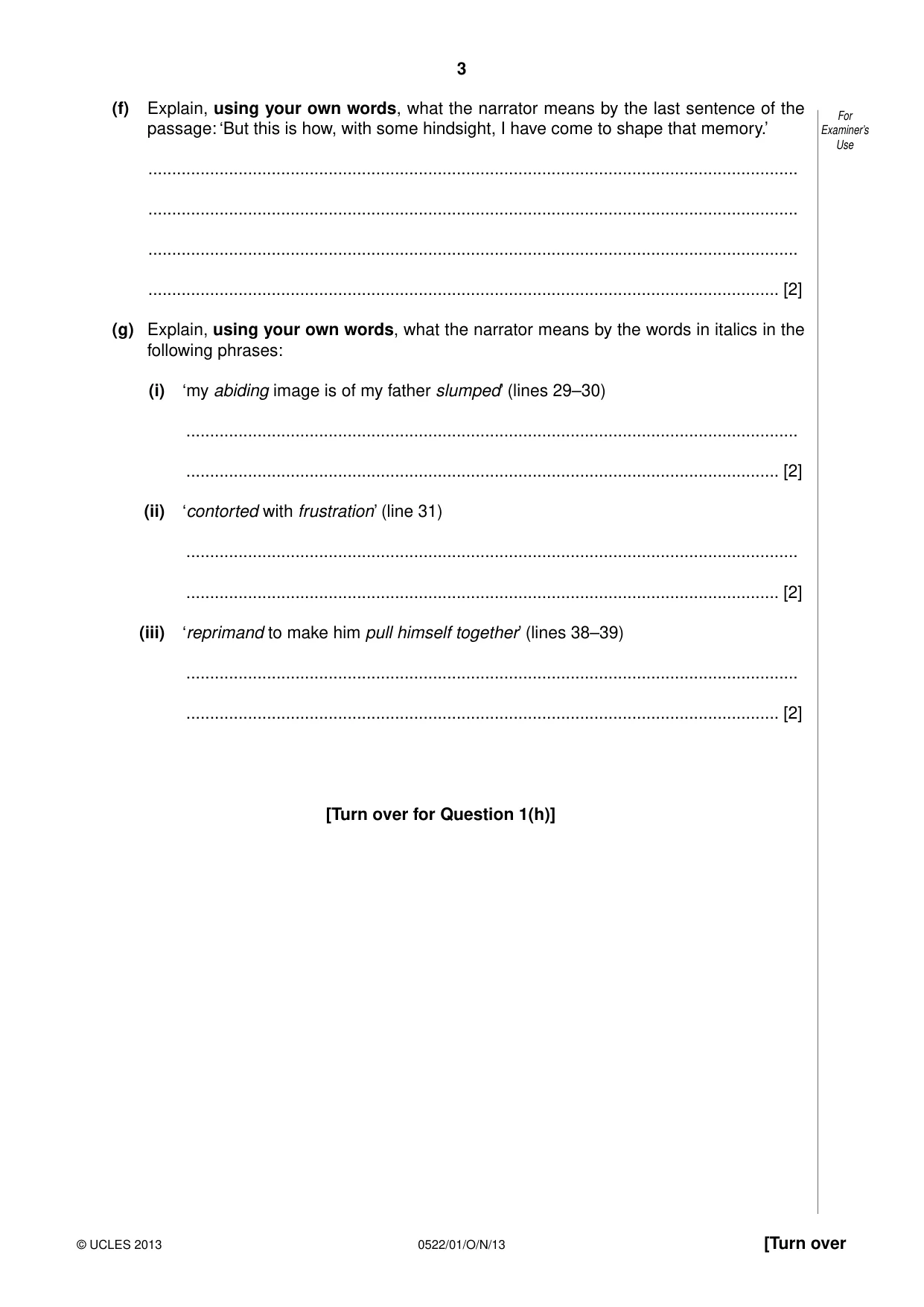
Question paper, page 3
3 0522/01/O/N/13 © UCLES 2013 [Turn over For Examiner’s Use (f) Explain, using your own words, what the narrator means by the last sentence of the passage: ‘But this is how, with some hindsight, I have come to shape that memory.’ … … … … [2] (g) Explain, using your own words, what the narrator means by the words in italics in the following phrases: (i) ‘my abiding image is of my father slumped’ (lines 29–30) … … [2] (ii) ‘contorted with frustration’ (line 31) … … [2] (iii) ‘reprimand to make him pull himself together’ (lines 38–39) … … [2] [Turn over for Question 1(h)]
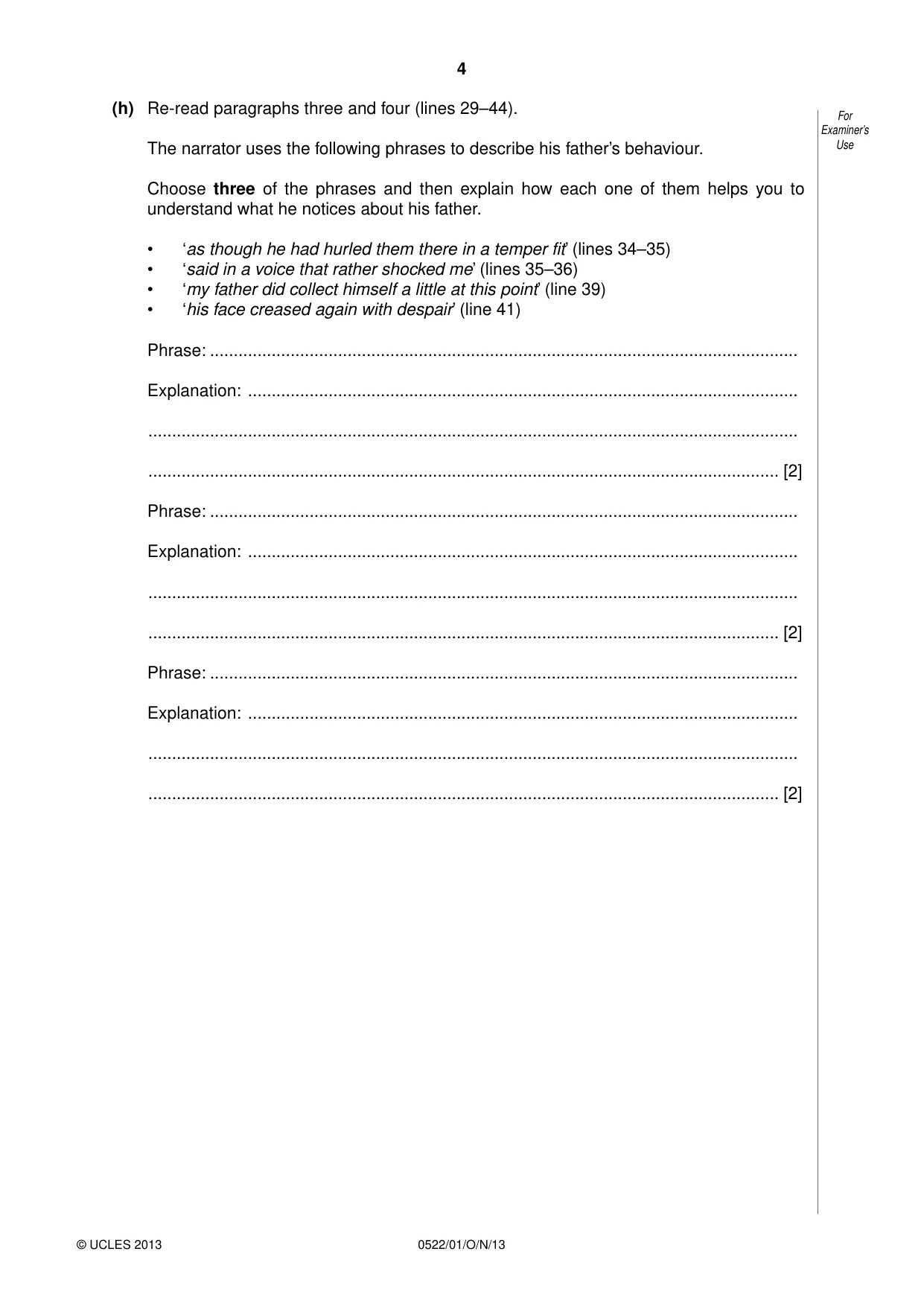
Question paper, page 4
4 0522/01/O/N/13 © UCLES 2013 For Examiner’s Use (h) Re-read paragraphs three and four (lines 29–44). The narrator uses the following phrases to describe his father’s behaviour. Choose three of the phrases and then explain how each one of them helps you to understand what he notices about his father. • ‘as though he had hurled them there in a temper fit’ (lines 34–35) • ‘said in a voice that rather shocked me’ (lines 35–36) • ‘my father did collect himself a little at this point’ (line 39) • ‘his face creased again with despair’ (line 41) Phrase: … Explanation: … … … [2] Phrase: … Explanation: … … … [2] Phrase: … Explanation: … … … [2]
Question paper, page 5
5 0522/01/O/N/13 © UCLES 2013 [Turn over For Examiner’s Use (i) Re-read the whole passage. Write a summary of what Christopher’s mother did on that memorable day. Write a paragraph of about 50–70 words. … … … … … … … … … … … … … … [7] [Total: 30] [Turn over for Question 2]
Question paper, page 6
6 0522/01/O/N/13 © UCLES 2013 For Examiner’s Use Question 2 Imagine that you are Christopher’s mother, Mrs Banks. Write your journal entry for this day in which you include: • your thoughts about what happened during the day • the concerns you have for your son and for your husband • your concerns about the situation in which the family finds itself. You should base your ideas on what you have read in the passage, but do not copy from it. Address each of the three bullet points. Write between 1 and 1½ sides, allowing for the size of your handwriting. Up to 10 marks are available for the content of your answer, and up to 10 marks for the quality of your writing. … … … … … … … … … … … … … … … … … … …
Question paper, page 7
7 0522/01/O/N/13 © UCLES 2013 For Examiner’s Use … … … … … … … … … … … … … … … … … … … … … … … … … … [Total: 20]
Question paper, page 8
8 0522/01/O/N/13 © UCLES 2013 For Examiner’s Use ADDITIONAL PAGE If you use the following lined page to complete the answer(s) to any question(s), the question number(s) must be clearly shown. … … … … … … … … … … … … … … … … … … … … … … … … …
Question paper, page 9
9 0522/01/O/N/13 © UCLES 2013 For Examiner’s Use ADDITIONAL PAGE If you use the following lined page to complete the answer(s) to any question(s), the question number(s) must be clearly shown. … … … … … … … … … … … … … … … … … … … … … … … … …
Question paper, page 10
10 0522/01/O/N/13 © UCLES 2013 BLANK PAGE
Question paper, page 11
11 0522/01/O/N/13 © UCLES 2013 BLANK PAGE
Question paper, page 12
12 0522/01/O/N/13 © UCLES 2013 BLANK PAGE Copyright Acknowledgements: Reading Passage © (adapted) Kazuo Ishiguro; When We Were Orphans; Faber & Faber Ltd; 2000. Permission to reproduce items where third-party owned material protected by copyright is included has been sought and cleared where possible. Every reasonable effort has been made by the publisher (UCLES) to trace copyright holders, but if any items requiring clearance have unwittingly been included, the publisher will be pleased to make amends at the earliest possible opportunity. University of Cambridge International Examinations is part of the Cambridge Assessment Group. Cambridge Assessment is the brand name of University of Cambridge Local Examinations Syndicate (UCLES), which is itself a department of the University of Cambridge.
Mark scheme, page 1
CAMBRIDGE INTERNATIONAL EXAMINATIONS International General Certificate of Secondary Education MARK SCHEME for the October/November 2013 series 0522 FIRST LANGUAGE ENGLISH 0522/01 Paper 1 (Reading Passage – Core), maximum raw mark 50 This mark scheme is published as an aid to teachers and candidates, to indicate the requirements of the examination. It shows the basis on which Examiners were instructed to award marks. It does not indicate the details of the discussions that took place at an Examiners’ meeting before marking began, which would have considered the acceptability of alternative answers. Mark schemes should be read in conjunction with the question paper and the Principal Examiner Report for Teachers. Cambridge will not enter into discussions about these mark schemes. Cambridge is publishing the mark schemes for the October/November 2013 series for most IGCSE, GCE Advanced Level and Advanced Subsidiary Level components and some Ordinary Level components. www.XtremePapers.com
Mark scheme, page 2
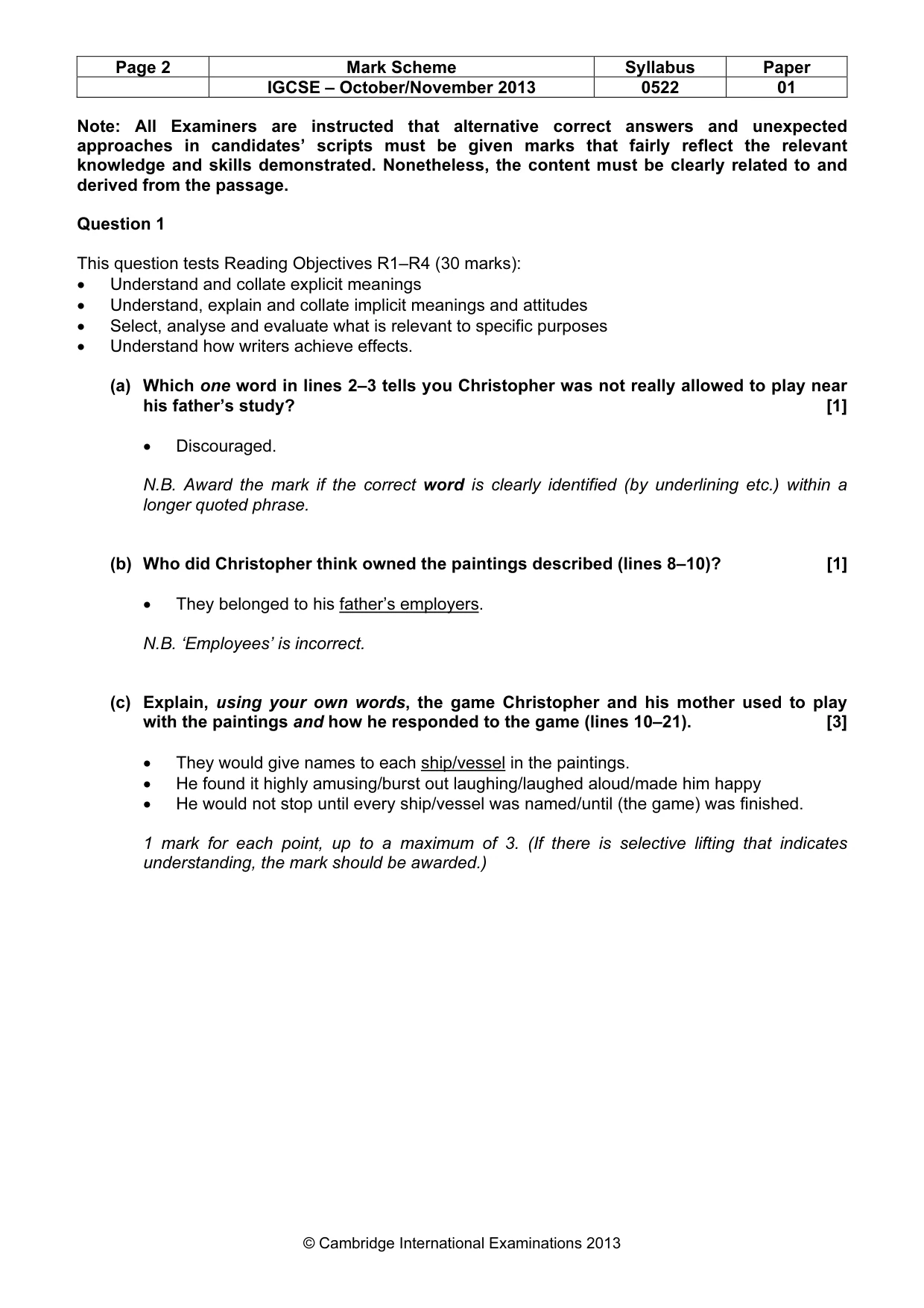
Page 2 Mark Scheme Syllabus Paper IGCSE – October/November 2013 0522 01 © Cambridge International Examinations 2013 Note: All Examiners are instructed that alternative correct answers and unexpected approaches in candidates’ scripts must be given marks that fairly reflect the relevant knowledge and skills demonstrated. Nonetheless, the content must be clearly related to and derived from the passage. Question 1 This question tests Reading Objectives R1–R4 (30 marks): • Understand and collate explicit meanings • Understand, explain and collate implicit meanings and attitudes • Select, analyse and evaluate what is relevant to specific purposes • Understand how writers achieve effects. (a) Which one word in lines 2–3 tells you Christopher was not really allowed to play near his father’s study? [1] • Discouraged. N.B. Award the mark if the correct word is clearly identified (by underlining etc.) within a longer quoted phrase. (b) Who did Christopher think owned the paintings described (lines 8–10)? [1] • They belonged to his father’s employers. N.B. ‘Employees’ is incorrect. (c) Explain, using your own words, the game Christopher and his mother used to play with the paintings and how he responded to the game (lines 10–21). [3] • They would give names to each ship/vessel in the paintings. • He found it highly amusing/burst out laughing/laughed aloud/made him happy • He would not stop until every ship/vessel was named/until (the game) was finished. 1 mark for each point, up to a maximum of 3. (If there is selective lifting that indicates understanding, the mark should be awarded.)
Mark scheme, page 3
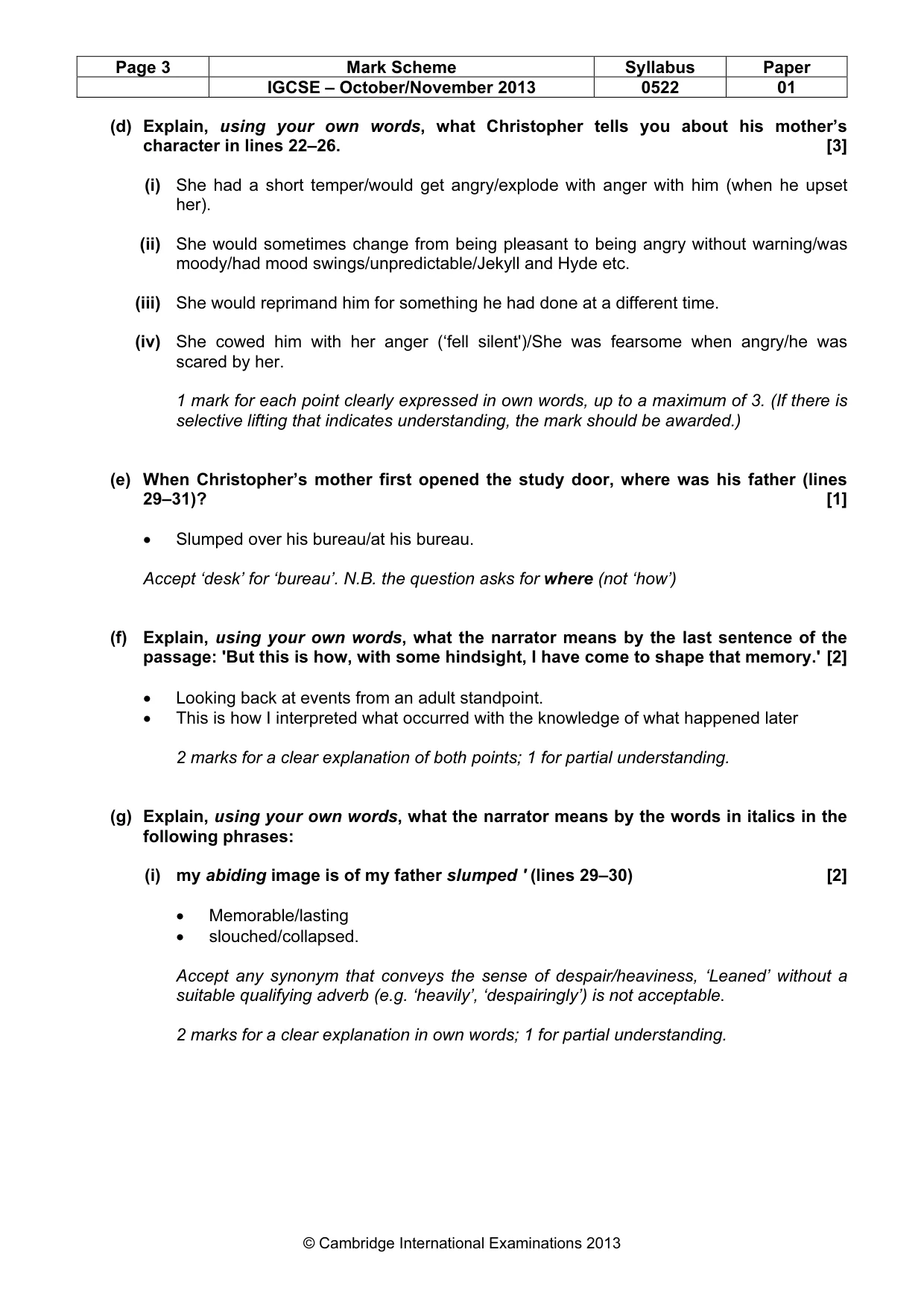
Page 3 Mark Scheme Syllabus Paper IGCSE – October/November 2013 0522 01 © Cambridge International Examinations 2013 (d) Explain, using your own words, what Christopher tells you about his mother’s character in lines 22–26. [3] (i) She had a short temper/would get angry/explode with anger with him (when he upset her). (ii) She would sometimes change from being pleasant to being angry without warning/was moody/had mood swings/unpredictable/Jekyll and Hyde etc. (iii) She would reprimand him for something he had done at a different time. (iv) She cowed him with her anger (‘fell silent')/She was fearsome when angry/he was scared by her. 1 mark for each point clearly expressed in own words, up to a maximum of 3. (If there is selective lifting that indicates understanding, the mark should be awarded.) (e) When Christopher’s mother first opened the study door, where was his father (lines 29–31)? [1] • Slumped over his bureau/at his bureau. Accept ‘desk’ for ‘bureau’. N.B. the question asks for where (not ‘how’) (f) Explain, using your own words, what the narrator means by the last sentence of the passage: 'But this is how, with some hindsight, I have come to shape that memory.' [2] • Looking back at events from an adult standpoint. • This is how I interpreted what occurred with the knowledge of what happened later 2 marks for a clear explanation of both points; 1 for partial understanding. (g) Explain, using your own words, what the narrator means by the words in italics in the following phrases: (i) my abiding image is of my father slumped ' (lines 29–30) [2] • Memorable/lasting • slouched/collapsed. Accept any synonym that conveys the sense of despair/heaviness, ‘Leaned’ without a suitable qualifying adverb (e.g. ‘heavily’, ‘despairingly’) is not acceptable. 2 marks for a clear explanation in own words; 1 for partial understanding.
Mark scheme, page 4
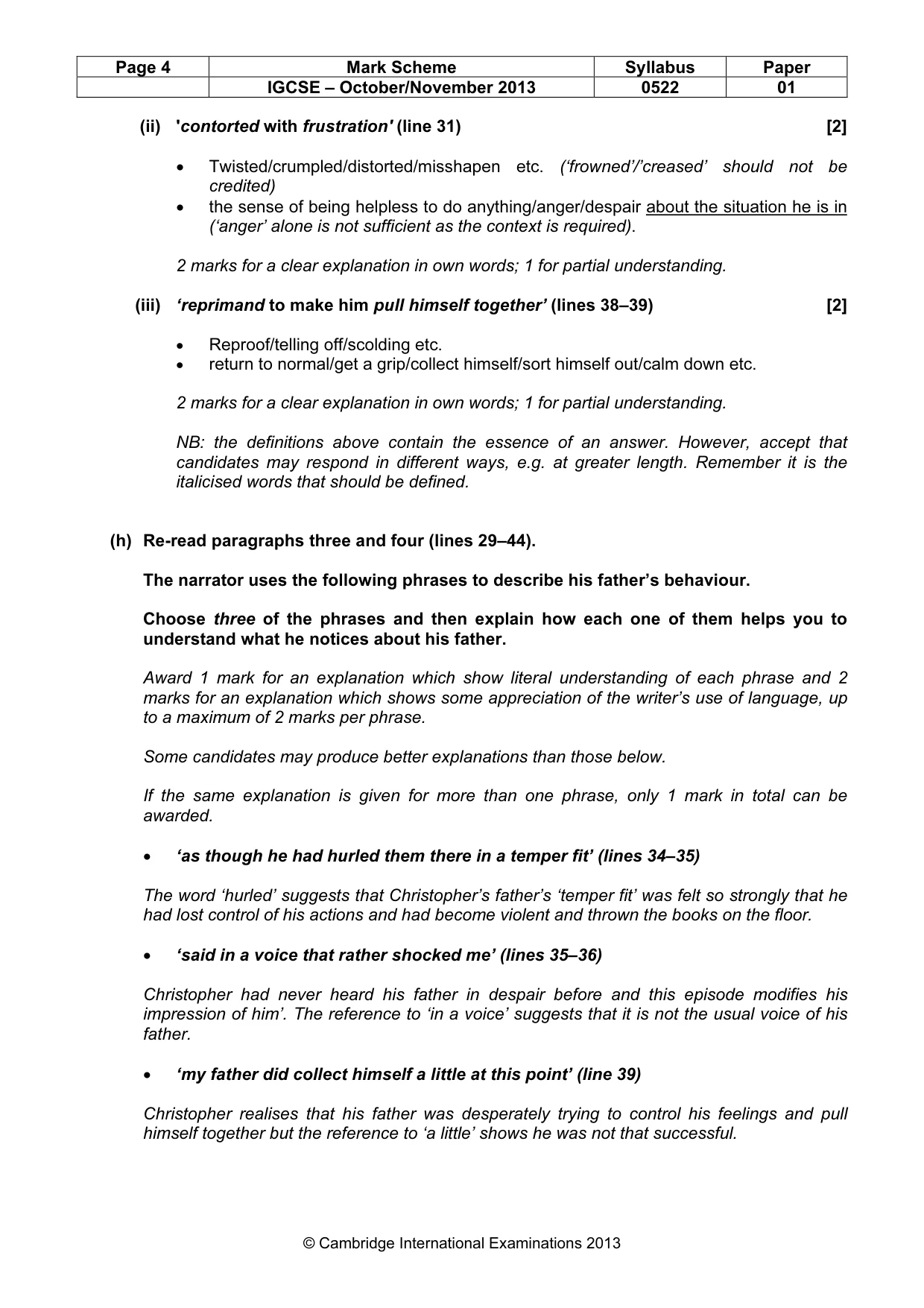
Page 4 Mark Scheme Syllabus Paper IGCSE – October/November 2013 0522 01 © Cambridge International Examinations 2013 (ii) 'contorted with frustration' (line 31) [2] • Twisted/crumpled/distorted/misshapen etc. (‘frowned’/’creased’ should not be credited) • the sense of being helpless to do anything/anger/despair about the situation he is in (‘anger’ alone is not sufficient as the context is required). 2 marks for a clear explanation in own words; 1 for partial understanding. (iii) ‘reprimand to make him pull himself together’ (lines 38–39) [2] • Reproof/telling off/scolding etc. • return to normal/get a grip/collect himself/sort himself out/calm down etc. 2 marks for a clear explanation in own words; 1 for partial understanding. NB: the definitions above contain the essence of an answer. However, accept that candidates may respond in different ways, e.g. at greater length. Remember it is the italicised words that should be defined. (h) Re-read paragraphs three and four (lines 29–44). The narrator uses the following phrases to describe his father’s behaviour. Choose three of the phrases and then explain how each one of them helps you to understand what he notices about his father. Award 1 mark for an explanation which show literal understanding of each phrase and 2 marks for an explanation which shows some appreciation of the writer’s use of language, up to a maximum of 2 marks per phrase. Some candidates may produce better explanations than those below. If the same explanation is given for more than one phrase, only 1 mark in total can be awarded. • ‘as though he had hurled them there in a temper fit’ (lines 34–35) The word ‘hurled’ suggests that Christopher’s father’s ‘temper fit’ was felt so strongly that he had lost control of his actions and had become violent and thrown the books on the floor. • ‘said in a voice that rather shocked me’ (lines 35–36) Christopher had never heard his father in despair before and this episode modifies his impression of him’. The reference to ‘in a voice’ suggests that it is not the usual voice of his father. • ‘my father did collect himself a little at this point’ (line 39) Christopher realises that his father was desperately trying to control his feelings and pull himself together but the reference to ‘a little’ shows he was not that successful.
Mark scheme, page 5
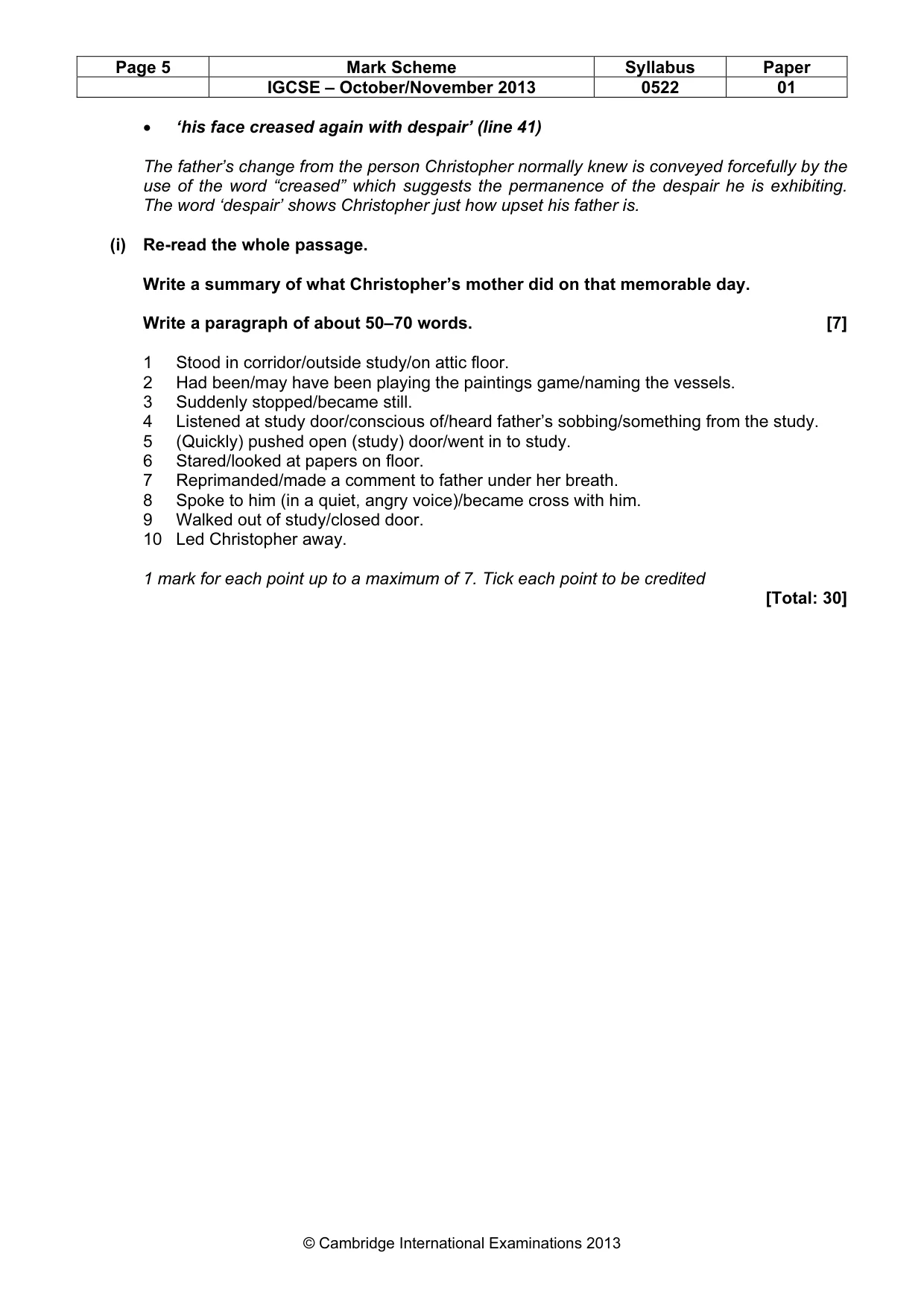
Page 5 Mark Scheme Syllabus Paper IGCSE – October/November 2013 0522 01 © Cambridge International Examinations 2013 • ‘his face creased again with despair’ (line 41) The father’s change from the person Christopher normally knew is conveyed forcefully by the use of the word “creased” which suggests the permanence of the despair he is exhibiting. The word ‘despair’ shows Christopher just how upset his father is. (i) Re-read the whole passage. Write a summary of what Christopher’s mother did on that memorable day. Write a paragraph of about 50–70 words. [7] 1 Stood in corridor/outside study/on attic floor. 2 Had been/may have been playing the paintings game/naming the vessels. 3 Suddenly stopped/became still. 4 Listened at study door/conscious of/heard father’s sobbing/something from the study. 5 (Quickly) pushed open (study) door/went in to study. 6 Stared/looked at papers on floor. 7 Reprimanded/made a comment to father under her breath. 8 Spoke to him (in a quiet, angry voice)/became cross with him. 9 Walked out of study/closed door. 10 Led Christopher away. 1 mark for each point up to a maximum of 7. Tick each point to be credited [Total: 30]
Mark scheme, page 6
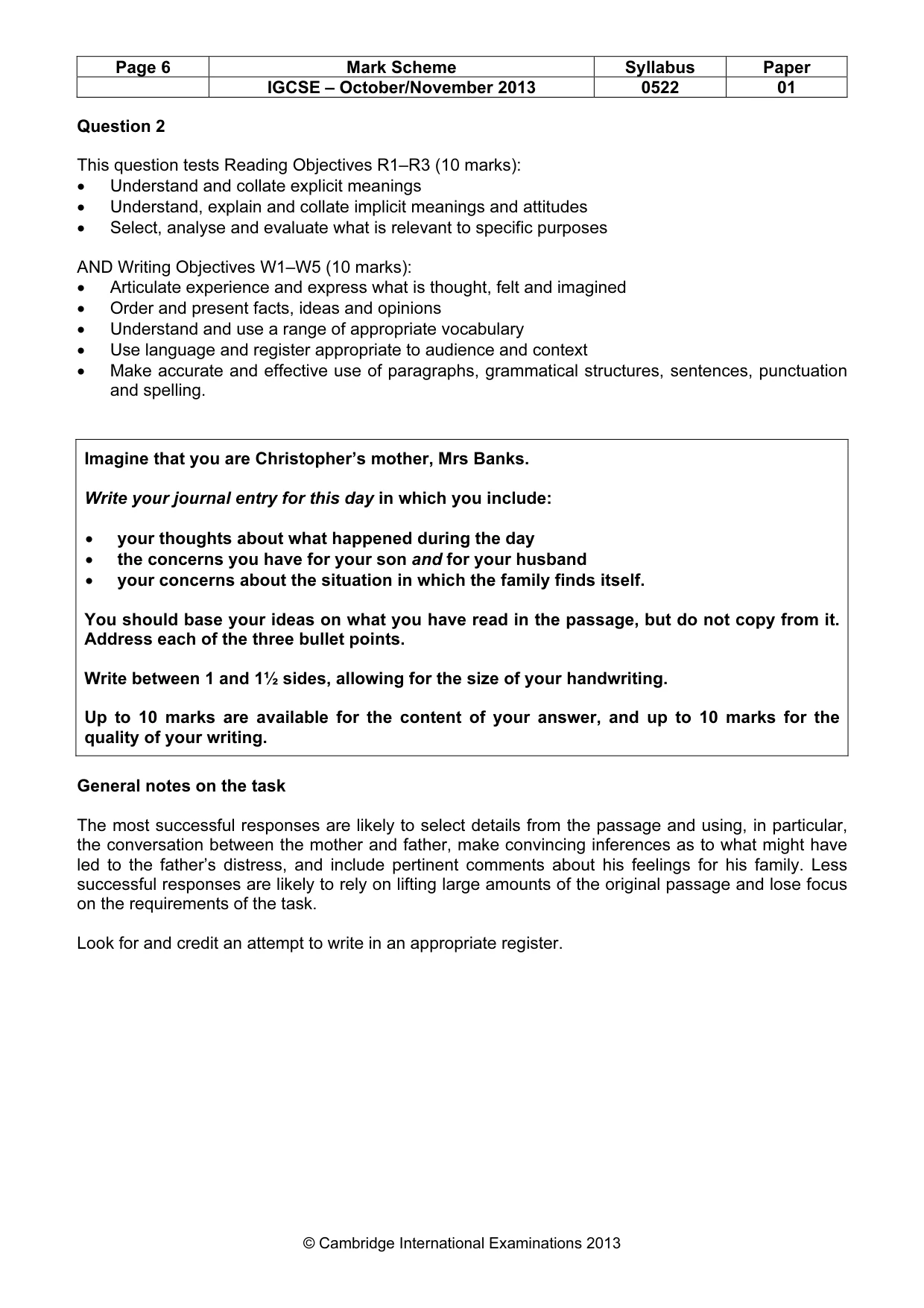
Page 6 Mark Scheme Syllabus Paper IGCSE – October/November 2013 0522 01 © Cambridge International Examinations 2013 Question 2 This question tests Reading Objectives R1–R3 (10 marks): • Understand and collate explicit meanings • Understand, explain and collate implicit meanings and attitudes • Select, analyse and evaluate what is relevant to specific purposes AND Writing Objectives W1–W5 (10 marks): • Articulate experience and express what is thought, felt and imagined • Order and present facts, ideas and opinions • Understand and use a range of appropriate vocabulary • Use language and register appropriate to audience and context • Make accurate and effective use of paragraphs, grammatical structures, sentences, punctuation and spelling. Imagine that you are Christopher’s mother, Mrs Banks. Write your journal entry for this day in which you include: • your thoughts about what happened during the day • the concerns you have for your son and for your husband • your concerns about the situation in which the family finds itself. You should base your ideas on what you have read in the passage, but do not copy from it. Address each of the three bullet points. Write between 1 and 1½ sides, allowing for the size of your handwriting. Up to 10 marks are available for the content of your answer, and up to 10 marks for the quality of your writing. General notes on the task The most successful responses are likely to select details from the passage and using, in particular, the conversation between the mother and father, make convincing inferences as to what might have led to the father’s distress, and include pertinent comments about his feelings for his family. Less successful responses are likely to rely on lifting large amounts of the original passage and lose focus on the requirements of the task. Look for and credit an attempt to write in an appropriate register.
Mark scheme, page 7
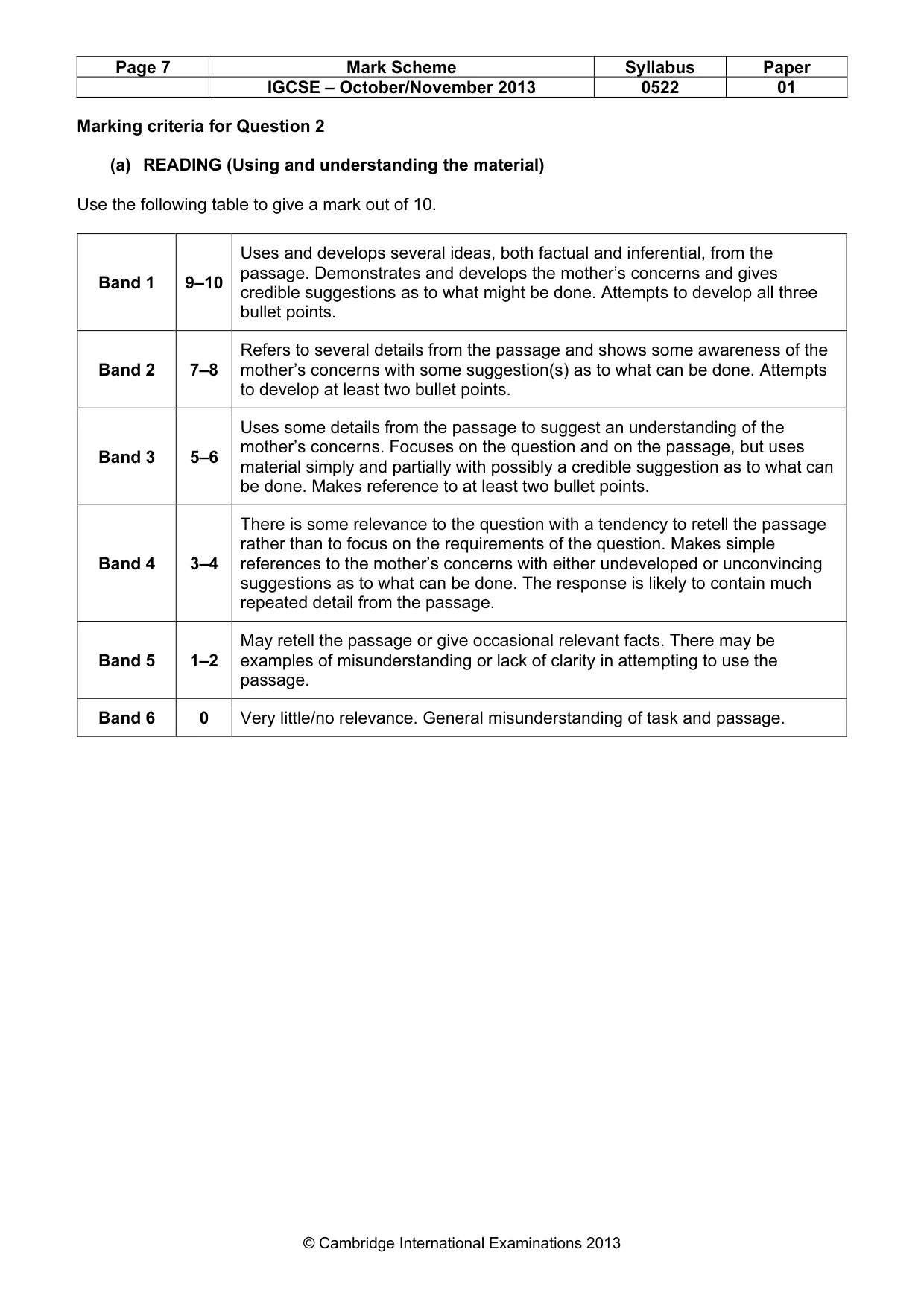
Page 7 Mark Scheme Syllabus Paper IGCSE – October/November 2013 0522 01 © Cambridge International Examinations 2013 Marking criteria for Question 2 (a) READING (Using and understanding the material) Use the following table to give a mark out of 10. Band 1 9–10 Uses and develops several ideas, both factual and inferential, from the passage. Demonstrates and develops the mother’s concerns and gives credible suggestions as to what might be done. Attempts to develop all three bullet points. Band 2 7–8 Refers to several details from the passage and shows some awareness of the mother’s concerns with some suggestion(s) as to what can be done. Attempts to develop at least two bullet points. Band 3 5–6 Uses some details from the passage to suggest an understanding of the mother’s concerns. Focuses on the question and on the passage, but uses material simply and partially with possibly a credible suggestion as to what can be done. Makes reference to at least two bullet points. Band 4 3–4 There is some relevance to the question with a tendency to retell the passage rather than to focus on the requirements of the question. Makes simple references to the mother’s concerns with either undeveloped or unconvincing suggestions as to what can be done. The response is likely to contain much repeated detail from the passage. Band 5 1–2 May retell the passage or give occasional relevant facts. There may be examples of misunderstanding or lack of clarity in attempting to use the passage. Band 6 0 Very little/no relevance. General misunderstanding of task and passage.
Mark scheme, page 8
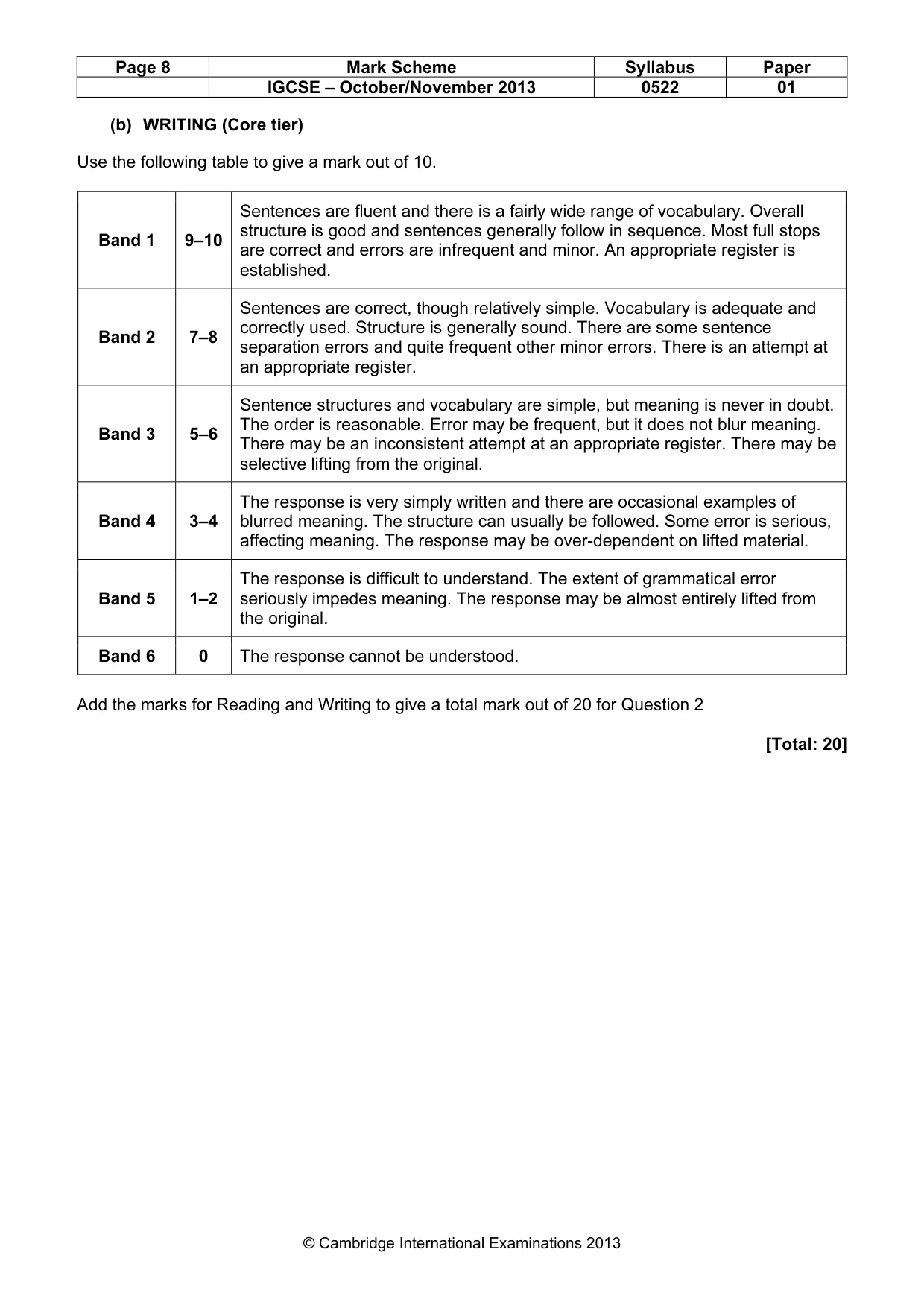
Page 8 Mark Scheme Syllabus Paper IGCSE – October/November 2013 0522 01 © Cambridge International Examinations 2013 (b) WRITING (Core tier) Use the following table to give a mark out of 10. Band 1 9–10 Sentences are fluent and there is a fairly wide range of vocabulary. Overall structure is good and sentences generally follow in sequence. Most full stops are correct and errors are infrequent and minor. An appropriate register is established. Band 2 7–8 Sentences are correct, though relatively simple. Vocabulary is adequate and correctly used. Structure is generally sound. There are some sentence separation errors and quite frequent other minor errors. There is an attempt at an appropriate register. Band 3 5–6 Sentence structures and vocabulary are simple, but meaning is never in doubt. The order is reasonable. Error may be frequent, but it does not blur meaning. There may be an inconsistent attempt at an appropriate register. There may be selective lifting from the original. Band 4 3–4 The response is very simply written and there are occasional examples of blurred meaning. The structure can usually be followed. Some error is serious, affecting meaning. The response may be over-dependent on lifted material. Band 5 1–2 The response is difficult to understand. The extent of grammatical error seriously impedes meaning. The response may be almost entirely lifted from the original. Band 6 0 The response cannot be understood. Add the marks for Reading and Writing to give a total mark out of 20 for Question 2 [Total: 20]
What you needed in this session
Cambridge’s own grade thresholds for 2013 Oct/Nov, Paper 1 · Variant 1. A higher threshold means an easier paper — the bar moves with how the cohort did.