Cambridge IGCSE English - First Language (UK) 0522 — 2011 Oct/Nov Paper 1 · Variant 1
0522/11/O/N/11 · 50 marks · ≈56 min
The question paper and its mark scheme, free to read here and free to download. This is Cambridge’s own paper, exactly as it was sat.
Question paper8 pages
Mark scheme7 pages
Answers below. Sit the paper first if you are practising.
Paper as text
Question paper, page 1
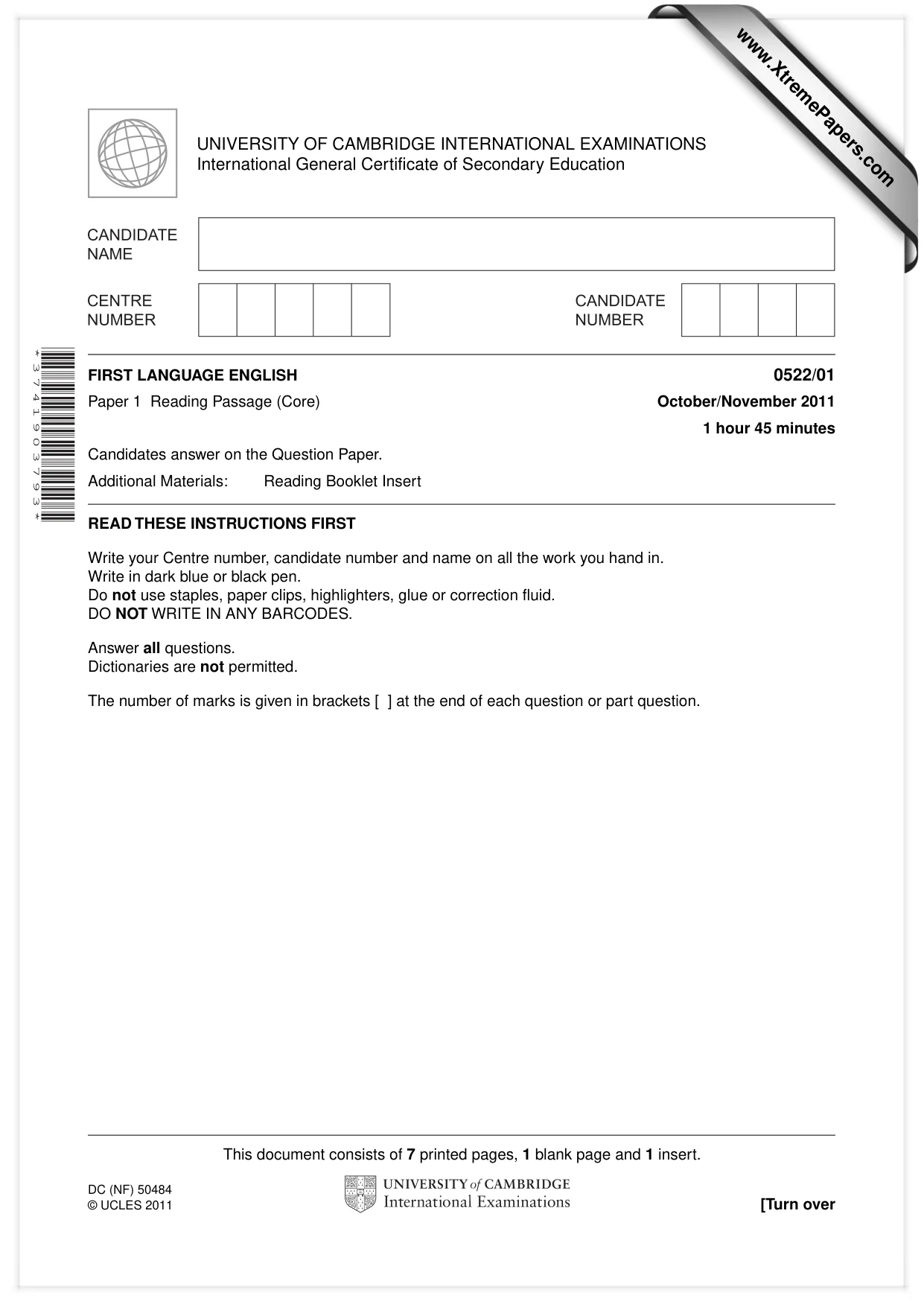
This document consists of 7 printed pages, 1 blank page and 1 insert. DC (NF) 50484 © UCLES 2011 [Turn over UNIVERSITY OF CAMBRIDGE INTERNATIONAL EXAMINATIONS International General Certificate of Secondary Education * 3 7 4 1 9 0 3 7 9 3 * FIRST LANGUAGE ENGLISH 0522/01 Paper 1 Reading Passage (Core) October/November 2011 1 hour 45 minutes Candidates answer on the Question Paper. Additional Materials: Reading Booklet Insert READ THESE INSTRUCTIONS FIRST Write your Centre number, candidate number and name on all the work you hand in. Write in dark blue or black pen. Do not use staples, paper clips, highlighters, glue or correction fluid. DO NOT WRITE IN ANY BARCODES. Answer all questions. Dictionaries are not permitted. The number of marks is given in brackets [ ] at the end of each question or part question. www.XtremePapers.com
Question paper, page 2
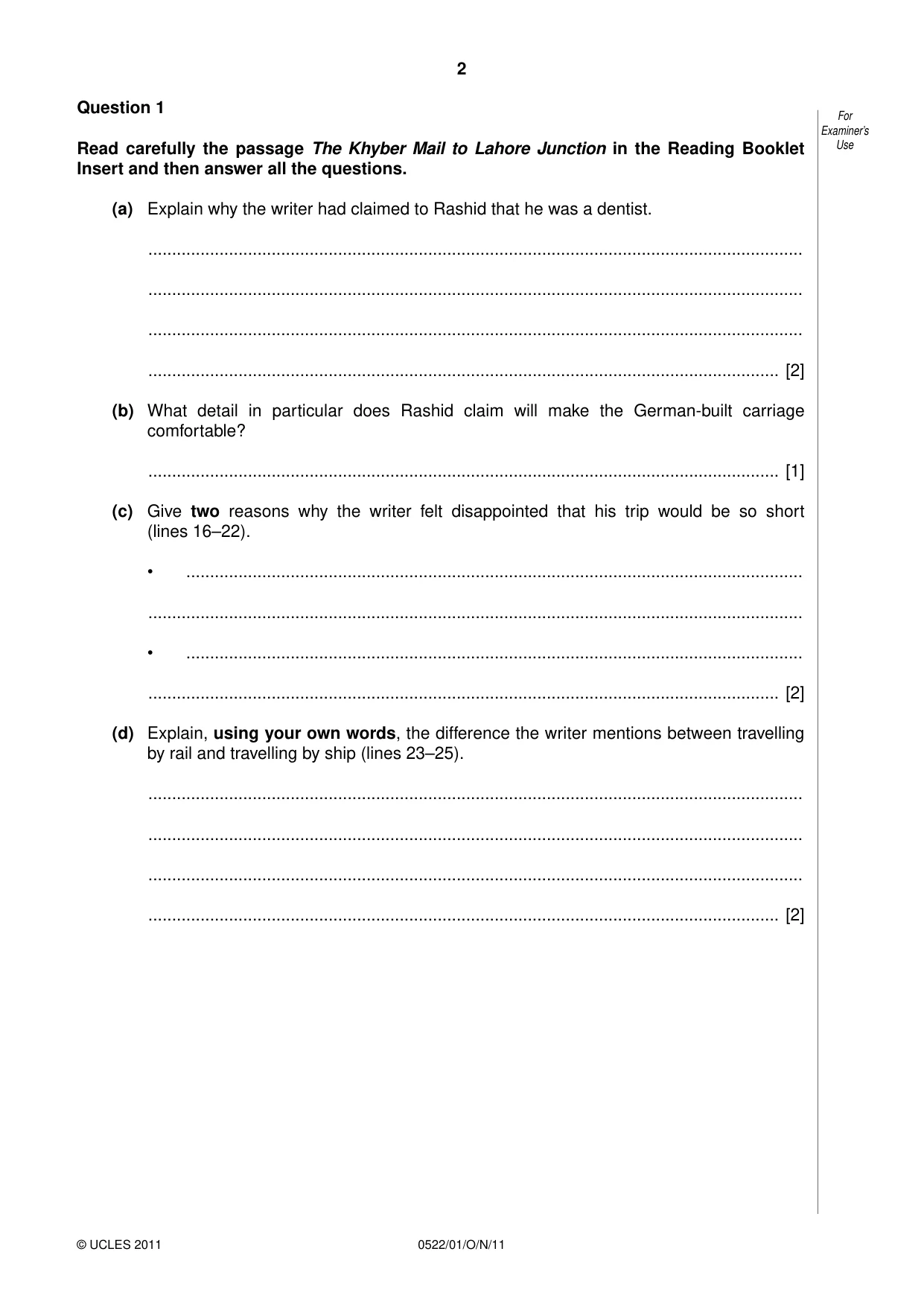
2 0522/01/O/N/11 © UCLES 2011 For Examiner’s Use Question 1 Read carefully the passage The Khyber Mail to Lahore Junction in the Reading Booklet Insert and then answer all the questions. (a) Explain why the writer had claimed to Rashid that he was a dentist. … … … … [2] (b) What detail in particular does Rashid claim will make the German-built carriage comfortable? … [1] (c) Give two reasons why the writer felt disappointed that his trip would be so short (lines 16–22). • … … • … … [2] (d) Explain, using your own words, the difference the writer mentions between travelling by rail and travelling by ship (lines 23–25). … … … … [2]
Question paper, page 3
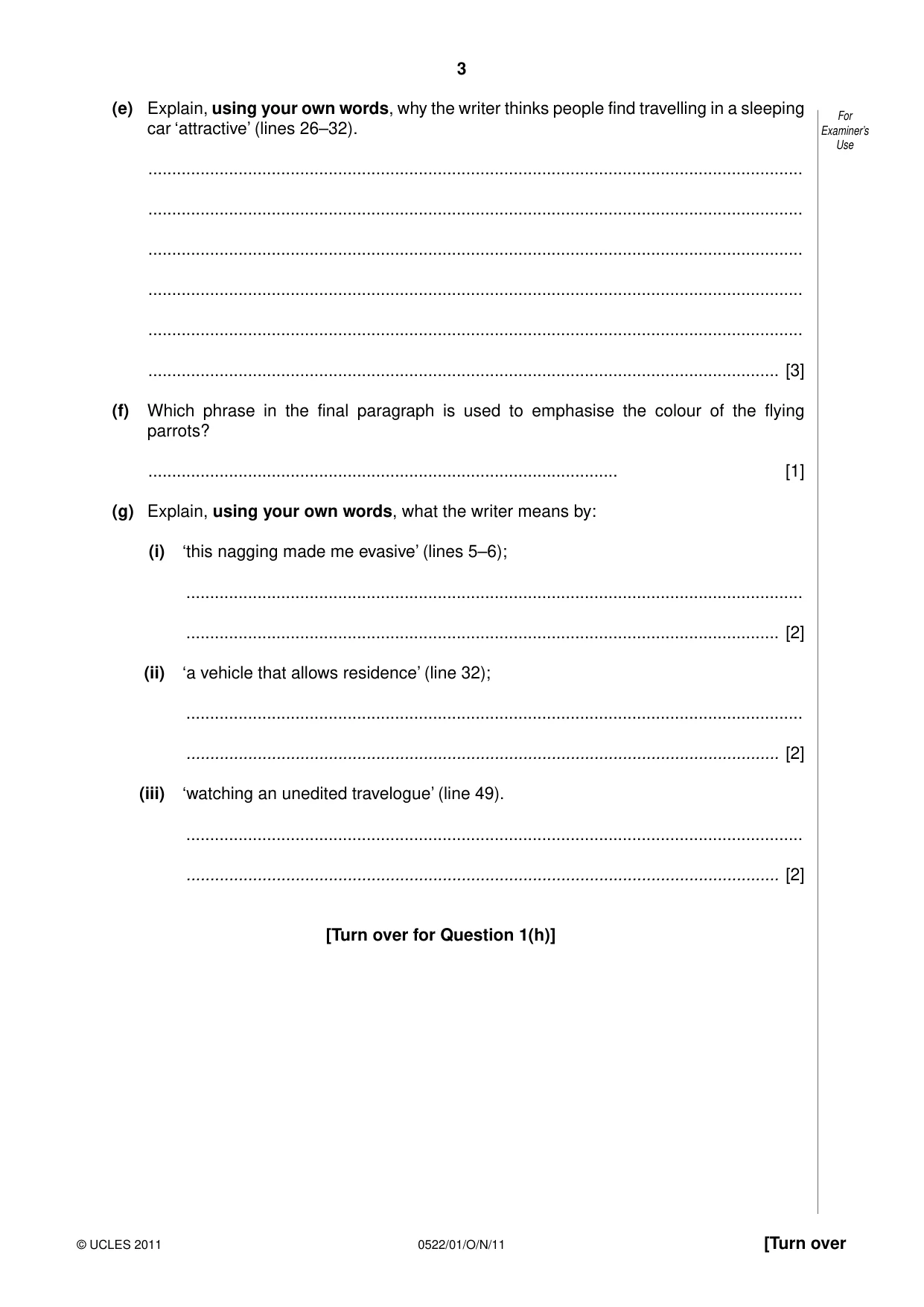
3 0522/01/O/N/11 © UCLES 2011 [Turn over For Examiner’s Use (e) Explain, using your own words, why the writer thinks people find travelling in a sleeping car ‘attractive’ (lines 26–32). … … … … … … [3] (f) Which phrase in the final paragraph is used to emphasise the colour of the flying parrots? … [1] (g) Explain, using your own words, what the writer means by: (i) ‘this nagging made me evasive’ (lines 5–6); … … [2] (ii) ‘a vehicle that allows residence’ (line 32); … … [2] (iii) ‘watching an unedited travelogue’ (line 49). … … [2] [Turn over for Question 1(h)]
Question paper, page 4
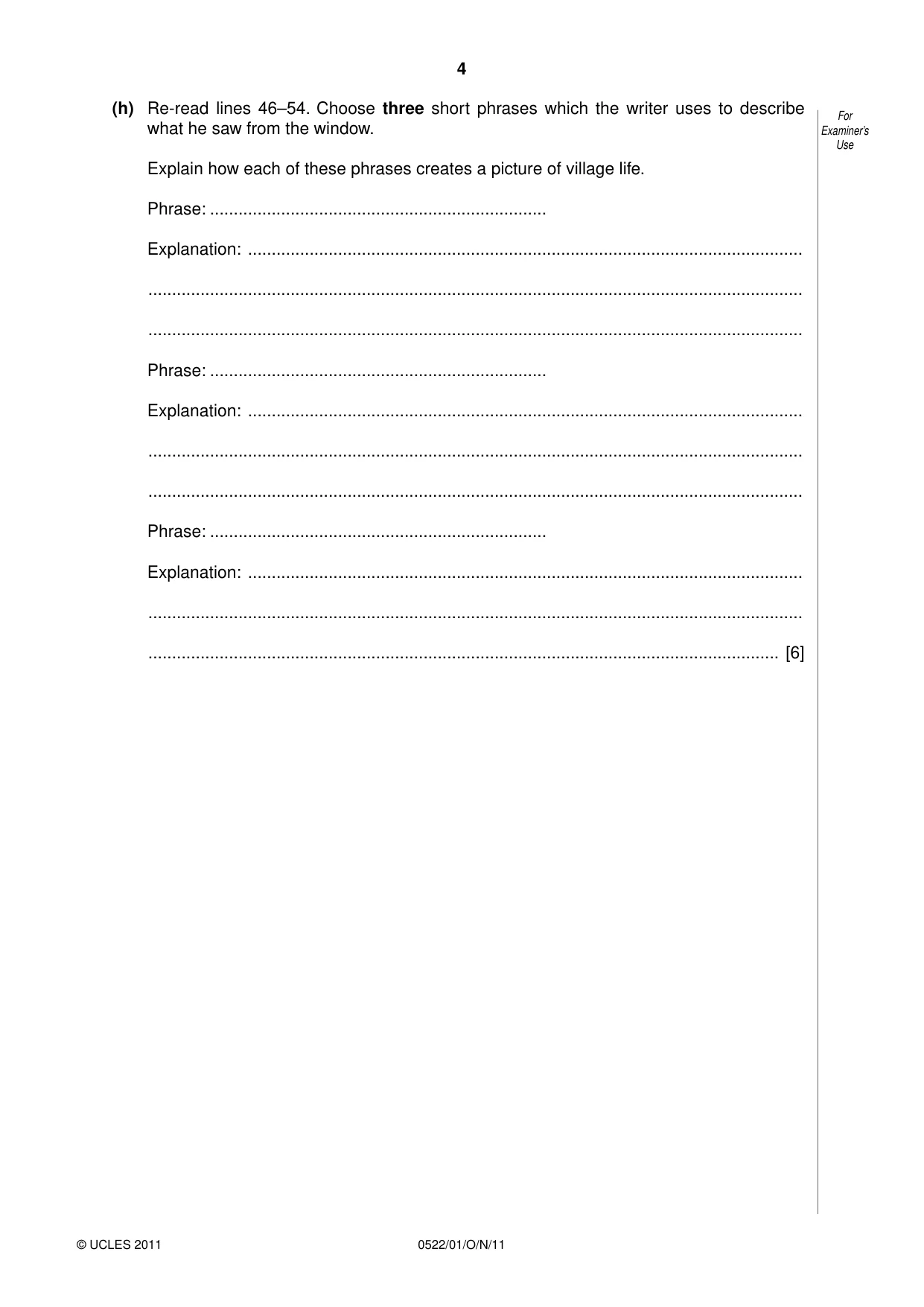
4 0522/01/O/N/11 © UCLES 2011 For Examiner’s Use (h) Re-read lines 46–54. Choose three short phrases which the writer uses to describe what he saw from the window. Explain how each of these phrases creates a picture of village life. Phrase: … Explanation: … … … Phrase: … Explanation: … … … Phrase: … Explanation: … … … [6]
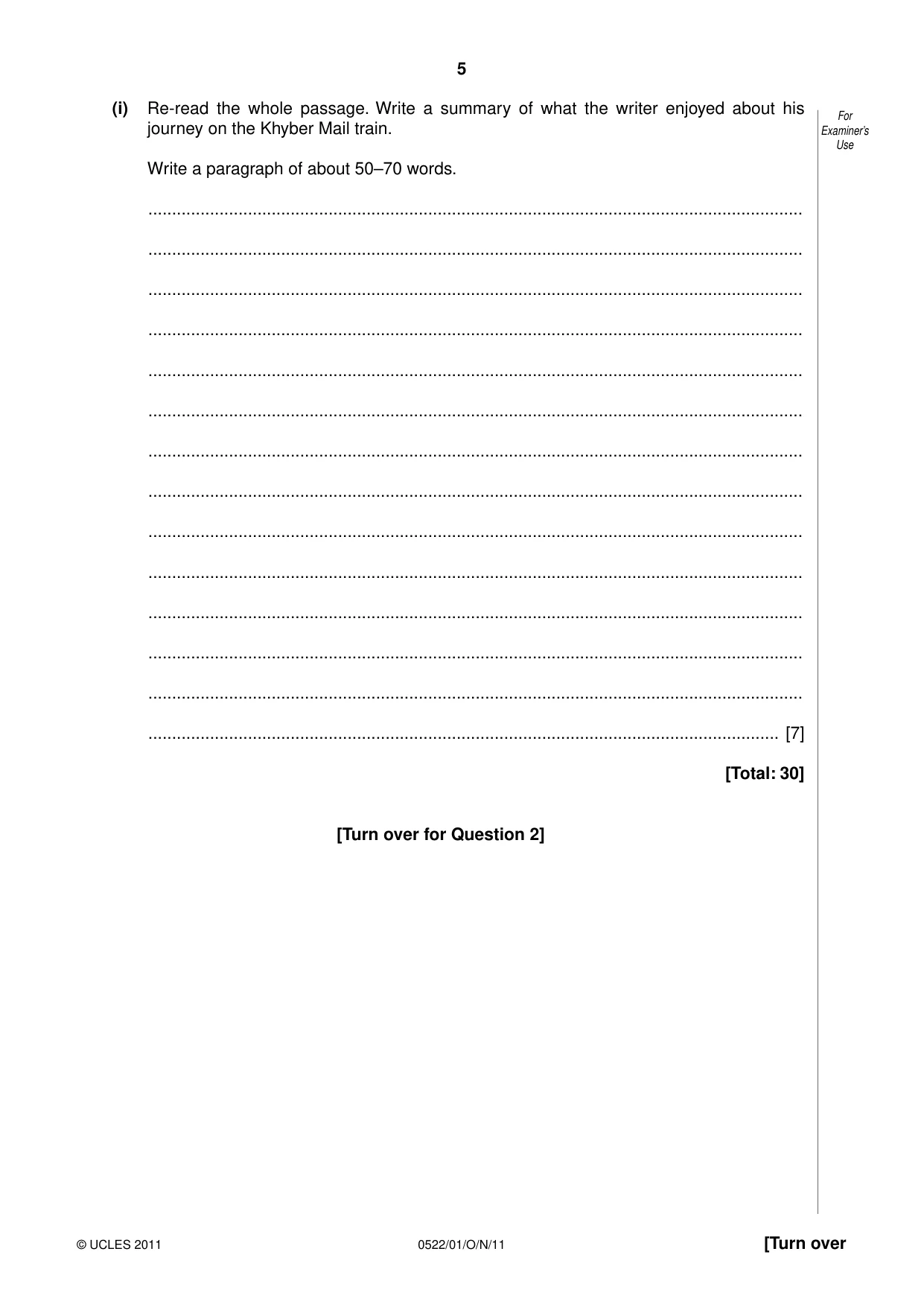
Question paper, page 5
5 0522/01/O/N/11 © UCLES 2011 [Turn over For Examiner’s Use (i) Re-read the whole passage. Write a summary of what the writer enjoyed about his journey on the Khyber Mail train. Write a paragraph of about 50–70 words. … … … … … … … … … … … … … … [7] [Total: 30] [Turn over for Question 2]
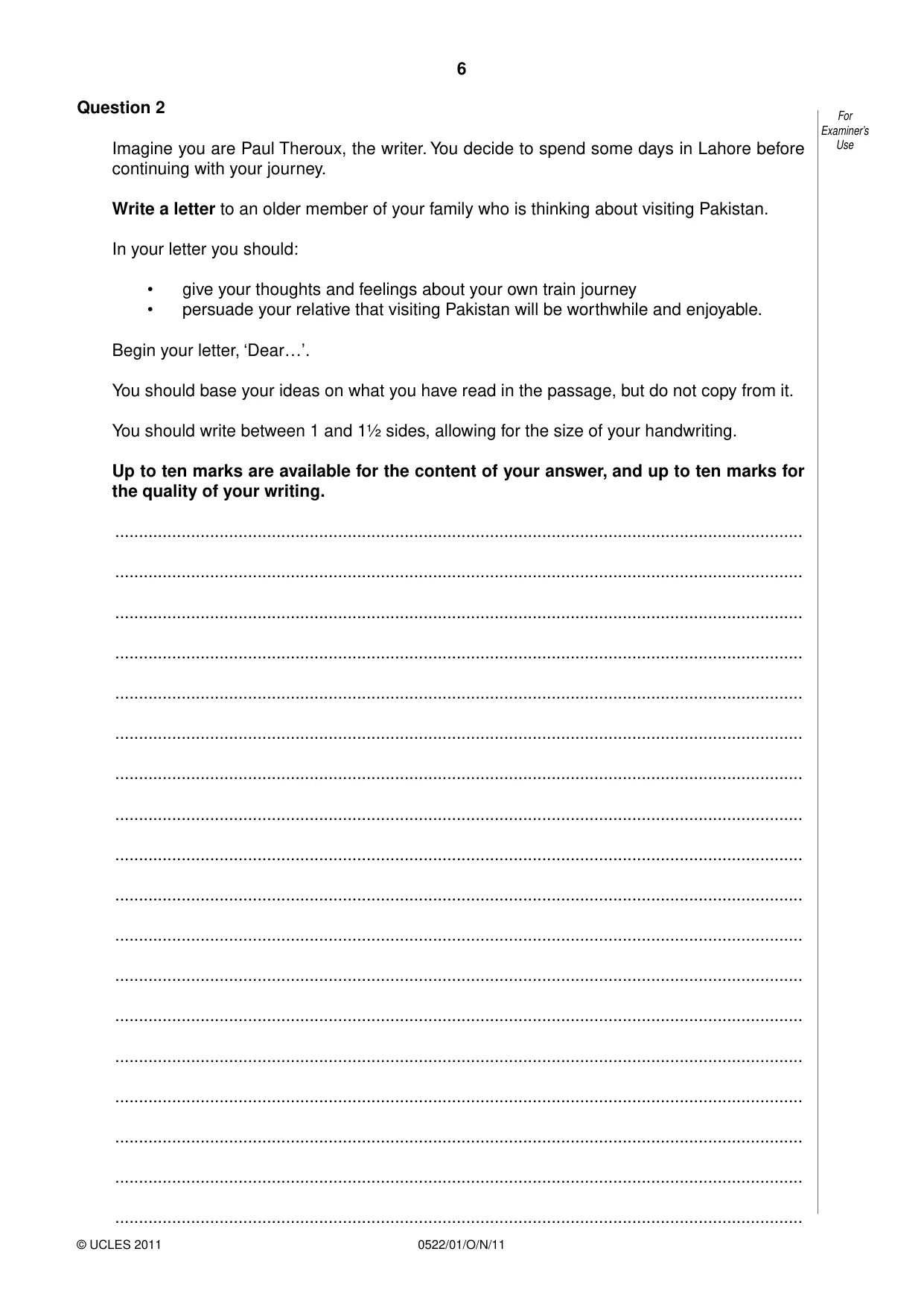
Question paper, page 6
6 0522/01/O/N/11 © UCLES 2011 For Examiner’s Use Question 2 Imagine you are Paul Theroux, the writer. You decide to spend some days in Lahore before continuing with your journey. Write a letter to an older member of your family who is thinking about visiting Pakistan. In your letter you should: • give your thoughts and feelings about your own train journey • persuade your relative that visiting Pakistan will be worthwhile and enjoyable. Begin your letter, ‘Dear…’. You should base your ideas on what you have read in the passage, but do not copy from it. You should write between 1 and 1½ sides, allowing for the size of your handwriting. Up to ten marks are available for the content of your answer, and up to ten marks for the quality of your writing. … … … … … … … … … … … … … … … … … …
Question paper, page 7
7 0522/01/O/N/11 © UCLES 2011 For Examiner’s Use … … … … … … … … … … … … … … … … … … … … … … … … … … … [Total: 20]
Question paper, page 8
8 0522/01/O/N/11 © UCLES 2011 BLANK PAGE Copyright Acknowledgements: Reading Passage © (adapted) Paul Theroux; The Great Railway Bazaar; Penguin Books Ltd, 1977. Permission to reproduce items where third-party owned material protected by copyright is included has been sought and cleared where possible. Every reasonable effort has been made by the publisher (UCLES) to trace copyright holders, but if any items requiring clearance have unwittingly been included, the publisher will be pleased to make amends at the earliest possible opportunity. University of Cambridge International Examinations is part of the Cambridge Assessment Group. Cambridge Assessment is the brand name of University of Cambridge Local Examinations Syndicate (UCLES), which is itself a department of the University of Cambridge.
Mark scheme, page 1
UNIVERSITY OF CAMBRIDGE INTERNATIONAL EXAMINATIONS International General Certificate of Secondary Education MARK SCHEME for the October/November 2011 question paper for the guidance of teachers 0522 FIRST LANGUAGE ENGLISH 0522/01 Paper 1 (Reading Passage – Core), maximum raw mark 50 This mark scheme is published as an aid to teachers and candidates, to indicate the requirements of the examination. It shows the basis on which Examiners were instructed to award marks. It does not indicate the details of the discussions that took place at an Examiners’ meeting before marking began, which would have considered the acceptability of alternative answers. Mark schemes must be read in conjunction with the question papers and the report on the examination. • Cambridge will not enter into discussions or correspondence in connection with these mark schemes. Cambridge is publishing the mark schemes for the October/November 2011 question papers for most IGCSE, GCE Advanced Level and Advanced Subsidiary Level syllabuses and some Ordinary Level syllabuses. www.XtremePapers.com
Mark scheme, page 2
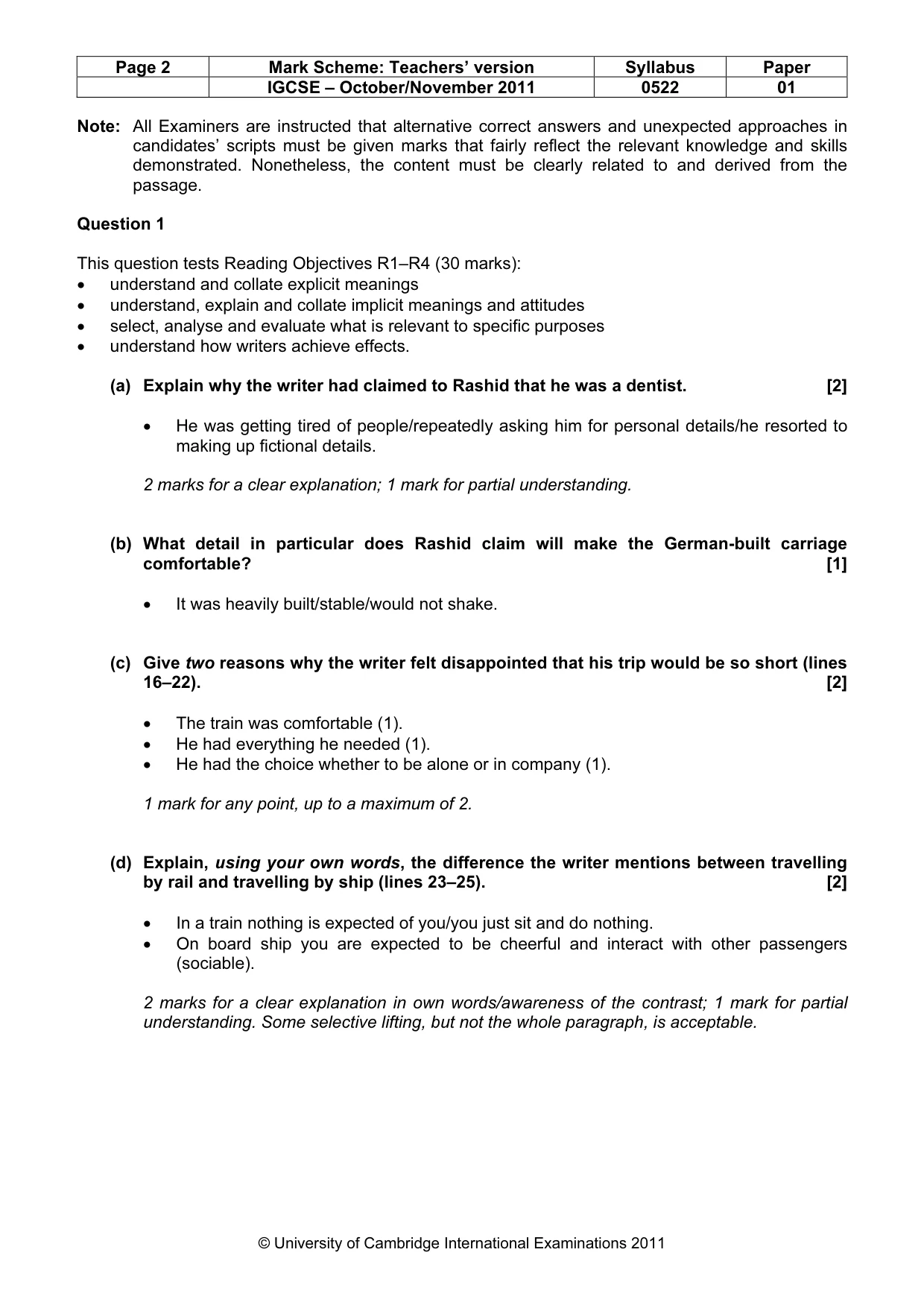
Page 2 Mark Scheme: Teachers’ version Syllabus Paper IGCSE – October/November 2011 0522 01 © University of Cambridge International Examinations 2011 Note: All Examiners are instructed that alternative correct answers and unexpected approaches in candidates’ scripts must be given marks that fairly reflect the relevant knowledge and skills demonstrated. Nonetheless, the content must be clearly related to and derived from the passage. Question 1 This question tests Reading Objectives R1–R4 (30 marks): • understand and collate explicit meanings • understand, explain and collate implicit meanings and attitudes • select, analyse and evaluate what is relevant to specific purposes • understand how writers achieve effects. (a) Explain why the writer had claimed to Rashid that he was a dentist. [2] • He was getting tired of people/repeatedly asking him for personal details/he resorted to making up fictional details. 2 marks for a clear explanation; 1 mark for partial understanding. (b) What detail in particular does Rashid claim will make the German-built carriage comfortable? [1] • It was heavily built/stable/would not shake. (c) Give two reasons why the writer felt disappointed that his trip would be so short (lines 16–22). [2] • The train was comfortable (1). • He had everything he needed (1). • He had the choice whether to be alone or in company (1). 1 mark for any point, up to a maximum of 2. (d) Explain, using your own words, the difference the writer mentions between travelling by rail and travelling by ship (lines 23–25). [2] • In a train nothing is expected of you/you just sit and do nothing. • On board ship you are expected to be cheerful and interact with other passengers (sociable). 2 marks for a clear explanation in own words/awareness of the contrast; 1 mark for partial understanding. Some selective lifting, but not the whole paragraph, is acceptable.
Mark scheme, page 3
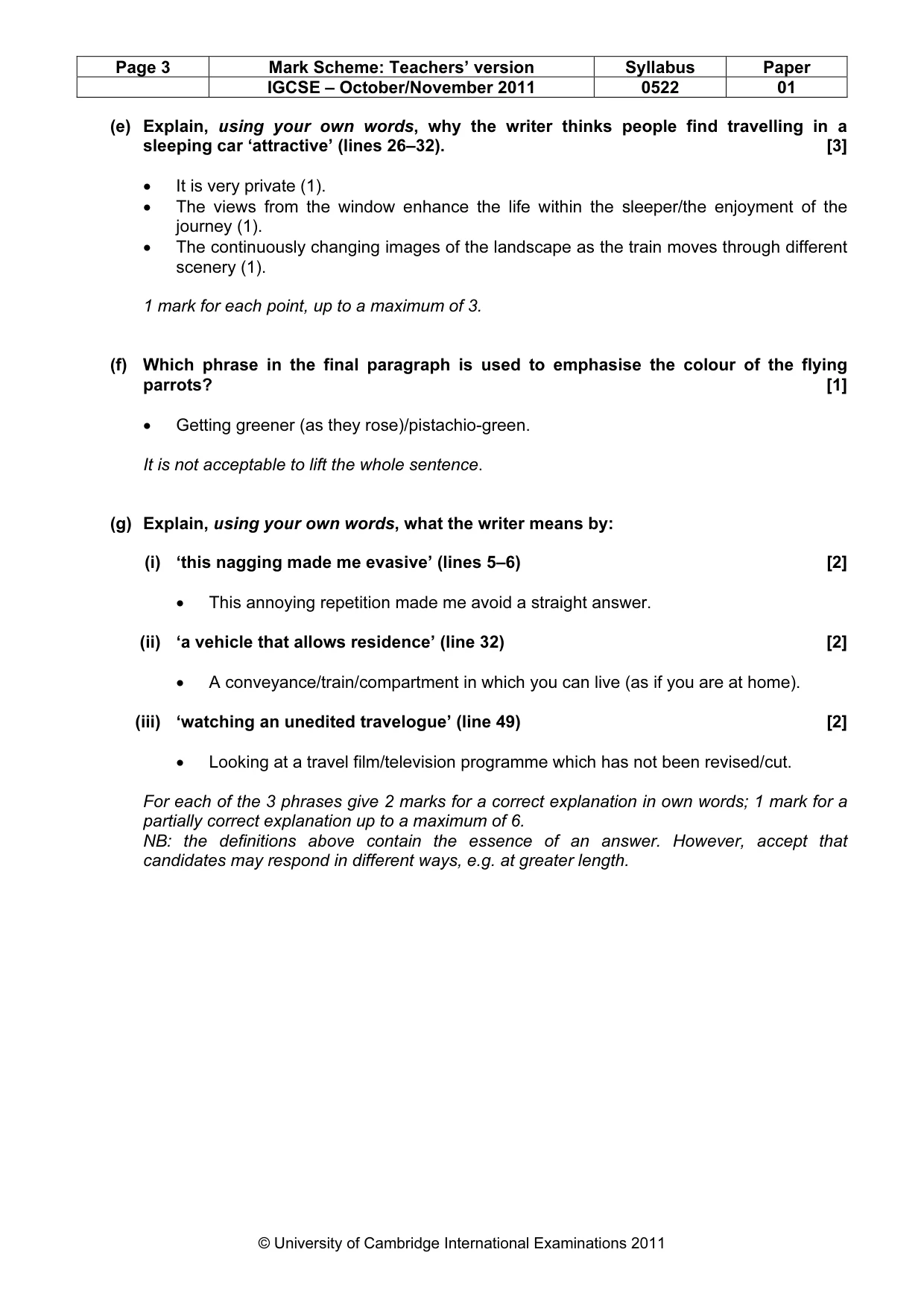
Page 3 Mark Scheme: Teachers’ version Syllabus Paper IGCSE – October/November 2011 0522 01 © University of Cambridge International Examinations 2011 (e) Explain, using your own words, why the writer thinks people find travelling in a sleeping car ‘attractive’ (lines 26–32). [3] • It is very private (1). • The views from the window enhance the life within the sleeper/the enjoyment of the journey (1). • The continuously changing images of the landscape as the train moves through different scenery (1). 1 mark for each point, up to a maximum of 3. (f) Which phrase in the final paragraph is used to emphasise the colour of the flying parrots? [1] • Getting greener (as they rose)/pistachio-green. It is not acceptable to lift the whole sentence. (g) Explain, using your own words, what the writer means by: (i) ‘this nagging made me evasive’ (lines 5–6) [2] • This annoying repetition made me avoid a straight answer. (ii) ‘a vehicle that allows residence’ (line 32) [2] • A conveyance/train/compartment in which you can live (as if you are at home). (iii) ‘watching an unedited travelogue’ (line 49) [2] • Looking at a travel film/television programme which has not been revised/cut. For each of the 3 phrases give 2 marks for a correct explanation in own words; 1 mark for a partially correct explanation up to a maximum of 6. NB: the definitions above contain the essence of an answer. However, accept that candidates may respond in different ways, e.g. at greater length.
Mark scheme, page 4
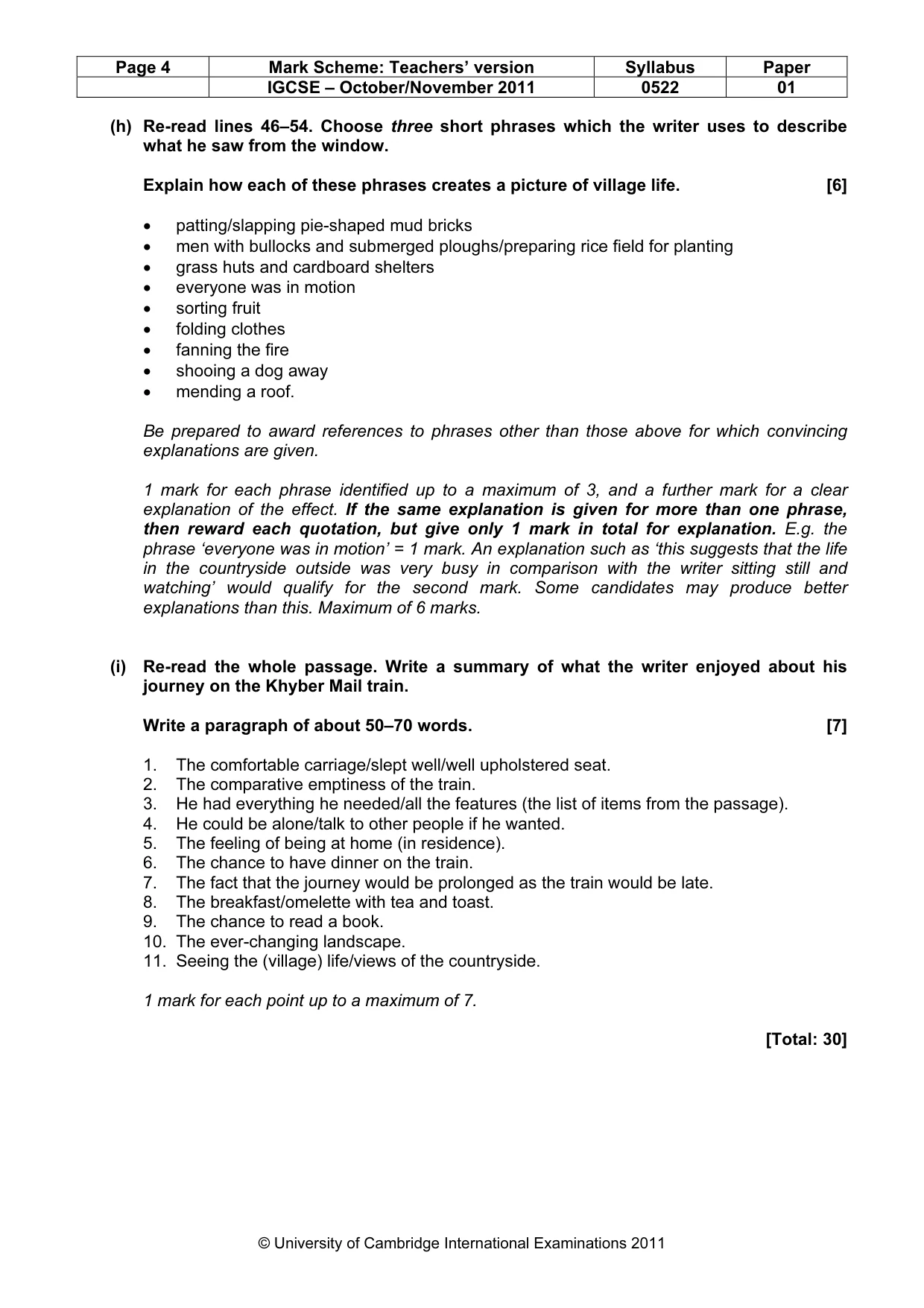
Page 4 Mark Scheme: Teachers’ version Syllabus Paper IGCSE – October/November 2011 0522 01 © University of Cambridge International Examinations 2011 (h) Re-read lines 46–54. Choose three short phrases which the writer uses to describe what he saw from the window. Explain how each of these phrases creates a picture of village life. [6] • patting/slapping pie-shaped mud bricks • men with bullocks and submerged ploughs/preparing rice field for planting • grass huts and cardboard shelters • everyone was in motion • sorting fruit • folding clothes • fanning the fire • shooing a dog away • mending a roof. Be prepared to award references to phrases other than those above for which convincing explanations are given. 1 mark for each phrase identified up to a maximum of 3, and a further mark for a clear explanation of the effect. If the same explanation is given for more than one phrase, then reward each quotation, but give only 1 mark in total for explanation. E.g. the phrase ‘everyone was in motion’ = 1 mark. An explanation such as ‘this suggests that the life in the countryside outside was very busy in comparison with the writer sitting still and watching’ would qualify for the second mark. Some candidates may produce better explanations than this. Maximum of 6 marks. (i) Re-read the whole passage. Write a summary of what the writer enjoyed about his journey on the Khyber Mail train. Write a paragraph of about 50–70 words. [7] 1. The comfortable carriage/slept well/well upholstered seat. 2. The comparative emptiness of the train. 3. He had everything he needed/all the features (the list of items from the passage). 4. He could be alone/talk to other people if he wanted. 5. The feeling of being at home (in residence). 6. The chance to have dinner on the train. 7. The fact that the journey would be prolonged as the train would be late. 8. The breakfast/omelette with tea and toast. 9. The chance to read a book. 10. The ever-changing landscape. 11. Seeing the (village) life/views of the countryside. 1 mark for each point up to a maximum of 7. [Total: 30]
Mark scheme, page 5
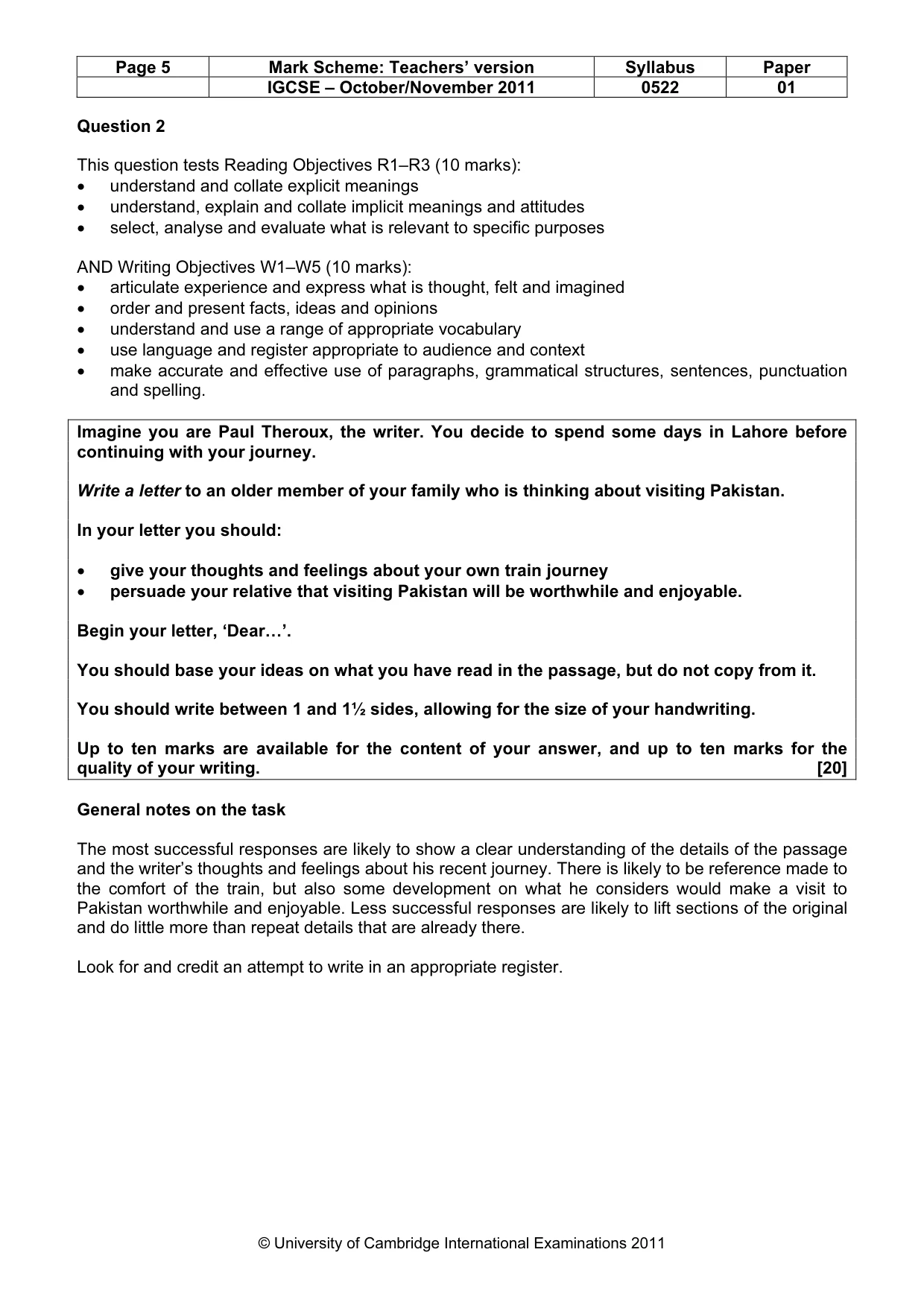
Page 5 Mark Scheme: Teachers’ version Syllabus Paper IGCSE – October/November 2011 0522 01 © University of Cambridge International Examinations 2011 Question 2 This question tests Reading Objectives R1–R3 (10 marks): • understand and collate explicit meanings • understand, explain and collate implicit meanings and attitudes • select, analyse and evaluate what is relevant to specific purposes AND Writing Objectives W1–W5 (10 marks): • articulate experience and express what is thought, felt and imagined • order and present facts, ideas and opinions • understand and use a range of appropriate vocabulary • use language and register appropriate to audience and context • make accurate and effective use of paragraphs, grammatical structures, sentences, punctuation and spelling. Imagine you are Paul Theroux, the writer. You decide to spend some days in Lahore before continuing with your journey. Write a letter to an older member of your family who is thinking about visiting Pakistan. In your letter you should: • give your thoughts and feelings about your own train journey • persuade your relative that visiting Pakistan will be worthwhile and enjoyable. Begin your letter, ‘Dear…’. You should base your ideas on what you have read in the passage, but do not copy from it. You should write between 1 and 1½ sides, allowing for the size of your handwriting. Up to ten marks are available for the content of your answer, and up to ten marks for the quality of your writing. [20] General notes on the task The most successful responses are likely to show a clear understanding of the details of the passage and the writer’s thoughts and feelings about his recent journey. There is likely to be reference made to the comfort of the train, but also some development on what he considers would make a visit to Pakistan worthwhile and enjoyable. Less successful responses are likely to lift sections of the original and do little more than repeat details that are already there. Look for and credit an attempt to write in an appropriate register.
Mark scheme, page 6
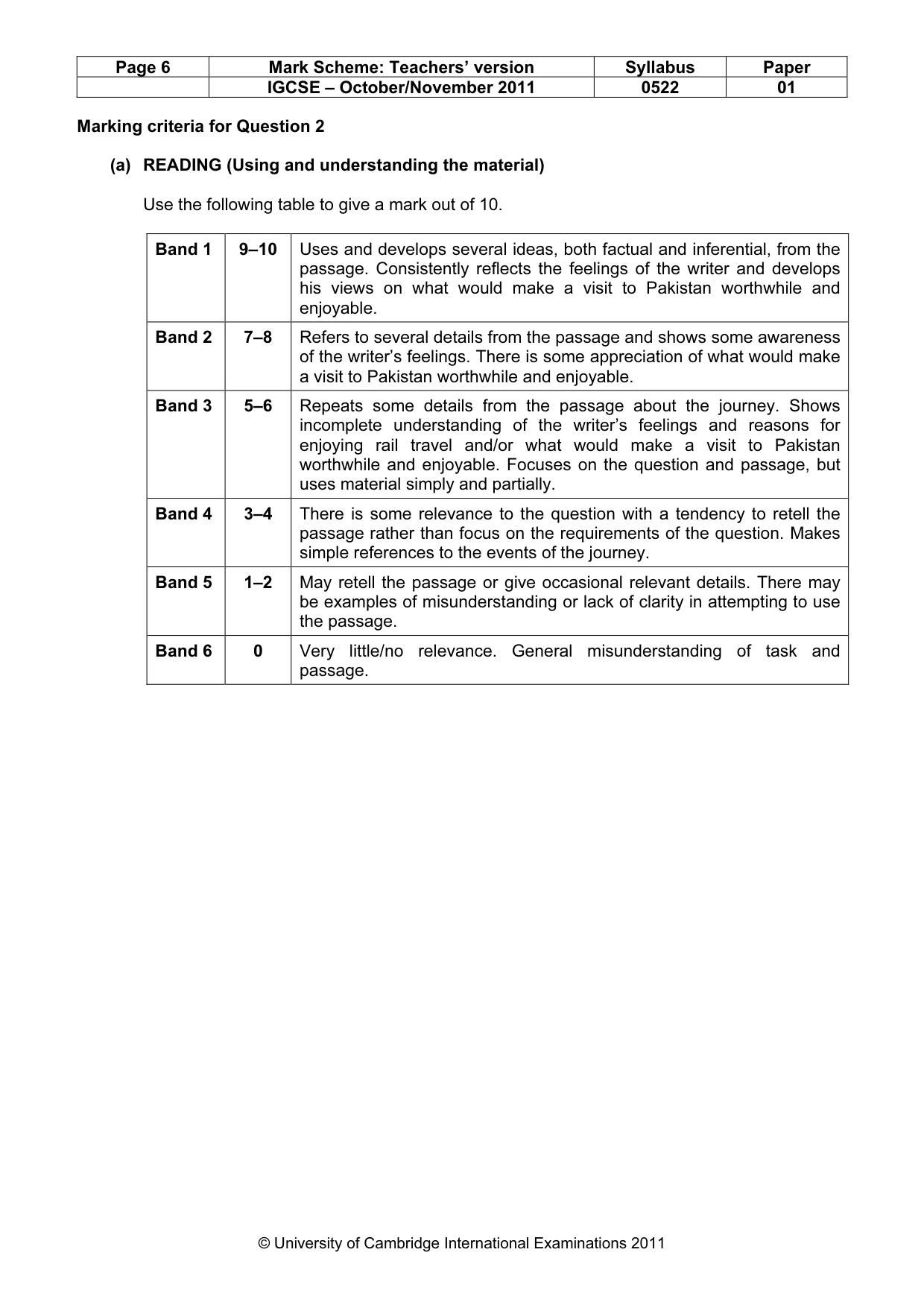
Page 6 Mark Scheme: Teachers’ version Syllabus Paper IGCSE – October/November 2011 0522 01 © University of Cambridge International Examinations 2011 Marking criteria for Question 2 (a) READING (Using and understanding the material) Use the following table to give a mark out of 10. Band 1 9–10 Uses and develops several ideas, both factual and inferential, from the passage. Consistently reflects the feelings of the writer and develops his views on what would make a visit to Pakistan worthwhile and enjoyable. Band 2 7–8 Refers to several details from the passage and shows some awareness of the writer’s feelings. There is some appreciation of what would make a visit to Pakistan worthwhile and enjoyable. Band 3 5–6 Repeats some details from the passage about the journey. Shows incomplete understanding of the writer’s feelings and reasons for enjoying rail travel and/or what would make a visit to Pakistan worthwhile and enjoyable. Focuses on the question and passage, but uses material simply and partially. Band 4 3–4 There is some relevance to the question with a tendency to retell the passage rather than focus on the requirements of the question. Makes simple references to the events of the journey. Band 5 1–2 May retell the passage or give occasional relevant details. There may be examples of misunderstanding or lack of clarity in attempting to use the passage. Band 6 0 Very little/no relevance. General misunderstanding of task and passage.
Mark scheme, page 7
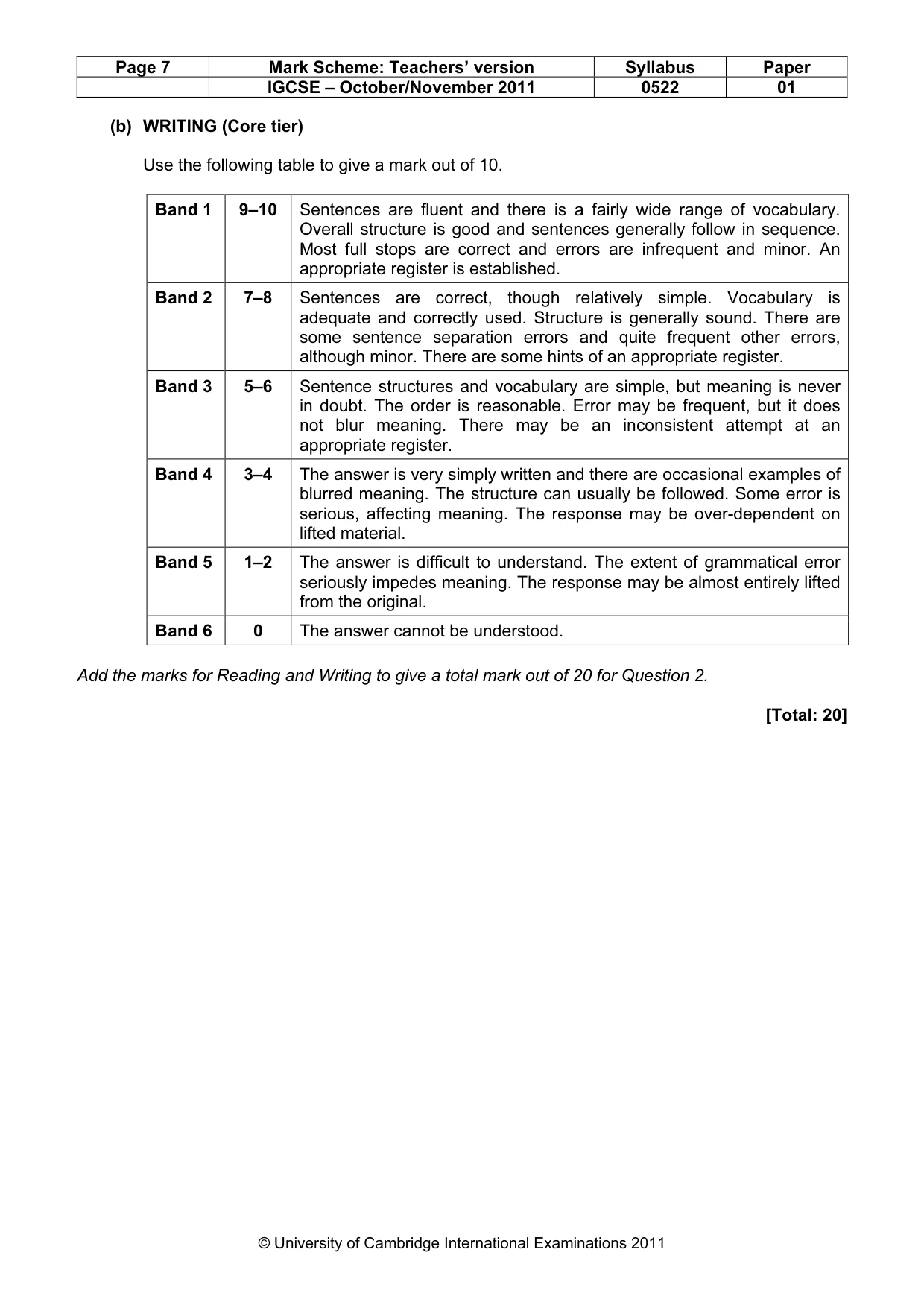
Page 7 Mark Scheme: Teachers’ version Syllabus Paper IGCSE – October/November 2011 0522 01 © University of Cambridge International Examinations 2011 (b) WRITING (Core tier) Use the following table to give a mark out of 10. Band 1 9–10 Sentences are fluent and there is a fairly wide range of vocabulary. Overall structure is good and sentences generally follow in sequence. Most full stops are correct and errors are infrequent and minor. An appropriate register is established. Band 2 7–8 Sentences are correct, though relatively simple. Vocabulary is adequate and correctly used. Structure is generally sound. There are some sentence separation errors and quite frequent other errors, although minor. There are some hints of an appropriate register. Band 3 5–6 Sentence structures and vocabulary are simple, but meaning is never in doubt. The order is reasonable. Error may be frequent, but it does not blur meaning. There may be an inconsistent attempt at an appropriate register. Band 4 3–4 The answer is very simply written and there are occasional examples of blurred meaning. The structure can usually be followed. Some error is serious, affecting meaning. The response may be over-dependent on lifted material. Band 5 1–2 The answer is difficult to understand. The extent of grammatical error seriously impedes meaning. The response may be almost entirely lifted from the original. Band 6 0 The answer cannot be understood. Add the marks for Reading and Writing to give a total mark out of 20 for Question 2. [Total: 20]
What you needed in this session
Cambridge’s own grade thresholds for 2011 Oct/Nov, Paper 1 · Variant 1. A higher threshold means an easier paper — the bar moves with how the cohort did.