Cambridge IGCSE English - First Language (BES) 0524 — 2024 May/June Paper 1 · Variant 3
0524/13/M/J/24 · 80 marks · ≈90 min
The question paper and its mark scheme, free to read here and free to download. This is Cambridge’s own paper, exactly as it was sat.
Question paper16 pages





Mark scheme23 pages
Answers below. Sit the paper first if you are practising.
Paper as text
Question paper, page 1
Cambridge IGCSE™ 0524/13 FIRST LANGUAGE ENGLISH (US) May/June 2024 Paper 1 Reading 2 hours You must answer on the question paper. You will need: Insert (enclosed) INSTRUCTIONS • Answer all questions. • Use a black or dark blue pen. • Write your name, center number and candidate number in the boxes at the top of the page. • Write your answer to each question in the space provided. • Do not use an erasable pen or correction fluid. • Do not write on any bar codes. • If additional space is needed, you should use the lined pages at the end of this booklet; the question number or numbers must be clearly shown. • Dictionaries are not allowed. INFORMATION • The total mark for this paper is 80. • The number of marks for each question or part question is shown in brackets [ ]. • The insert contains the reading texts. This document has 16 pages. Any blank pages are indicated. [Turn over 06_0524_13_2024_1.8 © UCLES 2024 *9037426171*
Question paper, page 2
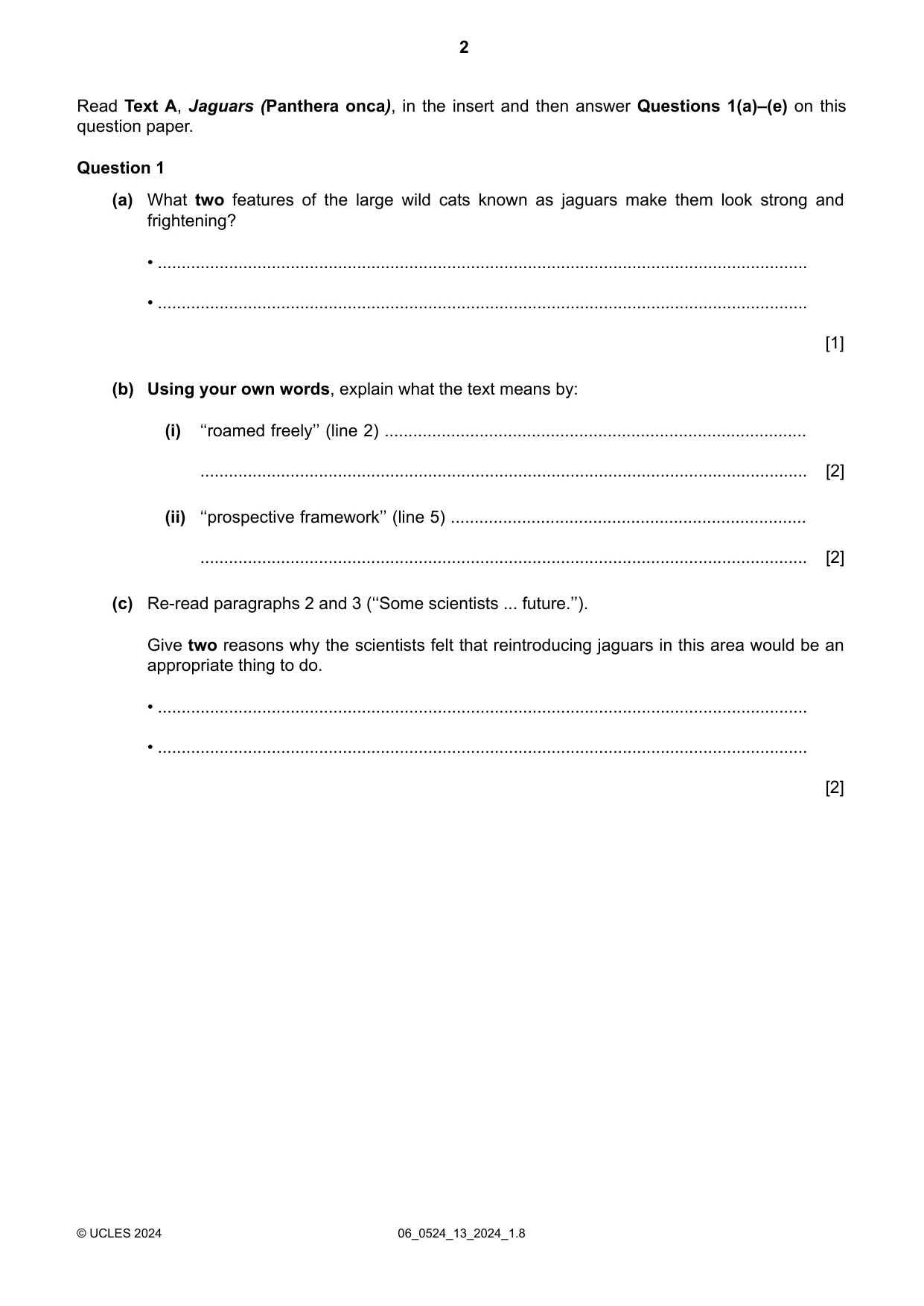
Read Text A, Jaguars (Panthera onca), in the insert and then answer Questions 1(a)–(e) on this question paper. Question 1 What two features of the large wild cats known as jaguars make them look strong and frightening? (a) • … • … [1] Using your own words, explain what the text means by: (b) (i) ‘‘roamed freely’’ (line 2) … … [2] (ii) ‘‘prospective framework’’ (line 5) … … [2] Re-read paragraphs 2 and 3 (‘‘Some scientists ... future.’’). (c) Give two reasons why the scientists felt that reintroducing jaguars in this area would be an appropriate thing to do. • … • … [2] 06_0524_13_2024_1.8 © UCLES 2024 2
Question paper, page 3
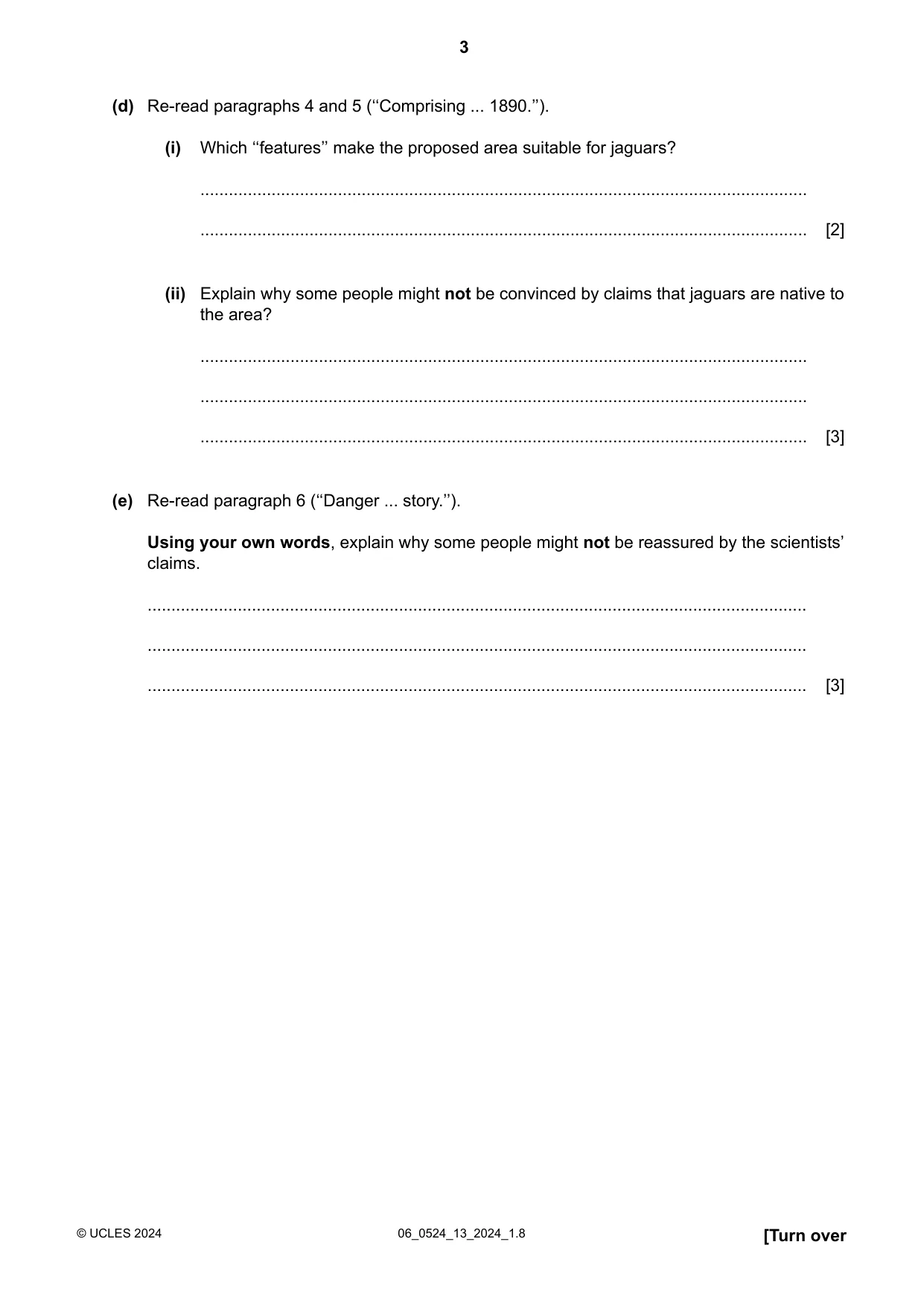
Re-read paragraphs 4 and 5 (‘‘Comprising ... 1890.’’). (d) Which ‘‘features’’ make the proposed area suitable for jaguars? (i) … … [2] Explain why some people might not be convinced by claims that jaguars are native to the area? (ii) … … … [3] Re-read paragraph 6 (‘‘Danger ... story.’’). (e) Using your own words, explain why some people might not be reassured by the scientists’ claims. … … … [3] [Turn over 06_0524_13_2024_1.8 © UCLES 2024 3
Question paper, page 4
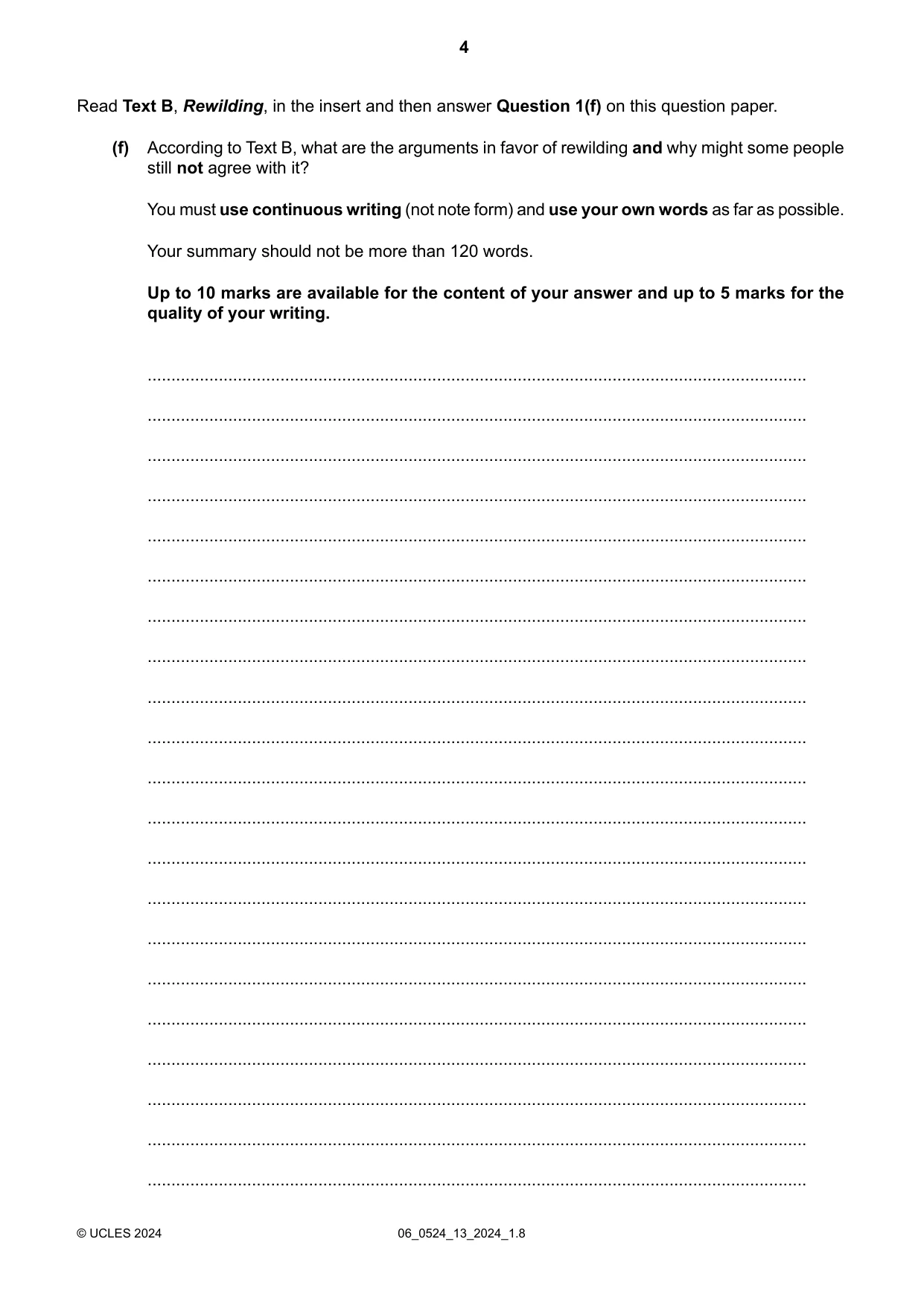
Read Text B, Rewilding, in the insert and then answer Question 1(f) on this question paper. According to Text B, what are the arguments in favor of rewilding and why might some people still not agree with it? (f) You must use continuous writing (not note form) and use your own words as far as possible. Your summary should not be more than 120 words. Up to 10 marks are available for the content of your answer and up to 5 marks for the quality of your writing. … … … … … … … … … … … … … … … … … … … … … 06_0524_13_2024_1.8 © UCLES 2024 4
Question paper, page 5
… … … … … … … … … … … … … … … … … … … … … … … … … … [15] [Total: 30] [Turn over 06_0524_13_2024_1.8 © UCLES 2024 5
Question paper, page 6
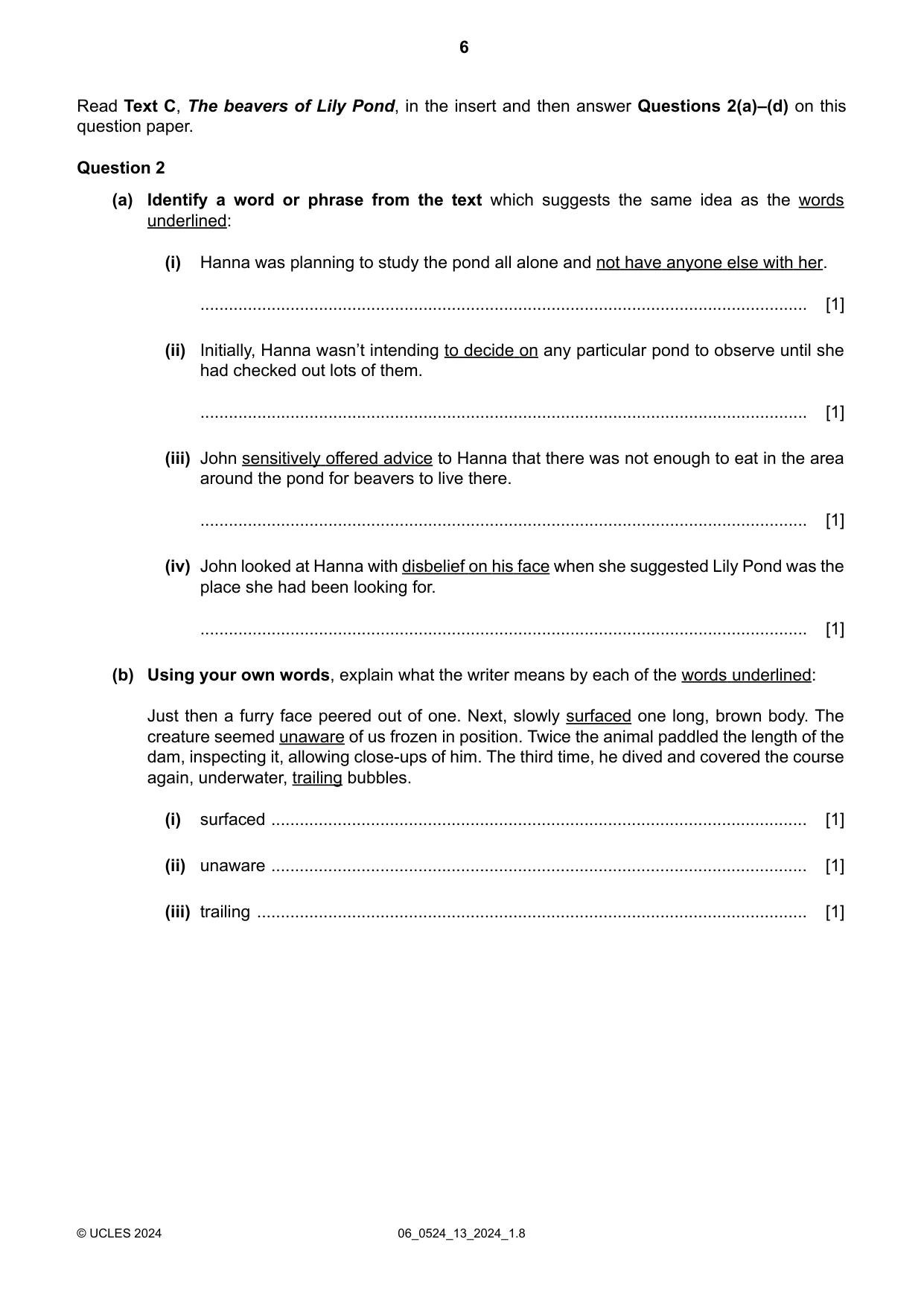
Read Text C, The beavers of Lily Pond, in the insert and then answer Questions 2(a)–(d) on this question paper. Question 2 Identify a word or phrase from the text which suggests the same idea as the words underlined: (a) Hanna was planning to study the pond all alone and not have anyone else with her. (i) … [1] Initially, Hanna wasn’t intending to decide on any particular pond to observe until she had checked out lots of them. (ii) … [1] John sensitively offered advice to Hanna that there was not enough to eat in the area around the pond for beavers to live there. (iii) … [1] John looked at Hanna with disbelief on his face when she suggested Lily Pond was the place she had been looking for. (iv) … [1] Using your own words, explain what the writer means by each of the words underlined: (b) Just then a furry face peered out of one. Next, slowly surfaced one long, brown body. The creature seemed unaware of us frozen in position. Twice the animal paddled the length of the dam, inspecting it, allowing close-ups of him. The third time, he dived and covered the course again, underwater, trailing bubbles. (i) surfaced … [1] (ii) unaware … [1] (iii) trailing … [1] 06_0524_13_2024_1.8 © UCLES 2024 6
Question paper, page 7
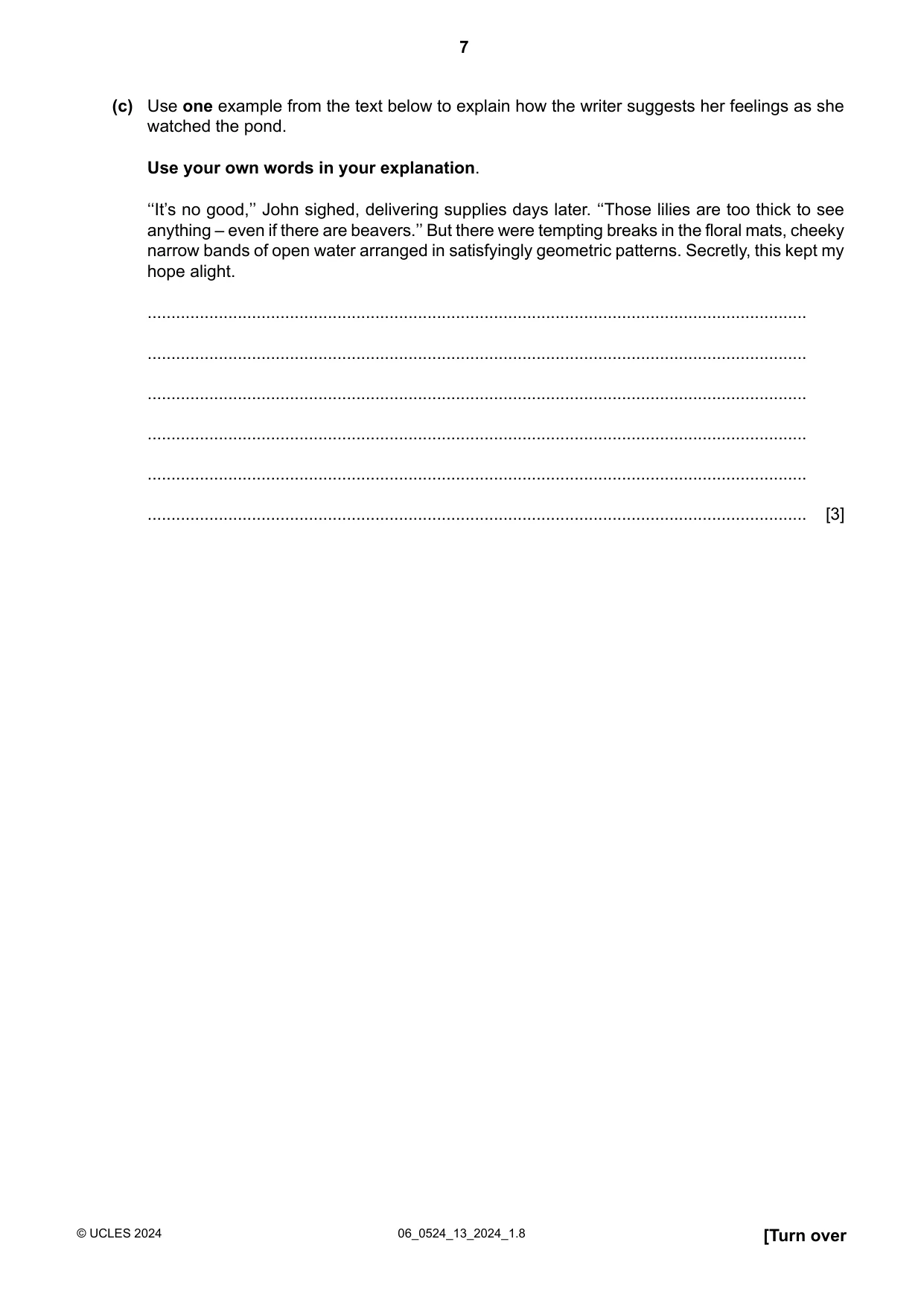
Use one example from the text below to explain how the writer suggests her feelings as she watched the pond. (c) Use your own words in your explanation. ‘‘It’s no good,’’ John sighed, delivering supplies days later. ‘‘Those lilies are too thick to see anything – even if there are beavers.’’ But there were tempting breaks in the floral mats, cheeky narrow bands of open water arranged in satisfyingly geometric patterns. Secretly, this kept my hope alight. … … … … … … [3] [Turn over 06_0524_13_2024_1.8 © UCLES 2024 7
Question paper, page 8
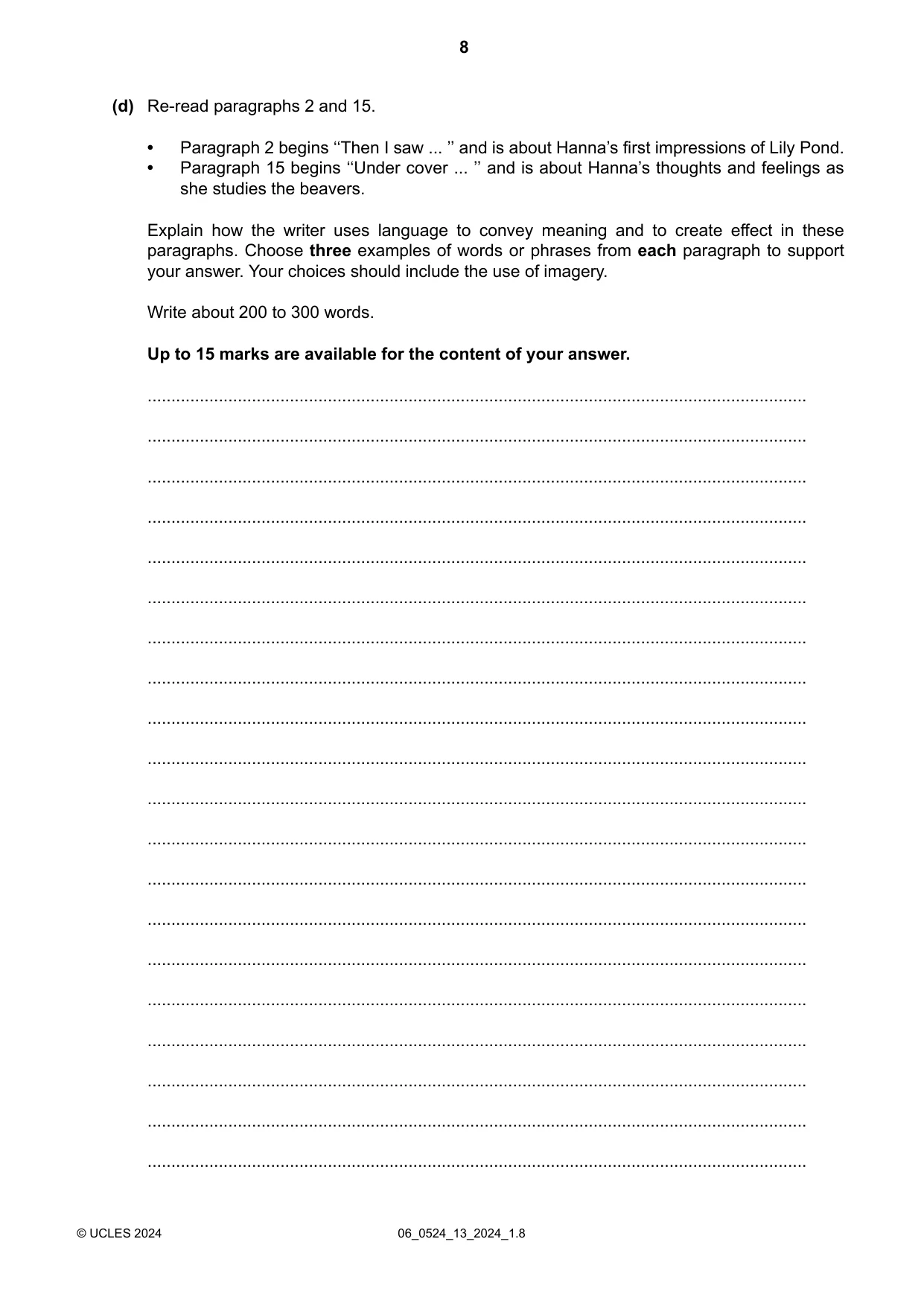
Re-read paragraphs 2 and 15. (d) • Paragraph 2 begins ‘‘Then I saw ... ’’ and is about Hanna’s first impressions of Lily Pond. • Paragraph 15 begins ‘‘Under cover ... ’’ and is about Hanna’s thoughts and feelings as she studies the beavers. Explain how the writer uses language to convey meaning and to create effect in these paragraphs. Choose three examples of words or phrases from each paragraph to support your answer. Your choices should include the use of imagery. Write about 200 to 300 words. Up to 15 marks are available for the content of your answer. … … … … … … … … … … … … … … … … … … … … 06_0524_13_2024_1.8 © UCLES 2024 8
Question paper, page 9
… … … … … … … … … … … … … … … … … … … … … … … … … … [15] [Total: 25] [Turn over 06_0524_13_2024_1.8 © UCLES 2024 9
Question paper, page 10
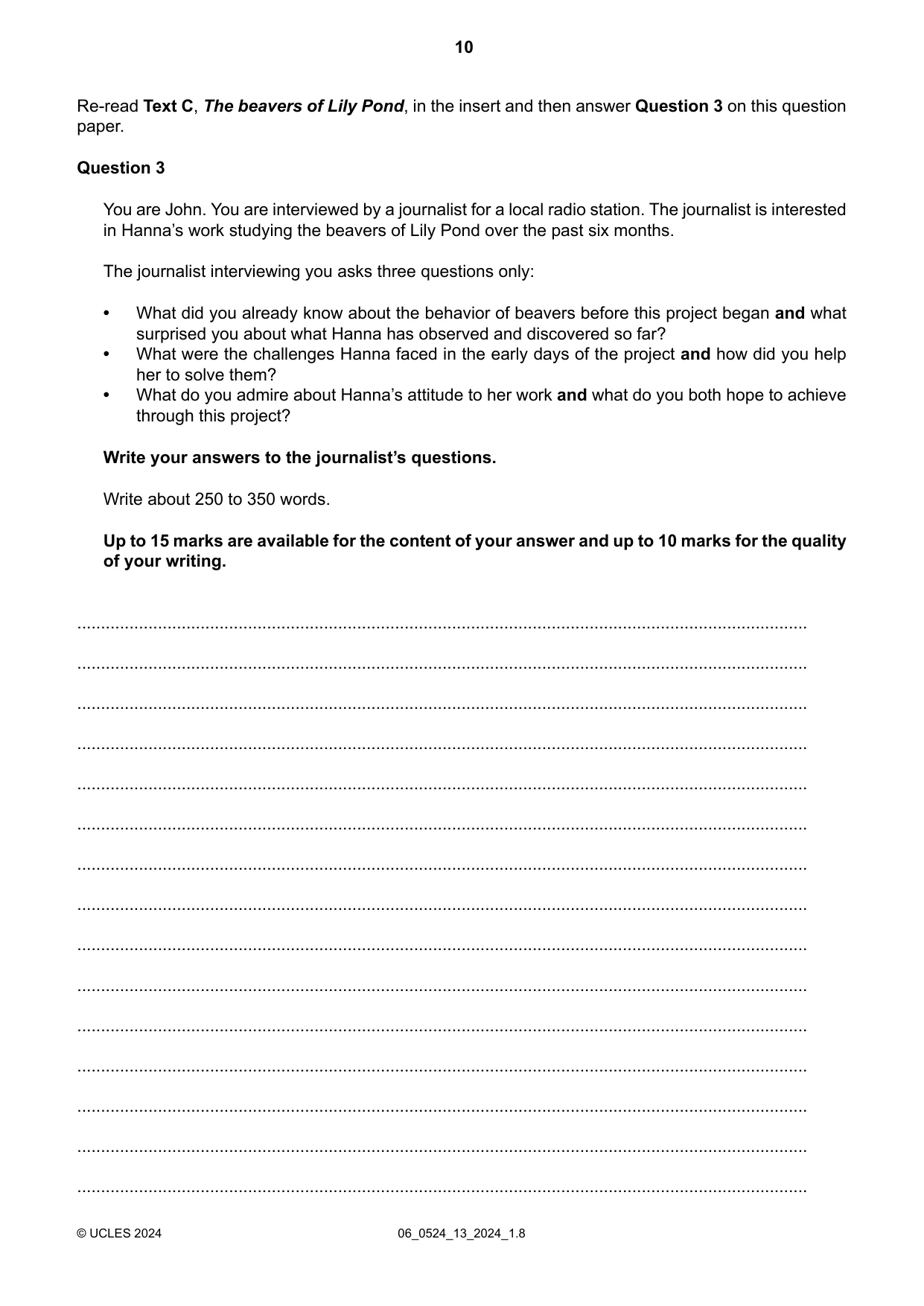
Re-read Text C, The beavers of Lily Pond, in the insert and then answer Question 3 on this question paper. Question 3 You are John. You are interviewed by a journalist for a local radio station. The journalist is interested in Hanna’s work studying the beavers of Lily Pond over the past six months. The journalist interviewing you asks three questions only: • What did you already know about the behavior of beavers before this project began and what surprised you about what Hanna has observed and discovered so far? • What were the challenges Hanna faced in the early days of the project and how did you help her to solve them? • What do you admire about Hanna’s attitude to her work and what do you both hope to achieve through this project? Write your answers to the journalist’s questions. Write about 250 to 350 words. Up to 15 marks are available for the content of your answer and up to 10 marks for the quality of your writing. … … … … … … … … … … … … … … … 06_0524_13_2024_1.8 © UCLES 2024 10
Question paper, page 11
… … … … … … … … … … … … … … … … … … … … … … … … … … [25] [Turn over 06_0524_13_2024_1.8 © UCLES 2024 11
Question paper, page 12
Additional Page If you use the following lined page to complete the answer(s) to any question(s), the question number(s) must be clearly shown. … … … … … … … … … … … … … … … … … … … … … … … … … 06_0524_13_2024_1.8 © UCLES 2024 12
Question paper, page 13
Additional Page If you use the following lined page to complete the answer(s) to any question(s), the question number(s) must be clearly shown. … … … … … … … … … … … … … … … … … … … … … … … … … 06_0524_13_2024_1.8 © UCLES 2024 13
Question paper, page 14
BLANK PAGE 06_0524_13_2024_1.8 © UCLES 2024 14
Question paper, page 15
BLANK PAGE 06_0524_13_2024_1.8 © UCLES 2024 15
Question paper, page 16
BLANK PAGE Permission to reproduce items where third-party owned material protected by copyright is included has been sought and cleared where possible. Every reasonable effort has been made by the publisher (UCLES) to trace copyright holders, but if any items requiring clearance have unwittingly been included, the publisher will be pleased to make amends at the earliest possible opportunity. To avoid the issue of disclosure of answer-related information to candidates, all copyright acknowledgements are reproduced online in the Cambridge Assessment International Education Copyright Acknowledgements Booklet. This is produced for each series of examinations and is freely available to download at www.cambridgeinternational.org after the live examination series. Cambridge Assessment International Education is part of Cambridge Assessment. Cambridge Assessment is the brand name of the University of Cambridge Local Examinations Syndicate (UCLES), which is a department of the University of Cambridge. 06_0524_13_2024_1.8 © UCLES 2024 16
Mark scheme, page 1
This document consists of 23 printed pages. © Cambridge University Press & Assessment 2024 [Turn over Cambridge IGCSE™ FIRST LANGUAGE ENGLISH (US) 0524/13 Paper 1 Reading May/June 2024 MARK SCHEME Maximum Mark: 80 Published This mark scheme is published as an aid to teachers and candidates, to indicate the requirements of the examination. It shows the basis on which Examiners were instructed to award marks. It does not indicate the details of the discussions that took place at an Examiners’ meeting before marking began, which would have considered the acceptability of alternative answers. Mark schemes should be read in conjunction with the question paper and the Principal Examiner Report for Teachers. Cambridge International will not enter into discussions about these mark schemes. Cambridge International is publishing the mark schemes for the May/June 2024 series for most Cambridge IGCSE, Cambridge International A and AS Level and Cambridge Pre-U components, and some Cambridge O Level components.
Mark scheme, page 2
0524/13 Cambridge IGCSE – Mark Scheme PUBLISHED May/June 2024 © Cambridge University Press & Assessment 2024 Page 2 of 23 Generic Marking Principles These general marking principles must be applied by all examiners when marking candidate answers. They should be applied alongside the specific content of the mark scheme or generic level descriptions for a question. Each question paper and mark scheme will also comply with these marking principles. GENERIC MARKING PRINCIPLE 1: Marks must be awarded in line with: the specific content of the mark scheme or the generic level descriptors for the question the specific skills defined in the mark scheme or in the generic level descriptors for the question the standard of response required by a candidate as exemplified by the standardisation scripts. GENERIC MARKING PRINCIPLE 2: Marks awarded are always whole marks (not half marks, or other fractions). GENERIC MARKING PRINCIPLE 3: Marks must be awarded positively: marks are awarded for correct/valid answers, as defined in the mark scheme. However, credit is given for valid answers which go beyond the scope of the syllabus and mark scheme, referring to your Team Leader as appropriate marks are awarded when candidates clearly demonstrate what they know and can do marks are not deducted for errors marks are not deducted for omissions answers should only be judged on the quality of spelling, punctuation and grammar when these features are specifically assessed by the question as indicated by the mark scheme. The meaning, however, should be unambiguous. GENERIC MARKING PRINCIPLE 4: Rules must be applied consistently, e.g. in situations where candidates have not followed instructions or in the application of generic level descriptors. GENERIC MARKING PRINCIPLE 5: Marks should be awarded using the full range of marks defined in the mark scheme for the question (however, the use of the full mark range may be limited according to the quality of the candidate responses seen). GENERIC MARKING PRINCIPLE 6: Marks awarded are based solely on the requirements as defined in the mark scheme. Marks should not be awarded with grade thresholds or grade descriptors in mind.
Mark scheme, page 3
0524/13 Cambridge IGCSE – Mark Scheme PUBLISHED May/June 2024 © Cambridge University Press & Assessment 2024 Page 3 of 23 English & Media subject specific general marking principles (To be read in conjunction with the Generic Marking Principles (and requiring further guidance on how to place marks within levels)) Components using level descriptors: We use level descriptors as a guide to broad understanding of the qualities normally expected of, or typical of, work in a level. Level descriptors are a means of general guidance and should not be interpreted as hurdle statements. Where indicative content notes are supplied for a question, these are not a prescription of required content, and must not be treated as such. Alternative correct points and unexpected answers in candidates’ scripts must be given marks that fairly reflect the knowledge and skills demonstrated. While we may have legitimate expectations as to the ground most answers may occupy, we must always be prepared to meet candidates on their chosen ground, provided it is relevant ground (e.g. clearly related to and derived from a relevant passage/text and meeting the mark scheme requirements for the question). Components using point-based marking: Point marking is often used to reward knowledge, understanding and application of skills. We give credit where the candidate’s answer shows relevant knowledge, understanding and application of skills in answering the question. We do not give credit where the answer shows confusion. From this it follows that we: a DO credit answers which are worded differently from the mark scheme if they clearly convey the same meaning (unless the mark scheme requires a specific term). b DO credit alternative answers/examples which are not written in the mark scheme if they are correct. c DO credit answers where candidates give more than one correct answer in one prompt/numbered/scaffolded space where extended writing is required rather than list-type answers. For example, questions that require n reasons (e.g. State two reasons…). d DO NOT credit answers simply for using a ‘key term’ unless that is all that is required. (Check for evidence: that it is understood and used correctly.). e DO NOT credit answers which are obviously self-contradicting or trying to cover all possibilities. f DO NOT give further credit for what is effectively repetition of a correct point already credited unless the language itself is being tested. This applies equally to ‘mirror statements’ (i.e. polluted/not polluted). g DO NOT require spellings to be correct unless this is part of the test. However, spellings of syllabus terms must allow for clear and unambiguous separation from other syllabus terms with which they may be confused (e.g. Corrasion/Corrosion).
Mark scheme, page 4
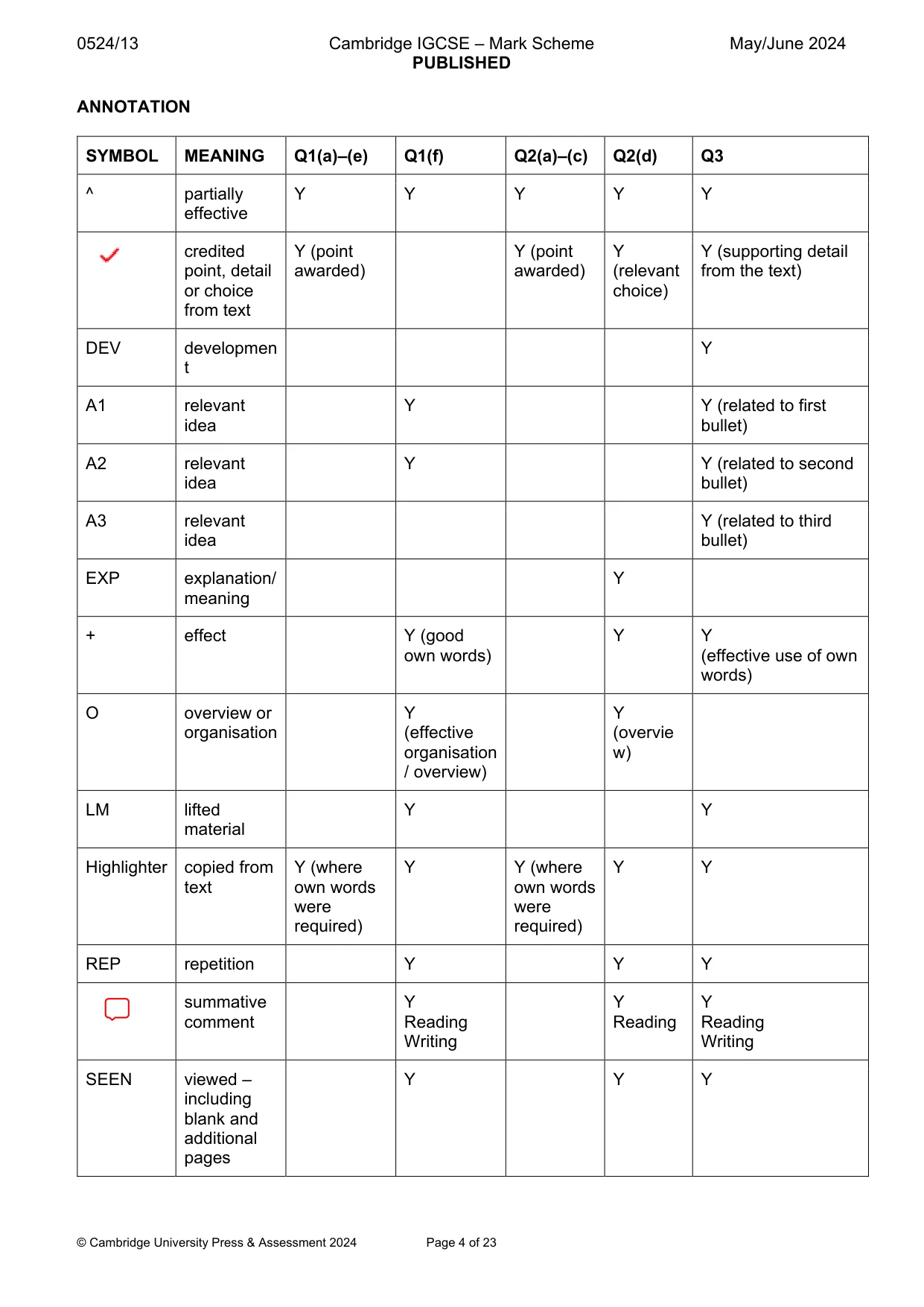
0524/13 Cambridge IGCSE – Mark Scheme PUBLISHED May/June 2024 © Cambridge University Press & Assessment 2024 Page 4 of 23 ANNOTATION SYMBOL MEANING Q1(a)–(e) Q1(f) Q2(a)–(c) Q2(d) Q3 ^ partially effective Y Y Y Y Y credited point, detail or choice from text Y (point awarded) Y (point awarded) Y (relevant choice) Y (supporting detail from the text) DEV developmen t Y A1 relevant idea Y Y (related to first bullet) A2 relevant idea Y Y (related to second bullet) A3 relevant idea Y (related to third bullet) EXP explanation/ meaning Y + effect Y (good own words) Y Y (effective use of own words) O overview or organisation Y (effective organisation / overview) Y (overvie w) LM lifted material Y Y Highlighter copied from text Y (where own words were required) Y Y (where own words were required) Y Y REP repetition Y Y Y summative comment Y Reading Writing Y Reading Y Reading Writing SEEN viewed – including blank and additional pages Y Y Y
Mark scheme, page 5
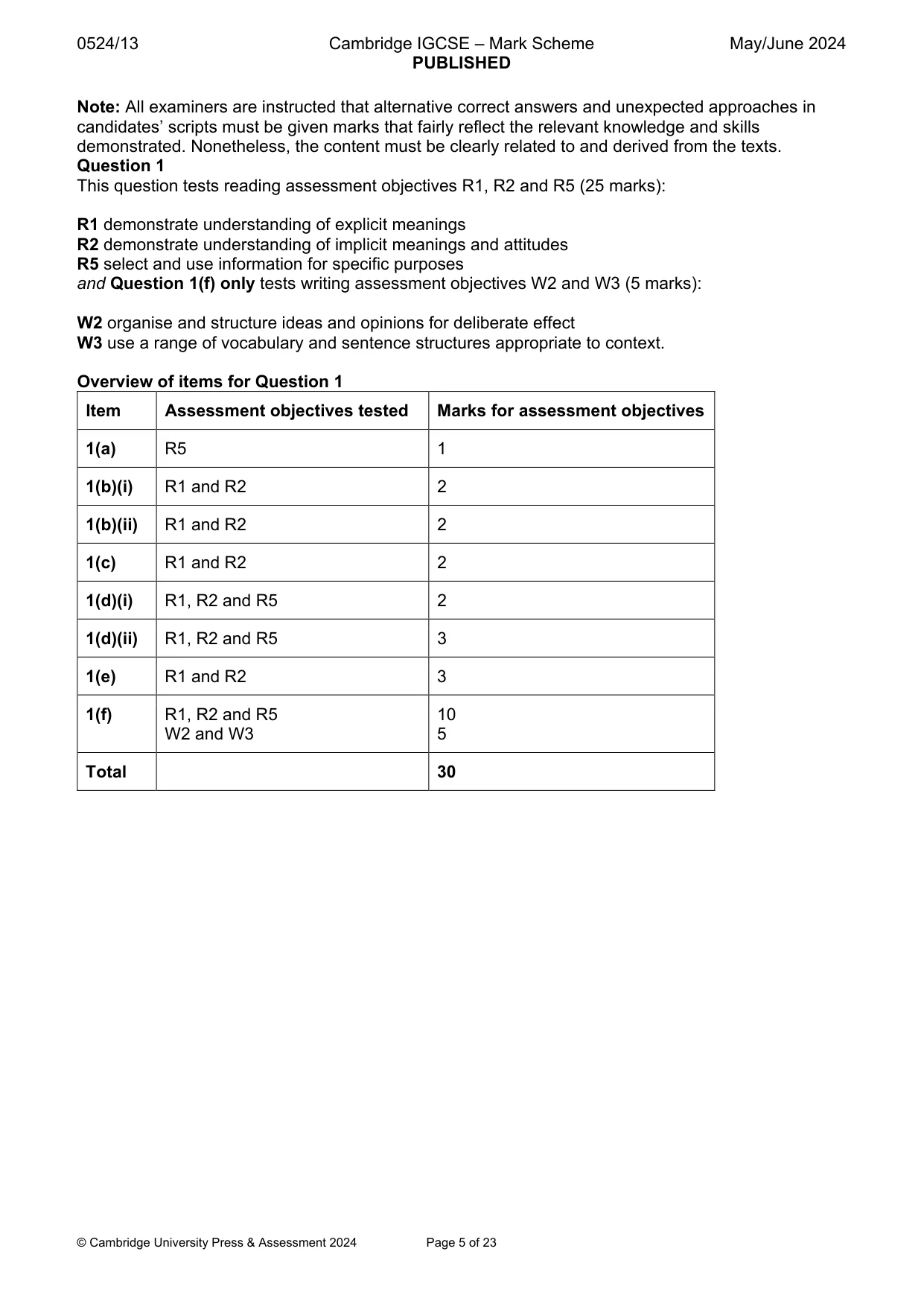
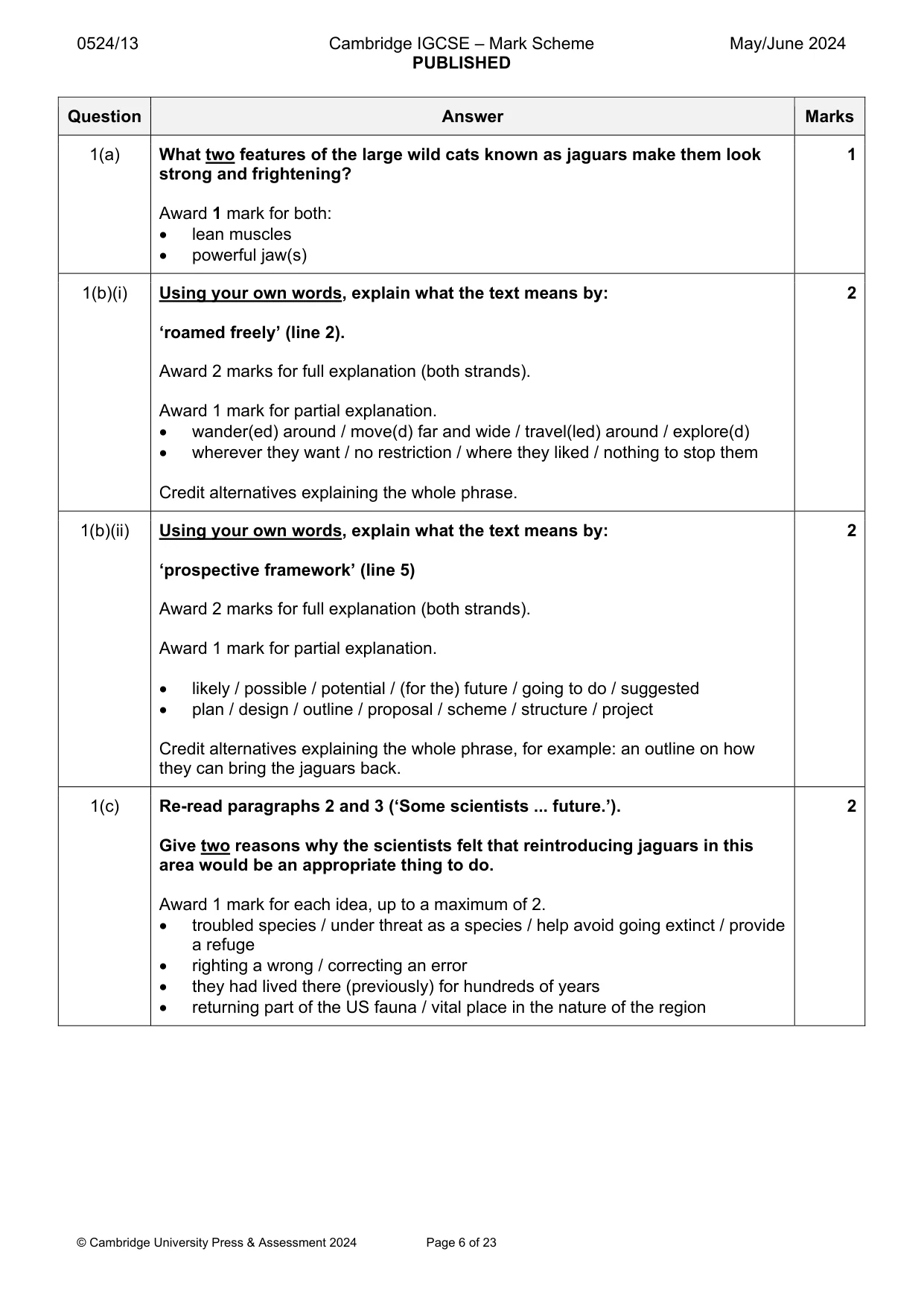
0524/13 Cambridge IGCSE – Mark Scheme PUBLISHED May/June 2024 © Cambridge University Press & Assessment 2024 Page 5 of 23 Note: All examiners are instructed that alternative correct answers and unexpected approaches in candidates’ scripts must be given marks that fairly reflect the relevant knowledge and skills demonstrated. Nonetheless, the content must be clearly related to and derived from the texts. Question 1 This question tests reading assessment objectives R1, R2 and R5 (25 marks): R1 demonstrate understanding of explicit meanings R2 demonstrate understanding of implicit meanings and attitudes R5 select and use information for specific purposes and Question 1(f) only tests writing assessment objectives W2 and W3 (5 marks): W2 organise and structure ideas and opinions for deliberate effect W3 use a range of vocabulary and sentence structures appropriate to context. Overview of items for Question 1 Item Assessment objectives tested Marks for assessment objectives 1(a) R5 1 1(b)(i) R1 and R2 2 1(b)(ii) R1 and R2 2 1(c) R1 and R2 2 1(d)(i) R1, R2 and R5 2 1(d)(ii) R1, R2 and R5 3 1(e) R1 and R2 3 1(f) R1, R2 and R5 W2 and W3 10 5 Total 30
Mark scheme, page 6
0524/13 Cambridge IGCSE – Mark Scheme PUBLISHED May/June 2024 © Cambridge University Press & Assessment 2024 Page 6 of 23 Question Answer Marks 1(a) What two features of the large wild cats known as jaguars make them look strong and frightening? Award 1 mark for both: lean muscles powerful jaw(s) 1 1(b)(i) Using your own words, explain what the text means by: ‘roamed freely’ (line 2). Award 2 marks for full explanation (both strands). Award 1 mark for partial explanation. wander(ed) around / move(d) far and wide / travel(led) around / explore(d) wherever they want / no restriction / where they liked / nothing to stop them Credit alternatives explaining the whole phrase. 2 1(b)(ii) Using your own words, explain what the text means by: ‘prospective framework’ (line 5) Award 2 marks for full explanation (both strands). Award 1 mark for partial explanation. likely / possible / potential / (for the) future / going to do / suggested plan / design / outline / proposal / scheme / structure / project Credit alternatives explaining the whole phrase, for example: an outline on how they can bring the jaguars back. 2 1(c) Re-read paragraphs 2 and 3 (‘Some scientists ... future.’). Give two reasons why the scientists felt that reintroducing jaguars in this area would be an appropriate thing to do. Award 1 mark for each idea, up to a maximum of 2. troubled species / under threat as a species / help avoid going extinct / provide a refuge righting a wrong / correcting an error they had lived there (previously) for hundreds of years returning part of the US fauna / vital place in the nature of the region 2
Mark scheme, page 7
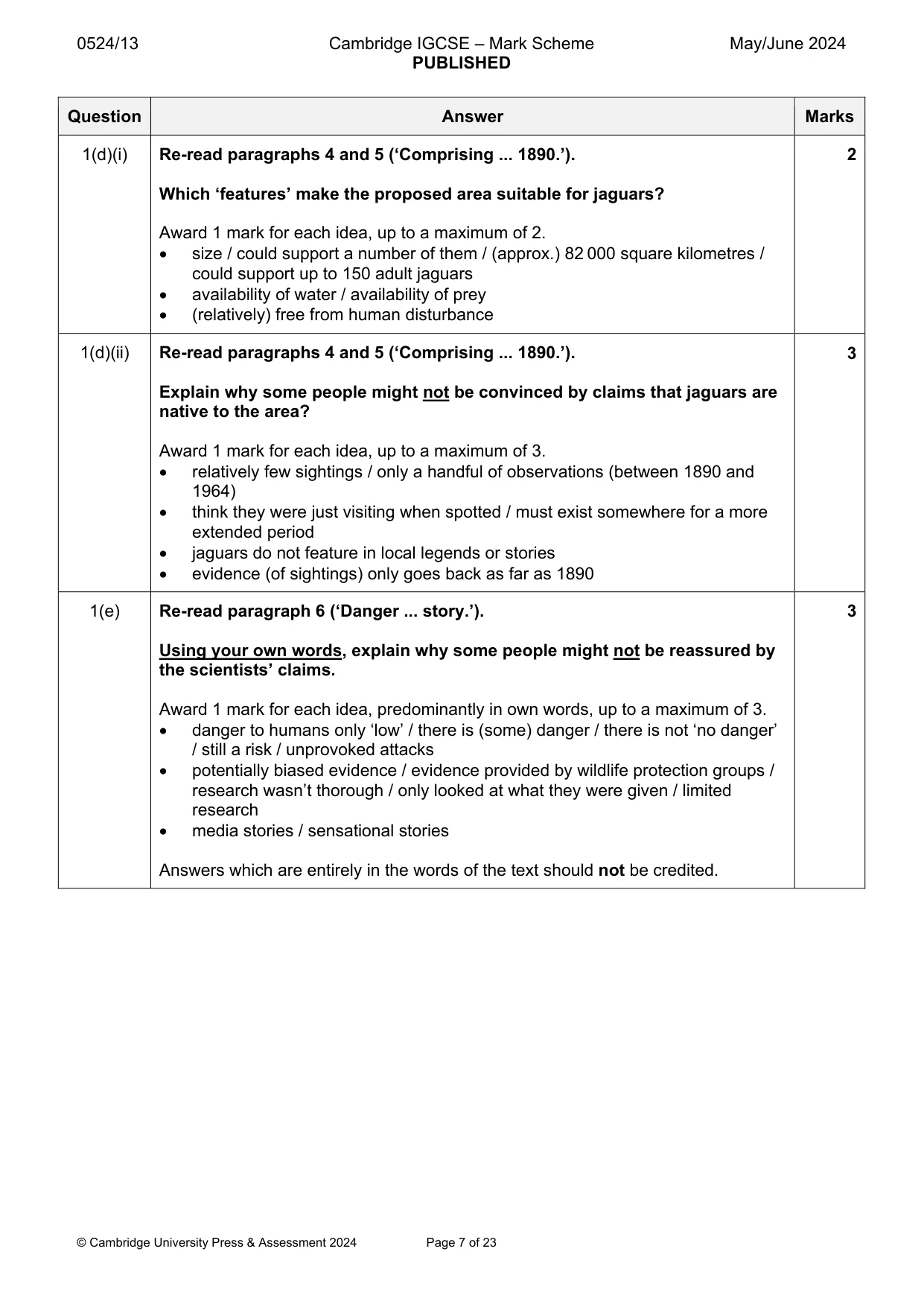
0524/13 Cambridge IGCSE – Mark Scheme PUBLISHED May/June 2024 © Cambridge University Press & Assessment 2024 Page 7 of 23 Question Answer Marks 1(d)(i) Re-read paragraphs 4 and 5 (‘Comprising ... 1890.’). Which ‘features’ make the proposed area suitable for jaguars? Award 1 mark for each idea, up to a maximum of 2. size / could support a number of them / (approx.) 82 000 square kilometres / could support up to 150 adult jaguars availability of water / availability of prey (relatively) free from human disturbance 2 1(d)(ii) Re-read paragraphs 4 and 5 (‘Comprising ... 1890.’). Explain why some people might not be convinced by claims that jaguars are native to the area? Award 1 mark for each idea, up to a maximum of 3. relatively few sightings / only a handful of observations (between 1890 and 1964) think they were just visiting when spotted / must exist somewhere for a more extended period jaguars do not feature in local legends or stories evidence (of sightings) only goes back as far as 1890 3 1(e) Re-read paragraph 6 (‘Danger ... story.’). Using your own words, explain why some people might not be reassured by the scientists’ claims. Award 1 mark for each idea, predominantly in own words, up to a maximum of 3. danger to humans only ‘low’ / there is (some) danger / there is not ‘no danger’ / still a risk / unprovoked attacks potentially biased evidence / evidence provided by wildlife protection groups / research wasn’t thorough / only looked at what they were given / limited research media stories / sensational stories Answers which are entirely in the words of the text should not be credited. 3
Mark scheme, page 8
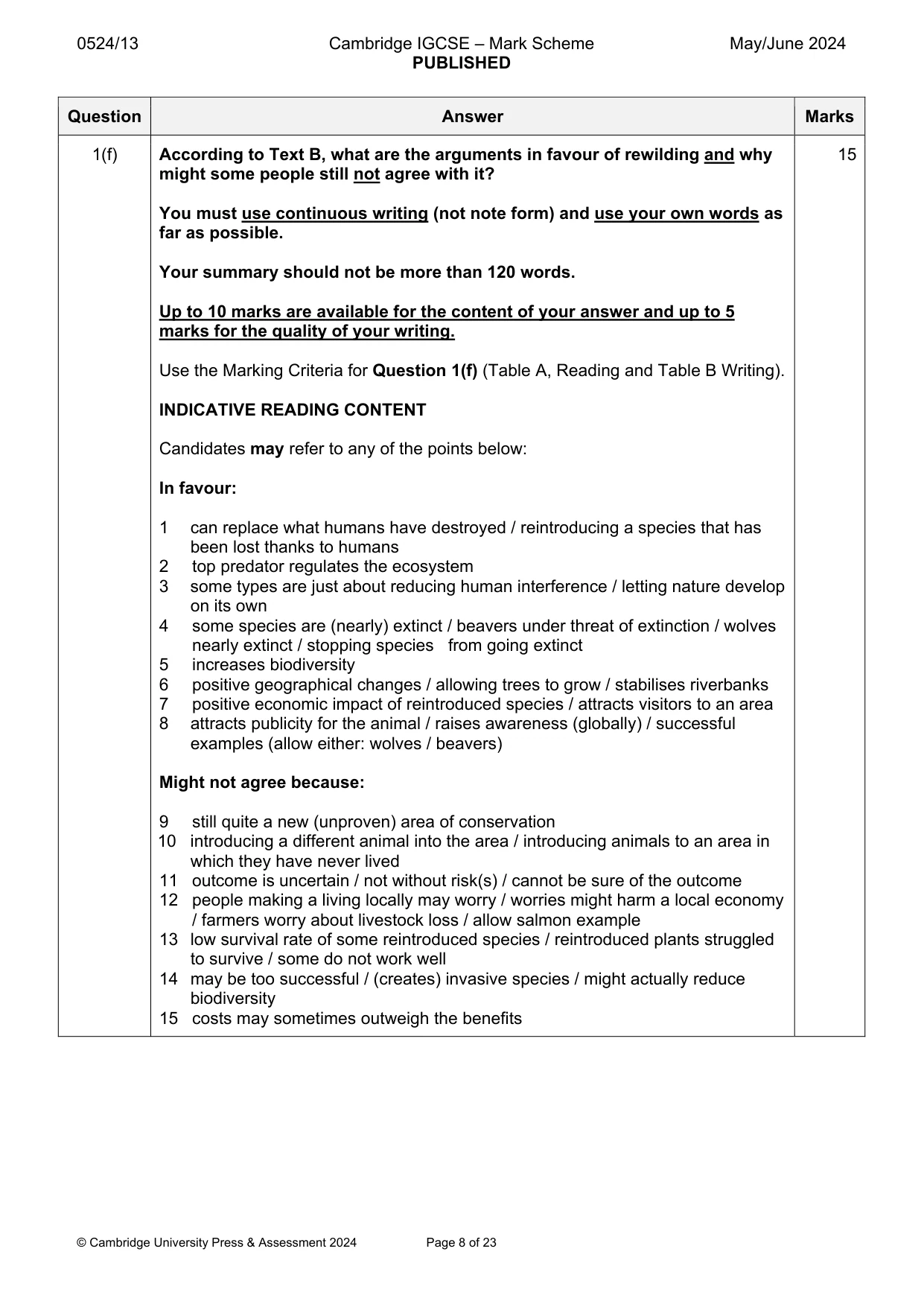
0524/13 Cambridge IGCSE – Mark Scheme PUBLISHED May/June 2024 © Cambridge University Press & Assessment 2024 Page 8 of 23 Question Answer Marks 1(f) According to Text B, what are the arguments in favour of rewilding and why might some people still not agree with it? You must use continuous writing (not note form) and use your own words as far as possible. Your summary should not be more than 120 words. Up to 10 marks are available for the content of your answer and up to 5 marks for the quality of your writing. Use the Marking Criteria for Question 1(f) (Table A, Reading and Table B Writing). INDICATIVE READING CONTENT Candidates may refer to any of the points below: In favour: 1 can replace what humans have destroyed / reintroducing a species that has been lost thanks to humans 2 top predator regulates the ecosystem 3 some types are just about reducing human interference / letting nature develop on its own 4 some species are (nearly) extinct / beavers under threat of extinction / wolves nearly extinct / stopping species from going extinct 5 increases biodiversity 6 positive geographical changes / allowing trees to grow / stabilises riverbanks 7 positive economic impact of reintroduced species / attracts visitors to an area 8 attracts publicity for the animal / raises awareness (globally) / successful examples (allow either: wolves / beavers) Might not agree because: 9 still quite a new (unproven) area of conservation 10 introducing a different animal into the area / introducing animals to an area in which they have never lived 11 outcome is uncertain / not without risk(s) / cannot be sure of the outcome 12 people making a living locally may worry / worries might harm a local economy / farmers worry about livestock loss / allow salmon example 13 low survival rate of some reintroduced species / reintroduced plants struggled to survive / some do not work well 14 may be too successful / (creates) invasive species / might actually reduce biodiversity 15 costs may sometimes outweigh the benefits 15
Mark scheme, page 9
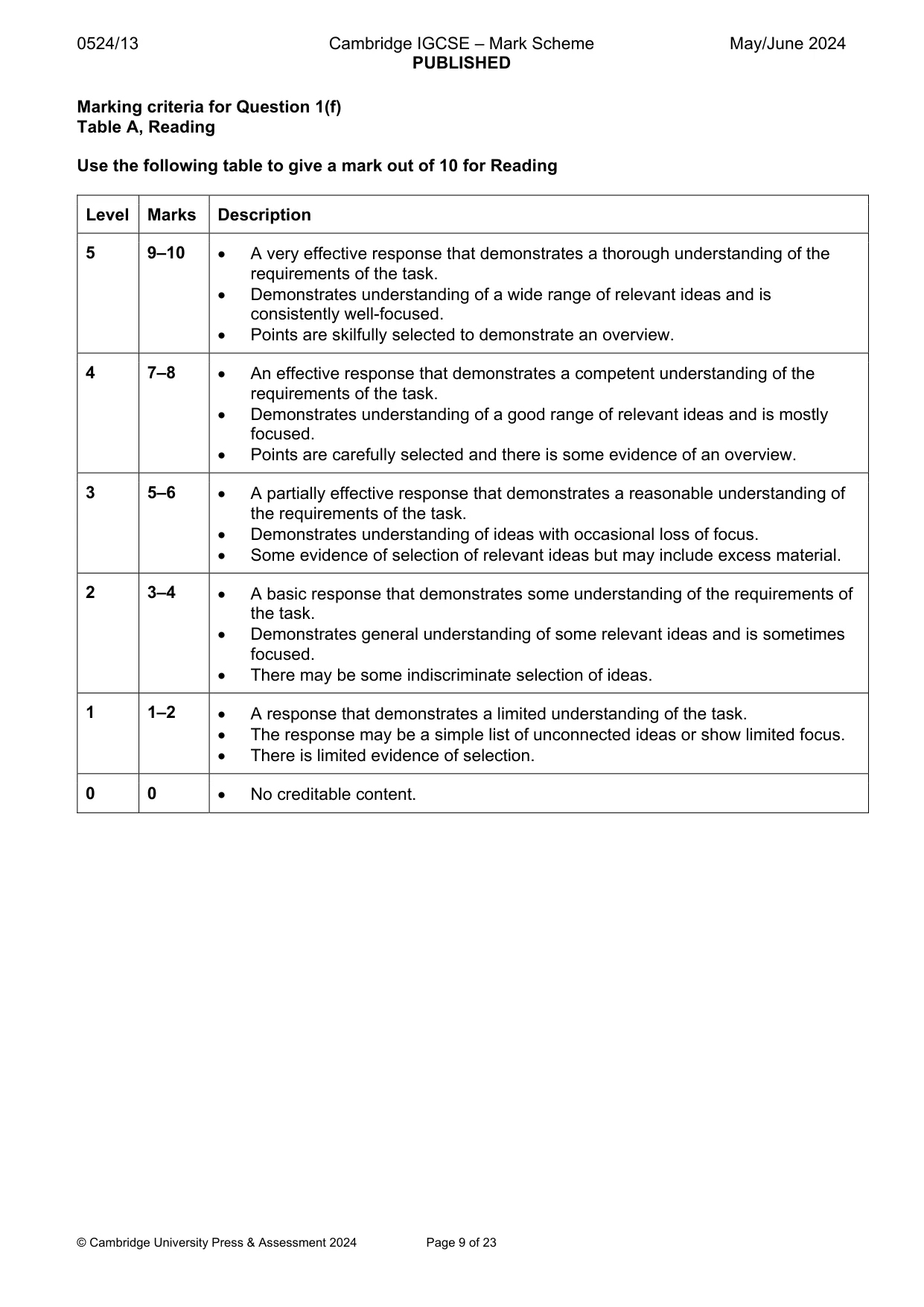
0524/13 Cambridge IGCSE – Mark Scheme PUBLISHED May/June 2024 © Cambridge University Press & Assessment 2024 Page 9 of 23 Marking criteria for Question 1(f) Table A, Reading Use the following table to give a mark out of 10 for Reading Level Marks Description 5 9–10 A very effective response that demonstrates a thorough understanding of the requirements of the task. Demonstrates understanding of a wide range of relevant ideas and is consistently well-focused. Points are skilfully selected to demonstrate an overview. 4 7–8 An effective response that demonstrates a competent understanding of the requirements of the task. Demonstrates understanding of a good range of relevant ideas and is mostly focused. Points are carefully selected and there is some evidence of an overview. 3 5–6 A partially effective response that demonstrates a reasonable understanding of the requirements of the task. Demonstrates understanding of ideas with occasional loss of focus. Some evidence of selection of relevant ideas but may include excess material. 2 3–4 A basic response that demonstrates some understanding of the requirements of the task. Demonstrates general understanding of some relevant ideas and is sometimes focused. There may be some indiscriminate selection of ideas. 1 1–2 A response that demonstrates a limited understanding of the task. The response may be a simple list of unconnected ideas or show limited focus. There is limited evidence of selection. 0 0 No creditable content.
Mark scheme, page 10
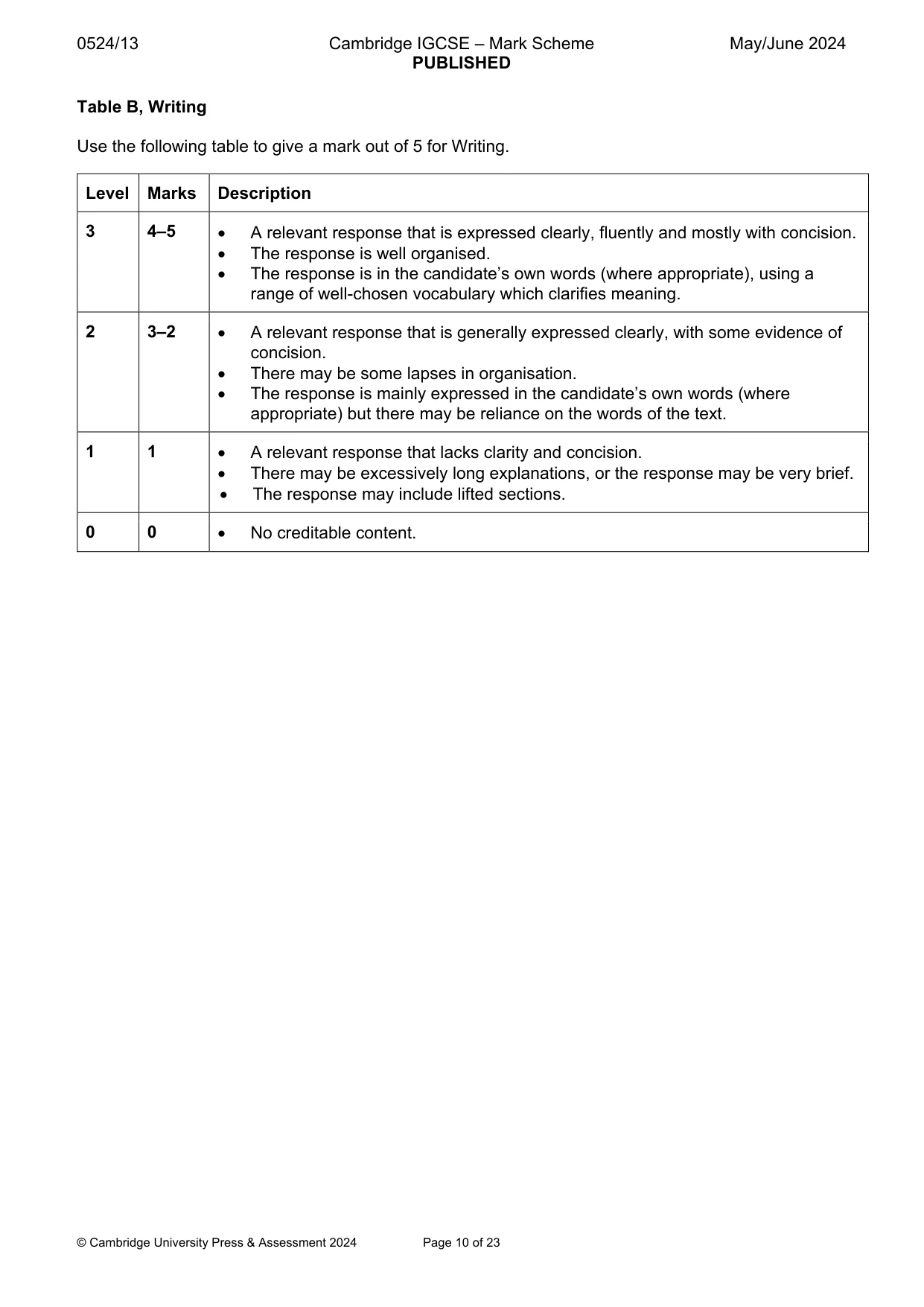
0524/13 Cambridge IGCSE – Mark Scheme PUBLISHED May/June 2024 © Cambridge University Press & Assessment 2024 Page 10 of 23 Table B, Writing Use the following table to give a mark out of 5 for Writing. Level Marks Description 3 4–5 A relevant response that is expressed clearly, fluently and mostly with concision. The response is well organised. The response is in the candidate’s own words (where appropriate), using a range of well-chosen vocabulary which clarifies meaning. 2 3–2 A relevant response that is generally expressed clearly, with some evidence of concision. There may be some lapses in organisation. The response is mainly expressed in the candidate’s own words (where appropriate) but there may be reliance on the words of the text. 1 1 A relevant response that lacks clarity and concision. There may be excessively long explanations, or the response may be very brief. The response may include lifted sections. 0 0 No creditable content.
Mark scheme, page 11
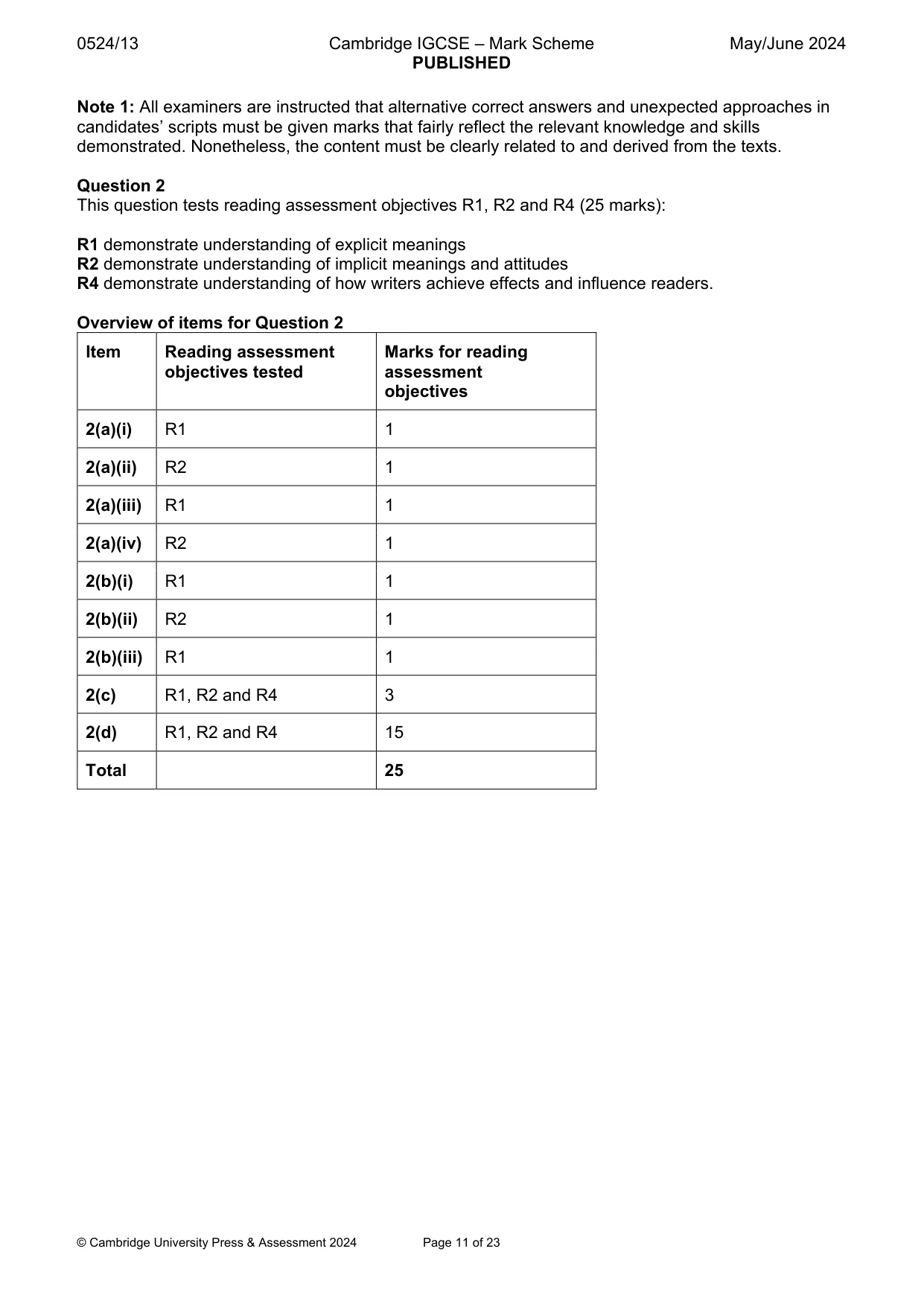
0524/13 Cambridge IGCSE – Mark Scheme PUBLISHED May/June 2024 © Cambridge University Press & Assessment 2024 Page 11 of 23 Note 1: All examiners are instructed that alternative correct answers and unexpected approaches in candidates’ scripts must be given marks that fairly reflect the relevant knowledge and skills demonstrated. Nonetheless, the content must be clearly related to and derived from the texts. Question 2 This question tests reading assessment objectives R1, R2 and R4 (25 marks): R1 demonstrate understanding of explicit meanings R2 demonstrate understanding of implicit meanings and attitudes R4 demonstrate understanding of how writers achieve effects and influence readers. Overview of items for Question 2 Item Reading assessment objectives tested Marks for reading assessment objectives 2(a)(i) R1 1 2(a)(ii) R2 1 2(a)(iii) R1 1 2(a)(iv) R2 1 2(b)(i) R1 1 2(b)(ii) R2 1 2(b)(iii) R1 1 2(c) R1, R2 and R4 3 2(d) R1, R2 and R4 15 Total 25
Mark scheme, page 12
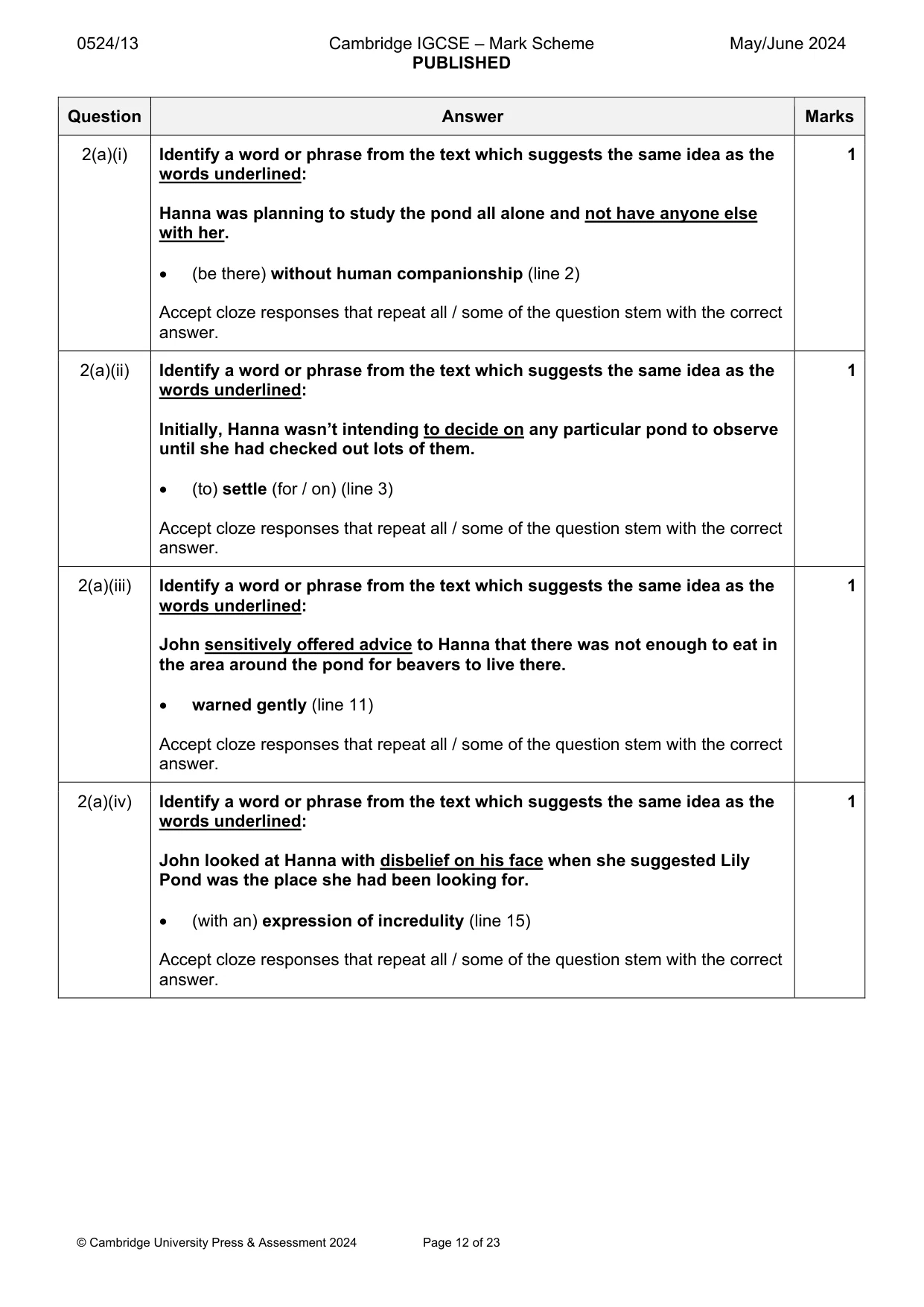
0524/13 Cambridge IGCSE – Mark Scheme PUBLISHED May/June 2024 © Cambridge University Press & Assessment 2024 Page 12 of 23 Question Answer Marks 2(a)(i) Identify a word or phrase from the text which suggests the same idea as the words underlined: Hanna was planning to study the pond all alone and not have anyone else with her. (be there) without human companionship (line 2) Accept cloze responses that repeat all / some of the question stem with the correct answer. 1 2(a)(ii) Identify a word or phrase from the text which suggests the same idea as the words underlined: Initially, Hanna wasn’t intending to decide on any particular pond to observe until she had checked out lots of them. (to) settle (for / on) (line 3) Accept cloze responses that repeat all / some of the question stem with the correct answer. 1 2(a)(iii) Identify a word or phrase from the text which suggests the same idea as the words underlined: John sensitively offered advice to Hanna that there was not enough to eat in the area around the pond for beavers to live there. warned gently (line 11) Accept cloze responses that repeat all / some of the question stem with the correct answer. 1 2(a)(iv) Identify a word or phrase from the text which suggests the same idea as the words underlined: John looked at Hanna with disbelief on his face when she suggested Lily Pond was the place she had been looking for. (with an) expression of incredulity (line 15) Accept cloze responses that repeat all / some of the question stem with the correct answer. 1
Mark scheme, page 13
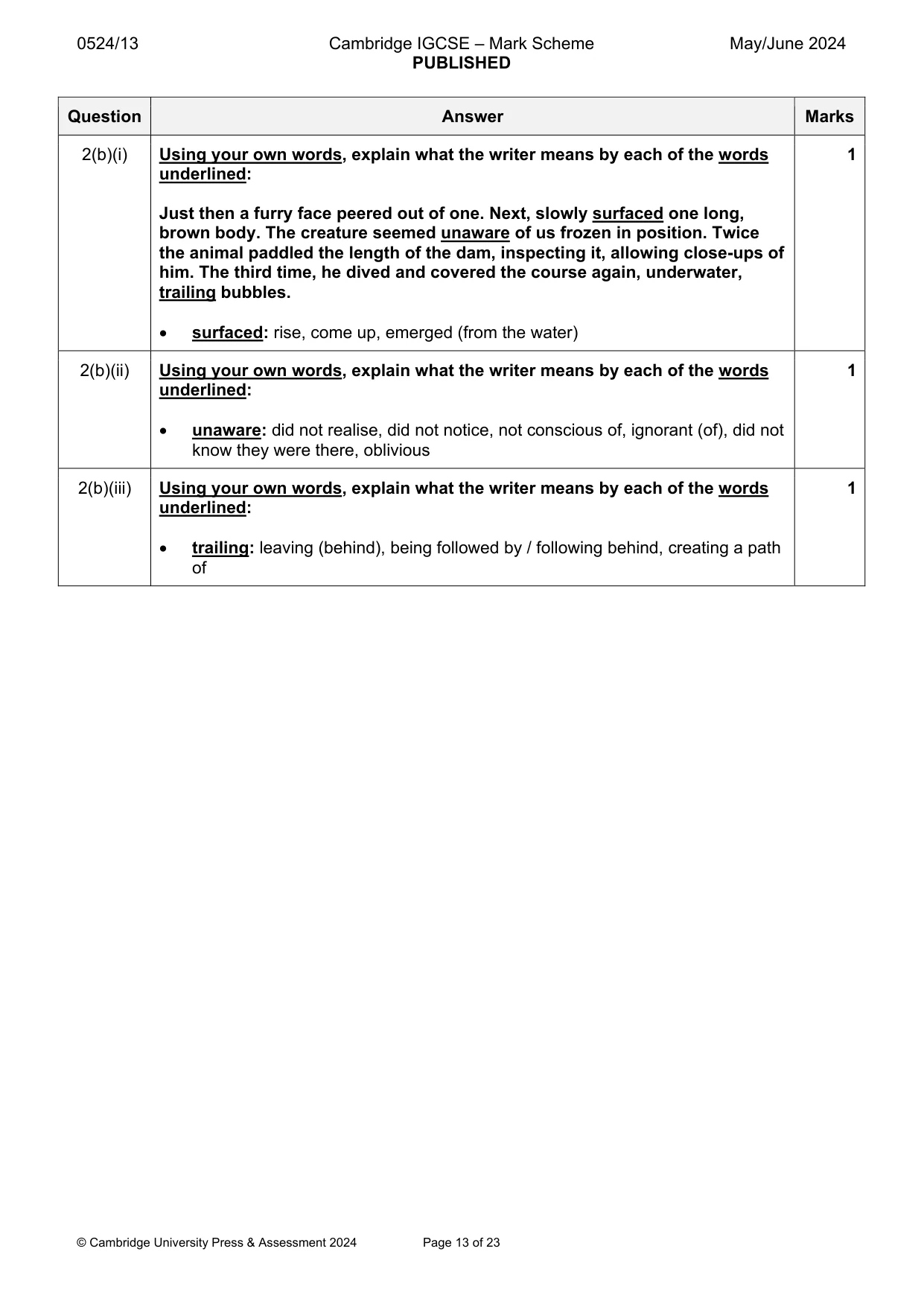
0524/13 Cambridge IGCSE – Mark Scheme PUBLISHED May/June 2024 © Cambridge University Press & Assessment 2024 Page 13 of 23 Question Answer Marks 2(b)(i) Using your own words, explain what the writer means by each of the words underlined: Just then a furry face peered out of one. Next, slowly surfaced one long, brown body. The creature seemed unaware of us frozen in position. Twice the animal paddled the length of the dam, inspecting it, allowing close-ups of him. The third time, he dived and covered the course again, underwater, trailing bubbles. surfaced: rise, come up, emerged (from the water) 1 2(b)(ii) Using your own words, explain what the writer means by each of the words underlined: unaware: did not realise, did not notice, not conscious of, ignorant (of), did not know they were there, oblivious 1 2(b)(iii) Using your own words, explain what the writer means by each of the words underlined: trailing: leaving (behind), being followed by / following behind, creating a path of 1
Mark scheme, page 14
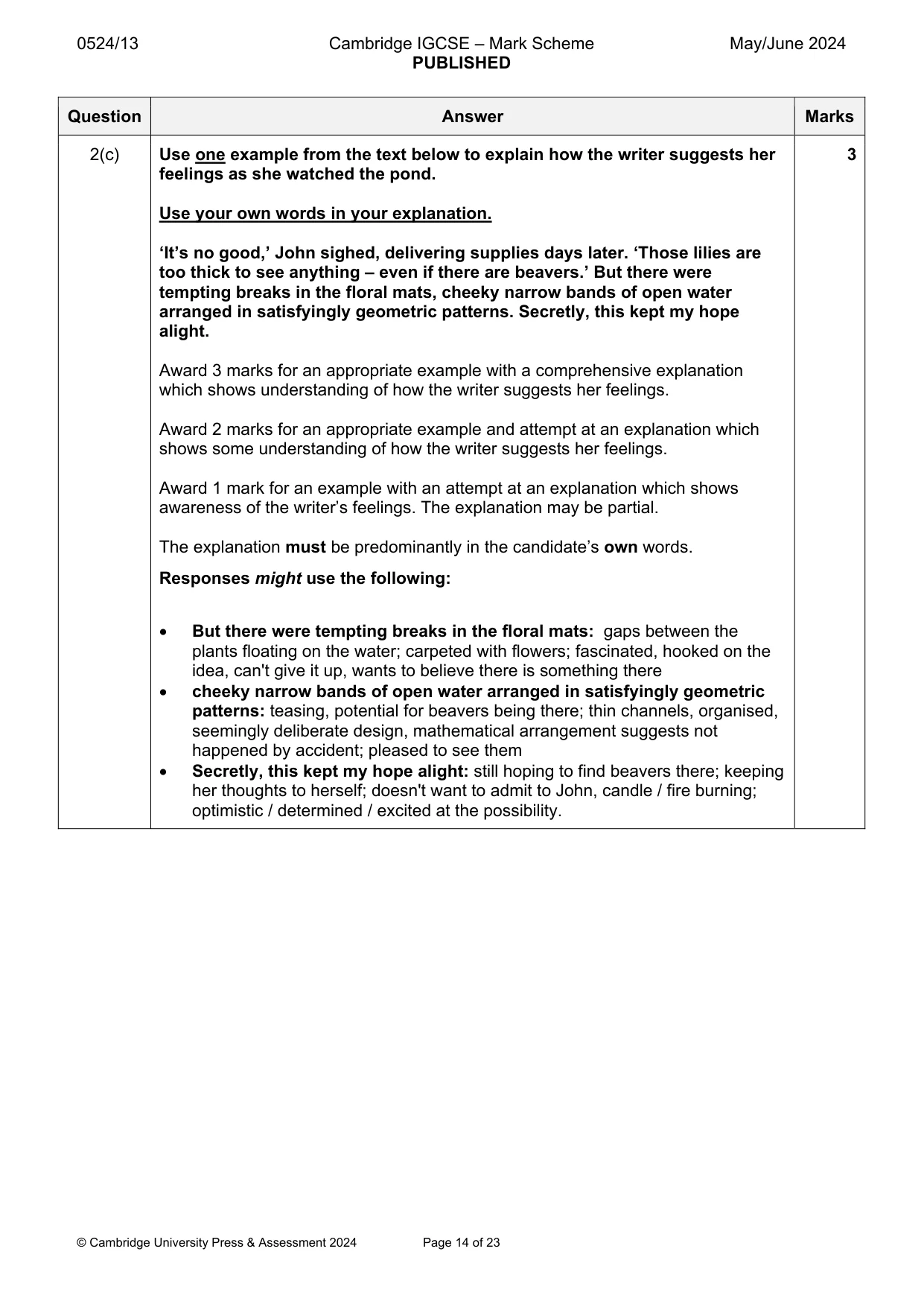
0524/13 Cambridge IGCSE – Mark Scheme PUBLISHED May/June 2024 © Cambridge University Press & Assessment 2024 Page 14 of 23 Question Answer Marks 2(c) Use one example from the text below to explain how the writer suggests her feelings as she watched the pond. Use your own words in your explanation. ‘It’s no good,’ John sighed, delivering supplies days later. ‘Those lilies are too thick to see anything – even if there are beavers.’ But there were tempting breaks in the floral mats, cheeky narrow bands of open water arranged in satisfyingly geometric patterns. Secretly, this kept my hope alight. Award 3 marks for an appropriate example with a comprehensive explanation which shows understanding of how the writer suggests her feelings. Award 2 marks for an appropriate example and attempt at an explanation which shows some understanding of how the writer suggests her feelings. Award 1 mark for an example with an attempt at an explanation which shows awareness of the writer’s feelings. The explanation may be partial. The explanation must be predominantly in the candidate’s own words. Responses might use the following: But there were tempting breaks in the floral mats: gaps between the plants floating on the water; carpeted with flowers; fascinated, hooked on the idea, can't give it up, wants to believe there is something there cheeky narrow bands of open water arranged in satisfyingly geometric patterns: teasing, potential for beavers being there; thin channels, organised, seemingly deliberate design, mathematical arrangement suggests not happened by accident; pleased to see them Secretly, this kept my hope alight: still hoping to find beavers there; keeping her thoughts to herself; doesn't want to admit to John, candle / fire burning; optimistic / determined / excited at the possibility. 3
Mark scheme, page 15
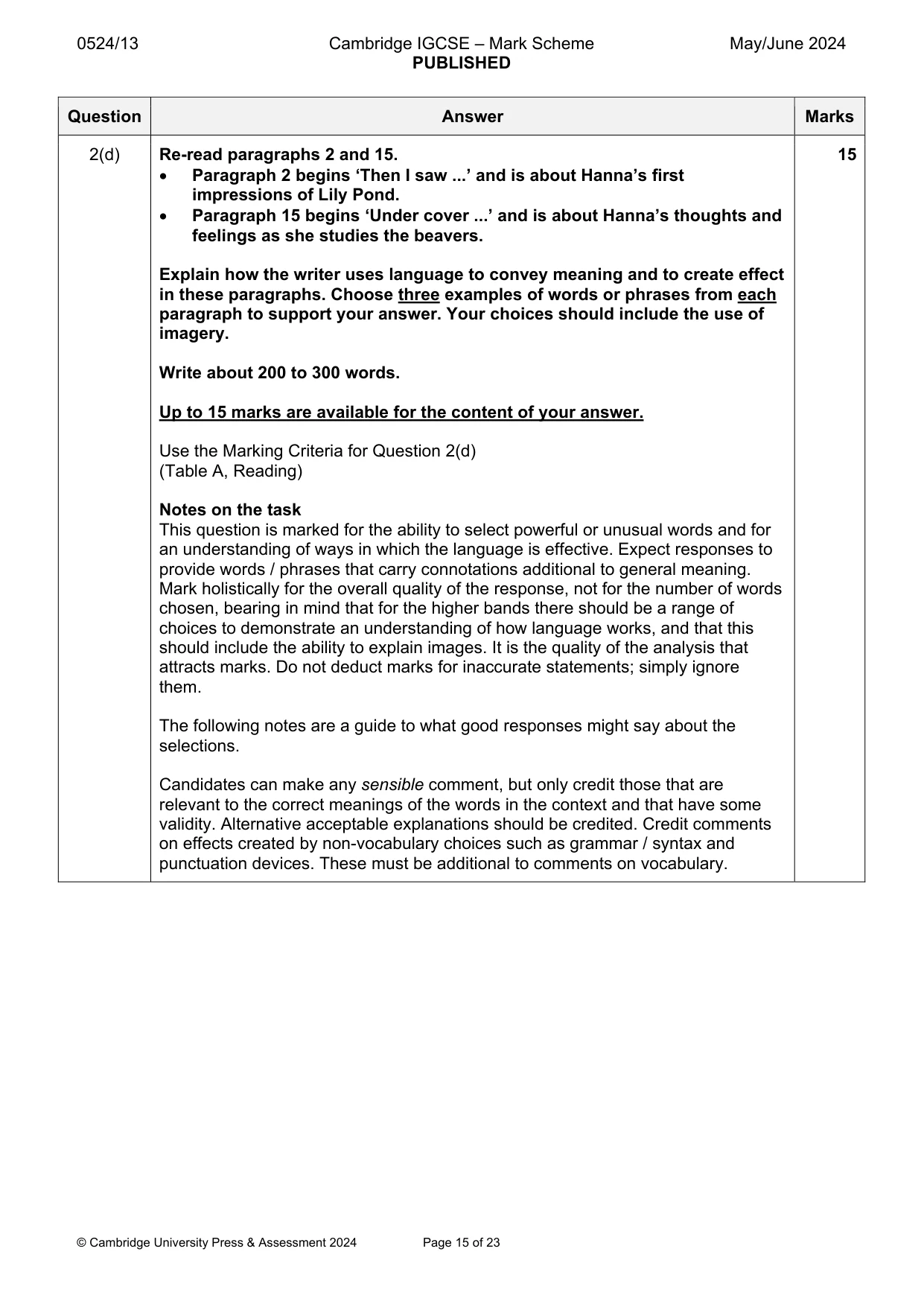
0524/13 Cambridge IGCSE – Mark Scheme PUBLISHED May/June 2024 © Cambridge University Press & Assessment 2024 Page 15 of 23 Question Answer Marks 2(d) Re-read paragraphs 2 and 15. Paragraph 2 begins ‘Then I saw ...’ and is about Hanna’s first impressions of Lily Pond. Paragraph 15 begins ‘Under cover ...’ and is about Hanna’s thoughts and feelings as she studies the beavers. Explain how the writer uses language to convey meaning and to create effect in these paragraphs. Choose three examples of words or phrases from each paragraph to support your answer. Your choices should include the use of imagery. Write about 200 to 300 words. Up to 15 marks are available for the content of your answer. Use the Marking Criteria for Question 2(d) (Table A, Reading) Notes on the task This question is marked for the ability to select powerful or unusual words and for an understanding of ways in which the language is effective. Expect responses to provide words / phrases that carry connotations additional to general meaning. Mark holistically for the overall quality of the response, not for the number of words chosen, bearing in mind that for the higher bands there should be a range of choices to demonstrate an understanding of how language works, and that this should include the ability to explain images. It is the quality of the analysis that attracts marks. Do not deduct marks for inaccurate statements; simply ignore them. The following notes are a guide to what good responses might say about the selections. Candidates can make any sensible comment, but only credit those that are relevant to the correct meanings of the words in the context and that have some validity. Alternative acceptable explanations should be credited. Credit comments on effects created by non-vocabulary choices such as grammar / syntax and punctuation devices. These must be additional to comments on vocabulary. 15
Mark scheme, page 16
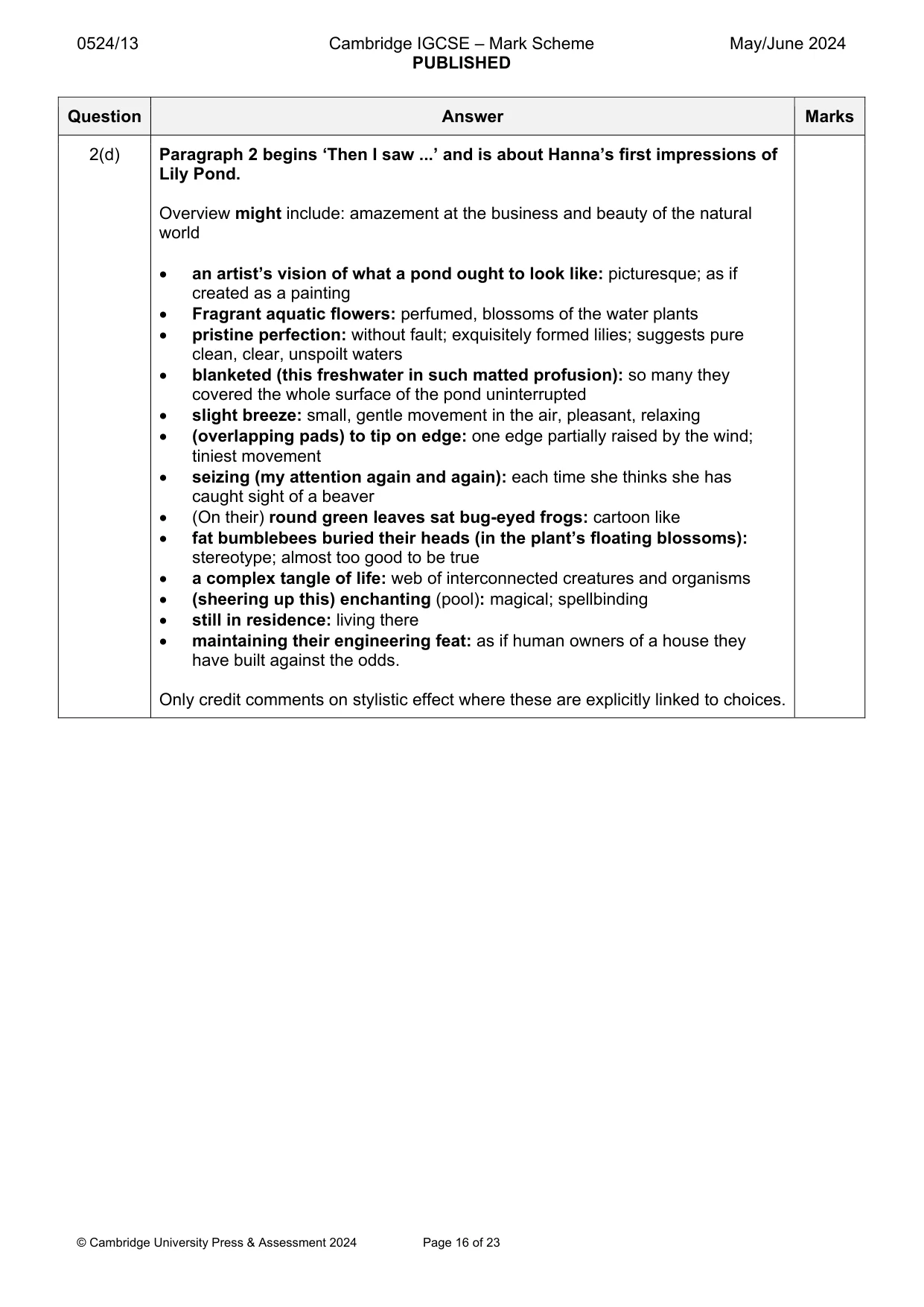
0524/13 Cambridge IGCSE – Mark Scheme PUBLISHED May/June 2024 © Cambridge University Press & Assessment 2024 Page 16 of 23 Question Answer Marks 2(d) Paragraph 2 begins ‘Then I saw ...’ and is about Hanna’s first impressions of Lily Pond. Overview might include: amazement at the business and beauty of the natural world an artist’s vision of what a pond ought to look like: picturesque; as if created as a painting Fragrant aquatic flowers: perfumed, blossoms of the water plants pristine perfection: without fault; exquisitely formed lilies; suggests pure clean, clear, unspoilt waters blanketed (this freshwater in such matted profusion): so many they covered the whole surface of the pond uninterrupted slight breeze: small, gentle movement in the air, pleasant, relaxing (overlapping pads) to tip on edge: one edge partially raised by the wind; tiniest movement seizing (my attention again and again): each time she thinks she has caught sight of a beaver (On their) round green leaves sat bug-eyed frogs: cartoon like fat bumblebees buried their heads (in the plant’s floating blossoms): stereotype; almost too good to be true a complex tangle of life: web of interconnected creatures and organisms (sheering up this) enchanting (pool): magical; spellbinding still in residence: living there maintaining their engineering feat: as if human owners of a house they have built against the odds. Only credit comments on stylistic effect where these are explicitly linked to choices.
Mark scheme, page 17
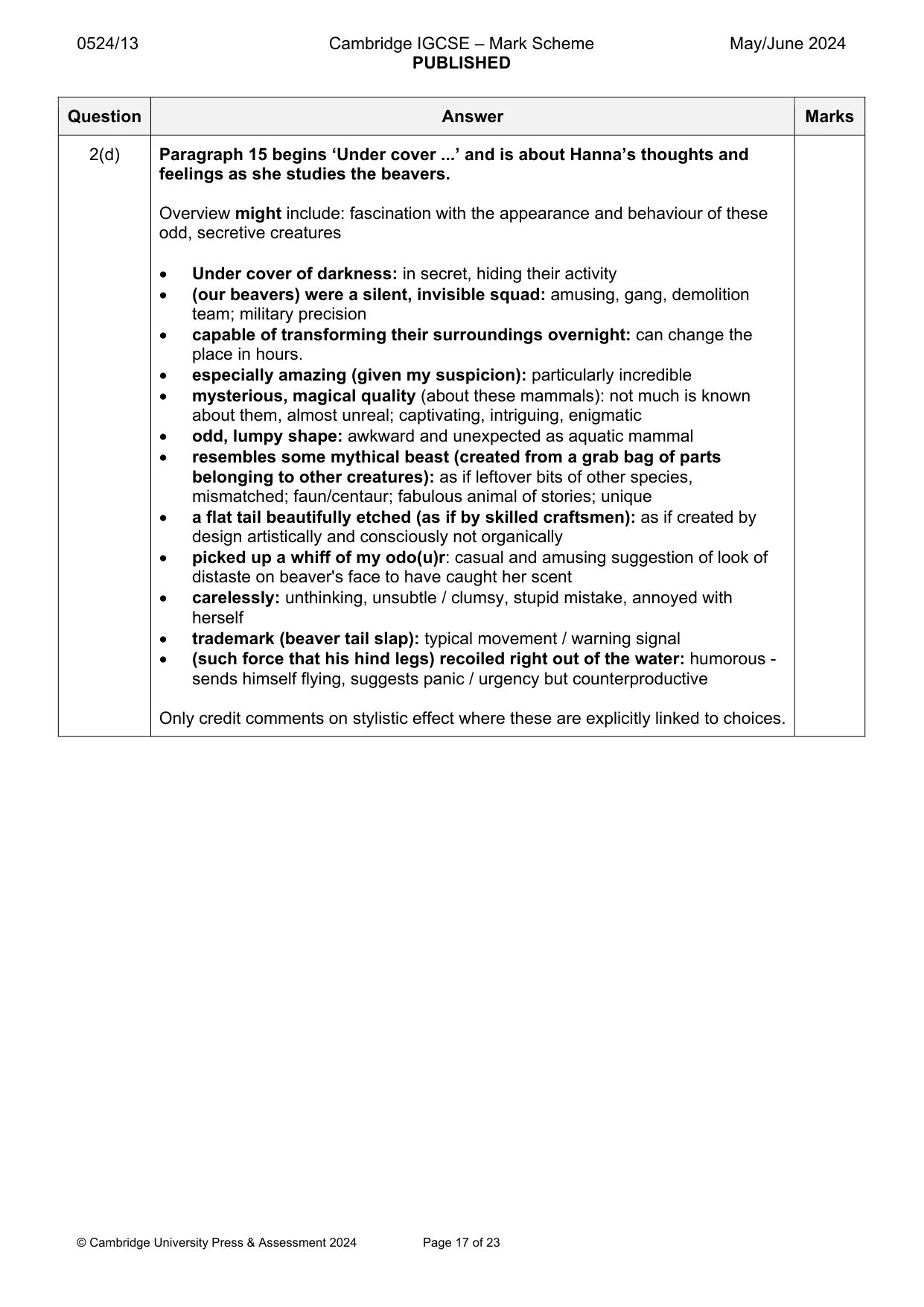
0524/13 Cambridge IGCSE – Mark Scheme PUBLISHED May/June 2024 © Cambridge University Press & Assessment 2024 Page 17 of 23 Question Answer Marks 2(d) Paragraph 15 begins ‘Under cover ...’ and is about Hanna’s thoughts and feelings as she studies the beavers. Overview might include: fascination with the appearance and behaviour of these odd, secretive creatures Under cover of darkness: in secret, hiding their activity (our beavers) were a silent, invisible squad: amusing, gang, demolition team; military precision capable of transforming their surroundings overnight: can change the place in hours. especially amazing (given my suspicion): particularly incredible mysterious, magical quality (about these mammals): not much is known about them, almost unreal; captivating, intriguing, enigmatic odd, lumpy shape: awkward and unexpected as aquatic mammal resembles some mythical beast (created from a grab bag of parts belonging to other creatures): as if leftover bits of other species, mismatched; faun/centaur; fabulous animal of stories; unique a flat tail beautifully etched (as if by skilled craftsmen): as if created by design artistically and consciously not organically picked up a whiff of my odo(u)r: casual and amusing suggestion of look of distaste on beaver's face to have caught her scent carelessly: unthinking, unsubtle / clumsy, stupid mistake, annoyed with herself trademark (beaver tail slap): typical movement / warning signal (such force that his hind legs) recoiled right out of the water: humorous - sends himself flying, suggests panic / urgency but counterproductive Only credit comments on stylistic effect where these are explicitly linked to choices.
Mark scheme, page 18
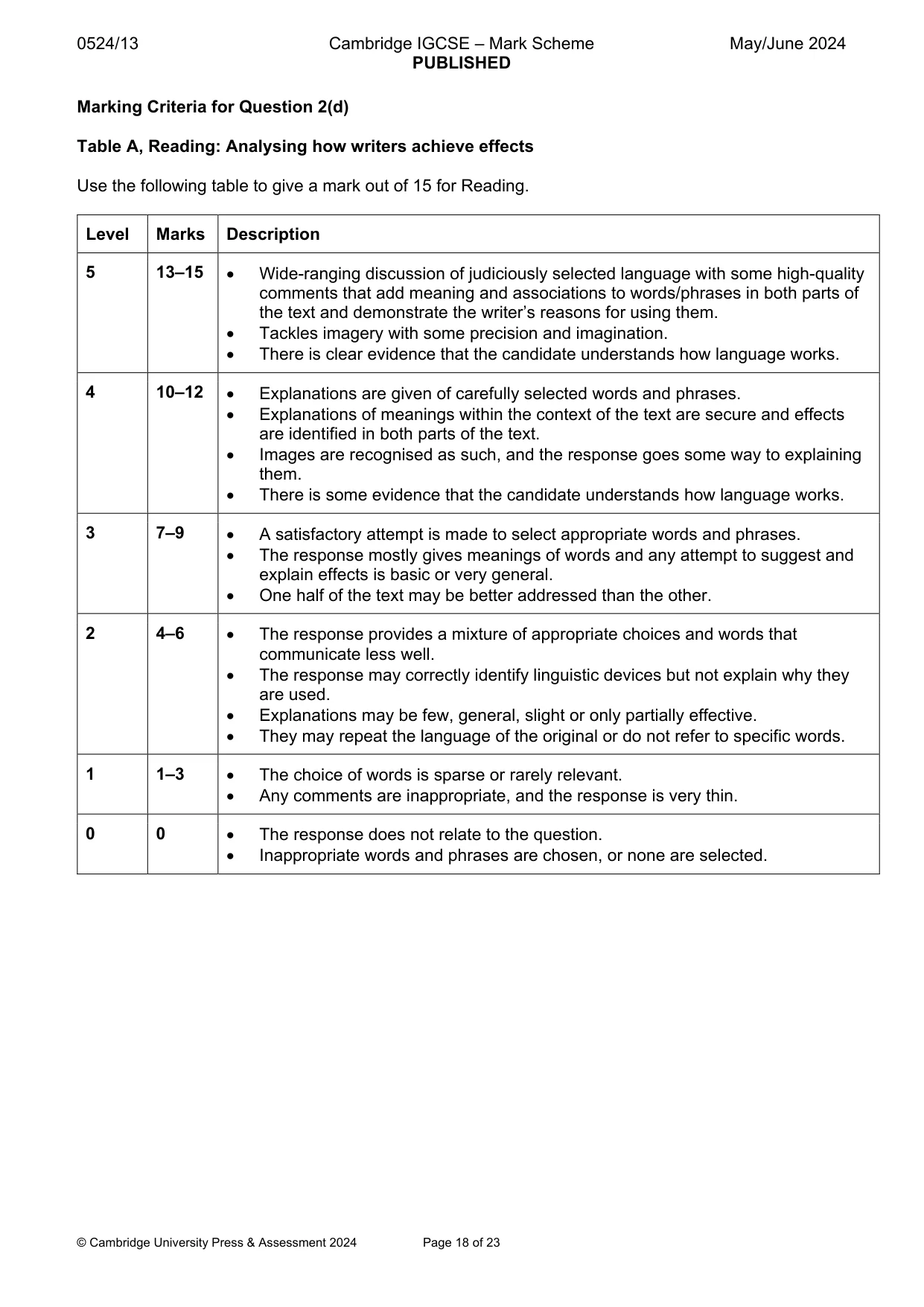
0524/13 Cambridge IGCSE – Mark Scheme PUBLISHED May/June 2024 © Cambridge University Press & Assessment 2024 Page 18 of 23 Marking Criteria for Question 2(d) Table A, Reading: Analysing how writers achieve effects Use the following table to give a mark out of 15 for Reading. Level Marks Description 5 13–15 Wide-ranging discussion of judiciously selected language with some high-quality comments that add meaning and associations to words/phrases in both parts of the text and demonstrate the writer’s reasons for using them. Tackles imagery with some precision and imagination. There is clear evidence that the candidate understands how language works. 4 10–12 Explanations are given of carefully selected words and phrases. Explanations of meanings within the context of the text are secure and effects are identified in both parts of the text. Images are recognised as such, and the response goes some way to explaining them. There is some evidence that the candidate understands how language works. 3 7–9 A satisfactory attempt is made to select appropriate words and phrases. The response mostly gives meanings of words and any attempt to suggest and explain effects is basic or very general. One half of the text may be better addressed than the other. 2 4–6 The response provides a mixture of appropriate choices and words that communicate less well. The response may correctly identify linguistic devices but not explain why they are used. Explanations may be few, general, slight or only partially effective. They may repeat the language of the original or do not refer to specific words. 1 1–3 The choice of words is sparse or rarely relevant. Any comments are inappropriate, and the response is very thin. 0 0 The response does not relate to the question. Inappropriate words and phrases are chosen, or none are selected.
Mark scheme, page 19
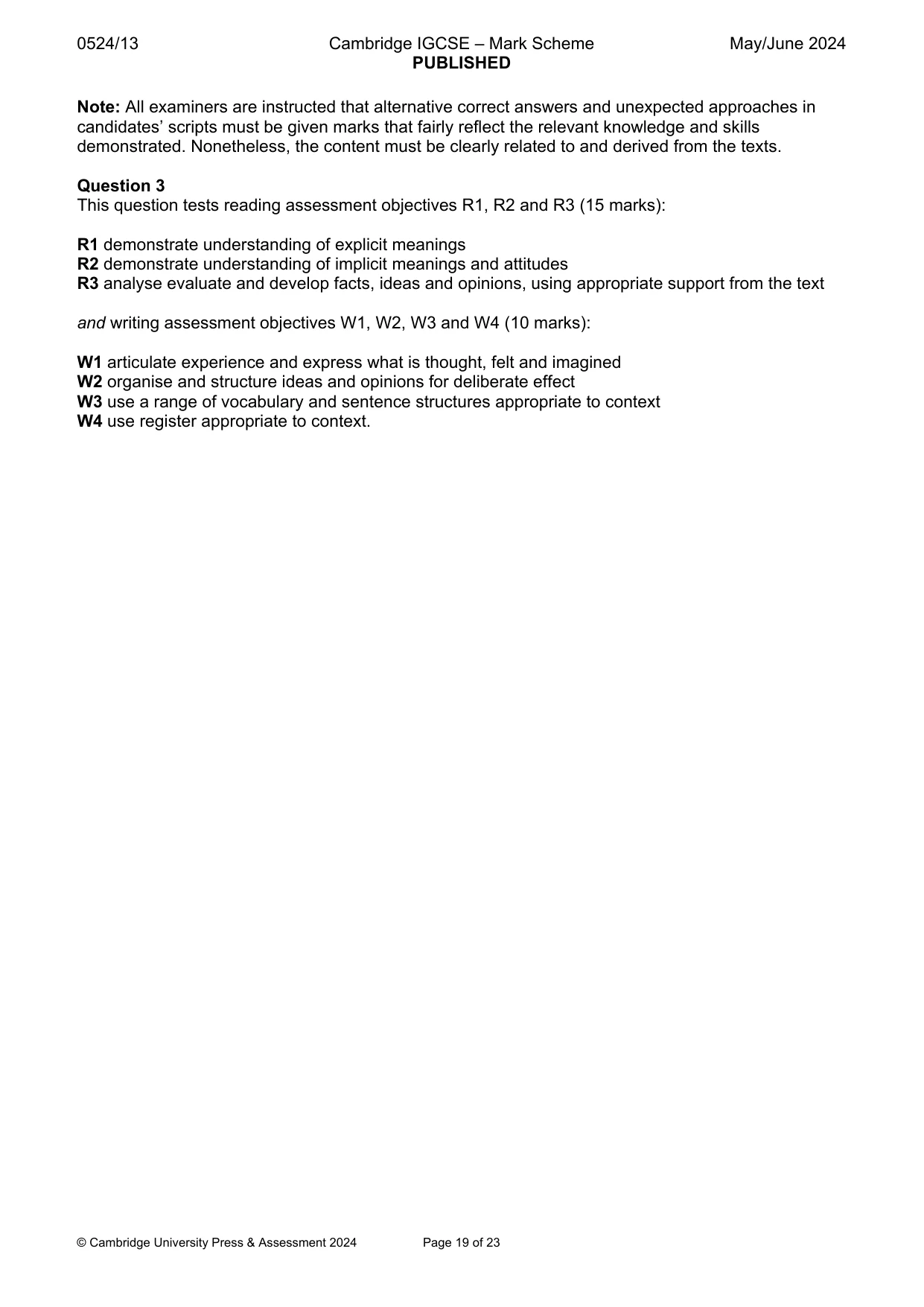
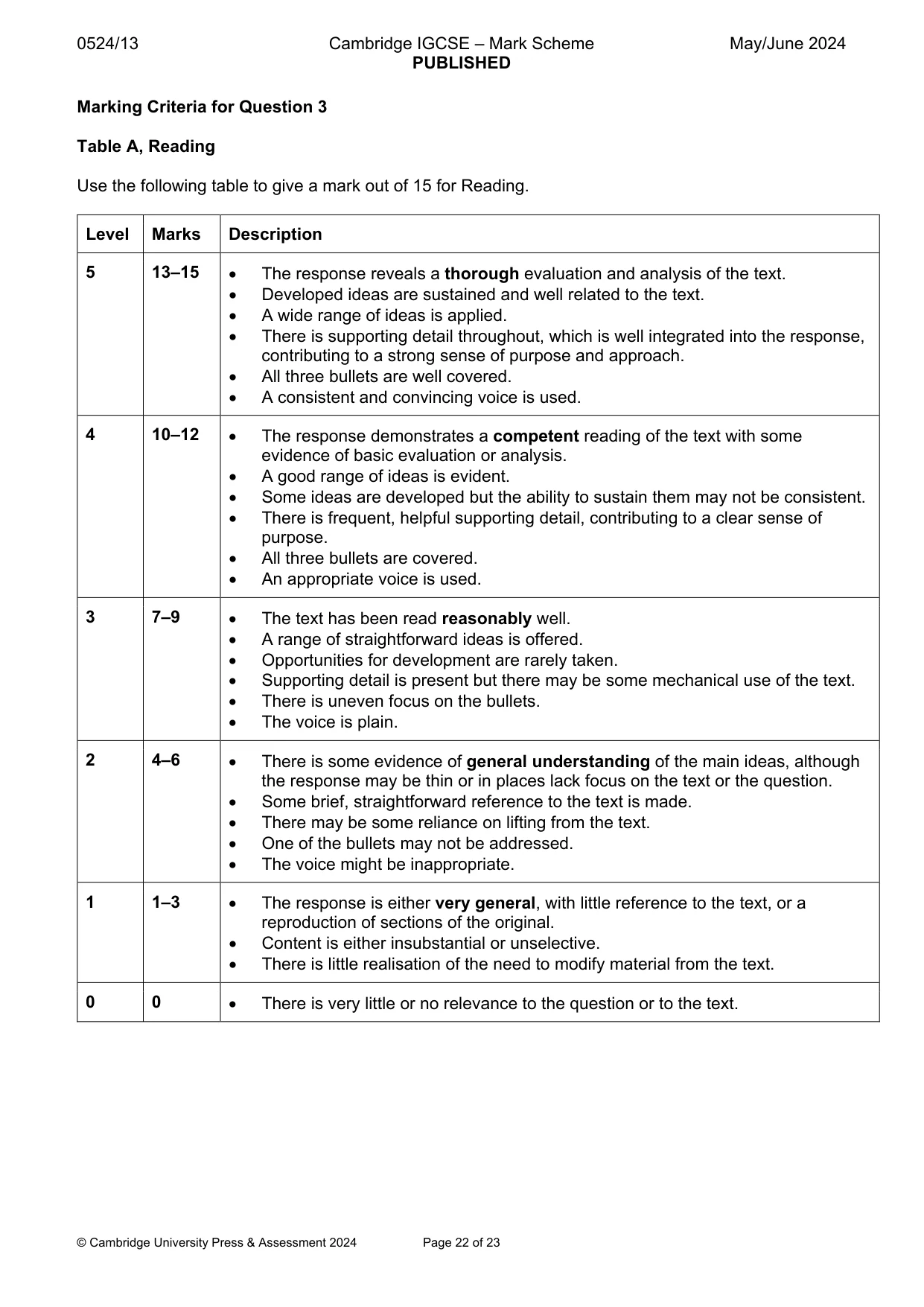
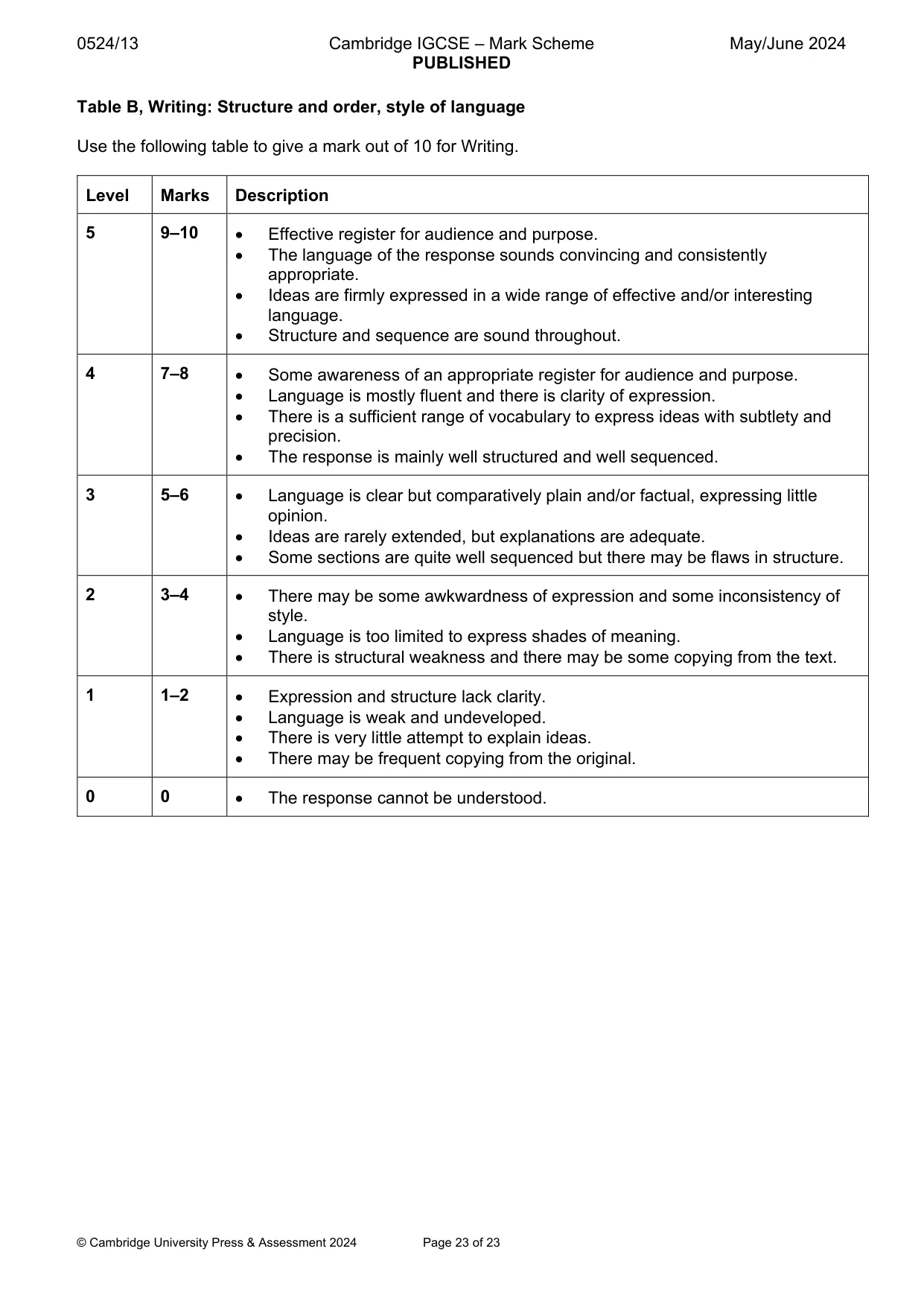
0524/13 Cambridge IGCSE – Mark Scheme PUBLISHED May/June 2024 © Cambridge University Press & Assessment 2024 Page 19 of 23 Note: All examiners are instructed that alternative correct answers and unexpected approaches in candidates’ scripts must be given marks that fairly reflect the relevant knowledge and skills demonstrated. Nonetheless, the content must be clearly related to and derived from the texts. Question 3 This question tests reading assessment objectives R1, R2 and R3 (15 marks): R1 demonstrate understanding of explicit meanings R2 demonstrate understanding of implicit meanings and attitudes R3 analyse evaluate and develop facts, ideas and opinions, using appropriate support from the text and writing assessment objectives W1, W2, W3 and W4 (10 marks): W1 articulate experience and express what is thought, felt and imagined W2 organise and structure ideas and opinions for deliberate effect W3 use a range of vocabulary and sentence structures appropriate to context W4 use register appropriate to context.
Mark scheme, page 20
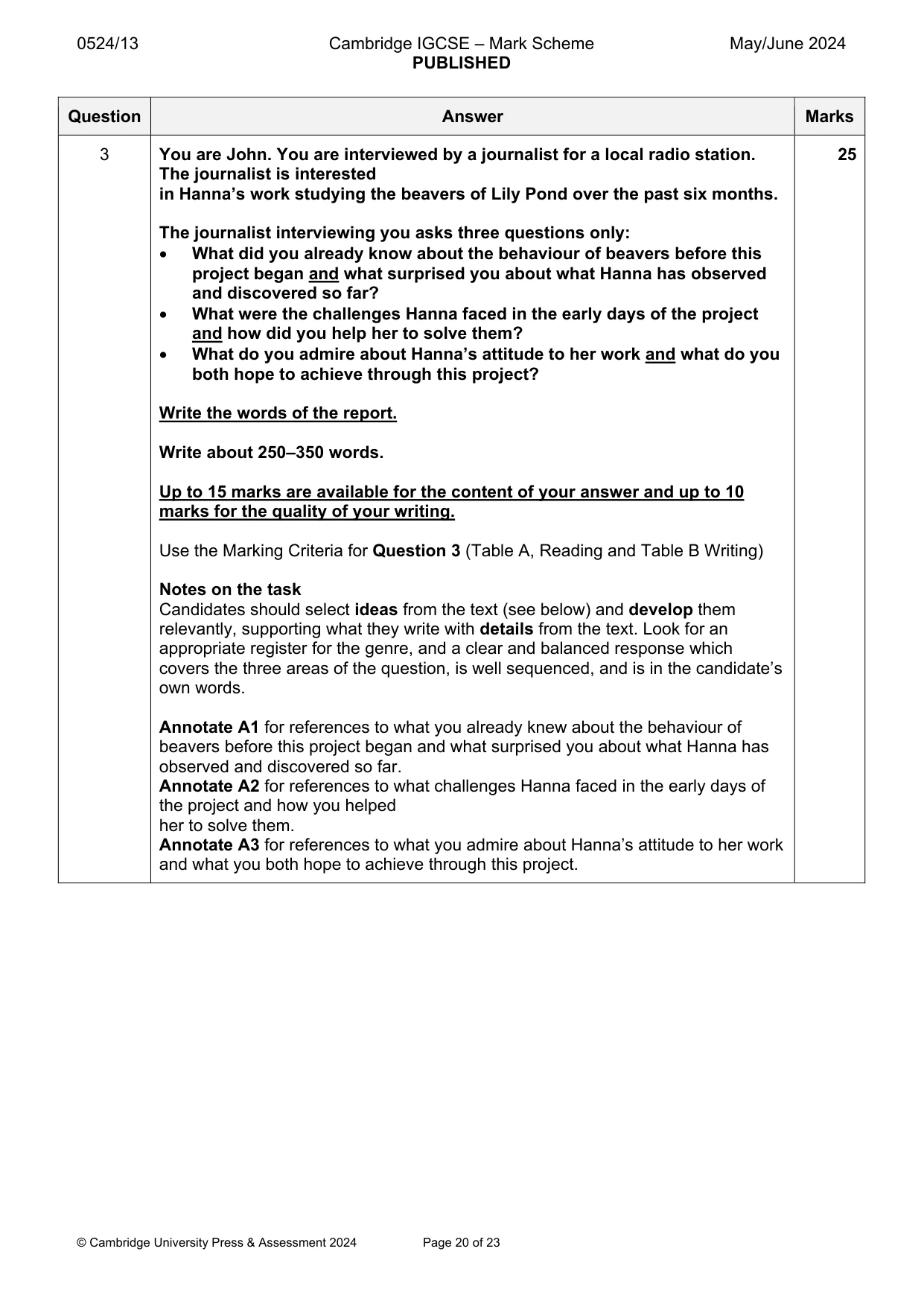
0524/13 Cambridge IGCSE – Mark Scheme PUBLISHED May/June 2024 © Cambridge University Press & Assessment 2024 Page 20 of 23 Question Answer Marks 3 You are John. You are interviewed by a journalist for a local radio station. The journalist is interested in Hanna’s work studying the beavers of Lily Pond over the past six months. The journalist interviewing you asks three questions only: What did you already know about the behaviour of beavers before this project began and what surprised you about what Hanna has observed and discovered so far? What were the challenges Hanna faced in the early days of the project and how did you help her to solve them? What do you admire about Hanna’s attitude to her work and what do you both hope to achieve through this project? Write the words of the report. Write about 250–350 words. Up to 15 marks are available for the content of your answer and up to 10 marks for the quality of your writing. Use the Marking Criteria for Question 3 (Table A, Reading and Table B Writing) Notes on the task Candidates should select ideas from the text (see below) and develop them relevantly, supporting what they write with details from the text. Look for an appropriate register for the genre, and a clear and balanced response which covers the three areas of the question, is well sequenced, and is in the candidate’s own words. Annotate A1 for references to what you already knew about the behaviour of beavers before this project began and what surprised you about what Hanna has observed and discovered so far. Annotate A2 for references to what challenges Hanna faced in the early days of the project and how you helped her to solve them. Annotate A3 for references to what you admire about Hanna’s attitude to her work and what you both hope to achieve through this project. 25
Mark scheme, page 21
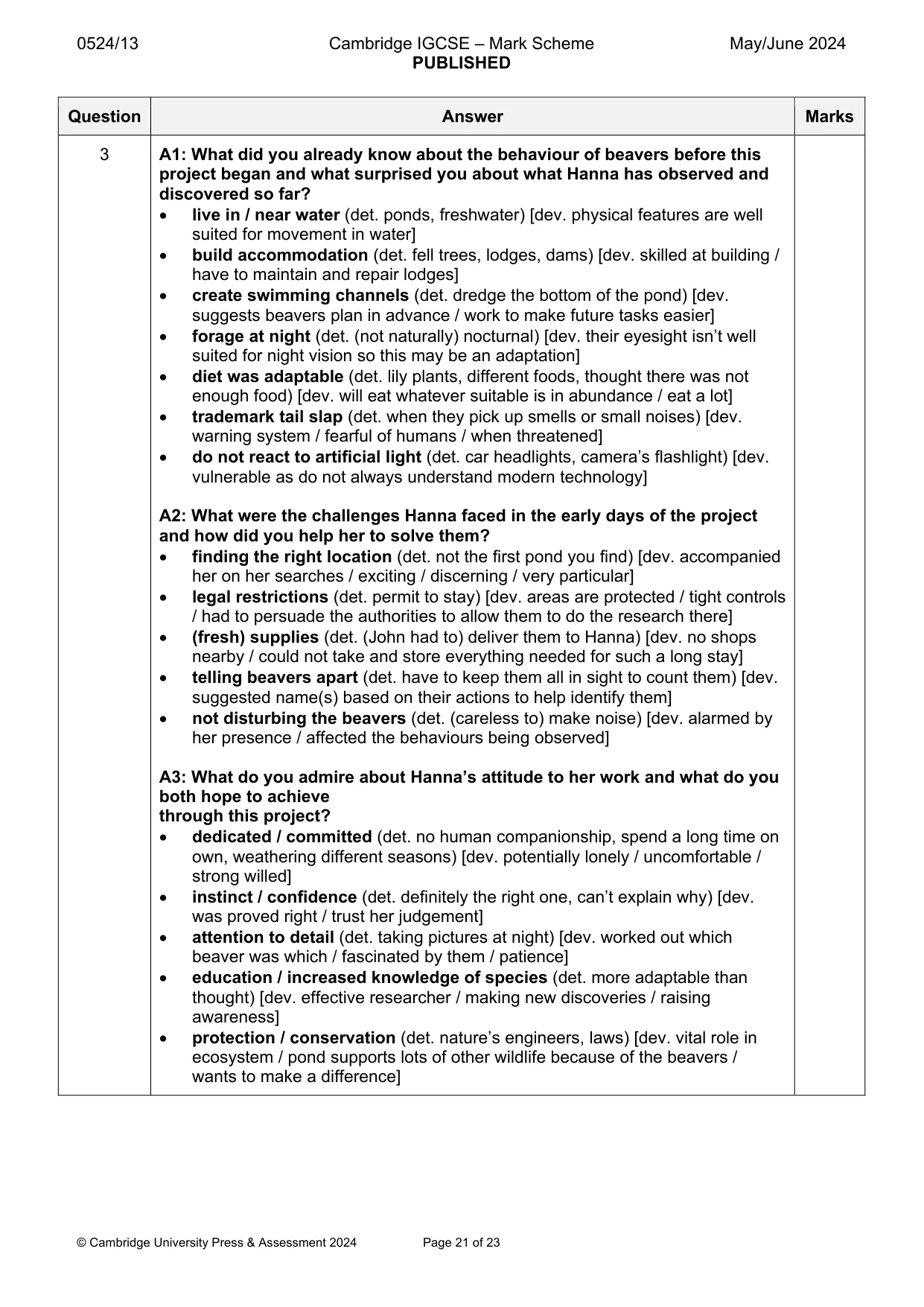
0524/13 Cambridge IGCSE – Mark Scheme PUBLISHED May/June 2024 © Cambridge University Press & Assessment 2024 Page 21 of 23 Question Answer Marks 3 A1: What did you already know about the behaviour of beavers before this project began and what surprised you about what Hanna has observed and discovered so far? live in / near water (det. ponds, freshwater) [dev. physical features are well suited for movement in water] build accommodation (det. fell trees, lodges, dams) [dev. skilled at building / have to maintain and repair lodges] create swimming channels (det. dredge the bottom of the pond) [dev. suggests beavers plan in advance / work to make future tasks easier] forage at night (det. (not naturally) nocturnal) [dev. their eyesight isn’t well suited for night vision so this may be an adaptation] diet was adaptable (det. lily plants, different foods, thought there was not enough food) [dev. will eat whatever suitable is in abundance / eat a lot] trademark tail slap (det. when they pick up smells or small noises) [dev. warning system / fearful of humans / when threatened] do not react to artificial light (det. car headlights, camera’s flashlight) [dev. vulnerable as do not always understand modern technology] A2: What were the challenges Hanna faced in the early days of the project and how did you help her to solve them? finding the right location (det. not the first pond you find) [dev. accompanied her on her searches / exciting / discerning / very particular] legal restrictions (det. permit to stay) [dev. areas are protected / tight controls / had to persuade the authorities to allow them to do the research there] (fresh) supplies (det. (John had to) deliver them to Hanna) [dev. no shops nearby / could not take and store everything needed for such a long stay] telling beavers apart (det. have to keep them all in sight to count them) [dev. suggested name(s) based on their actions to help identify them] not disturbing the beavers (det. (careless to) make noise) [dev. alarmed by her presence / affected the behaviours being observed] A3: What do you admire about Hanna’s attitude to her work and what do you both hope to achieve through this project? dedicated / committed (det. no human companionship, spend a long time on own, weathering different seasons) [dev. potentially lonely / uncomfortable / strong willed] instinct / confidence (det. definitely the right one, can’t explain why) [dev. was proved right / trust her judgement] attention to detail (det. taking pictures at night) [dev. worked out which beaver was which / fascinated by them / patience] education / increased knowledge of species (det. more adaptable than thought) [dev. effective researcher / making new discoveries / raising awareness] protection / conservation (det. nature’s engineers, laws) [dev. vital role in ecosystem / pond supports lots of other wildlife because of the beavers / wants to make a difference]
Mark scheme, page 22
0524/13 Cambridge IGCSE – Mark Scheme PUBLISHED May/June 2024 © Cambridge University Press & Assessment 2024 Page 22 of 23 Marking Criteria for Question 3 Table A, Reading Use the following table to give a mark out of 15 for Reading. Level Marks Description 5 13–15 The response reveals a thorough evaluation and analysis of the text. Developed ideas are sustained and well related to the text. A wide range of ideas is applied. There is supporting detail throughout, which is well integrated into the response, contributing to a strong sense of purpose and approach. All three bullets are well covered. A consistent and convincing voice is used. 4 10–12 The response demonstrates a competent reading of the text with some evidence of basic evaluation or analysis. A good range of ideas is evident. Some ideas are developed but the ability to sustain them may not be consistent. There is frequent, helpful supporting detail, contributing to a clear sense of purpose. All three bullets are covered. An appropriate voice is used. 3 7–9 The text has been read reasonably well. A range of straightforward ideas is offered. Opportunities for development are rarely taken. Supporting detail is present but there may be some mechanical use of the text. There is uneven focus on the bullets. The voice is plain. 2 4–6 There is some evidence of general understanding of the main ideas, although the response may be thin or in places lack focus on the text or the question. Some brief, straightforward reference to the text is made. There may be some reliance on lifting from the text. One of the bullets may not be addressed. The voice might be inappropriate. 1 1–3 The response is either very general, with little reference to the text, or a reproduction of sections of the original. Content is either insubstantial or unselective. There is little realisation of the need to modify material from the text. 0 0 There is very little or no relevance to the question or to the text.
Mark scheme, page 23
0524/13 Cambridge IGCSE – Mark Scheme PUBLISHED May/June 2024 © Cambridge University Press & Assessment 2024 Page 23 of 23 Table B, Writing: Structure and order, style of language Use the following table to give a mark out of 10 for Writing. Level Marks Description 5 9–10 Effective register for audience and purpose. The language of the response sounds convincing and consistently appropriate. Ideas are firmly expressed in a wide range of effective and/or interesting language. Structure and sequence are sound throughout. 4 7–8 Some awareness of an appropriate register for audience and purpose. Language is mostly fluent and there is clarity of expression. There is a sufficient range of vocabulary to express ideas with subtlety and precision. The response is mainly well structured and well sequenced. 3 5–6 Language is clear but comparatively plain and/or factual, expressing little opinion. Ideas are rarely extended, but explanations are adequate. Some sections are quite well sequenced but there may be flaws in structure. 2 3–4 There may be some awkwardness of expression and some inconsistency of style. Language is too limited to express shades of meaning. There is structural weakness and there may be some copying from the text. 1 1–2 Expression and structure lack clarity. Language is weak and undeveloped. There is very little attempt to explain ideas. There may be frequent copying from the original. 0 0 The response cannot be understood.
What you needed in this session
Cambridge’s own grade thresholds for 2024 May/June, Paper 1 · Variant 3. A higher threshold means an easier paper — the bar moves with how the cohort did.