Cambridge IGCSE English - First Language (9-1) (UK only) 0627 — 2018 May/June Paper 1 · Variant 0
0627/10/M/J/18
The question paper and its mark scheme, free to read here and free to download. This is Cambridge’s own paper, exactly as it was sat.
Question paper16 pages
Mark scheme
No mark scheme is in the library for this paper.
Paper as text
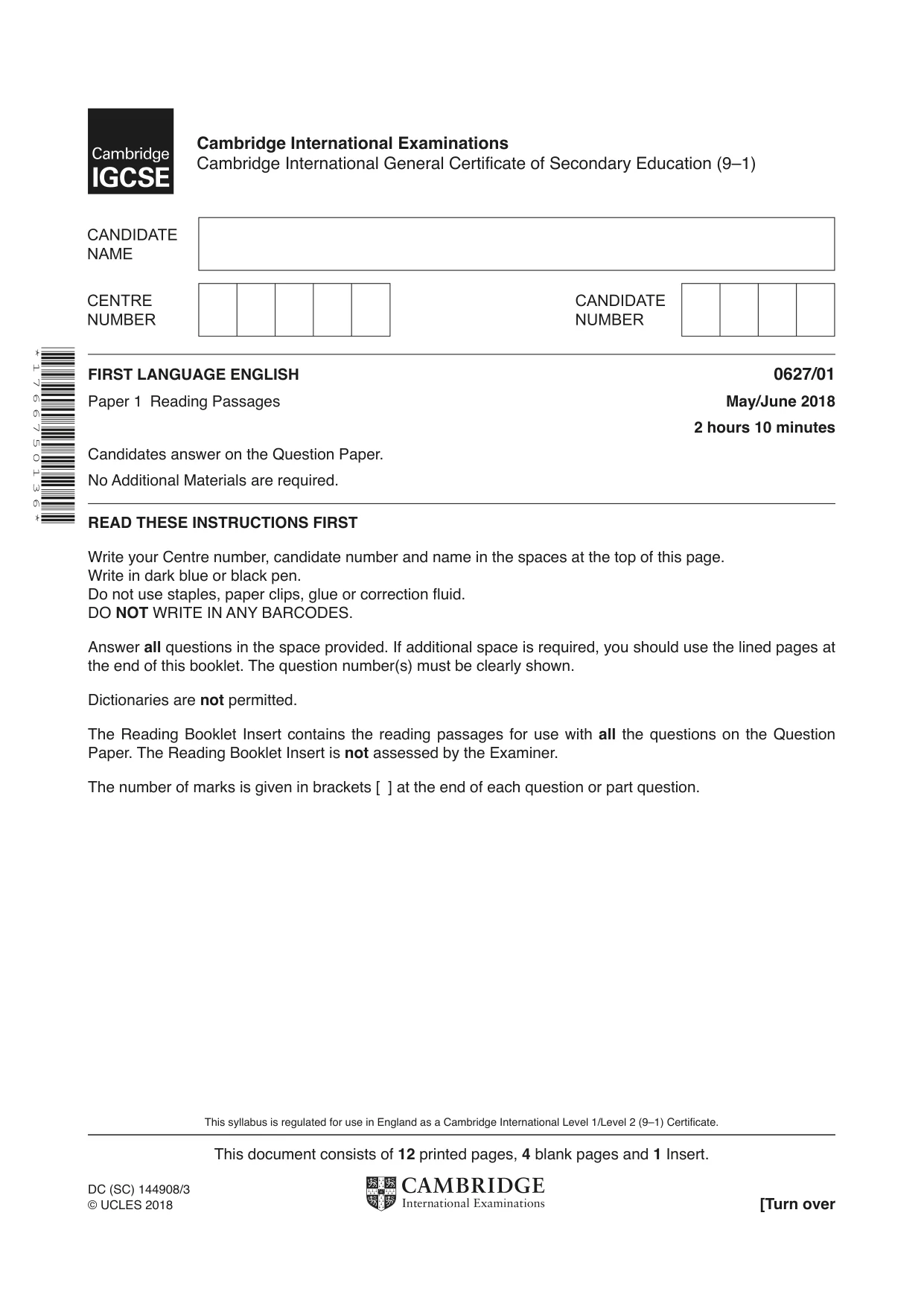
Question paper, page 1
* 1 7 6 6 7 5 0 1 3 6 * This document consists of 12 printed pages, 4 blank pages and 1 Insert. DC (SC) 144908/3 © UCLES 2018 [Turn over Cambridge International Examinations Cambridge International General Certificate of Secondary Education (9–1) FIRST LANGUAGE ENGLISH 0627/01 Paper 1 Reading Passages May/June 2018 2 hours 10 minutes Candidates answer on the Question Paper. No Additional Materials are required. READ THESE INSTRUCTIONS FIRST Write your Centre number, candidate number and name in the spaces at the top of this page. Write in dark blue or black pen. Do not use staples, paper clips, glue or correction fluid. DO NOT WRITE IN ANY BARCODES. Answer all questions in the space provided. If additional space is required, you should use the lined pages at the end of this booklet. The question number(s) must be clearly shown. Dictionaries are not permitted. The Reading Booklet Insert contains the reading passages for use with all the questions on the Question Paper. The Reading Booklet Insert is not assessed by the Examiner. The number of marks is given in brackets [ ] at the end of each question or part question. This syllabus is regulated for use in England as a Cambridge International Level 1/Level 2 (9–1) Certificate.
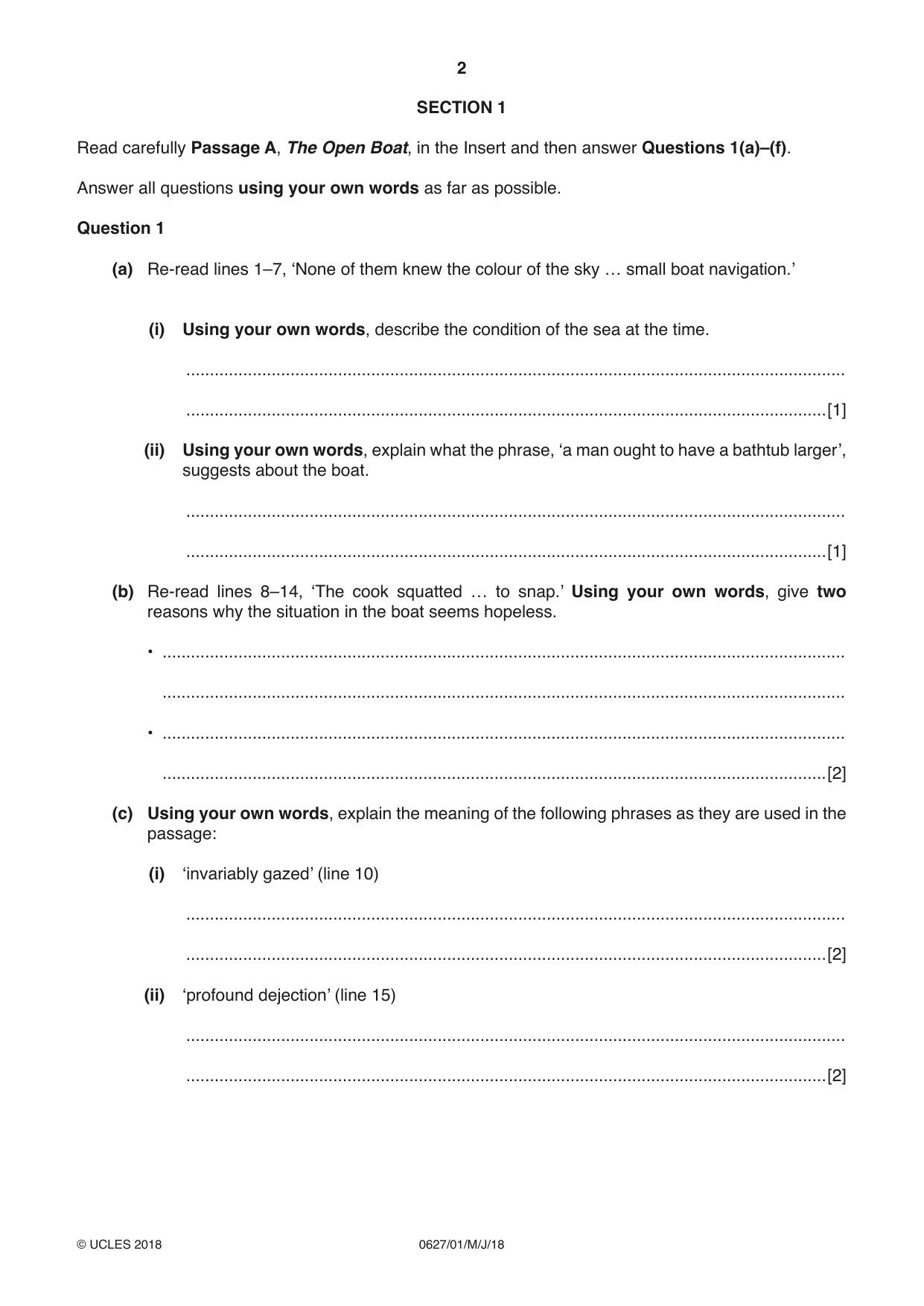
Question paper, page 2
2 0627/01/M/J/18 © UCLES 2018 SECTION 1 Read carefully Passage A, The Open Boat, in the Insert and then answer Questions 1(a)–(f). Answer all questions using your own words as far as possible. Question 1 (a) Re-read lines 1–7, ‘None of them knew the colour of the sky … small boat navigation.’ (i) Using your own words, describe the condition of the sea at the time. … …[1] (ii) Using your own words, explain what the phrase, ‘a man ought to have a bathtub larger’, suggests about the boat. … …[1] (b) Re-read lines 8–14, ‘The cook squatted … to snap.’ Using your own words, give two reasons why the situation in the boat seems hopeless. • … … • … …[2] (c) Using your own words, explain the meaning of the following phrases as they are used in the passage: (i) ‘invariably gazed’ (line 10) … …[2] (ii) ‘profound dejection’ (line 15) … …[2]
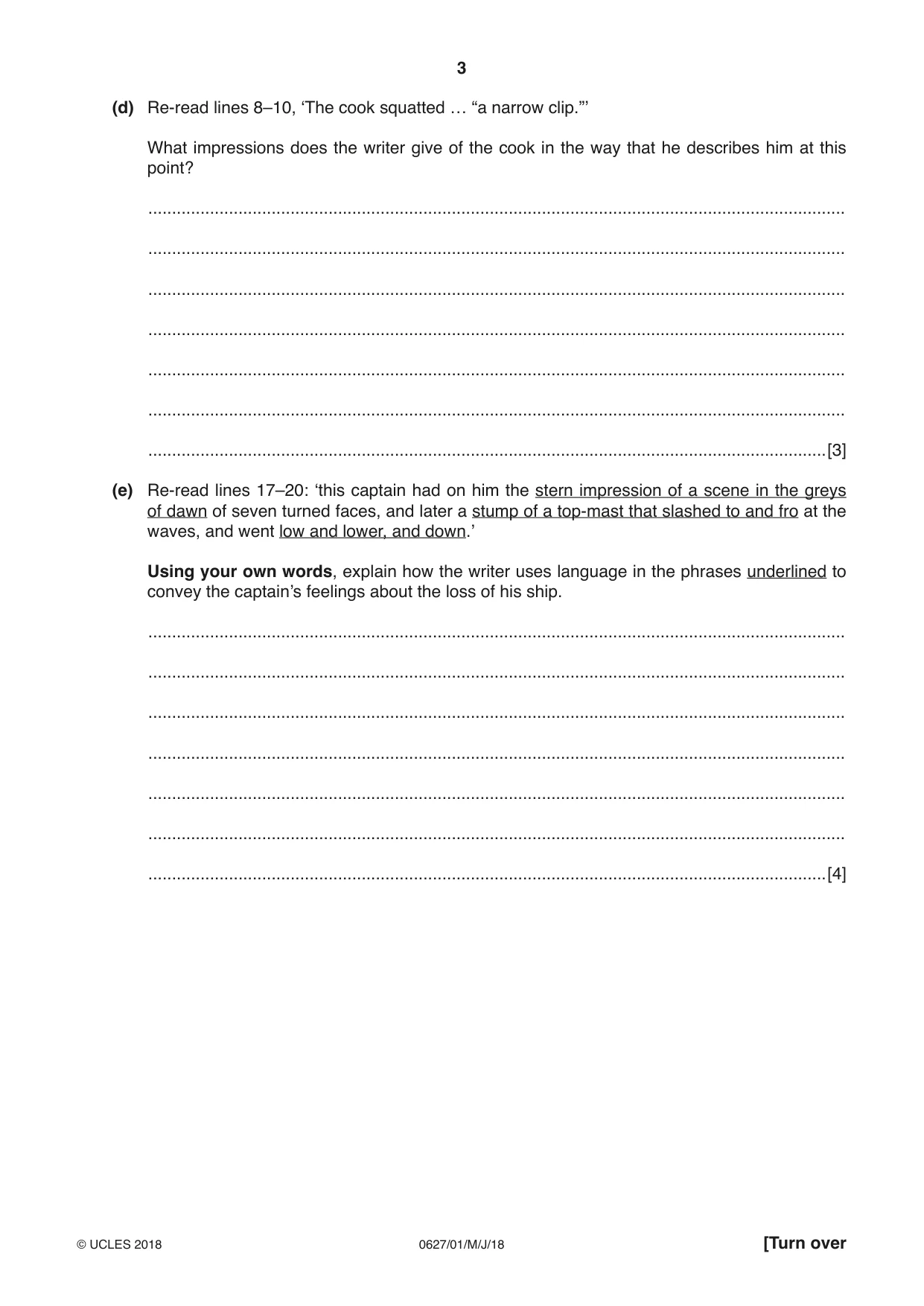
Question paper, page 3
3 0627/01/M/J/18 © UCLES 2018 [Turn over (d) Re-read lines 8–10, ‘The cook squatted … “a narrow clip.”’ What impressions does the writer give of the cook in the way that he describes him at this point? … … … … … … …[3] (e) Re-read lines 17–20: ‘this captain had on him the stern impression of a scene in the greys of dawn of seven turned faces, and later a stump of a top-mast that slashed to and fro at the waves, and went low and lower, and down.’ Using your own words, explain how the writer uses language in the phrases underlined to convey the captain’s feelings about the loss of his ship. … … … … … … …[4]
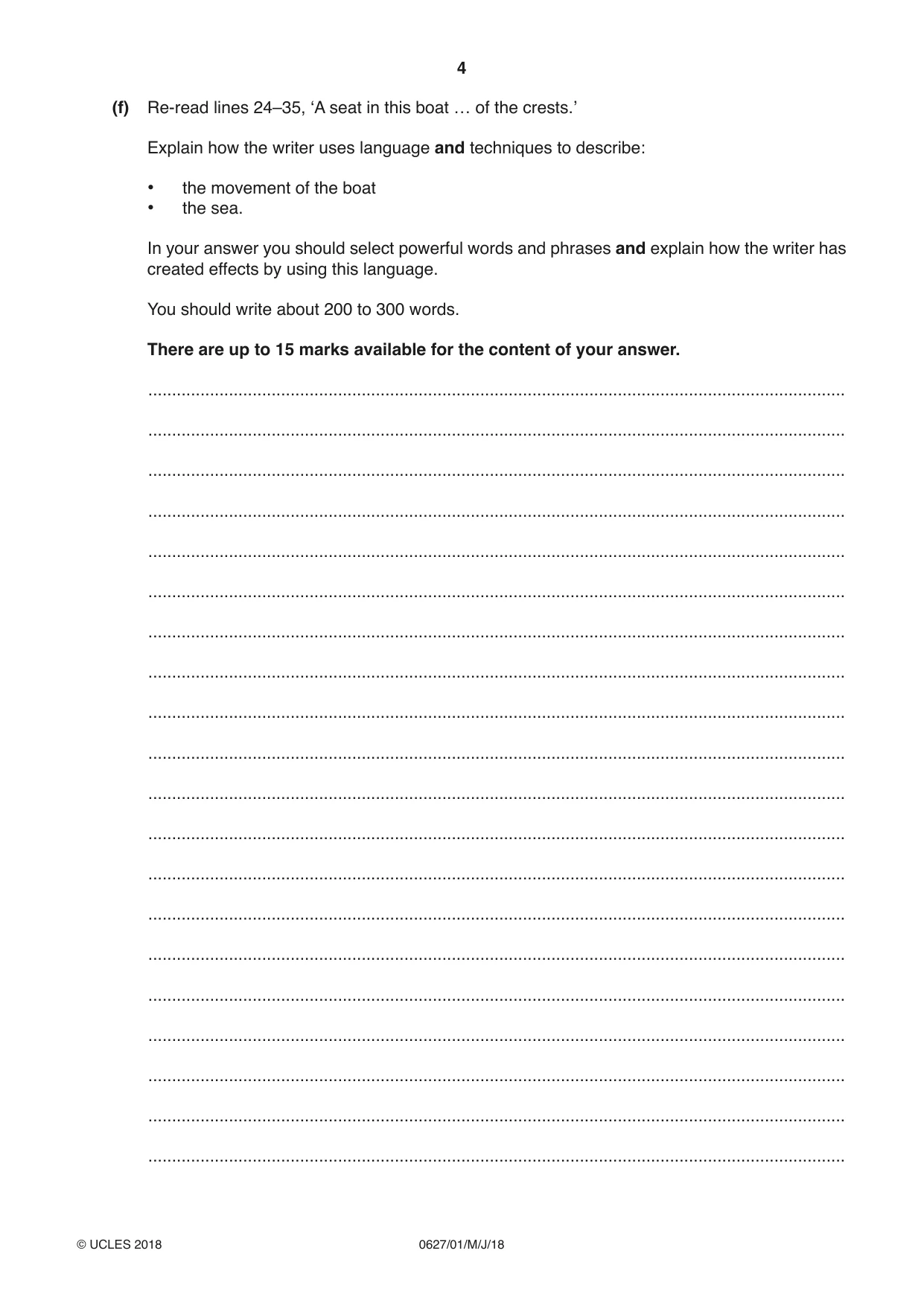
Question paper, page 4
4 0627/01/M/J/18 © UCLES 2018 (f) Re-read lines 24–35, ‘A seat in this boat … of the crests.’ Explain how the writer uses language and techniques to describe: • the movement of the boat • the sea. In your answer you should select powerful words and phrases and explain how the writer has created effects by using this language. You should write about 200 to 300 words. There are up to 15 marks available for the content of your answer. … … … … … … … … … … … … … … … … … … … …
Question paper, page 5
5 0627/01/M/J/18 © UCLES 2018 [Turn over … … … … … … … … … … … … … … … … … … … … … … … … … … … …[15]
Question paper, page 6
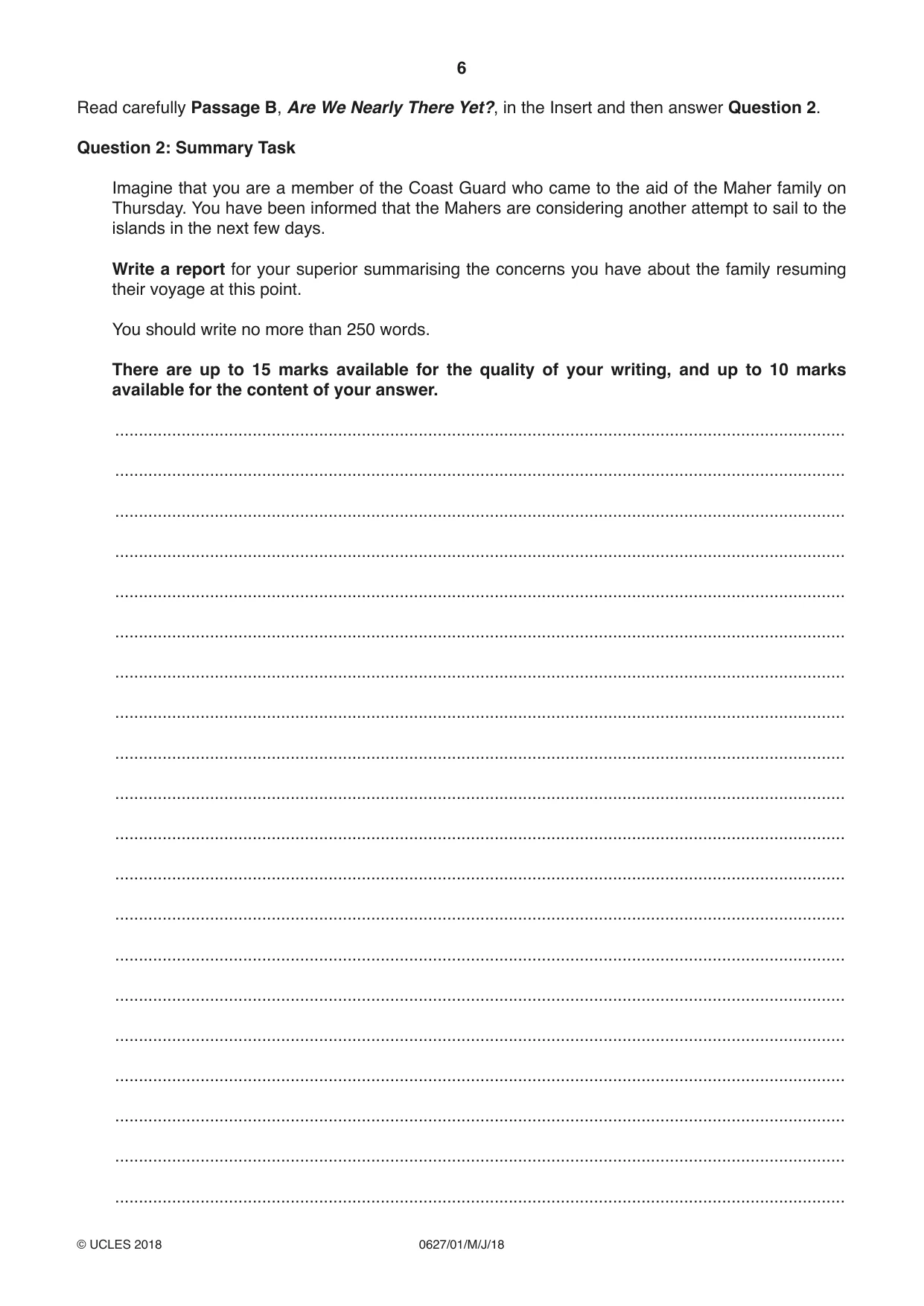
6 0627/01/M/J/18 © UCLES 2018 Read carefully Passage B, Are We Nearly There Yet?, in the Insert and then answer Question 2. Question 2: Summary Task Imagine that you are a member of the Coast Guard who came to the aid of the Maher family on Thursday. You have been informed that the Mahers are considering another attempt to sail to the islands in the next few days. Write a report for your superior summarising the concerns you have about the family resuming their voyage at this point. You should write no more than 250 words. There are up to 15 marks available for the quality of your writing, and up to 10 marks available for the content of your answer. … … … … … … … … … … … … … … … … … … … …
Question paper, page 7
7 0627/01/M/J/18 © UCLES 2018 [Turn over … … … … … … … … … … … … … … … … … … … … … … … … …[25]
Question paper, page 8
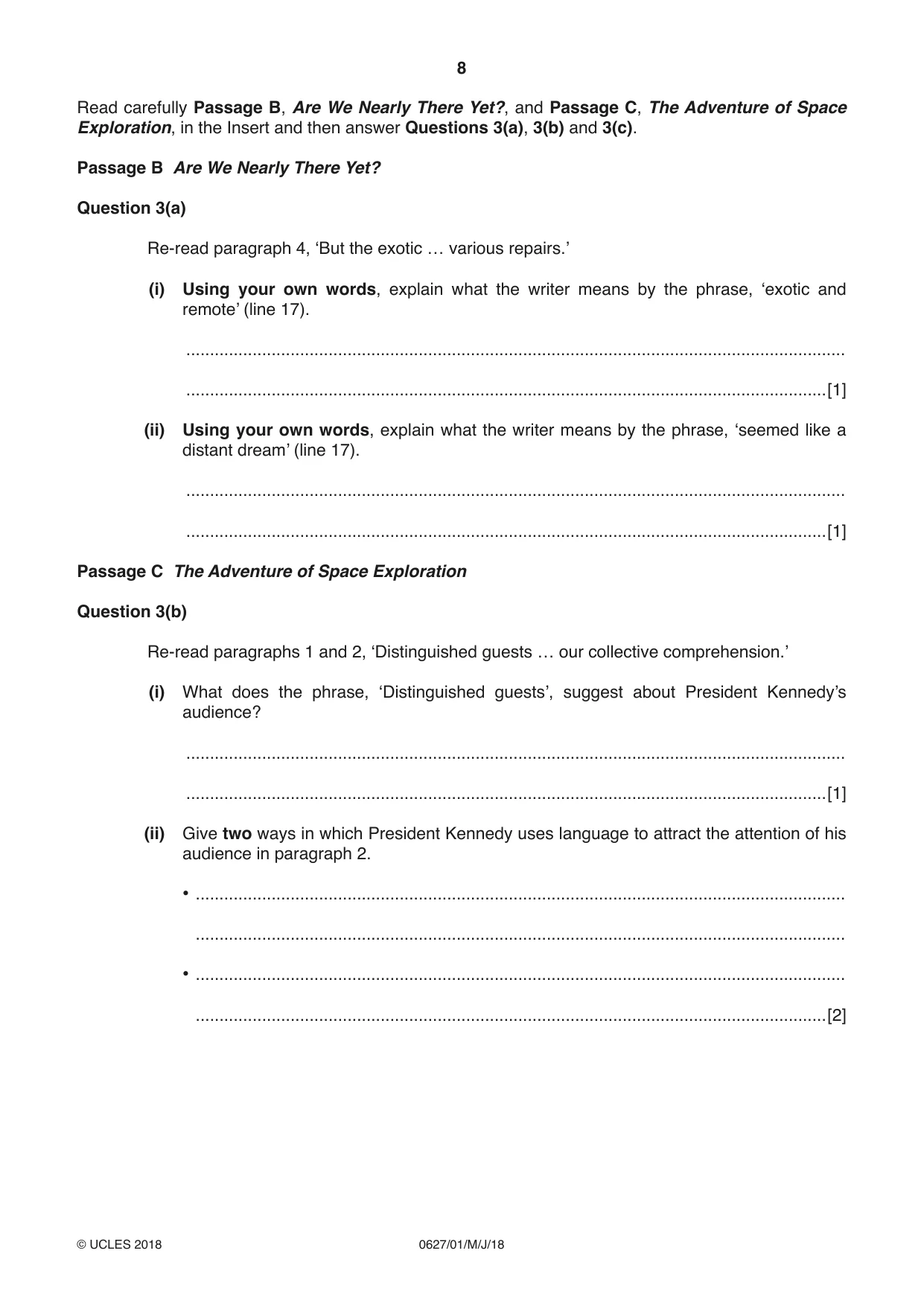
8 0627/01/M/J/18 © UCLES 2018 Read carefully Passage B, Are We Nearly There Yet?, and Passage C, The Adventure of Space Exploration, in the Insert and then answer Questions 3(a), 3(b) and 3(c). Passage B Are We Nearly There Yet? Question 3(a) Re-read paragraph 4, ‘But the exotic … various repairs.’ (i) Using your own words, explain what the writer means by the phrase, ‘exotic and remote’ (line 17). … …[1] (ii) Using your own words, explain what the writer means by the phrase, ‘seemed like a distant dream’ (line 17). … …[1] Passage C The Adventure of Space Exploration Question 3(b) Re-read paragraphs 1 and 2, ‘Distinguished guests … our collective comprehension.’ (i) What does the phrase, ‘Distinguished guests’, suggest about President Kennedy’s audience? … …[1] (ii) Give two ways in which President Kennedy uses language to attract the attention of his audience in paragraph 2. • … … • … …[2]
Question paper, page 9
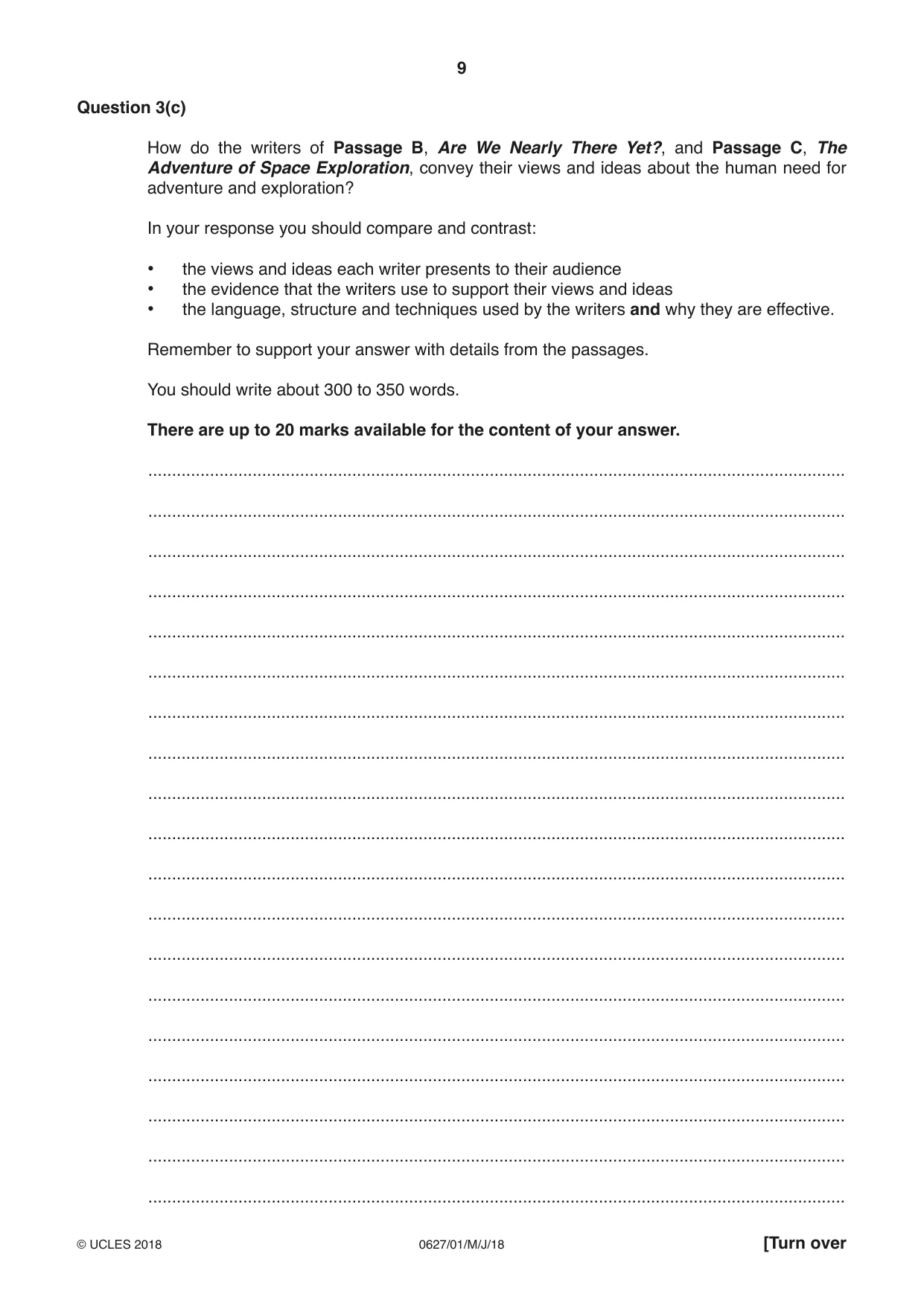
9 0627/01/M/J/18 © UCLES 2018 [Turn over Question 3(c) How do the writers of Passage B, Are We Nearly There Yet?, and Passage C, The Adventure of Space Exploration, convey their views and ideas about the human need for adventure and exploration? In your response you should compare and contrast: • the views and ideas each writer presents to their audience • the evidence that the writers use to support their views and ideas • the language, structure and techniques used by the writers and why they are effective. Remember to support your answer with details from the passages. You should write about 300 to 350 words. There are up to 20 marks available for the content of your answer. … … … … … … … … … … … … … … … … … … …
Question paper, page 10
10 0627/01/M/J/18 © UCLES 2018 … … … … … … … … … … … … … … … … … … … … … … … … … … … …
Question paper, page 11
11 0627/01/M/J/18 © UCLES 2018 … … … … … … … … … … … … … … … … … … … … … … … … … … …[20]
Question paper, page 12
12 0627/01/M/J/18 © UCLES 2018 Additional Page If you use the following lined page to complete the answer(s) to any question(s), the question number(s) must be clearly shown. … … … … … … … … … … … … … … … … … … … … … … … … … …
Question paper, page 13
13 0627/01/M/J/18 © UCLES 2018 BLANK PAGE
Question paper, page 14
14 0627/01/M/J/18 © UCLES 2018 BLANK PAGE
Question paper, page 15
15 0627/01/M/J/18 © UCLES 2018 BLANK PAGE
Question paper, page 16
16 0627/01/M/J/18 © UCLES 2018 Permission to reproduce items where third-party owned material protected by copyright is included has been sought and cleared where possible. Every reasonable effort has been made by the publisher (UCLES) to trace copyright holders, but if any items requiring clearance have unwittingly been included, the publisher will be pleased to make amends at the earliest possible opportunity. To avoid the issue of disclosure of answer-related information to candidates, all copyright acknowledgements are reproduced online in the Cambridge International Examinations Copyright Acknowledgements Booklet. This is produced for each series of examinations and is freely available to download at www.cie.org.uk after the live examination series. Cambridge International Examinations is part of the Cambridge Assessment Group. Cambridge Assessment is the brand name of University of Cambridge Local Examinations Syndicate (UCLES), which is itself a department of the University of Cambridge. BLANK PAGE