Cambridge IGCSE English - First Language (9-1) 0990 — 2024 May/June Paper 1 · Variant 2
0990/12/M/J/24 · 80 marks · 120 min
The question paper and its mark scheme, free to read here and free to download. This is Cambridge’s own paper, exactly as it was sat.
Question paper16 pages






Mark scheme23 pages
Answers below. Sit the paper first if you are practising.
Paper as text
Question paper, page 1
Cambridge IGCSE™(9-1) 0990/12 FIRST LANGUAGE ENGLISH May/June 2024 Paper 1 Reading 2 hours You must answer on the question paper. You will need: Insert (enclosed) INSTRUCTIONS • Answer all questions. • Use a black or dark blue pen. • Write your name, centre number and candidate number in the boxes at the top of the page. • Write your answer to each question in the space provided. • Do not use an erasable pen or correction fluid. • Do not write on any bar codes. • If additional space is needed, you should use the lined pages at the end of this booklet; the question number or numbers must be clearly shown. • Dictionaries are not allowed. INFORMATION • The total mark for this paper is 80. • The number of marks for each question or part question is shown in brackets [ ]. • The insert contains the reading texts. This document has 16 pages. Any blank pages are indicated. [Turn over 06_0990_12_2024_1.4 © UCLES 2024 *5272605588*
Question paper, page 2
Read Text A, Bring your child to work day, in the insert and then answer Questions 1(a)–(e) on this question paper. Question 1 What is the aim of ‘Bring your child to work day’ according to paragraph 1? (a) … … [1] Using your own words, explain what the text means by: (b) (i) ‘similar schemes’ (line 6) … … [2] (ii) ‘mutually convenient’ (line 7) … … [2] Re-read paragraph 2 (‘The initiative ... children.’). (c) Give two reasons why some companies participating in ‘Bring your child to work day’ choose not to do it on a set international date? • … • … [2] 06_0990_12_2024_1.4 © UCLES 2024 2
Question paper, page 3
Re-read paragraphs 3 and 4 (‘Why not ... the fields.’). (d) Give two ways in which participating in ‘Bring your child to work day’ might influence a child’s future career according to the text. (i) • … • … [2] Identify the benefits for the company of organising a ‘Bring your child to work day’ for their employees. (ii) … … … [3] Re-read paragraph 5 (‘Of course ... show.’). (e) Using your own words, explain why some people might think that ‘Bring your child to work day’ is not a good idea. … … … [3] [Turn over 06_0990_12_2024_1.4 © UCLES 2024 3
Question paper, page 4
Read Text B, A change of direction, in the insert and then answer Question 1(f) on this question paper. According to Text B, what are the positives for and of older learners returning to university? (f) You must use continuous writing (not note form) and use your own words as far as possible. Your summary should not be more than 120 words. Up to 10 marks are available for the content of your answer and up to 5 marks for the quality of your writing. … … … … … … … … … … … … … … … … … … … … … 06_0990_12_2024_1.4 © UCLES 2024 4
Question paper, page 5
… … … … … … … … … … … … … … … … … … … … … … … … … … [15] [Total: 30] [Turn over 06_0990_12_2024_1.4 © UCLES 2024 5
Question paper, page 6
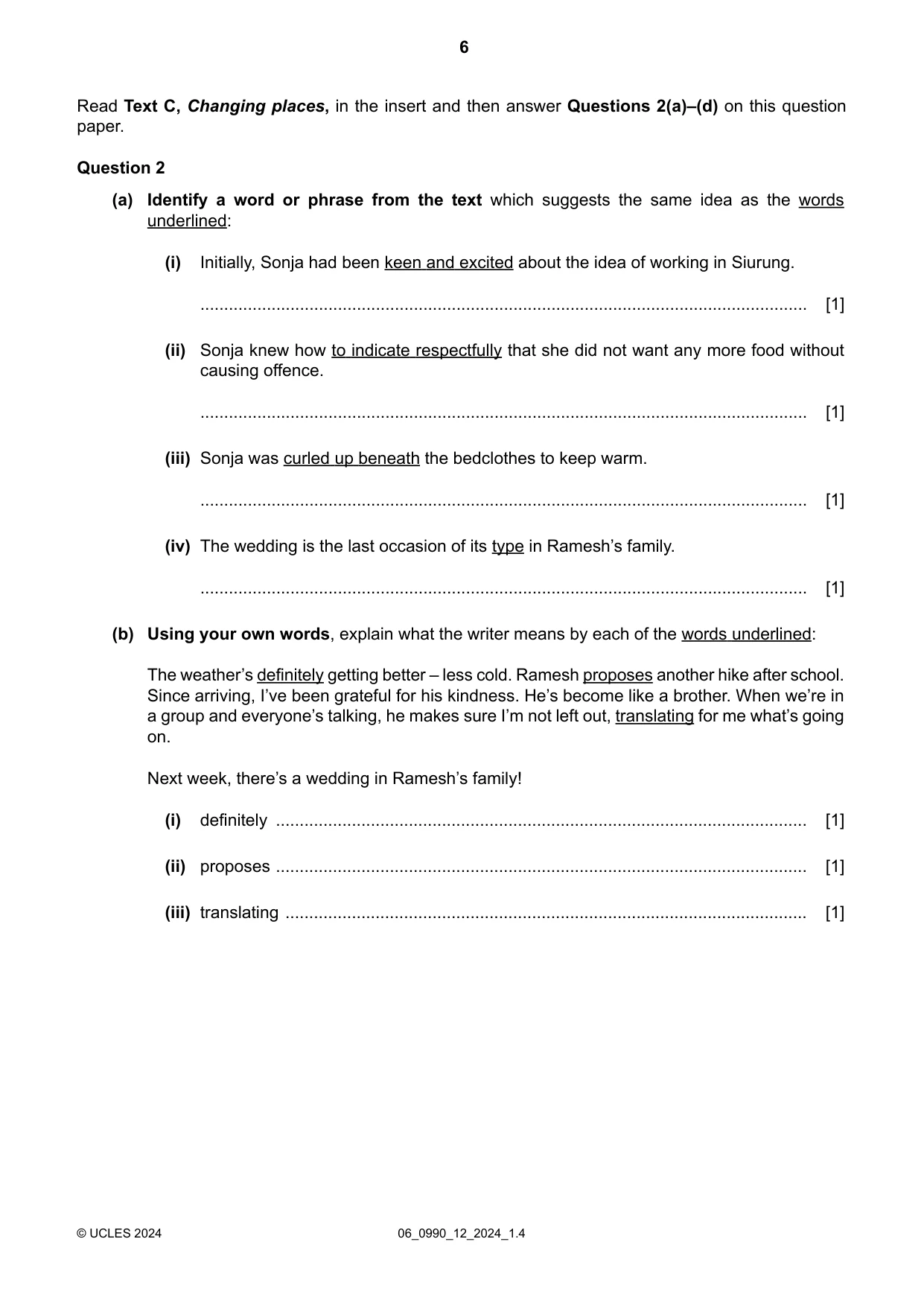
Read Text C, Changing places, in the insert and then answer Questions 2(a)–(d) on this question paper. Question 2 Identify a word or phrase from the text which suggests the same idea as the words underlined: (a) Initially, Sonja had been keen and excited about the idea of working in Siurung. (i) … [1] Sonja knew how to indicate respectfully that she did not want any more food without causing offence. (ii) … [1] Sonja was curled up beneath the bedclothes to keep warm. (iii) … [1] The wedding is the last occasion of its type in Ramesh’s family. (iv) … [1] Using your own words, explain what the writer means by each of the words underlined: (b) The weather’s definitely getting better – less cold. Ramesh proposes another hike after school. Since arriving, I’ve been grateful for his kindness. He’s become like a brother. When we’re in a group and everyone’s talking, he makes sure I’m not left out, translating for me what’s going on. Next week, there’s a wedding in Ramesh’s family! (i) definitely … [1] (ii) proposes … [1] (iii) translating … [1] 06_0990_12_2024_1.4 © UCLES 2024 6
Question paper, page 7
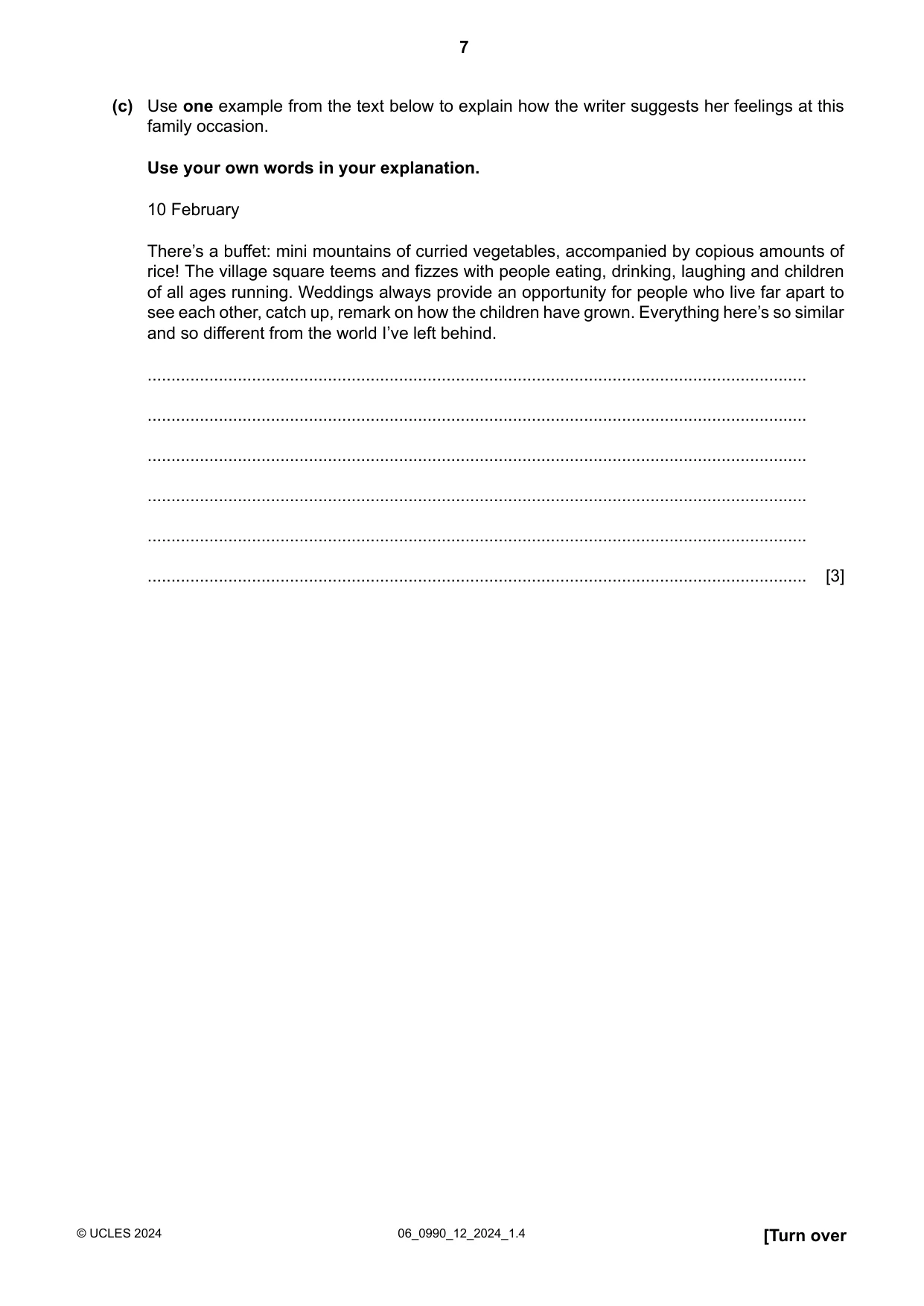
Use one example from the text below to explain how the writer suggests her feelings at this family occasion. (c) Use your own words in your explanation. 10 February There’s a buffet: mini mountains of curried vegetables, accompanied by copious amounts of rice! The village square teems and fizzes with people eating, drinking, laughing and children of all ages running. Weddings always provide an opportunity for people who live far apart to see each other, catch up, remark on how the children have grown. Everything here’s so similar and so different from the world I’ve left behind. … … … … … … [3] [Turn over 06_0990_12_2024_1.4 © UCLES 2024 7
Question paper, page 8
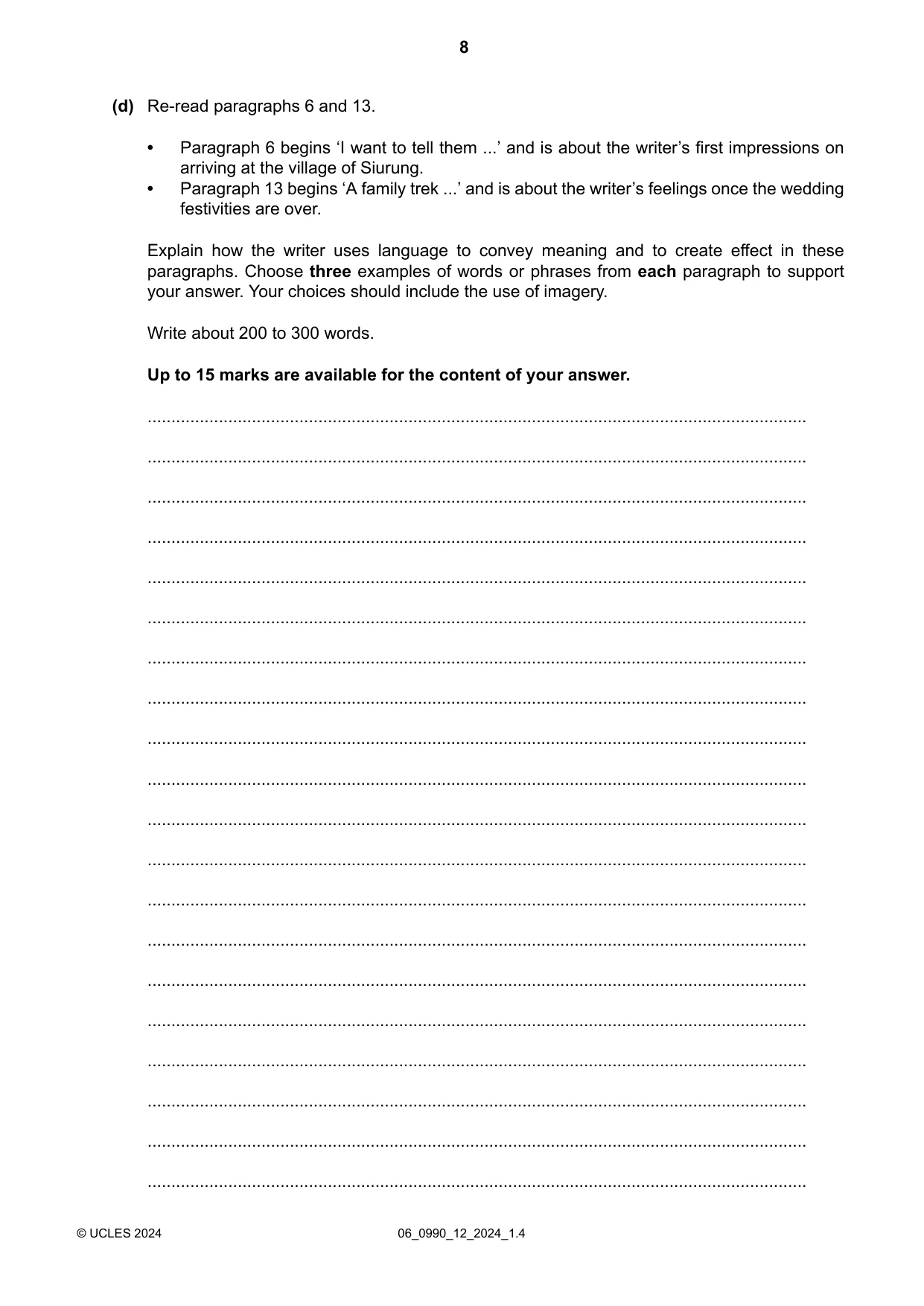
Re-read paragraphs 6 and 13. (d) • Paragraph 6 begins ‘I want to tell them ...’ and is about the writer’s first impressions on arriving at the village of Siurung. • Paragraph 13 begins ‘A family trek ...’ and is about the writer’s feelings once the wedding festivities are over. Explain how the writer uses language to convey meaning and to create effect in these paragraphs. Choose three examples of words or phrases from each paragraph to support your answer. Your choices should include the use of imagery. Write about 200 to 300 words. Up to 15 marks are available for the content of your answer. … … … … … … … … … … … … … … … … … … … … 06_0990_12_2024_1.4 © UCLES 2024 8
Question paper, page 9
… … … … … … … … … … … … … … … … … … … … … … … … … … [15] [Total: 25] [Turn over 06_0990_12_2024_1.4 © UCLES 2024 9
Question paper, page 10
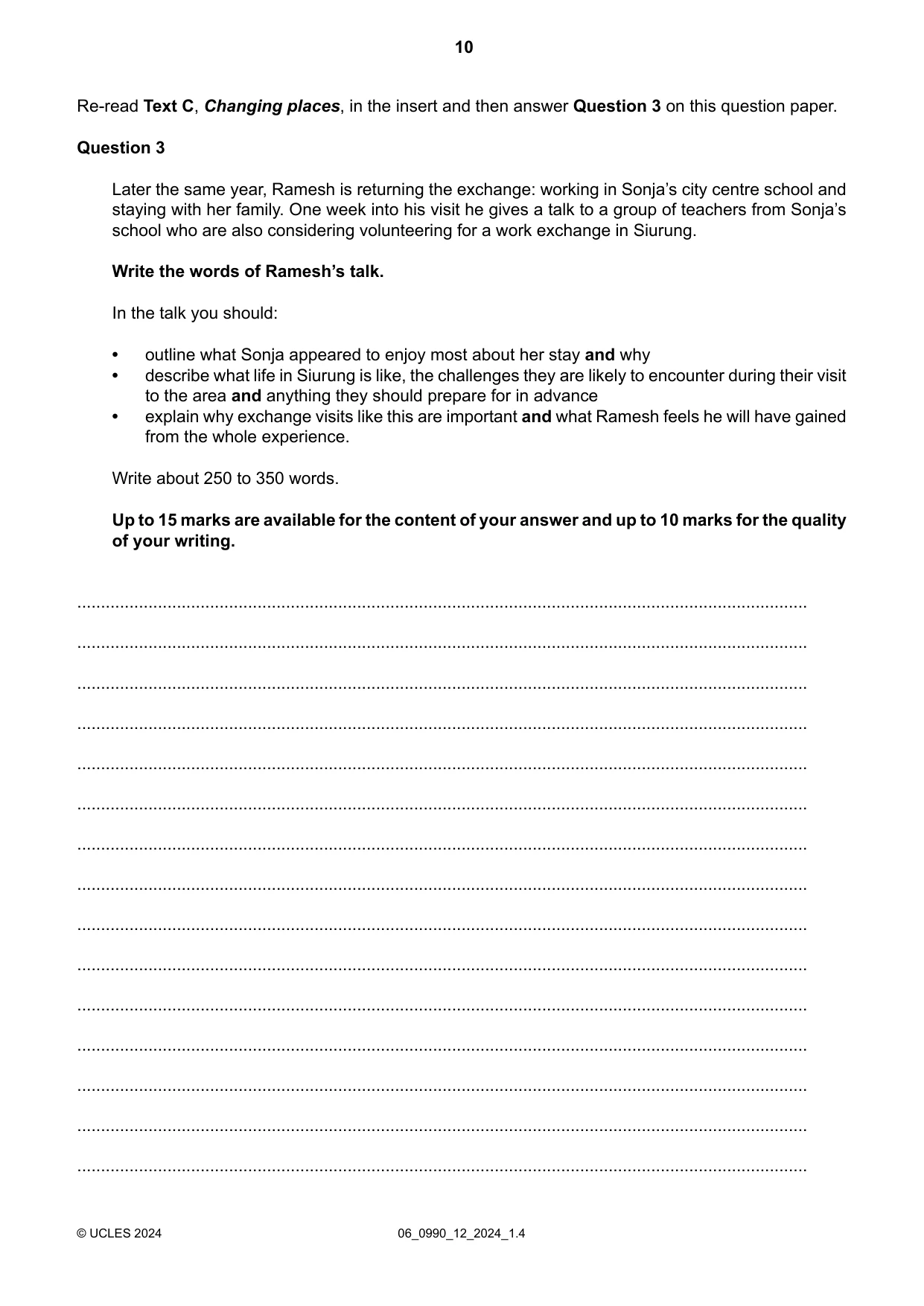
Re-read Text C, Changing places, in the insert and then answer Question 3 on this question paper. Question 3 Later the same year, Ramesh is returning the exchange: working in Sonja’s city centre school and staying with her family. One week into his visit he gives a talk to a group of teachers from Sonja’s school who are also considering volunteering for a work exchange in Siurung. Write the words of Ramesh’s talk. In the talk you should: • outline what Sonja appeared to enjoy most about her stay and why • describe what life in Siurung is like, the challenges they are likely to encounter during their visit to the area and anything they should prepare for in advance • explain why exchange visits like this are important and what Ramesh feels he will have gained from the whole experience. Write about 250 to 350 words. Up to 15 marks are available for the content of your answer and up to 10 marks for the quality of your writing. … … … … … … … … … … … … … … … 06_0990_12_2024_1.4 © UCLES 2024 10
Question paper, page 11
… … … … … … … … … … … … … … … … … … … … … … … … … … … [25] [Turn over 06_0990_12_2024_1.4 © UCLES 2024 11
Question paper, page 12
Additional Page If you use the following lined page to complete the answer(s) to any question(s), the question number(s) must be clearly shown. … … … … … … … … … … … … … … … … … … … … … … … … … 06_0990_12_2024_1.4 © UCLES 2024 12
Question paper, page 13
Additional Page If you use the following lined page to complete the answer(s) to any question(s), the question number(s) must be clearly shown. … … … … … … … … … … … … … … … … … … … … … … … … … 06_0990_12_2024_1.4 © UCLES 2024 13
Question paper, page 14
BLANK PAGE 06_0990_12_2024_1.4 © UCLES 2024 14
Question paper, page 15
BLANK PAGE 06_0990_12_2024_1.4 © UCLES 2024 15
Question paper, page 16
BLANK PAGE Permission to reproduce items where third-party owned material protected by copyright is included has been sought and cleared where possible. Every reasonable effort has been made by the publisher (UCLES) to trace copyright holders, but if any items requiring clearance have unwittingly been included, the publisher will be pleased to make amends at the earliest possible opportunity. To avoid the issue of disclosure of answer-related information to candidates, all copyright acknowledgements are reproduced online in the Cambridge Assessment International Education Copyright Acknowledgements Booklet. This is produced for each series of examinations and is freely available to download at www.cambridgeinternational.org after the live examination series. Cambridge Assessment International Education is part of Cambridge Assessment. Cambridge Assessment is the brand name of the University of Cambridge Local Examinations Syndicate (UCLES), which is a department of the University of Cambridge. 06_0990_12_2024_1.4 © UCLES 2024 16
Mark scheme, page 1
This document consists of 23 printed pages. © Cambridge University Press & Assessment 2024 [Turn over Cambridge IGCSE™ (9–1) FIRST LANGUAGE ENGLISH IGCSE 9–1 0990/12 Paper 1 Reading May/June 2024 MARK SCHEME Maximum Mark: 80 Published This mark scheme is published as an aid to teachers and candidates, to indicate the requirements of the examination. It shows the basis on which Examiners were instructed to award marks. It does not indicate the details of the discussions that took place at an Examiners’ meeting before marking began, which would have considered the acceptability of alternative answers. Mark schemes should be read in conjunction with the question paper and the Principal Examiner Report for Teachers. Cambridge International will not enter into discussions about these mark schemes. Cambridge International is publishing the mark schemes for the May/June 2024 series for most Cambridge IGCSE, Cambridge International A and AS Level and Cambridge Pre-U components, and some Cambridge O Level components.
Mark scheme, page 2
0990/12 Cambridge IGCSE (9–1) – Mark Scheme PUBLISHED May/June 2024 © Cambridge University Press & Assessment 2024 Page 2 of 23 Generic Marking Principles These general marking principles must be applied by all examiners when marking candidate answers. They should be applied alongside the specific content of the mark scheme or generic level descriptions for a question. Each question paper and mark scheme will also comply with these marking principles. GENERIC MARKING PRINCIPLE 1: Marks must be awarded in line with: the specific content of the mark scheme or the generic level descriptors for the question the specific skills defined in the mark scheme or in the generic level descriptors for the question the standard of response required by a candidate as exemplified by the standardisation scripts. GENERIC MARKING PRINCIPLE 2: Marks awarded are always whole marks (not half marks, or other fractions). GENERIC MARKING PRINCIPLE 3: Marks must be awarded positively: marks are awarded for correct/valid answers, as defined in the mark scheme. However, credit is given for valid answers which go beyond the scope of the syllabus and mark scheme, referring to your Team Leader as appropriate marks are awarded when candidates clearly demonstrate what they know and can do marks are not deducted for errors marks are not deducted for omissions answers should only be judged on the quality of spelling, punctuation and grammar when these features are specifically assessed by the question as indicated by the mark scheme. The meaning, however, should be unambiguous. GENERIC MARKING PRINCIPLE 4: Rules must be applied consistently, e.g. in situations where candidates have not followed instructions or in the application of generic level descriptors. GENERIC MARKING PRINCIPLE 5: Marks should be awarded using the full range of marks defined in the mark scheme for the question (however, the use of the full mark range may be limited according to the quality of the candidate responses seen). GENERIC MARKING PRINCIPLE 6: Marks awarded are based solely on the requirements as defined in the mark scheme. Marks should not be awarded with grade thresholds or grade descriptors in mind.
Mark scheme, page 3
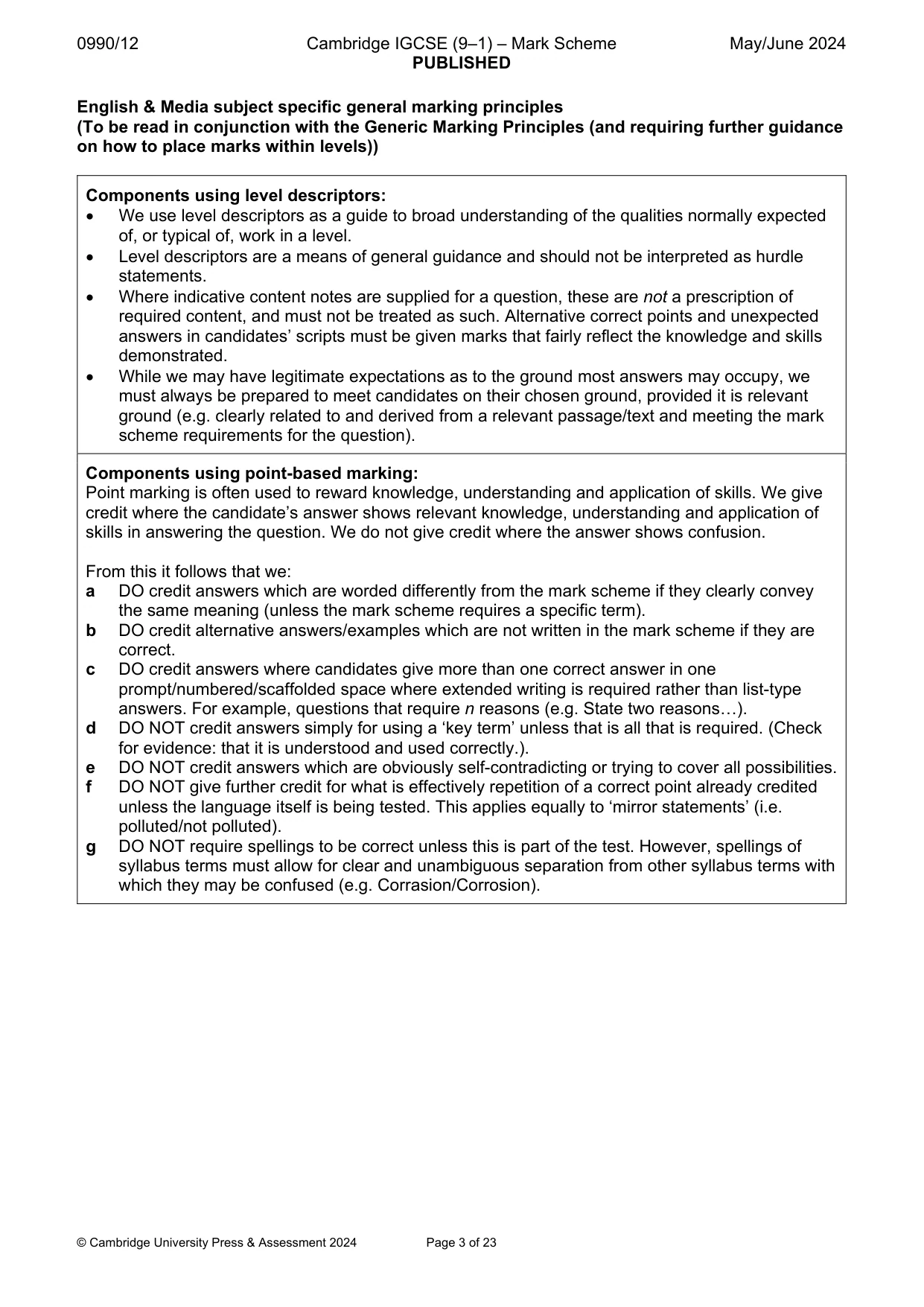
0990/12 Cambridge IGCSE (9–1) – Mark Scheme PUBLISHED May/June 2024 © Cambridge University Press & Assessment 2024 Page 3 of 23 English & Media subject specific general marking principles (To be read in conjunction with the Generic Marking Principles (and requiring further guidance on how to place marks within levels)) Components using level descriptors: We use level descriptors as a guide to broad understanding of the qualities normally expected of, or typical of, work in a level. Level descriptors are a means of general guidance and should not be interpreted as hurdle statements. Where indicative content notes are supplied for a question, these are not a prescription of required content, and must not be treated as such. Alternative correct points and unexpected answers in candidates’ scripts must be given marks that fairly reflect the knowledge and skills demonstrated. While we may have legitimate expectations as to the ground most answers may occupy, we must always be prepared to meet candidates on their chosen ground, provided it is relevant ground (e.g. clearly related to and derived from a relevant passage/text and meeting the mark scheme requirements for the question). Components using point-based marking: Point marking is often used to reward knowledge, understanding and application of skills. We give credit where the candidate’s answer shows relevant knowledge, understanding and application of skills in answering the question. We do not give credit where the answer shows confusion. From this it follows that we: a DO credit answers which are worded differently from the mark scheme if they clearly convey the same meaning (unless the mark scheme requires a specific term). b DO credit alternative answers/examples which are not written in the mark scheme if they are correct. c DO credit answers where candidates give more than one correct answer in one prompt/numbered/scaffolded space where extended writing is required rather than list-type answers. For example, questions that require n reasons (e.g. State two reasons…). d DO NOT credit answers simply for using a ‘key term’ unless that is all that is required. (Check for evidence: that it is understood and used correctly.). e DO NOT credit answers which are obviously self-contradicting or trying to cover all possibilities. f DO NOT give further credit for what is effectively repetition of a correct point already credited unless the language itself is being tested. This applies equally to ‘mirror statements’ (i.e. polluted/not polluted). g DO NOT require spellings to be correct unless this is part of the test. However, spellings of syllabus terms must allow for clear and unambiguous separation from other syllabus terms with which they may be confused (e.g. Corrasion/Corrosion).
Mark scheme, page 4
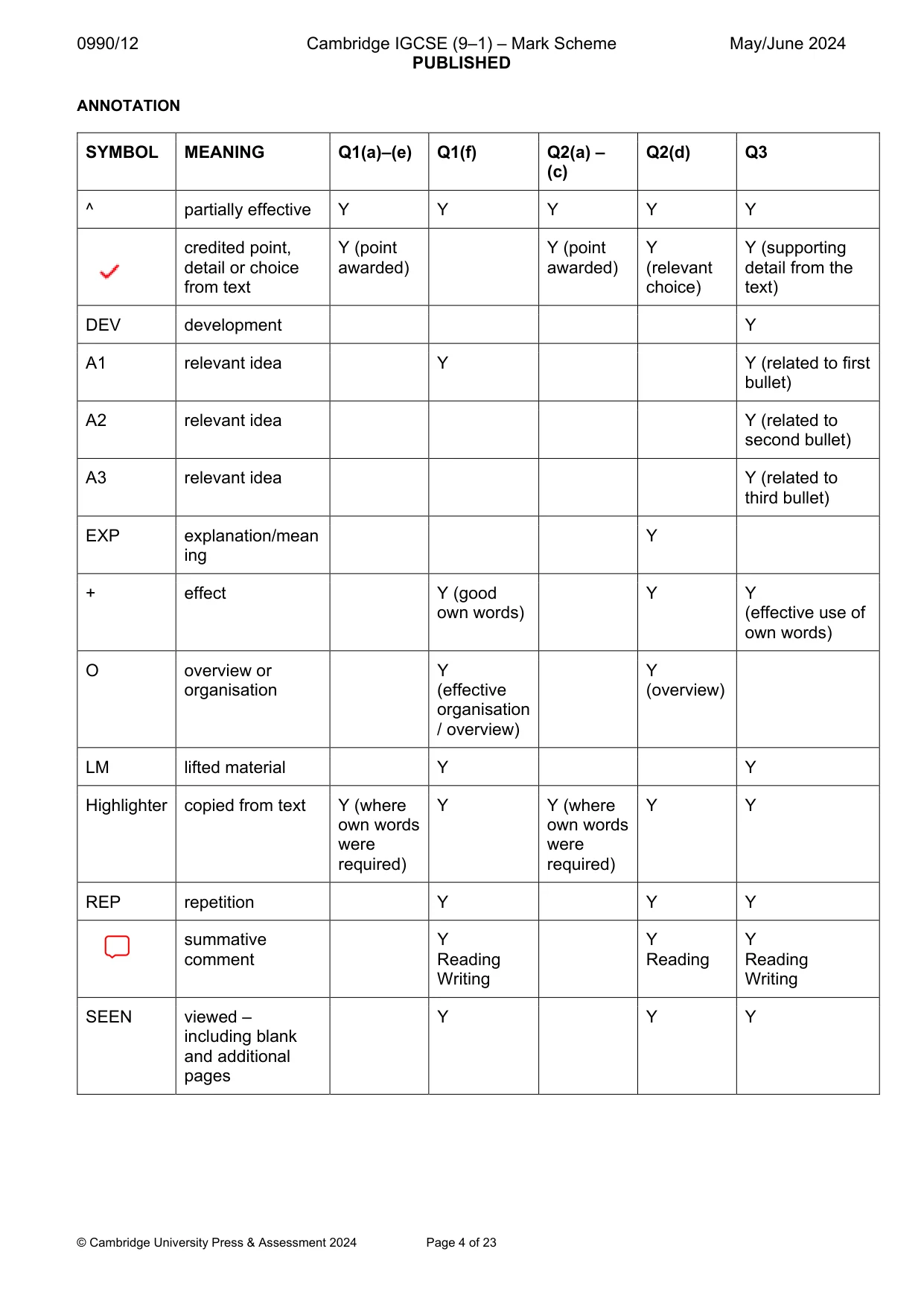
0990/12 Cambridge IGCSE (9–1) – Mark Scheme PUBLISHED May/June 2024 © Cambridge University Press & Assessment 2024 Page 4 of 23 ANNOTATION SYMBOL MEANING Q1(a)–(e) Q1(f) Q2(a) – (c) Q2(d) Q3 ^ partially effective Y Y Y Y Y credited point, detail or choice from text Y (point awarded) Y (point awarded) Y (relevant choice) Y (supporting detail from the text) DEV development Y A1 relevant idea Y Y (related to first bullet) A2 relevant idea Y (related to second bullet) A3 relevant idea Y (related to third bullet) EXP explanation/mean ing Y + effect Y (good own words) Y Y (effective use of own words) O overview or organisation Y (effective organisation / overview) Y (overview) LM lifted material Y Y Highlighter copied from text Y (where own words were required) Y Y (where own words were required) Y Y REP repetition Y Y Y summative comment Y Reading Writing Y Reading Y Reading Writing SEEN viewed – including blank and additional pages Y Y Y
Mark scheme, page 5
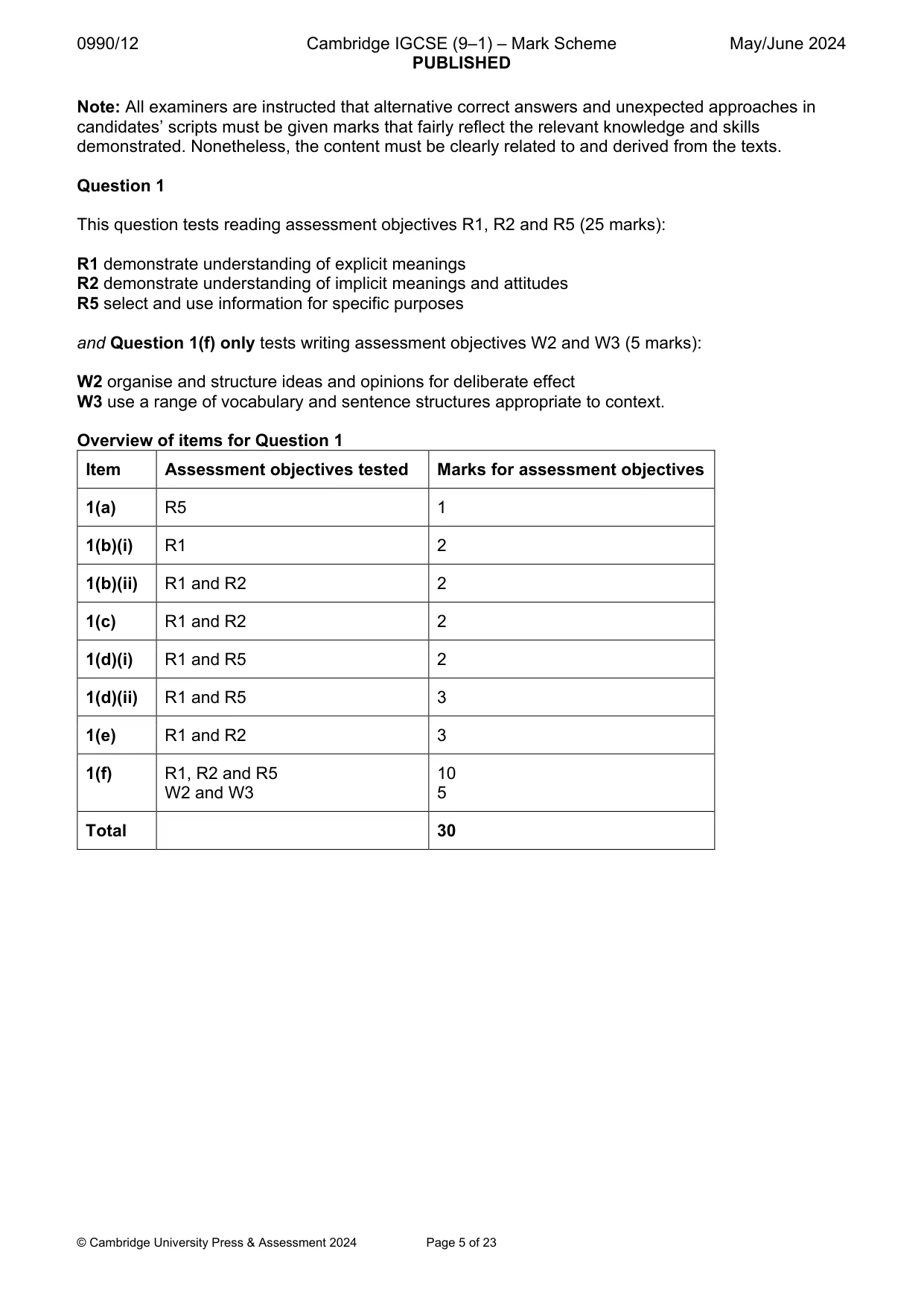
0990/12 Cambridge IGCSE (9–1) – Mark Scheme PUBLISHED May/June 2024 © Cambridge University Press & Assessment 2024 Page 5 of 23 Note: All examiners are instructed that alternative correct answers and unexpected approaches in candidates’ scripts must be given marks that fairly reflect the relevant knowledge and skills demonstrated. Nonetheless, the content must be clearly related to and derived from the texts. Question 1 This question tests reading assessment objectives R1, R2 and R5 (25 marks): R1 demonstrate understanding of explicit meanings R2 demonstrate understanding of implicit meanings and attitudes R5 select and use information for specific purposes and Question 1(f) only tests writing assessment objectives W2 and W3 (5 marks): W2 organise and structure ideas and opinions for deliberate effect W3 use a range of vocabulary and sentence structures appropriate to context. Overview of items for Question 1 Item Assessment objectives tested Marks for assessment objectives 1(a) R5 1 1(b)(i) R1 2 1(b)(ii) R1 and R2 2 1(c) R1 and R2 2 1(d)(i) R1 and R5 2 1(d)(ii) R1 and R5 3 1(e) R1 and R2 3 1(f) R1, R2 and R5 W2 and W3 10 5 Total 30
Mark scheme, page 6
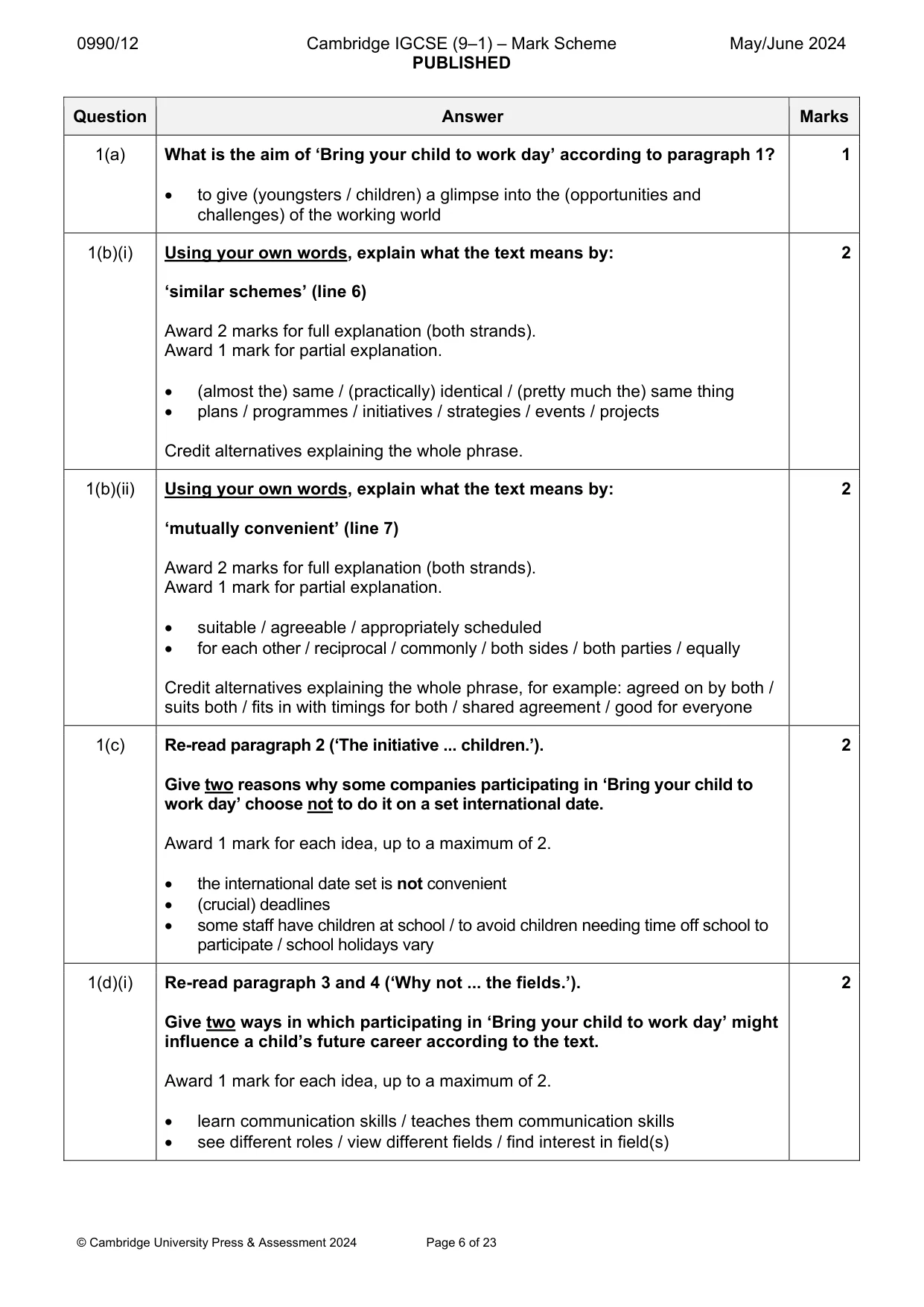
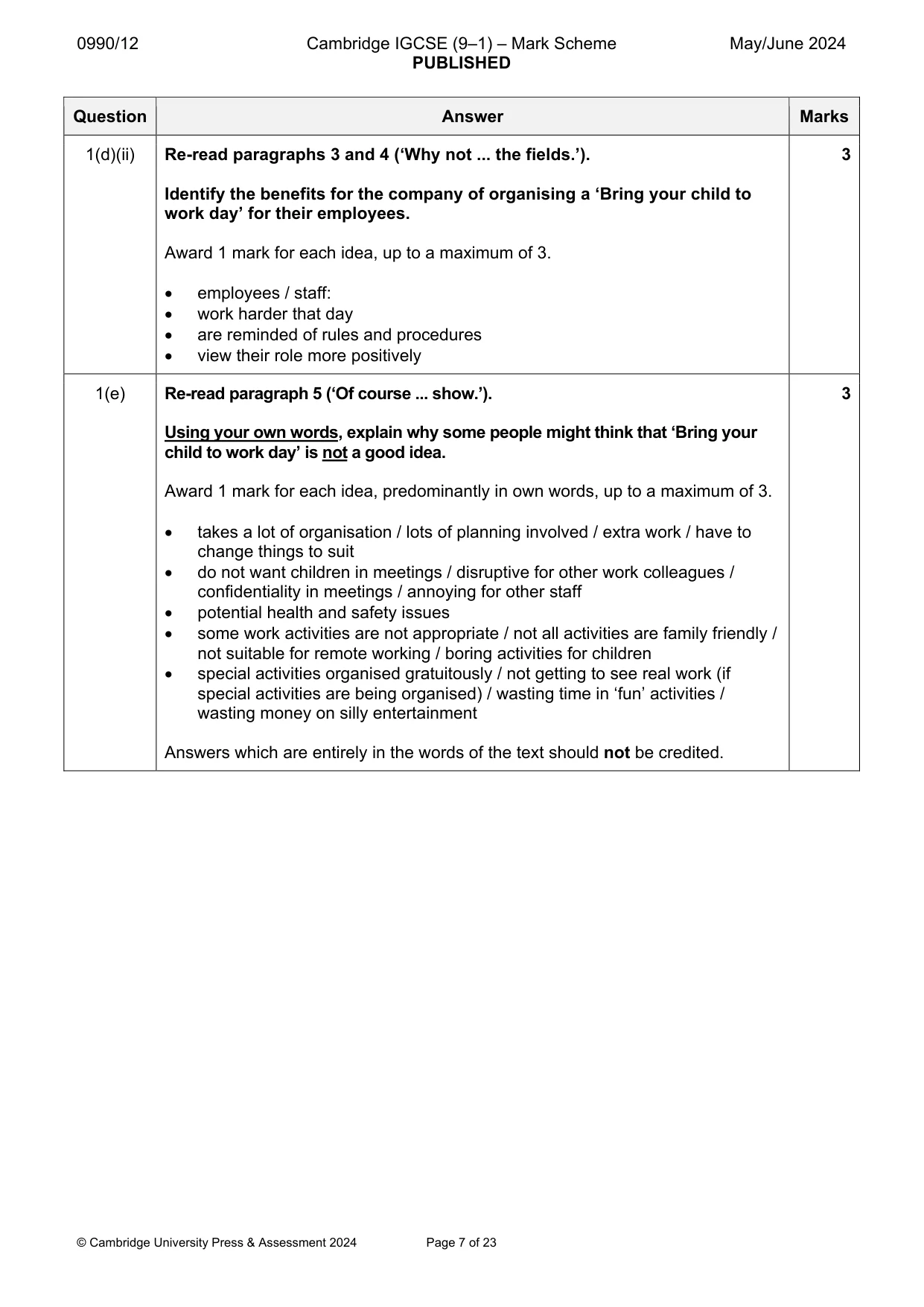
0990/12 Cambridge IGCSE (9–1) – Mark Scheme PUBLISHED May/June 2024 © Cambridge University Press & Assessment 2024 Page 6 of 23 Question Answer Marks 1(a) What is the aim of ‘Bring your child to work day’ according to paragraph 1? to give (youngsters / children) a glimpse into the (opportunities and challenges) of the working world 1 1(b)(i) Using your own words, explain what the text means by: ‘similar schemes’ (line 6) Award 2 marks for full explanation (both strands). Award 1 mark for partial explanation. (almost the) same / (practically) identical / (pretty much the) same thing plans / programmes / initiatives / strategies / events / projects Credit alternatives explaining the whole phrase. 2 1(b)(ii) Using your own words, explain what the text means by: ‘mutually convenient’ (line 7) Award 2 marks for full explanation (both strands). Award 1 mark for partial explanation. suitable / agreeable / appropriately scheduled for each other / reciprocal / commonly / both sides / both parties / equally Credit alternatives explaining the whole phrase, for example: agreed on by both / suits both / fits in with timings for both / shared agreement / good for everyone 2 1(c) Re-read paragraph 2 (‘The initiative ... children.’). Give two reasons why some companies participating in ‘Bring your child to work day’ choose not to do it on a set international date. Award 1 mark for each idea, up to a maximum of 2. the international date set is not convenient (crucial) deadlines some staff have children at school / to avoid children needing time off school to participate / school holidays vary 2 1(d)(i) Re-read paragraph 3 and 4 (‘Why not ... the fields.’). Give two ways in which participating in ‘Bring your child to work day’ might influence a child’s future career according to the text. Award 1 mark for each idea, up to a maximum of 2. learn communication skills / teaches them communication skills see different roles / view different fields / find interest in field(s) 2
Mark scheme, page 7
0990/12 Cambridge IGCSE (9–1) – Mark Scheme PUBLISHED May/June 2024 © Cambridge University Press & Assessment 2024 Page 7 of 23 Question Answer Marks 1(d)(ii) Re-read paragraphs 3 and 4 (‘Why not ... the fields.’). Identify the benefits for the company of organising a ‘Bring your child to work day’ for their employees. Award 1 mark for each idea, up to a maximum of 3. employees / staff: work harder that day are reminded of rules and procedures view their role more positively 3 1(e) Re-read paragraph 5 (‘Of course ... show.’). Using your own words, explain why some people might think that ‘Bring your child to work day’ is not a good idea. Award 1 mark for each idea, predominantly in own words, up to a maximum of 3. takes a lot of organisation / lots of planning involved / extra work / have to change things to suit do not want children in meetings / disruptive for other work colleagues / confidentiality in meetings / annoying for other staff potential health and safety issues some work activities are not appropriate / not all activities are family friendly / not suitable for remote working / boring activities for children special activities organised gratuitously / not getting to see real work (if special activities are being organised) / wasting time in ‘fun’ activities / wasting money on silly entertainment Answers which are entirely in the words of the text should not be credited. 3
Mark scheme, page 8
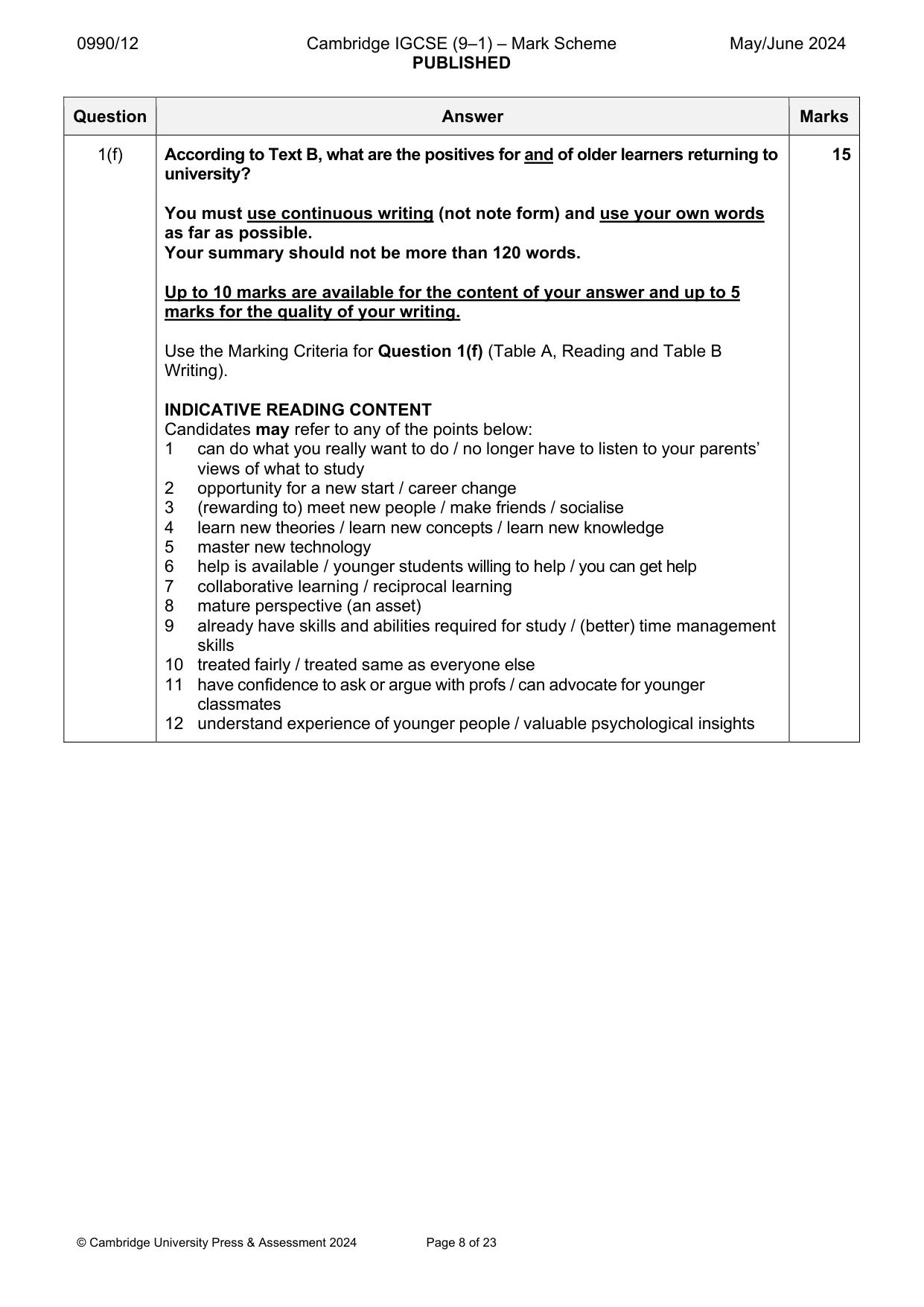
0990/12 Cambridge IGCSE (9–1) – Mark Scheme PUBLISHED May/June 2024 © Cambridge University Press & Assessment 2024 Page 8 of 23 Question Answer Marks 1(f) According to Text B, what are the positives for and of older learners returning to university? You must use continuous writing (not note form) and use your own words as far as possible. Your summary should not be more than 120 words. Up to 10 marks are available for the content of your answer and up to 5 marks for the quality of your writing. Use the Marking Criteria for Question 1(f) (Table A, Reading and Table B Writing). INDICATIVE READING CONTENT Candidates may refer to any of the points below: 1 can do what you really want to do / no longer have to listen to your parents’ views of what to study 2 opportunity for a new start / career change 3 (rewarding to) meet new people / make friends / socialise 4 learn new theories / learn new concepts / learn new knowledge 5 master new technology 6 help is available / younger students willing to help / you can get help 7 collaborative learning / reciprocal learning 8 mature perspective (an asset) 9 already have skills and abilities required for study / (better) time management skills 10 treated fairly / treated same as everyone else 11 have confidence to ask or argue with profs / can advocate for younger classmates 12 understand experience of younger people / valuable psychological insights 15
Mark scheme, page 9
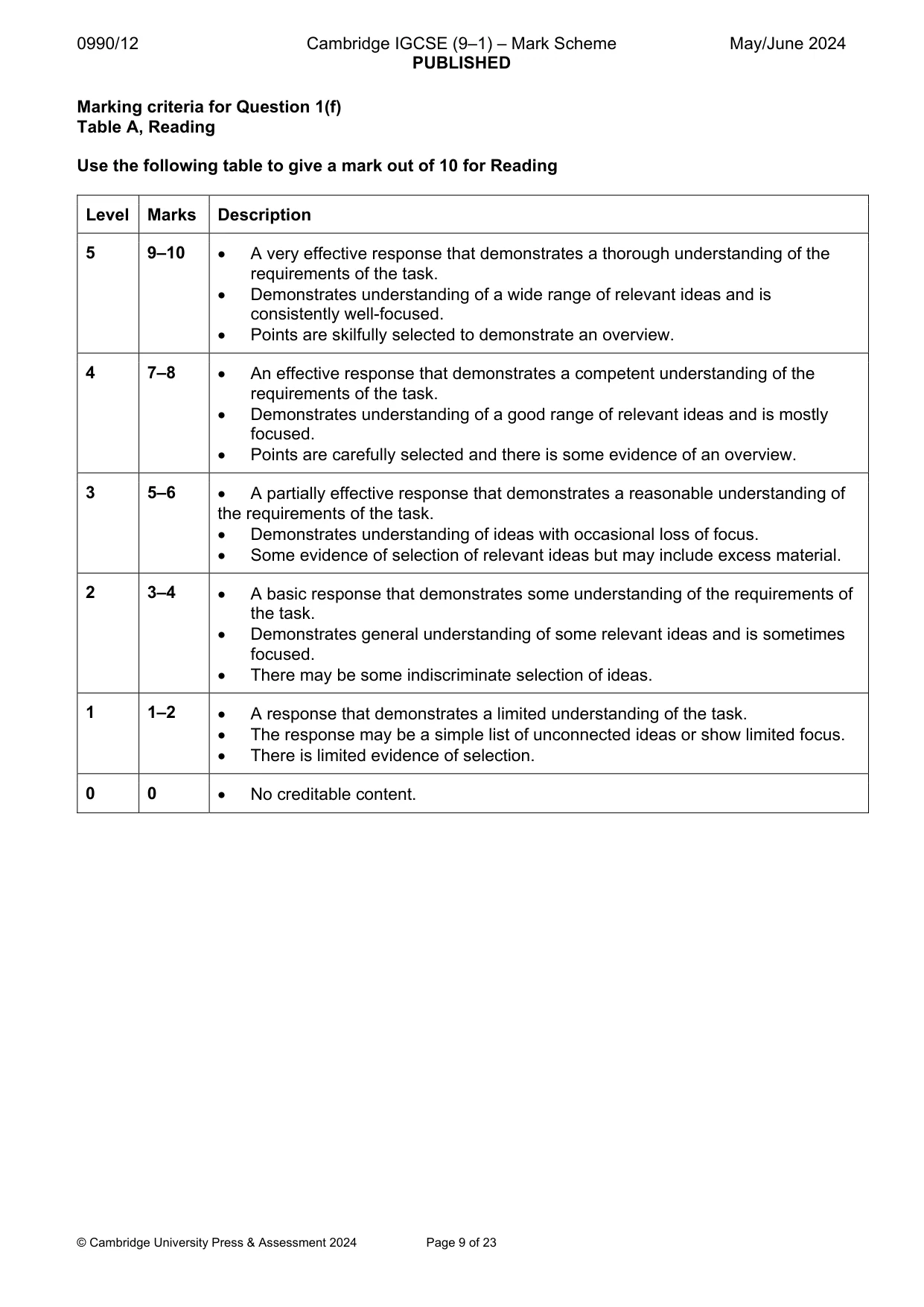
0990/12 Cambridge IGCSE (9–1) – Mark Scheme PUBLISHED May/June 2024 © Cambridge University Press & Assessment 2024 Page 9 of 23 Marking criteria for Question 1(f) Table A, Reading Use the following table to give a mark out of 10 for Reading Level Marks Description 5 9–10 A very effective response that demonstrates a thorough understanding of the requirements of the task. Demonstrates understanding of a wide range of relevant ideas and is consistently well-focused. Points are skilfully selected to demonstrate an overview. 4 7–8 An effective response that demonstrates a competent understanding of the requirements of the task. Demonstrates understanding of a good range of relevant ideas and is mostly focused. Points are carefully selected and there is some evidence of an overview. 3 5–6 A partially effective response that demonstrates a reasonable understanding of the requirements of the task. Demonstrates understanding of ideas with occasional loss of focus. Some evidence of selection of relevant ideas but may include excess material. 2 3–4 A basic response that demonstrates some understanding of the requirements of the task. Demonstrates general understanding of some relevant ideas and is sometimes focused. There may be some indiscriminate selection of ideas. 1 1–2 A response that demonstrates a limited understanding of the task. The response may be a simple list of unconnected ideas or show limited focus. There is limited evidence of selection. 0 0 No creditable content.
Mark scheme, page 10
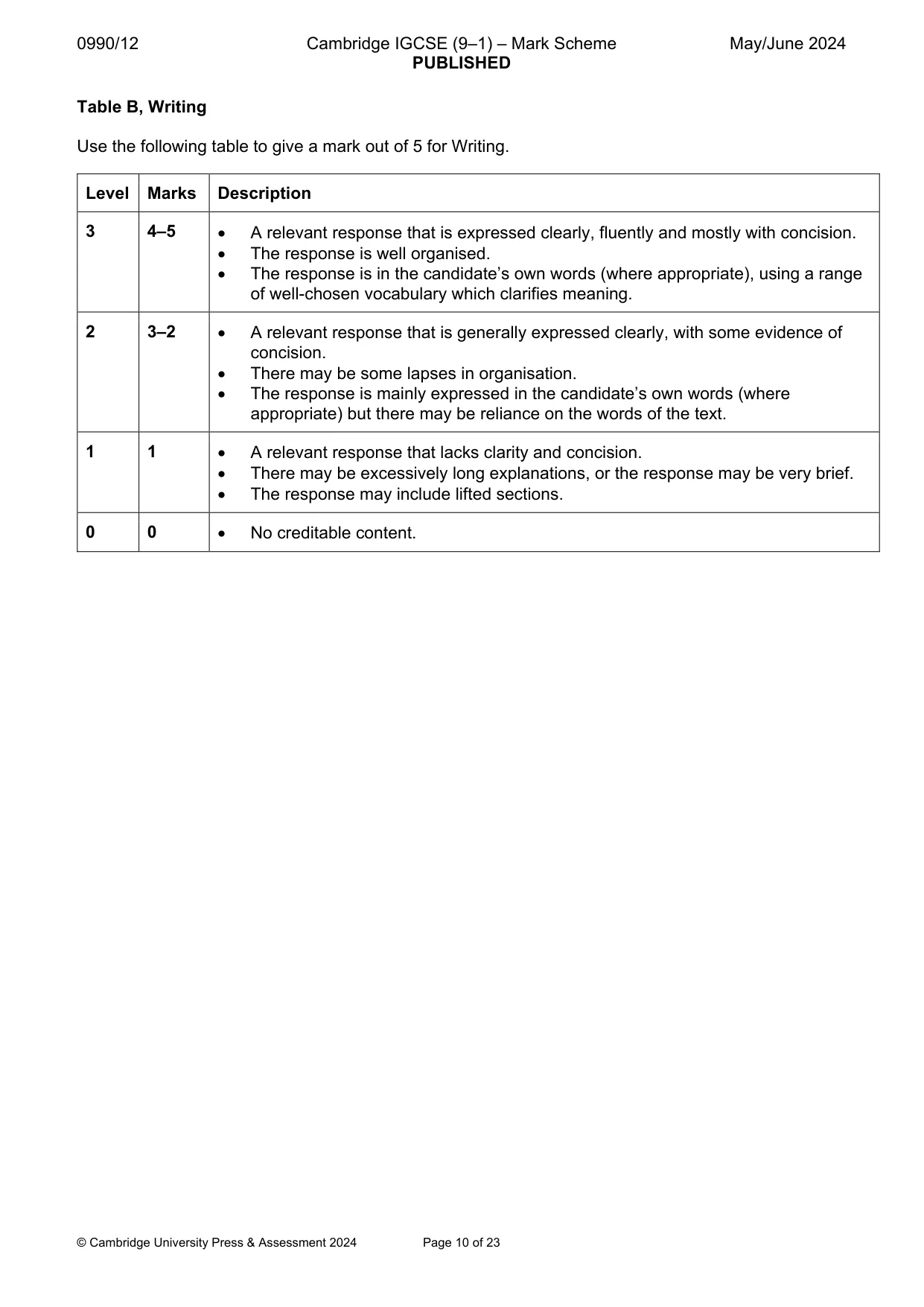
0990/12 Cambridge IGCSE (9–1) – Mark Scheme PUBLISHED May/June 2024 © Cambridge University Press & Assessment 2024 Page 10 of 23 Table B, Writing Use the following table to give a mark out of 5 for Writing. Level Marks Description 3 4–5 A relevant response that is expressed clearly, fluently and mostly with concision. The response is well organised. The response is in the candidate’s own words (where appropriate), using a range of well-chosen vocabulary which clarifies meaning. 2 3–2 A relevant response that is generally expressed clearly, with some evidence of concision. There may be some lapses in organisation. The response is mainly expressed in the candidate’s own words (where appropriate) but there may be reliance on the words of the text. 1 1 A relevant response that lacks clarity and concision. There may be excessively long explanations, or the response may be very brief. The response may include lifted sections. 0 0 No creditable content.
Mark scheme, page 11
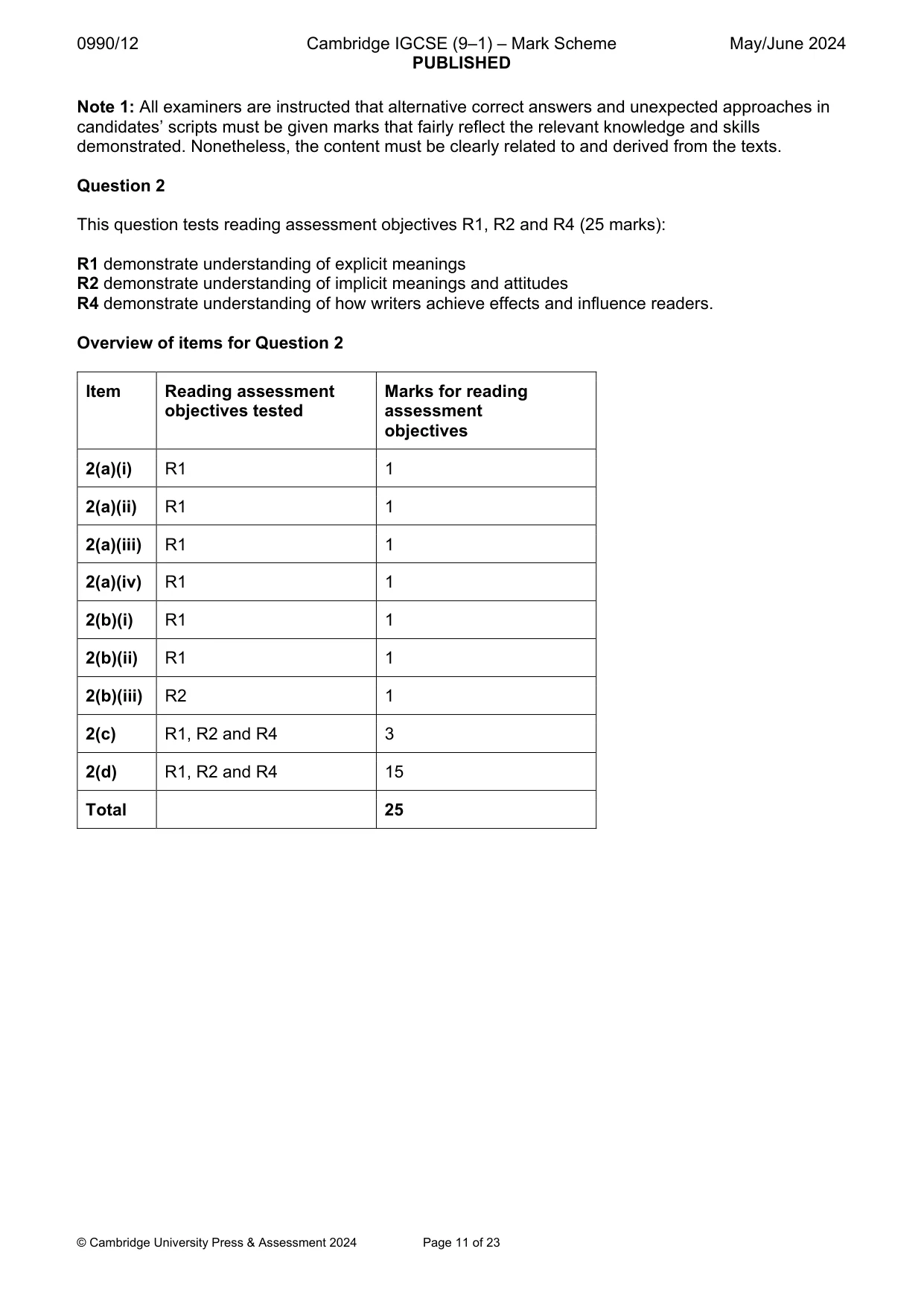
0990/12 Cambridge IGCSE (9–1) – Mark Scheme PUBLISHED May/June 2024 © Cambridge University Press & Assessment 2024 Page 11 of 23 Note 1: All examiners are instructed that alternative correct answers and unexpected approaches in candidates’ scripts must be given marks that fairly reflect the relevant knowledge and skills demonstrated. Nonetheless, the content must be clearly related to and derived from the texts. Question 2 This question tests reading assessment objectives R1, R2 and R4 (25 marks): R1 demonstrate understanding of explicit meanings R2 demonstrate understanding of implicit meanings and attitudes R4 demonstrate understanding of how writers achieve effects and influence readers. Overview of items for Question 2 Item Reading assessment objectives tested Marks for reading assessment objectives 2(a)(i) R1 1 2(a)(ii) R1 1 2(a)(iii) R1 1 2(a)(iv) R1 1 2(b)(i) R1 1 2(b)(ii) R1 1 2(b)(iii) R2 1 2(c) R1, R2 and R4 3 2(d) R1, R2 and R4 15 Total 25
Mark scheme, page 12
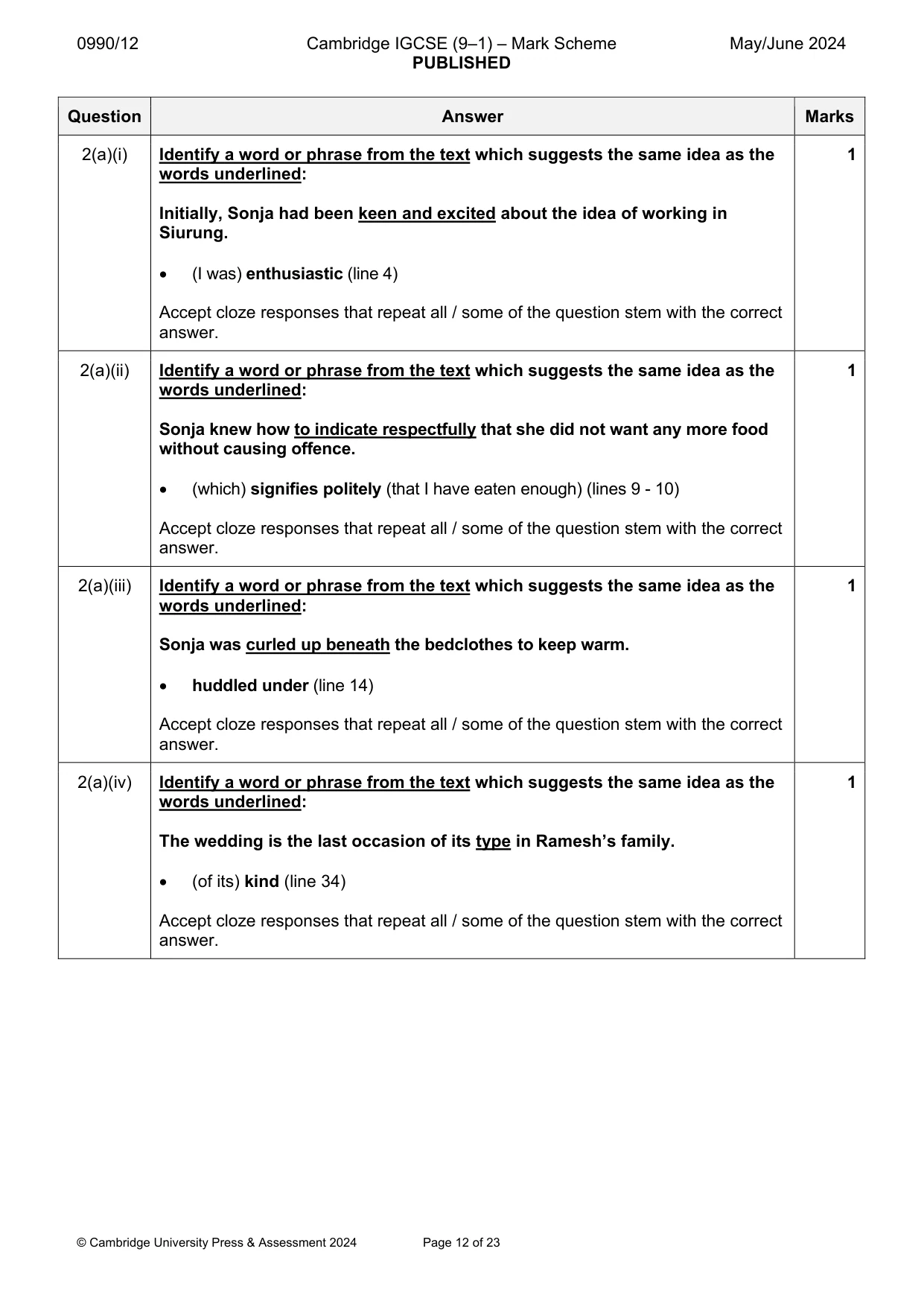
0990/12 Cambridge IGCSE (9–1) – Mark Scheme PUBLISHED May/June 2024 © Cambridge University Press & Assessment 2024 Page 12 of 23 Question Answer Marks 2(a)(i) Identify a word or phrase from the text which suggests the same idea as the words underlined: Initially, Sonja had been keen and excited about the idea of working in Siurung. (I was) enthusiastic (line 4) Accept cloze responses that repeat all / some of the question stem with the correct answer. 1 2(a)(ii) Identify a word or phrase from the text which suggests the same idea as the words underlined: Sonja knew how to indicate respectfully that she did not want any more food without causing offence. (which) signifies politely (that I have eaten enough) (lines 9 - 10) Accept cloze responses that repeat all / some of the question stem with the correct answer. 1 2(a)(iii) Identify a word or phrase from the text which suggests the same idea as the words underlined: Sonja was curled up beneath the bedclothes to keep warm. huddled under (line 14) Accept cloze responses that repeat all / some of the question stem with the correct answer. 1 2(a)(iv) Identify a word or phrase from the text which suggests the same idea as the words underlined: The wedding is the last occasion of its type in Ramesh’s family. (of its) kind (line 34) Accept cloze responses that repeat all / some of the question stem with the correct answer. 1
Mark scheme, page 13
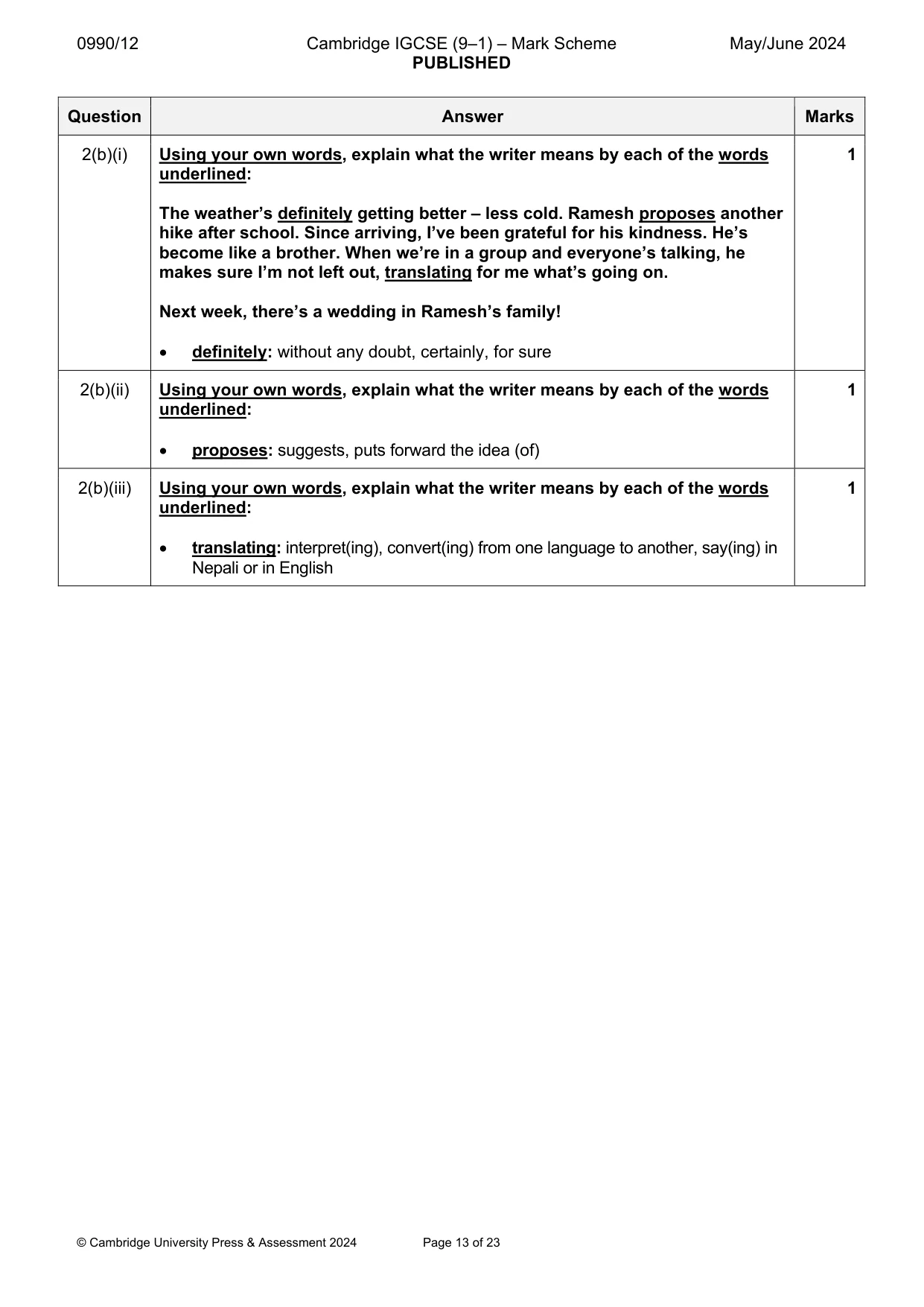
0990/12 Cambridge IGCSE (9–1) – Mark Scheme PUBLISHED May/June 2024 © Cambridge University Press & Assessment 2024 Page 13 of 23 Question Answer Marks 2(b)(i) Using your own words, explain what the writer means by each of the words underlined: The weather’s definitely getting better – less cold. Ramesh proposes another hike after school. Since arriving, I’ve been grateful for his kindness. He’s become like a brother. When we’re in a group and everyone’s talking, he makes sure I’m not left out, translating for me what’s going on. Next week, there’s a wedding in Ramesh’s family! definitely: without any doubt, certainly, for sure 1 2(b)(ii) Using your own words, explain what the writer means by each of the words underlined: proposes: suggests, puts forward the idea (of) 1 2(b)(iii) Using your own words, explain what the writer means by each of the words underlined: translating: interpret(ing), convert(ing) from one language to another, say(ing) in Nepali or in English 1
Mark scheme, page 14
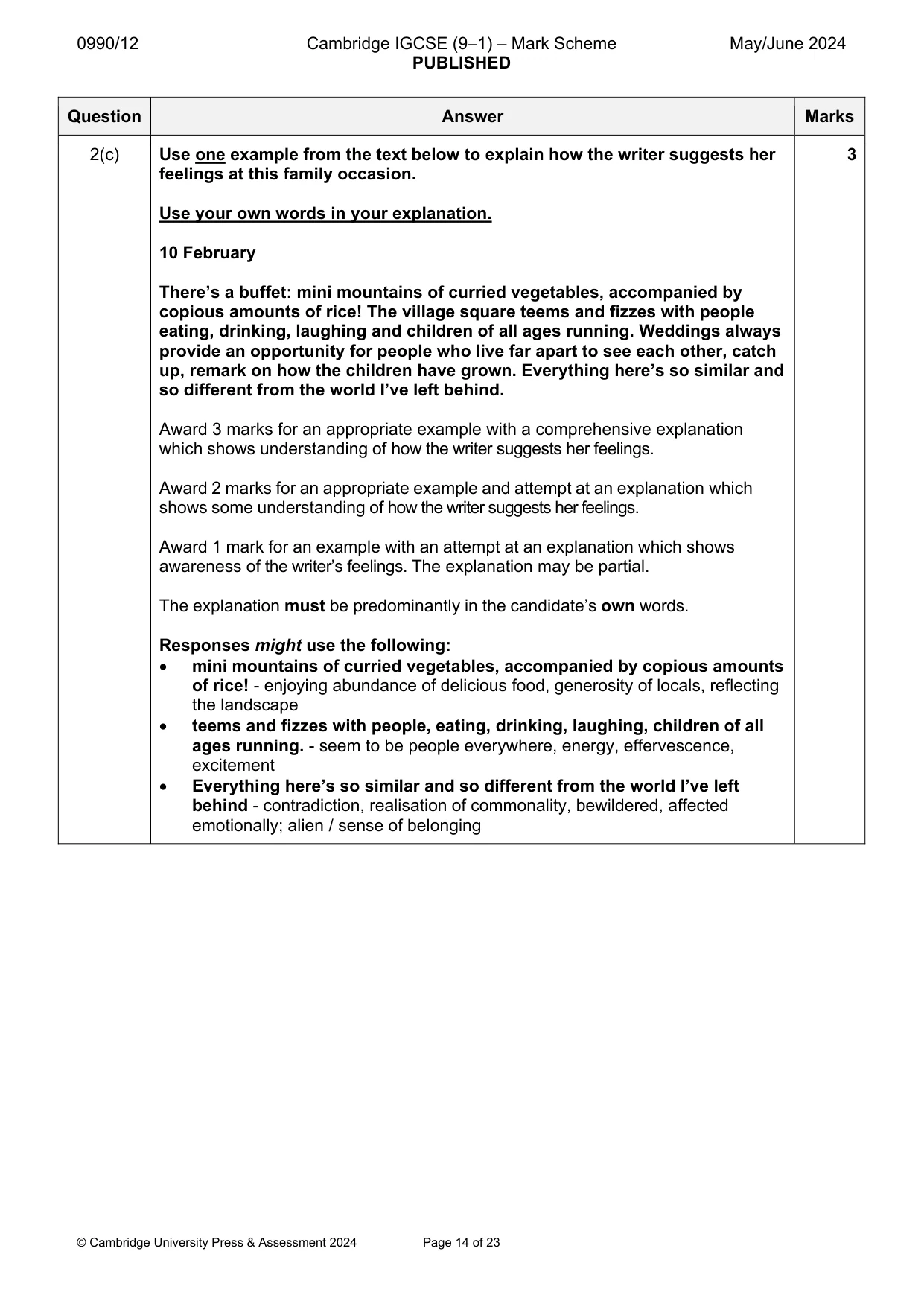
0990/12 Cambridge IGCSE (9–1) – Mark Scheme PUBLISHED May/June 2024 © Cambridge University Press & Assessment 2024 Page 14 of 23 Question Answer Marks 2(c) Use one example from the text below to explain how the writer suggests her feelings at this family occasion. Use your own words in your explanation. 10 February There’s a buffet: mini mountains of curried vegetables, accompanied by copious amounts of rice! The village square teems and fizzes with people eating, drinking, laughing and children of all ages running. Weddings always provide an opportunity for people who live far apart to see each other, catch up, remark on how the children have grown. Everything here’s so similar and so different from the world I’ve left behind. Award 3 marks for an appropriate example with a comprehensive explanation which shows understanding of how the writer suggests her feelings. Award 2 marks for an appropriate example and attempt at an explanation which shows some understanding of how the writer suggests her feelings. Award 1 mark for an example with an attempt at an explanation which shows awareness of the writer’s feelings. The explanation may be partial. The explanation must be predominantly in the candidate’s own words. Responses might use the following: mini mountains of curried vegetables, accompanied by copious amounts of rice! - enjoying abundance of delicious food, generosity of locals, reflecting the landscape teems and fizzes with people, eating, drinking, laughing, children of all ages running. - seem to be people everywhere, energy, effervescence, excitement Everything here’s so similar and so different from the world I’ve left behind - contradiction, realisation of commonality, bewildered, affected emotionally; alien / sense of belonging 3
Mark scheme, page 15
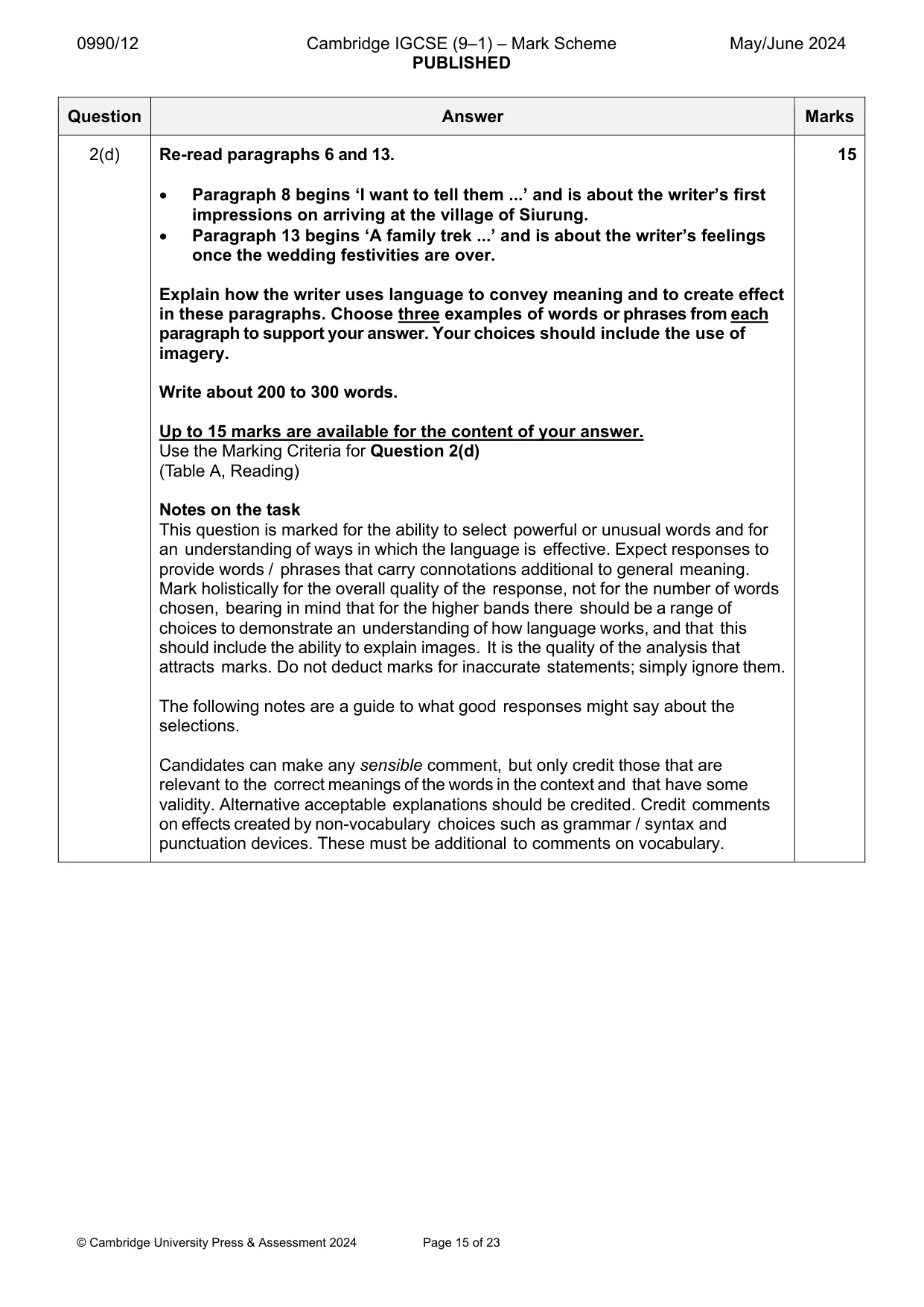
0990/12 Cambridge IGCSE (9–1) – Mark Scheme PUBLISHED May/June 2024 © Cambridge University Press & Assessment 2024 Page 15 of 23 Question Answer Marks 2(d) Re-read paragraphs 6 and 13. Paragraph 8 begins ‘I want to tell them ...’ and is about the writer’s first impressions on arriving at the village of Siurung. Paragraph 13 begins ‘A family trek ...’ and is about the writer’s feelings once the wedding festivities are over. Explain how the writer uses language to convey meaning and to create effect in these paragraphs. Choose three examples of words or phrases from each paragraph to support your answer. Your choices should include the use of imagery. Write about 200 to 300 words. Up to 15 marks are available for the content of your answer. Use the Marking Criteria for Question 2(d) (Table A, Reading) Notes on the task This question is marked for the ability to select powerful or unusual words and for an understanding of ways in which the language is effective. Expect responses to provide words / phrases that carry connotations additional to general meaning. Mark holistically for the overall quality of the response, not for the number of words chosen, bearing in mind that for the higher bands there should be a range of choices to demonstrate an understanding of how language works, and that this should include the ability to explain images. It is the quality of the analysis that attracts marks. Do not deduct marks for inaccurate statements; simply ignore them. The following notes are a guide to what good responses might say about the selections. Candidates can make any sensible comment, but only credit those that are relevant to the correct meanings of the words in the context and that have some validity. Alternative acceptable explanations should be credited. Credit comments on effects created by non-vocabulary choices such as grammar / syntax and punctuation devices. These must be additional to comments on vocabulary. 15
Mark scheme, page 16
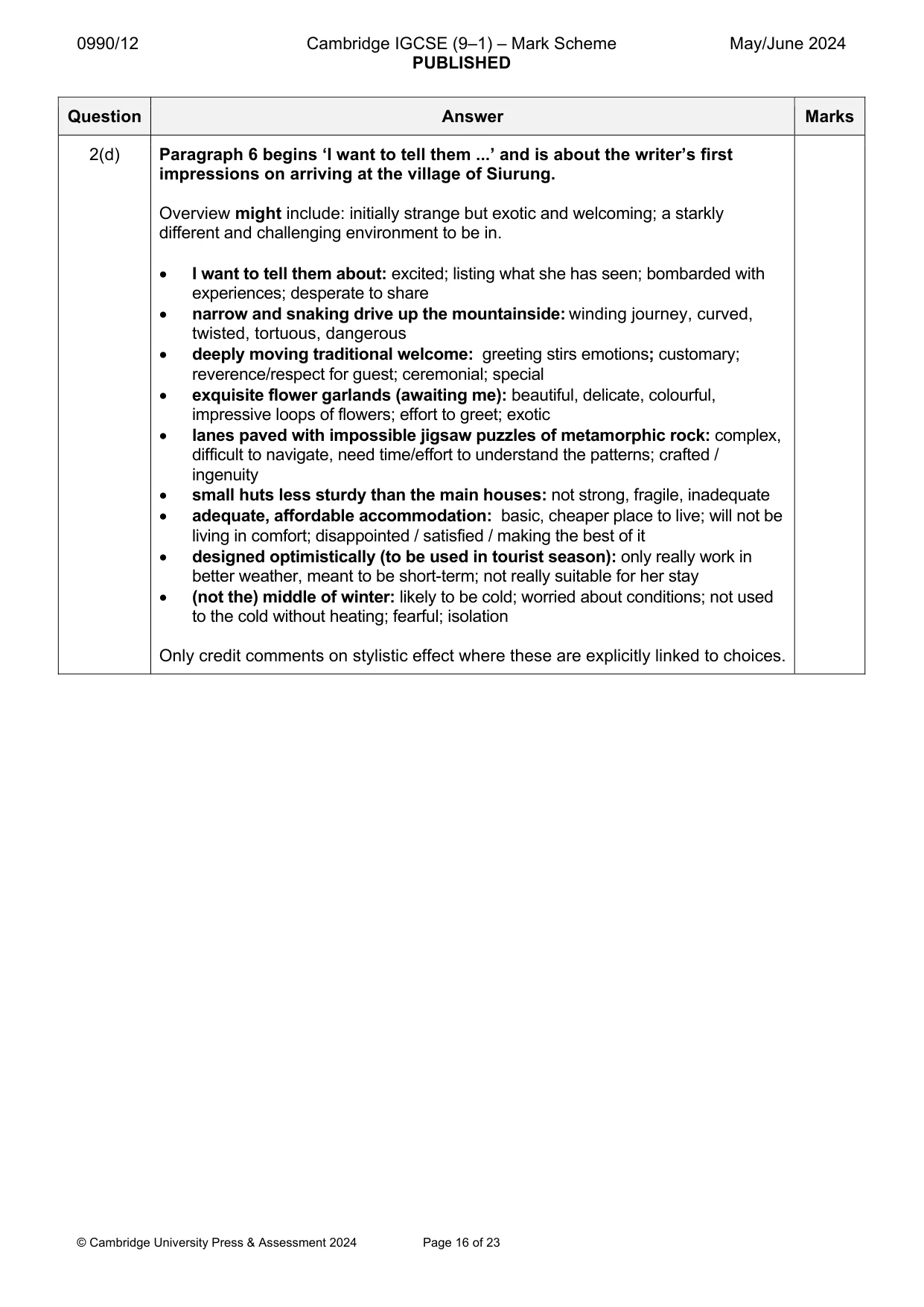
0990/12 Cambridge IGCSE (9–1) – Mark Scheme PUBLISHED May/June 2024 © Cambridge University Press & Assessment 2024 Page 16 of 23 Question Answer Marks 2(d) Paragraph 6 begins ‘I want to tell them ...’ and is about the writer’s first impressions on arriving at the village of Siurung. Overview might include: initially strange but exotic and welcoming; a starkly different and challenging environment to be in. I want to tell them about: excited; listing what she has seen; bombarded with experiences; desperate to share narrow and snaking drive up the mountainside: winding journey, curved, twisted, tortuous, dangerous deeply moving traditional welcome: greeting stirs emotions; customary; reverence/respect for guest; ceremonial; special exquisite flower garlands (awaiting me): beautiful, delicate, colourful, impressive loops of flowers; effort to greet; exotic lanes paved with impossible jigsaw puzzles of metamorphic rock: complex, difficult to navigate, need time/effort to understand the patterns; crafted / ingenuity small huts less sturdy than the main houses: not strong, fragile, inadequate adequate, affordable accommodation: basic, cheaper place to live; will not be living in comfort; disappointed / satisfied / making the best of it designed optimistically (to be used in tourist season): only really work in better weather, meant to be short-term; not really suitable for her stay (not the) middle of winter: likely to be cold; worried about conditions; not used to the cold without heating; fearful; isolation Only credit comments on stylistic effect where these are explicitly linked to choices.
Mark scheme, page 17
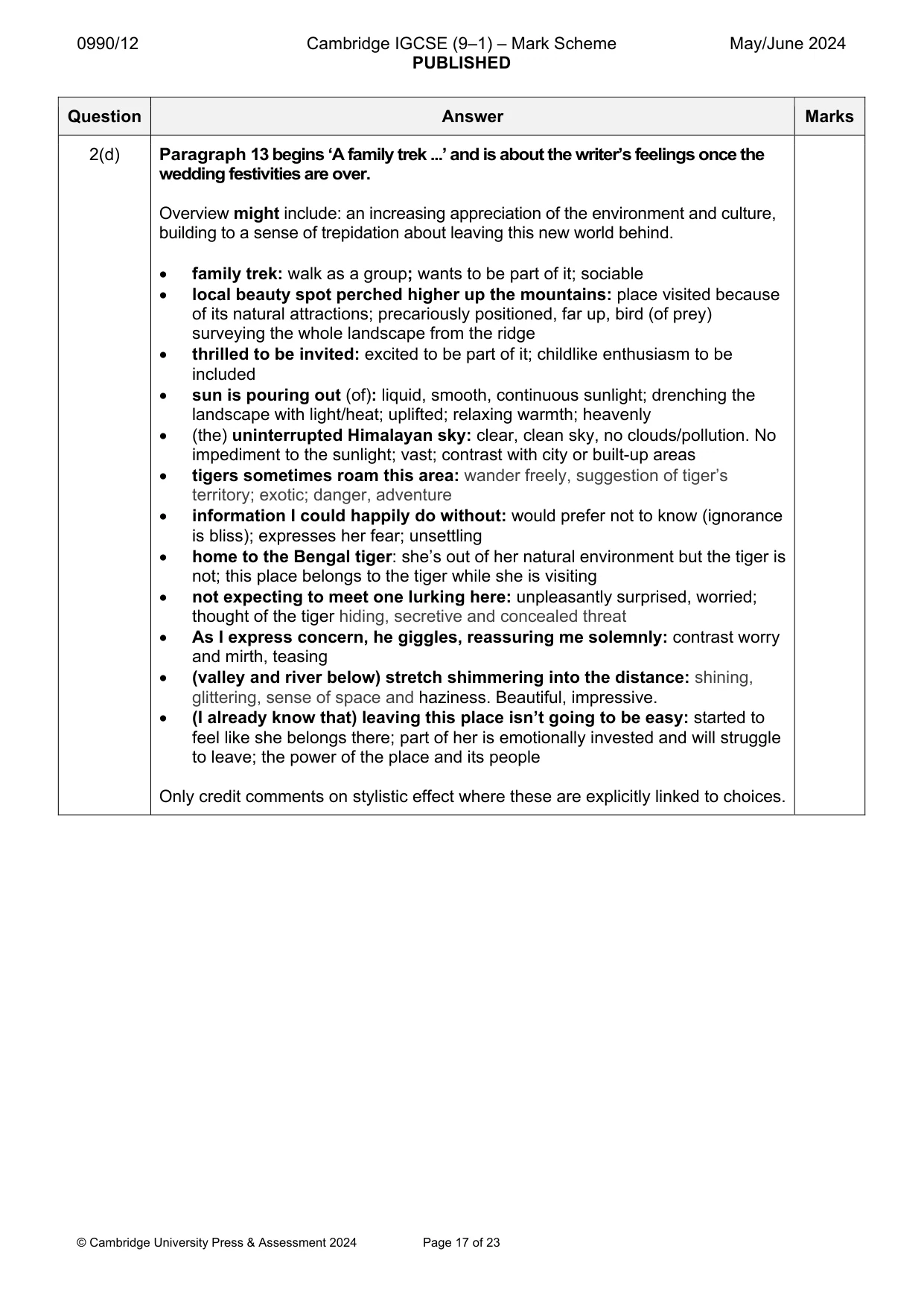
0990/12 Cambridge IGCSE (9–1) – Mark Scheme PUBLISHED May/June 2024 © Cambridge University Press & Assessment 2024 Page 17 of 23 Question Answer Marks 2(d) Paragraph 13 begins ‘A family trek ...’ and is about the writer’s feelings once the wedding festivities are over. Overview might include: an increasing appreciation of the environment and culture, building to a sense of trepidation about leaving this new world behind. family trek: walk as a group; wants to be part of it; sociable local beauty spot perched higher up the mountains: place visited because of its natural attractions; precariously positioned, far up, bird (of prey) surveying the whole landscape from the ridge thrilled to be invited: excited to be part of it; childlike enthusiasm to be included sun is pouring out (of): liquid, smooth, continuous sunlight; drenching the landscape with light/heat; uplifted; relaxing warmth; heavenly (the) uninterrupted Himalayan sky: clear, clean sky, no clouds/pollution. No impediment to the sunlight; vast; contrast with city or built-up areas tigers sometimes roam this area: wander freely, suggestion of tiger’s territory; exotic; danger, adventure information I could happily do without: would prefer not to know (ignorance is bliss); expresses her fear; unsettling home to the Bengal tiger: she’s out of her natural environment but the tiger is not; this place belongs to the tiger while she is visiting not expecting to meet one lurking here: unpleasantly surprised, worried; thought of the tiger hiding, secretive and concealed threat As I express concern, he giggles, reassuring me solemnly: contrast worry and mirth, teasing (valley and river below) stretch shimmering into the distance: shining, glittering, sense of space and haziness. Beautiful, impressive. (I already know that) leaving this place isn’t going to be easy: started to feel like she belongs there; part of her is emotionally invested and will struggle to leave; the power of the place and its people Only credit comments on stylistic effect where these are explicitly linked to choices.
Mark scheme, page 18
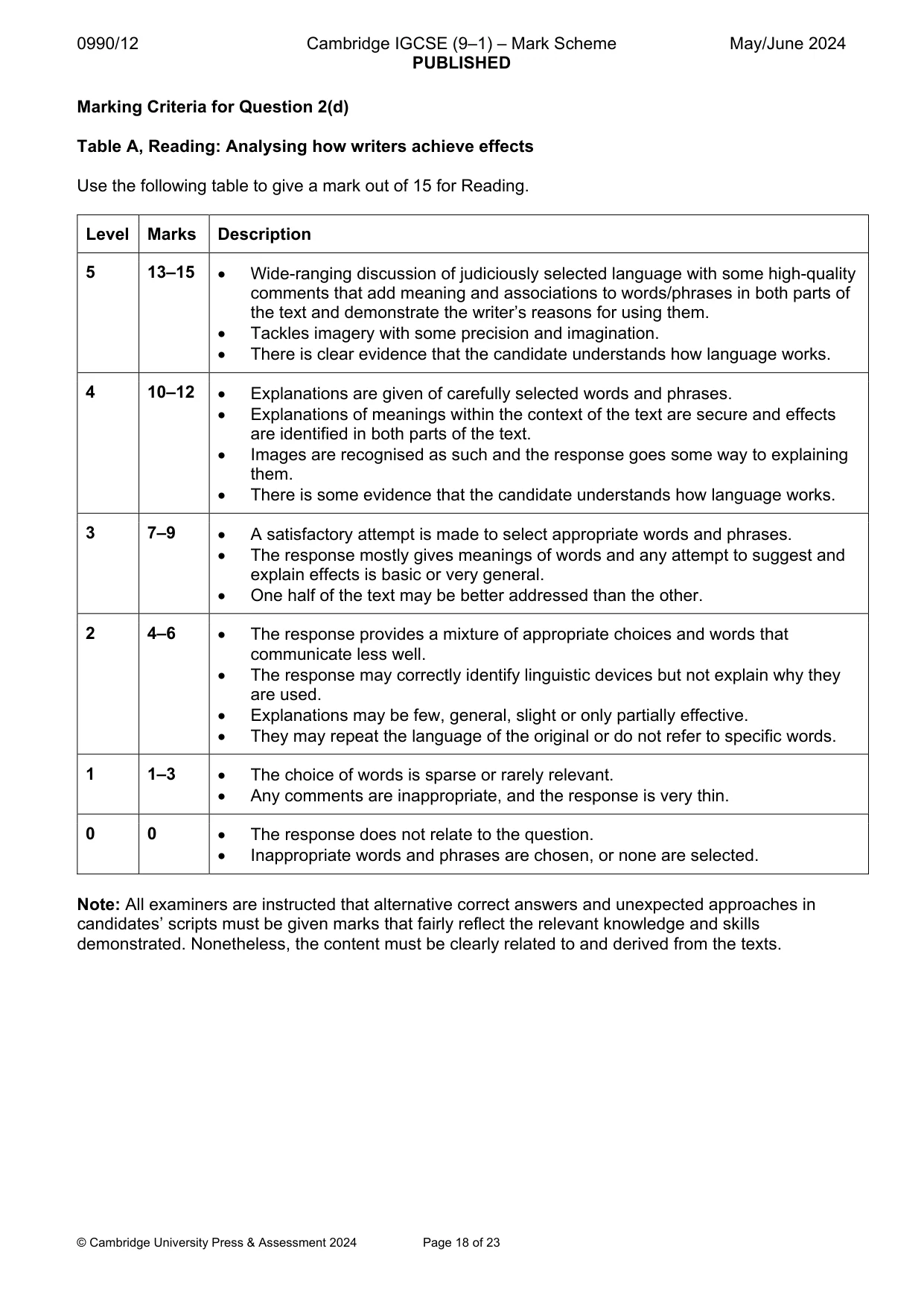
0990/12 Cambridge IGCSE (9–1) – Mark Scheme PUBLISHED May/June 2024 © Cambridge University Press & Assessment 2024 Page 18 of 23 Marking Criteria for Question 2(d) Table A, Reading: Analysing how writers achieve effects Use the following table to give a mark out of 15 for Reading. Level Marks Description 5 13–15 Wide-ranging discussion of judiciously selected language with some high-quality comments that add meaning and associations to words/phrases in both parts of the text and demonstrate the writer’s reasons for using them. Tackles imagery with some precision and imagination. There is clear evidence that the candidate understands how language works. 4 10–12 Explanations are given of carefully selected words and phrases. Explanations of meanings within the context of the text are secure and effects are identified in both parts of the text. Images are recognised as such and the response goes some way to explaining them. There is some evidence that the candidate understands how language works. 3 7–9 A satisfactory attempt is made to select appropriate words and phrases. The response mostly gives meanings of words and any attempt to suggest and explain effects is basic or very general. One half of the text may be better addressed than the other. 2 4–6 The response provides a mixture of appropriate choices and words that communicate less well. The response may correctly identify linguistic devices but not explain why they are used. Explanations may be few, general, slight or only partially effective. They may repeat the language of the original or do not refer to specific words. 1 1–3 The choice of words is sparse or rarely relevant. Any comments are inappropriate, and the response is very thin. 0 0 The response does not relate to the question. Inappropriate words and phrases are chosen, or none are selected. Note: All examiners are instructed that alternative correct answers and unexpected approaches in candidates’ scripts must be given marks that fairly reflect the relevant knowledge and skills demonstrated. Nonetheless, the content must be clearly related to and derived from the texts.
Mark scheme, page 19
0990/12 Cambridge IGCSE (9–1) – Mark Scheme PUBLISHED May/June 2024 © Cambridge University Press & Assessment 2024 Page 19 of 23 Question 3 This question tests reading assessment objectives R1, R2 and R3 (15 marks): R1 demonstrate understanding of explicit meanings R2 demonstrate understanding of implicit meanings and attitudes R3 analyse evaluate and develop facts, ideas and opinions, using appropriate support from the text and writing assessment objectives W1, W2, W3 and W4 (10 marks): W1 articulate experience and express what is thought, felt and imagined W2 organise and structure ideas and opinions for deliberate effect W3 use a range of vocabulary and sentence structures appropriate to context W4 use register appropriate to context.
Mark scheme, page 20
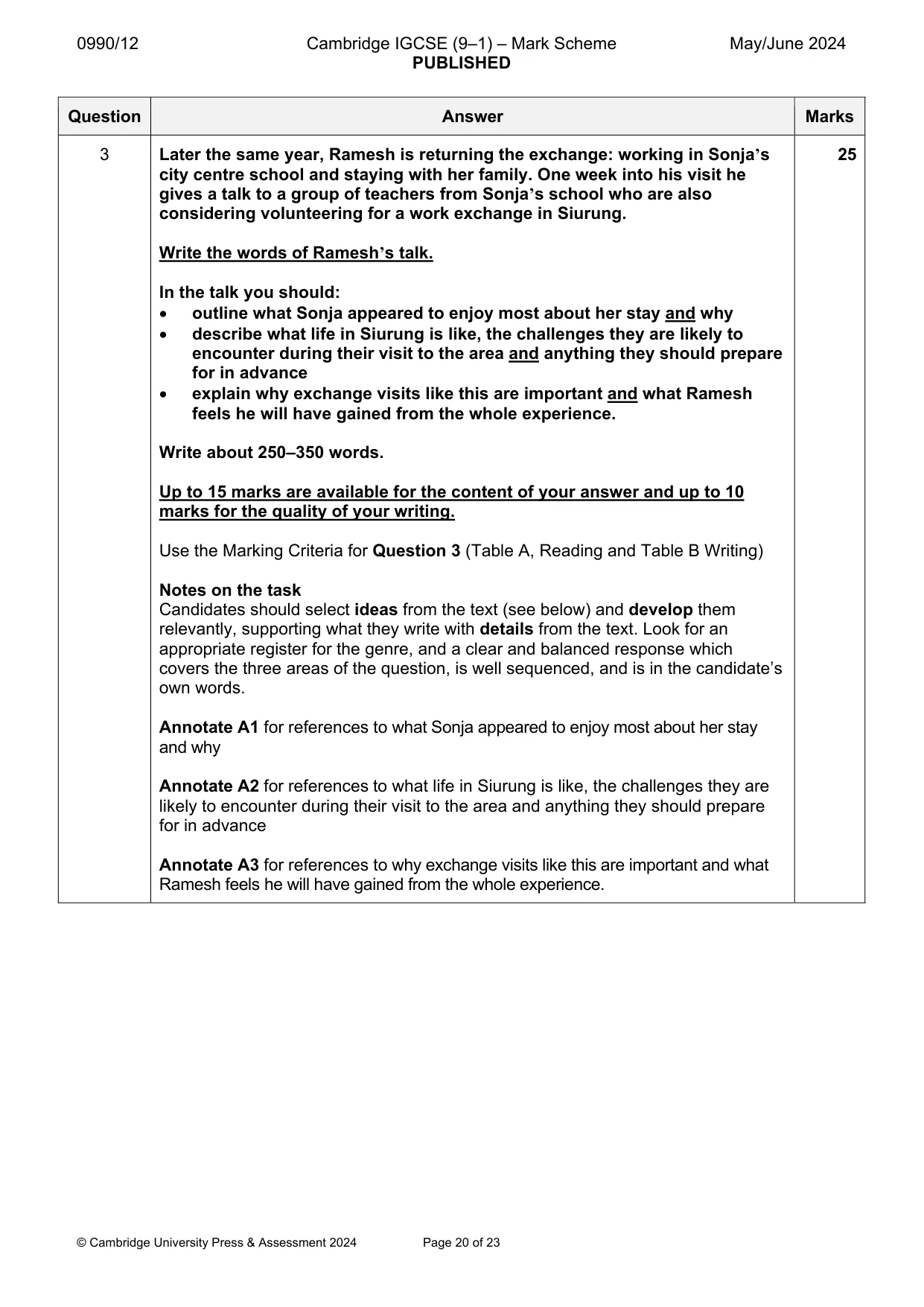
0990/12 Cambridge IGCSE (9–1) – Mark Scheme PUBLISHED May/June 2024 © Cambridge University Press & Assessment 2024 Page 20 of 23 Question Answer Marks 3 Later the same year, Ramesh is returning the exchange: working in Sonja’s city centre school and staying with her family. One week into his visit he gives a talk to a group of teachers from Sonja’s school who are also considering volunteering for a work exchange in Siurung. Write the words of Ramesh’s talk. In the talk you should: outline what Sonja appeared to enjoy most about her stay and why describe what life in Siurung is like, the challenges they are likely to encounter during their visit to the area and anything they should prepare for in advance explain why exchange visits like this are important and what Ramesh feels he will have gained from the whole experience. Write about 250–350 words. Up to 15 marks are available for the content of your answer and up to 10 marks for the quality of your writing. Use the Marking Criteria for Question 3 (Table A, Reading and Table B Writing) Notes on the task Candidates should select ideas from the text (see below) and develop them relevantly, supporting what they write with details from the text. Look for an appropriate register for the genre, and a clear and balanced response which covers the three areas of the question, is well sequenced, and is in the candidate’s own words. Annotate A1 for references to what Sonja appeared to enjoy most about her stay and why Annotate A2 for references to what life in Siurung is like, the challenges they are likely to encounter during their visit to the area and anything they should prepare for in advance Annotate A3 for references to why exchange visits like this are important and what Ramesh feels he will have gained from the whole experience. 25
Mark scheme, page 21
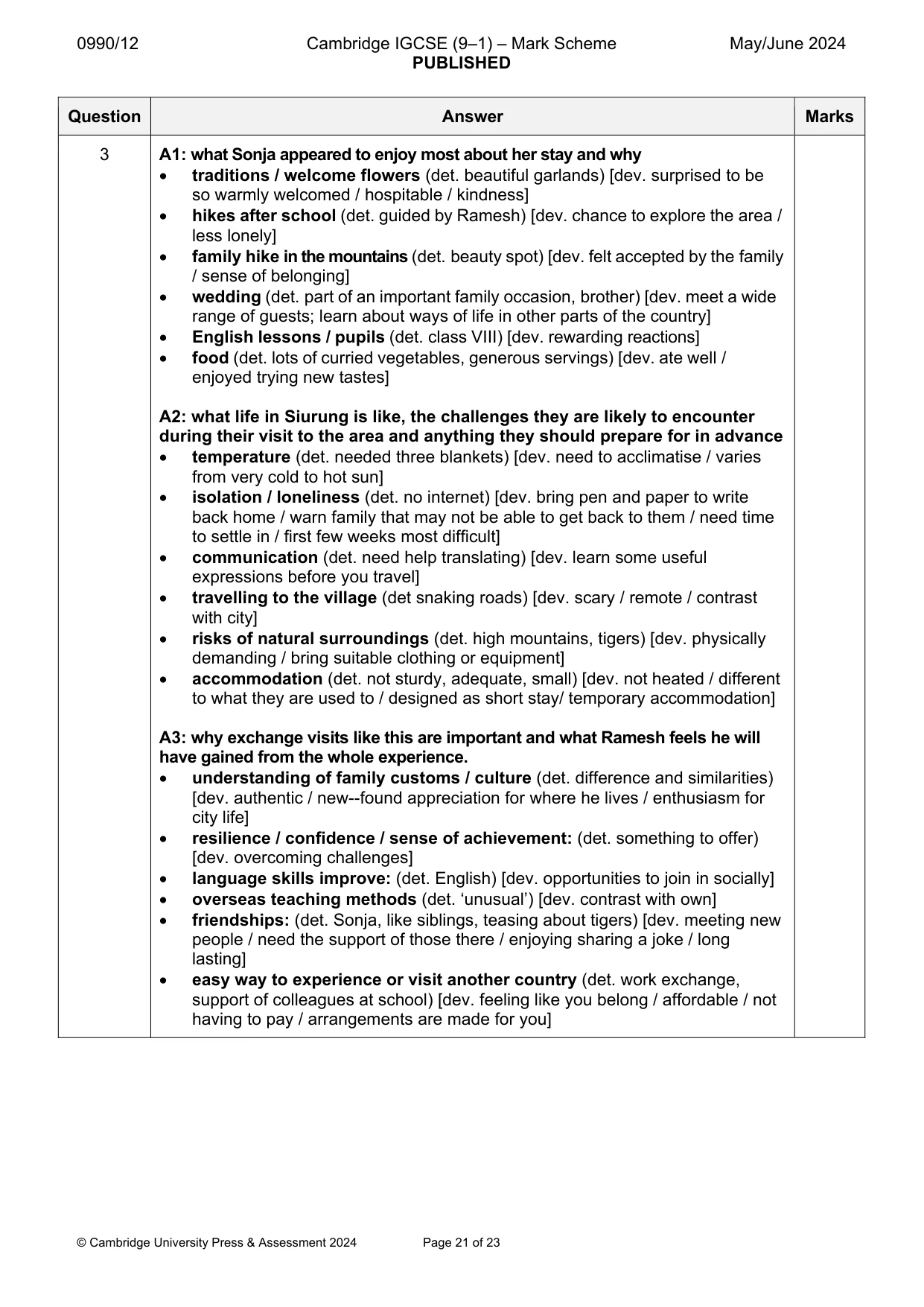
0990/12 Cambridge IGCSE (9–1) – Mark Scheme PUBLISHED May/June 2024 © Cambridge University Press & Assessment 2024 Page 21 of 23 Question Answer Marks 3 A1: what Sonja appeared to enjoy most about her stay and why traditions / welcome flowers (det. beautiful garlands) [dev. surprised to be so warmly welcomed / hospitable / kindness] hikes after school (det. guided by Ramesh) [dev. chance to explore the area / less lonely] family hike in the mountains (det. beauty spot) [dev. felt accepted by the family / sense of belonging] wedding (det. part of an important family occasion, brother) [dev. meet a wide range of guests; learn about ways of life in other parts of the country] English lessons / pupils (det. class VIII) [dev. rewarding reactions] food (det. lots of curried vegetables, generous servings) [dev. ate well / enjoyed trying new tastes] A2: what life in Siurung is like, the challenges they are likely to encounter during their visit to the area and anything they should prepare for in advance temperature (det. needed three blankets) [dev. need to acclimatise / varies from very cold to hot sun] isolation / loneliness (det. no internet) [dev. bring pen and paper to write back home / warn family that may not be able to get back to them / need time to settle in / first few weeks most difficult] communication (det. need help translating) [dev. learn some useful expressions before you travel] travelling to the village (det snaking roads) [dev. scary / remote / contrast with city] risks of natural surroundings (det. high mountains, tigers) [dev. physically demanding / bring suitable clothing or equipment] accommodation (det. not sturdy, adequate, small) [dev. not heated / different to what they are used to / designed as short stay/ temporary accommodation] A3: why exchange visits like this are important and what Ramesh feels he will have gained from the whole experience. understanding of family customs / culture (det. difference and similarities) [dev. authentic / new--found appreciation for where he lives / enthusiasm for city life] resilience / confidence / sense of achievement: (det. something to offer) [dev. overcoming challenges] language skills improve: (det. English) [dev. opportunities to join in socially] overseas teaching methods (det. ‘unusual’) [dev. contrast with own] friendships: (det. Sonja, like siblings, teasing about tigers) [dev. meeting new people / need the support of those there / enjoying sharing a joke / long lasting] easy way to experience or visit another country (det. work exchange, support of colleagues at school) [dev. feeling like you belong / affordable / not having to pay / arrangements are made for you]
Mark scheme, page 22
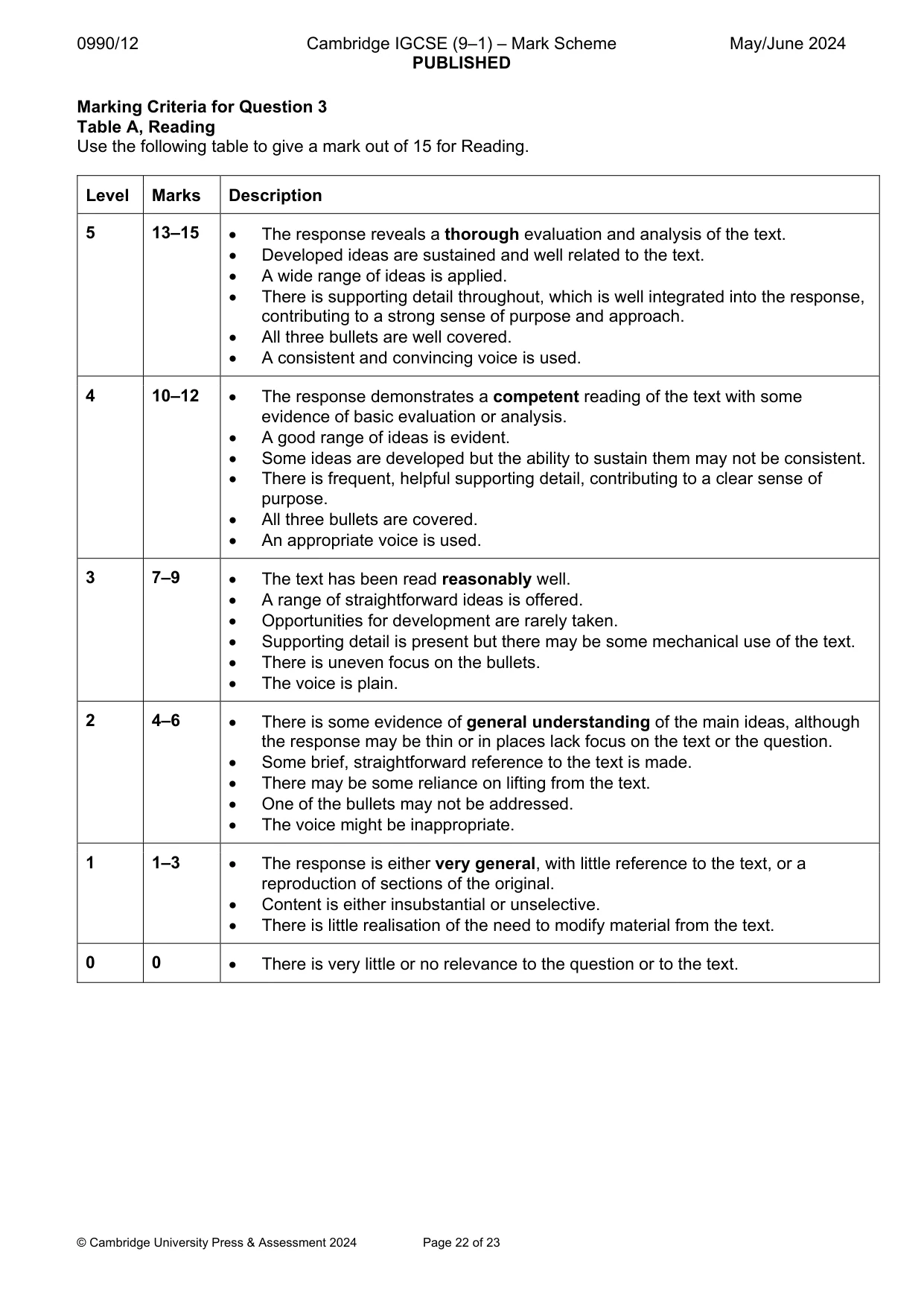
0990/12 Cambridge IGCSE (9–1) – Mark Scheme PUBLISHED May/June 2024 © Cambridge University Press & Assessment 2024 Page 22 of 23 Marking Criteria for Question 3 Table A, Reading Use the following table to give a mark out of 15 for Reading. Level Marks Description 5 13–15 The response reveals a thorough evaluation and analysis of the text. Developed ideas are sustained and well related to the text. A wide range of ideas is applied. There is supporting detail throughout, which is well integrated into the response, contributing to a strong sense of purpose and approach. All three bullets are well covered. A consistent and convincing voice is used. 4 10–12 The response demonstrates a competent reading of the text with some evidence of basic evaluation or analysis. A good range of ideas is evident. Some ideas are developed but the ability to sustain them may not be consistent. There is frequent, helpful supporting detail, contributing to a clear sense of purpose. All three bullets are covered. An appropriate voice is used. 3 7–9 The text has been read reasonably well. A range of straightforward ideas is offered. Opportunities for development are rarely taken. Supporting detail is present but there may be some mechanical use of the text. There is uneven focus on the bullets. The voice is plain. 2 4–6 There is some evidence of general understanding of the main ideas, although the response may be thin or in places lack focus on the text or the question. Some brief, straightforward reference to the text is made. There may be some reliance on lifting from the text. One of the bullets may not be addressed. The voice might be inappropriate. 1 1–3 The response is either very general, with little reference to the text, or a reproduction of sections of the original. Content is either insubstantial or unselective. There is little realisation of the need to modify material from the text. 0 0 There is very little or no relevance to the question or to the text.
Mark scheme, page 23
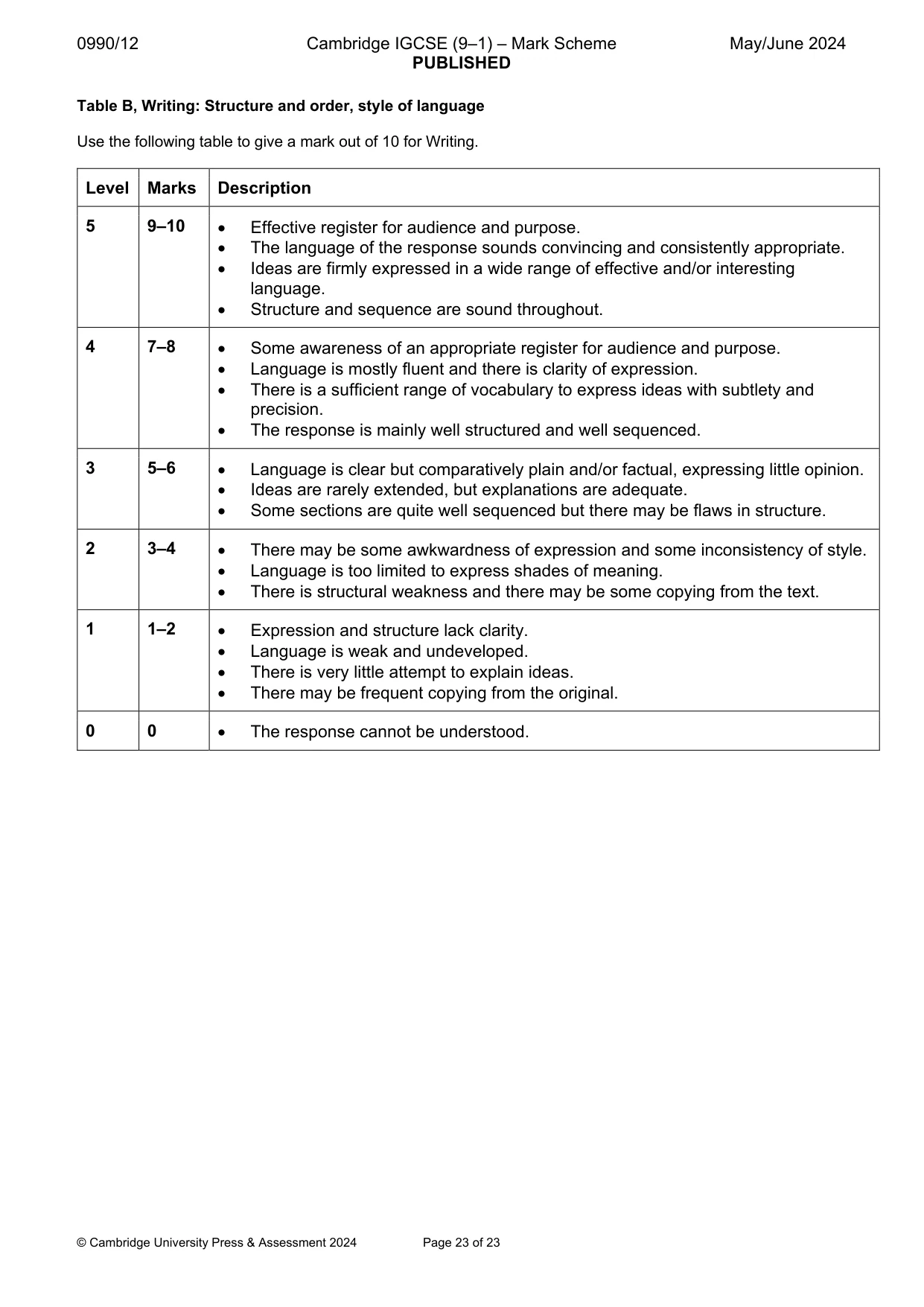
0990/12 Cambridge IGCSE (9–1) – Mark Scheme PUBLISHED May/June 2024 © Cambridge University Press & Assessment 2024 Page 23 of 23 Table B, Writing: Structure and order, style of language Use the following table to give a mark out of 10 for Writing. Level Marks Description 5 9–10 Effective register for audience and purpose. The language of the response sounds convincing and consistently appropriate. Ideas are firmly expressed in a wide range of effective and/or interesting language. Structure and sequence are sound throughout. 4 7–8 Some awareness of an appropriate register for audience and purpose. Language is mostly fluent and there is clarity of expression. There is a sufficient range of vocabulary to express ideas with subtlety and precision. The response is mainly well structured and well sequenced. 3 5–6 Language is clear but comparatively plain and/or factual, expressing little opinion. Ideas are rarely extended, but explanations are adequate. Some sections are quite well sequenced but there may be flaws in structure. 2 3–4 There may be some awkwardness of expression and some inconsistency of style. Language is too limited to express shades of meaning. There is structural weakness and there may be some copying from the text. 1 1–2 Expression and structure lack clarity. Language is weak and undeveloped. There is very little attempt to explain ideas. There may be frequent copying from the original. 0 0 The response cannot be understood.
What you needed in this session
Cambridge’s own grade thresholds for 2024 May/June, Paper 1 · Variant 2. A higher threshold means an easier paper — the bar moves with how the cohort did.