Cambridge IGCSE English - First Language (9-1) 0990 — 2022 May/June Paper 2 · Variant 2
0990/22/M/J/22 · 80 marks · ≈90 min
The question paper and its mark scheme, free to read here and free to download. This is Cambridge’s own paper, exactly as it was sat.
Question paper12 pages
Mark scheme12 pages
Answers below. Sit the paper first if you are practising.
Paper as text
Question paper, page 1
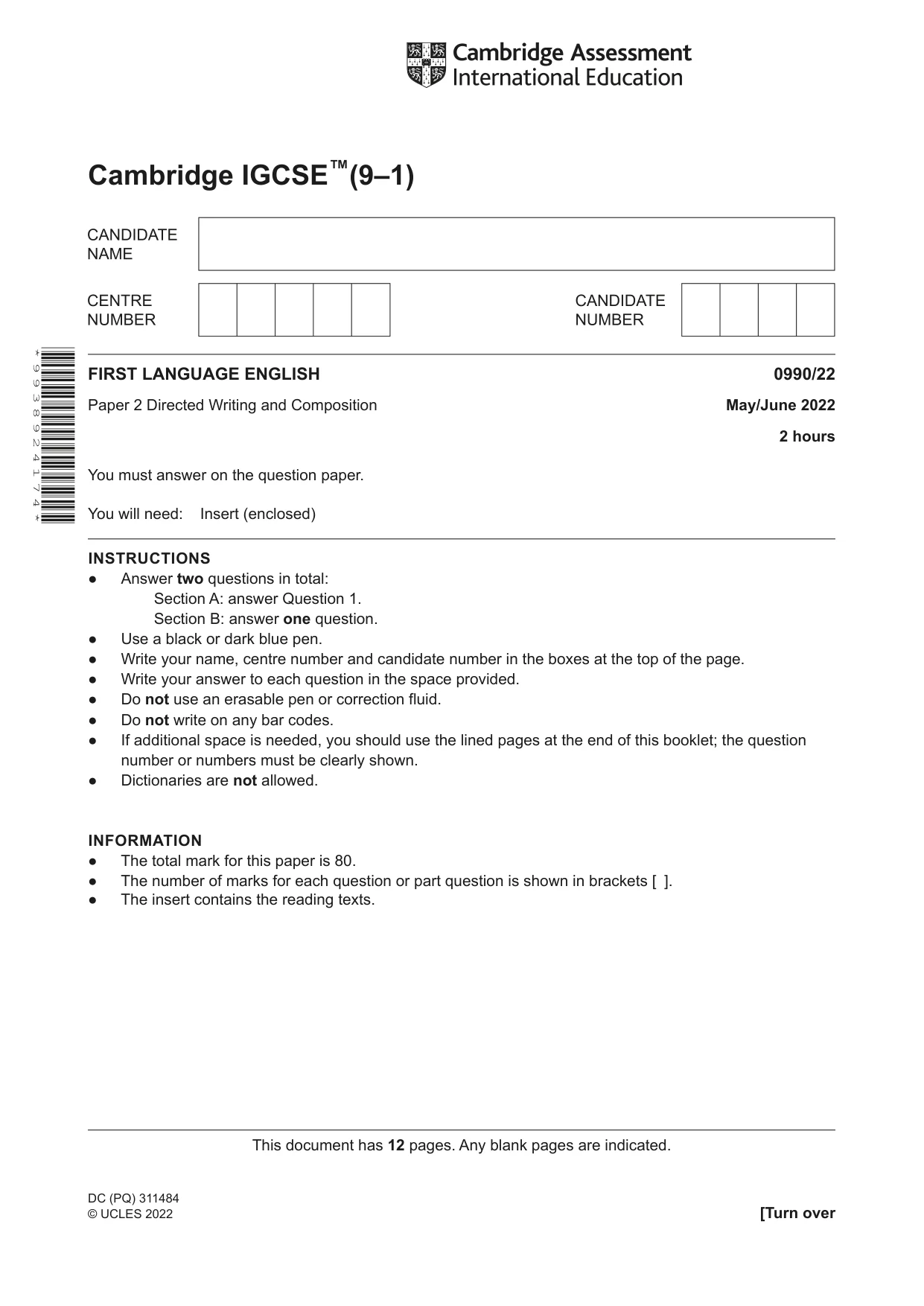
[Turn over DC (PQ) 311484 © UCLES 2022 This document has 12 pages. Any blank pages are indicated. * 9 9 3 8 9 2 4 1 7 4 * FIRST LANGUAGE ENGLISH 0990/22 Paper 2 Directed Writing and Composition May/June 2022 2 hours You must answer on the question paper. You will need: Insert (enclosed) INSTRUCTIONS ● Answer two questions in total: Section A: answer Question 1. Section B: answer one question. ● Use a black or dark blue pen. ● Write your name, centre number and candidate number in the boxes at the top of the page. ● Write your answer to each question in the space provided. ● Do not use an erasable pen or correction fluid. ● Do not write on any bar codes. ● If additional space is needed, you should use the lined pages at the end of this booklet; the question number or numbers must be clearly shown. ● Dictionaries are not allowed. INFORMATION ● The total mark for this paper is 80. ● The number of marks for each question or part question is shown in brackets [ ]. ● The insert contains the reading texts. Cambridge IGCSE™(9–1)
Question paper, page 2
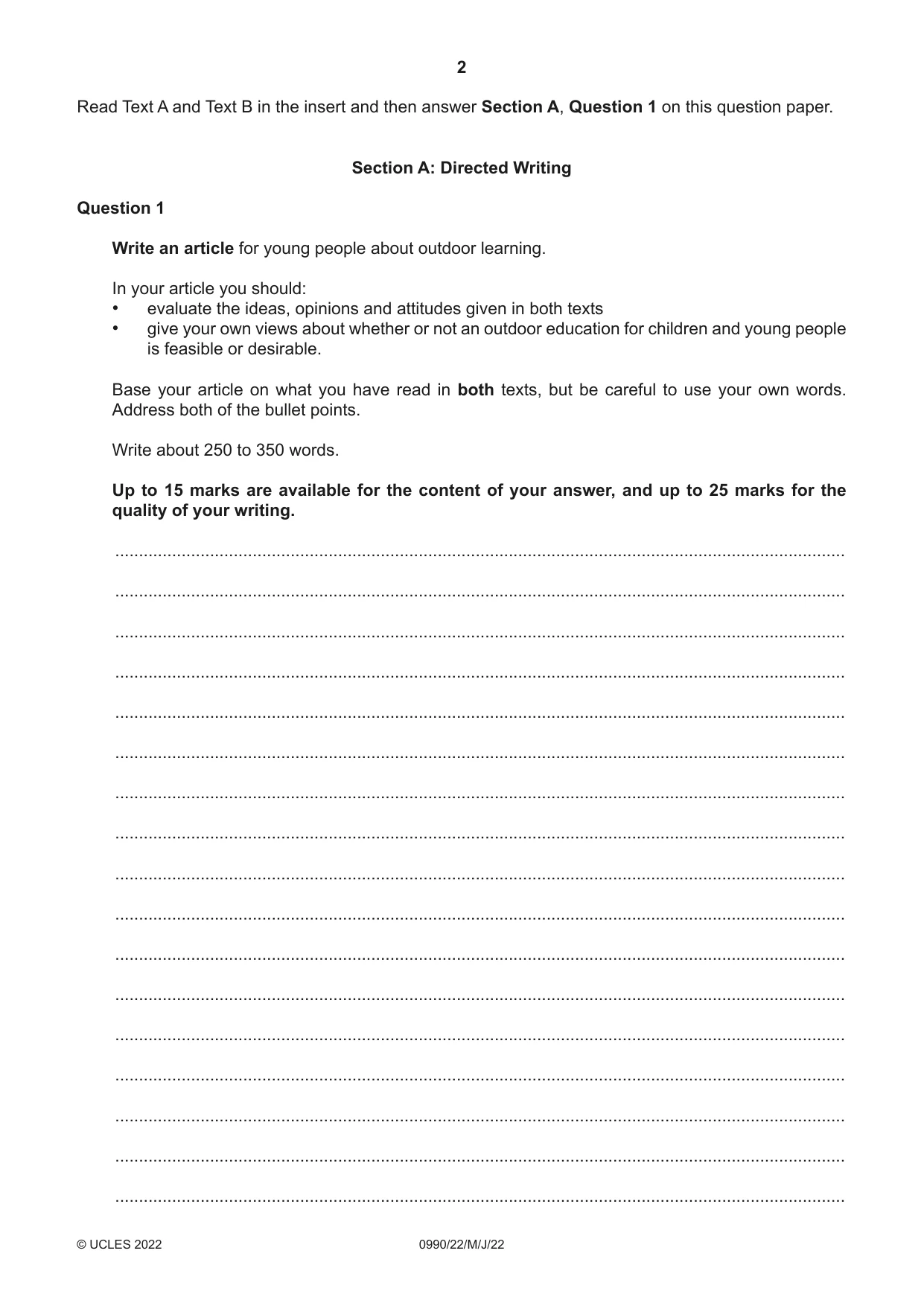
2 0990/22/M/J/22 © UCLES 2022 Read Text A and Text B in the insert and then answer Section A, Question 1 on this question paper. Section A: Directed Writing Question 1 Write an article for young people about outdoor learning. In your article you should: • evaluate the ideas, opinions and attitudes given in both texts • give your own views about whether or not an outdoor education for children and young people is feasible or desirable. Base your article on what you have read in both texts, but be careful to use your own words. Address both of the bullet points. Write about 250 to 350 words. Up to 15 marks are available for the content of your answer, and up to 25 marks for the quality of your writing. … … … … … … … … … … … … … … … … …
Question paper, page 3
3 0990/22/M/J/22 © UCLES 2022 [Turn over … … … … … … … … … … … … … … … … … … … … … … … … … … … …
Question paper, page 4
4 0990/22/M/J/22 © UCLES 2022 … … … … … … … … … … … … … … … … … … … … … … … … … … … [Total: 40]
Question paper, page 5
5 0990/22/M/J/22 © UCLES 2022 [Turn over [Turn to page 6 for Section B]
Question paper, page 6
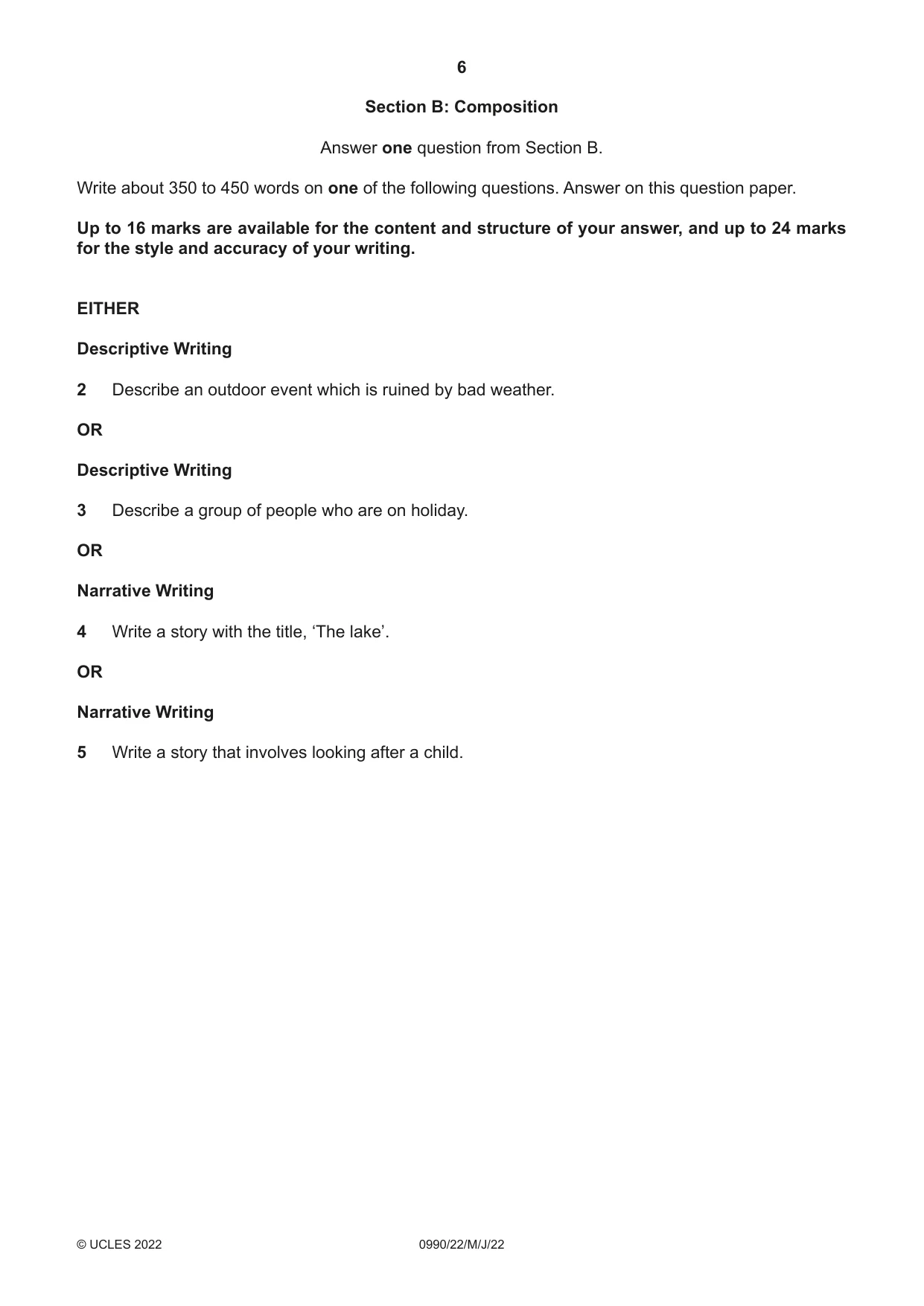
6 0990/22/M/J/22 © UCLES 2022 Section B: Composition Answer one question from Section B. Write about 350 to 450 words on one of the following questions. Answer on this question paper. Up to 16 marks are available for the content and structure of your answer, and up to 24 marks for the style and accuracy of your writing. EITHER Descriptive Writing 2 Describe an outdoor event which is ruined by bad weather. OR Descriptive Writing 3 Describe a group of people who are on holiday. OR Narrative Writing 4 Write a story with the title, ‘The lake’. OR Narrative Writing 5 Write a story that involves looking after a child.
Question paper, page 7
7 0990/22/M/J/22 © UCLES 2022 [Turn over Please write your chosen question number here (2, 3, 4, 5): … … … … … … … … … … … … … … … … … … … … … … … … … … … …
Question paper, page 8
8 0990/22/M/J/22 © UCLES 2022 … … … … … … … … … … … … … … … … … … … … … … … … … … … …
Question paper, page 9
9 0990/22/M/J/22 © UCLES 2022 … … … … … … … … … … … … … … … … … … … … … … … … … … … [40]
Question paper, page 10
10 0990/22/M/J/22 © UCLES 2022 Additional Page If you use the following lined page to complete the answer(s) to any question(s), the question number(s) must be clearly shown. … … … … … … … … … … … … … … … … … … … … … … … … … …
Question paper, page 11
11 0990/22/M/J/22 © UCLES 2022 Additional Page If you use the following lined page to complete the answer(s) to any question(s), the question number(s) must be clearly shown. … … … … … … … … … … … … … … … … … … … … … … … … … …
Question paper, page 12
12 0990/22/M/J/22 © UCLES 2022 Permission to reproduce items where third-party owned material protected by copyright is included has been sought and cleared where possible. Every reasonable effort has been made by the publisher (UCLES) to trace copyright holders, but if any items requiring clearance have unwittingly been included, the publisher will be pleased to make amends at the earliest possible opportunity. To avoid the issue of disclosure of answer-related information to candidates, all copyright acknowledgements are reproduced online in the Cambridge Assessment International Education Copyright Acknowledgements Booklet. This is produced for each series of examinations and is freely available to download at www.cambridgeinternational.org after the live examination series. Cambridge Assessment International Education is part of Cambridge Assessment. Cambridge Assessment is the brand name of the University of Cambridge Local Examinations Syndicate (UCLES), which is a department of the University of Cambridge. BLANK PAGE
Mark scheme, page 1
This document consists of 12 printed pages. © UCLES 2022 [Turn over Cambridge IGCSE™ (9–1) FIRST LANGUAGE ENGLISH IGCSE 9–1 0990/22 Paper 2 Directed Writing and Composition May/June 2022 MARK SCHEME Maximum Mark: 80 Published This mark scheme is published as an aid to teachers and candidates, to indicate the requirements of the examination. It shows the basis on which Examiners were instructed to award marks. It does not indicate the details of the discussions that took place at an Examiners’ meeting before marking began, which would have considered the acceptability of alternative answers. Mark schemes should be read in conjunction with the question paper and the Principal Examiner Report for Teachers. Cambridge International will not enter into discussions about these mark schemes. Cambridge International is publishing the mark schemes for the May/June 2022 series for most Cambridge IGCSE, Cambridge International A and AS Level and Cambridge Pre-U components, and some Cambridge O Level components.
Mark scheme, page 2
0990/22 Cambridge IGCSE (9–1) – Mark Scheme PUBLISHED May/June 2022 © UCLES 2022 Page 2 of 12 Generic Marking Principles These general marking principles must be applied by all examiners when marking candidate answers. They should be applied alongside the specific content of the mark scheme or generic level descriptors for a question. Each question paper and mark scheme will also comply with these marking principles. GENERIC MARKING PRINCIPLE 1: Marks must be awarded in line with: the specific content of the mark scheme or the generic level descriptors for the question the specific skills defined in the mark scheme or in the generic level descriptors for the question the standard of response required by a candidate as exemplified by the standardisation scripts. GENERIC MARKING PRINCIPLE 2: Marks awarded are always whole marks (not half marks, or other fractions). GENERIC MARKING PRINCIPLE 3: Marks must be awarded positively: marks are awarded for correct/valid answers, as defined in the mark scheme. However, credit is given for valid answers which go beyond the scope of the syllabus and mark scheme, referring to your Team Leader as appropriate marks are awarded when candidates clearly demonstrate what they know and can do marks are not deducted for errors marks are not deducted for omissions answers should only be judged on the quality of spelling, punctuation and grammar when these features are specifically assessed by the question as indicated by the mark scheme. The meaning, however, should be unambiguous. GENERIC MARKING PRINCIPLE 4: Rules must be applied consistently, e.g. in situations where candidates have not followed instructions or in the application of generic level descriptors. GENERIC MARKING PRINCIPLE 5: Marks should be awarded using the full range of marks defined in the mark scheme for the question (however, the use of the full mark range may be limited according to the quality of the candidate responses seen). GENERIC MARKING PRINCIPLE 6: Marks awarded are based solely on the requirements as defined in the mark scheme. Marks should not be awarded with grade thresholds or grade descriptors in mind.
Mark scheme, page 3
0990/22 Cambridge IGCSE (9–1) – Mark Scheme PUBLISHED May/June 2022 © UCLES 2022 Page 3 of 12 English & Media subject specific general marking principles (To be read in conjunction with the Generic Marking Principles (and requiring further guidance on how to place marks within levels)) Components using level descriptors: We use level descriptors as a guide to broad understanding of the qualities normally expected of, or typical of, work in a level. Level descriptors are a means of general guidance and should not be interpreted as hurdle statements. Where indicative content notes are supplied for a question, these are not a prescription of required content, and must not be treated as such. Alternative correct points and unexpected answers in candidates’ scripts must be given marks that fairly reflect the knowledge and skills demonstrated. While we may have legitimate expectations as to the ground most answers may occupy, we must at all times be prepared to meet candidates on their chosen ground, provided it is relevant ground (e.g. clearly related to and derived from a relevant passage/text and meeting the mark scheme requirements for the question). Components using point-based marking: Point marking is often used to reward knowledge, understanding and application of skills. We give credit where the candidate’s answer shows relevant knowledge, understanding and application of skills in answering the question. We do not give credit where the answer shows confusion. From this it follows that we: a DO credit answers which are worded differently from the mark scheme if they clearly convey the same meaning (unless the mark scheme requires a specific term). b DO credit alternative answers/examples which are not written in the mark scheme if they are correct. c DO credit answers where candidates give more than one correct answer in one prompt/numbered/scaffolded space where extended writing is required rather than list-type answers. For example, questions that require n reasons (e.g. State two reasons …). d DO NOT credit answers simply for using a ‘key term’ unless that is all that is required. (Check for evidence it is understood and not used wrongly.). e DO NOT credit answers which are obviously self-contradicting or trying to cover all possibilities. f DO NOT give further credit for what is effectively repetition of a correct point already credited unless the language itself is being tested. This applies equally to ‘mirror statements’ (i.e. polluted/not polluted). g DO NOT require spellings to be correct, unless this is part of the test. However, spellings of syllabus terms must allow for clear and unambiguous separation from other syllabus terms with which they may be confused (e.g. Corrasion/Corrosion).
Mark scheme, page 4
0990/22 Cambridge IGCSE (9–1) – Mark Scheme PUBLISHED May/June 2022 © UCLES 2022 Page 4 of 12 Note: All Examiners are instructed that alternative correct answers and unexpected approaches in candidates’ scripts must be given marks that fairly reflect the relevant knowledge and skills demonstrated. Nonetheless, the content must be clearly related to and derived from the passage. Section A: Directed Writing Question 1 This question tests the following writing assessment objectives (25 marks) W1 articulate experience and express what is thought, felt and imagined W2 organise and structure ideas and opinions for deliberate effect W3 use a range of vocabulary and sentence structures appropriate to context W4 use register appropriate to context W5 make accurate use of spelling, punctuation and grammar and reading assessment objectives (15 marks) R1 demonstrate understanding of explicit meanings R2 demonstrate understanding of implicit meanings and attitudes R3 analyse, evaluate and develop facts, ideas and opinions, using appropriate support from the text R5 select and use information for specific purposes.
Mark scheme, page 5
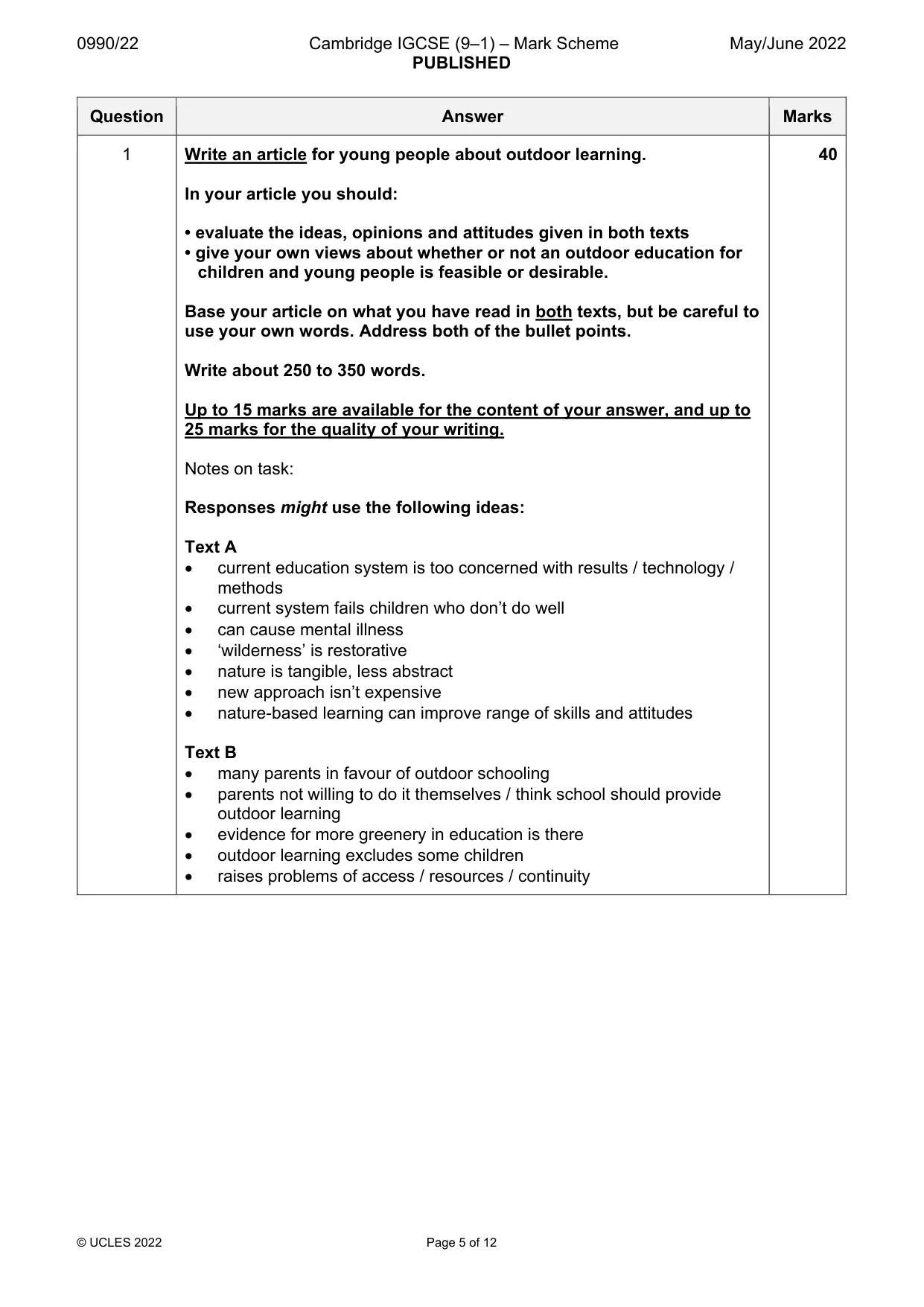
0990/22 Cambridge IGCSE (9–1) – Mark Scheme PUBLISHED May/June 2022 © UCLES 2022 Page 5 of 12 Question Answer Marks 1 Write an article for young people about outdoor learning. In your article you should: • evaluate the ideas, opinions and attitudes given in both texts • give your own views about whether or not an outdoor education for children and young people is feasible or desirable. Base your article on what you have read in both texts, but be careful to use your own words. Address both of the bullet points. Write about 250 to 350 words. Up to 15 marks are available for the content of your answer, and up to 25 marks for the quality of your writing. Notes on task: Responses might use the following ideas: Text A current education system is too concerned with results / technology / methods current system fails children who don’t do well can cause mental illness ‘wilderness’ is restorative nature is tangible, less abstract new approach isn’t expensive nature-based learning can improve range of skills and attitudes Text B many parents in favour of outdoor schooling parents not willing to do it themselves / think school should provide outdoor learning evidence for more greenery in education is there outdoor learning excludes some children raises problems of access / resources / continuity 40
Mark scheme, page 6
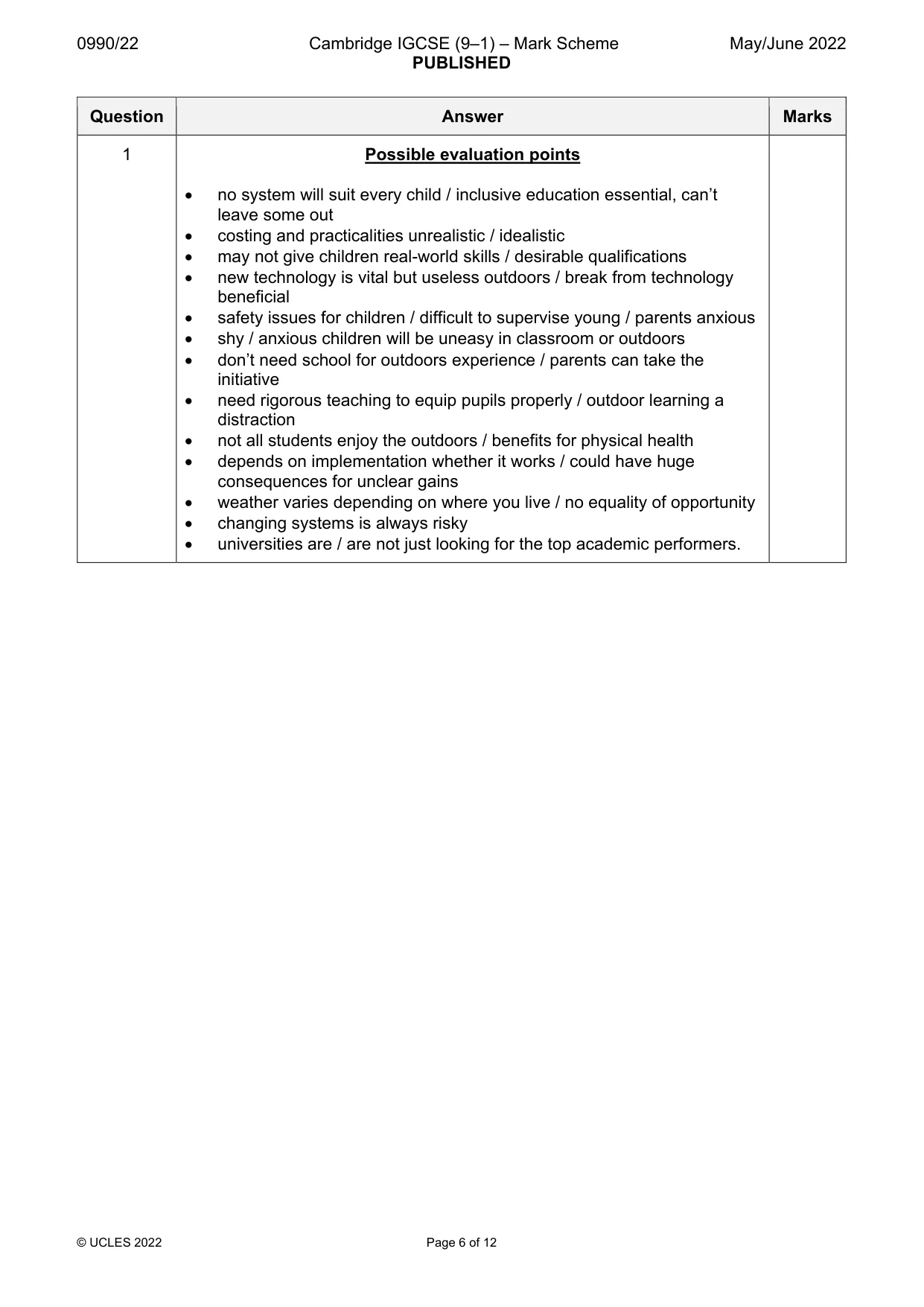
0990/22 Cambridge IGCSE (9–1) – Mark Scheme PUBLISHED May/June 2022 © UCLES 2022 Page 6 of 12 Question Answer Marks 1 Possible evaluation points no system will suit every child / inclusive education essential, can’t leave some out costing and practicalities unrealistic / idealistic may not give children real-world skills / desirable qualifications new technology is vital but useless outdoors / break from technology beneficial safety issues for children / difficult to supervise young / parents anxious shy / anxious children will be uneasy in classroom or outdoors don’t need school for outdoors experience / parents can take the initiative need rigorous teaching to equip pupils properly / outdoor learning a distraction not all students enjoy the outdoors / benefits for physical health depends on implementation whether it works / could have huge consequences for unclear gains weather varies depending on where you live / no equality of opportunity changing systems is always risky universities are / are not just looking for the top academic performers.
Mark scheme, page 7
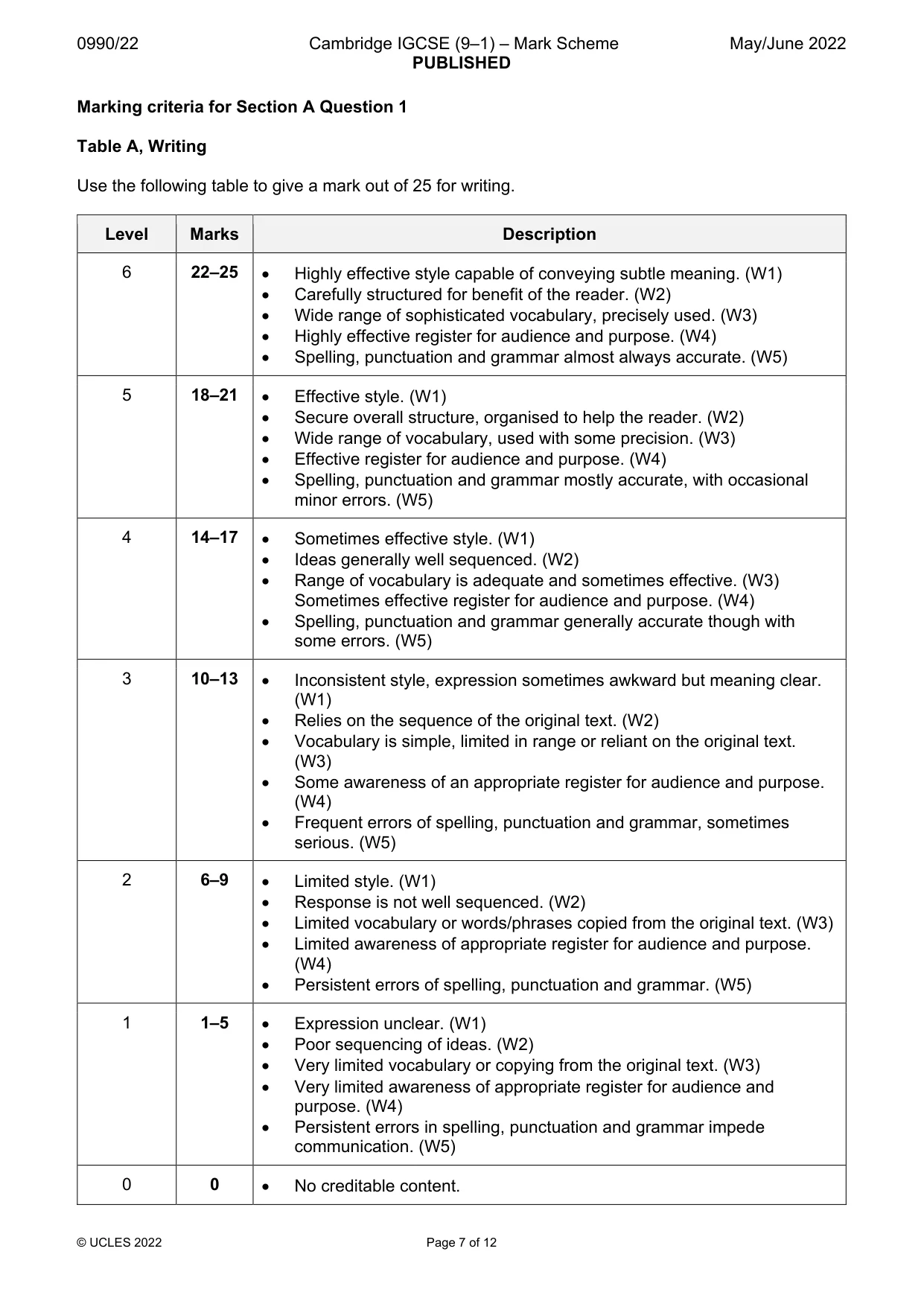
0990/22 Cambridge IGCSE (9–1) – Mark Scheme PUBLISHED May/June 2022 © UCLES 2022 Page 7 of 12 Marking criteria for Section A Question 1 Table A, Writing Use the following table to give a mark out of 25 for writing. Level Marks Description 6 22–25 Highly effective style capable of conveying subtle meaning. (W1) Carefully structured for benefit of the reader. (W2) Wide range of sophisticated vocabulary, precisely used. (W3) Highly effective register for audience and purpose. (W4) Spelling, punctuation and grammar almost always accurate. (W5) 5 18–21 Effective style. (W1) Secure overall structure, organised to help the reader. (W2) Wide range of vocabulary, used with some precision. (W3) Effective register for audience and purpose. (W4) Spelling, punctuation and grammar mostly accurate, with occasional minor errors. (W5) 4 14–17 Sometimes effective style. (W1) Ideas generally well sequenced. (W2) Range of vocabulary is adequate and sometimes effective. (W3) Sometimes effective register for audience and purpose. (W4) Spelling, punctuation and grammar generally accurate though with some errors. (W5) 3 10–13 Inconsistent style, expression sometimes awkward but meaning clear. (W1) Relies on the sequence of the original text. (W2) Vocabulary is simple, limited in range or reliant on the original text. (W3) Some awareness of an appropriate register for audience and purpose. (W4) Frequent errors of spelling, punctuation and grammar, sometimes serious. (W5) 2 6–9 Limited style. (W1) Response is not well sequenced. (W2) Limited vocabulary or words/phrases copied from the original text. (W3) Limited awareness of appropriate register for audience and purpose. (W4) Persistent errors of spelling, punctuation and grammar. (W5) 1 1–5 Expression unclear. (W1) Poor sequencing of ideas. (W2) Very limited vocabulary or copying from the original text. (W3) Very limited awareness of appropriate register for audience and purpose. (W4) Persistent errors in spelling, punctuation and grammar impede communication. (W5) 0 0 No creditable content.
Mark scheme, page 8
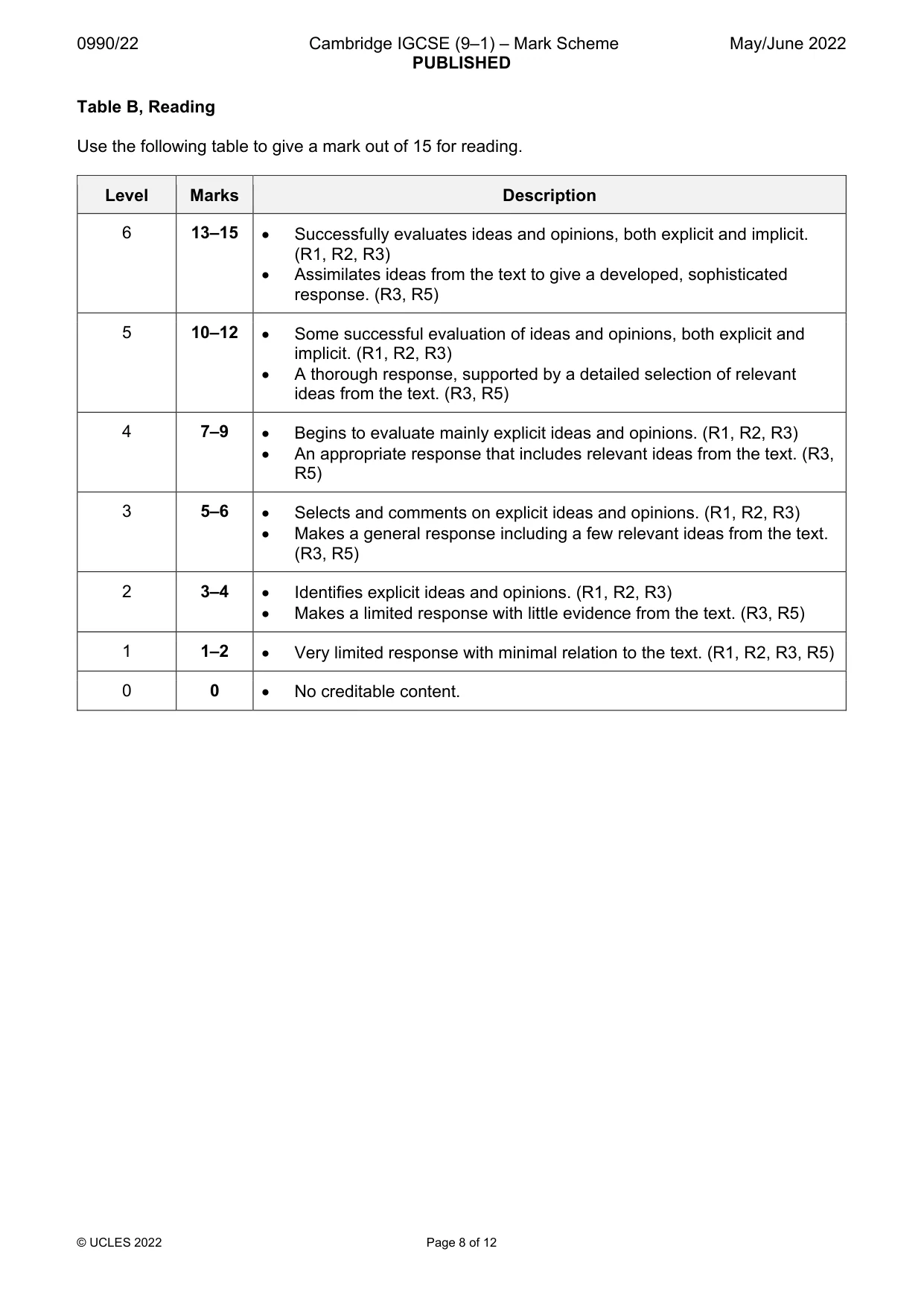
0990/22 Cambridge IGCSE (9–1) – Mark Scheme PUBLISHED May/June 2022 © UCLES 2022 Page 8 of 12 Table B, Reading Use the following table to give a mark out of 15 for reading. Level Marks Description 6 13–15 Successfully evaluates ideas and opinions, both explicit and implicit. (R1, R2, R3) Assimilates ideas from the text to give a developed, sophisticated response. (R3, R5) 5 10–12 Some successful evaluation of ideas and opinions, both explicit and implicit. (R1, R2, R3) A thorough response, supported by a detailed selection of relevant ideas from the text. (R3, R5) 4 7–9 Begins to evaluate mainly explicit ideas and opinions. (R1, R2, R3) An appropriate response that includes relevant ideas from the text. (R3, R5) 3 5–6 Selects and comments on explicit ideas and opinions. (R1, R2, R3) Makes a general response including a few relevant ideas from the text. (R3, R5) 2 3–4 Identifies explicit ideas and opinions. (R1, R2, R3) Makes a limited response with little evidence from the text. (R3, R5) 1 1–2 Very limited response with minimal relation to the text. (R1, R2, R3, R5) 0 0 No creditable content.
Mark scheme, page 9
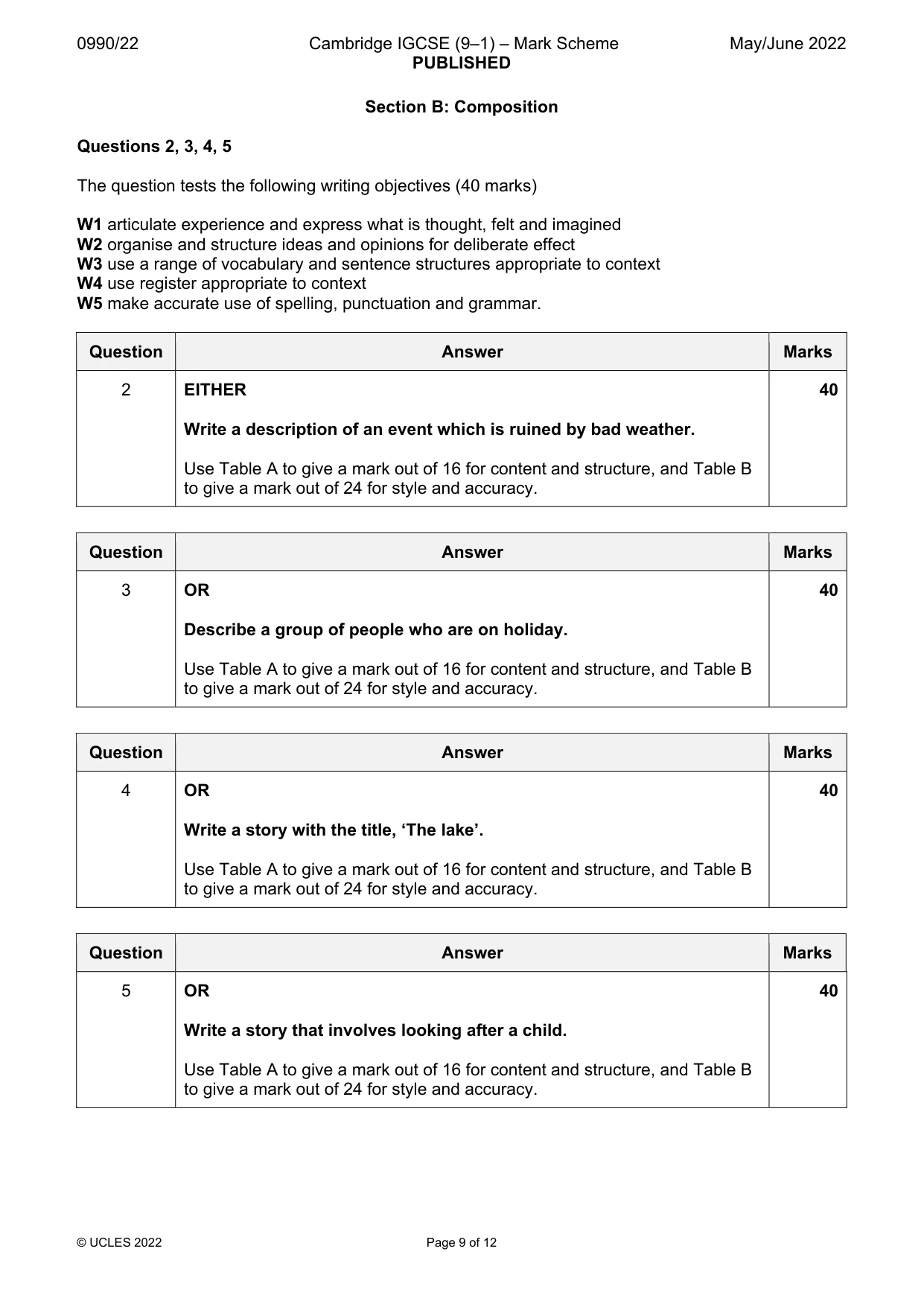
0990/22 Cambridge IGCSE (9–1) – Mark Scheme PUBLISHED May/June 2022 © UCLES 2022 Page 9 of 12 Section B: Composition Questions 2, 3, 4, 5 The question tests the following writing objectives (40 marks) W1 articulate experience and express what is thought, felt and imagined W2 organise and structure ideas and opinions for deliberate effect W3 use a range of vocabulary and sentence structures appropriate to context W4 use register appropriate to context W5 make accurate use of spelling, punctuation and grammar. Question Answer Marks 2 EITHER Write a description of an event which is ruined by bad weather. Use Table A to give a mark out of 16 for content and structure, and Table B to give a mark out of 24 for style and accuracy. 40 Question Answer Marks 3 OR Describe a group of people who are on holiday. Use Table A to give a mark out of 16 for content and structure, and Table B to give a mark out of 24 for style and accuracy. 40 Question Answer Marks 4 OR Write a story with the title, ‘The lake’. Use Table A to give a mark out of 16 for content and structure, and Table B to give a mark out of 24 for style and accuracy. 40 Question Answer Marks 5 OR Write a story that involves looking after a child. Use Table A to give a mark out of 16 for content and structure, and Table B to give a mark out of 24 for style and accuracy. 40
Mark scheme, page 10
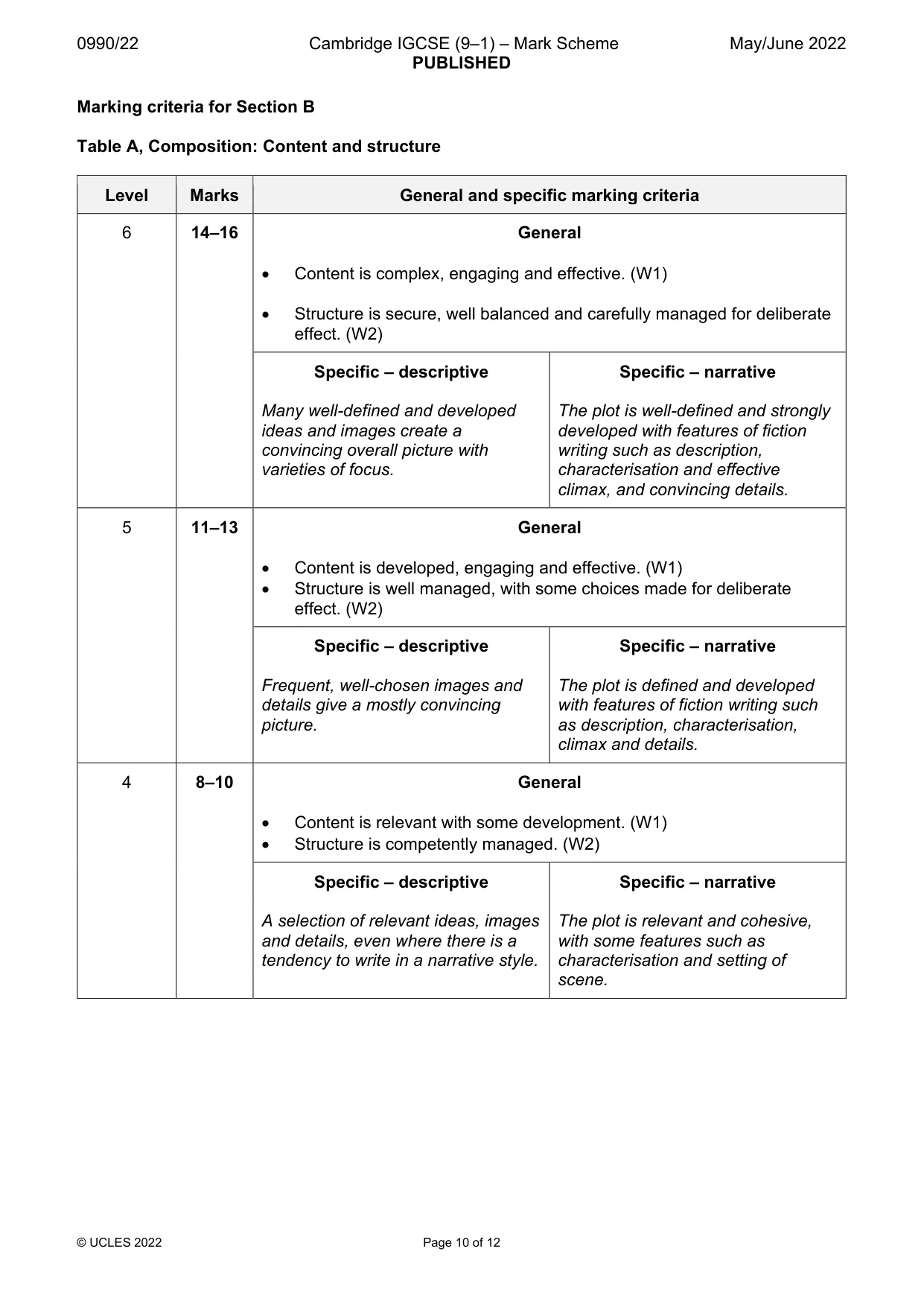
0990/22 Cambridge IGCSE (9–1) – Mark Scheme PUBLISHED May/June 2022 © UCLES 2022 Page 10 of 12 Marking criteria for Section B Table A, Composition: Content and structure Level Marks General and specific marking criteria 6 14–16 General Content is complex, engaging and effective. (W1) Structure is secure, well balanced and carefully managed for deliberate effect. (W2) Specific – descriptive Many well-defined and developed ideas and images create a convincing overall picture with varieties of focus. Specific – narrative The plot is well-defined and strongly developed with features of fiction writing such as description, characterisation and effective climax, and convincing details. 5 11–13 General Content is developed, engaging and effective. (W1) Structure is well managed, with some choices made for deliberate effect. (W2) Specific – descriptive Frequent, well-chosen images and details give a mostly convincing picture. Specific – narrative The plot is defined and developed with features of fiction writing such as description, characterisation, climax and details. 4 8–10 General Content is relevant with some development. (W1) Structure is competently managed. (W2) Specific – descriptive A selection of relevant ideas, images and details, even where there is a tendency to write in a narrative style. Specific – narrative The plot is relevant and cohesive, with some features such as characterisation and setting of scene.
Mark scheme, page 11
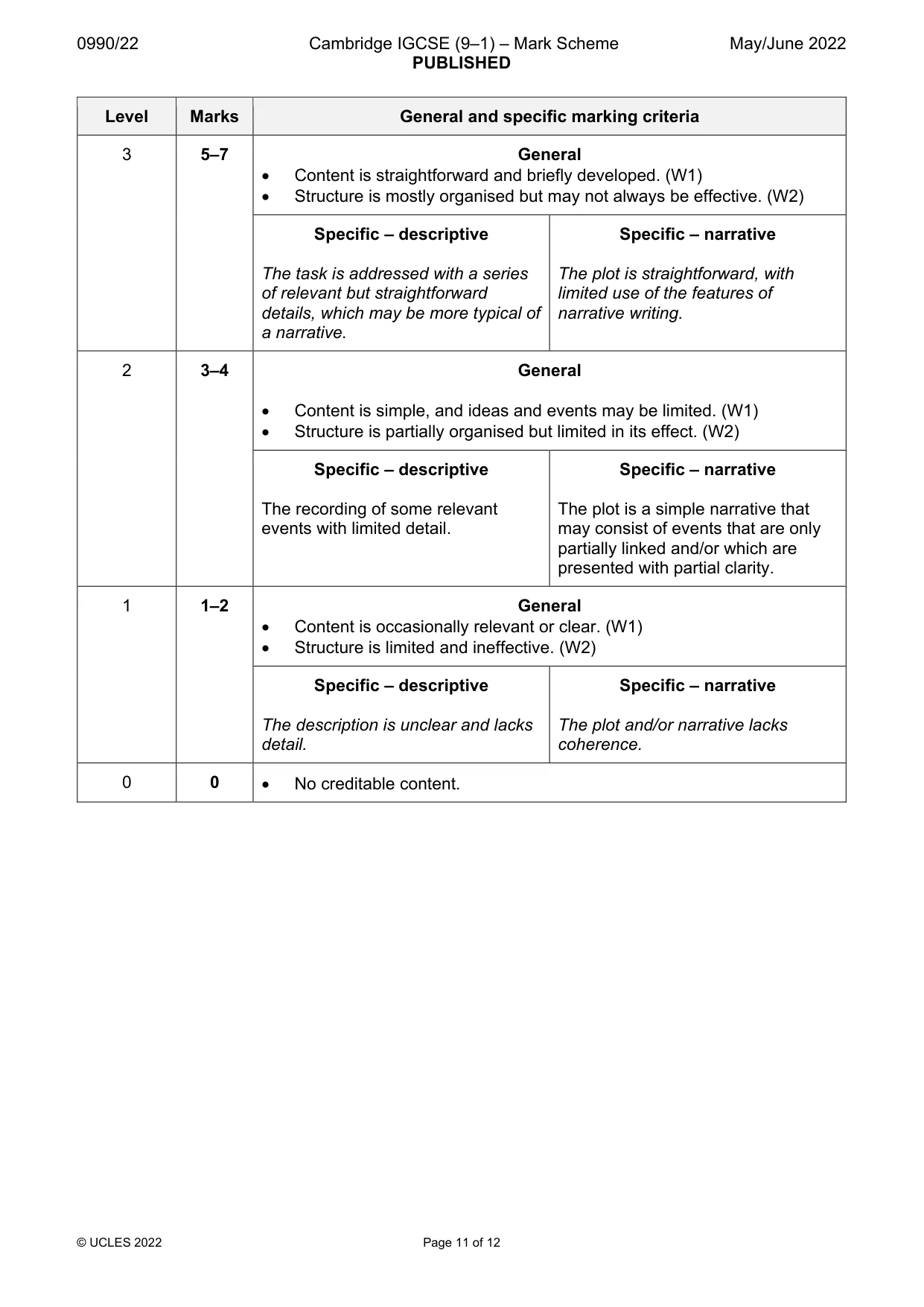
0990/22 Cambridge IGCSE (9–1) – Mark Scheme PUBLISHED May/June 2022 © UCLES 2022 Page 11 of 12 Level Marks General and specific marking criteria 3 5–7 General Content is straightforward and briefly developed. (W1) Structure is mostly organised but may not always be effective. (W2) Specific – descriptive The task is addressed with a series of relevant but straightforward details, which may be more typical of a narrative. Specific – narrative The plot is straightforward, with limited use of the features of narrative writing. 2 3–4 General Content is simple, and ideas and events may be limited. (W1) Structure is partially organised but limited in its effect. (W2) Specific – descriptive The recording of some relevant events with limited detail. Specific – narrative The plot is a simple narrative that may consist of events that are only partially linked and/or which are presented with partial clarity. 1 1–2 General Content is occasionally relevant or clear. (W1) Structure is limited and ineffective. (W2) Specific – descriptive The description is unclear and lacks detail. Specific – narrative The plot and/or narrative lacks coherence. 0 0 No creditable content.
Mark scheme, page 12
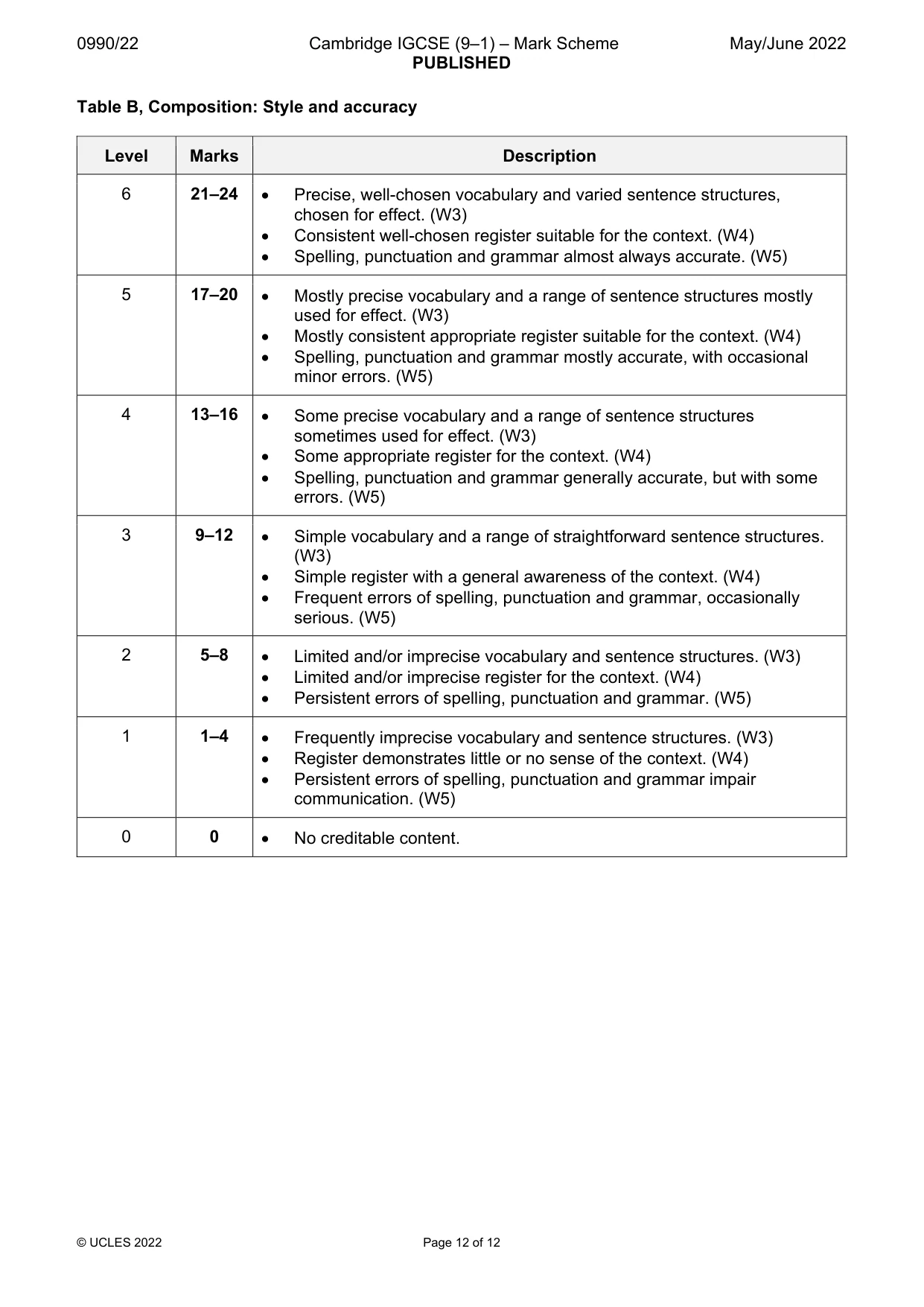
0990/22 Cambridge IGCSE (9–1) – Mark Scheme PUBLISHED May/June 2022 © UCLES 2022 Page 12 of 12 Table B, Composition: Style and accuracy Level Marks Description 6 21–24 Precise, well-chosen vocabulary and varied sentence structures, chosen for effect. (W3) Consistent well-chosen register suitable for the context. (W4) Spelling, punctuation and grammar almost always accurate. (W5) 5 17–20 Mostly precise vocabulary and a range of sentence structures mostly used for effect. (W3) Mostly consistent appropriate register suitable for the context. (W4) Spelling, punctuation and grammar mostly accurate, with occasional minor errors. (W5) 4 13–16 Some precise vocabulary and a range of sentence structures sometimes used for effect. (W3) Some appropriate register for the context. (W4) Spelling, punctuation and grammar generally accurate, but with some errors. (W5) 3 9–12 Simple vocabulary and a range of straightforward sentence structures. (W3) Simple register with a general awareness of the context. (W4) Frequent errors of spelling, punctuation and grammar, occasionally serious. (W5) 2 5–8 Limited and/or imprecise vocabulary and sentence structures. (W3) Limited and/or imprecise register for the context. (W4) Persistent errors of spelling, punctuation and grammar. (W5) 1 1–4 Frequently imprecise vocabulary and sentence structures. (W3) Register demonstrates little or no sense of the context. (W4) Persistent errors of spelling, punctuation and grammar impair communication. (W5) 0 0 No creditable content.
What you needed in this session
Cambridge’s own grade thresholds for 2022 May/June, Paper 2 · Variant 2. A higher threshold means an easier paper — the bar moves with how the cohort did.