Cambridge IGCSE English - First Language 0500 — 2022 Oct/Nov Paper 1 · Variant 1
0500/11/O/N/22 · 80 marks · ≈90 min
The question paper and its mark scheme, free to read here and free to download. This is Cambridge’s own paper, exactly as it was sat.
Question paper16 pages


Mark scheme20 pages
Answers below. Sit the paper first if you are practising.
Paper as text
Question paper, page 1
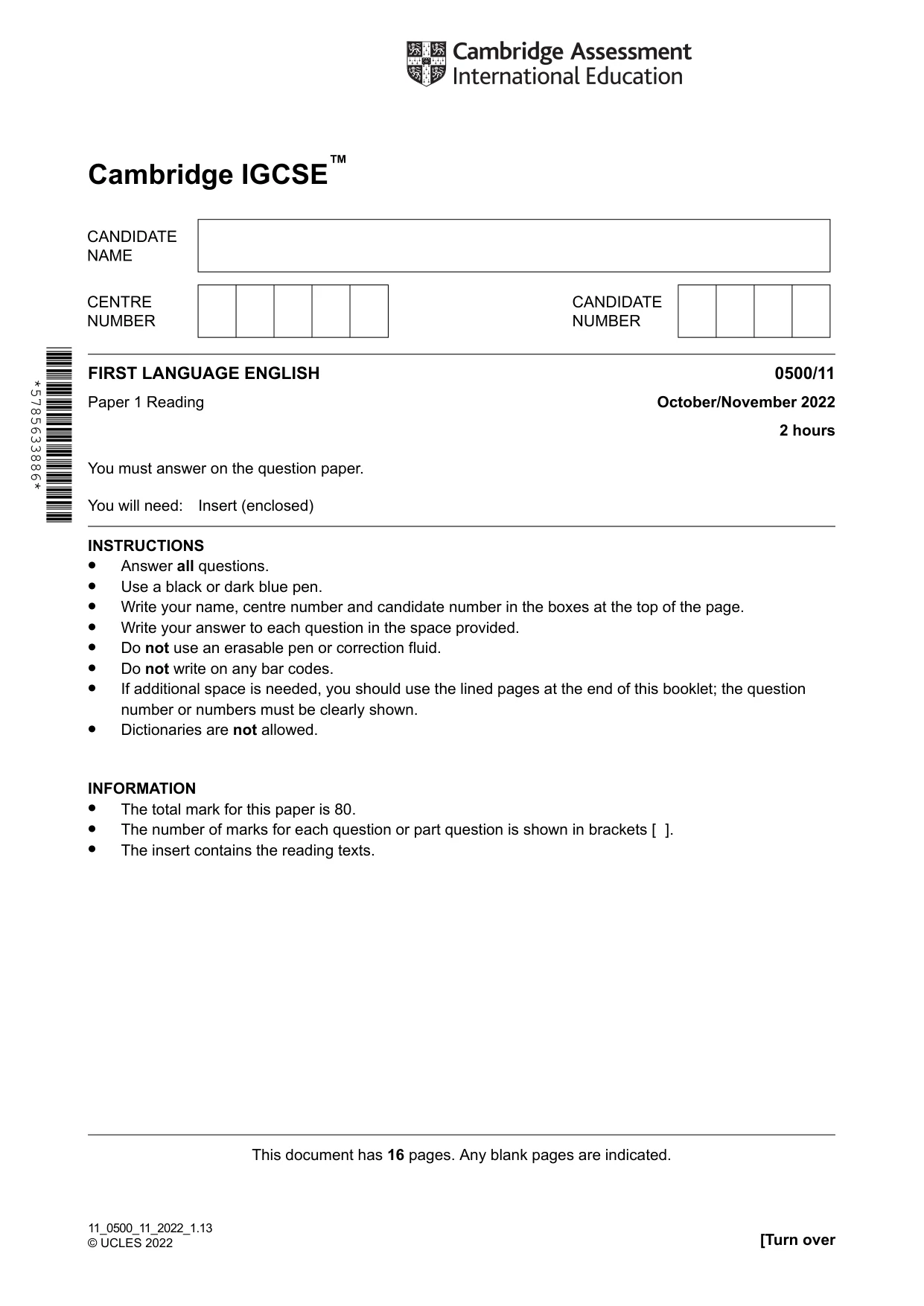
Cambridge IGCSE™ 0500/11 FIRST LANGUAGE ENGLISH October/November 2022 Paper 1 Reading 2 hours You must answer on the question paper. You will need: Insert (enclosed) INSTRUCTIONS • Answer all questions. • Use a black or dark blue pen. • Write your name, centre number and candidate number in the boxes at the top of the page. • Write your answer to each question in the space provided. • Do not use an erasable pen or correction fluid. • Do not write on any bar codes. • If additional space is needed, you should use the lined pages at the end of this booklet; the question number or numbers must be clearly shown. • Dictionaries are not allowed. INFORMATION • The total mark for this paper is 80. • The number of marks for each question or part question is shown in brackets [ ]. • The insert contains the reading texts. This document has 16 pages. Any blank pages are indicated. [Turn over 11_0500_11_2022_1.13 © UCLES 2022 *5785633886*
Question paper, page 2
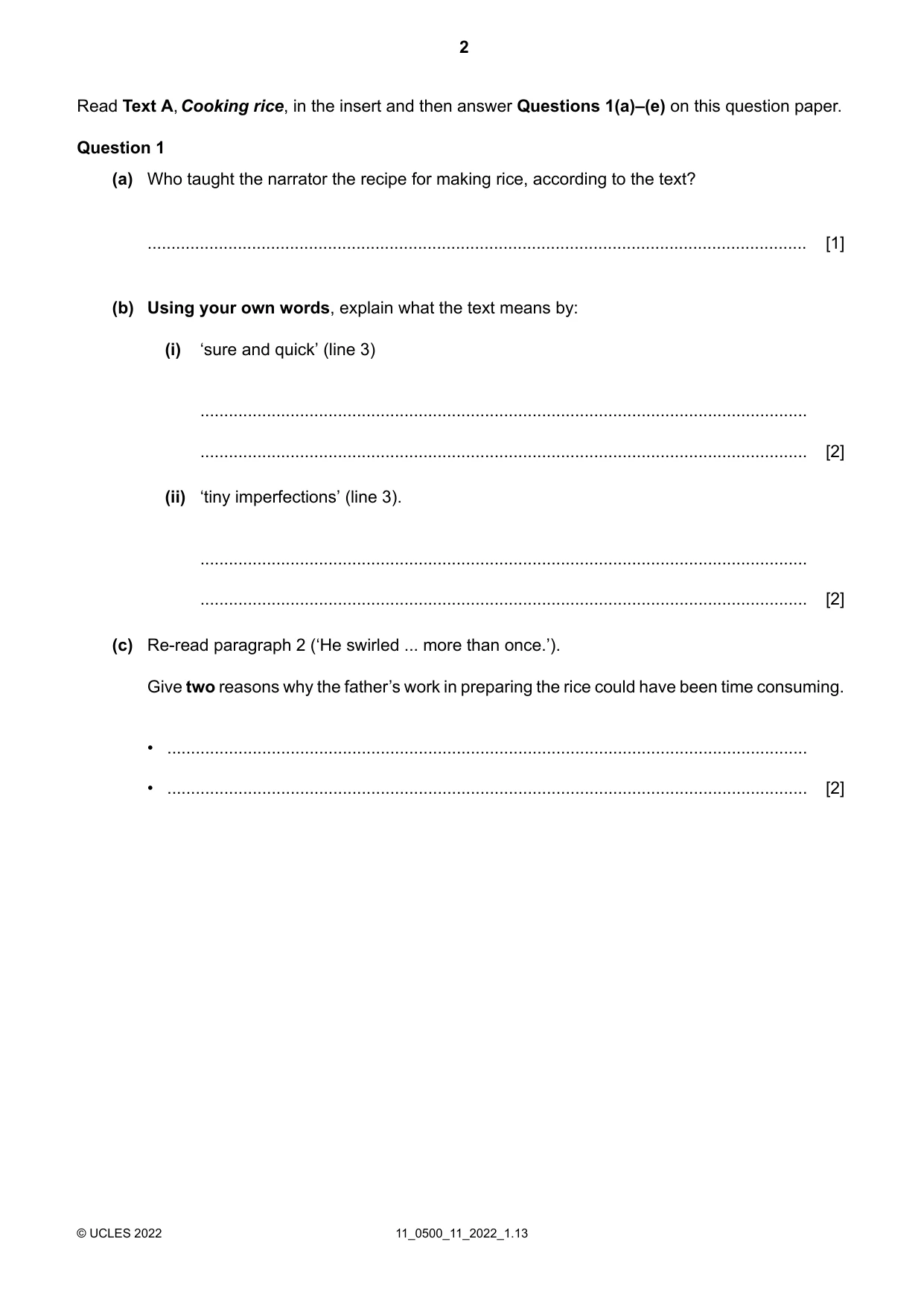
Read Text A,Cooking rice, in the insert and then answer Questions 1(a)–(e) on this question paper. Question 1 Who taught the narrator the recipe for making rice, according to the text? (a) … [1] Using your own words, explain what the text means by: (b) ‘sure and quick’ (line 3) (i) … … [2] ‘tiny imperfections’ (line 3). (ii) … … [2] Re-read paragraph 2 (‘He swirled ... more than once.’). (c) Give two reasons why the father’s work in preparing the rice could have been time consuming. • … • … [2] 11_0500_11_2022_1.13 © UCLES 2022 2
Question paper, page 3
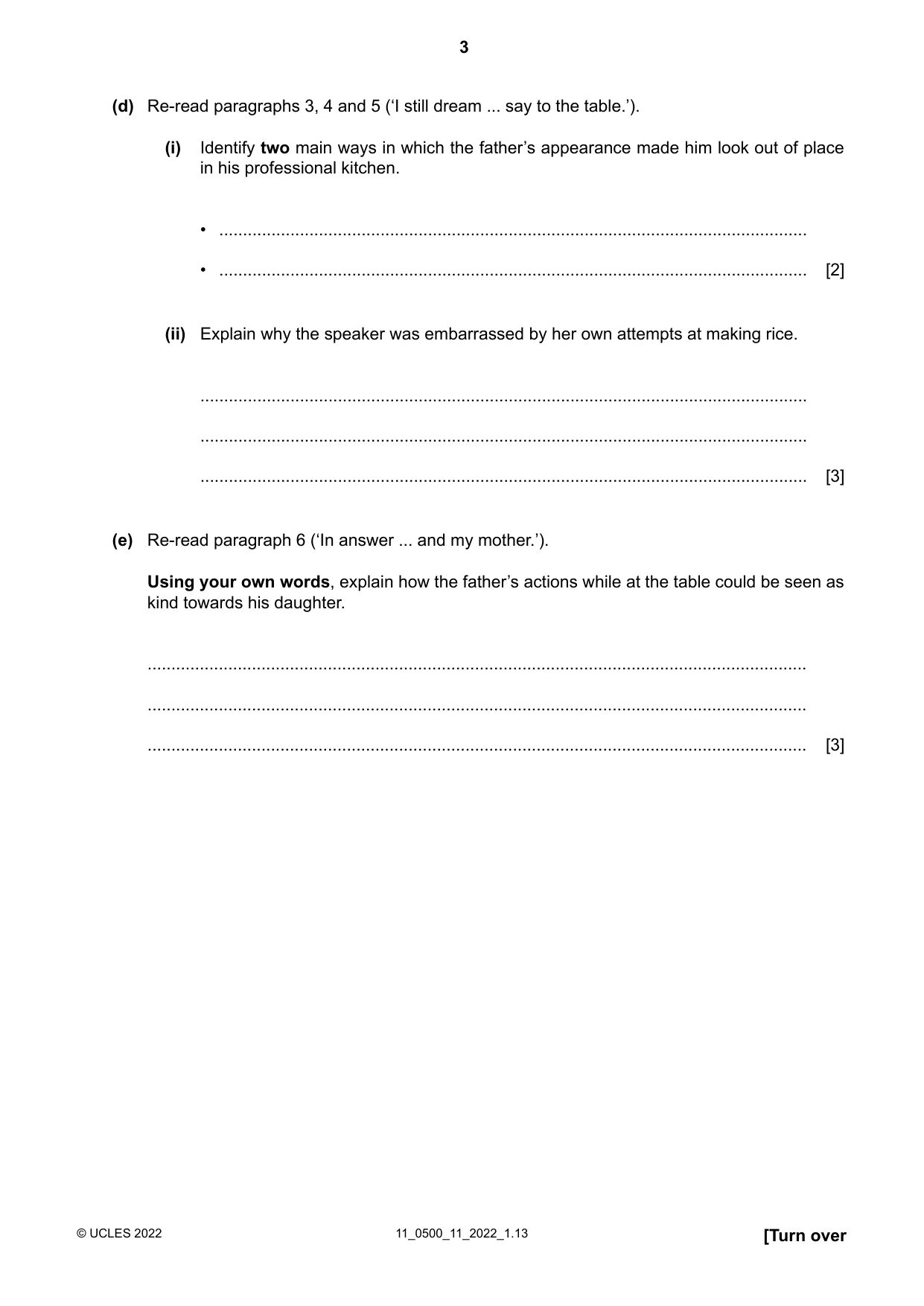
Re-read paragraphs 3, 4 and 5 (‘I still dream ... say to the table.’). (d) Identify two main ways in which the father’s appearance made him look out of place in his professional kitchen. (i) • … • … [2] Explain why the speaker was embarrassed by her own attempts at making rice. (ii) … … … [3] Re-read paragraph 6 (‘In answer ... and my mother.’). (e) Using your own words, explain how the father’s actions while at the table could be seen as kind towards his daughter. … … … [3] [Turn over 11_0500_11_2022_1.13 © UCLES 2022 3
Question paper, page 4
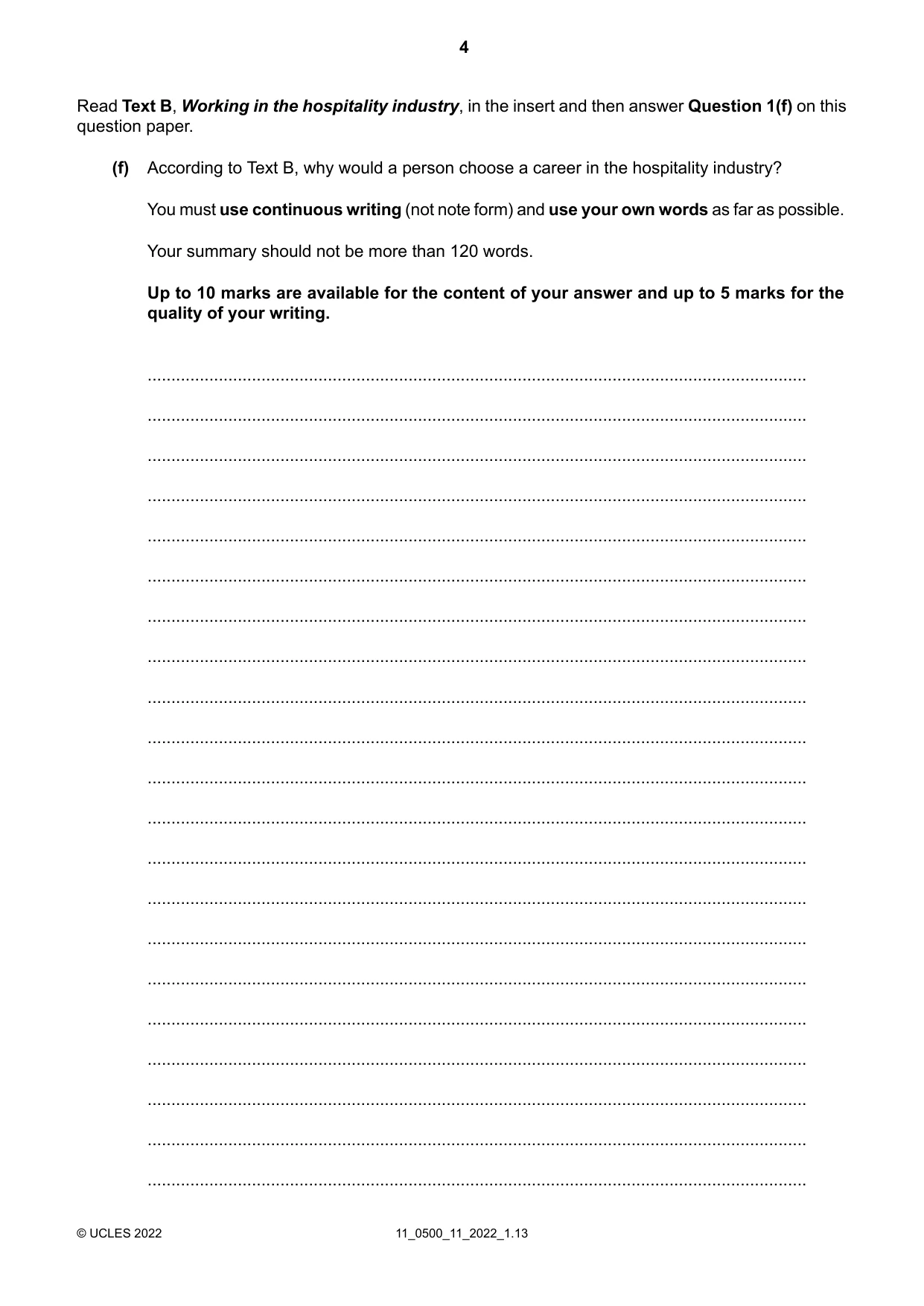
Read Text B, Working in the hospitality industry, in the insert and then answer Question 1(f) on this question paper. According to Text B, why would a person choose a career in the hospitality industry? (f) You must use continuous writing (not note form) and use your own words as far as possible. Your summary should not be more than 120 words. Up to 10 marks are available for the content of your answer and up to 5 marks for the quality of your writing. … … … … … … … … … … … … … … … … … … … … … 11_0500_11_2022_1.13 © UCLES 2022 4
Question paper, page 5
… … … … … … … … … … … … … … … … … … … … … … … … … … [15] [Total: 30] [Turn over 11_0500_11_2022_1.13 © UCLES 2022 5
Question paper, page 6
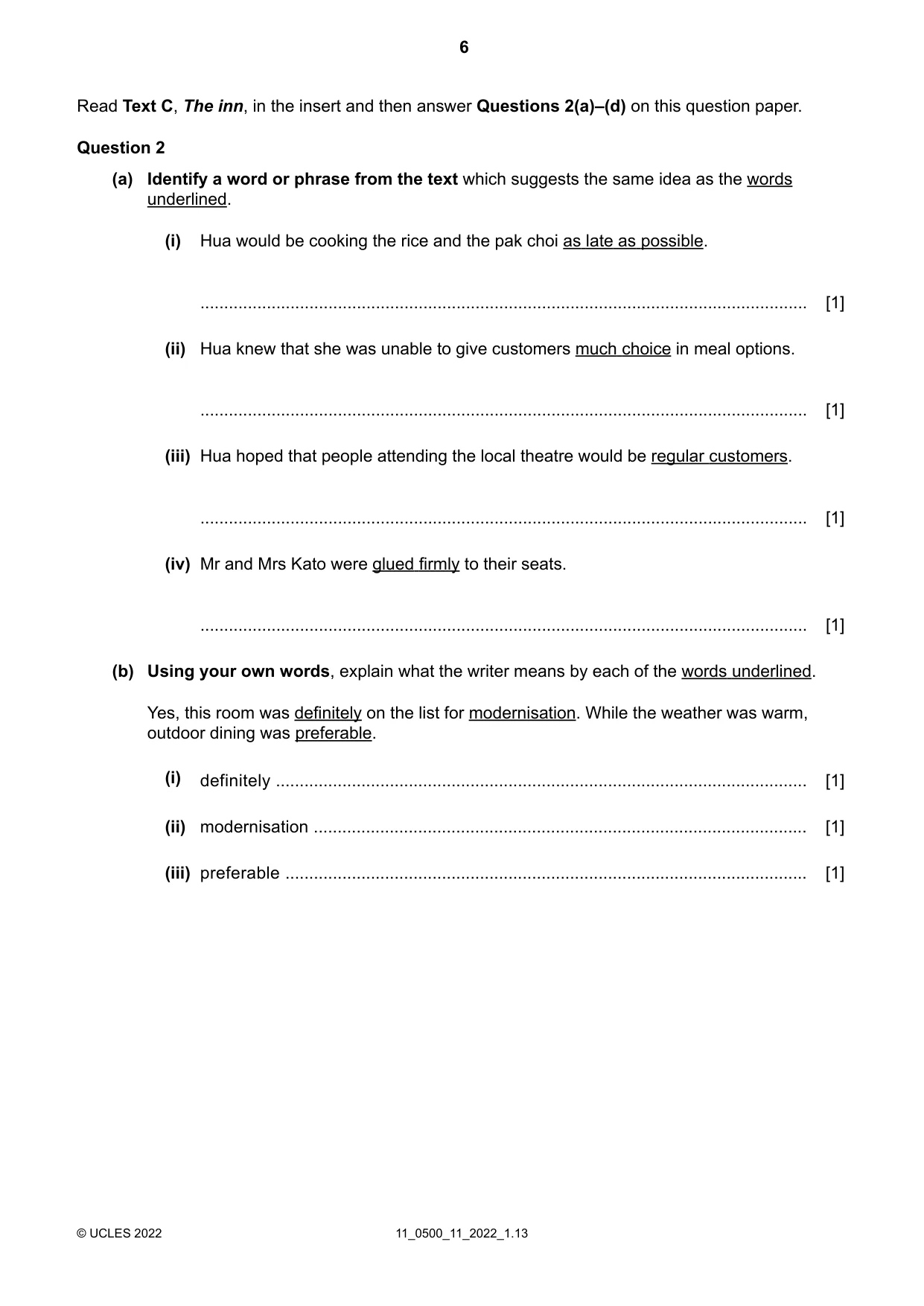
Read Text C, The inn, in the insert and then answer Questions 2(a)–(d) on this question paper. Question 2 Identify a word or phrase from the text which suggests the same idea as the words underlined. (a) Hua would be cooking the rice and the pak choi as late as possible. (i) … [1] Hua knew that she was unable to give customers much choice in meal options. (ii) … [1] Hua hoped that people attending the local theatre would be regular customers. (iii) … [1] Mr and Mrs Kato were glued firmly to their seats. (iv) … [1] Using your own words, explain what the writer means by each of the words underlined. (b) Yes, this room was definitely on the list for modernisation. While the weather was warm, outdoor dining was preferable. (i) definitely … [1] (ii) modernisation … [1] (iii) preferable … [1] 11_0500_11_2022_1.13 © UCLES 2022 6
Question paper, page 7
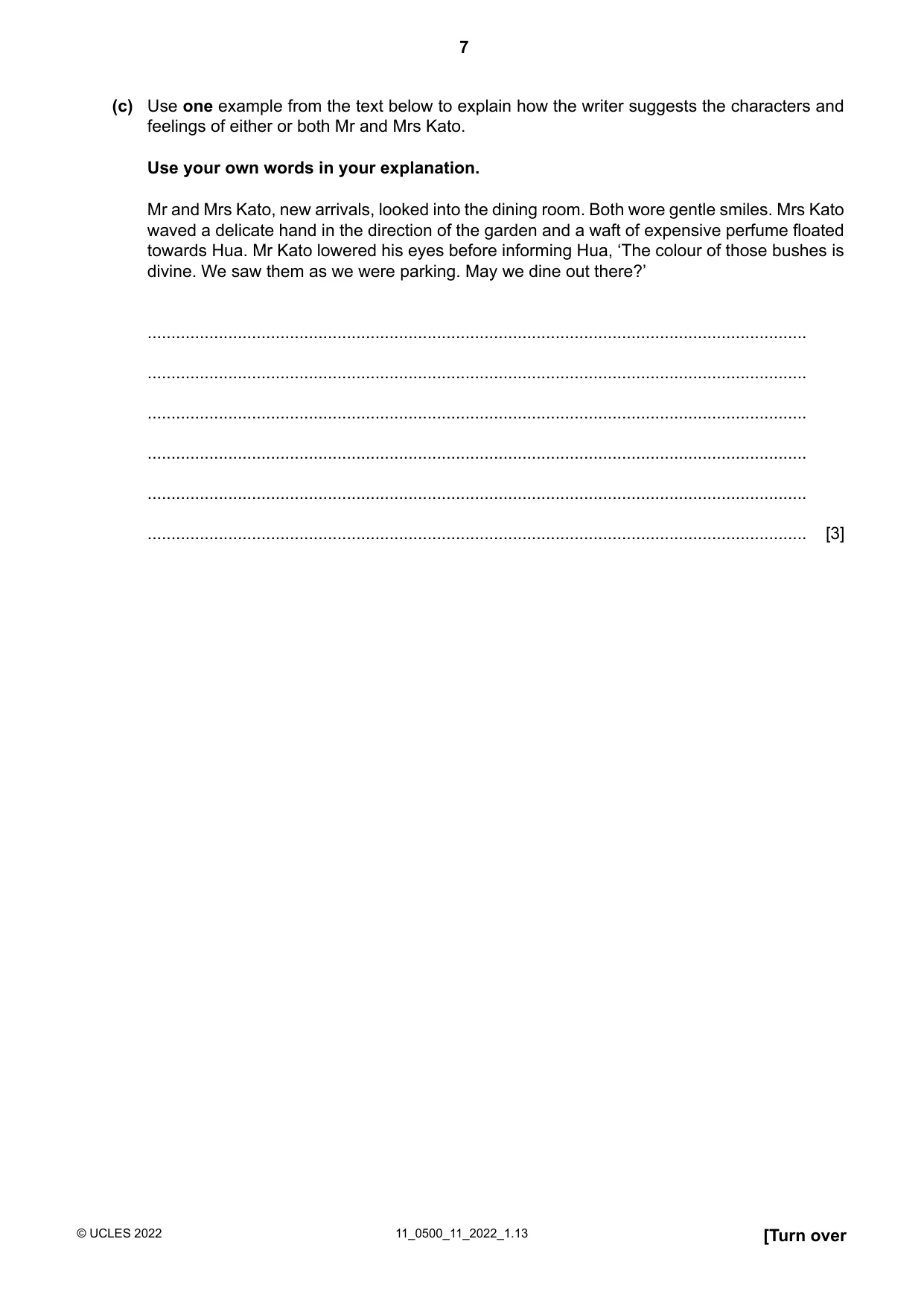
Use one example from the text below to explain how the writer suggests the characters and feelings of either or both Mr and Mrs Kato. (c) Use your own words in your explanation. Mr and Mrs Kato, new arrivals, looked into the dining room. Both wore gentle smiles. Mrs Kato waved a delicate hand in the direction of the garden and a waft of expensive perfume floated towards Hua. Mr Kato lowered his eyes before informing Hua, ‘The colour of those bushes is divine. We saw them as we were parking. May we dine out there?’ … … … … … … [3] [Turn over 11_0500_11_2022_1.13 © UCLES 2022 7
Question paper, page 8
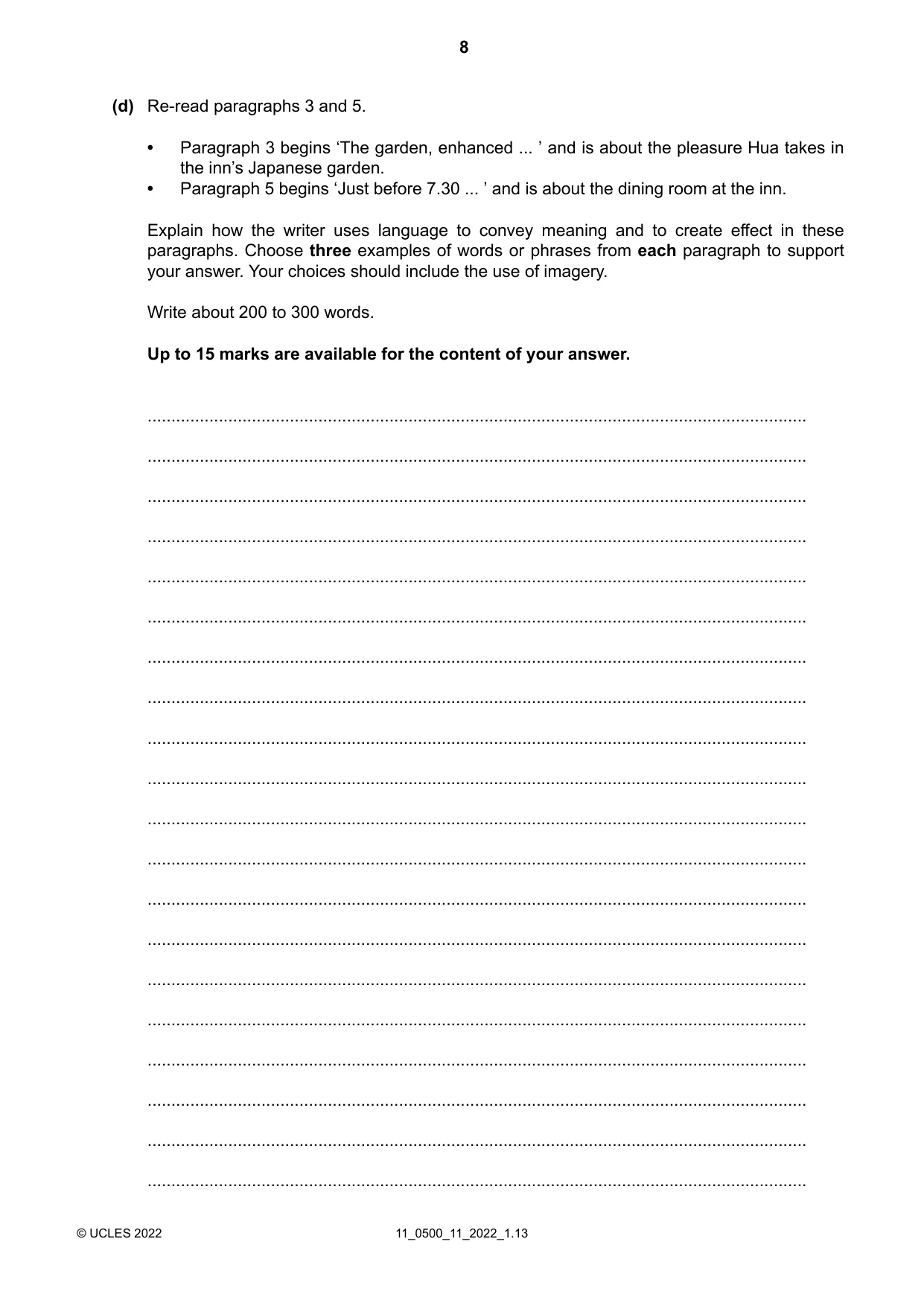
Re-read paragraphs 3 and 5. (d) • Paragraph 3 begins ‘The garden, enhanced ... ’ and is about the pleasure Hua takes in the inn’s Japanese garden. • Paragraph 5 begins ‘Just before 7.30 ... ’ and is about the dining room at the inn. Explain how the writer uses language to convey meaning and to create effect in these paragraphs. Choose three examples of words or phrases from each paragraph to support your answer. Your choices should include the use of imagery. Write about 200 to 300 words. Up to 15 marks are available for the content of your answer. … … … … … … … … … … … … … … … … … … … … 11_0500_11_2022_1.13 © UCLES 2022 8
Question paper, page 9
… … … … … … … … … … … … … … … … … … … … … … … … … … [15] [Total: 25] [Turn over 11_0500_11_2022_1.13 © UCLES 2022 9
Question paper, page 10
Re-read Text C, The inn, in the insert and then answer Question 3 on this question paper. Question 3 You are Hua, the owner of the inn. The next day you write a letter to your father back home telling him about your new business venture. In your letter you should: • describe the inn and what you hope will appeal to guests • describe the guests that you met on the first day and what you felt about them • explain what plans you have for developing the business in the future and how you hope to accomplish these plans. Write the words of the letter. Base your letter on what you have read in Text C, but be careful to use your own words. Address each of the three bullet points. Write about 250 to 350 words. Up to 15 marks are available for the content of your answer, and up to 10 marks for the quality of your writing. … … … … … … … … … … … … … … … 11_0500_11_2022_1.13 © UCLES 2022 10
Question paper, page 11
… … … … … … … … … … … … … … … … … … … … … … … … … … … … [25] [Turn over 11_0500_11_2022_1.13 © UCLES 2022 11
Question paper, page 12
Additional Page If you use the following lined page to complete the answer(s) to any question(s), the question number(s) must be clearly shown. … … … … … … … … … … … … … … … … … … … … … … … … … 11_0500_11_2022_1.13 © UCLES 2022 12
Question paper, page 13
Additional Page If you use the following lined page to complete the answer(s) to any question(s), the question number(s) must be clearly shown. … … … … … … … … … … … … … … … … … … … … … … … … … 11_0500_11_2022_1.13 © UCLES 2022 13
Question paper, page 14
BLANK PAGE 11_0500_11_2022_1.13 © UCLES 2022 14
Question paper, page 15
BLANK PAGE 11_0500_11_2022_1.13 © UCLES 2022 15
Question paper, page 16
BLANK PAGE Permission to reproduce items where third-party owned material protected by copyright is included has been sought and cleared where possible. Every reasonable effort has been made by the publisher (UCLES) to trace copyright holders, but if any items requiring clearance have unwittingly been included, the publisher will be pleased to make amends at the earliest possible opportunity. To avoid the issue of disclosure of answer-related information to candidates, all copyright acknowledgements are reproduced online in the Cambridge Assessment International Education Copyright Acknowledgements Booklet. This is produced for each series of examinations and is freely available to download at www.cambridgeinternational.org after the live examination series. Cambridge Assessment International Education is part of Cambridge Assessment. Cambridge Assessment is the brand name of the University of Cambridge Local Examinations Syndicate (UCLES), which is a department of the University of Cambridge. 11_0500_11_2022_1.13 © UCLES 2022 16
Mark scheme, page 1
This document consists of 20 printed pages. © UCLES 2022 [Turn over Cambridge IGCSE™ FIRST LANGUAGE ENGLISH 0500/11 Paper 1 Reading October/November 2022 MARK SCHEME Maximum Mark: 80 Published This mark scheme is published as an aid to teachers and candidates, to indicate the requirements of the examination. It shows the basis on which Examiners were instructed to award marks. It does not indicate the details of the discussions that took place at an Examiners’ meeting before marking began, which would have considered the acceptability of alternative answers. Mark schemes should be read in conjunction with the question paper and the Principal Examiner Report for Teachers. Cambridge International will not enter into discussions about these mark schemes. Cambridge International is publishing the mark schemes for the October/November 2022 series for most Cambridge IGCSE™, Cambridge International A and AS Level components and some Cambridge O Level components.
Mark scheme, page 2
0500/11 Cambridge IGCSE – Mark Scheme PUBLISHED October/November 2022 © UCLES 2022 Page 2 of 20 Generic Marking Principles These general marking principles must be applied by all examiners when marking candidate answers. They should be applied alongside the specific content of the mark scheme or generic level descriptors for a question. Each question paper and mark scheme will also comply with these marking principles. GENERIC MARKING PRINCIPLE 1: Marks must be awarded in line with: • the specific content of the mark scheme or the generic level descriptors for the question • the specific skills defined in the mark scheme or in the generic level descriptors for the question • the standard of response required by a candidate as exemplified by the standardisation scripts. GENERIC MARKING PRINCIPLE 2: Marks awarded are always whole marks (not half marks, or other fractions). GENERIC MARKING PRINCIPLE 3: Marks must be awarded positively: • marks are awarded for correct/valid answers, as defined in the mark scheme. However, credit is given for valid answers which go beyond the scope of the syllabus and mark scheme, referring to your Team Leader as appropriate • marks are awarded when candidates clearly demonstrate what they know and can do • marks are not deducted for errors • marks are not deducted for omissions • answers should only be judged on the quality of spelling, punctuation and grammar when these features are specifically assessed by the question as indicated by the mark scheme. The meaning, however, should be unambiguous. GENERIC MARKING PRINCIPLE 4: Rules must be applied consistently, e.g. in situations where candidates have not followed instructions or in the application of generic level descriptors. GENERIC MARKING PRINCIPLE 5: Marks should be awarded using the full range of marks defined in the mark scheme for the question (however; the use of the full mark range may be limited according to the quality of the candidate responses seen). GENERIC MARKING PRINCIPLE 6: Marks awarded are based solely on the requirements as defined in the mark scheme. Marks should not be awarded with grade thresholds or grade descriptors in mind.
Mark scheme, page 3
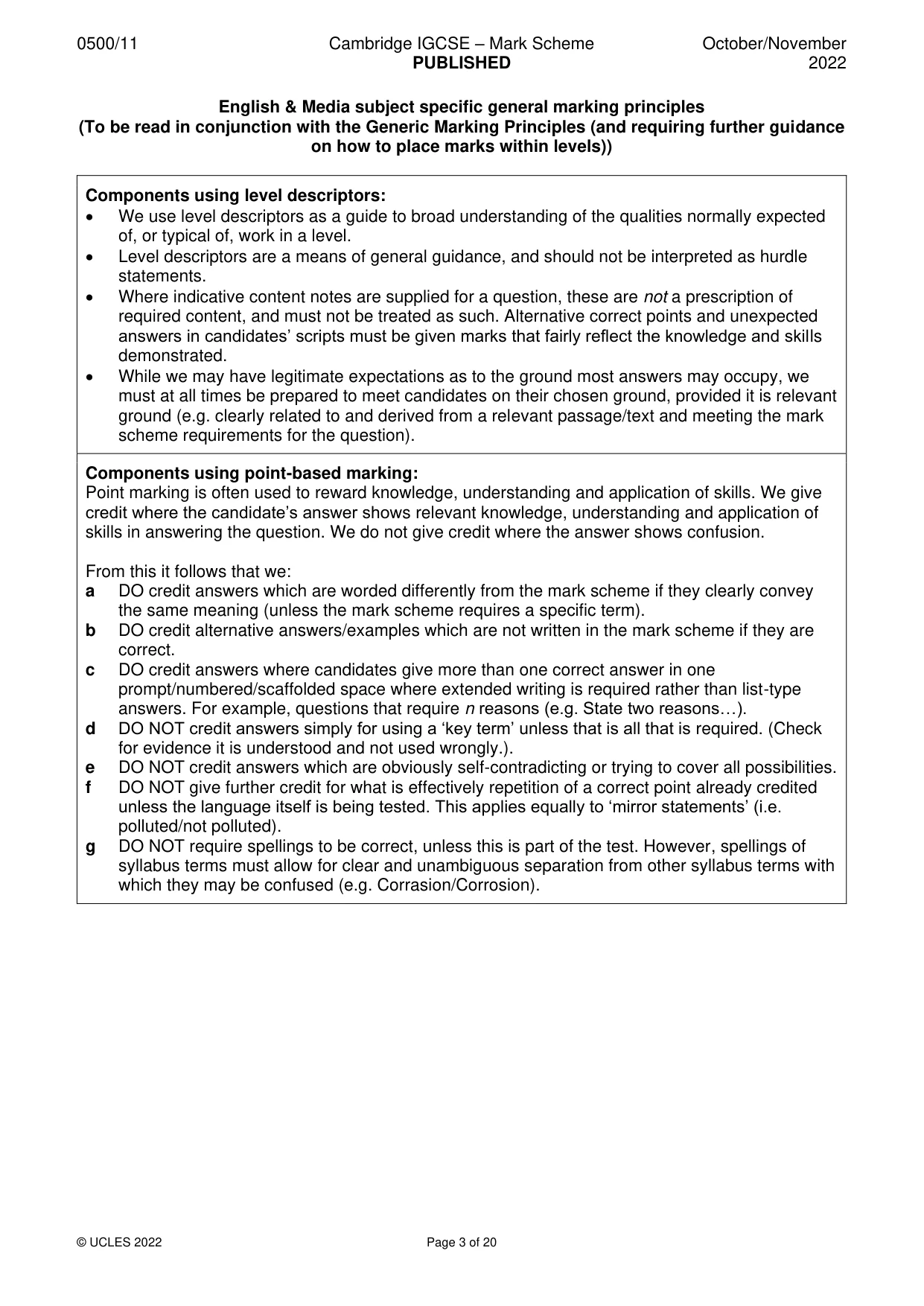
0500/11 Cambridge IGCSE – Mark Scheme PUBLISHED October/November 2022 © UCLES 2022 Page 3 of 20 English & Media subject specific general marking principles (To be read in conjunction with the Generic Marking Principles (and requiring further guidance on how to place marks within levels)) Components using level descriptors: • We use level descriptors as a guide to broad understanding of the qualities normally expected of, or typical of, work in a level. • Level descriptors are a means of general guidance, and should not be interpreted as hurdle statements. • Where indicative content notes are supplied for a question, these are not a prescription of required content, and must not be treated as such. Alternative correct points and unexpected answers in candidates’ scripts must be given marks that fairly reflect the knowledge and skills demonstrated. • While we may have legitimate expectations as to the ground most answers may occupy, we must at all times be prepared to meet candidates on their chosen ground, provided it is relevant ground (e.g. clearly related to and derived from a relevant passage/text and meeting the mark scheme requirements for the question). Components using point-based marking: Point marking is often used to reward knowledge, understanding and application of skills. We give credit where the candidate’s answer shows relevant knowledge, understanding and application of skills in answering the question. We do not give credit where the answer shows confusion. From this it follows that we: a DO credit answers which are worded differently from the mark scheme if they clearly convey the same meaning (unless the mark scheme requires a specific term). b DO credit alternative answers/examples which are not written in the mark scheme if they are correct. c DO credit answers where candidates give more than one correct answer in one prompt/numbered/scaffolded space where extended writing is required rather than list-type answers. For example, questions that require n reasons (e.g. State two reasons…). d DO NOT credit answers simply for using a ‘key term’ unless that is all that is required. (Check for evidence it is understood and not used wrongly.). e DO NOT credit answers which are obviously self-contradicting or trying to cover all possibilities. f DO NOT give further credit for what is effectively repetition of a correct point already credited unless the language itself is being tested. This applies equally to ‘mirror statements’ (i.e. polluted/not polluted). g DO NOT require spellings to be correct, unless this is part of the test. However, spellings of syllabus terms must allow for clear and unambiguous separation from other syllabus terms with which they may be confused (e.g. Corrasion/Corrosion).
Mark scheme, page 4
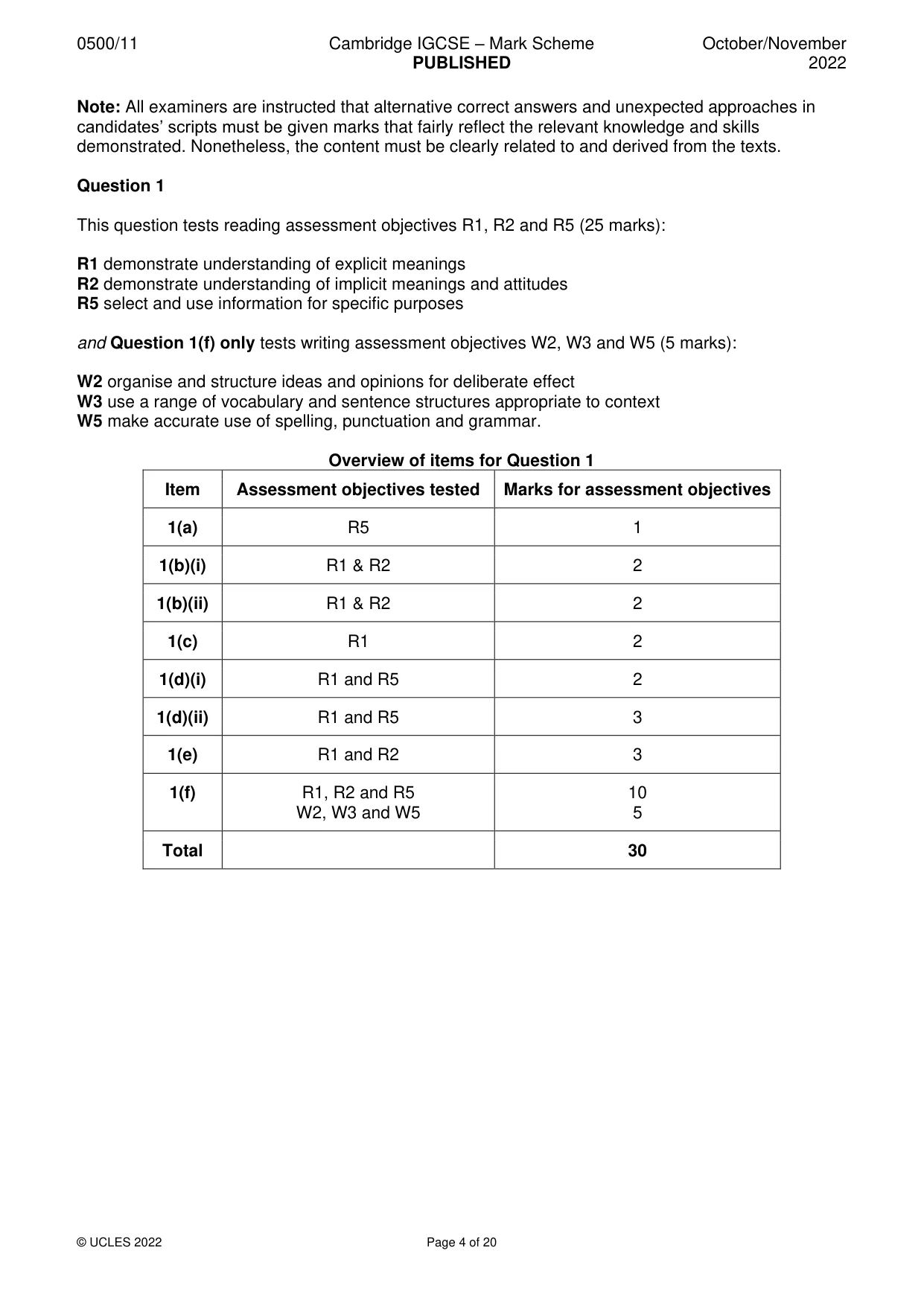
0500/11 Cambridge IGCSE – Mark Scheme PUBLISHED October/November 2022 © UCLES 2022 Page 4 of 20 Note: All examiners are instructed that alternative correct answers and unexpected approaches in candidates’ scripts must be given marks that fairly reflect the relevant knowledge and skills demonstrated. Nonetheless, the content must be clearly related to and derived from the texts. Question 1 This question tests reading assessment objectives R1, R2 and R5 (25 marks): R1 demonstrate understanding of explicit meanings R2 demonstrate understanding of implicit meanings and attitudes R5 select and use information for specific purposes and Question 1(f) only tests writing assessment objectives W2, W3 and W5 (5 marks): W2 organise and structure ideas and opinions for deliberate effect W3 use a range of vocabulary and sentence structures appropriate to context W5 make accurate use of spelling, punctuation and grammar. Overview of items for Question 1 Item Assessment objectives tested Marks for assessment objectives 1(a) R5 1 1(b)(i) R1 & R2 2 1(b)(ii) R1 & R2 2 1(c) R1 2 1(d)(i) R1 and R5 2 1(d)(ii) R1 and R5 3 1(e) R1 and R2 3 1(f) R1, R2 and R5 W2, W3 and W5 10 5 Total 30
Mark scheme, page 5
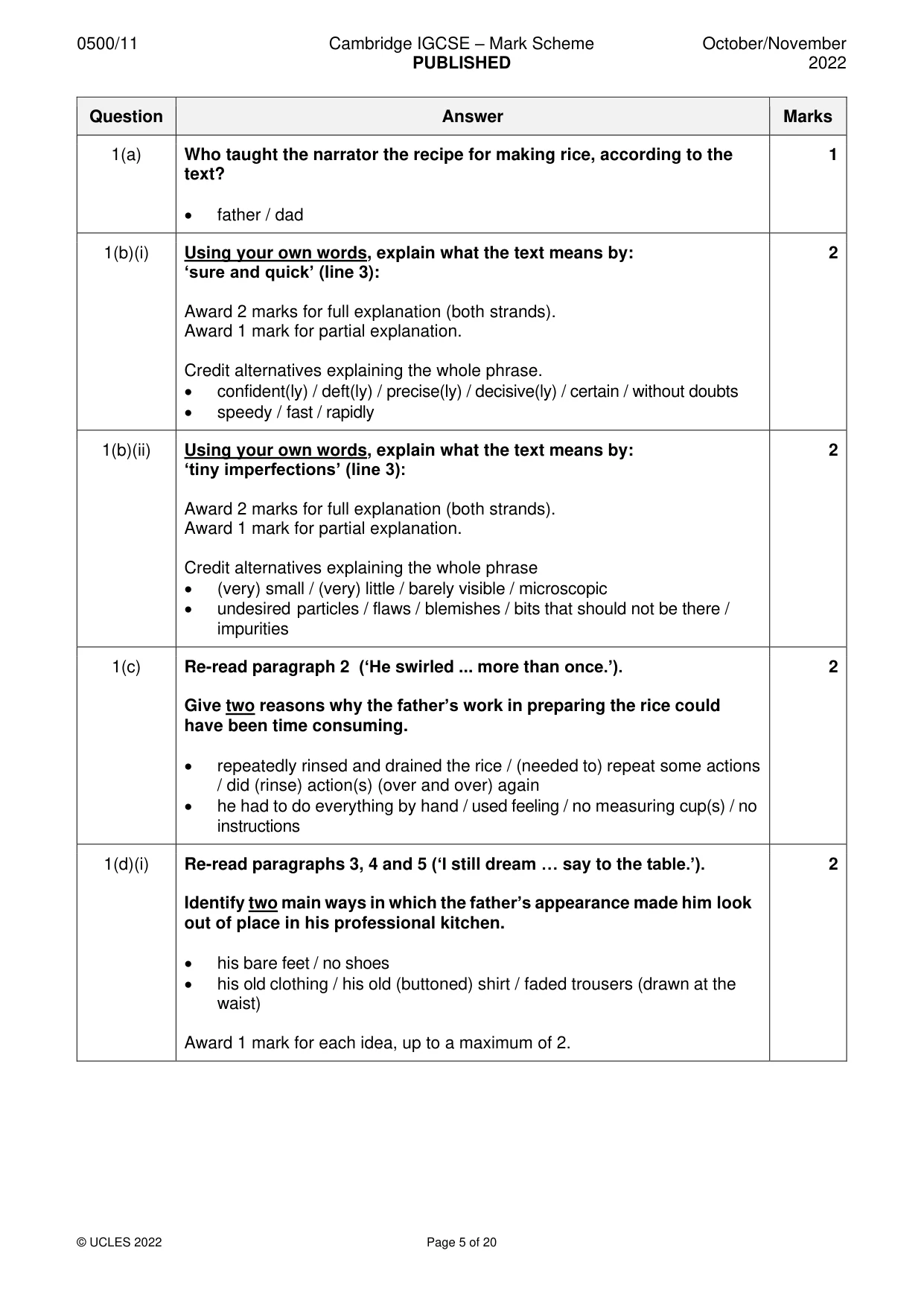
0500/11 Cambridge IGCSE – Mark Scheme PUBLISHED October/November 2022 © UCLES 2022 Page 5 of 20 Question Answer Marks 1(a) Who taught the narrator the recipe for making rice, according to the text? • father / dad 1 1(b)(i) Using your own words, explain what the text means by: ‘sure and quick’ (line 3): Award 2 marks for full explanation (both strands). Award 1 mark for partial explanation. Credit alternatives explaining the whole phrase. • confident(ly) / deft(ly) / precise(ly) / decisive(ly) / certain / without doubts • speedy / fast / rapidly 2 1(b)(ii) Using your own words, explain what the text means by: ‘tiny imperfections’ (line 3): Award 2 marks for full explanation (both strands). Award 1 mark for partial explanation. Credit alternatives explaining the whole phrase • (very) small / (very) little / barely visible / microscopic • undesired particles / flaws / blemishes / bits that should not be there / impurities 2 1(c) Re-read paragraph 2 (‘He swirled ... more than once.’). Give two reasons why the father’s work in preparing the rice could have been time consuming. • repeatedly rinsed and drained the rice / (needed to) repeat some actions / did (rinse) action(s) (over and over) again • he had to do everything by hand / used feeling / no measuring cup(s) / no instructions 2 1(d)(i) Re-read paragraphs 3, 4 and 5 (‘I still dream … say to the table.’). Identify two main ways in which the father’s appearance made him look out of place in his professional kitchen. • his bare feet / no shoes • his old clothing / his old (buttoned) shirt / faded trousers (drawn at the waist) Award 1 mark for each idea, up to a maximum of 2. 2
Mark scheme, page 6
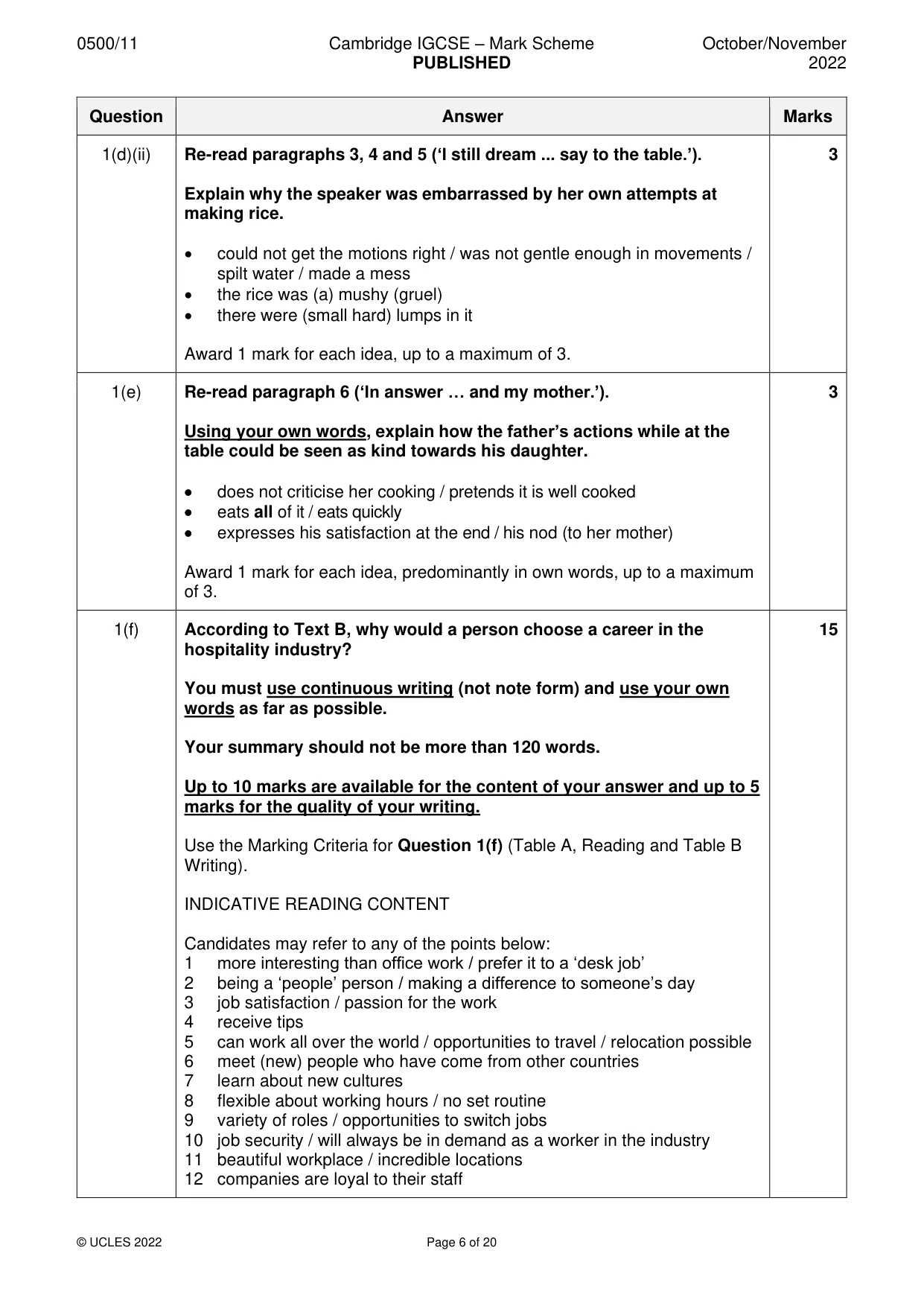
0500/11 Cambridge IGCSE – Mark Scheme PUBLISHED October/November 2022 © UCLES 2022 Page 6 of 20 Question Answer Marks 1(d)(ii) Re-read paragraphs 3, 4 and 5 (‘I still dream ... say to the table.’). Explain why the speaker was embarrassed by her own attempts at making rice. • could not get the motions right / was not gentle enough in movements / spilt water / made a mess • the rice was (a) mushy (gruel) • there were (small hard) lumps in it Award 1 mark for each idea, up to a maximum of 3. 3 1(e) Re-read paragraph 6 (‘In answer … and my mother.’). Using your own words, explain how the father’s actions while at the table could be seen as kind towards his daughter. • does not criticise her cooking / pretends it is well cooked • eats all of it / eats quickly • expresses his satisfaction at the end / his nod (to her mother) Award 1 mark for each idea, predominantly in own words, up to a maximum of 3. 3 1(f) According to Text B, why would a person choose a career in the hospitality industry? You must use continuous writing (not note form) and use your own words as far as possible. Your summary should not be more than 120 words. Up to 10 marks are available for the content of your answer and up to 5 marks for the quality of your writing. Use the Marking Criteria for Question 1(f) (Table A, Reading and Table B Writing). INDICATIVE READING CONTENT Candidates may refer to any of the points below: 1 more interesting than office work / prefer it to a ‘desk job’ 2 being a ‘people’ person / making a difference to someone’s day 3 job satisfaction / passion for the work 4 receive tips 5 can work all over the world / opportunities to travel / relocation possible 6 meet (new) people who have come from other countries 7 learn about new cultures 8 flexible about working hours / no set routine 9 variety of roles / opportunities to switch jobs 10 job security / will always be in demand as a worker in the industry 11 beautiful workplace / incredible locations 12 companies are loyal to their staff 15
Mark scheme, page 7
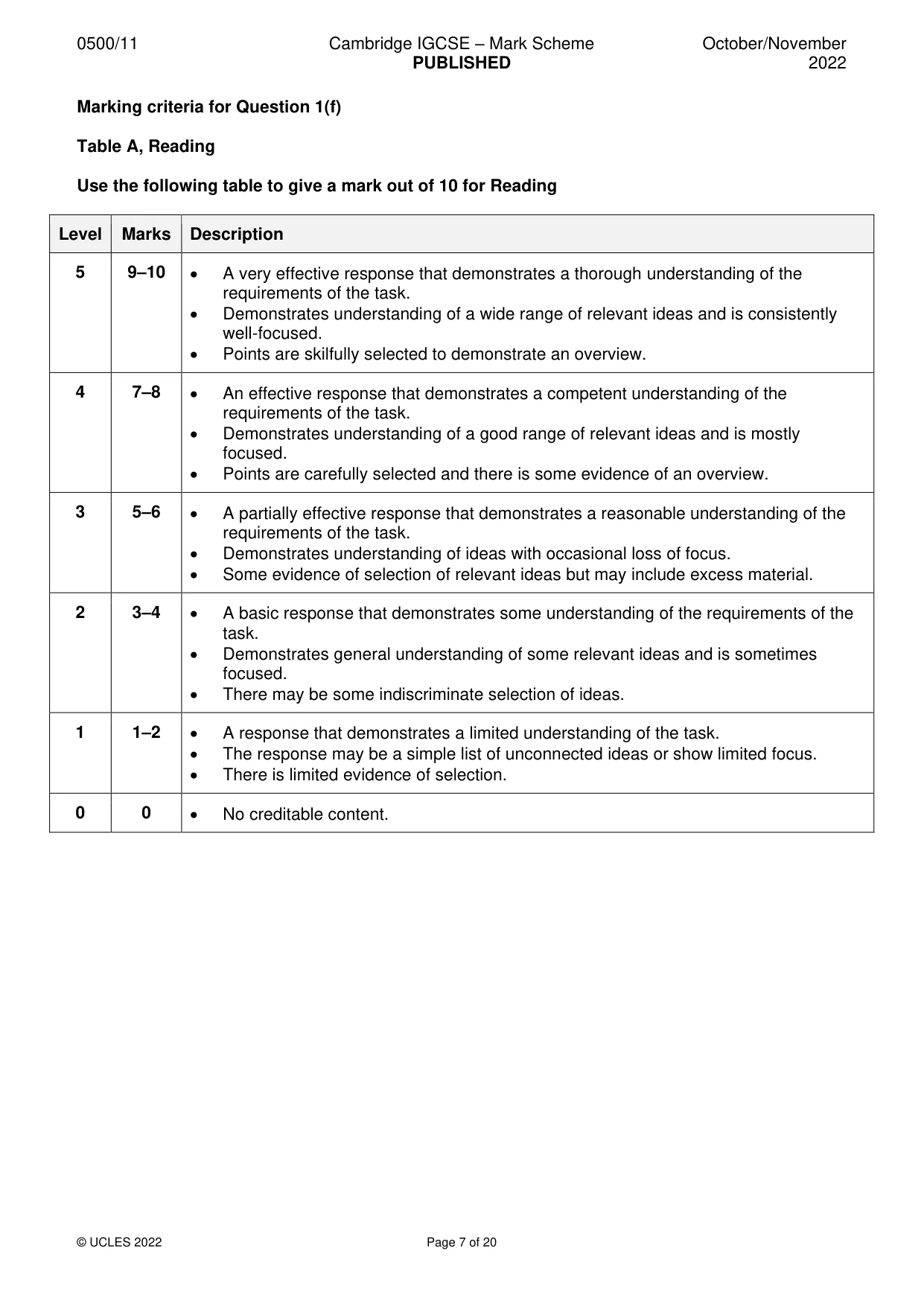
0500/11 Cambridge IGCSE – Mark Scheme PUBLISHED October/November 2022 © UCLES 2022 Page 7 of 20 Marking criteria for Question 1(f) Table A, Reading Use the following table to give a mark out of 10 for Reading Level Marks Description 5 9–10 • A very effective response that demonstrates a thorough understanding of the requirements of the task. • Demonstrates understanding of a wide range of relevant ideas and is consistently well-focused. • Points are skilfully selected to demonstrate an overview. 4 7–8 • An effective response that demonstrates a competent understanding of the requirements of the task. • Demonstrates understanding of a good range of relevant ideas and is mostly focused. • Points are carefully selected and there is some evidence of an overview. 3 5–6 • A partially effective response that demonstrates a reasonable understanding of the requirements of the task. • Demonstrates understanding of ideas with occasional loss of focus. • Some evidence of selection of relevant ideas but may include excess material. 2 3–4 • A basic response that demonstrates some understanding of the requirements of the task. • Demonstrates general understanding of some relevant ideas and is sometimes focused. • There may be some indiscriminate selection of ideas. 1 1–2 • A response that demonstrates a limited understanding of the task. • The response may be a simple list of unconnected ideas or show limited focus. • There is limited evidence of selection. 0 0 • No creditable content.
Mark scheme, page 8
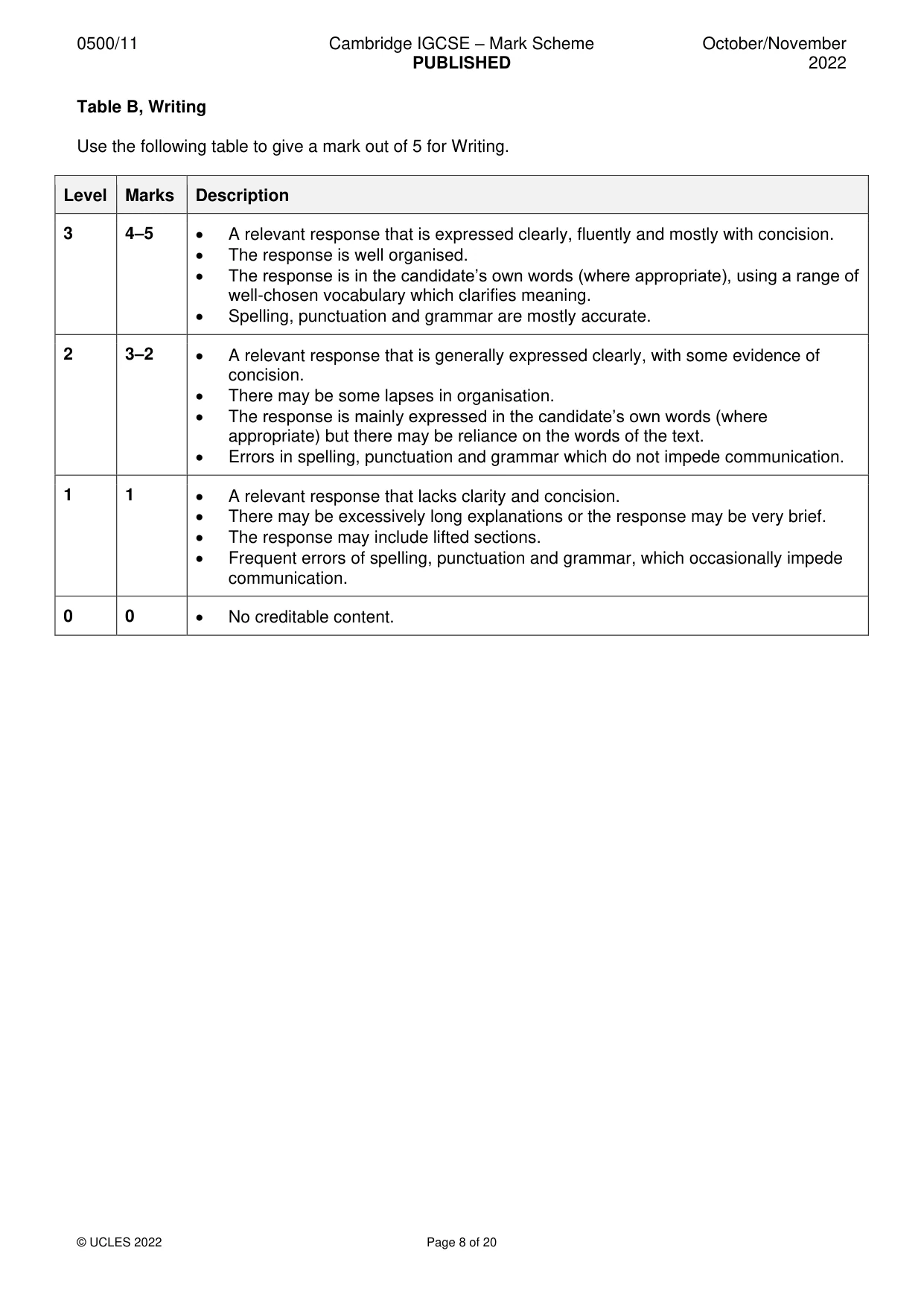
0500/11 Cambridge IGCSE – Mark Scheme PUBLISHED October/November 2022 © UCLES 2022 Page 8 of 20 Table B, Writing Use the following table to give a mark out of 5 for Writing. Level Marks Description 3 4–5 • A relevant response that is expressed clearly, fluently and mostly with concision. • The response is well organised. • The response is in the candidate’s own words (where appropriate), using a range of well-chosen vocabulary which clarifies meaning. • Spelling, punctuation and grammar are mostly accurate. 2 3–2 • A relevant response that is generally expressed clearly, with some evidence of concision. • There may be some lapses in organisation. • The response is mainly expressed in the candidate’s own words (where appropriate) but there may be reliance on the words of the text. • Errors in spelling, punctuation and grammar which do not impede communication. 1 1 • A relevant response that lacks clarity and concision. • There may be excessively long explanations or the response may be very brief. • The response may include lifted sections. • Frequent errors of spelling, punctuation and grammar, which occasionally impede communication. 0 0 • No creditable content.
Mark scheme, page 9
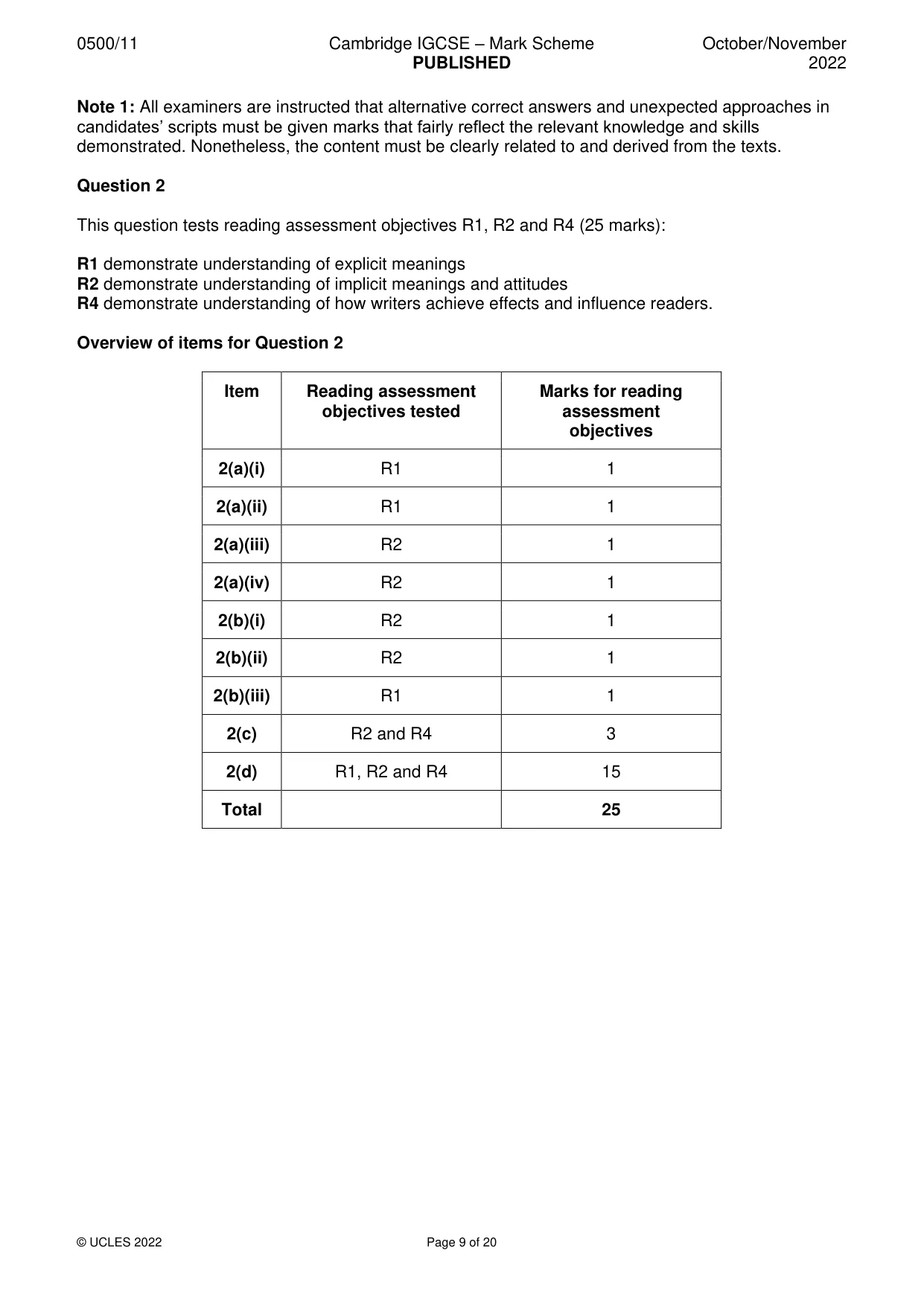
0500/11 Cambridge IGCSE – Mark Scheme PUBLISHED October/November 2022 © UCLES 2022 Page 9 of 20 Note 1: All examiners are instructed that alternative correct answers and unexpected approaches in candidates’ scripts must be given marks that fairly reflect the relevant knowledge and skills demonstrated. Nonetheless, the content must be clearly related to and derived from the texts. Question 2 This question tests reading assessment objectives R1, R2 and R4 (25 marks): R1 demonstrate understanding of explicit meanings R2 demonstrate understanding of implicit meanings and attitudes R4 demonstrate understanding of how writers achieve effects and influence readers. Overview of items for Question 2 Item Reading assessment objectives tested Marks for reading assessment objectives 2(a)(i) R1 1 2(a)(ii) R1 1 2(a)(iii) R2 1 2(a)(iv) R2 1 2(b)(i) R2 1 2(b)(ii) R2 1 2(b)(iii) R1 1 2(c) R2 and R4 3 2(d) R1, R2 and R4 15 Total 25
Mark scheme, page 10
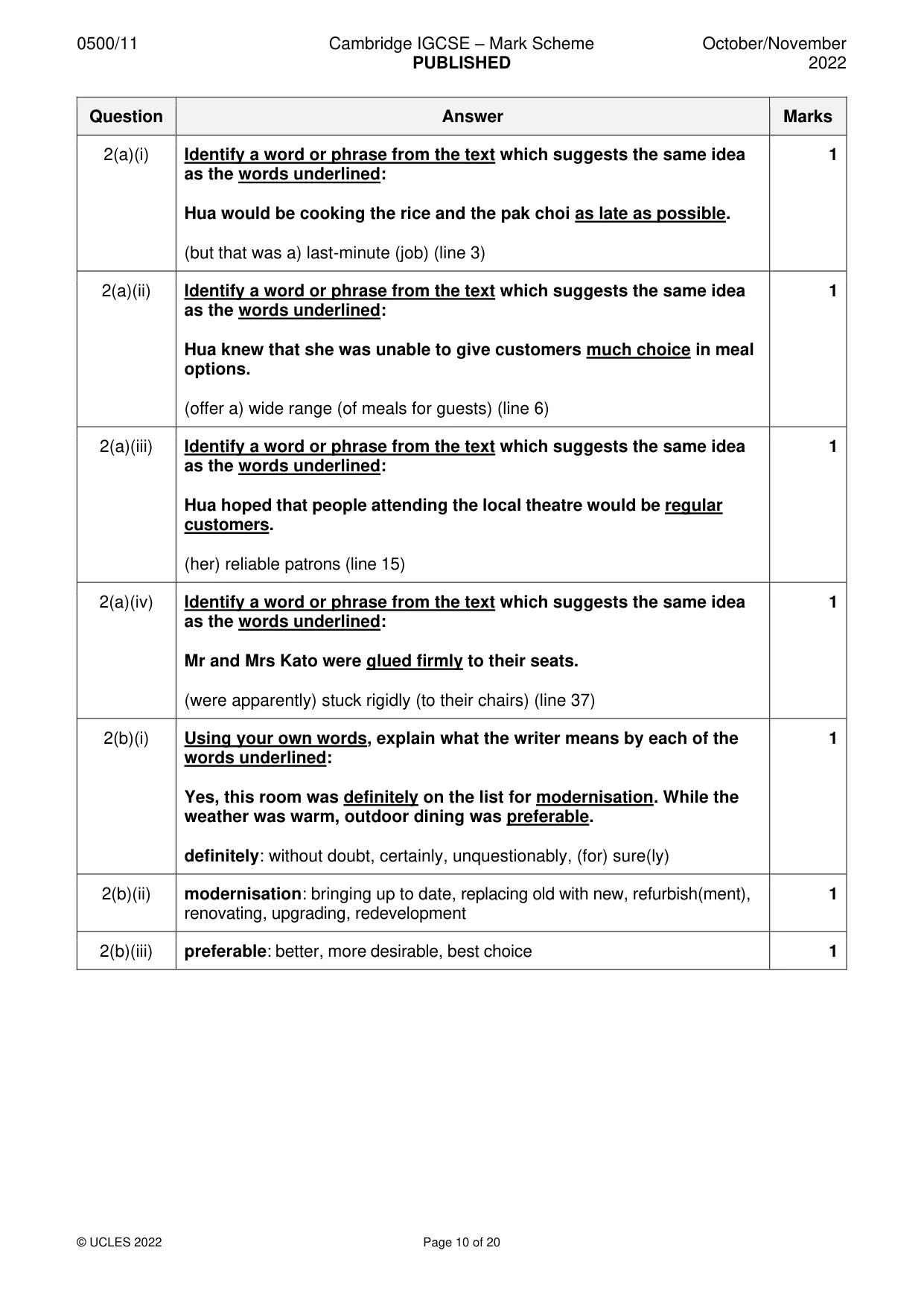
0500/11 Cambridge IGCSE – Mark Scheme PUBLISHED October/November 2022 © UCLES 2022 Page 10 of 20 Question Answer Marks 2(a)(i) Identify a word or phrase from the text which suggests the same idea as the words underlined: Hua would be cooking the rice and the pak choi as late as possible. (but that was a) last-minute (job) (line 3) 1 2(a)(ii) Identify a word or phrase from the text which suggests the same idea as the words underlined: Hua knew that she was unable to give customers much choice in meal options. (offer a) wide range (of meals for guests) (line 6) 1 2(a)(iii) Identify a word or phrase from the text which suggests the same idea as the words underlined: Hua hoped that people attending the local theatre would be regular customers. (her) reliable patrons (line 15) 1 2(a)(iv) Identify a word or phrase from the text which suggests the same idea as the words underlined: Mr and Mrs Kato were glued firmly to their seats. (were apparently) stuck rigidly (to their chairs) (line 37) 1 2(b)(i) Using your own words, explain what the writer means by each of the words underlined: Yes, this room was definitely on the list for modernisation. While the weather was warm, outdoor dining was preferable. definitely: without doubt, certainly, unquestionably, (for) sure(ly) 1 2(b)(ii) modernisation: bringing up to date, replacing old with new, refurbish(ment), renovating, upgrading, redevelopment 1 2(b)(iii) preferable: better, more desirable, best choice 1
Mark scheme, page 11
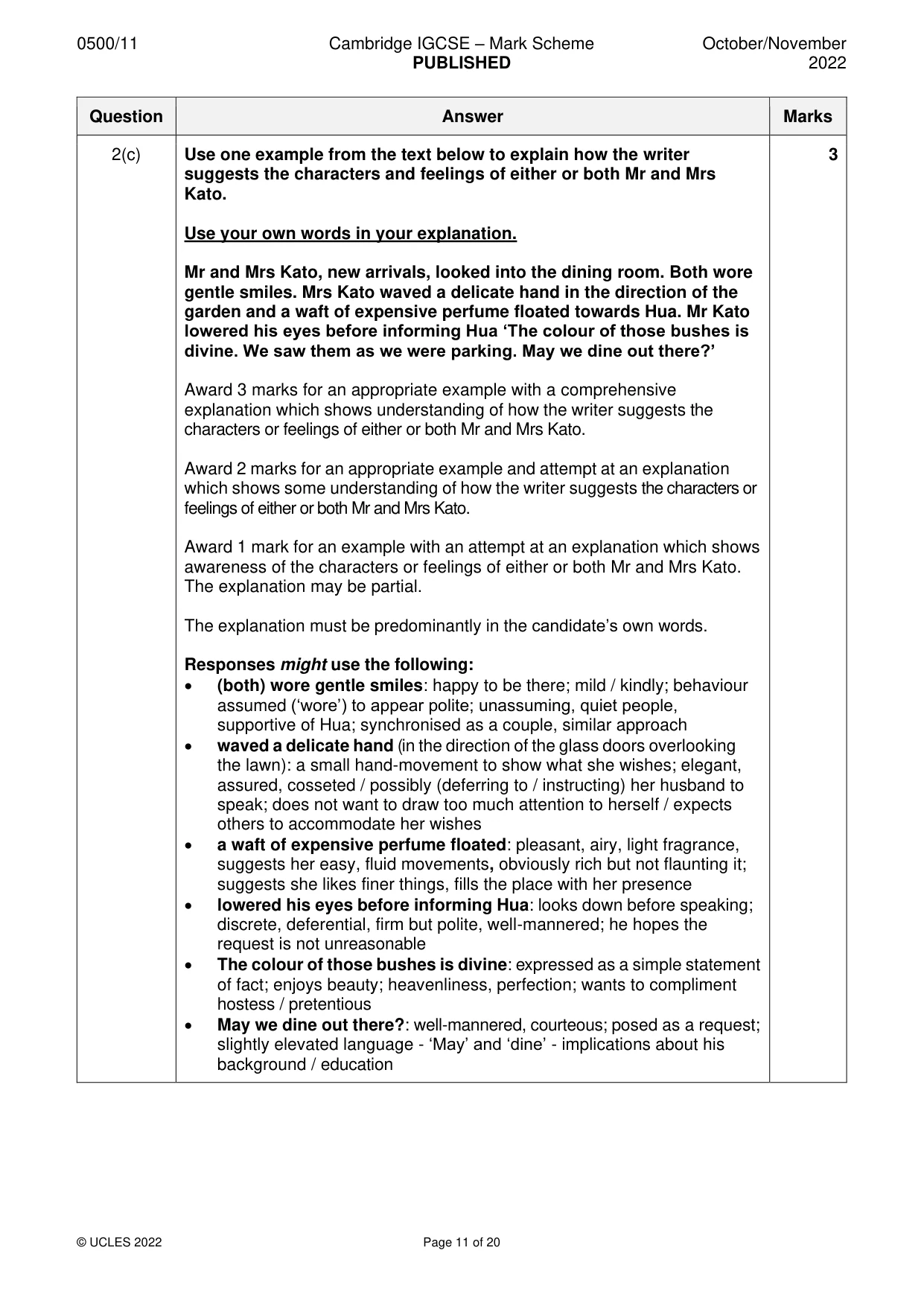
0500/11 Cambridge IGCSE – Mark Scheme PUBLISHED October/November 2022 © UCLES 2022 Page 11 of 20 Question Answer Marks 2(c) Use one example from the text below to explain how the writer suggests the characters and feelings of either or both Mr and Mrs Kato. Use your own words in your explanation. Mr and Mrs Kato, new arrivals, looked into the dining room. Both wore gentle smiles. Mrs Kato waved a delicate hand in the direction of the garden and a waft of expensive perfume floated towards Hua. Mr Kato lowered his eyes before informing Hua ‘The colour of those bushes is divine. We saw them as we were parking. May we dine out there?’ Award 3 marks for an appropriate example with a comprehensive explanation which shows understanding of how the writer suggests the characters or feelings of either or both Mr and Mrs Kato. Award 2 marks for an appropriate example and attempt at an explanation which shows some understanding of how the writer suggests the characters or feelings of either or both Mr and Mrs Kato. Award 1 mark for an example with an attempt at an explanation which shows awareness of the characters or feelings of either or both Mr and Mrs Kato. The explanation may be partial. The explanation must be predominantly in the candidate’s own words. Responses might use the following: • (both) wore gentle smiles: happy to be there; mild / kindly; behaviour assumed (‘wore’) to appear polite; unassuming, quiet people, supportive of Hua; synchronised as a couple, similar approach • waved a delicate hand (in the direction of the glass doors overlooking the lawn): a small hand-movement to show what she wishes; elegant, assured, cosseted / possibly (deferring to / instructing) her husband to speak; does not want to draw too much attention to herself / expects others to accommodate her wishes • a waft of expensive perfume floated: pleasant, airy, light fragrance, suggests her easy, fluid movements, obviously rich but not flaunting it; suggests she likes finer things, fills the place with her presence • lowered his eyes before informing Hua: looks down before speaking; discrete, deferential, firm but polite, well-mannered; he hopes the request is not unreasonable • The colour of those bushes is divine: expressed as a simple statement of fact; enjoys beauty; heavenliness, perfection; wants to compliment hostess / pretentious • May we dine out there?: well-mannered, courteous; posed as a request; slightly elevated language - ‘May’ and ‘dine’ - implications about his background / education 3
Mark scheme, page 12
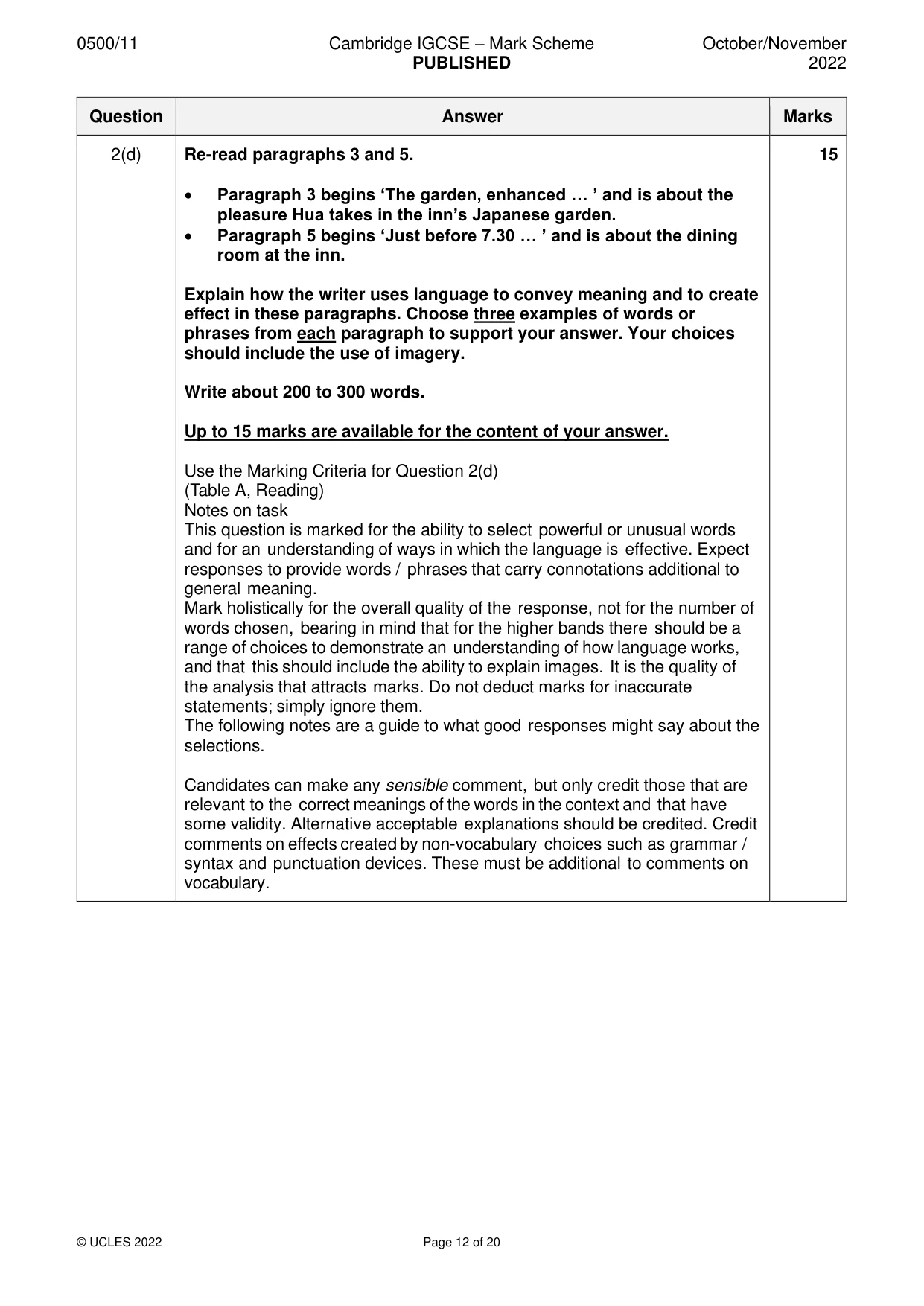
0500/11 Cambridge IGCSE – Mark Scheme PUBLISHED October/November 2022 © UCLES 2022 Page 12 of 20 Question Answer Marks 2(d) Re-read paragraphs 3 and 5. • Paragraph 3 begins ‘The garden, enhanced … ’ and is about the pleasure Hua takes in the inn’s Japanese garden. • Paragraph 5 begins ‘Just before 7.30 … ’ and is about the dining room at the inn. Explain how the writer uses language to convey meaning and to create effect in these paragraphs. Choose three examples of words or phrases from each paragraph to support your answer. Your choices should include the use of imagery. Write about 200 to 300 words. Up to 15 marks are available for the content of your answer. Use the Marking Criteria for Question 2(d) (Table A, Reading) Notes on task This question is marked for the ability to select powerful or unusual words and for an understanding of ways in which the language is effective. Expect responses to provide words / phrases that carry connotations additional to general meaning. Mark holistically for the overall quality of the response, not for the number of words chosen, bearing in mind that for the higher bands there should be a range of choices to demonstrate an understanding of how language works, and that this should include the ability to explain images. It is the quality of the analysis that attracts marks. Do not deduct marks for inaccurate statements; simply ignore them. The following notes are a guide to what good responses might say about the selections. Candidates can make any sensible comment, but only credit those that are relevant to the correct meanings of the words in the context and that have some validity. Alternative acceptable explanations should be credited. Credit comments on effects created by non-vocabulary choices such as grammar / syntax and punctuation devices. These must be additional to comments on vocabulary. 15
Mark scheme, page 13
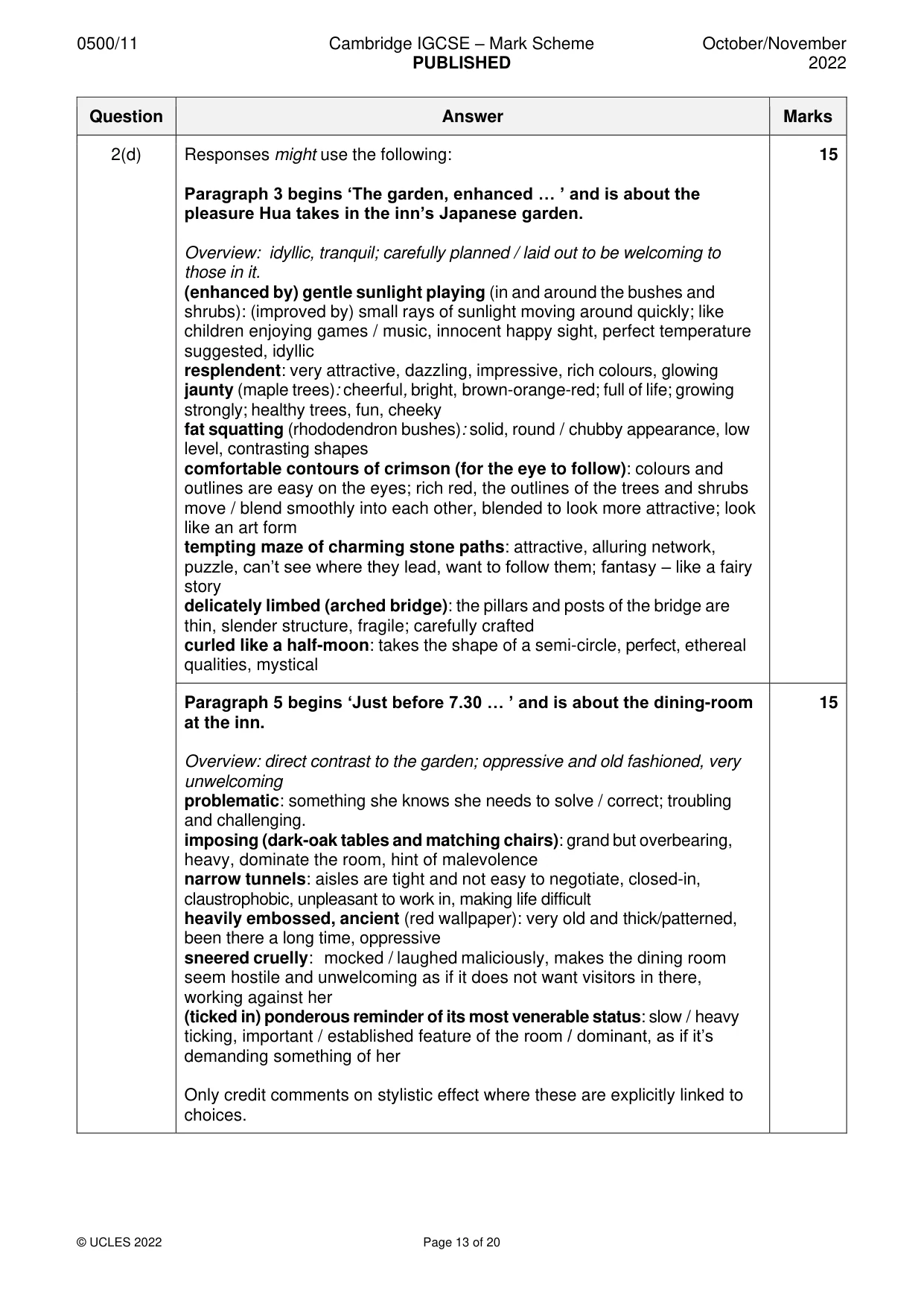
0500/11 Cambridge IGCSE – Mark Scheme PUBLISHED October/November 2022 © UCLES 2022 Page 13 of 20 Question Answer Marks 2(d) Responses might use the following: Paragraph 3 begins ‘The garden, enhanced … ’ and is about the pleasure Hua takes in the inn’s Japanese garden. Overview: idyllic, tranquil; carefully planned / laid out to be welcoming to those in it. (enhanced by) gentle sunlight playing (in and around the bushes and shrubs): (improved by) small rays of sunlight moving around quickly; like children enjoying games / music, innocent happy sight, perfect temperature suggested, idyllic resplendent: very attractive, dazzling, impressive, rich colours, glowing jaunty (maple trees): cheerful, bright, brown-orange-red; full of life; growing strongly; healthy trees, fun, cheeky fat squatting (rhododendron bushes): solid, round / chubby appearance, low level, contrasting shapes comfortable contours of crimson (for the eye to follow): colours and outlines are easy on the eyes; rich red, the outlines of the trees and shrubs move / blend smoothly into each other, blended to look more attractive; look like an art form tempting maze of charming stone paths: attractive, alluring network, puzzle, can’t see where they lead, want to follow them; fantasy – like a fairy story delicately limbed (arched bridge): the pillars and posts of the bridge are thin, slender structure, fragile; carefully crafted curled like a half-moon: takes the shape of a semi-circle, perfect, ethereal qualities, mystical 15 Paragraph 5 begins ‘Just before 7.30 … ’ and is about the dining-room at the inn. Overview: direct contrast to the garden; oppressive and old fashioned, very unwelcoming problematic: something she knows she needs to solve / correct; troubling and challenging. imposing (dark-oak tables and matching chairs): grand but overbearing, heavy, dominate the room, hint of malevolence narrow tunnels: aisles are tight and not easy to negotiate, closed-in, claustrophobic, unpleasant to work in, making life difficult heavily embossed, ancient (red wallpaper): very old and thick/patterned, been there a long time, oppressive sneered cruelly: mocked / laughed maliciously, makes the dining room seem hostile and unwelcoming as if it does not want visitors in there, working against her (ticked in) ponderous reminder of its most venerable status: slow / heavy ticking, important / established feature of the room / dominant, as if it’s demanding something of her Only credit comments on stylistic effect where these are explicitly linked to choices. 15
Mark scheme, page 14
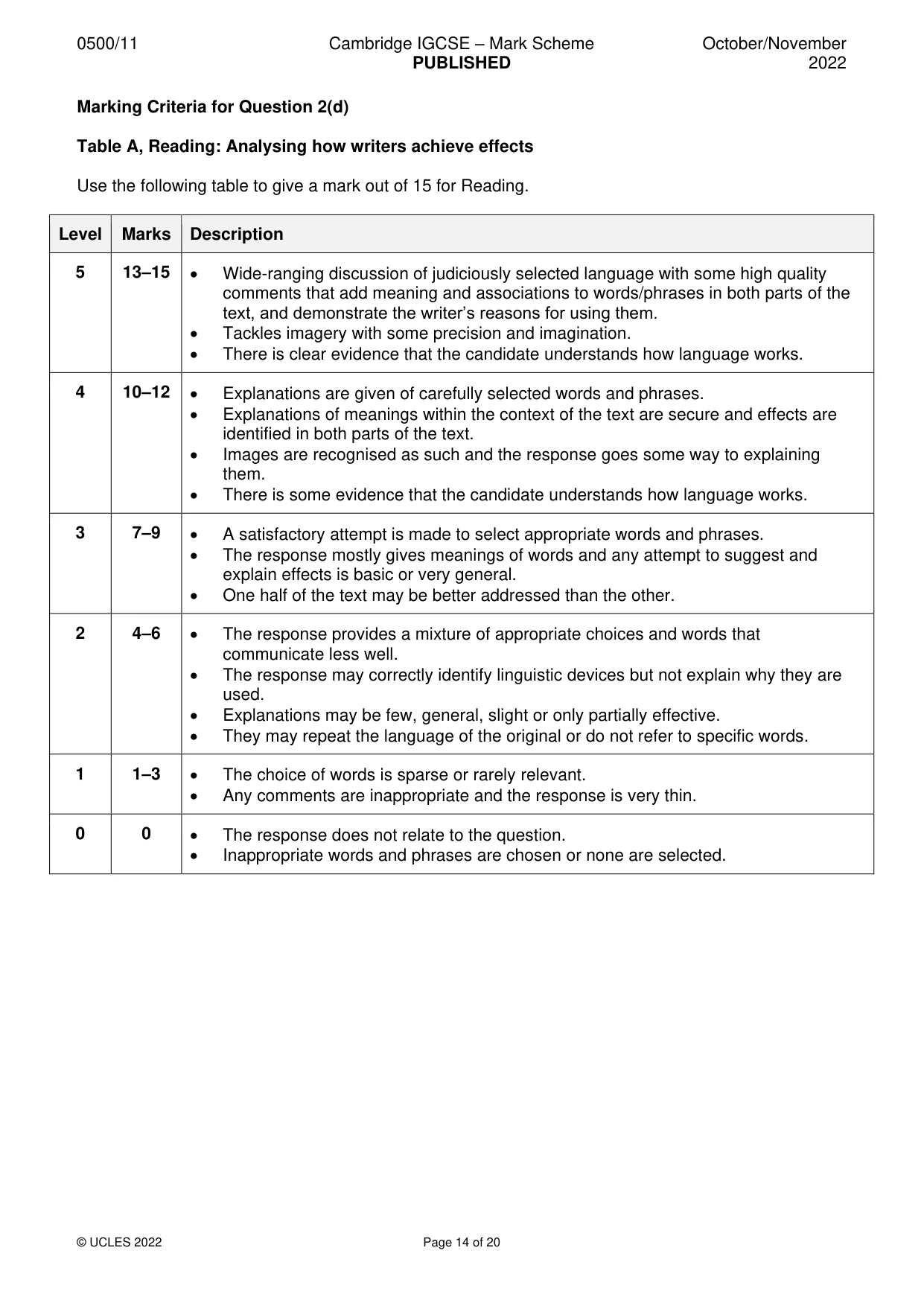
0500/11 Cambridge IGCSE – Mark Scheme PUBLISHED October/November 2022 © UCLES 2022 Page 14 of 20 Marking Criteria for Question 2(d) Table A, Reading: Analysing how writers achieve effects Use the following table to give a mark out of 15 for Reading. Level Marks Description 5 13–15 • Wide-ranging discussion of judiciously selected language with some high quality comments that add meaning and associations to words/phrases in both parts of the text, and demonstrate the writer’s reasons for using them. • Tackles imagery with some precision and imagination. • There is clear evidence that the candidate understands how language works. 4 10–12 • Explanations are given of carefully selected words and phrases. • Explanations of meanings within the context of the text are secure and effects are identified in both parts of the text. • Images are recognised as such and the response goes some way to explaining them. • There is some evidence that the candidate understands how language works. 3 7–9 • A satisfactory attempt is made to select appropriate words and phrases. • The response mostly gives meanings of words and any attempt to suggest and explain effects is basic or very general. • One half of the text may be better addressed than the other. 2 4–6 • The response provides a mixture of appropriate choices and words that communicate less well. • The response may correctly identify linguistic devices but not explain why they are used. • Explanations may be few, general, slight or only partially effective. • They may repeat the language of the original or do not refer to specific words. 1 1–3 • The choice of words is sparse or rarely relevant. • Any comments are inappropriate and the response is very thin. 0 0 • The response does not relate to the question. • Inappropriate words and phrases are chosen or none are selected.
Mark scheme, page 15
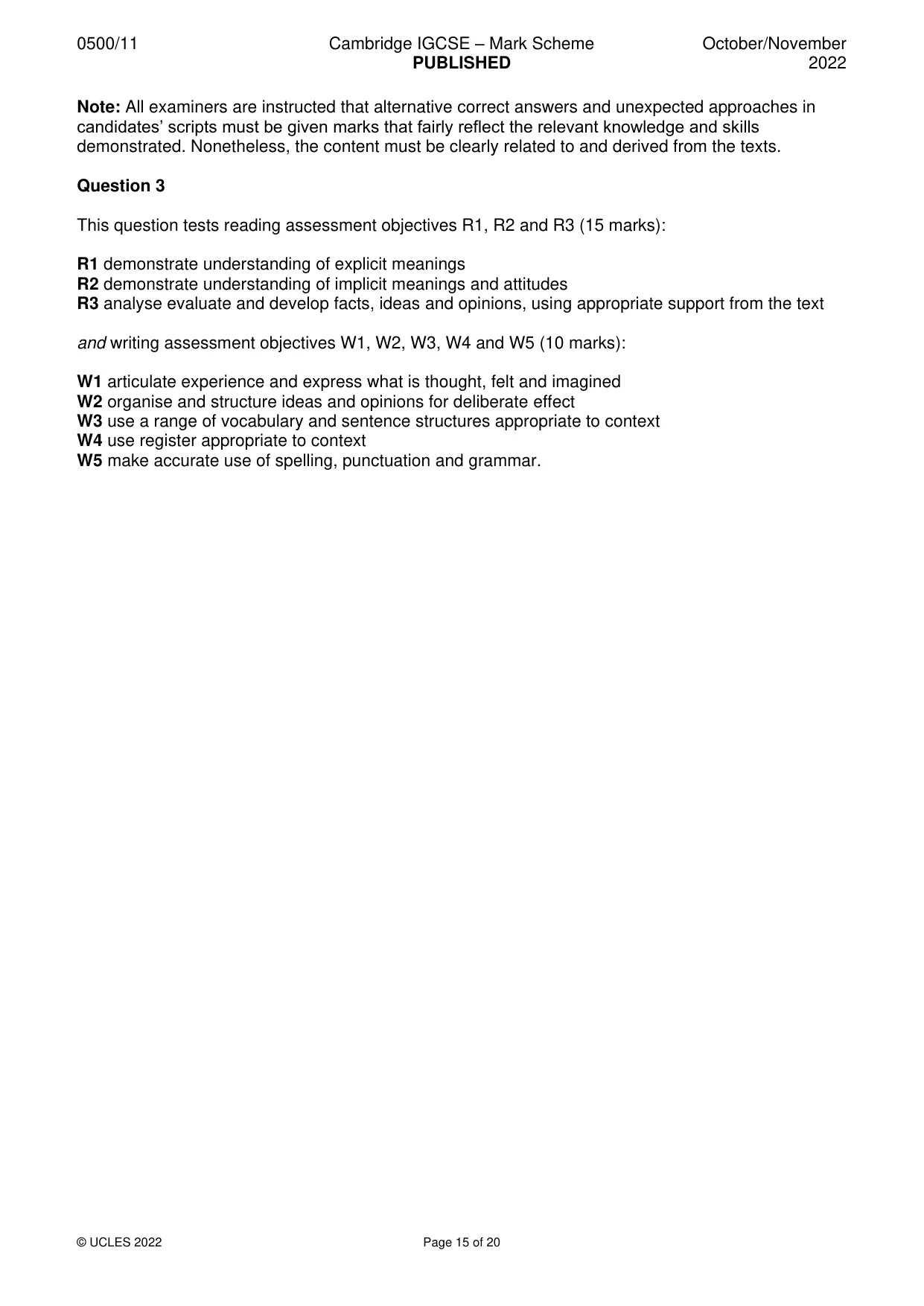
0500/11 Cambridge IGCSE – Mark Scheme PUBLISHED October/November 2022 © UCLES 2022 Page 15 of 20 Note: All examiners are instructed that alternative correct answers and unexpected approaches in candidates’ scripts must be given marks that fairly reflect the relevant knowledge and skills demonstrated. Nonetheless, the content must be clearly related to and derived from the texts. Question 3 This question tests reading assessment objectives R1, R2 and R3 (15 marks): R1 demonstrate understanding of explicit meanings R2 demonstrate understanding of implicit meanings and attitudes R3 analyse evaluate and develop facts, ideas and opinions, using appropriate support from the text and writing assessment objectives W1, W2, W3, W4 and W5 (10 marks): W1 articulate experience and express what is thought, felt and imagined W2 organise and structure ideas and opinions for deliberate effect W3 use a range of vocabulary and sentence structures appropriate to context W4 use register appropriate to context W5 make accurate use of spelling, punctuation and grammar.
Mark scheme, page 16
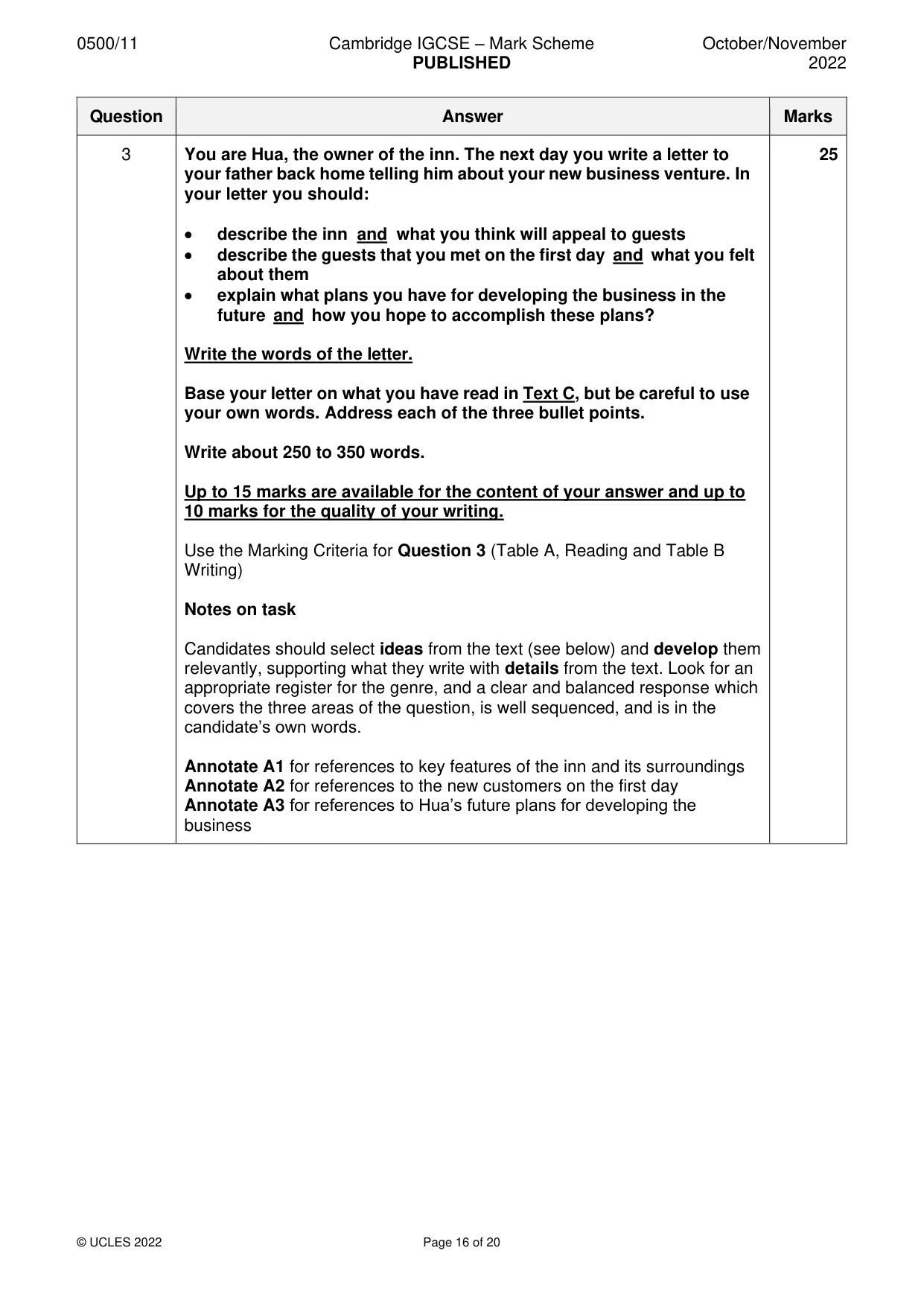
0500/11 Cambridge IGCSE – Mark Scheme PUBLISHED October/November 2022 © UCLES 2022 Page 16 of 20 Question Answer Marks 3 You are Hua, the owner of the inn. The next day you write a letter to your father back home telling him about your new business venture. In your letter you should: • describe the inn and what you think will appeal to guests • describe the guests that you met on the first day and what you felt about them • explain what plans you have for developing the business in the future and how you hope to accomplish these plans? Write the words of the letter. Base your letter on what you have read in Text C, but be careful to use your own words. Address each of the three bullet points. Write about 250 to 350 words. Up to 15 marks are available for the content of your answer and up to 10 marks for the quality of your writing. Use the Marking Criteria for Question 3 (Table A, Reading and Table B Writing) Notes on task Candidates should select ideas from the text (see below) and develop them relevantly, supporting what they write with details from the text. Look for an appropriate register for the genre, and a clear and balanced response which covers the three areas of the question, is well sequenced, and is in the candidate’s own words. Annotate A1 for references to key features of the inn and its surroundings Annotate A2 for references to the new customers on the first day Annotate A3 for references to Hua’s future plans for developing the business 25
Mark scheme, page 17
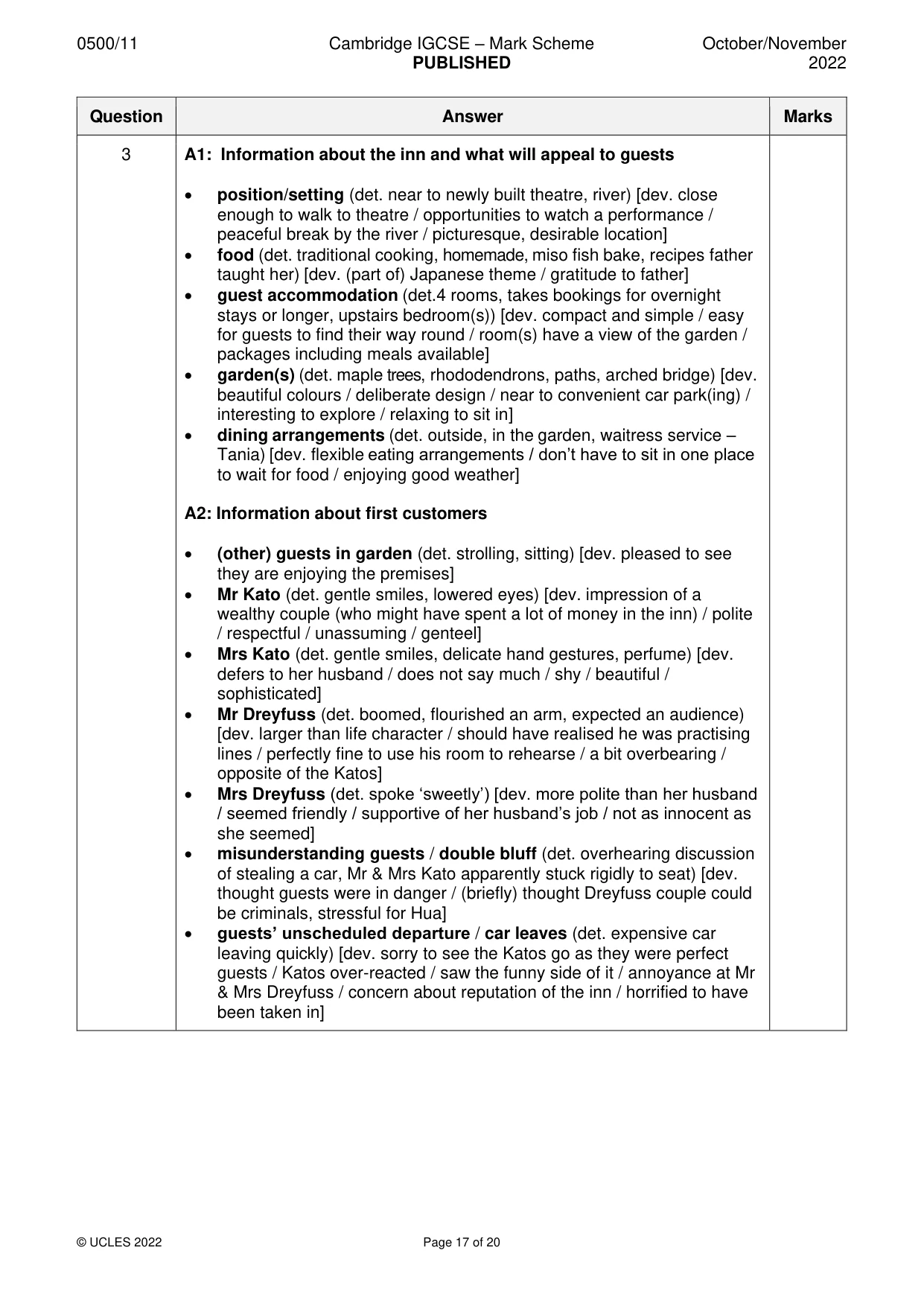
0500/11 Cambridge IGCSE – Mark Scheme PUBLISHED October/November 2022 © UCLES 2022 Page 17 of 20 Question Answer Marks 3 A1: Information about the inn and what will appeal to guests • position/setting (det. near to newly built theatre, river) [dev. close enough to walk to theatre / opportunities to watch a performance / peaceful break by the river / picturesque, desirable location] • food (det. traditional cooking, homemade, miso fish bake, recipes father taught her) [dev. (part of) Japanese theme / gratitude to father] • guest accommodation (det.4 rooms, takes bookings for overnight stays or longer, upstairs bedroom(s)) [dev. compact and simple / easy for guests to find their way round / room(s) have a view of the garden / packages including meals available] • garden(s) (det. maple trees, rhododendrons, paths, arched bridge) [dev. beautiful colours / deliberate design / near to convenient car park(ing) / interesting to explore / relaxing to sit in] • dining arrangements (det. outside, in the garden, waitress service – Tania) [dev. flexible eating arrangements / don’t have to sit in one place to wait for food / enjoying good weather] A2: Information about first customers • (other) guests in garden (det. strolling, sitting) [dev. pleased to see they are enjoying the premises] • Mr Kato (det. gentle smiles, lowered eyes) [dev. impression of a wealthy couple (who might have spent a lot of money in the inn) / polite / respectful / unassuming / genteel] • Mrs Kato (det. gentle smiles, delicate hand gestures, perfume) [dev. defers to her husband / does not say much / shy / beautiful / sophisticated] • Mr Dreyfuss (det. boomed, flourished an arm, expected an audience) [dev. larger than life character / should have realised he was practising lines / perfectly fine to use his room to rehearse / a bit overbearing / opposite of the Katos] • Mrs Dreyfuss (det. spoke ‘sweetly’) [dev. more polite than her husband / seemed friendly / supportive of her husband’s job / not as innocent as she seemed] • misunderstanding guests / double bluff (det. overhearing discussion of stealing a car, Mr & Mrs Kato apparently stuck rigidly to seat) [dev. thought guests were in danger / (briefly) thought Dreyfuss couple could be criminals, stressful for Hua] • guests’ unscheduled departure / car leaves (det. expensive car leaving quickly) [dev. sorry to see the Katos go as they were perfect guests / Katos over-reacted / saw the funny side of it / annoyance at Mr & Mrs Dreyfuss / concern about reputation of the inn / horrified to have been taken in]
Mark scheme, page 18
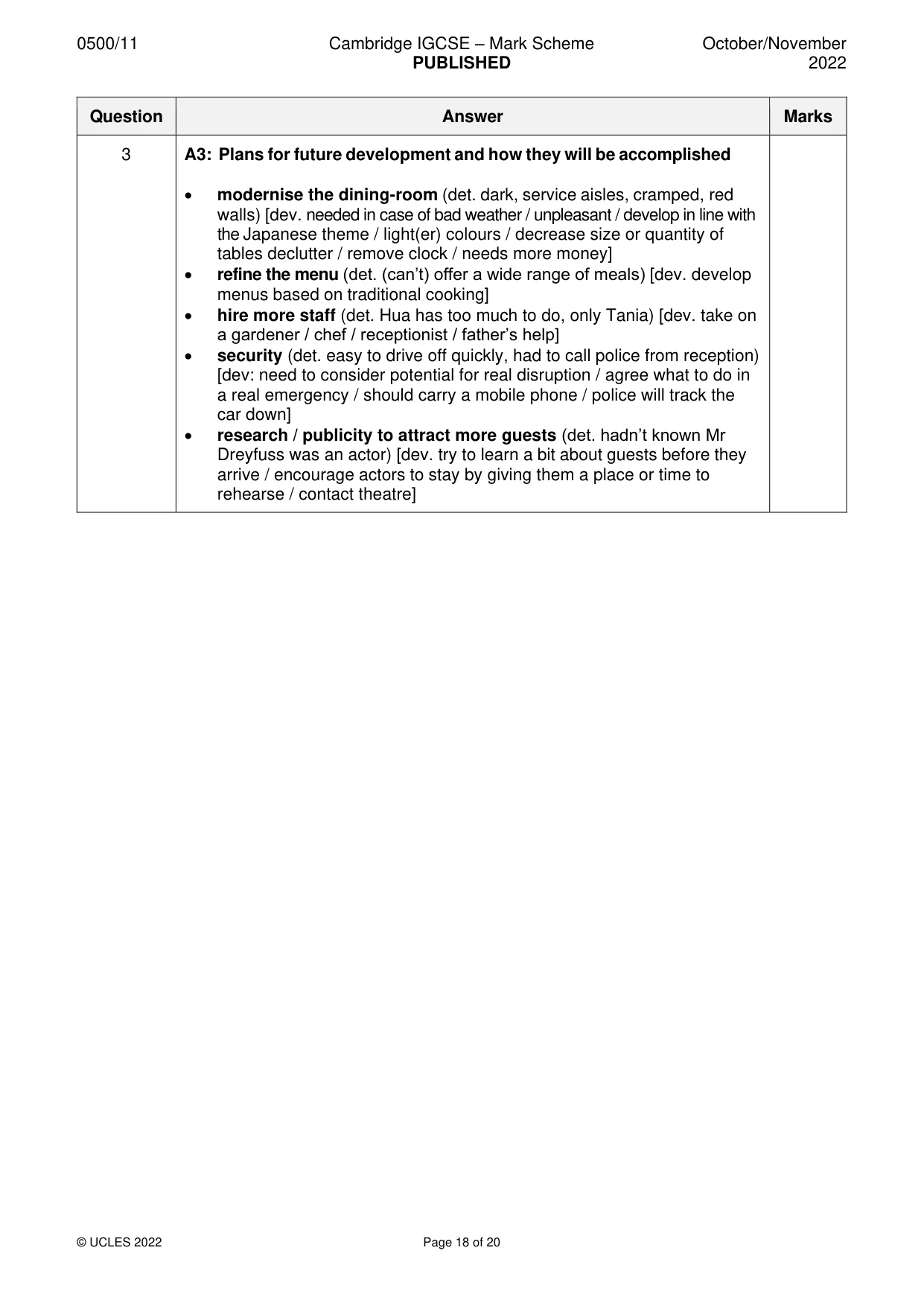
0500/11 Cambridge IGCSE – Mark Scheme PUBLISHED October/November 2022 © UCLES 2022 Page 18 of 20 Question Answer Marks 3 A3: Plans for future development and how they will be accomplished • modernise the dining-room (det. dark, service aisles, cramped, red walls) [dev. needed in case of bad weather / unpleasant / develop in line with the Japanese theme / light(er) colours / decrease size or quantity of tables declutter / remove clock / needs more money] • refine the menu (det. (can’t) offer a wide range of meals) [dev. develop menus based on traditional cooking] • hire more staff (det. Hua has too much to do, only Tania) [dev. take on a gardener / chef / receptionist / father’s help] • security (det. easy to drive off quickly, had to call police from reception) [dev: need to consider potential for real disruption / agree what to do in a real emergency / should carry a mobile phone / police will track the car down] • research / publicity to attract more guests (det. hadn’t known Mr Dreyfuss was an actor) [dev. try to learn a bit about guests before they arrive / encourage actors to stay by giving them a place or time to rehearse / contact theatre]
Mark scheme, page 19
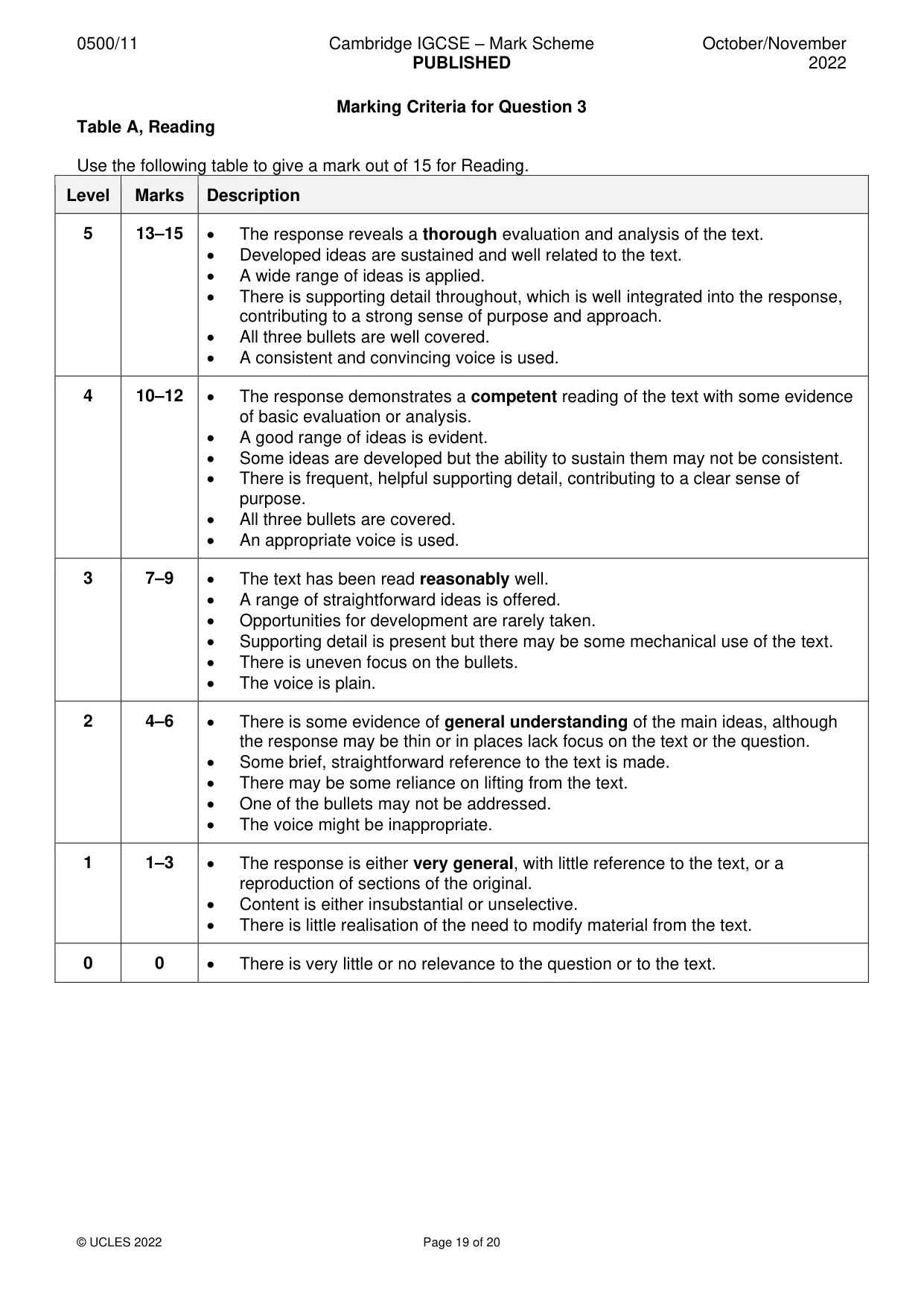
0500/11 Cambridge IGCSE – Mark Scheme PUBLISHED October/November 2022 © UCLES 2022 Page 19 of 20 Marking Criteria for Question 3 Table A, Reading Use the following table to give a mark out of 15 for Reading. Level Marks Description 5 13–15 • The response reveals a thorough evaluation and analysis of the text. • Developed ideas are sustained and well related to the text. • A wide range of ideas is applied. • There is supporting detail throughout, which is well integrated into the response, contributing to a strong sense of purpose and approach. • All three bullets are well covered. • A consistent and convincing voice is used. 4 10–12 • The response demonstrates a competent reading of the text with some evidence of basic evaluation or analysis. • A good range of ideas is evident. • Some ideas are developed but the ability to sustain them may not be consistent. • There is frequent, helpful supporting detail, contributing to a clear sense of purpose. • All three bullets are covered. • An appropriate voice is used. 3 7–9 • The text has been read reasonably well. • A range of straightforward ideas is offered. • Opportunities for development are rarely taken. • Supporting detail is present but there may be some mechanical use of the text. • There is uneven focus on the bullets. • The voice is plain. 2 4–6 • There is some evidence of general understanding of the main ideas, although the response may be thin or in places lack focus on the text or the question. • Some brief, straightforward reference to the text is made. • There may be some reliance on lifting from the text. • One of the bullets may not be addressed. • The voice might be inappropriate. 1 1–3 • The response is either very general, with little reference to the text, or a reproduction of sections of the original. • Content is either insubstantial or unselective. • There is little realisation of the need to modify material from the text. 0 0 • There is very little or no relevance to the question or to the text.
Mark scheme, page 20
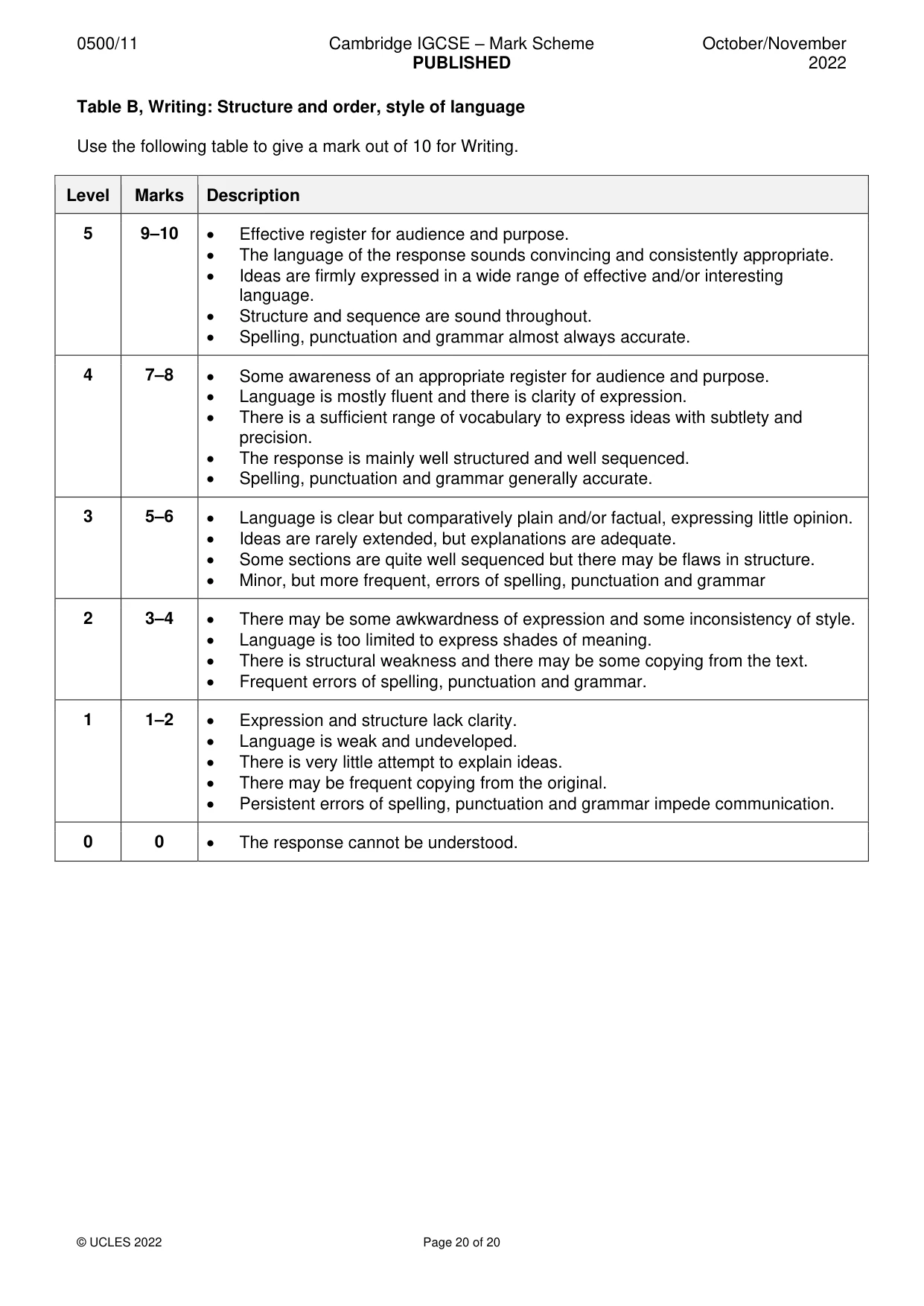
0500/11 Cambridge IGCSE – Mark Scheme PUBLISHED October/November 2022 © UCLES 2022 Page 20 of 20 Table B, Writing: Structure and order, style of language Use the following table to give a mark out of 10 for Writing. Level Marks Description 5 9–10 • Effective register for audience and purpose. • The language of the response sounds convincing and consistently appropriate. • Ideas are firmly expressed in a wide range of effective and/or interesting language. • Structure and sequence are sound throughout. • Spelling, punctuation and grammar almost always accurate. 4 7–8 • Some awareness of an appropriate register for audience and purpose. • Language is mostly fluent and there is clarity of expression. • There is a sufficient range of vocabulary to express ideas with subtlety and precision. • The response is mainly well structured and well sequenced. • Spelling, punctuation and grammar generally accurate. 3 5–6 • Language is clear but comparatively plain and/or factual, expressing little opinion. • Ideas are rarely extended, but explanations are adequate. • Some sections are quite well sequenced but there may be flaws in structure. • Minor, but more frequent, errors of spelling, punctuation and grammar 2 3–4 • There may be some awkwardness of expression and some inconsistency of style. • Language is too limited to express shades of meaning. • There is structural weakness and there may be some copying from the text. • Frequent errors of spelling, punctuation and grammar. 1 1–2 • Expression and structure lack clarity. • Language is weak and undeveloped. • There is very little attempt to explain ideas. • There may be frequent copying from the original. • Persistent errors of spelling, punctuation and grammar impede communication. 0 0 • The response cannot be understood.
What you needed in this session
Cambridge’s own grade thresholds for 2022 Oct/Nov, Paper 1 · Variant 1. A higher threshold means an easier paper — the bar moves with how the cohort did.