Cambridge IGCSE English - First Language 0500 — 2019 Oct/Nov Paper 2 · Variant 1
0500/21/O/N/19 · 50 marks · ≈56 min
The question paper and its mark scheme, free to read here and free to download. This is Cambridge’s own paper, exactly as it was sat.
Question paper12 pages
Mark scheme12 pages
Answers below. Sit the paper first if you are practising.
Paper as text
Question paper, page 1
This document consists of 11 printed pages, 1 blank page and 1 Reading Booklet Insert. DC (LT) 163805/3 © UCLES 2019 [Turn over Cambridge Assessment International Education Cambridge International General Certificate of Secondary Education * 7 4 7 6 9 6 4 0 9 9 * FIRST LANGUAGE ENGLISH 0500/21 Paper 2 Reading Passages (Extended) October/November 2019 2 hours Candidates answer on the Question Paper. Additional Materials: Reading Booklet Insert READ THESE INSTRUCTIONS FIRST Write your centre number, candidate number and name in the spaces provided. Write in dark blue or black pen. Do not use staples, paper clips, glue or correction fluid. DO NOT WRITE IN ANY BARCODES. Answer all questions in the space provided. If additional space is required, you should use the lined pages at the end of the booklet. The question number(s) must be clearly shown. Dictionaries are not permitted. The Reading Booklet Insert contains the reading passages for use with all questions on this Question Paper. The Reading Booklet Insert is not assessed by the Examiner. The number of marks is given in brackets [ ] at the end of each question or part question.
Question paper, page 2
2 0500/21/O/N/19 © UCLES 2019 Read carefully Passage A, Creative writing class, in the Reading Booklet Insert and then answer Questions 1 and 2 on this Question Paper. Question 1 You are Sumitra, the tutor at Stan’s creative writing class. After the class today, you write a journal entry. Write the journal entry. In your journal entry, you should: • describe your first impressions of the new students based on the introductions they gave while in the circle • describe your thoughts about what happened in class today • consider your plans for the next lesson and how you will manage the class and the students. Base your journal entry on what you have read in Passage A, but be careful to use your own words. Address each of the three bullet points. Begin your journal entry: ‘My first lesson today has given me a lot to think about …’ Write about 250 to 350 words. Up to 15 marks are available for the content of your answer, and up to 5 marks for the quality of your writing. … … … … … … … … … … … … … … …
Question paper, page 3
3 0500/21/O/N/19 © UCLES 2019 [Turn over … … … … … … … … … … … … … … … … … … … … … … … … … … … …
Question paper, page 4
4 0500/21/O/N/19 © UCLES 2019 … … … … … … … … … … … … … … … … … … … … … … … … … … … [Total: 20]
Question paper, page 5
5 0500/21/O/N/19 © UCLES 2019 [Turn over [Turn to page 6 for Question 2]
Question paper, page 6
6 0500/21/O/N/19 © UCLES 2019 Question 2 Re-read the descriptions of: (a) Stan’s memories of his school classroom in paragraph 4, beginning ‘A stern face …’ (b) what happened at break-time in paragraph 16, beginning ‘Suddenly a teapot …’ Select four powerful words or phrases from each paragraph. Your choices should include imagery. Explain how each word or phrase selected is used effectively in the context. Write about 200 to 300 words. Up to 10 marks are available for the content of your answer. … … … … … … … … … … … … … … … … … … … … …
Question paper, page 7
7 0500/21/O/N/19 © UCLES 2019 [Turn over … … … … … … … … … … … … … … … … … … … … … … … … … … … [Total: 10]
Question paper, page 8
8 0500/21/O/N/19 © UCLES 2019 Read carefully Passage B, Writing for attention, in the Reading Booklet Insert and then answer Question 3 on this Question Paper. Question 3 What is the key advice for writing online, according to Passage B? You must use continuous writing (not note form) and use your own words as far as possible. Your summary should not be more than 250 words. Up to 15 marks are available for the content of your answer, and up to 5 marks for the quality of your writing. … … … … … … … … … … … … … … … … … … … …
Question paper, page 9
9 0500/21/O/N/19 © UCLES 2019 … … … … … … … … … … … [Total: 20]
Question paper, page 10
10 0500/21/O/N/19 © UCLES 2019 Additional Page If you use the following lined page to complete the answer(s) to any question(s), the question number(s) must be clearly shown. … … … … … … … … … … … … … … … … … … … … … … … … … …
Question paper, page 11
11 0500/21/O/N/19 © UCLES 2019 Additional Page If you use the following lined page to complete the answer(s) to any question(s), the question number(s) must be clearly shown. … … … … … … … … … … … … … … … … … … … … … … … … … …
Question paper, page 12
12 0500/21/O/N/19 © UCLES 2019 Permission to reproduce items where third-party owned material protected by copyright is included has been sought and cleared where possible. Every reasonable effort has been made by the publisher (UCLES) to trace copyright holders, but if any items requiring clearance have unwittingly been included, the publisher will be pleased to make amends at the earliest possible opportunity. To avoid the issue of disclosure of answer-related information to candidates, all copyright acknowledgements are reproduced online in the Cambridge Assessment International Education Copyright Acknowledgements Booklet. This is produced for each series of examinations and is freely available to download at www.cambridgeinternational.org after the live examination series. Cambridge Assessment International Education is part of the Cambridge Assessment Group. Cambridge Assessment is the brand name of the University of Cambridge Local Examinations Syndicate (UCLES), which itself is a department of the University of Cambridge. BLANK PAGE
Mark scheme, page 1
This document consists of 12 printed pages. © UCLES 2019 [Turn over Cambridge Assessment International Education Cambridge International General Certificate of Secondary Education FIRST LANGUAGE ENGLISH 0500/21 Paper 2 Reading Passages (Extended) October/November 2019 MARK SCHEME Maximum Mark: 50 Published This mark scheme is published as an aid to teachers and candidates, to indicate the requirements of the examination. It shows the basis on which Examiners were instructed to award marks. It does not indicate the details of the discussions that took place at an Examiners’ meeting before marking began, which would have considered the acceptability of alternative answers. Mark schemes should be read in conjunction with the question paper and the Principal Examiner Report for Teachers. Cambridge International will not enter into discussions about these mark schemes. Cambridge International is publishing the mark schemes for the October/November 2019 series for most Cambridge IGCSE™, Cambridge International A and AS Level components and some Cambridge O Level components.
Mark scheme, page 2
0500/21 Cambridge IGCSE – Mark Scheme PUBLISHED October/November 2019 © UCLES 2019 Page 2 of 12 Generic Marking Principles These general marking principles must be applied by all examiners when marking candidate answers. They should be applied alongside the specific content of the mark scheme or generic level descriptors for a question. Each question paper and mark scheme will also comply with these marking principles. GENERIC MARKING PRINCIPLE 1: Marks must be awarded in line with: • the specific content of the mark scheme or the generic level descriptors for the question • the specific skills defined in the mark scheme or in the generic level descriptors for the question • the standard of response required by a candidate as exemplified by the standardisation scripts. GENERIC MARKING PRINCIPLE 2: Marks awarded are always whole marks (not half marks, or other fractions). GENERIC MARKING PRINCIPLE 3: Marks must be awarded positively: • marks are awarded for correct/valid answers, as defined in the mark scheme. However, credit is given for valid answers which go beyond the scope of the syllabus and mark scheme, referring to your Team Leader as appropriate • marks are awarded when candidates clearly demonstrate what they know and can do • marks are not deducted for errors • marks are not deducted for omissions • answers should only be judged on the quality of spelling, punctuation and grammar when these features are specifically assessed by the question as indicated by the mark scheme. The meaning, however, should be unambiguous. GENERIC MARKING PRINCIPLE 4: Rules must be applied consistently e.g. in situations where candidates have not followed instructions or in the application of generic level descriptors. GENERIC MARKING PRINCIPLE 5: Marks should be awarded using the full range of marks defined in the mark scheme for the question (however, the use of the full mark range may be limited according to the quality of the candidate responses seen). GENERIC MARKING PRINCIPLE 6: Marks awarded are based solely on the requirements as defined in the mark scheme. Marks should not be awarded with grade thresholds or grade descriptors in mind.
Mark scheme, page 3
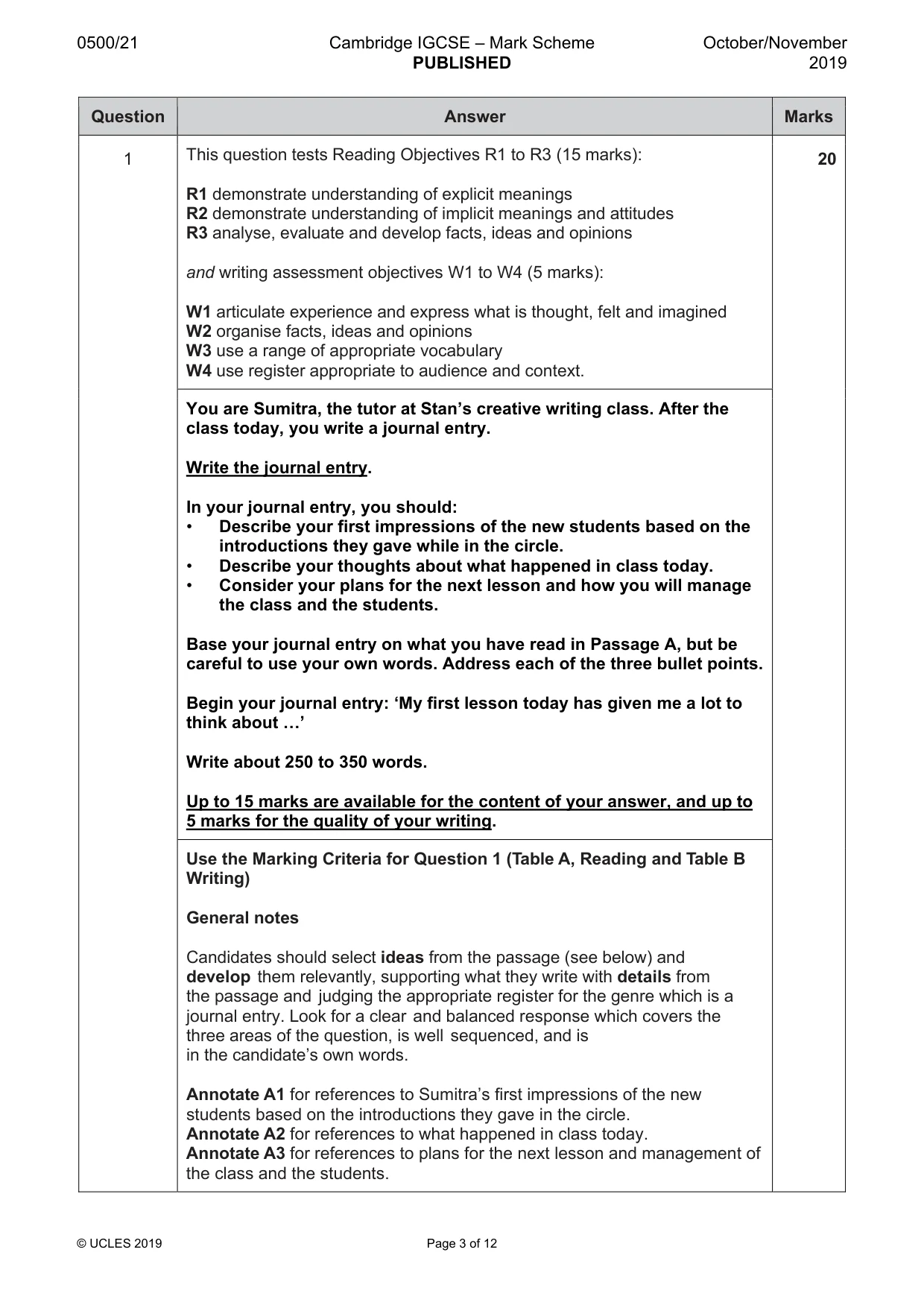
0500/21 Cambridge IGCSE – Mark Scheme PUBLISHED October/November 2019 © UCLES 2019 Page 3 of 12 Question Answer Marks 1 This question tests Reading Objectives R1 to R3 (15 marks): R1 demonstrate understanding of explicit meanings R2 demonstrate understanding of implicit meanings and attitudes R3 analyse, evaluate and develop facts, ideas and opinions and writing assessment objectives W1 to W4 (5 marks): W1 articulate experience and express what is thought, felt and imagined W2 organise facts, ideas and opinions W3 use a range of appropriate vocabulary W4 use register appropriate to audience and context. 20 You are Sumitra, the tutor at Stan’s creative writing class. After the class today, you write a journal entry. Write the journal entry. In your journal entry, you should: • Describe your first impressions of the new students based on the introductions they gave while in the circle. • Describe your thoughts about what happened in class today. • Consider your plans for the next lesson and how you will manage the class and the students. Base your journal entry on what you have read in Passage A, but be careful to use your own words. Address each of the three bullet points. Begin your journal entry: ‘My first lesson today has given me a lot to think about «’ Write about 250 to 350 words. Up to 15 marks are available for the content of your answer, and up to 5 marks for the quality of your writing. Use the Marking Criteria for Question 1 (Table A, Reading and Table B Writing) General notes Candidates should select ideas from the passage (see below) and develop them relevantly, supporting what they write with details from the passage and judging the appropriate register for the genre which is a journal entry. Look for a clear and balanced response which covers the three areas of the question, is well sequenced, and is in the candidate’s own words. Annotate A1 for references to Sumitra’s first impressions of the new students based on the introductions they gave in the circle. Annotate A2 for references to what happened in class today. Annotate A3 for references to plans for the next lesson and management of the class and the students.
Mark scheme, page 4
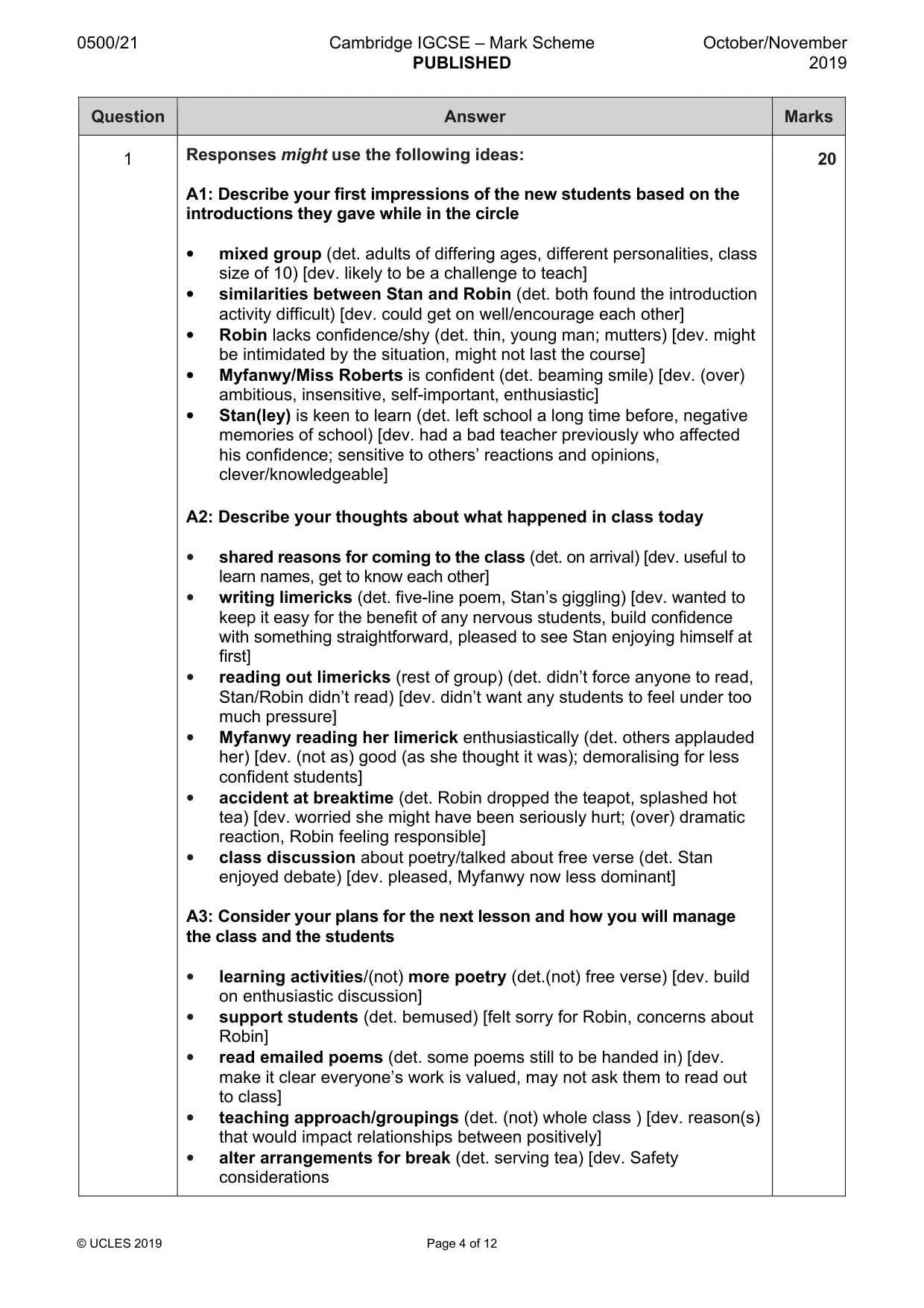
0500/21 Cambridge IGCSE – Mark Scheme PUBLISHED October/November 2019 © UCLES 2019 Page 4 of 12 Question Answer Marks 1 Responses might use the following ideas: A1: Describe your first impressions of the new students based on the introductions they gave while in the circle • mixed group (det. adults of differing ages, different personalities, class size of 10) [dev. likely to be a challenge to teach] • similarities between Stan and Robin (det. both found the introduction activity difficult) [dev. could get on well/encourage each other] • Robin lacks confidence/shy (det. thin, young man; mutters) [dev. might be intimidated by the situation, might not last the course] • Myfanwy/Miss Roberts is confident (det. beaming smile) [dev. (over) ambitious, insensitive, self-important, enthusiastic] • Stan(ley) is keen to learn (det. left school a long time before, negative memories of school) [dev. had a bad teacher previously who affected his confidence; sensitive to others’ reactions and opinions, clever/knowledgeable] A2: Describe your thoughts about what happened in class today • shared reasons for coming to the class (det. on arrival) [dev. useful to learn names, get to know each other] • writing limericks (det. five-line poem, Stan’s giggling) [dev. wanted to keep it easy for the benefit of any nervous students, build confidence with something straightforward, pleased to see Stan enjoying himself at first] • reading out limericks (rest of group) (det. didn’t force anyone to read, Stan/Robin didn’t read) [dev. didn’t want any students to feel under too much pressure] • Myfanwy reading her limerick enthusiastically (det. others applauded her) [dev. (not as) good (as she thought it was); demoralising for less confident students] • accident at breaktime (det. Robin dropped the teapot, splashed hot tea) [dev. worried she might have been seriously hurt; (over) dramatic reaction, Robin feeling responsible] • class discussion about poetry/talked about free verse (det. Stan enjoyed debate) [dev. pleased, Myfanwy now less dominant] A3: Consider your plans for the next lesson and how you will manage the class and the students • learning activities/(not) more poetry (det.(not) free verse) [dev. build on enthusiastic discussion] • support students (det. bemused) [felt sorry for Robin, concerns about Robin] • read emailed poems (det. some poems still to be handed in) [dev. make it clear everyone’s work is valued, may not ask them to read out to class] • teaching approach/groupings (det. (not) whole class ) [dev. reason(s) that would impact relationships between positively] • alter arrangements for break (det. serving tea) [dev. Safety considerations 20
Mark scheme, page 5
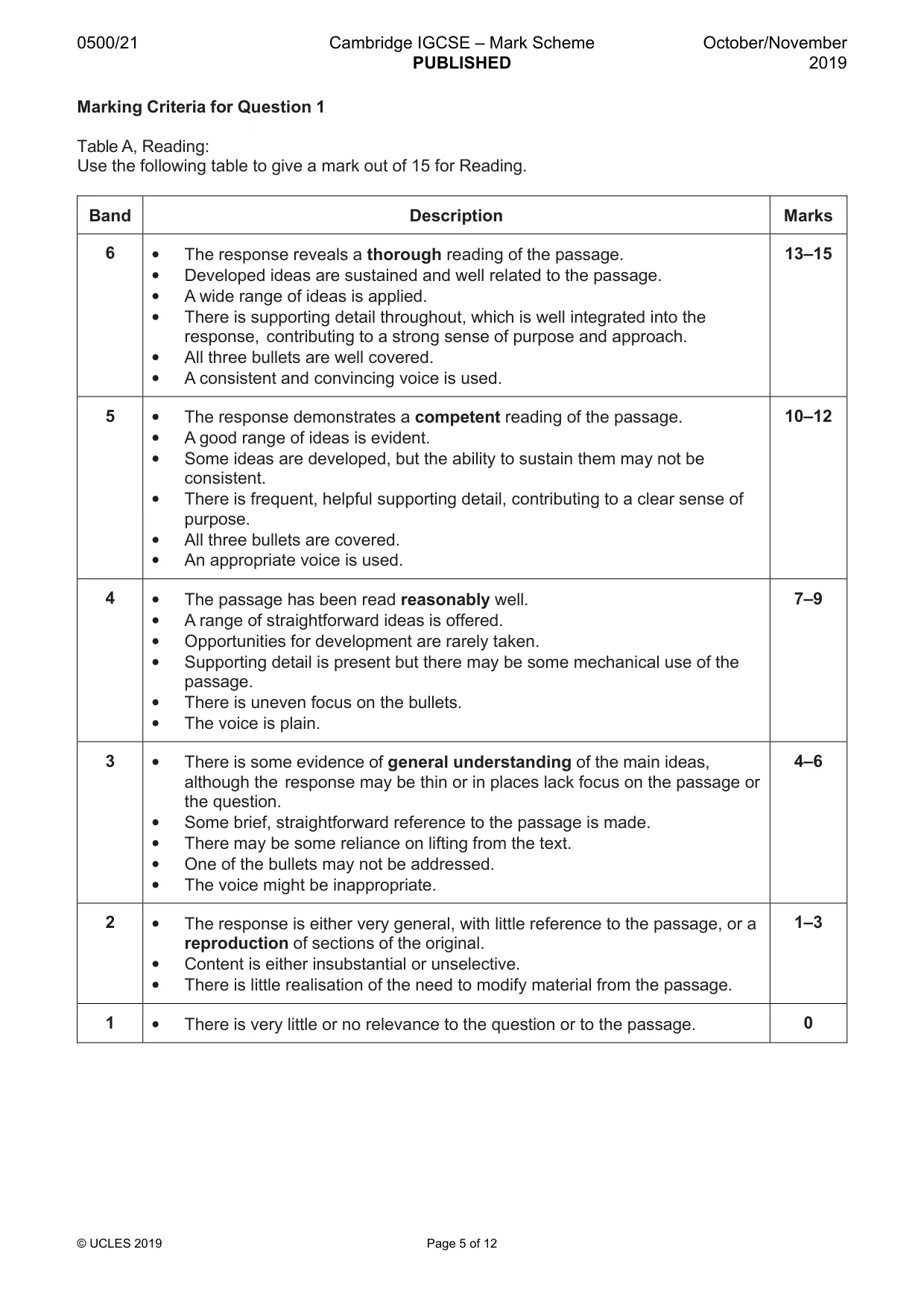
0500/21 Cambridge IGCSE – Mark Scheme PUBLISHED October/November 2019 © UCLES 2019 Page 5 of 12 Marking Criteria for Question 1 Table A, Reading: Use the following table to give a mark out of 15 for Reading. Band Description Marks 6 • The response reveals a thorough reading of the passage. • Developed ideas are sustained and well related to the passage. • A wide range of ideas is applied. • There is supporting detail throughout, which is well integrated into the response, contributing to a strong sense of purpose and approach. • All three bullets are well covered. • A consistent and convincing voice is used. 13–15 5 • The response demonstrates a competent reading of the passage. • A good range of ideas is evident. • Some ideas are developed, but the ability to sustain them may not be consistent. • There is frequent, helpful supporting detail, contributing to a clear sense of purpose. • All three bullets are covered. • An appropriate voice is used. 10–12 4 • The passage has been read reasonably well. • A range of straightforward ideas is offered. • Opportunities for development are rarely taken. • Supporting detail is present but there may be some mechanical use of the passage. • There is uneven focus on the bullets. • The voice is plain. 7–9 3 • There is some evidence of general understanding of the main ideas, although the response may be thin or in places lack focus on the passage or the question. • Some brief, straightforward reference to the passage is made. • There may be some reliance on lifting from the text. • One of the bullets may not be addressed. • The voice might be inappropriate. 4–6 2 • The response is either very general, with little reference to the passage, or a reproduction of sections of the original. • Content is either insubstantial or unselective. • There is little realisation of the need to modify material from the passage. 1–3 1 • There is very little or no relevance to the question or to the passage. 0
Mark scheme, page 6
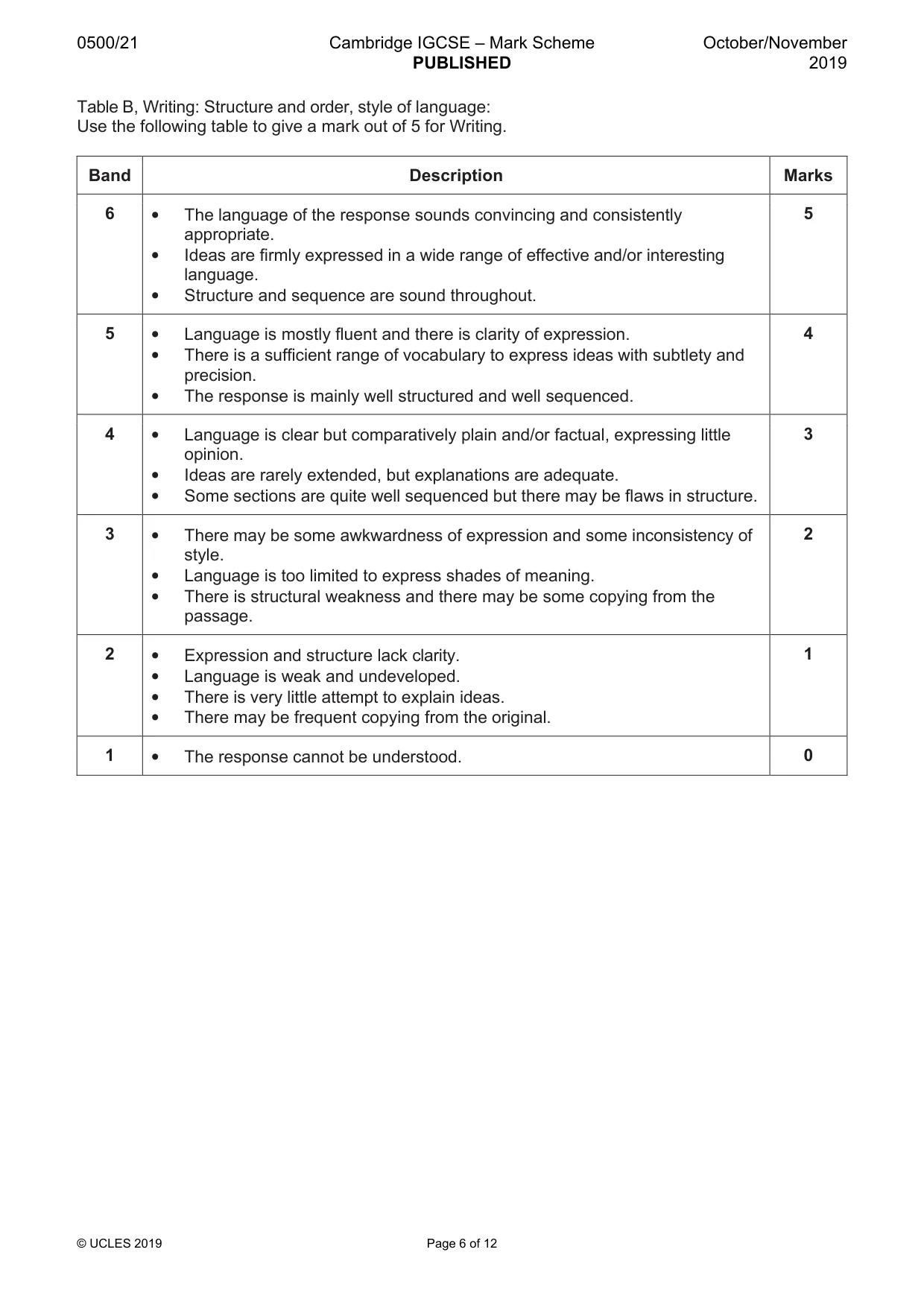
0500/21 Cambridge IGCSE – Mark Scheme PUBLISHED October/November 2019 © UCLES 2019 Page 6 of 12 Table B, Writing: Structure and order, style of language: Use the following table to give a mark out of 5 for Writing. Band Description Marks 6 • The language of the response sounds convincing and consistently appropriate. • Ideas are firmly expressed in a wide range of effective and/or interesting language. • Structure and sequence are sound throughout. 5 5 • Language is mostly fluent and there is clarity of expression. • There is a sufficient range of vocabulary to express ideas with subtlety and precision. • The response is mainly well structured and well sequenced. 4 4 • Language is clear but comparatively plain and/or factual, expressing little opinion. • Ideas are rarely extended, but explanations are adequate. • Some sections are quite well sequenced but there may be flaws in structure. 3 3 • There may be some awkwardness of expression and some inconsistency of style. • Language is too limited to express shades of meaning. • There is structural weakness and there may be some copying from the passage. 2 2 • Expression and structure lack clarity. • Language is weak and undeveloped. • There is very little attempt to explain ideas. • There may be frequent copying from the original. 1 1 • The response cannot be understood. 0
Mark scheme, page 7
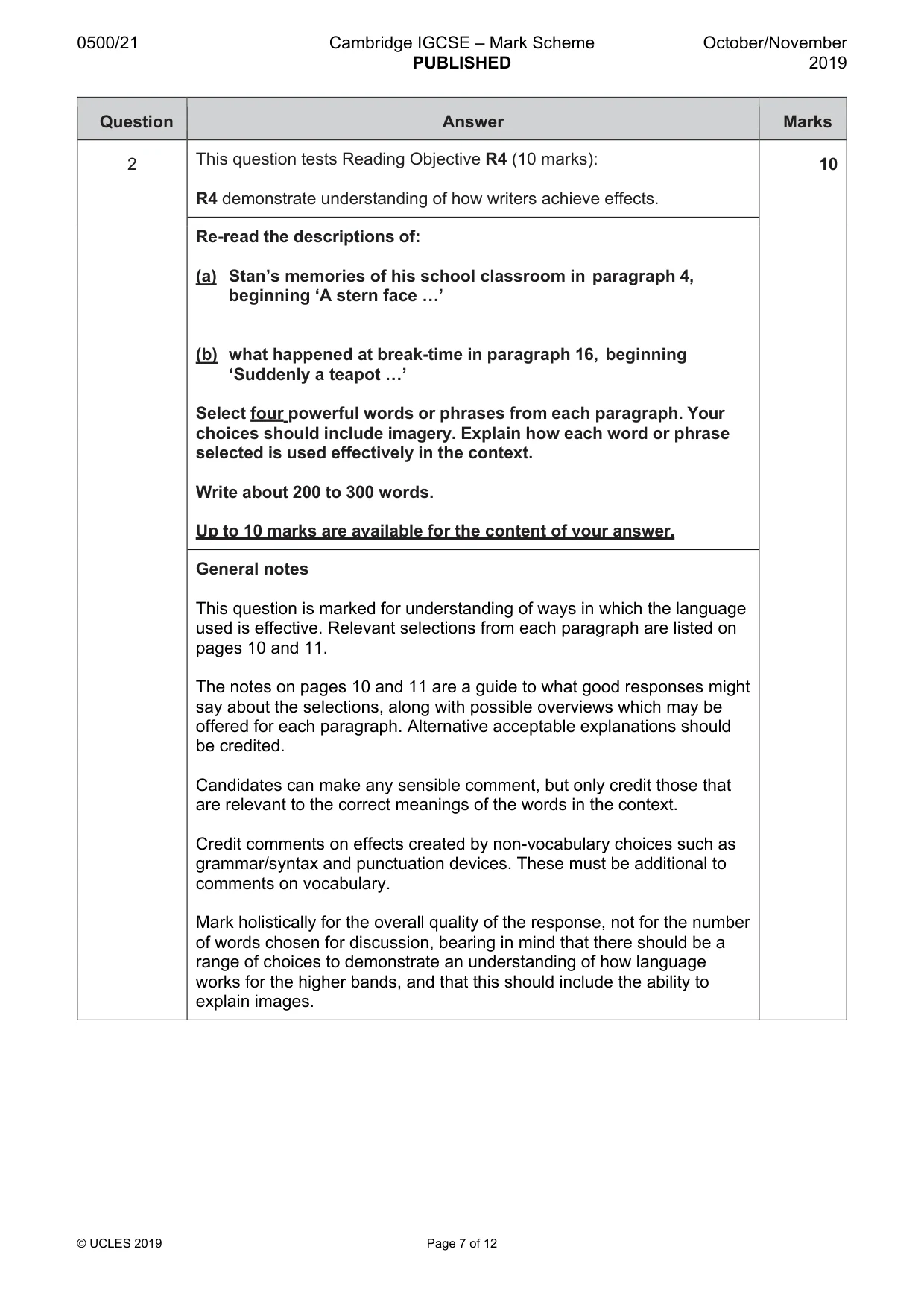
0500/21 Cambridge IGCSE – Mark Scheme PUBLISHED October/November 2019 © UCLES 2019 Page 7 of 12 Question Answer Marks 2 This question tests Reading Objective R4 (10 marks): R4 demonstrate understanding of how writers achieve effects. 10 Re-read the descriptions of: (a) Stan’s memories of his school classroom in paragraph 4, beginning ‘A stern face «’ (b) what happened at break-time in paragraph 16, beginning ‘Suddenly a teapot «’ Select four powerful words or phrases from each paragraph. Your choices should include imagery. Explain how each word or phrase selected is used effectively in the context. Write about 200 to 300 words. Up to 10 marks are available for the content of your answer. General notes This question is marked for understanding of ways in which the language used is effective. Relevant selections from each paragraph are listed on pages 10 and 11. The notes on pages 10 and 11 are a guide to what good responses might say about the selections, along with possible overviews which may be offered for each paragraph. Alternative acceptable explanations should be credited. Candidates can make any sensible comment, but only credit those that are relevant to the correct meanings of the words in the context. Credit comments on effects created by non-vocabulary choices such as grammar/syntax and punctuation devices. These must be additional to comments on vocabulary. Mark holistically for the overall quality of the response, not for the number of words chosen for discussion, bearing in mind that there should be a range of choices to demonstrate an understanding of how language works for the higher bands, and that this should include the ability to explain images.
Mark scheme, page 8
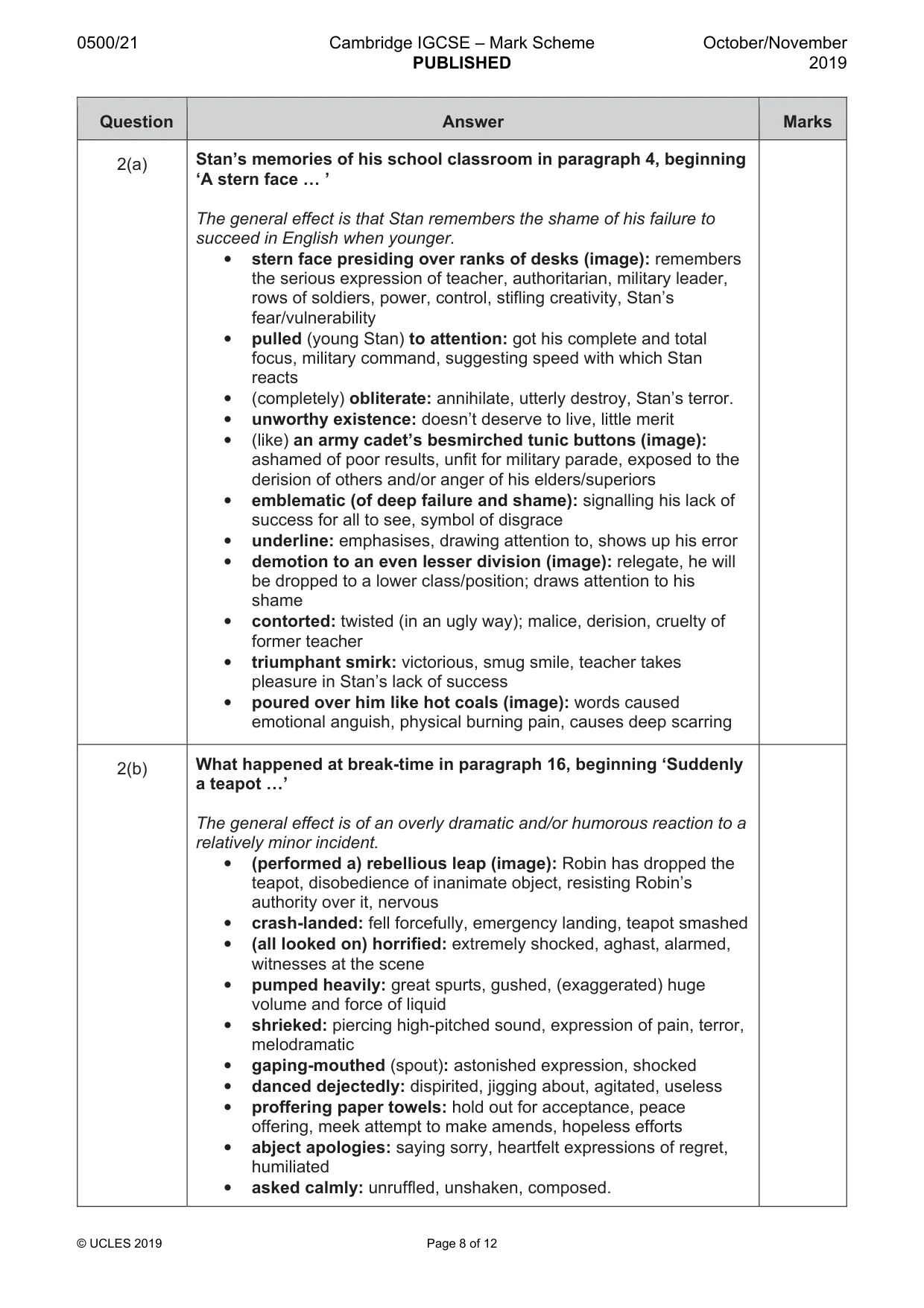
0500/21 Cambridge IGCSE – Mark Scheme PUBLISHED October/November 2019 © UCLES 2019 Page 8 of 12 Question Answer Marks 2(a) Stan’s memories of his school classroom in paragraph 4, beginning ‘A stern face « ’ The general effect is that Stan remembers the shame of his failure to succeed in English when younger. • stern face presiding over ranks of desks (image): remembers the serious expression of teacher, authoritarian, military leader, rows of soldiers, power, control, stifling creativity, Stan’s fear/vulnerability • pulled (young Stan) to attention: got his complete and total focus, military command, suggesting speed with which Stan reacts • (completely) obliterate: annihilate, utterly destroy, Stan’s terror. • unworthy existence: doesn’t deserve to live, little merit • (like) an army cadet’s besmirched tunic buttons (image): ashamed of poor results, unfit for military parade, exposed to the derision of others and/or anger of his elders/superiors • emblematic (of deep failure and shame): signalling his lack of success for all to see, symbol of disgrace • underline: emphasises, drawing attention to, shows up his error • demotion to an even lesser division (image): relegate, he will be dropped to a lower class/position; draws attention to his shame • contorted: twisted (in an ugly way); malice, derision, cruelty of former teacher • triumphant smirk: victorious, smug smile, teacher takes pleasure in Stan’s lack of success • poured over him like hot coals (image): words caused emotional anguish, physical burning pain, causes deep scarring 2(b) What happened at break-time in paragraph 16, beginning ‘Suddenly a teapot «’ The general effect is of an overly dramatic and/or humorous reaction to a relatively minor incident. • (performed a) rebellious leap (image): Robin has dropped the teapot, disobedience of inanimate object, resisting Robin’s authority over it, nervous • crash-landed: fell forcefully, emergency landing, teapot smashed • (all looked on) horrified: extremely shocked, aghast, alarmed, witnesses at the scene • pumped heavily: great spurts, gushed, (exaggerated) huge volume and force of liquid • shrieked: piercing high-pitched sound, expression of pain, terror, melodramatic • gaping-mouthed (spout): astonished expression, shocked • danced dejectedly: dispirited, jigging about, agitated, useless • proffering paper towels: hold out for acceptance, peace offering, meek attempt to make amends, hopeless efforts • abject apologies: saying sorry, heartfelt expressions of regret, humiliated • asked calmly: unruffled, unshaken, composed.
Mark scheme, page 9
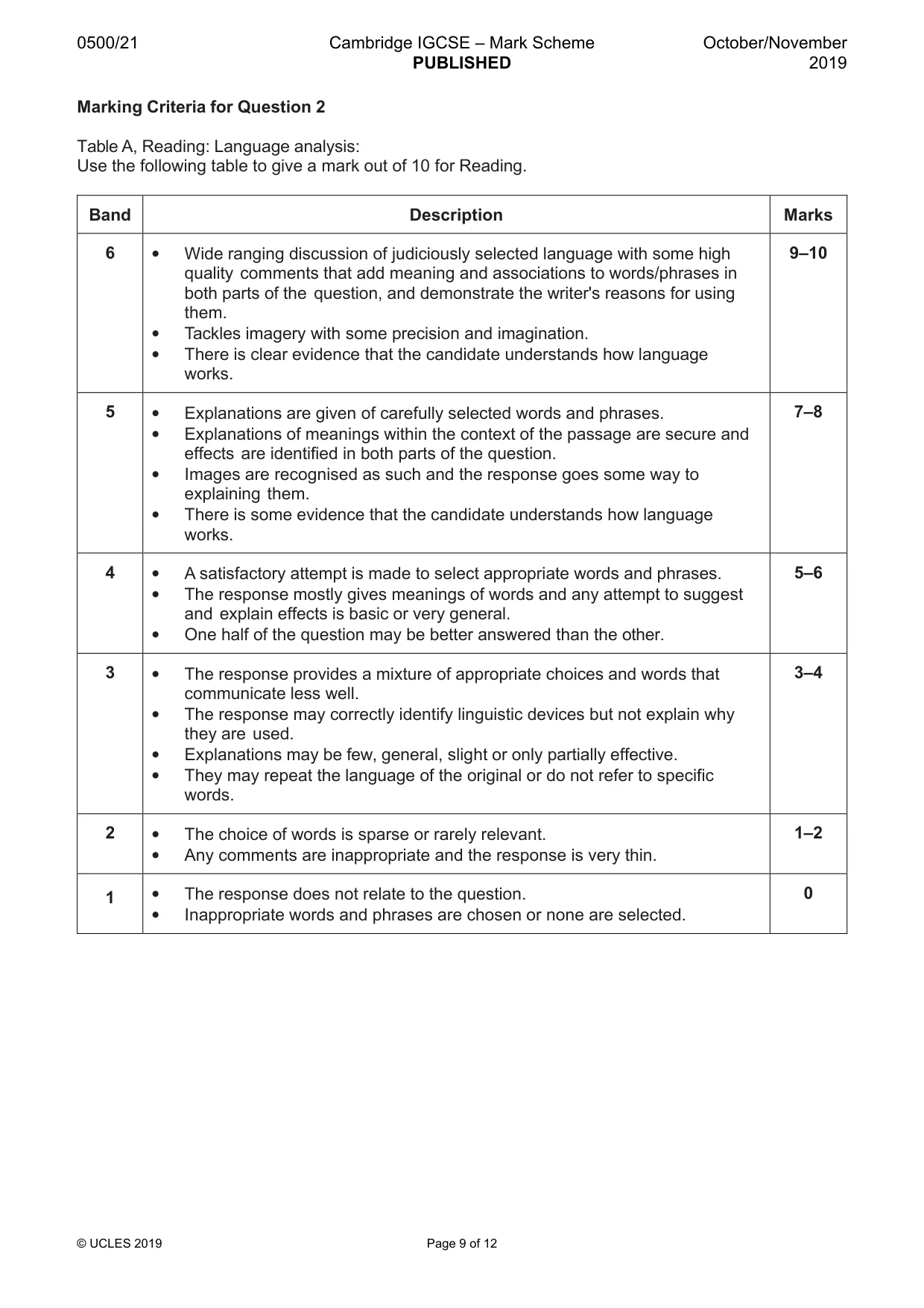
0500/21 Cambridge IGCSE – Mark Scheme PUBLISHED October/November 2019 © UCLES 2019 Page 9 of 12 Marking Criteria for Question 2 Table A, Reading: Language analysis: Use the following table to give a mark out of 10 for Reading. Band Description Marks 6 • Wide ranging discussion of judiciously selected language with some high quality comments that add meaning and associations to words/phrases in both parts of the question, and demonstrate the writer's reasons for using them. • Tackles imagery with some precision and imagination. • There is clear evidence that the candidate understands how language works. 9–10 5 • Explanations are given of carefully selected words and phrases. • Explanations of meanings within the context of the passage are secure and effects are identified in both parts of the question. • Images are recognised as such and the response goes some way to explaining them. • There is some evidence that the candidate understands how language works. 7–8 4 • A satisfactory attempt is made to select appropriate words and phrases. • The response mostly gives meanings of words and any attempt to suggest and explain effects is basic or very general. • One half of the question may be better answered than the other. 5–6 3 • The response provides a mixture of appropriate choices and words that communicate less well. • The response may correctly identify linguistic devices but not explain why they are used. • Explanations may be few, general, slight or only partially effective. • They may repeat the language of the original or do not refer to specific words. 3–4 2 • The choice of words is sparse or rarely relevant. • Any comments are inappropriate and the response is very thin. 1–2 1 • The response does not relate to the question. • Inappropriate words and phrases are chosen or none are selected. 0
Mark scheme, page 10
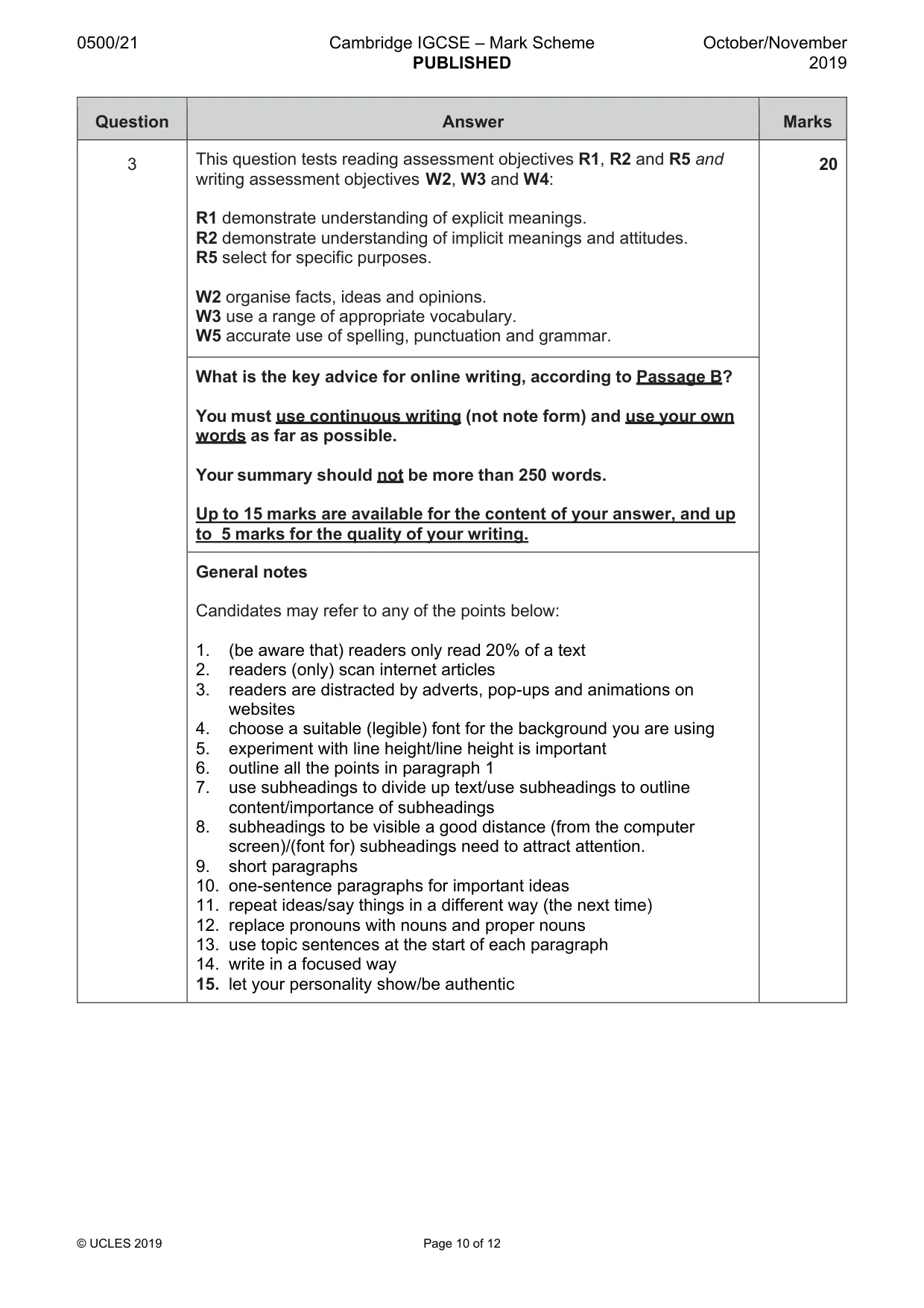
0500/21 Cambridge IGCSE – Mark Scheme PUBLISHED October/November 2019 © UCLES 2019 Page 10 of 12 Question Answer Marks 3 This question tests reading assessment objectives R1, R2 and R5 and writing assessment objectives W2, W3 and W4: R1 demonstrate understanding of explicit meanings. R2 demonstrate understanding of implicit meanings and attitudes. R5 select for specific purposes. W2 organise facts, ideas and opinions. W3 use a range of appropriate vocabulary. W5 accurate use of spelling, punctuation and grammar. 20 What is the key advice for online writing, according to Passage B? You must use continuous writing (not note form) and use your own words as far as possible. Your summary should not be more than 250 words. Up to 15 marks are available for the content of your answer, and up to 5 marks for the quality of your writing. General notes Candidates may refer to any of the points below: 1. (be aware that) readers only read 20% of a text 2. readers (only) scan internet articles 3. readers are distracted by adverts, pop-ups and animations on websites 4. choose a suitable (legible) font for the background you are using 5. experiment with line height/line height is important 6. outline all the points in paragraph 1 7. use subheadings to divide up text/use subheadings to outline content/importance of subheadings 8. subheadings to be visible a good distance (from the computer screen)/(font for) subheadings need to attract attention. 9. short paragraphs 10. one-sentence paragraphs for important ideas 11. repeat ideas/say things in a different way (the next time) 12. replace pronouns with nouns and proper nouns 13. use topic sentences at the start of each paragraph 14. write in a focused way 15. let your personality show/be authentic
Mark scheme, page 11
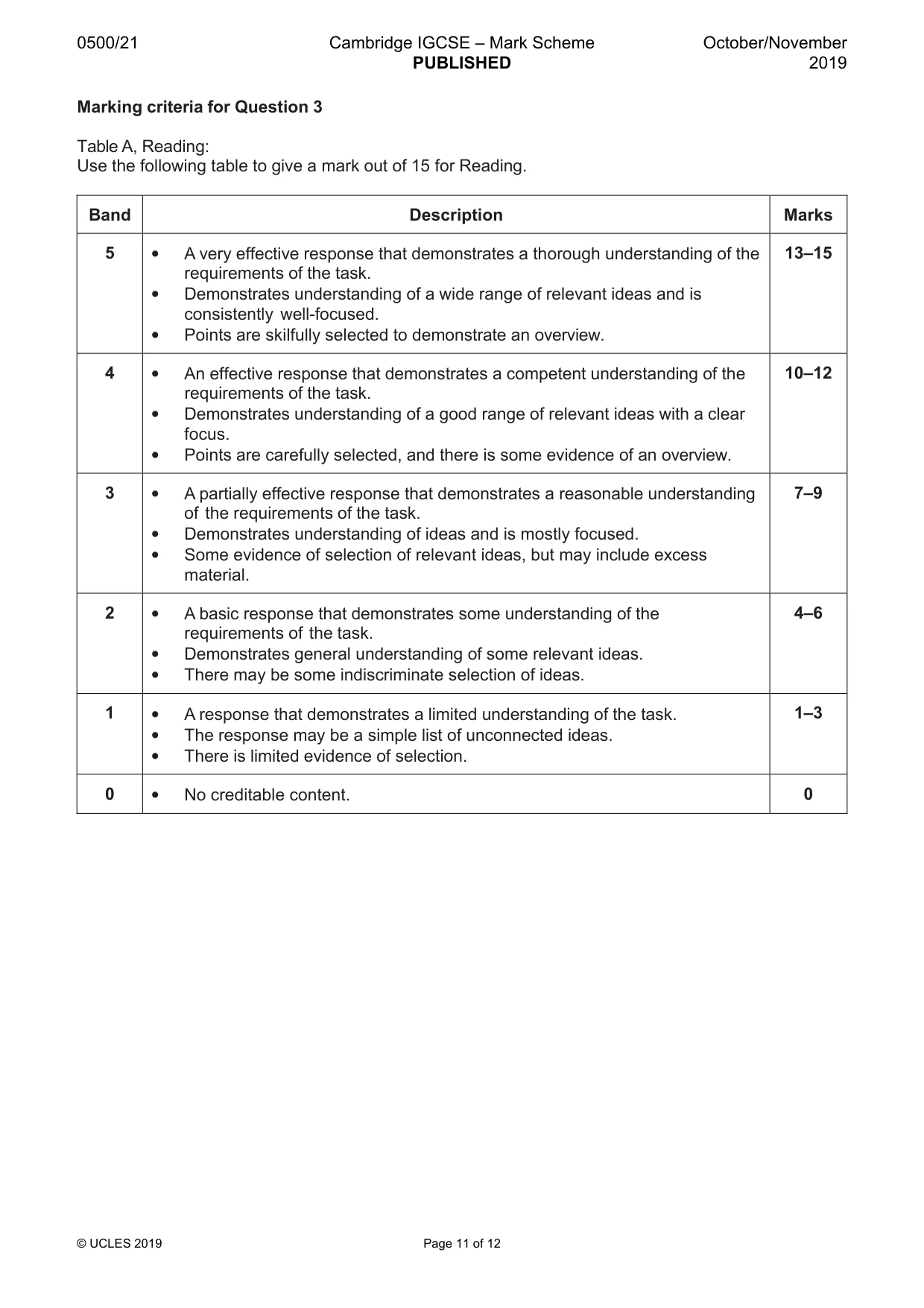
0500/21 Cambridge IGCSE – Mark Scheme PUBLISHED October/November 2019 © UCLES 2019 Page 11 of 12 Marking criteria for Question 3 Table A, Reading: Use the following table to give a mark out of 15 for Reading. Band Description Marks 5 • A very effective response that demonstrates a thorough understanding of the requirements of the task. • Demonstrates understanding of a wide range of relevant ideas and is consistently well-focused. • Points are skilfully selected to demonstrate an overview. 13–15 4 • An effective response that demonstrates a competent understanding of the requirements of the task. • Demonstrates understanding of a good range of relevant ideas with a clear focus. • Points are carefully selected, and there is some evidence of an overview. 10–12 3 • A partially effective response that demonstrates a reasonable understanding of the requirements of the task. • Demonstrates understanding of ideas and is mostly focused. • Some evidence of selection of relevant ideas, but may include excess material. 7–9 2 • A basic response that demonstrates some understanding of the requirements of the task. • Demonstrates general understanding of some relevant ideas. • There may be some indiscriminate selection of ideas. 4–6 1 • A response that demonstrates a limited understanding of the task. • The response may be a simple list of unconnected ideas. • There is limited evidence of selection. 1–3 0 • No creditable content. 0
Mark scheme, page 12
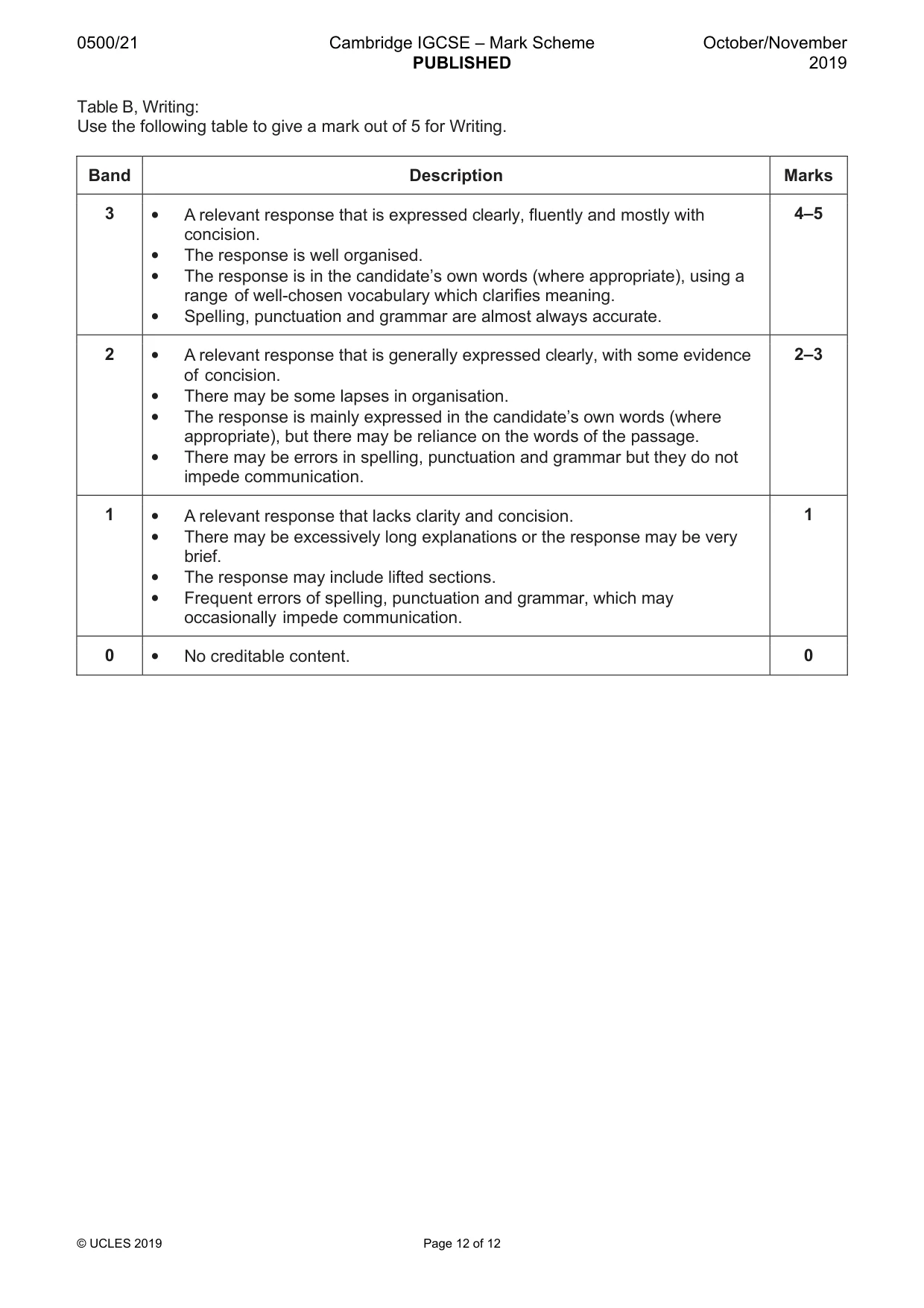
0500/21 Cambridge IGCSE – Mark Scheme PUBLISHED October/November 2019 © UCLES 2019 Page 12 of 12 Table B, Writing: Use the following table to give a mark out of 5 for Writing. Band Description Marks 3 • A relevant response that is expressed clearly, fluently and mostly with concision. • The response is well organised. • The response is in the candidate’s own words (where appropriate), using a range of well-chosen vocabulary which clarifies meaning. • Spelling, punctuation and grammar are almost always accurate. 4–5 2 • A relevant response that is generally expressed clearly, with some evidence of concision. • There may be some lapses in organisation. • The response is mainly expressed in the candidate’s own words (where appropriate), but there may be reliance on the words of the passage. • There may be errors in spelling, punctuation and grammar but they do not impede communication. 2–3 1 • A relevant response that lacks clarity and concision. • There may be excessively long explanations or the response may be very brief. • The response may include lifted sections. • Frequent errors of spelling, punctuation and grammar, which may occasionally impede communication. 1 0 • No creditable content. 0
What you needed in this session
Cambridge’s own grade thresholds for 2019 Oct/Nov, Paper 2 · Variant 1. A higher threshold means an easier paper — the bar moves with how the cohort did.