Cambridge IGCSE English - First Language 0500 — 2019 Oct/Nov Paper 1 · Variant 3
0500/13/O/N/19 · 50 marks · ≈56 min
The question paper and its mark scheme, free to read here and free to download. This is Cambridge’s own paper, exactly as it was sat.
Question paper12 pages
Mark scheme9 pages
Answers below. Sit the paper first if you are practising.
Paper as text
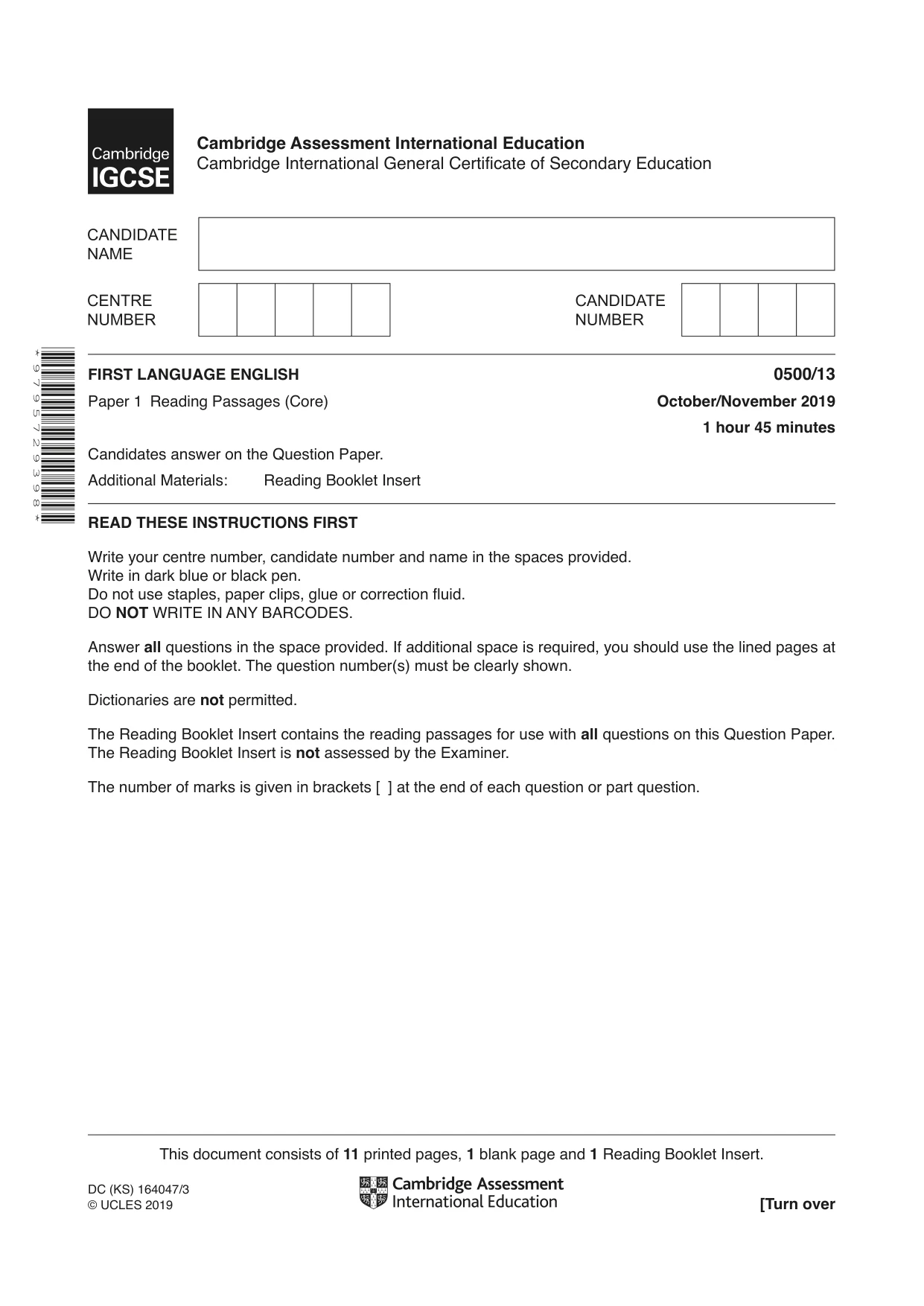
Question paper, page 1
This document consists of 11 printed pages, 1 blank page and 1 Reading Booklet Insert. DC (KS) 164047/3 © UCLES 2019 [Turn over Cambridge Assessment International Education Cambridge International General Certificate of Secondary Education * 9 7 9 5 7 2 9 3 9 8 * FIRST LANGUAGE ENGLISH 0500/13 Paper 1 Reading Passages (Core) October/November 2019 1 hour 45 minutes Candidates answer on the Question Paper. Additional Materials: Reading Booklet Insert READ THESE INSTRUCTIONS FIRST Write your centre number, candidate number and name in the spaces provided. Write in dark blue or black pen. Do not use staples, paper clips, glue or correction fluid. DO NOT WRITE IN ANY BARCODES. Answer all questions in the space provided. If additional space is required, you should use the lined pages at the end of the booklet. The question number(s) must be clearly shown. Dictionaries are not permitted. The Reading Booklet Insert contains the reading passages for use with all questions on this Question Paper. The Reading Booklet Insert is not assessed by the Examiner. The number of marks is given in brackets [ ] at the end of each question or part question.
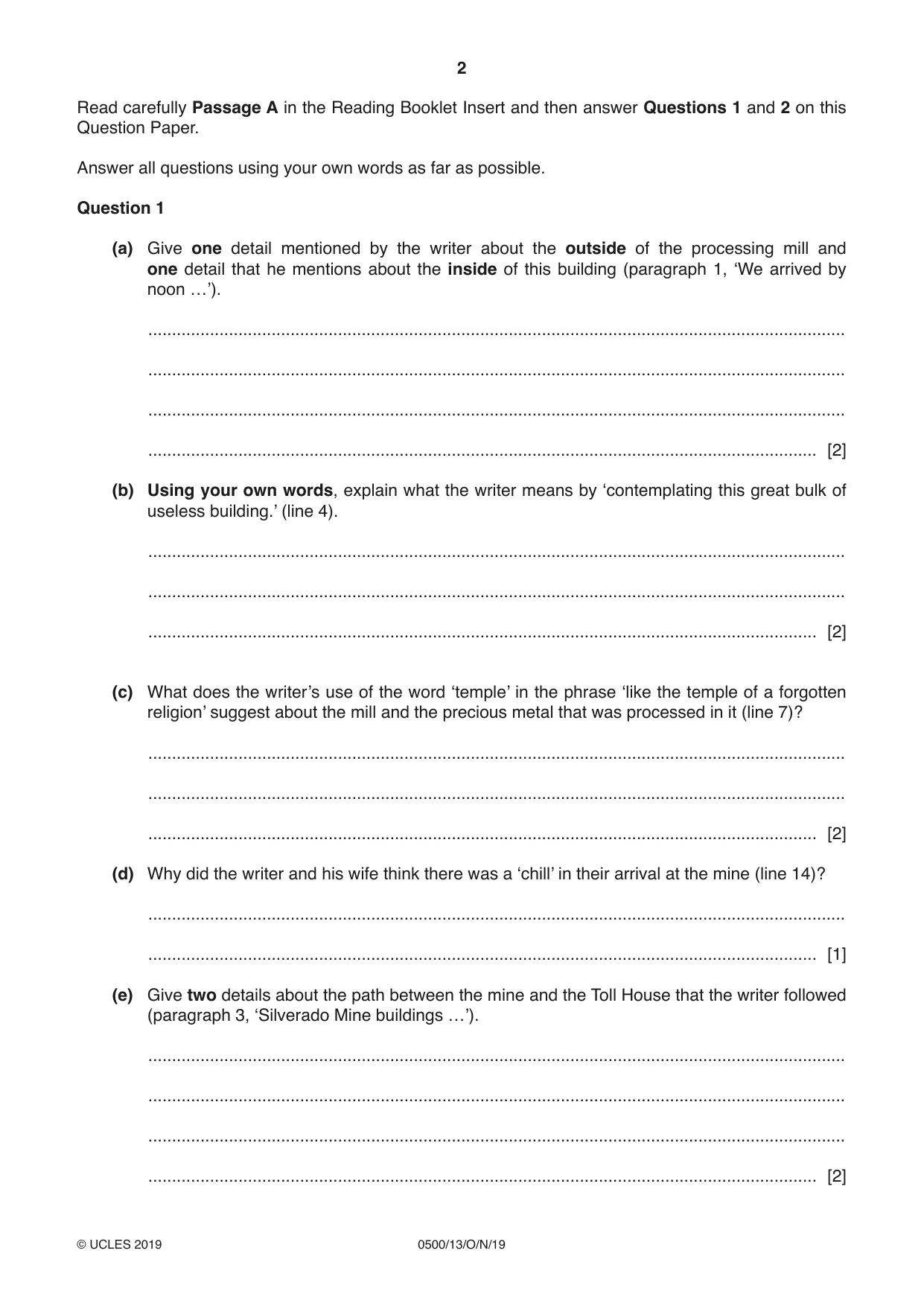
Question paper, page 2
2 0500/13/O/N/19 © UCLES 2019 Read carefully Passage A in the Reading Booklet Insert and then answer Questions 1 and 2 on this Question Paper. Answer all questions using your own words as far as possible. Question 1 (a) Give one detail mentioned by the writer about the outside of the processing mill and one detail that he mentions about the inside of this building (paragraph 1, ‘We arrived by noon …’). … … … … [2] (b) Using your own words, explain what the writer means by ‘contemplating this great bulk of useless building.’ (line 4). … … … [2] (c) What does the writer’s use of the word ‘temple’ in the phrase ‘like the temple of a forgotten religion’ suggest about the mill and the precious metal that was processed in it (line 7)? … … … [2] (d) Why did the writer and his wife think there was a ‘chill’ in their arrival at the mine (line 14)? … … [1] (e) Give two details about the path between the mine and the Toll House that the writer followed (paragraph 3, ‘Silverado Mine buildings …’). … … … … [2]
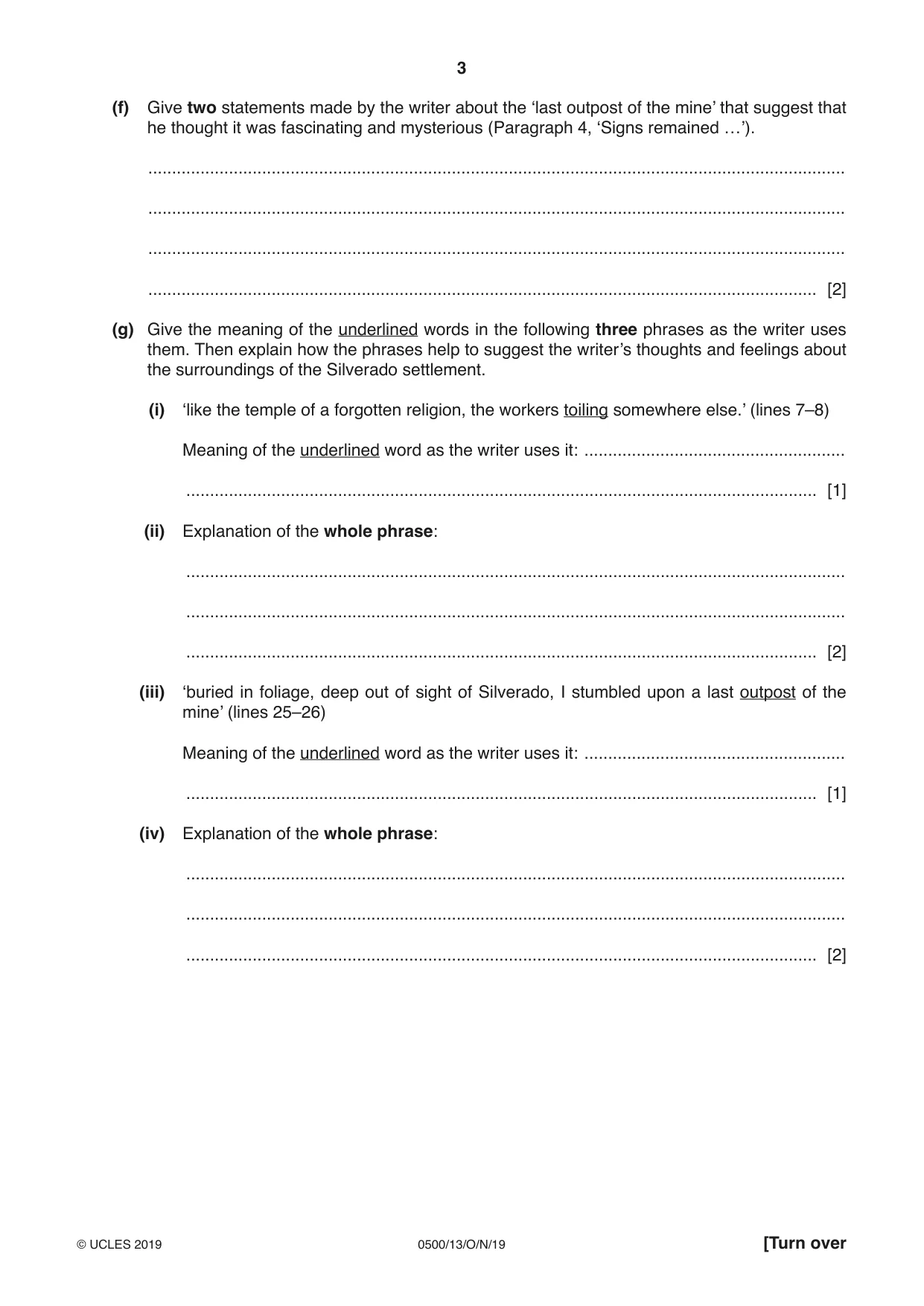
Question paper, page 3
3 0500/13/O/N/19 © UCLES 2019 [Turn over (f) Give two statements made by the writer about the ‘last outpost of the mine’ that suggest that he thought it was fascinating and mysterious (Paragraph 4, ‘Signs remained …’). … … … … [2] (g) Give the meaning of the underlined words in the following three phrases as the writer uses them. Then explain how the phrases help to suggest the writer’s thoughts and feelings about the surroundings of the Silverado settlement. (i) ‘like the temple of a forgotten religion, the workers toiling somewhere else.’ (lines 7–8) Meaning of the underlined word as the writer uses it: … … [1] (ii) Explanation of the whole phrase: … … … [2] (iii) ‘buried in foliage, deep out of sight of Silverado, I stumbled upon a last outpost of the mine’ (lines 25–26) Meaning of the underlined word as the writer uses it: … … [1] (iv) Explanation of the whole phrase: … … … [2]
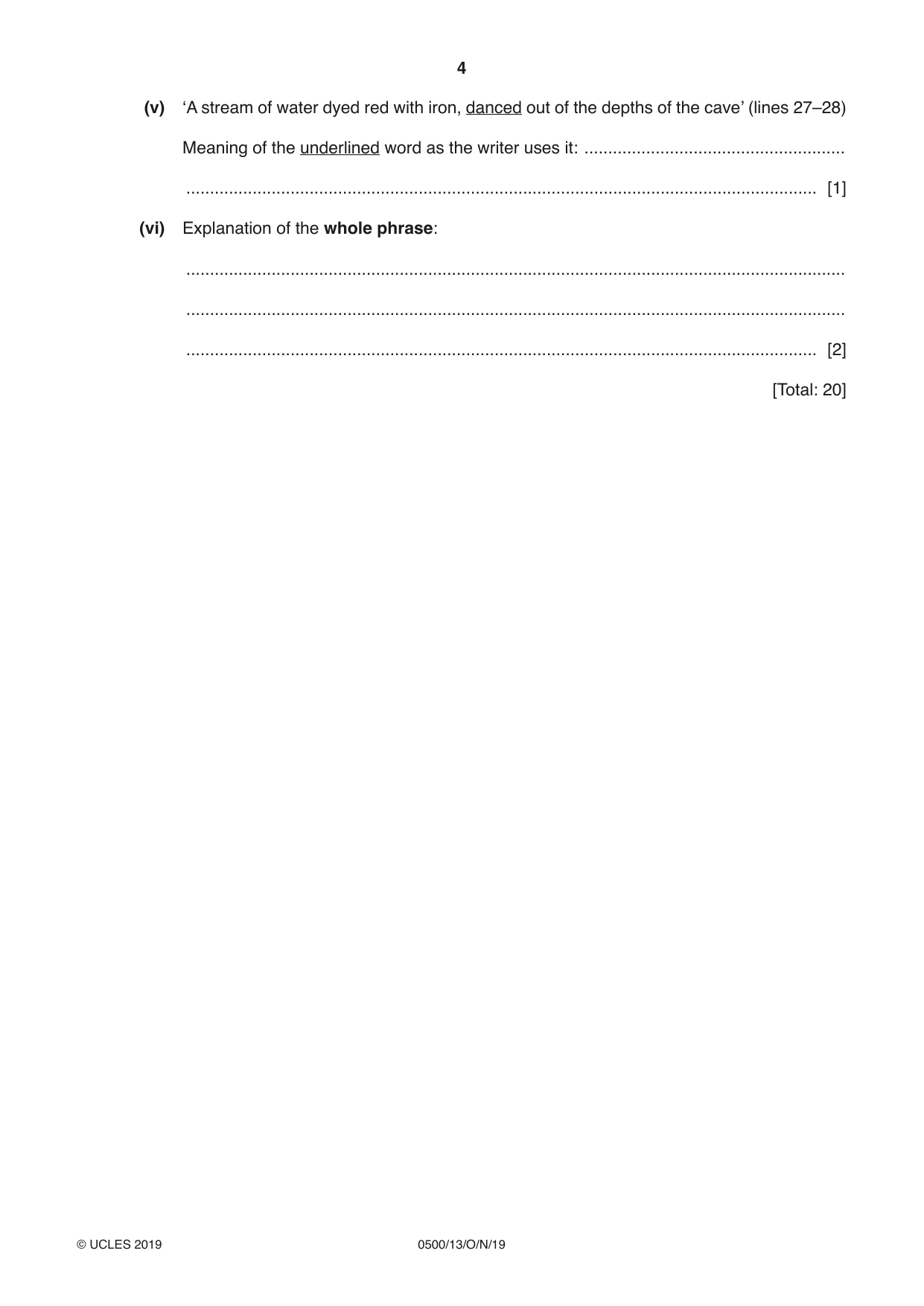
Question paper, page 4
4 0500/13/O/N/19 © UCLES 2019 (v) ‘A stream of water dyed red with iron, danced out of the depths of the cave’ (lines 27–28) Meaning of the underlined word as the writer uses it: … … [1] (vi) Explanation of the whole phrase: … … … [2] [Total: 20]
Question paper, page 5
5 0500/13/O/N/19 © UCLES 2019 [Turn over [Turn to page 6 for Question 2]
Question paper, page 6
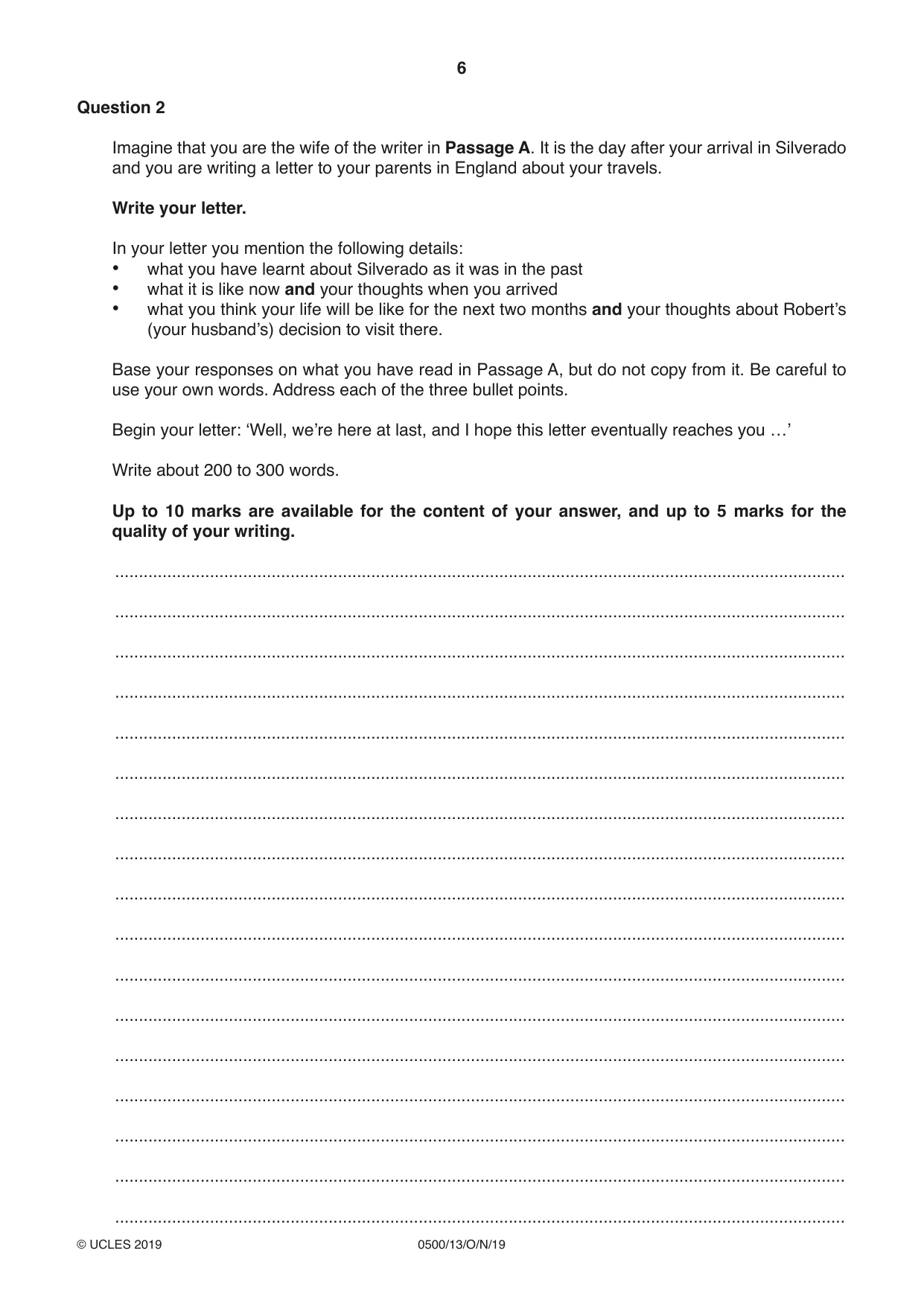
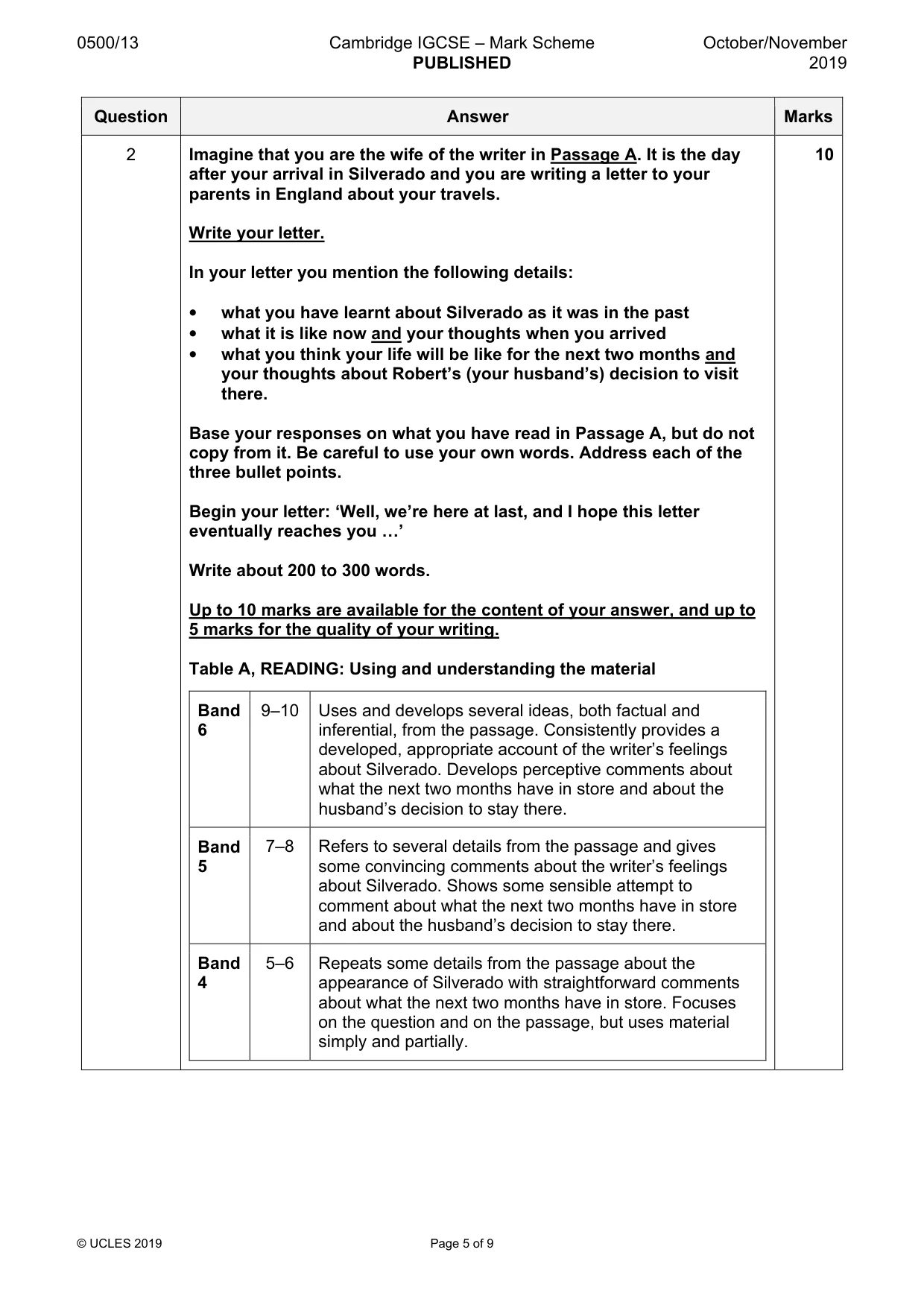
6 0500/13/O/N/19 © UCLES 2019 Question 2 Imagine that you are the wife of the writer in Passage A. It is the day after your arrival in Silverado and you are writing a letter to your parents in England about your travels. Write your letter. In your letter you mention the following details: • what you have learnt about Silverado as it was in the past • what it is like now and your thoughts when you arrived • what you think your life will be like for the next two months and your thoughts about Robert’s (your husband’s) decision to visit there. Base your responses on what you have read in Passage A, but do not copy from it. Be careful to use your own words. Address each of the three bullet points. Begin your letter: ‘Well, we’re here at last, and I hope this letter eventually reaches you …’ Write about 200 to 300 words. Up to 10 marks are available for the content of your answer, and up to 5 marks for the quality of your writing. … … … … … … … … … … … … … … … … …
Question paper, page 7
7 0500/13/O/N/19 © UCLES 2019 [Turn over … … … … … … … … … … … … … … … … … … … … … … … … … … … [Total: 15]
Question paper, page 8
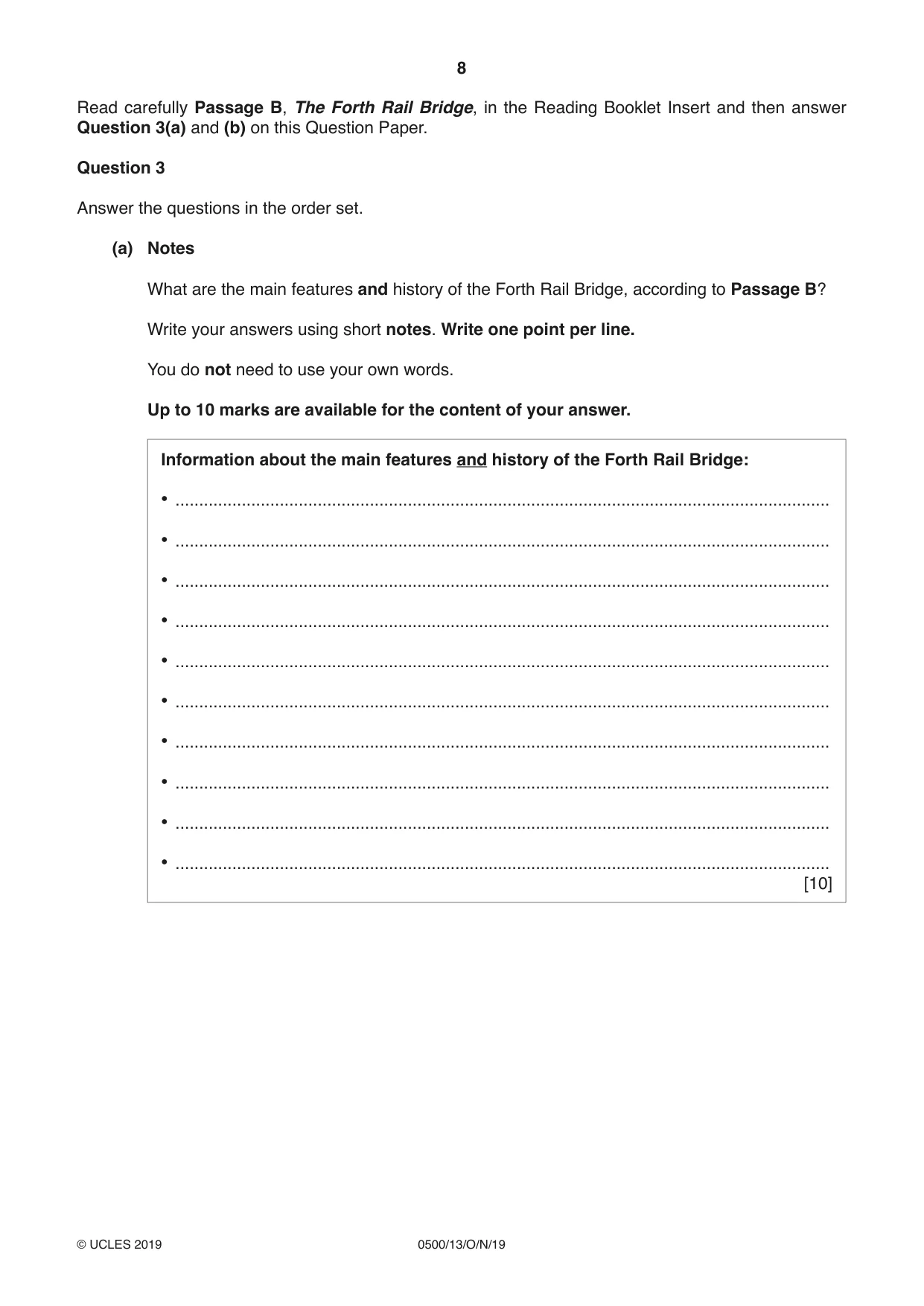
8 0500/13/O/N/19 © UCLES 2019 Read carefully Passage B, The Forth Rail Bridge, in the Reading Booklet Insert and then answer Question 3(a) and (b) on this Question Paper. Question 3 Answer the questions in the order set. (a) Notes What are the main features and history of the Forth Rail Bridge, according to Passage B? Write your answers using short notes. Write one point per line. You do not need to use your own words. Up to 10 marks are available for the content of your answer. Information about the main features and history of the Forth Rail Bridge: • … • … • … • … • … • … • … • … • … • … [10]
Question paper, page 9
9 0500/13/O/N/19 © UCLES 2019 (b) Summary Now use your notes to write a summary of what Passage B tells you about the main features and history of the Forth Rail Bridge. You must use continuous writing (not note form) and use your own words as far as possible. Your summary should not be more than 150 words. Up to 5 marks are available for the quality of your writing. … … … … … … … … … … … … … … … … … … … … … [5] [Total: 15]
Question paper, page 10
10 0500/13/O/N/19 © UCLES 2019 Additional Page If you use the following lined page to complete the answer(s) to any question(s), the question number(s) must be clearly shown. … … … … … … … … … … … … … … … … … … … … … … … … … …
Question paper, page 11
11 0500/13/O/N/19 © UCLES 2019 Additional Page If you use the following lined page to complete the answer(s) to any question(s), the question number(s) must be clearly shown. … … … … … … … … … … … … … … … … … … … … … … … … … …
Question paper, page 12
12 0500/13/O/N/19 © UCLES 2019 Permission to reproduce items where third-party owned material protected by copyright is included has been sought and cleared where possible. Every reasonable effort has been made by the publisher (UCLES) to trace copyright holders, but if any items requiring clearance have unwittingly been included, the publisher will be pleased to make amends at the earliest possible opportunity. To avoid the issue of disclosure of answer-related information to candidates, all copyright acknowledgements are reproduced online in the Cambridge Assessment International Education Copyright Acknowledgements Booklet. This is produced for each series of examinations and is freely available to download at www.cambridgeinternational.org after the live examination series. Cambridge Assessment International Education is part of the Cambridge Assessment Group. Cambridge Assessment is the brand name of the University of Cambridge Local Examinations Syndicate (UCLES), which itself is a department of the University of Cambridge. BLANK PAGE
Mark scheme, page 1
This document consists of 9 printed pages. © UCLES 2019 [Turn over Cambridge Assessment International Education Cambridge International General Certificate of Secondary Education FIRST LANGUAGE ENGLISH (ORAL ENDORSEMENT) 0500/13 Paper 1 Reading Passages (Core) October/November 2019 MARK SCHEME Maximum Mark: 50 Published This mark scheme is published as an aid to teachers and candidates, to indicate the requirements of the examination. It shows the basis on which Examiners were instructed to award marks. It does not indicate the details of the discussions that took place at an Examiners’ meeting before marking began, which would have considered the acceptability of alternative answers. Mark schemes should be read in conjunction with the question paper and the Principal Examiner Report for Teachers. Cambridge International will not enter into discussions about these mark schemes. Cambridge International is publishing the mark schemes for the October/November 2019 series for most Cambridge IGCSE™, Cambridge International A and AS Level components and some Cambridge O Level components.
Mark scheme, page 2
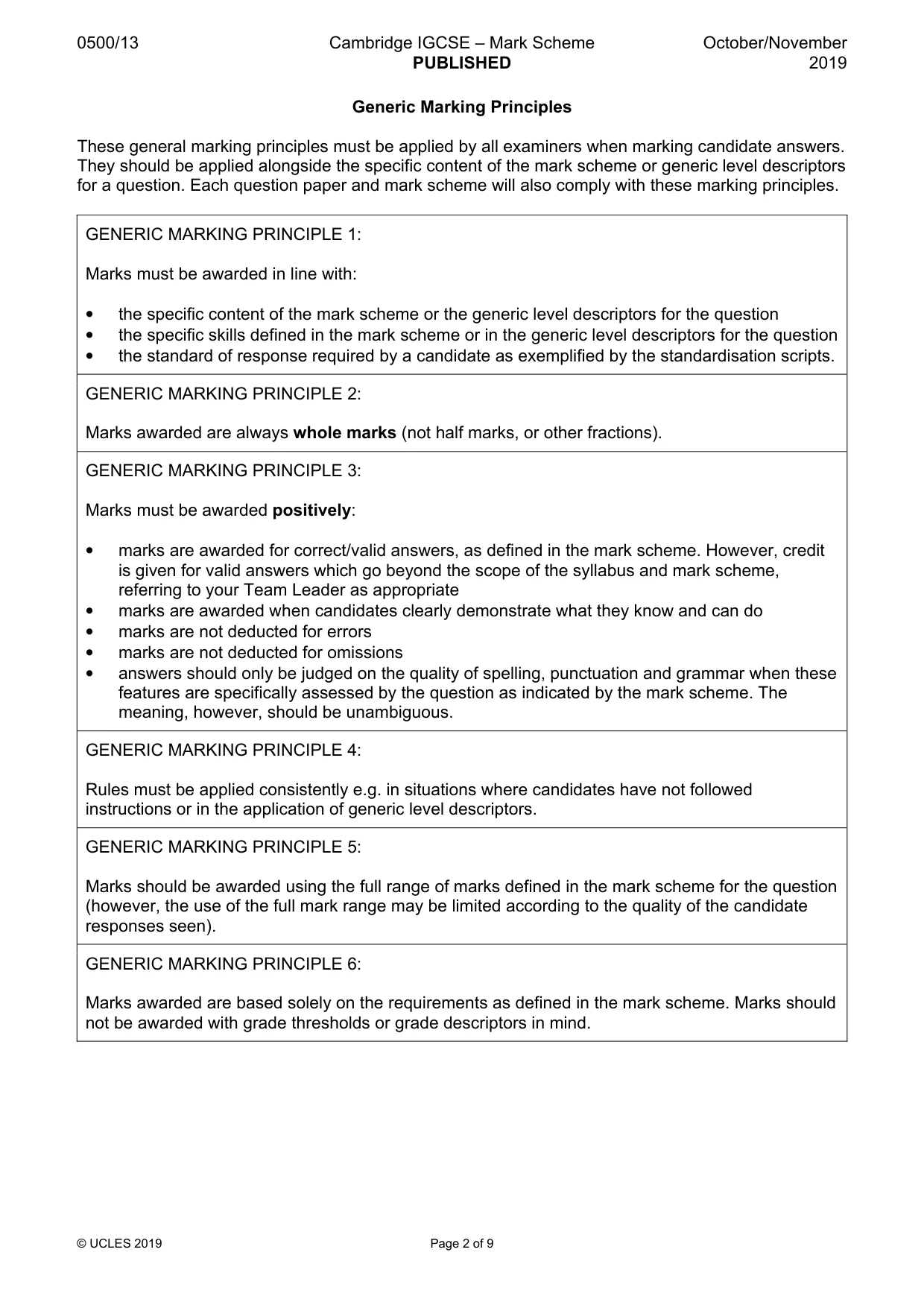
0500/13 Cambridge IGCSE – Mark Scheme PUBLISHED October/November 2019 © UCLES 2019 Page 2 of 9 Generic Marking Principles These general marking principles must be applied by all examiners when marking candidate answers. They should be applied alongside the specific content of the mark scheme or generic level descriptors for a question. Each question paper and mark scheme will also comply with these marking principles. GENERIC MARKING PRINCIPLE 1: Marks must be awarded in line with: • the specific content of the mark scheme or the generic level descriptors for the question • the specific skills defined in the mark scheme or in the generic level descriptors for the question • the standard of response required by a candidate as exemplified by the standardisation scripts. GENERIC MARKING PRINCIPLE 2: Marks awarded are always whole marks (not half marks, or other fractions). GENERIC MARKING PRINCIPLE 3: Marks must be awarded positively: • marks are awarded for correct/valid answers, as defined in the mark scheme. However, credit is given for valid answers which go beyond the scope of the syllabus and mark scheme, referring to your Team Leader as appropriate • marks are awarded when candidates clearly demonstrate what they know and can do • marks are not deducted for errors • marks are not deducted for omissions • answers should only be judged on the quality of spelling, punctuation and grammar when these features are specifically assessed by the question as indicated by the mark scheme. The meaning, however, should be unambiguous. GENERIC MARKING PRINCIPLE 4: Rules must be applied consistently e.g. in situations where candidates have not followed instructions or in the application of generic level descriptors. GENERIC MARKING PRINCIPLE 5: Marks should be awarded using the full range of marks defined in the mark scheme for the question (however, the use of the full mark range may be limited according to the quality of the candidate responses seen). GENERIC MARKING PRINCIPLE 6: Marks awarded are based solely on the requirements as defined in the mark scheme. Marks should not be awarded with grade thresholds or grade descriptors in mind.
Mark scheme, page 3
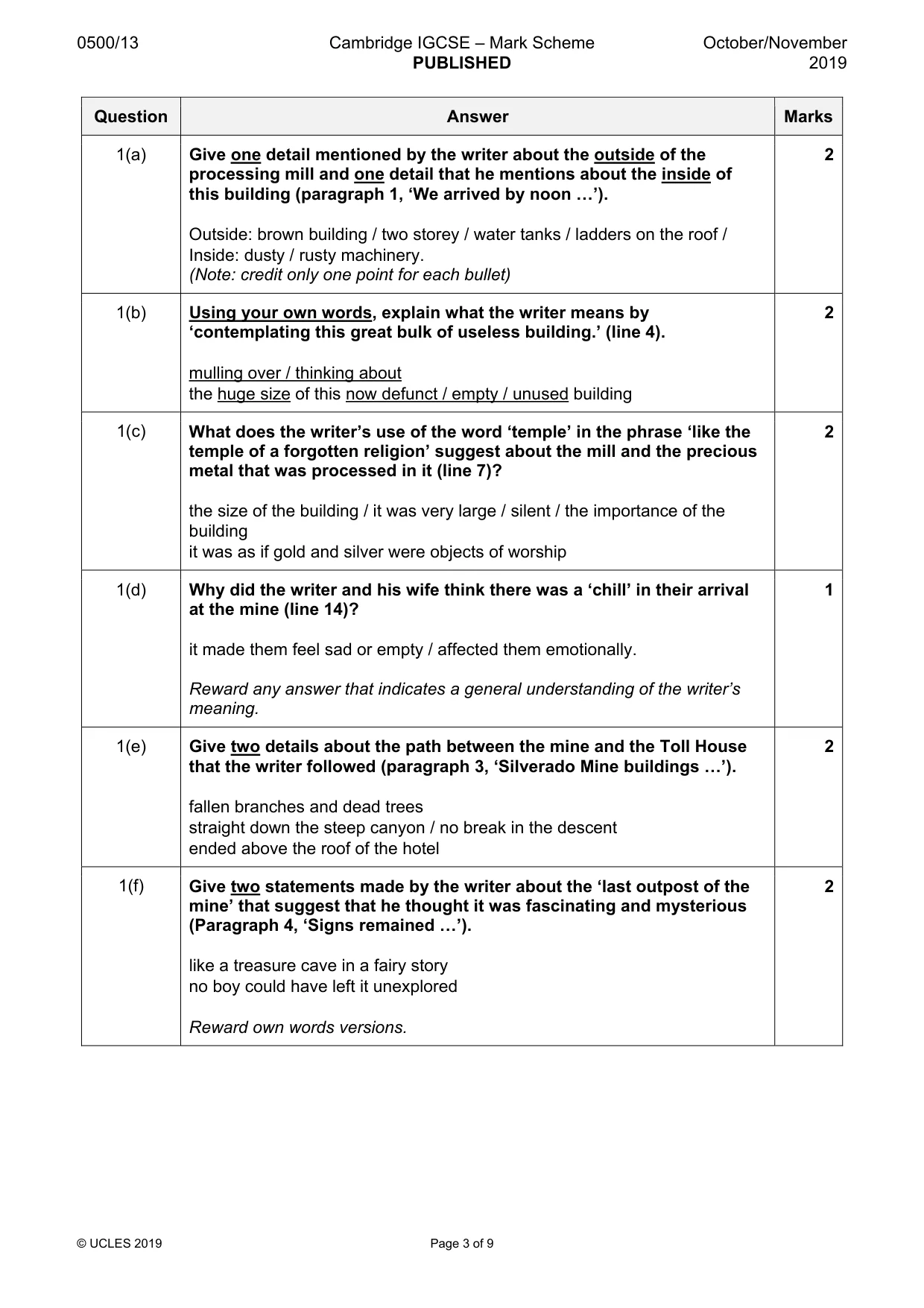
0500/13 Cambridge IGCSE – Mark Scheme PUBLISHED October/November 2019 © UCLES 2019 Page 3 of 9 Question Answer Marks 1(a) Give one detail mentioned by the writer about the outside of the processing mill and one detail that he mentions about the inside of this building (paragraph 1, ‘We arrived by noon «’). Outside: brown building / two storey / water tanks / ladders on the roof / Inside: dusty / rusty machinery. (Note: credit only one point for each bullet) 2 1(b) Using your own words, explain what the writer means by ‘contemplating this great bulk of useless building.’ (line 4). mulling over / thinking about the huge size of this now defunct / empty / unused building 2 1(c) What does the writer’s use of the word ‘temple’ in the phrase ‘like the temple of a forgotten religion’ suggest about the mill and the precious metal that was processed in it (line 7)? the size of the building / it was very large / silent / the importance of the building it was as if gold and silver were objects of worship 2 1(d) Why did the writer and his wife think there was a ‘chill’ in their arrival at the mine (line 14)? it made them feel sad or empty / affected them emotionally. Reward any answer that indicates a general understanding of the writer’s meaning. 1 1(e) Give two details about the path between the mine and the Toll House that the writer followed (paragraph 3, ‘Silverado Mine buildings «’). fallen branches and dead trees straight down the steep canyon / no break in the descent ended above the roof of the hotel 2 1(f) Give two statements made by the writer about the ‘last outpost of the mine’ that suggest that he thought it was fascinating and mysterious (Paragraph 4, ‘Signs remained «’). like a treasure cave in a fairy story no boy could have left it unexplored Reward own words versions. 2
Mark scheme, page 4
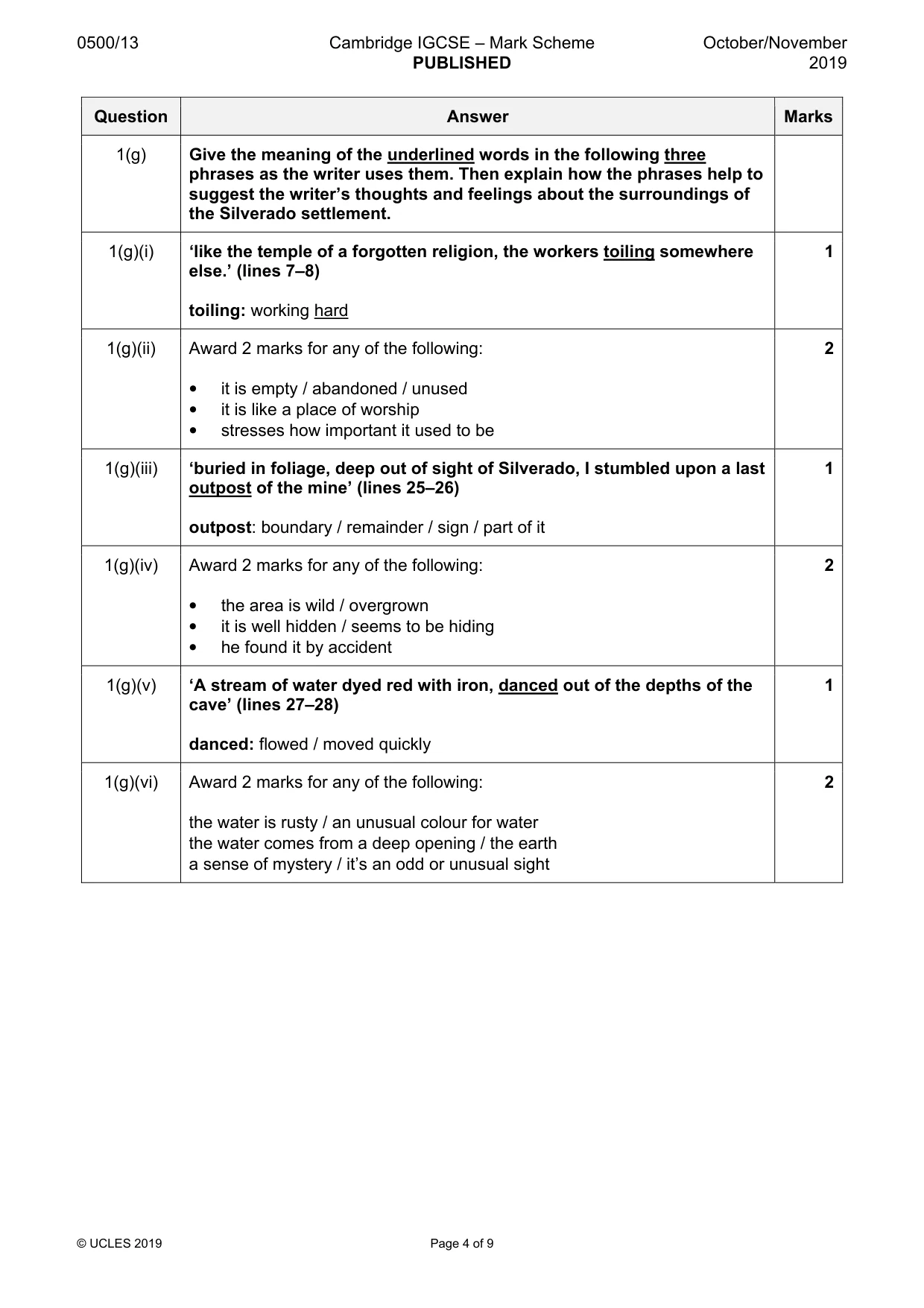
0500/13 Cambridge IGCSE – Mark Scheme PUBLISHED October/November 2019 © UCLES 2019 Page 4 of 9 Question Answer Marks 1(g) Give the meaning of the underlined words in the following three phrases as the writer uses them. Then explain how the phrases help to suggest the writer’s thoughts and feelings about the surroundings of the Silverado settlement. 1(g)(i) ‘like the temple of a forgotten religion, the workers toiling somewhere else.’ (lines 7–8) toiling: working hard 1 1(g)(ii) Award 2 marks for any of the following: • it is empty / abandoned / unused • it is like a place of worship • stresses how important it used to be 2 1(g)(iii) ‘buried in foliage, deep out of sight of Silverado, I stumbled upon a last outpost of the mine’ (lines 25–26) outpost: boundary / remainder / sign / part of it 1 1(g)(iv) Award 2 marks for any of the following: • the area is wild / overgrown • it is well hidden / seems to be hiding • he found it by accident 2 1(g)(v) ‘A stream of water dyed red with iron, danced out of the depths of the cave’ (lines 27–28) danced: flowed / moved quickly 1 1(g)(vi) Award 2 marks for any of the following: the water is rusty / an unusual colour for water the water comes from a deep opening / the earth a sense of mystery / it’s an odd or unusual sight 2
Mark scheme, page 5
0500/13 Cambridge IGCSE – Mark Scheme PUBLISHED October/November 2019 © UCLES 2019 Page 5 of 9 Question Answer Marks 2 Imagine that you are the wife of the writer in Passage A. It is the day after your arrival in Silverado and you are writing a letter to your parents in England about your travels. Write your letter. In your letter you mention the following details: • what you have learnt about Silverado as it was in the past • what it is like now and your thoughts when you arrived • what you think your life will be like for the next two months and your thoughts about Robert’s (your husband’s) decision to visit there. Base your responses on what you have read in Passage A, but do not copy from it. Be careful to use your own words. Address each of the three bullet points. Begin your letter: ‘Well, we’re here at last, and I hope this letter eventually reaches you «’ Write about 200 to 300 words. Up to 10 marks are available for the content of your answer, and up to 5 marks for the quality of your writing. Table A, READING: Using and understanding the material Band 6 9–10 Uses and develops several ideas, both factual and inferential, from the passage. Consistently provides a developed, appropriate account of the writer’s feelings about Silverado. Develops perceptive comments about what the next two months have in store and about the husband’s decision to stay there. Band 5 7–8 Refers to several details from the passage and gives some convincing comments about the writer’s feelings about Silverado. Shows some sensible attempt to comment about what the next two months have in store and about the husband’s decision to stay there. Band 4 5–6 Repeats some details from the passage about the appearance of Silverado with straightforward comments about what the next two months have in store. Focuses on the question and on the passage, but uses material simply and partially. 10
Mark scheme, page 6
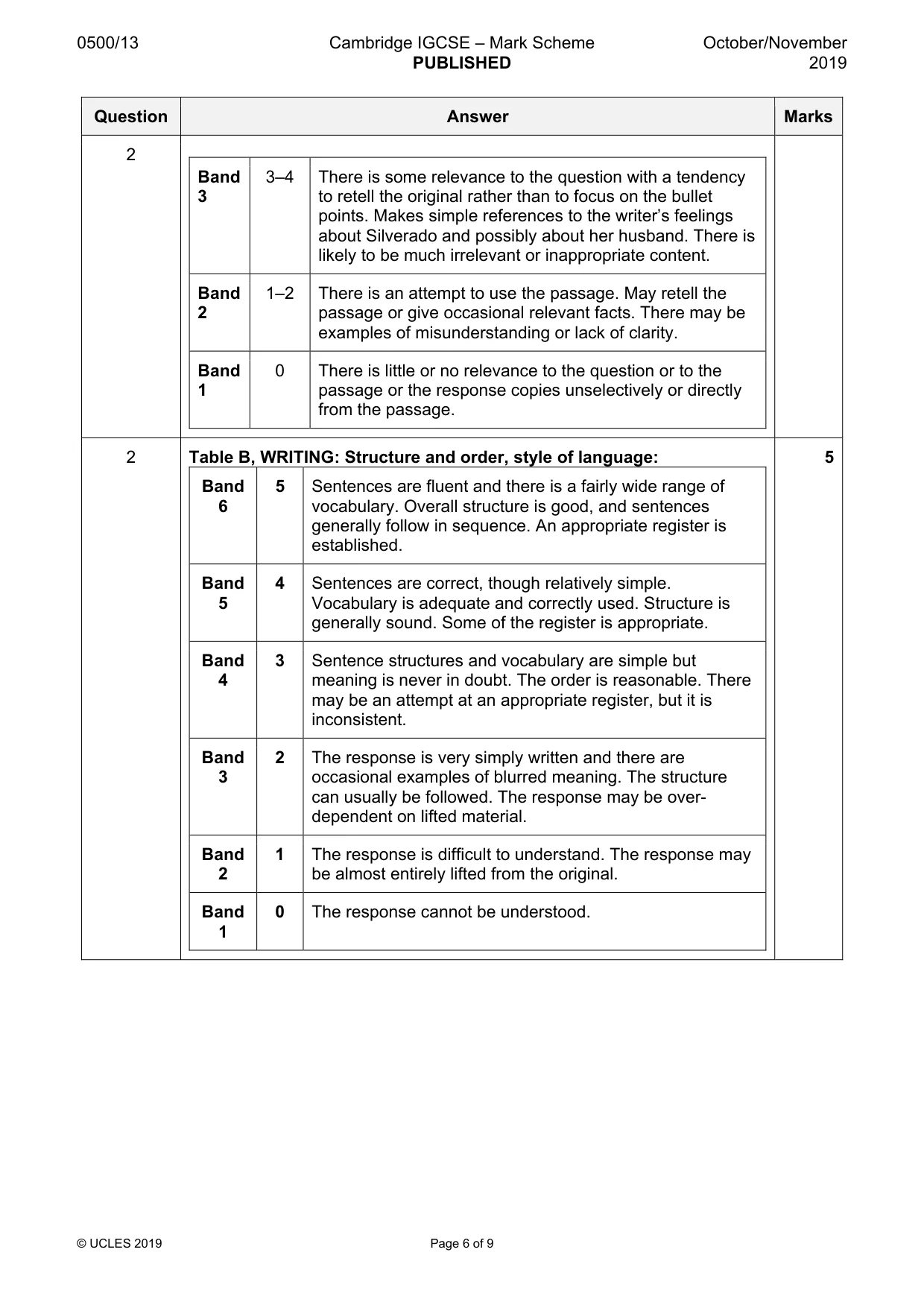
0500/13 Cambridge IGCSE – Mark Scheme PUBLISHED October/November 2019 © UCLES 2019 Page 6 of 9 Question Answer Marks 2 Band 3 3–4 There is some relevance to the question with a tendency to retell the original rather than to focus on the bullet points. Makes simple references to the writer’s feelings about Silverado and possibly about her husband. There is likely to be much irrelevant or inappropriate content. Band 2 1–2 There is an attempt to use the passage. May retell the passage or give occasional relevant facts. There may be examples of misunderstanding or lack of clarity. Band 1 0 There is little or no relevance to the question or to the passage or the response copies unselectively or directly from the passage. 2 Table B, WRITING: Structure and order, style of language: Band 6 5 Sentences are fluent and there is a fairly wide range of vocabulary. Overall structure is good, and sentences generally follow in sequence. An appropriate register is established. Band 5 4 Sentences are correct, though relatively simple. Vocabulary is adequate and correctly used. Structure is generally sound. Some of the register is appropriate. Band 4 3 Sentence structures and vocabulary are simple but meaning is never in doubt. The order is reasonable. There may be an attempt at an appropriate register, but it is inconsistent. Band 3 2 The response is very simply written and there are occasional examples of blurred meaning. The structure can usually be followed. The response may be over- dependent on lifted material. Band 2 1 The response is difficult to understand. The response may be almost entirely lifted from the original. Band 1 0 The response cannot be understood. 5
Mark scheme, page 7
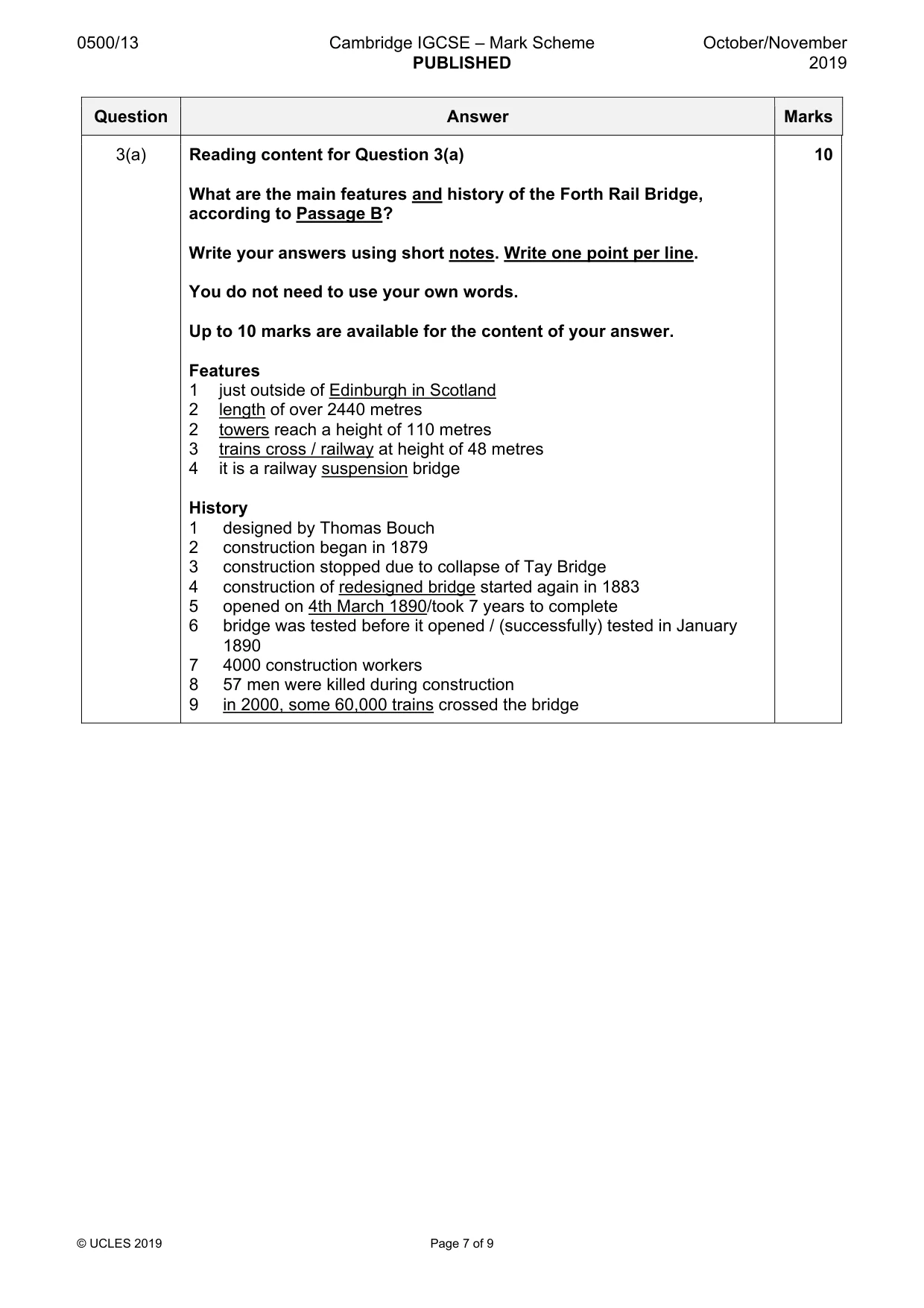
0500/13 Cambridge IGCSE – Mark Scheme PUBLISHED October/November 2019 © UCLES 2019 Page 7 of 9 Question Answer Marks 3(a) Reading content for Question 3(a) What are the main features and history of the Forth Rail Bridge, according to Passage B? Write your answers using short notes. Write one point per line. You do not need to use your own words. Up to 10 marks are available for the content of your answer. Features 1 just outside of Edinburgh in Scotland 2 length of over 2440 metres 2 towers reach a height of 110 metres 3 trains cross / railway at height of 48 metres 4 it is a railway suspension bridge History 1 designed by Thomas Bouch 2 construction began in 1879 3 construction stopped due to collapse of Tay Bridge 4 construction of redesigned bridge started again in 1883 5 opened on 4th March 1890/took 7 years to complete 6 bridge was tested before it opened / (successfully) tested in January 1890 7 4000 construction workers 8 57 men were killed during construction 9 in 2000, some 60,000 trains crossed the bridge 10
Mark scheme, page 8
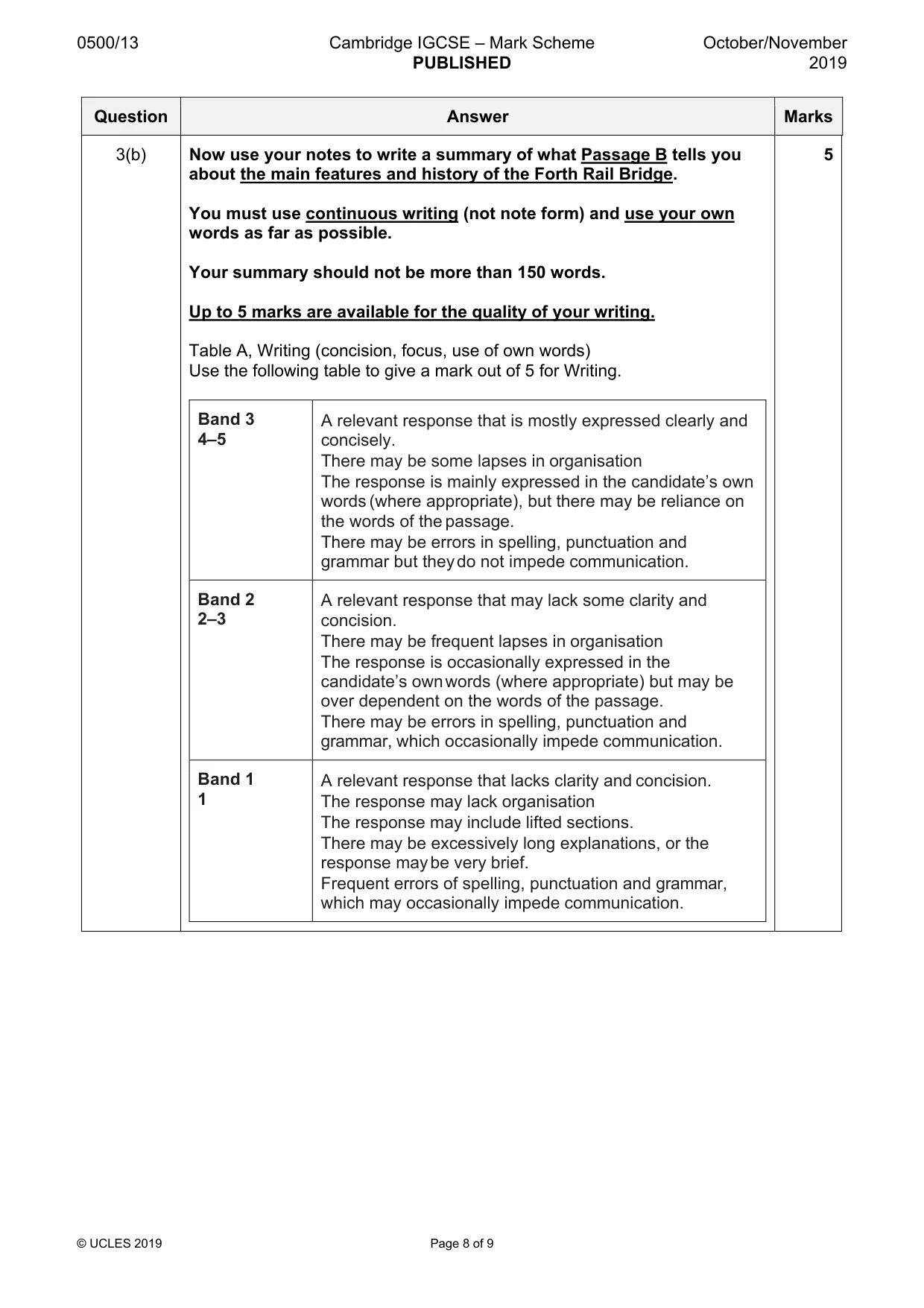
0500/13 Cambridge IGCSE – Mark Scheme PUBLISHED October/November 2019 © UCLES 2019 Page 8 of 9 Question Answer Marks 3(b) Now use your notes to write a summary of what Passage B tells you about the main features and history of the Forth Rail Bridge. You must use continuous writing (not note form) and use your own words as far as possible. Your summary should not be more than 150 words. Up to 5 marks are available for the quality of your writing. Table A, Writing (concision, focus, use of own words) Use the following table to give a mark out of 5 for Writing. Band 3 4–5 A relevant response that is mostly expressed clearly and concisely. There may be some lapses in organisation The response is mainly expressed in the candidate’s own words (where appropriate), but there may be reliance on the words of the passage. There may be errors in spelling, punctuation and grammar but they do not impede communication. Band 2 2–3 A relevant response that may lack some clarity and concision. There may be frequent lapses in organisation The response is occasionally expressed in the candidate’s own words (where appropriate) but may be over dependent on the words of the passage. There may be errors in spelling, punctuation and grammar, which occasionally impede communication. Band 1 1 A relevant response that lacks clarity and concision. The response may lack organisation The response may include lifted sections. There may be excessively long explanations, or the response may be very brief. Frequent errors of spelling, punctuation and grammar, which may occasionally impede communication. 5
Mark scheme, page 9
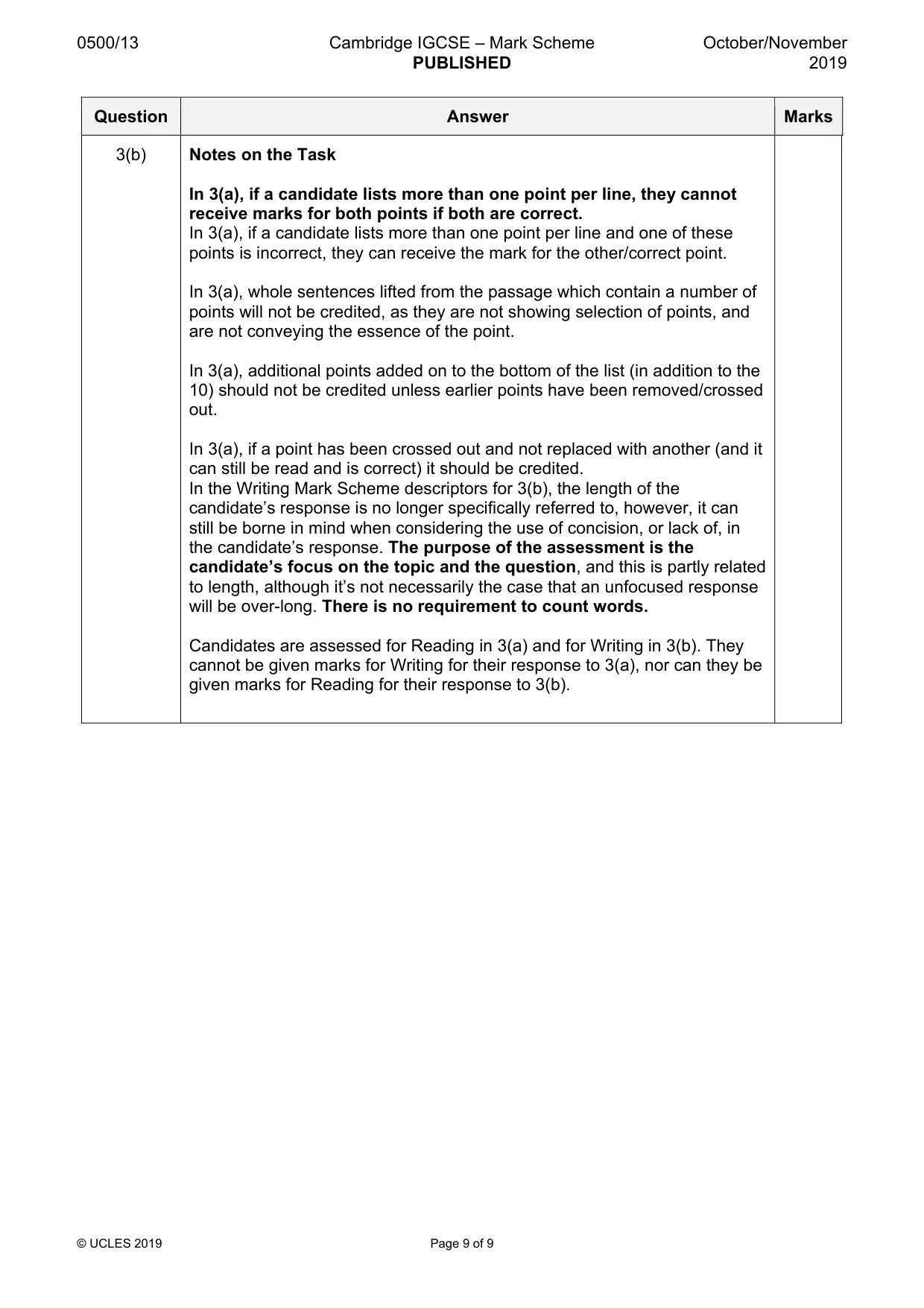
0500/13 Cambridge IGCSE – Mark Scheme PUBLISHED October/November 2019 © UCLES 2019 Page 9 of 9 Question Answer Marks 3(b) Notes on the Task In 3(a), if a candidate lists more than one point per line, they cannot receive marks for both points if both are correct. In 3(a), if a candidate lists more than one point per line and one of these points is incorrect, they can receive the mark for the other/correct point. In 3(a), whole sentences lifted from the passage which contain a number of points will not be credited, as they are not showing selection of points, and are not conveying the essence of the point. In 3(a), additional points added on to the bottom of the list (in addition to the 10) should not be credited unless earlier points have been removed/crossed out. In 3(a), if a point has been crossed out and not replaced with another (and it can still be read and is correct) it should be credited. In the Writing Mark Scheme descriptors for 3(b), the length of the candidate’s response is no longer specifically referred to, however, it can still be borne in mind when considering the use of concision, or lack of, in the candidate’s response. The purpose of the assessment is the candidate’s focus on the topic and the question, and this is partly related to length, although it’s not necessarily the case that an unfocused response will be over-long. There is no requirement to count words. Candidates are assessed for Reading in 3(a) and for Writing in 3(b). They cannot be given marks for Writing for their response to 3(a), nor can they be given marks for Reading for their response to 3(b).
What you needed in this session
Cambridge’s own grade thresholds for 2019 Oct/Nov, Paper 1 · Variant 3. A higher threshold means an easier paper — the bar moves with how the cohort did.