Cambridge IGCSE English - First Language 0500 — 2019 May/June Paper 1 · Variant 2
0500/12/M/J/19 · 50 marks · ≈56 min
The question paper and its mark scheme, free to read here and free to download. This is Cambridge’s own paper, exactly as it was sat.
Question paper12 pages
Mark scheme11 pages
Answers below. Sit the paper first if you are practising.
Paper as text
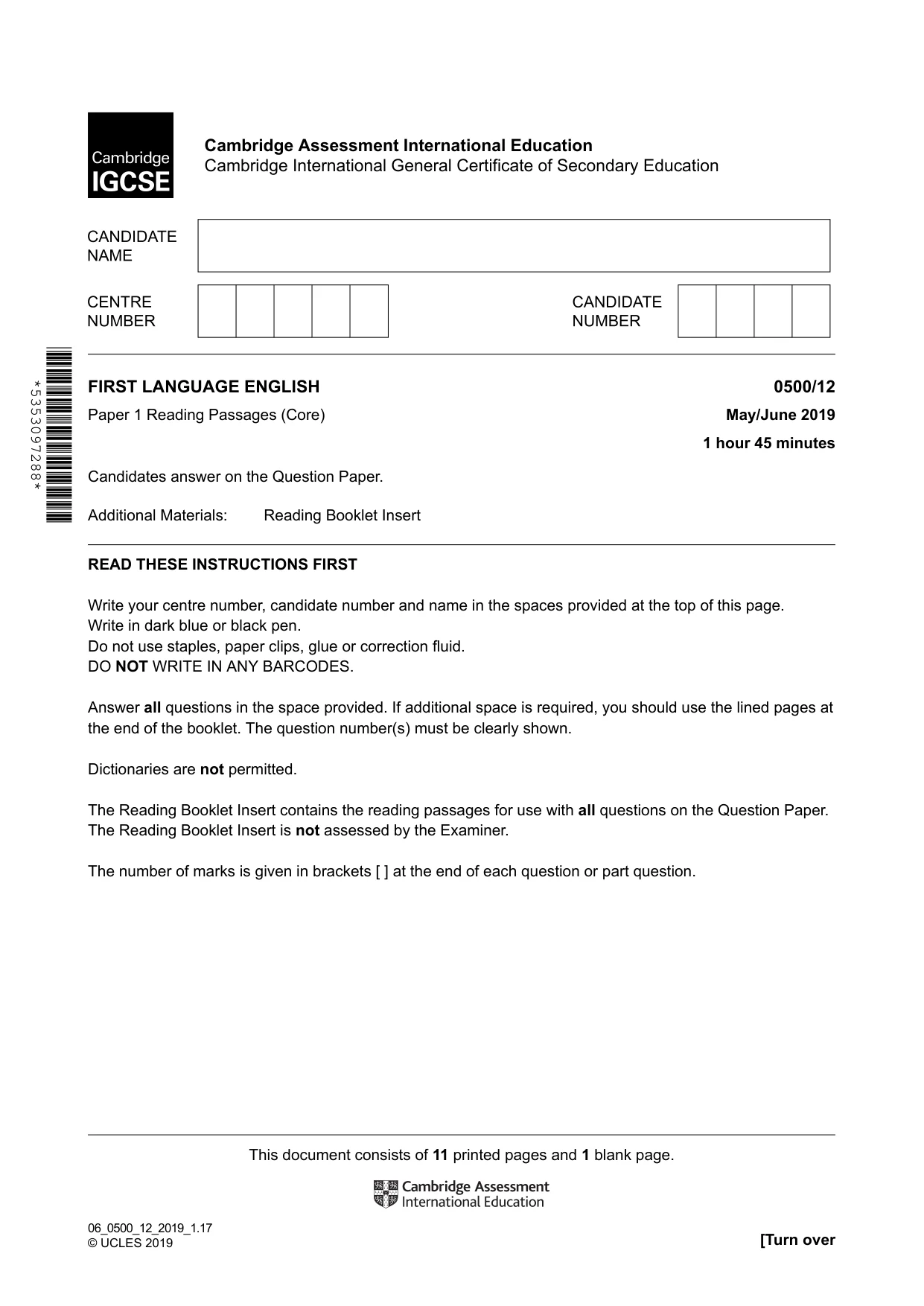
Question paper, page 1
Cambridge Assessment International Education Cambridge International General Certificate of Secondary Education 0500/12 May/June 2019 1 hour 45 minutes FIRST LANGUAGE ENGLISH Paper 1 Reading Passages (Core) Candidates answer on the Question Paper. Additional Materials: Reading Booklet Insert READ THESE INSTRUCTIONS FIRST Write your centre number, candidate number and name in the spaces provided at the top of this page. Write in dark blue or black pen. Do not use staples, paper clips, glue or correction fluid. DO NOT WRITE IN ANY BARCODES. Answer all questions in the space provided. If additional space is required, you should use the lined pages at the end of the booklet. The question number(s) must be clearly shown. Dictionaries are not permitted. The Reading Booklet Insert contains the reading passages for use with all questions on the Question Paper. The Reading Booklet Insert is not assessed by the Examiner. The number of marks is given in brackets [ ] at the end of each question or part question. This document consists of 11 printed pages and 1 blank page. [Turn over 06_0500_12_2019_1.17 © UCLES 2019 *5353097288*
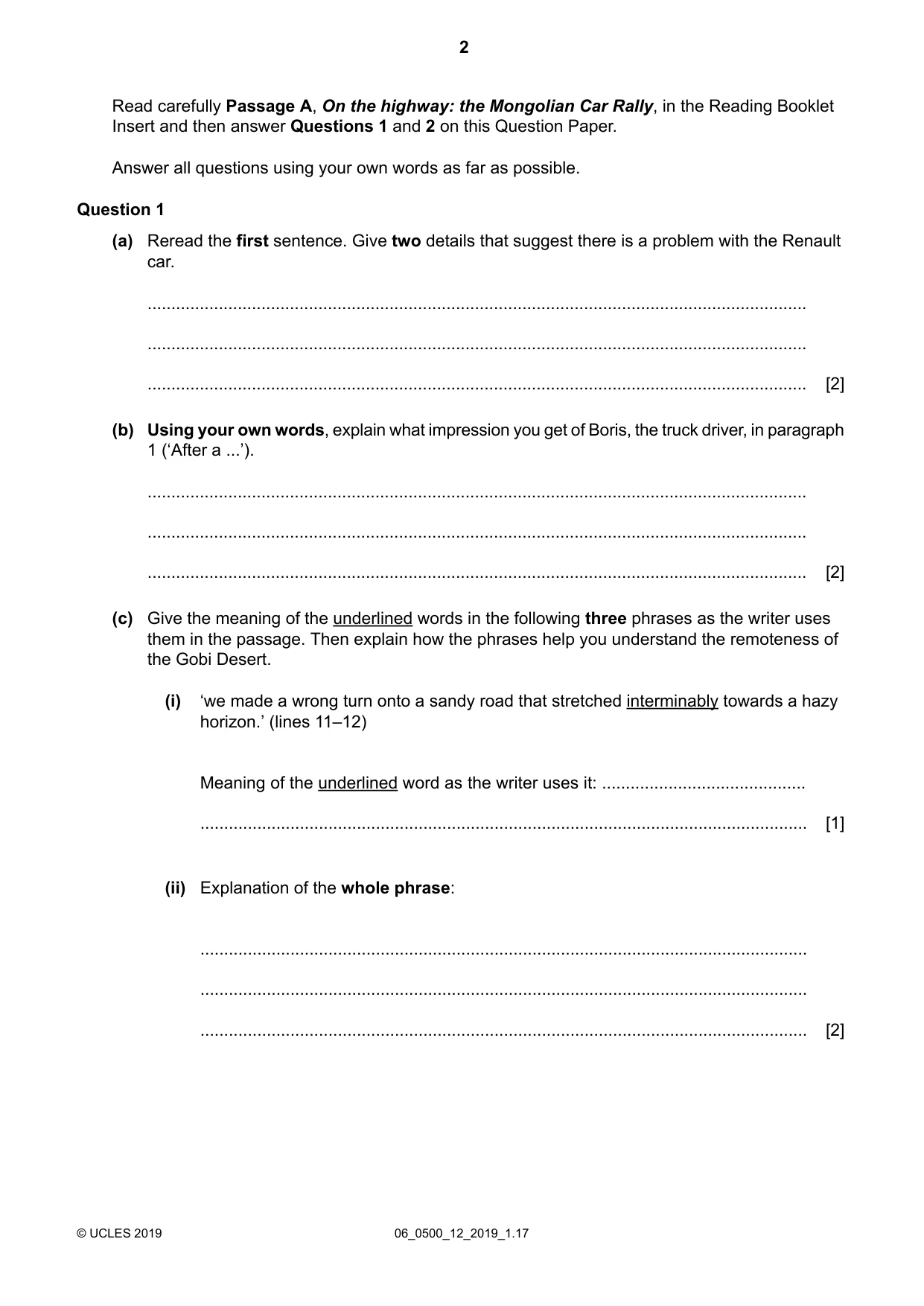
Question paper, page 2
Read carefully Passage A, On the highway: the Mongolian Car Rally, in the Reading Booklet Insert and then answer Questions 1 and 2 on this Question Paper. Answer all questions using your own words as far as possible. Question 1 Reread the first sentence. Give two details that suggest there is a problem with the Renault car. (a) … … … [2] Using your own words, explain what impression you get of Boris, the truck driver, in paragraph 1 (‘After a ...’). (b) … … … [2] Give the meaning of the underlined words in the following three phrases as the writer uses them in the passage. Then explain how the phrases help you understand the remoteness of the Gobi Desert. (c) ‘we made a wrong turn onto a sandy road that stretched interminably towards a hazy horizon.’ (lines 11–12) (i) Meaning of the underlined word as the writer uses it: … … [1] Explanation of the whole phrase: (ii) … … … [2] 06_0500_12_2019_1.17 © UCLES 2019 2
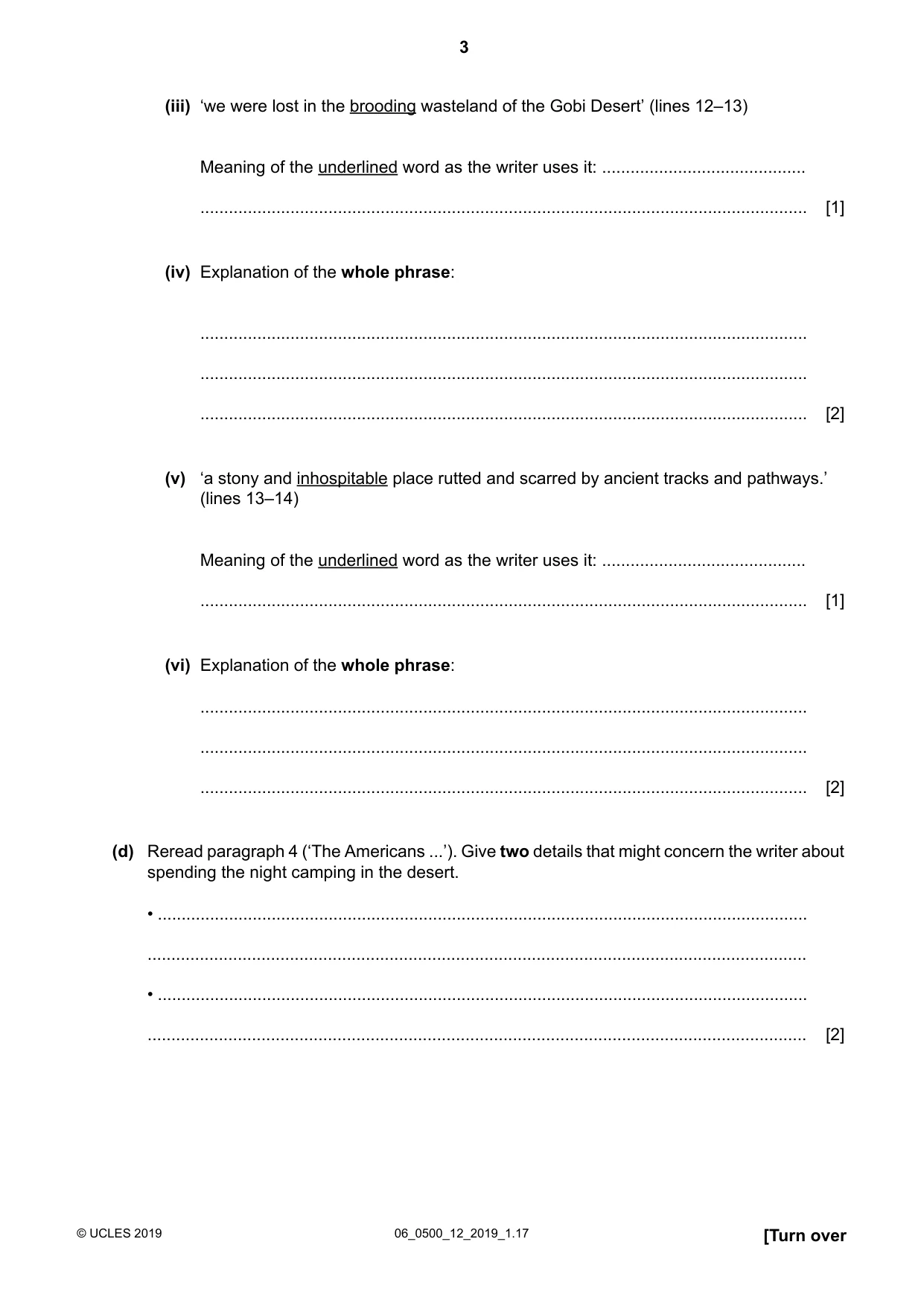
Question paper, page 3
‘we were lost in the brooding wasteland of the Gobi Desert’ (lines 12–13) (iii) Meaning of the underlined word as the writer uses it: … … [1] Explanation of the whole phrase: (iv) … … … [2] ‘a stony and inhospitable place rutted and scarred by ancient tracks and pathways.’ (lines 13–14) (v) Meaning of the underlined word as the writer uses it: … … [1] Explanation of the whole phrase: (vi) … … … [2] Reread paragraph 4 (‘The Americans ...’). Give two details that might concern the writer about spending the night camping in the desert. (d) • … … • … … [2] [Turn over 06_0500_12_2019_1.17 © UCLES 2019 3
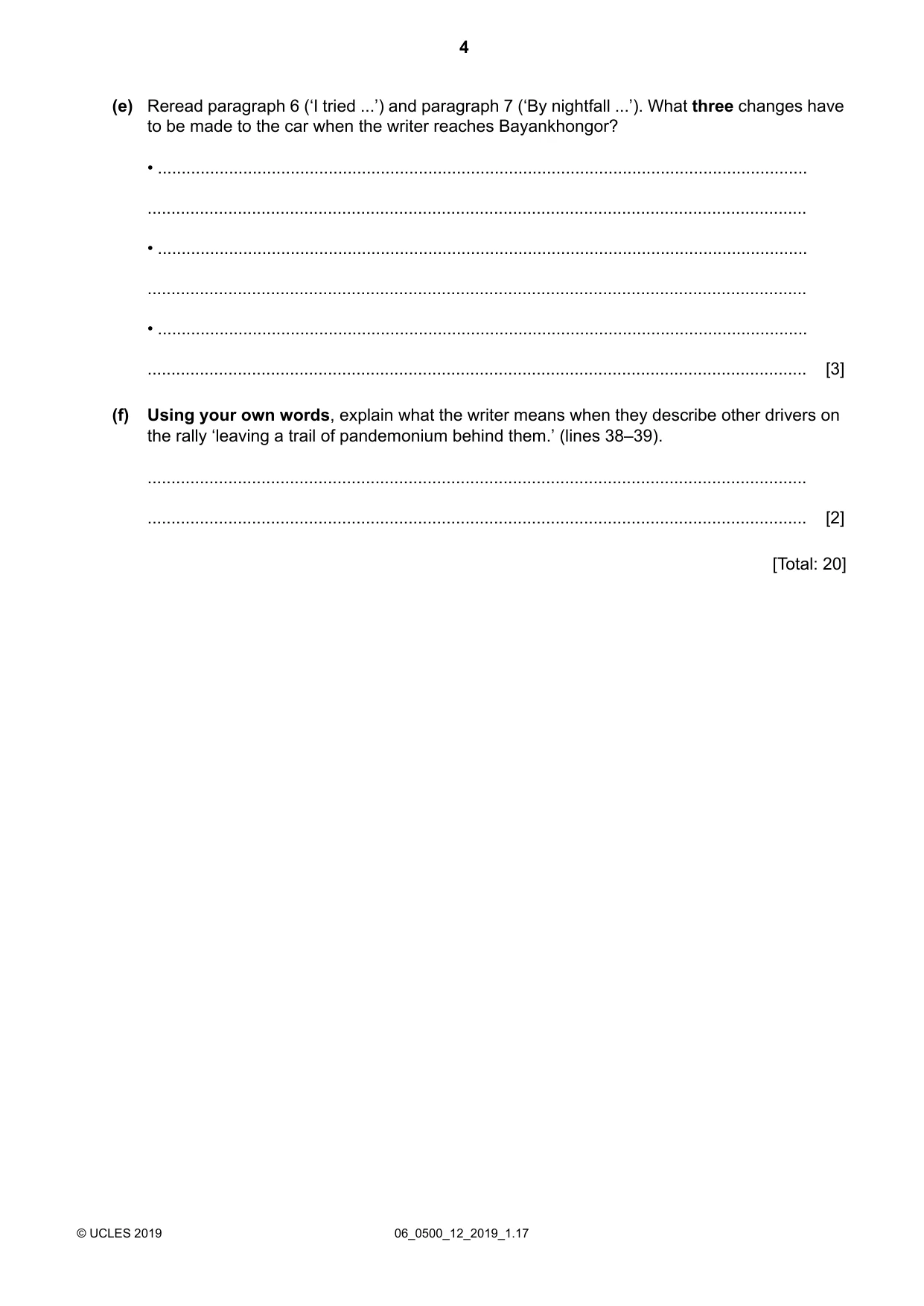
Question paper, page 4
Reread paragraph 6 (‘I tried ...’) and paragraph 7 (‘By nightfall ...’). What three changes have to be made to the car when the writer reaches Bayankhongor? (e) • … … • … … • … … [3] Using your own words, explain what the writer means when they describe other drivers on the rally ‘leaving a trail of pandemonium behind them.’ (lines 38–39). (f) … … [2] [Total: 20] 06_0500_12_2019_1.17 © UCLES 2019 4
Question paper, page 5
Question 2 Imagine you are the narrator of the events in Passage A. When you return home you are invited to write an article for a car magazine giving advice to possible entrants for the rally. Write your magazine article. In your magazine article you should cover the following: • the preparations someone should make for their journey • the dangers competitors face on the rally • the benefits of taking part. Base your ideas on what you have read in Passage A, but do not copy from it. Be careful to use your own words. Address each of the three bullet points. Begin your magazine article: ‘If you want to participate in the Mongolian Car Rally ...’ Write about 200 to 300 words. Up to 10 marks are available for the content of your answer, and up to 5 marks for the quality of your writing. … … … … … … … … … … … … … … … … [Turn over 06_0500_12_2019_1.17 © UCLES 2019 5
Question paper, page 6
… … … … … … … … … … … … … … … … … … … … … … … … … … … [15] 06_0500_12_2019_1.17 © UCLES 2019 6
Question paper, page 7
Read carefully Passage B, Why hot-air ballooning is Richard Branson’s favourite way to travel, in the Reading Booklet Insert and then answer Question 3(a) and (b) on this Question Paper. Question 3 Answer the questions in the order set. Notes What do you learn about what Richard Branson achieved and the problems he faced while hot-air ballooning, according to Passage B? Write your answers using short notes. Write one point per line. You do not need to use your own words. Up to 10 marks are available for the content of your answer. What Richard Branson achieved and the problems he faced while hot-air ballooning: (a) 1 … 2 … 3 … 4 … 5 … 6 … 7 … 8 … 9 … 10 … [10] [Turn over 06_0500_12_2019_1.17 © UCLES 2019 7
Question paper, page 8
Summary Now use your notes to write a summary of what Passage B tells you about what Richard Branson achieved and the problems he faced while hot-air ballooning. You must use continuous writing (not note form) and use your own words as far as possible. Your summary should not be more than 150 words. Up to 5 marks are available for the quality of your writing. (b) … … … … … … … … … … … … … … … … … … … … … [5] [Total: 15] 06_0500_12_2019_1.17 © UCLES 2019 8
Question paper, page 9
Additional Page If you use the following lined page to complete the answer(s) to any question(s), the question number(s) must be clearly shown. … … … … … … … … … … … … … … … … … … … … … … … … … [Turn over 06_0500_12_2019_1.17 © UCLES 2019 9
Question paper, page 10
Additional Page If you use the following lined page to complete the answer(s) to any question(s), the question number(s) must be clearly shown. … … … … … … … … … … … … … … … … … … … … … … … … … 06_0500_12_2019_1.17 © UCLES 2019 10
Question paper, page 11
Additional Page If you use the following lined page to complete the answer(s) to any question(s), the question number(s) must be clearly shown. … … … … … … … … … … … … … … … … … … … … … … … … … 06_0500_12_2019_1.17 © UCLES 2019 11
Question paper, page 12
BLANK PAGE Permission to reproduce items where third-party owned material protected by copyright is included has been sought and cleared where possible. Every reasonable effort has been made by the publisher (UCLES) to trace copyright holders, but if any items requiring clearance have unwittingly been included, the publisher will be pleased to make amends at the earliest possible opportunity. To avoid the issue of disclosure of answer-related information to candidates, all copyright acknowledgements are reproduced online in the Cambridge Assessment International Education Copyright Acknowledgements Booklet. This is produced for each series of examinations and is freely available to download at www.cambridgeinternational.org after the live examination series. Cambridge Assessment International Education is part of the Cambridge Assessment Group. Cambridge Assessment is the brand name of the University of Cambridge Local Examinations Syndicate (UCLES), which itself is a department of the University of Cambridge. 06_0500_12_2019_1.17 © UCLES 2019 12
Mark scheme, page 1
This document consists of 11 printed pages. © UCLES 2019 [Turn over - Cambridge Assessment International Education Cambridge International General Certificate of Secondary Education FIRST LANGUAGE ENGLISH 0500/12 Paper 1 Reading Passages (Core) May/June 2019 MARK SCHEME Maximum Mark: 50 Published This mark scheme is published as an aid to teachers and candidates, to indicate the requirements of the examination. It shows the basis on which Examiners were instructed to award marks. It does not indicate the details of the discussions that took place at an Examiners’ meeting before marking began, which would have considered the acceptability of alternative answers. Mark schemes should be read in conjunction with the question paper and the Principal Examiner Report for Teachers. Cambridge International will not enter into discussions about these mark schemes. Cambridge International is publishing the mark schemes for the May/June 2019 series for most Cambridge IGCSE™, Cambridge International A and AS Level and Cambridge Pre-U components, and some Cambridge O Level components.
Mark scheme, page 2
0500/12 Cambridge IGCSE – Mark Scheme PUBLISHED May/June 2019 © UCLES 2019 Page 2 of 11 Generic Marking Principles These general marking principles must be applied by all examiners when marking candidate answers. They should be applied alongside the specific content of the mark scheme or generic level descriptors for a question. Each question paper and mark scheme will also comply with these marking principles. GENERIC MARKING PRINCIPLE 1: Marks must be awarded in line with: • the specific content of the mark scheme or the generic level descriptors for the question • the specific skills defined in the mark scheme or in the generic level descriptors for the question • the standard of response required by a candidate as exemplified by the standardisation scripts. GENERIC MARKING PRINCIPLE 2: Marks awarded are always whole marks (not half marks, or other fractions). GENERIC MARKING PRINCIPLE 3: Marks must be awarded positively: • marks are awarded for correct/valid answers, as defined in the mark scheme. However, credit is given for valid answers which go beyond the scope of the syllabus and mark scheme, referring to your Team Leader as appropriate • marks are awarded when candidates clearly demonstrate what they know and can do • marks are not deducted for errors • marks are not deducted for omissions • answers should only be judged on the quality of spelling, punctuation and grammar when these features are specifically assessed by the question as indicated by the mark scheme. The meaning, however, should be unambiguous. GENERIC MARKING PRINCIPLE 4: Rules must be applied consistently e.g. in situations where candidates have not followed instructions or in the application of generic level descriptors. GENERIC MARKING PRINCIPLE 5: Marks should be awarded using the full range of marks defined in the mark scheme for the question (however; the use of the full mark range may be limited according to the quality of the candidate responses seen). GENERIC MARKING PRINCIPLE 6: Marks awarded are based solely on the requirements as defined in the mark scheme. Marks should not be awarded with grade thresholds or grade descriptors in mind.
Mark scheme, page 3
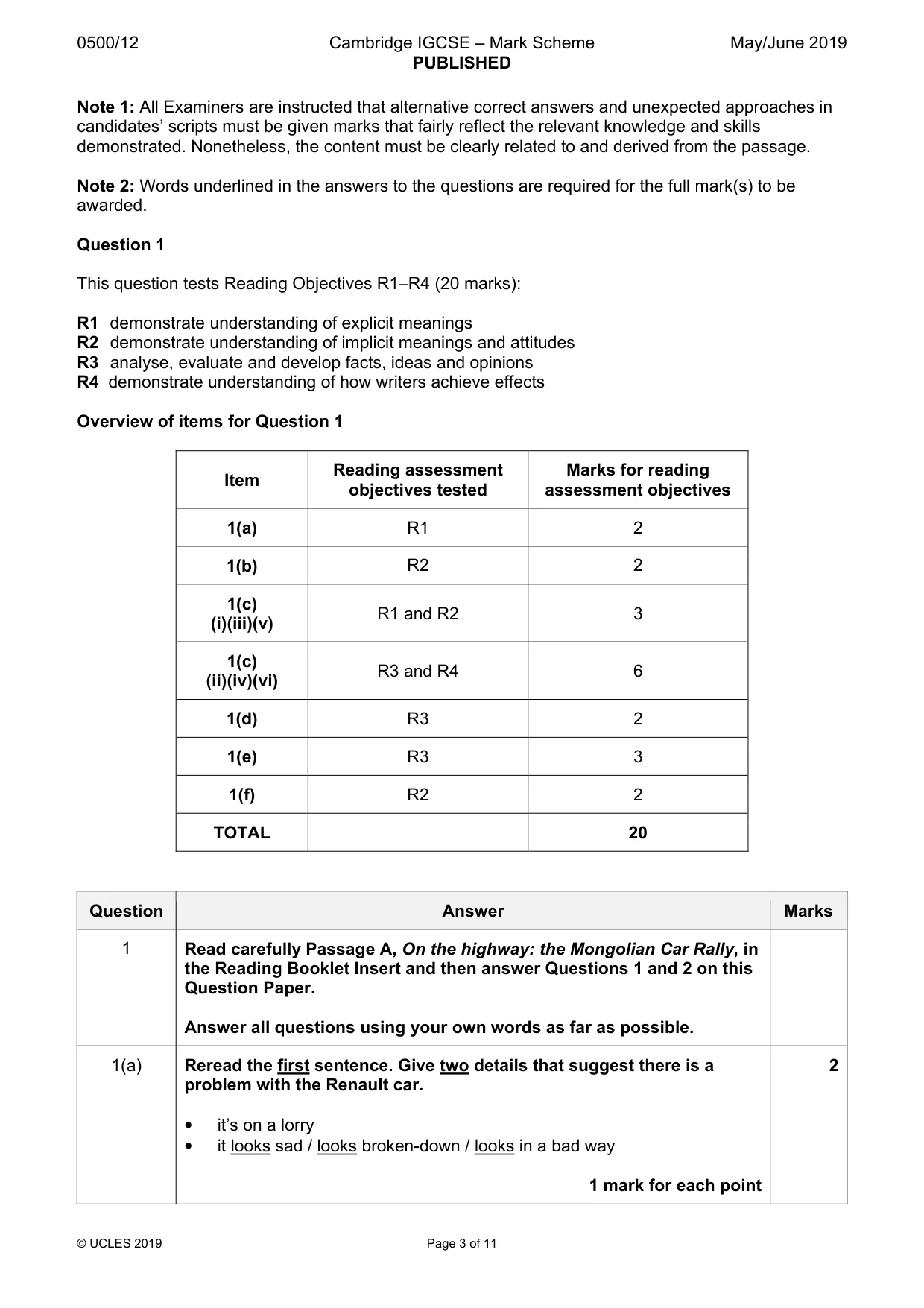
0500/12 Cambridge IGCSE – Mark Scheme PUBLISHED May/June 2019 © UCLES 2019 Page 3 of 11 Note 1: All Examiners are instructed that alternative correct answers and unexpected approaches in candidates’ scripts must be given marks that fairly reflect the relevant knowledge and skills demonstrated. Nonetheless, the content must be clearly related to and derived from the passage. Note 2: Words underlined in the answers to the questions are required for the full mark(s) to be awarded. Question 1 This question tests Reading Objectives R1–R4 (20 marks): R1 demonstrate understanding of explicit meanings R2 demonstrate understanding of implicit meanings and attitudes R3 analyse, evaluate and develop facts, ideas and opinions R4 demonstrate understanding of how writers achieve effects Overview of items for Question 1 Item Reading assessment objectives tested Marks for reading assessment objectives 1(a) R1 2 1(b) R2 2 1(c) (i)(iii)(v) R1 and R2 3 1(c) (ii)(iv)(vi) R3 and R4 6 1(d) R3 2 1(e) R3 3 1(f) R2 2 TOTAL 20 Question Answer Marks 1 Read carefully Passage A, On the highway: the Mongolian Car Rally, in the Reading Booklet Insert and then answer Questions 1 and 2 on this Question Paper. Answer all questions using your own words as far as possible. 1(a) Reread the first sentence. Give two details that suggest there is a problem with the Renault car. • it’s on a lorry • it looks sad / looks broken-down / looks in a bad way 1 mark for each point 2
Mark scheme, page 4
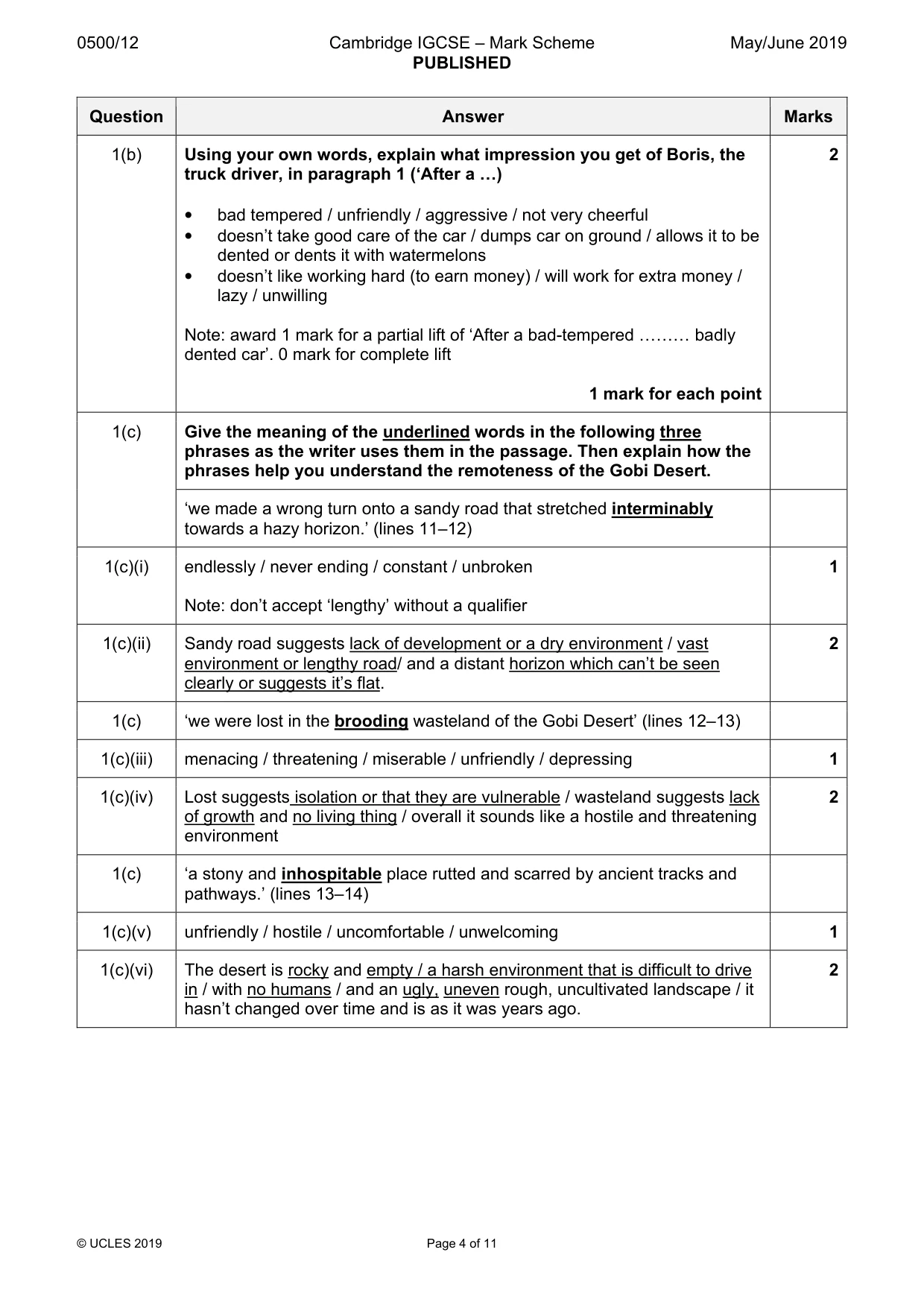
0500/12 Cambridge IGCSE – Mark Scheme PUBLISHED May/June 2019 © UCLES 2019 Page 4 of 11 Question Answer Marks 1(b) Using your own words, explain what impression you get of Boris, the truck driver, in paragraph 1 (‘After a «) • bad tempered / unfriendly / aggressive / not very cheerful • doesn’t take good care of the car / dumps car on ground / allows it to be dented or dents it with watermelons • doesn’t like working hard (to earn money) / will work for extra money / lazy / unwilling Note: award 1 mark for a partial lift of ‘After a bad-tempered ««« badly dented car’. 0 mark for complete lift 1 mark for each point 2 1(c) Give the meaning of the underlined words in the following three phrases as the writer uses them in the passage. Then explain how the phrases help you understand the remoteness of the Gobi Desert. ‘we made a wrong turn onto a sandy road that stretched interminably towards a hazy horizon.’ (lines 11–12) 1(c)(i) endlessly / never ending / constant / unbroken Note: don’t accept ‘lengthy’ without a qualifier 1 1(c)(ii) Sandy road suggests lack of development or a dry environment / vast environment or lengthy road/ and a distant horizon which can’t be seen clearly or suggests it’s flat. 2 1(c) ‘we were lost in the brooding wasteland of the Gobi Desert’ (lines 12–13) 1(c)(iii) menacing / threatening / miserable / unfriendly / depressing 1 1(c)(iv) Lost suggests isolation or that they are vulnerable / wasteland suggests lack of growth and no living thing / overall it sounds like a hostile and threatening environment 2 1(c) ‘a stony and inhospitable place rutted and scarred by ancient tracks and pathways.’ (lines 13–14) 1(c)(v) unfriendly / hostile / uncomfortable / unwelcoming 1 1(c)(vi) The desert is rocky and empty / a harsh environment that is difficult to drive in / with no humans / and an ugly, uneven rough, uncultivated landscape / it hasn’t changed over time and is as it was years ago. 2
Mark scheme, page 5
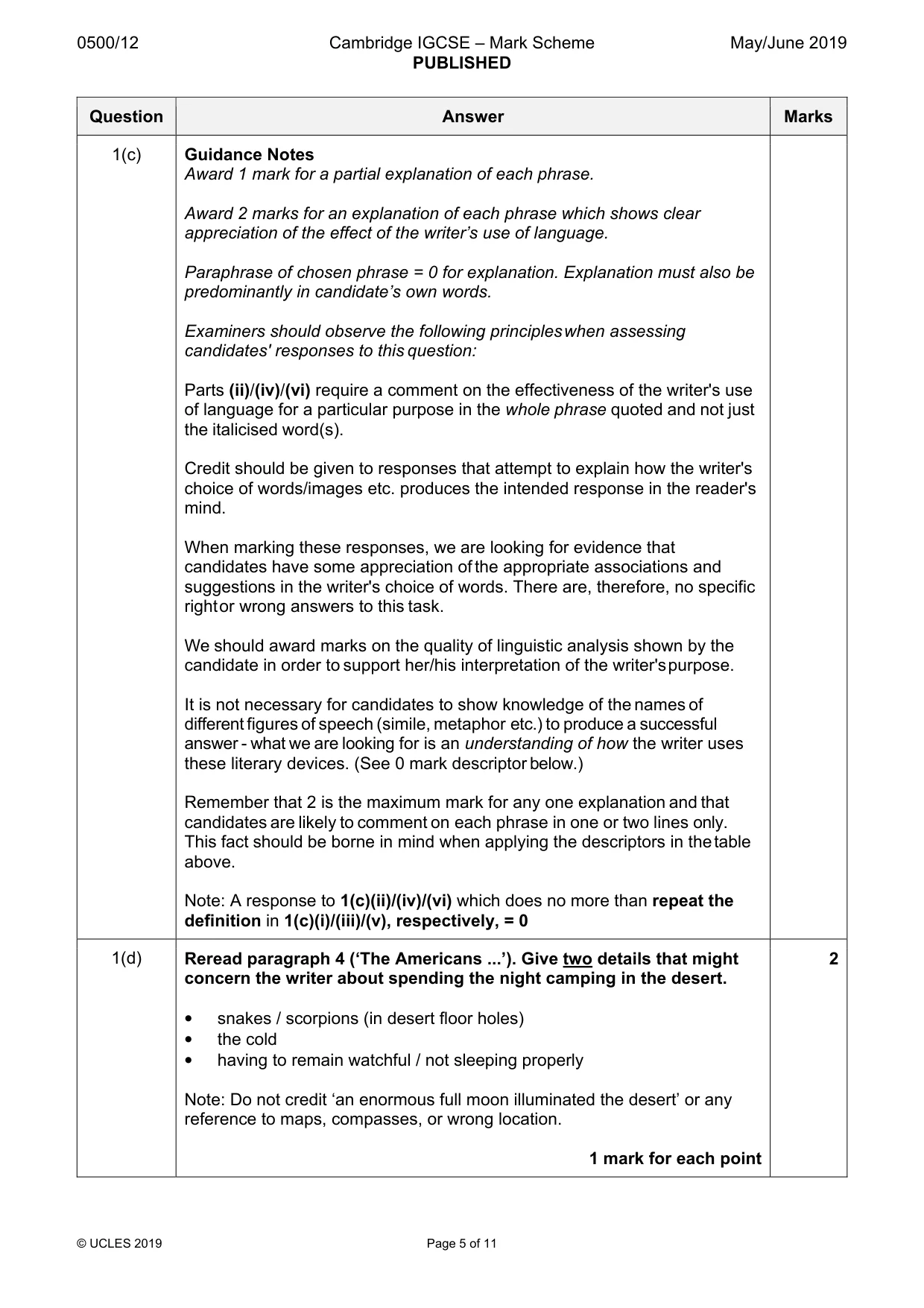
0500/12 Cambridge IGCSE – Mark Scheme PUBLISHED May/June 2019 © UCLES 2019 Page 5 of 11 Question Answer Marks 1(c) Guidance Notes Award 1 mark for a partial explanation of each phrase. Award 2 marks for an explanation of each phrase which shows clear appreciation of the effect of the writer’s use of language. Paraphrase of chosen phrase = 0 for explanation. Explanation must also be predominantly in candidate’s own words. Examiners should observe the following principles when assessing candidates' responses to this question: Parts (ii)/(iv)/(vi) require a comment on the effectiveness of the writer's use of language for a particular purpose in the whole phrase quoted and not just the italicised word(s). Credit should be given to responses that attempt to explain how the writer's choice of words/images etc. produces the intended response in the reader's mind. When marking these responses, we are looking for evidence that candidates have some appreciation of the appropriate associations and suggestions in the writer's choice of words. There are, therefore, no specific right or wrong answers to this task. We should award marks on the quality of linguistic analysis shown by the candidate in order to support her/his interpretation of the writer's purpose. It is not necessary for candidates to show knowledge of the names of different figures of speech (simile, metaphor etc.) to produce a successful answer - what we are looking for is an understanding of how the writer uses these literary devices. (See 0 mark descriptor below.) Remember that 2 is the maximum mark for any one explanation and that candidates are likely to comment on each phrase in one or two lines only. This fact should be borne in mind when applying the descriptors in the table above. Note: A response to 1(c)(ii)/(iv)/(vi) which does no more than repeat the definition in 1(c)(i)/(iii)/(v), respectively, = 0 1(d) Reread paragraph 4 (‘The Americans ...’). Give two details that might concern the writer about spending the night camping in the desert. • snakes / scorpions (in desert floor holes) • the cold • having to remain watchful / not sleeping properly Note: Do not credit ‘an enormous full moon illuminated the desert’ or any reference to maps, compasses, or wrong location. 1 mark for each point 2
Mark scheme, page 6
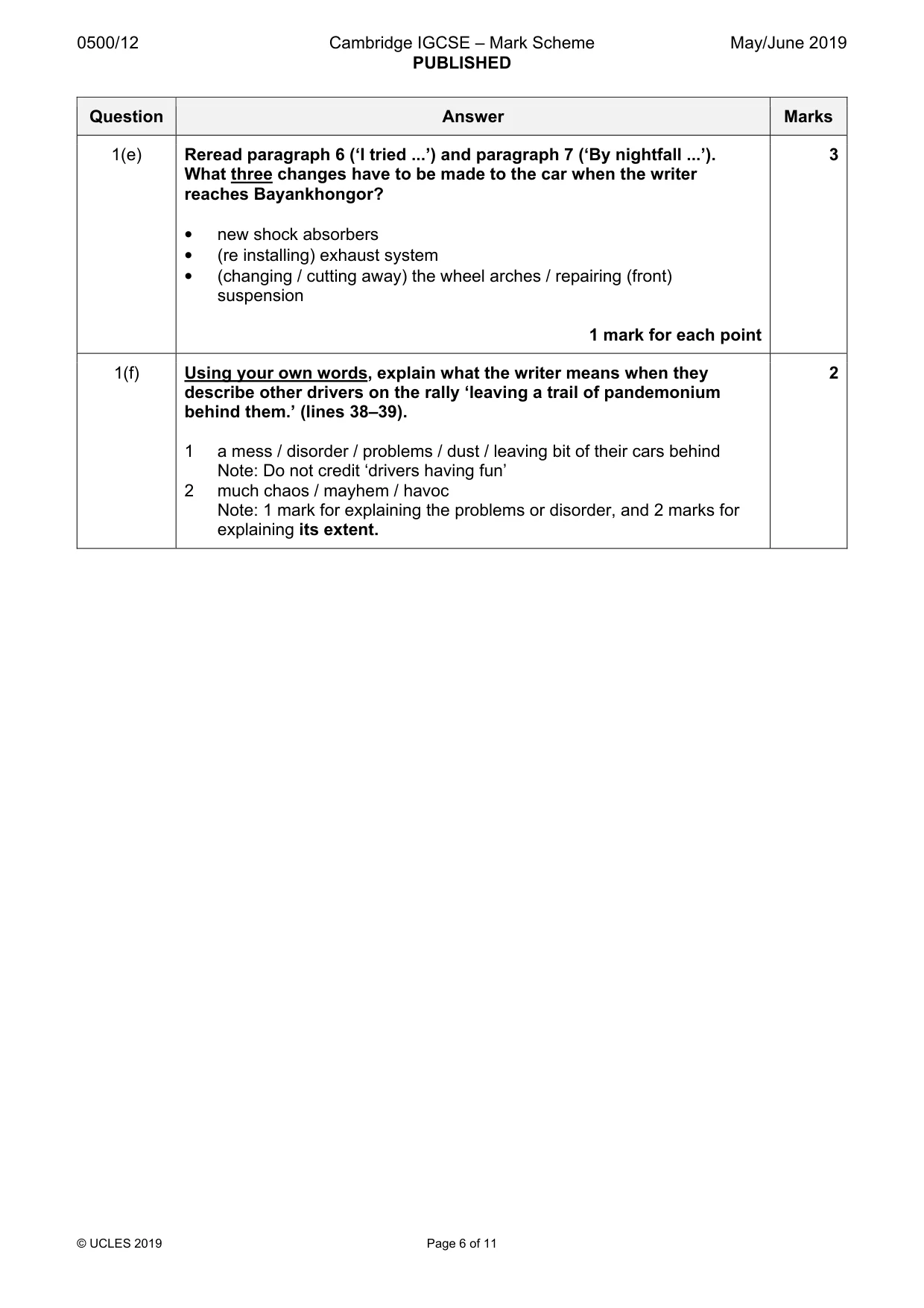
0500/12 Cambridge IGCSE – Mark Scheme PUBLISHED May/June 2019 © UCLES 2019 Page 6 of 11 Question Answer Marks 1(e) Reread paragraph 6 (‘I tried ...’) and paragraph 7 (‘By nightfall ...’). What three changes have to be made to the car when the writer reaches Bayankhongor? • new shock absorbers • (re installing) exhaust system • (changing / cutting away) the wheel arches / repairing (front) suspension 1 mark for each point 3 1(f) Using your own words, explain what the writer means when they describe other drivers on the rally ‘leaving a trail of pandemonium behind them.’ (lines 38–39). 1 a mess / disorder / problems / dust / leaving bit of their cars behind Note: Do not credit ‘drivers having fun’ 2 much chaos / mayhem / havoc Note: 1 mark for explaining the problems or disorder, and 2 marks for explaining its extent. 2
Mark scheme, page 7
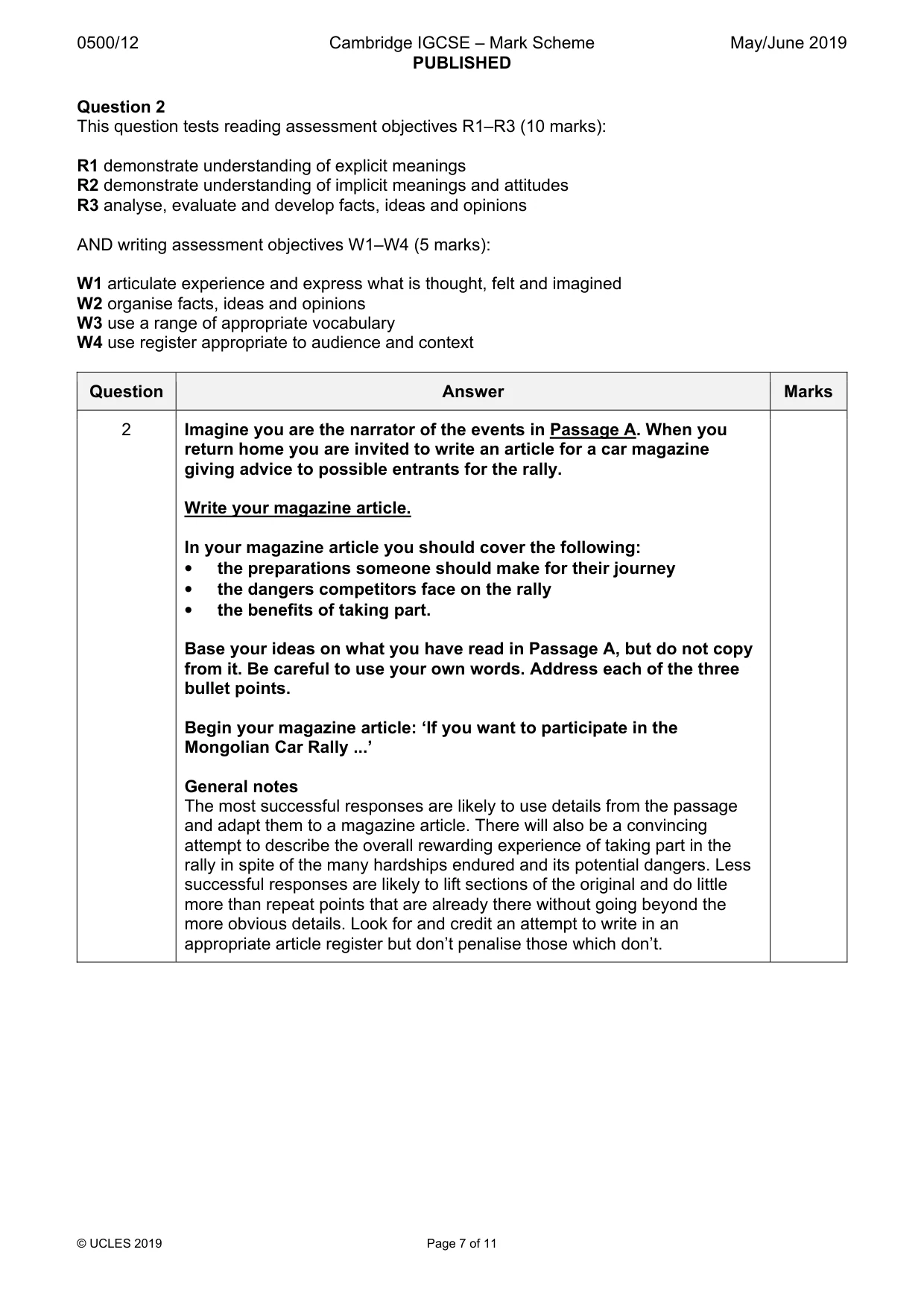
0500/12 Cambridge IGCSE – Mark Scheme PUBLISHED May/June 2019 © UCLES 2019 Page 7 of 11 Question 2 This question tests reading assessment objectives R1–R3 (10 marks): R1 demonstrate understanding of explicit meanings R2 demonstrate understanding of implicit meanings and attitudes R3 analyse, evaluate and develop facts, ideas and opinions AND writing assessment objectives W1–W4 (5 marks): W1 articulate experience and express what is thought, felt and imagined W2 organise facts, ideas and opinions W3 use a range of appropriate vocabulary W4 use register appropriate to audience and context Question Answer Marks 2 Imagine you are the narrator of the events in Passage A. When you return home you are invited to write an article for a car magazine giving advice to possible entrants for the rally. Write your magazine article. In your magazine article you should cover the following: • the preparations someone should make for their journey • the dangers competitors face on the rally • the benefits of taking part. Base your ideas on what you have read in Passage A, but do not copy from it. Be careful to use your own words. Address each of the three bullet points. Begin your magazine article: ‘If you want to participate in the Mongolian Car Rally ...’ General notes The most successful responses are likely to use details from the passage and adapt them to a magazine article. There will also be a convincing attempt to describe the overall rewarding experience of taking part in the rally in spite of the many hardships endured and its potential dangers. Less successful responses are likely to lift sections of the original and do little more than repeat points that are already there without going beyond the more obvious details. Look for and credit an attempt to write in an appropriate article register but don’t penalise those which don’t.
Mark scheme, page 8
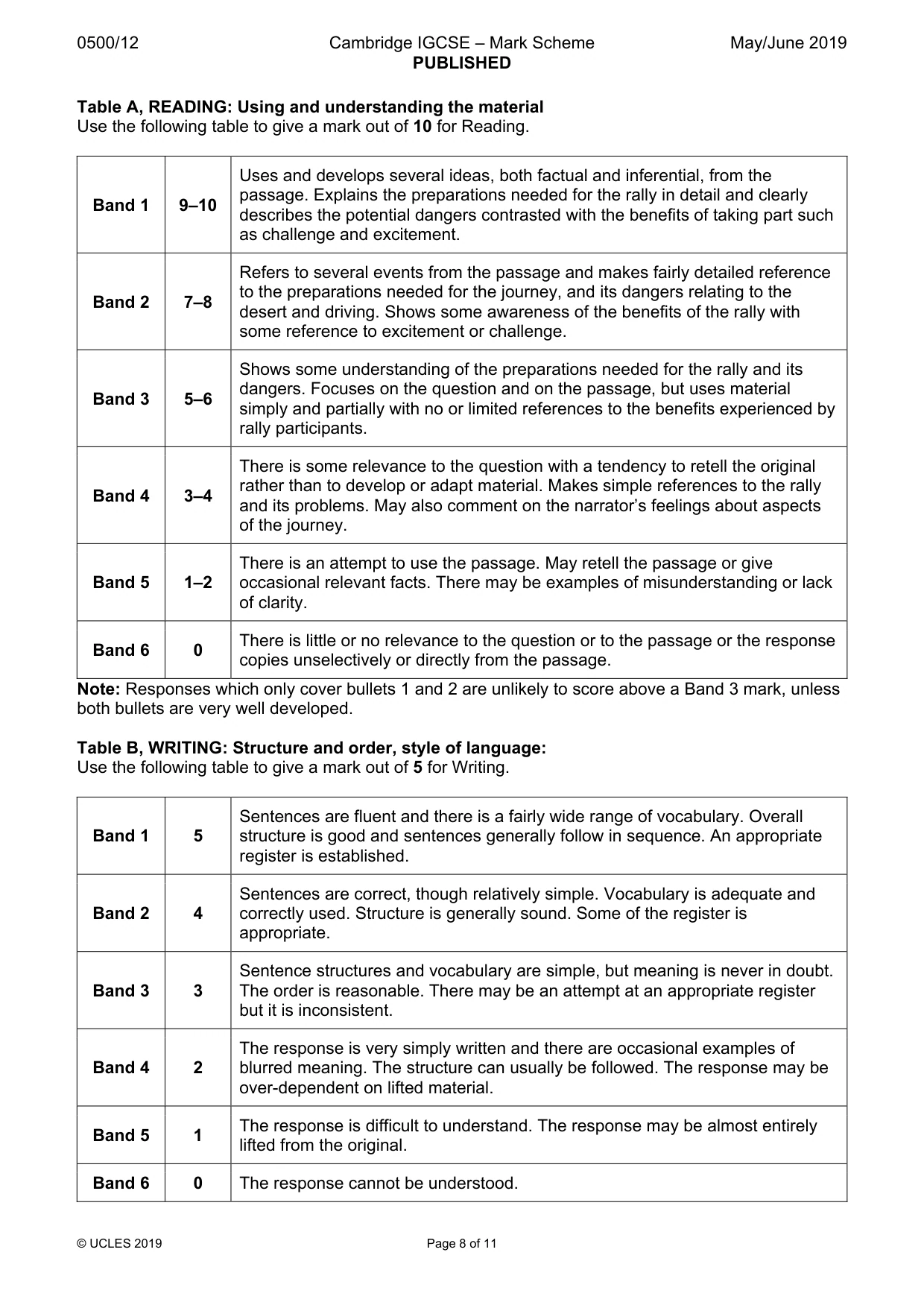
0500/12 Cambridge IGCSE – Mark Scheme PUBLISHED May/June 2019 © UCLES 2019 Page 8 of 11 Table A, READING: Using and understanding the material Use the following table to give a mark out of 10 for Reading. Band 1 9–10 Uses and develops several ideas, both factual and inferential, from the passage. Explains the preparations needed for the rally in detail and clearly describes the potential dangers contrasted with the benefits of taking part such as challenge and excitement. Band 2 7–8 Refers to several events from the passage and makes fairly detailed reference to the preparations needed for the journey, and its dangers relating to the desert and driving. Shows some awareness of the benefits of the rally with some reference to excitement or challenge. Band 3 5–6 Shows some understanding of the preparations needed for the rally and its dangers. Focuses on the question and on the passage, but uses material simply and partially with no or limited references to the benefits experienced by rally participants. Band 4 3–4 There is some relevance to the question with a tendency to retell the original rather than to develop or adapt material. Makes simple references to the rally and its problems. May also comment on the narrator’s feelings about aspects of the journey. Band 5 1–2 There is an attempt to use the passage. May retell the passage or give occasional relevant facts. There may be examples of misunderstanding or lack of clarity. Band 6 0 There is little or no relevance to the question or to the passage or the response copies unselectively or directly from the passage. Note: Responses which only cover bullets 1 and 2 are unlikely to score above a Band 3 mark, unless both bullets are very well developed. Table B, WRITING: Structure and order, style of language: Use the following table to give a mark out of 5 for Writing. Band 1 5 Sentences are fluent and there is a fairly wide range of vocabulary. Overall structure is good and sentences generally follow in sequence. An appropriate register is established. Band 2 4 Sentences are correct, though relatively simple. Vocabulary is adequate and correctly used. Structure is generally sound. Some of the register is appropriate. Band 3 3 Sentence structures and vocabulary are simple, but meaning is never in doubt. The order is reasonable. There may be an attempt at an appropriate register but it is inconsistent. Band 4 2 The response is very simply written and there are occasional examples of blurred meaning. The structure can usually be followed. The response may be over-dependent on lifted material. Band 5 1 The response is difficult to understand. The response may be almost entirely lifted from the original. Band 6 0 The response cannot be understood.
Mark scheme, page 9
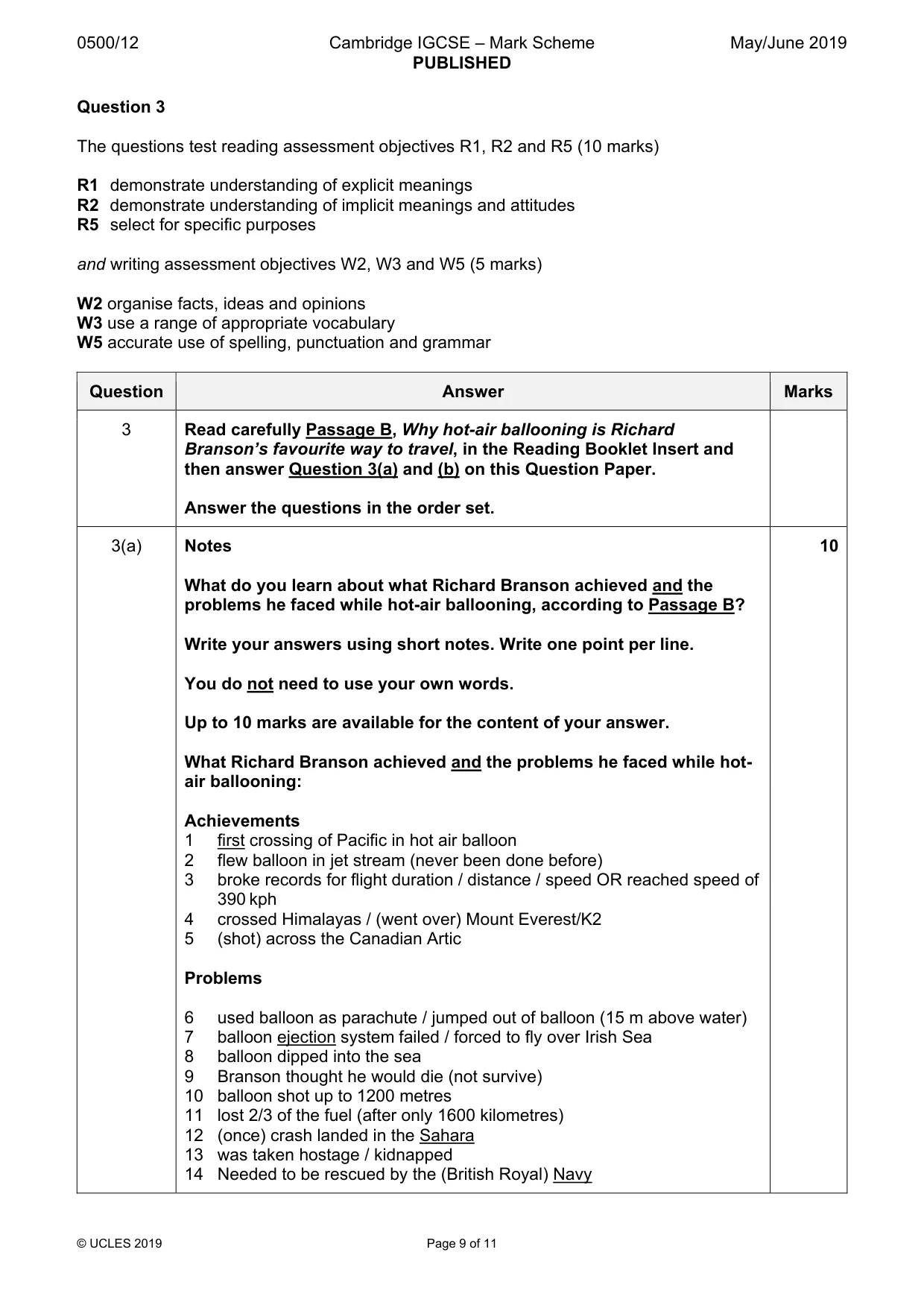
0500/12 Cambridge IGCSE – Mark Scheme PUBLISHED May/June 2019 © UCLES 2019 Page 9 of 11 Question 3 The questions test reading assessment objectives R1, R2 and R5 (10 marks) R1 demonstrate understanding of explicit meanings R2 demonstrate understanding of implicit meanings and attitudes R5 select for specific purposes and writing assessment objectives W2, W3 and W5 (5 marks) W2 organise facts, ideas and opinions W3 use a range of appropriate vocabulary W5 accurate use of spelling, punctuation and grammar Question Answer Marks 3 Read carefully Passage B, Why hot-air ballooning is Richard Branson’s favourite way to travel, in the Reading Booklet Insert and then answer Question 3(a) and (b) on this Question Paper. Answer the questions in the order set. 3(a) Notes What do you learn about what Richard Branson achieved and the problems he faced while hot-air ballooning, according to Passage B? Write your answers using short notes. Write one point per line. You do not need to use your own words. Up to 10 marks are available for the content of your answer. What Richard Branson achieved and the problems he faced while hot- air ballooning: Achievements 1 first crossing of Pacific in hot air balloon 2 flew balloon in jet stream (never been done before) 3 broke records for flight duration / distance / speed OR reached speed of 390 kph 4 crossed Himalayas / (went over) Mount Everest/K2 5 (shot) across the Canadian Artic Problems 6 used balloon as parachute / jumped out of balloon (15 m above water) 7 balloon ejection system failed / forced to fly over Irish Sea 8 balloon dipped into the sea 9 Branson thought he would die (not survive) 10 balloon shot up to 1200 metres 11 lost 2/3 of the fuel (after only 1600 kilometres) 12 (once) crash landed in the Sahara 13 was taken hostage / kidnapped 14 Needed to be rescued by the (British Royal) Navy 10
Mark scheme, page 10
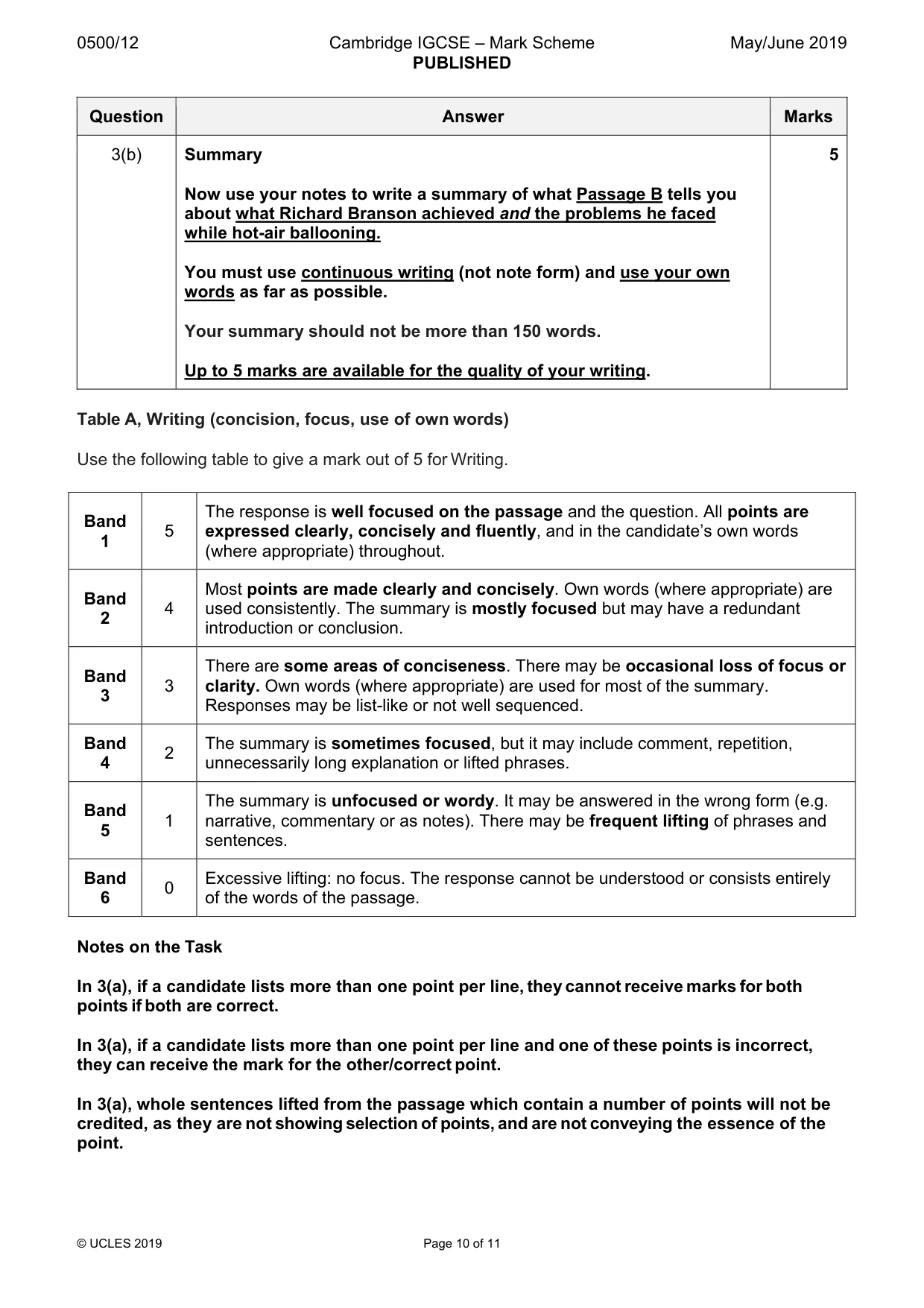
0500/12 Cambridge IGCSE – Mark Scheme PUBLISHED May/June 2019 © UCLES 2019 Page 10 of 11 Question Answer Marks 3(b) Summary Now use your notes to write a summary of what Passage B tells you about what Richard Branson achieved and the problems he faced while hot-air ballooning. You must use continuous writing (not note form) and use your own words as far as possible. Your summary should not be more than 150 words. Up to 5 marks are available for the quality of your writing. 5 Table A, Writing (concision, focus, use of own words) Use the following table to give a mark out of 5 for Writing. Band 1 5 The response is well focused on the passage and the question. All points are expressed clearly, concisely and fluently, and in the candidate’s own words (where appropriate) throughout. Band 2 4 Most points are made clearly and concisely. Own words (where appropriate) are used consistently. The summary is mostly focused but may have a redundant introduction or conclusion. Band 3 3 There are some areas of conciseness. There may be occasional loss of focus or clarity. Own words (where appropriate) are used for most of the summary. Responses may be list-like or not well sequenced. Band 4 2 The summary is sometimes focused, but it may include comment, repetition, unnecessarily long explanation or lifted phrases. Band 5 1 The summary is unfocused or wordy. It may be answered in the wrong form (e.g. narrative, commentary or as notes). There may be frequent lifting of phrases and sentences. Band 6 0 Excessive lifting: no focus. The response cannot be understood or consists entirely of the words of the passage. Notes on the Task In 3(a), if a candidate lists more than one point per line, they cannot receive marks for both points if both are correct. In 3(a), if a candidate lists more than one point per line and one of these points is incorrect, they can receive the mark for the other/correct point. In 3(a), whole sentences lifted from the passage which contain a number of points will not be credited, as they are not showing selection of points, and are not conveying the essence of the point.
Mark scheme, page 11
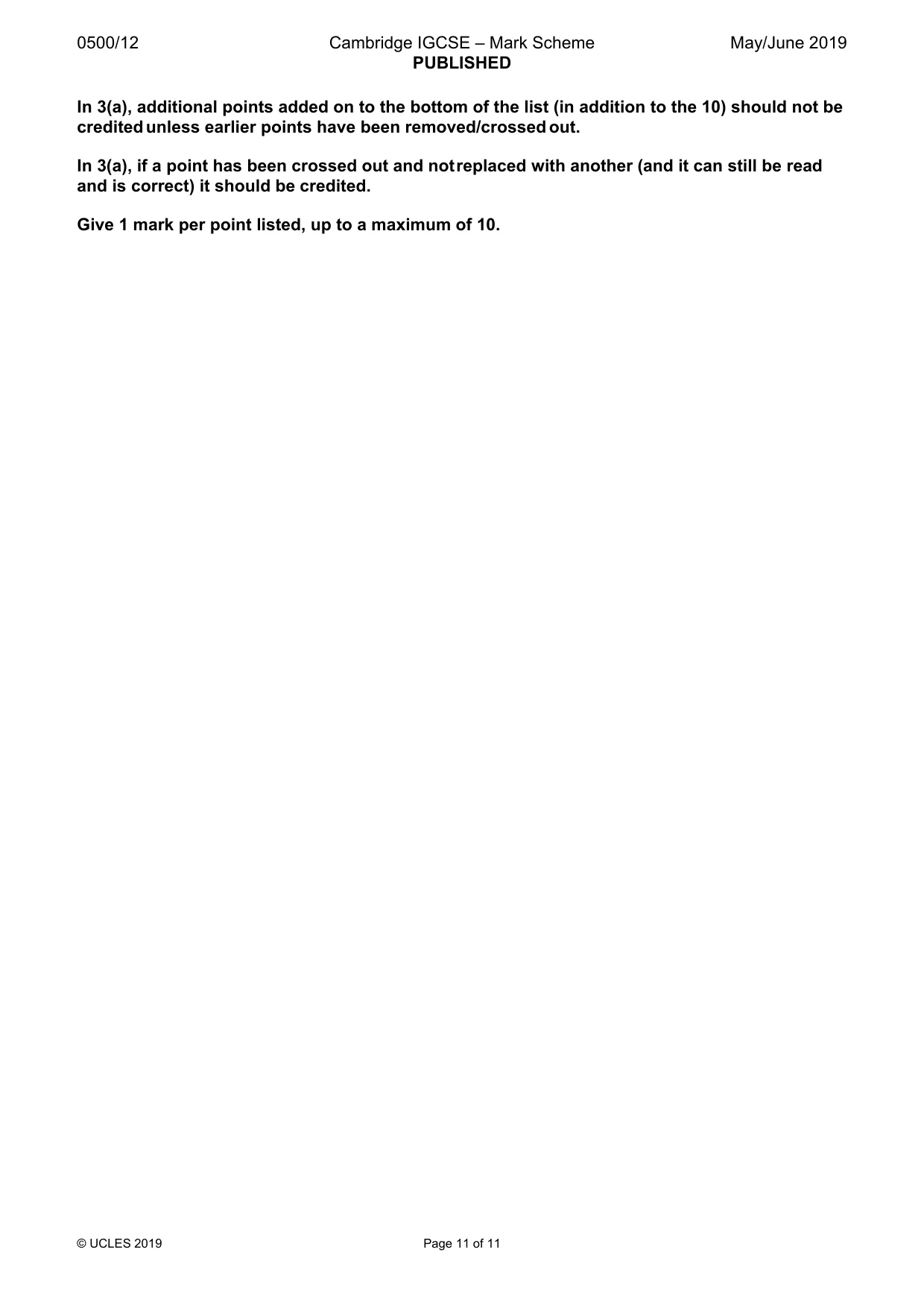
0500/12 Cambridge IGCSE – Mark Scheme PUBLISHED May/June 2019 © UCLES 2019 Page 11 of 11 In 3(a), additional points added on to the bottom of the list (in addition to the 10) should not be credited unless earlier points have been removed/crossed out. In 3(a), if a point has been crossed out and not replaced with another (and it can still be read and is correct) it should be credited. Give 1 mark per point listed, up to a maximum of 10.
What you needed in this session
Cambridge’s own grade thresholds for 2019 May/June, Paper 1 · Variant 2. A higher threshold means an easier paper — the bar moves with how the cohort did.