Cambridge IGCSE English - First Language 0500 — 2019 Feb/March Paper 2 · Variant 2
0500/22/F/M/19 · 50 marks · ≈56 min
The question paper and its mark scheme, free to read here and free to download. This is Cambridge’s own paper, exactly as it was sat.
Question paper12 pages
Mark scheme15 pages
Answers below. Sit the paper first if you are practising.
Paper as text
Question paper, page 1
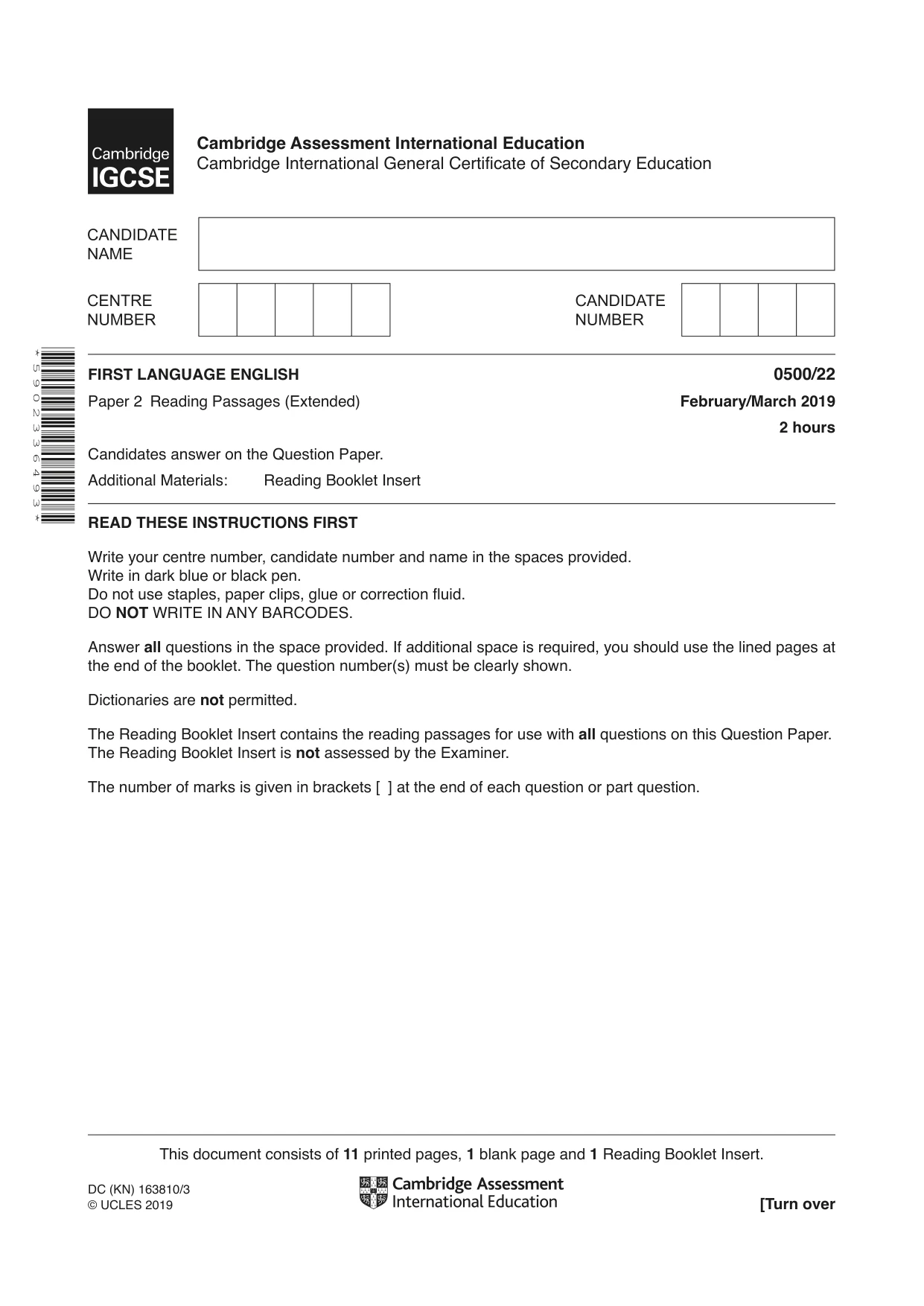
This document consists of 11 printed pages, 1 blank page and 1 Reading Booklet Insert. DC (KN) 163810/3 © UCLES 2019 [Turn over Cambridge Assessment International Education Cambridge International General Certificate of Secondary Education * 5 9 0 2 3 3 6 4 9 3 * FIRST LANGUAGE ENGLISH 0500/22 Paper 2 Reading Passages (Extended) February/March 2019 2 hours Candidates answer on the Question Paper. Additional Materials: Reading Booklet Insert READ THESE INSTRUCTIONS FIRST Write your centre number, candidate number and name in the spaces provided. Write in dark blue or black pen. Do not use staples, paper clips, glue or correction fluid. DO NOT WRITE IN ANY BARCODES. Answer all questions in the space provided. If additional space is required, you should use the lined pages at the end of the booklet. The question number(s) must be clearly shown. Dictionaries are not permitted. The Reading Booklet Insert contains the reading passages for use with all questions on this Question Paper. The Reading Booklet Insert is not assessed by the Examiner. The number of marks is given in brackets [ ] at the end of each question or part question.
Question paper, page 2
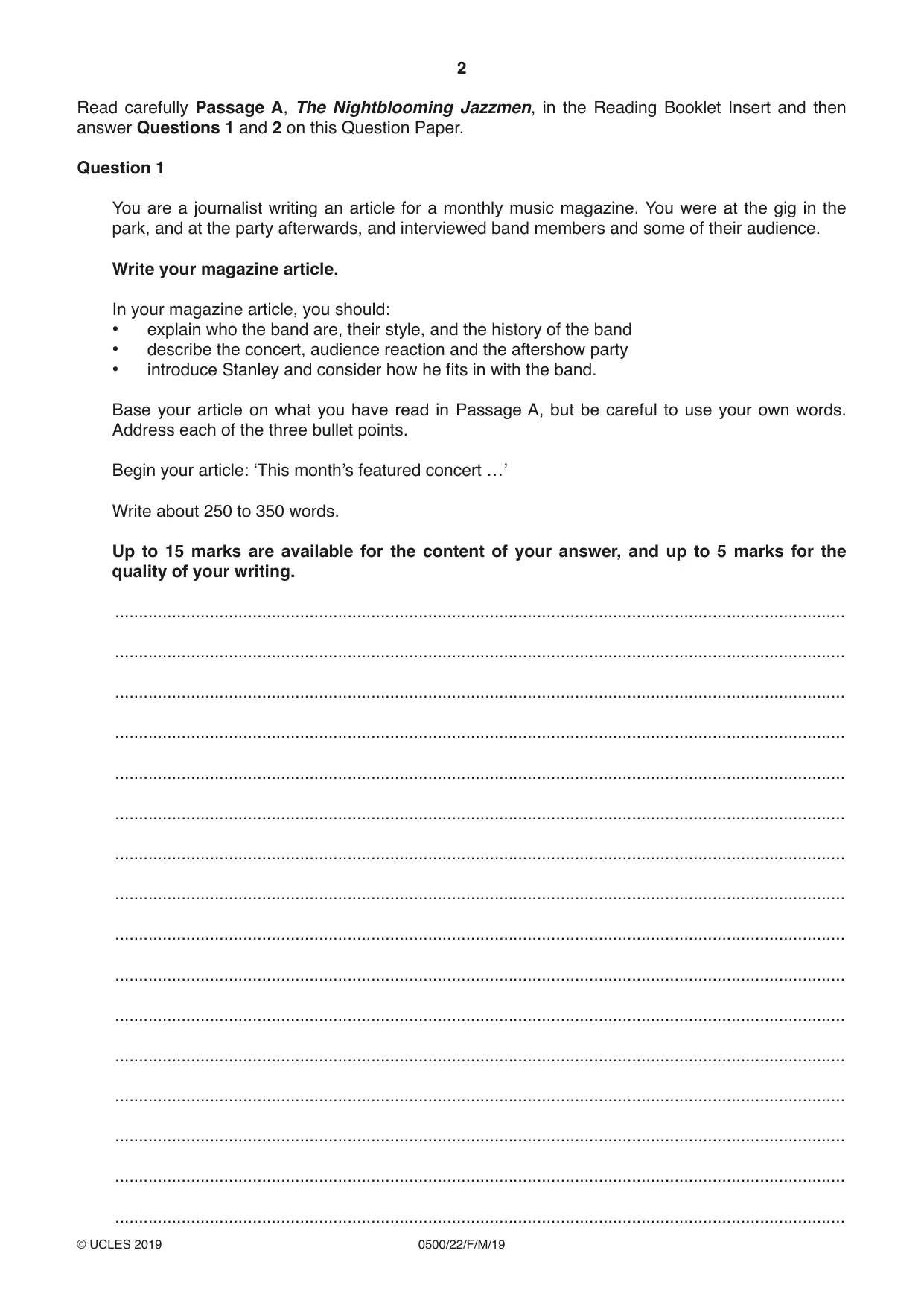
2 0500/22/F/M/19 © UCLES 2019 Read carefully Passage A, The Nightblooming Jazzmen, in the Reading Booklet Insert and then answer Questions 1 and 2 on this Question Paper. Question 1 You are a journalist writing an article for a monthly music magazine. You were at the gig in the park, and at the party afterwards, and interviewed band members and some of their audience. Write your magazine article. In your magazine article, you should: • explain who the band are, their style, and the history of the band • describe the concert, audience reaction and the aftershow party • introduce Stanley and consider how he fits in with the band. Base your article on what you have read in Passage A, but be careful to use your own words. Address each of the three bullet points. Begin your article: ‘This month’s featured concert …’ Write about 250 to 350 words. Up to 15 marks are available for the content of your answer, and up to 5 marks for the quality of your writing. … … … … … … … … … … … … … … … …
Question paper, page 3
3 0500/22/F/M/19 © UCLES 2019 [Turn over … … … … … … … … … … … … … … … … … … … … … … … … … … … …
Question paper, page 4
4 0500/22/F/M/19 © UCLES 2019 … … … … … … … … … … … … … … … … … … … … … … … … … … … [Total: 20]
Question paper, page 5
5 0500/22/F/M/19 © UCLES 2019 [Turn over [Turn to page 6 for Question 2]
Question paper, page 6
6 0500/22/F/M/19 © UCLES 2019 Question 2 Re-read the descriptions of: (a) the concert in paragraph 6, beginning ‘Clyde puffs …’ (b) the partygoers in paragraph 29, beginning ‘Looking back …’ Select four powerful words or phrases from each paragraph. Your choices should include imagery. Explain how each word or phrase selected is used effectively in the context. Write about 200 to 300 words. Up to 10 marks are available for the content of your answer. … … … … … … … … … … … … … … … … … … … … …
Question paper, page 7
7 0500/22/F/M/19 © UCLES 2019 [Turn over … … … … … … … … … … … … … … … … … … … … … … … … … … … [Total: 10]
Question paper, page 8
8 0500/22/F/M/19 © UCLES 2019 Read carefully Passage B, Caveman Rock, in the Reading Booklet Insert and then answer Question 3 on this Question Paper. Question 3 What facts are interesting and important about the musical instruments used in this concert, according to Passage B? You must use continuous writing (not note form) and use your own words as far as possible. Your summary should not be more than 250 words. Up to 15 marks are available for the content of your answer, and up to 5 marks for the quality of your writing. … … … … … … … … … … … … … … … … … … … … …
Question paper, page 9
9 0500/22/F/M/19 © UCLES 2019 … … … … … … … … … … … … … … [Total: 20]
Question paper, page 10
10 0500/22/F/M/19 © UCLES 2019 Additional Page If you use the following lined page to complete the answer(s) to any question(s), the question number(s) must be clearly shown. … … … … … … … … … … … … … … … … … … … … … … … … … …
Question paper, page 11
11 0500/22/F/M/19 © UCLES 2019 Additional Page If you use the following lined page to complete the answer(s) to any question(s), the question number(s) must be clearly shown. … … … … … … … … … … … … … … … … … … … … … … … … … …
Question paper, page 12
12 0500/22/F/M/19 © UCLES 2019 Permission to reproduce items where third-party owned material protected by copyright is included has been sought and cleared where possible. Every reasonable effort has been made by the publisher (UCLES) to trace copyright holders, but if any items requiring clearance have unwittingly been included, the publisher will be pleased to make amends at the earliest possible opportunity. To avoid the issue of disclosure of answer-related information to candidates, all copyright acknowledgements are reproduced online in the Cambridge Assessment International Education Copyright Acknowledgements Booklet. This is produced for each series of examinations and is freely available to download at www.cambridgeinternational.org after the live examination series. Cambridge Assessment International Education is part of the Cambridge Assessment Group. Cambridge Assessment is the brand name of the University of Cambridge Local Examinations Syndicate (UCLES), which itself is a department of the University of Cambridge. BLANK PAGE
Mark scheme, page 1
This document consists of 15 printed pages. © UCLES 2019 [Turn over Cambridge Assessment International Education Cambridge International General Certificate of Secondary Education FIRST LANGUAGE ENGLISH 0500/22 Paper 2 Reading Passages (Extended) March 2019 MARK SCHEME Maximum Mark: 50 Published This mark scheme is published as an aid to teachers and candidates, to indicate the requirements of the examination. It shows the basis on which Examiners were instructed to award marks. It does not indicate the details of the discussions that took place at an Examiners’ meeting before marking began, which would have considered the acceptability of alternative answers. Mark schemes should be read in conjunction with the question paper and the Principal Examiner Report for Teachers. Cambridge International will not enter into discussions about these mark schemes. Cambridge International is publishing the mark schemes for the March 2019 series for most Cambridge IGCSE™, Cambridge International A and AS Level components and some Cambridge O Level components.
Mark scheme, page 2
0500/22 Cambridge IGCSE – Mark Scheme PUBLISHED March 2019 © UCLES 2019 Page 2 of 15 Generic Marking Principles These general marking principles must be applied by all examiners when marking candidate answers. They should be applied alongside the specific content of the mark scheme or generic level descriptors for a question. Each question paper and mark scheme will also comply with these marking principles. GENERIC MARKING PRINCIPLE 1: Marks must be awarded in line with: • the specific content of the mark scheme or the generic level descriptors for the question • the specific skills defined in the mark scheme or in the generic level descriptors for the question • the standard of response required by a candidate as exemplified by the standardisation scripts. GENERIC MARKING PRINCIPLE 2: Marks awarded are always whole marks (not half marks, or other fractions). GENERIC MARKING PRINCIPLE 3: Marks must be awarded positively: • marks are awarded for correct/valid answers, as defined in the mark scheme. However, credit is given for valid answers which go beyond the scope of the syllabus and mark scheme, referring to your Team Leader as appropriate • marks are awarded when candidates clearly demonstrate what they know and can do • marks are not deducted for errors • marks are not deducted for omissions • answers should only be judged on the quality of spelling, punctuation and grammar when these features are specifically assessed by the question as indicated by the mark scheme. The meaning, however, should be unambiguous. GENERIC MARKING PRINCIPLE 4: Rules must be applied consistently e.g. in situations where candidates have not followed instructions or in the application of generic level descriptors. GENERIC MARKING PRINCIPLE 5: Marks should be awarded using the full range of marks defined in the mark scheme for the question (however - the use of the full mark range may be limited according to the quality of the candidate responses seen). GENERIC MARKING PRINCIPLE 6: Marks awarded are based solely on the requirements as defined in the mark scheme. Marks should not be awarded with grade thresholds or grade descriptors in mind.
Mark scheme, page 3
0500/22 Cambridge IGCSE – Mark Scheme PUBLISHED March 2019 © UCLES 2019 Page 3 of 15 Note: All Examiners are instructed that alternative correct answers and unexpected approaches in candidates’ scripts must be given marks that fairly reflect the relevant knowledge and skills demonstrated. Nonetheless, the content must be clearly related to and derived from the passage. Question 1 This question tests Reading Objectives R1 to R3 (15 marks): R1 demonstrate understanding of explicit meanings R2 demonstrate understanding of implicit meanings and attitudes R3 analyse, evaluate and develop facts, ideas and opinions and writing assessment objectives W1 to W4 (5 marks): W1 articulate experience and express what is thought, felt and imagined W2 organise facts, ideas and opinions W3 use a range of appropriate vocabulary W4 use register appropriate to audience and context.
Mark scheme, page 4
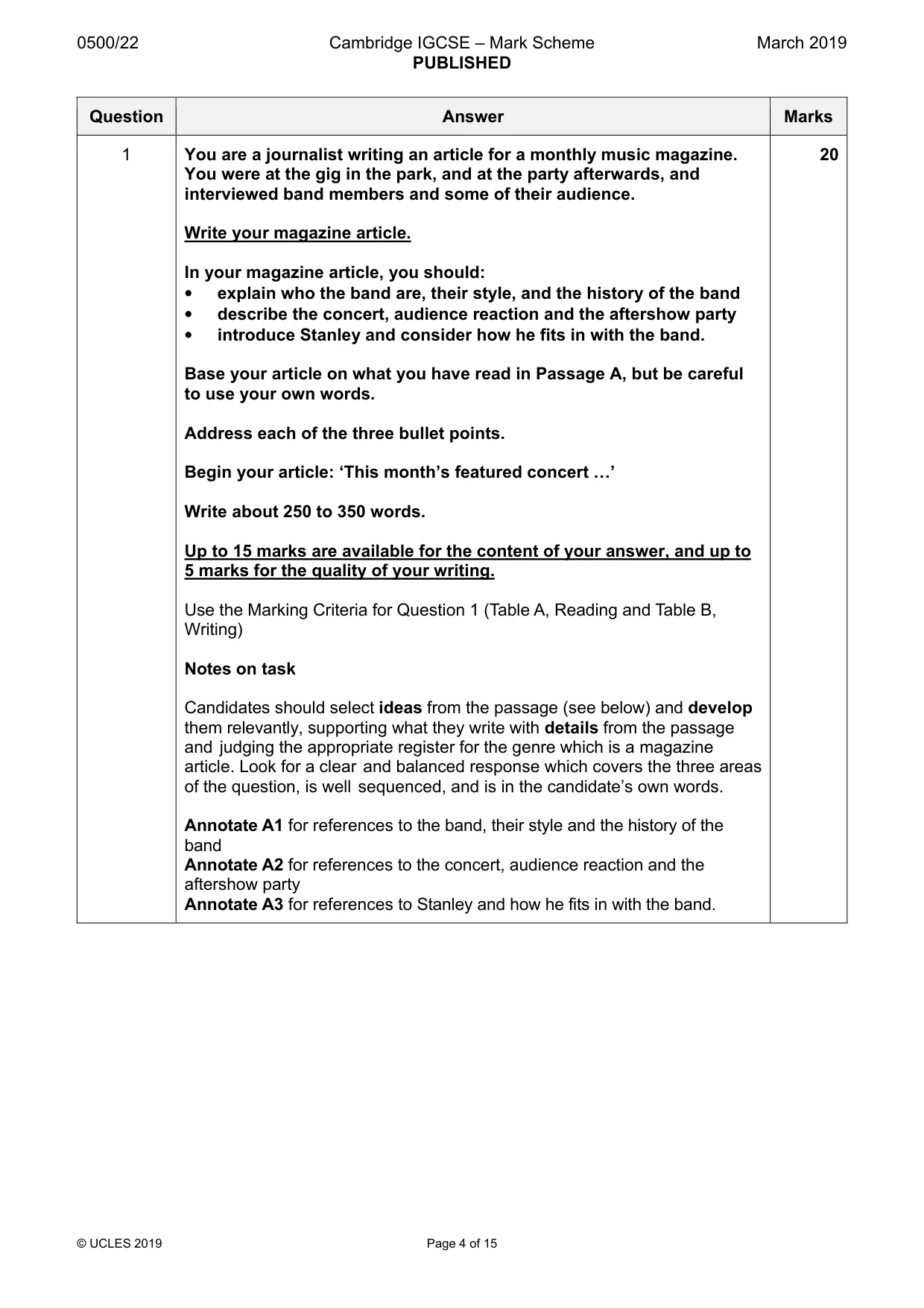
0500/22 Cambridge IGCSE – Mark Scheme PUBLISHED March 2019 © UCLES 2019 Page 4 of 15 Question Answer Marks 1 You are a journalist writing an article for a monthly music magazine. You were at the gig in the park, and at the party afterwards, and interviewed band members and some of their audience. Write your magazine article. In your magazine article, you should: • explain who the band are, their style, and the history of the band • describe the concert, audience reaction and the aftershow party • introduce Stanley and consider how he fits in with the band. Base your article on what you have read in Passage A, but be careful to use your own words. Address each of the three bullet points. Begin your article: ‘This month’s featured concert «’ Write about 250 to 350 words. Up to 15 marks are available for the content of your answer, and up to 5 marks for the quality of your writing. Use the Marking Criteria for Question 1 (Table A, Reading and Table B, Writing) Notes on task Candidates should select ideas from the passage (see below) and develop them relevantly, supporting what they write with details from the passage and judging the appropriate register for the genre which is a magazine article. Look for a clear and balanced response which covers the three areas of the question, is well sequenced, and is in the candidate’s own words. Annotate A1 for references to the band, their style and the history of the band Annotate A2 for references to the concert, audience reaction and the aftershow party Annotate A3 for references to Stanley and how he fits in with the band. 20
Mark scheme, page 5
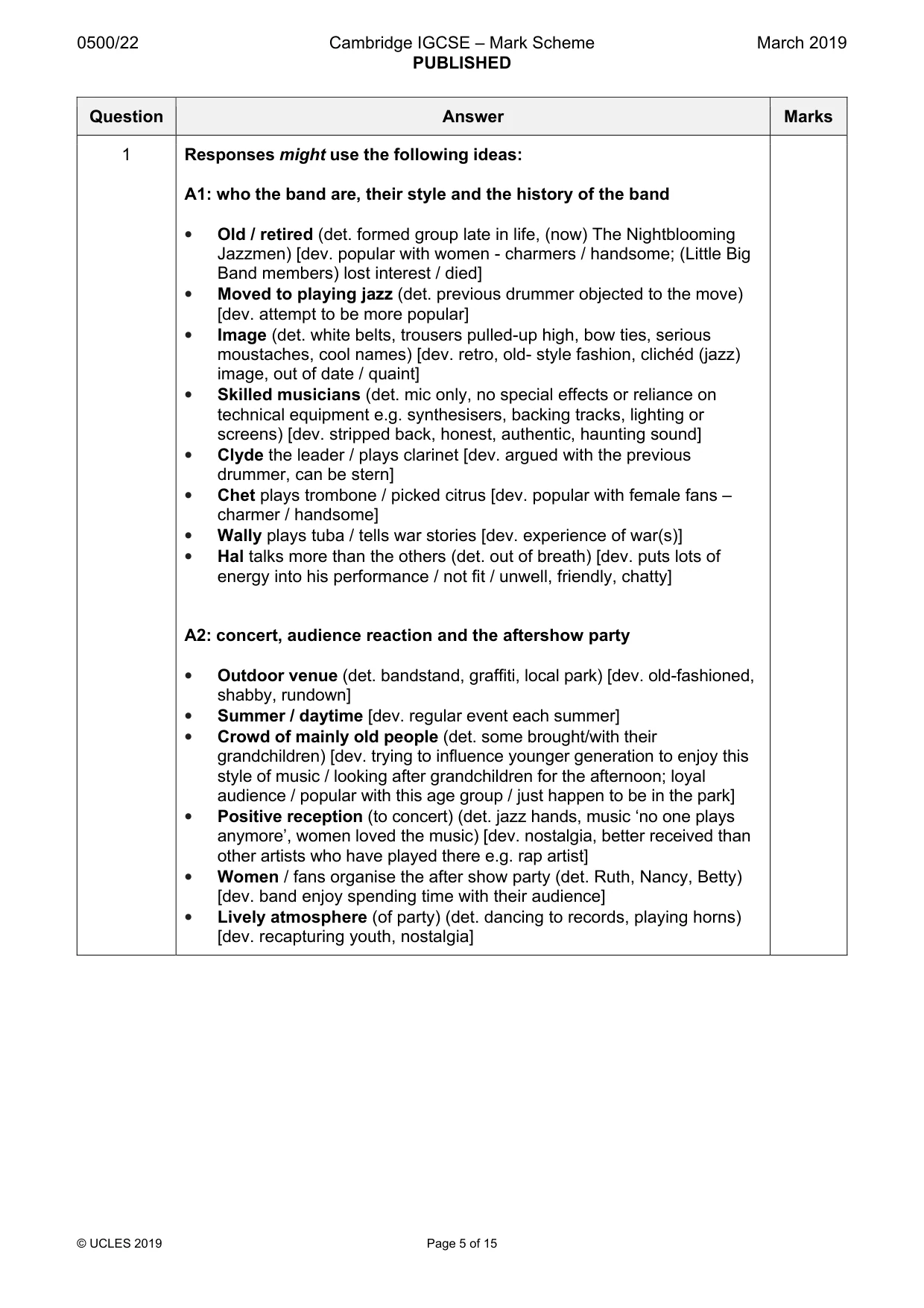
0500/22 Cambridge IGCSE – Mark Scheme PUBLISHED March 2019 © UCLES 2019 Page 5 of 15 Question Answer Marks 1 Responses might use the following ideas: A1: who the band are, their style and the history of the band • Old / retired (det. formed group late in life, (now) The Nightblooming Jazzmen) [dev. popular with women - charmers / handsome; (Little Big Band members) lost interest / died] • Moved to playing jazz (det. previous drummer objected to the move) [dev. attempt to be more popular] • Image (det. white belts, trousers pulled-up high, bow ties, serious moustaches, cool names) [dev. retro, old- style fashion, clichéd (jazz) image, out of date / quaint] • Skilled musicians (det. mic only, no special effects or reliance on technical equipment e.g. synthesisers, backing tracks, lighting or screens) [dev. stripped back, honest, authentic, haunting sound] • Clyde the leader / plays clarinet [dev. argued with the previous drummer, can be stern] • Chet plays trombone / picked citrus [dev. popular with female fans – charmer / handsome] • Wally plays tuba / tells war stories [dev. experience of war(s)] • Hal talks more than the others (det. out of breath) [dev. puts lots of energy into his performance / not fit / unwell, friendly, chatty] A2: concert, audience reaction and the aftershow party • Outdoor venue (det. bandstand, graffiti, local park) [dev. old-fashioned, shabby, rundown] • Summer / daytime [dev. regular event each summer] • Crowd of mainly old people (det. some brought/with their grandchildren) [dev. trying to influence younger generation to enjoy this style of music / looking after grandchildren for the afternoon; loyal audience / popular with this age group / just happen to be in the park] • Positive reception (to concert) (det. jazz hands, music ‘no one plays anymore’, women loved the music) [dev. nostalgia, better received than other artists who have played there e.g. rap artist] • Women / fans organise the after show party (det. Ruth, Nancy, Betty) [dev. band enjoy spending time with their audience] • Lively atmosphere (of party) (det. dancing to records, playing horns) [dev. recapturing youth, nostalgia]
Mark scheme, page 6
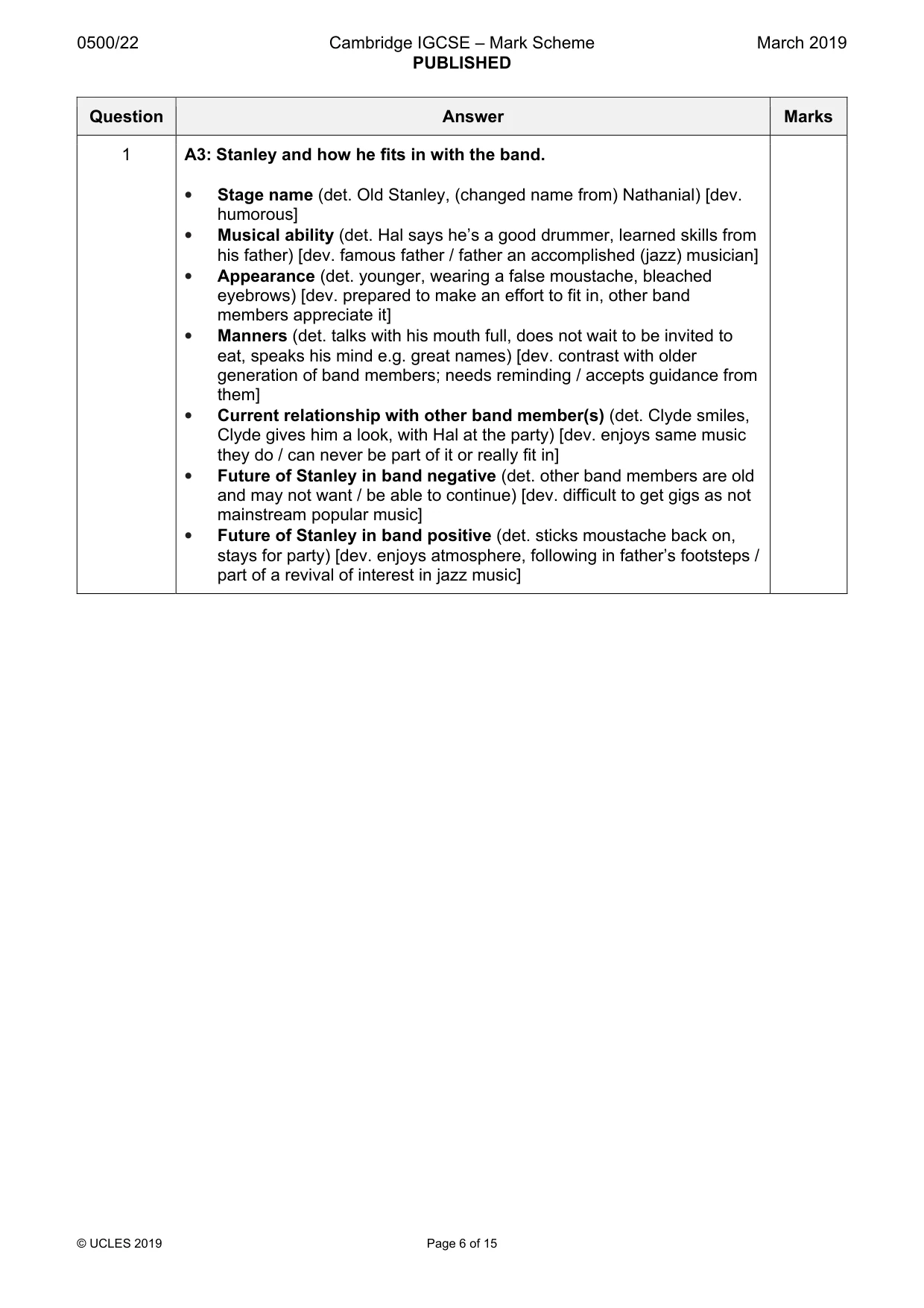
0500/22 Cambridge IGCSE – Mark Scheme PUBLISHED March 2019 © UCLES 2019 Page 6 of 15 Question Answer Marks 1 A3: Stanley and how he fits in with the band. • Stage name (det. Old Stanley, (changed name from) Nathanial) [dev. humorous] • Musical ability (det. Hal says he’s a good drummer, learned skills from his father) [dev. famous father / father an accomplished (jazz) musician] • Appearance (det. younger, wearing a false moustache, bleached eyebrows) [dev. prepared to make an effort to fit in, other band members appreciate it] • Manners (det. talks with his mouth full, does not wait to be invited to eat, speaks his mind e.g. great names) [dev. contrast with older generation of band members; needs reminding / accepts guidance from them] • Current relationship with other band member(s) (det. Clyde smiles, Clyde gives him a look, with Hal at the party) [dev. enjoys same music they do / can never be part of it or really fit in] • Future of Stanley in band negative (det. other band members are old and may not want / be able to continue) [dev. difficult to get gigs as not mainstream popular music] • Future of Stanley in band positive (det. sticks moustache back on, stays for party) [dev. enjoys atmosphere, following in father’s footsteps / part of a revival of interest in jazz music]
Mark scheme, page 7
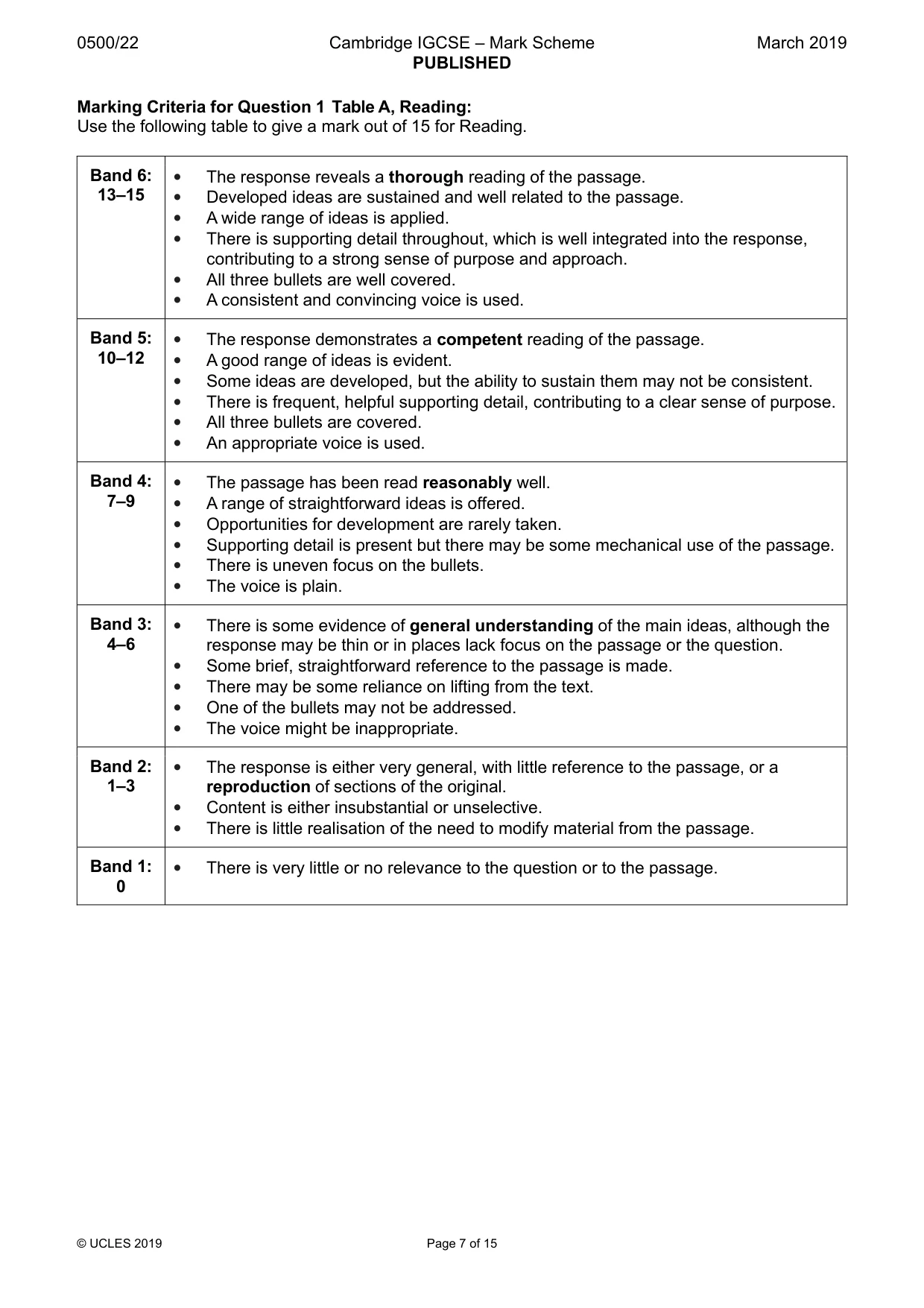
0500/22 Cambridge IGCSE – Mark Scheme PUBLISHED March 2019 © UCLES 2019 Page 7 of 15 Marking Criteria for Question 1 Table A, Reading: Use the following table to give a mark out of 15 for Reading. Band 6: 13–15 • The response reveals a thorough reading of the passage. • Developed ideas are sustained and well related to the passage. • A wide range of ideas is applied. • There is supporting detail throughout, which is well integrated into the response, contributing to a strong sense of purpose and approach. • All three bullets are well covered. • A consistent and convincing voice is used. Band 5: 10–12 • The response demonstrates a competent reading of the passage. • A good range of ideas is evident. • Some ideas are developed, but the ability to sustain them may not be consistent. • There is frequent, helpful supporting detail, contributing to a clear sense of purpose. • All three bullets are covered. • An appropriate voice is used. Band 4: 7–9 • The passage has been read reasonably well. • A range of straightforward ideas is offered. • Opportunities for development are rarely taken. • Supporting detail is present but there may be some mechanical use of the passage. • There is uneven focus on the bullets. • The voice is plain. Band 3: 4–6 • There is some evidence of general understanding of the main ideas, although the response may be thin or in places lack focus on the passage or the question. • Some brief, straightforward reference to the passage is made. • There may be some reliance on lifting from the text. • One of the bullets may not be addressed. • The voice might be inappropriate. Band 2: 1–3 • The response is either very general, with little reference to the passage, or a reproduction of sections of the original. • Content is either insubstantial or unselective. • There is little realisation of the need to modify material from the passage. Band 1: 0 • There is very little or no relevance to the question or to the passage.
Mark scheme, page 8
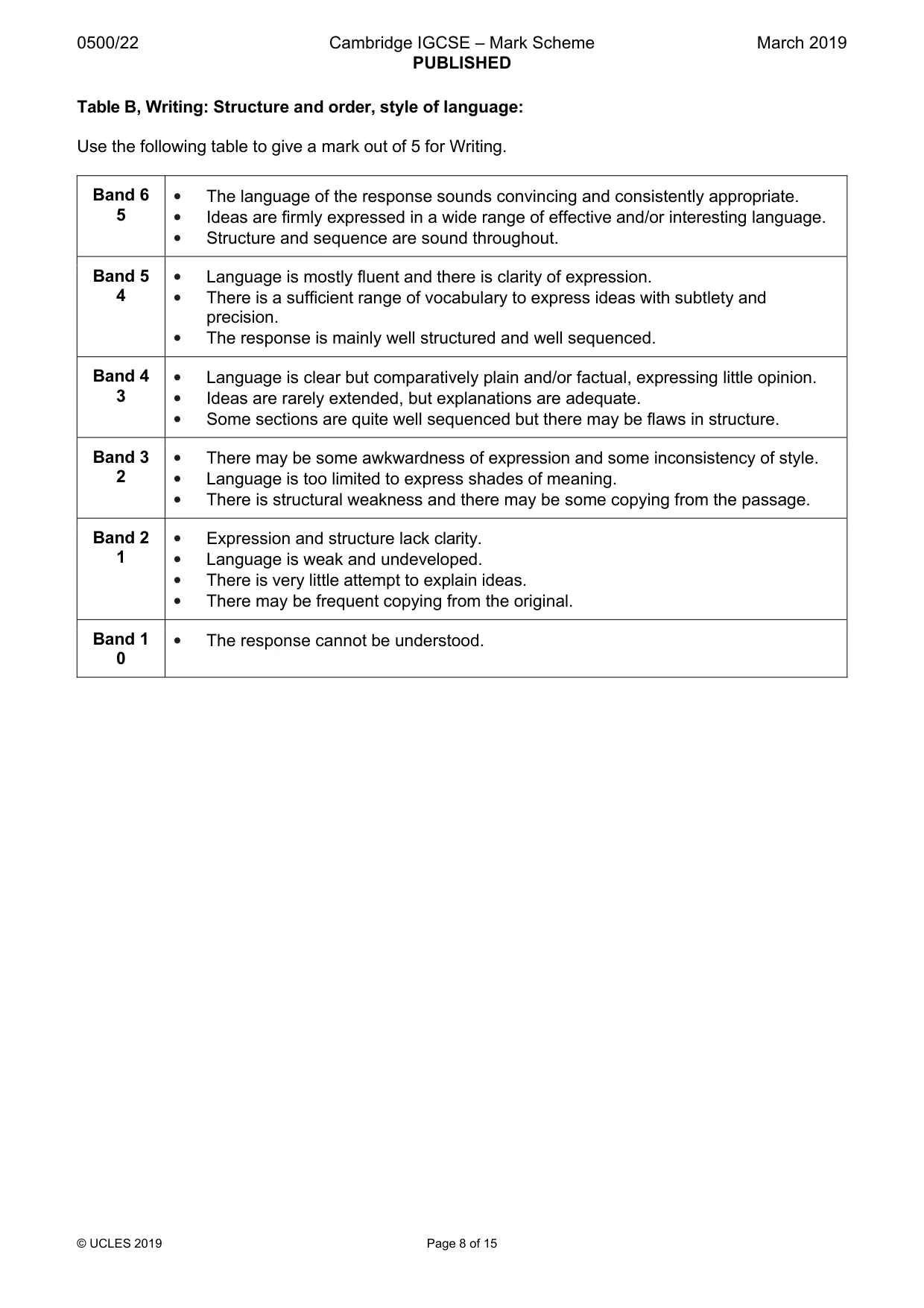
0500/22 Cambridge IGCSE – Mark Scheme PUBLISHED March 2019 © UCLES 2019 Page 8 of 15 Table B, Writing: Structure and order, style of language: Use the following table to give a mark out of 5 for Writing. Band 6 5 • The language of the response sounds convincing and consistently appropriate. • Ideas are firmly expressed in a wide range of effective and/or interesting language. • Structure and sequence are sound throughout. Band 5 4 • Language is mostly fluent and there is clarity of expression. • There is a sufficient range of vocabulary to express ideas with subtlety and precision. • The response is mainly well structured and well sequenced. Band 4 3 • Language is clear but comparatively plain and/or factual, expressing little opinion. • Ideas are rarely extended, but explanations are adequate. • Some sections are quite well sequenced but there may be flaws in structure. Band 3 2 • There may be some awkwardness of expression and some inconsistency of style. • Language is too limited to express shades of meaning. • There is structural weakness and there may be some copying from the passage. Band 2 1 • Expression and structure lack clarity. • Language is weak and undeveloped. • There is very little attempt to explain ideas. • There may be frequent copying from the original. Band 1 0 • The response cannot be understood.
Mark scheme, page 9
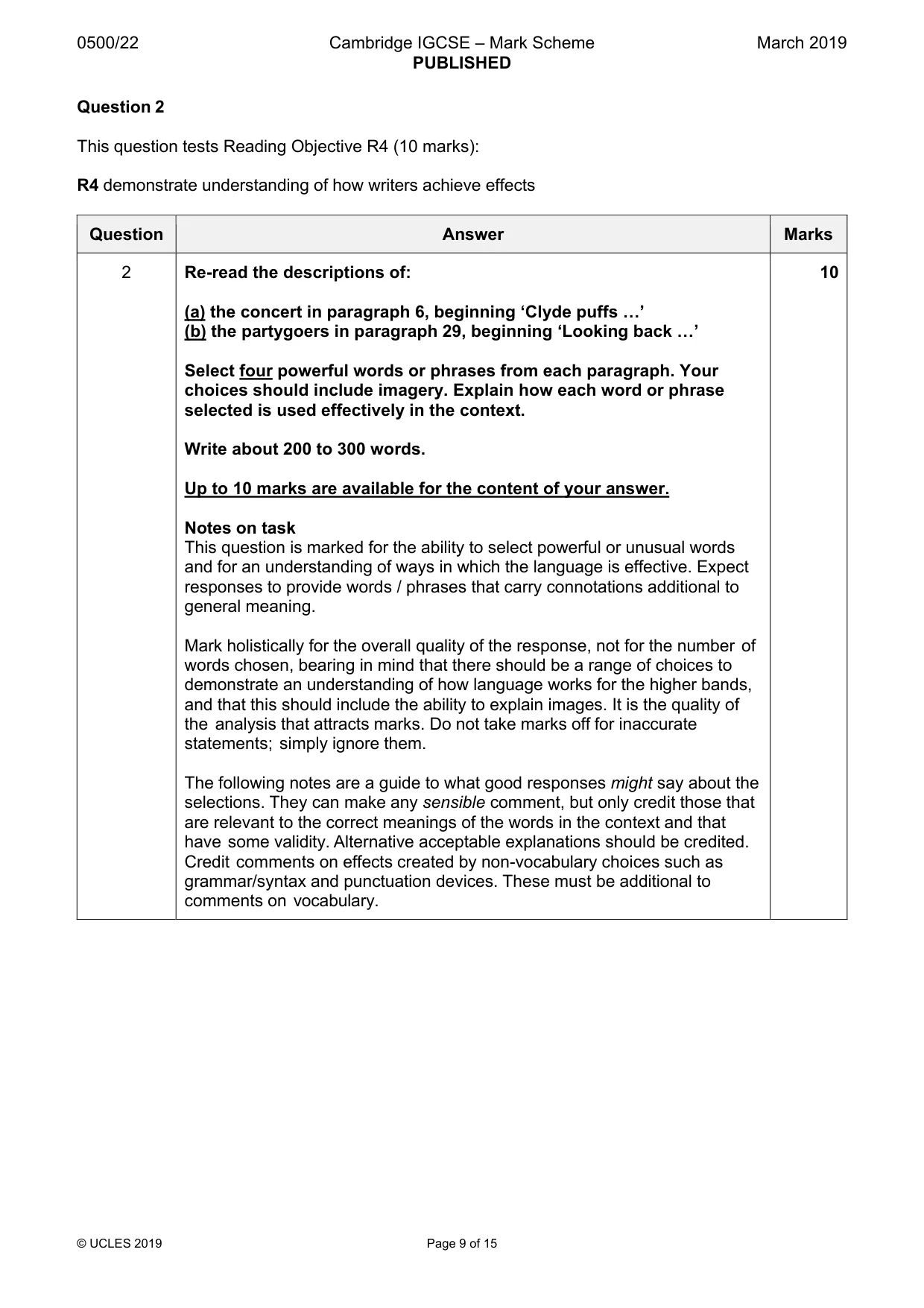
0500/22 Cambridge IGCSE – Mark Scheme PUBLISHED March 2019 © UCLES 2019 Page 9 of 15 Question 2 This question tests Reading Objective R4 (10 marks): R4 demonstrate understanding of how writers achieve effects Question Answer Marks 2 Re-read the descriptions of: (a) the concert in paragraph 6, beginning ‘Clyde puffs «’ (b) the partygoers in paragraph 29, beginning ‘Looking back «’ Select four powerful words or phrases from each paragraph. Your choices should include imagery. Explain how each word or phrase selected is used effectively in the context. Write about 200 to 300 words. Up to 10 marks are available for the content of your answer. Notes on task This question is marked for the ability to select powerful or unusual words and for an understanding of ways in which the language is effective. Expect responses to provide words / phrases that carry connotations additional to general meaning. Mark holistically for the overall quality of the response, not for the number of words chosen, bearing in mind that there should be a range of choices to demonstrate an understanding of how language works for the higher bands, and that this should include the ability to explain images. It is the quality of the analysis that attracts marks. Do not take marks off for inaccurate statements; simply ignore them. The following notes are a guide to what good responses might say about the selections. They can make any sensible comment, but only credit those that are relevant to the correct meanings of the words in the context and that have some validity. Alternative acceptable explanations should be credited. Credit comments on effects created by non-vocabulary choices such as grammar/syntax and punctuation devices. These must be additional to comments on vocabulary. 10
Mark scheme, page 10
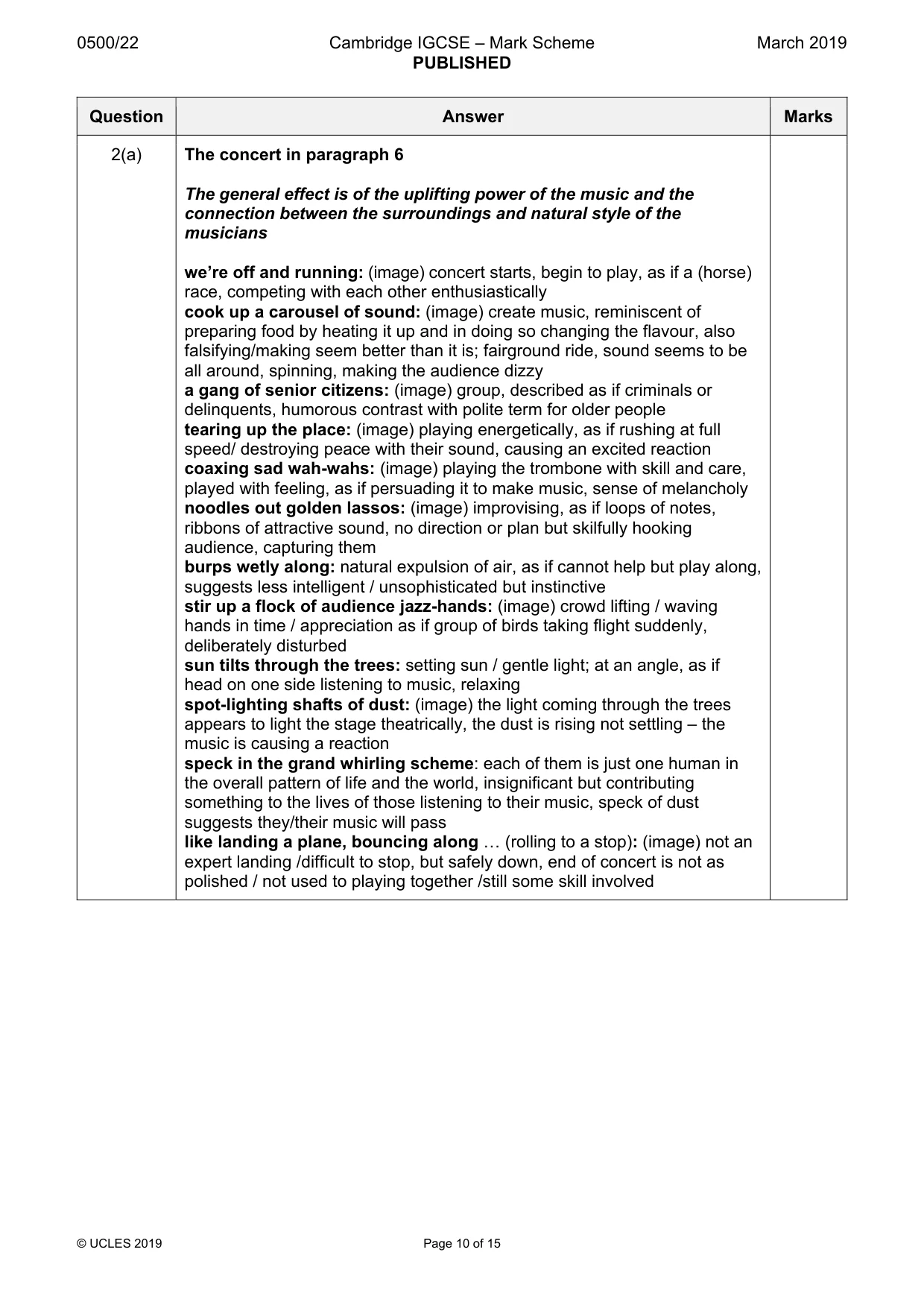
0500/22 Cambridge IGCSE – Mark Scheme PUBLISHED March 2019 © UCLES 2019 Page 10 of 15 Question Answer Marks 2(a) The concert in paragraph 6 The general effect is of the uplifting power of the music and the connection between the surroundings and natural style of the musicians we’re off and running: (image) concert starts, begin to play, as if a (horse) race, competing with each other enthusiastically cook up a carousel of sound: (image) create music, reminiscent of preparing food by heating it up and in doing so changing the flavour, also falsifying/making seem better than it is; fairground ride, sound seems to be all around, spinning, making the audience dizzy a gang of senior citizens: (image) group, described as if criminals or delinquents, humorous contrast with polite term for older people tearing up the place: (image) playing energetically, as if rushing at full speed/ destroying peace with their sound, causing an excited reaction coaxing sad wah-wahs: (image) playing the trombone with skill and care, played with feeling, as if persuading it to make music, sense of melancholy noodles out golden lassos: (image) improvising, as if loops of notes, ribbons of attractive sound, no direction or plan but skilfully hooking audience, capturing them burps wetly along: natural expulsion of air, as if cannot help but play along, suggests less intelligent / unsophisticated but instinctive stir up a flock of audience jazz-hands: (image) crowd lifting / waving hands in time / appreciation as if group of birds taking flight suddenly, deliberately disturbed sun tilts through the trees: setting sun / gentle light; at an angle, as if head on one side listening to music, relaxing spot-lighting shafts of dust: (image) the light coming through the trees appears to light the stage theatrically, the dust is rising not settling – the music is causing a reaction speck in the grand whirling scheme: each of them is just one human in the overall pattern of life and the world, insignificant but contributing something to the lives of those listening to their music, speck of dust suggests they/their music will pass like landing a plane, bouncing along « (rolling to a stop): (image) not an expert landing /difficult to stop, but safely down, end of concert is not as polished / not used to playing together /still some skill involved
Mark scheme, page 11
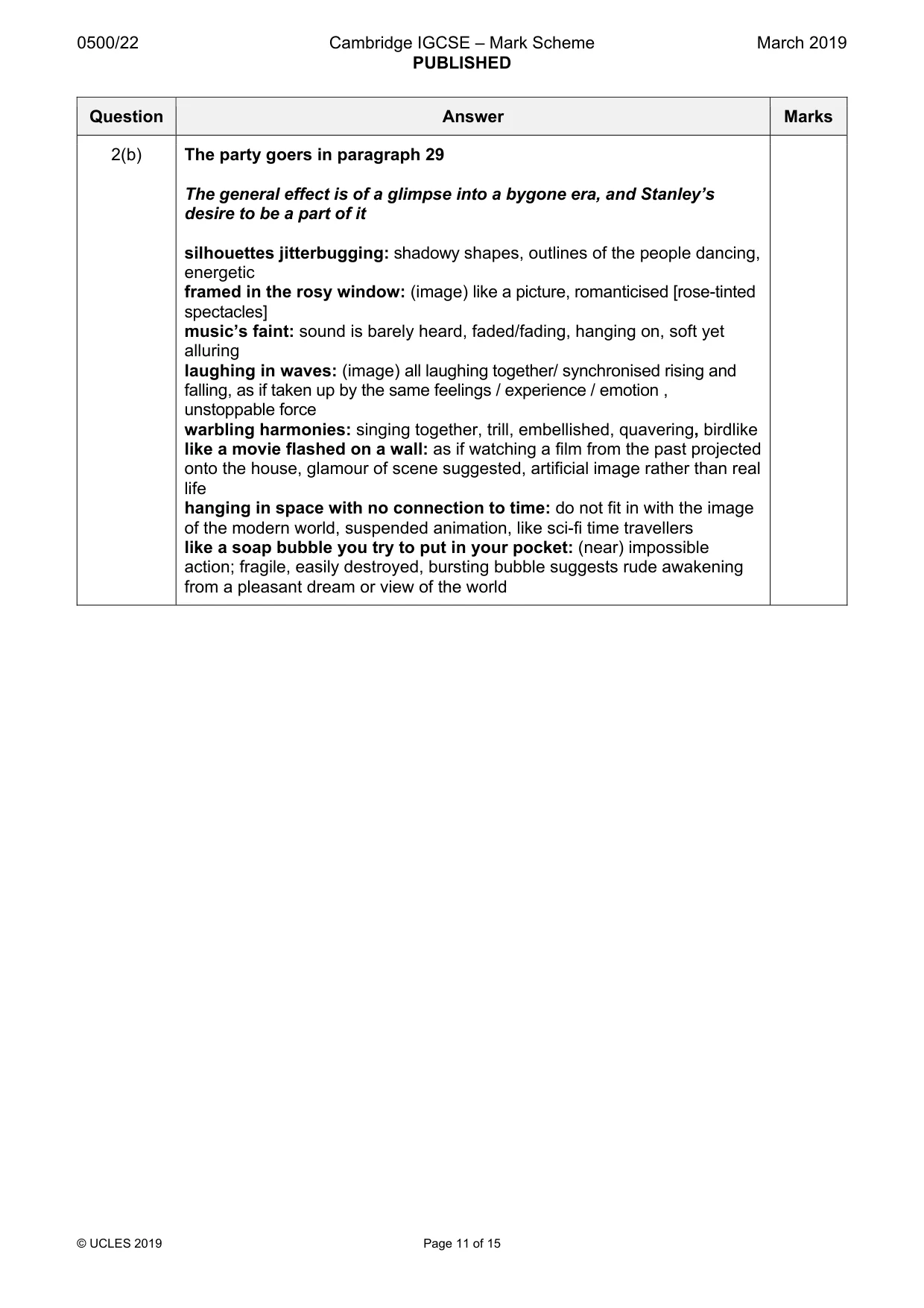
0500/22 Cambridge IGCSE – Mark Scheme PUBLISHED March 2019 © UCLES 2019 Page 11 of 15 Question Answer Marks 2(b) The party goers in paragraph 29 The general effect is of a glimpse into a bygone era, and Stanley’s desire to be a part of it silhouettes jitterbugging: shadowy shapes, outlines of the people dancing, energetic framed in the rosy window: (image) like a picture, romanticised [rose-tinted spectacles] music’s faint: sound is barely heard, faded/fading, hanging on, soft yet alluring laughing in waves: (image) all laughing together/ synchronised rising and falling, as if taken up by the same feelings / experience / emotion , unstoppable force warbling harmonies: singing together, trill, embellished, quavering, birdlike like a movie flashed on a wall: as if watching a film from the past projected onto the house, glamour of scene suggested, artificial image rather than real life hanging in space with no connection to time: do not fit in with the image of the modern world, suspended animation, like sci-fi time travellers like a soap bubble you try to put in your pocket: (near) impossible action; fragile, easily destroyed, bursting bubble suggests rude awakening from a pleasant dream or view of the world
Mark scheme, page 12
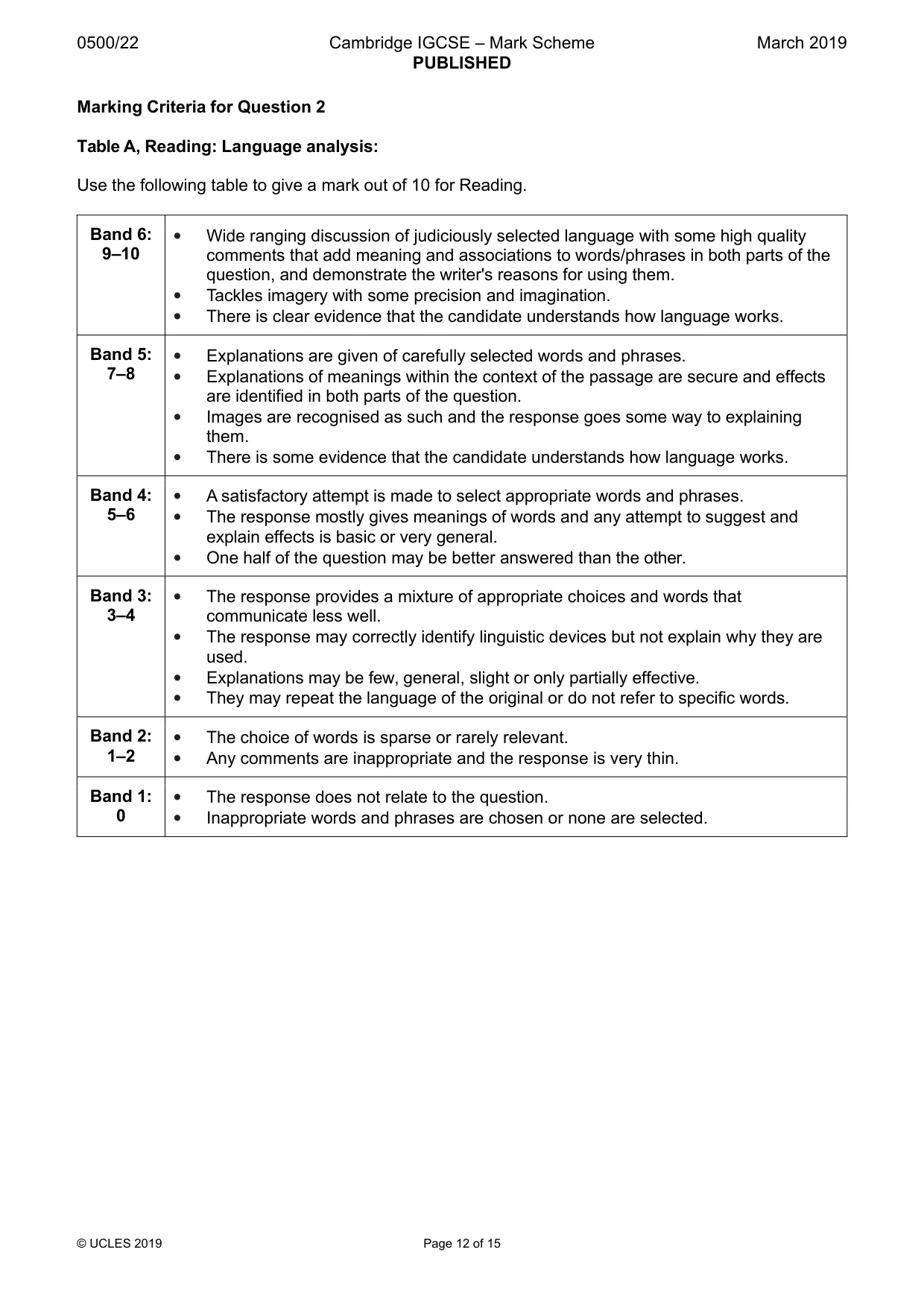
0500/22 Cambridge IGCSE – Mark Scheme PUBLISHED March 2019 © UCLES 2019 Page 12 of 15 Marking Criteria for Question 2 Table A, Reading: Language analysis: Use the following table to give a mark out of 10 for Reading. Band 6: 9–10 • Wide ranging discussion of judiciously selected language with some high quality comments that add meaning and associations to words/phrases in both parts of the question, and demonstrate the writer's reasons for using them. • Tackles imagery with some precision and imagination. • There is clear evidence that the candidate understands how language works. Band 5: 7–8 • Explanations are given of carefully selected words and phrases. • Explanations of meanings within the context of the passage are secure and effects are identified in both parts of the question. • Images are recognised as such and the response goes some way to explaining them. • There is some evidence that the candidate understands how language works. Band 4: 5–6 • A satisfactory attempt is made to select appropriate words and phrases. • The response mostly gives meanings of words and any attempt to suggest and explain effects is basic or very general. • One half of the question may be better answered than the other. Band 3: 3–4 • The response provides a mixture of appropriate choices and words that communicate less well. • The response may correctly identify linguistic devices but not explain why they are used. • Explanations may be few, general, slight or only partially effective. • They may repeat the language of the original or do not refer to specific words. Band 2: 1–2 • The choice of words is sparse or rarely relevant. • Any comments are inappropriate and the response is very thin. Band 1: 0 • The response does not relate to the question. • Inappropriate words and phrases are chosen or none are selected.
Mark scheme, page 13
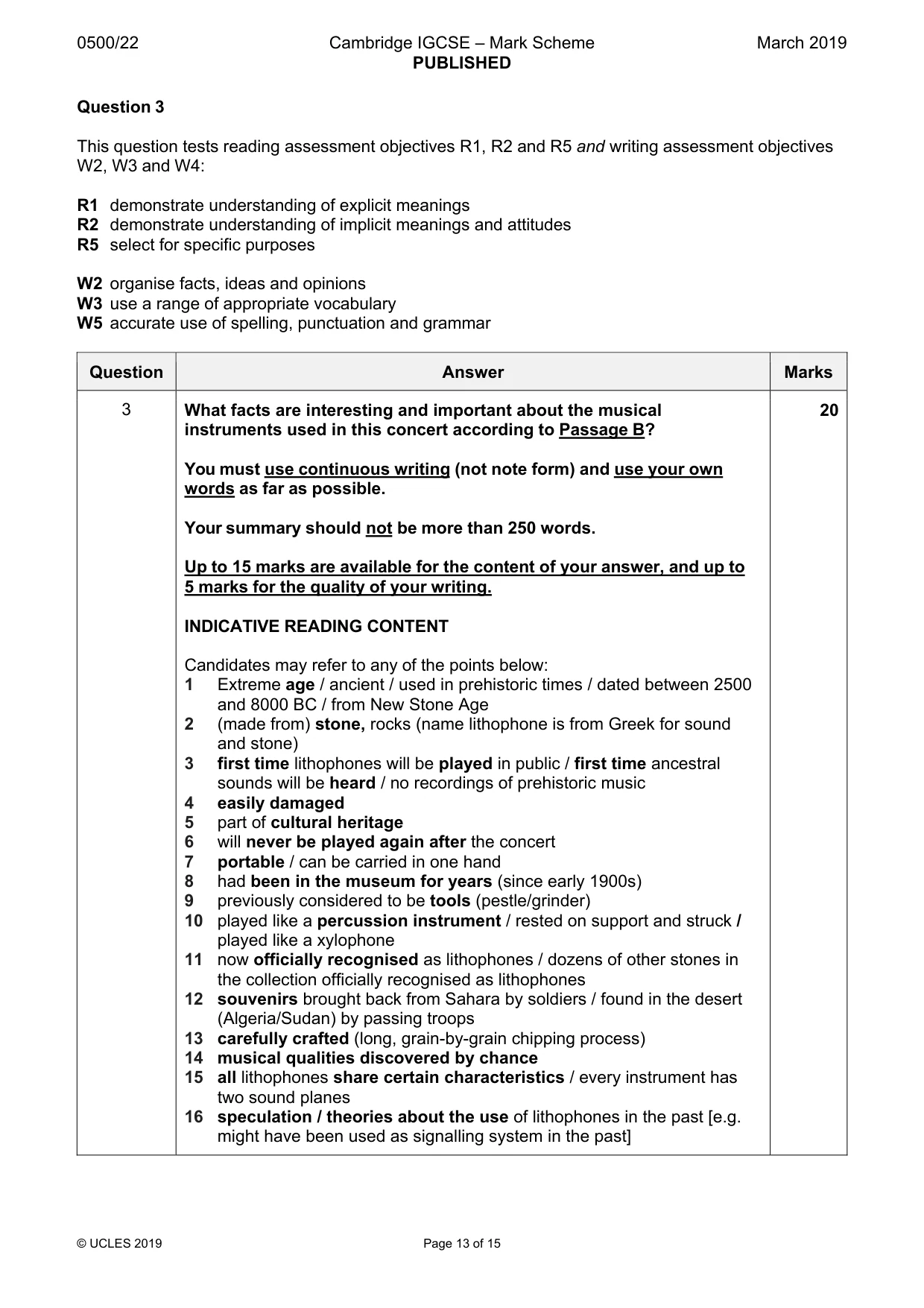
0500/22 Cambridge IGCSE – Mark Scheme PUBLISHED March 2019 © UCLES 2019 Page 13 of 15 Question 3 This question tests reading assessment objectives R1, R2 and R5 and writing assessment objectives W2, W3 and W4: R1 demonstrate understanding of explicit meanings R2 demonstrate understanding of implicit meanings and attitudes R5 select for specific purposes W2 organise facts, ideas and opinions W3 use a range of appropriate vocabulary W5 accurate use of spelling, punctuation and grammar Question Answer Marks 3 What facts are interesting and important about the musical instruments used in this concert according to Passage B? You must use continuous writing (not note form) and use your own words as far as possible. Your summary should not be more than 250 words. Up to 15 marks are available for the content of your answer, and up to 5 marks for the quality of your writing. INDICATIVE READING CONTENT Candidates may refer to any of the points below: 1 Extreme age / ancient / used in prehistoric times / dated between 2500 and 8000 BC / from New Stone Age 2 (made from) stone, rocks (name lithophone is from Greek for sound and stone) 3 first time lithophones will be played in public / first time ancestral sounds will be heard / no recordings of prehistoric music 4 easily damaged 5 part of cultural heritage 6 will never be played again after the concert 7 portable / can be carried in one hand 8 had been in the museum for years (since early 1900s) 9 previously considered to be tools (pestle/grinder) 10 played like a percussion instrument / rested on support and struck / played like a xylophone 11 now officially recognised as lithophones / dozens of other stones in the collection officially recognised as lithophones 12 souvenirs brought back from Sahara by soldiers / found in the desert (Algeria/Sudan) by passing troops 13 carefully crafted (long, grain-by-grain chipping process) 14 musical qualities discovered by chance 15 all lithophones share certain characteristics / every instrument has two sound planes 16 speculation / theories about the use of lithophones in the past [e.g. might have been used as signalling system in the past] 20
Mark scheme, page 14
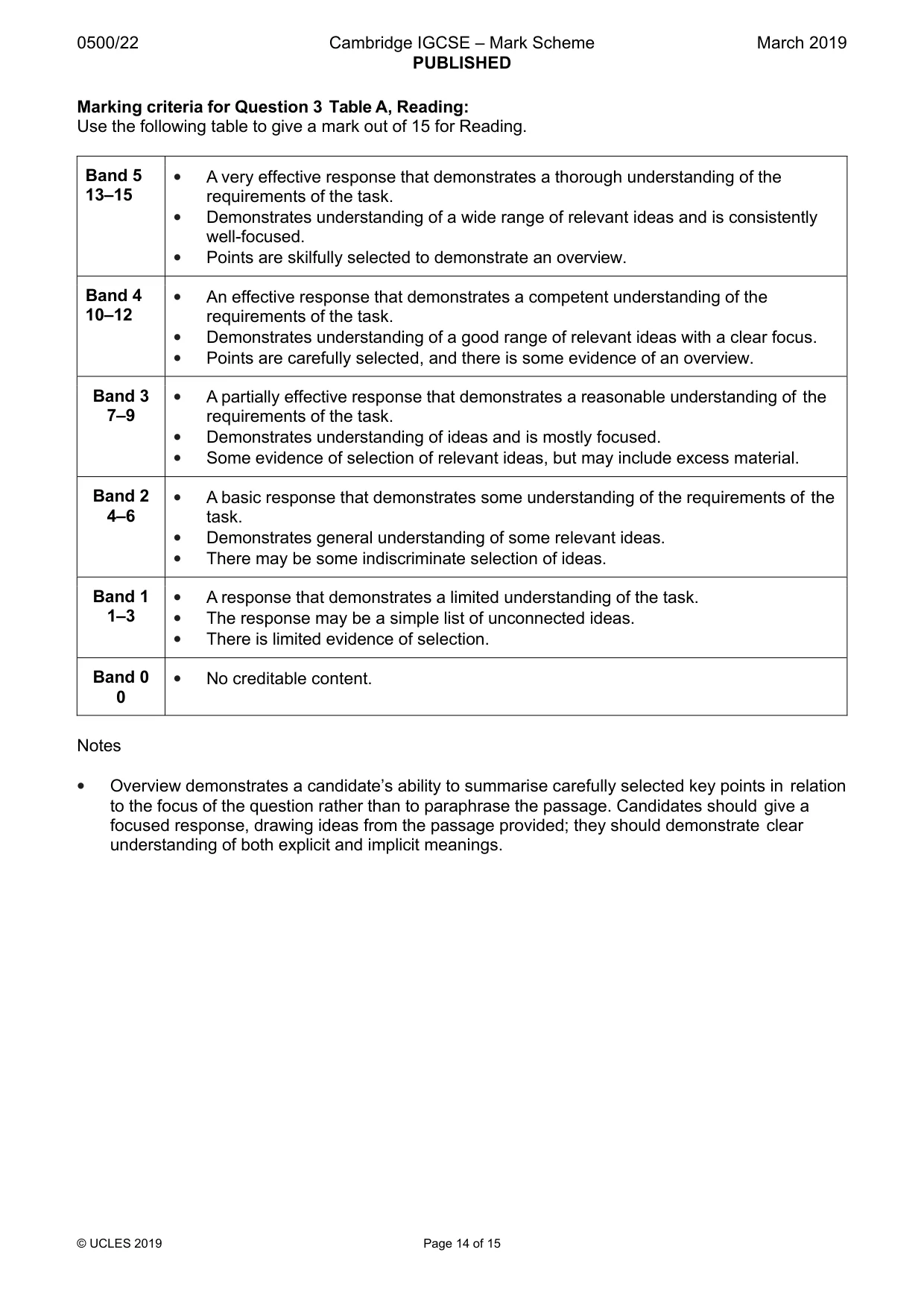
0500/22 Cambridge IGCSE – Mark Scheme PUBLISHED March 2019 © UCLES 2019 Page 14 of 15 Marking criteria for Question 3 Table A, Reading: Use the following table to give a mark out of 15 for Reading. Band 5 13–15 • A very effective response that demonstrates a thorough understanding of the requirements of the task. • Demonstrates understanding of a wide range of relevant ideas and is consistently well-focused. • Points are skilfully selected to demonstrate an overview. Band 4 10–12 • An effective response that demonstrates a competent understanding of the requirements of the task. • Demonstrates understanding of a good range of relevant ideas with a clear focus. • Points are carefully selected, and there is some evidence of an overview. Band 3 7–9 • A partially effective response that demonstrates a reasonable understanding of the requirements of the task. • Demonstrates understanding of ideas and is mostly focused. • Some evidence of selection of relevant ideas, but may include excess material. Band 2 4–6 • A basic response that demonstrates some understanding of the requirements of the task. • Demonstrates general understanding of some relevant ideas. • There may be some indiscriminate selection of ideas. Band 1 1–3 • A response that demonstrates a limited understanding of the task. • The response may be a simple list of unconnected ideas. • There is limited evidence of selection. Band 0 0 • No creditable content. Notes • Overview demonstrates a candidate’s ability to summarise carefully selected key points in relation to the focus of the question rather than to paraphrase the passage. Candidates should give a focused response, drawing ideas from the passage provided; they should demonstrate clear understanding of both explicit and implicit meanings.
Mark scheme, page 15
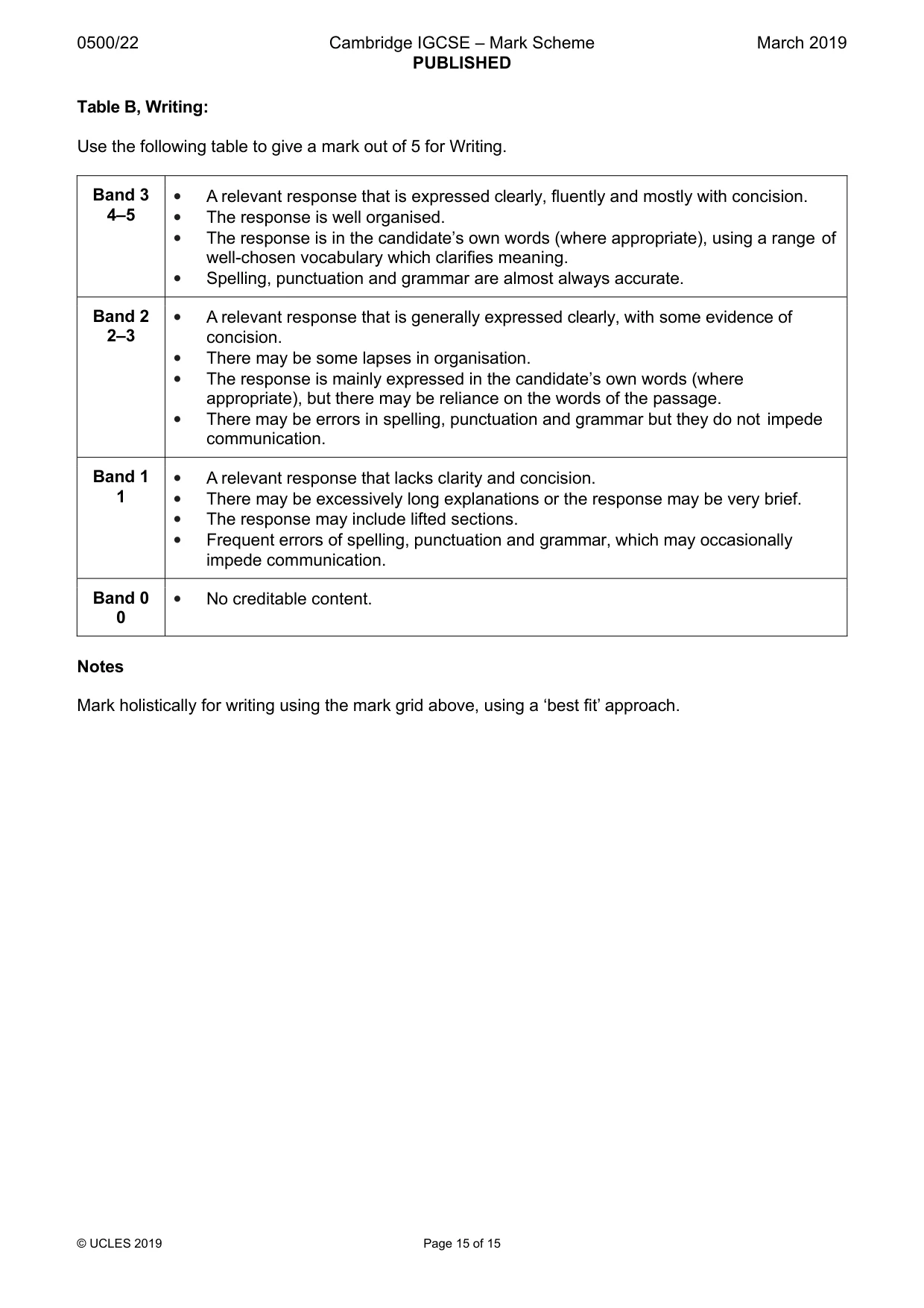
0500/22 Cambridge IGCSE – Mark Scheme PUBLISHED March 2019 © UCLES 2019 Page 15 of 15 Table B, Writing: Use the following table to give a mark out of 5 for Writing. Band 3 4–5 • A relevant response that is expressed clearly, fluently and mostly with concision. • The response is well organised. • The response is in the candidate’s own words (where appropriate), using a range of well-chosen vocabulary which clarifies meaning. • Spelling, punctuation and grammar are almost always accurate. Band 2 2–3 • A relevant response that is generally expressed clearly, with some evidence of concision. • There may be some lapses in organisation. • The response is mainly expressed in the candidate’s own words (where appropriate), but there may be reliance on the words of the passage. • There may be errors in spelling, punctuation and grammar but they do not impede communication. Band 1 1 • A relevant response that lacks clarity and concision. • There may be excessively long explanations or the response may be very brief. • The response may include lifted sections. • Frequent errors of spelling, punctuation and grammar, which may occasionally impede communication. Band 0 0 • No creditable content. Notes Mark holistically for writing using the mark grid above, using a ‘best fit’ approach.
What you needed in this session
Cambridge’s own grade thresholds for 2019 Feb/March, Paper 2 · Variant 2. A higher threshold means an easier paper — the bar moves with how the cohort did.