Cambridge IGCSE English - First Language 0500 — 2018 Oct/Nov Paper 2 · Variant 2
0500/22/O/N/18 · 50 marks · ≈56 min
The question paper and its mark scheme, free to read here and free to download. This is Cambridge’s own paper, exactly as it was sat.
Question paper12 pages
Mark scheme12 pages
Answers below. Sit the paper first if you are practising.
Paper as text
Question paper, page 1
* 4 0 5 3 1 7 2 3 2 2 * This document consists of 12 printed pages and 1 Reading Booklet Insert. DC (ST) 144719/2 © UCLES 2018 [Turn over FIRST LANGUAGE ENGLISH 0500/22 Paper 2 Reading Passages (Extended) October/November 2018 2 hours Candidates answer on the Question Paper. No Additional Materials are required. READ THESE INSTRUCTIONS FIRST Write your Centre number, candidate number and name in the spaces provided. Write in dark blue or black pen. Do not use staples, paper clips, glue or correction fluid. DO NOT WRITE IN ANY BARCODES. Answer all questions in the space provided. If additional space is required, you should use the lined pages at the end of this booklet. The question number(s) must be clearly shown. Dictionaries are not permitted. The Reading Booklet Insert contains the reading passages for use with all the questions on the Question Paper. The Insert is not assessed by the Examiner. The number of marks is given in brackets [ ] at the end of each question or part question. Cambridge International Examinations Cambridge International General Certificate of Secondary Education
Question paper, page 2
2 0500/22/O/N/18 © UCLES 2018 Read carefully Passage A, The Magician, in the Reading Booklet Insert and then answer Questions 1 and 2 on this Question Paper. Question 1 You are Thomas’s mother from Passage A. Months later another parent wants to hold a children’s party and asks you whether you would recommend Mr Pengelly as an entertainer. Write a letter to the parent. In your letter you should comment on: • your memories of what happened during the magic show at Thomas’s party • your thoughts and feelings about Mr Pengelly that day • whether you would recommend him. Base your letter on what you have read in Passage A, but be careful to use your own words. Address each of the three bullet points. Begin your response, ‘Dear friend, Thomas’s party will stay in my memory for a long time … ’ Write about 250 to 350 words. Up to 15 marks are available for the content of your answer, and up to 5 marks for the quality of your writing. … … … … … … … … … … … … … …
Question paper, page 3
3 0500/22/O/N/18 © UCLES 2018 [Turn over … … … … … … … … … … … … … … … … … … … … … … … … … … …
Question paper, page 4
4 0500/22/O/N/18 © UCLES 2018 … … … … … … … … … … … … … … … … … … … … … … … … … … … [Total: 20]
Question paper, page 5
5 0500/22/O/N/18 © UCLES 2018 [Turn over [Turn to page 6 for Question 2]
Question paper, page 6
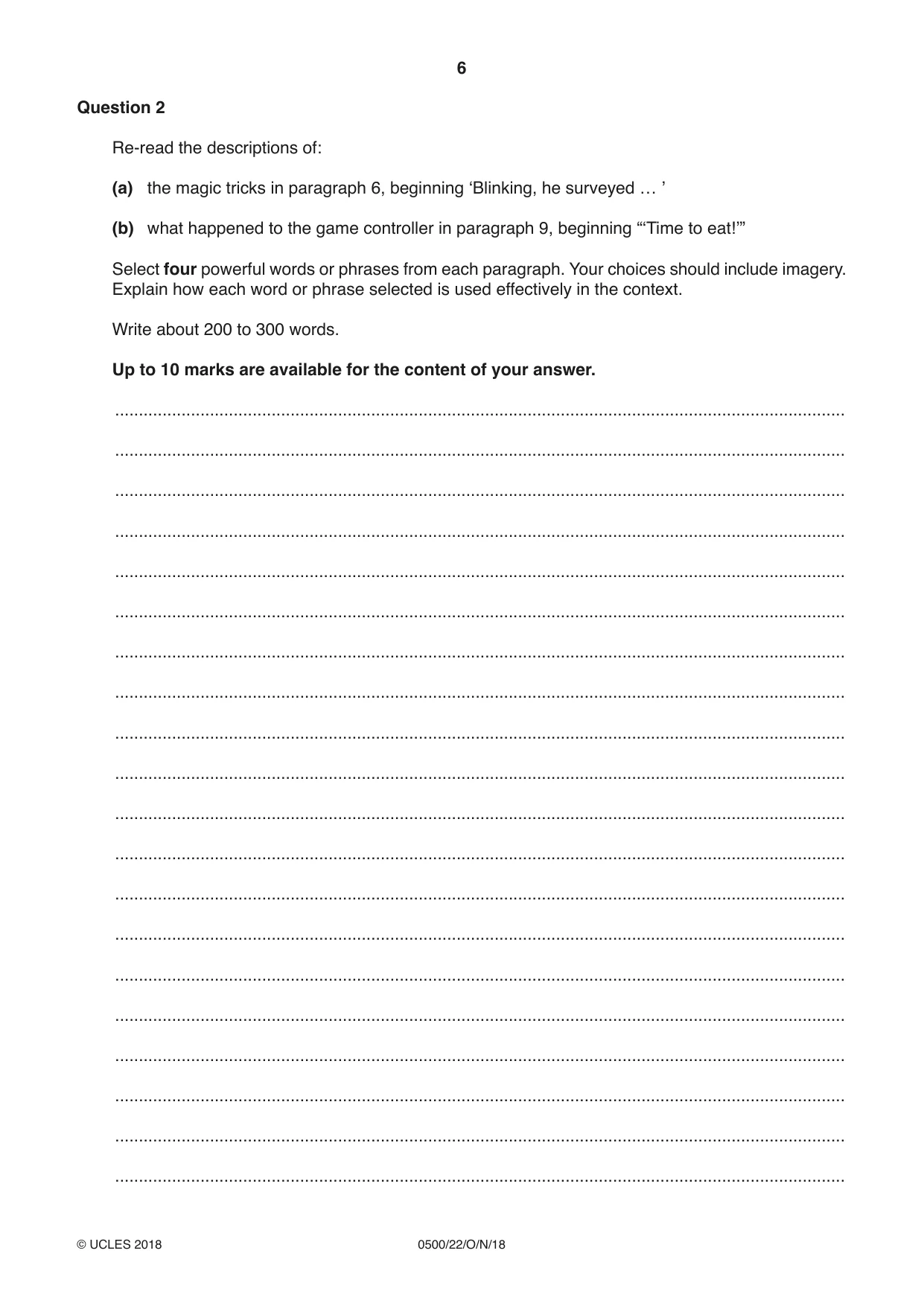
6 0500/22/O/N/18 © UCLES 2018 Question 2 Re-read the descriptions of: (a) the magic tricks in paragraph 6, beginning ‘Blinking, he surveyed … ’ (b) what happened to the game controller in paragraph 9, beginning “‘Time to eat!’” Select four powerful words or phrases from each paragraph. Your choices should include imagery. Explain how each word or phrase selected is used effectively in the context. Write about 200 to 300 words. Up to 10 marks are available for the content of your answer. … … … … … … … … … … … … … … … … … … … …
Question paper, page 7
7 0500/22/O/N/18 © UCLES 2018 [Turn over … … … … … … … … … … … … … … … … … … … … … … … … … … … [Total: 10]
Question paper, page 8
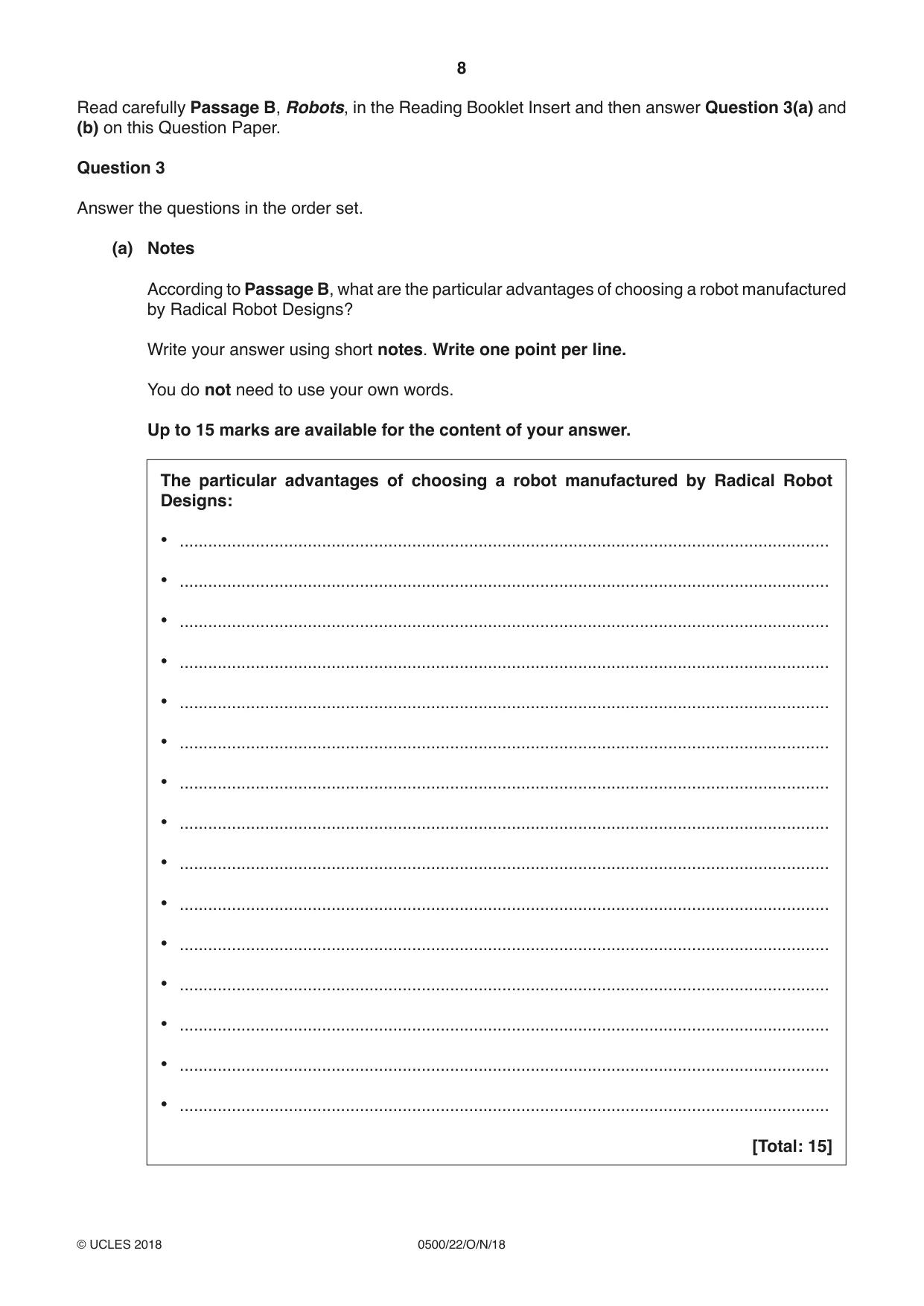
8 0500/22/O/N/18 © UCLES 2018 Read carefully Passage B, Robots, in the Reading Booklet Insert and then answer Question 3(a) and (b) on this Question Paper. Question 3 Answer the questions in the order set. (a) Notes According to Passage B, what are the particular advantages of choosing a robot manufactured by Radical Robot Designs? Write your answer using short notes. Write one point per line. You do not need to use your own words. Up to 15 marks are available for the content of your answer. The particular advantages of choosing a robot manufactured by Radical Robot Designs: • … • … • … • … • … • … • … • … • … • … • … • … • … • … • … [Total: 15]
Question paper, page 9
9 0500/22/O/N/18 © UCLES 2018 [Turn over (b) Summary Now use your notes from Question 3(a) to write a summary of the particular advantages of choosing a robot manufactured by Radical Robot Designs, according to Passage B. You must use continuous writing (not note form) and use your own words as far as possible. Your summary should include all 15 of your points in Question 3(a) and must be 200 to 250 words. Up to 5 marks are available for the quality of your writing. … … … … … … … … … … … … … … … … … … … … … …
Question paper, page 10
10 0500/22/O/N/18 © UCLES 2018 … … … … … … … … … … … … [Total: 5]
Question paper, page 11
11 0500/22/O/N/18 © UCLES 2018 Additional Page If you use the following lined page to complete the answer(s) to any question(s), the question number(s) must be clearly shown. … … … … … … … … … … … … … … … … … … … … … … … … … …
Question paper, page 12
12 0500/22/O/N/18 © UCLES 2018 Permission to reproduce items where third-party owned material protected by copyright is included has been sought and cleared where possible. Every reasonable effort has been made by the publisher (UCLES) to trace copyright holders, but if any items requiring clearance have unwittingly been included, the publisher will be pleased to make amends at the earliest possible opportunity. To avoid the issue of disclosure of answer-related information to candidates, all copyright acknowledgements are reproduced online in the Cambridge International Examinations Copyright Acknowledgements Booklet. This is produced for each series of examinations and is freely available to download at www.cie.org.uk after the live examination series. Cambridge International Examinations is part of the Cambridge Assessment Group. Cambridge Assessment is the brand name of University of Cambridge Local Examinations Syndicate (UCLES), which is itself a department of the University of Cambridge. Additional Page If you use the following lined page to complete the answer(s) to any question(s), the question number(s) must be clearly shown. … … … … … … … … … … … … … … … … … … … … …
Mark scheme, page 1
This document consists of 12 printed pages. © UCLES 2018 [Turn over Cambridge Assessment International Education Cambridge International General Certificate of Secondary Education FIRST LANGUAGE ENGLISH 0500/22 Paper 2 Reading Passages (Extended) October/November 2018 MARK SCHEME Maximum Mark: 50 Published This mark scheme is published as an aid to teachers and candidates, to indicate the requirements of the examination. It shows the basis on which Examiners were instructed to award marks. It does not indicate the details of the discussions that took place at an Examiners’ meeting before marking began, which would have considered the acceptability of alternative answers. Mark schemes should be read in conjunction with the question paper and the Principal Examiner Report for Teachers. Cambridge International will not enter into discussions about these mark schemes. Cambridge International is publishing the mark schemes for the October/November 2018 series for most Cambridge IGCSE™, Cambridge International A and AS Level components and some Cambridge O Level components.
Mark scheme, page 2
0500/22 Cambridge IGCSE – Mark Scheme PUBLISHED October/November 2018 © UCLES 2018 Page 2 of 12 Generic Marking Principles These general marking principles must be applied by all examiners when marking candidate answers. They should be applied alongside the specific content of the mark scheme or generic level descriptors for a question. Each question paper and mark scheme will also comply with these marking principles. GENERIC MARKING PRINCIPLE 1: Marks must be awarded in line with: • the specific content of the mark scheme or the generic level descriptors for the question • the specific skills defined in the mark scheme or in the generic level descriptors for the question • the standard of response required by a candidate as exemplified by the standardisation scripts. GENERIC MARKING PRINCIPLE 2: Marks awarded are always whole marks (not half marks, or other fractions). GENERIC MARKING PRINCIPLE 3: Marks must be awarded positively: • marks are awarded for correct/valid answers, as defined in the mark scheme. However, credit is given for valid answers which go beyond the scope of the syllabus and mark scheme, referring to your Team Leader as appropriate • marks are awarded when candidates clearly demonstrate what they know and can do • marks are not deducted for errors • marks are not deducted for omissions • answers should only be judged on the quality of spelling, punctuation and grammar when these features are specifically assessed by the question as indicated by the mark scheme. The meaning, however, should be unambiguous. GENERIC MARKING PRINCIPLE 4: Rules must be applied consistently e.g. in situations where candidates have not followed instructions or in the application of generic level descriptors. GENERIC MARKING PRINCIPLE 5: Marks should be awarded using the full range of marks defined in the mark scheme for the question (however; the use of the full mark range may be limited according to the quality of the candidate responses seen). GENERIC MARKING PRINCIPLE 6: Marks awarded are based solely on the requirements as defined in the mark scheme. Marks should not be awarded with grade thresholds or grade descriptors in mind.
Mark scheme, page 3
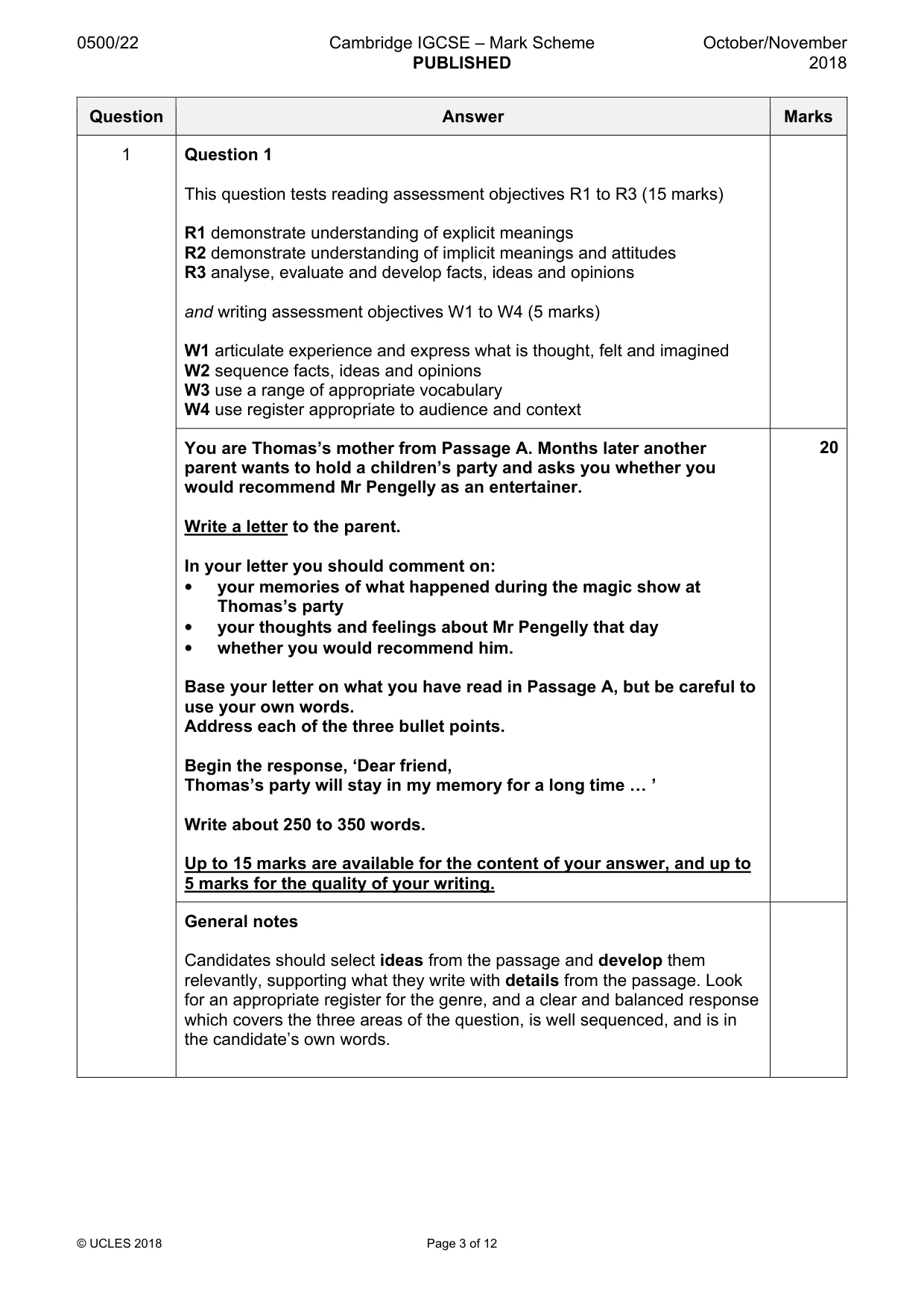
0500/22 Cambridge IGCSE – Mark Scheme PUBLISHED October/November 2018 © UCLES 2018 Page 3 of 12 Question Answer Marks 1 Question 1 This question tests reading assessment objectives R1 to R3 (15 marks) R1 demonstrate understanding of explicit meanings R2 demonstrate understanding of implicit meanings and attitudes R3 analyse, evaluate and develop facts, ideas and opinions and writing assessment objectives W1 to W4 (5 marks) W1 articulate experience and express what is thought, felt and imagined W2 sequence facts, ideas and opinions W3 use a range of appropriate vocabulary W4 use register appropriate to audience and context You are Thomas’s mother from Passage A. Months later another parent wants to hold a children’s party and asks you whether you would recommend Mr Pengelly as an entertainer. Write a letter to the parent. In your letter you should comment on: • your memories of what happened during the magic show at Thomas’s party • your thoughts and feelings about Mr Pengelly that day • whether you would recommend him. Base your letter on what you have read in Passage A, but be careful to use your own words. Address each of the three bullet points. Begin the response, ‘Dear friend, Thomas’s party will stay in my memory for a long time « ’ Write about 250 to 350 words. Up to 15 marks are available for the content of your answer, and up to 5 marks for the quality of your writing. 20 General notes Candidates should select ideas from the passage and develop them relevantly, supporting what they write with details from the passage. Look for an appropriate register for the genre, and a clear and balanced response which covers the three areas of the question, is well sequenced, and is in the candidate’s own words.
Mark scheme, page 4
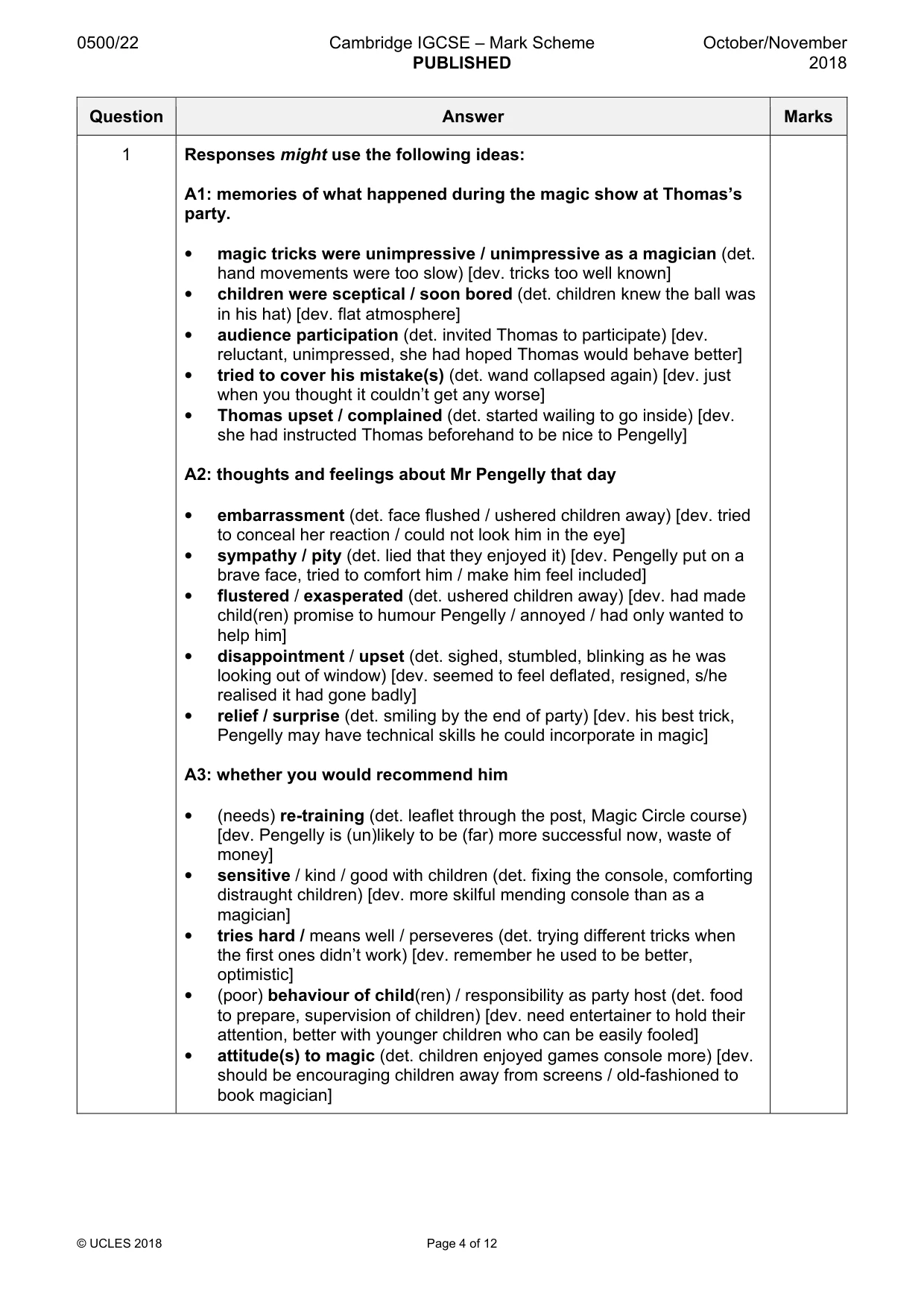
0500/22 Cambridge IGCSE – Mark Scheme PUBLISHED October/November 2018 © UCLES 2018 Page 4 of 12 Question Answer Marks 1 Responses might use the following ideas: A1: memories of what happened during the magic show at Thomas’s party. • magic tricks were unimpressive / unimpressive as a magician (det. hand movements were too slow) [dev. tricks too well known] • children were sceptical / soon bored (det. children knew the ball was in his hat) [dev. flat atmosphere] • audience participation (det. invited Thomas to participate) [dev. reluctant, unimpressed, she had hoped Thomas would behave better] • tried to cover his mistake(s) (det. wand collapsed again) [dev. just when you thought it couldn’t get any worse] • Thomas upset / complained (det. started wailing to go inside) [dev. she had instructed Thomas beforehand to be nice to Pengelly] A2: thoughts and feelings about Mr Pengelly that day • embarrassment (det. face flushed / ushered children away) [dev. tried to conceal her reaction / could not look him in the eye] • sympathy / pity (det. lied that they enjoyed it) [dev. Pengelly put on a brave face, tried to comfort him / make him feel included] • flustered / exasperated (det. ushered children away) [dev. had made child(ren) promise to humour Pengelly / annoyed / had only wanted to help him] • disappointment / upset (det. sighed, stumbled, blinking as he was looking out of window) [dev. seemed to feel deflated, resigned, s/he realised it had gone badly] • relief / surprise (det. smiling by the end of party) [dev. his best trick, Pengelly may have technical skills he could incorporate in magic] A3: whether you would recommend him • (needs) re-training (det. leaflet through the post, Magic Circle course) [dev. Pengelly is (un)likely to be (far) more successful now, waste of money] • sensitive / kind / good with children (det. fixing the console, comforting distraught children) [dev. more skilful mending console than as a magician] • tries hard / means well / perseveres (det. trying different tricks when the first ones didn’t work) [dev. remember he used to be better, optimistic] • (poor) behaviour of child(ren) / responsibility as party host (det. food to prepare, supervision of children) [dev. need entertainer to hold their attention, better with younger children who can be easily fooled] • attitude(s) to magic (det. children enjoyed games console more) [dev. should be encouraging children away from screens / old-fashioned to book magician]
Mark scheme, page 5
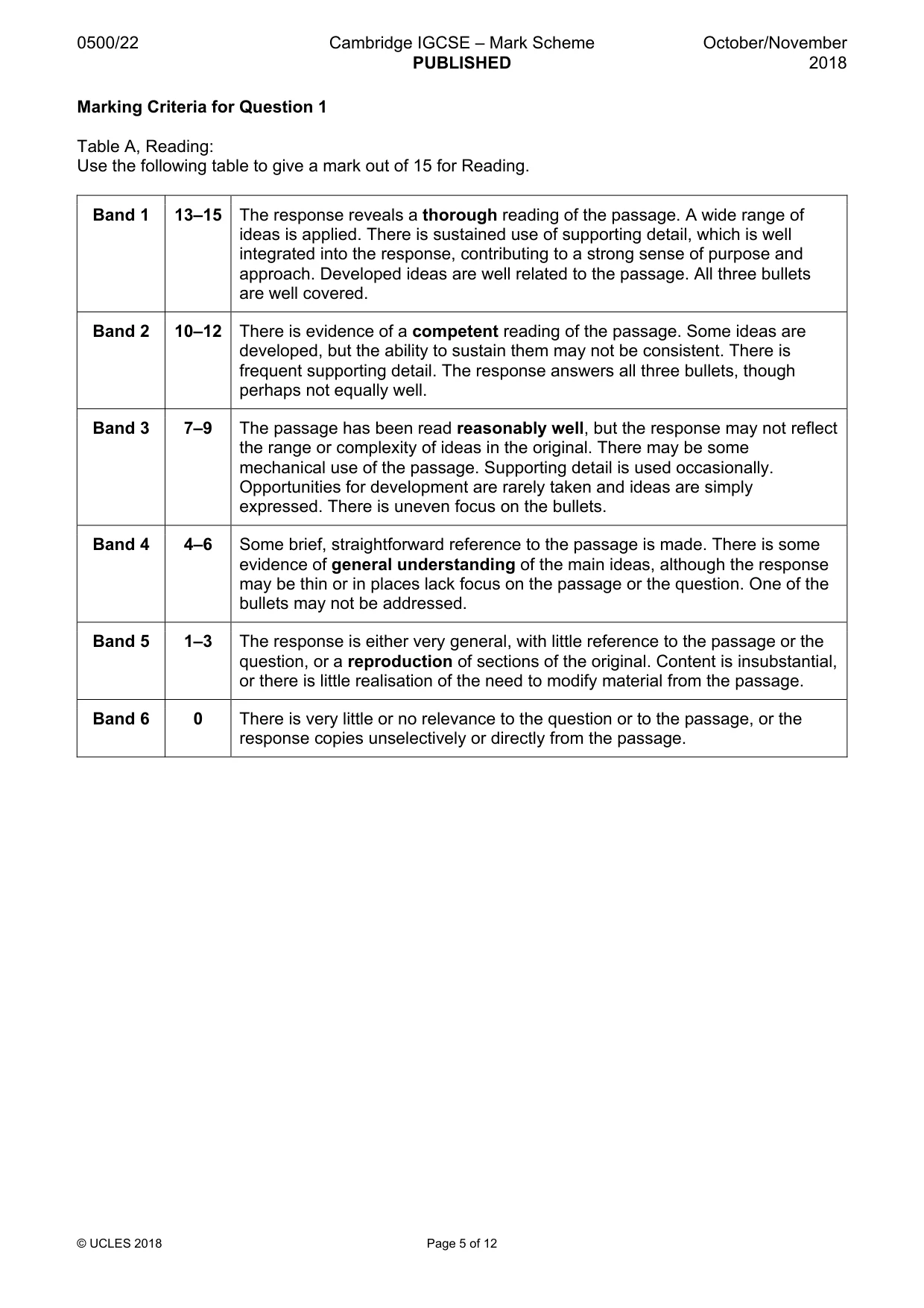
0500/22 Cambridge IGCSE – Mark Scheme PUBLISHED October/November 2018 © UCLES 2018 Page 5 of 12 Marking Criteria for Question 1 Table A, Reading: Use the following table to give a mark out of 15 for Reading. Band 1 13–15 The response reveals a thorough reading of the passage. A wide range of ideas is applied. There is sustained use of supporting detail, which is well integrated into the response, contributing to a strong sense of purpose and approach. Developed ideas are well related to the passage. All three bullets are well covered. Band 2 10–12 There is evidence of a competent reading of the passage. Some ideas are developed, but the ability to sustain them may not be consistent. There is frequent supporting detail. The response answers all three bullets, though perhaps not equally well. Band 3 7–9 The passage has been read reasonably well, but the response may not reflect the range or complexity of ideas in the original. There may be some mechanical use of the passage. Supporting detail is used occasionally. Opportunities for development are rarely taken and ideas are simply expressed. There is uneven focus on the bullets. Band 4 4–6 Some brief, straightforward reference to the passage is made. There is some evidence of general understanding of the main ideas, although the response may be thin or in places lack focus on the passage or the question. One of the bullets may not be addressed. Band 5 1–3 The response is either very general, with little reference to the passage or the question, or a reproduction of sections of the original. Content is insubstantial, or there is little realisation of the need to modify material from the passage. Band 6 0 There is very little or no relevance to the question or to the passage, or the response copies unselectively or directly from the passage.
Mark scheme, page 6
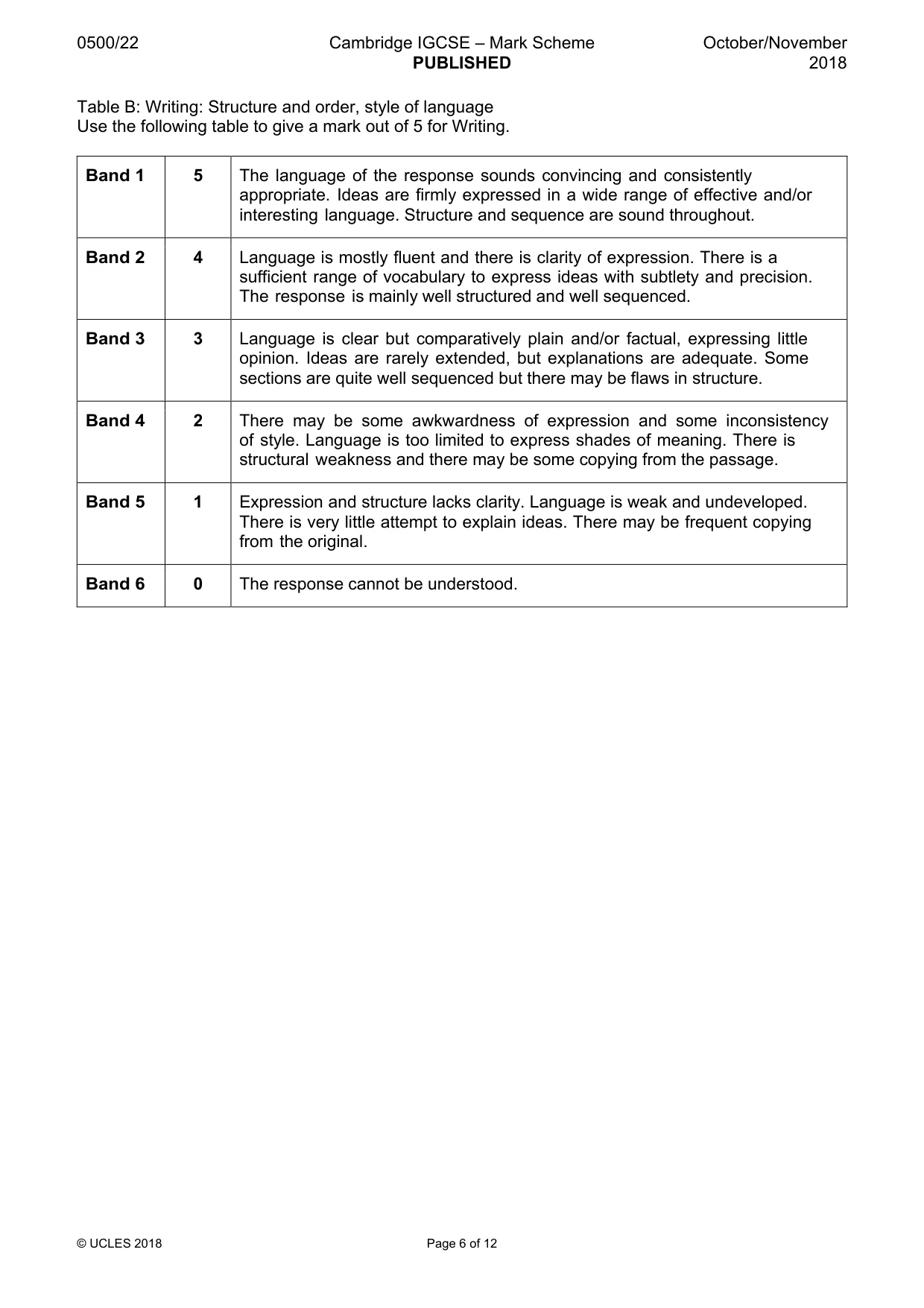
0500/22 Cambridge IGCSE – Mark Scheme PUBLISHED October/November 2018 © UCLES 2018 Page 6 of 12 Table B: Writing: Structure and order, style of language Use the following table to give a mark out of 5 for Writing. Band 1 5 The language of the response sounds convincing and consistently appropriate. Ideas are firmly expressed in a wide range of effective and/or interesting language. Structure and sequence are sound throughout. Band 2 4 Language is mostly fluent and there is clarity of expression. There is a sufficient range of vocabulary to express ideas with subtlety and precision. The response is mainly well structured and well sequenced. Band 3 3 Language is clear but comparatively plain and/or factual, expressing little opinion. Ideas are rarely extended, but explanations are adequate. Some sections are quite well sequenced but there may be flaws in structure. Band 4 2 There may be some awkwardness of expression and some inconsistency of style. Language is too limited to express shades of meaning. There is structural weakness and there may be some copying from the passage. Band 5 1 Expression and structure lacks clarity. Language is weak and undeveloped. There is very little attempt to explain ideas. There may be frequent copying from the original. Band 6 0 The response cannot be understood.
Mark scheme, page 7
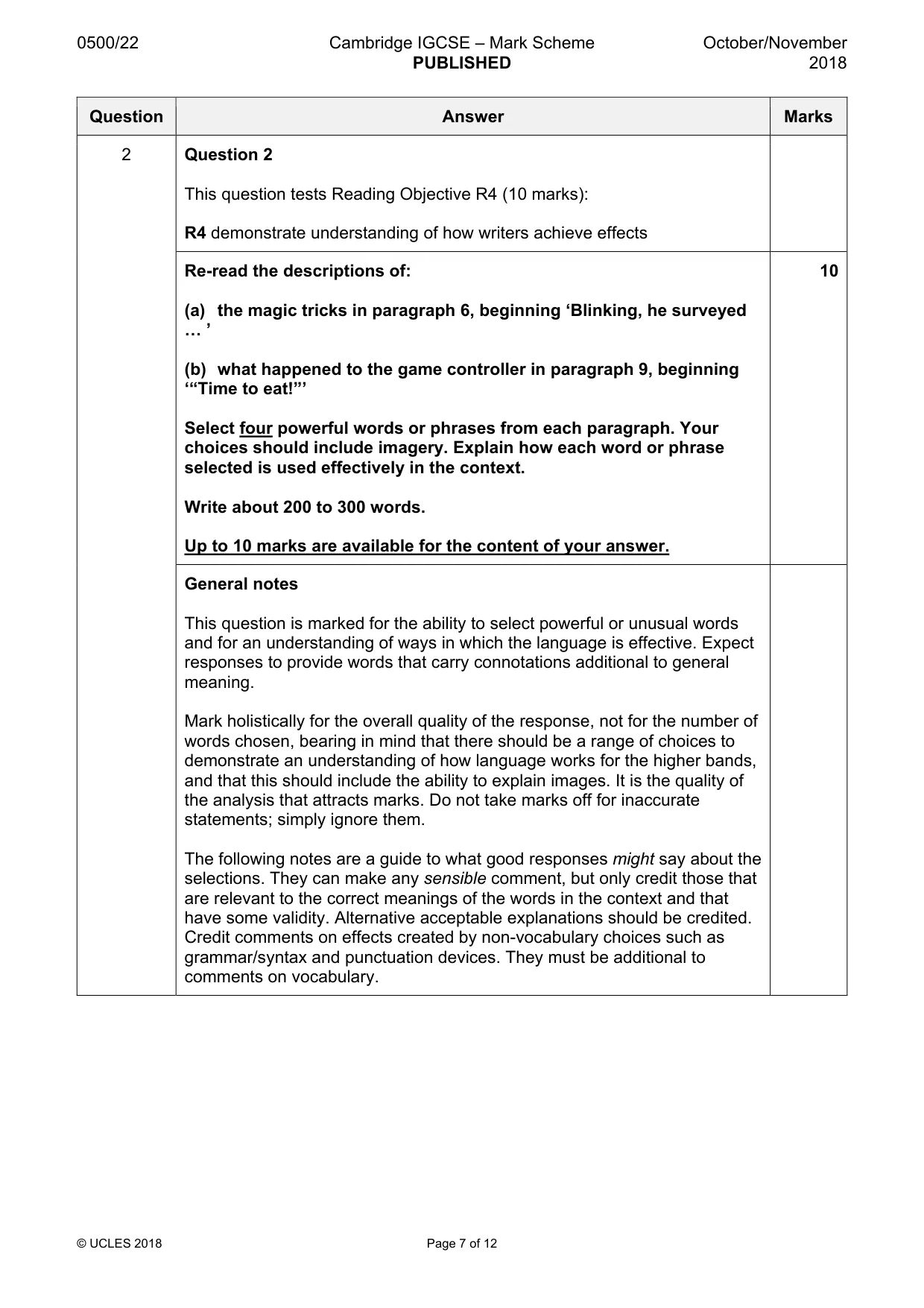
0500/22 Cambridge IGCSE – Mark Scheme PUBLISHED October/November 2018 © UCLES 2018 Page 7 of 12 Question Answer Marks 2 Question 2 This question tests Reading Objective R4 (10 marks): R4 demonstrate understanding of how writers achieve effects Re-read the descriptions of: (a) the magic tricks in paragraph 6, beginning ‘Blinking, he surveyed « ’ (b) what happened to the game controller in paragraph 9, beginning ‘“Time to eat!”’ Select four powerful words or phrases from each paragraph. Your choices should include imagery. Explain how each word or phrase selected is used effectively in the context. Write about 200 to 300 words. Up to 10 marks are available for the content of your answer. 10 General notes This question is marked for the ability to select powerful or unusual words and for an understanding of ways in which the language is effective. Expect responses to provide words that carry connotations additional to general meaning. Mark holistically for the overall quality of the response, not for the number of words chosen, bearing in mind that there should be a range of choices to demonstrate an understanding of how language works for the higher bands, and that this should include the ability to explain images. It is the quality of the analysis that attracts marks. Do not take marks off for inaccurate statements; simply ignore them. The following notes are a guide to what good responses might say about the selections. They can make any sensible comment, but only credit those that are relevant to the correct meanings of the words in the context and that have some validity. Alternative acceptable explanations should be credited. Credit comments on effects created by non-vocabulary choices such as grammar/syntax and punctuation devices. They must be additional to comments on vocabulary.
Mark scheme, page 8
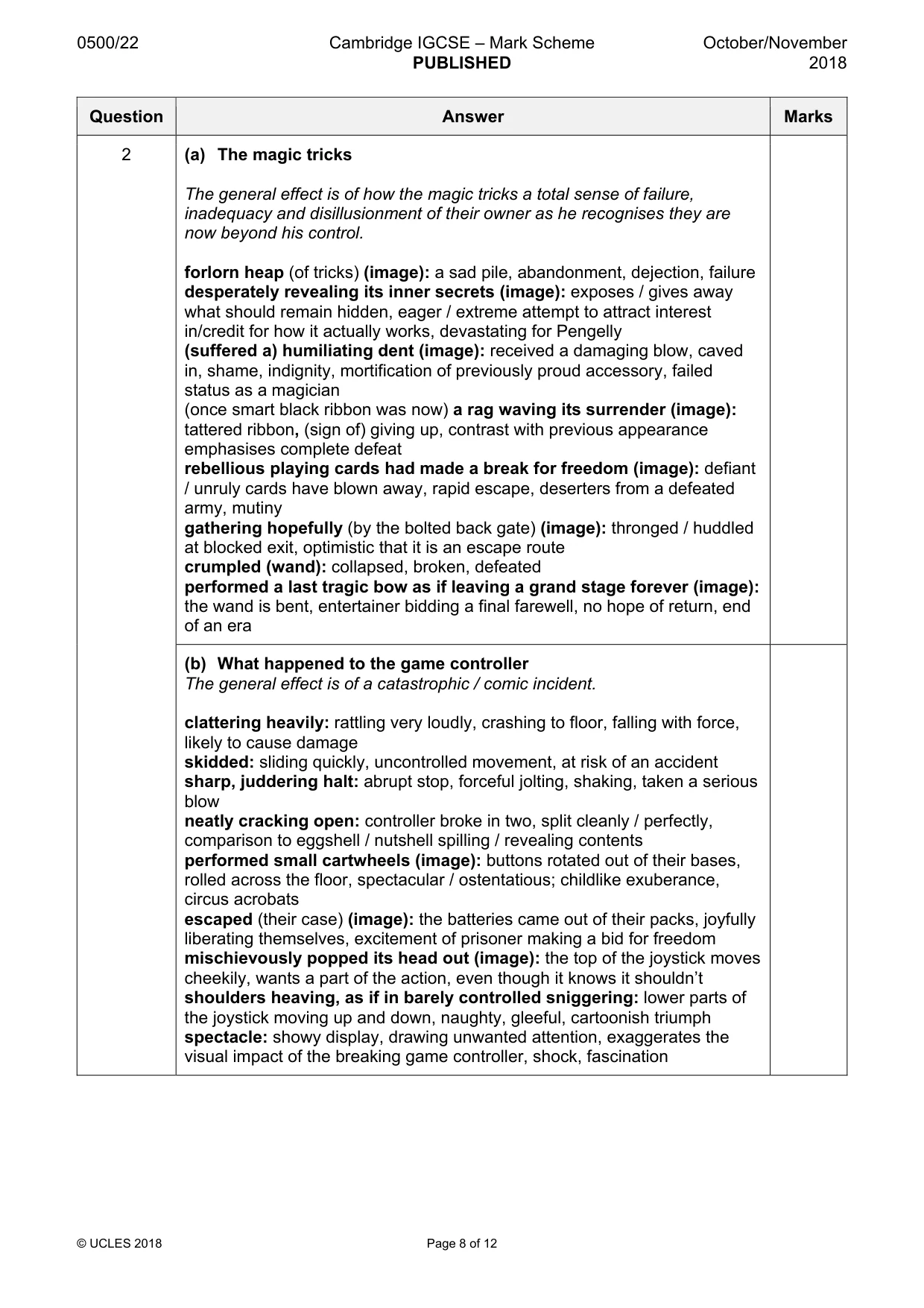
0500/22 Cambridge IGCSE – Mark Scheme PUBLISHED October/November 2018 © UCLES 2018 Page 8 of 12 Question Answer Marks 2 (a) The magic tricks The general effect is of how the magic tricks a total sense of failure, inadequacy and disillusionment of their owner as he recognises they are now beyond his control. forlorn heap (of tricks) (image): a sad pile, abandonment, dejection, failure desperately revealing its inner secrets (image): exposes / gives away what should remain hidden, eager / extreme attempt to attract interest in/credit for how it actually works, devastating for Pengelly (suffered a) humiliating dent (image): received a damaging blow, caved in, shame, indignity, mortification of previously proud accessory, failed status as a magician (once smart black ribbon was now) a rag waving its surrender (image): tattered ribbon, (sign of) giving up, contrast with previous appearance emphasises complete defeat rebellious playing cards had made a break for freedom (image): defiant / unruly cards have blown away, rapid escape, deserters from a defeated army, mutiny gathering hopefully (by the bolted back gate) (image): thronged / huddled at blocked exit, optimistic that it is an escape route crumpled (wand): collapsed, broken, defeated performed a last tragic bow as if leaving a grand stage forever (image): the wand is bent, entertainer bidding a final farewell, no hope of return, end of an era (b) What happened to the game controller The general effect is of a catastrophic / comic incident. clattering heavily: rattling very loudly, crashing to floor, falling with force, likely to cause damage skidded: sliding quickly, uncontrolled movement, at risk of an accident sharp, juddering halt: abrupt stop, forceful jolting, shaking, taken a serious blow neatly cracking open: controller broke in two, split cleanly / perfectly, comparison to eggshell / nutshell spilling / revealing contents performed small cartwheels (image): buttons rotated out of their bases, rolled across the floor, spectacular / ostentatious; childlike exuberance, circus acrobats escaped (their case) (image): the batteries came out of their packs, joyfully liberating themselves, excitement of prisoner making a bid for freedom mischievously popped its head out (image): the top of the joystick moves cheekily, wants a part of the action, even though it knows it shouldn’t shoulders heaving, as if in barely controlled sniggering: lower parts of the joystick moving up and down, naughty, gleeful, cartoonish triumph spectacle: showy display, drawing unwanted attention, exaggerates the visual impact of the breaking game controller, shock, fascination
Mark scheme, page 9
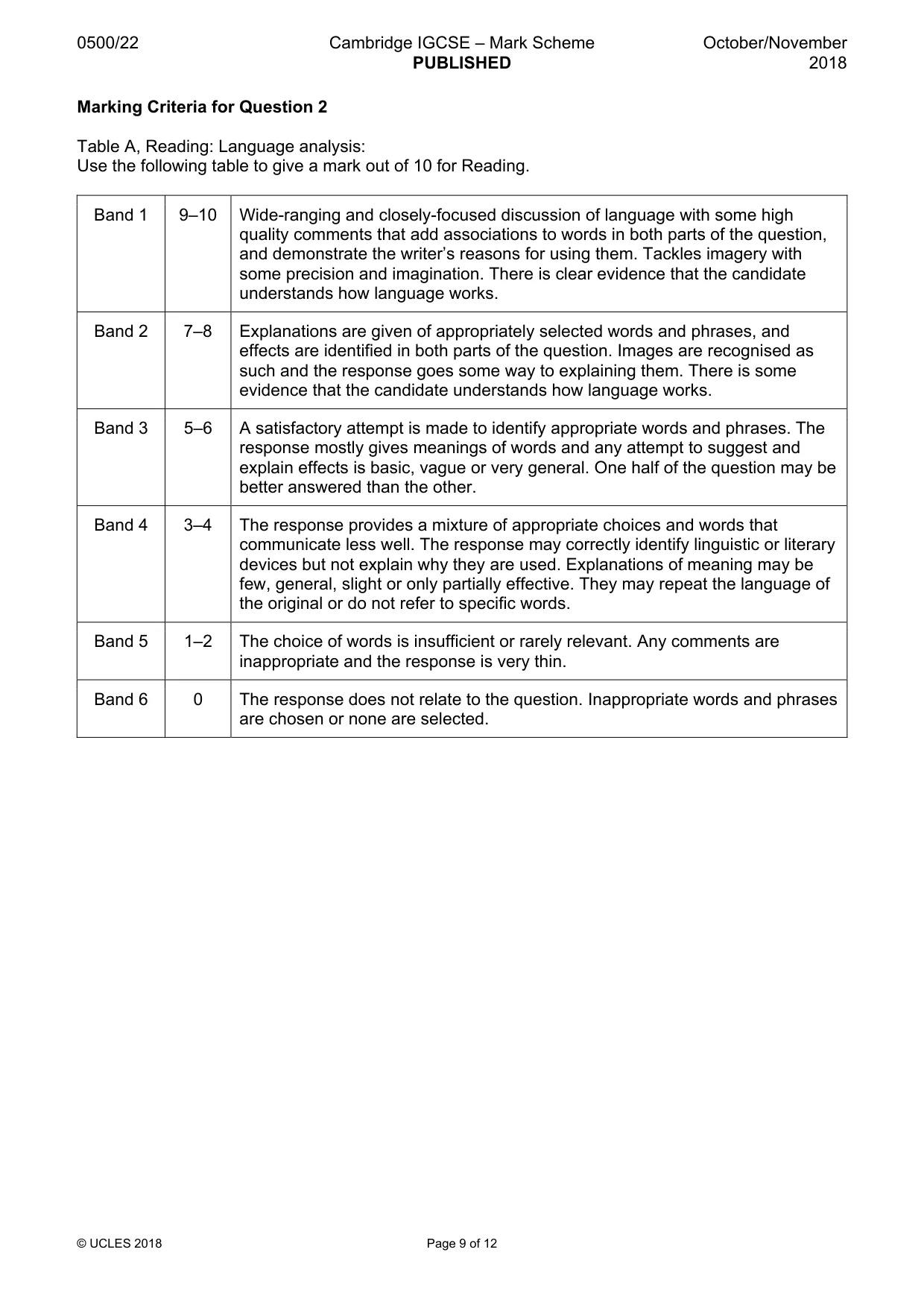
0500/22 Cambridge IGCSE – Mark Scheme PUBLISHED October/November 2018 © UCLES 2018 Page 9 of 12 Marking Criteria for Question 2 Table A, Reading: Language analysis: Use the following table to give a mark out of 10 for Reading. Band 1 9–10 Wide-ranging and closely-focused discussion of language with some high quality comments that add associations to words in both parts of the question, and demonstrate the writer’s reasons for using them. Tackles imagery with some precision and imagination. There is clear evidence that the candidate understands how language works. Band 2 7–8 Explanations are given of appropriately selected words and phrases, and effects are identified in both parts of the question. Images are recognised as such and the response goes some way to explaining them. There is some evidence that the candidate understands how language works. Band 3 5–6 A satisfactory attempt is made to identify appropriate words and phrases. The response mostly gives meanings of words and any attempt to suggest and explain effects is basic, vague or very general. One half of the question may be better answered than the other. Band 4 3–4 The response provides a mixture of appropriate choices and words that communicate less well. The response may correctly identify linguistic or literary devices but not explain why they are used. Explanations of meaning may be few, general, slight or only partially effective. They may repeat the language of the original or do not refer to specific words. Band 5 1–2 The choice of words is insufficient or rarely relevant. Any comments are inappropriate and the response is very thin. Band 6 0 The response does not relate to the question. Inappropriate words and phrases are chosen or none are selected.
Mark scheme, page 10
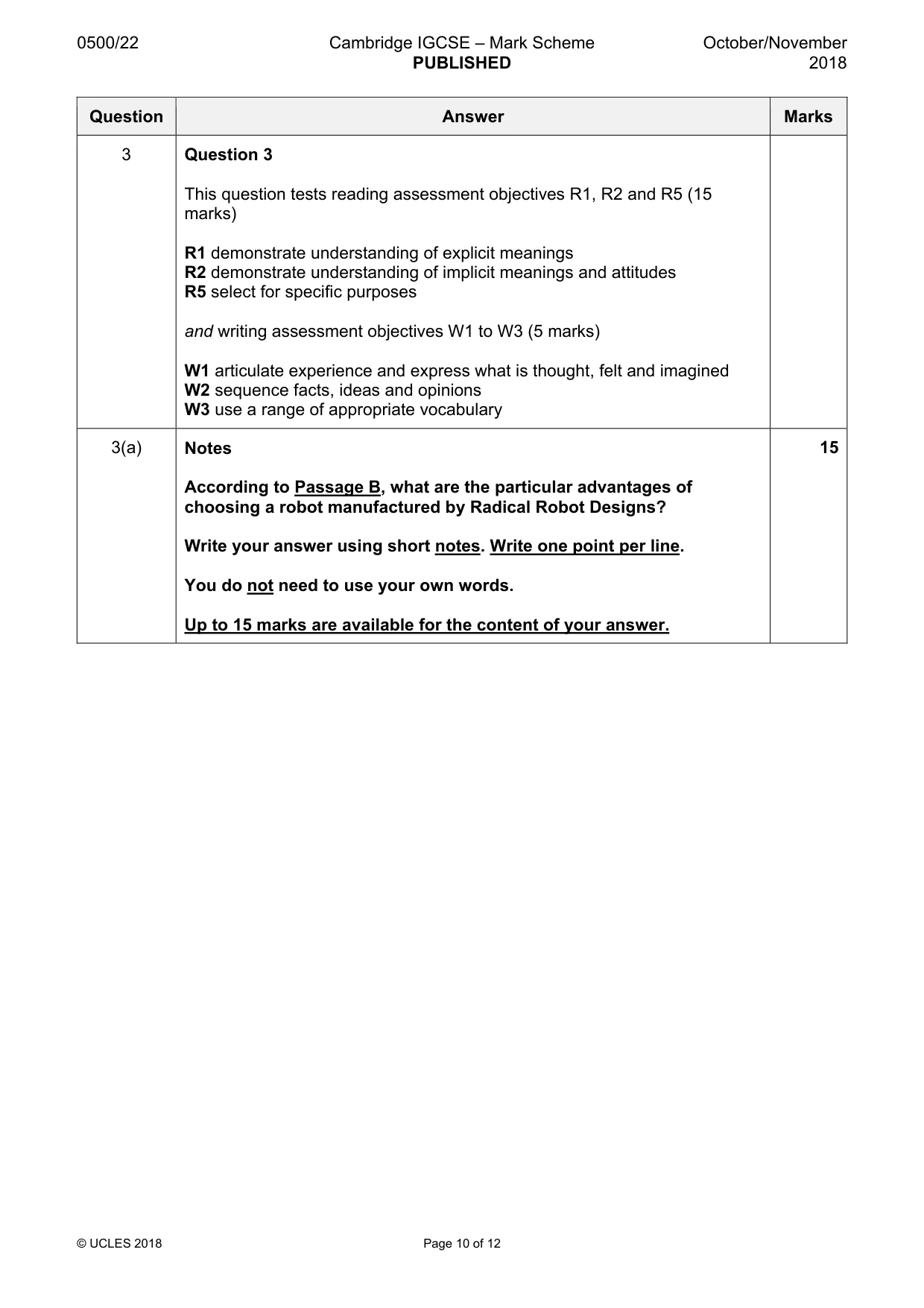
0500/22 Cambridge IGCSE – Mark Scheme PUBLISHED October/November 2018 © UCLES 2018 Page 10 of 12 Question Answer Marks 3 Question 3 This question tests reading assessment objectives R1, R2 and R5 (15 marks) R1 demonstrate understanding of explicit meanings R2 demonstrate understanding of implicit meanings and attitudes R5 select for specific purposes and writing assessment objectives W1 to W3 (5 marks) W1 articulate experience and express what is thought, felt and imagined W2 sequence facts, ideas and opinions W3 use a range of appropriate vocabulary 3(a) Notes According to Passage B, what are the particular advantages of choosing a robot manufactured by Radical Robot Designs? Write your answer using short notes. Write one point per line. You do not need to use your own words. Up to 15 marks are available for the content of your answer. 15
Mark scheme, page 11
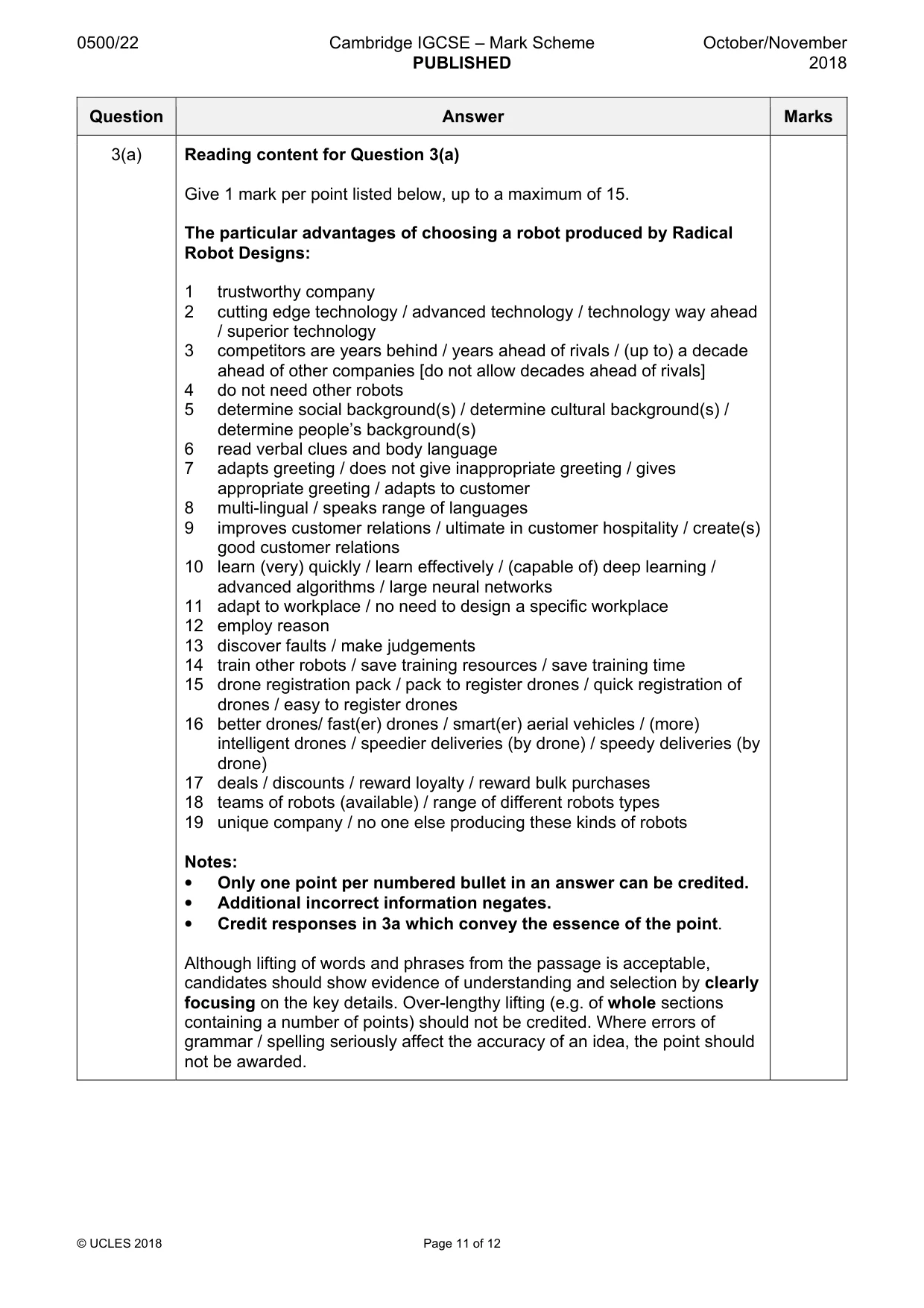
0500/22 Cambridge IGCSE – Mark Scheme PUBLISHED October/November 2018 © UCLES 2018 Page 11 of 12 Question Answer Marks 3(a) Reading content for Question 3(a) Give 1 mark per point listed below, up to a maximum of 15. The particular advantages of choosing a robot produced by Radical Robot Designs: 1 trustworthy company 2 cutting edge technology / advanced technology / technology way ahead / superior technology 3 competitors are years behind / years ahead of rivals / (up to) a decade ahead of other companies [do not allow decades ahead of rivals] 4 do not need other robots 5 determine social background(s) / determine cultural background(s) / determine people’s background(s) 6 read verbal clues and body language 7 adapts greeting / does not give inappropriate greeting / gives appropriate greeting / adapts to customer 8 multi-lingual / speaks range of languages 9 improves customer relations / ultimate in customer hospitality / create(s) good customer relations 10 learn (very) quickly / learn effectively / (capable of) deep learning / advanced algorithms / large neural networks 11 adapt to workplace / no need to design a specific workplace 12 employ reason 13 discover faults / make judgements 14 train other robots / save training resources / save training time 15 drone registration pack / pack to register drones / quick registration of drones / easy to register drones 16 better drones/ fast(er) drones / smart(er) aerial vehicles / (more) intelligent drones / speedier deliveries (by drone) / speedy deliveries (by drone) 17 deals / discounts / reward loyalty / reward bulk purchases 18 teams of robots (available) / range of different robots types 19 unique company / no one else producing these kinds of robots Notes: • Only one point per numbered bullet in an answer can be credited. • Additional incorrect information negates. • Credit responses in 3a which convey the essence of the point. Although lifting of words and phrases from the passage is acceptable, candidates should show evidence of understanding and selection by clearly focusing on the key details. Over-lengthy lifting (e.g. of whole sections containing a number of points) should not be credited. Where errors of grammar / spelling seriously affect the accuracy of an idea, the point should not be awarded.
Mark scheme, page 12
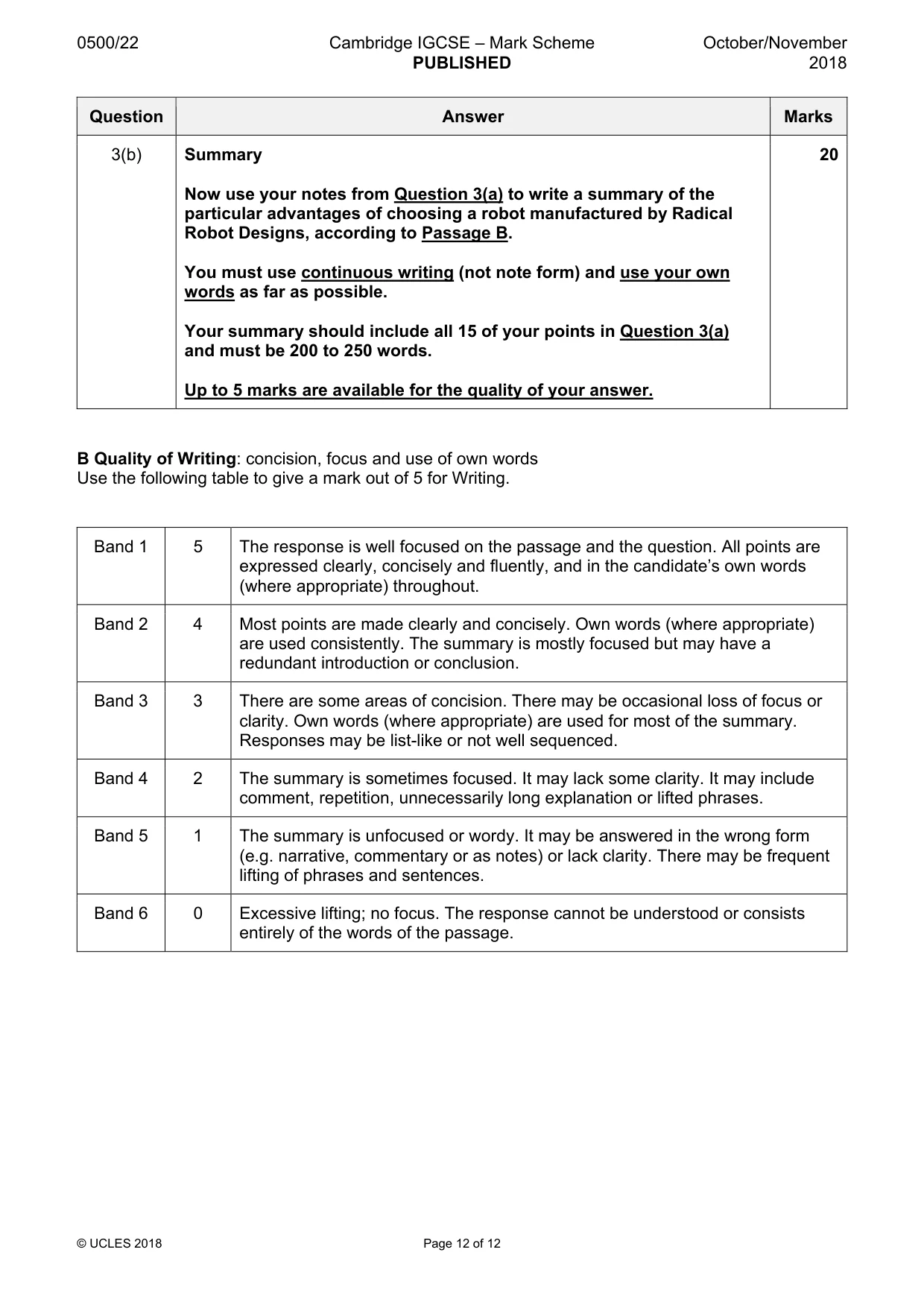
0500/22 Cambridge IGCSE – Mark Scheme PUBLISHED October/November 2018 © UCLES 2018 Page 12 of 12 Question Answer Marks 3(b) Summary Now use your notes from Question 3(a) to write a summary of the particular advantages of choosing a robot manufactured by Radical Robot Designs, according to Passage B. You must use continuous writing (not note form) and use your own words as far as possible. Your summary should include all 15 of your points in Question 3(a) and must be 200 to 250 words. Up to 5 marks are available for the quality of your answer. 20 B Quality of Writing: concision, focus and use of own words Use the following table to give a mark out of 5 for Writing. Band 1 5 The response is well focused on the passage and the question. All points are expressed clearly, concisely and fluently, and in the candidate’s own words (where appropriate) throughout. Band 2 4 Most points are made clearly and concisely. Own words (where appropriate) are used consistently. The summary is mostly focused but may have a redundant introduction or conclusion. Band 3 3 There are some areas of concision. There may be occasional loss of focus or clarity. Own words (where appropriate) are used for most of the summary. Responses may be list-like or not well sequenced. Band 4 2 The summary is sometimes focused. It may lack some clarity. It may include comment, repetition, unnecessarily long explanation or lifted phrases. Band 5 1 The summary is unfocused or wordy. It may be answered in the wrong form (e.g. narrative, commentary or as notes) or lack clarity. There may be frequent lifting of phrases and sentences. Band 6 0 Excessive lifting; no focus. The response cannot be understood or consists entirely of the words of the passage.
What you needed in this session
Cambridge’s own grade thresholds for 2018 Oct/Nov, Paper 2 · Variant 2. A higher threshold means an easier paper — the bar moves with how the cohort did.