Cambridge IGCSE English - First Language 0500 — 2018 Oct/Nov Paper 1 · Variant 3
0500/13/O/N/18 · 50 marks · ≈56 min
The question paper and its mark scheme, free to read here and free to download. This is Cambridge’s own paper, exactly as it was sat.
Question paper12 pages
Mark scheme12 pages
Answers below. Sit the paper first if you are practising.
Paper as text
Question paper, page 1
* 4 5 9 4 4 5 5 0 3 1 * This document consists of 9 printed pages, 3 blank pages and 1 Insert. DC (ST) 144996/3 © UCLES 2018 [Turn over Cambridge International Examinations Cambridge International General Certificate of Secondary Education FIRST LANGUAGE ENGLISH 0500/13 Paper 1 Reading Passages (Core) October/November 2018 1 hour 45 minutes Candidates answer on the Question Paper. No Additional Materials are required. READ THESE INSTRUCTIONS FIRST Write your Centre number, candidate number and name in the spaces provided. Write in dark blue or black pen. Do not use staples, paper clips, glue or correction fluid. DO NOT WRITE IN ANY BARCODES. Answer all questions in the space provided. If additional space is required, you should use the lined pages at the end of this booklet. The question number(s) must be clearly shown. Dictionaries are not permitted. The Reading Booklet Insert contains the reading passages for use with all questions on this Question Paper. The Reading Booklet Insert is not assessed by the Examiner. The number of marks is given in brackets [ ] at the end of each question or part question.
Question paper, page 2
2 0500/13/O/N/18 © UCLES 2018 Read carefully Passage A, A visit to Clytha Castle, in the Reading Booklet Insert and then answer Questions 1 and 2 on this Question Paper. Answer all questions using your own words as far as possible. Question 1 (a) Which word in lines 1–2 suggests the writer’s state of mind? … …[1] (b) What does the writer expect to find when visiting a castle (paragraph 1, ‘It was with … ’)? • … … • … …[2] (c) (i) Using your own words, explain what the writer means by the words underlined in each of the following quotations (paragraph 2, ‘Clytha sits on … ’): (1) ‘Clytha sits on a curious bump of a hill … ’ (line 7) Word underlined: … Meaning of the word underlined: …[1] (2) ‘ … all we could spot, at first, were some small pointed towers peering coyly from behind a grove of trees.’ (lines 7–8) Word underlined: … Meaning of the word underlined: …[1] (3) ‘ … we had to proceed up the hill, through an iron gate, and along a meandering, overgrown pathway.’ (lines 8–9) Word underlined: … Meaning of the word underlined: …[1]
Question paper, page 3
3 0500/13/O/N/18 © UCLES 2018 [Turn over (ii) Explain how the language in each of these quotations helps to create the atmosphere around the castle when they first arrive. In your answer you should refer to the whole quotation, not just the underlined words. Explanation: … …[2] Explanation: … …[2] Explanation: … …[2] (d) Using your own words, explain what the writer thinks is unusual about the Welsh landscape as she drives through it (paragraph 3, ‘It is said … ’). … …[2] (e) Using your own words, explain how the writer suggests Wales has changed (paragraph 5, ‘By the 19th century … ’). … … …[2] (f) Using your own words, explain what the writer means by: ‘the fortresses may now assist a country they once helped dominate.’ (lines 23–24) … … …[2] (g) Using your own words, explain how the writer’s daughter reacts to the castle (paragraph 7, ‘One of its four … ’). … … …[2] [Total: 20]
Question paper, page 4
4 0500/13/O/N/18 © UCLES 2018 Question 2 Imagine that you are the writer’s son or daughter. After you have left Clytha Castle you write a journal entry describing your visit. Write the words of your journal entry. In the journal entry you should include the following information: • your first impressions of Clytha Castle • what it was like and how it may have been different from your expectations • what you liked most about the visit. Base your journal entry on what you have read in Passage A, but do not copy from it. Be careful to use your own words. Address each of the three bullet points. Begin your journal entry: ‘I have just left the most unusual place … ’ Write about 200 to 300 words. Up to 10 marks are available for the content of your answer, and up to 5 marks for the quality of your writing. … … … … … … … … … … … … … … … … …
Question paper, page 5
5 0500/13/O/N/18 © UCLES 2018 [Turn over … … … … … … … … … … … … … … … … … … … … … … … … … … … [Total: 15]
Question paper, page 6
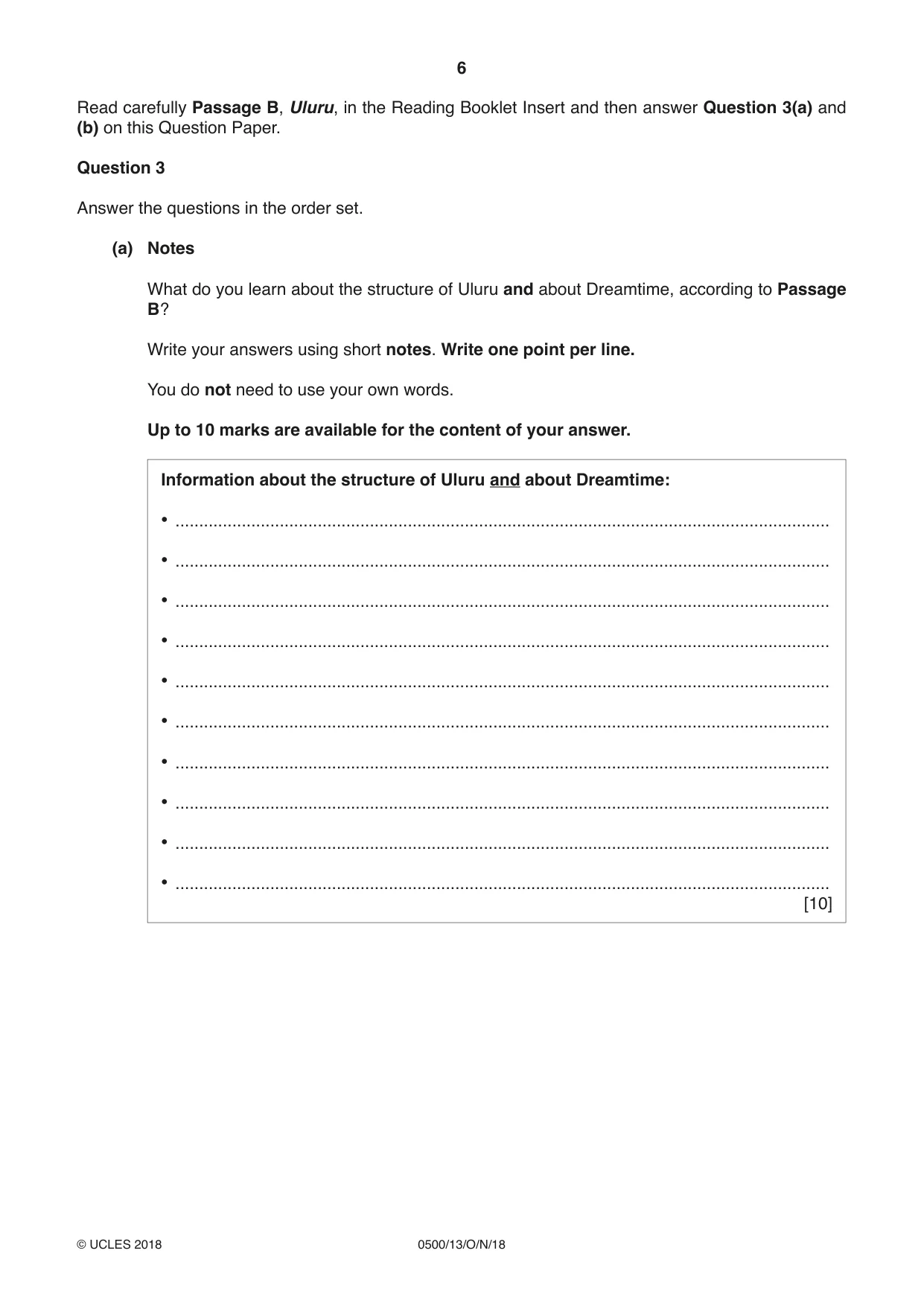
6 0500/13/O/N/18 © UCLES 2018 Read carefully Passage B, Uluru, in the Reading Booklet Insert and then answer Question 3(a) and (b) on this Question Paper. Question 3 Answer the questions in the order set. (a) Notes What do you learn about the structure of Uluru and about Dreamtime, according to Passage B? Write your answers using short notes. Write one point per line. You do not need to use your own words. Up to 10 marks are available for the content of your answer. Information about the structure of Uluru and about Dreamtime: • … • … • … • … • … • … • … • … • … • … [10]
Question paper, page 7
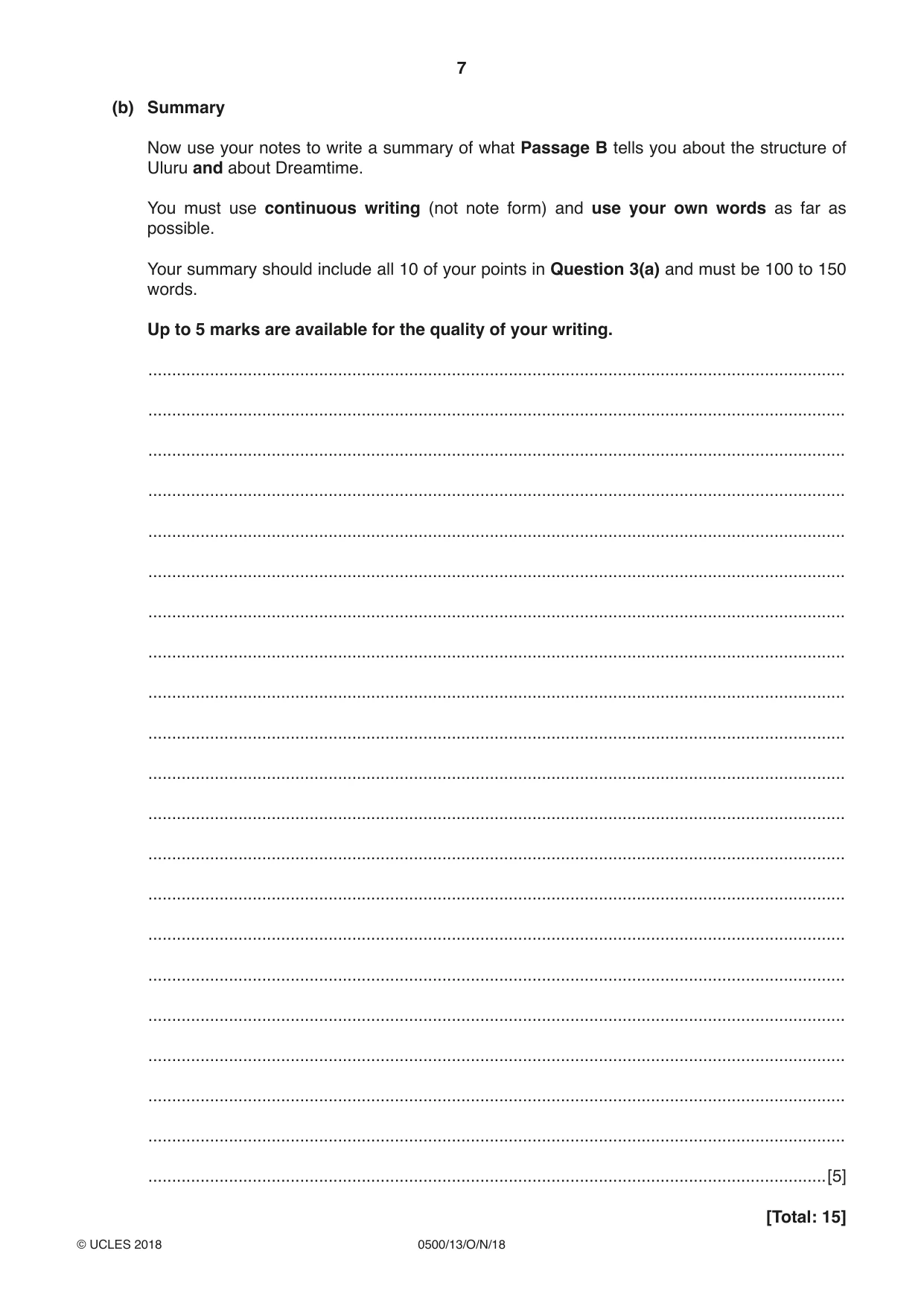
7 0500/13/O/N/18 © UCLES 2018 (b) Summary Now use your notes to write a summary of what Passage B tells you about the structure of Uluru and about Dreamtime. You must use continuous writing (not note form) and use your own words as far as possible. Your summary should include all 10 of your points in Question 3(a) and must be 100 to 150 words. Up to 5 marks are available for the quality of your writing. … … … … … … … … … … … … … … … … … … … … …[5] [Total: 15]
Question paper, page 8
8 0500/13/O/N/18 © UCLES 2018 Additional Page If you use the following lined page to complete the answer(s) to any question(s), the question number(s) must be clearly shown. … … … … … … … … … … … … … … … … … … … … … … … … … …
Question paper, page 9
9 0500/13/O/N/18 © UCLES 2018 Additional Page If you use the following lined page to complete the answer(s) to any question(s), the question number(s) must be clearly shown. … … … … … … … … … … … … … … … … … … … … … … … … … …
Question paper, page 10
10 0500/13/O/N/18 © UCLES 2018 BLANK PAGE
Question paper, page 11
11 0500/13/O/N/18 © UCLES 2018 BLANK PAGE
Question paper, page 12
12 0500/13/O/N/18 © UCLES 2018 Permission to reproduce items where third-party owned material protected by copyright is included has been sought and cleared where possible. Every reasonable effort has been made by the publisher (UCLES) to trace copyright holders, but if any items requiring clearance have unwittingly been included, the publisher will be pleased to make amends at the earliest possible opportunity. To avoid the issue of disclosure of answer-related information to candidates, all copyright acknowledgements are reproduced online in the Cambridge International Examinations Copyright Acknowledgements Booklet. This is produced for each series of examinations and is freely available to download at www.cie.org.uk after the live examination series. Cambridge International Examinations is part of the Cambridge Assessment Group. Cambridge Assessment is the brand name of University of Cambridge Local Examinations Syndicate (UCLES), which is itself a department of the University of Cambridge. BLANK PAGE
Mark scheme, page 1
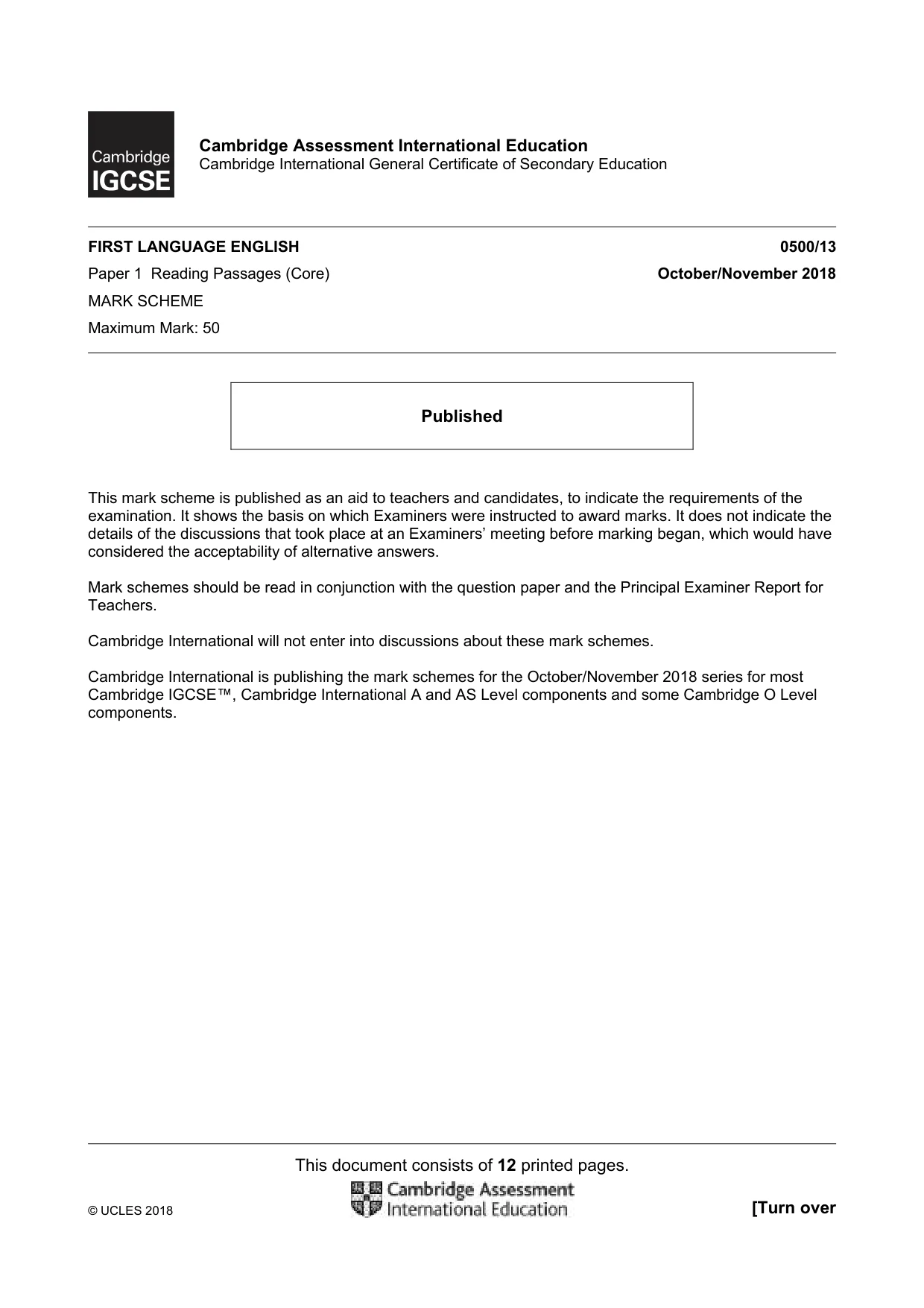
This document consists of 12 printed pages. © UCLES 2018 [Turn over Cambridge Assessment International Education Cambridge International General Certificate of Secondary Education FIRST LANGUAGE ENGLISH 0500/13 Paper 1 Reading Passages (Core) October/November 2018 MARK SCHEME Maximum Mark: 50 Published This mark scheme is published as an aid to teachers and candidates, to indicate the requirements of the examination. It shows the basis on which Examiners were instructed to award marks. It does not indicate the details of the discussions that took place at an Examiners’ meeting before marking began, which would have considered the acceptability of alternative answers. Mark schemes should be read in conjunction with the question paper and the Principal Examiner Report for Teachers. Cambridge International will not enter into discussions about these mark schemes. Cambridge International is publishing the mark schemes for the October/November 2018 series for most Cambridge IGCSE™, Cambridge International A and AS Level components and some Cambridge O Level components.
Mark scheme, page 2
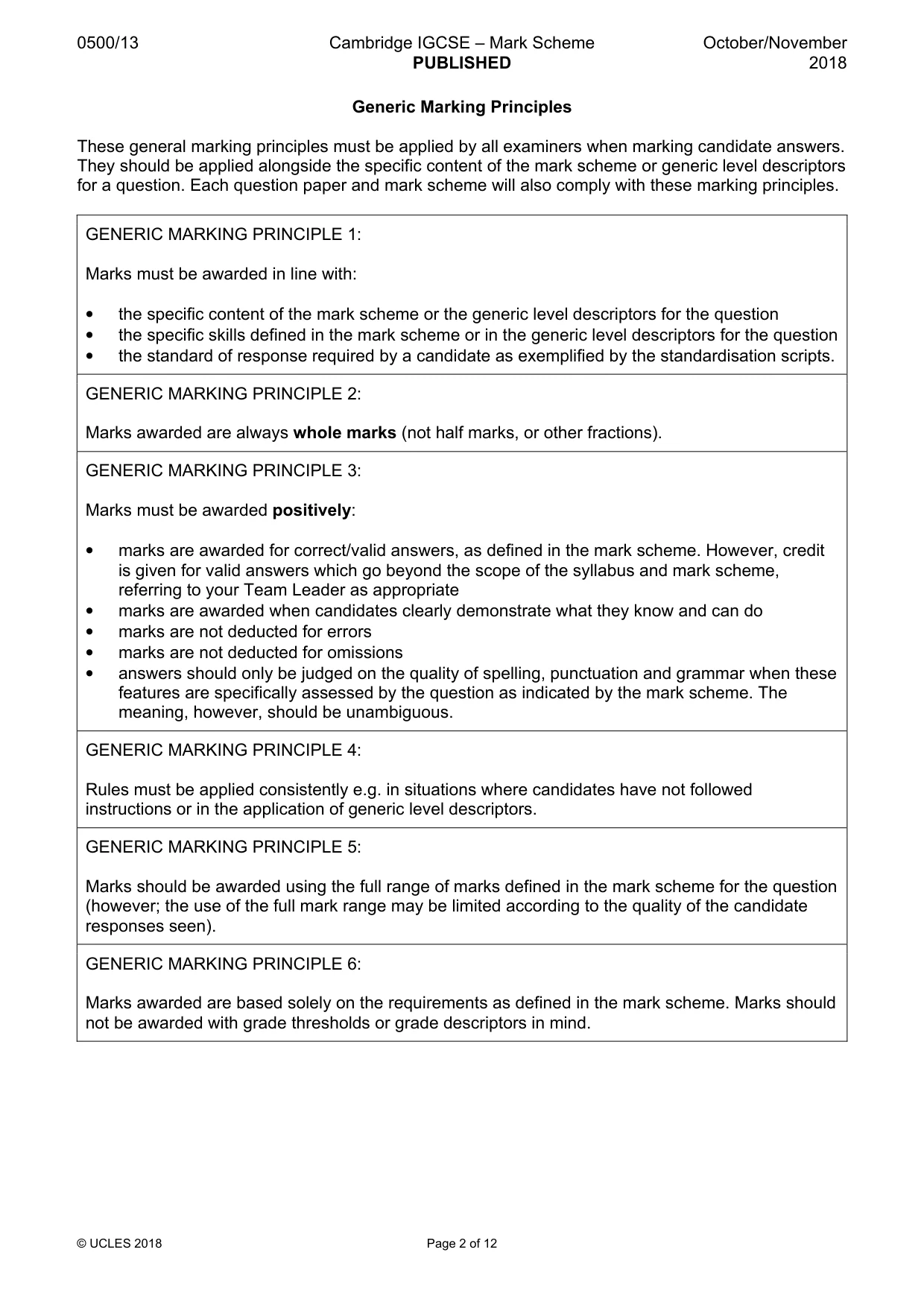
0500/13 Cambridge IGCSE – Mark Scheme PUBLISHED October/November 2018 © UCLES 2018 Page 2 of 12 Generic Marking Principles These general marking principles must be applied by all examiners when marking candidate answers. They should be applied alongside the specific content of the mark scheme or generic level descriptors for a question. Each question paper and mark scheme will also comply with these marking principles. GENERIC MARKING PRINCIPLE 1: Marks must be awarded in line with: • the specific content of the mark scheme or the generic level descriptors for the question • the specific skills defined in the mark scheme or in the generic level descriptors for the question • the standard of response required by a candidate as exemplified by the standardisation scripts. GENERIC MARKING PRINCIPLE 2: Marks awarded are always whole marks (not half marks, or other fractions). GENERIC MARKING PRINCIPLE 3: Marks must be awarded positively: • marks are awarded for correct/valid answers, as defined in the mark scheme. However, credit is given for valid answers which go beyond the scope of the syllabus and mark scheme, referring to your Team Leader as appropriate • marks are awarded when candidates clearly demonstrate what they know and can do • marks are not deducted for errors • marks are not deducted for omissions • answers should only be judged on the quality of spelling, punctuation and grammar when these features are specifically assessed by the question as indicated by the mark scheme. The meaning, however, should be unambiguous. GENERIC MARKING PRINCIPLE 4: Rules must be applied consistently e.g. in situations where candidates have not followed instructions or in the application of generic level descriptors. GENERIC MARKING PRINCIPLE 5: Marks should be awarded using the full range of marks defined in the mark scheme for the question (however; the use of the full mark range may be limited according to the quality of the candidate responses seen). GENERIC MARKING PRINCIPLE 6: Marks awarded are based solely on the requirements as defined in the mark scheme. Marks should not be awarded with grade thresholds or grade descriptors in mind.
Mark scheme, page 3
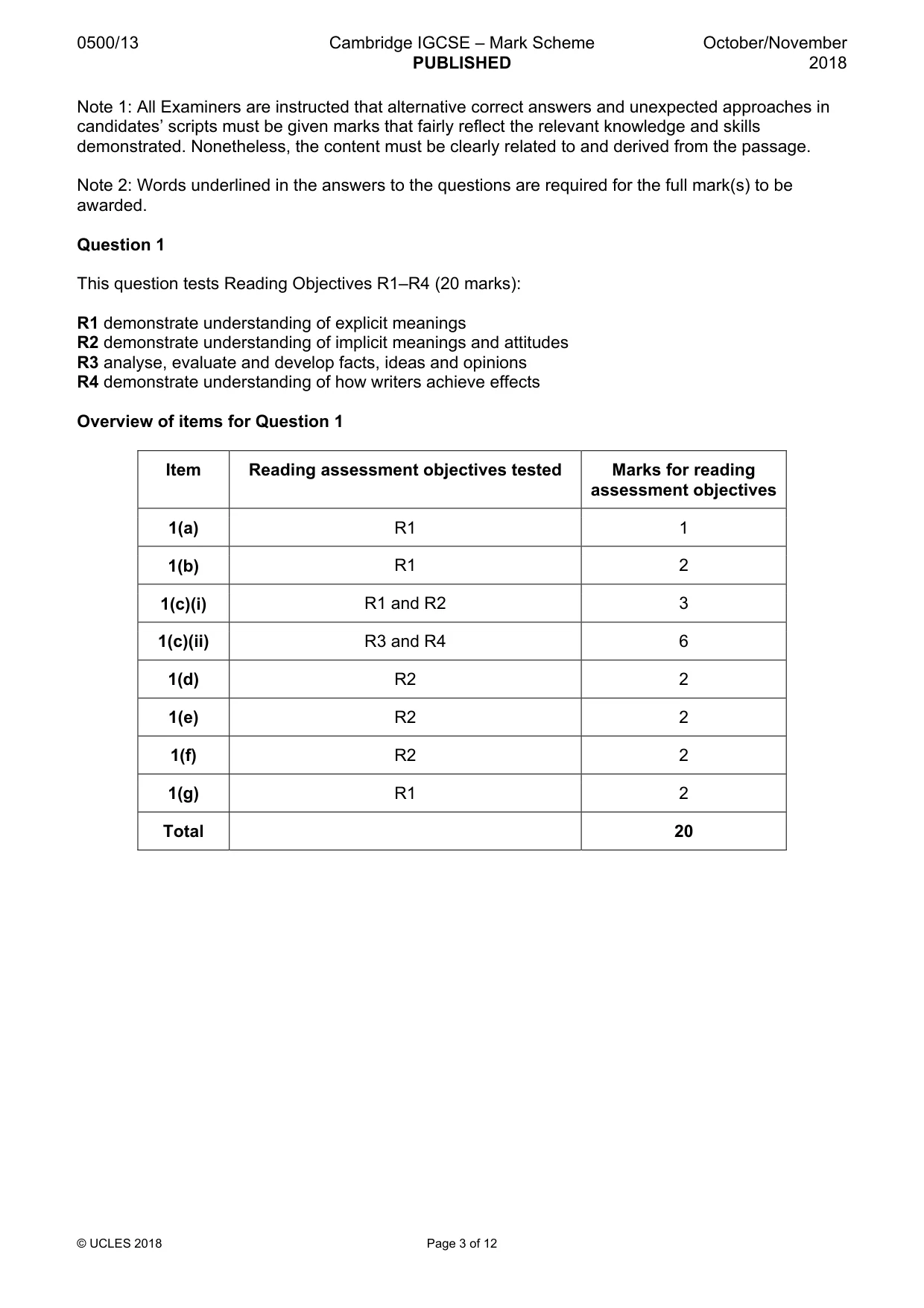
0500/13 Cambridge IGCSE – Mark Scheme PUBLISHED October/November 2018 © UCLES 2018 Page 3 of 12 Note 1: All Examiners are instructed that alternative correct answers and unexpected approaches in candidates’ scripts must be given marks that fairly reflect the relevant knowledge and skills demonstrated. Nonetheless, the content must be clearly related to and derived from the passage. Note 2: Words underlined in the answers to the questions are required for the full mark(s) to be awarded. Question 1 This question tests Reading Objectives R1–R4 (20 marks): R1 demonstrate understanding of explicit meanings R2 demonstrate understanding of implicit meanings and attitudes R3 analyse, evaluate and develop facts, ideas and opinions R4 demonstrate understanding of how writers achieve effects Overview of items for Question 1 Item Reading assessment objectives tested Marks for reading assessment objectives 1(a) R1 1 1(b) R1 2 1(c)(i) R1 and R2 3 1(c)(ii) R3 and R4 6 1(d) R2 2 1(e) R2 2 1(f) R2 2 1(g) R1 2 Total 20
Mark scheme, page 4
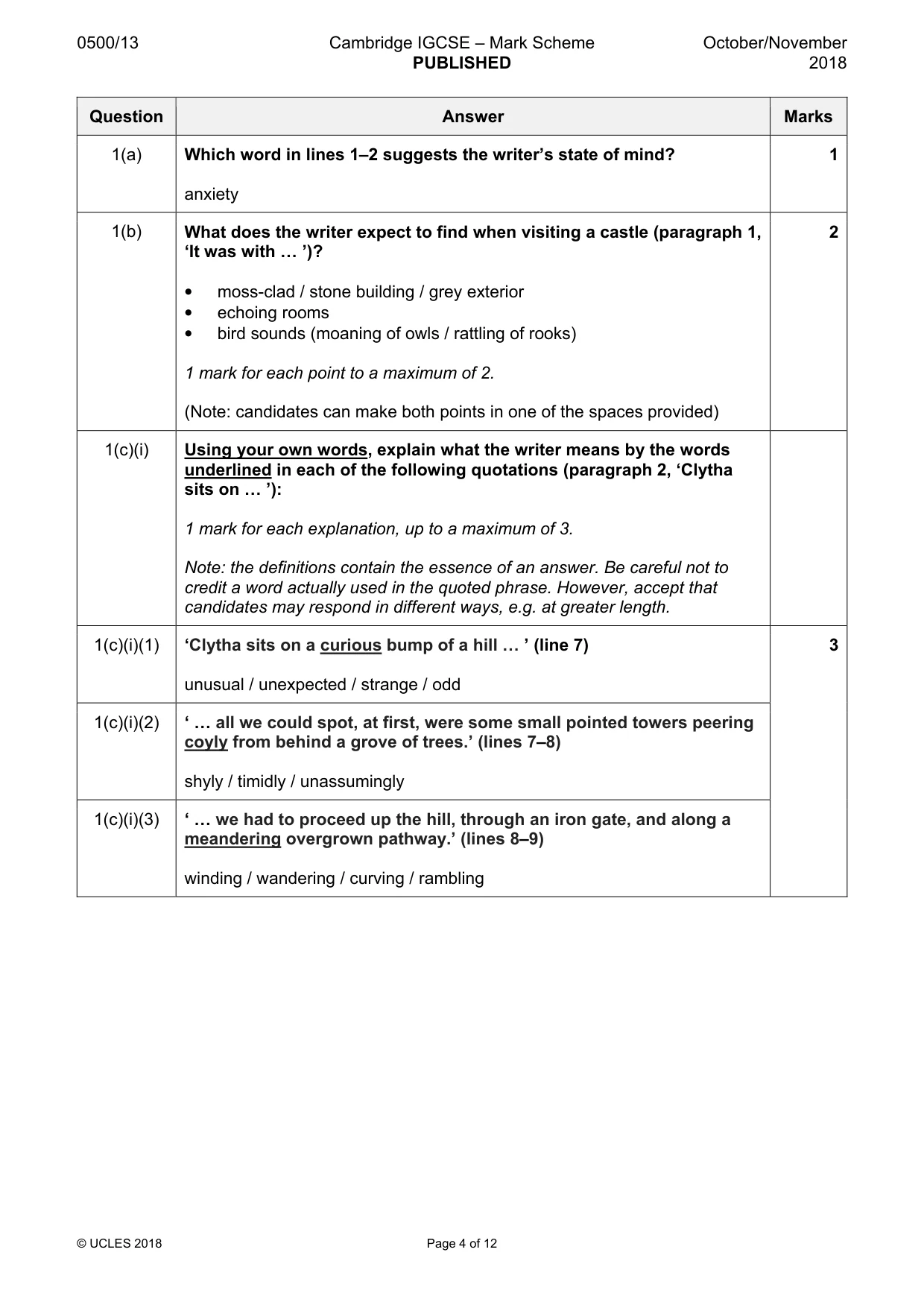
0500/13 Cambridge IGCSE – Mark Scheme PUBLISHED October/November 2018 © UCLES 2018 Page 4 of 12 Question Answer Marks 1(a) Which word in lines 1–2 suggests the writer’s state of mind? anxiety 1 1(b) What does the writer expect to find when visiting a castle (paragraph 1, ‘It was with « ’)? • moss-clad / stone building / grey exterior • echoing rooms • bird sounds (moaning of owls / rattling of rooks) 1 mark for each point to a maximum of 2. (Note: candidates can make both points in one of the spaces provided) 2 1(c)(i) Using your own words, explain what the writer means by the words underlined in each of the following quotations (paragraph 2, ‘Clytha sits on « ’): 1 mark for each explanation, up to a maximum of 3. Note: the definitions contain the essence of an answer. Be careful not to credit a word actually used in the quoted phrase. However, accept that candidates may respond in different ways, e.g. at greater length. 1(c)(i)(1) ‘Clytha sits on a curious bump of a hill « ’ (line 7) unusual / unexpected / strange / odd 3 1(c)(i)(2) ‘ « all we could spot, at first, were some small pointed towers peering coyly from behind a grove of trees.’ (lines 7–8) shyly / timidly / unassumingly 1(c)(i)(3) ‘ « we had to proceed up the hill, through an iron gate, and along a meandering overgrown pathway.’ (lines 8–9) winding / wandering / curving / rambling
Mark scheme, page 5
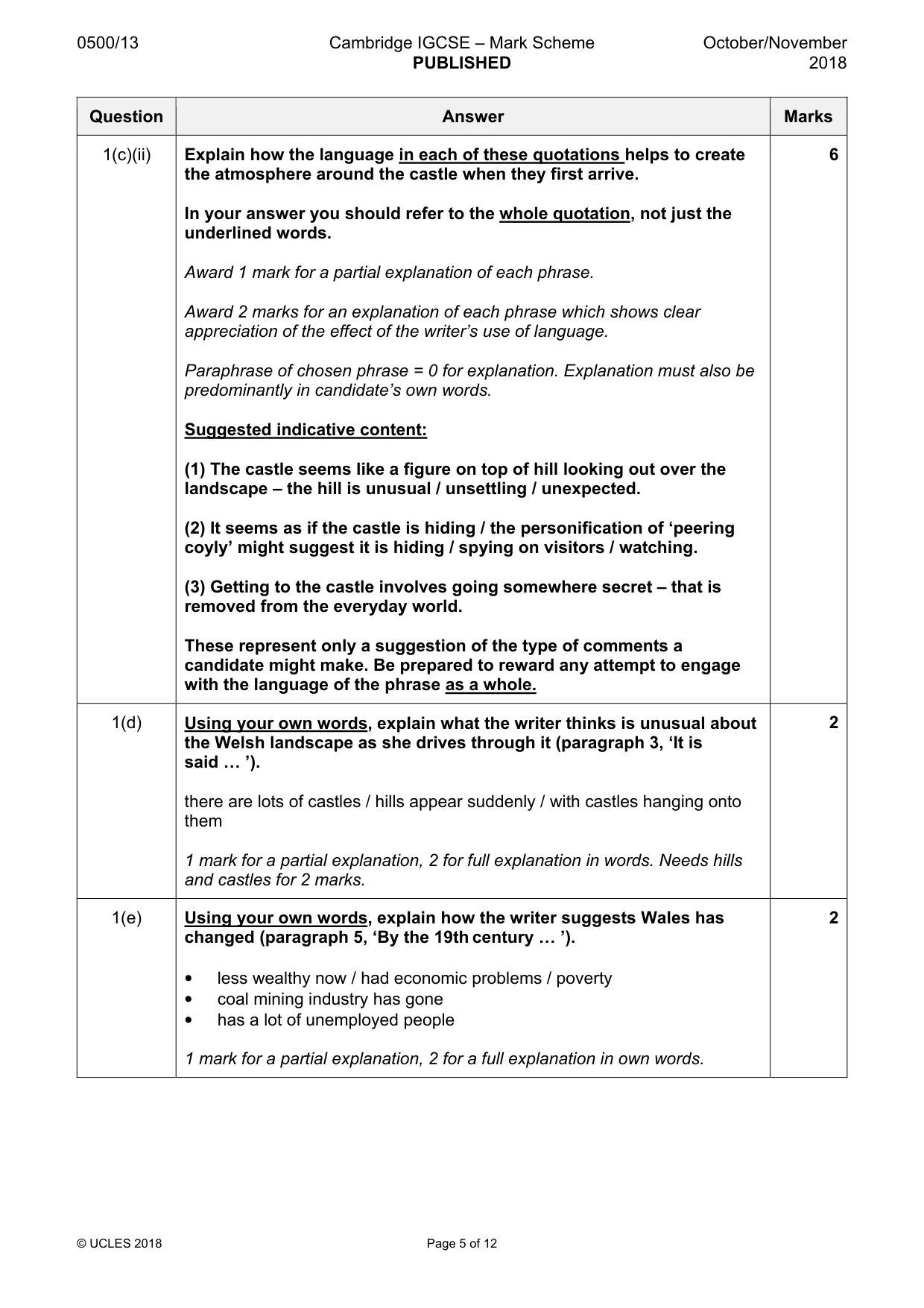
0500/13 Cambridge IGCSE – Mark Scheme PUBLISHED October/November 2018 © UCLES 2018 Page 5 of 12 Question Answer Marks 1(c)(ii) Explain how the language in each of these quotations helps to create the atmosphere around the castle when they first arrive. In your answer you should refer to the whole quotation, not just the underlined words. Award 1 mark for a partial explanation of each phrase. Award 2 marks for an explanation of each phrase which shows clear appreciation of the effect of the writer’s use of language. Paraphrase of chosen phrase = 0 for explanation. Explanation must also be predominantly in candidate’s own words. Suggested indicative content: (1) The castle seems like a figure on top of hill looking out over the landscape – the hill is unusual / unsettling / unexpected. (2) It seems as if the castle is hiding / the personification of ‘peering coyly’ might suggest it is hiding / spying on visitors / watching. (3) Getting to the castle involves going somewhere secret – that is removed from the everyday world. These represent only a suggestion of the type of comments a candidate might make. Be prepared to reward any attempt to engage with the language of the phrase as a whole. 6 1(d) Using your own words, explain what the writer thinks is unusual about the Welsh landscape as she drives through it (paragraph 3, ‘It is said « ’). there are lots of castles / hills appear suddenly / with castles hanging onto them 1 mark for a partial explanation, 2 for full explanation in words. Needs hills and castles for 2 marks. 2 1(e) Using your own words, explain how the writer suggests Wales has changed (paragraph 5, ‘By the 19th century « ’). • less wealthy now / had economic problems / poverty • coal mining industry has gone • has a lot of unemployed people 1 mark for a partial explanation, 2 for a full explanation in own words. 2
Mark scheme, page 6
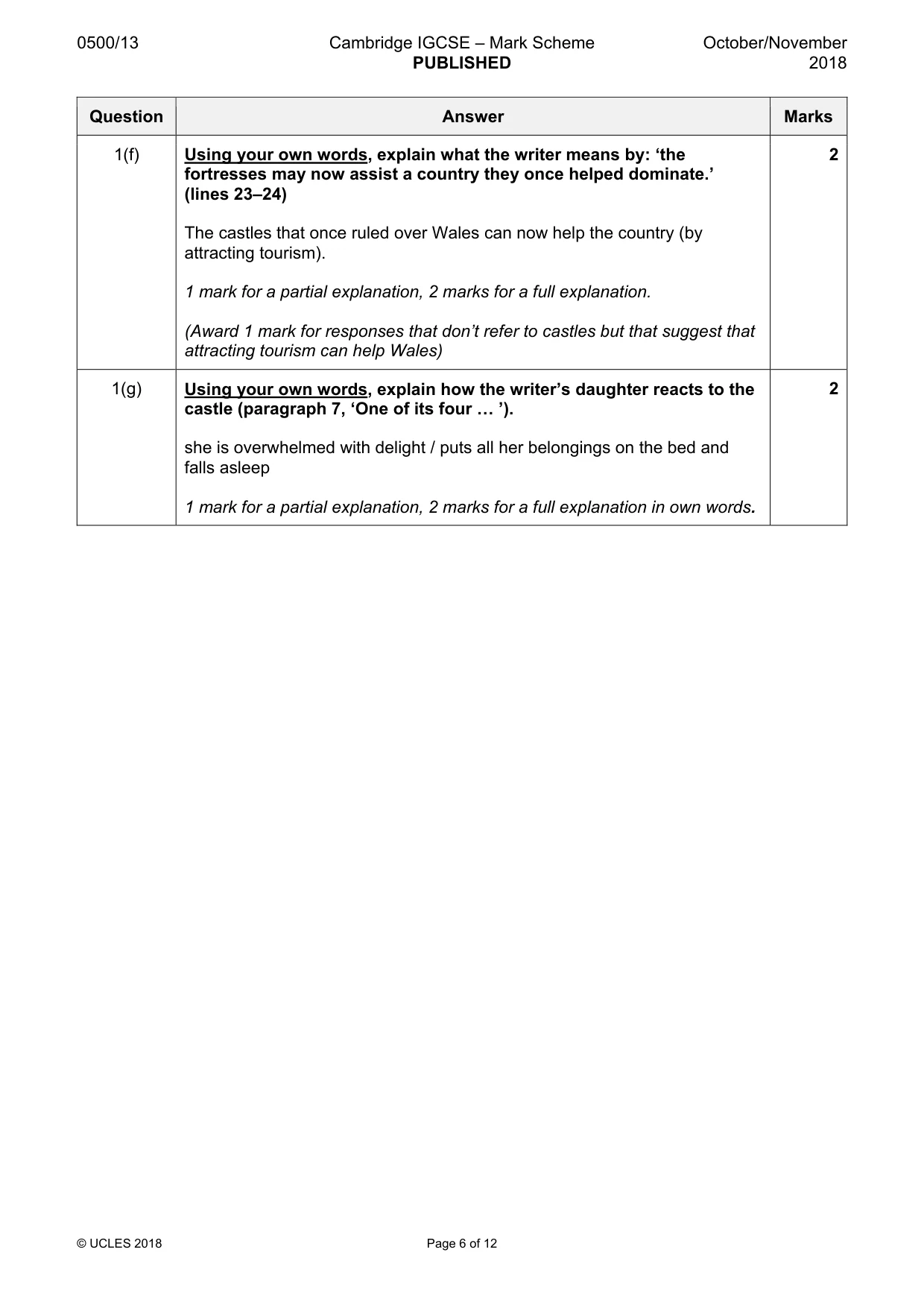
0500/13 Cambridge IGCSE – Mark Scheme PUBLISHED October/November 2018 © UCLES 2018 Page 6 of 12 Question Answer Marks 1(f) Using your own words, explain what the writer means by: ‘the fortresses may now assist a country they once helped dominate.’ (lines 23–24) The castles that once ruled over Wales can now help the country (by attracting tourism). 1 mark for a partial explanation, 2 marks for a full explanation. (Award 1 mark for responses that don’t refer to castles but that suggest that attracting tourism can help Wales) 2 1(g) Using your own words, explain how the writer’s daughter reacts to the castle (paragraph 7, ‘One of its four « ’). she is overwhelmed with delight / puts all her belongings on the bed and falls asleep 1 mark for a partial explanation, 2 marks for a full explanation in own words. 2
Mark scheme, page 7
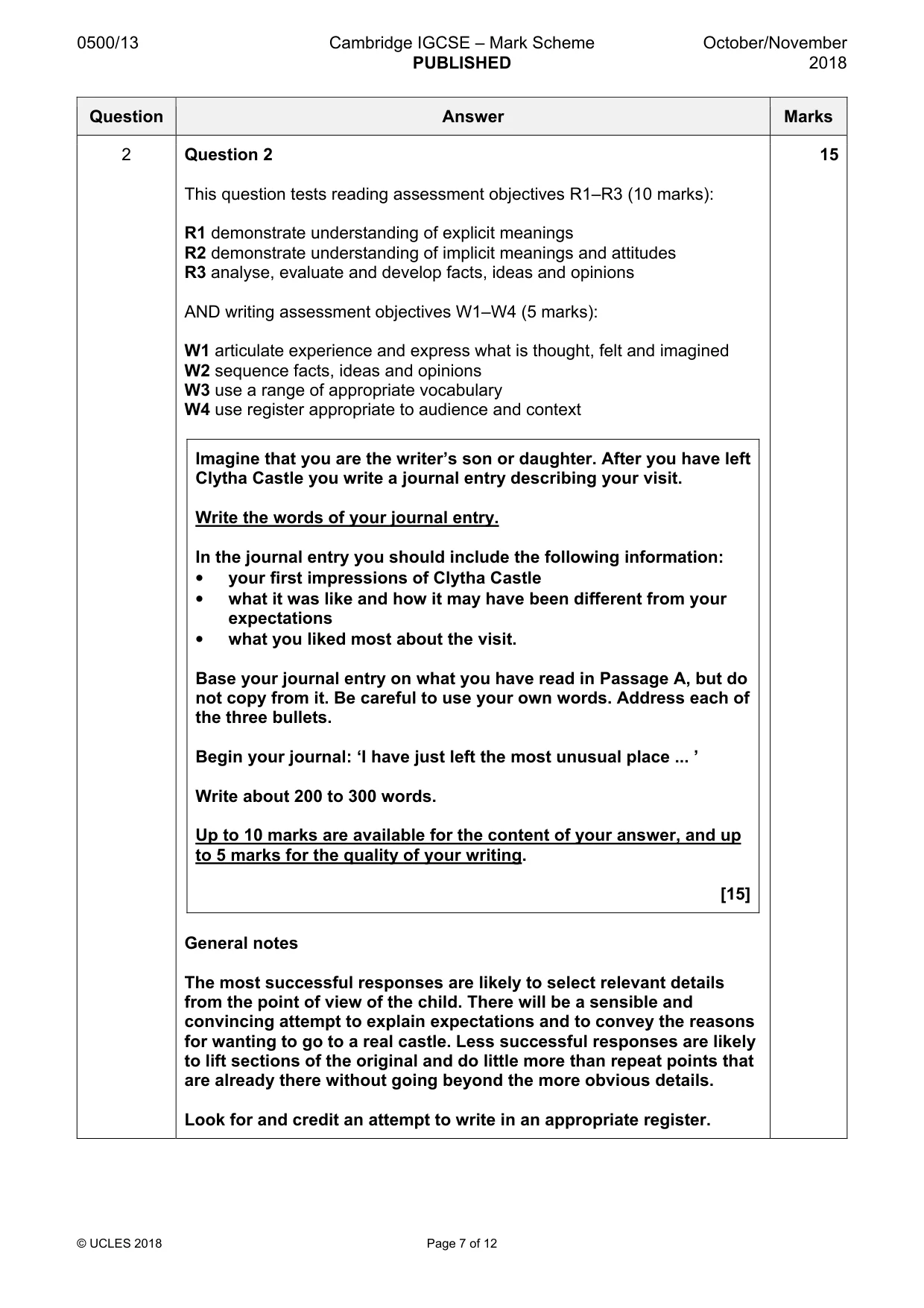
0500/13 Cambridge IGCSE – Mark Scheme PUBLISHED October/November 2018 © UCLES 2018 Page 7 of 12 Question Answer Marks 2 Question 2 This question tests reading assessment objectives R1–R3 (10 marks): R1 demonstrate understanding of explicit meanings R2 demonstrate understanding of implicit meanings and attitudes R3 analyse, evaluate and develop facts, ideas and opinions AND writing assessment objectives W1–W4 (5 marks): W1 articulate experience and express what is thought, felt and imagined W2 sequence facts, ideas and opinions W3 use a range of appropriate vocabulary W4 use register appropriate to audience and context Imagine that you are the writer’s son or daughter. After you have left Clytha Castle you write a journal entry describing your visit. Write the words of your journal entry. In the journal entry you should include the following information: • your first impressions of Clytha Castle • what it was like and how it may have been different from your expectations • what you liked most about the visit. Base your journal entry on what you have read in Passage A, but do not copy from it. Be careful to use your own words. Address each of the three bullets. Begin your journal: ‘I have just left the most unusual place ... ’ Write about 200 to 300 words. Up to 10 marks are available for the content of your answer, and up to 5 marks for the quality of your writing. [15] General notes The most successful responses are likely to select relevant details from the point of view of the child. There will be a sensible and convincing attempt to explain expectations and to convey the reasons for wanting to go to a real castle. Less successful responses are likely to lift sections of the original and do little more than repeat points that are already there without going beyond the more obvious details. Look for and credit an attempt to write in an appropriate register. 15
Mark scheme, page 8
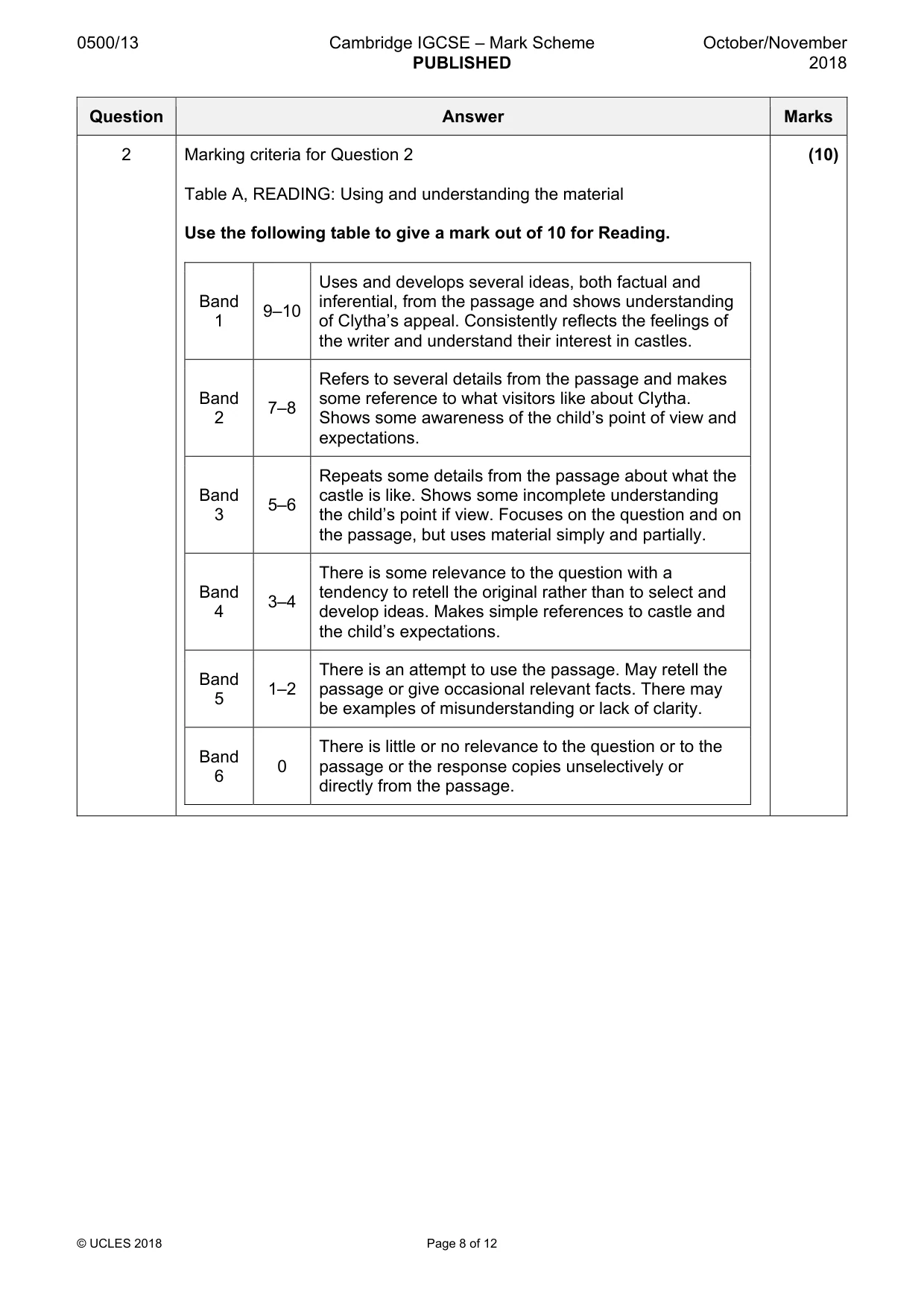
0500/13 Cambridge IGCSE – Mark Scheme PUBLISHED October/November 2018 © UCLES 2018 Page 8 of 12 Question Answer Marks 2 Marking criteria for Question 2 Table A, READING: Using and understanding the material Use the following table to give a mark out of 10 for Reading. Band 1 9–10 Uses and develops several ideas, both factual and inferential, from the passage and shows understanding of Clytha’s appeal. Consistently reflects the feelings of the writer and understand their interest in castles. Band 2 7–8 Refers to several details from the passage and makes some reference to what visitors like about Clytha. Shows some awareness of the child’s point of view and expectations. Band 3 5–6 Repeats some details from the passage about what the castle is like. Shows some incomplete understanding the child’s point if view. Focuses on the question and on the passage, but uses material simply and partially. Band 4 3–4 There is some relevance to the question with a tendency to retell the original rather than to select and develop ideas. Makes simple references to castle and the child’s expectations. Band 5 1–2 There is an attempt to use the passage. May retell the passage or give occasional relevant facts. There may be examples of misunderstanding or lack of clarity. Band 6 0 There is little or no relevance to the question or to the passage or the response copies unselectively or directly from the passage. (10)
Mark scheme, page 9
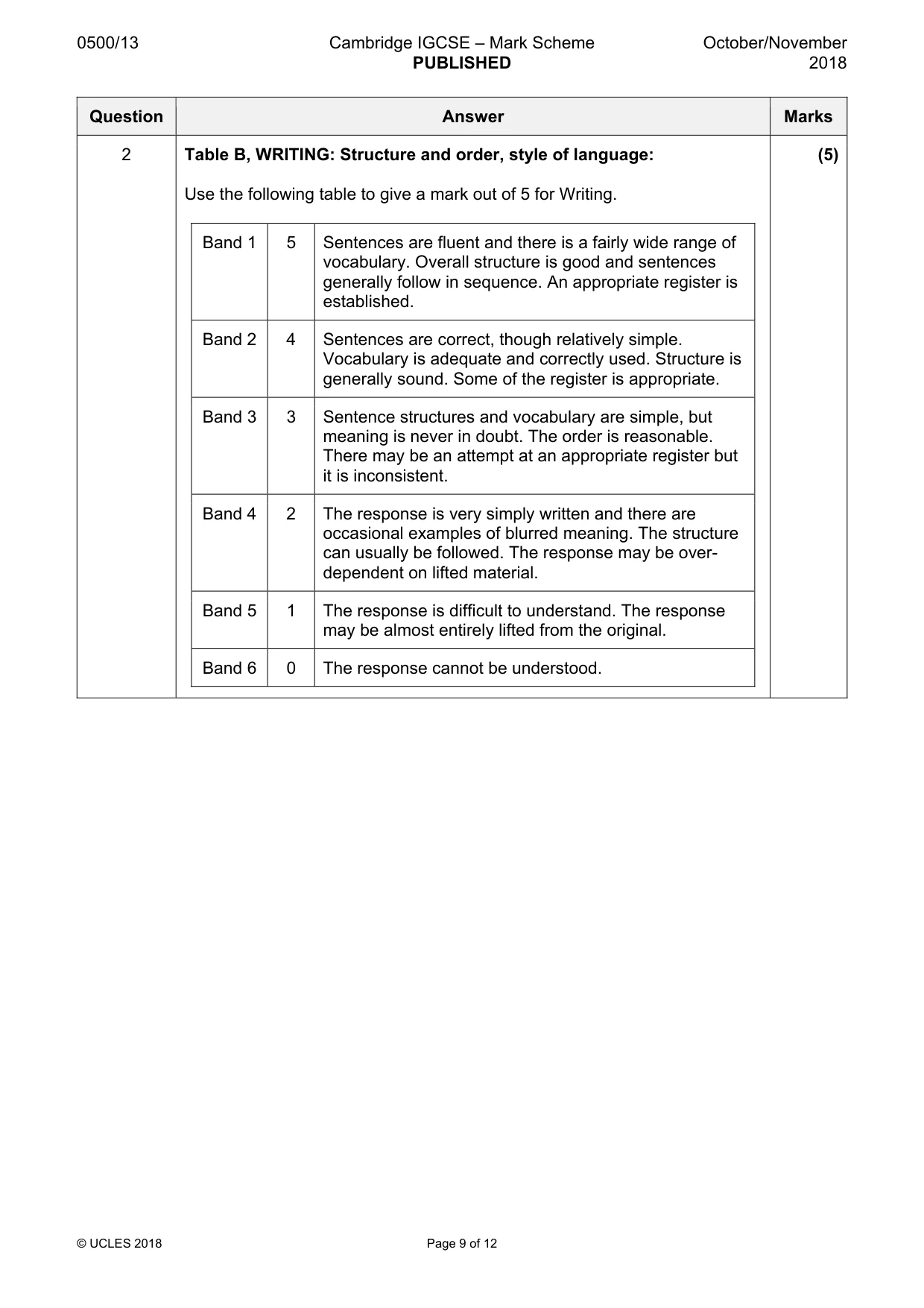
0500/13 Cambridge IGCSE – Mark Scheme PUBLISHED October/November 2018 © UCLES 2018 Page 9 of 12 Question Answer Marks 2 Table B, WRITING: Structure and order, style of language: Use the following table to give a mark out of 5 for Writing. Band 1 5 Sentences are fluent and there is a fairly wide range of vocabulary. Overall structure is good and sentences generally follow in sequence. An appropriate register is established. Band 2 4 Sentences are correct, though relatively simple. Vocabulary is adequate and correctly used. Structure is generally sound. Some of the register is appropriate. Band 3 3 Sentence structures and vocabulary are simple, but meaning is never in doubt. The order is reasonable. There may be an attempt at an appropriate register but it is inconsistent. Band 4 2 The response is very simply written and there are occasional examples of blurred meaning. The structure can usually be followed. The response may be over- dependent on lifted material. Band 5 1 The response is difficult to understand. The response may be almost entirely lifted from the original. Band 6 0 The response cannot be understood. (5)
Mark scheme, page 10
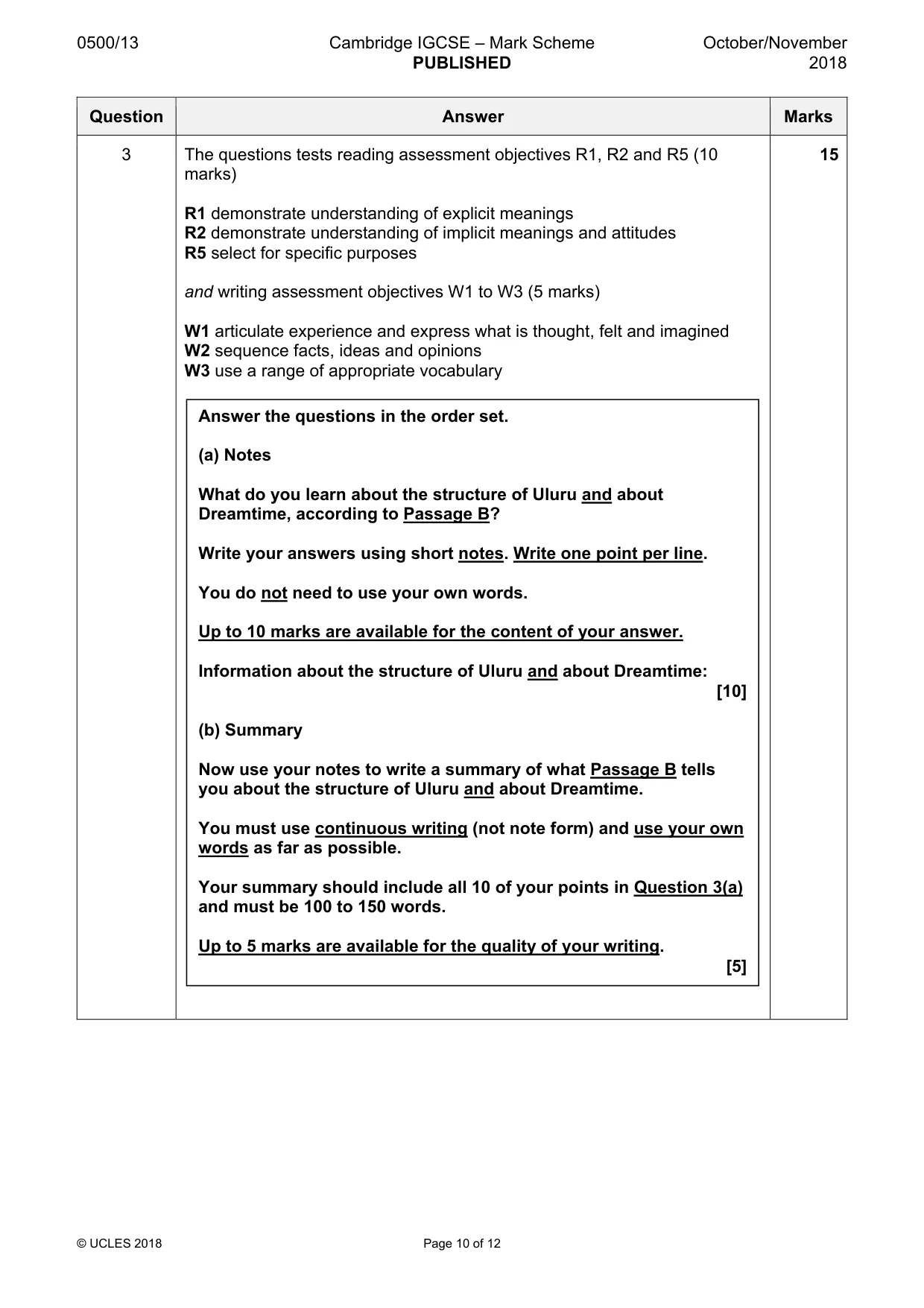
0500/13 Cambridge IGCSE – Mark Scheme PUBLISHED October/November 2018 © UCLES 2018 Page 10 of 12 Question Answer Marks 3 The questions tests reading assessment objectives R1, R2 and R5 (10 marks) R1 demonstrate understanding of explicit meanings R2 demonstrate understanding of implicit meanings and attitudes R5 select for specific purposes and writing assessment objectives W1 to W3 (5 marks) W1 articulate experience and express what is thought, felt and imagined W2 sequence facts, ideas and opinions W3 use a range of appropriate vocabulary 15 Answer the questions in the order set. (a) Notes What do you learn about the structure of Uluru and about Dreamtime, according to Passage B? Write your answers using short notes. Write one point per line. You do not need to use your own words. Up to 10 marks are available for the content of your answer. Information about the structure of Uluru and about Dreamtime: [10] (b) Summary Now use your notes to write a summary of what Passage B tells you about the structure of Uluru and about Dreamtime. You must use continuous writing (not note form) and use your own words as far as possible. Your summary should include all 10 of your points in Question 3(a) and must be 100 to 150 words. Up to 5 marks are available for the quality of your writing. [5]
Mark scheme, page 11
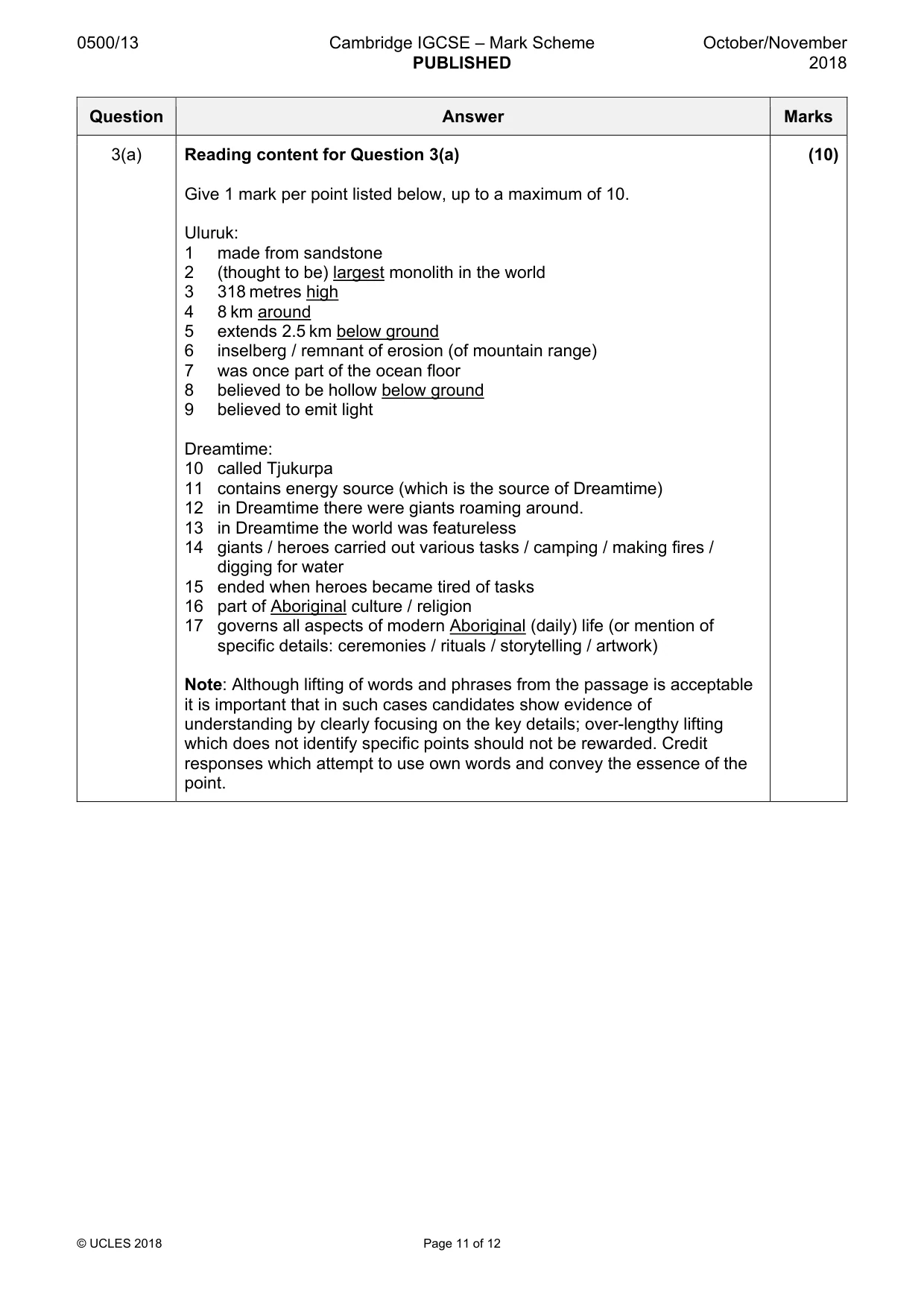
0500/13 Cambridge IGCSE – Mark Scheme PUBLISHED October/November 2018 © UCLES 2018 Page 11 of 12 Question Answer Marks 3(a) Reading content for Question 3(a) Give 1 mark per point listed below, up to a maximum of 10. Uluruk: 1 made from sandstone 2 (thought to be) largest monolith in the world 3 318 metres high 4 8 km around 5 extends 2.5 km below ground 6 inselberg / remnant of erosion (of mountain range) 7 was once part of the ocean floor 8 believed to be hollow below ground 9 believed to emit light Dreamtime: 10 called Tjukurpa 11 contains energy source (which is the source of Dreamtime) 12 in Dreamtime there were giants roaming around. 13 in Dreamtime the world was featureless 14 giants / heroes carried out various tasks / camping / making fires / digging for water 15 ended when heroes became tired of tasks 16 part of Aboriginal culture / religion 17 governs all aspects of modern Aboriginal (daily) life (or mention of specific details: ceremonies / rituals / storytelling / artwork) Note: Although lifting of words and phrases from the passage is acceptable it is important that in such cases candidates show evidence of understanding by clearly focusing on the key details; over-lengthy lifting which does not identify specific points should not be rewarded. Credit responses which attempt to use own words and convey the essence of the point. (10)
Mark scheme, page 12
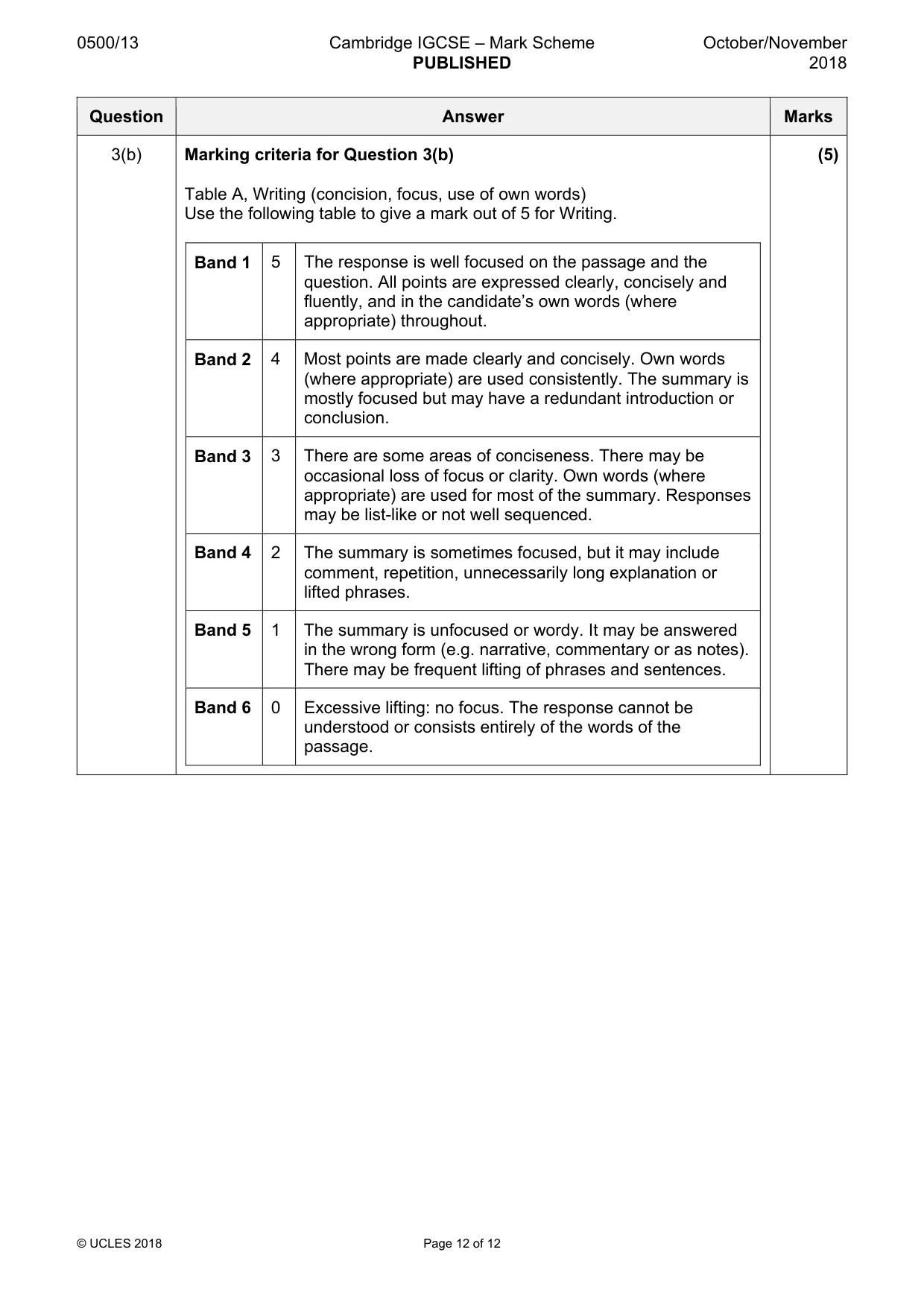
0500/13 Cambridge IGCSE – Mark Scheme PUBLISHED October/November 2018 © UCLES 2018 Page 12 of 12 Question Answer Marks 3(b) Marking criteria for Question 3(b) Table A, Writing (concision, focus, use of own words) Use the following table to give a mark out of 5 for Writing. Band 1 5 The response is well focused on the passage and the question. All points are expressed clearly, concisely and fluently, and in the candidate’s own words (where appropriate) throughout. Band 2 4 Most points are made clearly and concisely. Own words (where appropriate) are used consistently. The summary is mostly focused but may have a redundant introduction or conclusion. Band 3 3 There are some areas of conciseness. There may be occasional loss of focus or clarity. Own words (where appropriate) are used for most of the summary. Responses may be list-like or not well sequenced. Band 4 2 The summary is sometimes focused, but it may include comment, repetition, unnecessarily long explanation or lifted phrases. Band 5 1 The summary is unfocused or wordy. It may be answered in the wrong form (e.g. narrative, commentary or as notes). There may be frequent lifting of phrases and sentences. Band 6 0 Excessive lifting: no focus. The response cannot be understood or consists entirely of the words of the passage. (5)
What you needed in this session
Cambridge’s own grade thresholds for 2018 Oct/Nov, Paper 1 · Variant 3. A higher threshold means an easier paper — the bar moves with how the cohort did.