Cambridge IGCSE English - First Language 0500 — 2018 May/June Paper 1 · Variant 1
0500/11/M/J/18 · 50 marks · ≈56 min
The question paper and its mark scheme, free to read here and free to download. This is Cambridge’s own paper, exactly as it was sat.
Question paper12 pages

Mark scheme16 pages
Answers below. Sit the paper first if you are practising.
Paper as text
Question paper, page 1
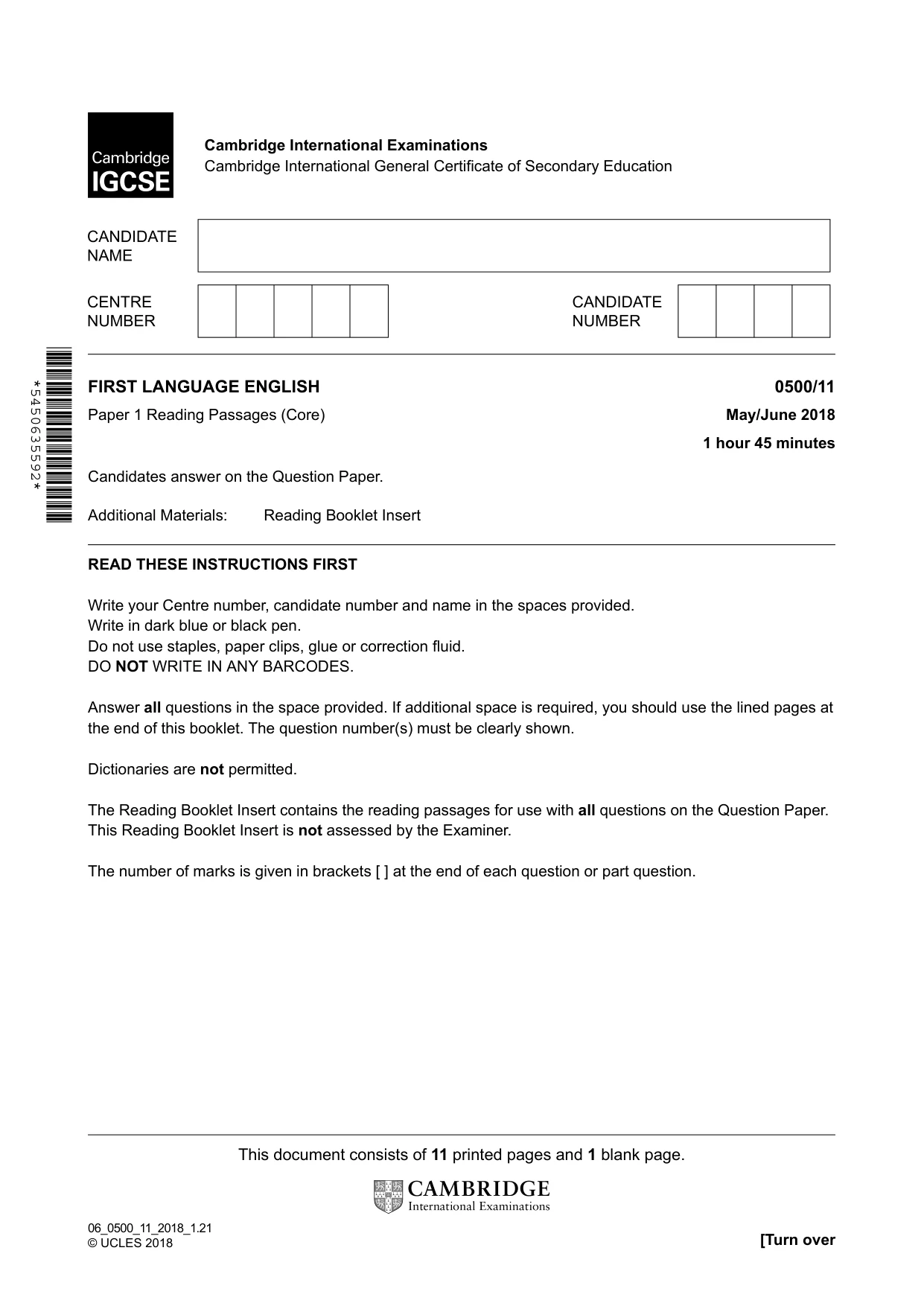
Cambridge International Examinations Cambridge International General Certificate of Secondary Education 0500/11 May/June 2018 1 hour 45 minutes FIRST LANGUAGE ENGLISH Paper 1 Reading Passages (Core) Candidates answer on the Question Paper. Additional Materials: Reading Booklet Insert READ THESE INSTRUCTIONS FIRST Write your Centre number, candidate number and name in the spaces provided. Write in dark blue or black pen. Do not use staples, paper clips, glue or correction fluid. DO NOT WRITE IN ANY BARCODES. Answer all questions in the space provided. If additional space is required, you should use the lined pages at the end of this booklet. The question number(s) must be clearly shown. Dictionaries are not permitted. The Reading Booklet Insert contains the reading passages for use with all questions on the Question Paper. This Reading Booklet Insert is not assessed by the Examiner. The number of marks is given in brackets [ ] at the end of each question or part question. This document consists of 11 printed pages and 1 blank page. [Turn over 06_0500_11_2018_1.21 © UCLES 2018 *5450635592*
Question paper, page 2
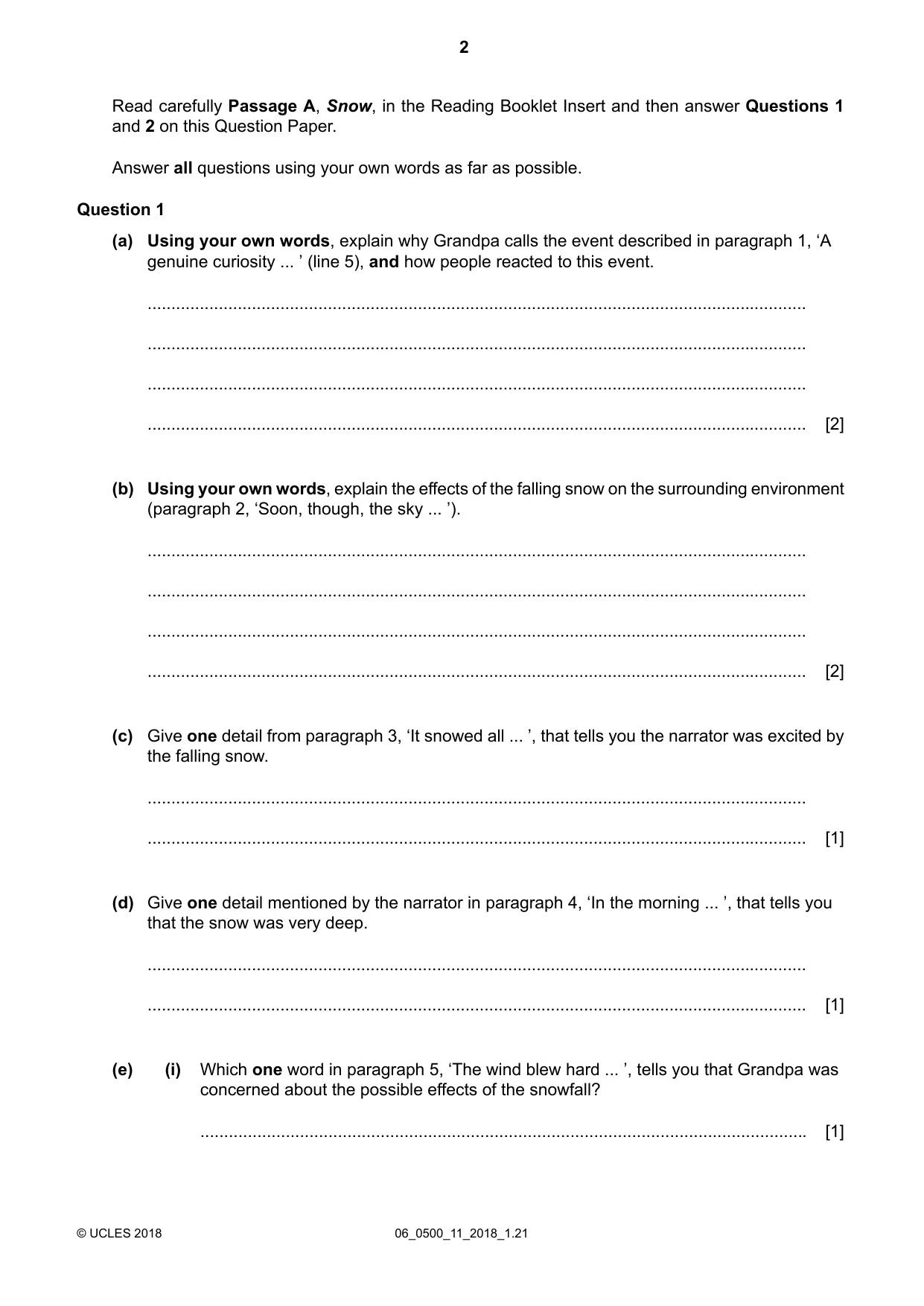
Read carefully Passage A, Snow, in the Reading Booklet Insert and then answer Questions 1 and 2 on this Question Paper. Answer all questions using your own words as far as possible. Question 1 Using your own words, explain why Grandpa calls the event described in paragraph 1, ‘A genuine curiosity ... ’ (line 5), and how people reacted to this event. (a) … … … … [2] Using your own words, explain the effects of the falling snow on the surrounding environment (paragraph 2, ‘Soon, though, the sky ... ’). (b) … … … … [2] Give one detail from paragraph 3, ‘It snowed all ... ’, that tells you the narrator was excited by the falling snow. (c) … … [1] Give one detail mentioned by the narrator in paragraph 4, ‘In the morning ... ’, that tells you that the snow was very deep. (d) … … [1] Which one word in paragraph 5, ‘The wind blew hard ... ’, tells you that Grandpa was concerned about the possible effects of the snowfall? (i) (e) … [1] 06_0500_11_2018_1.21 © UCLES 2018 2
Question paper, page 3
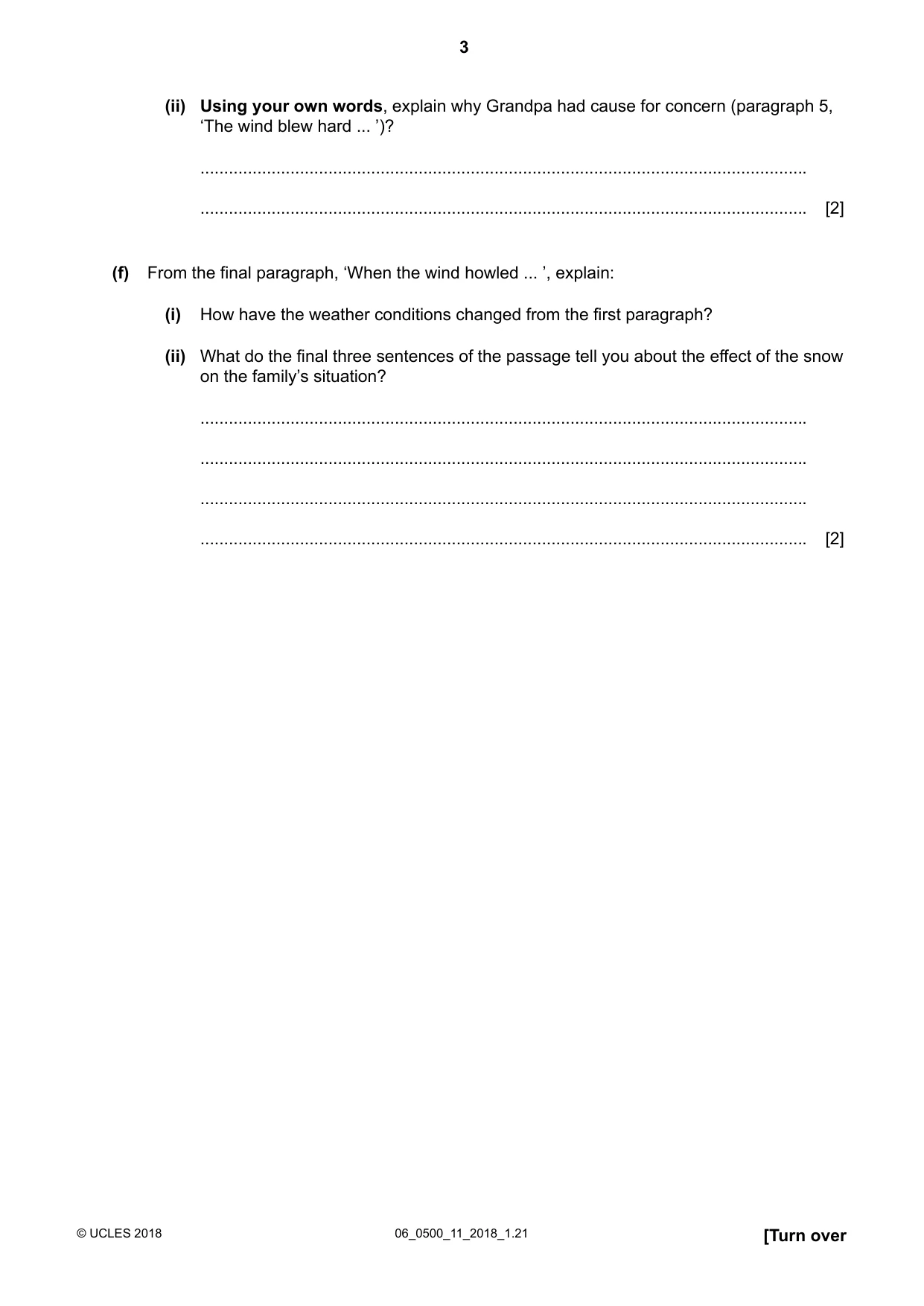
Using your own words, explain why Grandpa had cause for concern (paragraph 5, ‘The wind blew hard ... ’)? (ii) … … [2] From the final paragraph, ‘When the wind howled ... ’, explain: (f) How have the weather conditions changed from the first paragraph? (i) What do the final three sentences of the passage tell you about the effect of the snow on the family’s situation? (ii) … … … … [2] [Turn over 06_0500_11_2018_1.21 © UCLES 2018 3
Question paper, page 4
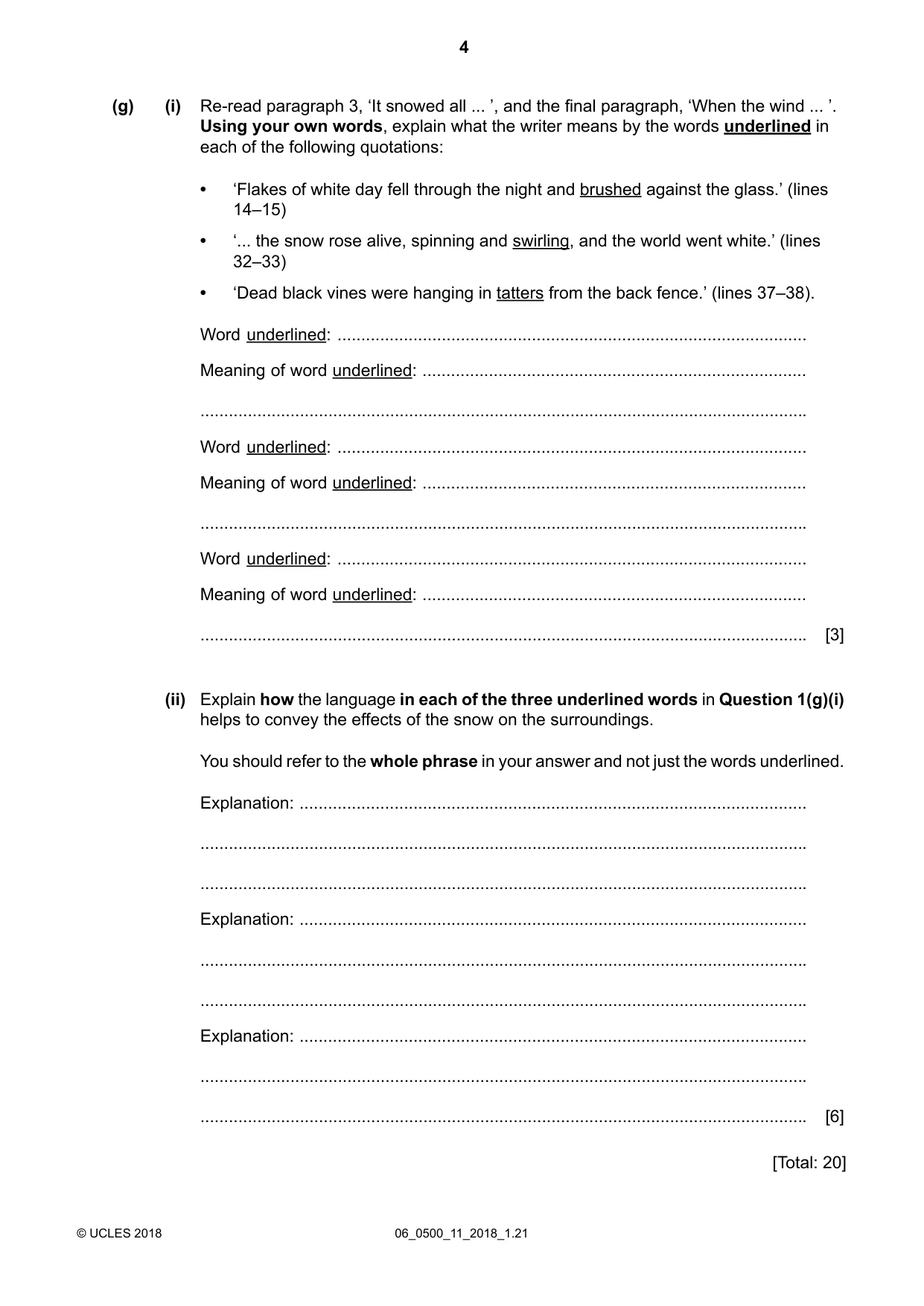
Re-read paragraph 3, ‘It snowed all ... ’, and the final paragraph, ‘When the wind ... ’. Using your own words, explain what the writer means by the words underlined in each of the following quotations: (i) (g) • ‘Flakes of white day fell through the night and brushed against the glass.’ (lines 14–15) • ‘... the snow rose alive, spinning and swirling, and the world went white.’ (lines 32–33) • ‘Dead black vines were hanging in tatters from the back fence.’ (lines 37–38). Word underlined: … Meaning of word underlined: … … Word underlined: … Meaning of word underlined: … … Word underlined: … Meaning of word underlined: … … [3] Explain how the language in each of the three underlined words in Question 1(g)(i) helps to convey the effects of the snow on the surroundings. You should refer to the whole phrase in your answer and not just the words underlined. (ii) Explanation: … … … Explanation: … … … Explanation: … … … [6] [Total: 20] 06_0500_11_2018_1.21 © UCLES 2018 4
Question paper, page 5
Question 2 Imagine that you are Grandma, from Passage A. It is two weeks later and the snow has finally gone. Write a letter to your sister who lives in another part of the country, telling her about all that has happened. In your letter you should cover the following points: • what happened during the first few days of the snowstorm • how the people in your household and the neighbours reacted to the snow • the problems caused by the snow and how you and your family coped with them. Base your letter on what you have read in Passage A, but do not copy from it. Be careful to use your own words. Address each of the three bullet points. Begin your letter, ‘My dearest ... ’ Write about 200 to 300 words. Up to 10 marks are available for the content of your answer, and up to 5 marks for the quality of your writing. … … … … … … … … … … … … … … … … … [Turn over 06_0500_11_2018_1.21 © UCLES 2018 5
Question paper, page 6
… … … … … … … … … … … … … … … … … … … … … … … … … … … … 06_0500_11_2018_1.21 © UCLES 2018 6
Question paper, page 7
… … … … … … … … … … … … … … … … … … … … … … … … … … [15] [Turn over 06_0500_11_2018_1.21 © UCLES 2018 7
Question paper, page 8
Read carefully Passage B, The Viking explorer who beat Columbus to North America, in the Reading Booklet Insert and then answer Question 3(a) and (b) on this Question Paper. Question 3 Answer the questions in the order set. Notes What do you learn from Passage B about the Vikings’ discovery of North America and what they found there? Write your answers using short notes. You do not need to use your own words. Up to 10 marks are available for the content of your answer. Information about the Vikings’ discovery of North America and what they found there. (a) 1… 2… 3… 4… 5… 6… 7… 8… 9… 10… [10] 06_0500_11_2018_1.21 © UCLES 2018 8
Question paper, page 9
Summary Now use your notes to write a summary of what Passage B tells you about the Vikings’ discovery of North America and what they found there. You must use continuous writing (not note form) and use your own words as far as possible. Your summary should include all 10 of your points in Question 3(a) and must be 100 to 150 words. Up to 5 marks are available for the quality of your writing. (b) … … … … … … … … … … … … … … … [5] [Total: 15] [Turn over 06_0500_11_2018_1.21 © UCLES 2018 9
Question paper, page 10
Additional Page If you use the following lined page to complete the answer(s) to any question(s), the question number(s) must be clearly shown. … … … … … … … … … … … … … … … … … … … … … … … … … 06_0500_11_2018_1.21 © UCLES 2018 10
Question paper, page 11
Additional Page If you use the following lined page to complete the answer(s) to any question(s), the question number(s) must be clearly shown. … … … … … … … … … … … … … … … … … … … … … … … … … 06_0500_11_2018_1.21 © UCLES 2018 11
Question paper, page 12
BLANK PAGE Permission to reproduce items where third-party owned material protected by copyright is included has been sought and cleared where possible. Every reasonable effort has been made by the publisher (UCLES) to trace copyright holders, but if any items requiring clearance have unwittingly been included, the publisher will be pleased to make amends at the earliest possible opportunity. To avoid the issue of disclosure of answer-related information to candidates, all copyright acknowledgements are reproduced online in the Cambridge International Examinations Copyright Acknowledgements Booklet. This is produced for each series of examinations and is freely available to download at www.cie.org.uk after the live examination series. Cambridge International Examinations is part of the Cambridge Assessment Group. Cambridge Assessment is the brand name of University of Cambridge Local Examinations Syndicate (UCLES), which is itself a department of the University of Cambridge. 06_0500_11_2018_1.21 © UCLES 2018 12
Mark scheme, page 1
IGCSE™ is a registered trademark. This document consists of 16 printed pages. © UCLES 2018 [Turn over Cambridge Assessment International Education Cambridge International General Certificate of Secondary Education FIRST LANGUAGE ENGLISH 0500/11 Paper 1 Reading Passages (Core) May/June 2018 MARK SCHEME Maximum Mark: 50 Published This mark scheme is published as an aid to teachers and candidates, to indicate the requirements of the examination. It shows the basis on which Examiners were instructed to award marks. It does not indicate the details of the discussions that took place at an Examiners’ meeting before marking began, which would have considered the acceptability of alternative answers. Mark schemes should be read in conjunction with the question paper and the Principal Examiner Report for Teachers. Cambridge International will not enter into discussions about these mark schemes. Cambridge International is publishing the mark schemes for the May/June 2018 series for most Cambridge IGCSE™, Cambridge International A and AS Level and Cambridge Pre-U components, and some Cambridge O Level components.
Mark scheme, page 2
0500/11 Cambridge IGCSE – Mark Scheme PUBLISHED May/June 2018 © UCLES 2018 Page 2 of 16 Generic Marking Principles These general marking principles must be applied by all examiners when marking candidate answers. They should be applied alongside the specific content of the mark scheme or generic level descriptors for a question. Each question paper and mark scheme will also comply with these marking principles. GENERIC MARKING PRINCIPLE 1: Marks must be awarded in line with: • the specific content of the mark scheme or the generic level descriptors for the question • the specific skills defined in the mark scheme or in the generic level descriptors for the question • the standard of response required by a candidate as exemplified by the standardisation scripts. GENERIC MARKING PRINCIPLE 2: Marks awarded are always whole marks (not half marks, or other fractions). GENERIC MARKING PRINCIPLE 3: Marks must be awarded positively: • marks are awarded for correct/valid answers, as defined in the mark scheme. However, credit is given for valid answers which go beyond the scope of the syllabus and mark scheme, referring to your Team Leader as appropriate • marks are awarded when candidates clearly demonstrate what they know and can do • marks are not deducted for errors • marks are not deducted for omissions • answers should only be judged on the quality of spelling, punctuation and grammar when these features are specifically assessed by the question as indicated by the mark scheme. The meaning, however, should be unambiguous. GENERIC MARKING PRINCIPLE 4: Rules must be applied consistently e.g. in situations where candidates have not followed instructions or in the application of generic level descriptors.
Mark scheme, page 3
0500/11 Cambridge IGCSE – Mark Scheme PUBLISHED May/June 2018 © UCLES 2018 Page 3 of 16 GENERIC MARKING PRINCIPLE 5: Marks should be awarded using the full range of marks defined in the mark scheme for the question (however; the use of the full mark range may be limited according to the quality of the candidate responses seen). GENERIC MARKING PRINCIPLE 6: Marks awarded are based solely on the requirements as defined in the mark scheme. Marks should not be awarded with grade thresholds or grade descriptors in mind.
Mark scheme, page 4
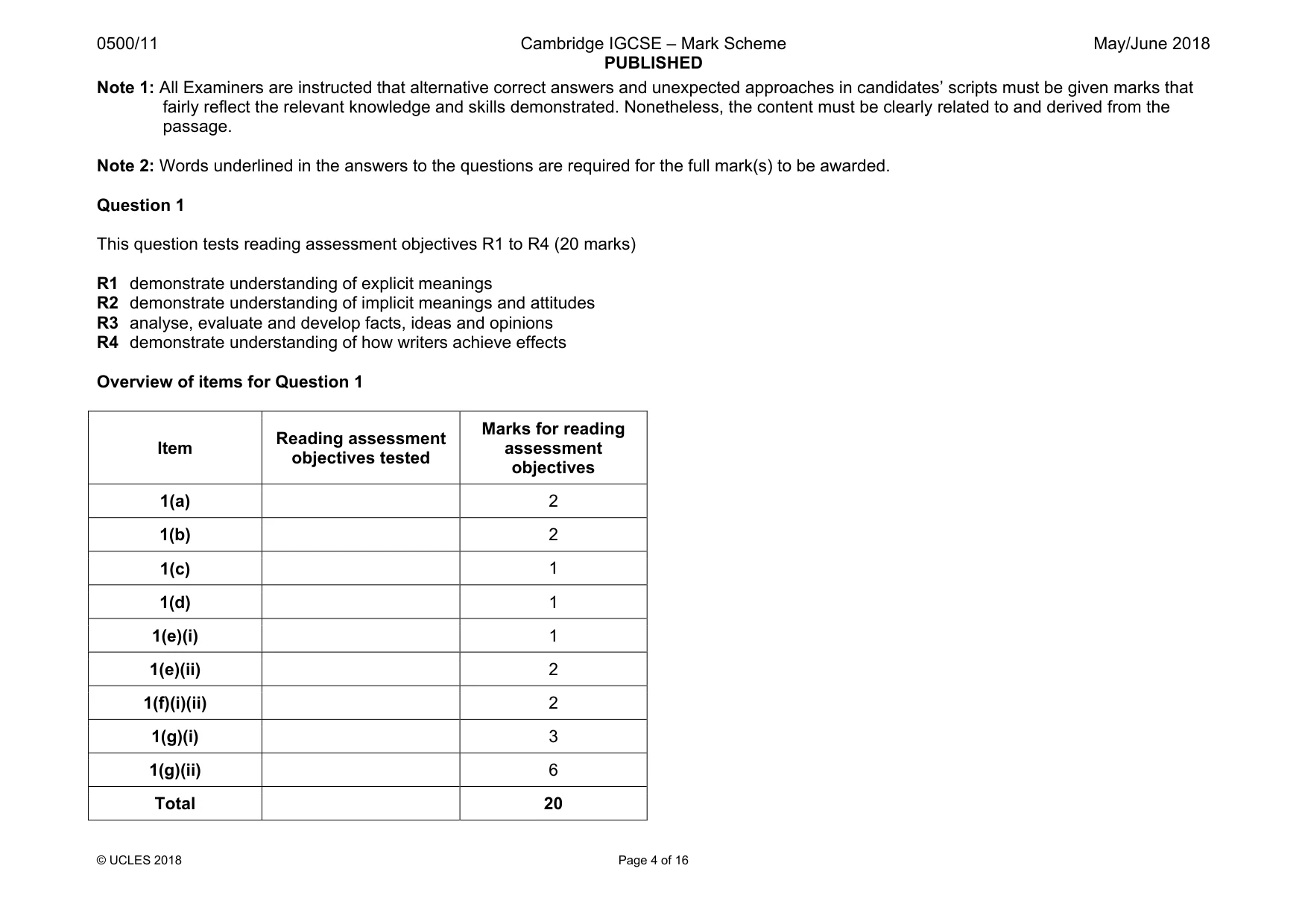
0500/11 Cambridge IGCSE – Mark Scheme PUBLISHED May/June 2018 © UCLES 2018 Page 4 of 16 Note 1: All Examiners are instructed that alternative correct answers and unexpected approaches in candidates’ scripts must be given marks that fairly reflect the relevant knowledge and skills demonstrated. Nonetheless, the content must be clearly related to and derived from the passage. Note 2: Words underlined in the answers to the questions are required for the full mark(s) to be awarded. Question 1 This question tests reading assessment objectives R1 to R4 (20 marks) R1 demonstrate understanding of explicit meanings R2 demonstrate understanding of implicit meanings and attitudes R3 analyse, evaluate and develop facts, ideas and opinions R4 demonstrate understanding of how writers achieve effects Overview of items for Question 1 Item Reading assessment objectives tested Marks for reading assessment objectives 1(a) 2 1(b) 2 1(c) 1 1(d) 1 1(e)(i) 1 1(e)(ii) 2 1(f)(i)(ii) 2 1(g)(i) 3 1(g)(ii) 6 Total 20
Mark scheme, page 5
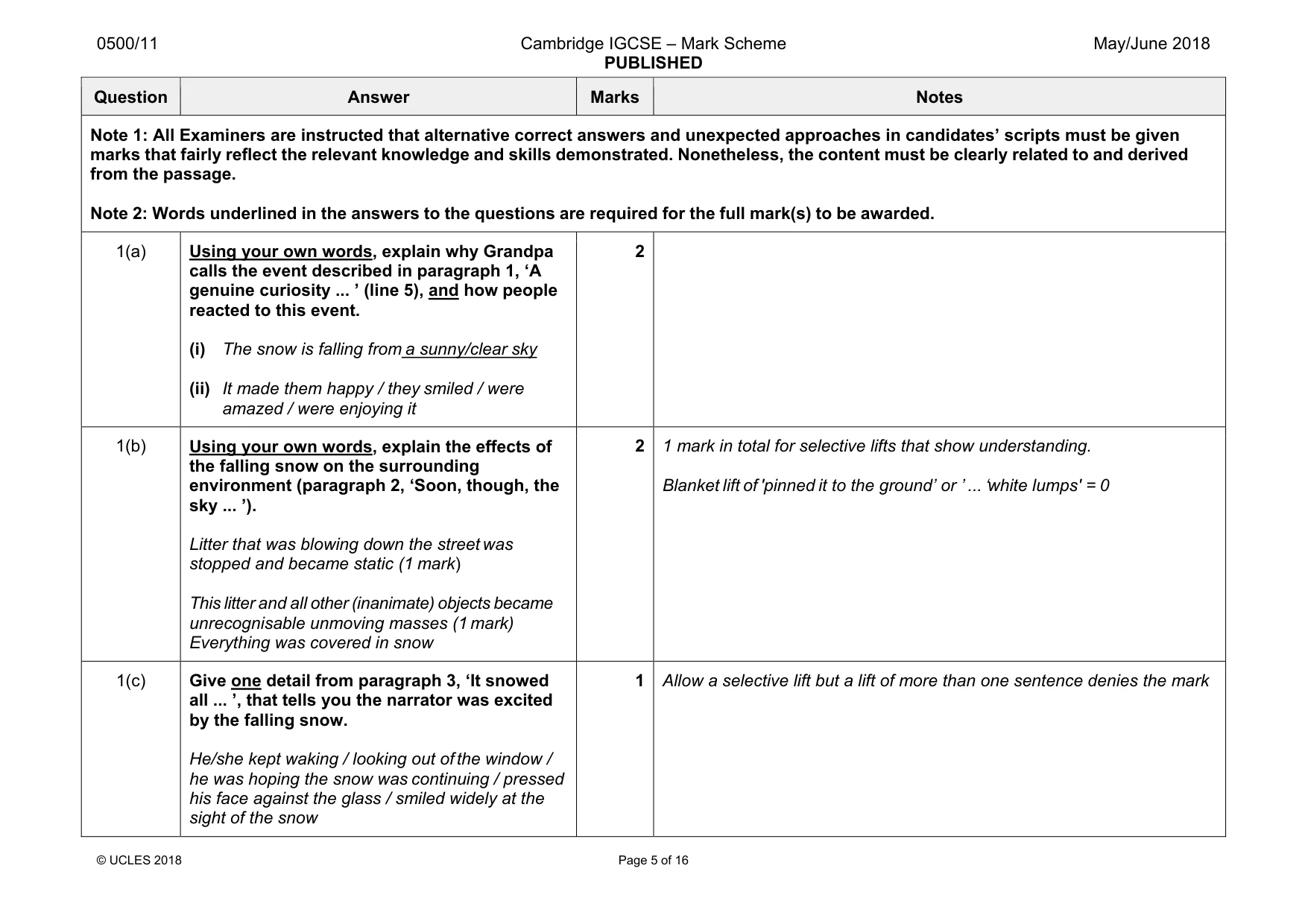
0500/11 Cambridge IGCSE – Mark Scheme PUBLISHED May/June 2018 © UCLES 2018 Page 5 of 16 Question Answer Marks Notes Note 1: All Examiners are instructed that alternative correct answers and unexpected approaches in candidates’ scripts must be given marks that fairly reflect the relevant knowledge and skills demonstrated. Nonetheless, the content must be clearly related to and derived from the passage. Note 2: Words underlined in the answers to the questions are required for the full mark(s) to be awarded. 1(a) Using your own words, explain why Grandpa calls the event described in paragraph 1, ‘A genuine curiosity ... ’ (line 5), and how people reacted to this event. (i) The snow is falling from a sunny/clear sky (ii) It made them happy / they smiled / were amazed / were enjoying it 2 1(b) Using your own words, explain the effects of the falling snow on the surrounding environment (paragraph 2, ‘Soon, though, the sky ... ’). Litter that was blowing down the street was stopped and became static (1 mark) This litter and all other (inanimate) objects became unrecognisable unmoving masses (1 mark) Everything was covered in snow 2 1 mark in total for selective lifts that show understanding. Blanket lift of 'pinned it to the ground’ or ’ ... ‘white lumps' = 0 1(c) Give one detail from paragraph 3, ‘It snowed all ... ’, that tells you the narrator was excited by the falling snow. He/she kept waking / looking out of the window / he was hoping the snow was continuing / pressed his face against the glass / smiled widely at the sight of the snow 1 Allow a selective lift but a lift of more than one sentence denies the mark
Mark scheme, page 6
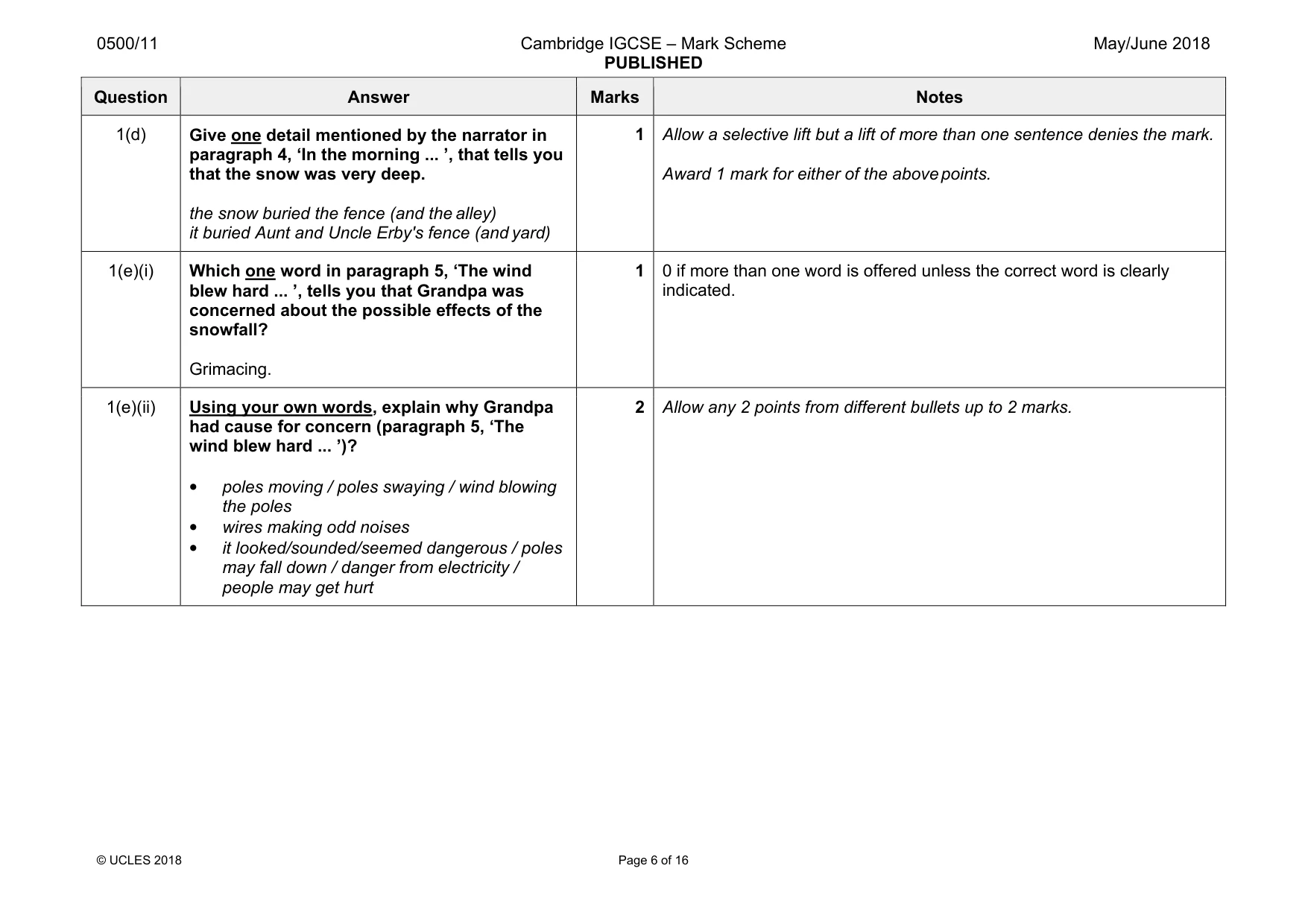
0500/11 Cambridge IGCSE – Mark Scheme PUBLISHED May/June 2018 © UCLES 2018 Page 6 of 16 Question Answer Marks Notes 1(d) Give one detail mentioned by the narrator in paragraph 4, ‘In the morning ... ’, that tells you that the snow was very deep. the snow buried the fence (and the alley) it buried Aunt and Uncle Erby's fence (and yard) 1 Allow a selective lift but a lift of more than one sentence denies the mark. Award 1 mark for either of the above points. 1(e)(i) Which one word in paragraph 5, ‘The wind blew hard ... ’, tells you that Grandpa was concerned about the possible effects of the snowfall? Grimacing. 1 0 if more than one word is offered unless the correct word is clearly indicated. 1(e)(ii) Using your own words, explain why Grandpa had cause for concern (paragraph 5, ‘The wind blew hard ... ’)? • poles moving / poles swaying / wind blowing the poles • wires making odd noises • it looked/sounded/seemed dangerous / poles may fall down / danger from electricity / people may get hurt 2 Allow any 2 points from different bullets up to 2 marks.
Mark scheme, page 7
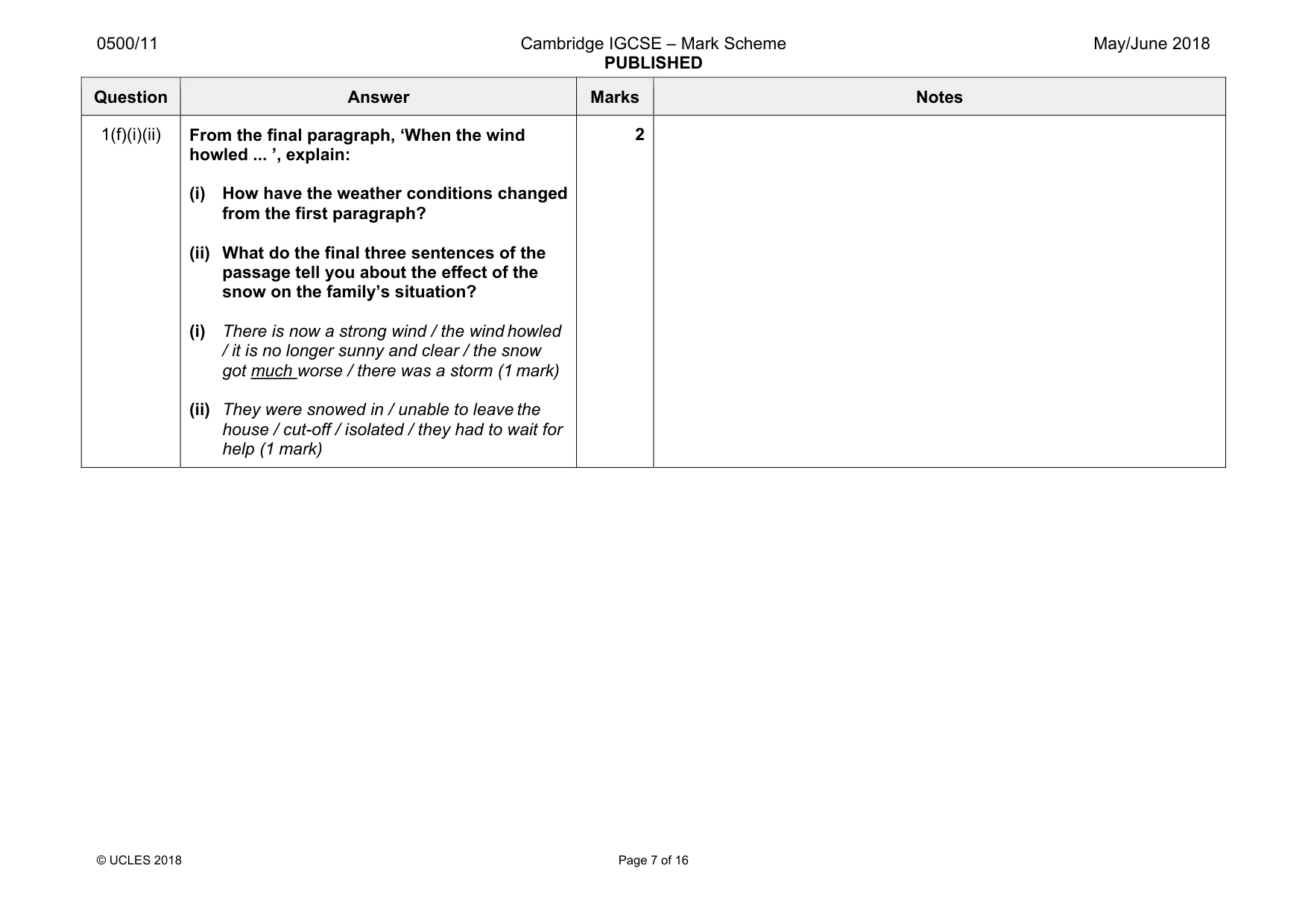
0500/11 Cambridge IGCSE – Mark Scheme PUBLISHED May/June 2018 © UCLES 2018 Page 7 of 16 Question Answer Marks Notes 1(f)(i)(ii) From the final paragraph, ‘When the wind howled ... ’, explain: (i) How have the weather conditions changed from the first paragraph? (ii) What do the final three sentences of the passage tell you about the effect of the snow on the family’s situation? (i) There is now a strong wind / the wind howled / it is no longer sunny and clear / the snow got much worse / there was a storm (1 mark) (ii) They were snowed in / unable to leave the house / cut-off / isolated / they had to wait for help (1 mark) 2
Mark scheme, page 8
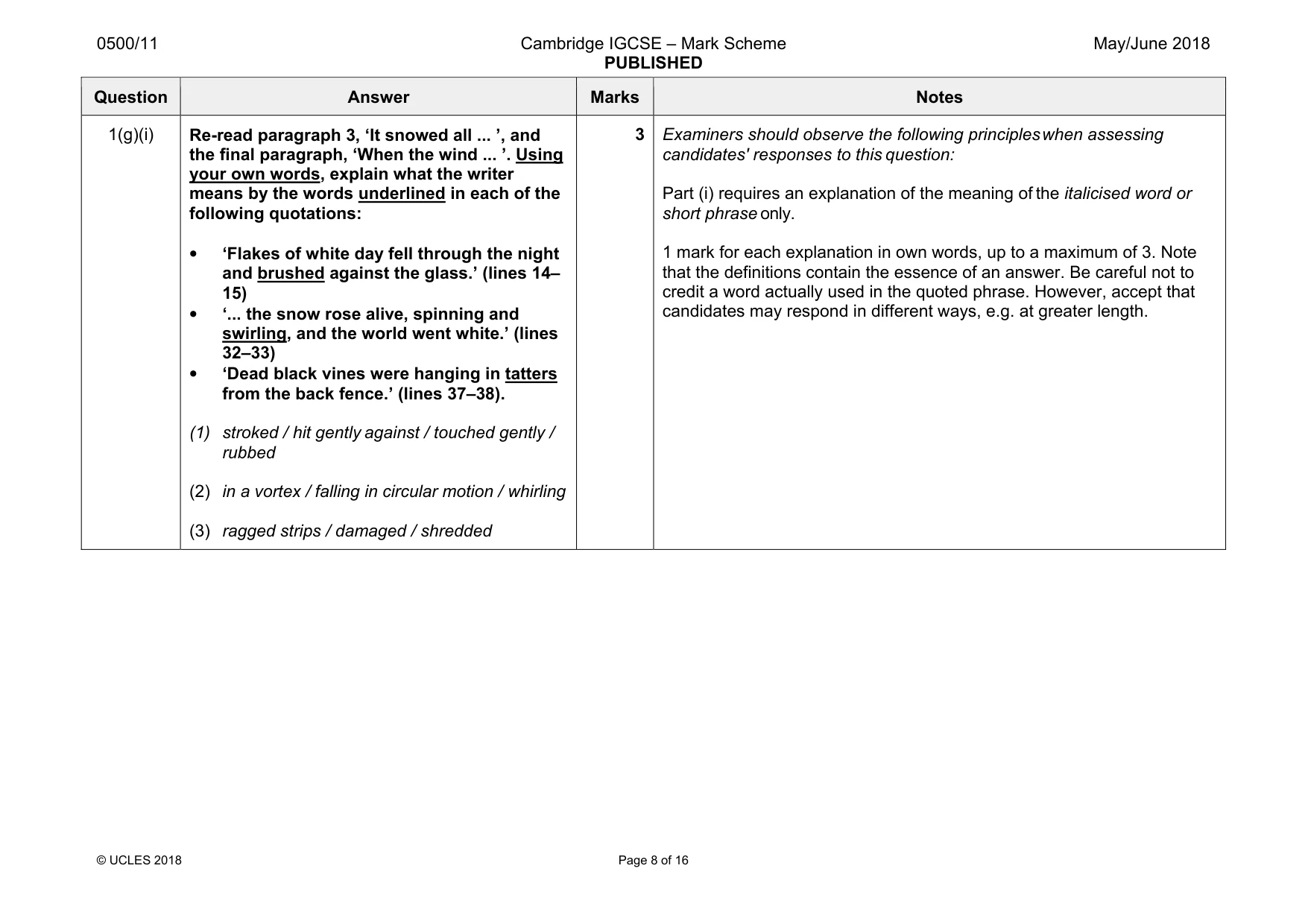
0500/11 Cambridge IGCSE – Mark Scheme PUBLISHED May/June 2018 © UCLES 2018 Page 8 of 16 Question Answer Marks Notes 1(g)(i) Re-read paragraph 3, ‘It snowed all ... ’, and the final paragraph, ‘When the wind ... ’. Using your own words, explain what the writer means by the words underlined in each of the following quotations: • ‘Flakes of white day fell through the night and brushed against the glass.’ (lines 14– 15) • ‘... the snow rose alive, spinning and swirling, and the world went white.’ (lines 32–33) • ‘Dead black vines were hanging in tatters from the back fence.’ (lines 37–38). (1) stroked / hit gently against / touched gently / rubbed (2) in a vortex / falling in circular motion / whirling (3) ragged strips / damaged / shredded 3 Examiners should observe the following principles when assessing candidates' responses to this question: Part (i) requires an explanation of the meaning of the italicised word or short phrase only. 1 mark for each explanation in own words, up to a maximum of 3. Note that the definitions contain the essence of an answer. Be careful not to credit a word actually used in the quoted phrase. However, accept that candidates may respond in different ways, e.g. at greater length.
Mark scheme, page 9
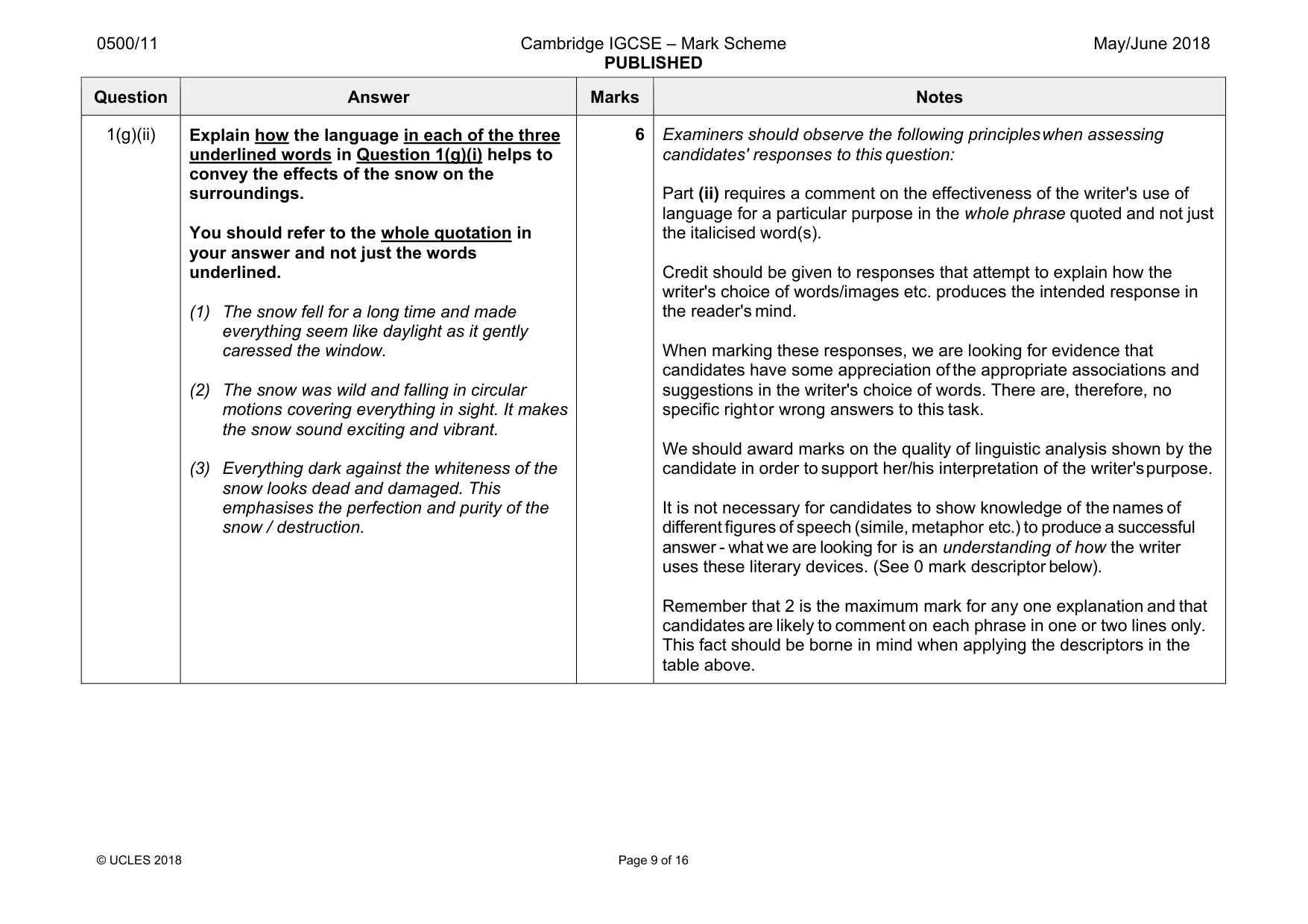
0500/11 Cambridge IGCSE – Mark Scheme PUBLISHED May/June 2018 © UCLES 2018 Page 9 of 16 Question Answer Marks Notes 1(g)(ii) Explain how the language in each of the three underlined words in Question 1(g)(i) helps to convey the effects of the snow on the surroundings. You should refer to the whole quotation in your answer and not just the words underlined. (1) The snow fell for a long time and made everything seem like daylight as it gently caressed the window. (2) The snow was wild and falling in circular motions covering everything in sight. It makes the snow sound exciting and vibrant. (3) Everything dark against the whiteness of the snow looks dead and damaged. This emphasises the perfection and purity of the snow / destruction. 6 Examiners should observe the following principles when assessing candidates' responses to this question: Part (ii) requires a comment on the effectiveness of the writer's use of language for a particular purpose in the whole phrase quoted and not just the italicised word(s). Credit should be given to responses that attempt to explain how the writer's choice of words/images etc. produces the intended response in the reader's mind. When marking these responses, we are looking for evidence that candidates have some appreciation of the appropriate associations and suggestions in the writer's choice of words. There are, therefore, no specific right or wrong answers to this task. We should award marks on the quality of linguistic analysis shown by the candidate in order to support her/his interpretation of the writer's purpose. It is not necessary for candidates to show knowledge of the names of different figures of speech (simile, metaphor etc.) to produce a successful answer - what we are looking for is an understanding of how the writer uses these literary devices. (See 0 mark descriptor below). Remember that 2 is the maximum mark for any one explanation and that candidates are likely to comment on each phrase in one or two lines only. This fact should be borne in mind when applying the descriptors in the table above.
Mark scheme, page 10
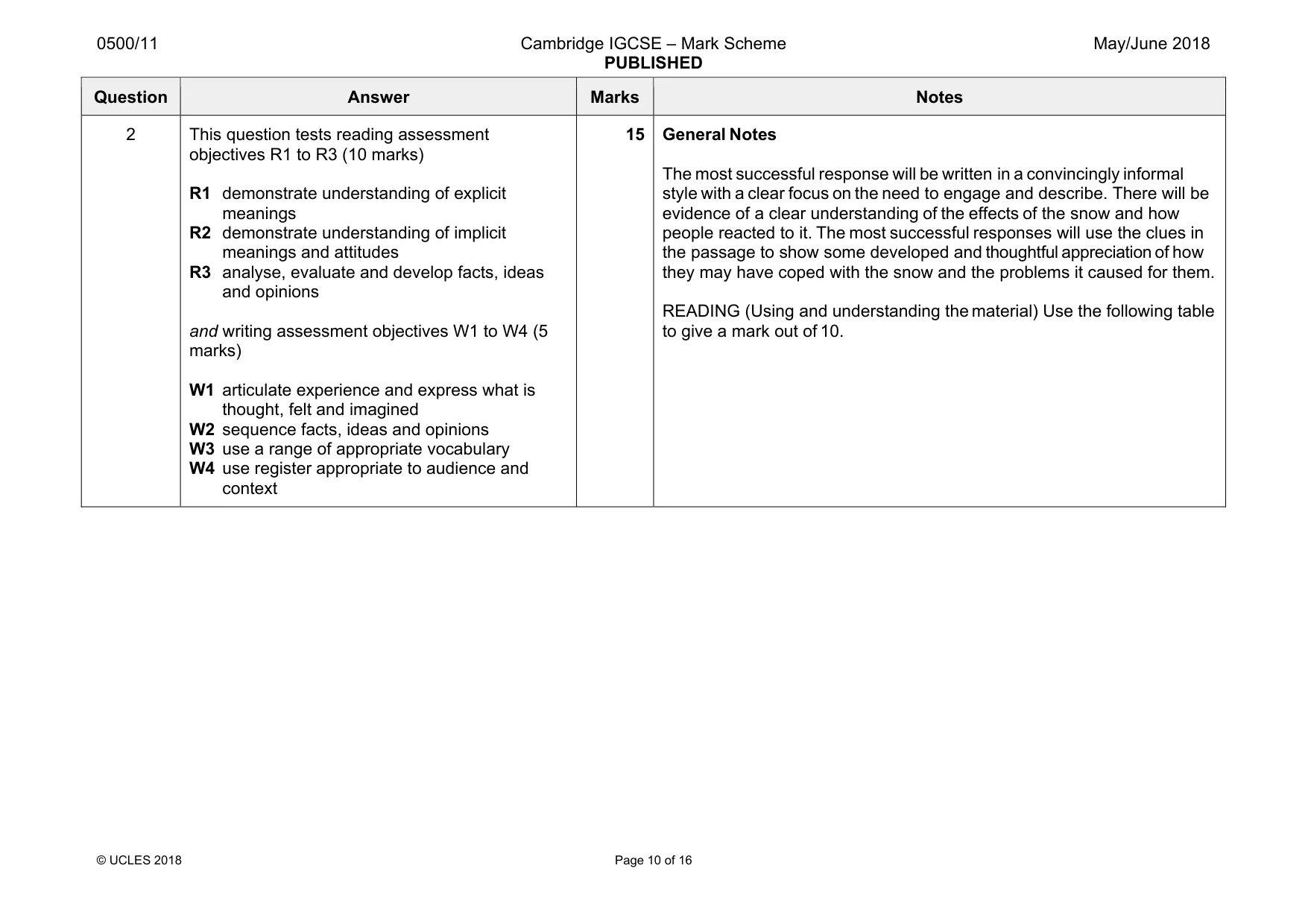
0500/11 Cambridge IGCSE – Mark Scheme PUBLISHED May/June 2018 © UCLES 2018 Page 10 of 16 Question Answer Marks Notes 2 This question tests reading assessment objectives R1 to R3 (10 marks) R1 demonstrate understanding of explicit meanings R2 demonstrate understanding of implicit meanings and attitudes R3 analyse, evaluate and develop facts, ideas and opinions and writing assessment objectives W1 to W4 (5 marks) W1 articulate experience and express what is thought, felt and imagined W2 sequence facts, ideas and opinions W3 use a range of appropriate vocabulary W4 use register appropriate to audience and context 15 General Notes The most successful response will be written in a convincingly informal style with a clear focus on the need to engage and describe. There will be evidence of a clear understanding of the effects of the snow and how people reacted to it. The most successful responses will use the clues in the passage to show some developed and thoughtful appreciation of how they may have coped with the snow and the problems it caused for them. READING (Using and understanding the material) Use the following table to give a mark out of 10.
Mark scheme, page 11
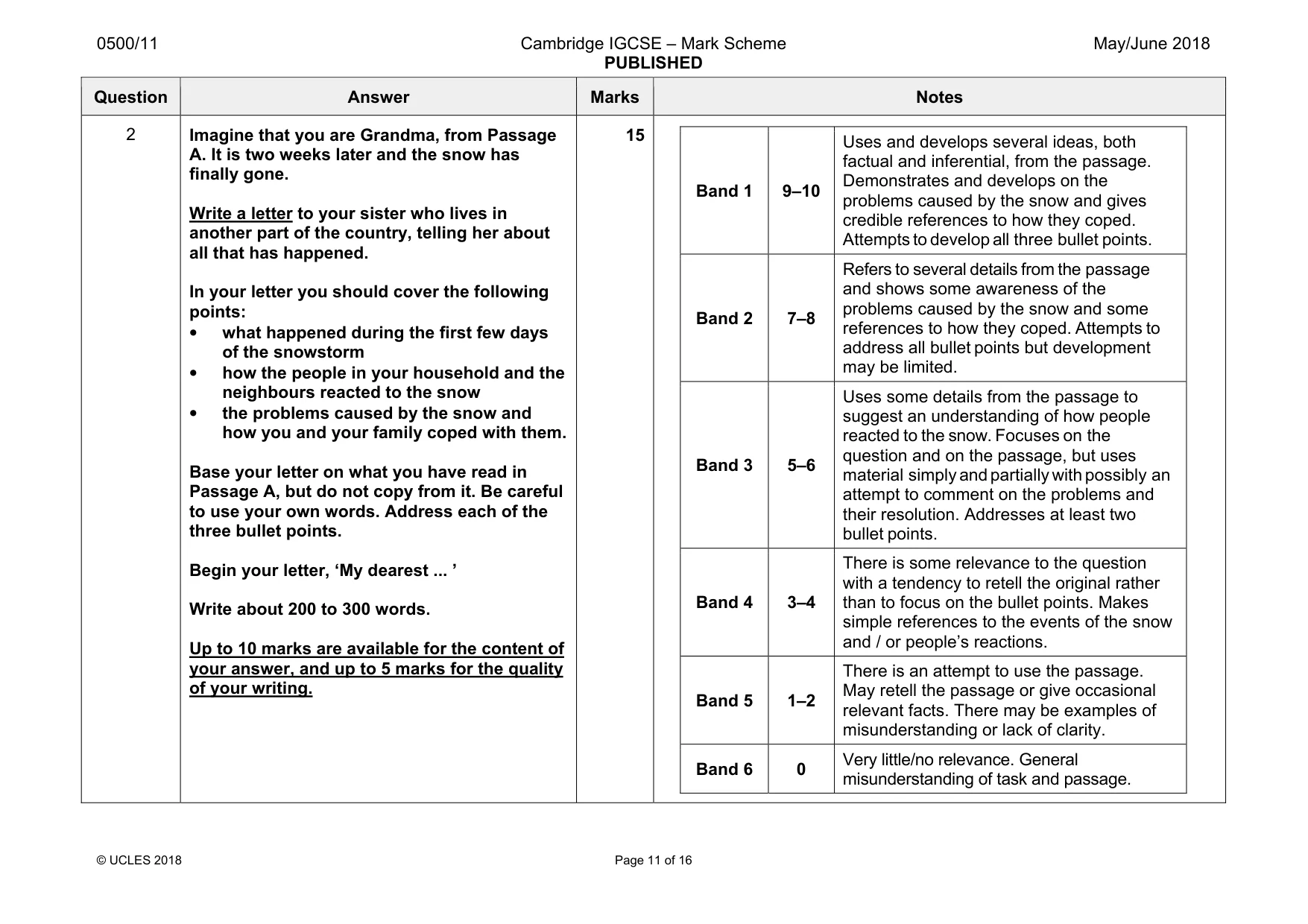
0500/11 Cambridge IGCSE – Mark Scheme PUBLISHED May/June 2018 © UCLES 2018 Page 11 of 16 Question Answer Marks Notes 2 Imagine that you are Grandma, from Passage A. It is two weeks later and the snow has finally gone. Write a letter to your sister who lives in another part of the country, telling her about all that has happened. In your letter you should cover the following points: • what happened during the first few days of the snowstorm • how the people in your household and the neighbours reacted to the snow • the problems caused by the snow and how you and your family coped with them. Base your letter on what you have read in Passage A, but do not copy from it. Be careful to use your own words. Address each of the three bullet points. Begin your letter, ‘My dearest ... ’ Write about 200 to 300 words. Up to 10 marks are available for the content of your answer, and up to 5 marks for the quality of your writing. 15 Band 1 9–10 Uses and develops several ideas, both factual and inferential, from the passage. Demonstrates and develops on the problems caused by the snow and gives credible references to how they coped. Attempts to develop all three bullet points. Band 2 7–8 Refers to several details from the passage and shows some awareness of the problems caused by the snow and some references to how they coped. Attempts to address all bullet points but development may be limited. Band 3 5–6 Uses some details from the passage to suggest an understanding of how people reacted to the snow. Focuses on the question and on the passage, but uses material simply and partially with possibly an attempt to comment on the problems and their resolution. Addresses at least two bullet points. Band 4 3–4 There is some relevance to the question with a tendency to retell the original rather than to focus on the bullet points. Makes simple references to the events of the snow and / or people’s reactions. Band 5 1–2 There is an attempt to use the passage. May retell the passage or give occasional relevant facts. There may be examples of misunderstanding or lack of clarity. Band 6 0 Very little/no relevance. General misunderstanding of task and passage.
Mark scheme, page 12
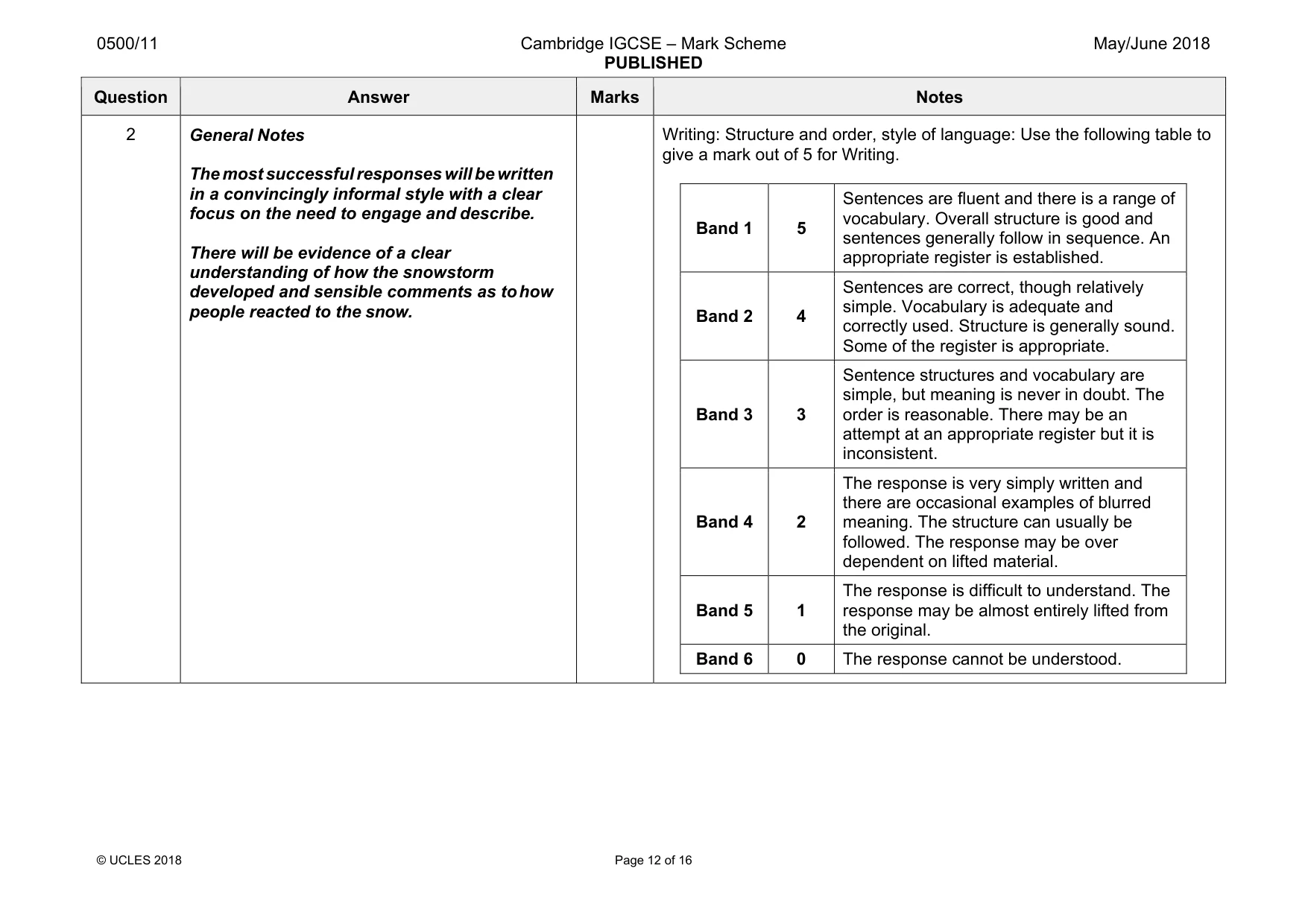
0500/11 Cambridge IGCSE – Mark Scheme PUBLISHED May/June 2018 © UCLES 2018 Page 12 of 16 Question Answer Marks Notes 2 General Notes The most successful responses will be written in a convincingly informal style with a clear focus on the need to engage and describe. There will be evidence of a clear understanding of how the snowstorm developed and sensible comments as to how people reacted to the snow. Writing: Structure and order, style of language: Use the following table to give a mark out of 5 for Writing. Band 1 5 Sentences are fluent and there is a range of vocabulary. Overall structure is good and sentences generally follow in sequence. An appropriate register is established. Band 2 4 Sentences are correct, though relatively simple. Vocabulary is adequate and correctly used. Structure is generally sound. Some of the register is appropriate. Band 3 3 Sentence structures and vocabulary are simple, but meaning is never in doubt. The order is reasonable. There may be an attempt at an appropriate register but it is inconsistent. Band 4 2 The response is very simply written and there are occasional examples of blurred meaning. The structure can usually be followed. The response may be over dependent on lifted material. Band 5 1 The response is difficult to understand. The response may be almost entirely lifted from the original. Band 6 0 The response cannot be understood.
Mark scheme, page 13
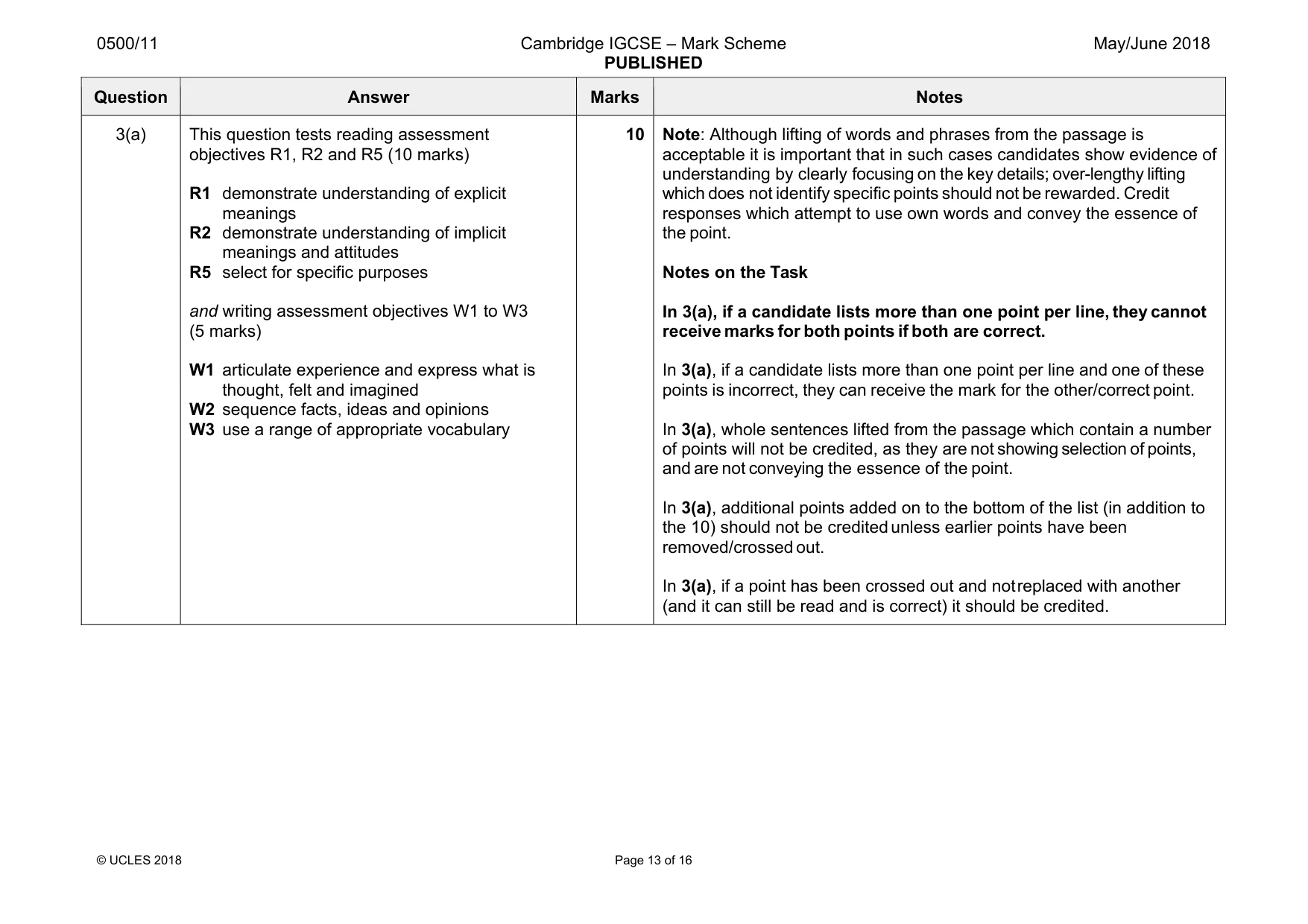
0500/11 Cambridge IGCSE – Mark Scheme PUBLISHED May/June 2018 © UCLES 2018 Page 13 of 16 Question Answer Marks Notes 3(a) This question tests reading assessment objectives R1, R2 and R5 (10 marks) R1 demonstrate understanding of explicit meanings R2 demonstrate understanding of implicit meanings and attitudes R5 select for specific purposes and writing assessment objectives W1 to W3 (5 marks) W1 articulate experience and express what is thought, felt and imagined W2 sequence facts, ideas and opinions W3 use a range of appropriate vocabulary 10 Note: Although lifting of words and phrases from the passage is acceptable it is important that in such cases candidates show evidence of understanding by clearly focusing on the key details; over-lengthy lifting which does not identify specific points should not be rewarded. Credit responses which attempt to use own words and convey the essence of the point. Notes on the Task In 3(a), if a candidate lists more than one point per line, they cannot receive marks for both points if both are correct. In 3(a), if a candidate lists more than one point per line and one of these points is incorrect, they can receive the mark for the other/correct point. In 3(a), whole sentences lifted from the passage which contain a number of points will not be credited, as they are not showing selection of points, and are not conveying the essence of the point. In 3(a), additional points added on to the bottom of the list (in addition to the 10) should not be credited unless earlier points have been removed/crossed out. In 3(a), if a point has been crossed out and not replaced with another (and it can still be read and is correct) it should be credited.
Mark scheme, page 14
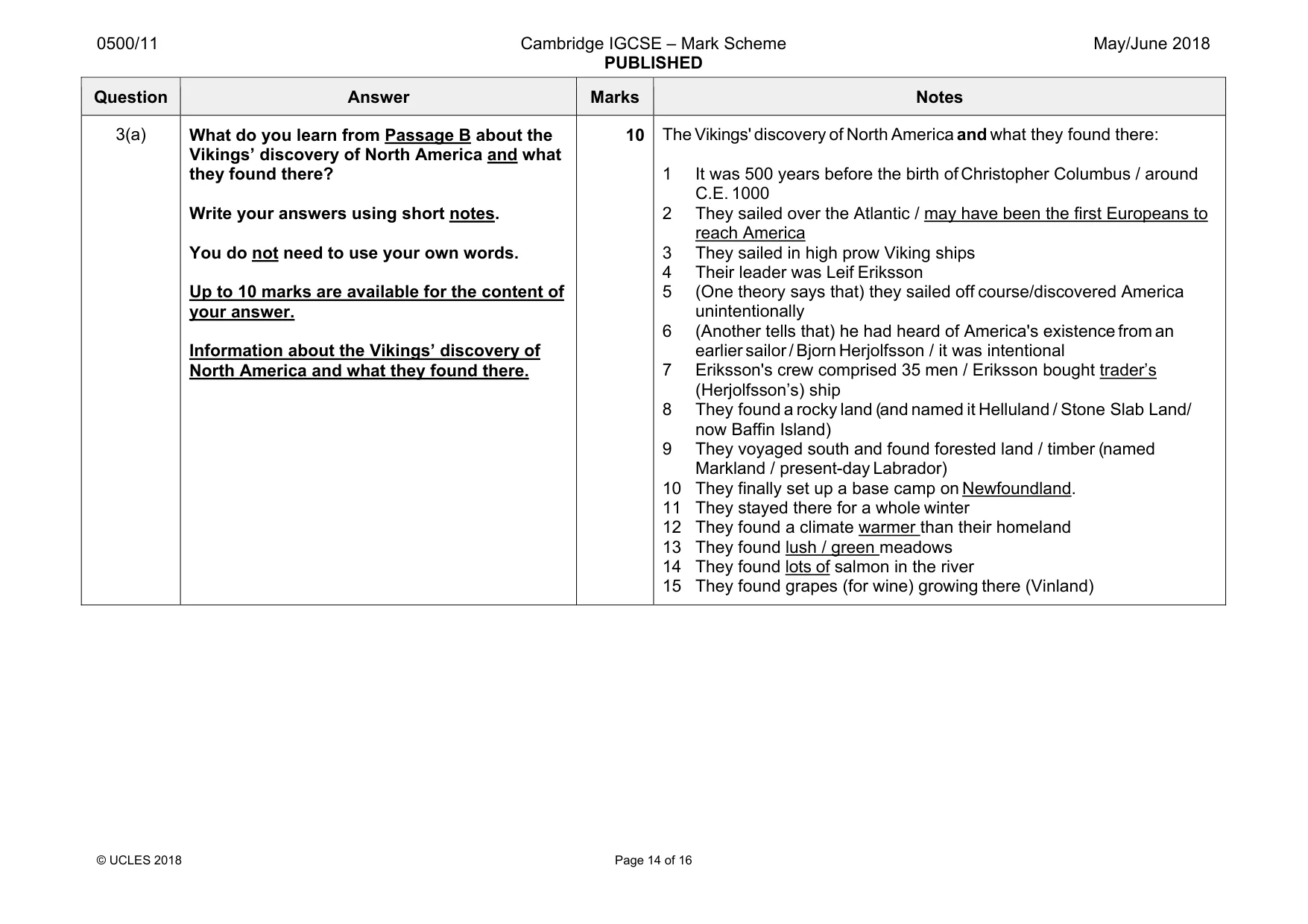
0500/11 Cambridge IGCSE – Mark Scheme PUBLISHED May/June 2018 © UCLES 2018 Page 14 of 16 Question Answer Marks Notes 3(a) What do you learn from Passage B about the Vikings’ discovery of North America and what they found there? Write your answers using short notes. You do not need to use your own words. Up to 10 marks are available for the content of your answer. Information about the Vikings’ discovery of North America and what they found there. 10 The Vikings' discovery of North America and what they found there: 1 It was 500 years before the birth of Christopher Columbus / around C.E. 1000 2 They sailed over the Atlantic / may have been the first Europeans to reach America 3 They sailed in high prow Viking ships 4 Their leader was Leif Eriksson 5 (One theory says that) they sailed off course/discovered America unintentionally 6 (Another tells that) he had heard of America's existence from an earlier sailor / Bjorn Herjolfsson / it was intentional 7 Eriksson's crew comprised 35 men / Eriksson bought trader’s (Herjolfsson’s) ship 8 They found a rocky land (and named it Helluland / Stone Slab Land/ now Baffin Island) 9 They voyaged south and found forested land / timber (named Markland / present-day Labrador) 10 They finally set up a base camp on Newfoundland. 11 They stayed there for a whole winter 12 They found a climate warmer than their homeland 13 They found lush / green meadows 14 They found lots of salmon in the river 15 They found grapes (for wine) growing there (Vinland)
Mark scheme, page 15
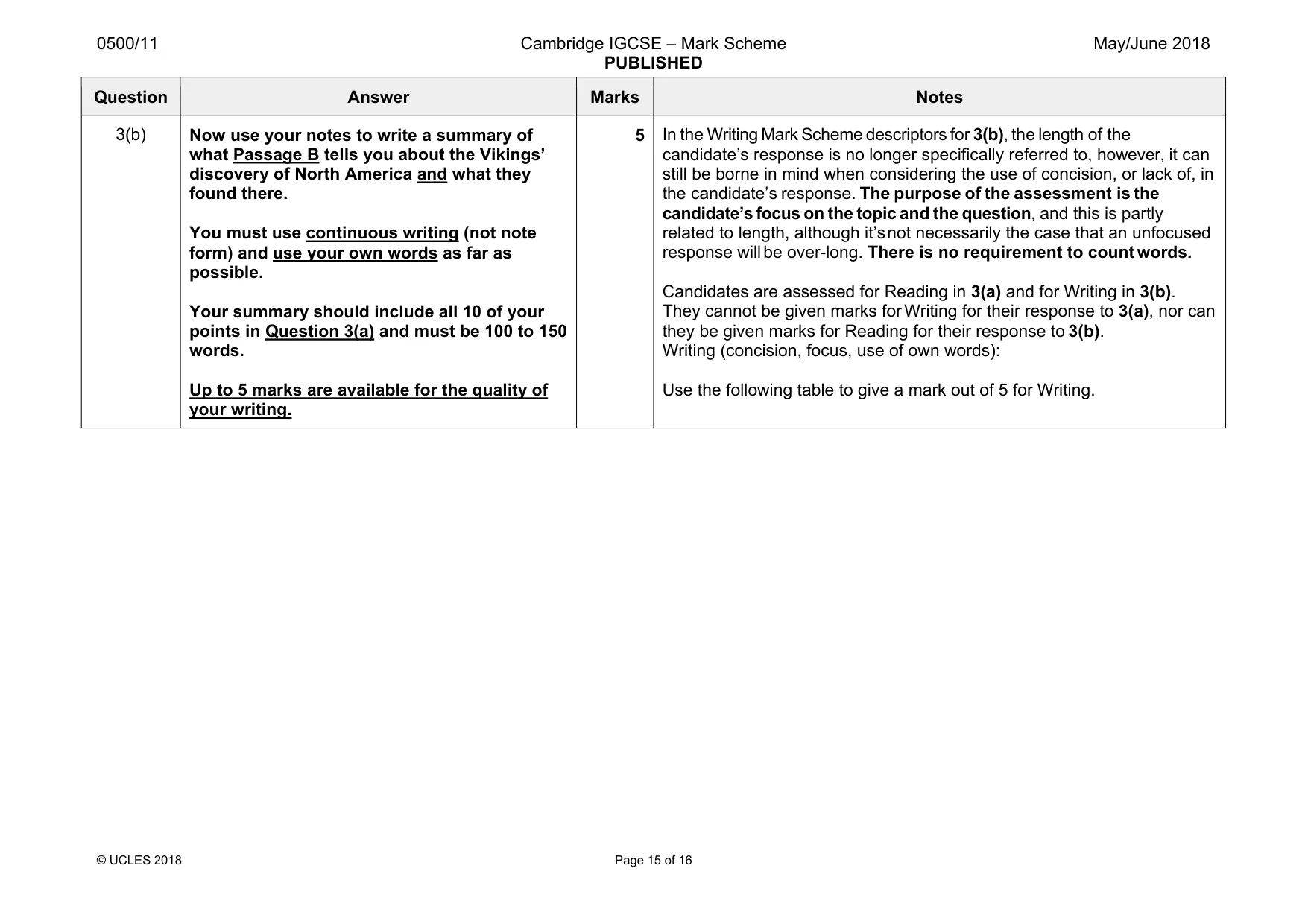
0500/11 Cambridge IGCSE – Mark Scheme PUBLISHED May/June 2018 © UCLES 2018 Page 15 of 16 Question Answer Marks Notes 3(b) Now use your notes to write a summary of what Passage B tells you about the Vikings’ discovery of North America and what they found there. You must use continuous writing (not note form) and use your own words as far as possible. Your summary should include all 10 of your points in Question 3(a) and must be 100 to 150 words. Up to 5 marks are available for the quality of your writing. 5 In the Writing Mark Scheme descriptors for 3(b), the length of the candidate’s response is no longer specifically referred to, however, it can still be borne in mind when considering the use of concision, or lack of, in the candidate’s response. The purpose of the assessment is the candidate’s focus on the topic and the question, and this is partly related to length, although it’s not necessarily the case that an unfocused response will be over-long. There is no requirement to count words. Candidates are assessed for Reading in 3(a) and for Writing in 3(b). They cannot be given marks for Writing for their response to 3(a), nor can they be given marks for Reading for their response to 3(b). Writing (concision, focus, use of own words): Use the following table to give a mark out of 5 for Writing.
Mark scheme, page 16
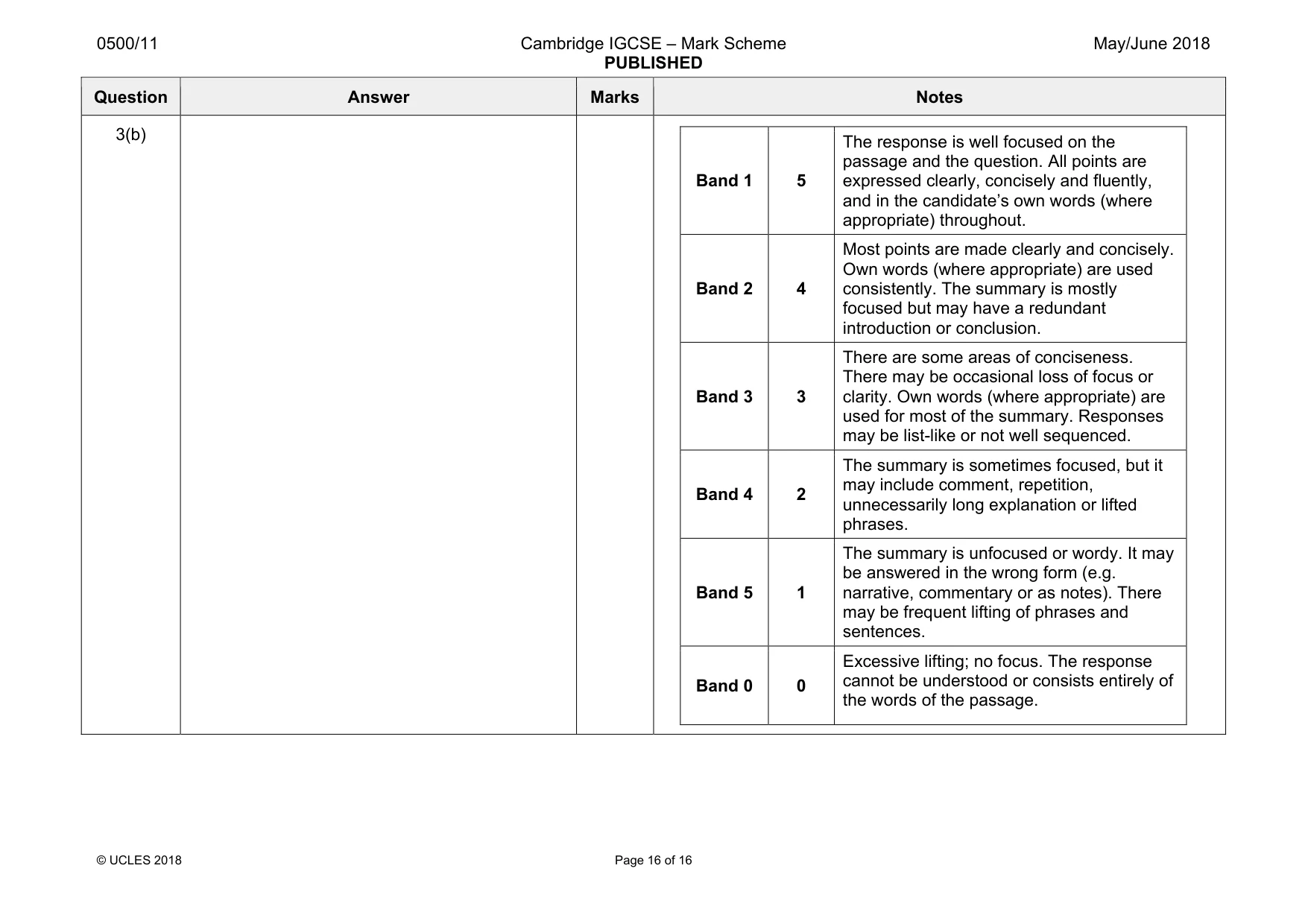
0500/11 Cambridge IGCSE – Mark Scheme PUBLISHED May/June 2018 © UCLES 2018 Page 16 of 16 Question Answer Marks Notes 3(b) Band 1 5 The response is well focused on the passage and the question. All points are expressed clearly, concisely and fluently, and in the candidate’s own words (where appropriate) throughout. Band 2 4 Most points are made clearly and concisely. Own words (where appropriate) are used consistently. The summary is mostly focused but may have a redundant introduction or conclusion. Band 3 3 There are some areas of conciseness. There may be occasional loss of focus or clarity. Own words (where appropriate) are used for most of the summary. Responses may be list-like or not well sequenced. Band 4 2 The summary is sometimes focused, but it may include comment, repetition, unnecessarily long explanation or lifted phrases. Band 5 1 The summary is unfocused or wordy. It may be answered in the wrong form (e.g. narrative, commentary or as notes). There may be frequent lifting of phrases and sentences. Band 0 0 Excessive lifting; no focus. The response cannot be understood or consists entirely of the words of the passage.
What you needed in this session
Cambridge’s own grade thresholds for 2018 May/June, Paper 1 · Variant 1. A higher threshold means an easier paper — the bar moves with how the cohort did.