Cambridge IGCSE English - First Language 0500 — 2017 Oct/Nov Paper 1 · Variant 2
0500/12/O/N/17 · 50 marks · ≈56 min
The question paper and its mark scheme, free to read here and free to download. This is Cambridge’s own paper, exactly as it was sat.
Question paper12 pages


Mark scheme8 pages
Answers below. Sit the paper first if you are practising.
Paper as text
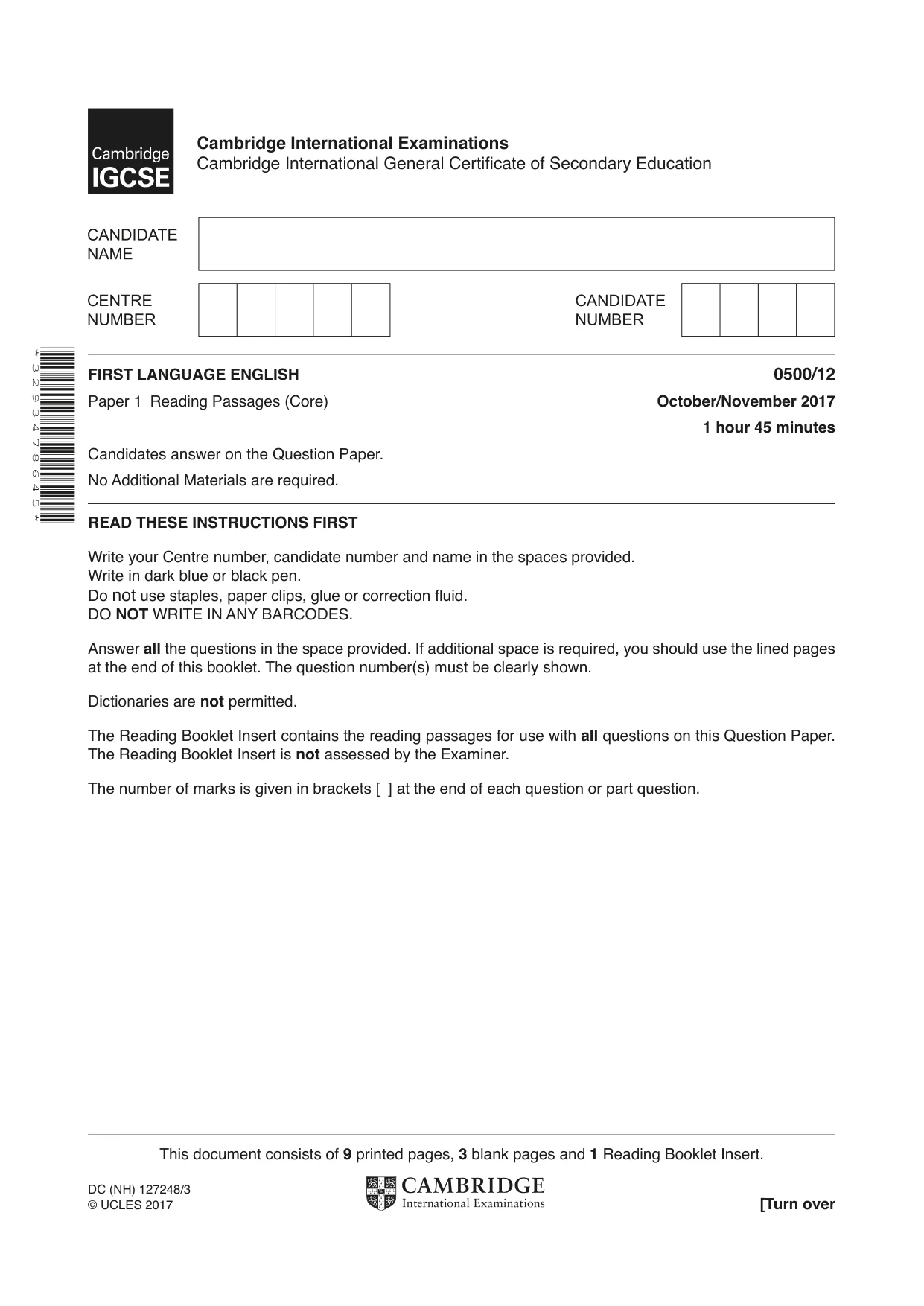
Question paper, page 1
This document consists of 9 printed pages, 3 blank pages and 1 Reading Booklet Insert. DC (NH) 127248/3 © UCLES 2017 [Turn over * 3 2 9 3 4 7 8 6 4 5 * FIRST LANGUAGE ENGLISH 0500/12 Paper 1 Reading Passages (Core) October/November 2017 1 hour 45 minutes Candidates answer on the Question Paper. No Additional Materials are required. READ THESE INSTRUCTIONS FIRST Write your Centre number, candidate number and name in the spaces provided. Write in dark blue or black pen. Do not use staples, paper clips, glue or correction fluid. DO NOT WRITE IN ANY BARCODES. Answer all the questions in the space provided. If additional space is required, you should use the lined pages at the end of this booklet. The question number(s) must be clearly shown. Dictionaries are not permitted. The Reading Booklet Insert contains the reading passages for use with all questions on this Question Paper. The Reading Booklet Insert is not assessed by the Examiner. The number of marks is given in brackets [ ] at the end of each question or part question. Cambridge International Examinations Cambridge International General Certificate of Secondary Education
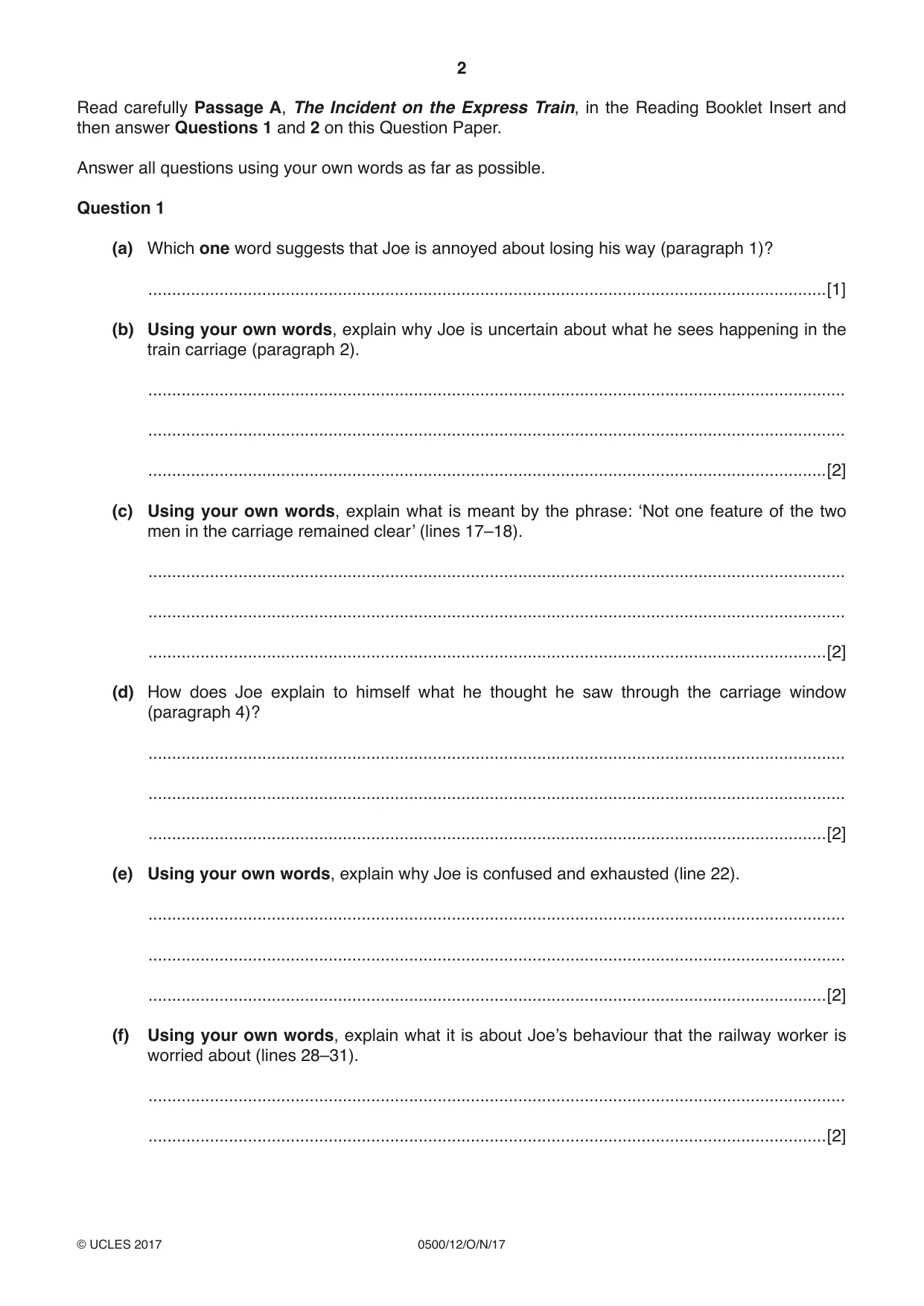
Question paper, page 2
2 0500/12/O/N/17 © UCLES 2017 Read carefully Passage A, The Incident on the Express Train, in the Reading Booklet Insert and then answer Questions 1 and 2 on this Question Paper. Answer all questions using your own words as far as possible. Question 1 (a) Which one word suggests that Joe is annoyed about losing his way (paragraph 1)? …[1] (b) Using your own words, explain why Joe is uncertain about what he sees happening in the train carriage (paragraph 2). … … …[2] (c) Using your own words, explain what is meant by the phrase: ‘Not one feature of the two men in the carriage remained clear’ (lines 17–18). … … …[2] (d) How does Joe explain to himself what he thought he saw through the carriage window (paragraph 4)? … … …[2] (e) Using your own words, explain why Joe is confused and exhausted (line 22). … … …[2] (f) Using your own words, explain what it is about Joe’s behaviour that the railway worker is worried about (lines 28–31). … …[2]
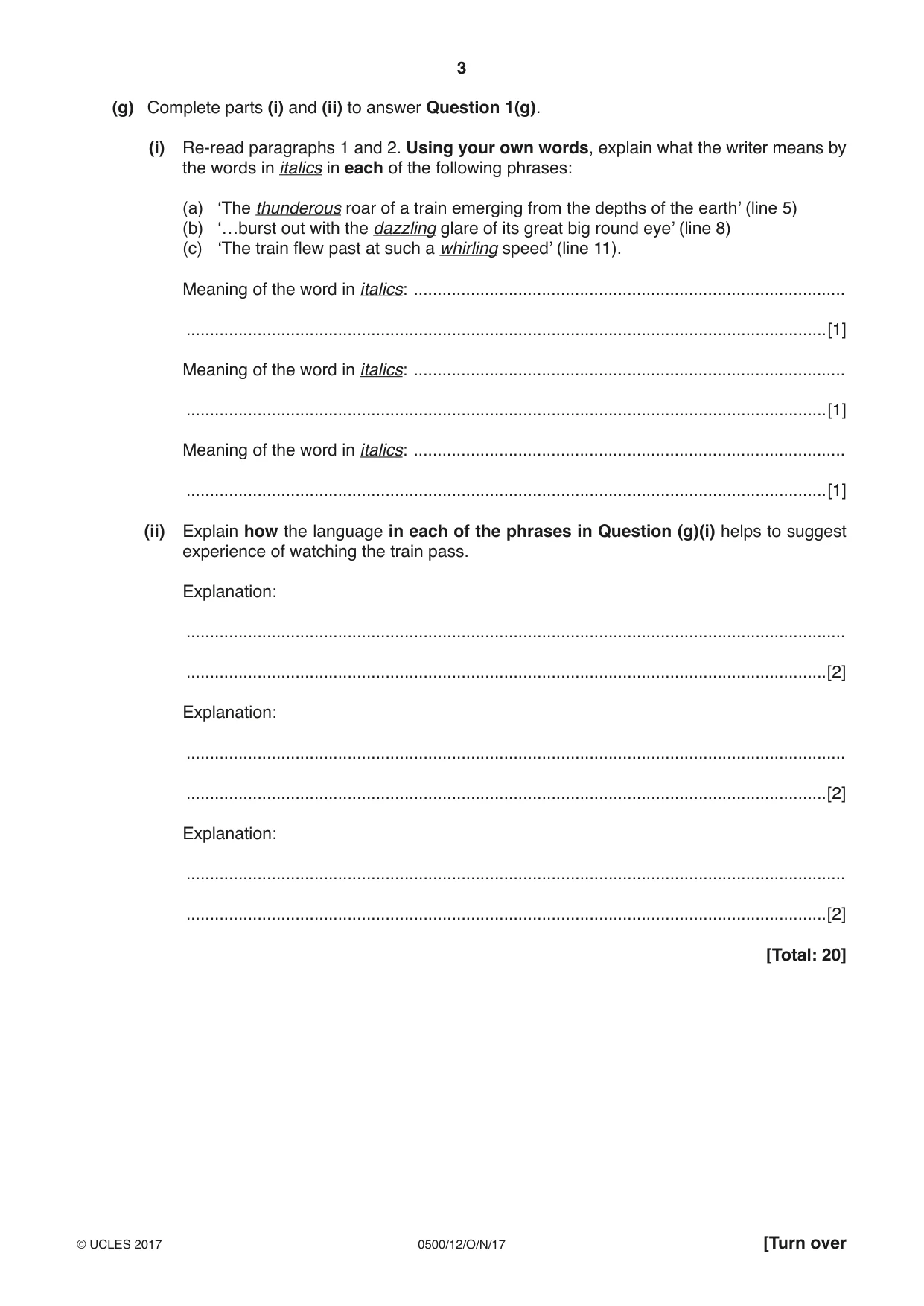
Question paper, page 3
3 0500/12/O/N/17 © UCLES 2017 [Turn over (g) Complete parts (i) and (ii) to answer Question 1(g). (i) Re-read paragraphs 1 and 2. Using your own words, explain what the writer means by the words in italics in each of the following phrases: (a) ‘The thunderous roar of a train emerging from the depths of the earth’ (line 5) (b) ‘…burst out with the dazzling glare of its great big round eye’ (line 8) (c) ‘The train flew past at such a whirling speed’ (line 11). Meaning of the word in italics: … …[1] Meaning of the word in italics: … …[1] Meaning of the word in italics: … …[1] (ii) Explain how the language in each of the phrases in Question (g)(i) helps to suggest experience of watching the train pass. Explanation: … …[2] Explanation: … …[2] Explanation: … …[2] [Total: 20]
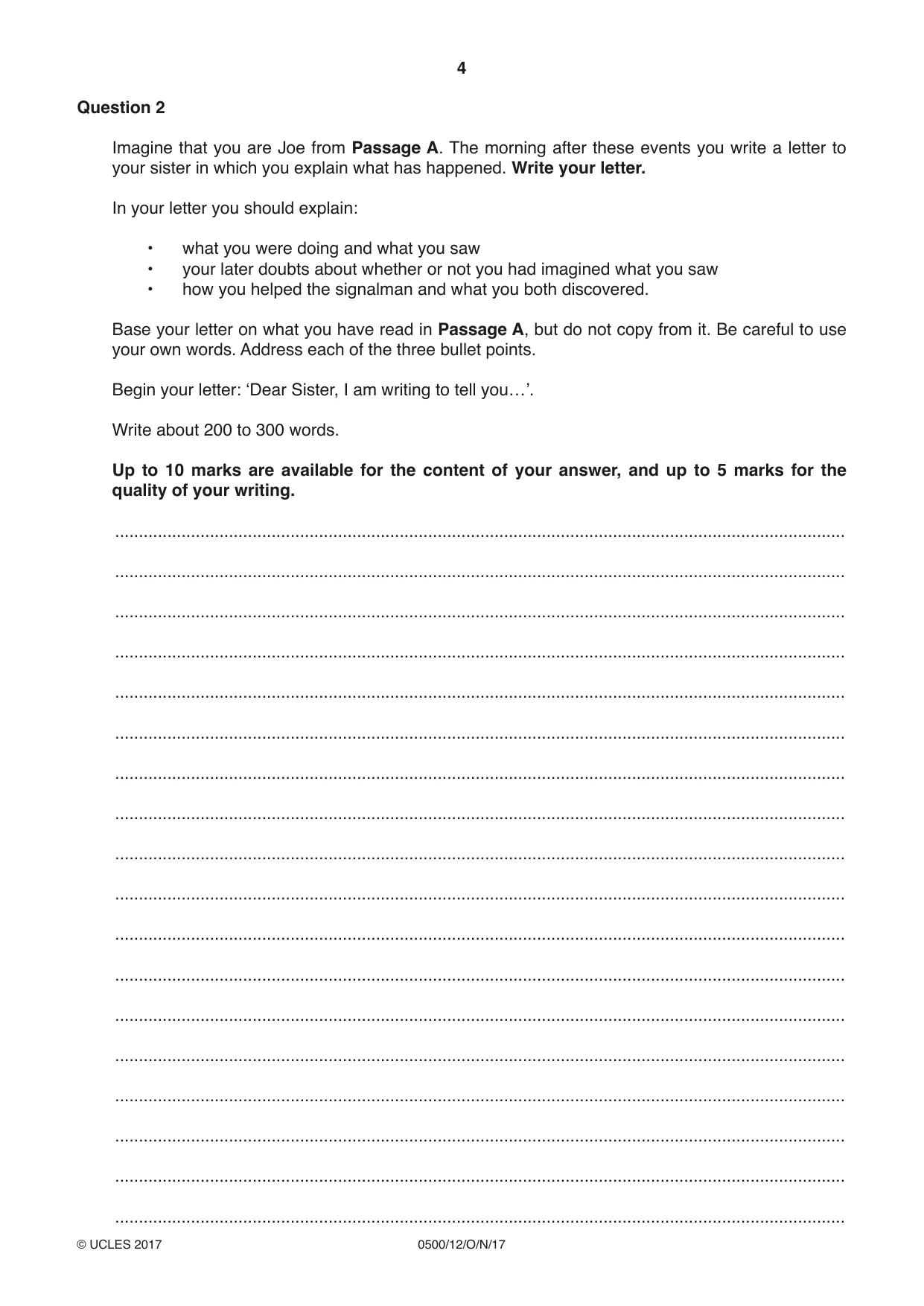
Question paper, page 4
4 0500/12/O/N/17 © UCLES 2017 Question 2 Imagine that you are Joe from Passage A. The morning after these events you write a letter to your sister in which you explain what has happened. Write your letter. In your letter you should explain: • what you were doing and what you saw • your later doubts about whether or not you had imagined what you saw • how you helped the signalman and what you both discovered. Base your letter on what you have read in Passage A, but do not copy from it. Be careful to use your own words. Address each of the three bullet points. Begin your letter: ‘Dear Sister, I am writing to tell you…’. Write about 200 to 300 words. Up to 10 marks are available for the content of your answer, and up to 5 marks for the quality of your writing. … … … … … … … … … … … … … … … … … …
Question paper, page 5
5 0500/12/O/N/17 © UCLES 2017 [Turn over … … … … … … … … … … … … … … … … … … … … … … … … … … … [Total: 15]
Question paper, page 6
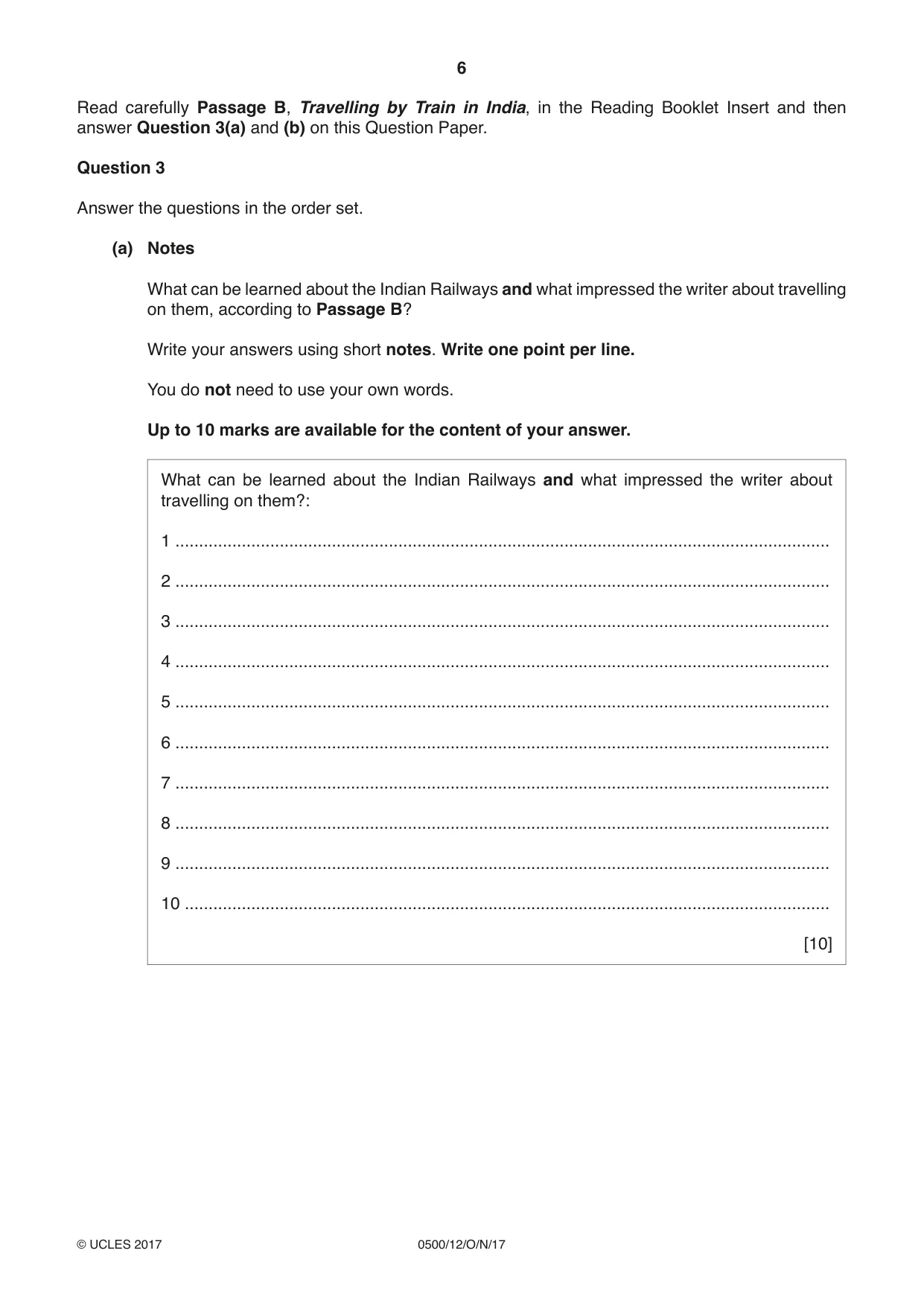
6 0500/12/O/N/17 © UCLES 2017 Read carefully Passage B, Travelling by Train in India, in the Reading Booklet Insert and then answer Question 3(a) and (b) on this Question Paper. Question 3 Answer the questions in the order set. (a) Notes What can be learned about the Indian Railways and what impressed the writer about travelling on them, according to Passage B? Write your answers using short notes. Write one point per line. You do not need to use your own words. Up to 10 marks are available for the content of your answer. What can be learned about the Indian Railways and what impressed the writer about travelling on them?: 1 … 2 … 3 … 4 … 5 … 6 … 7 … 8 … 9 … 10 … [10]
Question paper, page 7
7 0500/12/O/N/17 © UCLES 2017 (b) Summary Now use your notes to write a summary of what Passage B tells you about Indian railways and what impressed the writer about travelling on them. You must use continuous writing (not note form) and use your own words as far as possible. Your summary should include all 10 of your points in Question 3(a) and must be 100 to 150 words. Up to 5 marks are available for the quality of your writing. … … … … … … … … … … … … … …[5] [Total: 15]
Question paper, page 8
8 0500/12/O/N/17 © UCLES 2017 Additional Page If you use the following lined page to complete the answer(s) to any question(s), the question number(s) must be clearly shown. … … … … … … … … … … … … … … … … … … … … … … … … … …
Question paper, page 9
9 0500/12/O/N/17 © UCLES 2017 Additional Page If you use the following lined page to complete the answer(s) to any question(s), the question number(s) must be clearly shown. … … … … … … … … … … … … … … … … … … … … … … … … … …
Question paper, page 10
10 0500/12/O/N/17 © UCLES 2017 BLANK PAGE
Question paper, page 11
11 0500/12/O/N/17 © UCLES 2017 BLANK PAGE
Question paper, page 12
12 0500/12/O/N/17 © UCLES 2017 Permission to reproduce items where third-party owned material protected by copyright is included has been sought and cleared where possible. Every reasonable effort has been made by the publisher (UCLES) to trace copyright holders, but if any items requiring clearance have unwittingly been included, the publisher will be pleased to make amends at the earliest possible opportunity. To avoid the issue of disclosure of answer-related information to candidates, all copyright acknowledgements are reproduced online in the Cambridge International Examinations Copyright Acknowledgements Booklet. This is produced for each series of examinations and is freely available to download at www.cie.org.uk after the live examination series. Cambridge International Examinations is part of the Cambridge Assessment Group. Cambridge Assessment is the brand name of University of Cambridge Local Examinations Syndicate (UCLES), which is itself a department of the University of Cambridge. BLANK PAGE
Mark scheme, page 1
® IGCSE is a registered trademark. This document consists of 8 printed pages. © UCLES 2017 [Turn over Cambridge Assessment International Education Cambridge International General Certificate of Secondary Education FIRST LANGUAGE ENGLISH 0500/12 Paper 1 Reading Passage (Core) October/November 2017 MARK SCHEME Maximum Mark: 50 Published This mark scheme is published as an aid to teachers and candidates, to indicate the requirements of the examination. It shows the basis on which Examiners were instructed to award marks. It does not indicate the details of the discussions that took place at an Examiners’ meeting before marking began, which would have considered the acceptability of alternative answers. Mark schemes should be read in conjunction with the question paper and the Principal Examiner Report for Teachers. Cambridge International will not enter into discussions about these mark schemes. Cambridge International is publishing the mark schemes for the October/November 2017 series for most Cambridge IGCSE®, Cambridge International A and AS Level components and some Cambridge O Level components.
Mark scheme, page 2
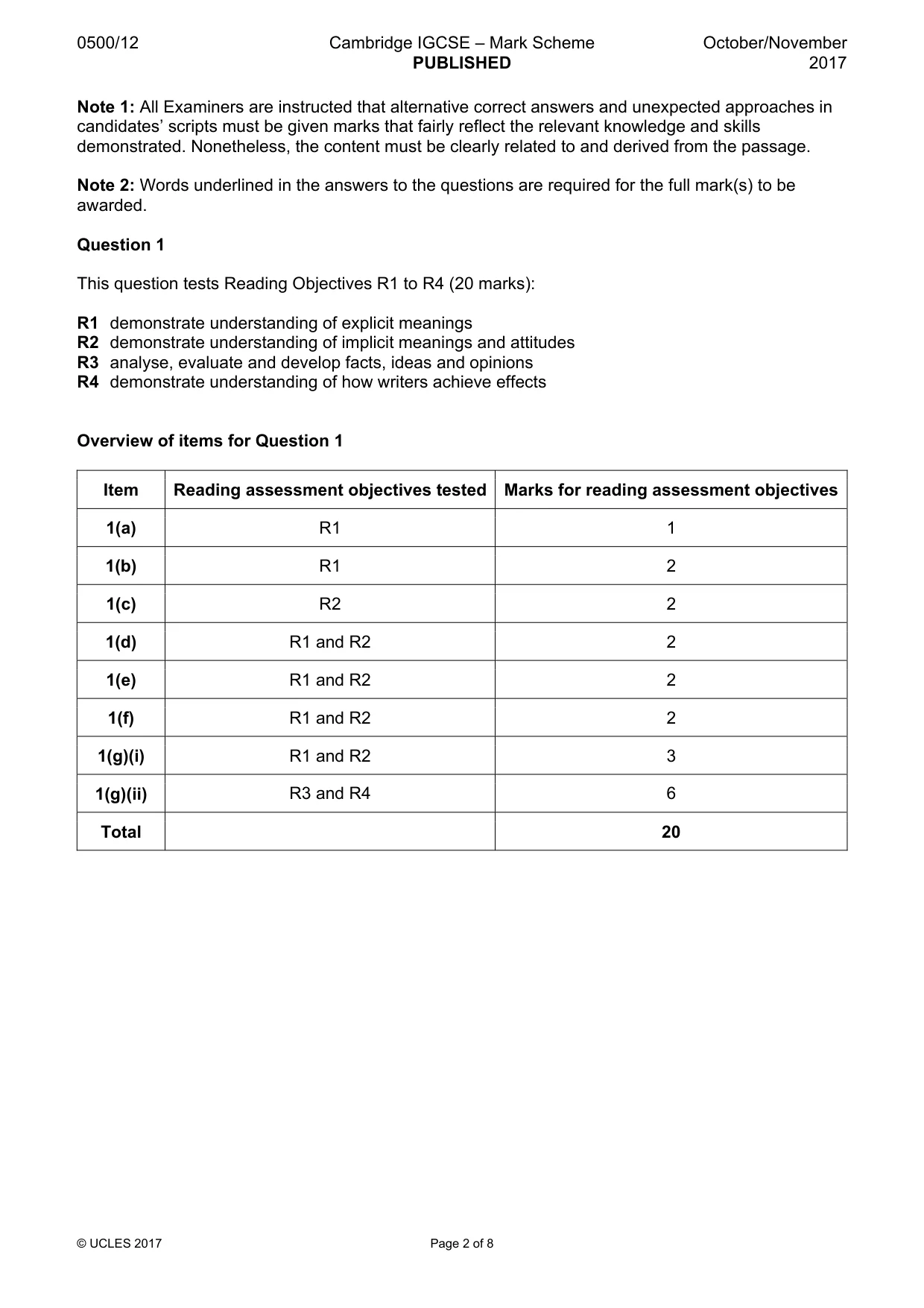
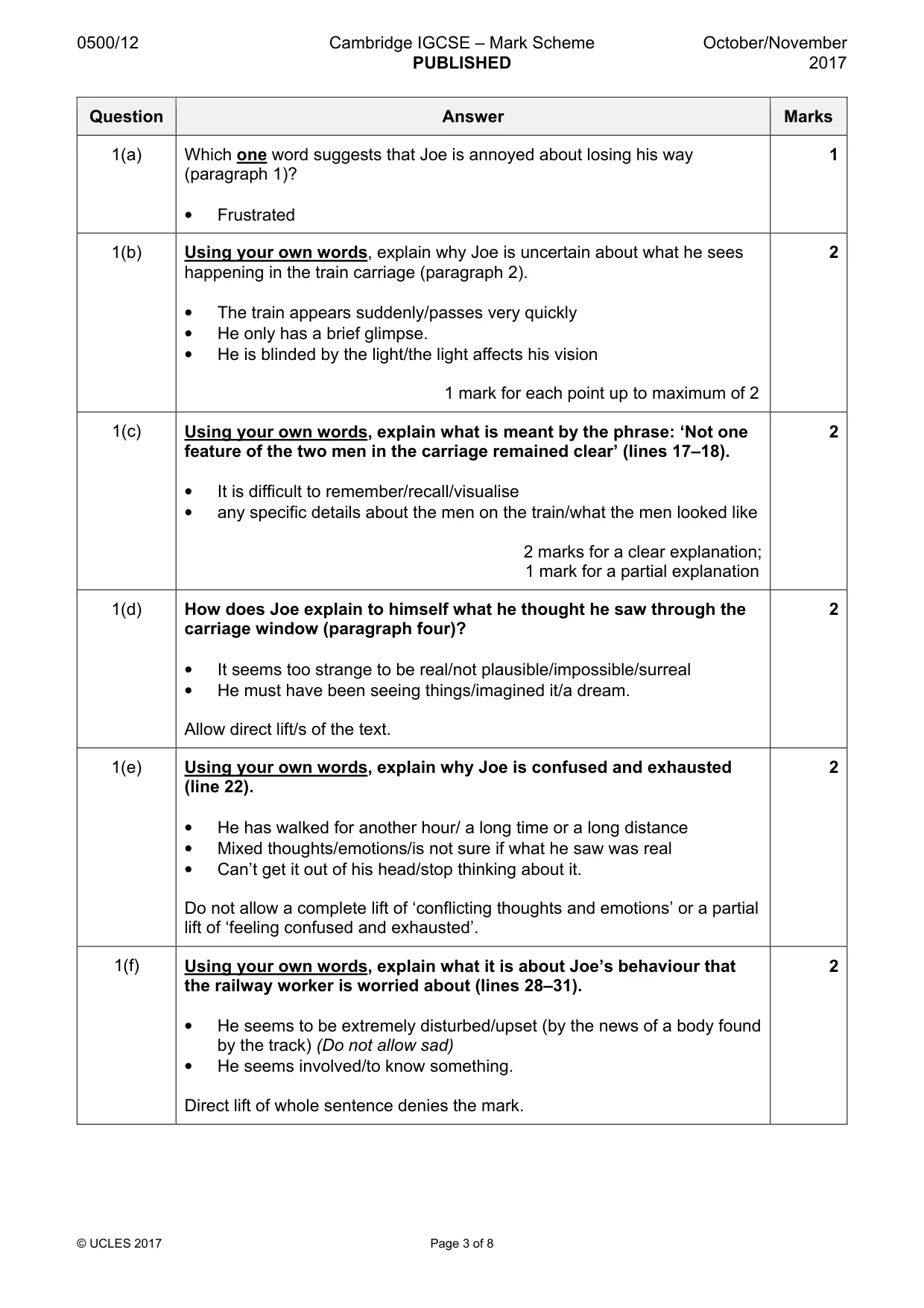
0500/12 Cambridge IGCSE – Mark Scheme PUBLISHED October/November 2017 © UCLES 2017 Page 2 of 8 Note 1: All Examiners are instructed that alternative correct answers and unexpected approaches in candidates’ scripts must be given marks that fairly reflect the relevant knowledge and skills demonstrated. Nonetheless, the content must be clearly related to and derived from the passage. Note 2: Words underlined in the answers to the questions are required for the full mark(s) to be awarded. Question 1 This question tests Reading Objectives R1 to R4 (20 marks): R1 demonstrate understanding of explicit meanings R2 demonstrate understanding of implicit meanings and attitudes R3 analyse, evaluate and develop facts, ideas and opinions R4 demonstrate understanding of how writers achieve effects Overview of items for Question 1 Item Reading assessment objectives tested Marks for reading assessment objectives 1(a) R1 1 1(b) R1 2 1(c) R2 2 1(d) R1 and R2 2 1(e) R1 and R2 2 1(f) R1 and R2 2 1(g)(i) R1 and R2 3 1(g)(ii) R3 and R4 6 Total 20
Mark scheme, page 3
0500/12 Cambridge IGCSE – Mark Scheme PUBLISHED October/November 2017 © UCLES 2017 Page 3 of 8 Question Answer Marks 1(a) Which one word suggests that Joe is annoyed about losing his way (paragraph 1)? • Frustrated 1 1(b) Using your own words, explain why Joe is uncertain about what he sees happening in the train carriage (paragraph 2). • The train appears suddenly/passes very quickly • He only has a brief glimpse. • He is blinded by the light/the light affects his vision 1 mark for each point up to maximum of 2 2 1(c) Using your own words, explain what is meant by the phrase: ‘Not one feature of the two men in the carriage remained clear’ (lines 17–18). • It is difficult to remember/recall/visualise • any specific details about the men on the train/what the men looked like 2 marks for a clear explanation; 1 mark for a partial explanation 2 1(d) How does Joe explain to himself what he thought he saw through the carriage window (paragraph four)? • It seems too strange to be real/not plausible/impossible/surreal • He must have been seeing things/imagined it/a dream. Allow direct lift/s of the text. 2 1(e) Using your own words, explain why Joe is confused and exhausted (line 22). • He has walked for another hour/ a long time or a long distance • Mixed thoughts/emotions/is not sure if what he saw was real • Can’t get it out of his head/stop thinking about it. Do not allow a complete lift of ‘conflicting thoughts and emotions’ or a partial lift of ‘feeling confused and exhausted’. 2 1(f) Using your own words, explain what it is about Joe’s behaviour that the railway worker is worried about (lines 28–31). • He seems to be extremely disturbed/upset (by the news of a body found by the track) (Do not allow sad) • He seems involved/to know something. Direct lift of whole sentence denies the mark. 2
Mark scheme, page 4
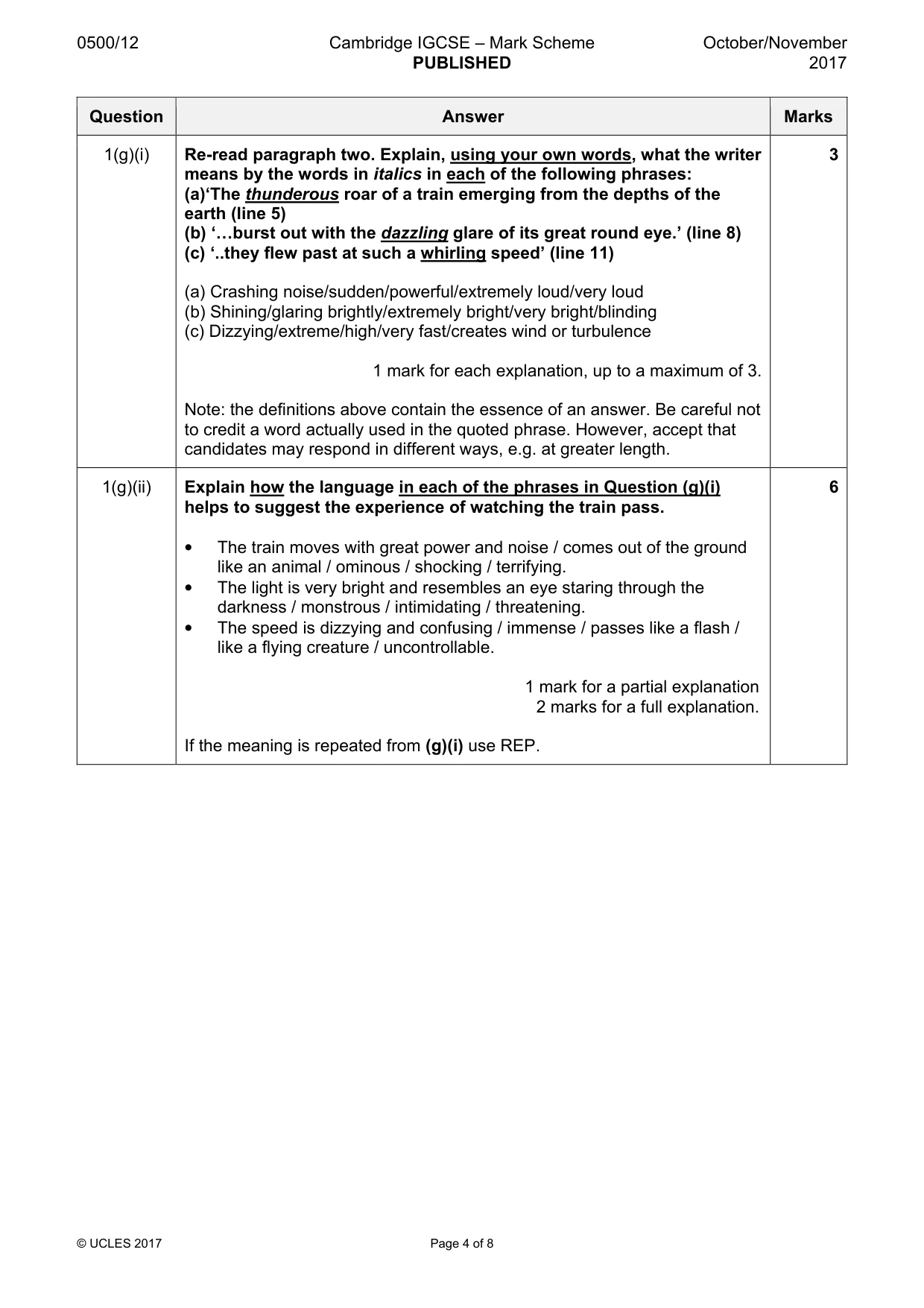
0500/12 Cambridge IGCSE – Mark Scheme PUBLISHED October/November 2017 © UCLES 2017 Page 4 of 8 Question Answer Marks 1(g)(i) Re-read paragraph two. Explain, using your own words, what the writer means by the words in italics in each of the following phrases: (a)‘The thunderous roar of a train emerging from the depths of the earth (line 5) (b) ‘«burst out with the dazzling glare of its great round eye.’ (line 8) (c) ‘..they flew past at such a whirling speed’ (line 11) (a) Crashing noise/sudden/powerful/extremely loud/very loud (b) Shining/glaring brightly/extremely bright/very bright/blinding (c) Dizzying/extreme/high/very fast/creates wind or turbulence 1 mark for each explanation, up to a maximum of 3. Note: the definitions above contain the essence of an answer. Be careful not to credit a word actually used in the quoted phrase. However, accept that candidates may respond in different ways, e.g. at greater length. 3 1(g)(ii) Explain how the language in each of the phrases in Question (g)(i) helps to suggest the experience of watching the train pass. • The train moves with great power and noise / comes out of the ground like an animal / ominous / shocking / terrifying. • The light is very bright and resembles an eye staring through the darkness / monstrous / intimidating / threatening. • The speed is dizzying and confusing / immense / passes like a flash / like a flying creature / uncontrollable. 1 mark for a partial explanation 2 marks for a full explanation. If the meaning is repeated from (g)(i) use REP. 6
Mark scheme, page 5
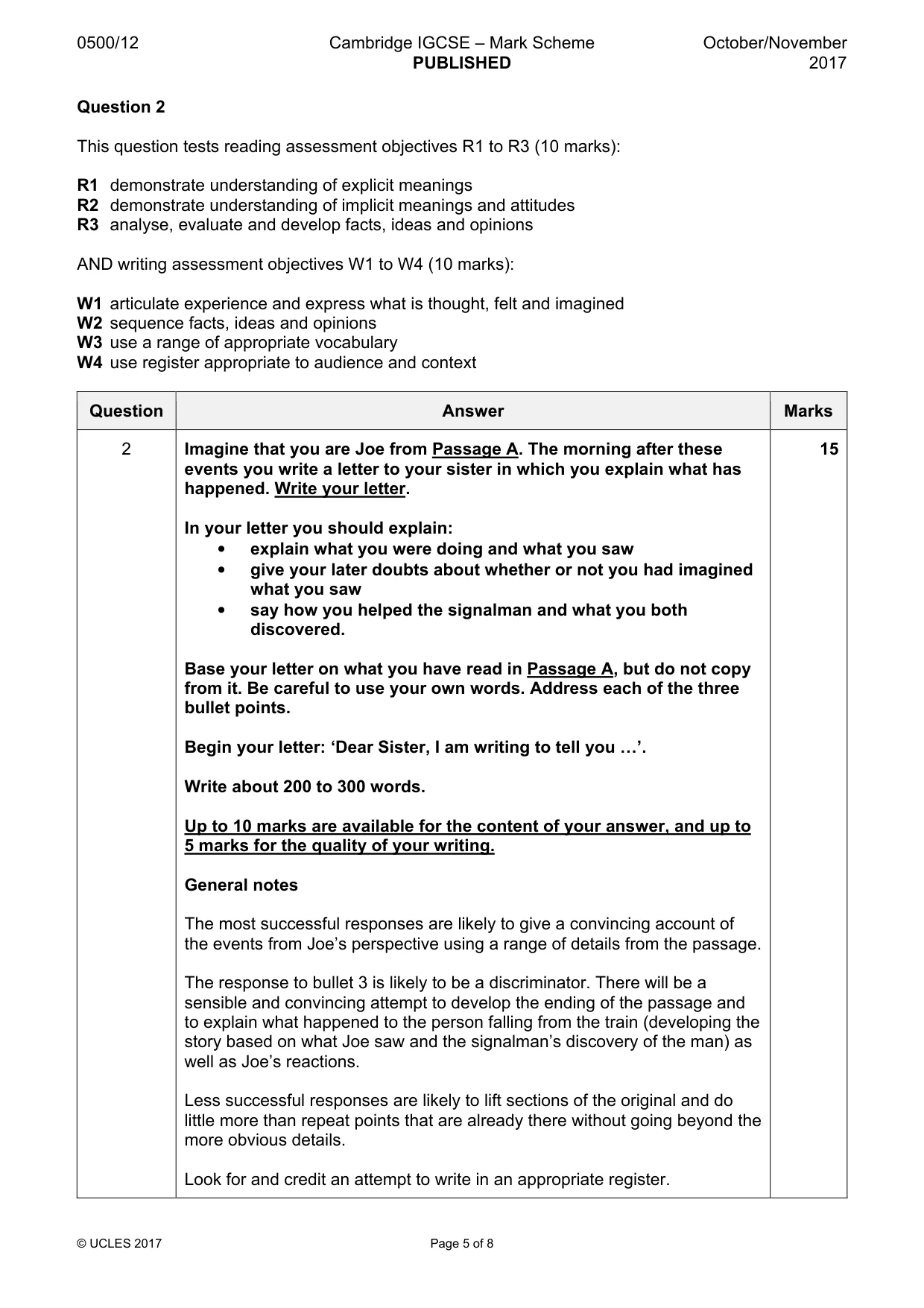
0500/12 Cambridge IGCSE – Mark Scheme PUBLISHED October/November 2017 © UCLES 2017 Page 5 of 8 Question 2 This question tests reading assessment objectives R1 to R3 (10 marks): R1 demonstrate understanding of explicit meanings R2 demonstrate understanding of implicit meanings and attitudes R3 analyse, evaluate and develop facts, ideas and opinions AND writing assessment objectives W1 to W4 (10 marks): W1 articulate experience and express what is thought, felt and imagined W2 sequence facts, ideas and opinions W3 use a range of appropriate vocabulary W4 use register appropriate to audience and context Question Answer Marks 2 Imagine that you are Joe from Passage A. The morning after these events you write a letter to your sister in which you explain what has happened. Write your letter. In your letter you should explain: • explain what you were doing and what you saw • give your later doubts about whether or not you had imagined what you saw • say how you helped the signalman and what you both discovered. Base your letter on what you have read in Passage A, but do not copy from it. Be careful to use your own words. Address each of the three bullet points. Begin your letter: ‘Dear Sister, I am writing to tell you «’. Write about 200 to 300 words. Up to 10 marks are available for the content of your answer, and up to 5 marks for the quality of your writing. General notes The most successful responses are likely to give a convincing account of the events from Joe’s perspective using a range of details from the passage. The response to bullet 3 is likely to be a discriminator. There will be a sensible and convincing attempt to develop the ending of the passage and to explain what happened to the person falling from the train (developing the story based on what Joe saw and the signalman’s discovery of the man) as well as Joe’s reactions. Less successful responses are likely to lift sections of the original and do little more than repeat points that are already there without going beyond the more obvious details. Look for and credit an attempt to write in an appropriate register. 15
Mark scheme, page 6
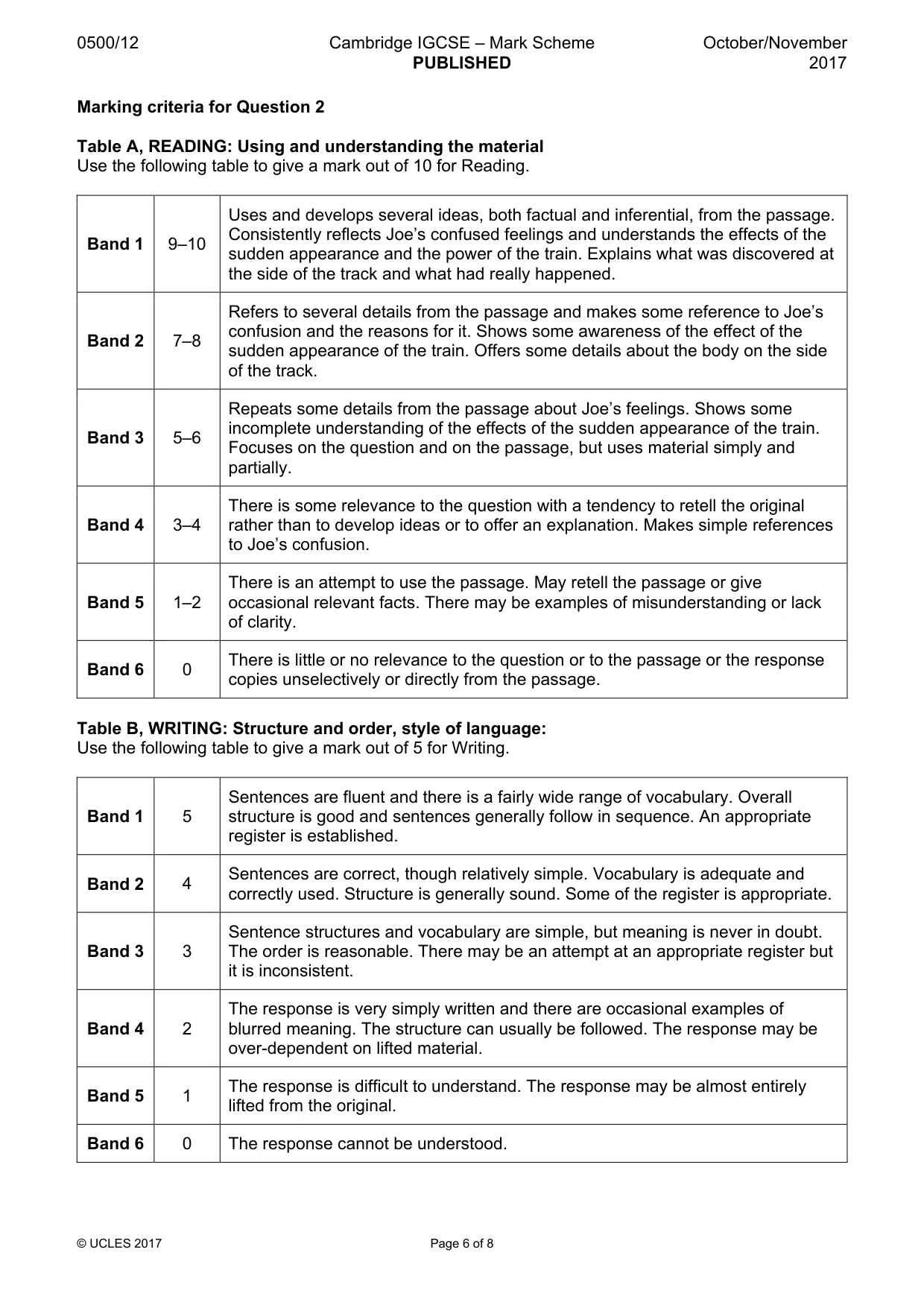
0500/12 Cambridge IGCSE – Mark Scheme PUBLISHED October/November 2017 © UCLES 2017 Page 6 of 8 Marking criteria for Question 2 Table A, READING: Using and understanding the material Use the following table to give a mark out of 10 for Reading. Band 1 9–10 Uses and develops several ideas, both factual and inferential, from the passage. Consistently reflects Joe’s confused feelings and understands the effects of the sudden appearance and the power of the train. Explains what was discovered at the side of the track and what had really happened. Band 2 7–8 Refers to several details from the passage and makes some reference to Joe’s confusion and the reasons for it. Shows some awareness of the effect of the sudden appearance of the train. Offers some details about the body on the side of the track. Band 3 5–6 Repeats some details from the passage about Joe’s feelings. Shows some incomplete understanding of the effects of the sudden appearance of the train. Focuses on the question and on the passage, but uses material simply and partially. Band 4 3–4 There is some relevance to the question with a tendency to retell the original rather than to develop ideas or to offer an explanation. Makes simple references to Joe’s confusion. Band 5 1–2 There is an attempt to use the passage. May retell the passage or give occasional relevant facts. There may be examples of misunderstanding or lack of clarity. Band 6 0 There is little or no relevance to the question or to the passage or the response copies unselectively or directly from the passage. Table B, WRITING: Structure and order, style of language: Use the following table to give a mark out of 5 for Writing. Band 1 5 Sentences are fluent and there is a fairly wide range of vocabulary. Overall structure is good and sentences generally follow in sequence. An appropriate register is established. Band 2 4 Sentences are correct, though relatively simple. Vocabulary is adequate and correctly used. Structure is generally sound. Some of the register is appropriate. Band 3 3 Sentence structures and vocabulary are simple, but meaning is never in doubt. The order is reasonable. There may be an attempt at an appropriate register but it is inconsistent. Band 4 2 The response is very simply written and there are occasional examples of blurred meaning. The structure can usually be followed. The response may be over-dependent on lifted material. Band 5 1 The response is difficult to understand. The response may be almost entirely lifted from the original. Band 6 0 The response cannot be understood.
Mark scheme, page 7
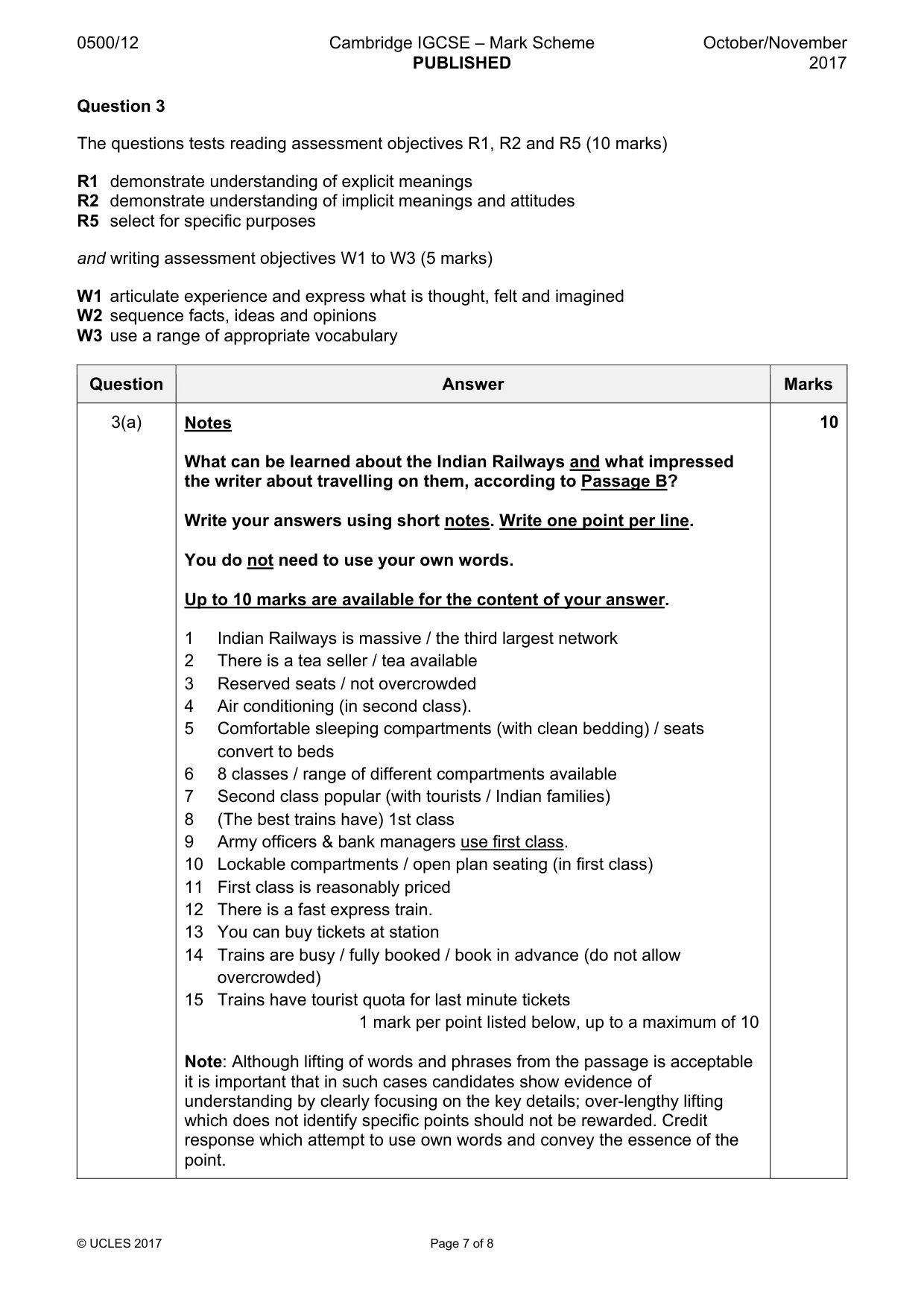
0500/12 Cambridge IGCSE – Mark Scheme PUBLISHED October/November 2017 © UCLES 2017 Page 7 of 8 Question 3 The questions tests reading assessment objectives R1, R2 and R5 (10 marks) R1 demonstrate understanding of explicit meanings R2 demonstrate understanding of implicit meanings and attitudes R5 select for specific purposes and writing assessment objectives W1 to W3 (5 marks) W1 articulate experience and express what is thought, felt and imagined W2 sequence facts, ideas and opinions W3 use a range of appropriate vocabulary Question Answer Marks 3(a) Notes What can be learned about the Indian Railways and what impressed the writer about travelling on them, according to Passage B? Write your answers using short notes. Write one point per line. You do not need to use your own words. Up to 10 marks are available for the content of your answer. 1 Indian Railways is massive / the third largest network 2 There is a tea seller / tea available 3 Reserved seats / not overcrowded 4 Air conditioning (in second class). 5 Comfortable sleeping compartments (with clean bedding) / seats convert to beds 6 8 classes / range of different compartments available 7 Second class popular (with tourists / Indian families) 8 (The best trains have) 1st class 9 Army officers & bank managers use first class. 10 Lockable compartments / open plan seating (in first class) 11 First class is reasonably priced 12 There is a fast express train. 13 You can buy tickets at station 14 Trains are busy / fully booked / book in advance (do not allow overcrowded) 15 Trains have tourist quota for last minute tickets 1 mark per point listed below, up to a maximum of 10 Note: Although lifting of words and phrases from the passage is acceptable it is important that in such cases candidates show evidence of understanding by clearly focusing on the key details; over-lengthy lifting which does not identify specific points should not be rewarded. Credit response which attempt to use own words and convey the essence of the point. 10
Mark scheme, page 8
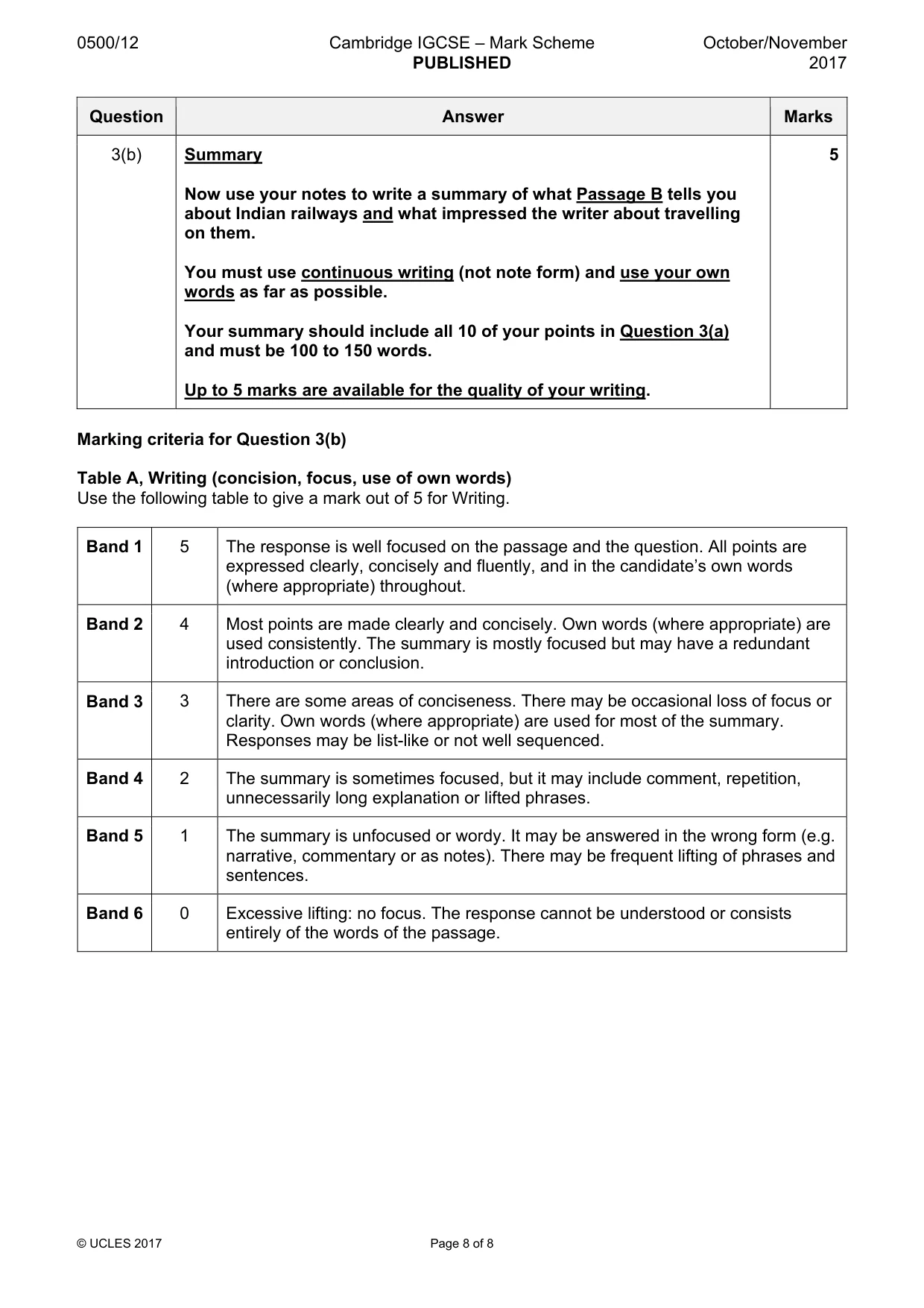
0500/12 Cambridge IGCSE – Mark Scheme PUBLISHED October/November 2017 © UCLES 2017 Page 8 of 8 Question Answer Marks 3(b) Summary Now use your notes to write a summary of what Passage B tells you about Indian railways and what impressed the writer about travelling on them. You must use continuous writing (not note form) and use your own words as far as possible. Your summary should include all 10 of your points in Question 3(a) and must be 100 to 150 words. Up to 5 marks are available for the quality of your writing. 5 Marking criteria for Question 3(b) Table A, Writing (concision, focus, use of own words) Use the following table to give a mark out of 5 for Writing. Band 1 5 The response is well focused on the passage and the question. All points are expressed clearly, concisely and fluently, and in the candidate’s own words (where appropriate) throughout. Band 2 4 Most points are made clearly and concisely. Own words (where appropriate) are used consistently. The summary is mostly focused but may have a redundant introduction or conclusion. Band 3 3 There are some areas of conciseness. There may be occasional loss of focus or clarity. Own words (where appropriate) are used for most of the summary. Responses may be list-like or not well sequenced. Band 4 2 The summary is sometimes focused, but it may include comment, repetition, unnecessarily long explanation or lifted phrases. Band 5 1 The summary is unfocused or wordy. It may be answered in the wrong form (e.g. narrative, commentary or as notes). There may be frequent lifting of phrases and sentences. Band 6 0 Excessive lifting: no focus. The response cannot be understood or consists entirely of the words of the passage.
What you needed in this session
Cambridge’s own grade thresholds for 2017 Oct/Nov, Paper 1 · Variant 2. A higher threshold means an easier paper — the bar moves with how the cohort did.