Cambridge IGCSE English - First Language 0500 — 2017 Feb/March Paper 2 · Variant 2
0500/22/F/M/17 · 50 marks · ≈56 min
The question paper and its mark scheme, free to read here and free to download. This is Cambridge’s own paper, exactly as it was sat.
Question paper12 pages
Mark scheme13 pages
Answers below. Sit the paper first if you are practising.
Paper as text
Question paper, page 1
This document consists of 12 printed pages and 1 Reading Booklet Insert. DC (RCL (KM)) 135604/1 © UCLES 2017 [Turn over Cambridge International Examinations Cambridge International General Certificate of Secondary Education * 3 7 3 6 3 3 9 9 2 6 * FIRST LANGUAGE ENGLISH 0500/22 Paper 2 Reading Passages (Extended) February/March 2017 2 hours Candidates answer on the Question Paper. No Additional Materials are required. READ THESE INSTRUCTIONS FIRST Write your Centre number, candidate number and name in the spaces provided. Write in dark blue or black pen. Do not use staples, paper clips, glue or correction fluid. DO NOT WRITE IN ANY BARCODES. Answer all questions in the space provided. If additional space is required, you should use the lined pages at the end of this booklet. The question number(s) must be clearly shown. Dictionaries are not permitted. The Reading Booklet Insert contains the reading passages for use with all questions on the Question Paper. The Reading Booklet Insert is not assessed by the Examiner. The number of marks is given in brackets [ ] at the end of each question or part question.
Question paper, page 2
2 0500/22/F/M/17 © UCLES 2017 Read carefully Passage A, The Island Visit, in the Reading Booklet Insert and then answer Questions 1 and 2 on this Question Paper. Question 1 Later the same month, after a tour of the island, the mayor returns to his home country just in time for his re-election campaign to begin. A radio programme interviews him about his visit to the island. Write the interview. The interviewer asks the mayor the following three questions only: • So tell us about the island, its people and their way of life. What impressed you and why did you decide to visit? • What kind of reactions did your visit receive from the media and the islanders? • Your speech and gifts to the islanders have been criticised recently and your motives questioned. What exactly are people’s criticisms and how do you defend yourself against each of them? Base your interview on what you have read in Passage A, but be careful to use your own words. Address each of the three bullet points. Write about 250 to 350 words. Up to 15 marks are available for the content of your answer, and up to 5 marks for the quality of your writing. … … … … … … … … … … … … … …
Question paper, page 3
3 0500/22/F/M/17 © UCLES 2017 [Turn over … … … … … … … … … … … … … … … … … … … … … … … … … … … …
Question paper, page 4
4 0500/22/F/M/17 © UCLES 2017 … … … … … … … … … … … … … … … … … … … … … … … … … … … [Total: 20]
Question paper, page 5
5 0500/22/F/M/17 © UCLES 2017 [Turn over [Turn over for Question 2]
Question paper, page 6
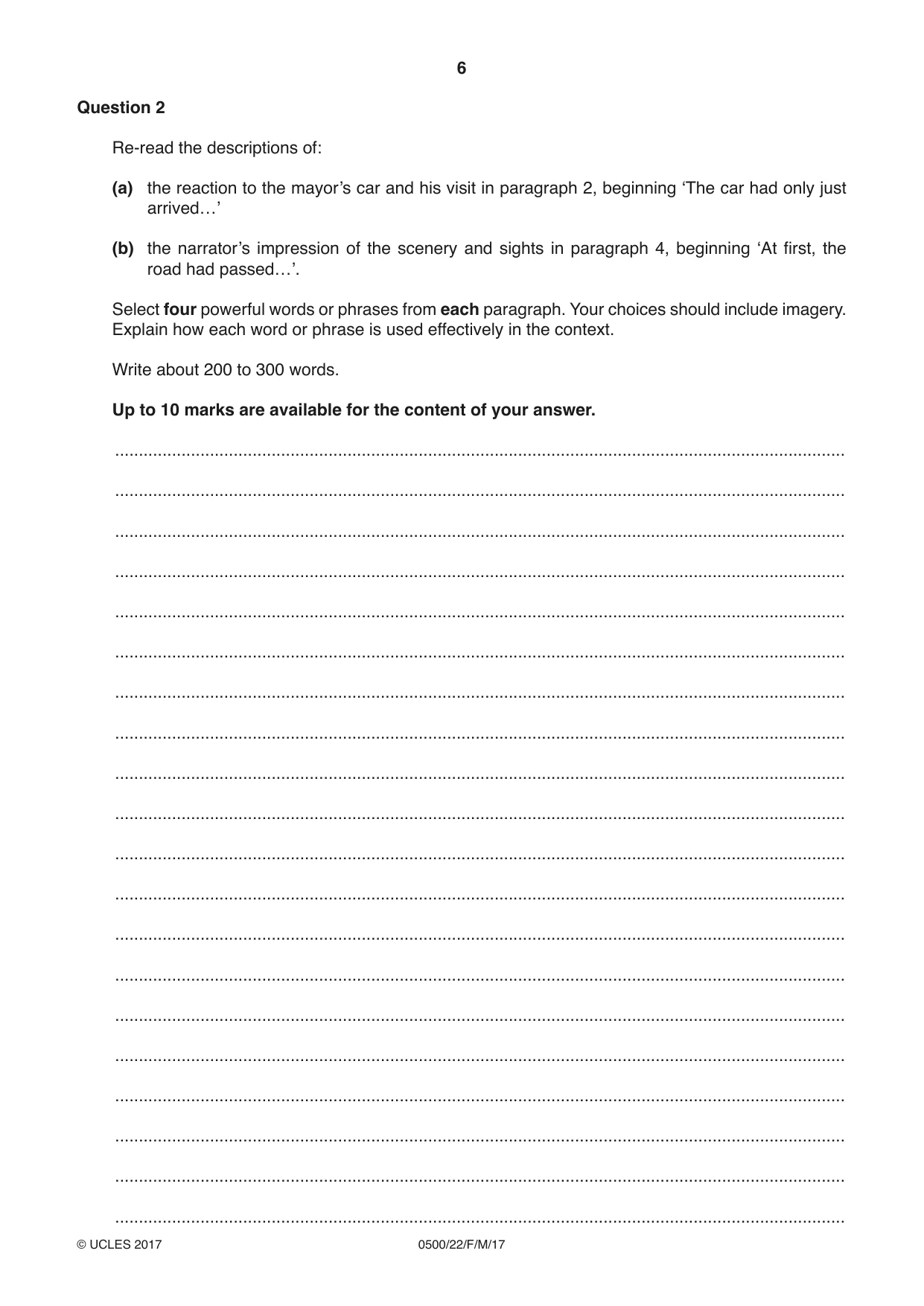
6 0500/22/F/M/17 © UCLES 2017 Question 2 Re-read the descriptions of: (a) the reaction to the mayor’s car and his visit in paragraph 2, beginning ‘The car had only just arrived…’ (b) the narrator’s impression of the scenery and sights in paragraph 4, beginning ‘At first, the road had passed…’. Select four powerful words or phrases from each paragraph. Your choices should include imagery. Explain how each word or phrase is used effectively in the context. Write about 200 to 300 words. Up to 10 marks are available for the content of your answer. … … … … … … … … … … … … … … … … … … … …
Question paper, page 7
7 0500/22/F/M/17 © UCLES 2017 [Turn over … … … … … … … … … … … … … … … … … … … … … … … … … … … [Total: 10]
Question paper, page 8
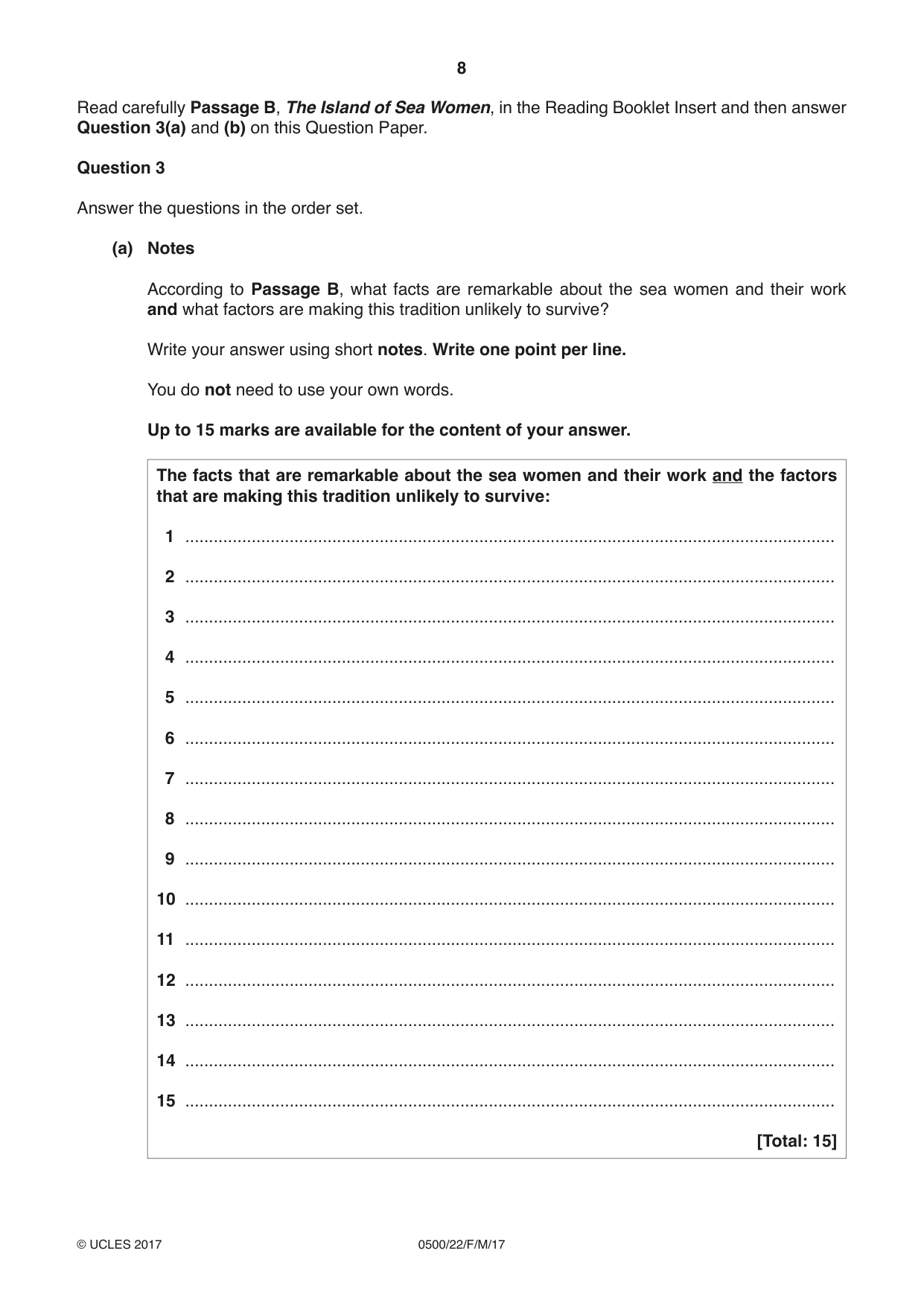
8 0500/22/F/M/17 © UCLES 2017 Read carefully Passage B, The Island of Sea Women, in the Reading Booklet Insert and then answer Question 3(a) and (b) on this Question Paper. Question 3 Answer the questions in the order set. (a) Notes According to Passage B, what facts are remarkable about the sea women and their work and what factors are making this tradition unlikely to survive? Write your answer using short notes. Write one point per line. You do not need to use your own words. Up to 15 marks are available for the content of your answer. The facts that are remarkable about the sea women and their work and the factors that are making this tradition unlikely to survive: 1 … 2 … 3 … 4 … 5 … 6 … 7 … 8 … 9 … 10 … 11 … 12 … 13 … 14 … 15 … [Total: 15]
Question paper, page 9
9 0500/22/F/M/17 © UCLES 2017 [Turn over (b) Summary Now use your notes to write a summary of the remarkable facts about sea women and their work and the factors making this tradition unlikely to survive, according to Passage B. You must use continuous writing (not note form) and use your own words as far as possible. Your summary should include all 15 of your points in Question 3(a) and must be 200 to 250 words. Up to 5 marks are available for the quality of your writing. … … … … … … … … … … … … … … … … … … … … … …
Question paper, page 10
10 0500/22/F/M/17 © UCLES 2017 … … … … … … … … … … … … … … … … … … … … … … … … … … … [Total: 5]
Question paper, page 11
11 0500/22/F/M/17 © UCLES 2017 Additional Page If you use the following lined page to complete the answer(s) to any question(s), the question number(s) must be clearly shown. … … … … … … … … … … … … … … … … … … … … … … … … … …
Question paper, page 12
12 0500/22/F/M/17 © UCLES 2017 Permission to reproduce items where third-party owned material protected by copyright is included has been sought and cleared where possible. Every reasonable effort has been made by the publisher (UCLES) to trace copyright holders, but if any items requiring clearance have unwittingly been included, the publisher will be pleased to make amends at the earliest possible opportunity. To avoid the issue of disclosure of answer-related information to candidates, all copyright acknowledgements are reproduced online in the Cambridge International Examinations Copyright Acknowledgements Booklet. This is produced for each series of examinations and is freely available to download at www.cie.org.uk after the live examination series. Cambridge International Examinations is part of the Cambridge Assessment Group. Cambridge Assessment is the brand name of University of Cambridge Local Examinations Syndicate (UCLES), which is itself a department of the University of Cambridge. Additional Page If you use the following lined page to complete the answer(s) to any question(s), the question number(s) must be clearly shown. … … … … … … … … … … … … … … … … … … … … …
Mark scheme, page 1
® IGCSE is a registered trademark. This document consists of 13 printed pages. © UCLES 2017 [Turn over Cambridge International Examinations Cambridge International General Certificate of Secondary Education FIRST LANGUAGE ENGLISH 0500/22 Paper 2 Reading Passages (Extended) March 2017 MARK SCHEME Maximum Mark: 50 Published This mark scheme is published as an aid to teachers and candidates, to indicate the requirements of the examination. It shows the basis on which Examiners were instructed to award marks. It does not indicate the details of the discussions that took place at an Examiners’ meeting before marking began, which would have considered the acceptability of alternative answers. Mark schemes should be read in conjunction with the question paper and the Principal Examiner Report for Teachers. Cambridge will not enter into discussions about these mark schemes. Cambridge is publishing the mark schemes for the March 2017 series for most Cambridge IGCSE®, Cambridge International A and AS Level components and some Cambridge O Level components.
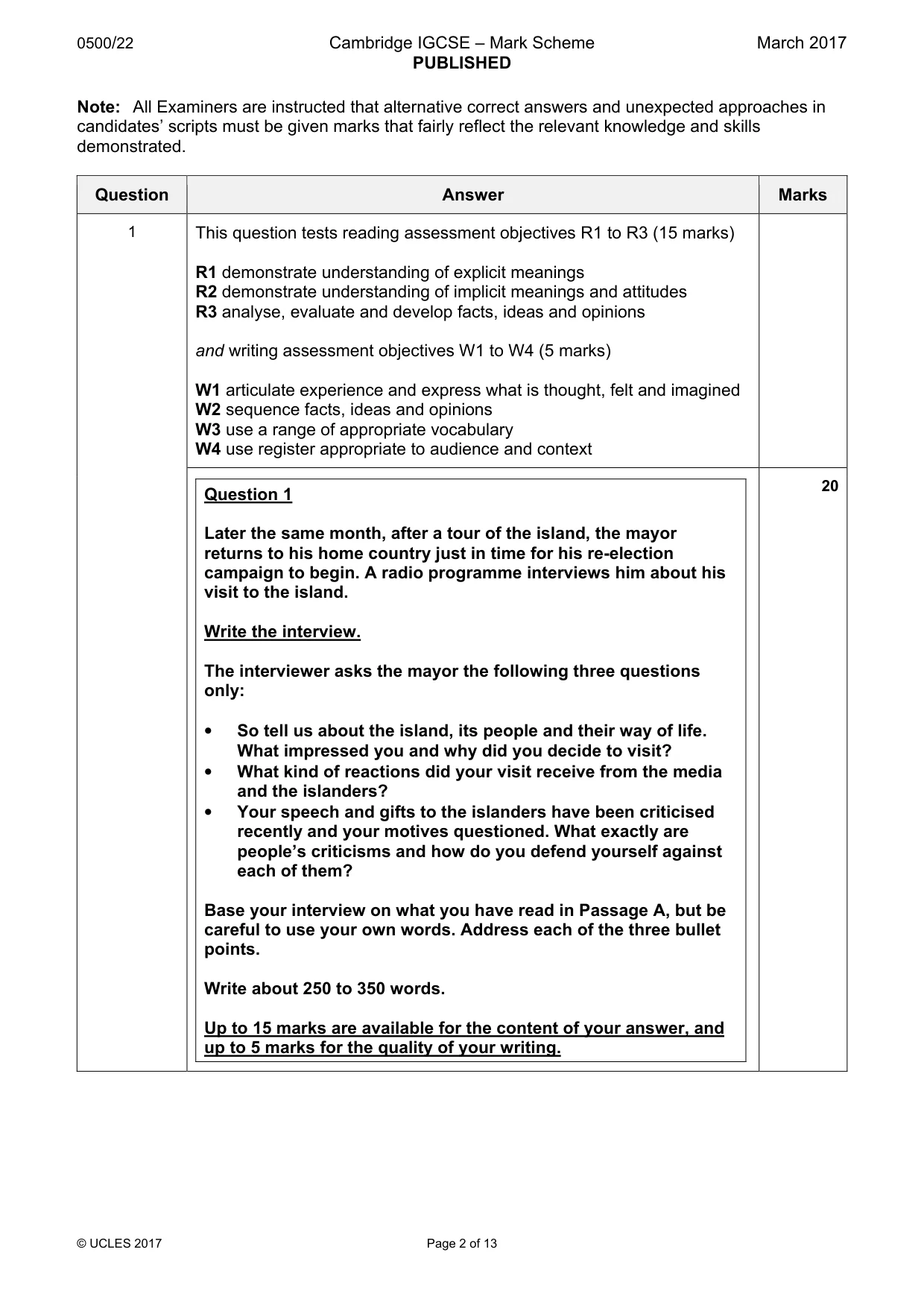
Mark scheme, page 2
0500/22 Cambridge IGCSE – Mark Scheme PUBLISHED March 2017 © UCLES 2017 Page 2 of 13 Note: All Examiners are instructed that alternative correct answers and unexpected approaches in candidates’ scripts must be given marks that fairly reflect the relevant knowledge and skills demonstrated. Question Answer Marks 1 This question tests reading assessment objectives R1 to R3 (15 marks) R1 demonstrate understanding of explicit meanings R2 demonstrate understanding of implicit meanings and attitudes R3 analyse, evaluate and develop facts, ideas and opinions and writing assessment objectives W1 to W4 (5 marks) W1 articulate experience and express what is thought, felt and imagined W2 sequence facts, ideas and opinions W3 use a range of appropriate vocabulary W4 use register appropriate to audience and context Question 1 Later the same month, after a tour of the island, the mayor returns to his home country just in time for his re-election campaign to begin. A radio programme interviews him about his visit to the island. Write the interview. The interviewer asks the mayor the following three questions only: • So tell us about the island, its people and their way of life. What impressed you and why did you decide to visit? • What kind of reactions did your visit receive from the media and the islanders? • Your speech and gifts to the islanders have been criticised recently and your motives questioned. What exactly are people’s criticisms and how do you defend yourself against each of them? Base your interview on what you have read in Passage A, but be careful to use your own words. Address each of the three bullet points. Write about 250 to 350 words. Up to 15 marks are available for the content of your answer, and up to 5 marks for the quality of your writing. 20
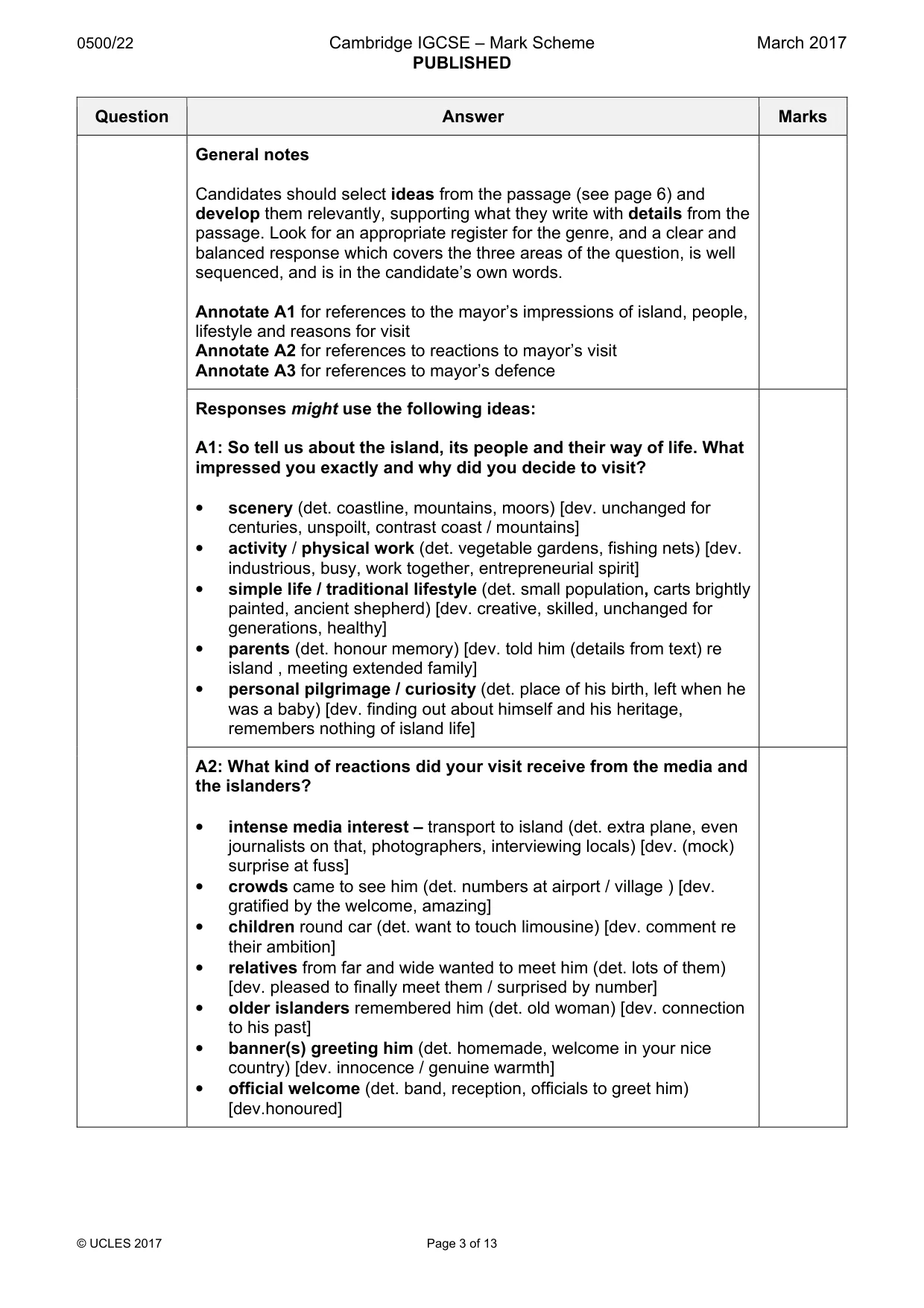
Mark scheme, page 3
0500/22 Cambridge IGCSE – Mark Scheme PUBLISHED March 2017 © UCLES 2017 Page 3 of 13 Question Answer Marks General notes Candidates should select ideas from the passage (see page 6) and develop them relevantly, supporting what they write with details from the passage. Look for an appropriate register for the genre, and a clear and balanced response which covers the three areas of the question, is well sequenced, and is in the candidate’s own words. Annotate A1 for references to the mayor’s impressions of island, people, lifestyle and reasons for visit Annotate A2 for references to reactions to mayor’s visit Annotate A3 for references to mayor’s defence Responses might use the following ideas: A1: So tell us about the island, its people and their way of life. What impressed you exactly and why did you decide to visit? • scenery (det. coastline, mountains, moors) [dev. unchanged for centuries, unspoilt, contrast coast / mountains] • activity / physical work (det. vegetable gardens, fishing nets) [dev. industrious, busy, work together, entrepreneurial spirit] • simple life / traditional lifestyle (det. small population, carts brightly painted, ancient shepherd) [dev. creative, skilled, unchanged for generations, healthy] • parents (det. honour memory) [dev. told him (details from text) re island , meeting extended family] • personal pilgrimage / curiosity (det. place of his birth, left when he was a baby) [dev. finding out about himself and his heritage, remembers nothing of island life] A2: What kind of reactions did your visit receive from the media and the islanders? • intense media interest – transport to island (det. extra plane, even journalists on that, photographers, interviewing locals) [dev. (mock) surprise at fuss] • crowds came to see him (det. numbers at airport / village ) [dev. gratified by the welcome, amazing] • children round car (det. want to touch limousine) [dev. comment re their ambition] • relatives from far and wide wanted to meet him (det. lots of them) [dev. pleased to finally meet them / surprised by number] • older islanders remembered him (det. old woman) [dev. connection to his past] • banner(s) greeting him (det. homemade, welcome in your nice country) [dev. innocence / genuine warmth] • official welcome (det. band, reception, officials to greet him) [dev.honoured]
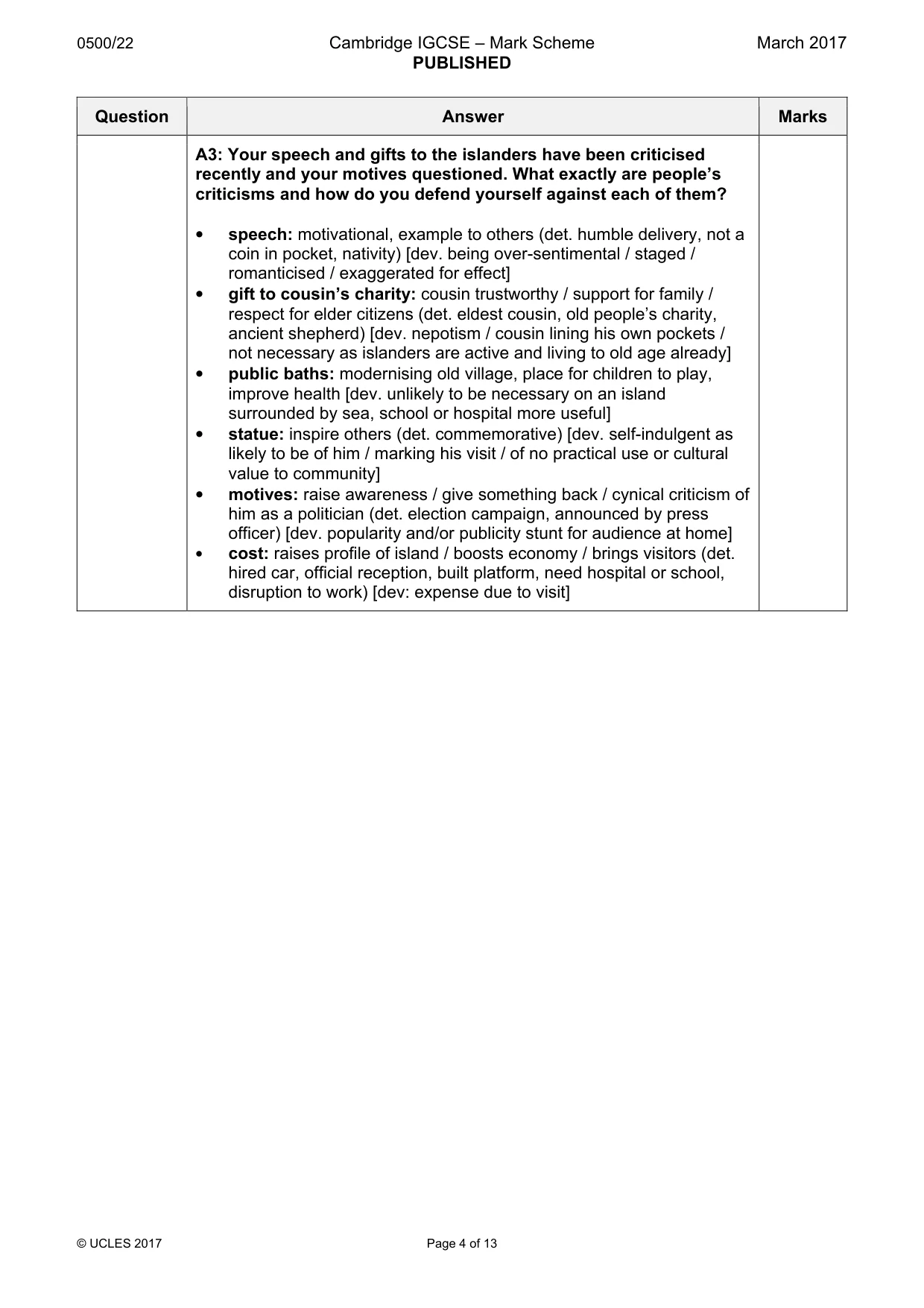
Mark scheme, page 4
0500/22 Cambridge IGCSE – Mark Scheme PUBLISHED March 2017 © UCLES 2017 Page 4 of 13 Question Answer Marks A3: Your speech and gifts to the islanders have been criticised recently and your motives questioned. What exactly are people’s criticisms and how do you defend yourself against each of them? • speech: motivational, example to others (det. humble delivery, not a coin in pocket, nativity) [dev. being over-sentimental / staged / romanticised / exaggerated for effect] • gift to cousin’s charity: cousin trustworthy / support for family / respect for elder citizens (det. eldest cousin, old people’s charity, ancient shepherd) [dev. nepotism / cousin lining his own pockets / not necessary as islanders are active and living to old age already] • public baths: modernising old village, place for children to play, improve health [dev. unlikely to be necessary on an island surrounded by sea, school or hospital more useful] • statue: inspire others (det. commemorative) [dev. self-indulgent as likely to be of him / marking his visit / of no practical use or cultural value to community] • motives: raise awareness / give something back / cynical criticism of him as a politician (det. election campaign, announced by press officer) [dev. popularity and/or publicity stunt for audience at home] • cost: raises profile of island / boosts economy / brings visitors (det. hired car, official reception, built platform, need hospital or school, disruption to work) [dev: expense due to visit]
Mark scheme, page 5
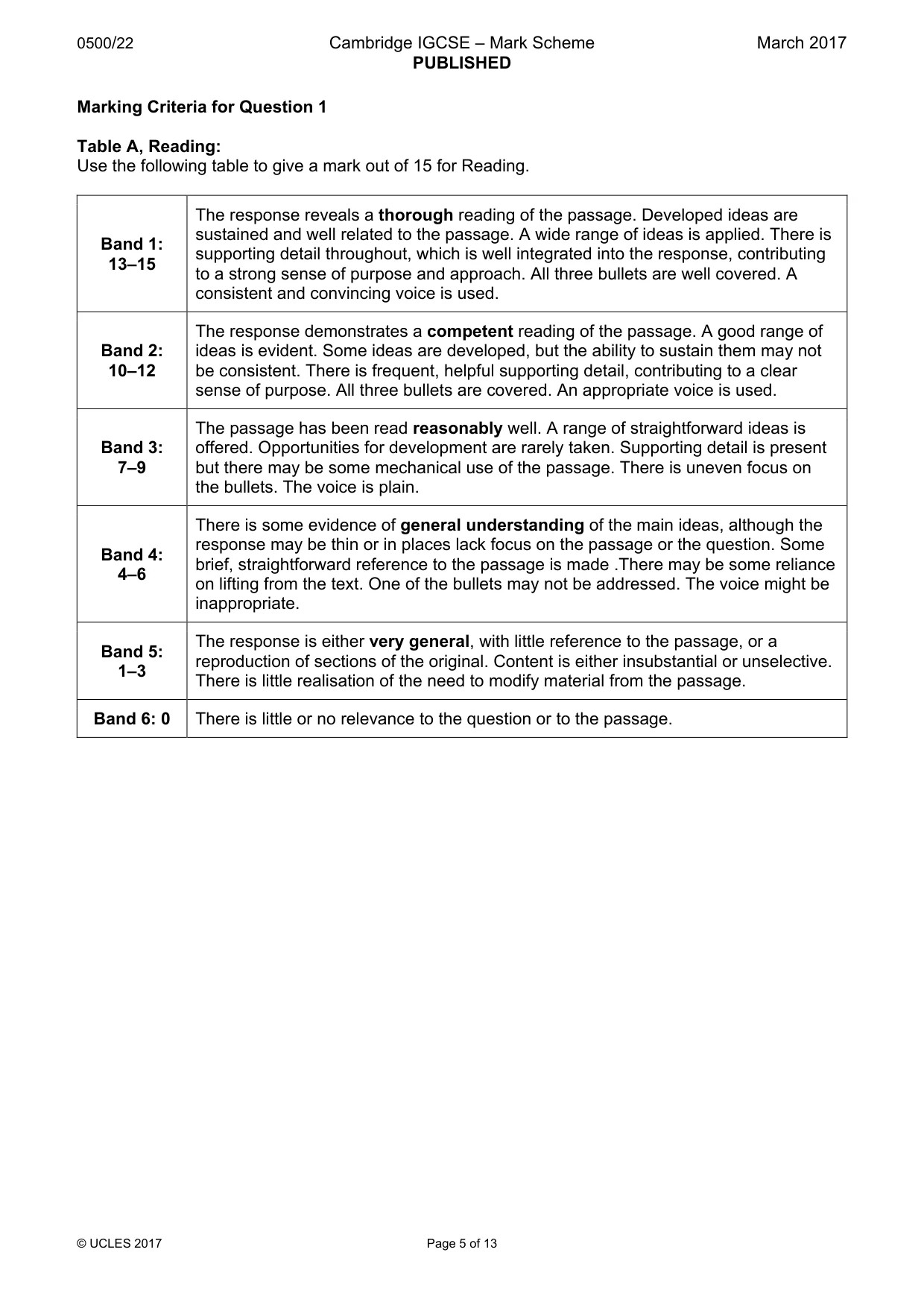
0500/22 Cambridge IGCSE – Mark Scheme PUBLISHED March 2017 © UCLES 2017 Page 5 of 13 Marking Criteria for Question 1 Table A, Reading: Use the following table to give a mark out of 15 for Reading. Band 1: 13–15 The response reveals a thorough reading of the passage. Developed ideas are sustained and well related to the passage. A wide range of ideas is applied. There is supporting detail throughout, which is well integrated into the response, contributing to a strong sense of purpose and approach. All three bullets are well covered. A consistent and convincing voice is used. Band 2: 10–12 The response demonstrates a competent reading of the passage. A good range of ideas is evident. Some ideas are developed, but the ability to sustain them may not be consistent. There is frequent, helpful supporting detail, contributing to a clear sense of purpose. All three bullets are covered. An appropriate voice is used. Band 3: 7–9 The passage has been read reasonably well. A range of straightforward ideas is offered. Opportunities for development are rarely taken. Supporting detail is present but there may be some mechanical use of the passage. There is uneven focus on the bullets. The voice is plain. Band 4: 4–6 There is some evidence of general understanding of the main ideas, although the response may be thin or in places lack focus on the passage or the question. Some brief, straightforward reference to the passage is made .There may be some reliance on lifting from the text. One of the bullets may not be addressed. The voice might be inappropriate. Band 5: 1–3 The response is either very general, with little reference to the passage, or a reproduction of sections of the original. Content is either insubstantial or unselective. There is little realisation of the need to modify material from the passage. Band 6: 0 There is little or no relevance to the question or to the passage.
Mark scheme, page 6
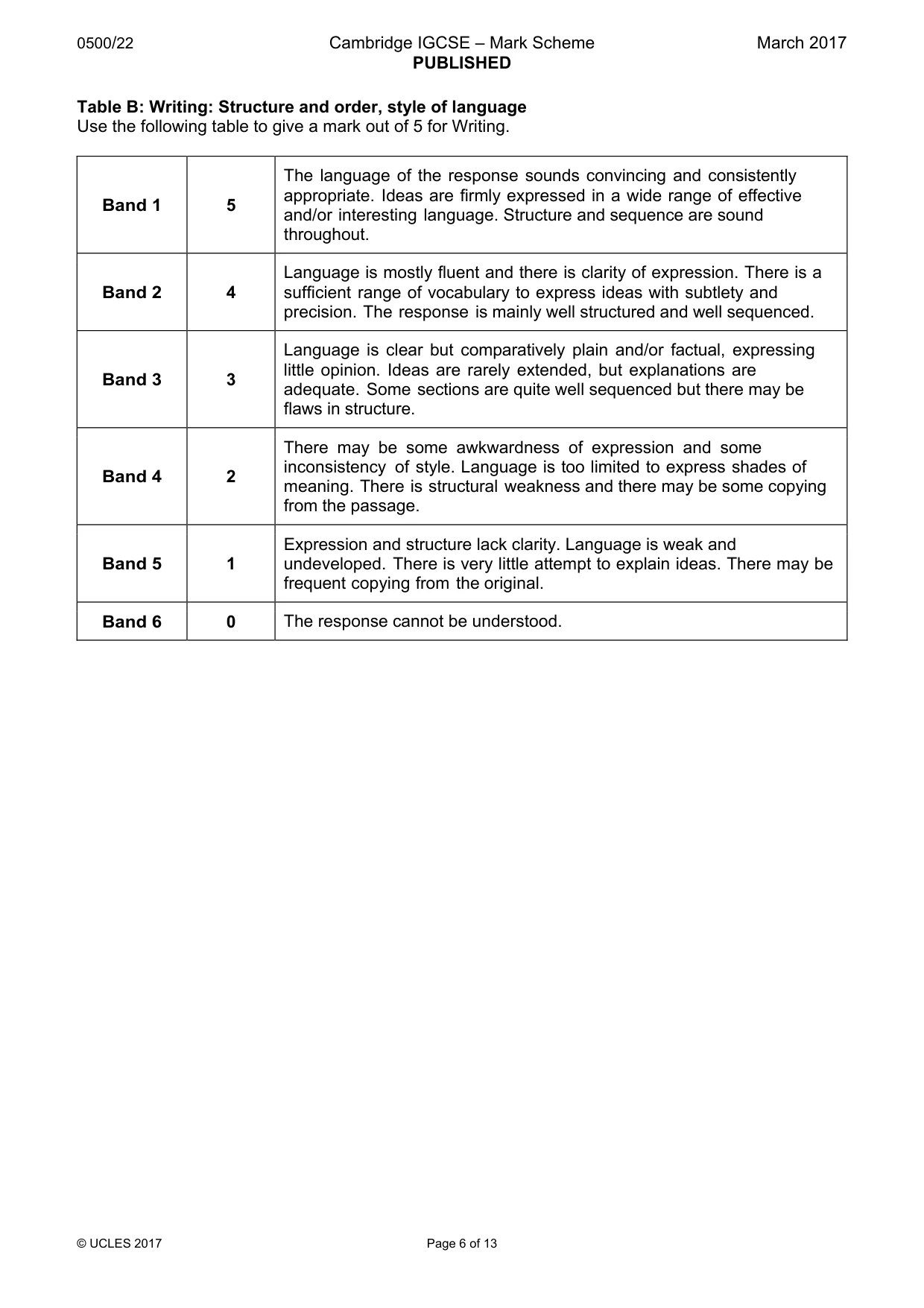
0500/22 Cambridge IGCSE – Mark Scheme PUBLISHED March 2017 © UCLES 2017 Page 6 of 13 Table B: Writing: Structure and order, style of language Use the following table to give a mark out of 5 for Writing. Band 1 5 The language of the response sounds convincing and consistently appropriate. Ideas are firmly expressed in a wide range of effective and/or interesting language. Structure and sequence are sound throughout. Band 2 4 Language is mostly fluent and there is clarity of expression. There is a sufficient range of vocabulary to express ideas with subtlety and precision. The response is mainly well structured and well sequenced. Band 3 3 Language is clear but comparatively plain and/or factual, expressing little opinion. Ideas are rarely extended, but explanations are adequate. Some sections are quite well sequenced but there may be flaws in structure. Band 4 2 There may be some awkwardness of expression and some inconsistency of style. Language is too limited to express shades of meaning. There is structural weakness and there may be some copying from the passage. Band 5 1 Expression and structure lack clarity. Language is weak and undeveloped. There is very little attempt to explain ideas. There may be frequent copying from the original. Band 6 0 The response cannot be understood.
Mark scheme, page 7
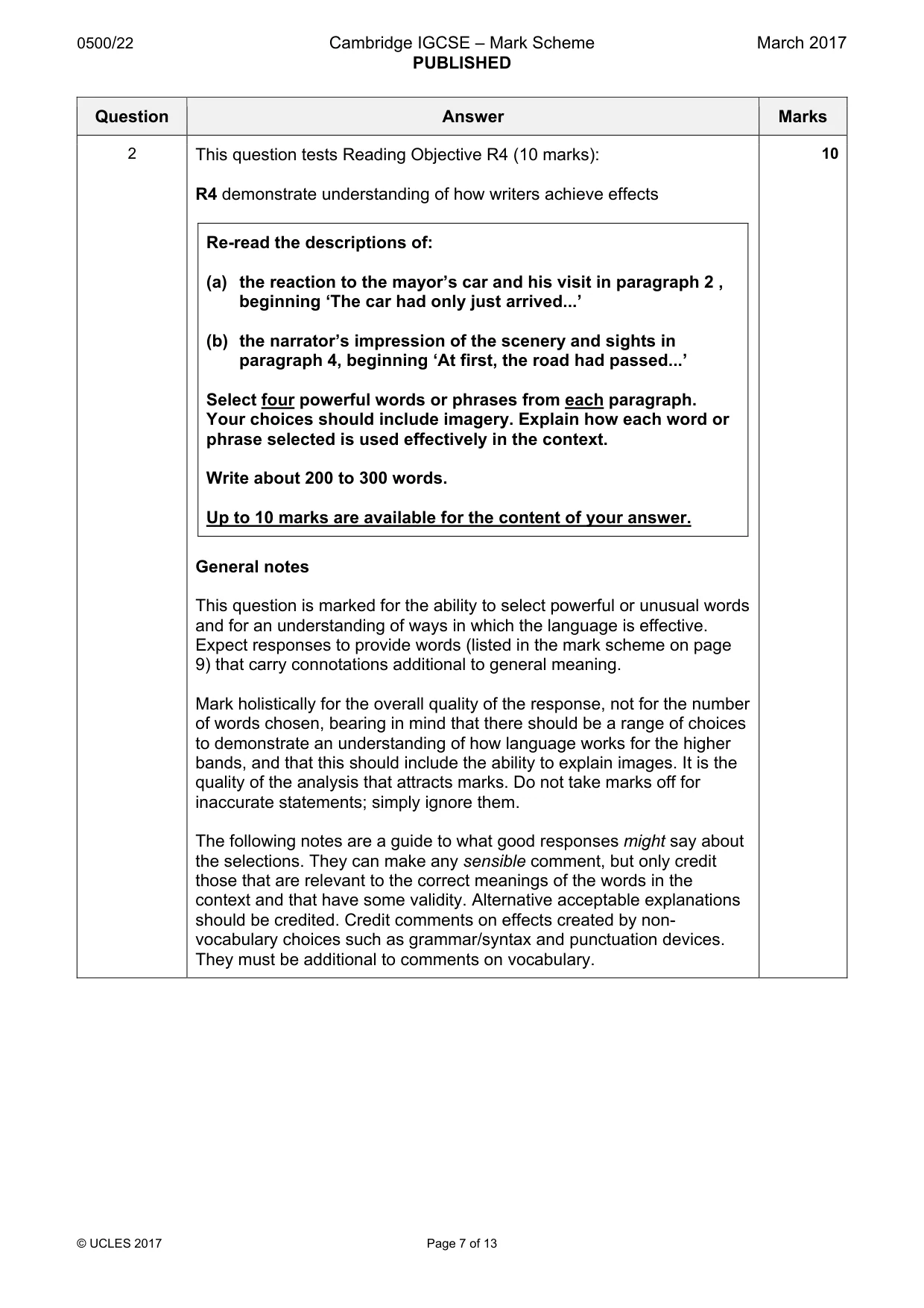
0500/22 Cambridge IGCSE – Mark Scheme PUBLISHED March 2017 © UCLES 2017 Page 7 of 13 Question Answer Marks 2 This question tests Reading Objective R4 (10 marks): R4 demonstrate understanding of how writers achieve effects Re-read the descriptions of: (a) the reaction to the mayor’s car and his visit in paragraph 2 , beginning ‘The car had only just arrived...’ (b) the narrator’s impression of the scenery and sights in paragraph 4, beginning ‘At first, the road had passed...’ Select four powerful words or phrases from each paragraph. Your choices should include imagery. Explain how each word or phrase selected is used effectively in the context. Write about 200 to 300 words. Up to 10 marks are available for the content of your answer. General notes This question is marked for the ability to select powerful or unusual words and for an understanding of ways in which the language is effective. Expect responses to provide words (listed in the mark scheme on page 9) that carry connotations additional to general meaning. Mark holistically for the overall quality of the response, not for the number of words chosen, bearing in mind that there should be a range of choices to demonstrate an understanding of how language works for the higher bands, and that this should include the ability to explain images. It is the quality of the analysis that attracts marks. Do not take marks off for inaccurate statements; simply ignore them. The following notes are a guide to what good responses might say about the selections. They can make any sensible comment, but only credit those that are relevant to the correct meanings of the words in the context and that have some validity. Alternative acceptable explanations should be credited. Credit comments on effects created by non- vocabulary choices such as grammar/syntax and punctuation devices. They must be additional to comments on vocabulary. 10
Mark scheme, page 8
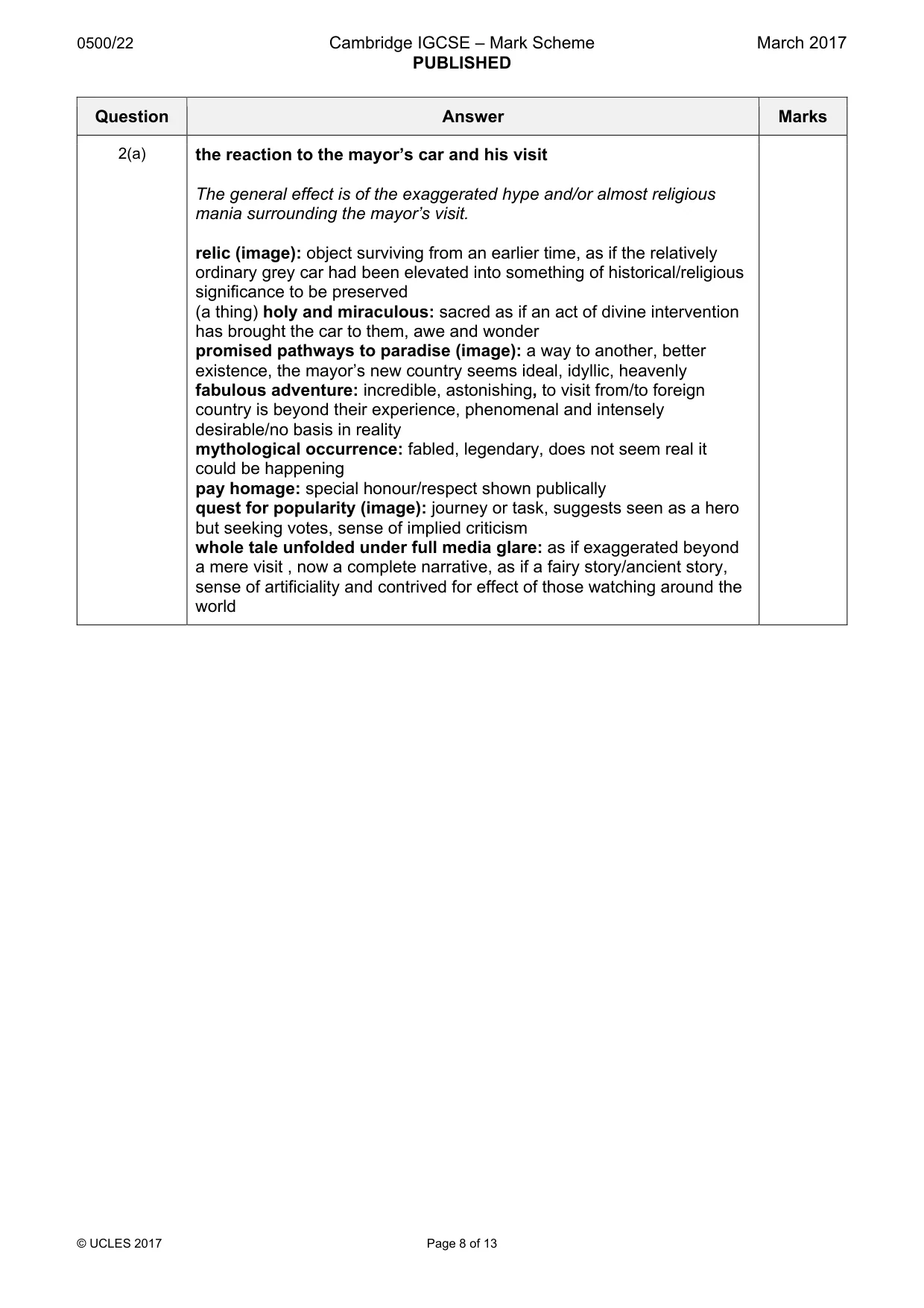
0500/22 Cambridge IGCSE – Mark Scheme PUBLISHED March 2017 © UCLES 2017 Page 8 of 13 Question Answer Marks 2(a) the reaction to the mayor’s car and his visit The general effect is of the exaggerated hype and/or almost religious mania surrounding the mayor’s visit. relic (image): object surviving from an earlier time, as if the relatively ordinary grey car had been elevated into something of historical/religious significance to be preserved (a thing) holy and miraculous: sacred as if an act of divine intervention has brought the car to them, awe and wonder promised pathways to paradise (image): a way to another, better existence, the mayor’s new country seems ideal, idyllic, heavenly fabulous adventure: incredible, astonishing, to visit from/to foreign country is beyond their experience, phenomenal and intensely desirable/no basis in reality mythological occurrence: fabled, legendary, does not seem real it could be happening pay homage: special honour/respect shown publically quest for popularity (image): journey or task, suggests seen as a hero but seeking votes, sense of implied criticism whole tale unfolded under full media glare: as if exaggerated beyond a mere visit , now a complete narrative, as if a fairy story/ancient story, sense of artificiality and contrived for effect of those watching around the world
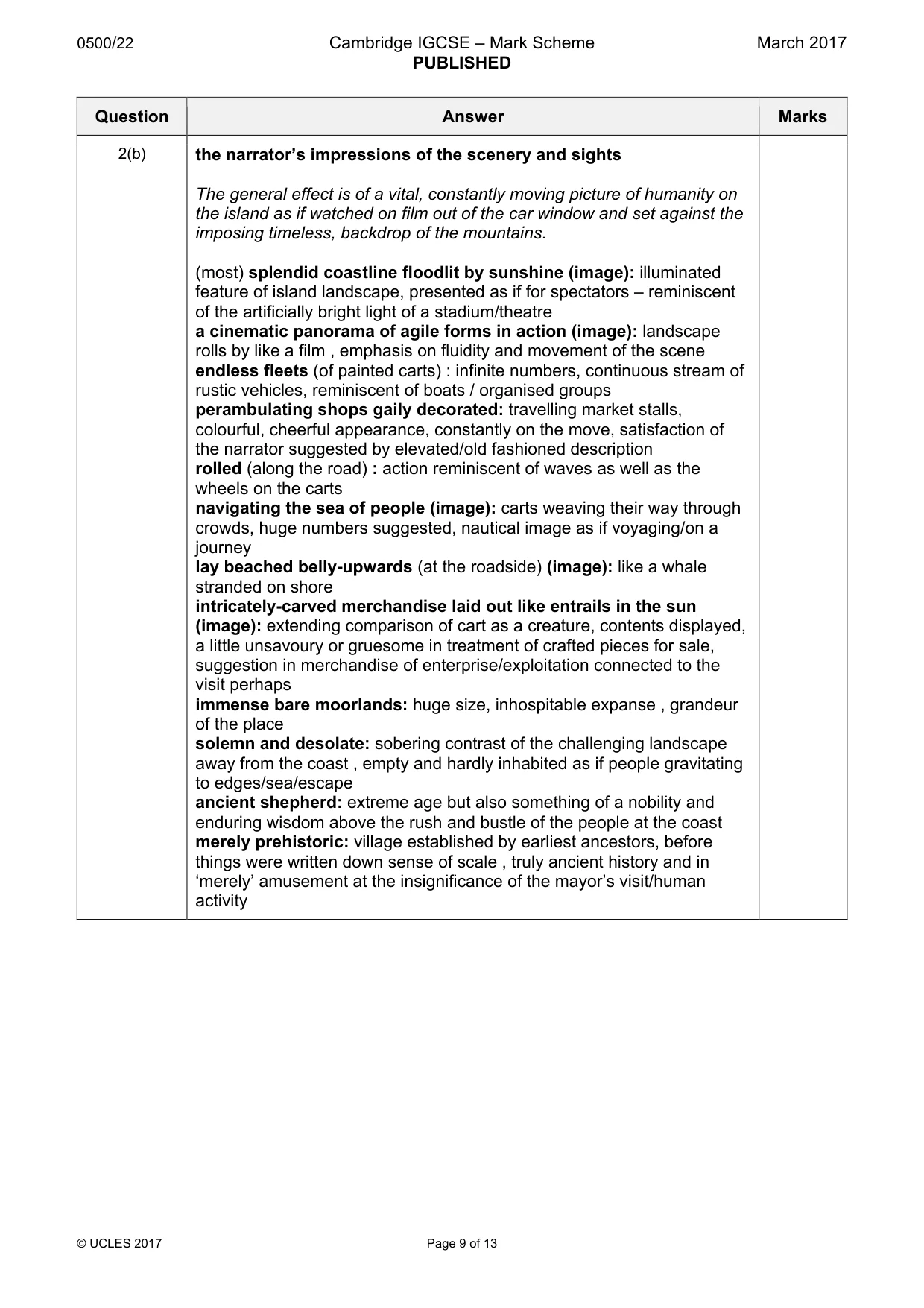
Mark scheme, page 9
0500/22 Cambridge IGCSE – Mark Scheme PUBLISHED March 2017 © UCLES 2017 Page 9 of 13 Question Answer Marks 2(b) the narrator’s impressions of the scenery and sights The general effect is of a vital, constantly moving picture of humanity on the island as if watched on film out of the car window and set against the imposing timeless, backdrop of the mountains. (most) splendid coastline floodlit by sunshine (image): illuminated feature of island landscape, presented as if for spectators – reminiscent of the artificially bright light of a stadium/theatre a cinematic panorama of agile forms in action (image): landscape rolls by like a film , emphasis on fluidity and movement of the scene endless fleets (of painted carts) : infinite numbers, continuous stream of rustic vehicles, reminiscent of boats / organised groups perambulating shops gaily decorated: travelling market stalls, colourful, cheerful appearance, constantly on the move, satisfaction of the narrator suggested by elevated/old fashioned description rolled (along the road) : action reminiscent of waves as well as the wheels on the carts navigating the sea of people (image): carts weaving their way through crowds, huge numbers suggested, nautical image as if voyaging/on a journey lay beached belly-upwards (at the roadside) (image): like a whale stranded on shore intricately-carved merchandise laid out like entrails in the sun (image): extending comparison of cart as a creature, contents displayed, a little unsavoury or gruesome in treatment of crafted pieces for sale, suggestion in merchandise of enterprise/exploitation connected to the visit perhaps immense bare moorlands: huge size, inhospitable expanse , grandeur of the place solemn and desolate: sobering contrast of the challenging landscape away from the coast , empty and hardly inhabited as if people gravitating to edges/sea/escape ancient shepherd: extreme age but also something of a nobility and enduring wisdom above the rush and bustle of the people at the coast merely prehistoric: village established by earliest ancestors, before things were written down sense of scale , truly ancient history and in ‘merely’ amusement at the insignificance of the mayor’s visit/human activity
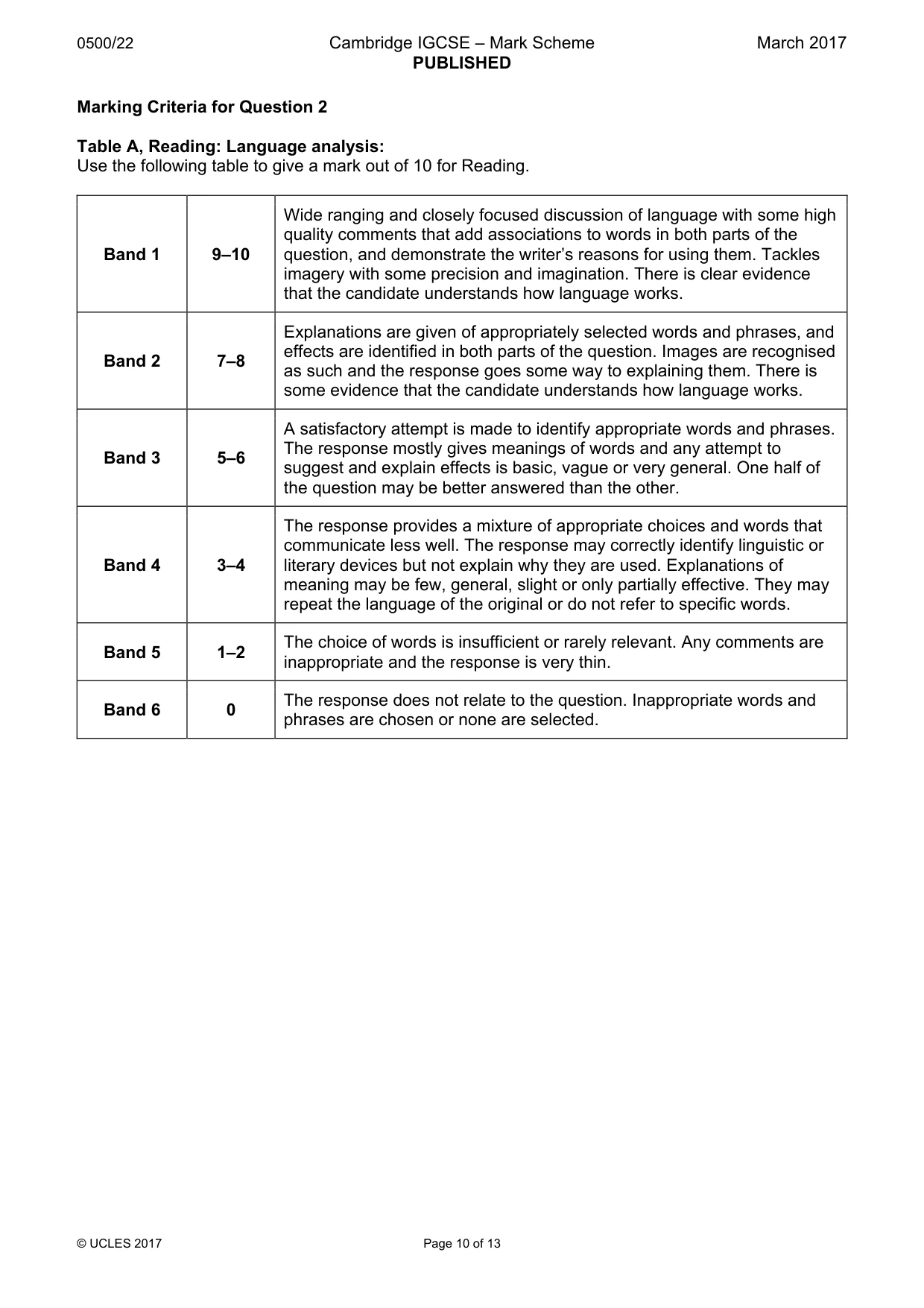
Mark scheme, page 10
0500/22 Cambridge IGCSE – Mark Scheme PUBLISHED March 2017 © UCLES 2017 Page 10 of 13 Marking Criteria for Question 2 Table A, Reading: Language analysis: Use the following table to give a mark out of 10 for Reading. Band 1 9–10 Wide ranging and closely focused discussion of language with some high quality comments that add associations to words in both parts of the question, and demonstrate the writer’s reasons for using them. Tackles imagery with some precision and imagination. There is clear evidence that the candidate understands how language works. Band 2 7–8 Explanations are given of appropriately selected words and phrases, and effects are identified in both parts of the question. Images are recognised as such and the response goes some way to explaining them. There is some evidence that the candidate understands how language works. Band 3 5–6 A satisfactory attempt is made to identify appropriate words and phrases. The response mostly gives meanings of words and any attempt to suggest and explain effects is basic, vague or very general. One half of the question may be better answered than the other. Band 4 3–4 The response provides a mixture of appropriate choices and words that communicate less well. The response may correctly identify linguistic or literary devices but not explain why they are used. Explanations of meaning may be few, general, slight or only partially effective. They may repeat the language of the original or do not refer to specific words. Band 5 1–2 The choice of words is insufficient or rarely relevant. Any comments are inappropriate and the response is very thin. Band 6 0 The response does not relate to the question. Inappropriate words and phrases are chosen or none are selected.
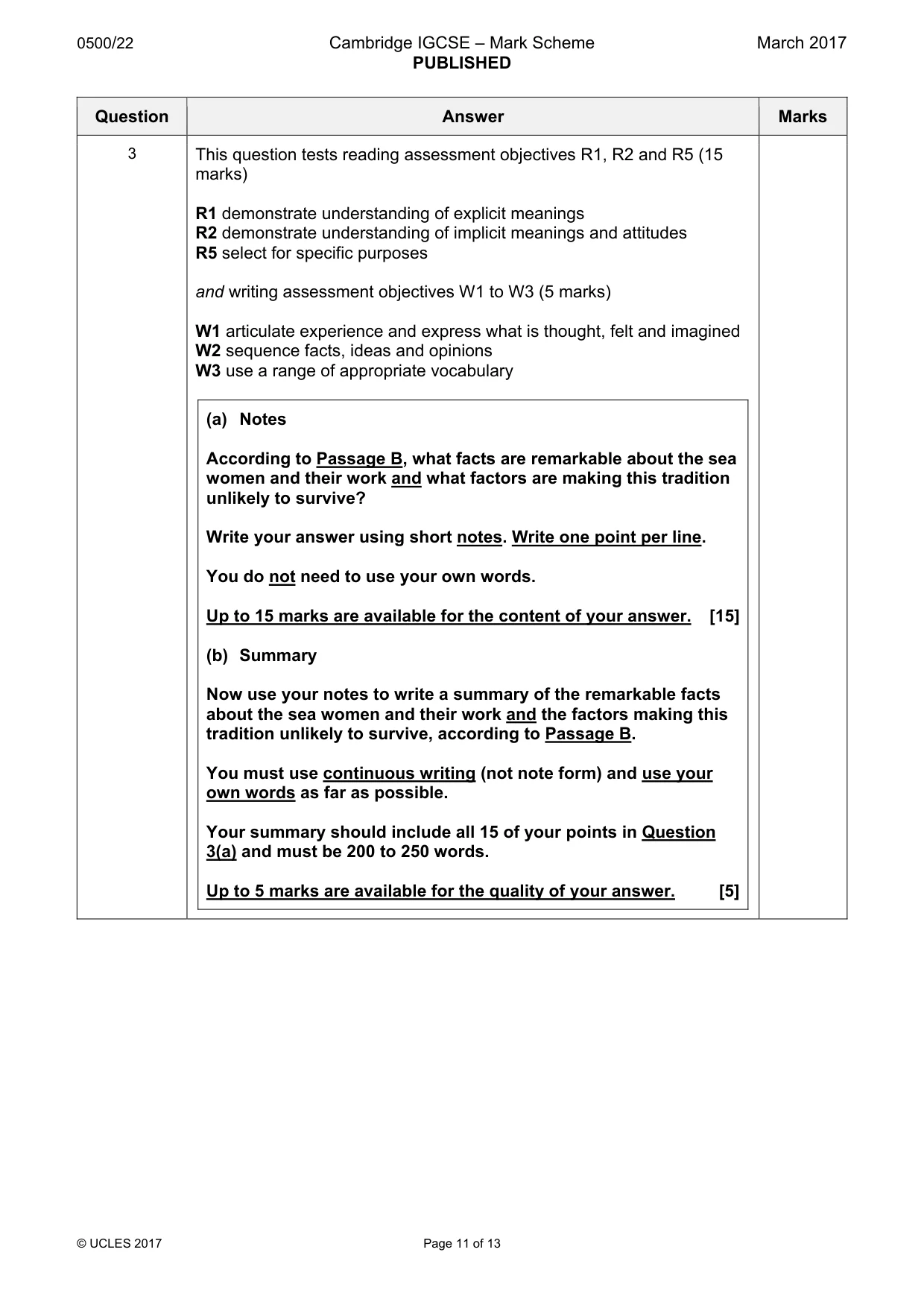
Mark scheme, page 11
0500/22 Cambridge IGCSE – Mark Scheme PUBLISHED March 2017 © UCLES 2017 Page 11 of 13 Question Answer Marks 3 This question tests reading assessment objectives R1, R2 and R5 (15 marks) R1 demonstrate understanding of explicit meanings R2 demonstrate understanding of implicit meanings and attitudes R5 select for specific purposes and writing assessment objectives W1 to W3 (5 marks) W1 articulate experience and express what is thought, felt and imagined W2 sequence facts, ideas and opinions W3 use a range of appropriate vocabulary (a) Notes According to Passage B, what facts are remarkable about the sea women and their work and what factors are making this tradition unlikely to survive? Write your answer using short notes. Write one point per line. You do not need to use your own words. Up to 15 marks are available for the content of your answer. [15] (b) Summary Now use your notes to write a summary of the remarkable facts about the sea women and their work and the factors making this tradition unlikely to survive, according to Passage B. You must use continuous writing (not note form) and use your own words as far as possible. Your summary should include all 15 of your points in Question 3(a) and must be 200 to 250 words. Up to 5 marks are available for the quality of your answer. [5]
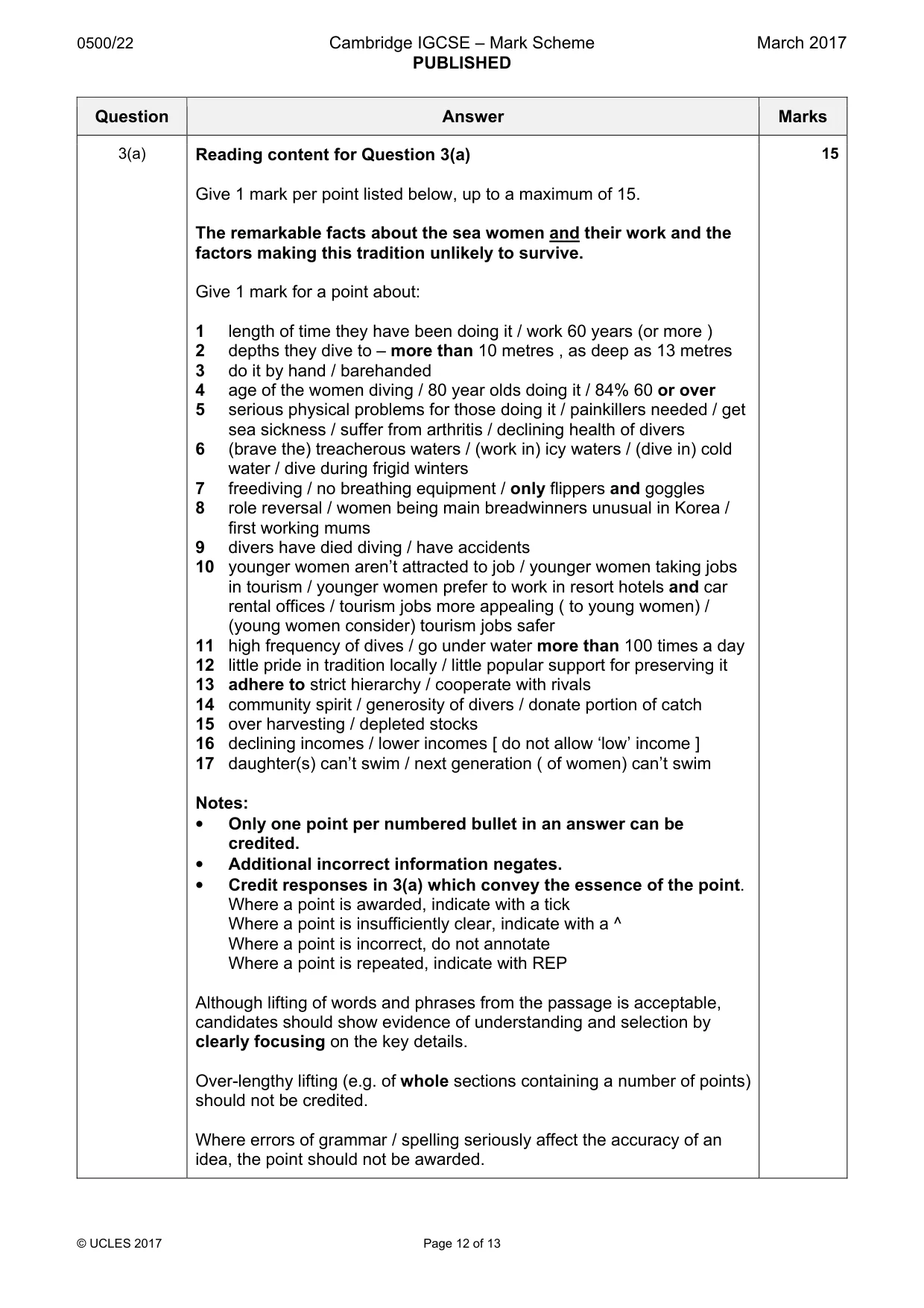
Mark scheme, page 12
0500/22 Cambridge IGCSE – Mark Scheme PUBLISHED March 2017 © UCLES 2017 Page 12 of 13 Question Answer Marks 3(a) Reading content for Question 3(a) Give 1 mark per point listed below, up to a maximum of 15. The remarkable facts about the sea women and their work and the factors making this tradition unlikely to survive. Give 1 mark for a point about: 1 length of time they have been doing it / work 60 years (or more ) 2 depths they dive to – more than 10 metres , as deep as 13 metres 3 do it by hand / barehanded 4 age of the women diving / 80 year olds doing it / 84% 60 or over 5 serious physical problems for those doing it / painkillers needed / get sea sickness / suffer from arthritis / declining health of divers 6 (brave the) treacherous waters / (work in) icy waters / (dive in) cold water / dive during frigid winters 7 freediving / no breathing equipment / only flippers and goggles 8 role reversal / women being main breadwinners unusual in Korea / first working mums 9 divers have died diving / have accidents 10 younger women aren’t attracted to job / younger women taking jobs in tourism / younger women prefer to work in resort hotels and car rental offices / tourism jobs more appealing ( to young women) / (young women consider) tourism jobs safer 11 high frequency of dives / go under water more than 100 times a day 12 little pride in tradition locally / little popular support for preserving it 13 adhere to strict hierarchy / cooperate with rivals 14 community spirit / generosity of divers / donate portion of catch 15 over harvesting / depleted stocks 16 declining incomes / lower incomes [ do not allow ‘low’ income ] 17 daughter(s) can’t swim / next generation ( of women) can’t swim Notes: • Only one point per numbered bullet in an answer can be credited. • Additional incorrect information negates. • Credit responses in 3(a) which convey the essence of the point. Where a point is awarded, indicate with a tick Where a point is insufficiently clear, indicate with a ^ Where a point is incorrect, do not annotate Where a point is repeated, indicate with REP Although lifting of words and phrases from the passage is acceptable, candidates should show evidence of understanding and selection by clearly focusing on the key details. Over-lengthy lifting (e.g. of whole sections containing a number of points) should not be credited. Where errors of grammar / spelling seriously affect the accuracy of an idea, the point should not be awarded. 15
Mark scheme, page 13
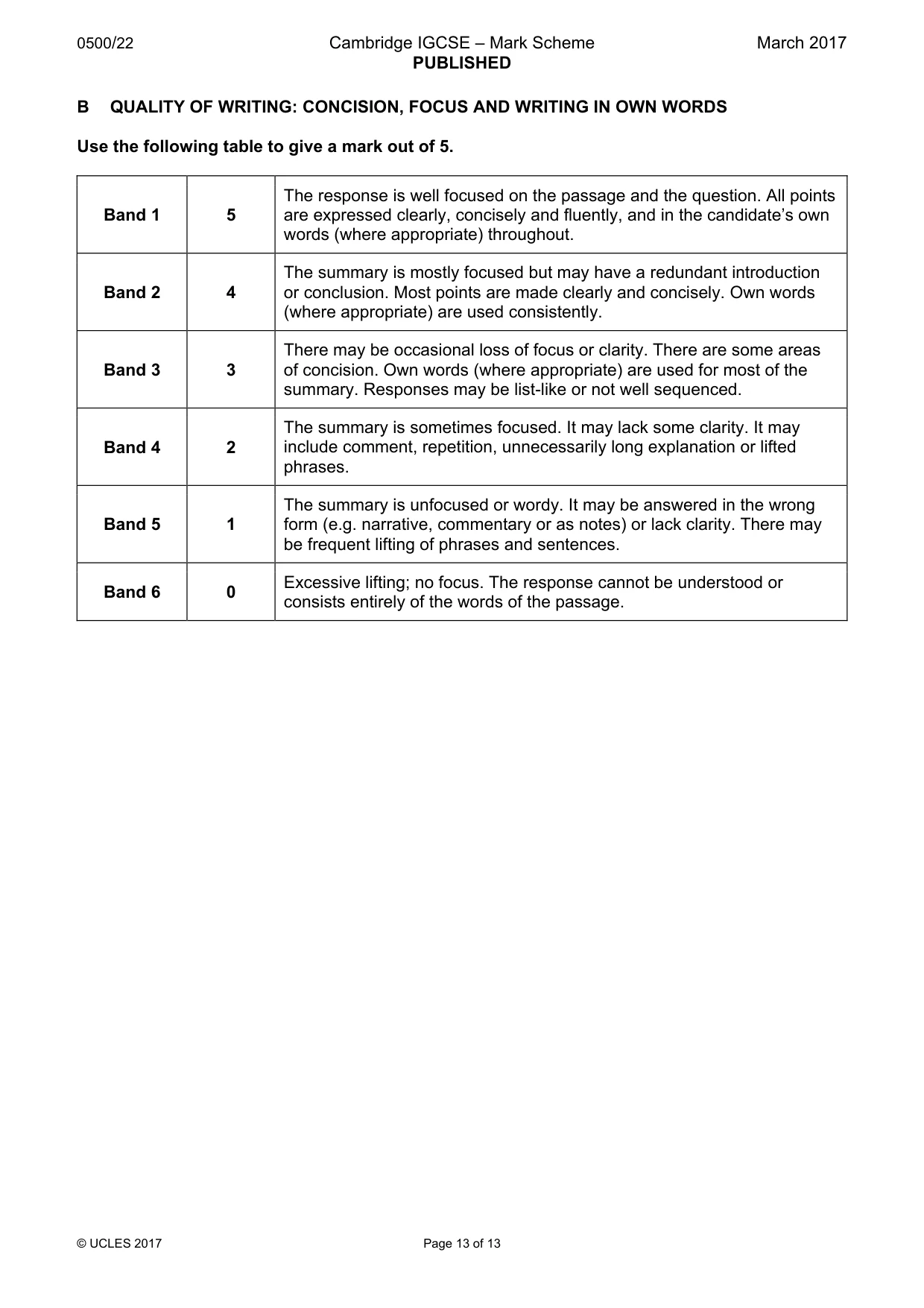
0500/22 Cambridge IGCSE – Mark Scheme PUBLISHED March 2017 © UCLES 2017 Page 13 of 13 B QUALITY OF WRITING: CONCISION, FOCUS AND WRITING IN OWN WORDS Use the following table to give a mark out of 5. Band 1 5 The response is well focused on the passage and the question. All points are expressed clearly, concisely and fluently, and in the candidate’s own words (where appropriate) throughout. Band 2 4 The summary is mostly focused but may have a redundant introduction or conclusion. Most points are made clearly and concisely. Own words (where appropriate) are used consistently. Band 3 3 There may be occasional loss of focus or clarity. There are some areas of concision. Own words (where appropriate) are used for most of the summary. Responses may be list-like or not well sequenced. Band 4 2 The summary is sometimes focused. It may lack some clarity. It may include comment, repetition, unnecessarily long explanation or lifted phrases. Band 5 1 The summary is unfocused or wordy. It may be answered in the wrong form (e.g. narrative, commentary or as notes) or lack clarity. There may be frequent lifting of phrases and sentences. Band 6 0 Excessive lifting; no focus. The response cannot be understood or consists entirely of the words of the passage.
What you needed in this session
Cambridge’s own grade thresholds for 2017 Feb/March, Paper 2 · Variant 2. A higher threshold means an easier paper — the bar moves with how the cohort did.