Cambridge IGCSE English - First Language 0500 — 2017 Feb/March Paper 1 · Variant 2
0500/12/F/M/17 · 50 marks · ≈56 min
The question paper and its mark scheme, free to read here and free to download. This is Cambridge’s own paper, exactly as it was sat.
Question paper12 pages
Mark scheme12 pages
Answers below. Sit the paper first if you are practising.
Paper as text
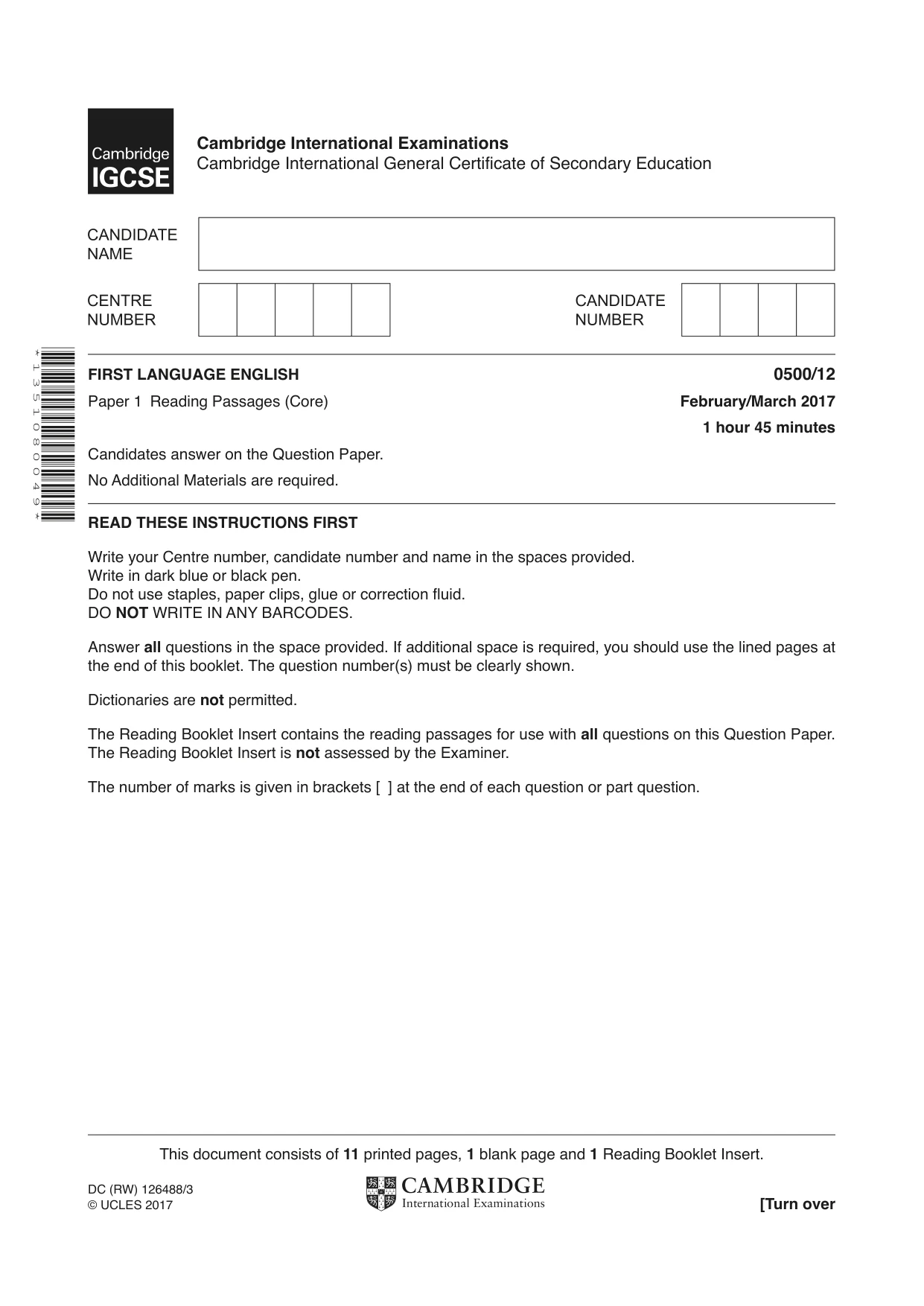
Question paper, page 1
This document consists of 11 printed pages, 1 blank page and 1 Reading Booklet Insert. DC (RW) 126488/3 © UCLES 2017 [Turn over Cambridge International Examinations Cambridge International General Certificate of Secondary Education * 1 3 5 1 0 8 0 0 4 9 * FIRST LANGUAGE ENGLISH 0500/12 Paper 1 Reading Passages (Core) February/March 2017 1 hour 45 minutes Candidates answer on the Question Paper. No Additional Materials are required. READ THESE INSTRUCTIONS FIRST Write your Centre number, candidate number and name in the spaces provided. Write in dark blue or black pen. Do not use staples, paper clips, glue or correction fluid. DO NOT WRITE IN ANY BARCODES. Answer all questions in the space provided. If additional space is required, you should use the lined pages at the end of this booklet. The question number(s) must be clearly shown. Dictionaries are not permitted. The Reading Booklet Insert contains the reading passages for use with all questions on this Question Paper. The Reading Booklet Insert is not assessed by the Examiner. The number of marks is given in brackets [ ] at the end of each question or part question.
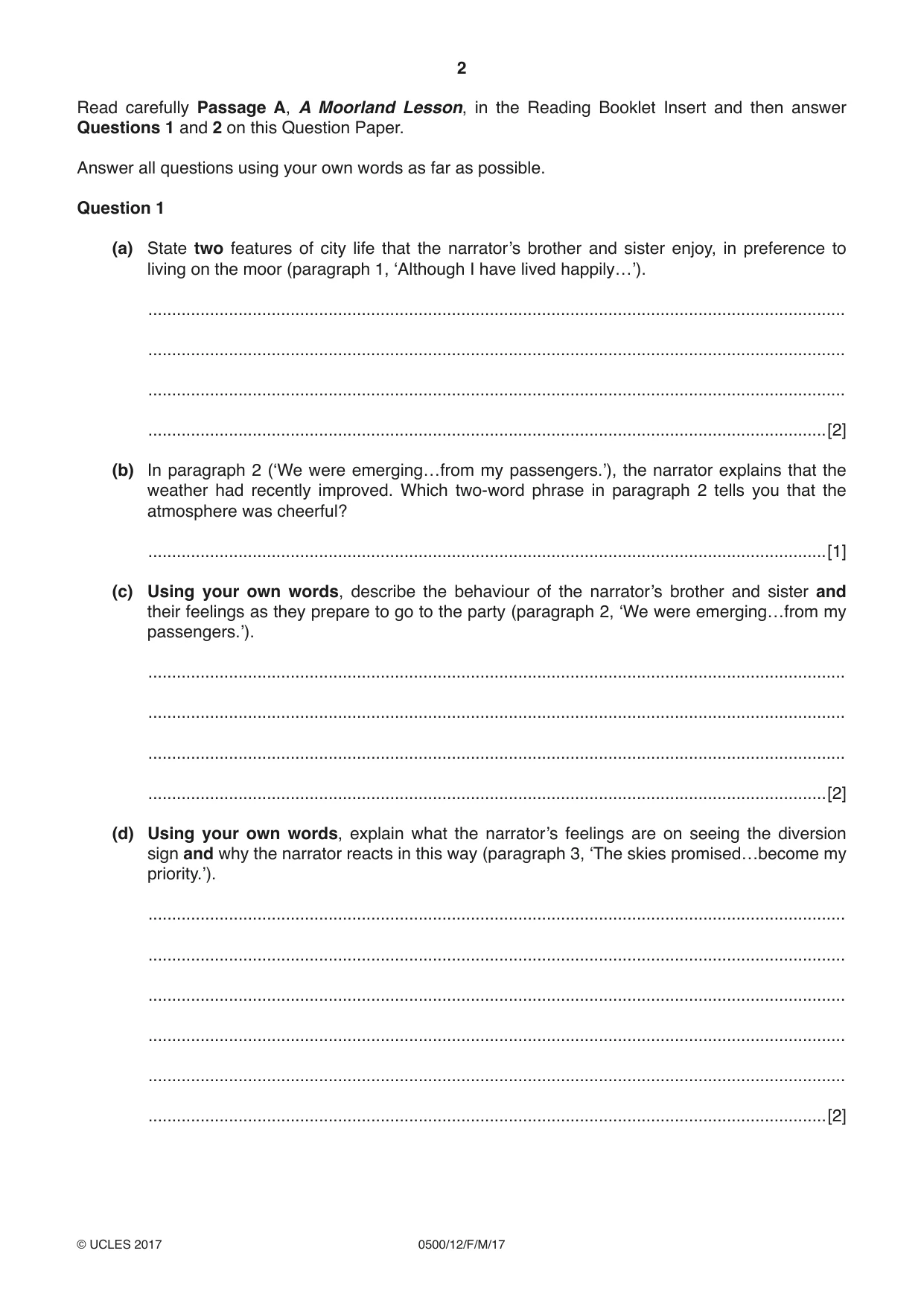
Question paper, page 2
2 0500/12/F/M/17 © UCLES 2017 Read carefully Passage A, A Moorland Lesson, in the Reading Booklet Insert and then answer Questions 1 and 2 on this Question Paper. Answer all questions using your own words as far as possible. Question 1 (a) State two features of city life that the narrator’s brother and sister enjoy, in preference to living on the moor (paragraph 1, ‘Although I have lived happily…’). … … … …[2] (b) In paragraph 2 (‘We were emerging…from my passengers.’), the narrator explains that the weather had recently improved. Which two-word phrase in paragraph 2 tells you that the atmosphere was cheerful? …[1] (c) Using your own words, describe the behaviour of the narrator’s brother and sister and their feelings as they prepare to go to the party (paragraph 2, ‘We were emerging…from my passengers.’). … … … …[2] (d) Using your own words, explain what the narrator’s feelings are on seeing the diversion sign and why the narrator reacts in this way (paragraph 3, ‘The skies promised…become my priority.’). … … … … … …[2]
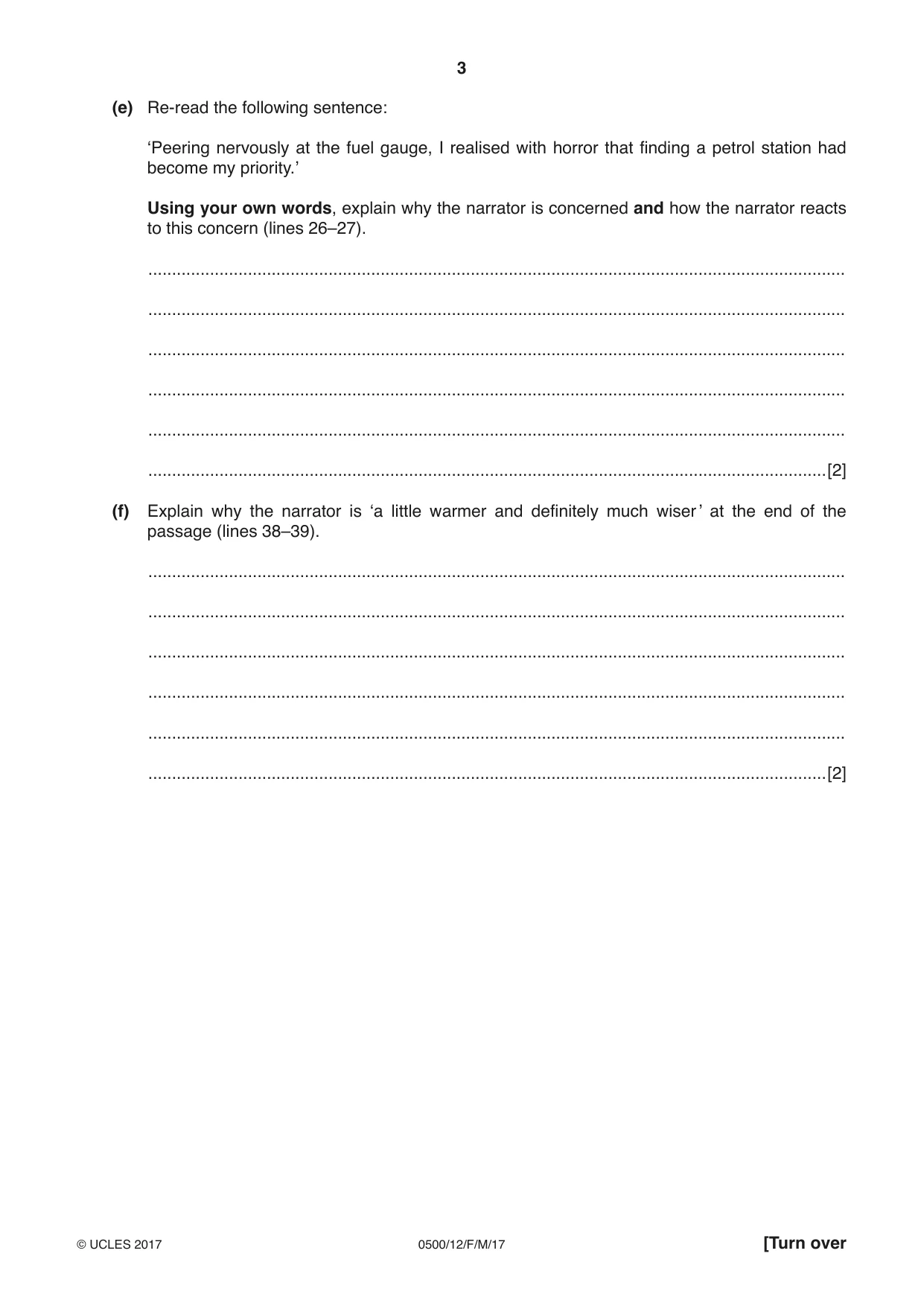
Question paper, page 3
3 0500/12/F/M/17 © UCLES 2017 [Turn over (e) Re-read the following sentence: ‘Peering nervously at the fuel gauge, I realised with horror that finding a petrol station had become my priority.’ Using your own words, explain why the narrator is concerned and how the narrator reacts to this concern (lines 26–27). … … … … … …[2] (f) Explain why the narrator is ‘a little warmer and definitely much wiser ’ at the end of the passage (lines 38–39). … … … … … …[2]
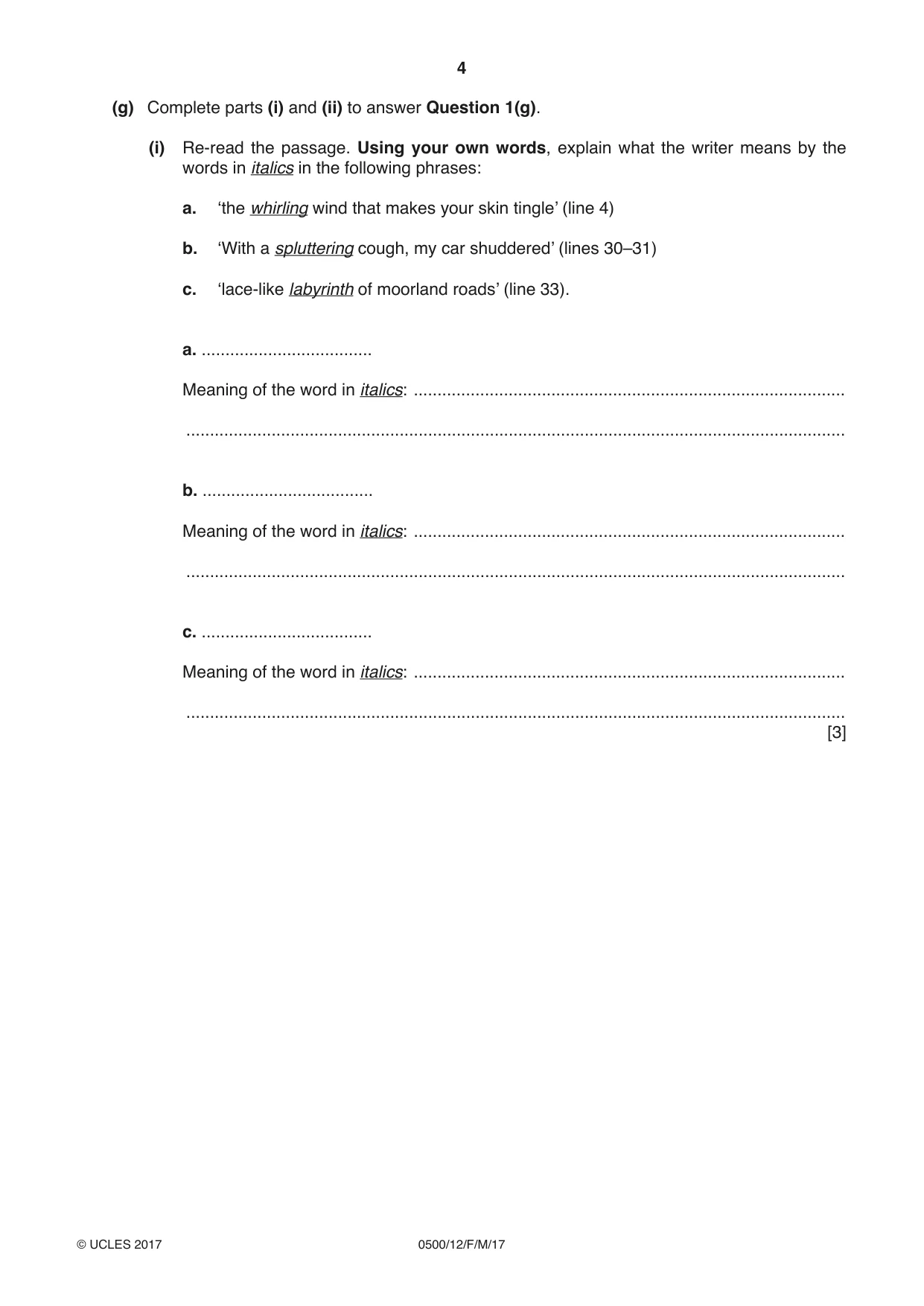
Question paper, page 4
4 0500/12/F/M/17 © UCLES 2017 (g) Complete parts (i) and (ii) to answer Question 1(g). (i) Re-read the passage. Using your own words, explain what the writer means by the words in italics in the following phrases: a. ‘the whirling wind that makes your skin tingle’ (line 4) b. ‘With a spluttering cough, my car shuddered’ (lines 30–31) c. ‘lace-like labyrinth of moorland roads’ (line 33). a. … Meaning of the word in italics: … … b. … Meaning of the word in italics: … … c. … Meaning of the word in italics: … … [3]
Question paper, page 5
5 0500/12/F/M/17 © UCLES 2017 [Turn over (ii) Explain how the language in each of the phrases in (g)(i) helps to suggest the narrator’s thoughts about the sights and sounds on the moor. a. … Explanation: … … … … b. … Explanation: … … … … c. … Explanation: … … … … [6] [Total: 20]
Question paper, page 6
6 0500/12/F/M/17 © UCLES 2017 Question 2 Imagine that you are either the brother or the sister of the narrator in Passage A. You have been asked to write an article for a magazine, describing your experience on the moor. Write your magazine article. In your magazine article you should: • describe the sights and sounds of the moor and your responses to them • explain what happened when you travelled to the party and your reactions to this • explain what you have learned from the experience and what advice you would offer to anyone as a result. Base your magazine article on what you have read in Passage A, but do not copy from it. Be careful to use your own words. Address each of the three bullet points. Begin your magazine article: ‘It felt strange seeing the moor again…’. Write about 200 to 300 words. Up to 10 marks are available for the content of your answer, and up to 5 marks for the quality of your writing. … … … … … … … … … … … … … … … …
Question paper, page 7
7 0500/12/F/M/17 © UCLES 2017 [Turn over … … … … … … … … … … … … … … … … … … … … … … … … … … … [Total: 15]
Question paper, page 8
8 0500/12/F/M/17 © UCLES 2017 Read carefully Passage B, Avocados in Andalusia, in the Reading Booklet Insert and then answer Question 3(a) and (b) on this Question Paper. Question 3 Answer the questions in the order set. (a) Notes What facts do you learn about avocados and the farming methods involved in growing them, according to Passage B? Write your answers using short notes. Write one point per line. You do not need to use your own words. Up to 10 marks are available for the content of your answer. Facts about avocados and the farming methods involved in growing them. 1. … 2. … 3. … 4. … 5. … 6. … 7. … 8. … 9. … 10. … [10]
Question paper, page 9
9 0500/12/F/M/17 © UCLES 2017 (b) Summary Now use your notes to write a summary of what Passage B tells you about avocados and the farming methods involved in growing them. You must use continuous writing (not note form) and use your own words as far as possible. Your summary should include all 10 of your points in Question 3(a) and must be 100 to 150 words. Up to 5 marks are available for the quality of your writing. … … … … … … … … … … … … … … … … … … … … …[5] [Total: 15]
Question paper, page 10
10 0500/12/F/M/17 © UCLES 2017 Additional Page If you use the following lined page to complete the answer(s) to any question(s), the question number(s) must be clearly shown. … … … … … … … … … … … … … … … … … … … … … … … … … …
Question paper, page 11
11 0500/12/F/M/17 © UCLES 2017 Additional Page If you use the following lined page to complete the answer(s) to any question(s), the question number(s) must be clearly shown. … … … … … … … … … … … … … … … … … … … … … … … … … …
Question paper, page 12
12 0500/12/F/M/17 © UCLES 2017 Permission to reproduce items where third-party owned material protected by copyright is included has been sought and cleared where possible. Every reasonable effort has been made by the publisher (UCLES) to trace copyright holders, but if any items requiring clearance have unwittingly been included, the publisher will be pleased to make amends at the earliest possible opportunity. To avoid the issue of disclosure of answer-related information to candidates, all copyright acknowledgements are reproduced online in the Cambridge International Examinations Copyright Acknowledgements Booklet. This is produced for each series of examinations and is freely available to download at www.cie.org.uk after the live examination series. Cambridge International Examinations is part of the Cambridge Assessment Group. Cambridge Assessment is the brand name of University of Cambridge Local Examinations Syndicate (UCLES), which is itself a department of the University of Cambridge. BLANK PAGE
Mark scheme, page 1
® IGCSE is a registered trademark. This document consists of 12 printed pages. © UCLES 2017 [Turn over Cambridge International Examinations Cambridge International General Certificate of Secondary Education FIRST LANGUAGE ENGLISH 0500/12 Paper 1 Reading Passages (Core) March 2017 MARK SCHEME Maximum Mark: 50 Published This mark scheme is published as an aid to teachers and candidates, to indicate the requirements of the examination. It shows the basis on which Examiners were instructed to award marks. It does not indicate the details of the discussions that took place at an Examiners’ meeting before marking began, which would have considered the acceptability of alternative answers. Mark schemes should be read in conjunction with the question paper and the Principal Examiner Report for Teachers. Cambridge will not enter into discussions about these mark schemes. Cambridge is publishing the mark schemes for the March 2017 series for most Cambridge IGCSE®, Cambridge International A and AS Level components and some Cambridge O Level components.
Mark scheme, page 2
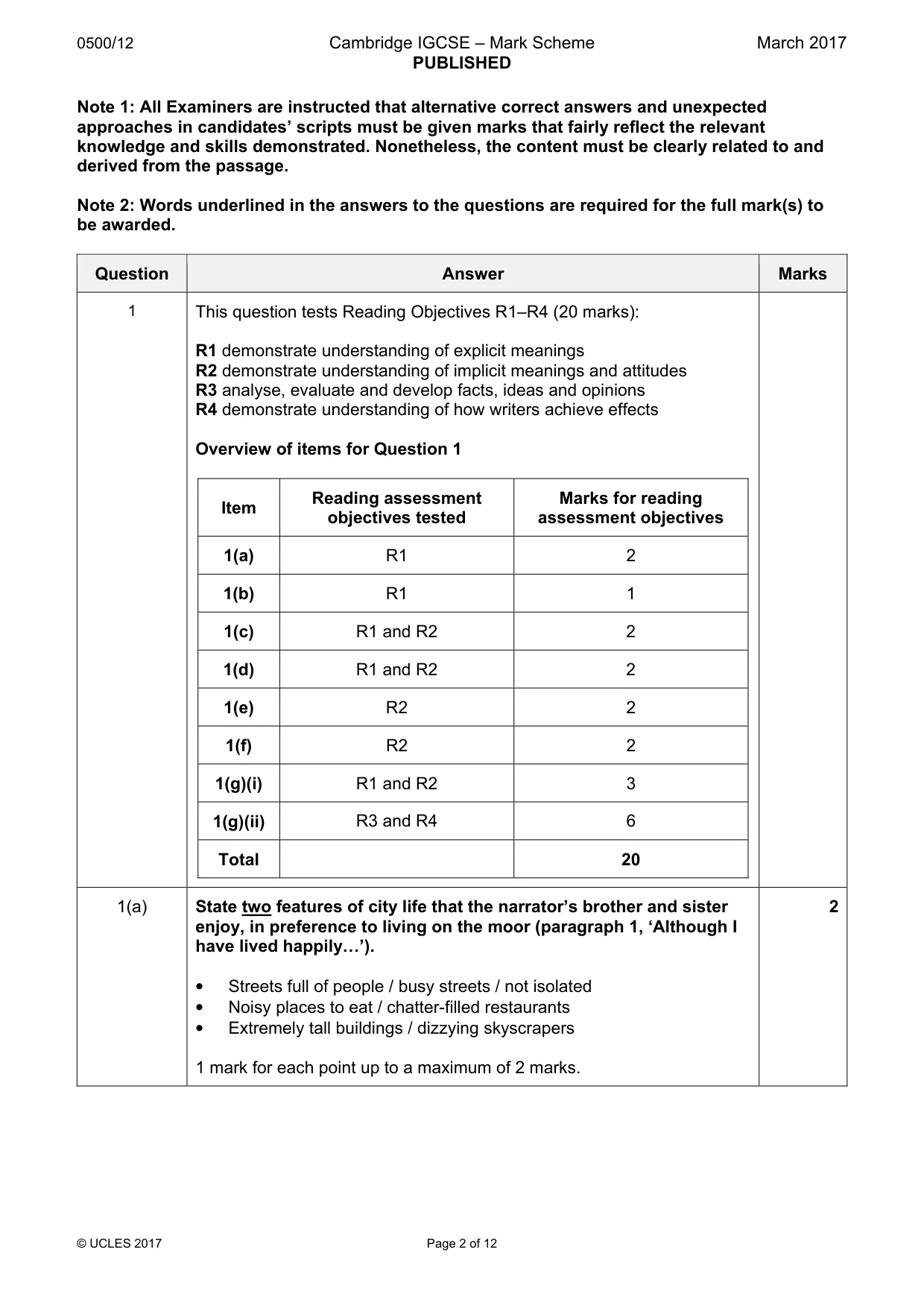
0500/12 Cambridge IGCSE – Mark Scheme PUBLISHED March 2017 © UCLES 2017 Page 2 of 12 Note 1: All Examiners are instructed that alternative correct answers and unexpected approaches in candidates’ scripts must be given marks that fairly reflect the relevant knowledge and skills demonstrated. Nonetheless, the content must be clearly related to and derived from the passage. Note 2: Words underlined in the answers to the questions are required for the full mark(s) to be awarded. Question Answer Marks 1 This question tests Reading Objectives R1–R4 (20 marks): R1 demonstrate understanding of explicit meanings R2 demonstrate understanding of implicit meanings and attitudes R3 analyse, evaluate and develop facts, ideas and opinions R4 demonstrate understanding of how writers achieve effects Overview of items for Question 1 Item Reading assessment objectives tested Marks for reading assessment objectives 1(a) R1 2 1(b) R1 1 1(c) R1 and R2 2 1(d) R1 and R2 2 1(e) R2 2 1(f) R2 2 1(g)(i) R1 and R2 3 1(g)(ii) R3 and R4 6 Total 20 1(a) State two features of city life that the narrator’s brother and sister enjoy, in preference to living on the moor (paragraph 1, ‘Although I have lived happily«’). • Streets full of people / busy streets / not isolated • Noisy places to eat / chatter-filled restaurants • Extremely tall buildings / dizzying skyscrapers 1 mark for each point up to a maximum of 2 marks. 2
Mark scheme, page 3
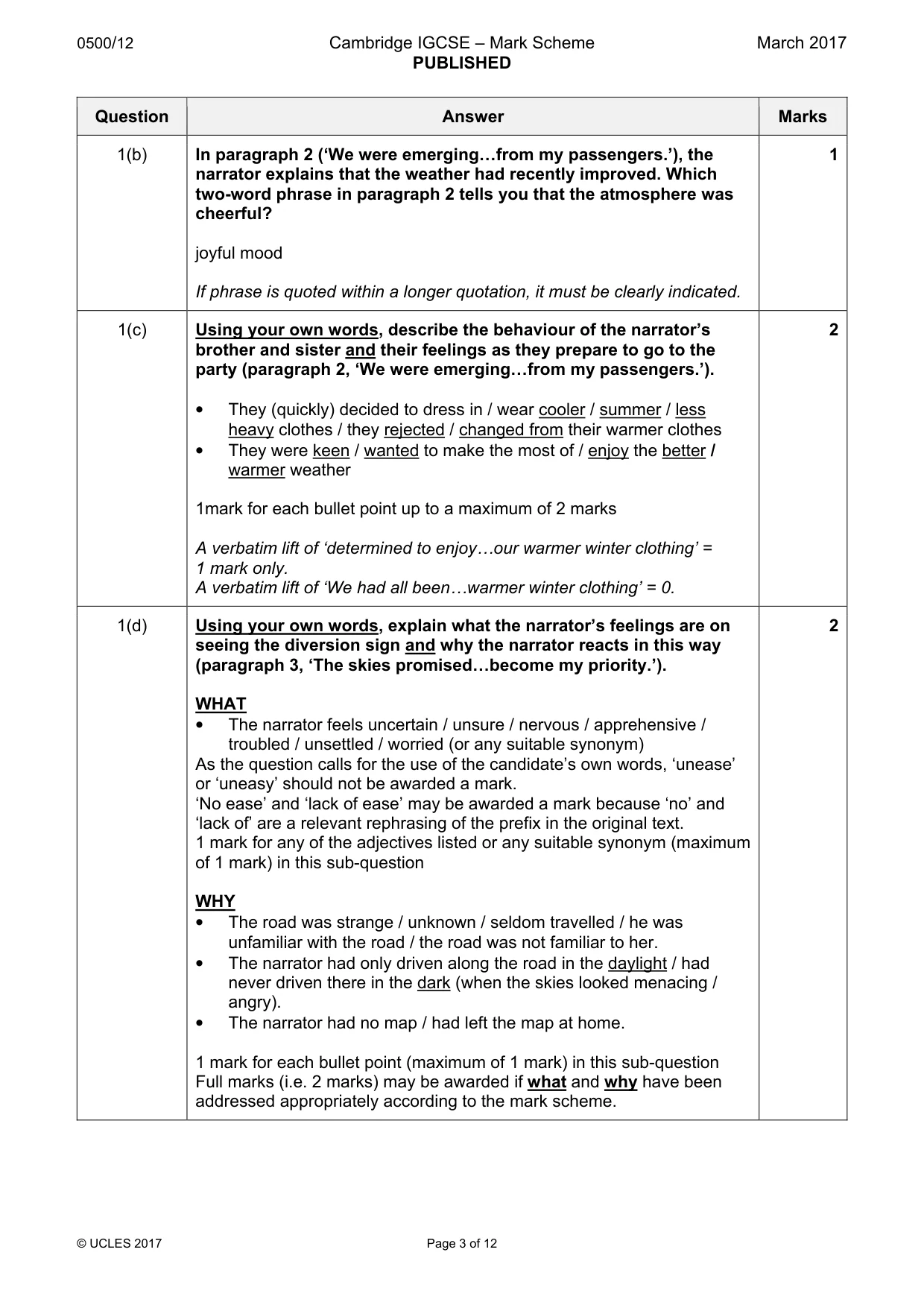
0500/12 Cambridge IGCSE – Mark Scheme PUBLISHED March 2017 © UCLES 2017 Page 3 of 12 Question Answer Marks 1(b) In paragraph 2 (‘We were emerging«from my passengers.’), the narrator explains that the weather had recently improved. Which two-word phrase in paragraph 2 tells you that the atmosphere was cheerful? joyful mood If phrase is quoted within a longer quotation, it must be clearly indicated. 1 1(c) Using your own words, describe the behaviour of the narrator’s brother and sister and their feelings as they prepare to go to the party (paragraph 2, ‘We were emerging«from my passengers.’). • They (quickly) decided to dress in / wear cooler / summer / less heavy clothes / they rejected / changed from their warmer clothes • They were keen / wanted to make the most of / enjoy the better / warmer weather 1mark for each bullet point up to a maximum of 2 marks A verbatim lift of ‘determined to enjoy«our warmer winter clothing’ = 1 mark only. A verbatim lift of ‘We had all been«warmer winter clothing’ = 0. 2 1(d) Using your own words, explain what the narrator’s feelings are on seeing the diversion sign and why the narrator reacts in this way (paragraph 3, ‘The skies promised«become my priority.’). WHAT • The narrator feels uncertain / unsure / nervous / apprehensive / troubled / unsettled / worried (or any suitable synonym) As the question calls for the use of the candidate’s own words, ‘unease’ or ‘uneasy’ should not be awarded a mark. ‘No ease’ and ‘lack of ease’ may be awarded a mark because ‘no’ and ‘lack of’ are a relevant rephrasing of the prefix in the original text. 1 mark for any of the adjectives listed or any suitable synonym (maximum of 1 mark) in this sub-question WHY • The road was strange / unknown / seldom travelled / he was unfamiliar with the road / the road was not familiar to her. • The narrator had only driven along the road in the daylight / had never driven there in the dark (when the skies looked menacing / angry). • The narrator had no map / had left the map at home. 1 mark for each bullet point (maximum of 1 mark) in this sub-question Full marks (i.e. 2 marks) may be awarded if what and why have been addressed appropriately according to the mark scheme. 2
Mark scheme, page 4
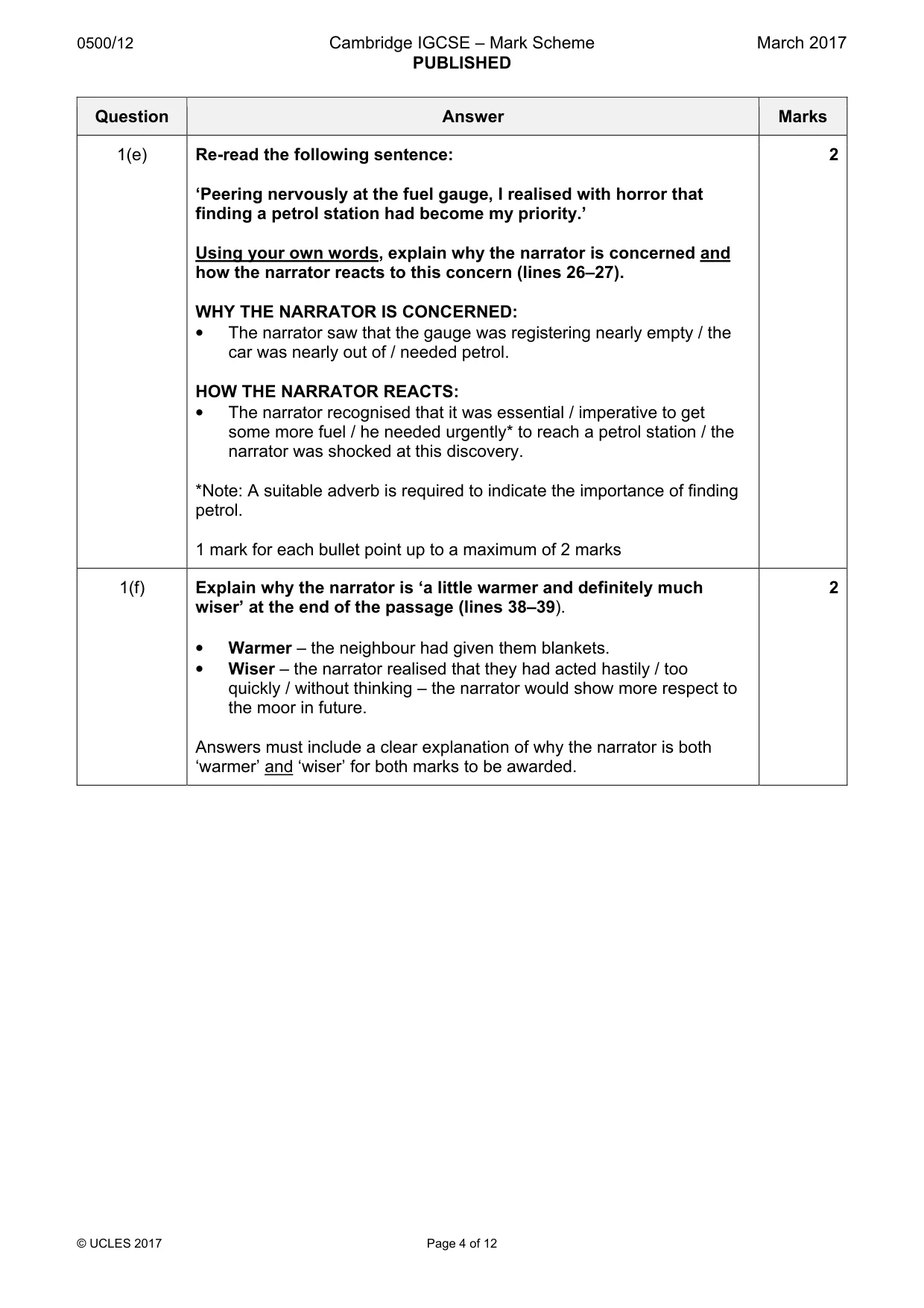
0500/12 Cambridge IGCSE – Mark Scheme PUBLISHED March 2017 © UCLES 2017 Page 4 of 12 Question Answer Marks 1(e) Re-read the following sentence: ‘Peering nervously at the fuel gauge, I realised with horror that finding a petrol station had become my priority.’ Using your own words, explain why the narrator is concerned and how the narrator reacts to this concern (lines 26–27). WHY THE NARRATOR IS CONCERNED: • The narrator saw that the gauge was registering nearly empty / the car was nearly out of / needed petrol. HOW THE NARRATOR REACTS: • The narrator recognised that it was essential / imperative to get some more fuel / he needed urgently* to reach a petrol station / the narrator was shocked at this discovery. *Note: A suitable adverb is required to indicate the importance of finding petrol. 1 mark for each bullet point up to a maximum of 2 marks 2 1(f) Explain why the narrator is ‘a little warmer and definitely much wiser’ at the end of the passage (lines 38–39). • Warmer – the neighbour had given them blankets. • Wiser – the narrator realised that they had acted hastily / too quickly / without thinking – the narrator would show more respect to the moor in future. Answers must include a clear explanation of why the narrator is both ‘warmer’ and ‘wiser’ for both marks to be awarded. 2
Mark scheme, page 5
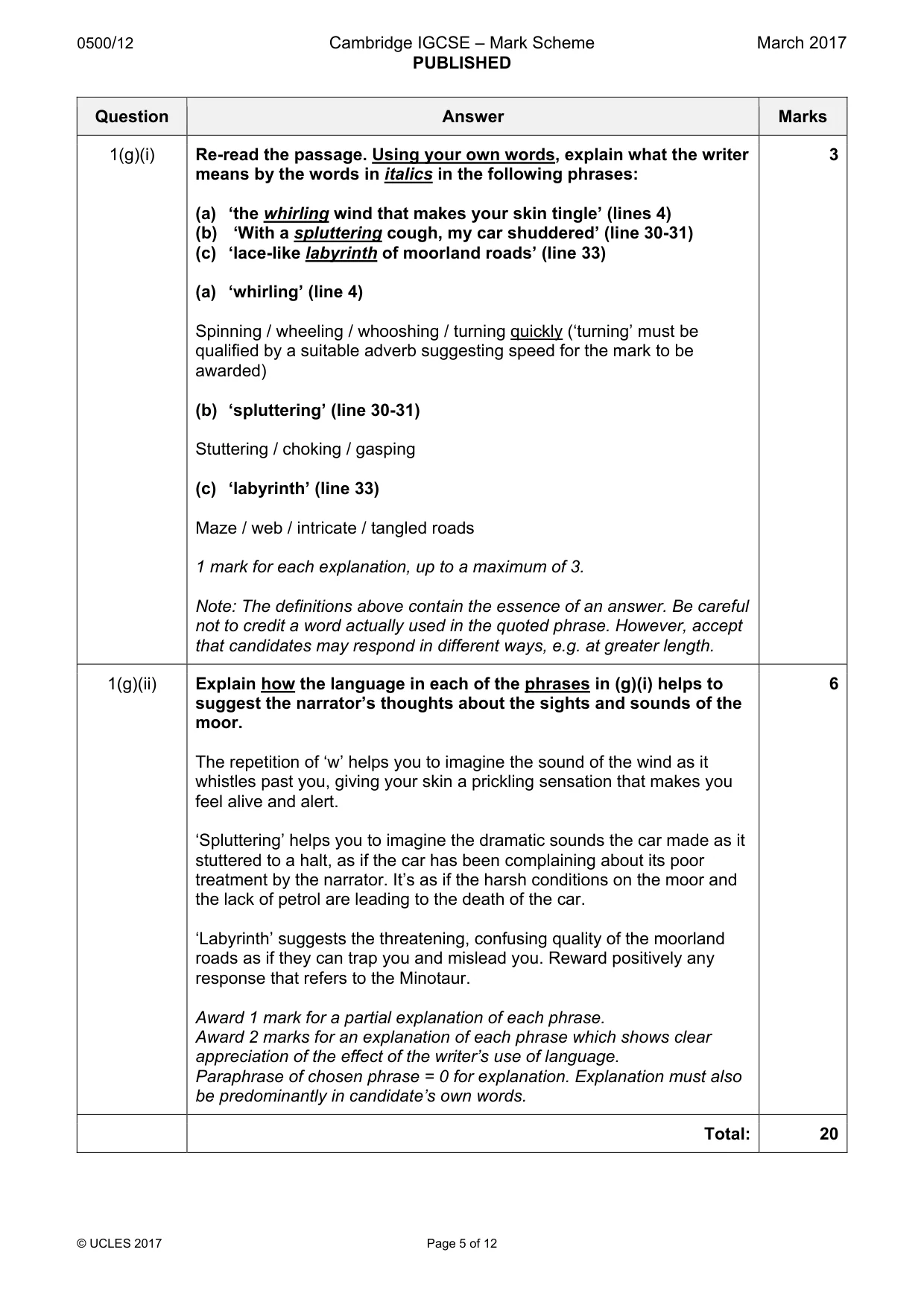
0500/12 Cambridge IGCSE – Mark Scheme PUBLISHED March 2017 © UCLES 2017 Page 5 of 12 Question Answer Marks 1(g)(i) Re-read the passage. Using your own words, explain what the writer means by the words in italics in the following phrases: (a) ‘the whirling wind that makes your skin tingle’ (lines 4) (b) ‘With a spluttering cough, my car shuddered’ (line 30-31) (c) ‘lace-like labyrinth of moorland roads’ (line 33) (a) ‘whirling’ (line 4) Spinning / wheeling / whooshing / turning quickly (‘turning’ must be qualified by a suitable adverb suggesting speed for the mark to be awarded) (b) ‘spluttering’ (line 30-31) Stuttering / choking / gasping (c) ‘labyrinth’ (line 33) Maze / web / intricate / tangled roads 1 mark for each explanation, up to a maximum of 3. Note: The definitions above contain the essence of an answer. Be careful not to credit a word actually used in the quoted phrase. However, accept that candidates may respond in different ways, e.g. at greater length. 3 1(g)(ii) Explain how the language in each of the phrases in (g)(i) helps to suggest the narrator’s thoughts about the sights and sounds of the moor. The repetition of ‘w’ helps you to imagine the sound of the wind as it whistles past you, giving your skin a prickling sensation that makes you feel alive and alert. ‘Spluttering’ helps you to imagine the dramatic sounds the car made as it stuttered to a halt, as if the car has been complaining about its poor treatment by the narrator. It’s as if the harsh conditions on the moor and the lack of petrol are leading to the death of the car. ‘Labyrinth’ suggests the threatening, confusing quality of the moorland roads as if they can trap you and mislead you. Reward positively any response that refers to the Minotaur. Award 1 mark for a partial explanation of each phrase. Award 2 marks for an explanation of each phrase which shows clear appreciation of the effect of the writer’s use of language. Paraphrase of chosen phrase = 0 for explanation. Explanation must also be predominantly in candidate’s own words. 6 Total: 20
Mark scheme, page 6
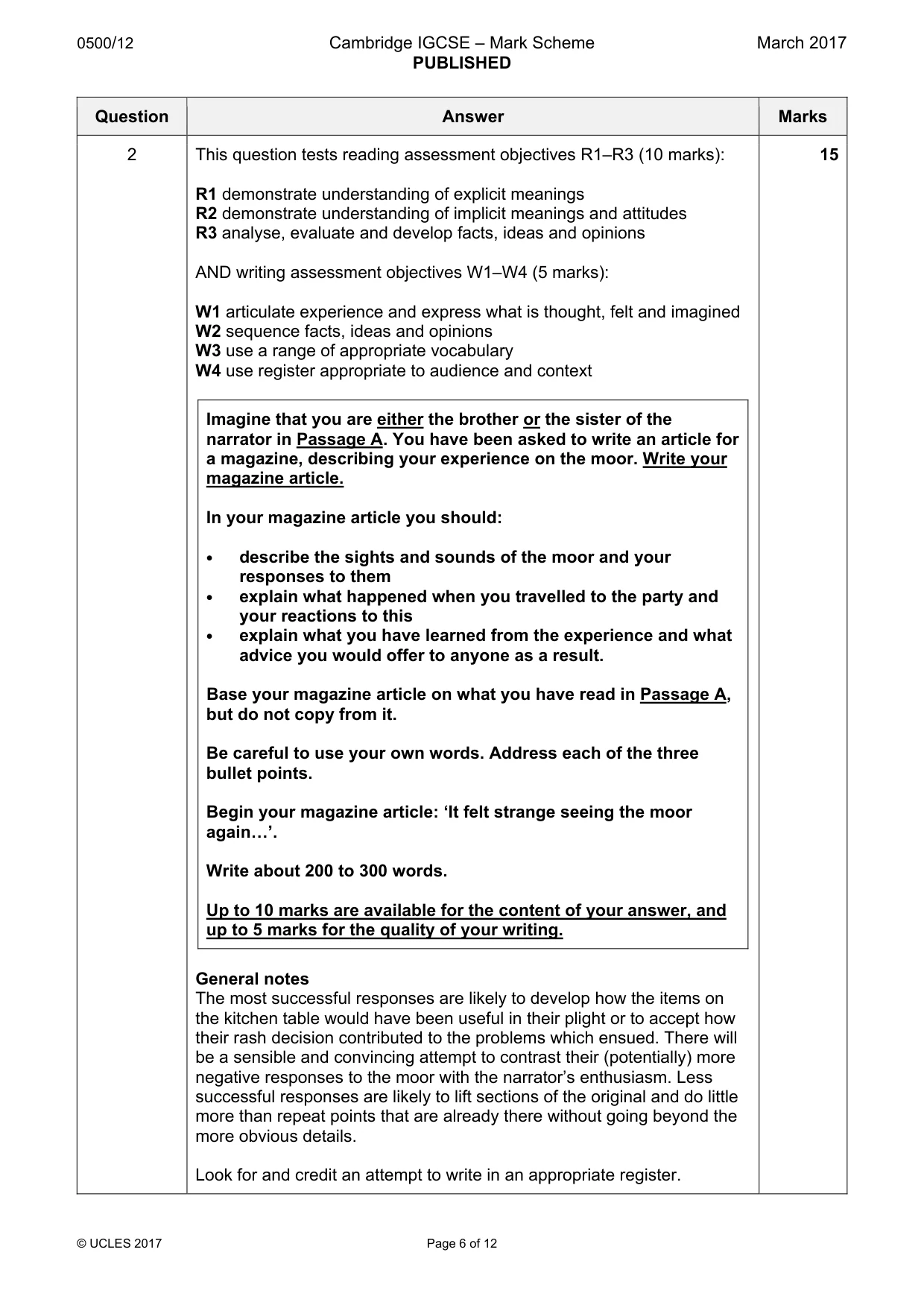
0500/12 Cambridge IGCSE – Mark Scheme PUBLISHED March 2017 © UCLES 2017 Page 6 of 12 Question Answer Marks 2 This question tests reading assessment objectives R1–R3 (10 marks): R1 demonstrate understanding of explicit meanings R2 demonstrate understanding of implicit meanings and attitudes R3 analyse, evaluate and develop facts, ideas and opinions AND writing assessment objectives W1–W4 (5 marks): W1 articulate experience and express what is thought, felt and imagined W2 sequence facts, ideas and opinions W3 use a range of appropriate vocabulary W4 use register appropriate to audience and context Imagine that you are either the brother or the sister of the narrator in Passage A. You have been asked to write an article for a magazine, describing your experience on the moor. Write your magazine article. In your magazine article you should: • describe the sights and sounds of the moor and your responses to them • explain what happened when you travelled to the party and your reactions to this • explain what you have learned from the experience and what advice you would offer to anyone as a result. Base your magazine article on what you have read in Passage A, but do not copy from it. Be careful to use your own words. Address each of the three bullet points. Begin your magazine article: ‘It felt strange seeing the moor again«’. Write about 200 to 300 words. Up to 10 marks are available for the content of your answer, and up to 5 marks for the quality of your writing. General notes The most successful responses are likely to develop how the items on the kitchen table would have been useful in their plight or to accept how their rash decision contributed to the problems which ensued. There will be a sensible and convincing attempt to contrast their (potentially) more negative responses to the moor with the narrator’s enthusiasm. Less successful responses are likely to lift sections of the original and do little more than repeat points that are already there without going beyond the more obvious details. Look for and credit an attempt to write in an appropriate register. 15
Mark scheme, page 7
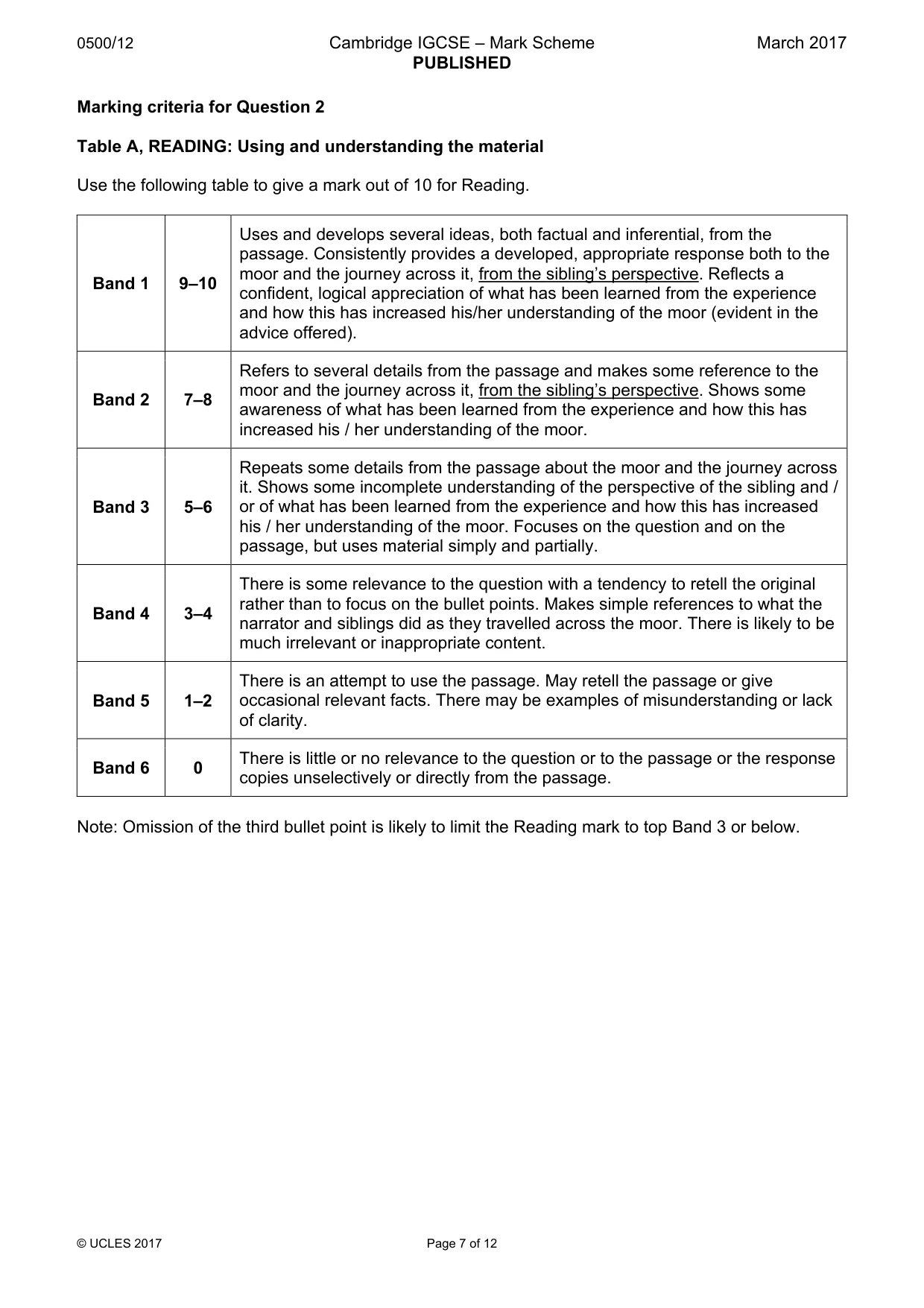
0500/12 Cambridge IGCSE – Mark Scheme PUBLISHED March 2017 © UCLES 2017 Page 7 of 12 Marking criteria for Question 2 Table A, READING: Using and understanding the material Use the following table to give a mark out of 10 for Reading. Band 1 9–10 Uses and develops several ideas, both factual and inferential, from the passage. Consistently provides a developed, appropriate response both to the moor and the journey across it, from the sibling’s perspective. Reflects a confident, logical appreciation of what has been learned from the experience and how this has increased his/her understanding of the moor (evident in the advice offered). Band 2 7–8 Refers to several details from the passage and makes some reference to the moor and the journey across it, from the sibling’s perspective. Shows some awareness of what has been learned from the experience and how this has increased his / her understanding of the moor. Band 3 5–6 Repeats some details from the passage about the moor and the journey across it. Shows some incomplete understanding of the perspective of the sibling and / or of what has been learned from the experience and how this has increased his / her understanding of the moor. Focuses on the question and on the passage, but uses material simply and partially. Band 4 3–4 There is some relevance to the question with a tendency to retell the original rather than to focus on the bullet points. Makes simple references to what the narrator and siblings did as they travelled across the moor. There is likely to be much irrelevant or inappropriate content. Band 5 1–2 There is an attempt to use the passage. May retell the passage or give occasional relevant facts. There may be examples of misunderstanding or lack of clarity. Band 6 0 There is little or no relevance to the question or to the passage or the response copies unselectively or directly from the passage. Note: Omission of the third bullet point is likely to limit the Reading mark to top Band 3 or below.
Mark scheme, page 8
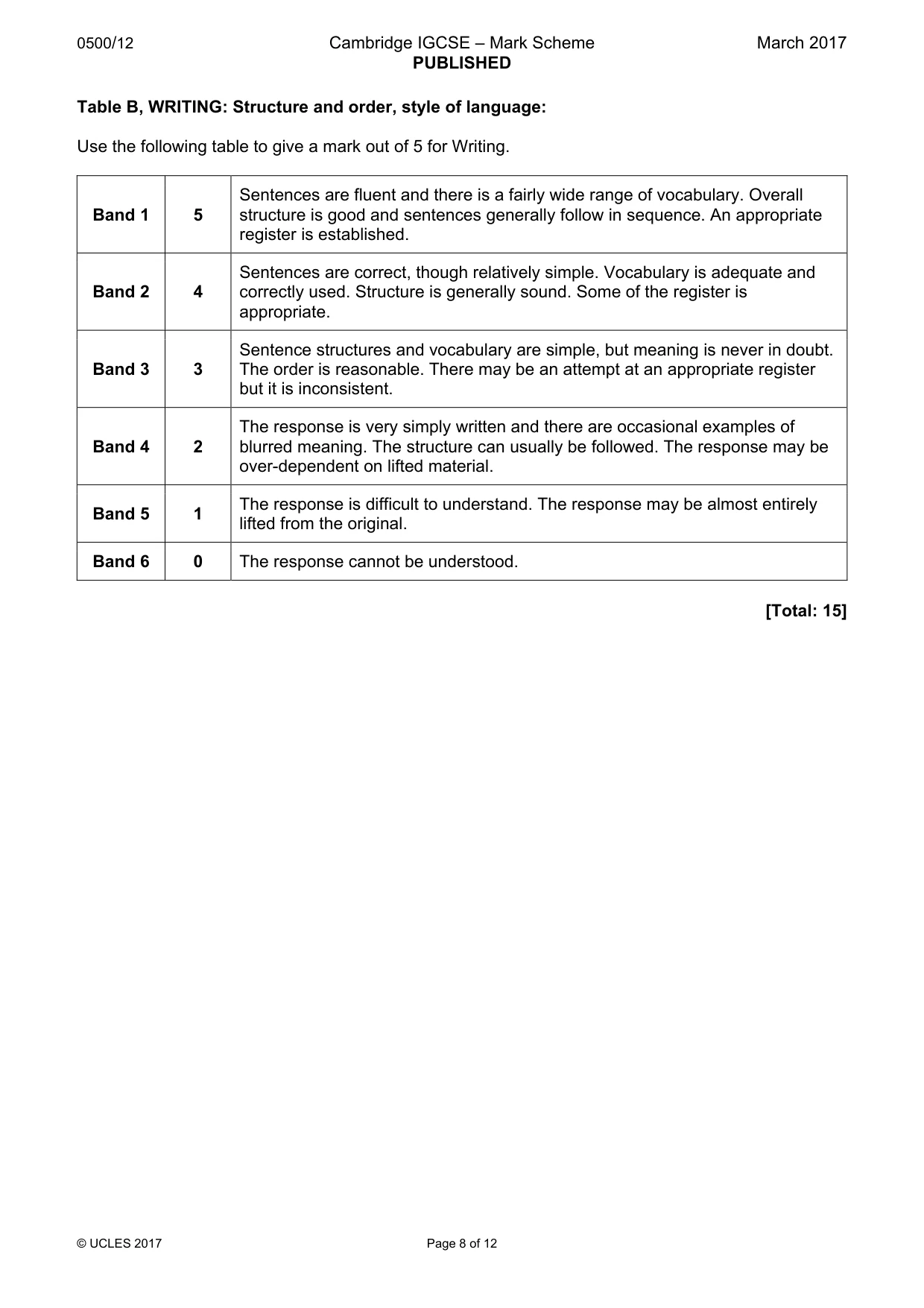
0500/12 Cambridge IGCSE – Mark Scheme PUBLISHED March 2017 © UCLES 2017 Page 8 of 12 Table B, WRITING: Structure and order, style of language: Use the following table to give a mark out of 5 for Writing. Band 1 5 Sentences are fluent and there is a fairly wide range of vocabulary. Overall structure is good and sentences generally follow in sequence. An appropriate register is established. Band 2 4 Sentences are correct, though relatively simple. Vocabulary is adequate and correctly used. Structure is generally sound. Some of the register is appropriate. Band 3 3 Sentence structures and vocabulary are simple, but meaning is never in doubt. The order is reasonable. There may be an attempt at an appropriate register but it is inconsistent. Band 4 2 The response is very simply written and there are occasional examples of blurred meaning. The structure can usually be followed. The response may be over-dependent on lifted material. Band 5 1 The response is difficult to understand. The response may be almost entirely lifted from the original. Band 6 0 The response cannot be understood. [Total: 15]
Mark scheme, page 9
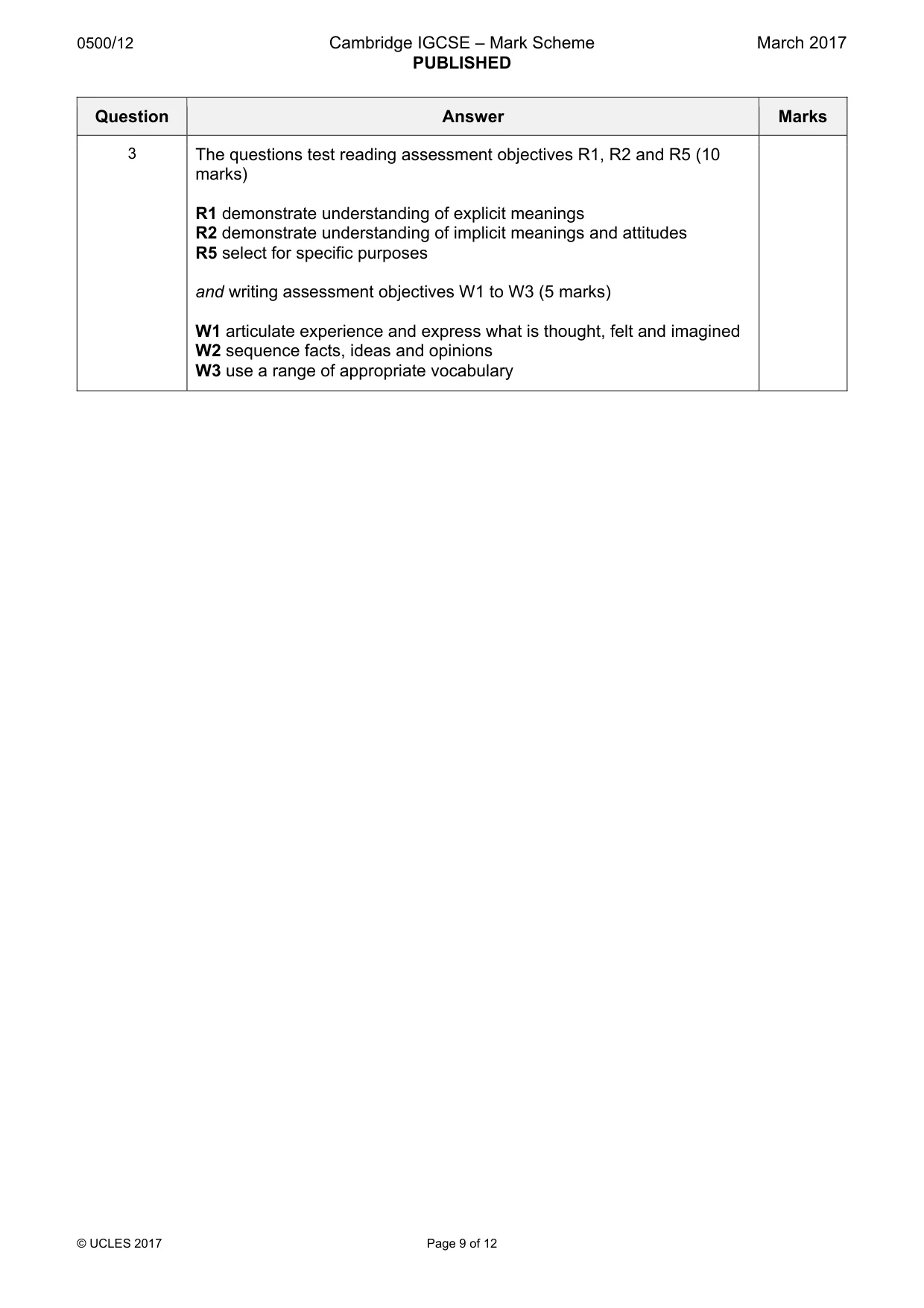
0500/12 Cambridge IGCSE – Mark Scheme PUBLISHED March 2017 © UCLES 2017 Page 9 of 12 Question Answer Marks 3 The questions test reading assessment objectives R1, R2 and R5 (10 marks) R1 demonstrate understanding of explicit meanings R2 demonstrate understanding of implicit meanings and attitudes R5 select for specific purposes and writing assessment objectives W1 to W3 (5 marks) W1 articulate experience and express what is thought, felt and imagined W2 sequence facts, ideas and opinions W3 use a range of appropriate vocabulary
Mark scheme, page 10
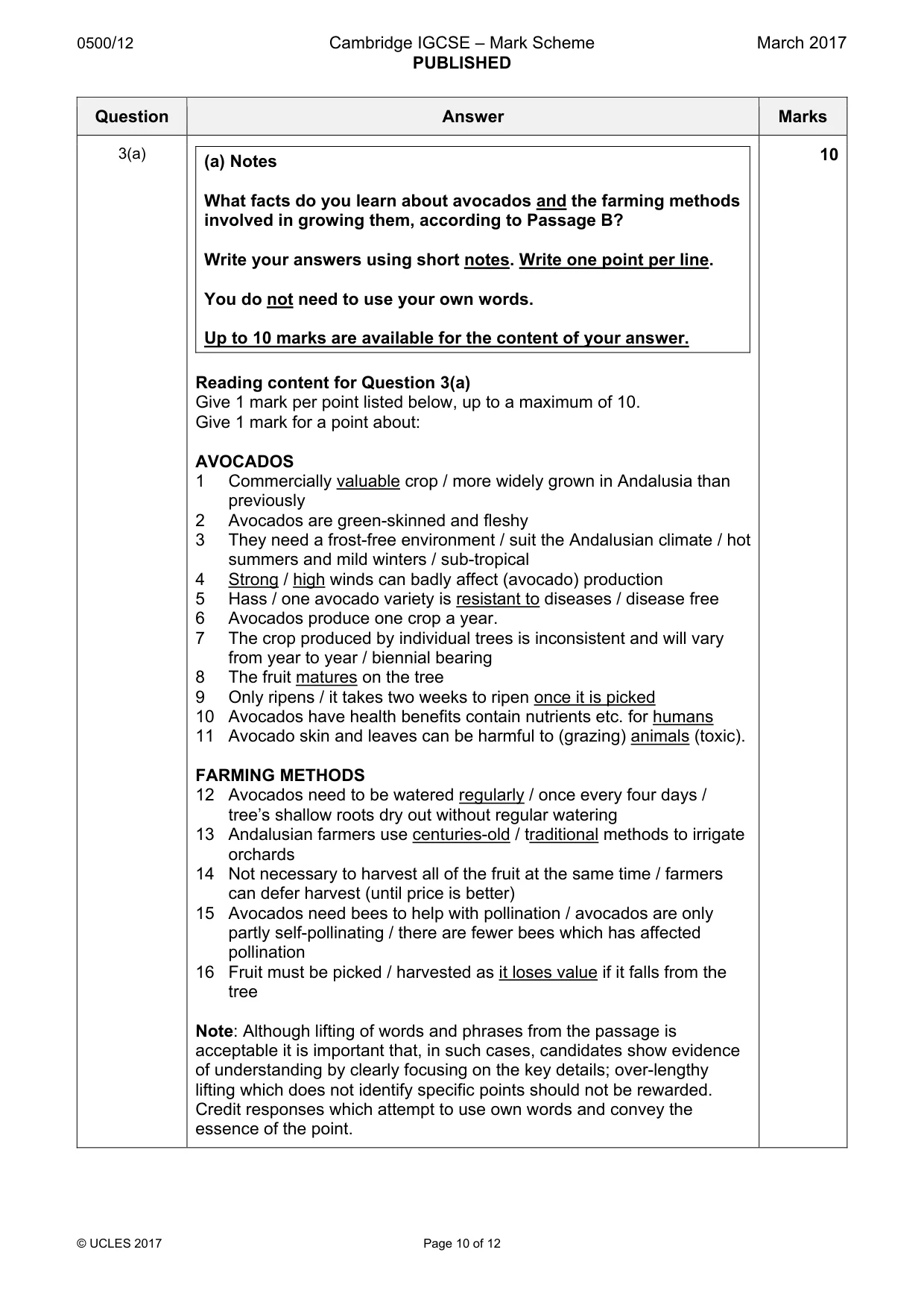
0500/12 Cambridge IGCSE – Mark Scheme PUBLISHED March 2017 © UCLES 2017 Page 10 of 12 Question Answer Marks 3(a) (a) Notes What facts do you learn about avocados and the farming methods involved in growing them, according to Passage B? Write your answers using short notes. Write one point per line. You do not need to use your own words. Up to 10 marks are available for the content of your answer. Reading content for Question 3(a) Give 1 mark per point listed below, up to a maximum of 10. Give 1 mark for a point about: AVOCADOS 1 Commercially valuable crop / more widely grown in Andalusia than previously 2 Avocados are green-skinned and fleshy 3 They need a frost-free environment / suit the Andalusian climate / hot summers and mild winters / sub-tropical 4 Strong / high winds can badly affect (avocado) production 5 Hass / one avocado variety is resistant to diseases / disease free 6 Avocados produce one crop a year. 7 The crop produced by individual trees is inconsistent and will vary from year to year / biennial bearing 8 The fruit matures on the tree 9 Only ripens / it takes two weeks to ripen once it is picked 10 Avocados have health benefits contain nutrients etc. for humans 11 Avocado skin and leaves can be harmful to (grazing) animals (toxic). FARMING METHODS 12 Avocados need to be watered regularly / once every four days / tree’s shallow roots dry out without regular watering 13 Andalusian farmers use centuries-old / traditional methods to irrigate orchards 14 Not necessary to harvest all of the fruit at the same time / farmers can defer harvest (until price is better) 15 Avocados need bees to help with pollination / avocados are only partly self-pollinating / there are fewer bees which has affected pollination 16 Fruit must be picked / harvested as it loses value if it falls from the tree Note: Although lifting of words and phrases from the passage is acceptable it is important that, in such cases, candidates show evidence of understanding by clearly focusing on the key details; over-lengthy lifting which does not identify specific points should not be rewarded. Credit responses which attempt to use own words and convey the essence of the point. 10
Mark scheme, page 11
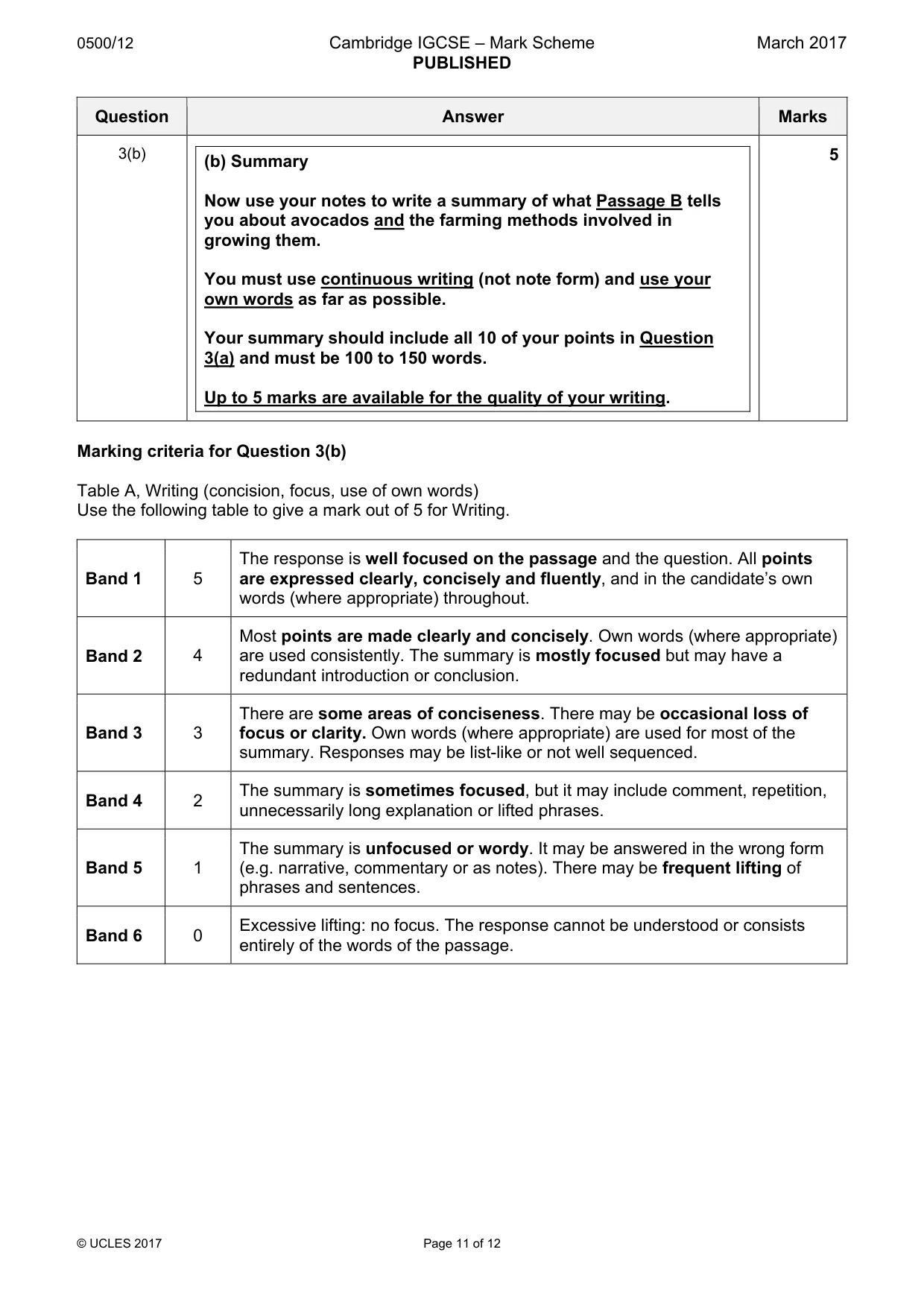
0500/12 Cambridge IGCSE – Mark Scheme PUBLISHED March 2017 © UCLES 2017 Page 11 of 12 Question Answer Marks 3(b) (b) Summary Now use your notes to write a summary of what Passage B tells you about avocados and the farming methods involved in growing them. You must use continuous writing (not note form) and use your own words as far as possible. Your summary should include all 10 of your points in Question 3(a) and must be 100 to 150 words. Up to 5 marks are available for the quality of your writing. 5 Marking criteria for Question 3(b) Table A, Writing (concision, focus, use of own words) Use the following table to give a mark out of 5 for Writing. Band 1 5 The response is well focused on the passage and the question. All points are expressed clearly, concisely and fluently, and in the candidate’s own words (where appropriate) throughout. Band 2 4 Most points are made clearly and concisely. Own words (where appropriate) are used consistently. The summary is mostly focused but may have a redundant introduction or conclusion. Band 3 3 There are some areas of conciseness. There may be occasional loss of focus or clarity. Own words (where appropriate) are used for most of the summary. Responses may be list-like or not well sequenced. Band 4 2 The summary is sometimes focused, but it may include comment, repetition, unnecessarily long explanation or lifted phrases. Band 5 1 The summary is unfocused or wordy. It may be answered in the wrong form (e.g. narrative, commentary or as notes). There may be frequent lifting of phrases and sentences. Band 6 0 Excessive lifting: no focus. The response cannot be understood or consists entirely of the words of the passage.
Mark scheme, page 12
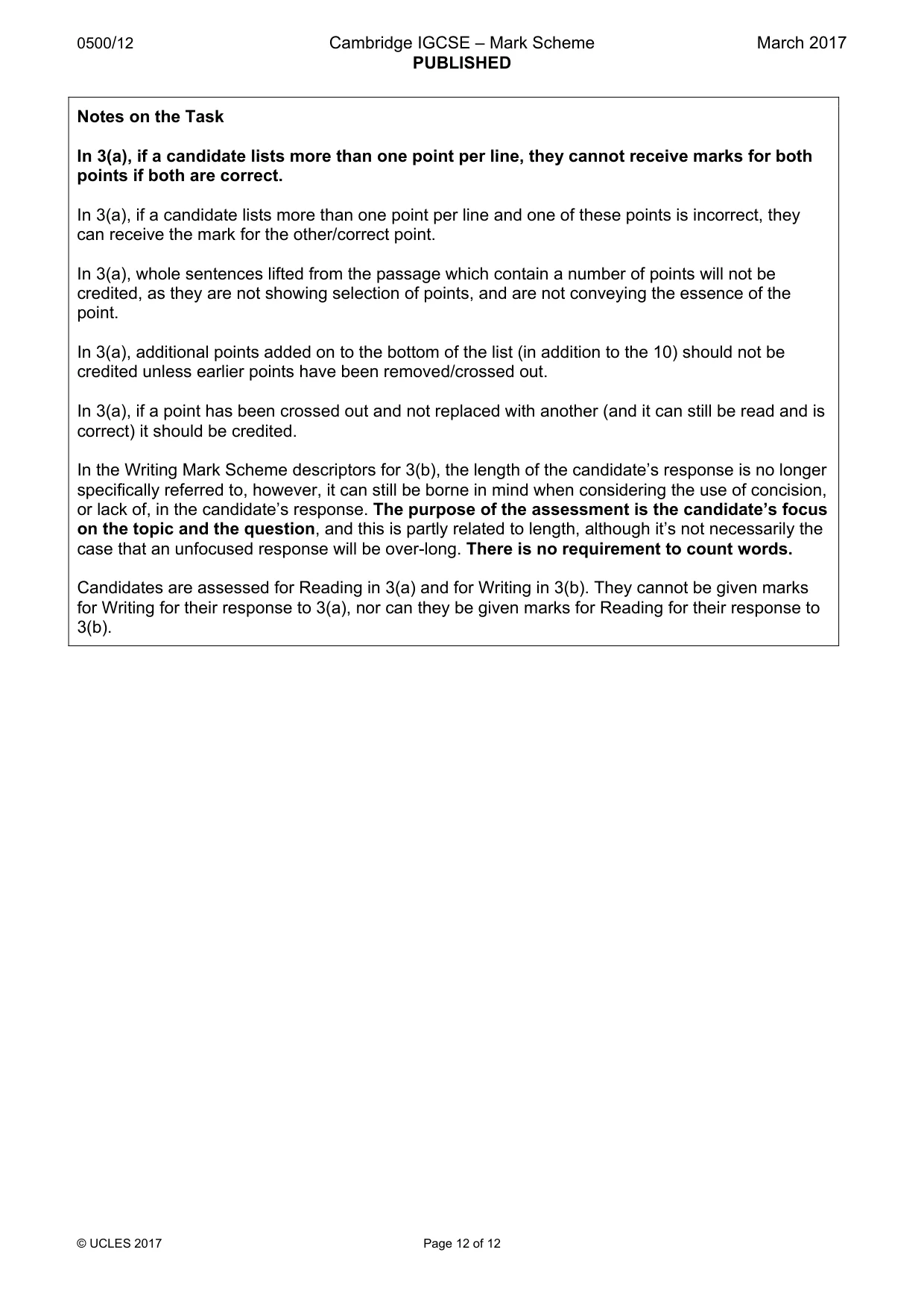
0500/12 Cambridge IGCSE – Mark Scheme PUBLISHED March 2017 © UCLES 2017 Page 12 of 12 Notes on the Task In 3(a), if a candidate lists more than one point per line, they cannot receive marks for both points if both are correct. In 3(a), if a candidate lists more than one point per line and one of these points is incorrect, they can receive the mark for the other/correct point. In 3(a), whole sentences lifted from the passage which contain a number of points will not be credited, as they are not showing selection of points, and are not conveying the essence of the point. In 3(a), additional points added on to the bottom of the list (in addition to the 10) should not be credited unless earlier points have been removed/crossed out. In 3(a), if a point has been crossed out and not replaced with another (and it can still be read and is correct) it should be credited. In the Writing Mark Scheme descriptors for 3(b), the length of the candidate’s response is no longer specifically referred to, however, it can still be borne in mind when considering the use of concision, or lack of, in the candidate’s response. The purpose of the assessment is the candidate’s focus on the topic and the question, and this is partly related to length, although it’s not necessarily the case that an unfocused response will be over-long. There is no requirement to count words. Candidates are assessed for Reading in 3(a) and for Writing in 3(b). They cannot be given marks for Writing for their response to 3(a), nor can they be given marks for Reading for their response to 3(b).
What you needed in this session
Cambridge’s own grade thresholds for 2017 Feb/March, Paper 1 · Variant 2. A higher threshold means an easier paper — the bar moves with how the cohort did.