Cambridge IGCSE English - First Language 0500 — 2016 Oct/Nov Paper 2 · Variant 1
0500/21/O/N/16 · 50 marks · ≈56 min
The question paper and its mark scheme, free to read here and free to download. This is Cambridge’s own paper, exactly as it was sat.
Question paper12 pages
Mark scheme12 pages
Answers below. Sit the paper first if you are practising.
Paper as text
Question paper, page 1
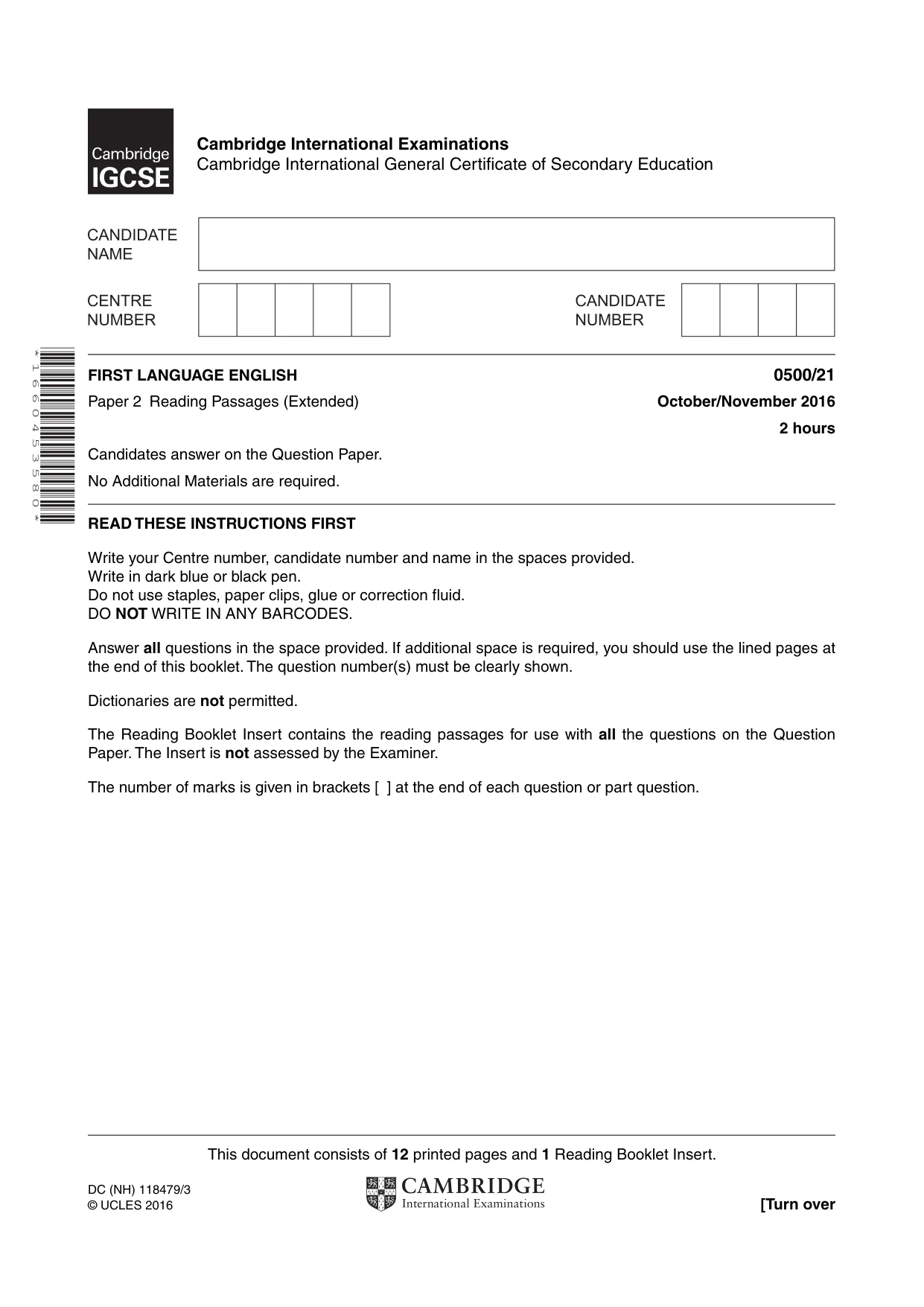
This document consists of 12 printed pages and 1 Reading Booklet Insert. DC (NH) 118479/3 © UCLES 2016 [Turn over * 1 6 6 0 4 5 3 5 8 0 * FIRST LANGUAGE ENGLISH 0500/21 Paper 2 Reading Passages (Extended) October/November 2016 2 hours Candidates answer on the Question Paper. No Additional Materials are required. READ THESE INSTRUCTIONS FIRST Write your Centre number, candidate number and name in the spaces provided. Write in dark blue or black pen. Do not use staples, paper clips, glue or correction fluid. DO NOT WRITE IN ANY BARCODES. Answer all questions in the space provided. If additional space is required, you should use the lined pages at the end of this booklet. The question number(s) must be clearly shown. Dictionaries are not permitted. The Reading Booklet Insert contains the reading passages for use with all the questions on the Question Paper. The Insert is not assessed by the Examiner. The number of marks is given in brackets [ ] at the end of each question or part question. Cambridge International Examinations Cambridge International General Certificate of Secondary Education
Question paper, page 2
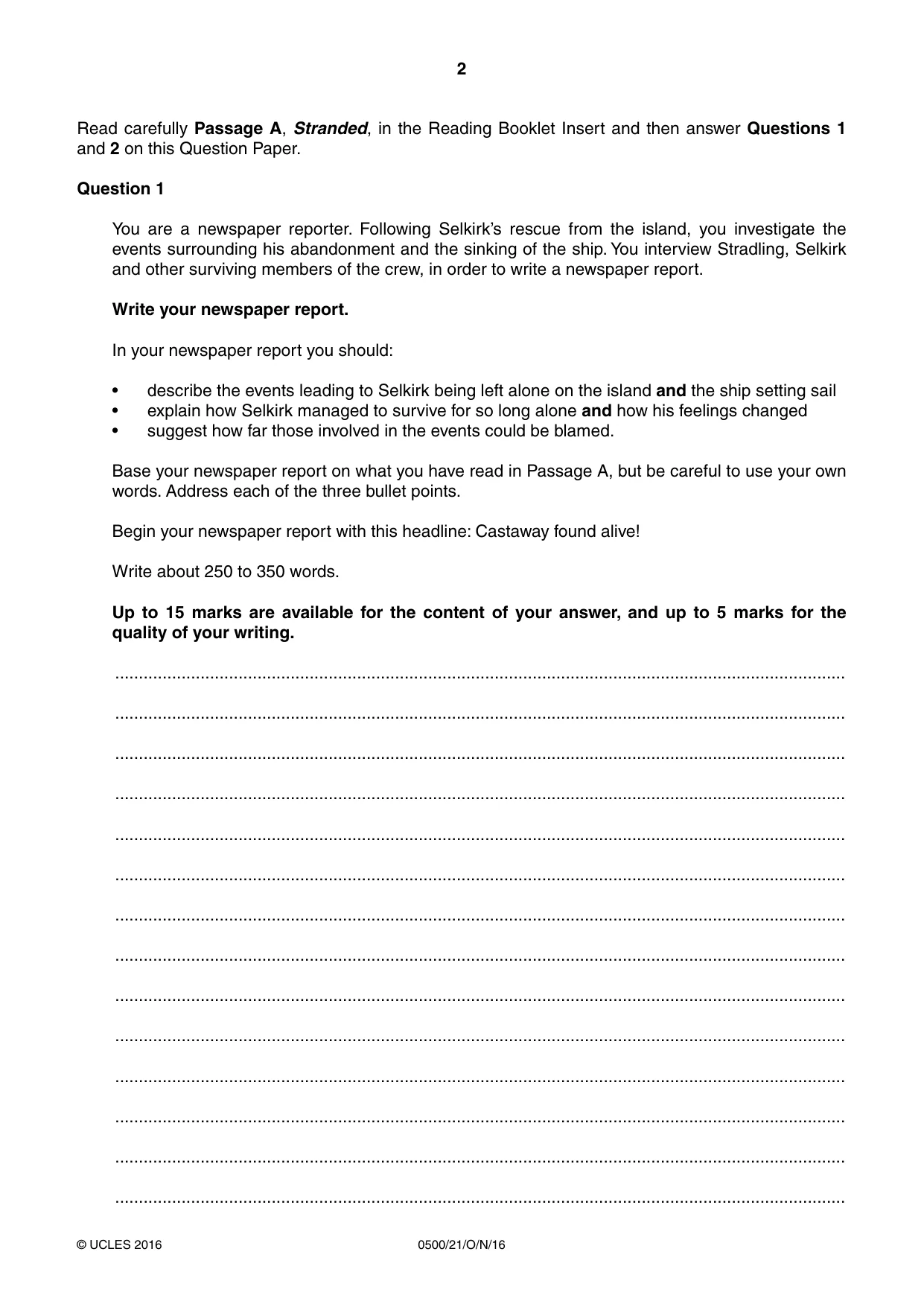
2 0500/21/O/N/16 © UCLES 2016 Read carefully Passage A, Stranded, in the Reading Booklet Insert and then answer Questions 1 and 2 on this Question Paper. Question 1 You are a newspaper reporter. Following Selkirk’s rescue from the island, you investigate the events surrounding his abandonment and the sinking of the ship. You interview Stradling, Selkirk and other surviving members of the crew, in order to write a newspaper report. Write your newspaper report. In your newspaper report you should: • describe the events leading to Selkirk being left alone on the island and the ship setting sail • explain how Selkirk managed to survive for so long alone and how his feelings changed • suggest how far those involved in the events could be blamed. Base your newspaper report on what you have read in Passage A, but be careful to use your own words. Address each of the three bullet points. Begin your newspaper report with this headline: Castaway found alive! Write about 250 to 350 words. Up to 15 marks are available for the content of your answer, and up to 5 marks for the quality of your writing. … … … … … … … … … … … … … …
Question paper, page 3
3 0500/21/O/N/16 © UCLES 2016 [Turn over … … … … … … … … … … … … … … … … … … … … … … … … … … … …
Question paper, page 4
4 0500/21/O/N/16 © UCLES 2016 … … … … … … … … … … … … … … … … … … … … … … … … … … … [Total: 20]
Question paper, page 5
5 0500/21/O/N/16 © UCLES 2016 [Turn over [Turn to page 6 for Question 2]
Question paper, page 6
6 0500/21/O/N/16 © UCLES 2016 Question 2 Re-read the descriptions of: (a) Selkirk’s surroundings and how they make him feel in paragraph 4, beginning ‘All courage left him…’ (b) the island at night in paragraph 5, beginning ‘The sun dipped down…’. Select four powerful words or phrases from each paragraph. Your choices should include imagery. Explain how each word or phrase selected is used effectively in the context. Write about 200 to 300 words. Up to 10 marks are available for the content of your answer. … … … … … … … … … … … … … … … … … … … …
Question paper, page 7
7 0500/21/O/N/16 © UCLES 2016 [Turn over … … … … … … … … … … … … … … … … … … … … … … … … … … … [Total: 10]
Question paper, page 8
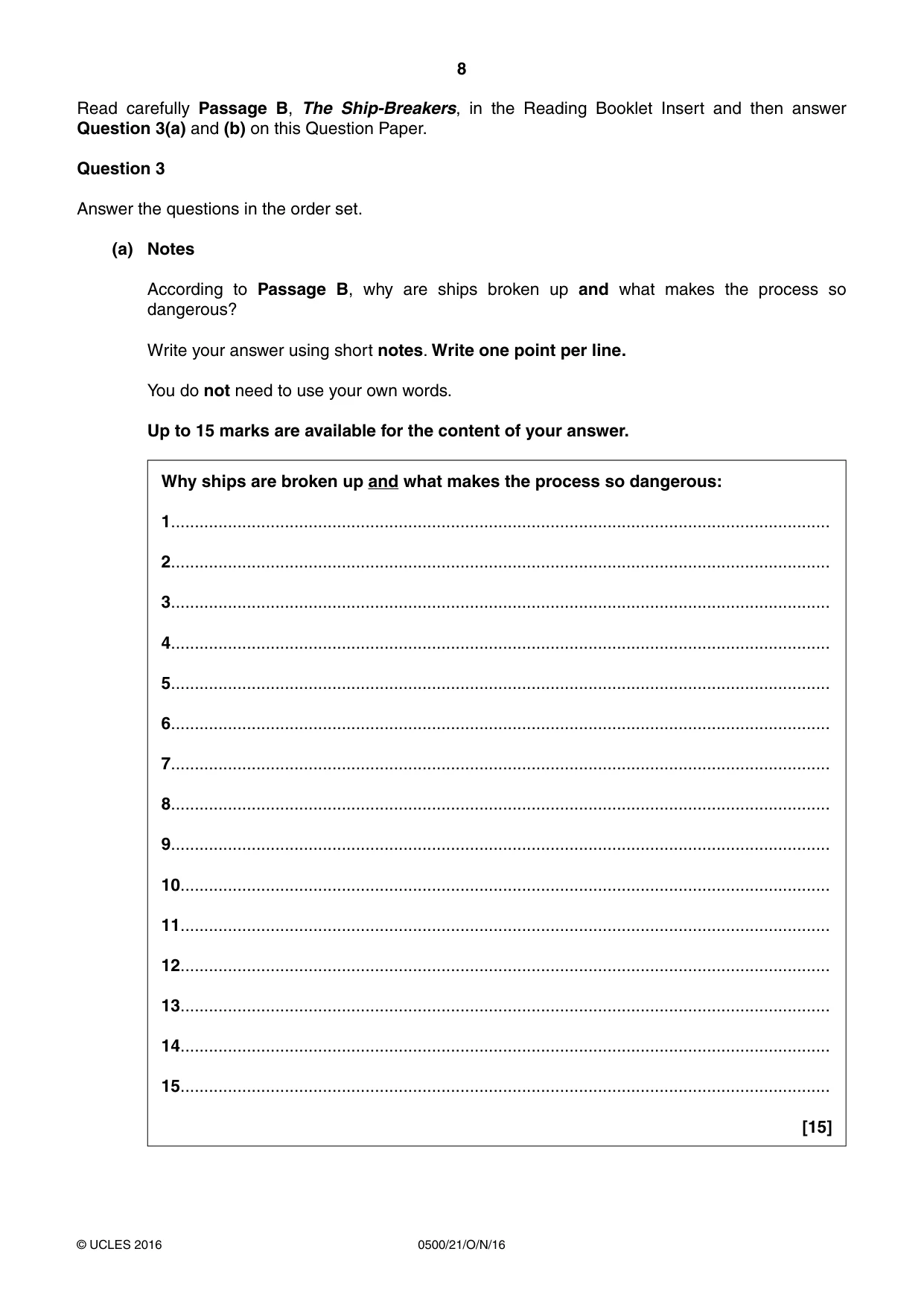
8 0500/21/O/N/16 © UCLES 2016 Read carefully Passage B, The Ship-Breakers, in the Reading Booklet Insert and then answer Question 3(a) and (b) on this Question Paper. Question 3 Answer the questions in the order set. (a) Notes According to Passage B, why are ships broken up and what makes the process so dangerous? Write your answer using short notes. Write one point per line. You do not need to use your own words. Up to 15 marks are available for the content of your answer. Why ships are broken up and what makes the process so dangerous: 1… 2… 3… 4… 5… 6… 7… 8… 9… 10… 11… 12… 13… 14… 15… [15]
Question paper, page 9
9 0500/21/O/N/16 © UCLES 2016 [Turn over (b) Summary Now use your notes from Question 3(a) to write a summary of why ships are broken up and what makes the process so dangerous, according to Passage B. You must use continuous writing (not note form) and use your own words as far as possible. Your summary should include all 15 of your points in Question 3(a) and must be 200 to 250 words. Up to 5 marks are available for the quality of your writing. … … … … … … … … … … … … … … … … … … … … … …
Question paper, page 10
10 0500/21/O/N/16 © UCLES 2016 … … … … … … … … … … … [5] [Total: 20]
Question paper, page 11
11 0500/21/O/N/16 © UCLES 2016 ADDITIONAL PAGE If you use the following lined page to complete the answer(s) to any question(s), the question number(s) must be clearly shown. … … … … … … … … … … … … … … … … … … … … … … … … … …
Question paper, page 12
12 0500/21/O/N/16 © UCLES 2016 Permission to reproduce items where third-party owned material protected by copyright is included has been sought and cleared where possible. Every reasonable effort has been made by the publisher (UCLES) to trace copyright holders, but if any items requiring clearance have unwittingly been included, the publisher will be pleased to make amends at the earliest possible opportunity. To avoid the issue of disclosure of answer-related information to candidates, all copyright acknowledgements are reproduced online in the Cambridge International Examinations Copyright Acknowledgements Booklet. This is produced for each series of examinations and is freely available to download at www.cie.org.uk after the live examination series. Cambridge International Examinations is part of the Cambridge Assessment Group. Cambridge Assessment is the brand name of University of Cambridge Local Examinations Syndicate (UCLES), which is itself a department of the University of Cambridge. ADDITIONAL PAGE If you use the following lined page to complete the answer(s) to any question(s), the question number(s) must be clearly shown. … … … … … … … … … … … … … … … … … … … … …
Mark scheme, page 1
® IGCSE is the registered trademark of Cambridge International Examinations. This document consists of 12 printed pages. © UCLES 2016 [Turn over Cambridge International Examinations Cambridge International General Certificate of Secondary Education FIRST LANGUAGE ENGLISH 0500/21 Paper 2 Reading Passages (Extended) October/November 2016 MARK SCHEME Maximum Mark: 50 Published This mark scheme is published as an aid to teachers and candidates, to indicate the requirements of the examination. It shows the basis on which Examiners were instructed to award marks. It does not indicate the details of the discussions that took place at an Examiners’ meeting before marking began, which would have considered the acceptability of alternative answers. Mark schemes should be read in conjunction with the question paper and the Principal Examiner Report for Teachers. Cambridge will not enter into discussions about these mark schemes. Cambridge is publishing the mark schemes for the October/November 2016 series for most Cambridge IGCSE®, Cambridge International A and AS Level components and some Cambridge O Level components.
Mark scheme, page 2
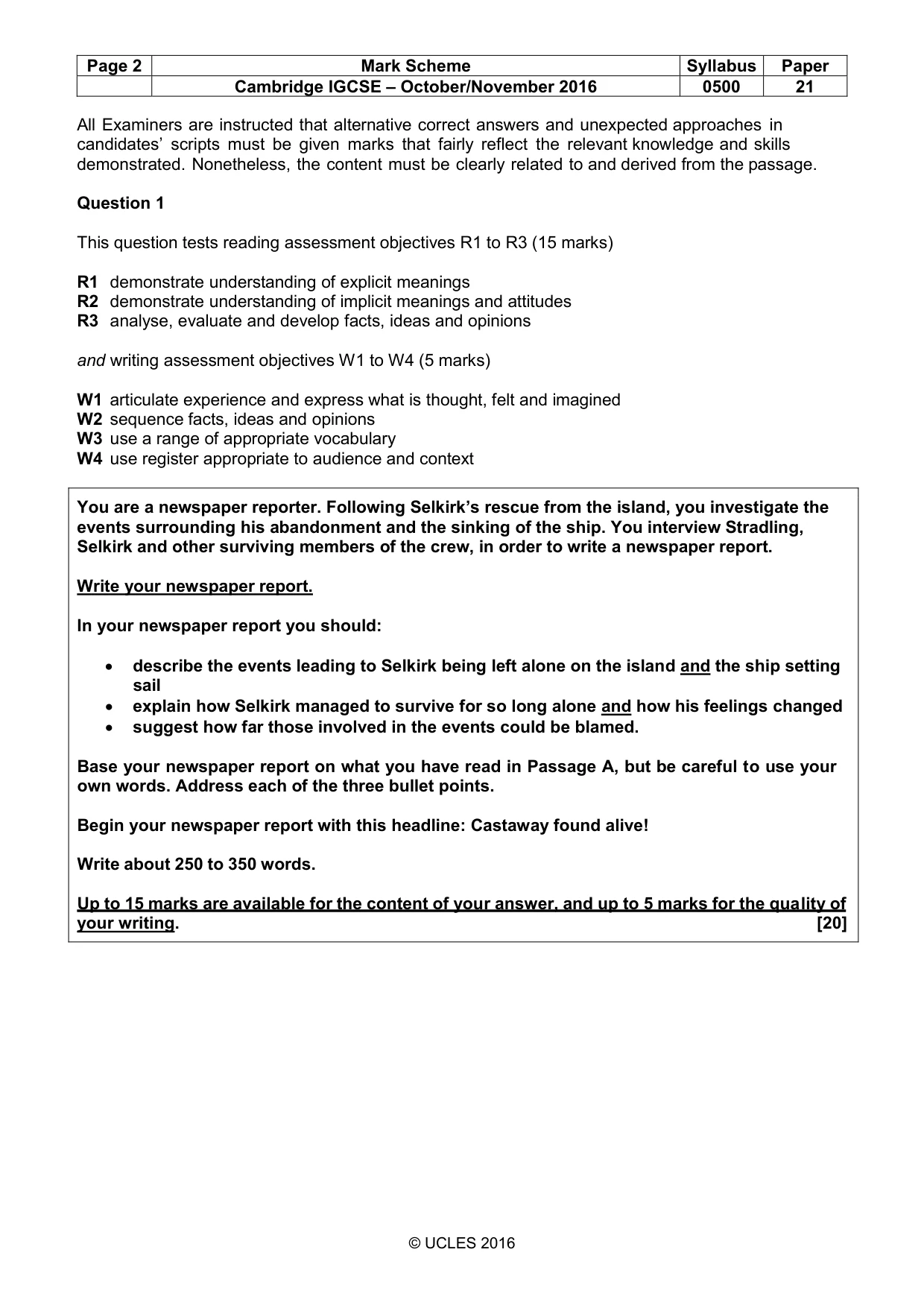
Page 2 Mark Scheme Syllabus Paper Cambridge IGCSE – October/November 2016 0500 21 © UCLES 2016 All Examiners are instructed that alternative correct answers and unexpected approaches in candidates’ scripts must be given marks that fairly reflect the relevant knowledge and skills demonstrated. Nonetheless, the content must be clearly related to and derived from the passage. Question 1 This question tests reading assessment objectives R1 to R3 (15 marks) R1 demonstrate understanding of explicit meanings R2 demonstrate understanding of implicit meanings and attitudes R3 analyse, evaluate and develop facts, ideas and opinions and writing assessment objectives W1 to W4 (5 marks) W1 articulate experience and express what is thought, felt and imagined W2 sequence facts, ideas and opinions W3 use a range of appropriate vocabulary W4 use register appropriate to audience and context You are a newspaper reporter. Following Selkirk’s rescue from the island, you investigate the events surrounding his abandonment and the sinking of the ship. You interview Stradling, Selkirk and other surviving members of the crew, in order to write a newspaper report. Write your newspaper report. In your newspaper report you should: • describe the events leading to Selkirk being left alone on the island and the ship setting sail • explain how Selkirk managed to survive for so long alone and how his feelings changed • suggest how far those involved in the events could be blamed. Base your newspaper report on what you have read in Passage A, but be careful to use your own words. Address each of the three bullet points. Begin your newspaper report with this headline: Castaway found alive! Write about 250 to 350 words. Up to 15 marks are available for the content of your answer, and up to 5 marks for the qua lity of your writing. [20]
Mark scheme, page 3
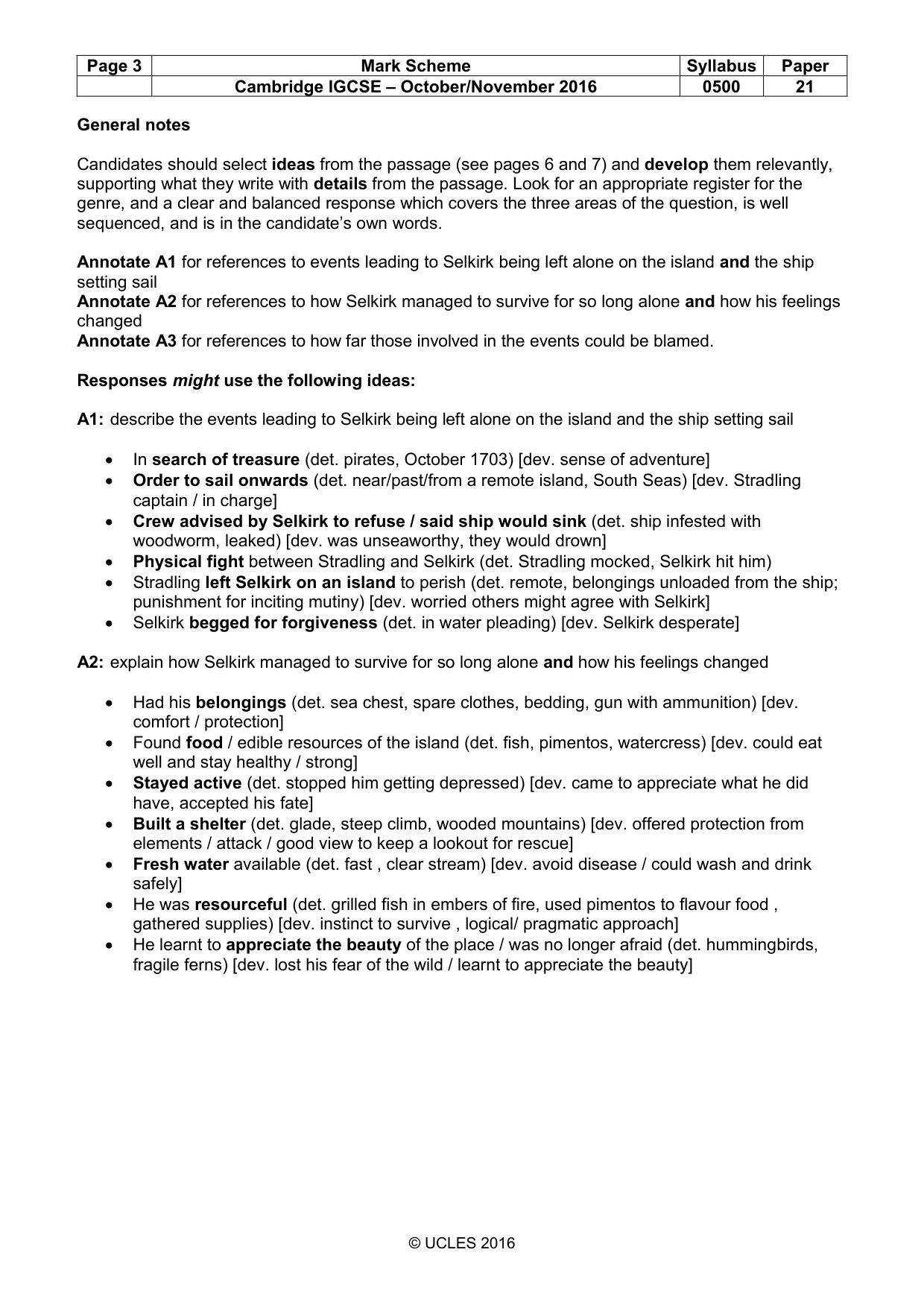
Page 3 Mark Scheme Syllabus Paper Cambridge IGCSE – October/November 2016 0500 21 © UCLES 2016 General notes Candidates should select ideas from the passage (see pages 6 and 7) and develop them relevantly, supporting what they write with details from the passage. Look for an appropriate register for the genre, and a clear and balanced response which covers the three areas of the question, is well sequenced, and is in the candidate’s own words. Annotate A1 for references to events leading to Selkirk being left alone on the island and the ship setting sail Annotate A2 for references to how Selkirk managed to survive for so long alone and how his feelings changed Annotate A3 for references to how far those involved in the events could be blamed. Responses might use the following ideas: A1: describe the events leading to Selkirk being left alone on the island and the ship setting sail • In search of treasure (det. pirates, October 1703) [dev. sense of adventure] • Order to sail onwards (det. near/past/from a remote island, South Seas) [dev. Stradling captain / in charge] • Crew advised by Selkirk to refuse / said ship would sink (det. ship infested with woodworm, leaked) [dev. was unseaworthy, they would drown] • Physical fight between Stradling and Selkirk (det. Stradling mocked, Selkirk hit him) • Stradling left Selkirk on an island to perish (det. remote, belongings unloaded from the ship; punishment for inciting mutiny) [dev. worried others might agree with Selkirk] • Selkirk begged for forgiveness (det. in water pleading) [dev. Selkirk desperate] A2: explain how Selkirk managed to survive for so long alone and how his feelings changed • Had his belongings (det. sea chest, spare clothes, bedding, gun with ammunition) [dev. comfort / protection] • Found food / edible resources of the island (det. fish, pimentos, watercress) [dev. could eat well and stay healthy / strong] • Stayed active (det. stopped him getting depressed) [dev. came to appreciate what he did have, accepted his fate] • Built a shelter (det. glade, steep climb, wooded mountains) [dev. offered protection from elements / attack / good view to keep a lookout for rescue] • Fresh water available (det. fast , clear stream) [dev. avoid disease / could wash and drink safely] • He was resourceful (det. grilled fish in embers of fire, used pimentos to flavour food , gathered supplies) [dev. instinct to survive , logical/ pragmatic approach] • He learnt to appreciate the beauty of the place / was no longer afraid (det. hummingbirds, fragile ferns) [dev. lost his fear of the wild / learnt to appreciate the beauty]
Mark scheme, page 4
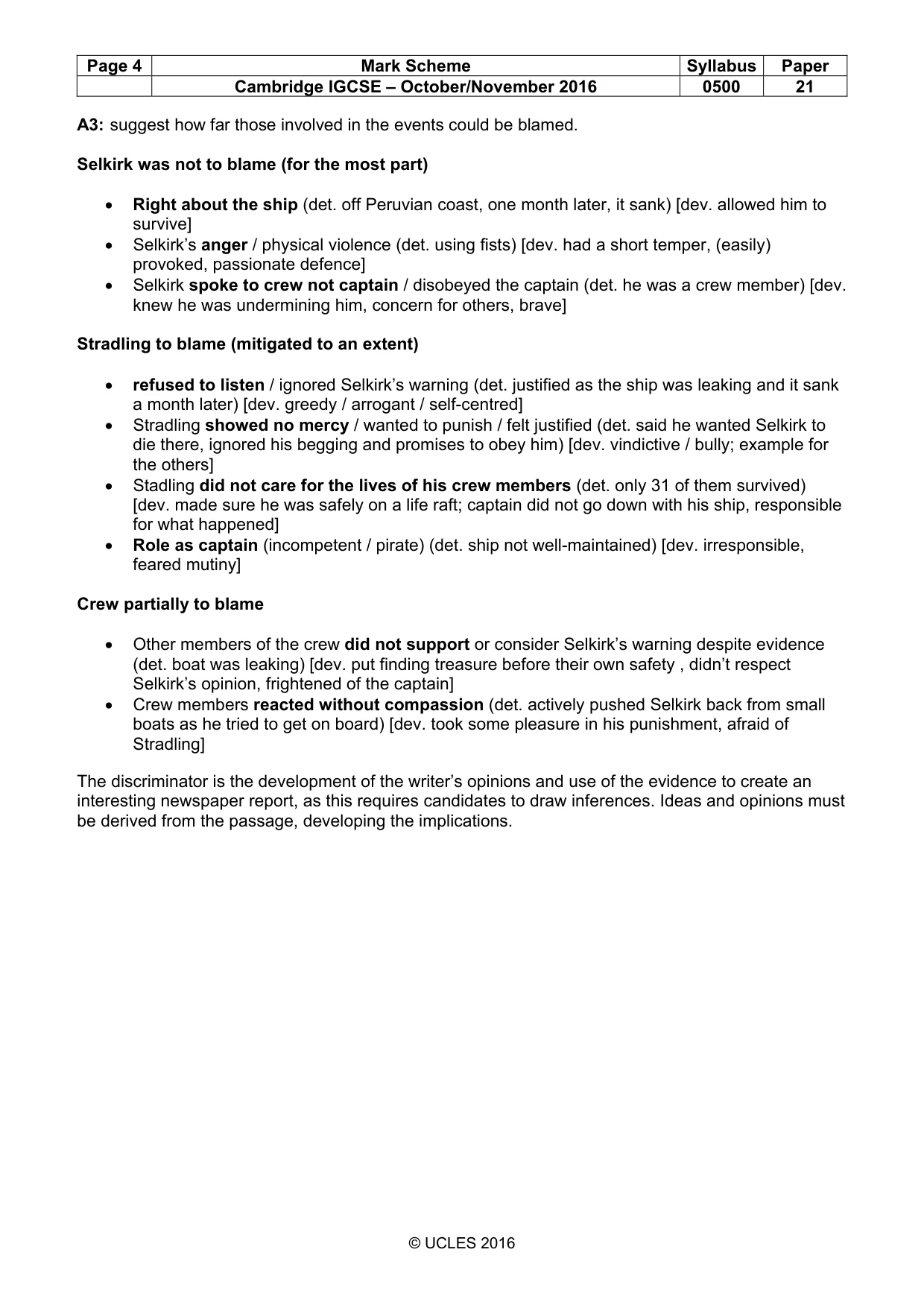
Page 4 Mark Scheme Syllabus Paper Cambridge IGCSE – October/November 2016 0500 21 © UCLES 2016 A3: suggest how far those involved in the events could be blamed. Selkirk was not to blame (for the most part) • Right about the ship (det. off Peruvian coast, one month later, it sank) [dev. allowed him to survive] • Selkirk’s anger / physical violence (det. using fists) [dev. had a short temper, (easily) provoked, passionate defence] • Selkirk spoke to crew not captain / disobeyed the captain (det. he was a crew member) [dev. knew he was undermining him, concern for others, brave] Stradling to blame (mitigated to an extent) • refused to listen / ignored Selkirk’s warning (det. justified as the ship was leaking and it sank a month later) [dev. greedy / arrogant / self-centred] • Stradling showed no mercy / wanted to punish / felt justified (det. said he wanted Selkirk to die there, ignored his begging and promises to obey him) [dev. vindictive / bully; example for the others] • Stadling did not care for the lives of his crew members (det. only 31 of them survived) [dev. made sure he was safely on a life raft; captain did not go down with his ship, responsible for what happened] • Role as captain (incompetent / pirate) (det. ship not well-maintained) [dev. irresponsible, feared mutiny] Crew partially to blame • Other members of the crew did not support or consider Selkirk’s warning despite evidence (det. boat was leaking) [dev. put finding treasure before their own safety , didn’t respect Selkirk’s opinion, frightened of the captain] • Crew members reacted without compassion (det. actively pushed Selkirk back from small boats as he tried to get on board) [dev. took some pleasure in his punishment, afraid of Stradling] The discriminator is the development of the writer’s opinions and use of the evidence to create an interesting newspaper report, as this requires candidates to draw inferences. Ideas and opinions must be derived from the passage, developing the implications.
Mark scheme, page 5
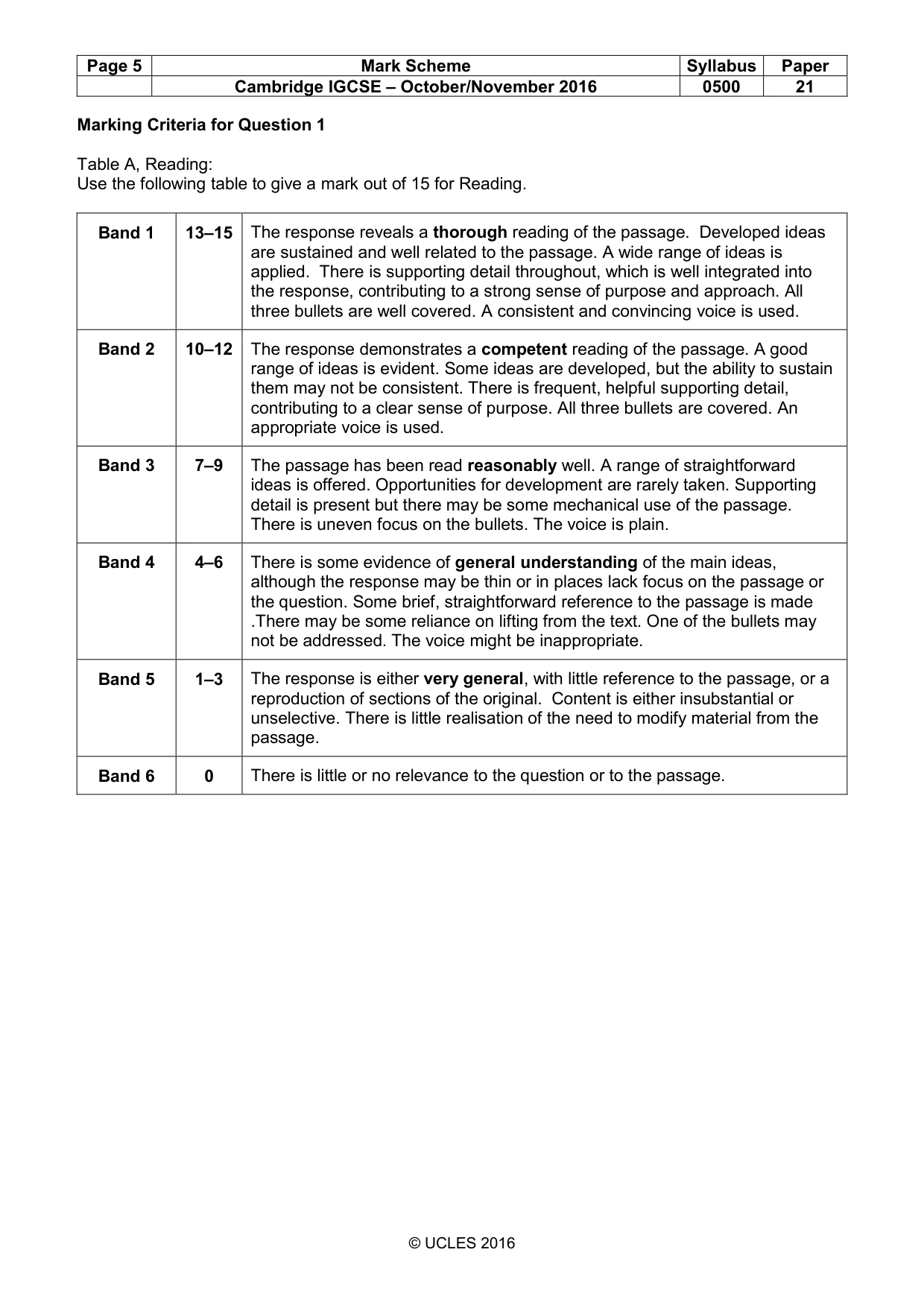
Page 5 Mark Scheme Syllabus Paper Cambridge IGCSE – October/November 2016 0500 21 © UCLES 2016 Marking Criteria for Question 1 Table A, Reading: Use the following table to give a mark out of 15 for Reading. Band 1 13–15 The response reveals a thorough reading of the passage. Developed ideas are sustained and well related to the passage. A wide range of ideas is applied. There is supporting detail throughout, which is well integrated into the response, contributing to a strong sense of purpose and approach. All three bullets are well covered. A consistent and convincing voice is used. Band 2 10–12 The response demonstrates a competent reading of the passage. A good range of ideas is evident. Some ideas are developed, but the ability to sustain them may not be consistent. There is frequent, helpful supporting detail, contributing to a clear sense of purpose. All three bullets are covered. An appropriate voice is used. Band 3 7–9 The passage has been read reasonably well. A range of straightforward ideas is offered. Opportunities for development are rarely taken. Supporting detail is present but there may be some mechanical use of the passage. There is uneven focus on the bullets. The voice is plain. Band 4 4–6 There is some evidence of general understanding of the main ideas, although the response may be thin or in places lack focus on the passage or the question. Some brief, straightforward reference to the passage is made .There may be some reliance on lifting from the text. One of the bullets may not be addressed. The voice might be inappropriate. Band 5 1–3 The response is either very general, with little reference to the passage, or a reproduction of sections of the original. Content is either insubstantial or unselective. There is little realisation of the need to modify material from the passage. Band 6 0 There is little or no relevance to the question or to the passage.
Mark scheme, page 6
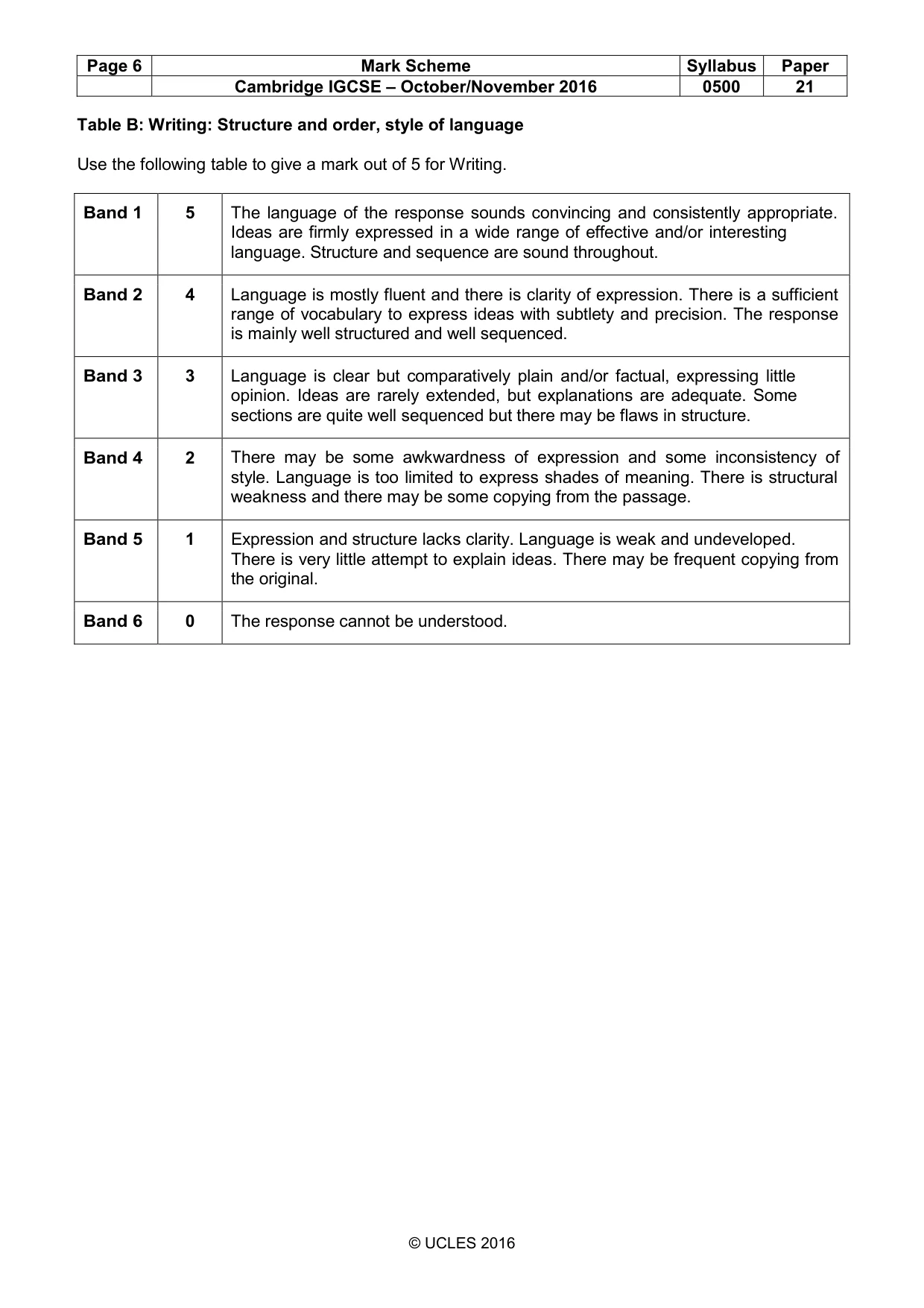
Page 6 Mark Scheme Syllabus Paper Cambridge IGCSE – October/November 2016 0500 21 © UCLES 2016 Table B: Writing: Structure and order, style of language Use the following table to give a mark out of 5 for Writing. Band 1 5 The language of the response sounds convincing and consistently appropriate. Ideas are firmly expressed in a wide range of effective and/or interesting language. Structure and sequence are sound throughout. Band 2 4 Language is mostly fluent and there is clarity of expression. There is a sufficient range of vocabulary to express ideas with subtlety and precision. The response is mainly well structured and well sequenced. Band 3 3 Language is clear but comparatively plain and/or factual, expressing little opinion. Ideas are rarely extended, but explanations are adequate. Some sections are quite well sequenced but there may be flaws in structure. Band 4 2 There may be some awkwardness of expression and some inconsistency of style. Language is too limited to express shades of meaning. There is structural weakness and there may be some copying from the passage. Band 5 1 Expression and structure lacks clarity. Language is weak and undeveloped. There is very little attempt to explain ideas. There may be frequent copying from the original. Band 6 0 The response cannot be understood.
Mark scheme, page 7
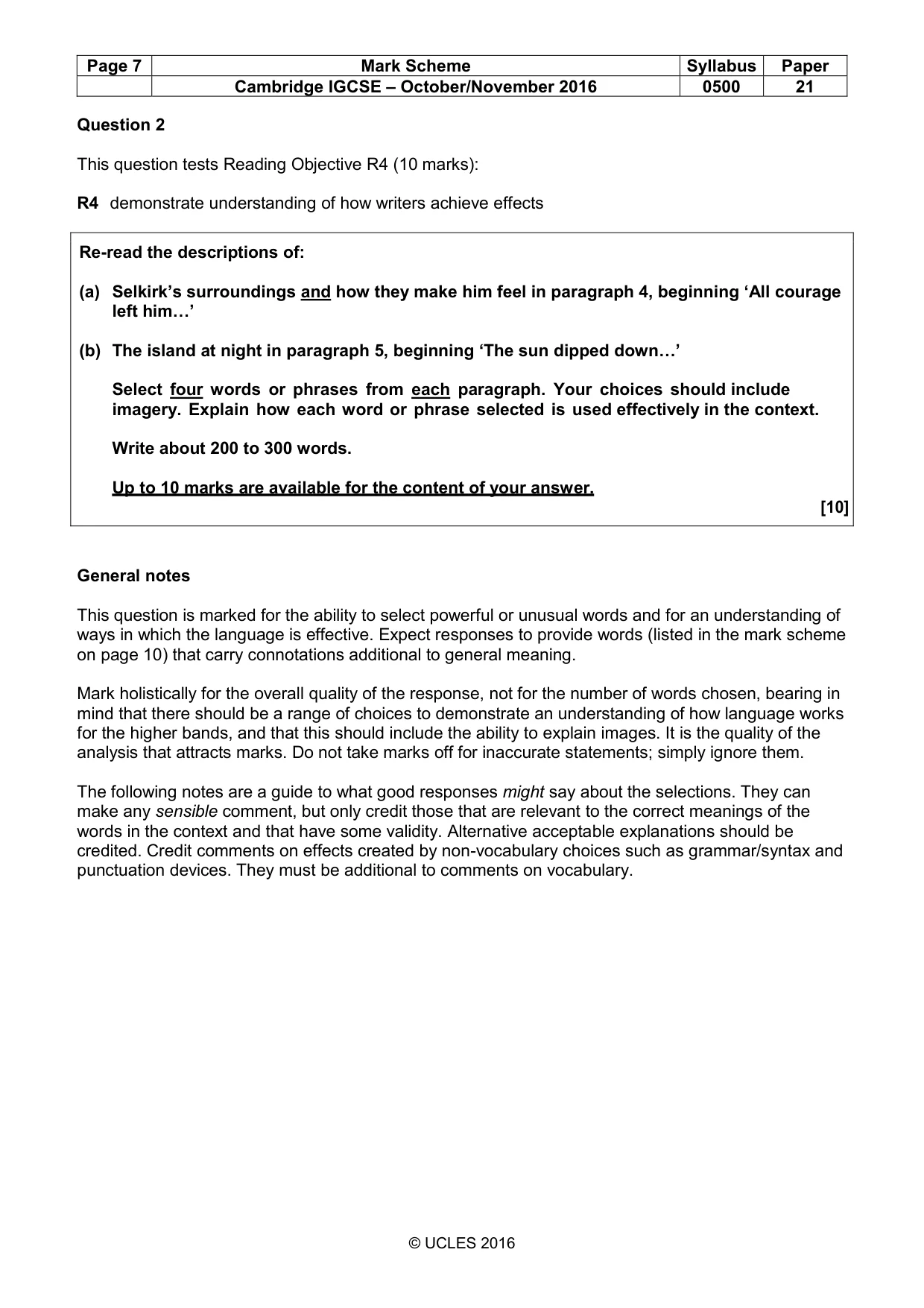
Page 7 Mark Scheme Syllabus Paper Cambridge IGCSE – October/November 2016 0500 21 © UCLES 2016 Question 2 This question tests Reading Objective R4 (10 marks): R4 demonstrate understanding of how writers achieve effects Re-read the descriptions of: (a) Selkirk’s surroundings and how they make him feel in paragraph 4, beginning ‘All courage left him…’ (b) The island at night in paragraph 5, beginning ‘The sun dipped down…’ Select four words or phrases from each paragraph. Your choices should include imagery. Explain how each word or phrase selected is used effectively in the context. Write about 200 to 300 words. Up to 10 marks are available for the content of your answer. [10] General notes This question is marked for the ability to select powerful or unusual words and for an understanding of ways in which the language is effective. Expect responses to provide words (listed in the mark scheme on page 10) that carry connotations additional to general meaning. Mark holistically for the overall quality of the response, not for the number of words chosen, bearing in mind that there should be a range of choices to demonstrate an understanding of how language works for the higher bands, and that this should include the ability to explain images. It is the quality of the analysis that attracts marks. Do not take marks off for inaccurate statements; simply ignore them. The following notes are a guide to what good responses might say about the selections. They can make any sensible comment, but only credit those that are relevant to the correct meanings of the words in the context and that have some validity. Alternative acceptable explanations should be credited. Credit comments on effects created by non-vocabulary choices such as grammar/syntax and punctuation devices. They must be additional to comments on vocabulary.
Mark scheme, page 8
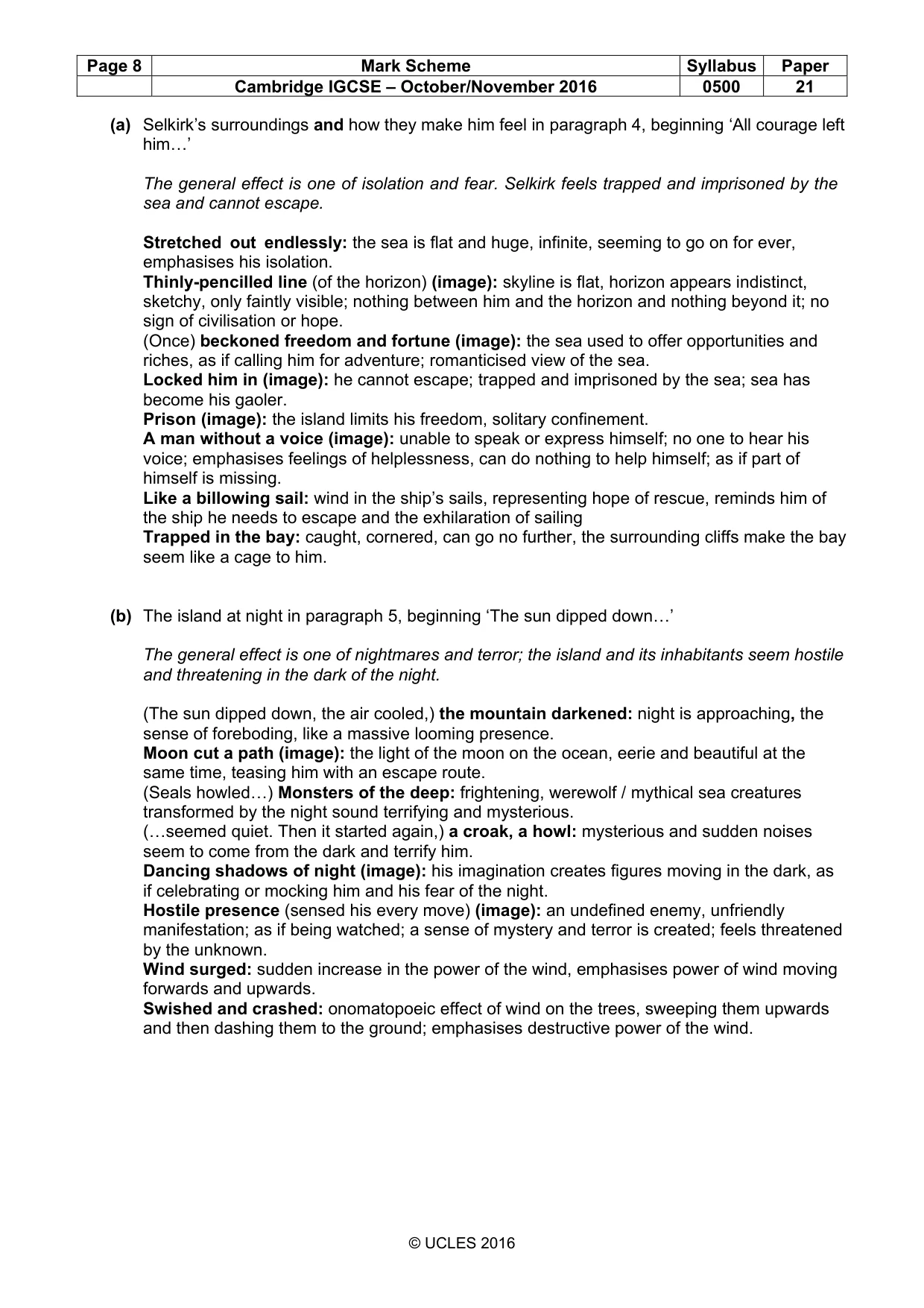
Page 8 Mark Scheme Syllabus Paper Cambridge IGCSE – October/November 2016 0500 21 © UCLES 2016 (a) Selkirk’s surroundings and how they make him feel in paragraph 4, beginning ‘All courage left him…’ The general effect is one of isolation and fear. Selkirk feels trapped and imprisoned by the sea and cannot escape. Stretched out endlessly: the sea is flat and huge, infinite, seeming to go on for ever, emphasises his isolation. Thinly-pencilled line (of the horizon) (image): skyline is flat, horizon appears indistinct, sketchy, only faintly visible; nothing between him and the horizon and nothing beyond it; no sign of civilisation or hope. (Once) beckoned freedom and fortune (image): the sea used to offer opportunities and riches, as if calling him for adventure; romanticised view of the sea. Locked him in (image): he cannot escape; trapped and imprisoned by the sea; sea has become his gaoler. Prison (image): the island limits his freedom, solitary confinement. A man without a voice (image): unable to speak or express himself; no one to hear his voice; emphasises feelings of helplessness, can do nothing to help himself; as if part of himself is missing. Like a billowing sail: wind in the ship’s sails, representing hope of rescue, reminds him of the ship he needs to escape and the exhilaration of sailing Trapped in the bay: caught, cornered, can go no further, the surrounding cliffs make the bay seem like a cage to him. (b) The island at night in paragraph 5, beginning ‘The sun dipped down…’ The general effect is one of nightmares and terror; the island and its inhabitants seem hostile and threatening in the dark of the night. (The sun dipped down, the air cooled,) the mountain darkened: night is approaching, the sense of foreboding, like a massive looming presence. Moon cut a path (image): the light of the moon on the ocean, eerie and beautiful at the same time, teasing him with an escape route. (Seals howled…) Monsters of the deep: frightening, werewolf / mythical sea creatures transformed by the night sound terrifying and mysterious. (…seemed quiet. Then it started again,) a croak, a howl: mysterious and sudden noises seem to come from the dark and terrify him. Dancing shadows of night (image): his imagination creates figures moving in the dark, as if celebrating or mocking him and his fear of the night. Hostile presence (sensed his every move) (image): an undefined enemy, unfriendly manifestation; as if being watched; a sense of mystery and terror is created; feels threatened by the unknown. Wind surged: sudden increase in the power of the wind, emphasises power of wind moving forwards and upwards. Swished and crashed: onomatopoeic effect of wind on the trees, sweeping them upwards and then dashing them to the ground; emphasises destructive power of the wind.
Mark scheme, page 9
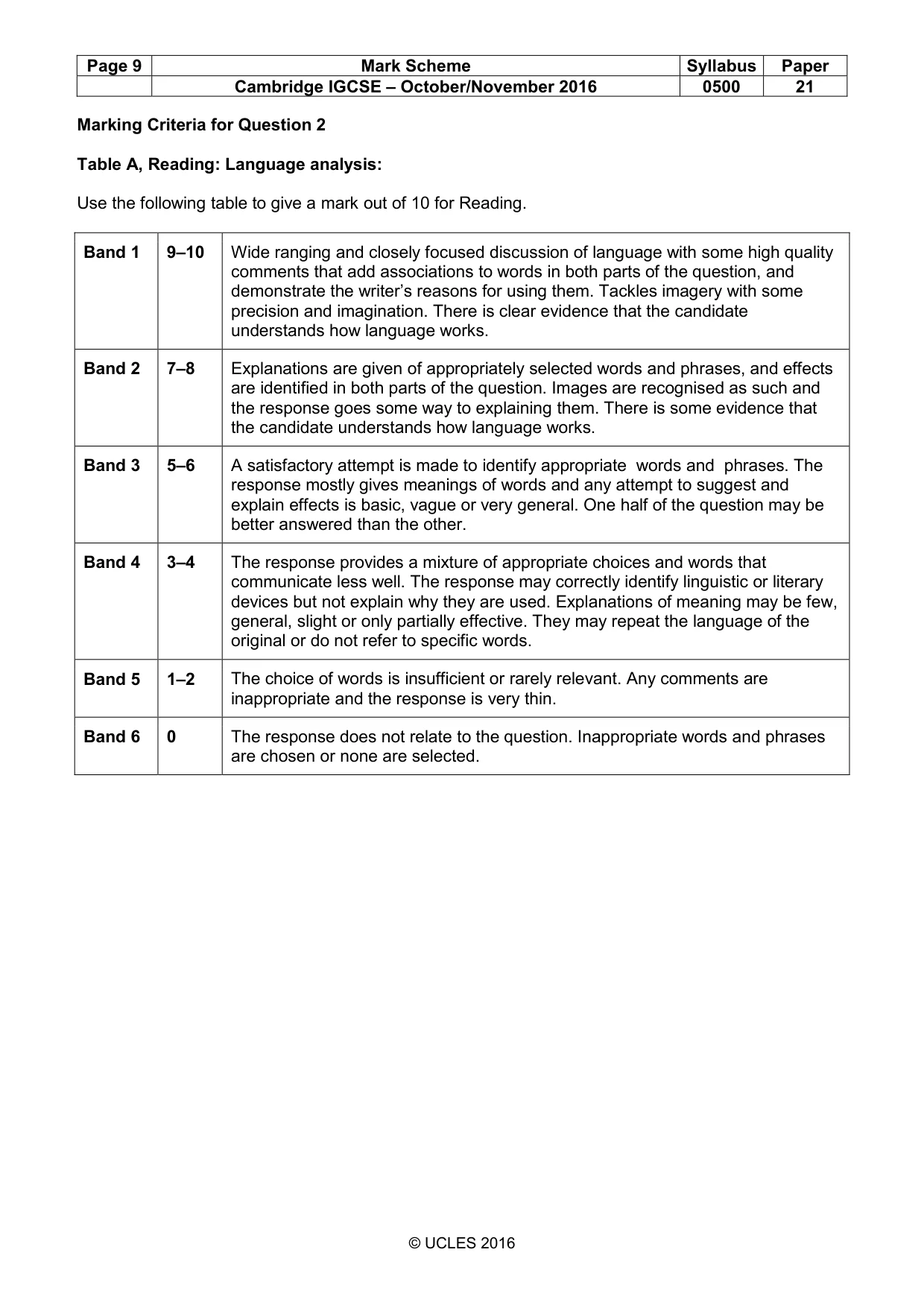
Page 9 Mark Scheme Syllabus Paper Cambridge IGCSE – October/November 2016 0500 21 © UCLES 2016 Marking Criteria for Question 2 Table A, Reading: Language analysis: Use the following table to give a mark out of 10 for Reading. Band 1 9–10 Wide ranging and closely focused discussion of language with some high quality comments that add associations to words in both parts of the question, and demonstrate the writer’s reasons for using them. Tackles imagery with some precision and imagination. There is clear evidence that the candidate understands how language works. Band 2 7–8 Explanations are given of appropriately selected words and phrases, and effects are identified in both parts of the question. Images are recognised as such and the response goes some way to explaining them. There is some evidence that the candidate understands how language works. Band 3 5–6 A satisfactory attempt is made to identify appropriate words and phrases. The response mostly gives meanings of words and any attempt to suggest and explain effects is basic, vague or very general. One half of the question may be better answered than the other. Band 4 3–4 The response provides a mixture of appropriate choices and words that communicate less well. The response may correctly identify linguistic or literary devices but not explain why they are used. Explanations of meaning may be few, general, slight or only partially effective. They may repeat the language of the original or do not refer to specific words. Band 5 1–2 The choice of words is insufficient or rarely relevant. Any comments are inappropriate and the response is very thin. Band 6 0 The response does not relate to the question. Inappropriate words and phrases are chosen or none are selected.
Mark scheme, page 10
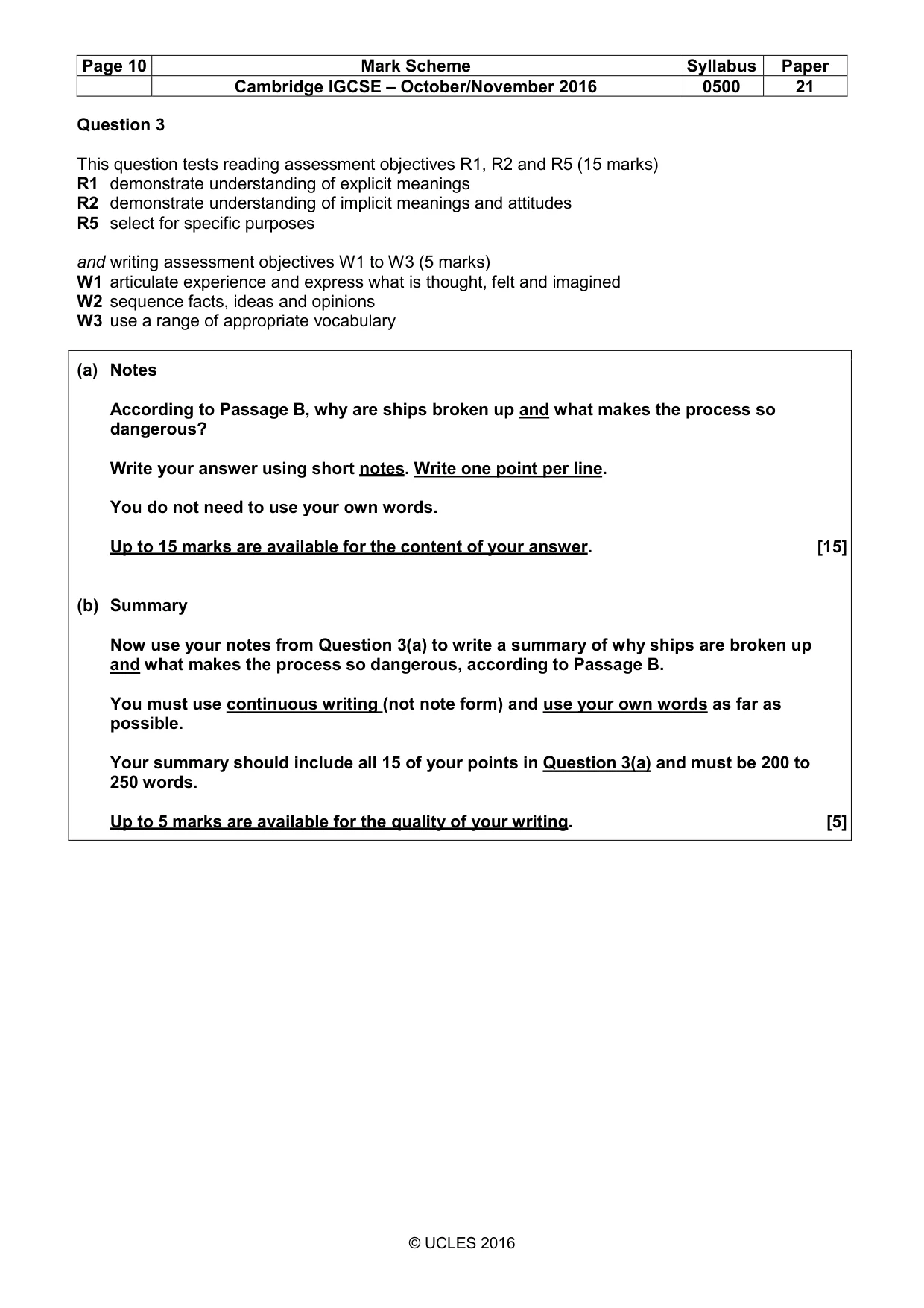
Page 10 Mark Scheme Syllabus Paper Cambridge IGCSE – October/November 2016 0500 21 © UCLES 2016 Question 3 This question tests reading assessment objectives R1, R2 and R5 (15 marks) R1 demonstrate understanding of explicit meanings R2 demonstrate understanding of implicit meanings and attitudes R5 select for specific purposes and writing assessment objectives W1 to W3 (5 marks) W1 articulate experience and express what is thought, felt and imagined W2 sequence facts, ideas and opinions W3 use a range of appropriate vocabulary (a) Notes According to Passage B, why are ships broken up and what makes the process so dangerous? Write your answer using short notes. Write one point per line. You do not need to use your own words. Up to 15 marks are available for the content of your answer. [15] (b) Summary Now use your notes from Question 3(a) to write a summary of why ships are broken up and what makes the process so dangerous, according to Passage B. You must use continuous writing (not note form) and use your own words as far as possible. Your summary should include all 15 of your points in Question 3(a) and must be 200 to 250 words. Up to 5 marks are available for the quality of your writing. [5]
Mark scheme, page 11
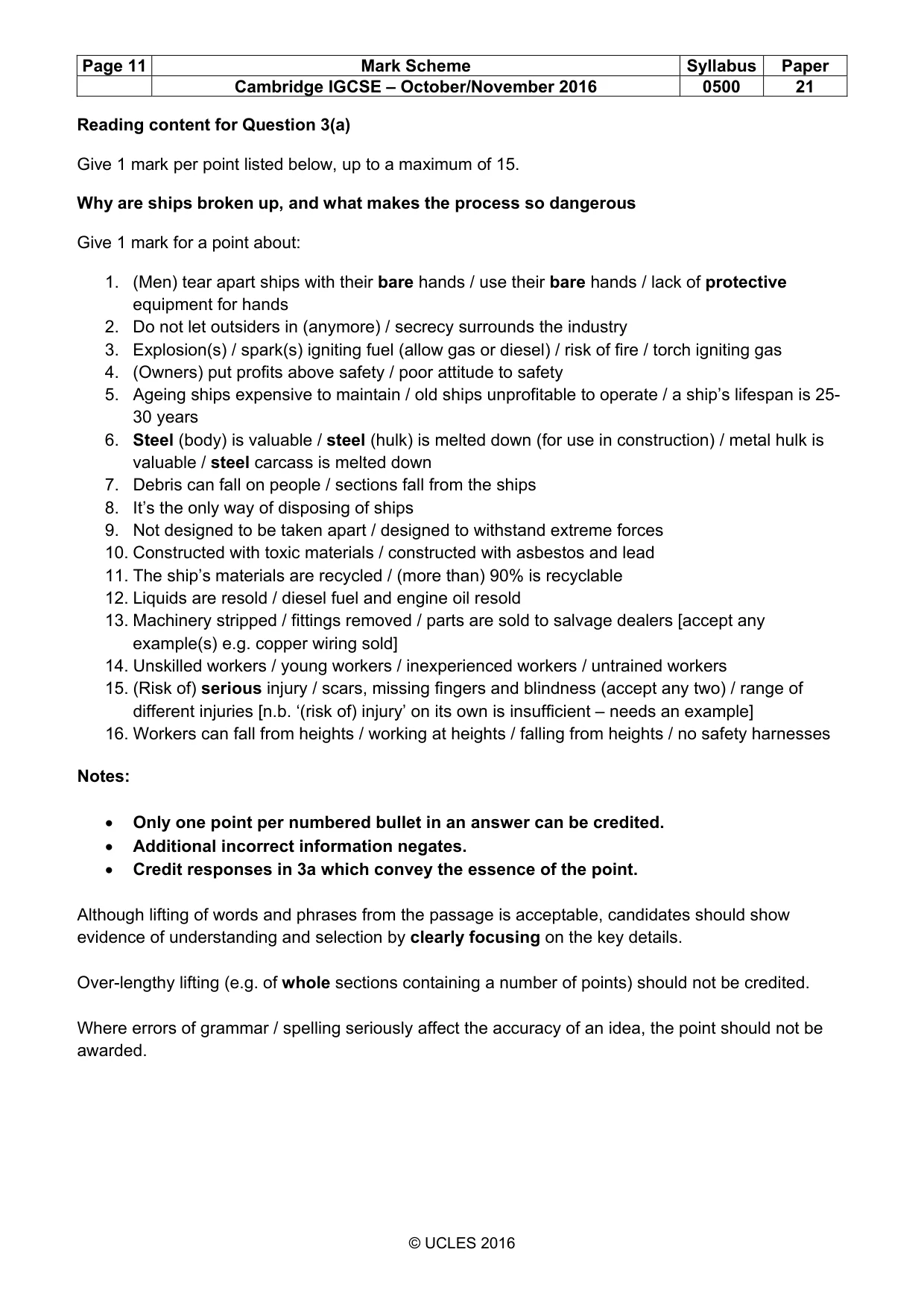
Page 11 Mark Scheme Syllabus Paper Cambridge IGCSE – October/November 2016 0500 21 © UCLES 2016 Reading content for Question 3(a) Give 1 mark per point listed below, up to a maximum of 15. Why are ships broken up, and what makes the process so dangerous Give 1 mark for a point about: 1. (Men) tear apart ships with their bare hands / use their bare hands / lack of protective equipment for hands 2. Do not let outsiders in (anymore) / secrecy surrounds the industry 3. Explosion(s) / spark(s) igniting fuel (allow gas or diesel) / risk of fire / torch igniting gas 4. (Owners) put profits above safety / poor attitude to safety 5. Ageing ships expensive to maintain / old ships unprofitable to operate / a ship’s lifespan is 25- 30 years 6. Steel (body) is valuable / steel (hulk) is melted down (for use in construction) / metal hulk is valuable / steel carcass is melted down 7. Debris can fall on people / sections fall from the ships 8. It’s the only way of disposing of ships 9. Not designed to be taken apart / designed to withstand extreme forces 10. Constructed with toxic materials / constructed with asbestos and lead 11. The ship’s materials are recycled / (more than) 90% is recyclable 12. Liquids are resold / diesel fuel and engine oil resold 13. Machinery stripped / fittings removed / parts are sold to salvage dealers [accept any example(s) e.g. copper wiring sold] 14. Unskilled workers / young workers / inexperienced workers / untrained workers 15. (Risk of) serious injury / scars, missing fingers and blindness (accept any two) / range of different injuries [n.b. ‘(risk of) injury’ on its own is insufficient – needs an example] 16. Workers can fall from heights / working at heights / falling from heights / no safety harnesses Notes: • Only one point per numbered bullet in an answer can be credited. • Additional incorrect information negates. • Credit responses in 3a which convey the essence of the point. Although lifting of words and phrases from the passage is acceptable, candidates should show evidence of understanding and selection by clearly focusing on the key details. Over-lengthy lifting (e.g. of whole sections containing a number of points) should not be credited. Where errors of grammar / spelling seriously affect the accuracy of an idea, the point should not be awarded.
Mark scheme, page 12
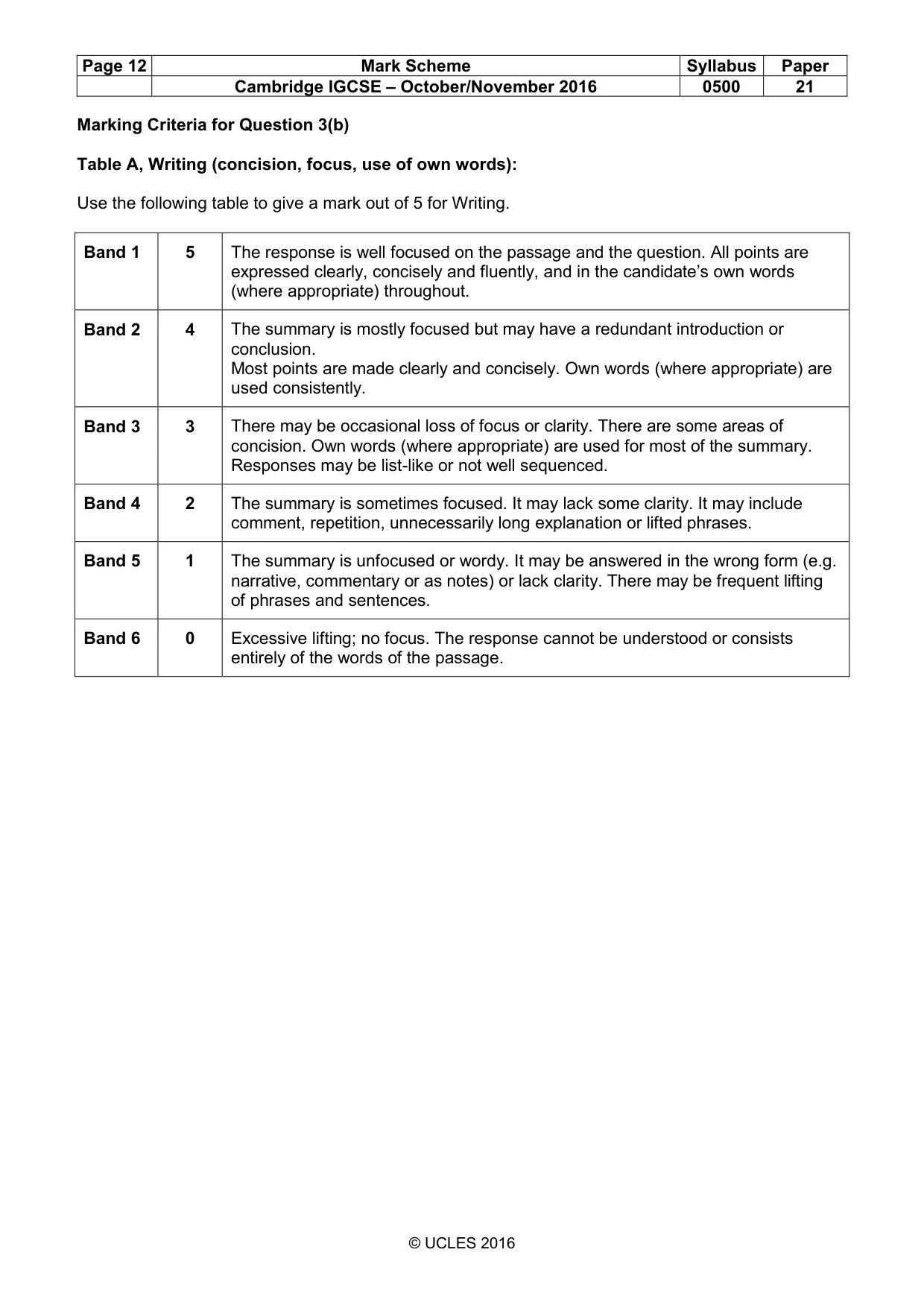
Page 12 Mark Scheme Syllabus Paper Cambridge IGCSE – October/November 2016 0500 21 © UCLES 2016 Marking Criteria for Question 3(b) Table A, Writing (concision, focus, use of own words): Use the following table to give a mark out of 5 for Writing. Band 1 5 The response is well focused on the passage and the question. All points are expressed clearly, concisely and fluently, and in the candidate’s own words (where appropriate) throughout. Band 2 4 The summary is mostly focused but may have a redundant introduction or conclusion. Most points are made clearly and concisely. Own words (where appropriate) are used consistently. Band 3 3 There may be occasional loss of focus or clarity. There are some areas of concision. Own words (where appropriate) are used for most of the summary. Responses may be list-like or not well sequenced. Band 4 2 The summary is sometimes focused. It may lack some clarity. It may include comment, repetition, unnecessarily long explanation or lifted phrases. Band 5 1 The summary is unfocused or wordy. It may be answered in the wrong form (e.g. narrative, commentary or as notes) or lack clarity. There may be frequent lifting of phrases and sentences. Band 6 0 Excessive lifting; no focus. The response cannot be understood or consists entirely of the words of the passage.
What you needed in this session
Cambridge’s own grade thresholds for 2016 Oct/Nov, Paper 2 · Variant 1. A higher threshold means an easier paper — the bar moves with how the cohort did.