Cambridge IGCSE English - First Language 0500 — 2016 Oct/Nov Paper 1 · Variant 1
0500/11/O/N/16 · 50 marks · ≈56 min
The question paper and its mark scheme, free to read here and free to download. This is Cambridge’s own paper, exactly as it was sat.
Question paper12 pages
Mark scheme12 pages
Answers below. Sit the paper first if you are practising.
Paper as text
Question paper, page 1
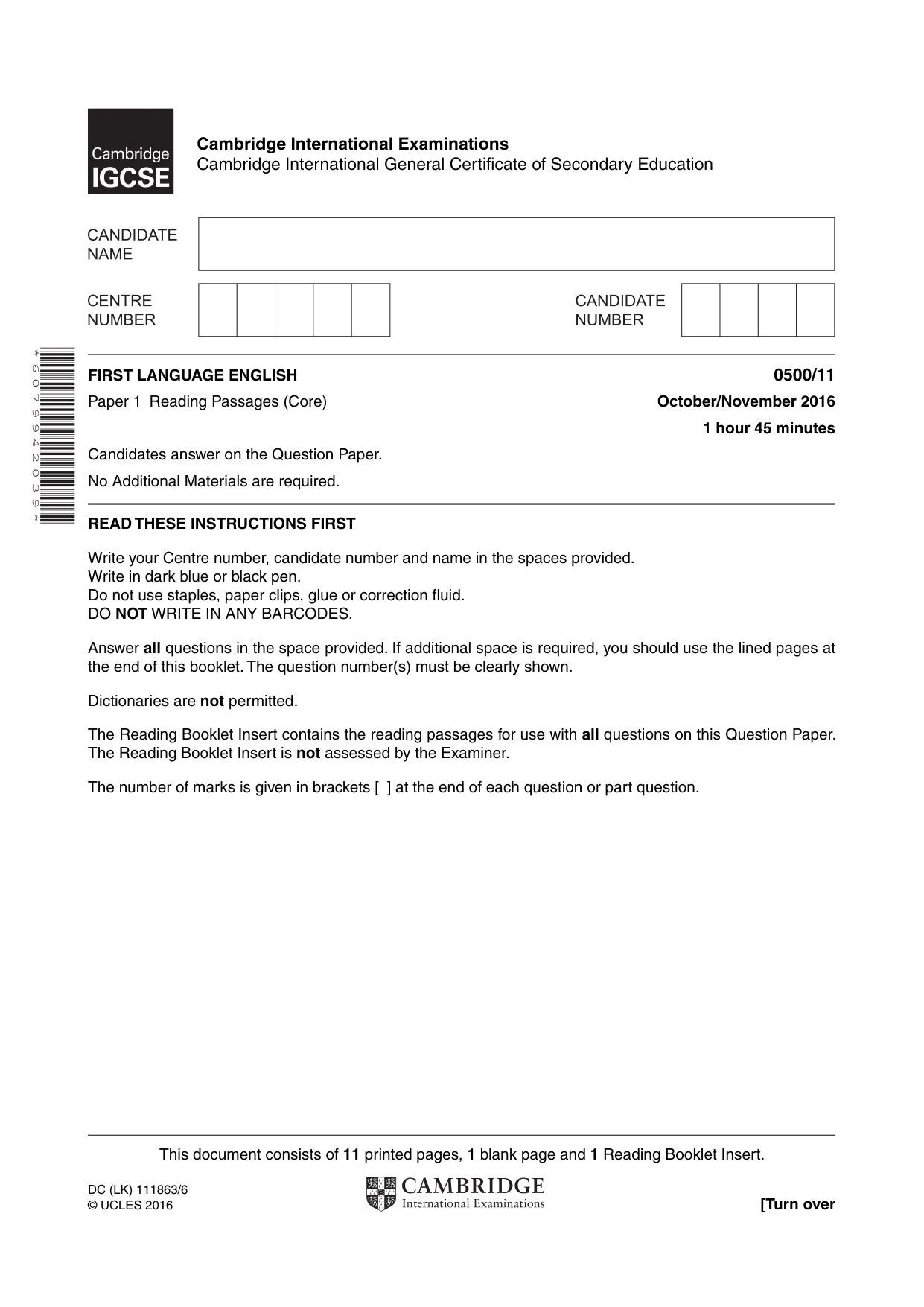
This document consists of 11 printed pages, 1 blank page and 1 Reading Booklet Insert. DC (LK) 111863/6 © UCLES 2016 [Turn over Cambridge International Examinations Cambridge International General Certificate of Secondary Education * 6 0 7 9 9 4 2 0 3 9 * FIRST LANGUAGE ENGLISH 0500/11 Paper 1 Reading Passages (Core) October/November 2016 1 hour 45 minutes Candidates answer on the Question Paper. No Additional Materials are required. READ THESE INSTRUCTIONS FIRST Write your Centre number, candidate number and name in the spaces provided. Write in dark blue or black pen. Do not use staples, paper clips, glue or correction fluid. DO NOT WRITE IN ANY BARCODES. Answer all questions in the space provided. If additional space is required, you should use the lined pages at the end of this booklet. The question number(s) must be clearly shown. Dictionaries are not permitted. The Reading Booklet Insert contains the reading passages for use with all questions on this Question Paper. The Reading Booklet Insert is not assessed by the Examiner. The number of marks is given in brackets [ ] at the end of each question or part question.
Question paper, page 2
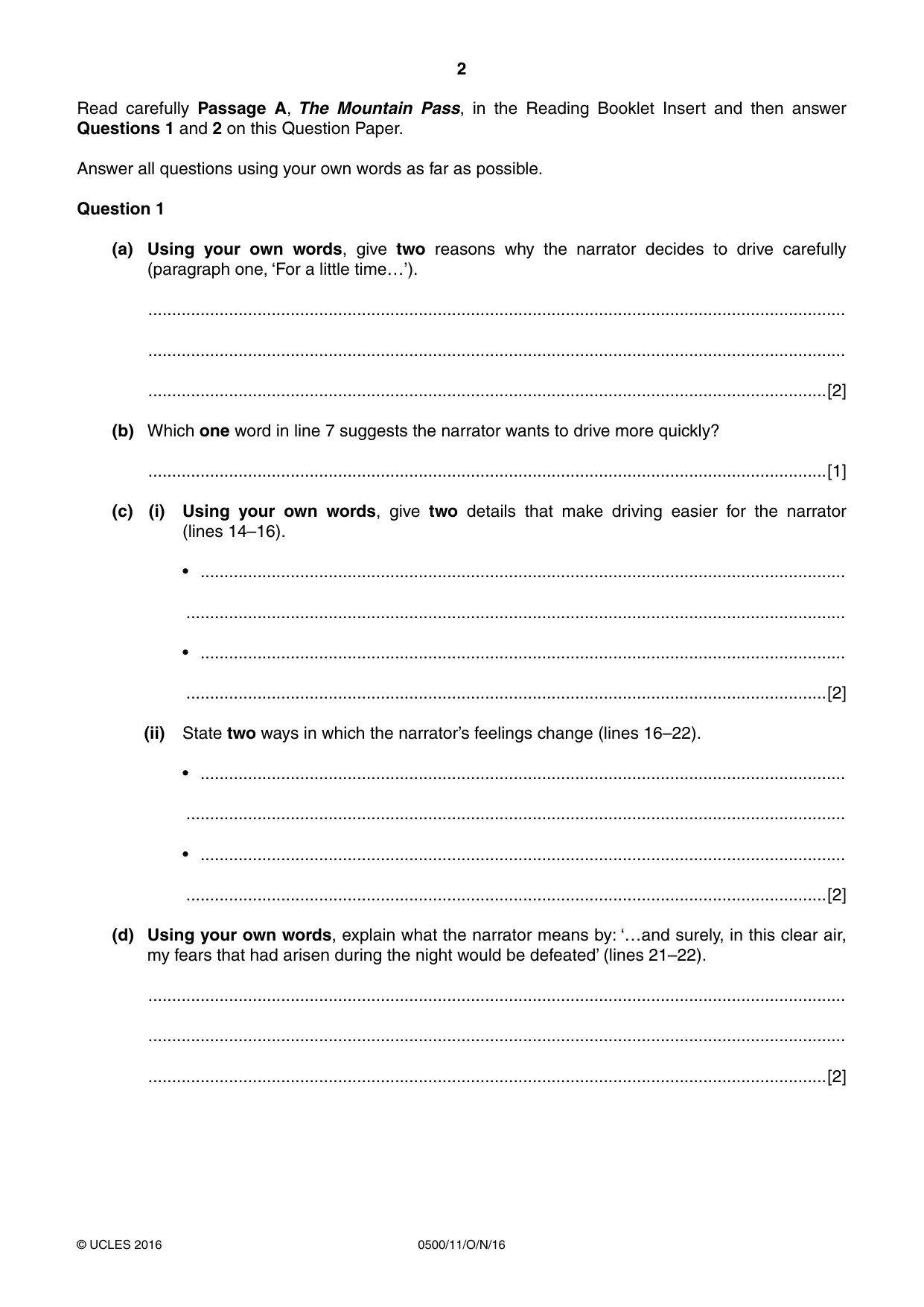
2 0500/11/O/N/16 © UCLES 2016 Read carefully Passage A, The Mountain Pass, in the Reading Booklet Insert and then answer Questions 1 and 2 on this Question Paper. Answer all questions using your own words as far as possible. Question 1 (a) Using your own words, give two reasons why the narrator decides to drive carefully (paragraph one, ‘For a little time…’). … … …[2] (b) Which one word in line 7 suggests the narrator wants to drive more quickly? …[1] (c) (i) Using your own words, give two details that make driving easier for the narrator (lines 14–16). • … … • … …[2] (ii) State two ways in which the narrator’s feelings change (lines 16–22). • … … • … …[2] (d) Using your own words, explain what the narrator means by: ‘…and surely, in this clear air, my fears that had arisen during the night would be defeated’ (lines 21–22). … … …[2]
Question paper, page 3
3 0500/11/O/N/16 © UCLES 2016 [Turn over (e) Give two details that the narrator suggests led to his crash (paragraph five, ‘I had grown…’). • … … • … …[2]
Question paper, page 4
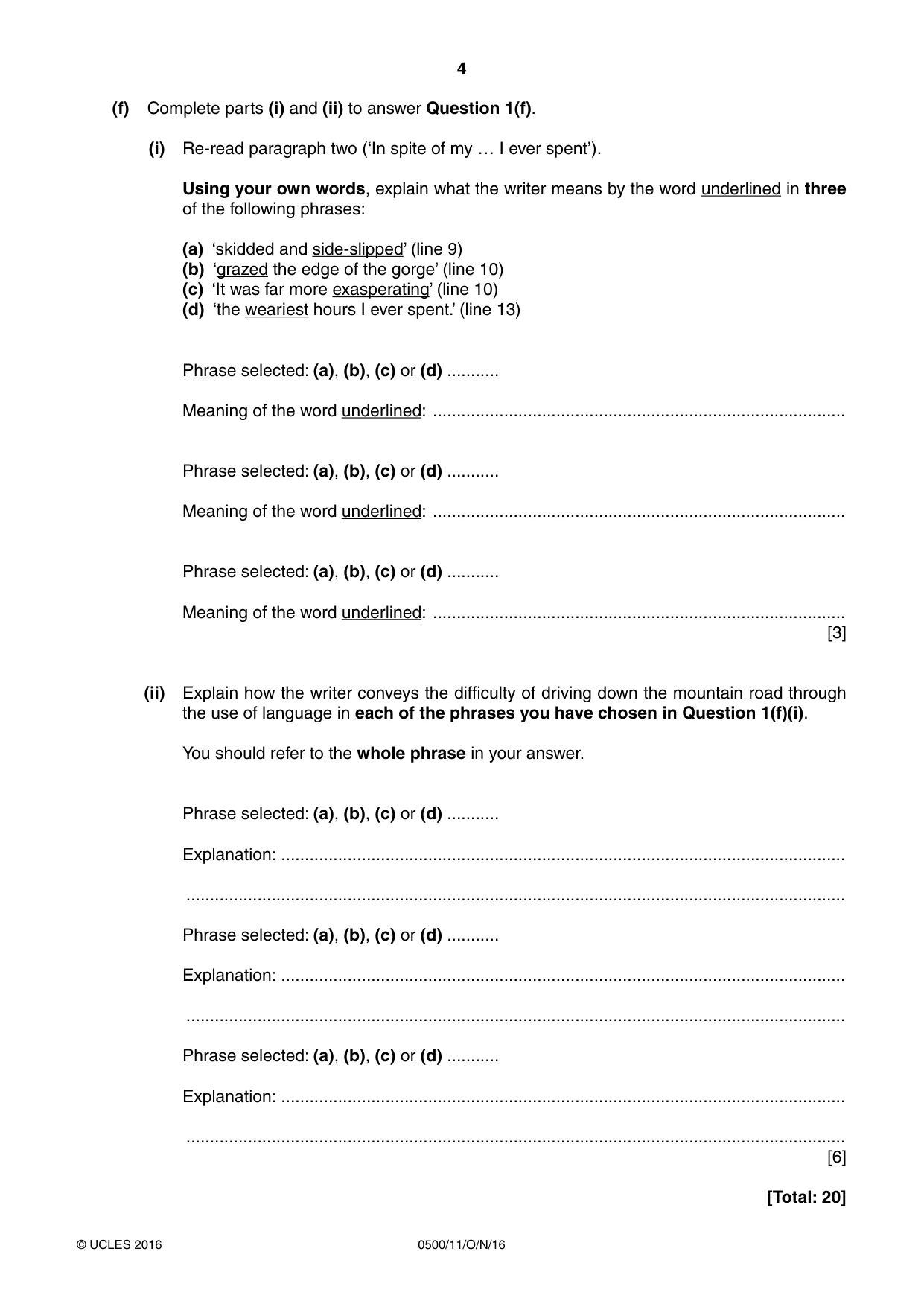
4 0500/11/O/N/16 © UCLES 2016 (f) Complete parts (i) and (ii) to answer Question 1(f). (i) Re-read paragraph two (‘In spite of my … I ever spent’). Using your own words, explain what the writer means by the word underlined in three of the following phrases: (a) ‘skidded and side-slipped’ (line 9) (b) ‘grazed the edge of the gorge’ (line 10) (c) ‘It was far more exasperating’ (line 10) (d) ‘the weariest hours I ever spent.’ (line 13) Phrase selected: (a), (b), (c) or (d) … Meaning of the word underlined: … Phrase selected: (a), (b), (c) or (d) … Meaning of the word underlined: … Phrase selected: (a), (b), (c) or (d) … Meaning of the word underlined: … [3] (ii) Explain how the writer conveys the difficulty of driving down the mountain road through the use of language in each of the phrases you have chosen in Question 1(f)(i). You should refer to the whole phrase in your answer. Phrase selected: (a), (b), (c) or (d) … Explanation: … … Phrase selected: (a), (b), (c) or (d) … Explanation: … … Phrase selected: (a), (b), (c) or (d) … Explanation: … … [6] [Total: 20]
Question paper, page 5
5 0500/11/O/N/16 © UCLES 2016 [Turn over [Turn to page 6 for Question 2]
Question paper, page 6
6 0500/11/O/N/16 © UCLES 2016 Question 2 Imagine you are the narrator of the events in Passage A. When you return home you are interviewed by a local radio station about your experiences on the journey to help your friend. Write the words of the interview. In your interview you are asked the following three questions only: • What was particularly difficult about your journey through the mountains? • Can you explain how the car crash happened? • What did you do to help your friend? Base your ideas on what you have read in Passage A, but do not copy from it. Be careful to use your own words. Address each of the three bullet points. Begin your answer with the first question: Interviewer: What was particularly difficult… Write about 200 to 300 words. Up to 10 marks are available for the content of your answer, and up to 5 marks for the quality of your writing. … … … … … … … … … … … … … … … …
Question paper, page 7
7 0500/11/O/N/16 © UCLES 2016 [Turn over … … … … … … … … … … … … … … … … … … … … … … … … … … [Total: 15]
Question paper, page 8
8 0500/11/O/N/16 © UCLES 2016 Read carefully Passage B, A Guide to Surviving Hurricanes, in the Reading Booklet Insert and then answer Question 3(a) and (b) on this Question Paper. Question 3 Answer the questions in the order set. (a) Notes What do you learn about the characteristics of hurricanes and how to protect yourself against them, according to Passage B? Write your answers using short notes. Write one point per line. You do not need to use your own words. Up to 10 marks are available for the content of your answer. The characteristics of hurricanes and how to protect yourself against them: 1 … 2 … 3 … 4 … 5 … 6 … 7 … 8 … 9 … 10 … [10]
Question paper, page 9
9 0500/11/O/N/16 © UCLES 2016 (b) Summary Now use your notes to write a summary of what Passage B tells you about the characteristics of hurricanes and how to protect yourself against them. You must use continuous writing (not note form) and use your own words as far as possible. Your summary should include all 10 of your points in Question 3(a) and must be 100 to 150 words. Up to 5 marks are available for the quality of your writing. … … … … … … … … … … … … … …[5] [Total: 15]
Question paper, page 10
10 0500/11/O/N/16 © UCLES 2016 Additional Page If you use the following lined page to complete the answer(s) to any question(s), the question number(s) must be clearly shown. … … … … … … … … … … … … … … … … … … … … … … … … … …
Question paper, page 11
11 0500/11/O/N/16 © UCLES 2016 Additional Page If you use the following lined page to complete the answer(s) to any question(s), the question number(s) must be clearly shown. … … … … … … … … … … … … … … … … … … … … … … … … … …
Question paper, page 12
12 0500/11/O/N/16 © UCLES 2016 Permission to reproduce items where third-party owned material protected by copyright is included has been sought and cleared where possible. Every reasonable effort has been made by the publisher (UCLES) to trace copyright holders, but if any items requiring clearance have unwittingly been included, the publisher will be pleased to make amends at the earliest possible opportunity. To avoid the issue of disclosure of answer-related information to candidates, all copyright acknowledgements are reproduced online in the Cambridge International Examinations Copyright Acknowledgements Booklet. This is produced for each series of examinations and is freely available to download at www.cie.org.uk after the live examination series. Cambridge International Examinations is part of the Cambridge Assessment Group. Cambridge Assessment is the brand name of University of Cambridge Local Examinations Syndicate (UCLES), which is itself a department of the University of Cambridge. BLANK PAGE
Mark scheme, page 1
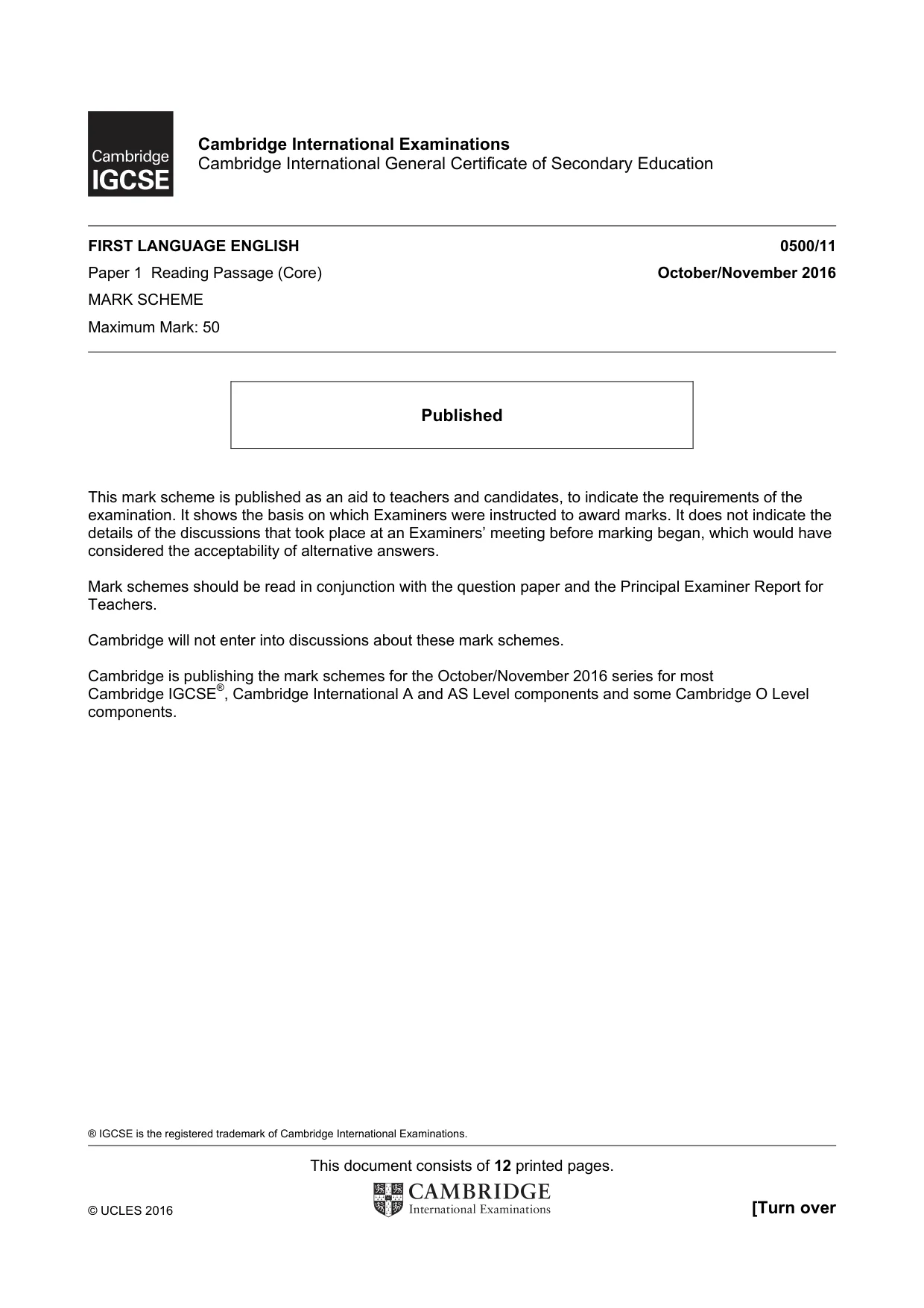
® IGCSE is the registered trademark of Cambridge International Examinations. This document consists of 12 printed pages. © UCLES 2016 [Turn over Cambridge International Examinations Cambridge International General Certificate of Secondary Education FIRST LANGUAGE ENGLISH 0500/11 Paper 1 Reading Passage (Core) October/November 2016 MARK SCHEME Maximum Mark: 50 Published This mark scheme is published as an aid to teachers and candidates, to indicate the requirements of the examination. It shows the basis on which Examiners were instructed to award marks. It does not indicate the details of the discussions that took place at an Examiners’ meeting before marking began, which would have considered the acceptability of alternative answers. Mark schemes should be read in conjunction with the question paper and the Principal Examiner Report for Teachers. Cambridge will not enter into discussions about these mark schemes. Cambridge is publishing the mark schemes for the October/November 2016 series for most Cambridge IGCSE®, Cambridge International A and AS Level components and some Cambridge O Level components.
Mark scheme, page 2
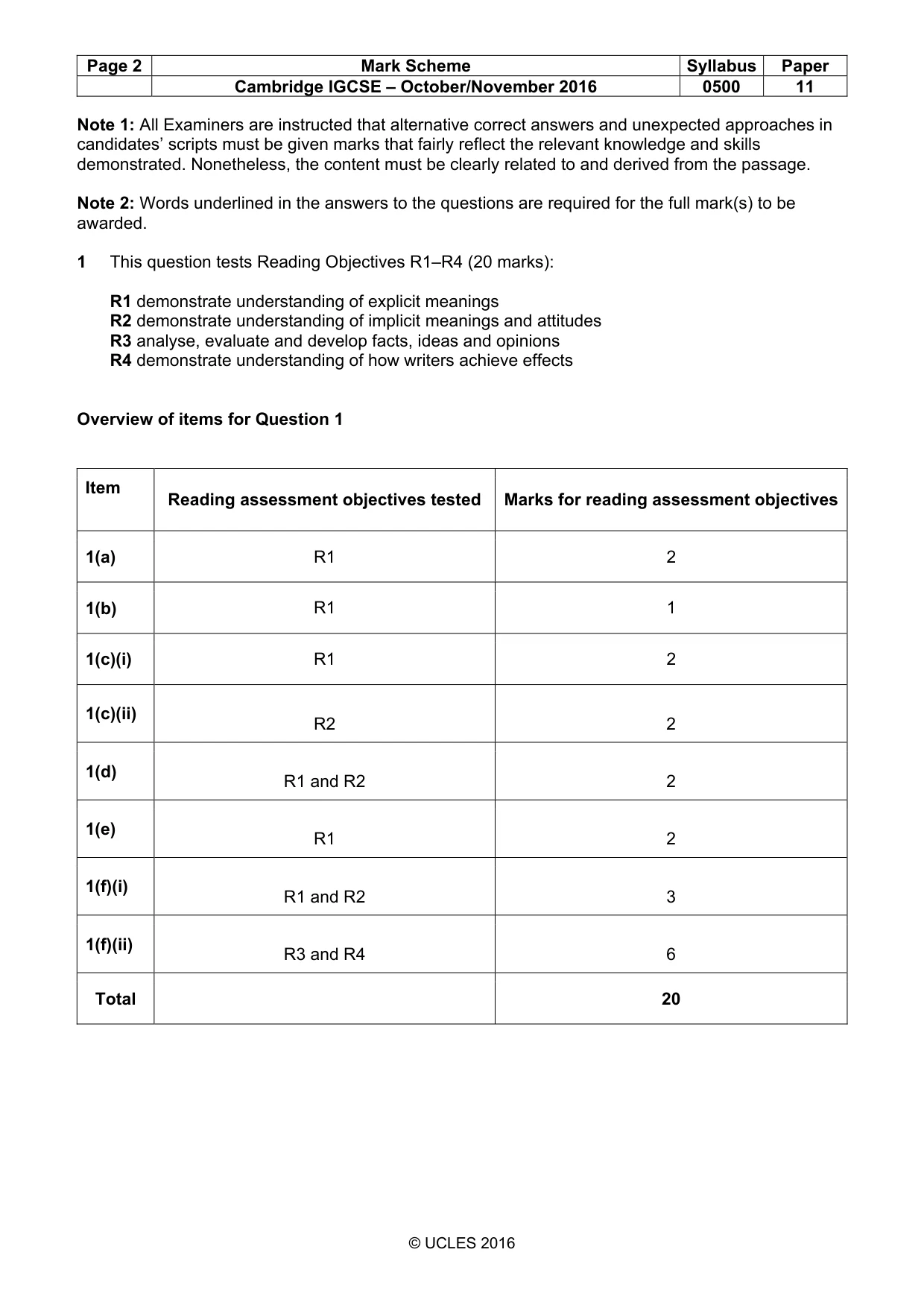
Page 2 Mark Scheme Syllabus Paper Cambridge IGCSE – October/November 2016 0500 11 © UCLES 2016 Note 1: All Examiners are instructed that alternative correct answers and unexpected approaches in candidates’ scripts must be given marks that fairly reflect the relevant knowledge and skills demonstrated. Nonetheless, the content must be clearly related to and derived from the passage. Note 2: Words underlined in the answers to the questions are required for the full mark(s) to be awarded. 1 This question tests Reading Objectives R1–R4 (20 marks): R1 demonstrate understanding of explicit meanings R2 demonstrate understanding of implicit meanings and attitudes R3 analyse, evaluate and develop facts, ideas and opinions R4 demonstrate understanding of how writers achieve effects Overview of items for Question 1 Item Reading assessment objectives tested Marks for reading assessment objectives 1(a) R1 2 1(b) R1 1 1(c)(i) R1 2 1(c)(ii) R2 2 1(d) R1 and R2 2 1(e) R1 2 1(f)(i) R1 and R2 3 1(f)(ii) R3 and R4 6 Total 20
Mark scheme, page 3
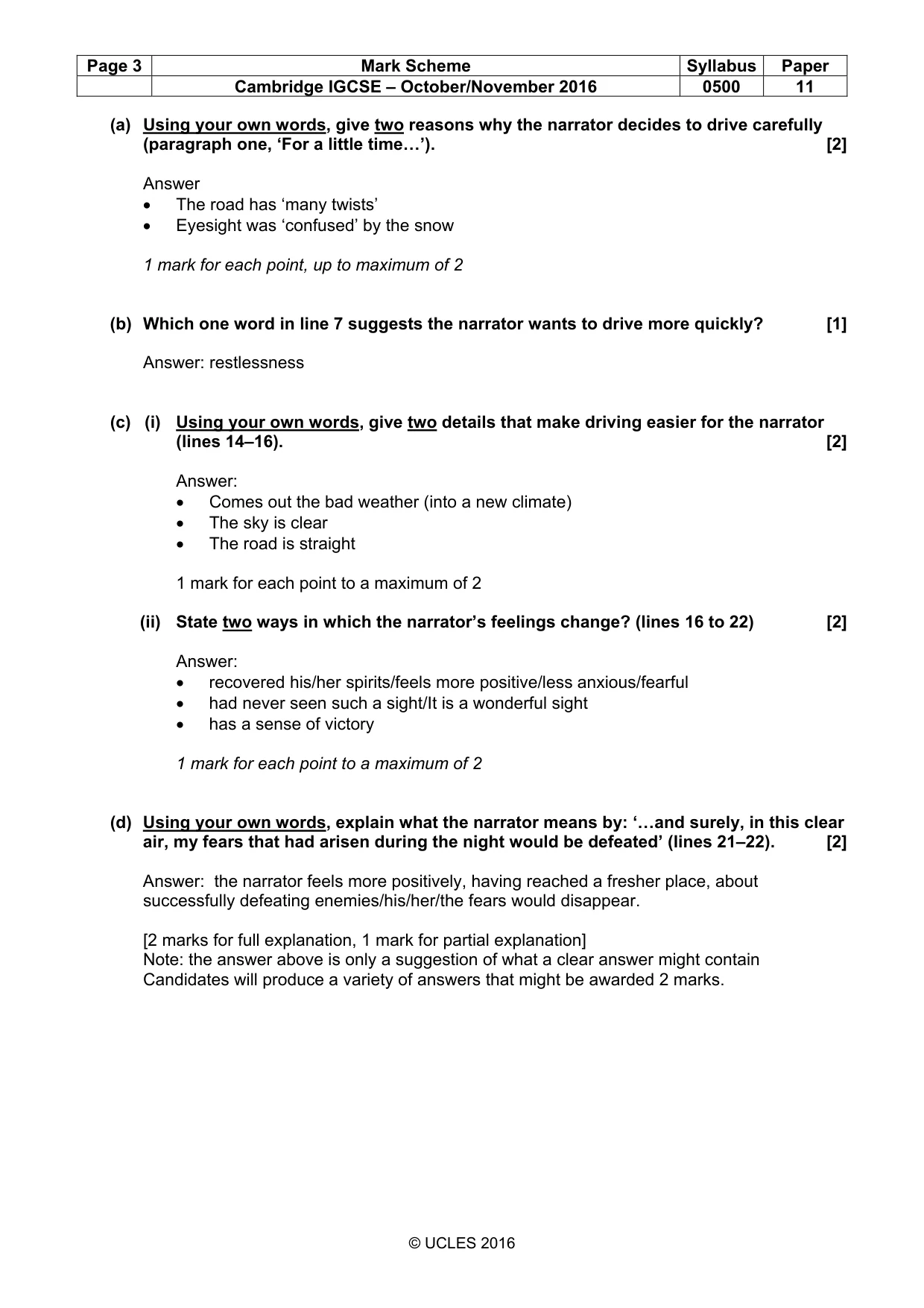
Page 3 Mark Scheme Syllabus Paper Cambridge IGCSE – October/November 2016 0500 11 © UCLES 2016 (a) Using your own words, give two reasons why the narrator decides to drive carefully (paragraph one, ‘For a little time…’). [2] Answer • The road has ‘many twists’ • Eyesight was ‘confused’ by the snow 1 mark for each point, up to maximum of 2 (b) Which one word in line 7 suggests the narrator wants to drive more quickly? [1] Answer: restlessness (c) (i) Using your own words, give two details that make driving easier for the narrator (lines 14–16). [2] Answer: • Comes out the bad weather (into a new climate) • The sky is clear • The road is straight 1 mark for each point to a maximum of 2 (ii) State two ways in which the narrator’s feelings change? (lines 16 to 22) [2] Answer: • recovered his/her spirits/feels more positive/less anxious/fearful • had never seen such a sight/It is a wonderful sight • has a sense of victory 1 mark for each point to a maximum of 2 (d) Using your own words, explain what the narrator means by: ‘…and surely, in this clear air, my fears that had arisen during the night would be defeated’ (lines 21–22). [2] Answer: the narrator feels more positively, having reached a fresher place, about successfully defeating enemies/his/her/the fears would disappear. [2 marks for full explanation, 1 mark for partial explanation] Note: the answer above is only a suggestion of what a clear answer might contain Candidates will produce a variety of answers that might be awarded 2 marks.
Mark scheme, page 4
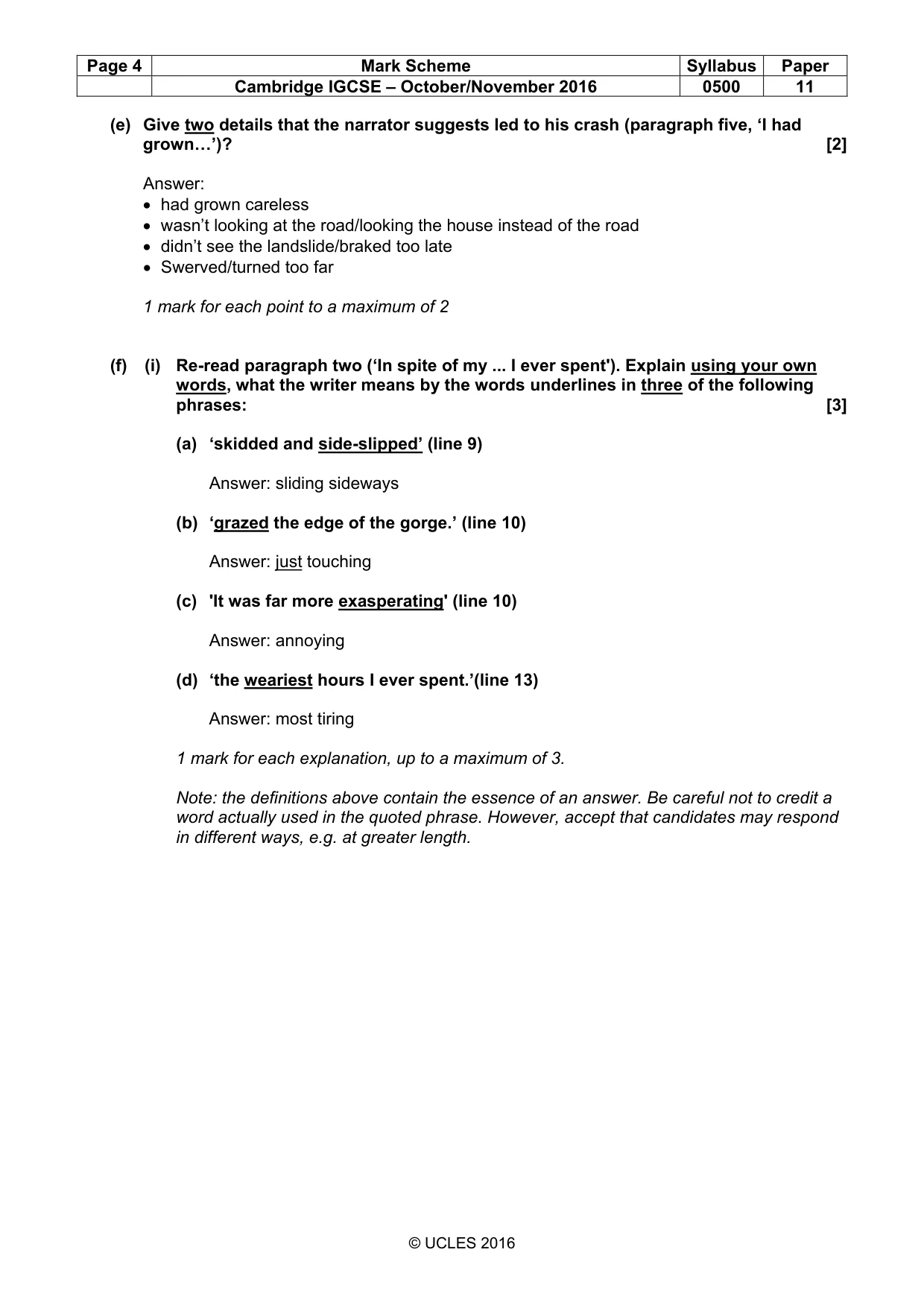
Page 4 Mark Scheme Syllabus Paper Cambridge IGCSE – October/November 2016 0500 11 © UCLES 2016 (e) Give two details that the narrator suggests led to his crash (paragraph five, ‘I had grown…’)? [2] Answer: • had grown careless • wasn’t looking at the road/looking the house instead of the road • didn’t see the landslide/braked too late • Swerved/turned too far 1 mark for each point to a maximum of 2 (f) (i) Re-read paragraph two (‘In spite of my ... I ever spent'). Explain using your own words, what the writer means by the words underlines in three of the following phrases: [3] (a) ‘skidded and side-slipped’ (line 9) Answer: sliding sideways (b) ‘grazed the edge of the gorge.’ (line 10) Answer: just touching (c) 'It was far more exasperating' (line 10) Answer: annoying (d) ‘the weariest hours I ever spent.’(line 13) Answer: most tiring 1 mark for each explanation, up to a maximum of 3. Note: the definitions above contain the essence of an answer. Be careful not to credit a word actually used in the quoted phrase. However, accept that candidates may respond in different ways, e.g. at greater length.
Mark scheme, page 5
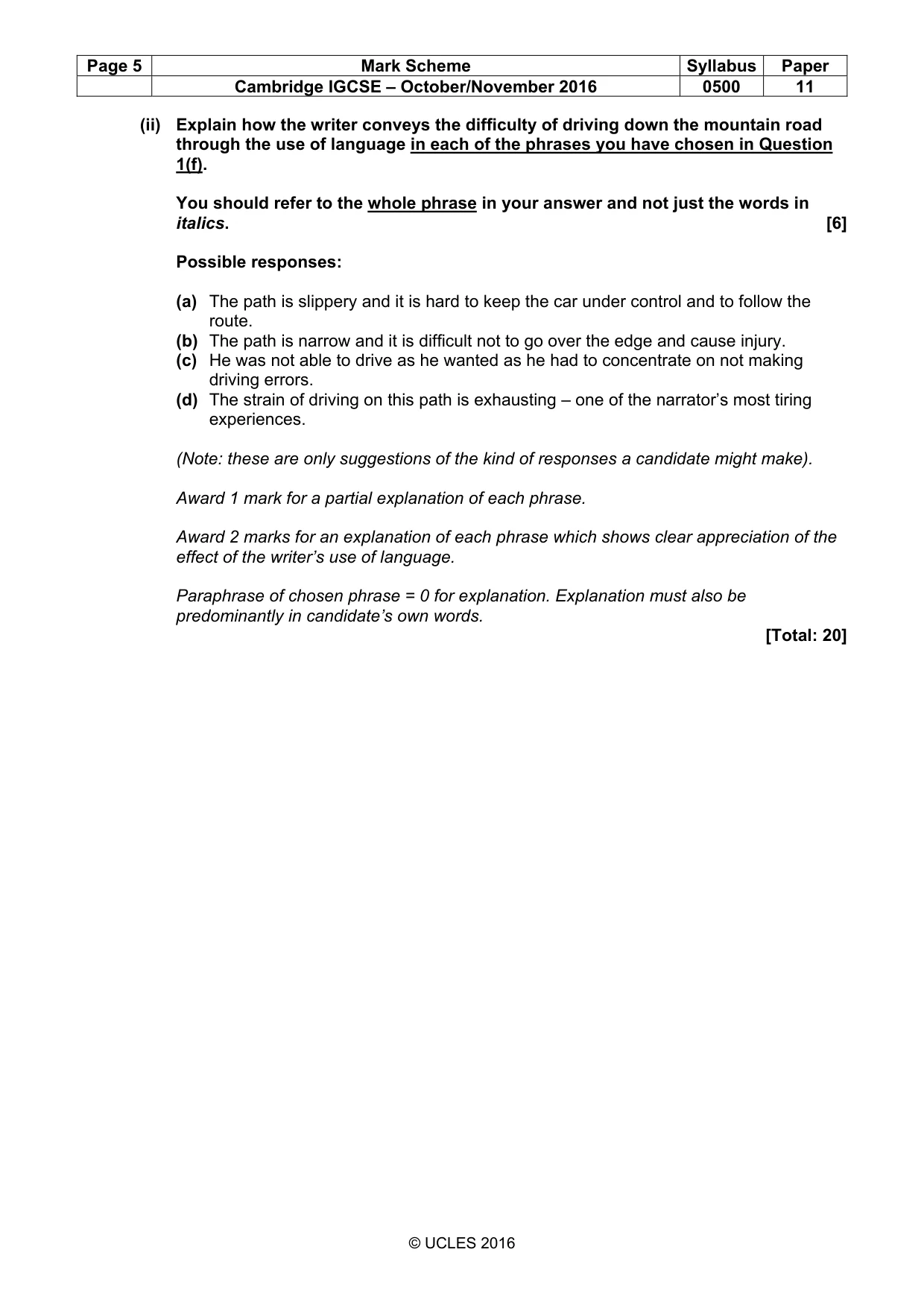
Page 5 Mark Scheme Syllabus Paper Cambridge IGCSE – October/November 2016 0500 11 © UCLES 2016 (ii) Explain how the writer conveys the difficulty of driving down the mountain road through the use of language in each of the phrases you have chosen in Question 1(f). You should refer to the whole phrase in your answer and not just the words in italics. [6] Possible responses: (a) The path is slippery and it is hard to keep the car under control and to follow the route. (b) The path is narrow and it is difficult not to go over the edge and cause injury. (c) He was not able to drive as he wanted as he had to concentrate on not making driving errors. (d) The strain of driving on this path is exhausting – one of the narrator’s most tiring experiences. (Note: these are only suggestions of the kind of responses a candidate might make). Award 1 mark for a partial explanation of each phrase. Award 2 marks for an explanation of each phrase which shows clear appreciation of the effect of the writer’s use of language. Paraphrase of chosen phrase = 0 for explanation. Explanation must also be predominantly in candidate’s own words. [Total: 20]
Mark scheme, page 6
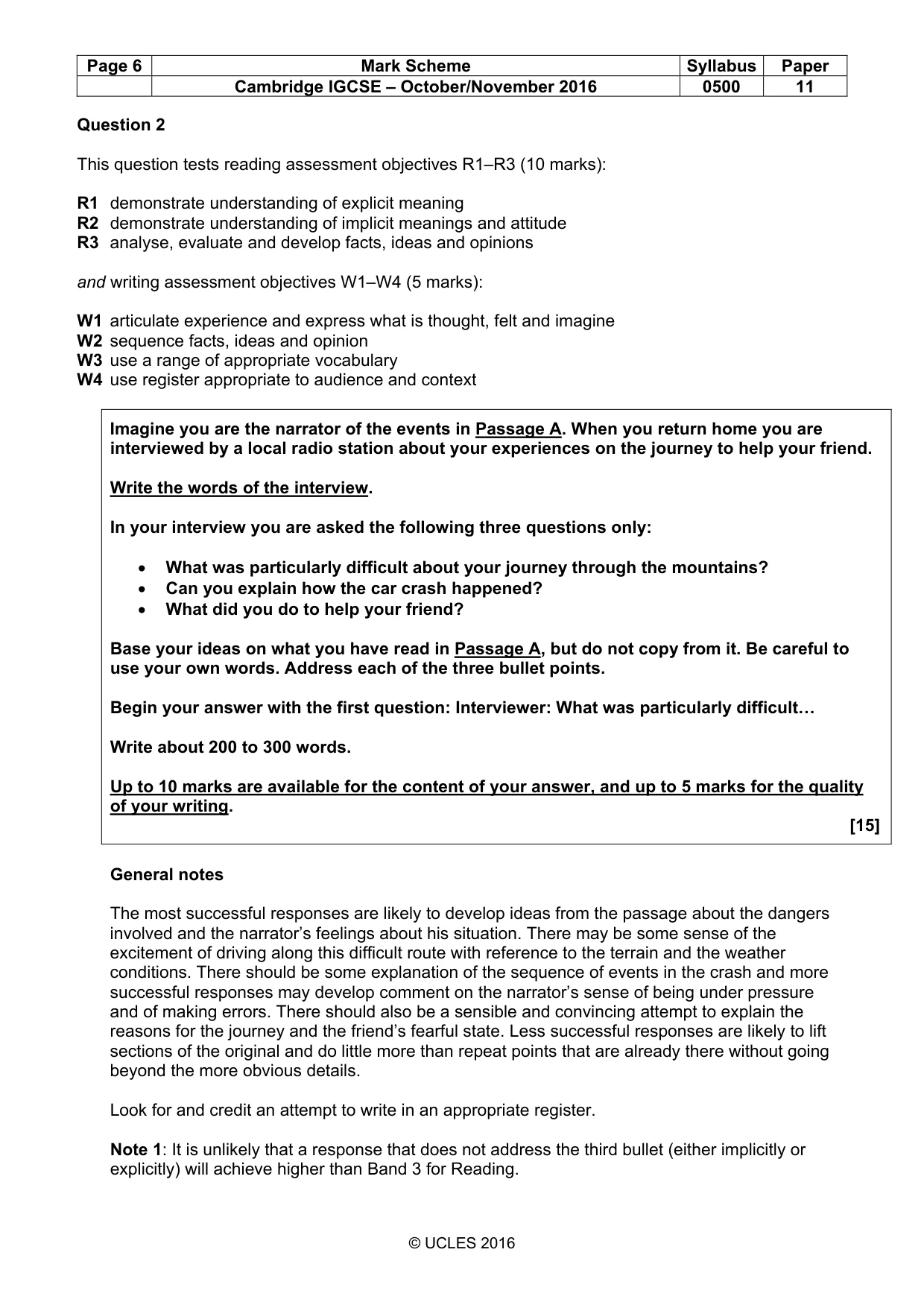
Page 6 Mark Scheme Syllabus Paper Cambridge IGCSE – October/November 2016 0500 11 © UCLES 2016 Question 2 This question tests reading assessment objectives R1–R3 (10 marks): R1 demonstrate understanding of explicit meaning R2 demonstrate understanding of implicit meanings and attitude R3 analyse, evaluate and develop facts, ideas and opinions and writing assessment objectives W1–W4 (5 marks): W1 articulate experience and express what is thought, felt and imagine W2 sequence facts, ideas and opinion W3 use a range of appropriate vocabulary W4 use register appropriate to audience and context Imagine you are the narrator of the events in Passage A. When you return home you are interviewed by a local radio station about your experiences on the journey to help your friend. Write the words of the interview. In your interview you are asked the following three questions only: • What was particularly difficult about your journey through the mountains? • Can you explain how the car crash happened? • What did you do to help your friend? Base your ideas on what you have read in Passage A, but do not copy from it. Be careful to use your own words. Address each of the three bullet points. Begin your answer with the first question: Interviewer: What was particularly difficult… Write about 200 to 300 words. Up to 10 marks are available for the content of your answer, and up to 5 marks for the quality of your writing. [15] General notes The most successful responses are likely to develop ideas from the passage about the dangers involved and the narrator’s feelings about his situation. There may be some sense of the excitement of driving along this difficult route with reference to the terrain and the weather conditions. There should be some explanation of the sequence of events in the crash and more successful responses may develop comment on the narrator’s sense of being under pressure and of making errors. There should also be a sensible and convincing attempt to explain the reasons for the journey and the friend’s fearful state. Less successful responses are likely to lift sections of the original and do little more than repeat points that are already there without going beyond the more obvious details. Look for and credit an attempt to write in an appropriate register. Note 1: It is unlikely that a response that does not address the third bullet (either implicitly or explicitly) will achieve higher than Band 3 for Reading.
Mark scheme, page 7
Page 7 Mark Scheme Syllabus Paper Cambridge IGCSE – October/November 2016 0500 11 © UCLES 2016 Note 2: It is not a requirement for responses to include the opening sentence provided which is given as a steer for candidates.
Mark scheme, page 8
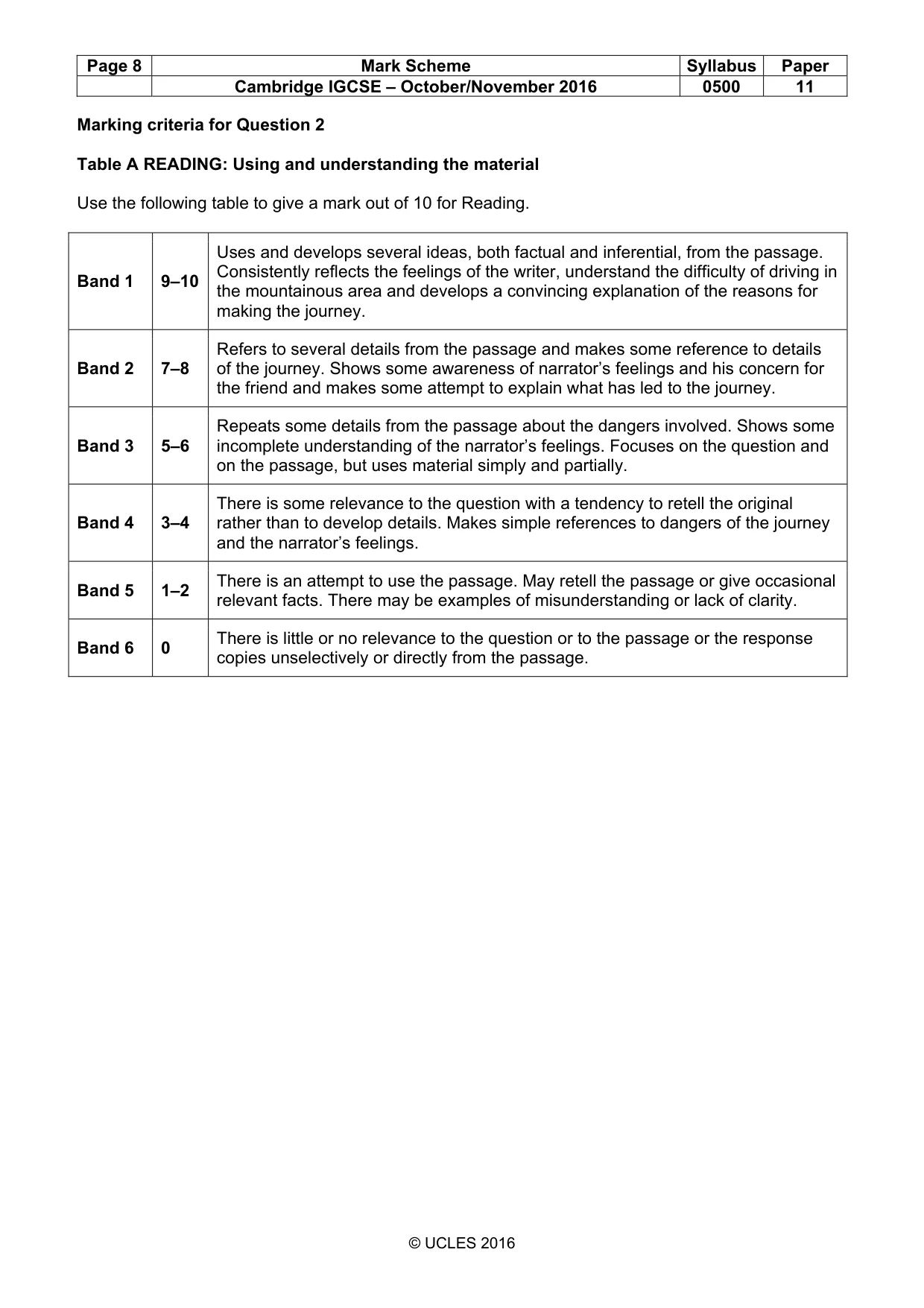
Page 8 Mark Scheme Syllabus Paper Cambridge IGCSE – October/November 2016 0500 11 © UCLES 2016 Marking criteria for Question 2 Table A READING: Using and understanding the material Use the following table to give a mark out of 10 for Reading. Band 1 9–10 Uses and develops several ideas, both factual and inferential, from the passage. Consistently reflects the feelings of the writer, understand the difficulty of driving in the mountainous area and develops a convincing explanation of the reasons for making the journey. Band 2 7–8 Refers to several details from the passage and makes some reference to details of the journey. Shows some awareness of narrator’s feelings and his concern for the friend and makes some attempt to explain what has led to the journey. Band 3 5–6 Repeats some details from the passage about the dangers involved. Shows some incomplete understanding of the narrator’s feelings. Focuses on the question and on the passage, but uses material simply and partially. Band 4 3–4 There is some relevance to the question with a tendency to retell the original rather than to develop details. Makes simple references to dangers of the journey and the narrator’s feelings. Band 5 1–2 There is an attempt to use the passage. May retell the passage or give occasional relevant facts. There may be examples of misunderstanding or lack of clarity. Band 6 0 There is little or no relevance to the question or to the passage or the response copies unselectively or directly from the passage.
Mark scheme, page 9
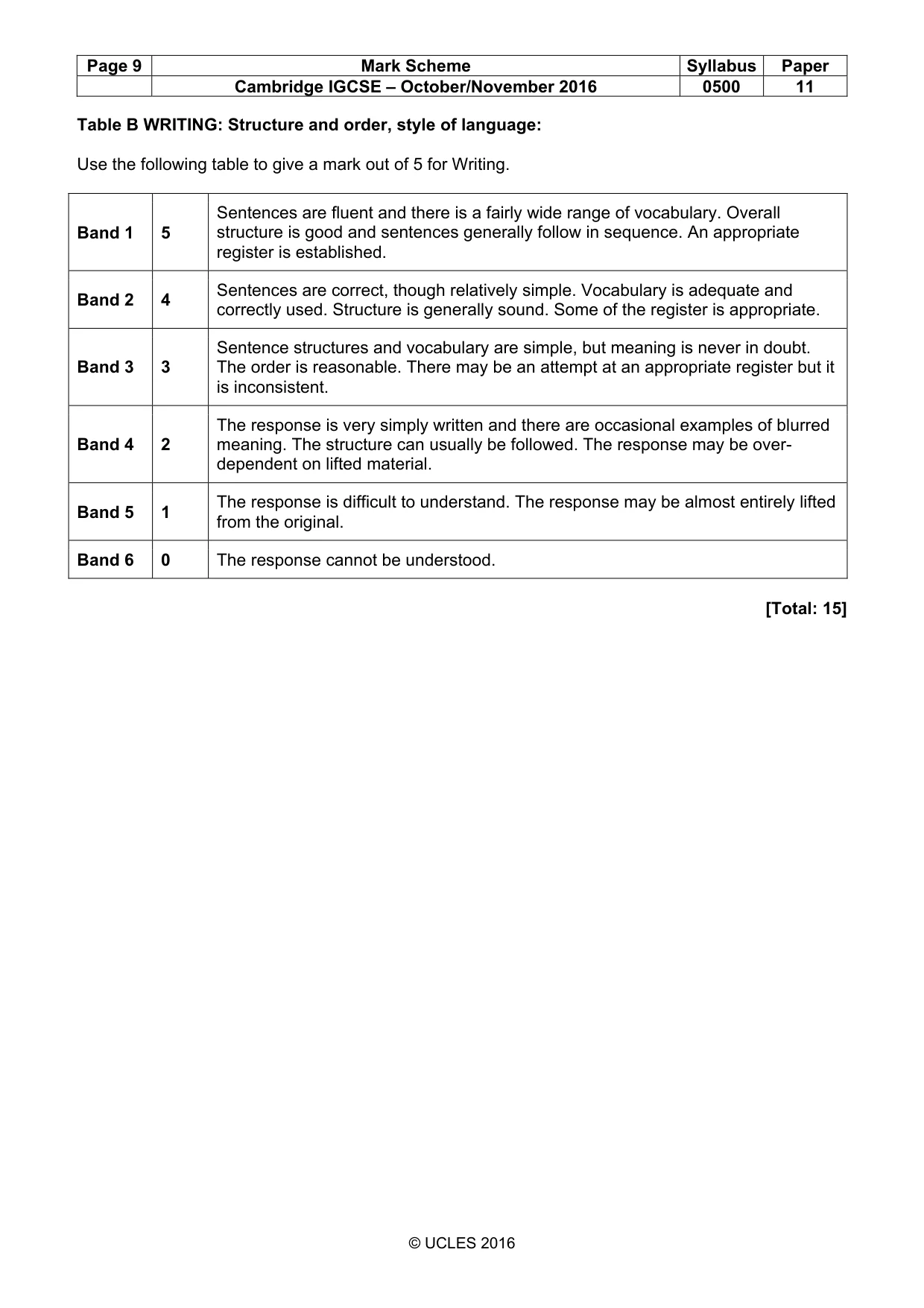
Page 9 Mark Scheme Syllabus Paper Cambridge IGCSE – October/November 2016 0500 11 © UCLES 2016 Table B WRITING: Structure and order, style of language: Use the following table to give a mark out of 5 for Writing. Band 1 5 Sentences are fluent and there is a fairly wide range of vocabulary. Overall structure is good and sentences generally follow in sequence. An appropriate register is established. Band 2 4 Sentences are correct, though relatively simple. Vocabulary is adequate and correctly used. Structure is generally sound. Some of the register is appropriate. Band 3 3 Sentence structures and vocabulary are simple, but meaning is never in doubt. The order is reasonable. There may be an attempt at an appropriate register but it is inconsistent. Band 4 2 The response is very simply written and there are occasional examples of blurred meaning. The structure can usually be followed. The response may be over- dependent on lifted material. Band 5 1 The response is difficult to understand. The response may be almost entirely lifted from the original. Band 6 0 The response cannot be understood. [Total: 15]
Mark scheme, page 10
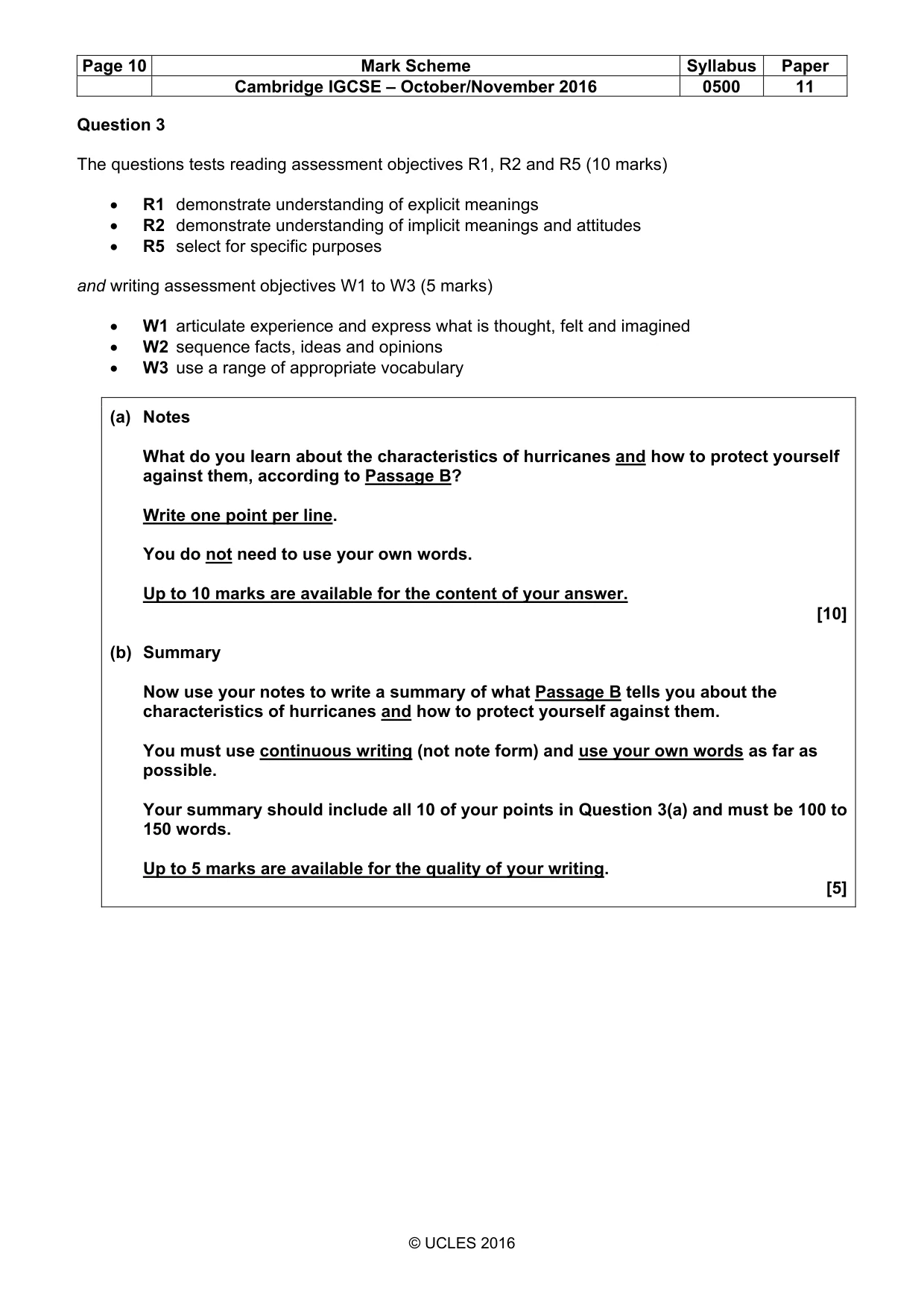
Page 10 Mark Scheme Syllabus Paper Cambridge IGCSE – October/November 2016 0500 11 © UCLES 2016 Question 3 The questions tests reading assessment objectives R1, R2 and R5 (10 marks) • R1 demonstrate understanding of explicit meanings • R2 demonstrate understanding of implicit meanings and attitudes • R5 select for specific purposes and writing assessment objectives W1 to W3 (5 marks) • W1 articulate experience and express what is thought, felt and imagined • W2 sequence facts, ideas and opinions • W3 use a range of appropriate vocabulary (a) Notes What do you learn about the characteristics of hurricanes and how to protect yourself against them, according to Passage B? Write one point per line. You do not need to use your own words. Up to 10 marks are available for the content of your answer. [10] (b) Summary Now use your notes to write a summary of what Passage B tells you about the characteristics of hurricanes and how to protect yourself against them. You must use continuous writing (not note form) and use your own words as far as possible. Your summary should include all 10 of your points in Question 3(a) and must be 100 to 150 words. Up to 5 marks are available for the quality of your writing. [5]
Mark scheme, page 11
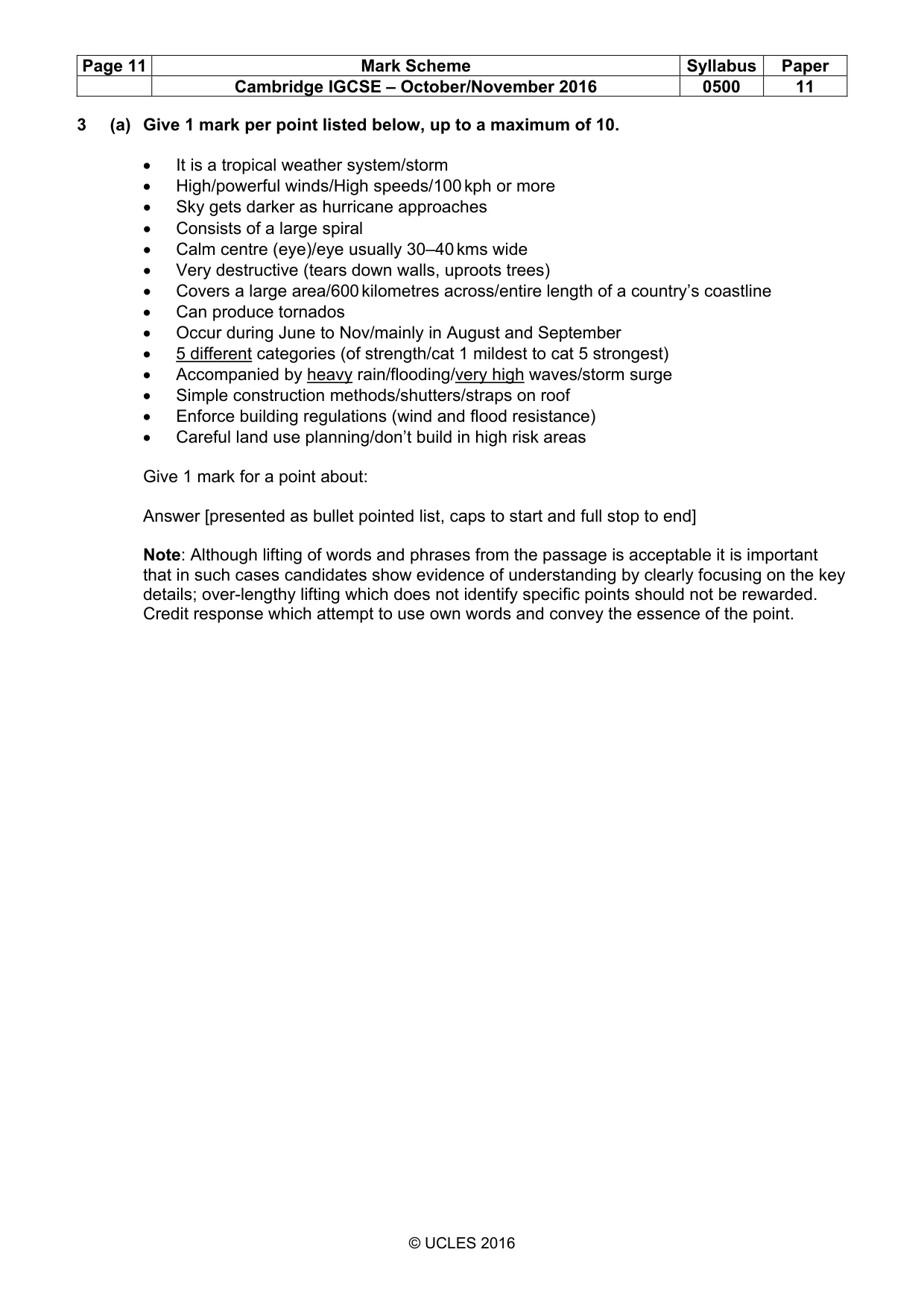
Page 11 Mark Scheme Syllabus Paper Cambridge IGCSE – October/November 2016 0500 11 © UCLES 2016 3 (a) Give 1 mark per point listed below, up to a maximum of 10. • It is a tropical weather system/storm • High/powerful winds/High speeds/100 kph or more • Sky gets darker as hurricane approaches • Consists of a large spiral • Calm centre (eye)/eye usually 30–40 kms wide • Very destructive (tears down walls, uproots trees) • Covers a large area/600 kilometres across/entire length of a country’s coastline • Can produce tornados • Occur during June to Nov/mainly in August and September • 5 different categories (of strength/cat 1 mildest to cat 5 strongest) • Accompanied by heavy rain/flooding/very high waves/storm surge • Simple construction methods/shutters/straps on roof • Enforce building regulations (wind and flood resistance) • Careful land use planning/don’t build in high risk areas Give 1 mark for a point about: Answer [presented as bullet pointed list, caps to start and full stop to end] Note: Although lifting of words and phrases from the passage is acceptable it is important that in such cases candidates show evidence of understanding by clearly focusing on the key details; over-lengthy lifting which does not identify specific points should not be rewarded. Credit response which attempt to use own words and convey the essence of the point.
Mark scheme, page 12
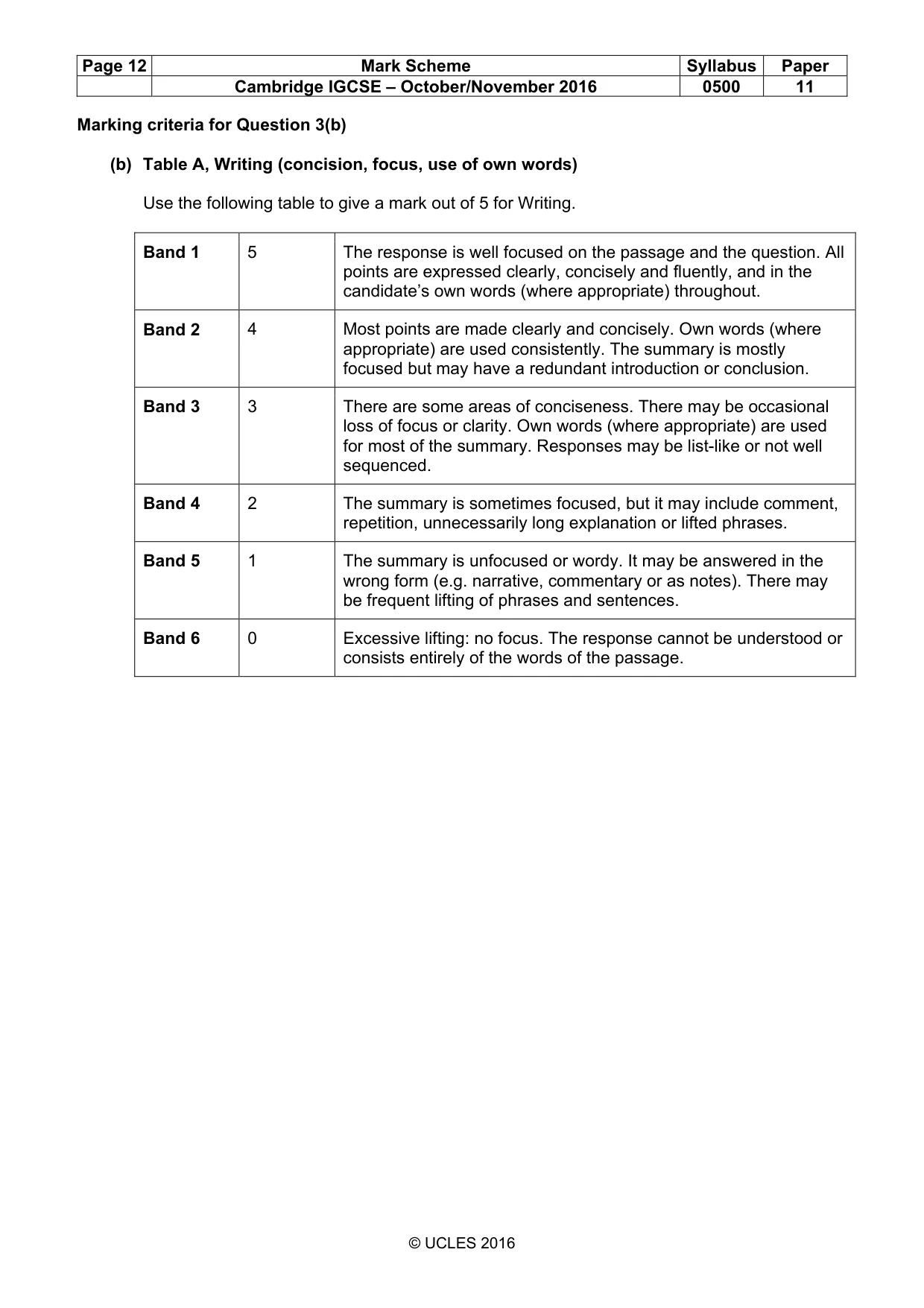
Page 12 Mark Scheme Syllabus Paper Cambridge IGCSE – October/November 2016 0500 11 © UCLES 2016 Marking criteria for Question 3(b) (b) Table A, Writing (concision, focus, use of own words) Use the following table to give a mark out of 5 for Writing. Band 1 5 The response is well focused on the passage and the question. All points are expressed clearly, concisely and fluently, and in the candidate’s own words (where appropriate) throughout. Band 2 4 Most points are made clearly and concisely. Own words (where appropriate) are used consistently. The summary is mostly focused but may have a redundant introduction or conclusion. Band 3 3 There are some areas of conciseness. There may be occasional loss of focus or clarity. Own words (where appropriate) are used for most of the summary. Responses may be list-like or not well sequenced. Band 4 2 The summary is sometimes focused, but it may include comment, repetition, unnecessarily long explanation or lifted phrases. Band 5 1 The summary is unfocused or wordy. It may be answered in the wrong form (e.g. narrative, commentary or as notes). There may be frequent lifting of phrases and sentences. Band 6 0 Excessive lifting: no focus. The response cannot be understood or consists entirely of the words of the passage.
What you needed in this session
Cambridge’s own grade thresholds for 2016 Oct/Nov, Paper 1 · Variant 1. A higher threshold means an easier paper — the bar moves with how the cohort did.