Cambridge IGCSE English - First Language 0500 — 2016 May/June Paper 1 · Variant 3
0500/13/M/J/16 · 50 marks · ≈56 min
The question paper and its mark scheme, free to read here and free to download. This is Cambridge’s own paper, exactly as it was sat.
Question paper12 pages
Mark scheme8 pages
Answers below. Sit the paper first if you are practising.
Paper as text
Question paper, page 1
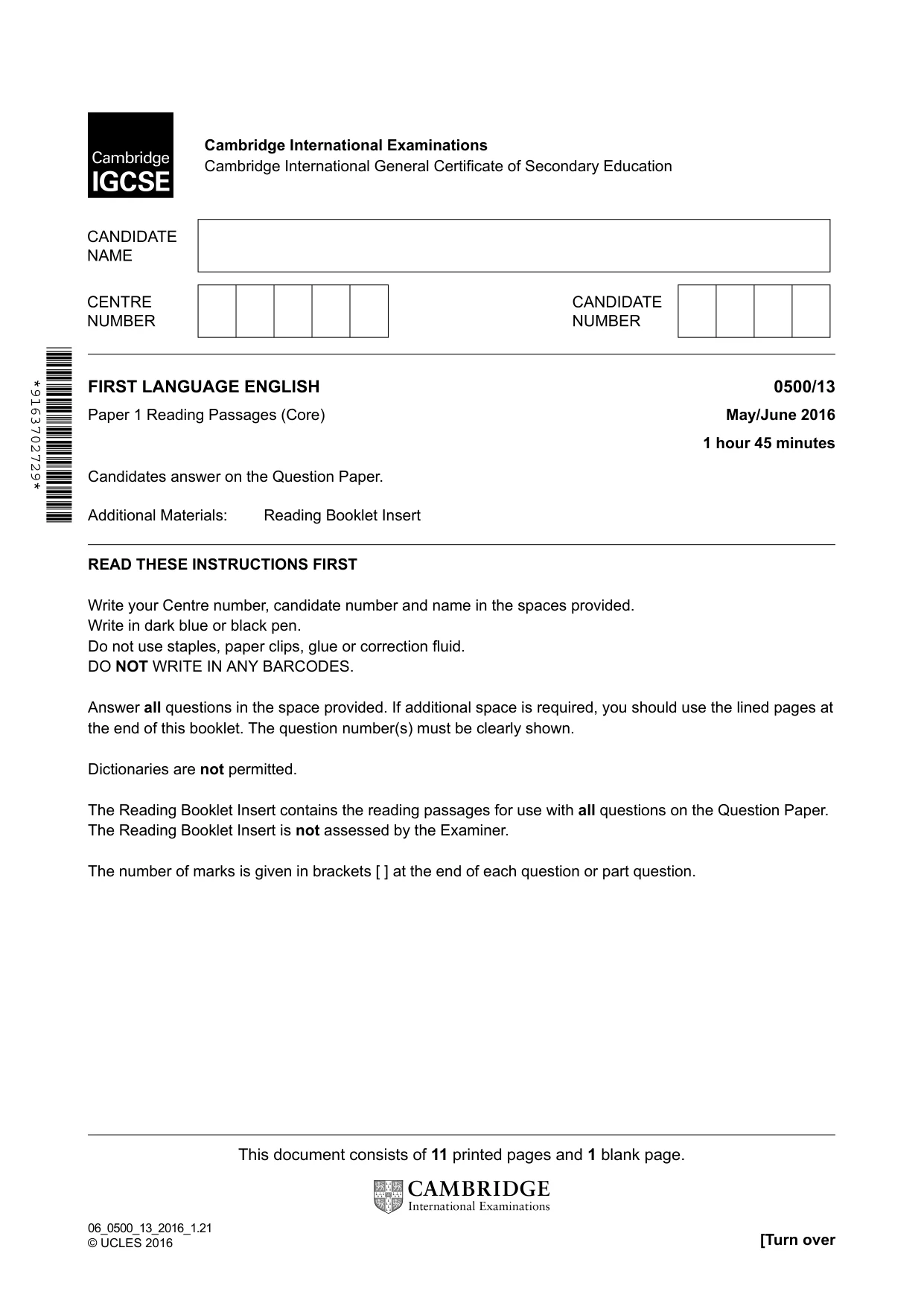
Cambridge International Examinations Cambridge International General Certificate of Secondary Education 0500/13 May/June 2016 1 hour 45 minutes FIRST LANGUAGE ENGLISH Paper 1 Reading Passages (Core) Candidates answer on the Question Paper. Additional Materials: Reading Booklet Insert READ THESE INSTRUCTIONS FIRST Write your Centre number, candidate number and name in the spaces provided. Write in dark blue or black pen. Do not use staples, paper clips, glue or correction fluid. DO NOT WRITE IN ANY BARCODES. Answer all questions in the space provided. If additional space is required, you should use the lined pages at the end of this booklet. The question number(s) must be clearly shown. Dictionaries are not permitted. The Reading Booklet Insert contains the reading passages for use with all questions on the Question Paper. The Reading Booklet Insert is not assessed by the Examiner. The number of marks is given in brackets [ ] at the end of each question or part question. This document consists of 11 printed pages and 1 blank page. [Turn over 06_0500_13_2016_1.21 © UCLES 2016 *9163702729*
Question paper, page 2
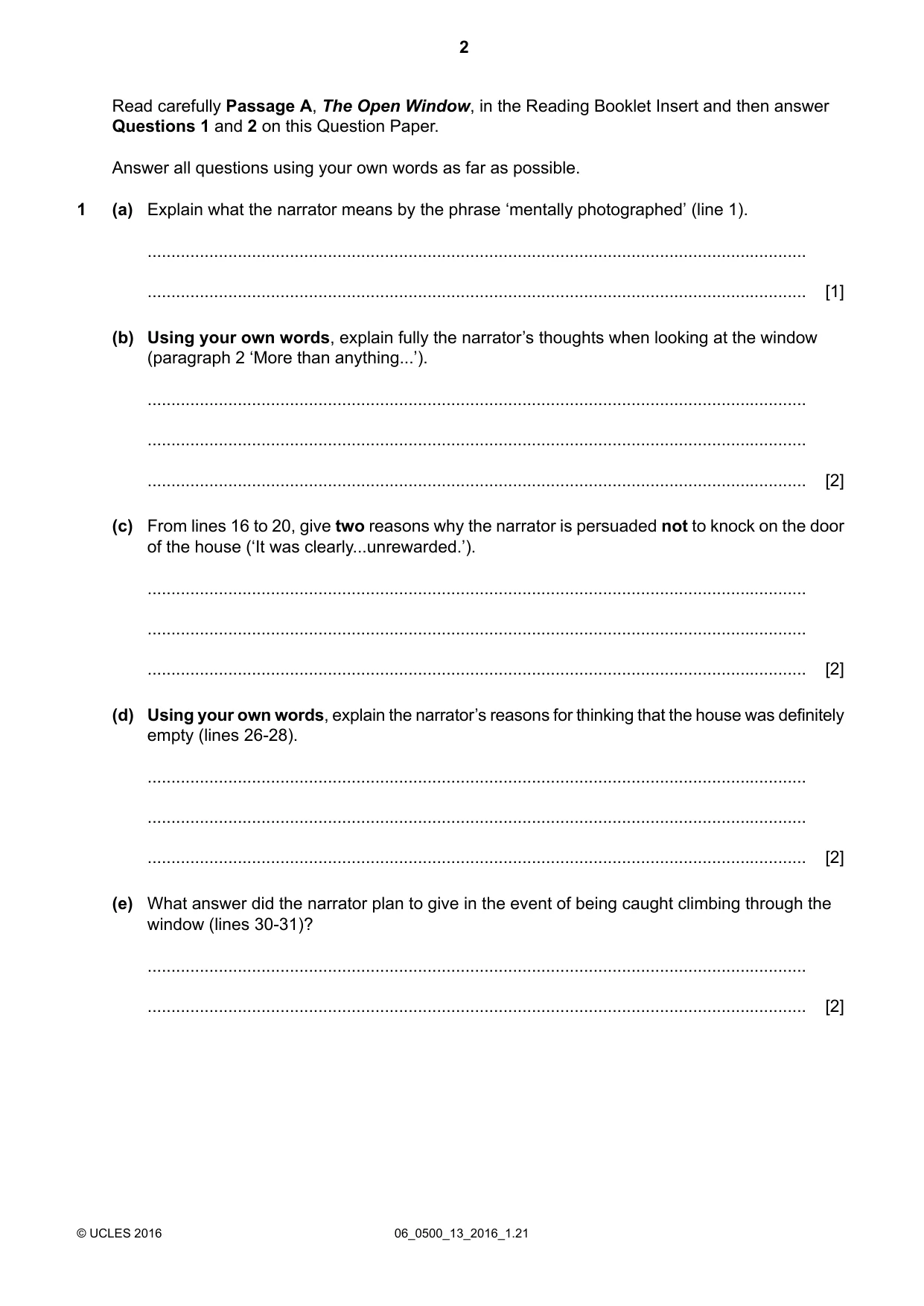
Read carefully Passage A, The Open Window, in the Reading Booklet Insert and then answer Questions 1 and 2 on this Question Paper. Answer all questions using your own words as far as possible. Explain what the narrator means by the phrase ‘mentally photographed’ (line 1). (a) 1 … … [1] Using your own words, explain fully the narrator’s thoughts when looking at the window (paragraph 2 ‘More than anything...’). (b) … … … [2] From lines 16 to 20, give two reasons why the narrator is persuaded not to knock on the door of the house (‘It was clearly...unrewarded.’). (c) … … … [2] Using your own words, explain the narrator’s reasons for thinking that the house was definitely empty (lines 26-28). (d) … … … [2] What answer did the narrator plan to give in the event of being caught climbing through the window (lines 30-31)? (e) … … [2] 06_0500_13_2016_1.21 © UCLES 2016 2
Question paper, page 3
State two of the narrator’s thoughts while climbing through the window (lines 32-41, ‘In such damp weather...What was I to do next?’). (f) • … • … [2] [Turn over 06_0500_13_2016_1.21 © UCLES 2016 3
Question paper, page 4
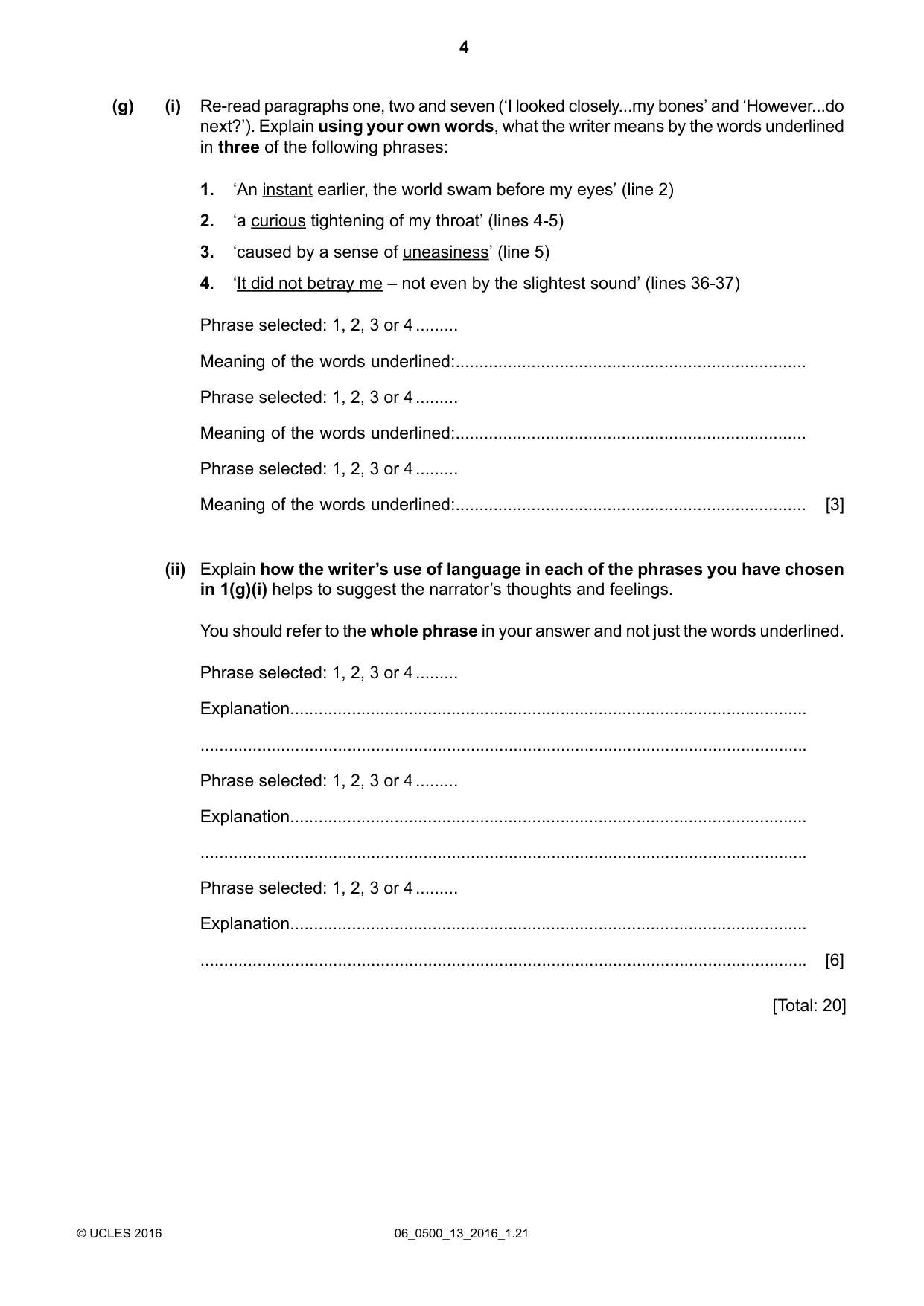
Re-read paragraphs one, two and seven (‘I looked closely...my bones’ and ‘However...do next?’). Explain using your own words, what the writer means by the words underlined in three of the following phrases: (i) (g) 1. ‘An instant earlier, the world swam before my eyes’ (line 2) 2. ‘a curious tightening of my throat’ (lines 4-5) 3. ‘caused by a sense of uneasiness’ (line 5) 4. ‘It did not betray me – not even by the slightest sound’ (lines 36-37) Phrase selected: 1, 2, 3 or 4… Meaning of the words underlined:… Phrase selected: 1, 2, 3 or 4… Meaning of the words underlined:… Phrase selected: 1, 2, 3 or 4… Meaning of the words underlined:… [3] Explain how the writer’s use of language in each of the phrases you have chosen in 1(g)(i) helps to suggest the narrator’s thoughts and feelings. You should refer to the whole phrase in your answer and not just the words underlined. (ii) Phrase selected: 1, 2, 3 or 4… Explanation… … Phrase selected: 1, 2, 3 or 4… Explanation… … Phrase selected: 1, 2, 3 or 4… Explanation… … [6] [Total: 20] 06_0500_13_2016_1.21 © UCLES 2016 4
Question paper, page 5
TURN OVER TO PAGE 6 FOR QUESTION 2 [Turn over 06_0500_13_2016_1.21 © UCLES 2016 5
Question paper, page 6
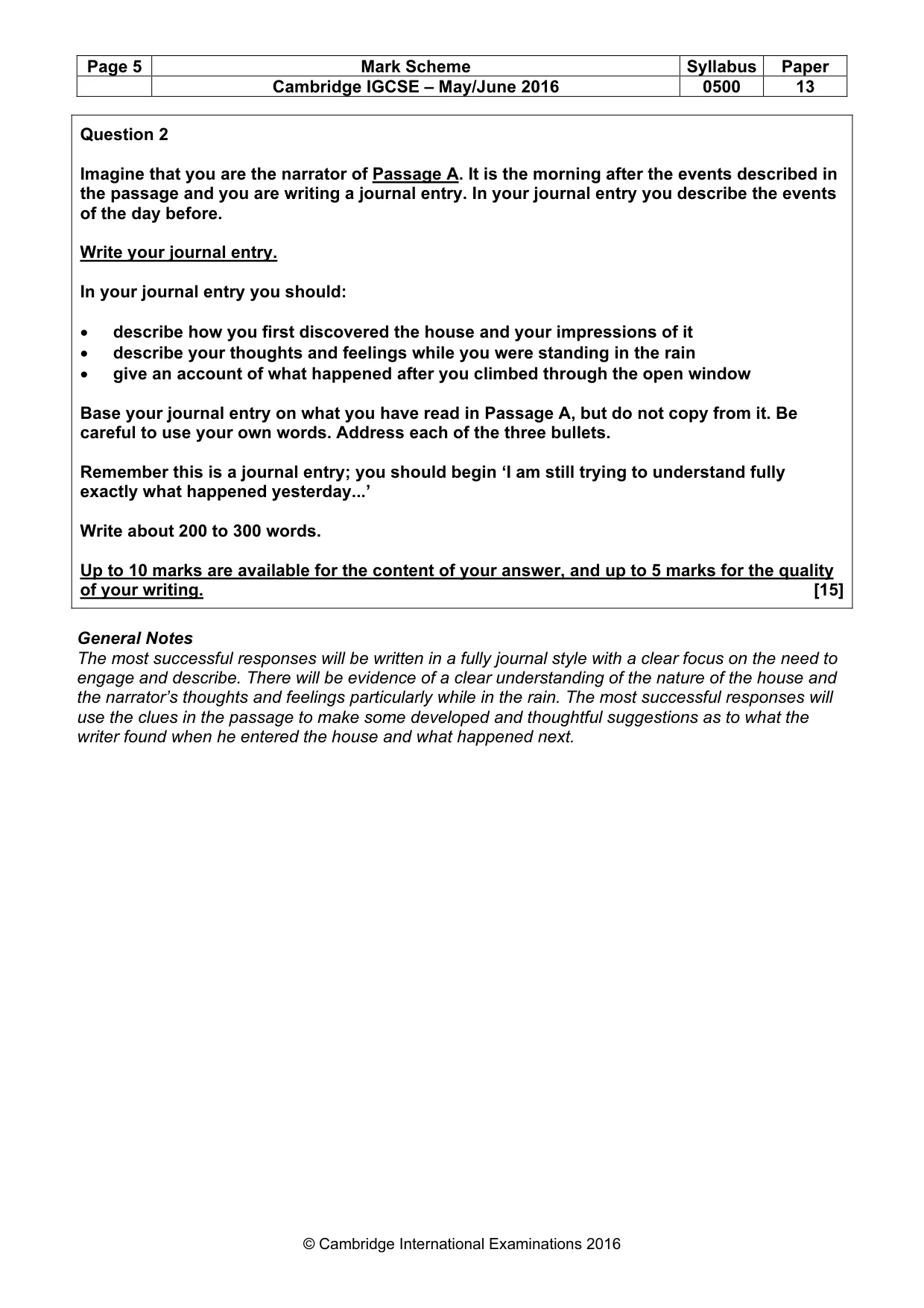
Imagine that you are the narrator of Passage A. It is the morning after the events described in the passage and you are writing a journal entry. In your journal entry you describe the events of the day before. 2 Write your journal entry. In your journal entry you should: • describe how you first discovered the house and your impressions of it • describe your thoughts and feelings while you were standing in the rain • give an account of what happened after you climbed through the open window. Base your journal entry on what you have read in Passage A, but do not copy from it. Be careful to use your own words. Address each of the three bullet points. Begin your journal entry, ‘I am still trying to understand exactly what happened yesterday...’ Write about 200 to 300 words. Up to 10 marks are available for the content of your answer, and up to 5 marks for the quality of your writing. … … … … … … … … … … … … … … … … … … 06_0500_13_2016_1.21 © UCLES 2016 6
Question paper, page 7
… … … … … … … … … … … … … … … … … … … … … … … … … … … … [15] [Turn over 06_0500_13_2016_1.21 © UCLES 2016 7
Question paper, page 8
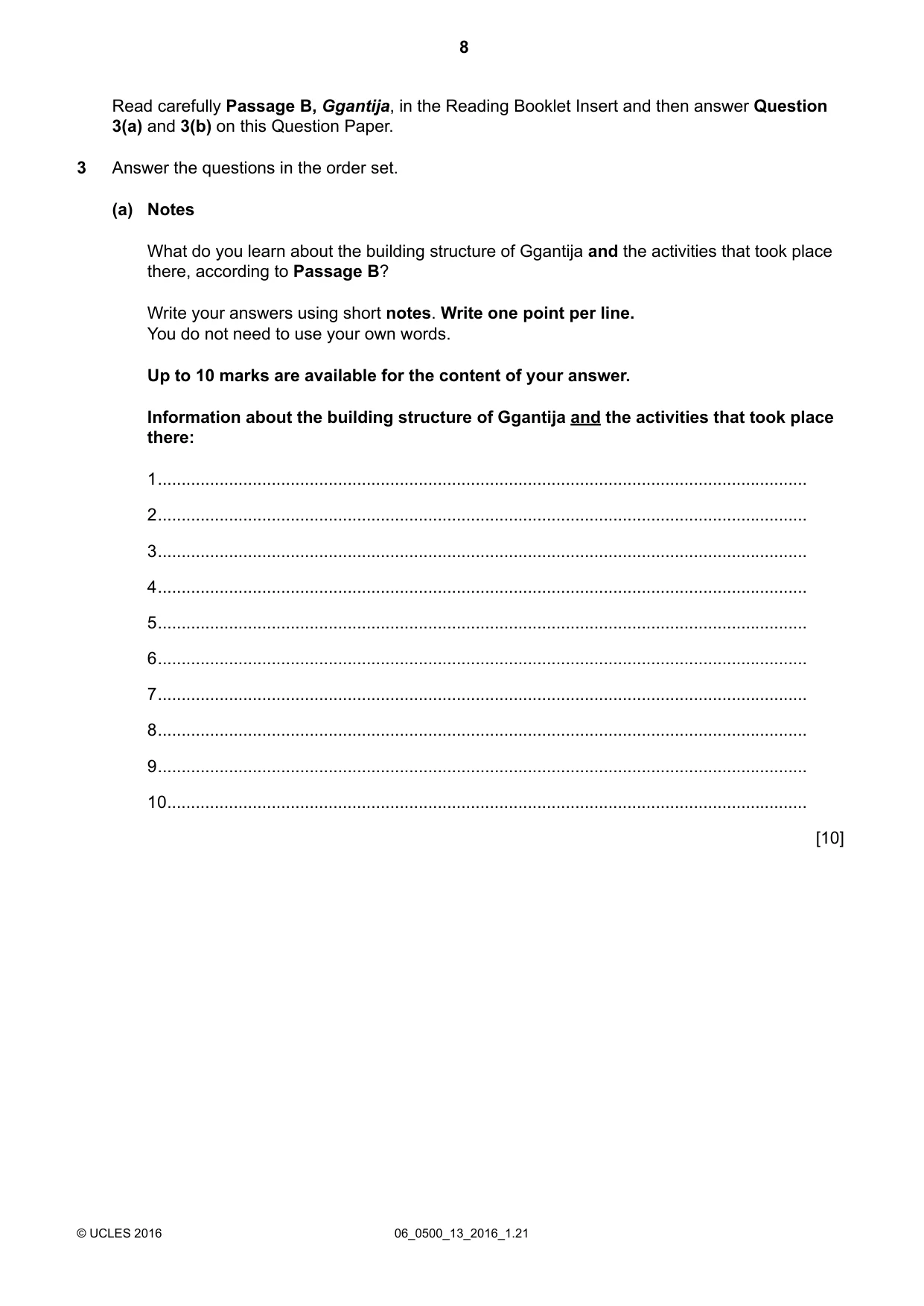
Read carefully Passage B, Ggantija, in the Reading Booklet Insert and then answer Question 3(a) and 3(b) on this Question Paper. Answer the questions in the order set. 3 Notes What do you learn about the building structure of Ggantija and the activities that took place there, according to Passage B? Write your answers using short notes. Write one point per line. You do not need to use your own words. Up to 10 marks are available for the content of your answer. Information about the building structure of Ggantija and the activities that took place there: (a) 1… 2… 3… 4… 5… 6… 7… 8… 9… 10… [10] 06_0500_13_2016_1.21 © UCLES 2016 8
Question paper, page 9
Summary Now use your notes to write a summary of what Passage B tells you about the building structure of Ggantija and the activities that took place there. You must use continuous writing (not note form) and use your own words as far as possible. Your summary should include all 10 of your points in Question 3(a) and must be 100 to 150 words. Up to 5 marks are available for the quality of your writing. (b) … … … … … … … … … … … … … … … [5] [Total: 15] [Turn over 06_0500_13_2016_1.21 © UCLES 2016 9
Question paper, page 10
Additional Page If you use the following lined page to complete the answer(s) to any question(s), the question number(s) must be clearly shown. … … … … … … … … … … … … … … … … … … … … … … … … … 06_0500_13_2016_1.21 © UCLES 2016 10
Question paper, page 11
Additional Page If you use the following lined page to complete the answer(s) to any question(s), the question number(s) must be clearly shown. … … … … … … … … … … … … … … … … … … … … … … … … … [Turn over 06_0500_13_2016_1.21 © UCLES 2016 11
Question paper, page 12
BLANK PAGE Permission to reproduce items where third-party owned material protected by copyright is included has been sought and cleared where possible. Every reasonable effort has been made by the publisher (UCLES) to trace copyright holders, but if any items requiring clearance have unwittingly been included, the publisher will be pleased to make amends at the earliest possible opportunity. To avoid the issue of disclosure of answer-related information to candidates, all copyright acknowledgements are reproduced online in the Cambridge International Examinations Copyright Acknowledgements Booklet. This is produced for each series of examinations and is freely available to download at www.cie.org.uk after the live examination series. Cambridge International Examinations is part of the Cambridge Assessment Group. Cambridge Assessment is the brand name of University of Cambridge Local Examinations Syndicate (UCLES), which is itself a department of the University of Cambridge. 06_0500_13_2016_1.21 © UCLES 2016 12
Mark scheme, page 1
® IGCSE is the registered trademark of Cambridge International Examinations. This document consists of 8 printed pages. © UCLES 2016 [Turn over Cambridge International Examinations Cambridge International General Certificate of Secondary Education FIRST LANGUAGE ENGLISH 0500/13 Paper 1 Reading Passages – Core May/June 2016 MARK SCHEME Maximum Mark: 50 Published This mark scheme is published as an aid to teachers and candidates, to indicate the requirements of the examination. It shows the basis on which Examiners were instructed to award marks. It does not indicate the details of the discussions that took place at an Examiners’ meeting before marking began, which would have considered the acceptability of alternative answers. Mark schemes should be read in conjunction with the question paper and the Principal Examiner Report for Teachers. Cambridge will not enter into discussions about these mark schemes. Cambridge is publishing the mark schemes for the May/June 2016 series for most Cambridge IGCSE®, Cambridge International A and AS Level components and some Cambridge O Level components.
Mark scheme, page 2
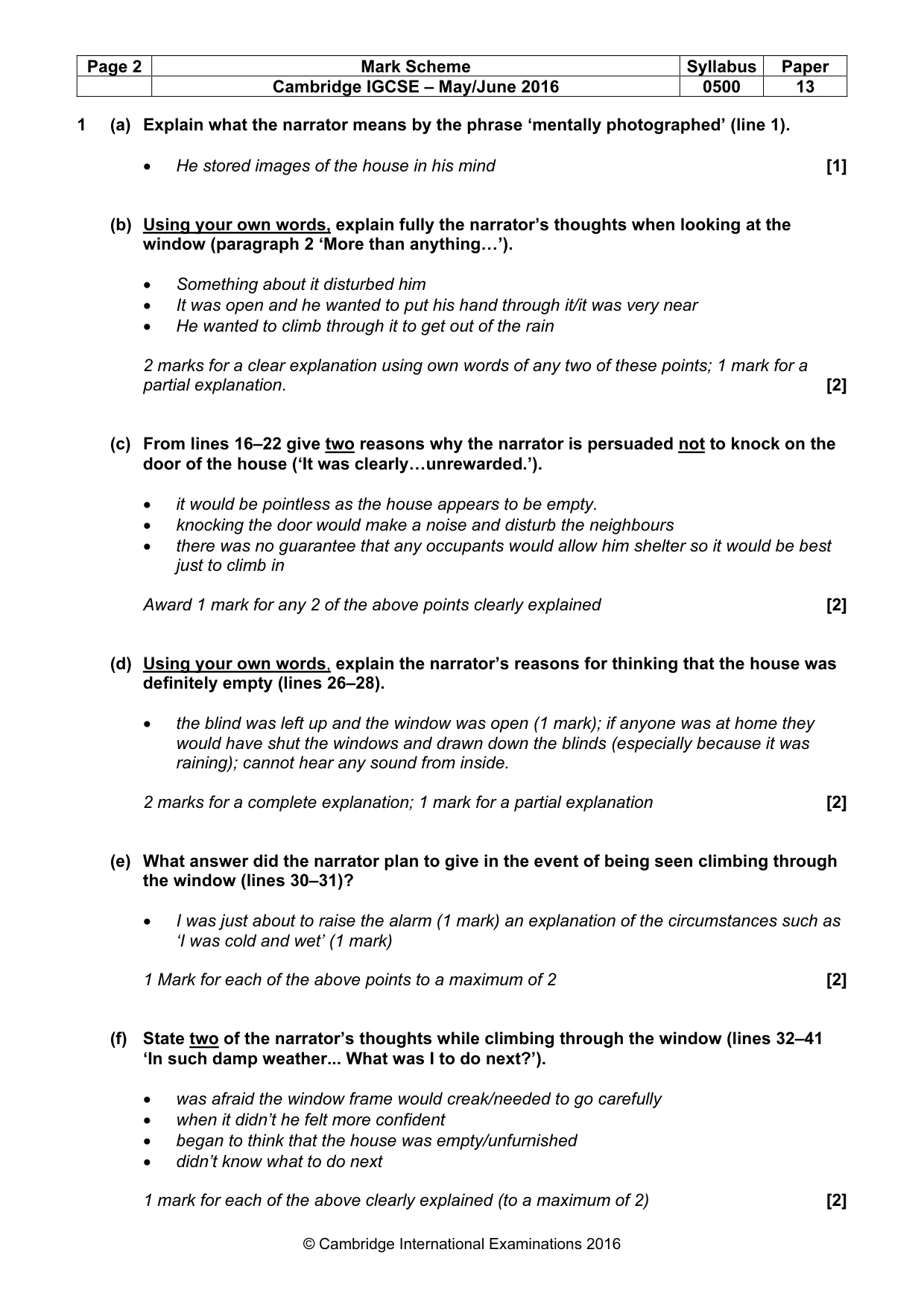
Page 2 Mark Scheme Syllabus Paper Cambridge IGCSE – May/June 2016 0500 13 © Cambridge International Examinations 2016 1 (a) Explain what the narrator means by the phrase ‘mentally photographed’ (line 1). • He stored images of the house in his mind [1] (b) Using your own words, explain fully the narrator’s thoughts when looking at the window (paragraph 2 ‘More than anything…’). • Something about it disturbed him • It was open and he wanted to put his hand through it/it was very near • He wanted to climb through it to get out of the rain 2 marks for a clear explanation using own words of any two of these points; 1 mark for a partial explanation. [2] (c) From lines 16–22 give two reasons why the narrator is persuaded not to knock on the door of the house (‘It was clearly…unrewarded.’). • it would be pointless as the house appears to be empty. • knocking the door would make a noise and disturb the neighbours • there was no guarantee that any occupants would allow him shelter so it would be best just to climb in Award 1 mark for any 2 of the above points clearly explained [2] (d) Using your own words, explain the narrator’s reasons for thinking that the house was definitely empty (lines 26–28). • the blind was left up and the window was open (1 mark); if anyone was at home they would have shut the windows and drawn down the blinds (especially because it was raining); cannot hear any sound from inside. 2 marks for a complete explanation; 1 mark for a partial explanation [2] (e) What answer did the narrator plan to give in the event of being seen climbing through the window (lines 30–31)? • I was just about to raise the alarm (1 mark) an explanation of the circumstances such as ‘I was cold and wet’ (1 mark) 1 Mark for each of the above points to a maximum of 2 [2] (f) State two of the narrator’s thoughts while climbing through the window (lines 32–41 ‘In such damp weather... What was I to do next?’). • was afraid the window frame would creak/needed to go carefully • when it didn’t he felt more confident • began to think that the house was empty/unfurnished • didn’t know what to do next 1 mark for each of the above clearly explained (to a maximum of 2) [2]
Mark scheme, page 3
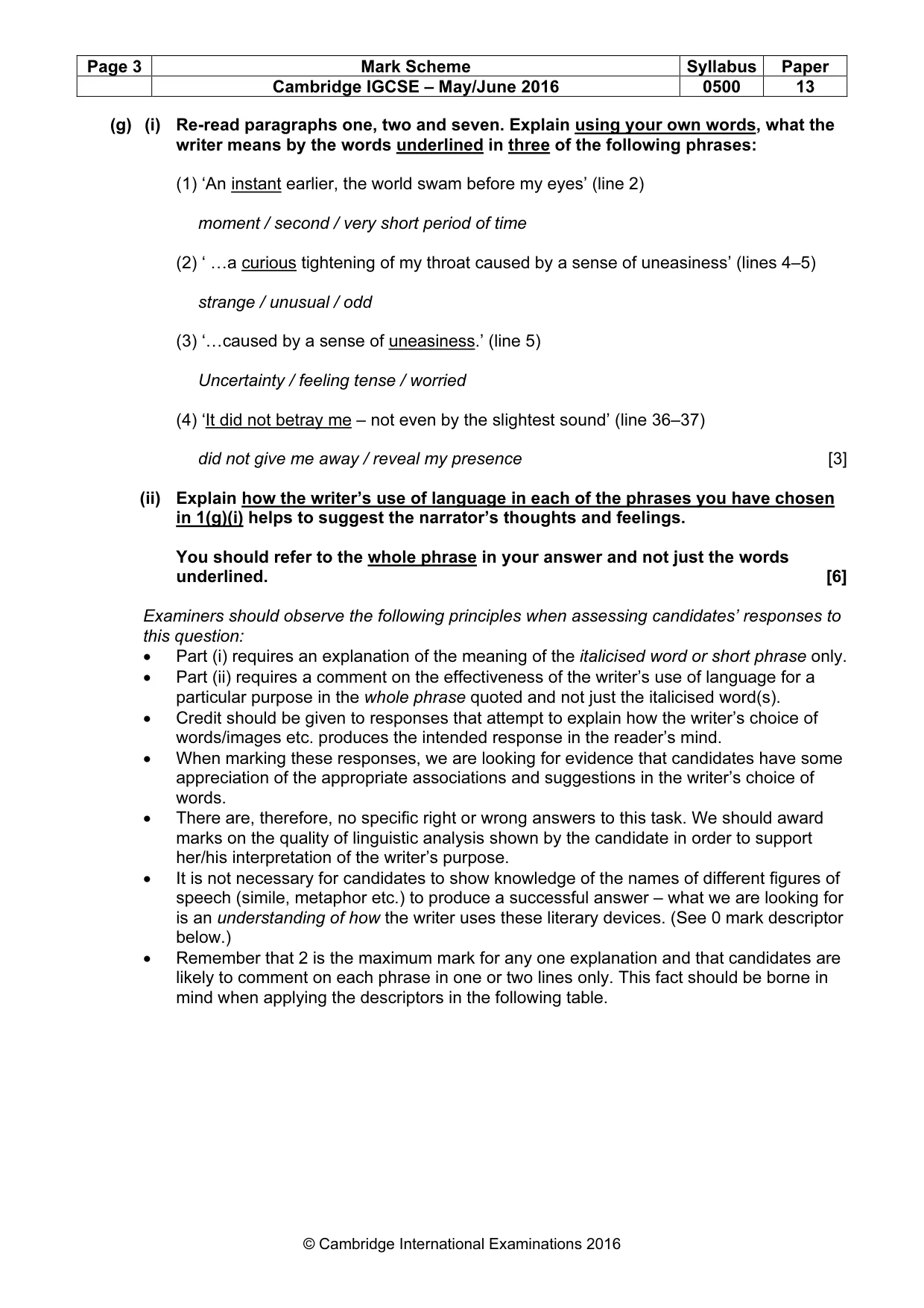
Page 3 Mark Scheme Syllabus Paper Cambridge IGCSE – May/June 2016 0500 13 © Cambridge International Examinations 2016 (g) (i) Re-read paragraphs one, two and seven. Explain using your own words, what the writer means by the words underlined in three of the following phrases: (1) ‘An instant earlier, the world swam before my eyes’ (line 2) moment / second / very short period of time (2) ‘ …a curious tightening of my throat caused by a sense of uneasiness’ (lines 4–5) strange / unusual / odd (3) ‘…caused by a sense of uneasiness.’ (line 5) Uncertainty / feeling tense / worried (4) ‘It did not betray me – not even by the slightest sound’ (line 36–37) did not give me away / reveal my presence [3] (ii) Explain how the writer’s use of language in each of the phrases you have chosen in 1(g)(i) helps to suggest the narrator’s thoughts and feelings. You should refer to the whole phrase in your answer and not just the words underlined. [6] Examiners should observe the following principles when assessing candidates’ responses to this question: • Part (i) requires an explanation of the meaning of the italicised word or short phrase only. • Part (ii) requires a comment on the effectiveness of the writer’s use of language for a particular purpose in the whole phrase quoted and not just the italicised word(s). • Credit should be given to responses that attempt to explain how the writer’s choice of words/images etc. produces the intended response in the reader’s mind. • When marking these responses, we are looking for evidence that candidates have some appreciation of the appropriate associations and suggestions in the writer’s choice of words. • There are, therefore, no specific right or wrong answers to this task. We should award marks on the quality of linguistic analysis shown by the candidate in order to support her/his interpretation of the writer’s purpose. • It is not necessary for candidates to show knowledge of the names of different figures of speech (simile, metaphor etc.) to produce a successful answer – what we are looking for is an understanding of how the writer uses these literary devices. (See 0 mark descriptor below.) • Remember that 2 is the maximum mark for any one explanation and that candidates are likely to comment on each phrase in one or two lines only. This fact should be borne in mind when applying the descriptors in the following table.
Mark scheme, page 4
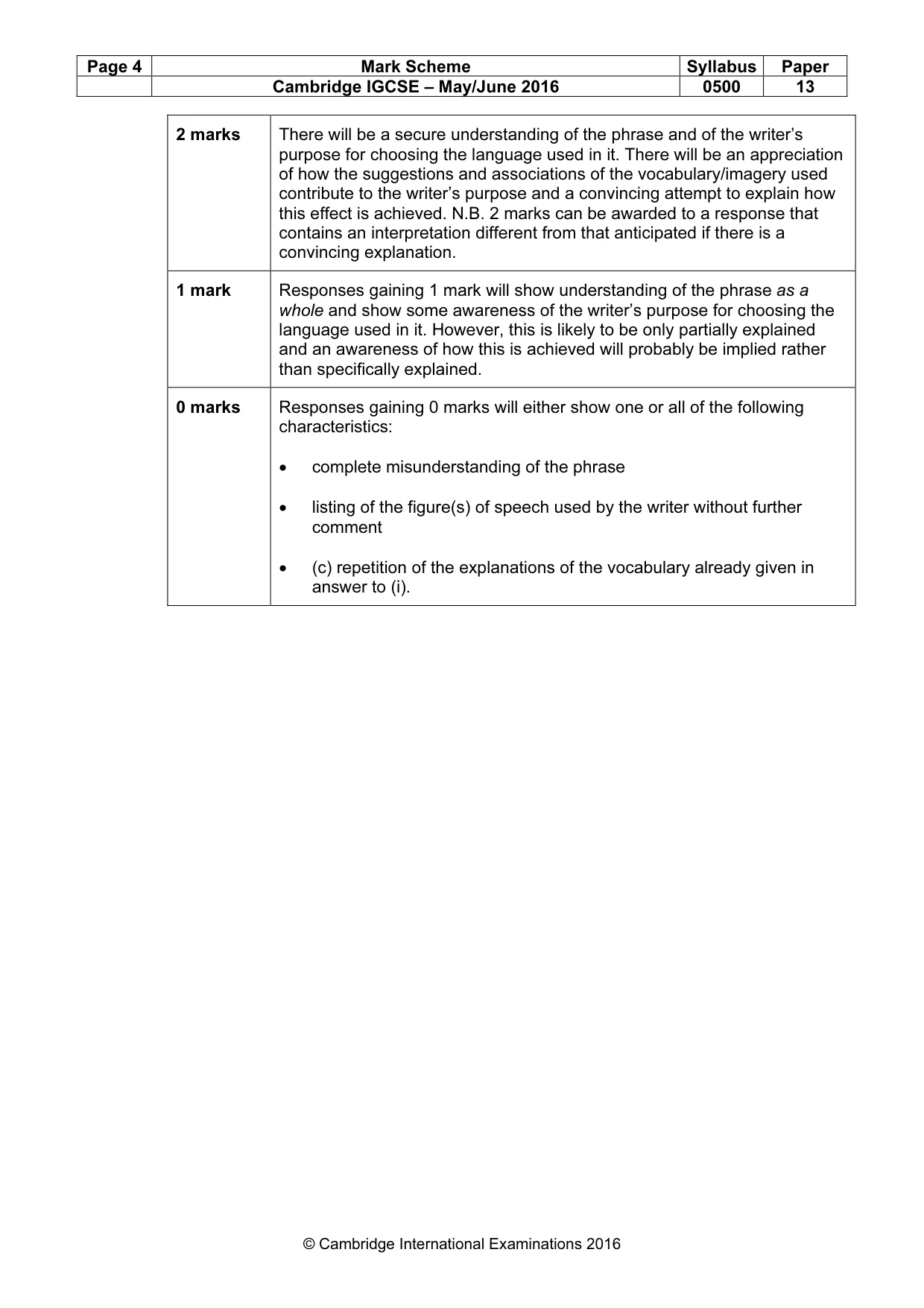
Page 4 Mark Scheme Syllabus Paper Cambridge IGCSE – May/June 2016 0500 13 © Cambridge International Examinations 2016 2 marks There will be a secure understanding of the phrase and of the writer’s purpose for choosing the language used in it. There will be an appreciation of how the suggestions and associations of the vocabulary/imagery used contribute to the writer’s purpose and a convincing attempt to explain how this effect is achieved. N.B. 2 marks can be awarded to a response that contains an interpretation different from that anticipated if there is a convincing explanation. 1 mark Responses gaining 1 mark will show understanding of the phrase as a whole and show some awareness of the writer’s purpose for choosing the language used in it. However, this is likely to be only partially explained and an awareness of how this is achieved will probably be implied rather than specifically explained. 0 marks Responses gaining 0 marks will either show one or all of the following characteristics: • complete misunderstanding of the phrase • listing of the figure(s) of speech used by the writer without further comment • (c) repetition of the explanations of the vocabulary already given in answer to (i).
Mark scheme, page 5
Page 5 Mark Scheme Syllabus Paper Cambridge IGCSE – May/June 2016 0500 13 © Cambridge International Examinations 2016 Question 2 Imagine that you are the narrator of Passage A. It is the morning after the events described in the passage and you are writing a journal entry. In your journal entry you describe the events of the day before. Write your journal entry. In your journal entry you should: • describe how you first discovered the house and your impressions of it • describe your thoughts and feelings while you were standing in the rain • give an account of what happened after you climbed through the open window Base your journal entry on what you have read in Passage A, but do not copy from it. Be careful to use your own words. Address each of the three bullets. Remember this is a journal entry; you should begin ‘I am still trying to understand fully exactly what happened yesterday...’ Write about 200 to 300 words. Up to 10 marks are available for the content of your answer, and up to 5 marks for the quality of your writing. [15] General Notes The most successful responses will be written in a fully journal style with a clear focus on the need to engage and describe. There will be evidence of a clear understanding of the nature of the house and the narrator’s thoughts and feelings particularly while in the rain. The most successful responses will use the clues in the passage to make some developed and thoughtful suggestions as to what the writer found when he entered the house and what happened next.
Mark scheme, page 6
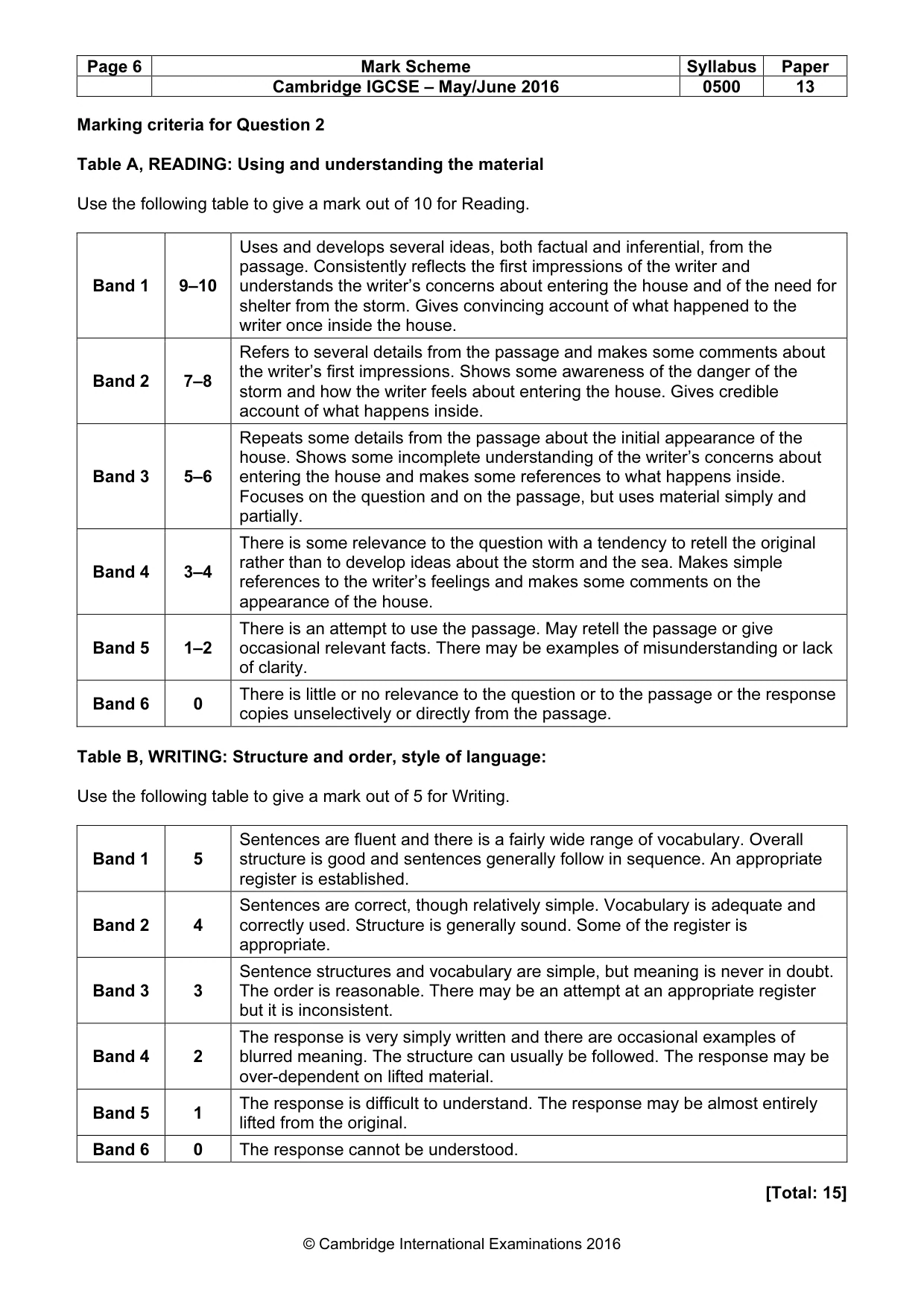
Page 6 Mark Scheme Syllabus Paper Cambridge IGCSE – May/June 2016 0500 13 © Cambridge International Examinations 2016 Marking criteria for Question 2 Table A, READING: Using and understanding the material Use the following table to give a mark out of 10 for Reading. Band 1 9–10 Uses and develops several ideas, both factual and inferential, from the passage. Consistently reflects the first impressions of the writer and understands the writer’s concerns about entering the house and of the need for shelter from the storm. Gives convincing account of what happened to the writer once inside the house. Band 2 7–8 Refers to several details from the passage and makes some comments about the writer’s first impressions. Shows some awareness of the danger of the storm and how the writer feels about entering the house. Gives credible account of what happens inside. Band 3 5–6 Repeats some details from the passage about the initial appearance of the house. Shows some incomplete understanding of the writer’s concerns about entering the house and makes some references to what happens inside. Focuses on the question and on the passage, but uses material simply and partially. Band 4 3–4 There is some relevance to the question with a tendency to retell the original rather than to develop ideas about the storm and the sea. Makes simple references to the writer’s feelings and makes some comments on the appearance of the house. Band 5 1–2 There is an attempt to use the passage. May retell the passage or give occasional relevant facts. There may be examples of misunderstanding or lack of clarity. Band 6 0 There is little or no relevance to the question or to the passage or the response copies unselectively or directly from the passage. Table B, WRITING: Structure and order, style of language: Use the following table to give a mark out of 5 for Writing. Band 1 5 Sentences are fluent and there is a fairly wide range of vocabulary. Overall structure is good and sentences generally follow in sequence. An appropriate register is established. Band 2 4 Sentences are correct, though relatively simple. Vocabulary is adequate and correctly used. Structure is generally sound. Some of the register is appropriate. Band 3 3 Sentence structures and vocabulary are simple, but meaning is never in doubt. The order is reasonable. There may be an attempt at an appropriate register but it is inconsistent. Band 4 2 The response is very simply written and there are occasional examples of blurred meaning. The structure can usually be followed. The response may be over-dependent on lifted material. Band 5 1 The response is difficult to understand. The response may be almost entirely lifted from the original. Band 6 0 The response cannot be understood. [Total: 15]
Mark scheme, page 7
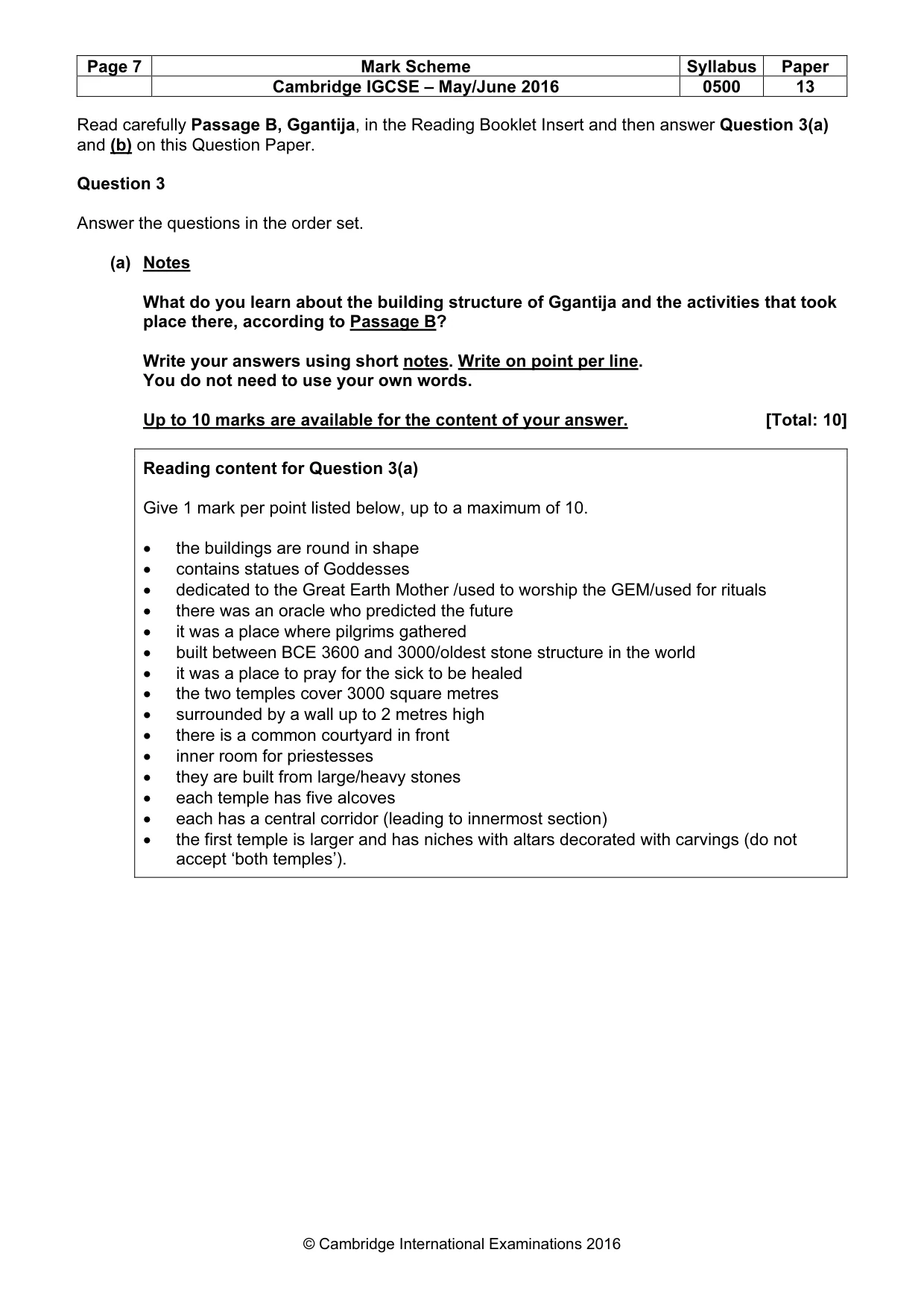
Page 7 Mark Scheme Syllabus Paper Cambridge IGCSE – May/June 2016 0500 13 © Cambridge International Examinations 2016 Read carefully Passage B, Ggantija, in the Reading Booklet Insert and then answer Question 3(a) and (b) on this Question Paper. Question 3 Answer the questions in the order set. (a) Notes What do you learn about the building structure of Ggantija and the activities that took place there, according to Passage B? Write your answers using short notes. Write on point per line. You do not need to use your own words. Up to 10 marks are available for the content of your answer. [Total: 10] Reading content for Question 3(a) Give 1 mark per point listed below, up to a maximum of 10. • the buildings are round in shape • contains statues of Goddesses • dedicated to the Great Earth Mother /used to worship the GEM/used for rituals • there was an oracle who predicted the future • it was a place where pilgrims gathered • built between BCE 3600 and 3000/oldest stone structure in the world • it was a place to pray for the sick to be healed • the two temples cover 3000 square metres • surrounded by a wall up to 2 metres high • there is a common courtyard in front • inner room for priestesses • they are built from large/heavy stones • each temple has five alcoves • each has a central corridor (leading to innermost section) • the first temple is larger and has niches with altars decorated with carvings (do not accept ‘both temples’).
Mark scheme, page 8
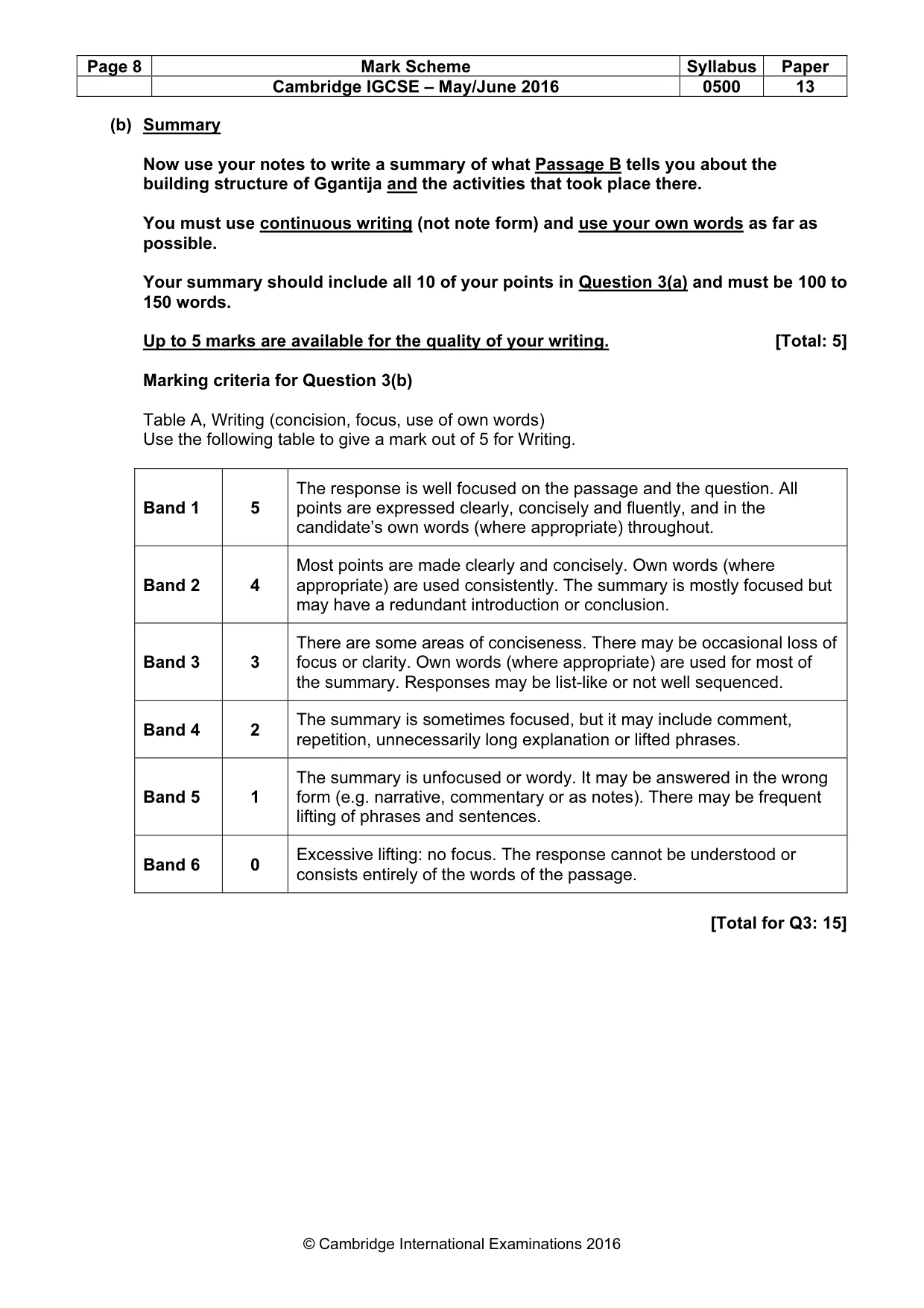
Page 8 Mark Scheme Syllabus Paper Cambridge IGCSE – May/June 2016 0500 13 © Cambridge International Examinations 2016 (b) Summary Now use your notes to write a summary of what Passage B tells you about the building structure of Ggantija and the activities that took place there. You must use continuous writing (not note form) and use your own words as far as possible. Your summary should include all 10 of your points in Question 3(a) and must be 100 to 150 words. Up to 5 marks are available for the quality of your writing. [Total: 5] Marking criteria for Question 3(b) Table A, Writing (concision, focus, use of own words) Use the following table to give a mark out of 5 for Writing. Band 1 5 The response is well focused on the passage and the question. All points are expressed clearly, concisely and fluently, and in the candidate’s own words (where appropriate) throughout. Band 2 4 Most points are made clearly and concisely. Own words (where appropriate) are used consistently. The summary is mostly focused but may have a redundant introduction or conclusion. Band 3 3 There are some areas of conciseness. There may be occasional loss of focus or clarity. Own words (where appropriate) are used for most of the summary. Responses may be list-like or not well sequenced. Band 4 2 The summary is sometimes focused, but it may include comment, repetition, unnecessarily long explanation or lifted phrases. Band 5 1 The summary is unfocused or wordy. It may be answered in the wrong form (e.g. narrative, commentary or as notes). There may be frequent lifting of phrases and sentences. Band 6 0 Excessive lifting: no focus. The response cannot be understood or consists entirely of the words of the passage. [Total for Q3: 15]
What you needed in this session
Cambridge’s own grade thresholds for 2016 May/June, Paper 1 · Variant 3. A higher threshold means an easier paper — the bar moves with how the cohort did.