Cambridge IGCSE English - First Language 0500 — 2016 Feb/March Paper 2 · Variant 2
0500/22/F/M/16 · 50 marks · ≈56 min
The question paper and its mark scheme, free to read here and free to download. This is Cambridge’s own paper, exactly as it was sat.
Question paper12 pages
Mark scheme11 pages
Answers below. Sit the paper first if you are practising.
Paper as text
Question paper, page 1
This document consists of 12 printed pages and 1 Insert. DC (NH) 113735/1 © UCLES 2016 [Turn over * 0 6 0 3 1 0 1 7 9 3 * FIRST LANGUAGE ENGLISH 0500/22 Paper 2 Reading Passages (Extended) February/March 2016 2 hours Candidates answer on the Question Paper. READ THESE INSTRUCTIONS FIRST Write your Centre number, candidate number and name in the spaces provided. Write in dark blue or black pen. Do not use staples, paper clips, glue or correction fluid. DO NOT WRITE IN ANY BARCODES. Answer all questions in the space provided. If additional space is required, you should use the lined pages at the end of this booklet. The question number(s) must be clearly shown. Dictionaries are not permitted. The Reading Booklet Insert contains the reading passages for use with all questions on the Question Paper. The Reading Booklet Insert is not assessed by the Examiner. The number of marks is given in brackets [ ] at the end of each question or part question. Cambridge International Examinations Cambridge International General Certificate of Secondary Education
Question paper, page 2
2 0500/22/F/M/16 © UCLES 2016 Read carefully Passage A, Badluck Way, Sun Ranch, in the Reading Booklet Insert and then answer Questions 1 and 2 on this Question Paper. Question 1 In the final paragraph of Passage A, the narrator explains that he read a magazine article about Sun Ranch, which persuaded him to apply for the job as Assistant Grazing Technician/Livestock Manager. Write the magazine article that the narrator might have read. In your magazine article you should: • describe the attractions of Sun Ranch and its surroundings • explain the activities and appeal of daily life as a worker at Sun Ranch • suggest the challenges of working in that environment and the opportunities for personal development a job there might offer. Base your magazine article on what you have read in Passage A, but be careful to use your own words. Address each of the three bullet points. Give your magazine article a suitable headline and begin with, ‘The Sun Ranch is located …’ Write about 250 to 350 words. Up to 15 marks are available for the content of your answer, and up to 5 marks for the quality of your writing. … … … … … … … … … … … … … …
Question paper, page 3
3 0500/22/F/M/16 © UCLES 2016 [Turn over … … … … … … … … … … … … … … … … … … … … … … … … … … … …
Question paper, page 4
4 0500/22/F/M/16 © UCLES 2016 … … … … … … … … … … … … … … … … … … … … … … … … … … … [Total: 20]
Question paper, page 5
5 0500/22/F/M/16 © UCLES 2016 [Turn over [Turn over for Question 2]
Question paper, page 6
6 0500/22/F/M/16 © UCLES 2016 Question 2 Re-read the descriptions of: (a) The sun setting and the light in paragraph 1, beginning, ‘When the sun dropped …’ (b) The log cabin in paragraph 5, beginning, ‘My house on Badluck Way …’ Select four powerful words or phrases from each paragraph. Your choices should include imagery. Explain how each word or phrase selected is used effectively in the context. Write about 200 to 300 words. Up to 10 marks are available for the content of your answer. … … … … … … … … … … … … … … … … … … … … …
Question paper, page 7
7 0500/22/F/M/16 © UCLES 2016 [Turn over … … … … … … … … … … … … … … … … … … … … … … … … … … … [Total: 10]
Question paper, page 8
8 0500/22/F/M/16 © UCLES 2016 Read carefully Passage B, Wild West Shows, in the Reading Booklet Insert and then answer Questions 3(a) and (b) on this Question Paper. Question 3 Answer the questions in the order set. (a) Notes What attracted audiences to Wild West shows according to Passage B? Write your answer using short notes. Write one point per line. You do not need to use your own words. Up to 15 marks are available for the content of your answer. What attracted audiences to Wild West shows: 1 … 2 … 3 … 4 … 5 … 6 … 7 … 8 … 9 … 10 … 11 … 12 … 13 … 14 … 15 … [Total: 15]
Question paper, page 9
9 0500/22/F/M/16 © UCLES 2016 [Turn over (b) Summary Now use your notes from Question 3(a) to write a summary of what attracted audiences to Wild West shows, according to Passage B. You must use continuous writing (not note form) and use your own words as far as possible. Your summary should include all 15 of your points in Question 3(a) and must be 200 to 250 words. Up to 5 marks are available for the quality of your writing. … … … … … … … … … … … … … … … … … … … … … …
Question paper, page 10
10 0500/22/F/M/16 © UCLES 2016 … … … … … … … … … … … … … … … … … … … … … … … … … … … [Total: 5]
Question paper, page 11
11 0500/22/F/M/16 © UCLES 2016 Additional Page If you use the following lined page to complete the answer(s) to any question(s), the question number(s) must be clearly shown. … … … … … … … … … … … … … … … … … … … … … … … … … …
Question paper, page 12
12 0500/22/F/M/16 © UCLES 2016 Permission to reproduce items where third-party owned material protected by copyright is included has been sought and cleared where possible. Every reasonable effort has been made by the publisher (UCLES) to trace copyright holders, but if any items requiring clearance have unwittingly been included, the publisher will be pleased to make amends at the earliest possible opportunity. To avoid the issue of disclosure of answer-related information to candidates, all copyright acknowledgements are reproduced online in the Cambridge International Examinations Copyright Acknowledgements Booklet. This is produced for each series of examinations and is freely available to download at www.cie.org.uk after the live examination series. Cambridge International Examinations is part of the Cambridge Assessment Group. Cambridge Assessment is the brand name of University of Cambridge Local Examinations Syndicate (UCLES), which is itself a department of the University of Cambridge. Additional Page If you use the following lined page to complete the answer(s) to any question(s), the question number(s) must be clearly shown. … … … … … … … … … … … … … … … … … … … … …
Mark scheme, page 1
® IGCSE is the registered trademark of Cambridge International Examinations. CAMBRIDGE INTERNATIONAL EXAMINATIONS Cambridge International General Certificate of Secondary Education MARK SCHEME for the March 2016 series 0500 FIRST LANGUAGE ENGLISH 0500/22 Paper 2 (Reading Passages – Extended), maximum raw mark 50 This mark scheme is published as an aid to teachers and candidates, to indicate the requirements of the examination. It shows the basis on which Examiners were instructed to award marks. It does not indicate the details of the discussions that took place at an Examiners’ meeting before marking began, which would have considered the acceptability of alternative answers. Mark schemes should be read in conjunction with the question paper and the Principal Examiner Report for Teachers. Cambridge will not enter into discussions about these mark schemes. Cambridge is publishing the mark schemes for the March 2016 series for most Cambridge IGCSE® and Cambridge International A and AS Level components.
Mark scheme, page 2
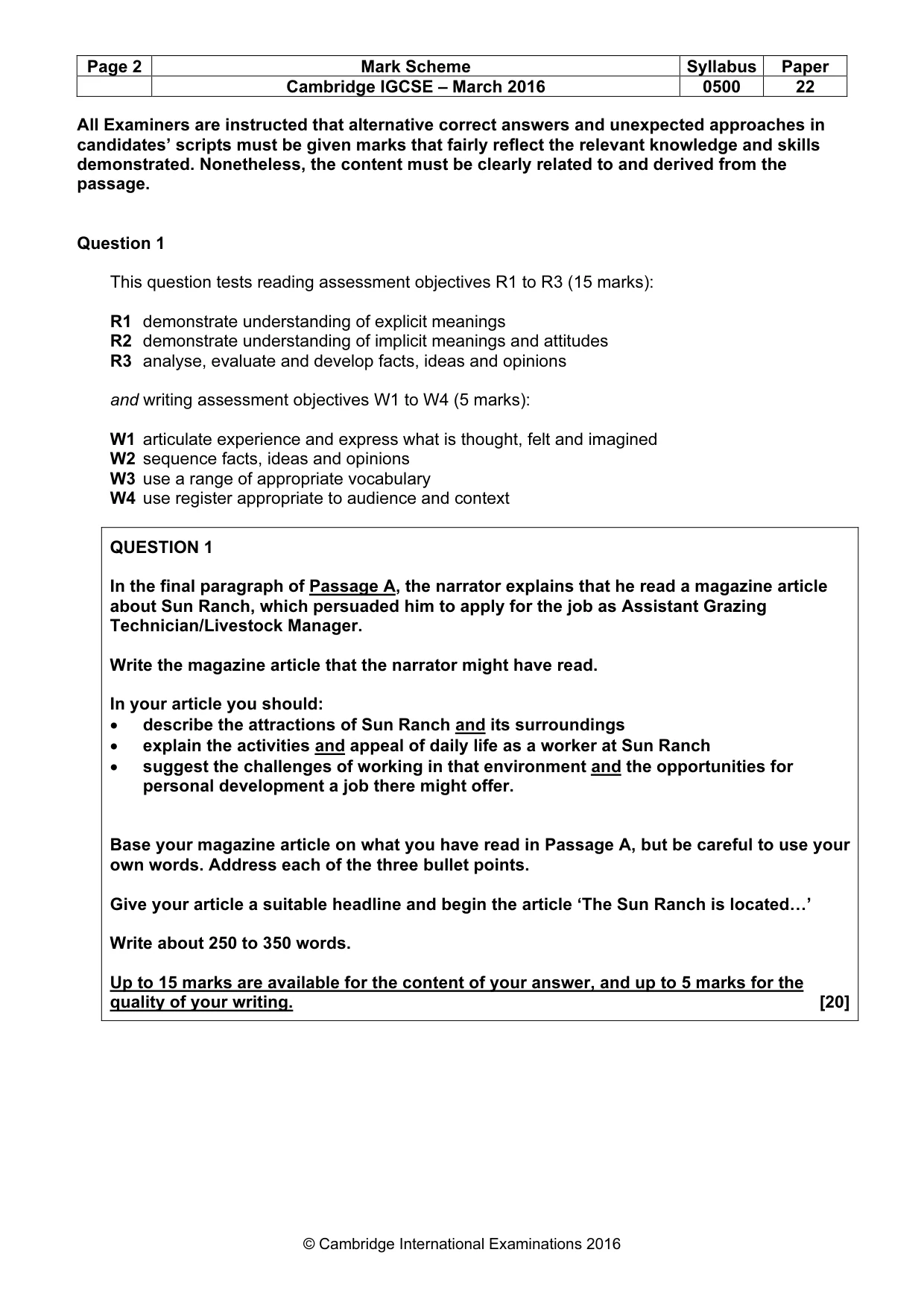
Page 2 Mark Scheme Syllabus Paper Cambridge IGCSE – March 2016 0500 22 © Cambridge International Examinations 2016 All Examiners are instructed that alternative correct answers and unexpected approaches in candidates’ scripts must be given marks that fairly reflect the relevant knowledge and skills demonstrated. Nonetheless, the content must be clearly related to and derived from the passage. Question 1 This question tests reading assessment objectives R1 to R3 (15 marks): R1 demonstrate understanding of explicit meanings R2 demonstrate understanding of implicit meanings and attitudes R3 analyse, evaluate and develop facts, ideas and opinions and writing assessment objectives W1 to W4 (5 marks): W1 articulate experience and express what is thought, felt and imagined W2 sequence facts, ideas and opinions W3 use a range of appropriate vocabulary W4 use register appropriate to audience and context QUESTION 1 In the final paragraph of Passage A, the narrator explains that he read a magazine article about Sun Ranch, which persuaded him to apply for the job as Assistant Grazing Technician/Livestock Manager. Write the magazine article that the narrator might have read. In your article you should: • describe the attractions of Sun Ranch and its surroundings • explain the activities and appeal of daily life as a worker at Sun Ranch • suggest the challenges of working in that environment and the opportunities for personal development a job there might offer. Base your magazine article on what you have read in Passage A, but be careful to use your own words. Address each of the three bullet points. Give your article a suitable headline and begin the article ‘The Sun Ranch is located…’ Write about 250 to 350 words. Up to 15 marks are available for the content of your answer, and up to 5 marks for the quality of your writing. [20]
Mark scheme, page 3
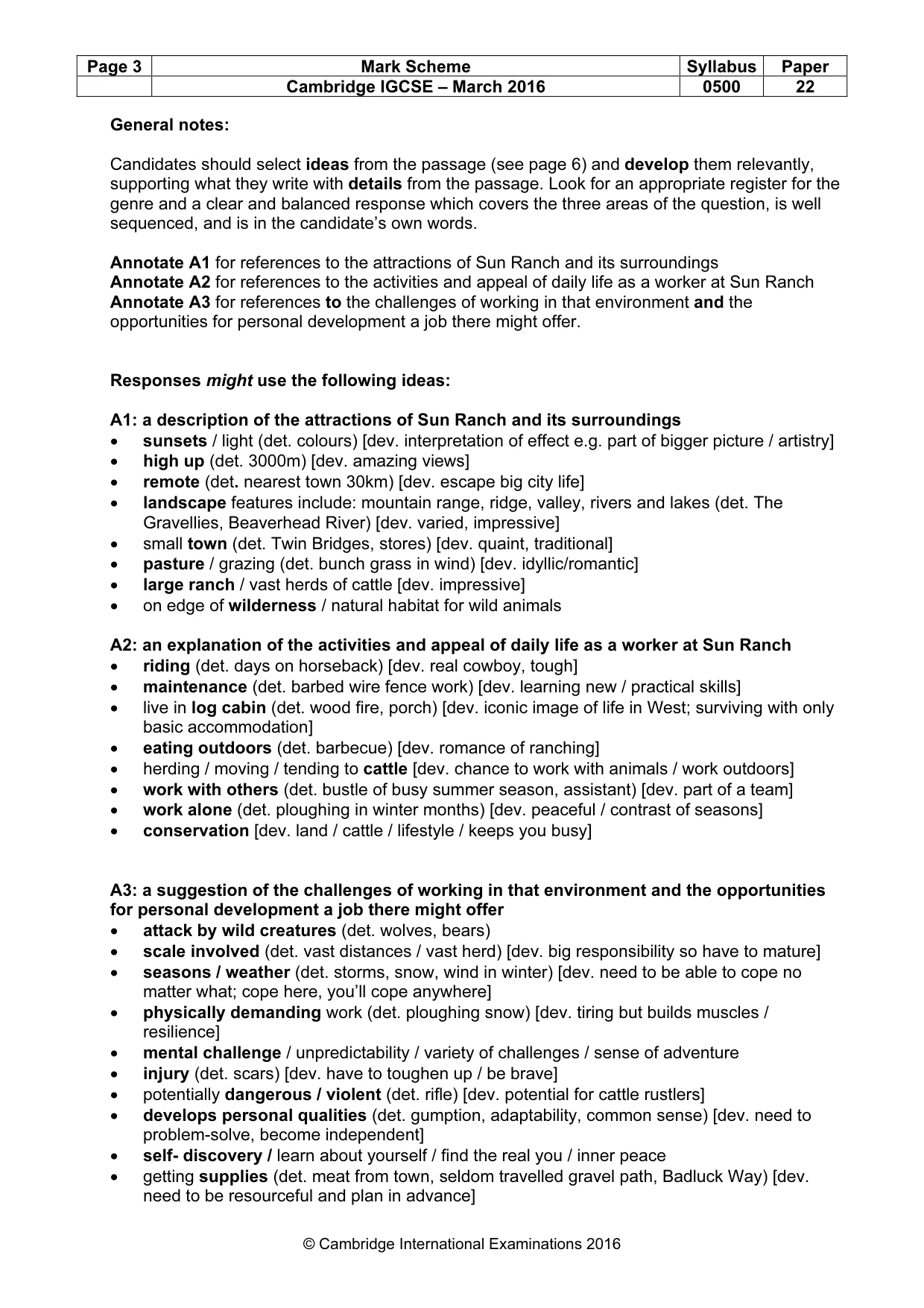
Page 3 Mark Scheme Syllabus Paper Cambridge IGCSE – March 2016 0500 22 © Cambridge International Examinations 2016 General notes: Candidates should select ideas from the passage (see page 6) and develop them relevantly, supporting what they write with details from the passage. Look for an appropriate register for the genre and a clear and balanced response which covers the three areas of the question, is well sequenced, and is in the candidate’s own words. Annotate A1 for references to the attractions of Sun Ranch and its surroundings Annotate A2 for references to the activities and appeal of daily life as a worker at Sun Ranch Annotate A3 for references to the challenges of working in that environment and the opportunities for personal development a job there might offer. Responses might use the following ideas: A1: a description of the attractions of Sun Ranch and its surroundings • sunsets / light (det. colours) [dev. interpretation of effect e.g. part of bigger picture / artistry] • high up (det. 3000m) [dev. amazing views] • remote (det. nearest town 30km) [dev. escape big city life] • landscape features include: mountain range, ridge, valley, rivers and lakes (det. The Gravellies, Beaverhead River) [dev. varied, impressive] • small town (det. Twin Bridges, stores) [dev. quaint, traditional] • pasture / grazing (det. bunch grass in wind) [dev. idyllic/romantic] • large ranch / vast herds of cattle [dev. impressive] • on edge of wilderness / natural habitat for wild animals A2: an explanation of the activities and appeal of daily life as a worker at Sun Ranch • riding (det. days on horseback) [dev. real cowboy, tough] • maintenance (det. barbed wire fence work) [dev. learning new / practical skills] • live in log cabin (det. wood fire, porch) [dev. iconic image of life in West; surviving with only basic accommodation] • eating outdoors (det. barbecue) [dev. romance of ranching] • herding / moving / tending to cattle [dev. chance to work with animals / work outdoors] • work with others (det. bustle of busy summer season, assistant) [dev. part of a team] • work alone (det. ploughing in winter months) [dev. peaceful / contrast of seasons] • conservation [dev. land / cattle / lifestyle / keeps you busy] A3: a suggestion of the challenges of working in that environment and the opportunities for personal development a job there might offer • attack by wild creatures (det. wolves, bears) • scale involved (det. vast distances / vast herd) [dev. big responsibility so have to mature] • seasons / weather (det. storms, snow, wind in winter) [dev. need to be able to cope no matter what; cope here, you’ll cope anywhere] • physically demanding work (det. ploughing snow) [dev. tiring but builds muscles / resilience] • mental challenge / unpredictability / variety of challenges / sense of adventure • injury (det. scars) [dev. have to toughen up / be brave] • potentially dangerous / violent (det. rifle) [dev. potential for cattle rustlers] • develops personal qualities (det. gumption, adaptability, common sense) [dev. need to problem-solve, become independent] • self- discovery / learn about yourself / find the real you / inner peace • getting supplies (det. meat from town, seldom travelled gravel path, Badluck Way) [dev. need to be resourceful and plan in advance]
Mark scheme, page 4
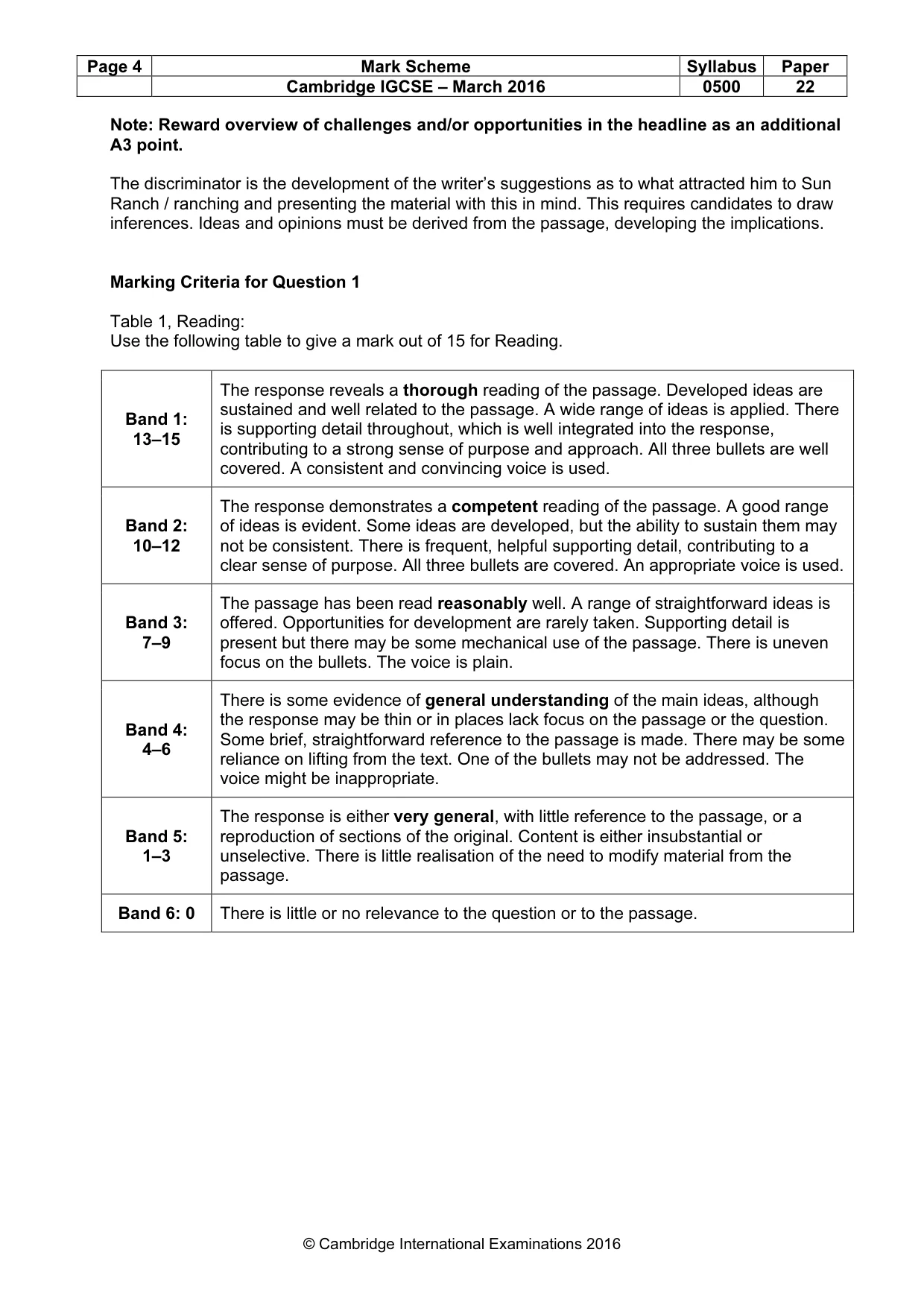
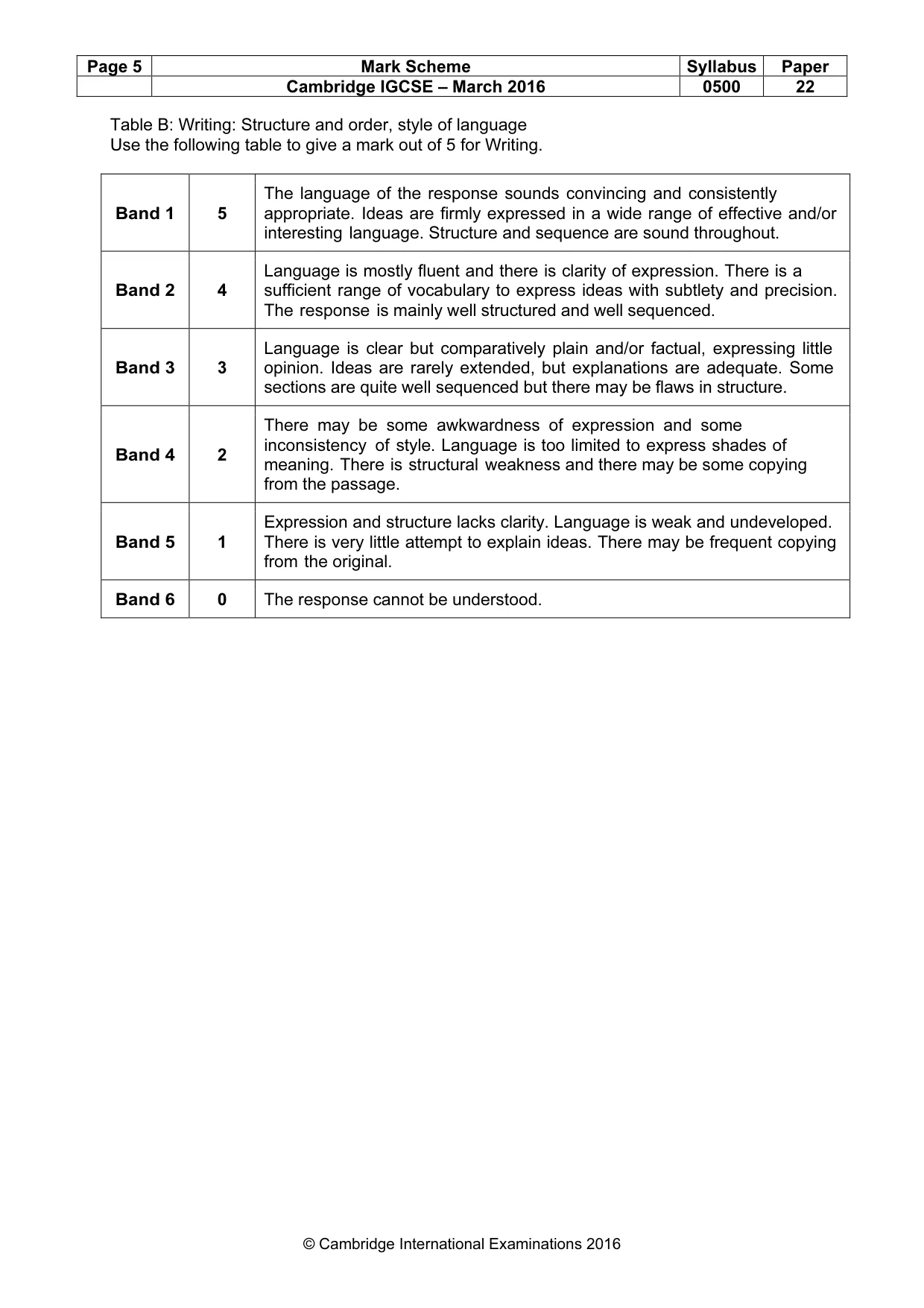
Page 4 Mark Scheme Syllabus Paper Cambridge IGCSE – March 2016 0500 22 © Cambridge International Examinations 2016 Note: Reward overview of challenges and/or opportunities in the headline as an additional A3 point. The discriminator is the development of the writer’s suggestions as to what attracted him to Sun Ranch / ranching and presenting the material with this in mind. This requires candidates to draw inferences. Ideas and opinions must be derived from the passage, developing the implications. Marking Criteria for Question 1 Table 1, Reading: Use the following table to give a mark out of 15 for Reading. Band 1: 13–15 The response reveals a thorough reading of the passage. Developed ideas are sustained and well related to the passage. A wide range of ideas is applied. There is supporting detail throughout, which is well integrated into the response, contributing to a strong sense of purpose and approach. All three bullets are well covered. A consistent and convincing voice is used. Band 2: 10–12 The response demonstrates a competent reading of the passage. A good range of ideas is evident. Some ideas are developed, but the ability to sustain them may not be consistent. There is frequent, helpful supporting detail, contributing to a clear sense of purpose. All three bullets are covered. An appropriate voice is used. Band 3: 7–9 The passage has been read reasonably well. A range of straightforward ideas is offered. Opportunities for development are rarely taken. Supporting detail is present but there may be some mechanical use of the passage. There is uneven focus on the bullets. The voice is plain. Band 4: 4–6 There is some evidence of general understanding of the main ideas, although the response may be thin or in places lack focus on the passage or the question. Some brief, straightforward reference to the passage is made. There may be some reliance on lifting from the text. One of the bullets may not be addressed. The voice might be inappropriate. Band 5: 1–3 The response is either very general, with little reference to the passage, or a reproduction of sections of the original. Content is either insubstantial or unselective. There is little realisation of the need to modify material from the passage. Band 6: 0 There is little or no relevance to the question or to the passage.
Mark scheme, page 5
Page 5 Mark Scheme Syllabus Paper Cambridge IGCSE – March 2016 0500 22 © Cambridge International Examinations 2016 Table B: Writing: Structure and order, style of language Use the following table to give a mark out of 5 for Writing. Band 1 5 The language of the response sounds convincing and consistently appropriate. Ideas are firmly expressed in a wide range of effective and/or interesting language. Structure and sequence are sound throughout. Band 2 4 Language is mostly fluent and there is clarity of expression. There is a sufficient range of vocabulary to express ideas with subtlety and precision. The response is mainly well structured and well sequenced. Band 3 3 Language is clear but comparatively plain and/or factual, expressing little opinion. Ideas are rarely extended, but explanations are adequate. Some sections are quite well sequenced but there may be flaws in structure. Band 4 2 There may be some awkwardness of expression and some inconsistency of style. Language is too limited to express shades of meaning. There is structural weakness and there may be some copying from the passage. Band 5 1 Expression and structure lacks clarity. Language is weak and undeveloped. There is very little attempt to explain ideas. There may be frequent copying from the original. Band 6 0 The response cannot be understood.
Mark scheme, page 6
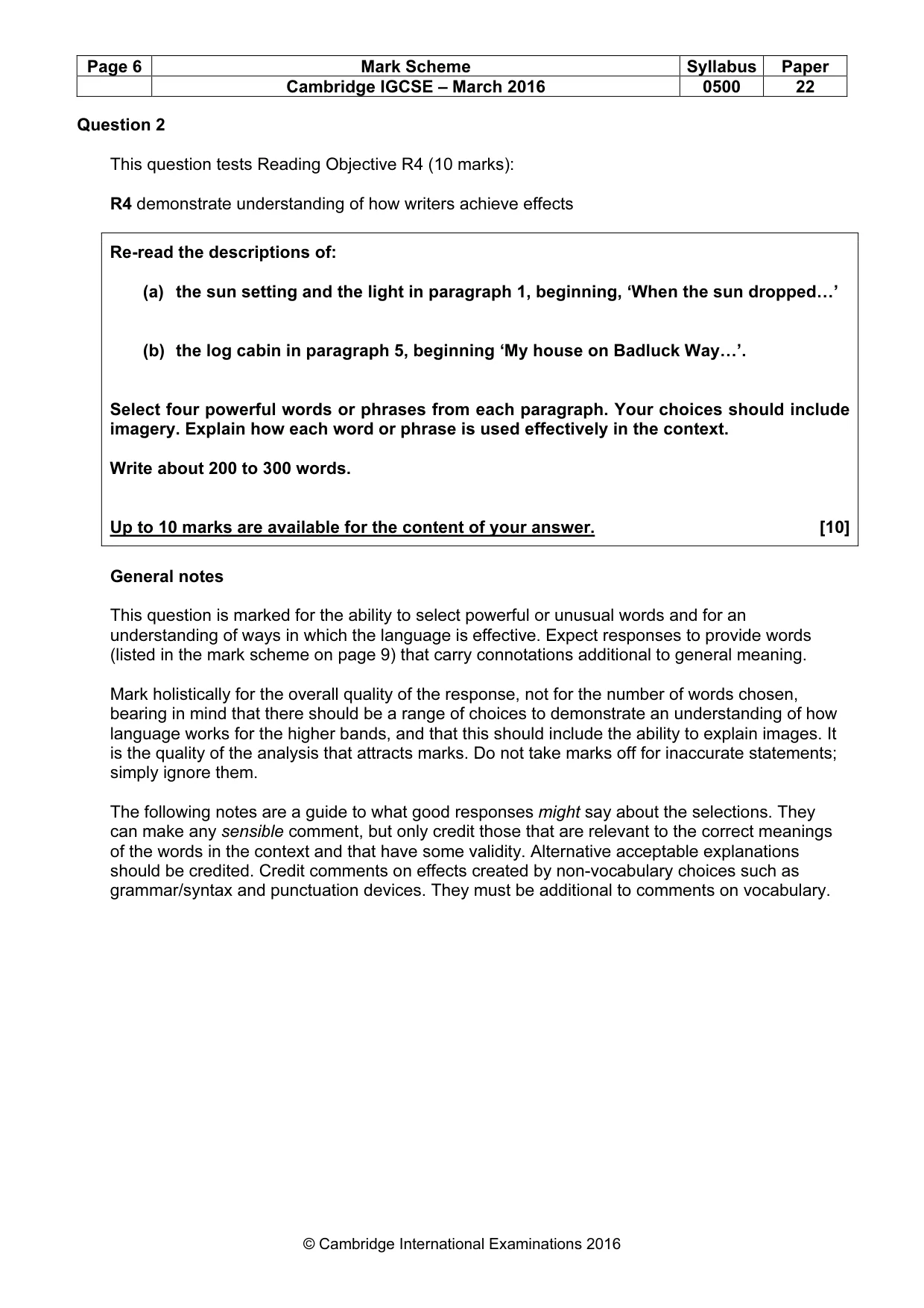
Page 6 Mark Scheme Syllabus Paper Cambridge IGCSE – March 2016 0500 22 © Cambridge International Examinations 2016 Question 2 This question tests Reading Objective R4 (10 marks): R4 demonstrate understanding of how writers achieve effects Re-read the descriptions of: (a) the sun setting and the light in paragraph 1, beginning, ‘When the sun dropped…’ (b) the log cabin in paragraph 5, beginning ‘My house on Badluck Way…’. Select four powerful words or phrases from each paragraph. Your choices should include imagery. Explain how each word or phrase is used effectively in the context. Write about 200 to 300 words. Up to 10 marks are available for the content of your answer. [10] General notes This question is marked for the ability to select powerful or unusual words and for an understanding of ways in which the language is effective. Expect responses to provide words (listed in the mark scheme on page 9) that carry connotations additional to general meaning. Mark holistically for the overall quality of the response, not for the number of words chosen, bearing in mind that there should be a range of choices to demonstrate an understanding of how language works for the higher bands, and that this should include the ability to explain images. It is the quality of the analysis that attracts marks. Do not take marks off for inaccurate statements; simply ignore them. The following notes are a guide to what good responses might say about the selections. They can make any sensible comment, but only credit those that are relevant to the correct meanings of the words in the context and that have some validity. Alternative acceptable explanations should be credited. Credit comments on effects created by non-vocabulary choices such as grammar/syntax and punctuation devices. They must be additional to comments on vocabulary.
Mark scheme, page 7
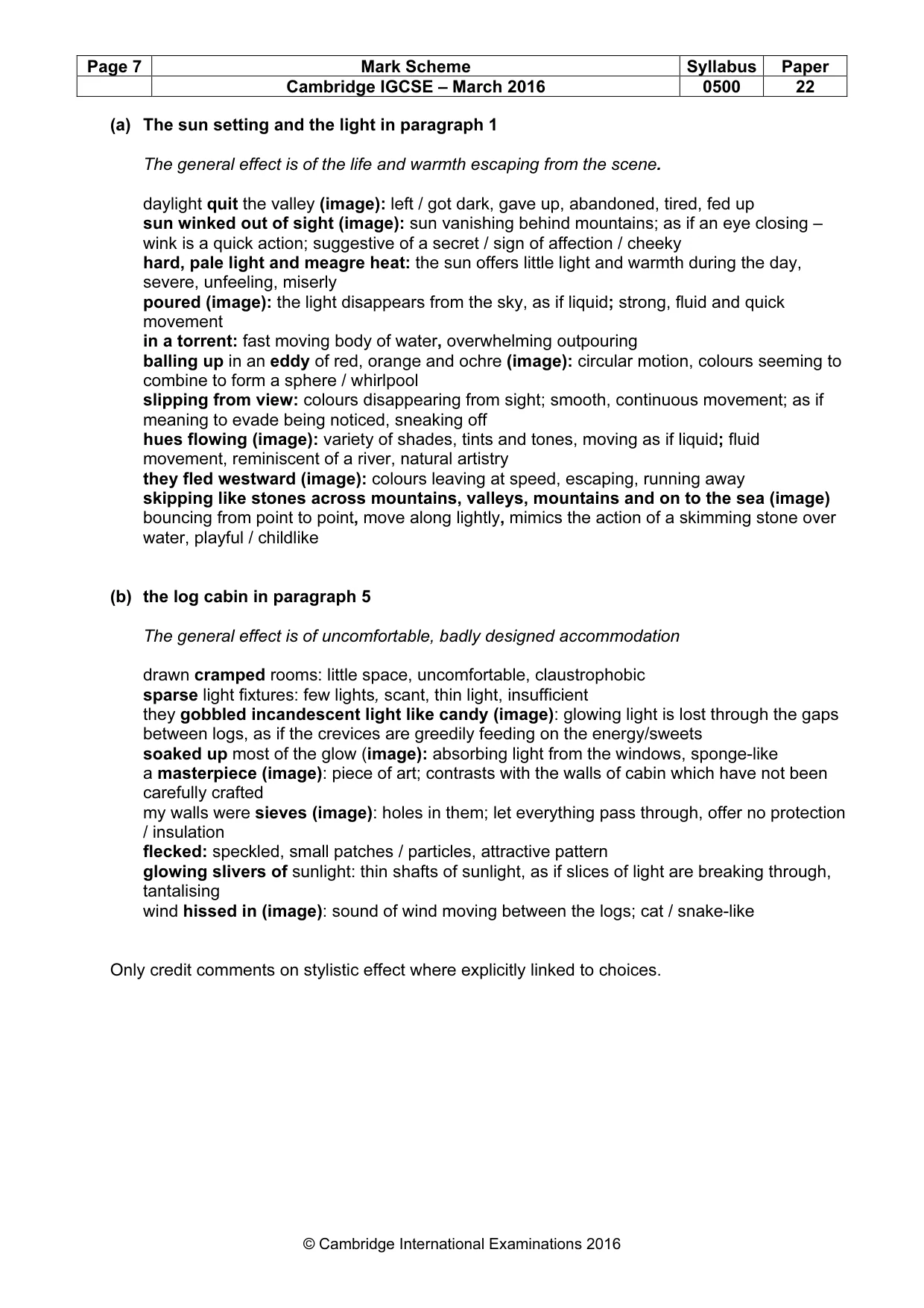
Page 7 Mark Scheme Syllabus Paper Cambridge IGCSE – March 2016 0500 22 © Cambridge International Examinations 2016 (a) The sun setting and the light in paragraph 1 The general effect is of the life and warmth escaping from the scene. daylight quit the valley (image): left / got dark, gave up, abandoned, tired, fed up sun winked out of sight (image): sun vanishing behind mountains; as if an eye closing – wink is a quick action; suggestive of a secret / sign of affection / cheeky hard, pale light and meagre heat: the sun offers little light and warmth during the day, severe, unfeeling, miserly poured (image): the light disappears from the sky, as if liquid; strong, fluid and quick movement in a torrent: fast moving body of water, overwhelming outpouring balling up in an eddy of red, orange and ochre (image): circular motion, colours seeming to combine to form a sphere / whirlpool slipping from view: colours disappearing from sight; smooth, continuous movement; as if meaning to evade being noticed, sneaking off hues flowing (image): variety of shades, tints and tones, moving as if liquid; fluid movement, reminiscent of a river, natural artistry they fled westward (image): colours leaving at speed, escaping, running away skipping like stones across mountains, valleys, mountains and on to the sea (image) bouncing from point to point, move along lightly, mimics the action of a skimming stone over water, playful / childlike (b) the log cabin in paragraph 5 The general effect is of uncomfortable, badly designed accommodation drawn cramped rooms: little space, uncomfortable, claustrophobic sparse light fixtures: few lights, scant, thin light, insufficient they gobbled incandescent light like candy (image): glowing light is lost through the gaps between logs, as if the crevices are greedily feeding on the energy/sweets soaked up most of the glow (image): absorbing light from the windows, sponge-like a masterpiece (image): piece of art; contrasts with the walls of cabin which have not been carefully crafted my walls were sieves (image): holes in them; let everything pass through, offer no protection / insulation flecked: speckled, small patches / particles, attractive pattern glowing slivers of sunlight: thin shafts of sunlight, as if slices of light are breaking through, tantalising wind hissed in (image): sound of wind moving between the logs; cat / snake-like Only credit comments on stylistic effect where explicitly linked to choices.
Mark scheme, page 8
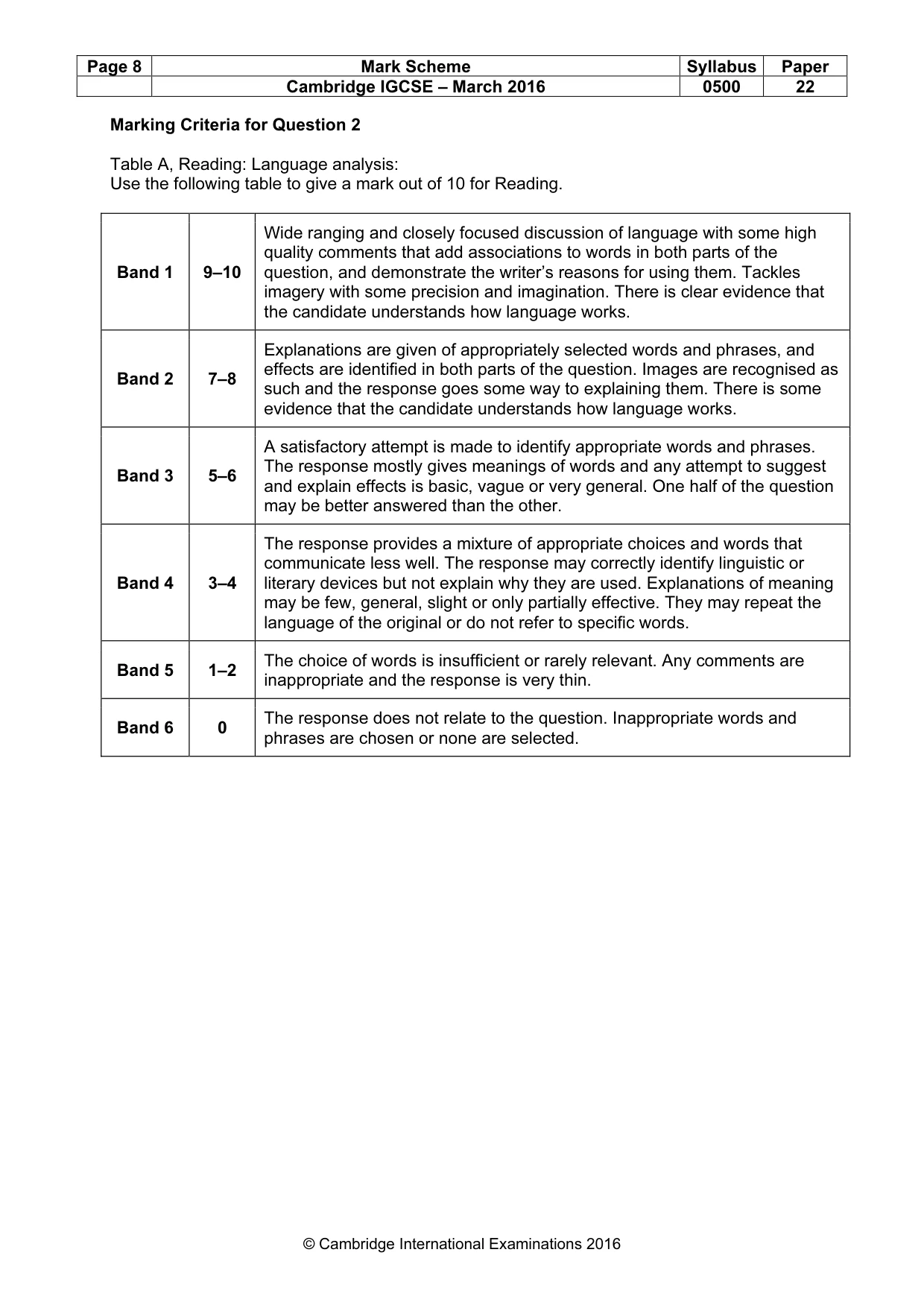
Page 8 Mark Scheme Syllabus Paper Cambridge IGCSE – March 2016 0500 22 © Cambridge International Examinations 2016 Marking Criteria for Question 2 Table A, Reading: Language analysis: Use the following table to give a mark out of 10 for Reading. Band 1 9–10 Wide ranging and closely focused discussion of language with some high quality comments that add associations to words in both parts of the question, and demonstrate the writer’s reasons for using them. Tackles imagery with some precision and imagination. There is clear evidence that the candidate understands how language works. Band 2 7–8 Explanations are given of appropriately selected words and phrases, and effects are identified in both parts of the question. Images are recognised as such and the response goes some way to explaining them. There is some evidence that the candidate understands how language works. Band 3 5–6 A satisfactory attempt is made to identify appropriate words and phrases. The response mostly gives meanings of words and any attempt to suggest and explain effects is basic, vague or very general. One half of the question may be better answered than the other. Band 4 3–4 The response provides a mixture of appropriate choices and words that communicate less well. The response may correctly identify linguistic or literary devices but not explain why they are used. Explanations of meaning may be few, general, slight or only partially effective. They may repeat the language of the original or do not refer to specific words. Band 5 1–2 The choice of words is insufficient or rarely relevant. Any comments are inappropriate and the response is very thin. Band 6 0 The response does not relate to the question. Inappropriate words and phrases are chosen or none are selected.
Mark scheme, page 9
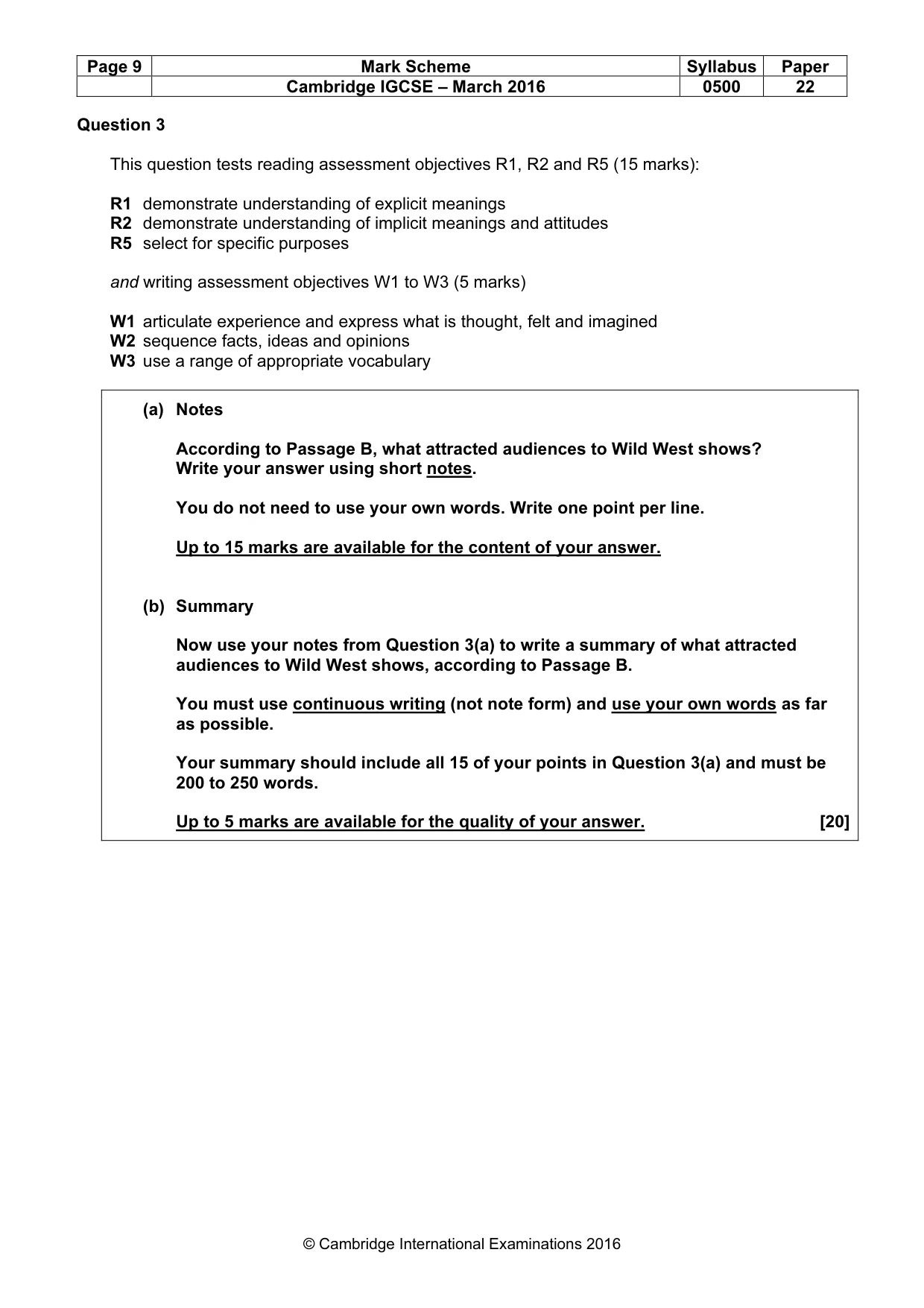
Page 9 Mark Scheme Syllabus Paper Cambridge IGCSE – March 2016 0500 22 © Cambridge International Examinations 2016 Question 3 This question tests reading assessment objectives R1, R2 and R5 (15 marks): R1 demonstrate understanding of explicit meanings R2 demonstrate understanding of implicit meanings and attitudes R5 select for specific purposes and writing assessment objectives W1 to W3 (5 marks) W1 articulate experience and express what is thought, felt and imagined W2 sequence facts, ideas and opinions W3 use a range of appropriate vocabulary (a) Notes According to Passage B, what attracted audiences to Wild West shows? Write your answer using short notes. You do not need to use your own words. Write one point per line. Up to 15 marks are available for the content of your answer. (b) Summary Now use your notes from Question 3(a) to write a summary of what attracted audiences to Wild West shows, according to Passage B. You must use continuous writing (not note form) and use your own words as far as possible. Your summary should include all 15 of your points in Question 3(a) and must be 200 to 250 words. Up to 5 marks are available for the quality of your answer. [20]
Mark scheme, page 10
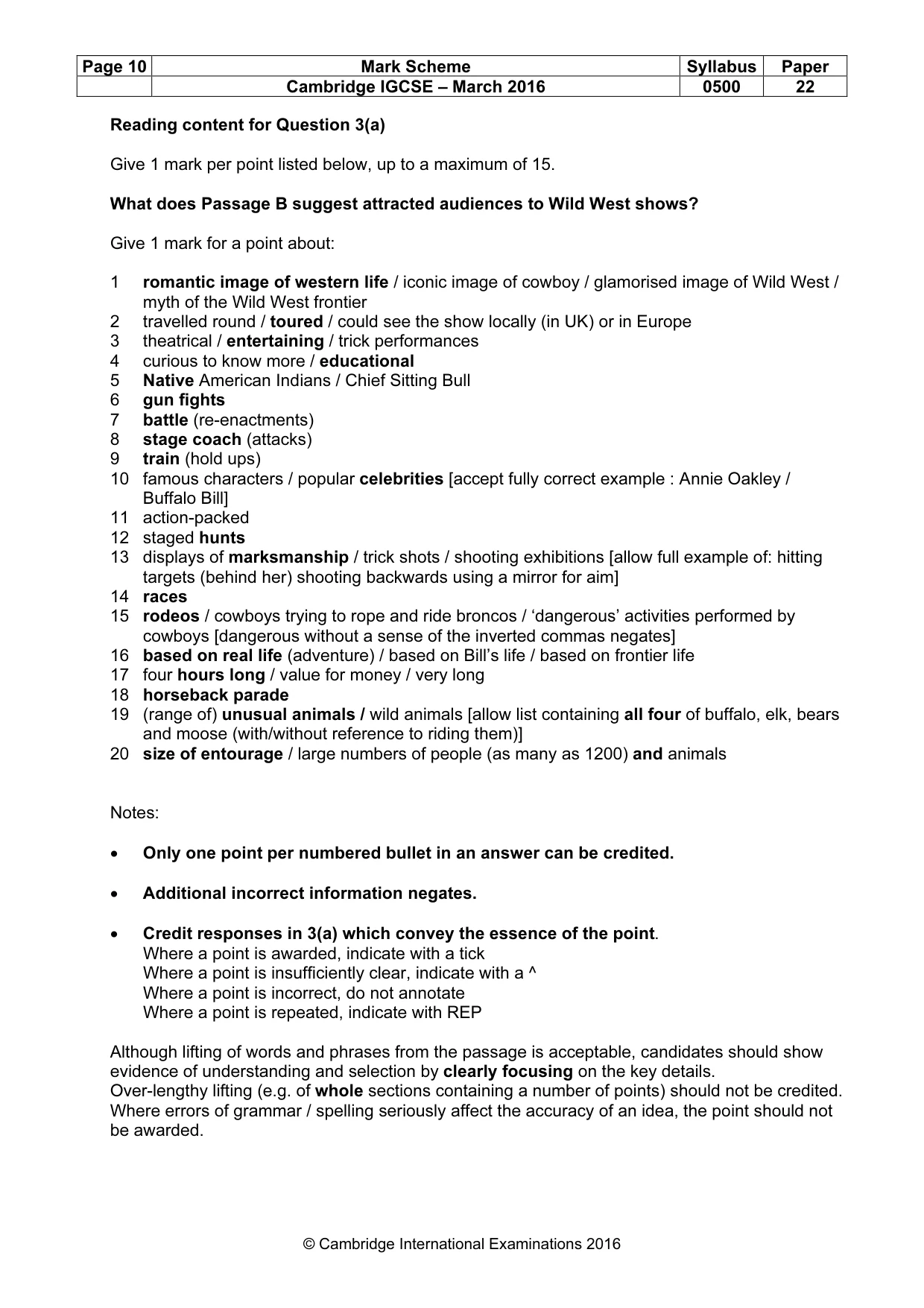
Page 10 Mark Scheme Syllabus Paper Cambridge IGCSE – March 2016 0500 22 © Cambridge International Examinations 2016 Reading content for Question 3(a) Give 1 mark per point listed below, up to a maximum of 15. What does Passage B suggest attracted audiences to Wild West shows? Give 1 mark for a point about: 1 romantic image of western life / iconic image of cowboy / glamorised image of Wild West / myth of the Wild West frontier 2 travelled round / toured / could see the show locally (in UK) or in Europe 3 theatrical / entertaining / trick performances 4 curious to know more / educational 5 Native American Indians / Chief Sitting Bull 6 gun fights 7 battle (re-enactments) 8 stage coach (attacks) 9 train (hold ups) 10 famous characters / popular celebrities [accept fully correct example : Annie Oakley / Buffalo Bill] 11 action-packed 12 staged hunts 13 displays of marksmanship / trick shots / shooting exhibitions [allow full example of: hitting targets (behind her) shooting backwards using a mirror for aim] 14 races 15 rodeos / cowboys trying to rope and ride broncos / ‘dangerous’ activities performed by cowboys [dangerous without a sense of the inverted commas negates] 16 based on real life (adventure) / based on Bill’s life / based on frontier life 17 four hours long / value for money / very long 18 horseback parade 19 (range of) unusual animals / wild animals [allow list containing all four of buffalo, elk, bears and moose (with/without reference to riding them)] 20 size of entourage / large numbers of people (as many as 1200) and animals Notes: • Only one point per numbered bullet in an answer can be credited. • Additional incorrect information negates. • Credit responses in 3(a) which convey the essence of the point. Where a point is awarded, indicate with a tick Where a point is insufficiently clear, indicate with a ^ Where a point is incorrect, do not annotate Where a point is repeated, indicate with REP Although lifting of words and phrases from the passage is acceptable, candidates should show evidence of understanding and selection by clearly focusing on the key details. Over-lengthy lifting (e.g. of whole sections containing a number of points) should not be credited. Where errors of grammar / spelling seriously affect the accuracy of an idea, the point should not be awarded.
Mark scheme, page 11
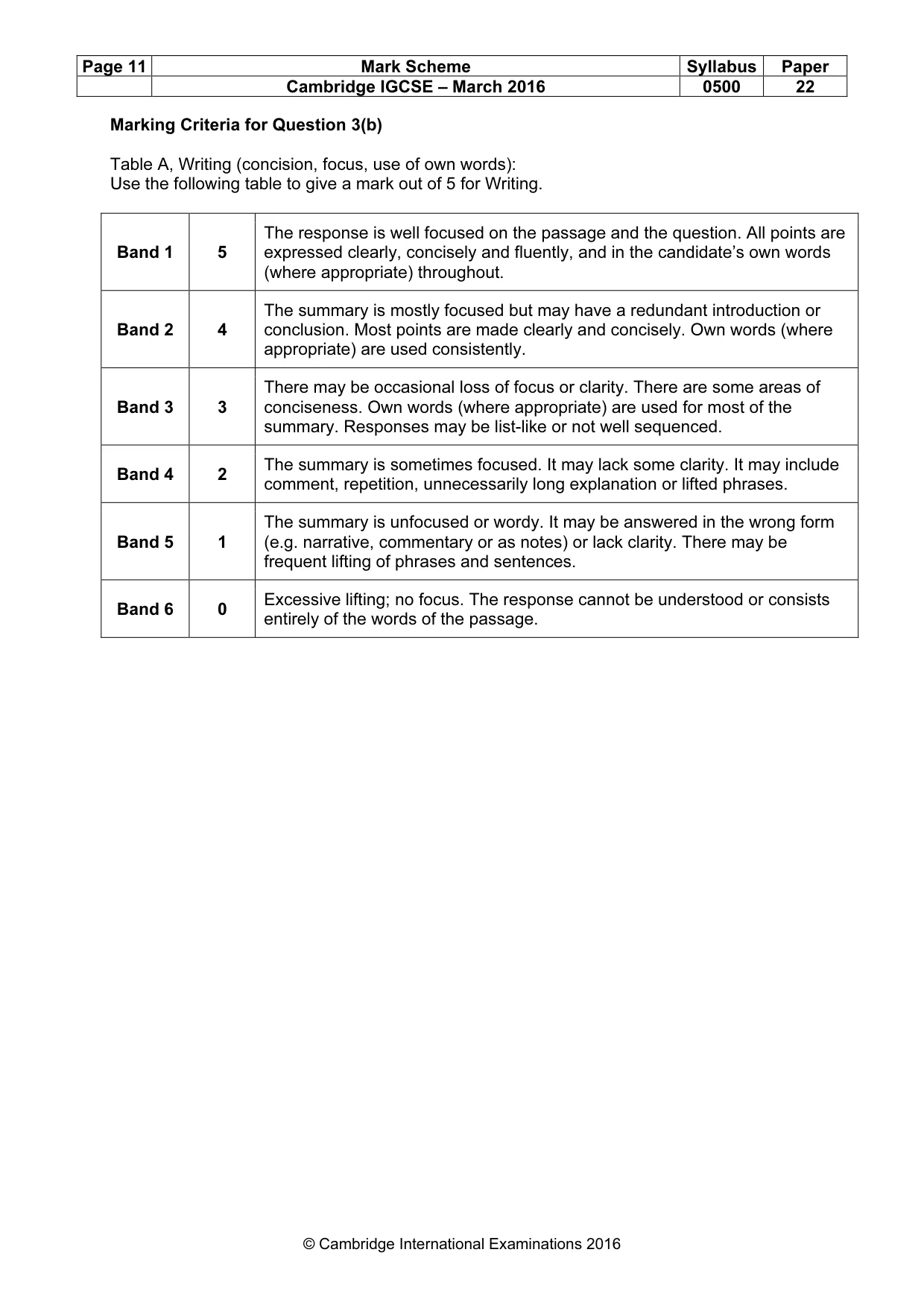
Page 11 Mark Scheme Syllabus Paper Cambridge IGCSE – March 2016 0500 22 © Cambridge International Examinations 2016 Marking Criteria for Question 3(b) Table A, Writing (concision, focus, use of own words): Use the following table to give a mark out of 5 for Writing. Band 1 5 The response is well focused on the passage and the question. All points are expressed clearly, concisely and fluently, and in the candidate’s own words (where appropriate) throughout. Band 2 4 The summary is mostly focused but may have a redundant introduction or conclusion. Most points are made clearly and concisely. Own words (where appropriate) are used consistently. Band 3 3 There may be occasional loss of focus or clarity. There are some areas of conciseness. Own words (where appropriate) are used for most of the summary. Responses may be list-like or not well sequenced. Band 4 2 The summary is sometimes focused. It may lack some clarity. It may include comment, repetition, unnecessarily long explanation or lifted phrases. Band 5 1 The summary is unfocused or wordy. It may be answered in the wrong form (e.g. narrative, commentary or as notes) or lack clarity. There may be frequent lifting of phrases and sentences. Band 6 0 Excessive lifting; no focus. The response cannot be understood or consists entirely of the words of the passage.
What you needed in this session
Cambridge’s own grade thresholds for 2016 Feb/March, Paper 2 · Variant 2. A higher threshold means an easier paper — the bar moves with how the cohort did.