Cambridge IGCSE English - First Language 0500 — 2014 Oct/Nov Paper 3 · Variant 1
0500/31/O/N/14 · 50 marks · ≈56 min
The question paper and its mark scheme, free to read here and free to download. This is Cambridge’s own paper, exactly as it was sat.
Question paper12 pages
Mark scheme9 pages
Answers below. Sit the paper first if you are practising.
Paper as text
Question paper, page 1
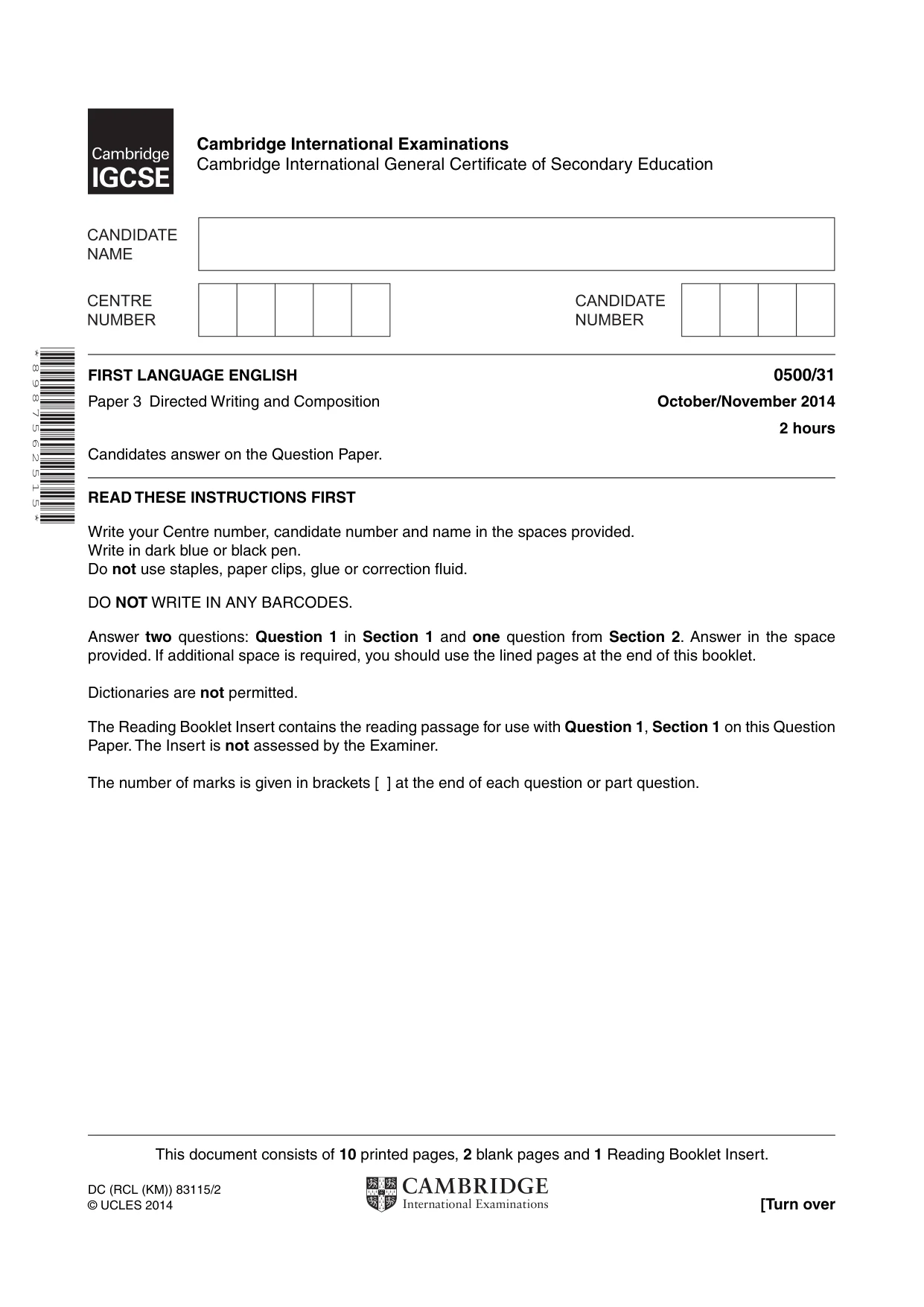
This document consists of 10 printed pages, 2 blank pages and 1 Reading Booklet Insert. DC (RCL (KM)) 83115/2 © UCLES 2014 [Turn over Cambridge International Examinations Cambridge International General Certificate of Secondary Education * 8 9 8 7 5 6 2 5 1 5 * FIRST LANGUAGE ENGLISH 0500/31 Paper 3 Directed Writing and Composition October/November 2014 2 hours Candidates answer on the Question Paper. READ THESE INSTRUCTIONS FIRST Write your Centre number, candidate number and name in the spaces provided. Write in dark blue or black pen. Do not use staples, paper clips, glue or correction fluid. DO NOT WRITE IN ANY BARCODES. Answer two questions: Question 1 in Section 1 and one question from Section 2. Answer in the space provided. If additional space is required, you should use the lined pages at the end of this booklet. Dictionaries are not permitted. The Reading Booklet Insert contains the reading passage for use with Question 1, Section 1 on this Question Paper. The Insert is not assessed by the Examiner. The number of marks is given in brackets [ ] at the end of each question or part question.
Question paper, page 2
2 0500/31/O/N/14 © UCLES 2014 Section 1: Directed Writing 1 Read carefully the conversation in the Reading Booklet Insert. Then answer Section 1, Question 1 on this Question Paper. Following your conversation with your art teacher, you decide to write an article for your school magazine, entitled ‘Do we need art?’. Write your magazine article. In your magazine article you should: • identify and evaluate the arguments presented by both you and your teacher • explain which arguments you now agree with, and why. Base your magazine article on what you have read in the conversation, but be careful to use your own words. Address each of the two bullet points. Begin your magazine article: ‘In a recent conversation about the role of art in society and in school …’. Write between 1½ and 2 sides, allowing for the size of your handwriting. Up to 10 marks are available for the content of your answer, and up to 15 marks for the quality of your writing. … … … … … … … … … … … … … … … … …
Question paper, page 3
3 0500/31/O/N/14 © UCLES 2014 [Turn over … … … … … … … … … … … … … … … … … … … … … … … … … … … …
Question paper, page 4
4 0500/31/O/N/14 © UCLES 2014 … … … … … … … … … … … … … … … … … … … … … … … … … … … [Total: 25]
Question paper, page 5
5 0500/31/O/N/14 © UCLES 2014 [Turn over Section 2: Composition Write about 2 sides, allowing for the size of your handwriting, on one of the following questions. Up to 13 marks are available for the content and structure of your answer, and up to 12 marks are available for the style and accuracy of your writing. Argumentative/Discursive writing 2 (a) Parents and other adults often influence children’s career choices. Do you think this is a good thing? OR (b) ‘Our grandchildren will not recognise the world we live in now.’ Do you think this statement is true? Give examples to explain your views. Descriptive writing 3 (a) You have struggled for some time to acquire a skill. Describe what you are doing at the moment of success, and your thoughts and feelings at this time. OR (b) Imagine that you are watching a building being destroyed. Describe what you see and hear, and your thoughts and feelings about what used to happen in this place. Narrative writing 4 (a) ‘I’m afraid there’s nothing else for it. We have to go back.’ Write a story beginning with these words. OR (b) Write a story about a practical joke which goes wrong. [Turn to page 6 to answer Section 2]
Question paper, page 6
6 0500/31/O/N/14 © UCLES 2014 Please write your chosen question number: (Question 2a, 2b, 3a, 3b, 4a or 4b)… … … … … … … … … … … … … … … … … … … … … … … … … … … …
Question paper, page 7
7 0500/31/O/N/14 © UCLES 2014 [Turn over … … … … … … … … … … … … … … … … … … … … … … … … … … … …
Question paper, page 8
8 0500/31/O/N/14 © UCLES 2014 … … … … … … … … … … … … … … … … … … … … … … … … … … … [Total: 25]
Question paper, page 9
9 0500/31/O/N/14 © UCLES 2014 ADDITIONAL PAGE If you use the following lined pages to complete the answer(s) to any question(s), the question number(s) must be clearly shown. … … … … … … … … … … … … … … … … … … … … … … … … … …
Question paper, page 10
10 0500/31/O/N/14 © UCLES 2014 ADDITIONAL PAGE If you use the following lined pages to complete the answer(s) to any question(s), the question number(s) must be clearly shown. … … … … … … … … … … … … … … … … … … … … … … … … … …
Question paper, page 11
11 0500/31/O/N/14 © UCLES 2014 BLANK PAGE
Question paper, page 12
12 0500/31/O/N/14 © UCLES 2014 Permission to reproduce items where third-party owned material protected by copyright is included has been sought and cleared where possible. Every reasonable effort has been made by the publisher (UCLES) to trace copyright holders, but if any items requiring clearance have unwittingly been included, the publisher will be pleased to make amends at the earliest possible opportunity. Cambridge International Examinations is part of the Cambridge Assessment Group. Cambridge Assessment is the brand name of University of Cambridge Local Examinations Syndicate (UCLES), which is itself a department of the University of Cambridge. BLANK PAGE
Mark scheme, page 1
® IGCSE is the registered trademark of Cambridge International Examinations. CAMBRIDGE INTERNATIONAL EXAMINATIONS Cambridge International General Certificate of Secondary Education MARK SCHEME for the October/November 2014 series 0500 FIRST LANGUAGE ENGLISH 0500/31 Paper 3 (Directed Writing and Composition), maximum raw mark 50 This mark scheme is published as an aid to teachers and candidates, to indicate the requirements of the examination. It shows the basis on which Examiners were instructed to award marks. It does not indicate the details of the discussions that took place at an Examiners’ meeting before marking began, which would have considered the acceptability of alternative answers. Mark schemes should be read in conjunction with the question paper and the Principal Examiner Report for Teachers. Cambridge will not enter into discussions about these mark schemes. Cambridge is publishing the mark schemes for the October/November 2014 series for most Cambridge IGCSE®, Cambridge International A and AS Level components and some Cambridge O Level components.
Mark scheme, page 2
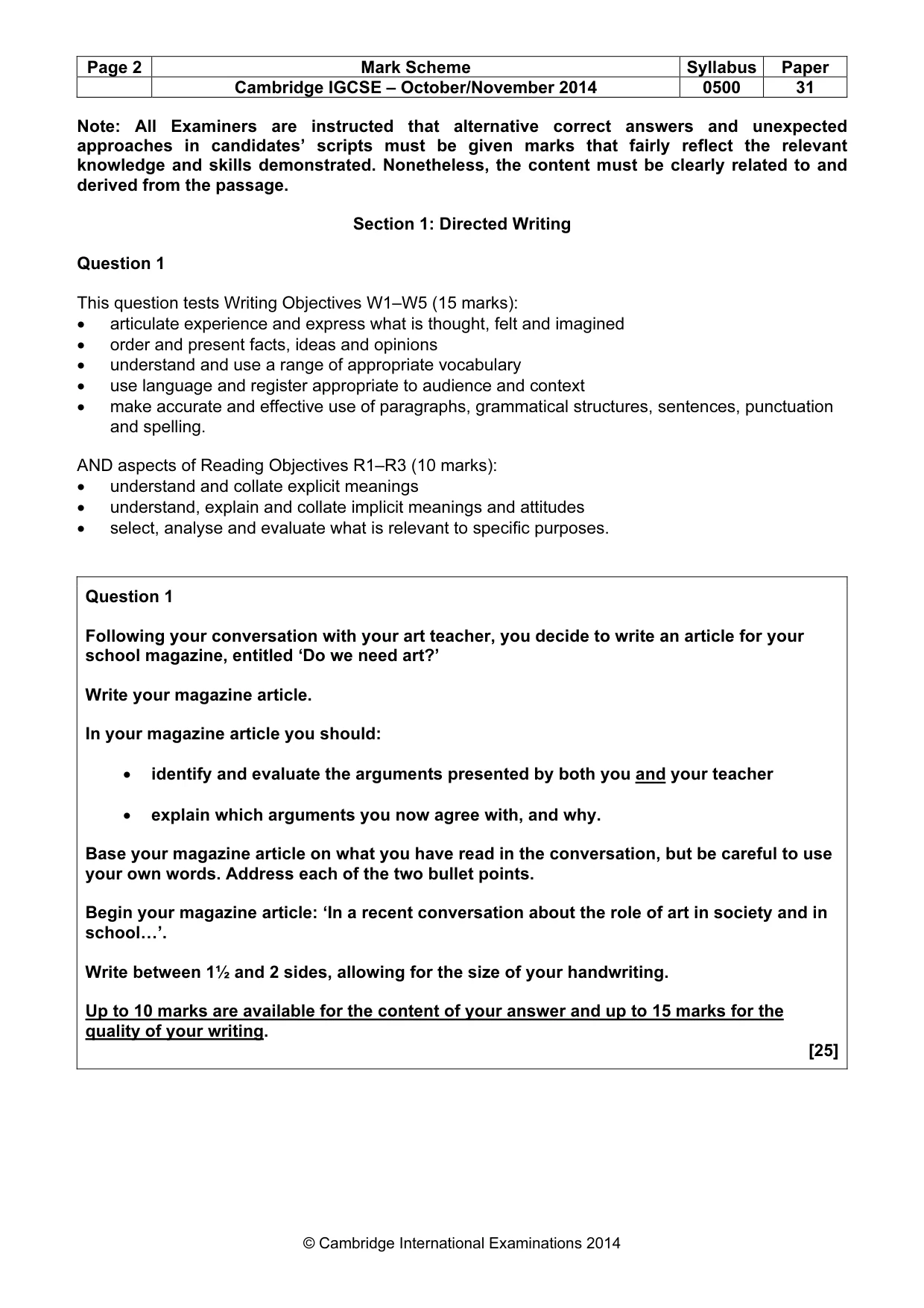
Page 2 Mark Scheme Syllabus Paper Cambridge IGCSE – October/November 2014 0500 31 © Cambridge International Examinations 2014 Note: All Examiners are instructed that alternative correct answers and unexpected approaches in candidates’ scripts must be given marks that fairly reflect the relevant knowledge and skills demonstrated. Nonetheless, the content must be clearly related to and derived from the passage. Section 1: Directed Writing Question 1 This question tests Writing Objectives W1–W5 (15 marks): • articulate experience and express what is thought, felt and imagined • order and present facts, ideas and opinions • understand and use a range of appropriate vocabulary • use language and register appropriate to audience and context • make accurate and effective use of paragraphs, grammatical structures, sentences, punctuation and spelling. AND aspects of Reading Objectives R1–R3 (10 marks): • understand and collate explicit meanings • understand, explain and collate implicit meanings and attitudes • select, analyse and evaluate what is relevant to specific purposes. Question 1 Following your conversation with your art teacher, you decide to write an article for your school magazine, entitled ‘Do we need art?’ Write your magazine article. In your magazine article you should: • identify and evaluate the arguments presented by both you and your teacher • explain which arguments you now agree with, and why. Base your magazine article on what you have read in the conversation, but be careful to use your own words. Address each of the two bullet points. Begin your magazine article: ‘In a recent conversation about the role of art in society and in school…’. Write between 1½ and 2 sides, allowing for the size of your handwriting. Up to 10 marks are available for the content of your answer and up to 15 marks for the quality of your writing. [25]
Mark scheme, page 3
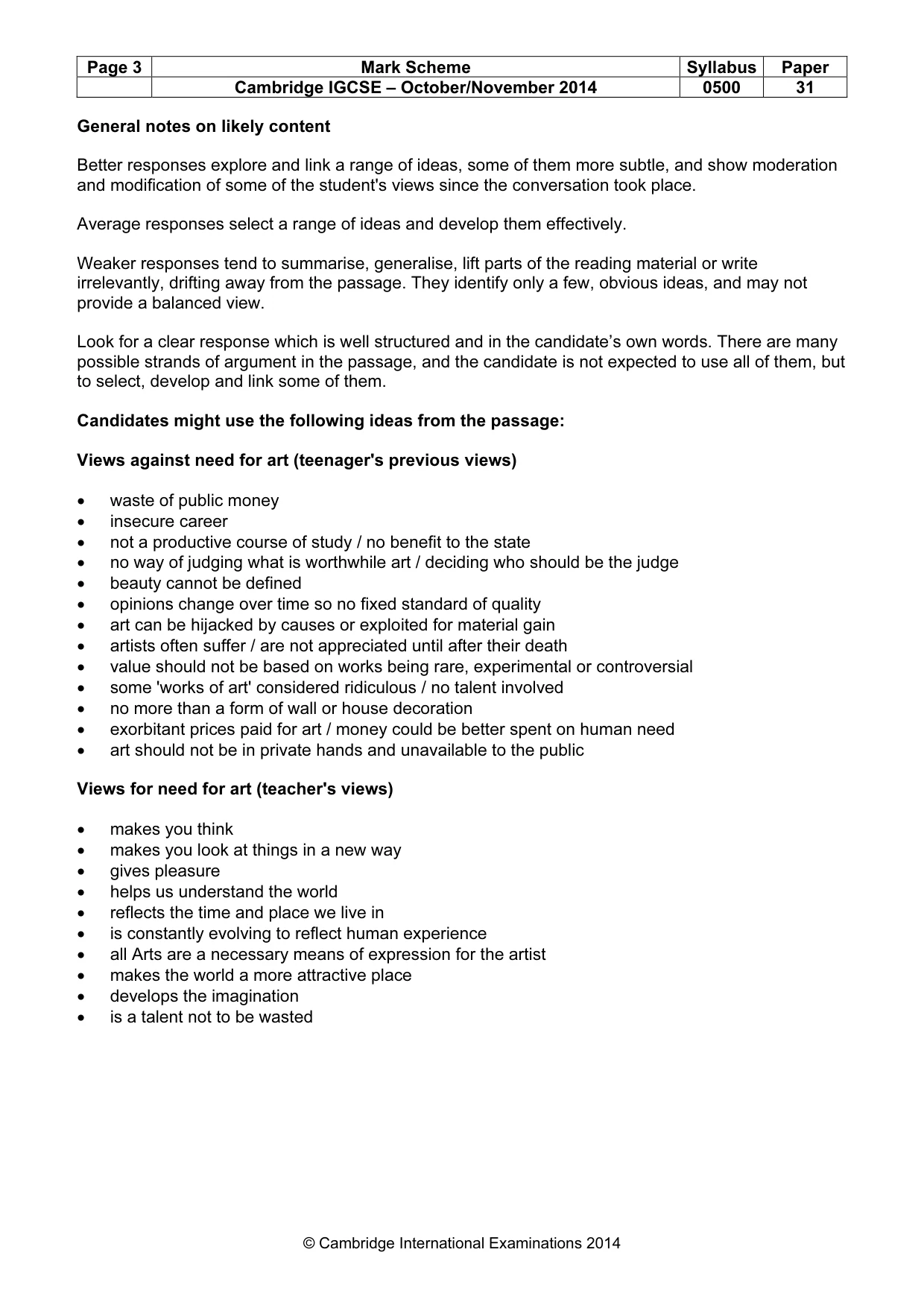
Page 3 Mark Scheme Syllabus Paper Cambridge IGCSE – October/November 2014 0500 31 © Cambridge International Examinations 2014 General notes on likely content Better responses explore and link a range of ideas, some of them more subtle, and show moderation and modification of some of the student's views since the conversation took place. Average responses select a range of ideas and develop them effectively. Weaker responses tend to summarise, generalise, lift parts of the reading material or write irrelevantly, drifting away from the passage. They identify only a few, obvious ideas, and may not provide a balanced view. Look for a clear response which is well structured and in the candidate’s own words. There are many possible strands of argument in the passage, and the candidate is not expected to use all of them, but to select, develop and link some of them. Candidates might use the following ideas from the passage: Views against need for art (teenager's previous views) • waste of public money • insecure career • not a productive course of study / no benefit to the state • no way of judging what is worthwhile art / deciding who should be the judge • beauty cannot be defined • opinions change over time so no fixed standard of quality • art can be hijacked by causes or exploited for material gain • artists often suffer / are not appreciated until after their death • value should not be based on works being rare, experimental or controversial • some 'works of art' considered ridiculous / no talent involved • no more than a form of wall or house decoration • exorbitant prices paid for art / money could be better spent on human need • art should not be in private hands and unavailable to the public Views for need for art (teacher's views) • makes you think • makes you look at things in a new way • gives pleasure • helps us understand the world • reflects the time and place we live in • is constantly evolving to reflect human experience • all Arts are a necessary means of expression for the artist • makes the world a more attractive place • develops the imagination • is a talent not to be wasted
Mark scheme, page 4
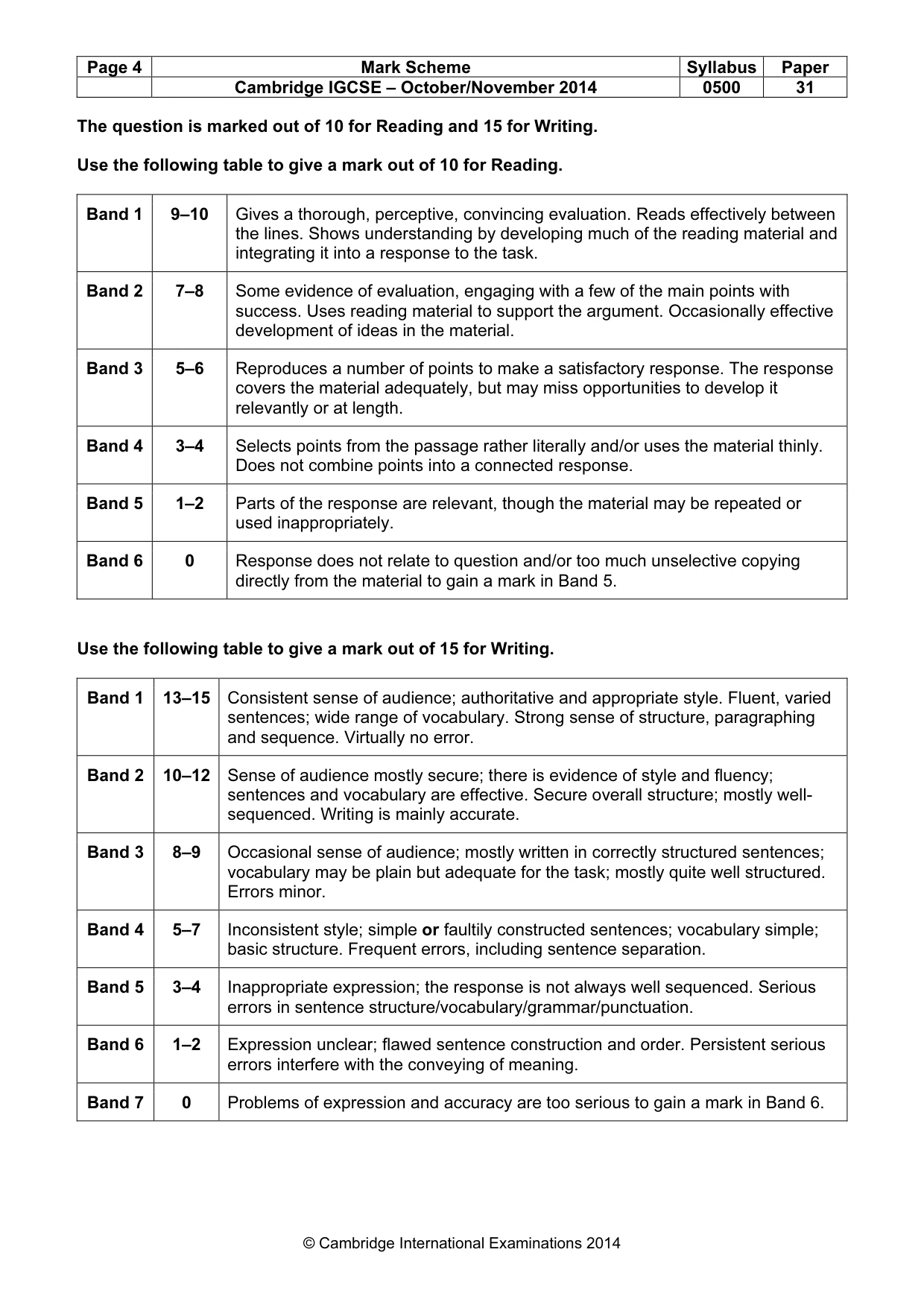
Page 4 Mark Scheme Syllabus Paper Cambridge IGCSE – October/November 2014 0500 31 © Cambridge International Examinations 2014 The question is marked out of 10 for Reading and 15 for Writing. Use the following table to give a mark out of 10 for Reading. Band 1 9–10 Gives a thorough, perceptive, convincing evaluation. Reads effectively between the lines. Shows understanding by developing much of the reading material and integrating it into a response to the task. Band 2 7–8 Some evidence of evaluation, engaging with a few of the main points with success. Uses reading material to support the argument. Occasionally effective development of ideas in the material. Band 3 5–6 Reproduces a number of points to make a satisfactory response. The response covers the material adequately, but may miss opportunities to develop it relevantly or at length. Band 4 3–4 Selects points from the passage rather literally and/or uses the material thinly. Does not combine points into a connected response. Band 5 1–2 Parts of the response are relevant, though the material may be repeated or used inappropriately. Band 6 0 Response does not relate to question and/or too much unselective copying directly from the material to gain a mark in Band 5. First variant Mark Scheme Use the following table to give a mark out of 15 for Writing. Band 1 13–15 Consistent sense of audience; authoritative and appropriate style. Fluent, varied sentences; wide range of vocabulary. Strong sense of structure, paragraphing and sequence. Virtually no error. Band 2 10–12 Sense of audience mostly secure; there is evidence of style and fluency; sentences and vocabulary are effective. Secure overall structure; mostly well- sequenced. Writing is mainly accurate. Band 3 8–9 Occasional sense of audience; mostly written in correctly structured sentences; vocabulary may be plain but adequate for the task; mostly quite well structured. Errors minor. Band 4 5–7 Inconsistent style; simple or faultily constructed sentences; vocabulary simple; basic structure. Frequent errors, including sentence separation. Band 5 3–4 Inappropriate expression; the response is not always well sequenced. Serious errors in sentence structure/vocabulary/grammar/punctuation. Band 6 1–2 Expression unclear; flawed sentence construction and order. Persistent serious errors interfere with the conveying of meaning. Band 7 0 Problems of expression and accuracy are too serious to gain a mark in Band 6. First variant Mark Scheme
Mark scheme, page 5
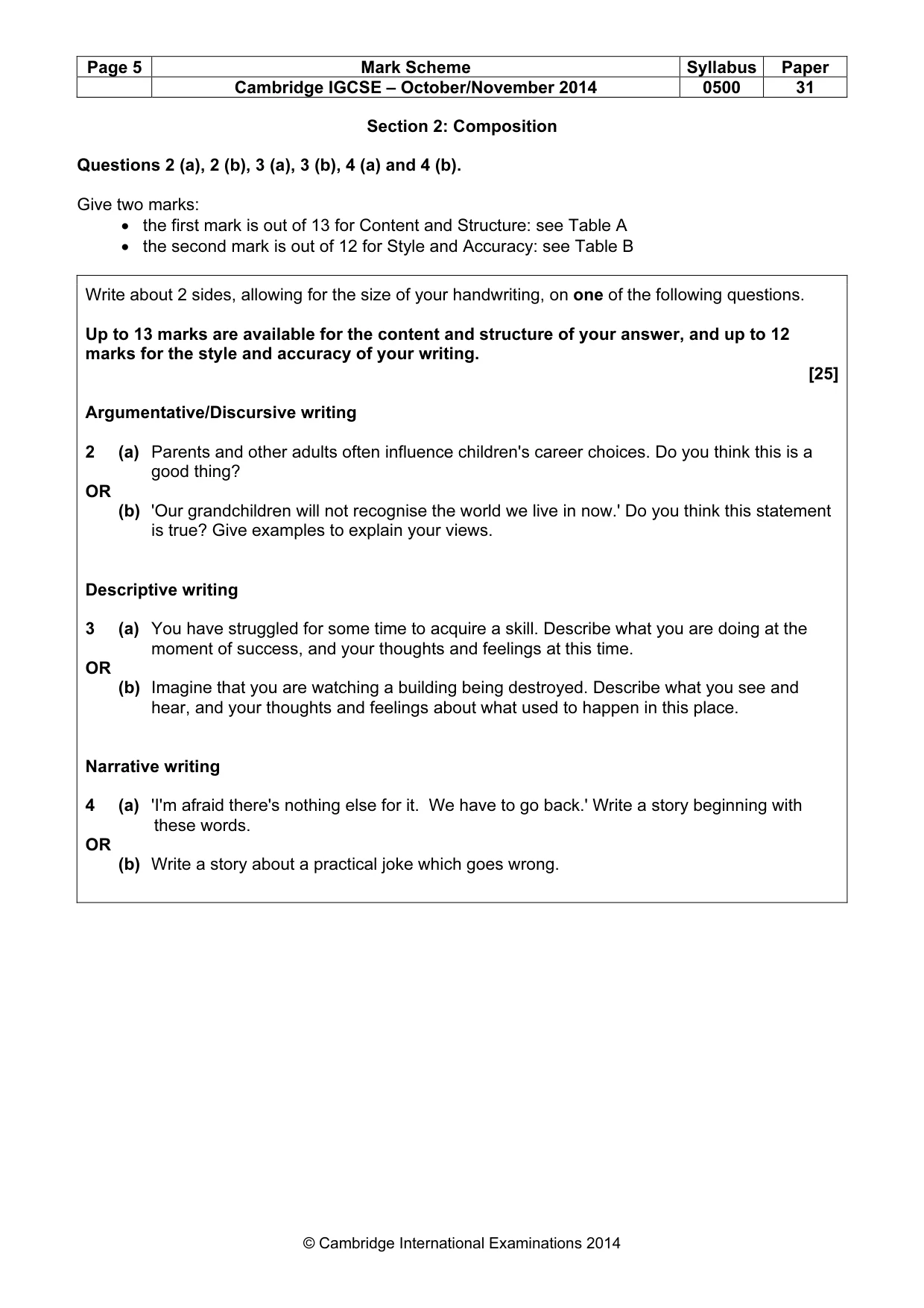
Page 5 Mark Scheme Syllabus Paper Cambridge IGCSE – October/November 2014 0500 31 © Cambridge International Examinations 2014 Section 2: Composition Questions 2 (a), 2 (b), 3 (a), 3 (b), 4 (a) and 4 (b). Give two marks: • the first mark is out of 13 for Content and Structure: see Table A • the second mark is out of 12 for Style and Accuracy: see Table B Write about 2 sides, allowing for the size of your handwriting, on one of the following questions. Up to 13 marks are available for the content and structure of your answer, and up to 12 marks for the style and accuracy of your writing. [25] Argumentative/Discursive writing 2 (a) Parents and other adults often influence children's career choices. Do you think this is a good thing? OR (b) 'Our grandchildren will not recognise the world we live in now.' Do you think this statement is true? Give examples to explain your views. Descriptive writing 3 (a) You have struggled for some time to acquire a skill. Describe what you are doing at the moment of success, and your thoughts and feelings at this time. OR (b) Imagine that you are watching a building being destroyed. Describe what you see and hear, and your thoughts and feelings about what used to happen in this place. Narrative writing 4 (a) 'I'm afraid there's nothing else for it. We have to go back.' Write a story beginning with these words. OR (b) Write a story about a practical joke which goes wrong.
Mark scheme, page 6
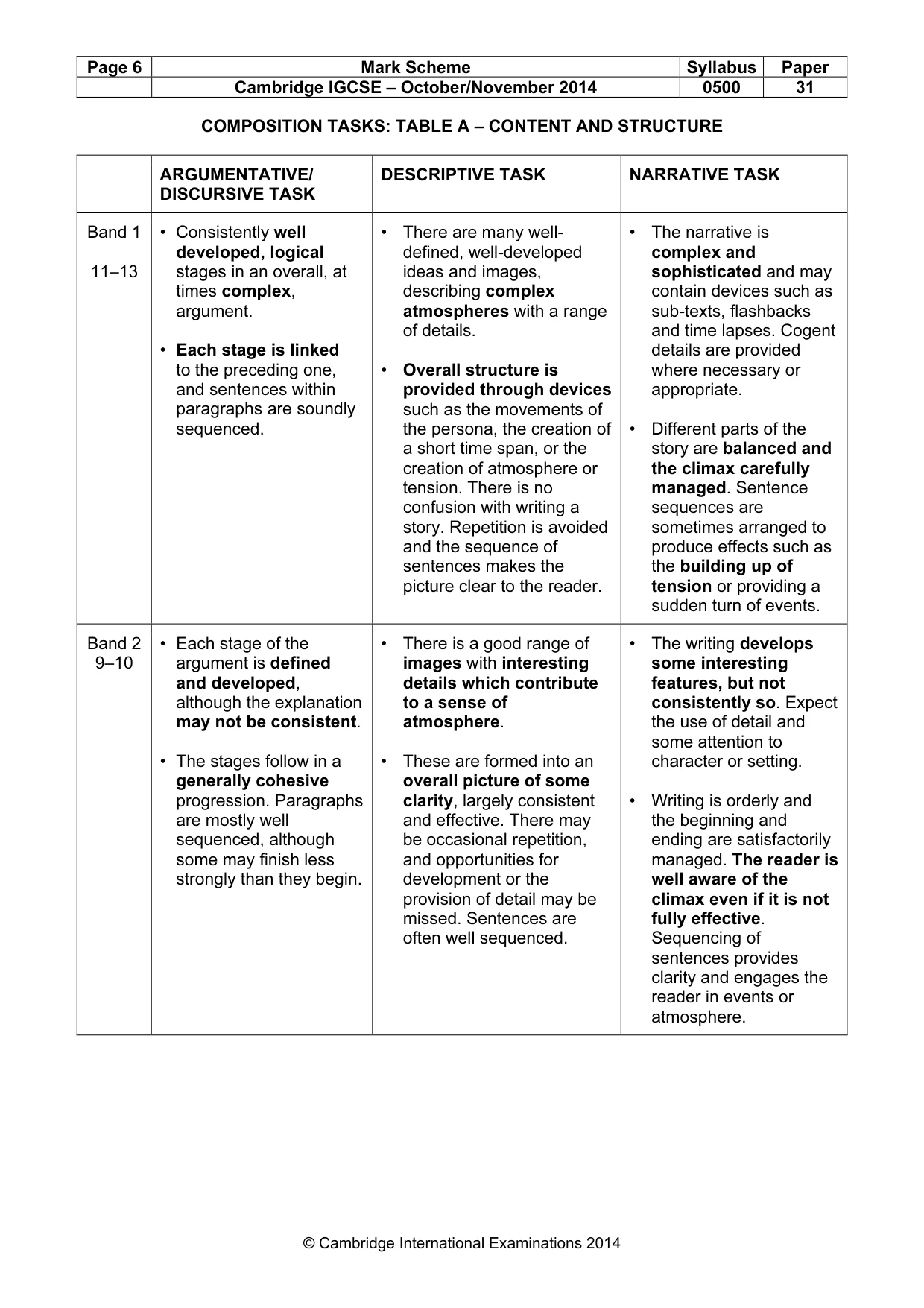
Page 6 Mark Scheme Syllabus Paper Cambridge IGCSE – October/November 2014 0500 31 © Cambridge International Examinations 2014 COMPOSITION TASKS: TABLE A – CONTENT AND STRUCTURE ARGUMENTATIVE/ DISCURSIVE TASK DESCRIPTIVE TASK NARRATIVE TASK Band 1 11–13 • Consistently well developed, logical stages in an overall, at times complex, argument. • Each stage is linked to the preceding one, and sentences within paragraphs are soundly sequenced. • There are many well- defined, well-developed ideas and images, describing complex atmospheres with a range of details. • Overall structure is provided through devices such as the movements of the persona, the creation of a short time span, or the creation of atmosphere or tension. There is no confusion with writing a story. Repetition is avoided and the sequence of sentences makes the picture clear to the reader. • The narrative is complex and sophisticated and may contain devices such as sub-texts, flashbacks and time lapses. Cogent details are provided where necessary or appropriate. • Different parts of the story are balanced and the climax carefully managed. Sentence sequences are sometimes arranged to produce effects such as the building up of tension or providing a sudden turn of events. Band 2 9–10 • Each stage of the argument is defined and developed, although the explanation may not be consistent. • The stages follow in a generally cohesive progression. Paragraphs are mostly well sequenced, although some may finish less strongly than they begin. • There is a good range of images with interesting details which contribute to a sense of atmosphere. • These are formed into an overall picture of some clarity, largely consistent and effective. There may be occasional repetition, and opportunities for development or the provision of detail may be missed. Sentences are often well sequenced. • The writing develops some interesting features, but not consistently so. Expect the use of detail and some attention to character or setting. • Writing is orderly and the beginning and ending are satisfactorily managed. The reader is well aware of the climax even if it is not fully effective. Sequencing of sentences provides clarity and engages the reader in events or atmosphere.
Mark scheme, page 7
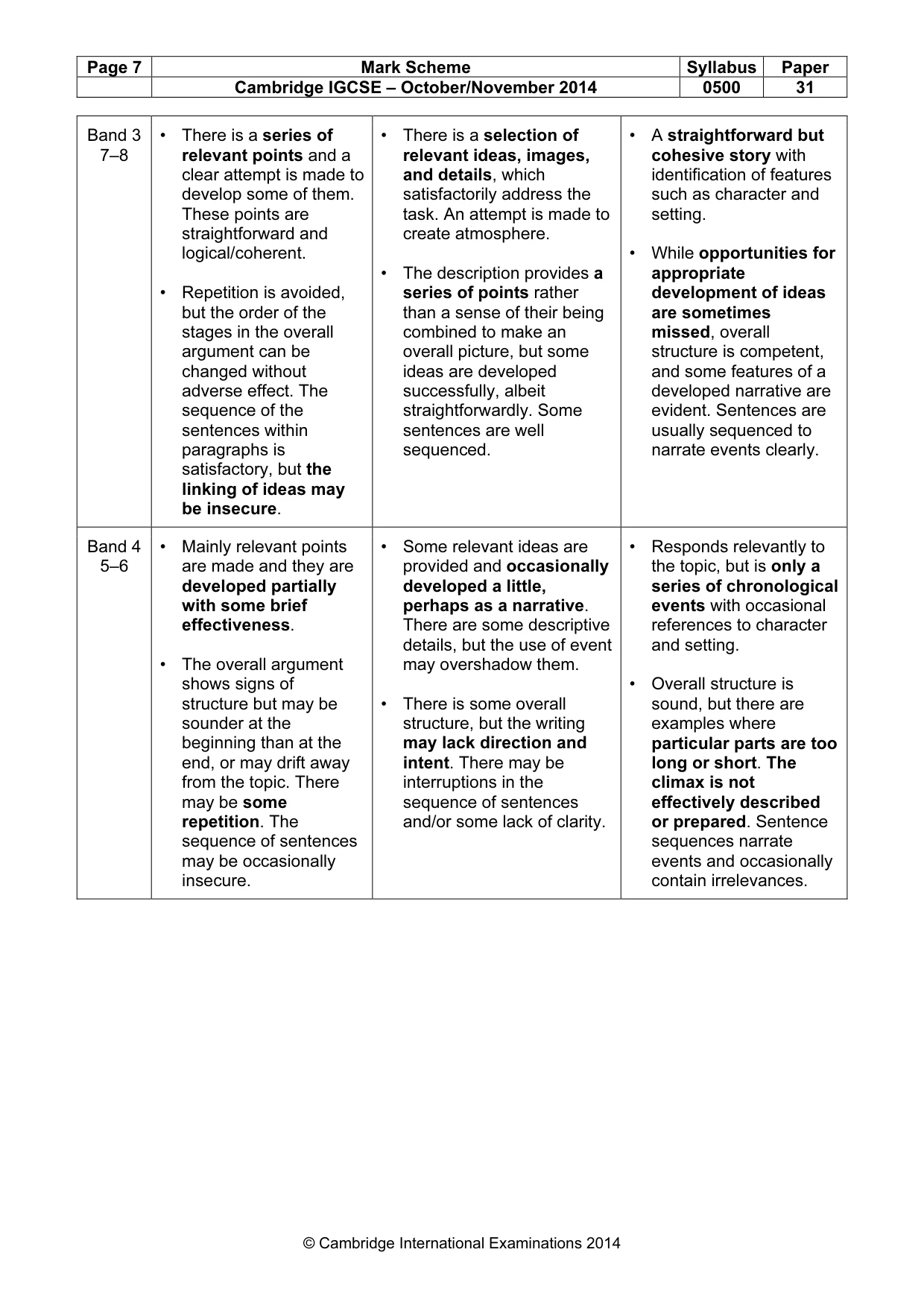
Page 7 Mark Scheme Syllabus Paper Cambridge IGCSE – October/November 2014 0500 31 © Cambridge International Examinations 2014 Band 3 7–8 • There is a series of relevant points and a clear attempt is made to develop some of them. These points are straightforward and logical/coherent. • Repetition is avoided, but the order of the stages in the overall argument can be changed without adverse effect. The sequence of the sentences within paragraphs is satisfactory, but the linking of ideas may be insecure. • There is a selection of relevant ideas, images, and details, which satisfactorily address the task. An attempt is made to create atmosphere. • The description provides a series of points rather than a sense of their being combined to make an overall picture, but some ideas are developed successfully, albeit straightforwardly. Some sentences are well sequenced. • A straightforward but cohesive story with identification of features such as character and setting. • While opportunities for appropriate development of ideas are sometimes missed, overall structure is competent, and some features of a developed narrative are evident. Sentences are usually sequenced to narrate events clearly. Band 4 5–6 • Mainly relevant points are made and they are developed partially with some brief effectiveness. • The overall argument shows signs of structure but may be sounder at the beginning than at the end, or may drift away from the topic. There may be some repetition. The sequence of sentences may be occasionally insecure. • Some relevant ideas are provided and occasionally developed a little, perhaps as a narrative. There are some descriptive details, but the use of event may overshadow them. • There is some overall structure, but the writing may lack direction and intent. There may be interruptions in the sequence of sentences and/or some lack of clarity. • Responds relevantly to the topic, but is only a series of chronological events with occasional references to character and setting. • Overall structure is sound, but there are examples where particular parts are too long or short. The climax is not effectively described or prepared. Sentence sequences narrate events and occasionally contain irrelevances.
Mark scheme, page 8
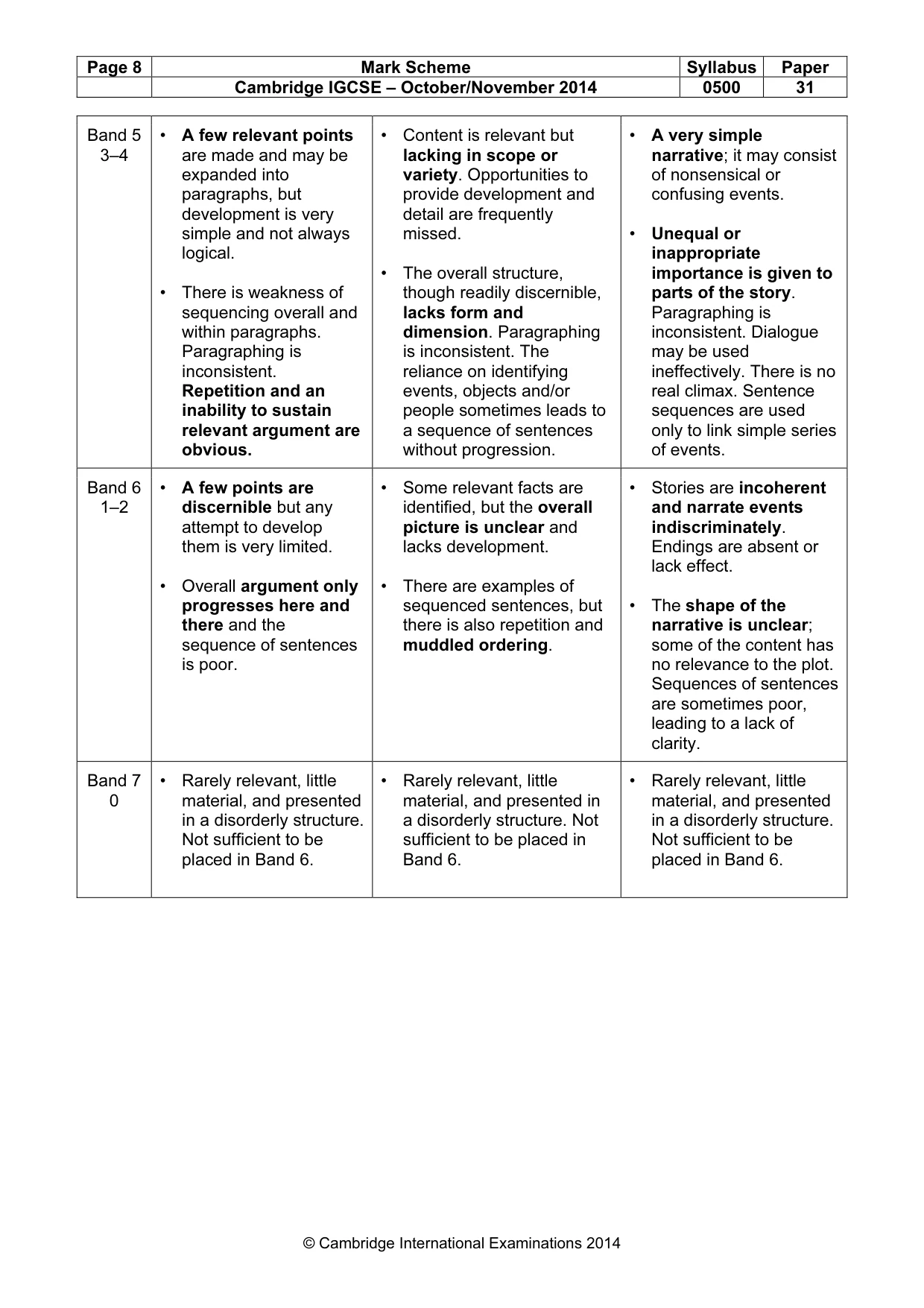
Page 8 Mark Scheme Syllabus Paper Cambridge IGCSE – October/November 2014 0500 31 © Cambridge International Examinations 2014 Band 5 3–4 • A few relevant points are made and may be expanded into paragraphs, but development is very simple and not always logical. • There is weakness of sequencing overall and within paragraphs. Paragraphing is inconsistent. Repetition and an inability to sustain relevant argument are obvious. • Content is relevant but lacking in scope or variety. Opportunities to provide development and detail are frequently missed. • The overall structure, though readily discernible, lacks form and dimension. Paragraphing is inconsistent. The reliance on identifying events, objects and/or people sometimes leads to a sequence of sentences without progression. • A very simple narrative; it may consist of nonsensical or confusing events. • Unequal or inappropriate importance is given to parts of the story. Paragraphing is inconsistent. Dialogue may be used ineffectively. There is no real climax. Sentence sequences are used only to link simple series of events. Band 6 1–2 • A few points are discernible but any attempt to develop them is very limited. • Overall argument only progresses here and there and the sequence of sentences is poor. • Some relevant facts are identified, but the overall picture is unclear and lacks development. • There are examples of sequenced sentences, but there is also repetition and muddled ordering. • Stories are incoherent and narrate events indiscriminately. Endings are absent or lack effect. • The shape of the narrative is unclear; some of the content has no relevance to the plot. Sequences of sentences are sometimes poor, leading to a lack of clarity. Band 7 0 • Rarely relevant, little material, and presented in a disorderly structure. Not sufficient to be placed in Band 6. • Rarely relevant, little material, and presented in a disorderly structure. Not sufficient to be placed in Band 6. • Rarely relevant, little material, and presented in a disorderly structure. Not sufficient to be placed in Band 6.
Mark scheme, page 9
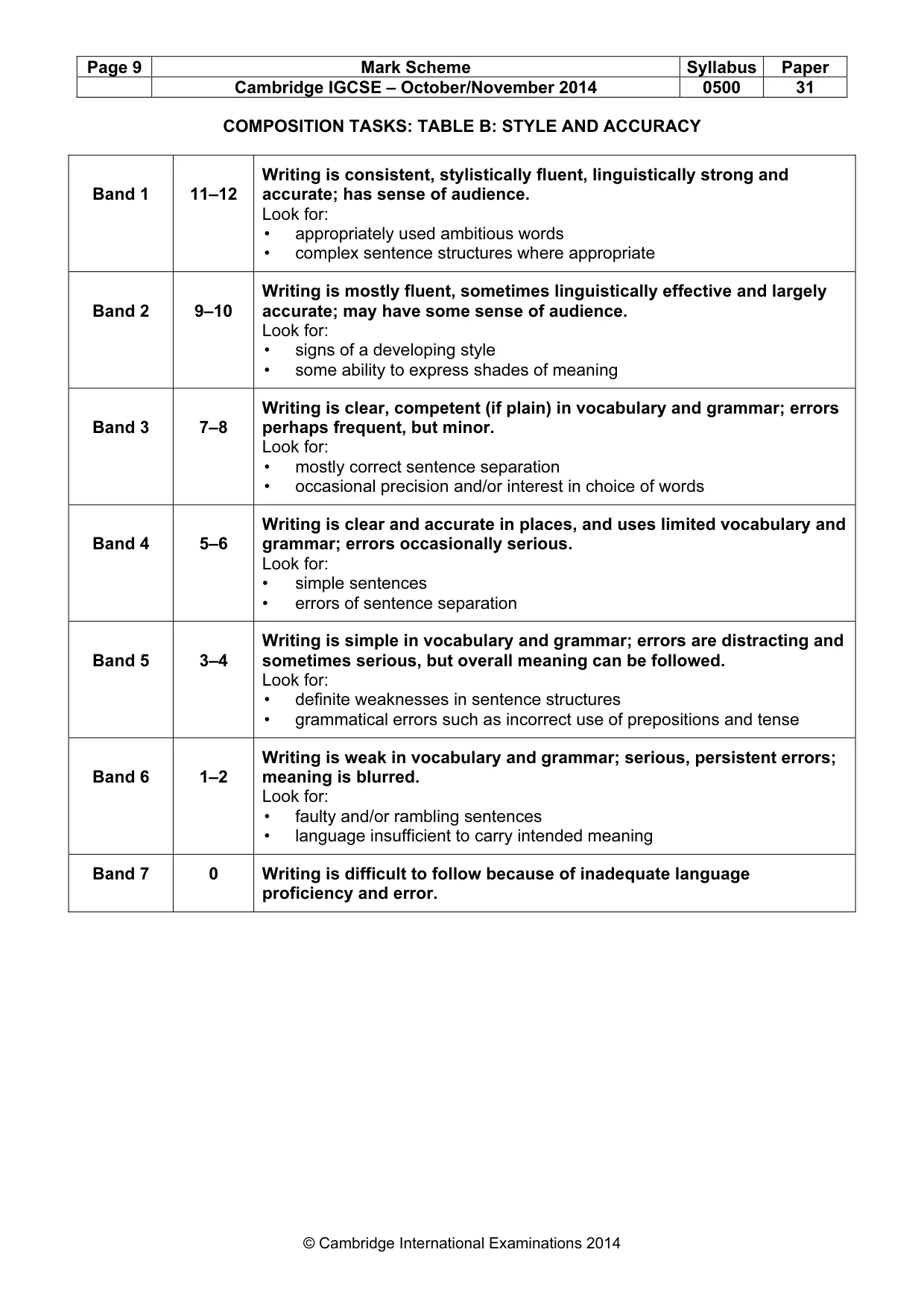
Page 9 Mark Scheme Syllabus Paper Cambridge IGCSE – October/November 2014 0500 31 © Cambridge International Examinations 2014 COMPOSITION TASKS: TABLE B: STYLE AND ACCURACY Band 1 11–12 Writing is consistent, stylistically fluent, linguistically strong and accurate; has sense of audience. Look for: • appropriately used ambitious words • complex sentence structures where appropriate Band 2 9–10 Writing is mostly fluent, sometimes linguistically effective and largely accurate; may have some sense of audience. Look for: • signs of a developing style • some ability to express shades of meaning Band 3 7–8 Writing is clear, competent (if plain) in vocabulary and grammar; errors perhaps frequent, but minor. Look for: • mostly correct sentence separation • occasional precision and/or interest in choice of words Band 4 5–6 Writing is clear and accurate in places, and uses limited vocabulary and grammar; errors occasionally serious. Look for: • simple sentences • errors of sentence separation Band 5 3–4 Writing is simple in vocabulary and grammar; errors are distracting and sometimes serious, but overall meaning can be followed. Look for: • definite weaknesses in sentence structures • grammatical errors such as incorrect use of prepositions and tense Band 6 1–2 Writing is weak in vocabulary and grammar; serious, persistent errors; meaning is blurred. Look for: • faulty and/or rambling sentences • language insufficient to carry intended meaning Band 7 0 Writing is difficult to follow because of inadequate language proficiency and error.
What you needed in this session
Cambridge’s own grade thresholds for 2014 Oct/Nov, Paper 3 · Variant 1. A higher threshold means an easier paper — the bar moves with how the cohort did.