Cambridge IGCSE English - First Language 0500 — 2014 Oct/Nov Paper 2 · Variant 1
0500/21/O/N/14 · 50 marks · ≈56 min
The question paper and its mark scheme, free to read here and free to download. This is Cambridge’s own paper, exactly as it was sat.
Question paper12 pages
Mark scheme11 pages
Answers below. Sit the paper first if you are practising.
Paper as text
Question paper, page 1
This document consists of 11 printed pages, 1 blank page and 1 Reading Booklet Insert. DC (RCL (KM)) 83638/3 © UCLES 2014 [Turn over Cambridge International Examinations Cambridge International General Certificate of Secondary Education * 5 9 8 7 4 7 0 8 6 1 * FIRST LANGUAGE ENGLISH 0500/21 Paper 2 Reading Passages (Extended) October/November 2014 2 hours Candidates answer on the Question Paper READ THESE INSTRUCTIONS FIRST Write your Centre number, candidate number and name in the spaces provided. Write in dark blue or black pen. Do not use staples, paper clips, glue or correction fluid. DO NOT WRITE IN ANY BARCODES. Answer all questions in the space provided. If additional space is required, you should use the lined pages at the end of this booklet. The question number(s) must be clearly shown. Dictionaries are not permitted. The Reading Booklet Insert contains the reading passages for use with all questions on the Question Paper. The Insert is not assessed by the Examiner. The number of marks is given in brackets [ ] at the end of each question or part question.
Question paper, page 2
2 0500/21/O/N/14 © UCLES 2014 1 Imagine you are Elsie Clinch. Write a letter of complaint to the tour company. In your letter, you should: • describe the tour bus and the route • give your impressions of the driver and the office staff • recommend some actions the company should take to improve the experience. Base your letter on what you have read in Passage A. Address all three bullet points. Be careful to use your own words. Begin your letter: ‘Dear Sir or Madam, I was recently a passenger on one of your tours…’ Write between 1½ and 2 sides, allowing for the size of your handwriting. Up to 15 marks are available for the content of your answer, and up to 5 marks for the quality of your writing. … … … … … … … … … … … … … … … … … … …
Question paper, page 3
3 0500/21/O/N/14 © UCLES 2014 [Turn over … … … … … … … … … … … … … … … … … … … … … … … … … … … …
Question paper, page 4
4 0500/21/O/N/14 © UCLES 2014 … … … … … … … … … … … … … … … … … … … … … … … … … … … [Total: 20]
Question paper, page 5
5 0500/21/O/N/14 © UCLES 2014 [Turn over [Turn over for Question 2]
Question paper, page 6
6 0500/21/O/N/14 © UCLES 2014 2 Re-read the descriptions of: (a) Elsie Clinch in paragraph 3, beginning with ‘Elsie Clinch stomped...’; (b) the road in paragraph 8, beginning with ‘Eventually, the plains gave way…’. Select words and phrases from these descriptions, and explain how the writer has created effects by using this language. Write between 1 and 1½ sides, allowing for the size of your handwriting. Up to 10 marks are available for the content of your answer. … … … … … … … … … … … … … … … … … … … … … …
Question paper, page 7
7 0500/21/O/N/14 © UCLES 2014 [Turn over … … … … … … … … … … … … … … … … … … … … … … … … … … … [Total: 10]
Question paper, page 8
8 0500/21/O/N/14 © UCLES 2014 3 Summarise: (a) the uses and appeal of Greyhound-type buses, as described in Passage B; (b) the considerations Elsie had taken into account when packing and preparing for the tour, as described in Passage A. Your summary must be in continuous writing (full sentences; not note form). Use your own words as far as possible. Aim to write no more than one side in total, allowing for the size of your handwriting. Write your response on the lines provided on page 9. Up to 15 marks are available for the content of your answer, and up to 5 marks for the quality of your writing.
Question paper, page 9
9 0500/21/O/N/14 © UCLES 2014 [Turn over … … … … … … … … … … … … … … … … … … … … … … … … … … … [Total: 20]
Question paper, page 10
10 0500/21/O/N/14 © UCLES 2014 Additional Page If you use the following lined page to complete the answer(s) to any question(s), the question number(s) must be clearly shown. … … … … … … … … … … … … … … … … … … … … … … … … … …
Question paper, page 11
11 0500/21/O/N/14 © UCLES 2014 Additional Page If you use the following lined page to complete the answer(s) to any question(s), the question number(s) must be clearly shown. … … … … … … … … … … … … … … … … … … … … … … … … … …
Question paper, page 12
12 0500/21/O/N/14 © UCLES 2014 Permission to reproduce items where third-party owned material protected by copyright is included has been sought and cleared where possible. Every reasonable effort has been made by the publisher (UCLES) to trace copyright holders, but if any items requiring clearance have unwittingly been included, the publisher will be pleased to make amends at the earliest possible opportunity. Cambridge International Examinations is part of the Cambridge Assessment Group. Cambridge Assessment is the brand name of University of Cambridge Local Examinations Syndicate (UCLES), which is itself a department of the University of Cambridge. BLANK PAGE
Mark scheme, page 1
® IGCSE is the registered trademark of Cambridge International Examinations. CAMBRIDGE INTERNATIONAL EXAMINATIONS Cambridge International General Certificate of Secondary Education MARK SCHEME for the October/November 2014 series 0500 FIRST LANGUAGE ENGLISH 0500/21 Paper 2 (Reading Passages – Extended), maximum raw mark 50 This mark scheme is published as an aid to teachers and candidates, to indicate the requirements of the examination. It shows the basis on which Examiners were instructed to award marks. It does not indicate the details of the discussions that took place at an Examiners’ meeting before marking began, which would have considered the acceptability of alternative answers. Mark schemes should be read in conjunction with the question paper and the Principal Examiner Report for Teachers. Cambridge will not enter into discussions about these mark schemes. Cambridge is publishing the mark schemes for the October/November 2014 series for most Cambridge IGCSE®, Cambridge International A and AS Level components and some Cambridge O Level components.
Mark scheme, page 2
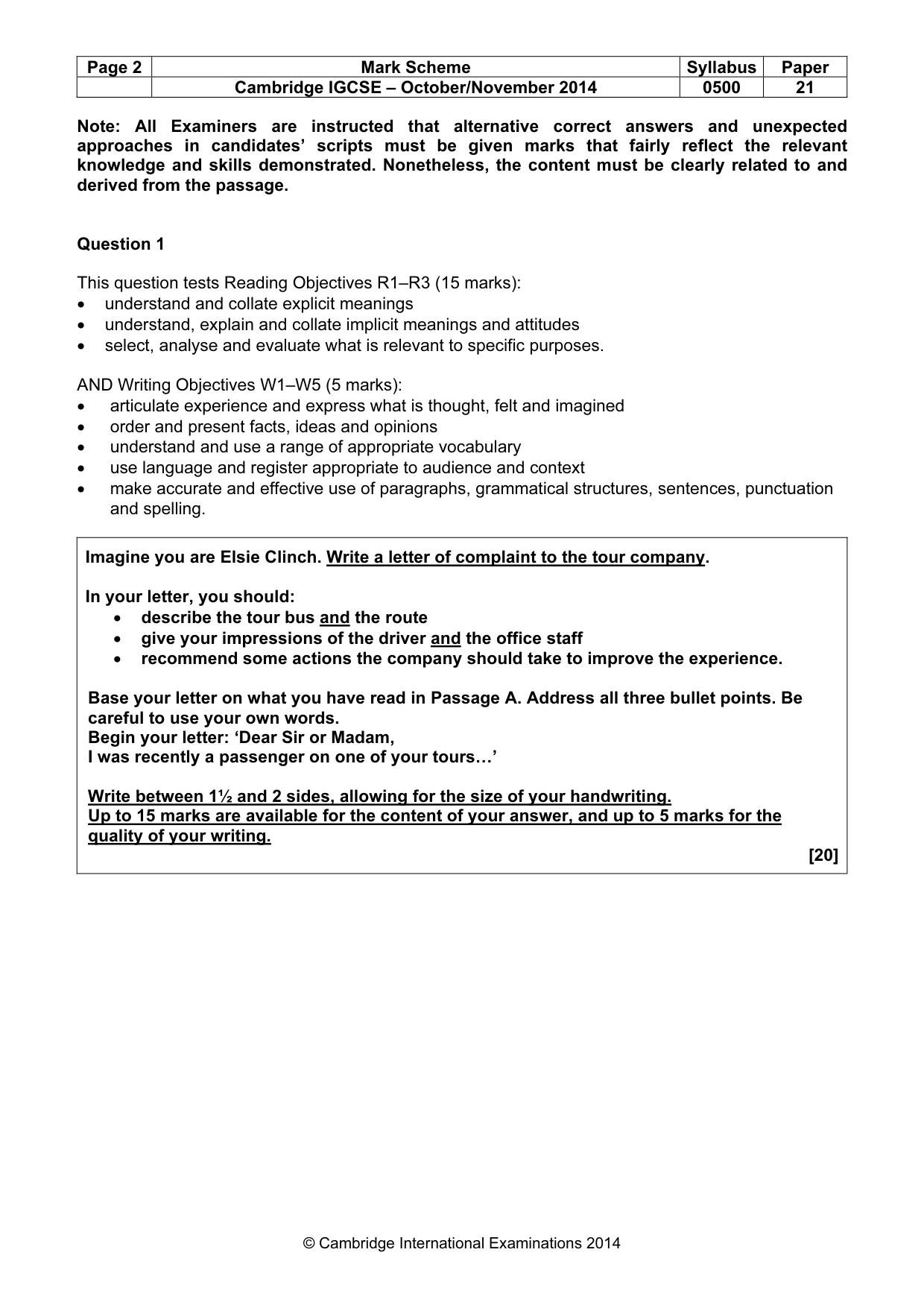
Page 2 Mark Scheme Syllabus Paper Cambridge IGCSE – October/November 2014 0500 21 © Cambridge International Examinations 2014 Note: All Examiners are instructed that alternative correct answers and unexpected approaches in candidates’ scripts must be given marks that fairly reflect the relevant knowledge and skills demonstrated. Nonetheless, the content must be clearly related to and derived from the passage. Question 1 This question tests Reading Objectives R1–R3 (15 marks): • understand and collate explicit meanings • understand, explain and collate implicit meanings and attitudes • select, analyse and evaluate what is relevant to specific purposes. AND Writing Objectives W1–W5 (5 marks): • articulate experience and express what is thought, felt and imagined • order and present facts, ideas and opinions • understand and use a range of appropriate vocabulary • use language and register appropriate to audience and context • make accurate and effective use of paragraphs, grammatical structures, sentences, punctuation and spelling. Imagine you are Elsie Clinch. Write a letter of complaint to the tour company. In your letter, you should: • describe the tour bus and the route • give your impressions of the driver and the office staff • recommend some actions the company should take to improve the experience. Base your letter on what you have read in Passage A. Address all three bullet points. Be careful to use your own words. Begin your letter: ‘Dear Sir or Madam, I was recently a passenger on one of your tours…’ Write between 1½ and 2 sides, allowing for the size of your handwriting. Up to 15 marks are available for the content of your answer, and up to 5 marks for the quality of your writing. [20]
Mark scheme, page 3
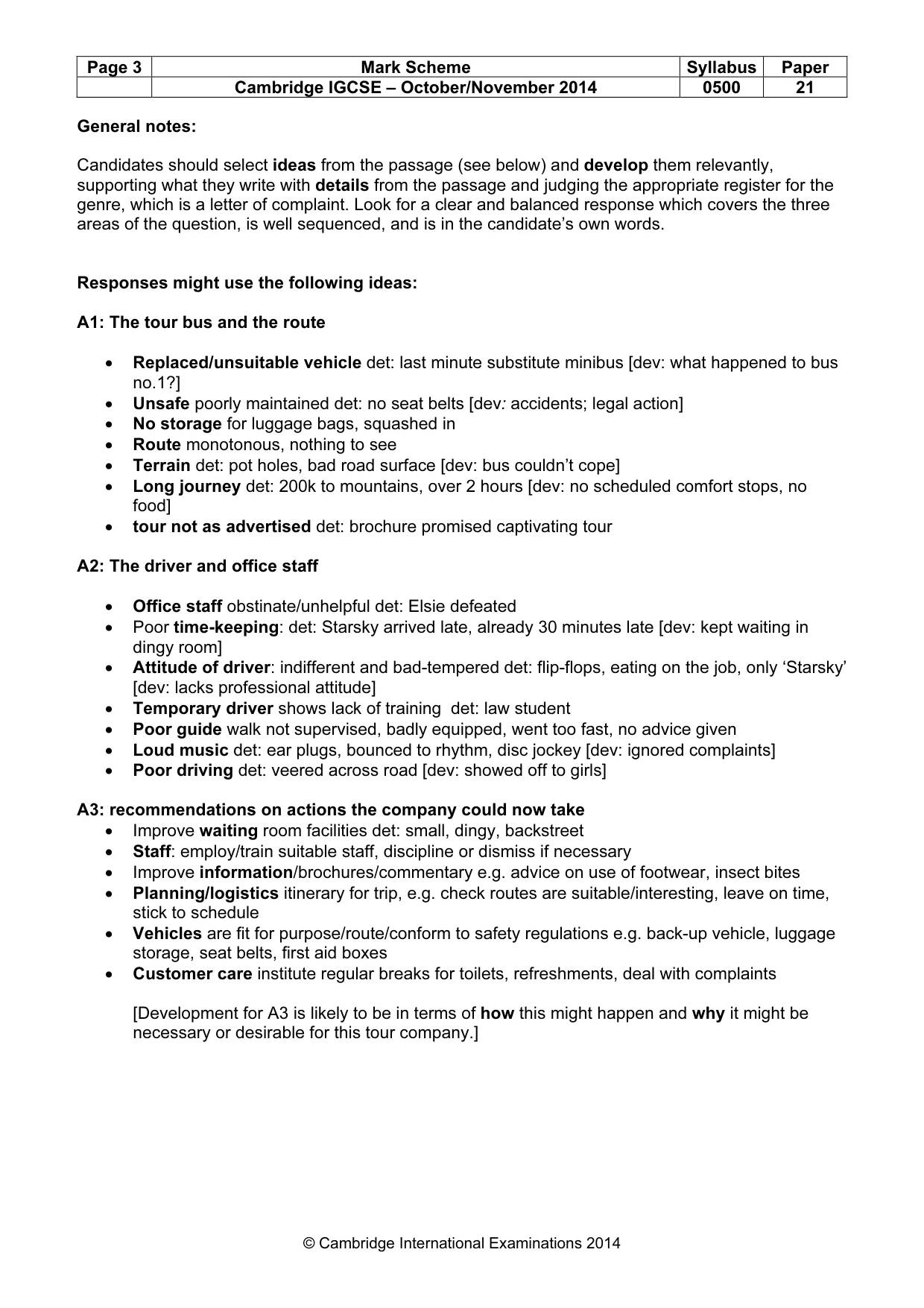
Page 3 Mark Scheme Syllabus Paper Cambridge IGCSE – October/November 2014 0500 21 © Cambridge International Examinations 2014 General notes: Candidates should select ideas from the passage (see below) and develop them relevantly, supporting what they write with details from the passage and judging the appropriate register for the genre, which is a letter of complaint. Look for a clear and balanced response which covers the three areas of the question, is well sequenced, and is in the candidate’s own words. Responses might use the following ideas: A1: The tour bus and the route • Replaced/unsuitable vehicle det: last minute substitute minibus [dev: what happened to bus no.1?] • Unsafe poorly maintained det: no seat belts [dev: accidents; legal action] • No storage for luggage bags, squashed in • Route monotonous, nothing to see • Terrain det: pot holes, bad road surface [dev: bus couldn’t cope] • Long journey det: 200k to mountains, over 2 hours [dev: no scheduled comfort stops, no food] • tour not as advertised det: brochure promised captivating tour A2: The driver and office staff • Office staff obstinate/unhelpful det: Elsie defeated • Poor time-keeping: det: Starsky arrived late, already 30 minutes late [dev: kept waiting in dingy room] • Attitude of driver: indifferent and bad-tempered det: flip-flops, eating on the job, only ‘Starsky’ [dev: lacks professional attitude] • Temporary driver shows lack of training det: law student • Poor guide walk not supervised, badly equipped, went too fast, no advice given • Loud music det: ear plugs, bounced to rhythm, disc jockey [dev: ignored complaints] • Poor driving det: veered across road [dev: showed off to girls] A3: recommendations on actions the company could now take • Improve waiting room facilities det: small, dingy, backstreet • Staff: employ/train suitable staff, discipline or dismiss if necessary • Improve information/brochures/commentary e.g. advice on use of footwear, insect bites • Planning/logistics itinerary for trip, e.g. check routes are suitable/interesting, leave on time, stick to schedule • Vehicles are fit for purpose/route/conform to safety regulations e.g. back-up vehicle, luggage storage, seat belts, first aid boxes • Customer care institute regular breaks for toilets, refreshments, deal with complaints [Development for A3 is likely to be in terms of how this might happen and why it might be necessary or desirable for this tour company.]
Mark scheme, page 4
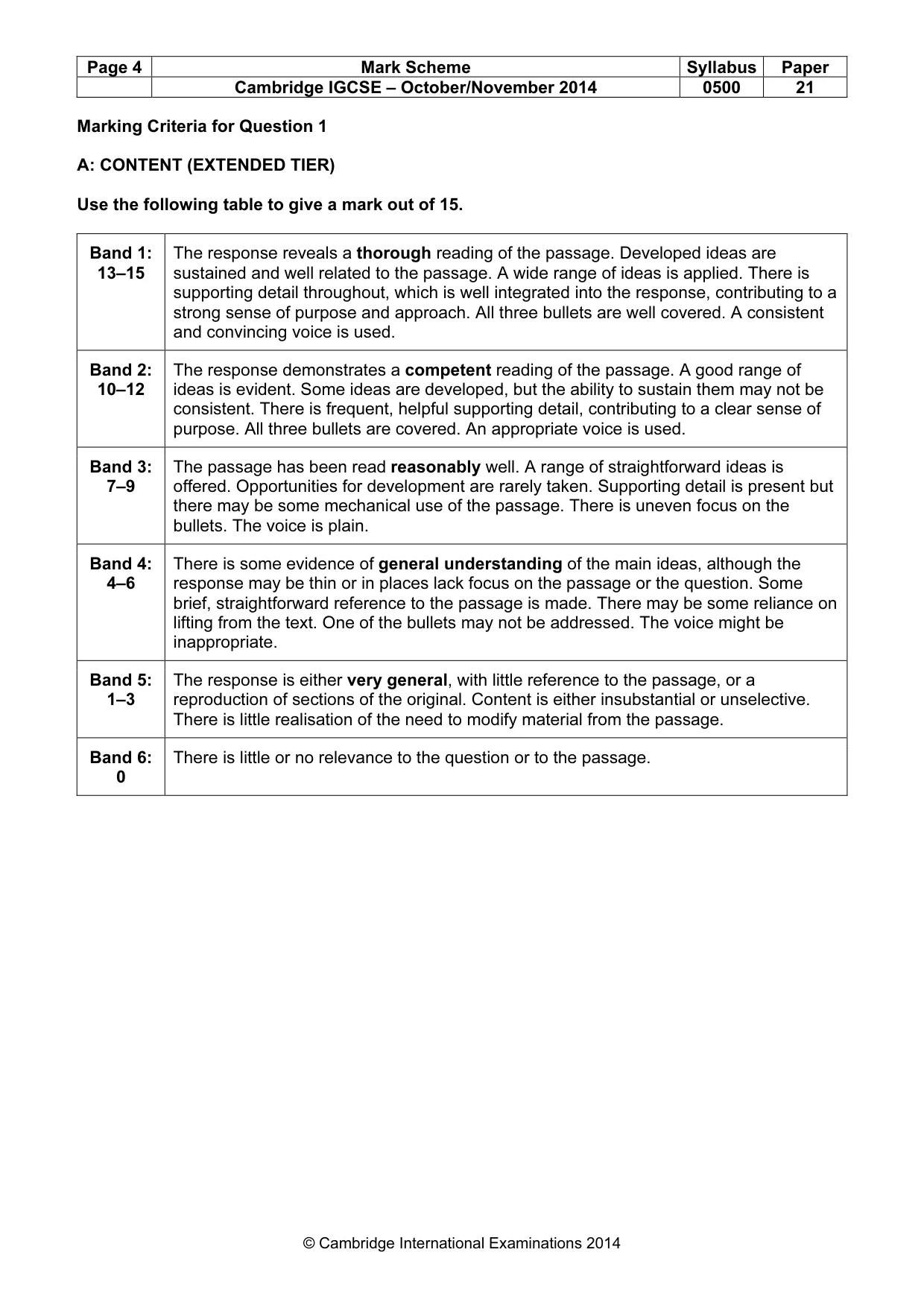
Page 4 Mark Scheme Syllabus Paper Cambridge IGCSE – October/November 2014 0500 21 © Cambridge International Examinations 2014 Marking Criteria for Question 1 A: CONTENT (EXTENDED TIER) Use the following table to give a mark out of 15. Band 1: 13–15 The response reveals a thorough reading of the passage. Developed ideas are sustained and well related to the passage. A wide range of ideas is applied. There is supporting detail throughout, which is well integrated into the response, contributing to a strong sense of purpose and approach. All three bullets are well covered. A consistent and convincing voice is used. Band 2: 10–12 The response demonstrates a competent reading of the passage. A good range of ideas is evident. Some ideas are developed, but the ability to sustain them may not be consistent. There is frequent, helpful supporting detail, contributing to a clear sense of purpose. All three bullets are covered. An appropriate voice is used. Band 3: 7–9 The passage has been read reasonably well. A range of straightforward ideas is offered. Opportunities for development are rarely taken. Supporting detail is present but there may be some mechanical use of the passage. There is uneven focus on the bullets. The voice is plain. Band 4: 4–6 There is some evidence of general understanding of the main ideas, although the response may be thin or in places lack focus on the passage or the question. Some brief, straightforward reference to the passage is made. There may be some reliance on lifting from the text. One of the bullets may not be addressed. The voice might be inappropriate. Band 5: 1–3 The response is either very general, with little reference to the passage, or a reproduction of sections of the original. Content is either insubstantial or unselective. There is little realisation of the need to modify material from the passage. Band 6: 0 There is little or no relevance to the question or to the passage.
Mark scheme, page 5
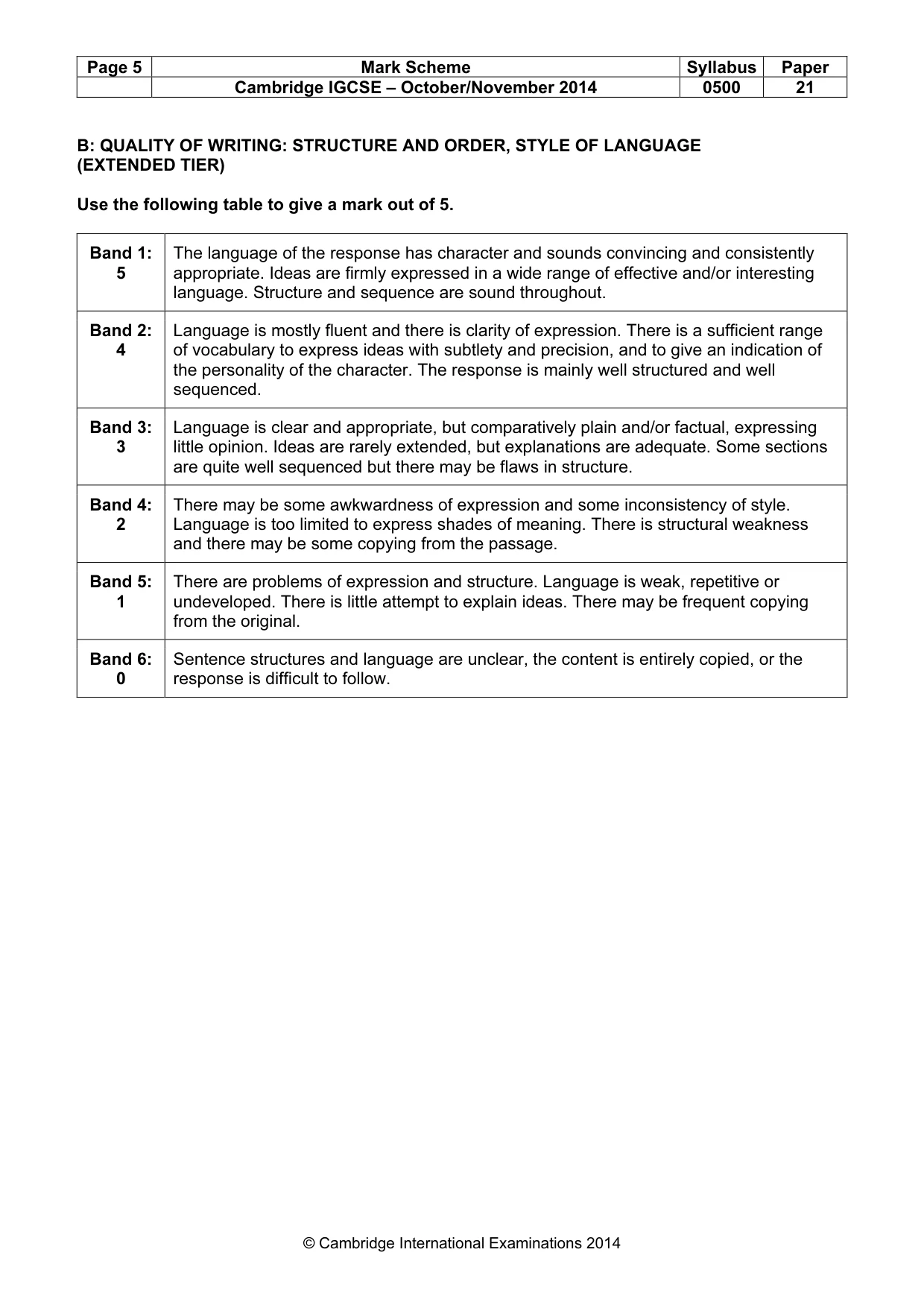
Page 5 Mark Scheme Syllabus Paper Cambridge IGCSE – October/November 2014 0500 21 © Cambridge International Examinations 2014 B: QUALITY OF WRITING: STRUCTURE AND ORDER, STYLE OF LANGUAGE (EXTENDED TIER) Use the following table to give a mark out of 5. Band 1: 5 The language of the response has character and sounds convincing and consistently appropriate. Ideas are firmly expressed in a wide range of effective and/or interesting language. Structure and sequence are sound throughout. Band 2: 4 Language is mostly fluent and there is clarity of expression. There is a sufficient range of vocabulary to express ideas with subtlety and precision, and to give an indication of the personality of the character. The response is mainly well structured and well sequenced. Band 3: 3 Language is clear and appropriate, but comparatively plain and/or factual, expressing little opinion. Ideas are rarely extended, but explanations are adequate. Some sections are quite well sequenced but there may be flaws in structure. Band 4: 2 There may be some awkwardness of expression and some inconsistency of style. Language is too limited to express shades of meaning. There is structural weakness and there may be some copying from the passage. Band 5: 1 There are problems of expression and structure. Language is weak, repetitive or undeveloped. There is little attempt to explain ideas. There may be frequent copying from the original. Band 6: 0 Sentence structures and language are unclear, the content is entirely copied, or the response is difficult to follow.
Mark scheme, page 6
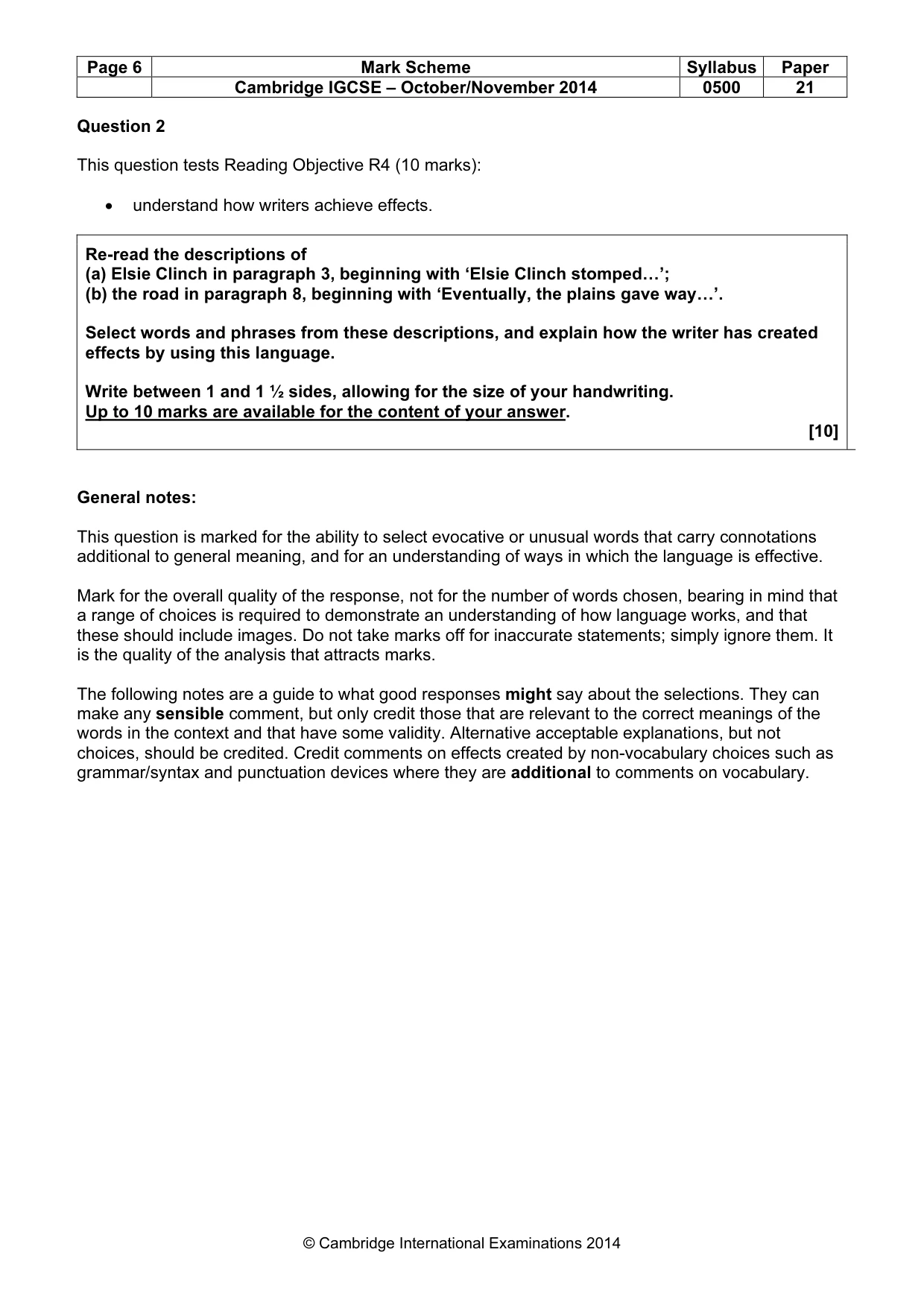
Page 6 Mark Scheme Syllabus Paper Cambridge IGCSE – October/November 2014 0500 21 © Cambridge International Examinations 2014 Question 2 This question tests Reading Objective R4 (10 marks): • understand how writers achieve effects. Re-read the descriptions of (a) Elsie Clinch in paragraph 3, beginning with ‘Elsie Clinch stomped…’; (b) the road in paragraph 8, beginning with ‘Eventually, the plains gave way…’. Select words and phrases from these descriptions, and explain how the writer has created effects by using this language. Write between 1 and 1 ½ sides, allowing for the size of your handwriting. Up to 10 marks are available for the content of your answer. [10] General notes: This question is marked for the ability to select evocative or unusual words that carry connotations additional to general meaning, and for an understanding of ways in which the language is effective. Mark for the overall quality of the response, not for the number of words chosen, bearing in mind that a range of choices is required to demonstrate an understanding of how language works, and that these should include images. Do not take marks off for inaccurate statements; simply ignore them. It is the quality of the analysis that attracts marks. The following notes are a guide to what good responses might say about the selections. They can make any sensible comment, but only credit those that are relevant to the correct meanings of the words in the context and that have some validity. Alternative acceptable explanations, but not choices, should be credited. Credit comments on effects created by non-vocabulary choices such as grammar/syntax and punctuation devices where they are additional to comments on vocabulary.
Mark scheme, page 7
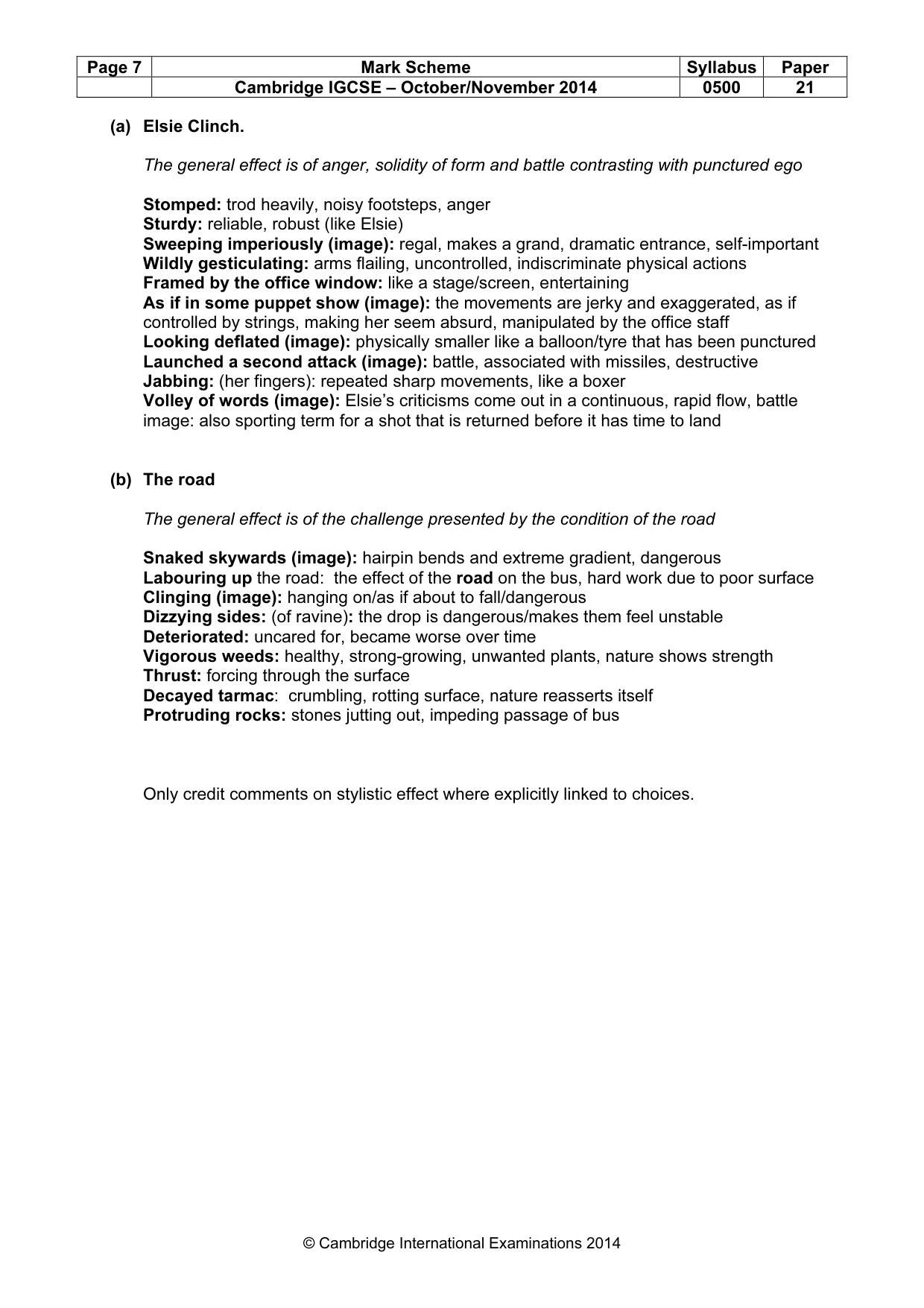
Page 7 Mark Scheme Syllabus Paper Cambridge IGCSE – October/November 2014 0500 21 © Cambridge International Examinations 2014 (a) Elsie Clinch. The general effect is of anger, solidity of form and battle contrasting with punctured ego Stomped: trod heavily, noisy footsteps, anger Sturdy: reliable, robust (like Elsie) Sweeping imperiously (image): regal, makes a grand, dramatic entrance, self-important Wildly gesticulating: arms flailing, uncontrolled, indiscriminate physical actions Framed by the office window: like a stage/screen, entertaining As if in some puppet show (image): the movements are jerky and exaggerated, as if controlled by strings, making her seem absurd, manipulated by the office staff Looking deflated (image): physically smaller like a balloon/tyre that has been punctured Launched a second attack (image): battle, associated with missiles, destructive Jabbing: (her fingers): repeated sharp movements, like a boxer Volley of words (image): Elsie’s criticisms come out in a continuous, rapid flow, battle image: also sporting term for a shot that is returned before it has time to land (b) The road The general effect is of the challenge presented by the condition of the road Snaked skywards (image): hairpin bends and extreme gradient, dangerous Labouring up the road: the effect of the road on the bus, hard work due to poor surface Clinging (image): hanging on/as if about to fall/dangerous Dizzying sides: (of ravine): the drop is dangerous/makes them feel unstable Deteriorated: uncared for, became worse over time Vigorous weeds: healthy, strong-growing, unwanted plants, nature shows strength Thrust: forcing through the surface Decayed tarmac: crumbling, rotting surface, nature reasserts itself Protruding rocks: stones jutting out, impeding passage of bus Only credit comments on stylistic effect where explicitly linked to choices.
Mark scheme, page 8
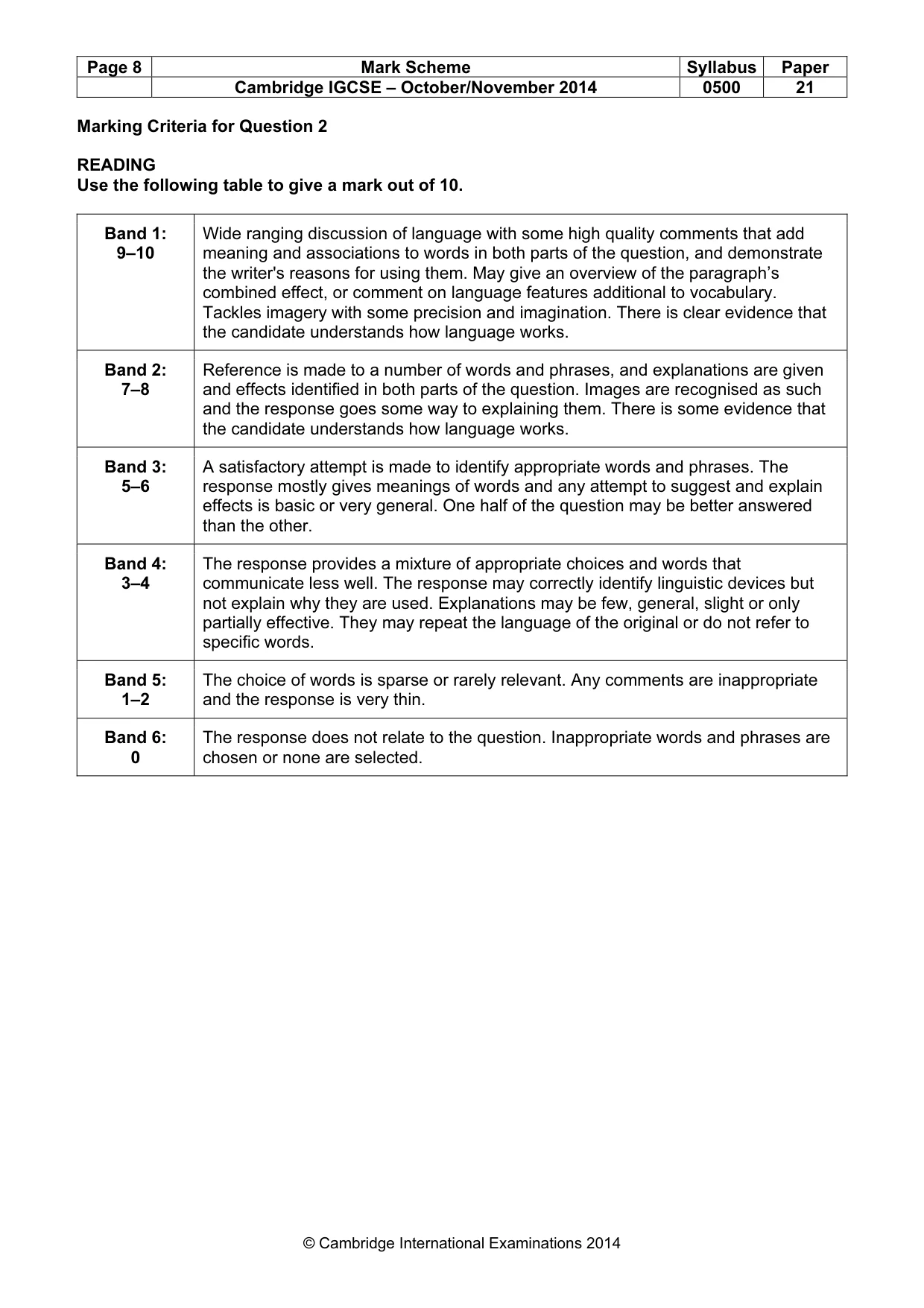
Page 8 Mark Scheme Syllabus Paper Cambridge IGCSE – October/November 2014 0500 21 © Cambridge International Examinations 2014 Marking Criteria for Question 2 READING Use the following table to give a mark out of 10. Band 1: 9–10 Wide ranging discussion of language with some high quality comments that add meaning and associations to words in both parts of the question, and demonstrate the writer's reasons for using them. May give an overview of the paragraph’s combined effect, or comment on language features additional to vocabulary. Tackles imagery with some precision and imagination. There is clear evidence that the candidate understands how language works. Band 2: 7–8 Reference is made to a number of words and phrases, and explanations are given and effects identified in both parts of the question. Images are recognised as such and the response goes some way to explaining them. There is some evidence that the candidate understands how language works. Band 3: 5–6 A satisfactory attempt is made to identify appropriate words and phrases. The response mostly gives meanings of words and any attempt to suggest and explain effects is basic or very general. One half of the question may be better answered than the other. Band 4: 3–4 The response provides a mixture of appropriate choices and words that communicate less well. The response may correctly identify linguistic devices but not explain why they are used. Explanations may be few, general, slight or only partially effective. They may repeat the language of the original or do not refer to specific words. Band 5: 1–2 The choice of words is sparse or rarely relevant. Any comments are inappropriate and the response is very thin. Band 6: 0 The response does not relate to the question. Inappropriate words and phrases are chosen or none are selected.
Mark scheme, page 9
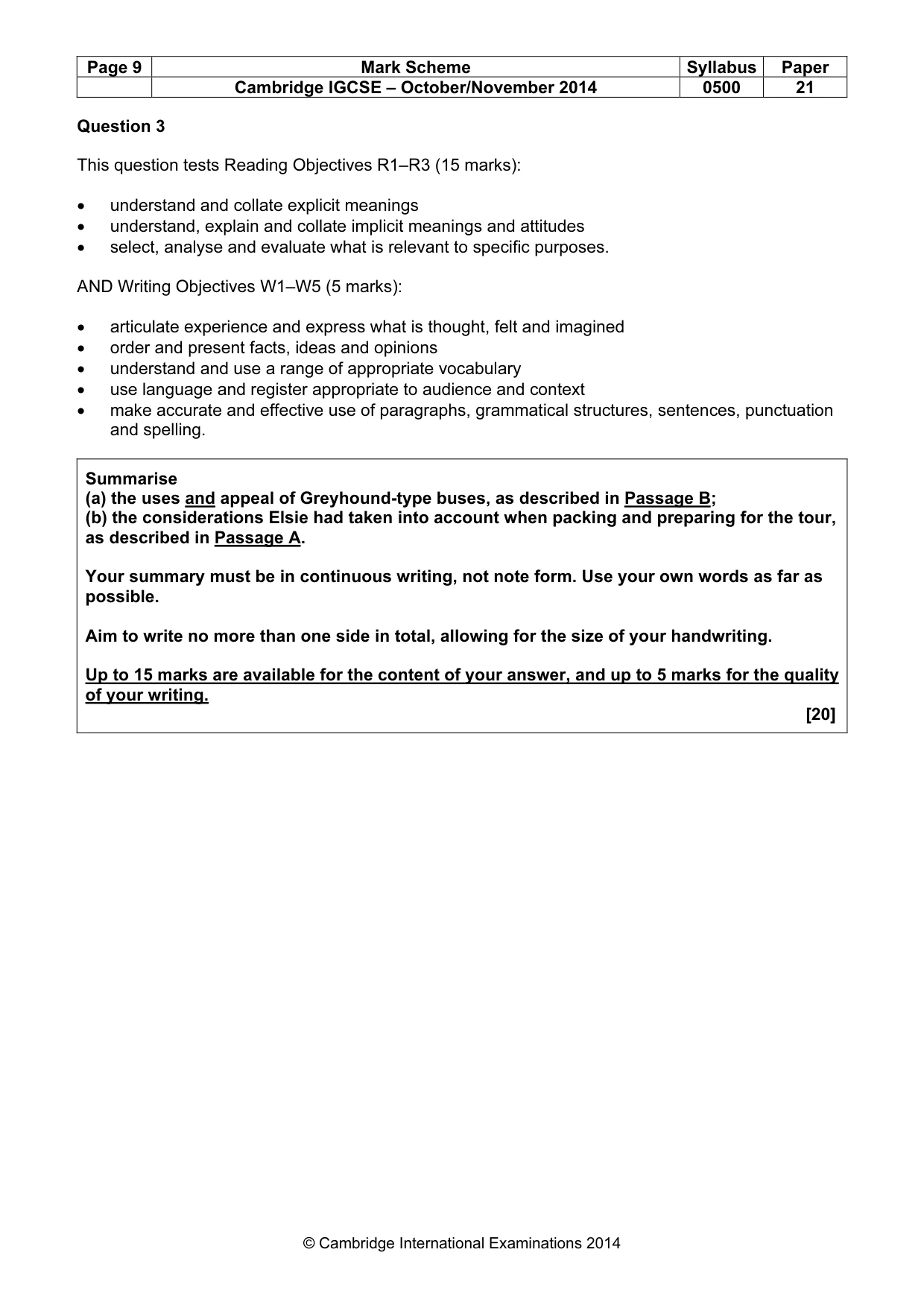
Page 9 Mark Scheme Syllabus Paper Cambridge IGCSE – October/November 2014 0500 21 © Cambridge International Examinations 2014 Question 3 This question tests Reading Objectives R1–R3 (15 marks): • understand and collate explicit meanings • understand, explain and collate implicit meanings and attitudes • select, analyse and evaluate what is relevant to specific purposes. AND Writing Objectives W1–W5 (5 marks): • articulate experience and express what is thought, felt and imagined • order and present facts, ideas and opinions • understand and use a range of appropriate vocabulary • use language and register appropriate to audience and context • make accurate and effective use of paragraphs, grammatical structures, sentences, punctuation and spelling. Summarise (a) the uses and appeal of Greyhound-type buses, as described in Passage B; (b) the considerations Elsie had taken into account when packing and preparing for the tour, as described in Passage A. Your summary must be in continuous writing, not note form. Use your own words as far as possible. Aim to write no more than one side in total, allowing for the size of your handwriting. Up to 15 marks are available for the content of your answer, and up to 5 marks for the quality of your writing. [20]
Mark scheme, page 10
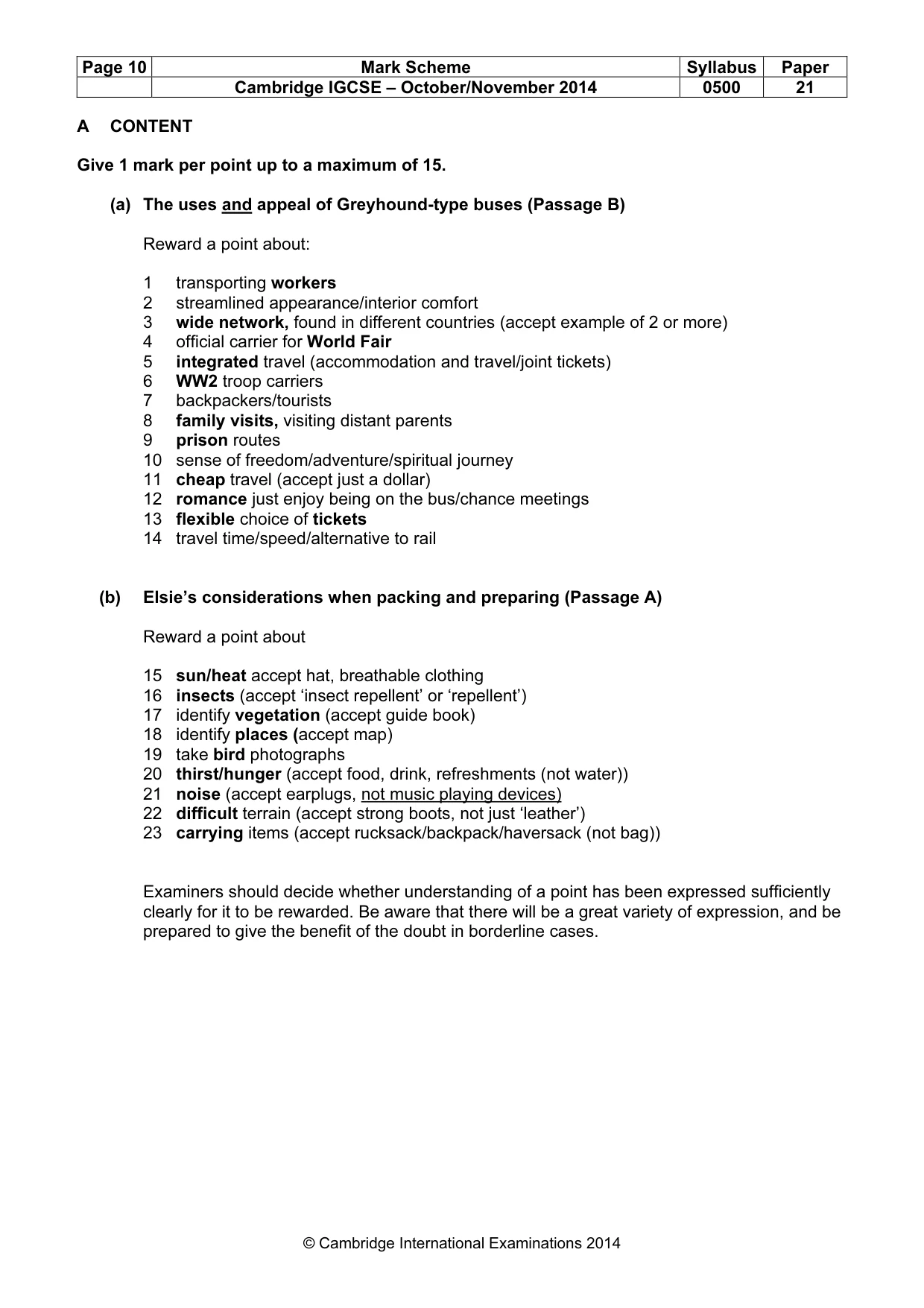
Page 10 Mark Scheme Syllabus Paper Cambridge IGCSE – October/November 2014 0500 21 © Cambridge International Examinations 2014 A CONTENT Give 1 mark per point up to a maximum of 15. (a) The uses and appeal of Greyhound-type buses (Passage B) Reward a point about: 1 transporting workers 2 streamlined appearance/interior comfort 3 wide network, found in different countries (accept example of 2 or more) 4 official carrier for World Fair 5 integrated travel (accommodation and travel/joint tickets) 6 WW2 troop carriers 7 backpackers/tourists 8 family visits, visiting distant parents 9 prison routes 10 sense of freedom/adventure/spiritual journey 11 cheap travel (accept just a dollar) 12 romance just enjoy being on the bus/chance meetings 13 flexible choice of tickets 14 travel time/speed/alternative to rail (b) Elsie’s considerations when packing and preparing (Passage A) Reward a point about 15 sun/heat accept hat, breathable clothing 16 insects (accept ‘insect repellent’ or ‘repellent’) 17 identify vegetation (accept guide book) 18 identify places (accept map) 19 take bird photographs 20 thirst/hunger (accept food, drink, refreshments (not water)) 21 noise (accept earplugs, not music playing devices) 22 difficult terrain (accept strong boots, not just ‘leather’) 23 carrying items (accept rucksack/backpack/haversack (not bag)) Examiners should decide whether understanding of a point has been expressed sufficiently clearly for it to be rewarded. Be aware that there will be a great variety of expression, and be prepared to give the benefit of the doubt in borderline cases.
Mark scheme, page 11
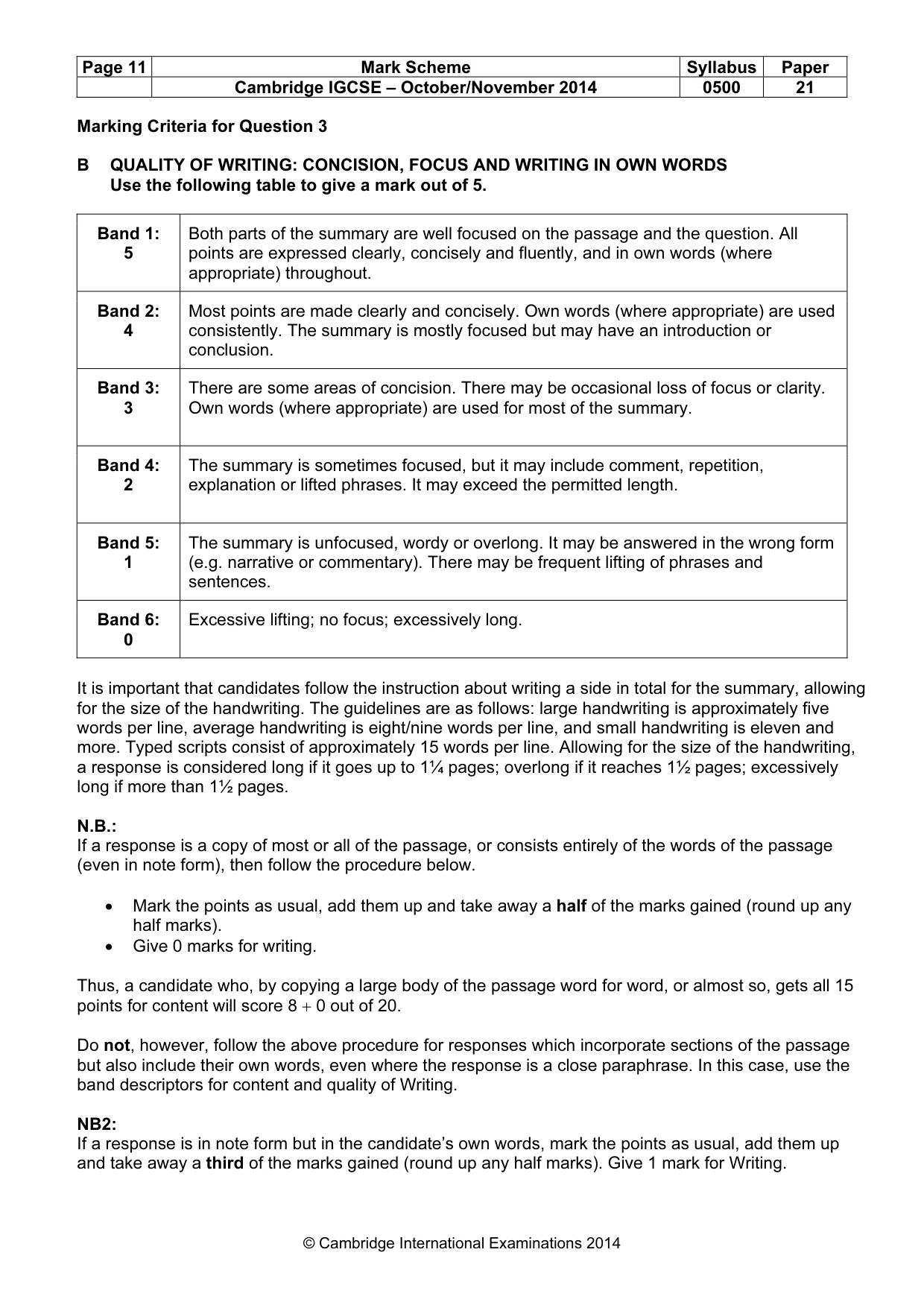
Page 11 Mark Scheme Syllabus Paper Cambridge IGCSE – October/November 2014 0500 21 © Cambridge International Examinations 2014 Marking Criteria for Question 3 B QUALITY OF WRITING: CONCISION, FOCUS AND WRITING IN OWN WORDS Use the following table to give a mark out of 5. Band 1: 5 Both parts of the summary are well focused on the passage and the question. All points are expressed clearly, concisely and fluently, and in own words (where appropriate) throughout. Band 2: 4 Most points are made clearly and concisely. Own words (where appropriate) are used consistently. The summary is mostly focused but may have an introduction or conclusion. Band 3: 3 There are some areas of concision. There may be occasional loss of focus or clarity. Own words (where appropriate) are used for most of the summary. Band 4: 2 The summary is sometimes focused, but it may include comment, repetition, explanation or lifted phrases. It may exceed the permitted length. Band 5: 1 The summary is unfocused, wordy or overlong. It may be answered in the wrong form (e.g. narrative or commentary). There may be frequent lifting of phrases and sentences. Band 6: 0 Excessive lifting; no focus; excessively long. It is important that candidates follow the instruction about writing a side in total for the summary, allowing for the size of the handwriting. The guidelines are as follows: large handwriting is approximately five words per line, average handwriting is eight/nine words per line, and small handwriting is eleven and more. Typed scripts consist of approximately 15 words per line. Allowing for the size of the handwriting, a response is considered long if it goes up to 1¼ pages; overlong if it reaches 1½ pages; excessively long if more than 1½ pages. N.B.: If a response is a copy of most or all of the passage, or consists entirely of the words of the passage (even in note form), then follow the procedure below. • Mark the points as usual, add them up and take away a half of the marks gained (round up any half marks). • Give 0 marks for writing. Thus, a candidate who, by copying a large body of the passage word for word, or almost so, gets all 15 points for content will score 8 + 0 out of 20. Do not, however, follow the above procedure for responses which incorporate sections of the passage but also include their own words, even where the response is a close paraphrase. In this case, use the band descriptors for content and quality of Writing. NB2: If a response is in note form but in the candidate’s own words, mark the points as usual, add them up and take away a third of the marks gained (round up any half marks). Give 1 mark for Writing.
What you needed in this session
Cambridge’s own grade thresholds for 2014 Oct/Nov, Paper 2 · Variant 1. A higher threshold means an easier paper — the bar moves with how the cohort did.