Cambridge IGCSE English - First Language 0500 — 2014 Oct/Nov Paper 1 · Variant 3
0500/13/O/N/14 · 50 marks · ≈56 min
The question paper and its mark scheme, free to read here and free to download. This is Cambridge’s own paper, exactly as it was sat.
Question paper12 pages


Mark scheme8 pages
Answers below. Sit the paper first if you are practising.
Paper as text
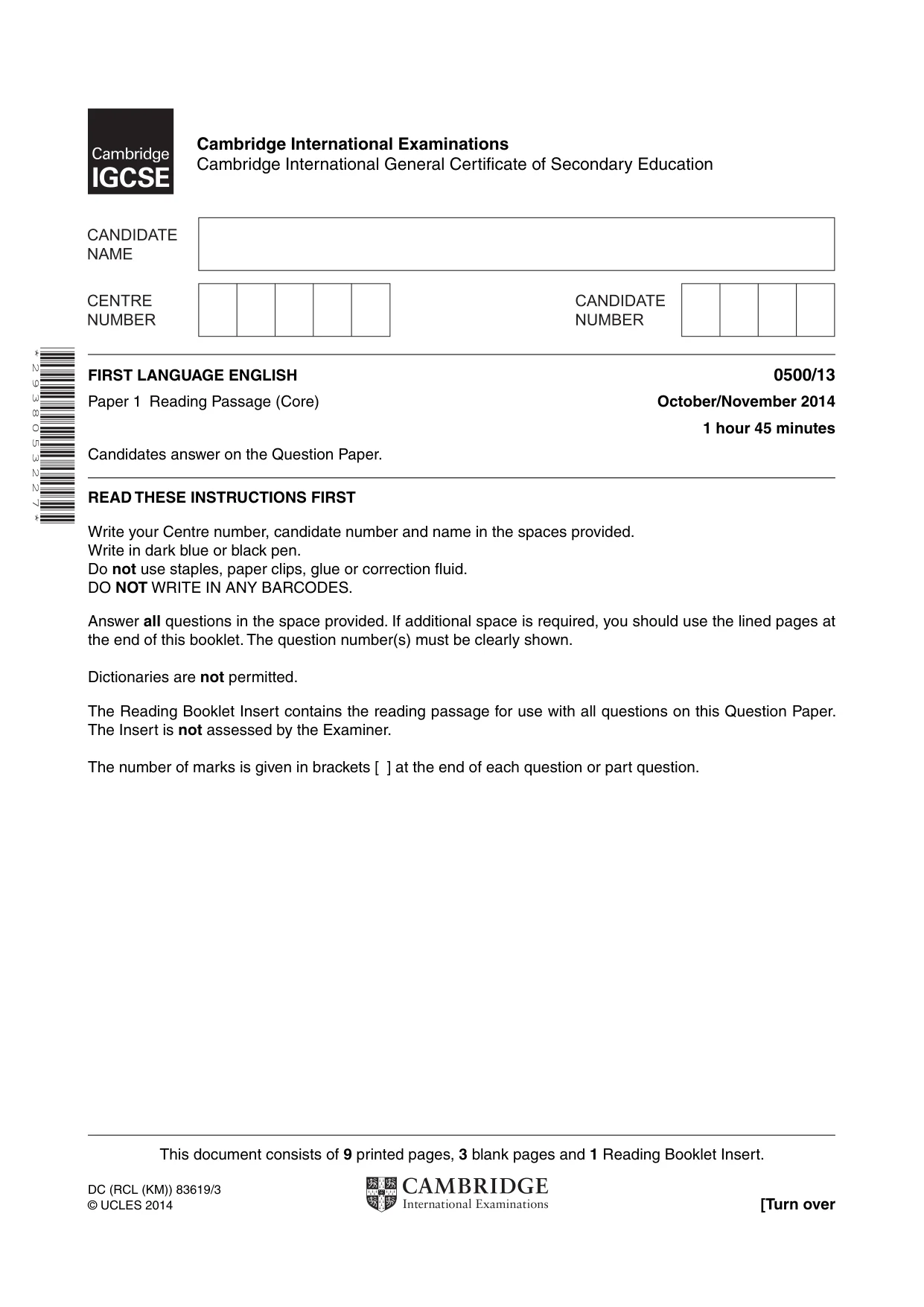
Question paper, page 1
This document consists of 9 printed pages, 3 blank pages and 1 Reading Booklet Insert. DC (RCL (KM)) 83619/3 © UCLES 2014 [Turn over Cambridge International Examinations Cambridge International General Certificate of Secondary Education * 2 9 3 8 0 5 3 2 2 7 * FIRST LANGUAGE ENGLISH 0500/13 Paper 1 Reading Passage (Core) October/November 2014 1 hour 45 minutes Candidates answer on the Question Paper. READ THESE INSTRUCTIONS FIRST Write your Centre number, candidate number and name in the spaces provided. Write in dark blue or black pen. Do not use staples, paper clips, glue or correction fluid. DO NOT WRITE IN ANY BARCODES. Answer all questions in the space provided. If additional space is required, you should use the lined pages at the end of this booklet. The question number(s) must be clearly shown. Dictionaries are not permitted. The Reading Booklet Insert contains the reading passage for use with all questions on this Question Paper. The Insert is not assessed by the Examiner. The number of marks is given in brackets [ ] at the end of each question or part question.
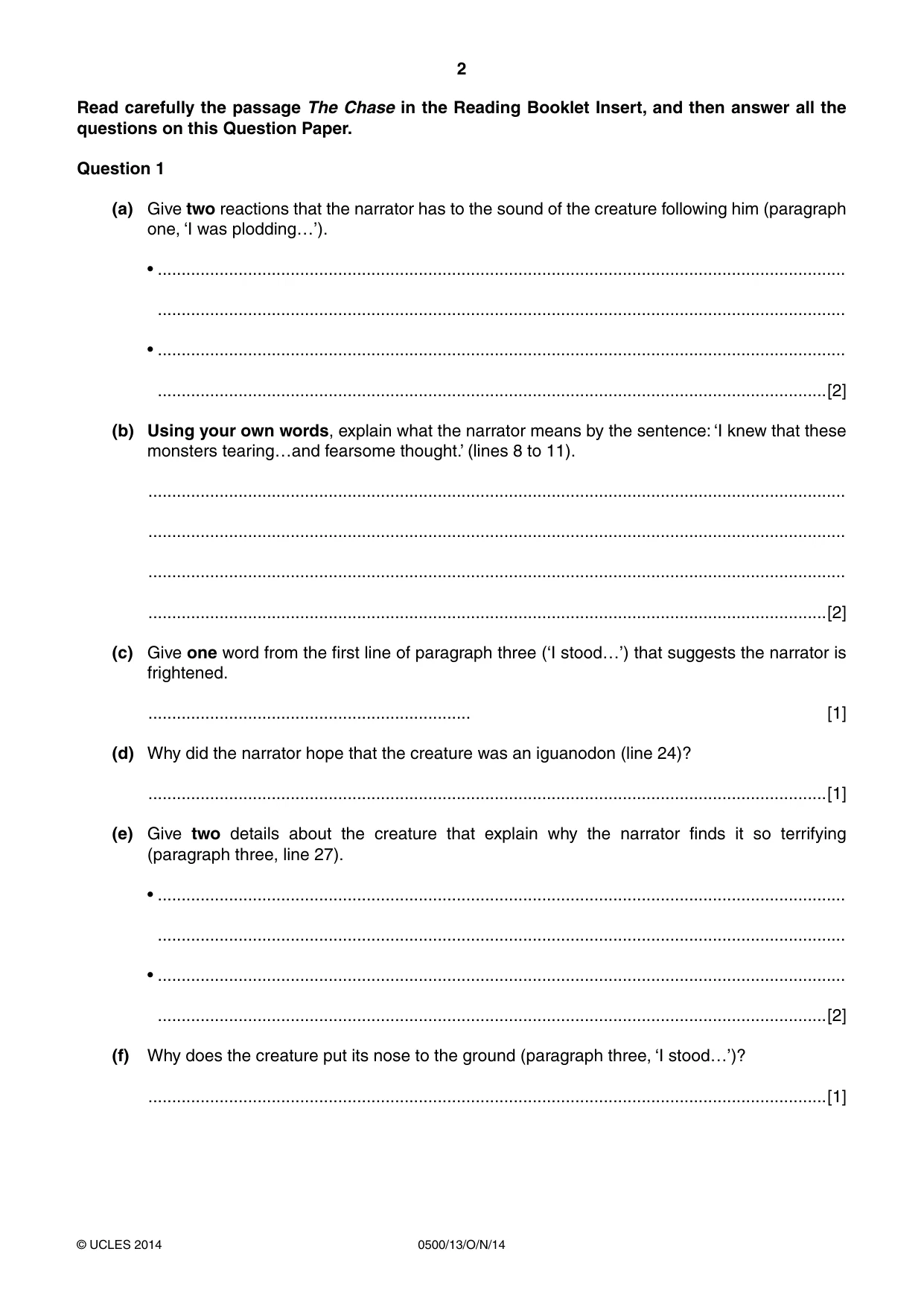
Question paper, page 2
2 0500/13/O/N/14 © UCLES 2014 Read carefully the passage The Chase in the Reading Booklet Insert, and then answer all the questions on this Question Paper. Question 1 (a) Give two reactions that the narrator has to the sound of the creature following him (paragraph one, ‘I was plodding…’). • … … • … …[2] (b) Using your own words, explain what the narrator means by the sentence: ‘I knew that these monsters tearing…and fearsome thought.’ (lines 8 to 11). … … … …[2] (c) Give one word from the first line of paragraph three (‘I stood…’) that suggests the narrator is frightened. … [1] (d) Why did the narrator hope that the creature was an iguanodon (line 24)? …[1] (e) Give two details about the creature that explain why the narrator finds it so terrifying (paragraph three, line 27). • … … • … …[2] (f) Why does the creature put its nose to the ground (paragraph three, ‘I stood…’)? …[1]
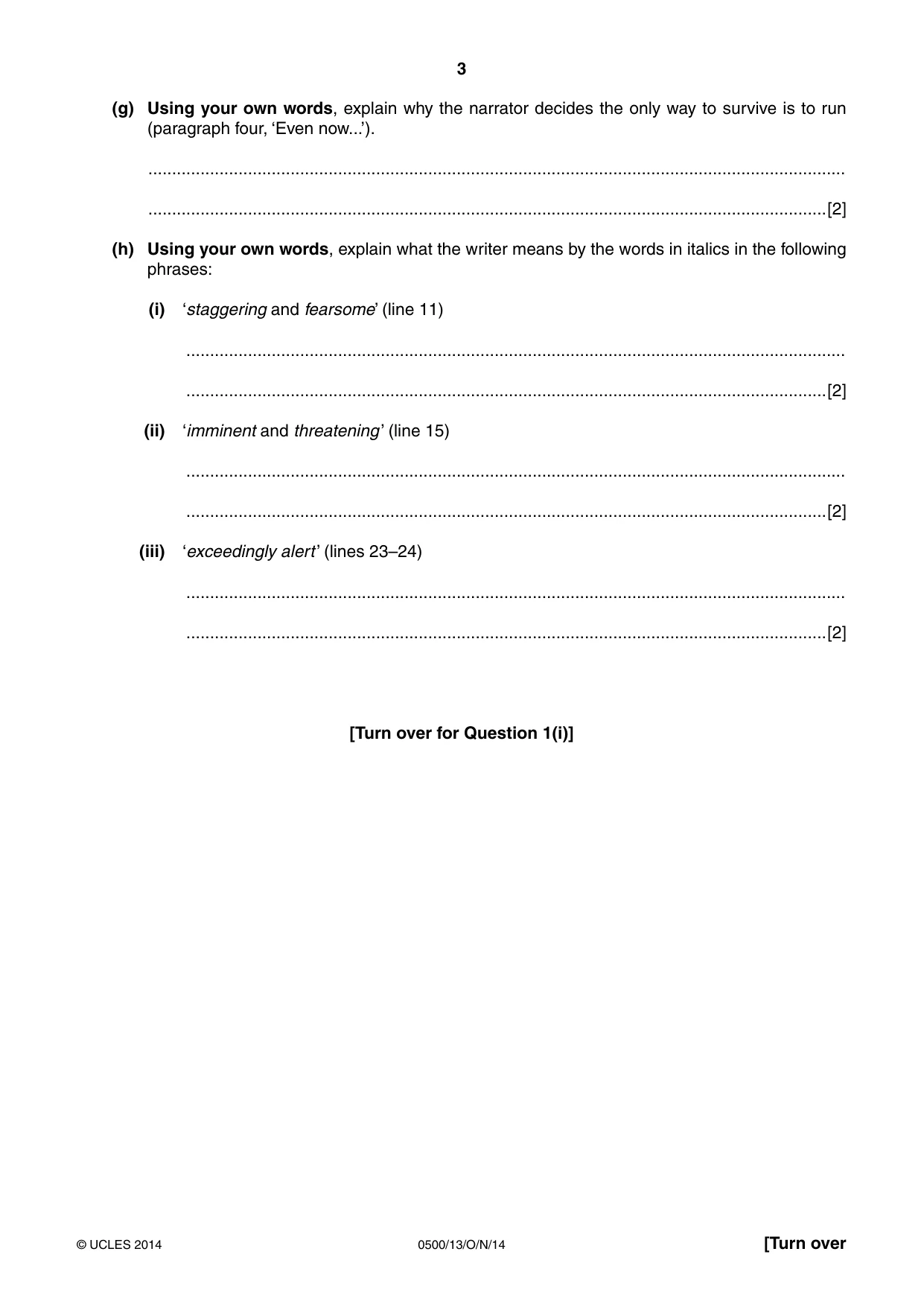
Question paper, page 3
3 0500/13/O/N/14 © UCLES 2014 [Turn over (g) Using your own words, explain why the narrator decides the only way to survive is to run (paragraph four, ‘Even now...’). … …[2] (h) Using your own words, explain what the writer means by the words in italics in the following phrases: (i) ‘staggering and fearsome’ (line 11) … …[2] (ii) ‘imminent and threatening ’ (line 15) … …[2] (iii) ‘exceedingly alert ’ (lines 23–24) … …[2] [Turn over for Question 1(i)]
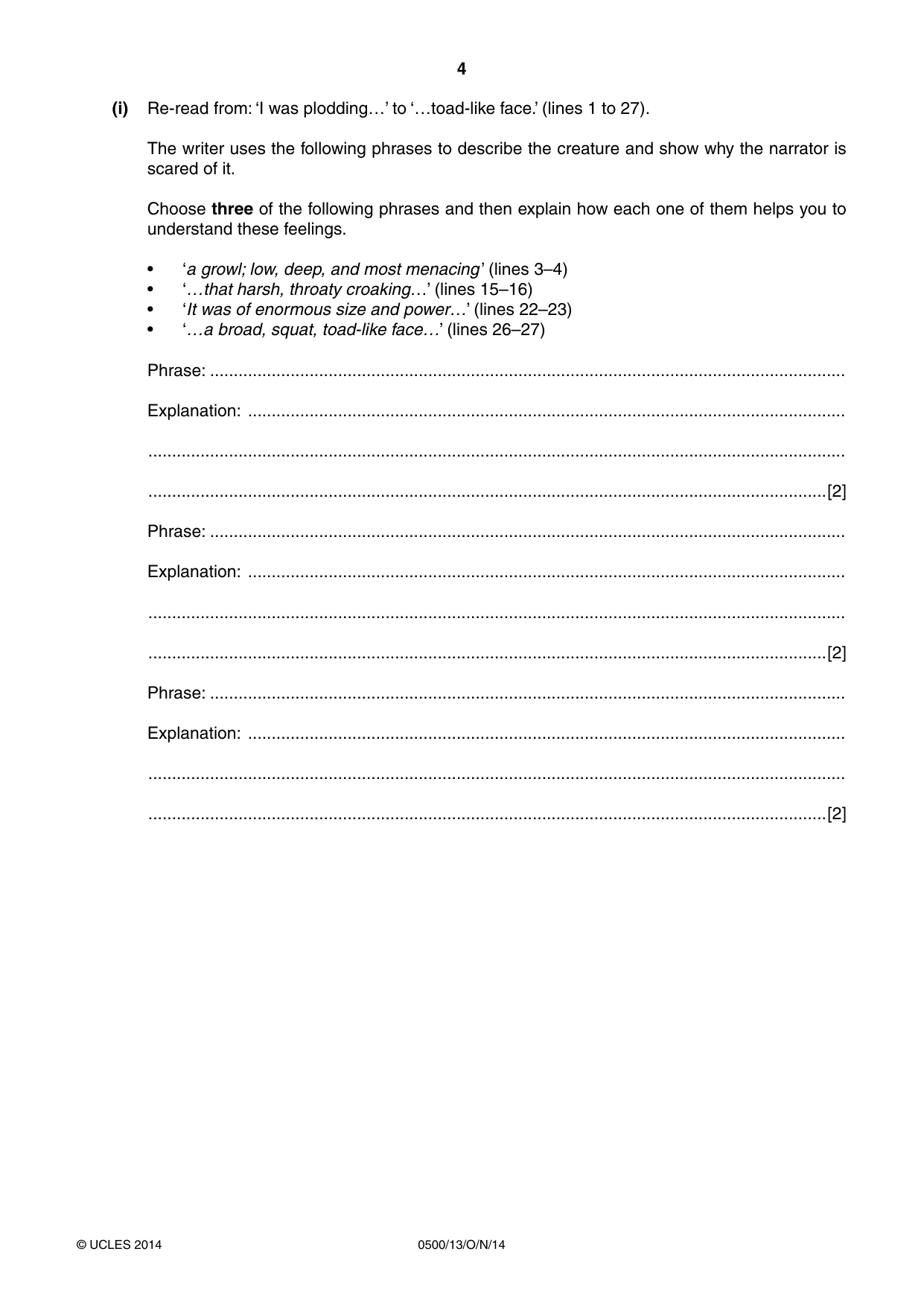
Question paper, page 4
4 0500/13/O/N/14 © UCLES 2014 (i) Re-read from: ‘I was plodding…’ to ‘…toad-like face.’ (lines 1 to 27). The writer uses the following phrases to describe the creature and show why the narrator is scared of it. Choose three of the following phrases and then explain how each one of them helps you to understand these feelings. • ‘a growl; low, deep, and most menacing ’ (lines 3–4) • ‘…that harsh, throaty croaking…’ (lines 15–16) • ‘It was of enormous size and power…’ (lines 22–23) • ‘…a broad, squat, toad-like face…’ (lines 26–27) Phrase: … Explanation: … … …[2] Phrase: … Explanation: … … …[2] Phrase: … Explanation: … … …[2]
Question paper, page 5
5 0500/13/O/N/14 © UCLES 2014 [Turn over (j) Re-read paragraph three (‘I stood…’ to ‘…the path I had taken.’). Write a summary of the appearance and behaviour of the creature. Write a paragraph of about 50–70 words. … … … … … … … … … … … … … …[7] [Total: 30] [Turn over for Question 2]
Question paper, page 6
6 0500/13/O/N/14 © UCLES 2014 Question 2 Imagine that you are the narrator. When you return home you are interviewed on the radio about your experiences in the jungle. Write the interview between the interviewer and the narrator. In the interview you should describe: • how you first became aware of the creature • your thoughts and feelings during the chase • how you escaped from the creature. You should base your ideas on what you have read in the passage, but do not copy from it. Address each of the three bullet points. Begin the interview: Interviewer: ‘So, perhaps you could tell us a little about your reasons for visiting such a dangerous place.’ Write between 1 and 1½ sides, allowing for the size of your handwriting. Up to 10 marks are available for the content of your answer, and up to 10 marks for the quality of your writing. … … … … … … … … … … … … … … …
Question paper, page 7
7 0500/13/O/N/14 © UCLES 2014 … … … … … … … … … … … … … … … … … … … … … … … … … … … [Total: 20]
Question paper, page 8
8 0500/13/O/N/14 © UCLES 2014 ADDITIONAL PAGE If you use the following lined page to complete the answer(s) to any question(s), the question number(s) must be clearly shown. … … … … … … … … … … … … … … … … … … … … … … … … … …
Question paper, page 9
9 0500/13/O/N/14 © UCLES 2014 ADDITIONAL PAGE If you use the following lined page to complete the answer(s) to any question(s), the question number(s) must be clearly shown. … … … … … … … … … … … … … … … … … … … … … … … … … …
Question paper, page 10
10 0500/13/O/N/14 © UCLES 2014 BLANK PAGE
Question paper, page 11
11 0500/13/O/N/14 © UCLES 2014 BLANK PAGE
Question paper, page 12
12 0500/13/O/N/14 © UCLES 2014 Copyright Acknowledgements: Question 1 & 2 Sir Arthur Conan Doyle; The Lost World; Wordsworth Editions Ltd.; 1995. Permission to reproduce items where third-party owned material protected by copyright is included has been sought and cleared where possible. Every reasonable effort has been made by the publisher (UCLES) to trace copyright holders, but if any items requiring clearance have unwittingly been included, the publisher will be pleased to make amends at the earliest possible opportunity. Cambridge International Examinations is part of the Cambridge Assessment Group. Cambridge Assessment is the brand name of University of Cambridge Local Examinations Syndicate (UCLES), which is itself a department of the University of Cambridge. BLANK PAGE
Mark scheme, page 1
® IGCSE is the registered trademark of Cambridge International Examinations. CAMBRIDGE INTERNATIONAL EXAMINATIONS Cambridge International General Certificate of Secondary Education MARK SCHEME for the October/November 2014 series 0500 FIRST LANGUAGE ENGLISH 0500/13 Paper 1 (Reading Passage – Core), maximum raw mark 50 This mark scheme is published as an aid to teachers and candidates, to indicate the requirements of the examination. It shows the basis on which Examiners were instructed to award marks. It does not indicate the details of the discussions that took place at an Examiners’ meeting before marking began, which would have considered the acceptability of alternative answers. Mark schemes should be read in conjunction with the question paper and the Principal Examiner Report for Teachers. Cambridge will not enter into discussions about these mark schemes. Cambridge is publishing the mark schemes for the October/November 2014 series for most Cambridge IGCSE®, Cambridge International A and AS Level components and some Cambridge O Level components.
Mark scheme, page 2
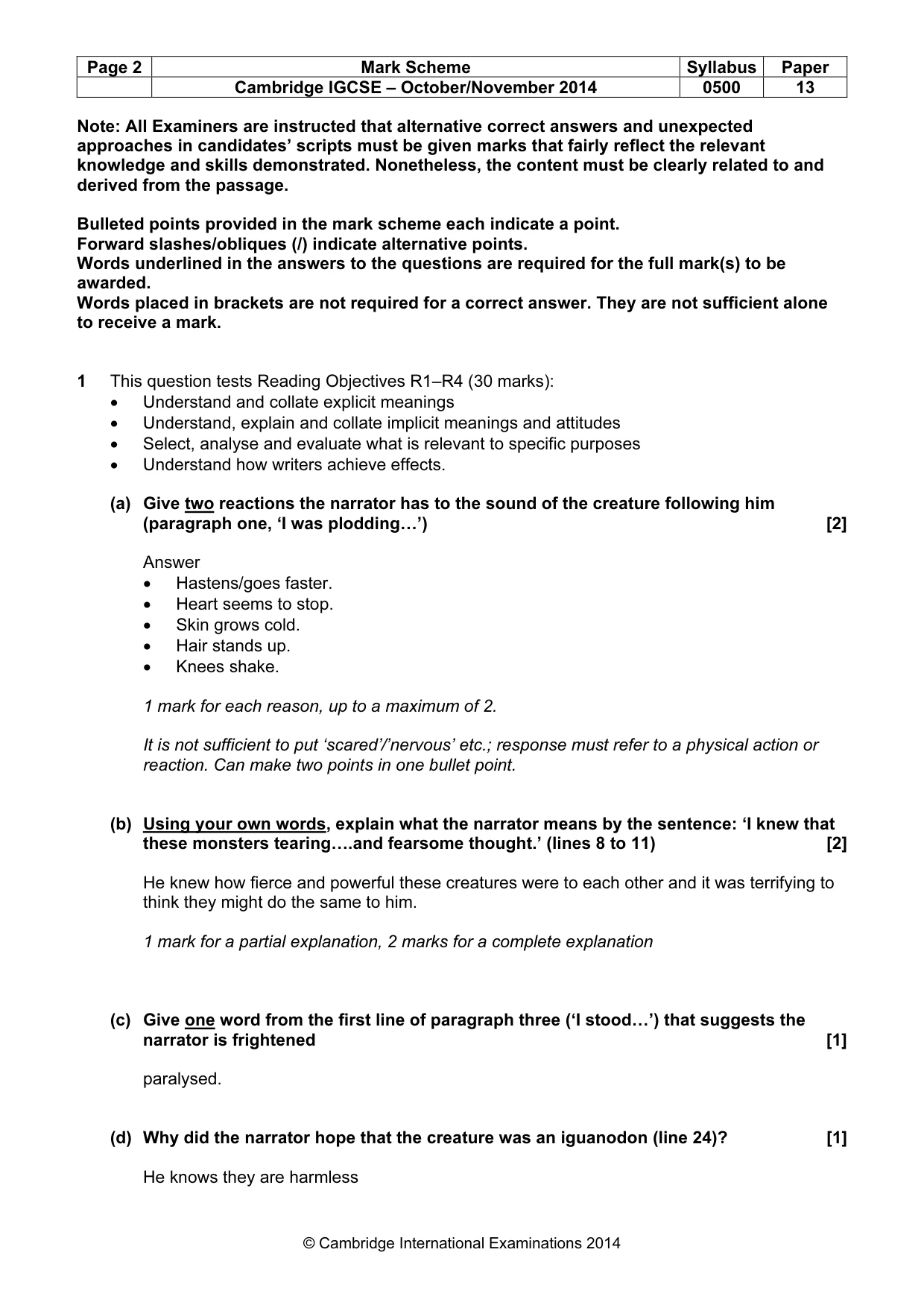
Page 2 Mark Scheme Syllabus Paper Cambridge IGCSE – October/November 2014 0500 13 © Cambridge International Examinations 2014 Note: All Examiners are instructed that alternative correct answers and unexpected approaches in candidates’ scripts must be given marks that fairly reflect the relevant knowledge and skills demonstrated. Nonetheless, the content must be clearly related to and derived from the passage. Bulleted points provided in the mark scheme each indicate a point. Forward slashes/obliques (/) indicate alternative points. Words underlined in the answers to the questions are required for the full mark(s) to be awarded. Words placed in brackets are not required for a correct answer. They are not sufficient alone to receive a mark. 1 This question tests Reading Objectives R1–R4 (30 marks): • Understand and collate explicit meanings • Understand, explain and collate implicit meanings and attitudes • Select, analyse and evaluate what is relevant to specific purposes • Understand how writers achieve effects. (a) Give two reactions the narrator has to the sound of the creature following him (paragraph one, ‘I was plodding…’) [2] Answer • Hastens/goes faster. • Heart seems to stop. • Skin grows cold. • Hair stands up. • Knees shake. 1 mark for each reason, up to a maximum of 2. It is not sufficient to put ‘scared’/’nervous’ etc.; response must refer to a physical action or reaction. Can make two points in one bullet point. (b) Using your own words, explain what the narrator means by the sentence: ‘I knew that these monsters tearing….and fearsome thought.’ (lines 8 to 11) [2] He knew how fierce and powerful these creatures were to each other and it was terrifying to think they might do the same to him. 1 mark for a partial explanation, 2 marks for a complete explanation (c) Give one word from the first line of paragraph three (‘I stood…’) that suggests the narrator is frightened [1] paralysed. (d) Why did the narrator hope that the creature was an iguanodon (line 24)? [1] He knows they are harmless
Mark scheme, page 3
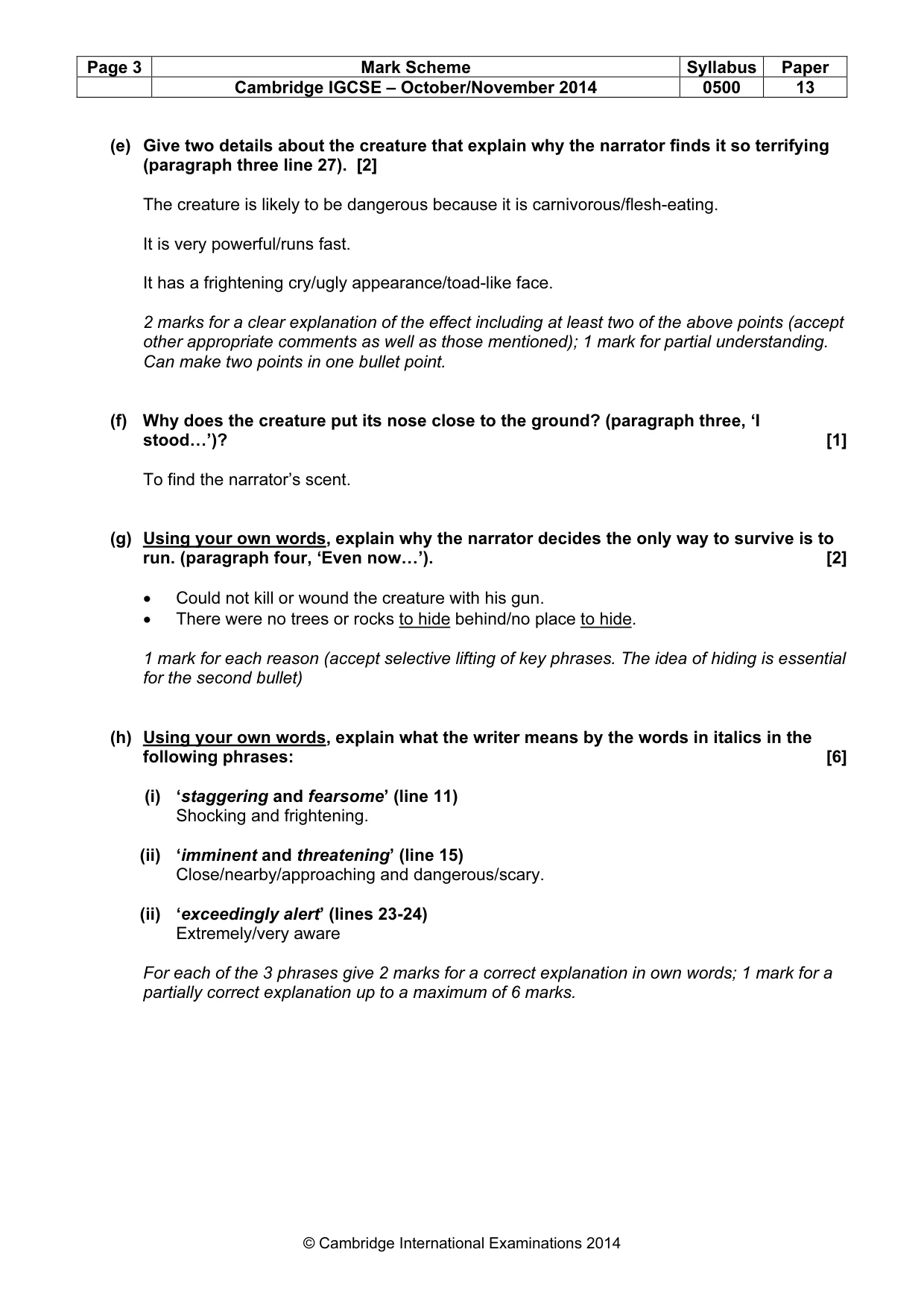
Page 3 Mark Scheme Syllabus Paper Cambridge IGCSE – October/November 2014 0500 13 © Cambridge International Examinations 2014 (e) Give two details about the creature that explain why the narrator finds it so terrifying (paragraph three line 27). [2] The creature is likely to be dangerous because it is carnivorous/flesh-eating. It is very powerful/runs fast. It has a frightening cry/ugly appearance/toad-like face. 2 marks for a clear explanation of the effect including at least two of the above points (accept other appropriate comments as well as those mentioned); 1 mark for partial understanding. Can make two points in one bullet point. (f) Why does the creature put its nose close to the ground? (paragraph three, ‘I stood…’)? [1] To find the narrator’s scent. (g) Using your own words, explain why the narrator decides the only way to survive is to run. (paragraph four, ‘Even now…’). [2] • Could not kill or wound the creature with his gun. • There were no trees or rocks to hide behind/no place to hide. 1 mark for each reason (accept selective lifting of key phrases. The idea of hiding is essential for the second bullet) (h) Using your own words, explain what the writer means by the words in italics in the following phrases: [6] (i) ‘staggering and fearsome’ (line 11) Shocking and frightening. (ii) ‘imminent and threatening’ (line 15) Close/nearby/approaching and dangerous/scary. (ii) ‘exceedingly alert’ (lines 23-24) Extremely/very aware For each of the 3 phrases give 2 marks for a correct explanation in own words; 1 mark for a partially correct explanation up to a maximum of 6 marks.
Mark scheme, page 4
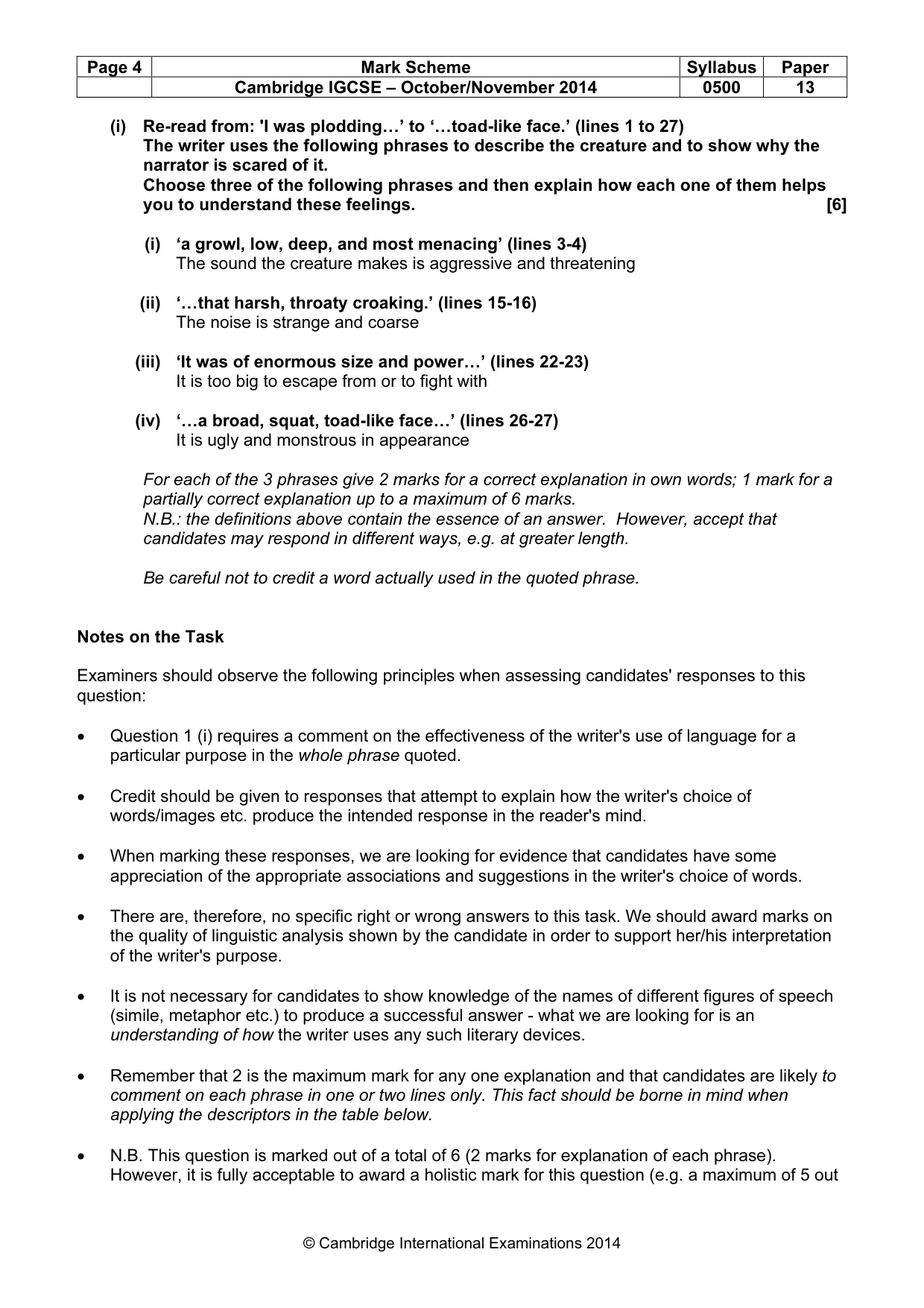
Page 4 Mark Scheme Syllabus Paper Cambridge IGCSE – October/November 2014 0500 13 © Cambridge International Examinations 2014 (i) Re-read from: 'I was plodding…’ to ‘…toad-like face.’ (lines 1 to 27) The writer uses the following phrases to describe the creature and to show why the narrator is scared of it. Choose three of the following phrases and then explain how each one of them helps you to understand these feelings. [6] (i) ‘a growl, low, deep, and most menacing’ (lines 3-4) The sound the creature makes is aggressive and threatening (ii) ‘…that harsh, throaty croaking.’ (lines 15-16) The noise is strange and coarse (iii) ‘It was of enormous size and power…’ (lines 22-23) It is too big to escape from or to fight with (iv) ‘…a broad, squat, toad-like face…’ (lines 26-27) It is ugly and monstrous in appearance For each of the 3 phrases give 2 marks for a correct explanation in own words; 1 mark for a partially correct explanation up to a maximum of 6 marks. N.B.: the definitions above contain the essence of an answer. However, accept that candidates may respond in different ways, e.g. at greater length. Be careful not to credit a word actually used in the quoted phrase. Notes on the Task Examiners should observe the following principles when assessing candidates' responses to this question: • Question 1 (i) requires a comment on the effectiveness of the writer's use of language for a particular purpose in the whole phrase quoted. • Credit should be given to responses that attempt to explain how the writer's choice of words/images etc. produce the intended response in the reader's mind. • When marking these responses, we are looking for evidence that candidates have some appreciation of the appropriate associations and suggestions in the writer's choice of words. • There are, therefore, no specific right or wrong answers to this task. We should award marks on the quality of linguistic analysis shown by the candidate in order to support her/his interpretation of the writer's purpose. • It is not necessary for candidates to show knowledge of the names of different figures of speech (simile, metaphor etc.) to produce a successful answer - what we are looking for is an understanding of how the writer uses any such literary devices. • Remember that 2 is the maximum mark for any one explanation and that candidates are likely to comment on each phrase in one or two lines only. This fact should be borne in mind when applying the descriptors in the table below. • N.B. This question is marked out of a total of 6 (2 marks for explanation of each phrase). However, it is fully acceptable to award a holistic mark for this question (e.g. a maximum of 5 out
Mark scheme, page 5
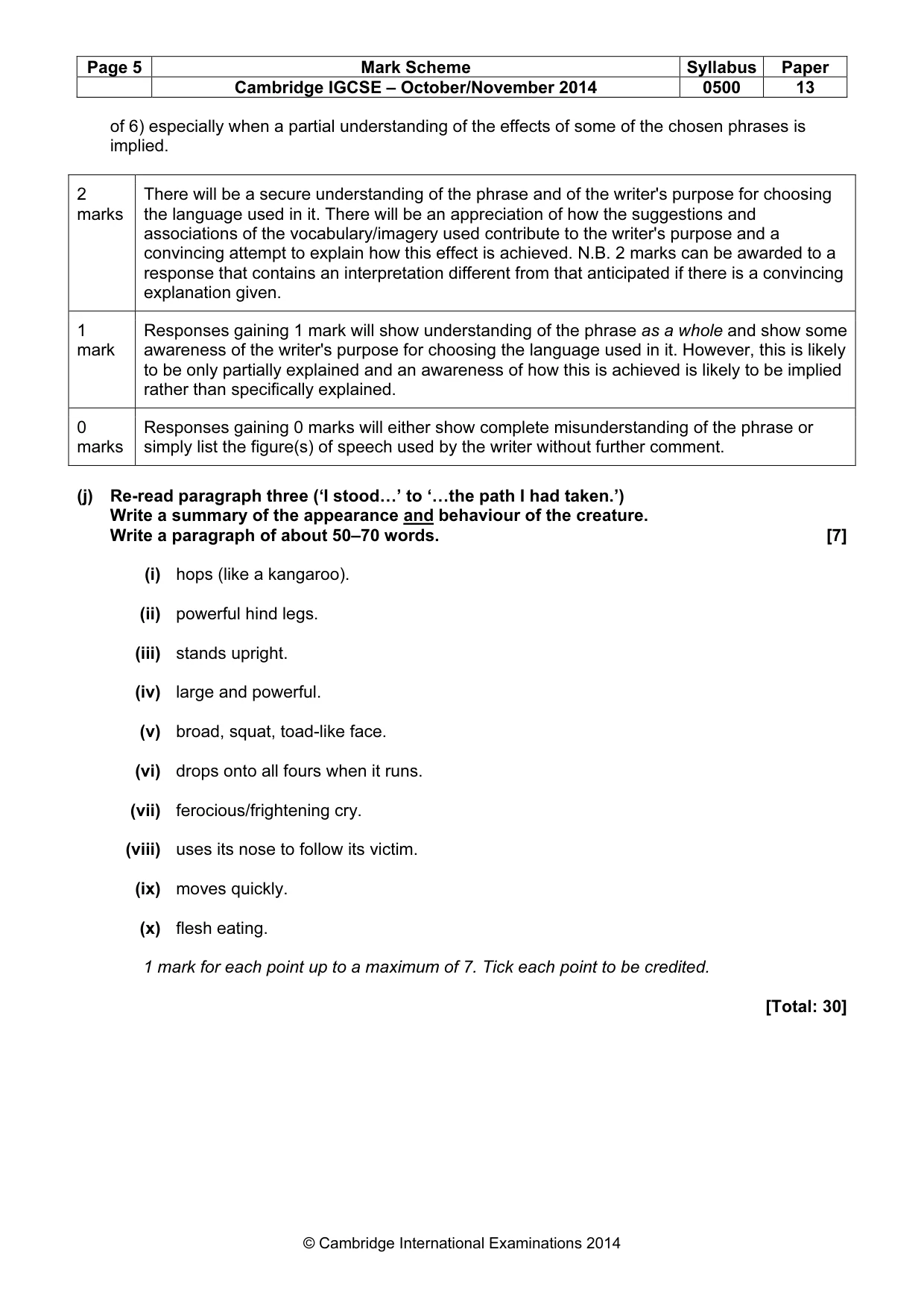
Page 5 Mark Scheme Syllabus Paper Cambridge IGCSE – October/November 2014 0500 13 © Cambridge International Examinations 2014 of 6) especially when a partial understanding of the effects of some of the chosen phrases is implied. 2 marks There will be a secure understanding of the phrase and of the writer's purpose for choosing the language used in it. There will be an appreciation of how the suggestions and associations of the vocabulary/imagery used contribute to the writer's purpose and a convincing attempt to explain how this effect is achieved. N.B. 2 marks can be awarded to a response that contains an interpretation different from that anticipated if there is a convincing explanation given. 1 mark Responses gaining 1 mark will show understanding of the phrase as a whole and show some awareness of the writer's purpose for choosing the language used in it. However, this is likely to be only partially explained and an awareness of how this is achieved is likely to be implied rather than specifically explained. 0 marks Responses gaining 0 marks will either show complete misunderstanding of the phrase or simply list the figure(s) of speech used by the writer without further comment. (j) Re-read paragraph three (‘I stood…’ to ‘…the path I had taken.’) Write a summary of the appearance and behaviour of the creature. Write a paragraph of about 50–70 words. [7] (i) hops (like a kangaroo). (ii) powerful hind legs. (iii) stands upright. (iv) large and powerful. (v) broad, squat, toad-like face. (vi) drops onto all fours when it runs. (vii) ferocious/frightening cry. (viii) uses its nose to follow its victim. (ix) moves quickly. (x) flesh eating. 1 mark for each point up to a maximum of 7. Tick each point to be credited. [Total: 30]
Mark scheme, page 6
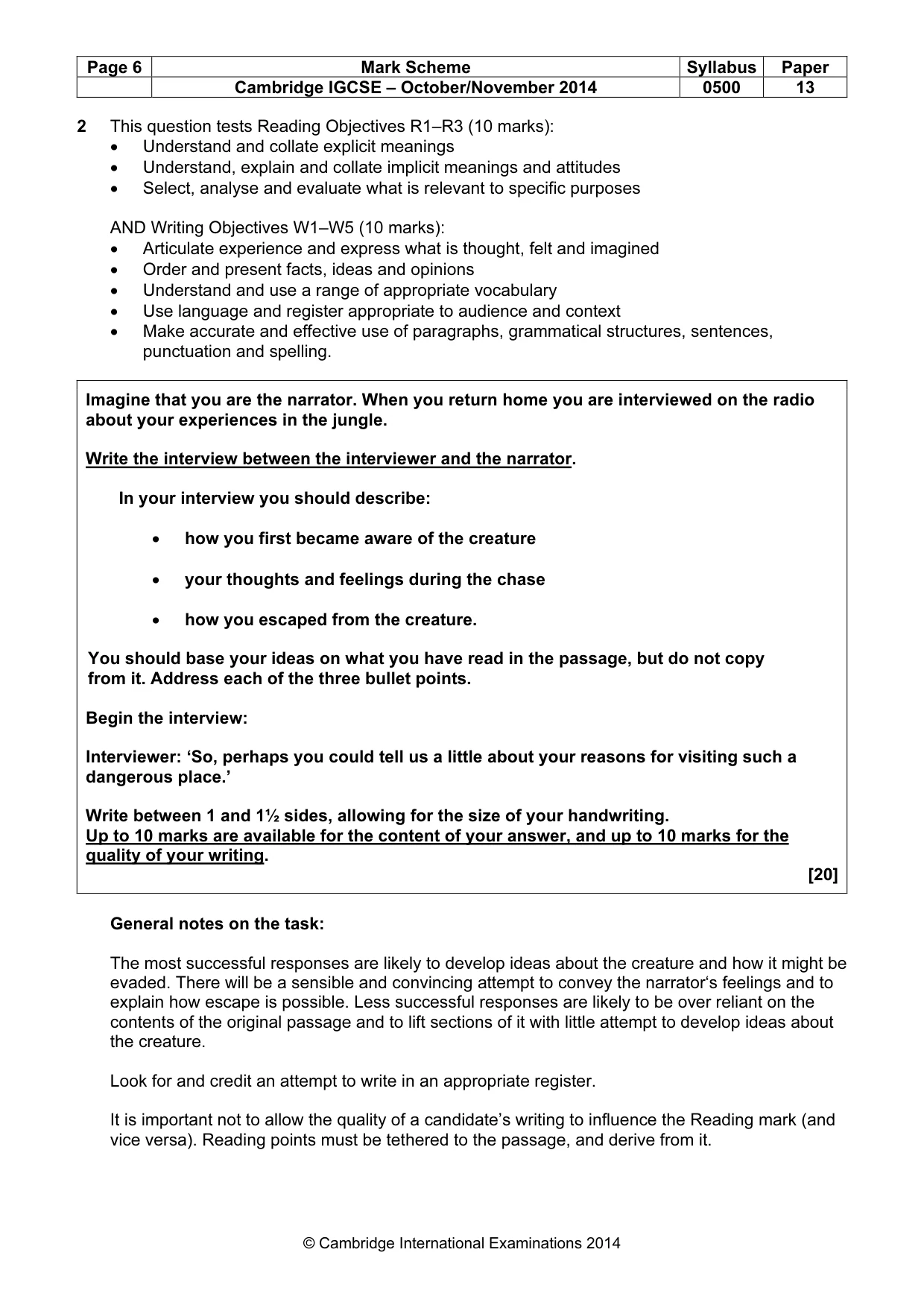
Page 6 Mark Scheme Syllabus Paper Cambridge IGCSE – October/November 2014 0500 13 © Cambridge International Examinations 2014 2 This question tests Reading Objectives R1–R3 (10 marks): • Understand and collate explicit meanings • Understand, explain and collate implicit meanings and attitudes • Select, analyse and evaluate what is relevant to specific purposes AND Writing Objectives W1–W5 (10 marks): • Articulate experience and express what is thought, felt and imagined • Order and present facts, ideas and opinions • Understand and use a range of appropriate vocabulary • Use language and register appropriate to audience and context • Make accurate and effective use of paragraphs, grammatical structures, sentences, punctuation and spelling. Imagine that you are the narrator. When you return home you are interviewed on the radio about your experiences in the jungle. Write the interview between the interviewer and the narrator. In your interview you should describe: • how you first became aware of the creature • your thoughts and feelings during the chase • how you escaped from the creature. You should base your ideas on what you have read in the passage, but do not copy from it. Address each of the three bullet points. Begin the interview: Interviewer: ‘So, perhaps you could tell us a little about your reasons for visiting such a dangerous place.’ Write between 1 and 1½ sides, allowing for the size of your handwriting. Up to 10 marks are available for the content of your answer, and up to 10 marks for the quality of your writing. [20] General notes on the task: The most successful responses are likely to develop ideas about the creature and how it might be evaded. There will be a sensible and convincing attempt to convey the narrator‘s feelings and to explain how escape is possible. Less successful responses are likely to be over reliant on the contents of the original passage and to lift sections of it with little attempt to develop ideas about the creature. Look for and credit an attempt to write in an appropriate register. It is important not to allow the quality of a candidate’s writing to influence the Reading mark (and vice versa). Reading points must be tethered to the passage, and derive from it.
Mark scheme, page 7
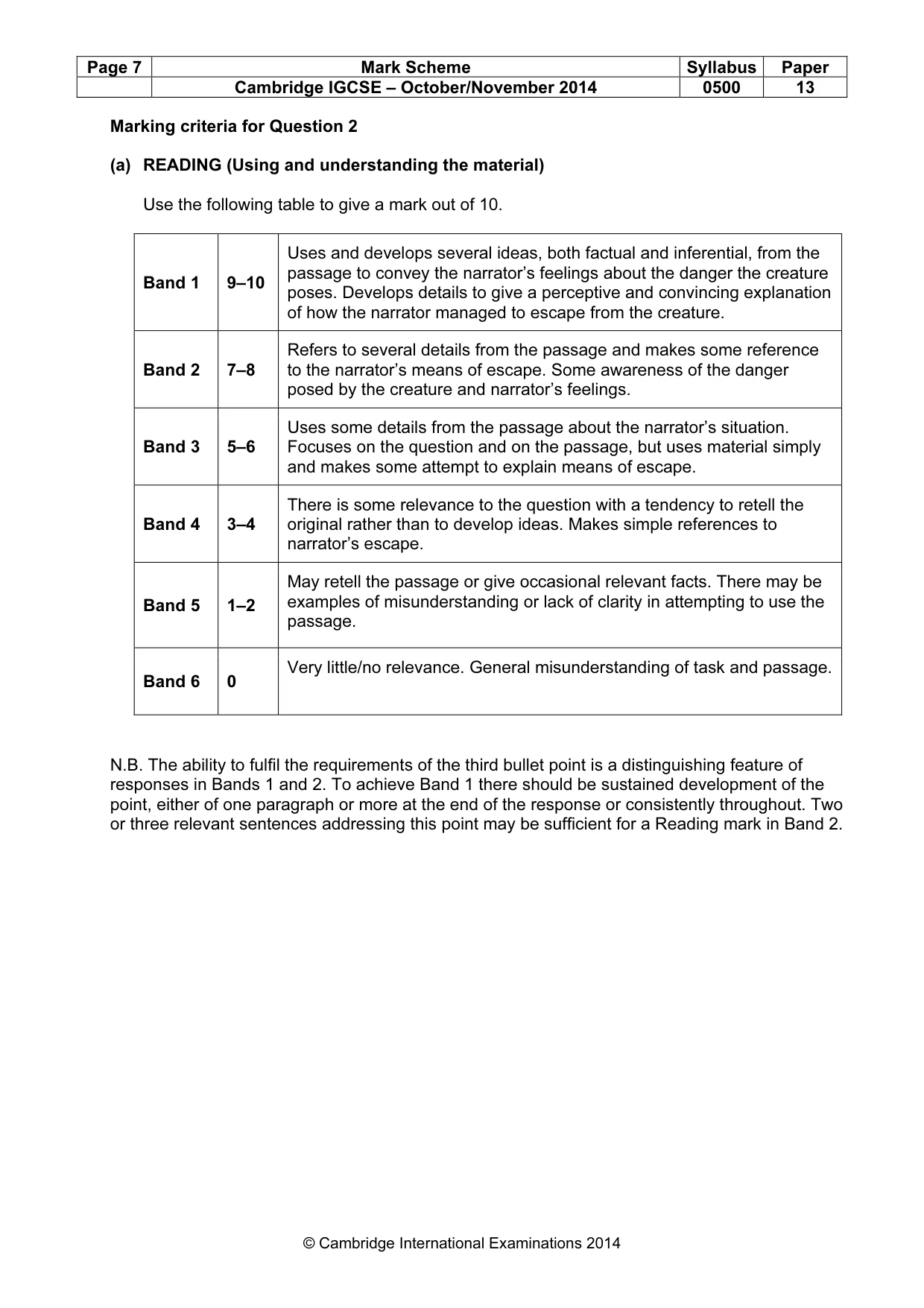
Page 7 Mark Scheme Syllabus Paper Cambridge IGCSE – October/November 2014 0500 13 © Cambridge International Examinations 2014 Marking criteria for Question 2 (a) READING (Using and understanding the material) Use the following table to give a mark out of 10. Band 1 9–10 Uses and develops several ideas, both factual and inferential, from the passage to convey the narrator’s feelings about the danger the creature poses. Develops details to give a perceptive and convincing explanation of how the narrator managed to escape from the creature. Band 2 7–8 Refers to several details from the passage and makes some reference to the narrator’s means of escape. Some awareness of the danger posed by the creature and narrator’s feelings. Band 3 5–6 Uses some details from the passage about the narrator’s situation. Focuses on the question and on the passage, but uses material simply and makes some attempt to explain means of escape. Band 4 3–4 There is some relevance to the question with a tendency to retell the original rather than to develop ideas. Makes simple references to narrator’s escape. Band 5 1–2 May retell the passage or give occasional relevant facts. There may be examples of misunderstanding or lack of clarity in attempting to use the passage. Band 6 0 Very little/no relevance. General misunderstanding of task and passage. N.B. The ability to fulfil the requirements of the third bullet point is a distinguishing feature of responses in Bands 1 and 2. To achieve Band 1 there should be sustained development of the point, either of one paragraph or more at the end of the response or consistently throughout. Two or three relevant sentences addressing this point may be sufficient for a Reading mark in Band 2.
Mark scheme, page 8
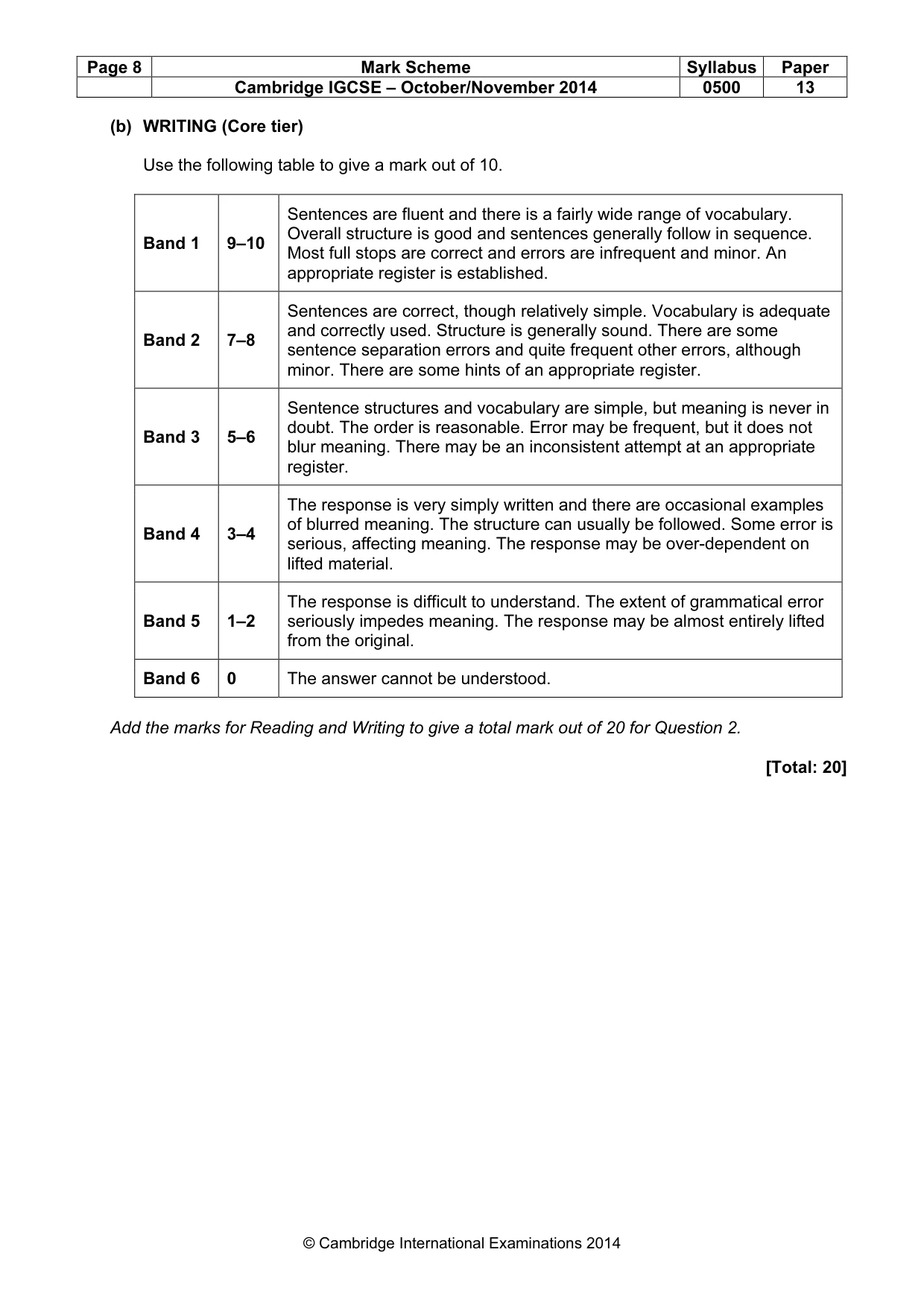
Page 8 Mark Scheme Syllabus Paper Cambridge IGCSE – October/November 2014 0500 13 © Cambridge International Examinations 2014 (b) WRITING (Core tier) Use the following table to give a mark out of 10. Band 1 9–10 Sentences are fluent and there is a fairly wide range of vocabulary. Overall structure is good and sentences generally follow in sequence. Most full stops are correct and errors are infrequent and minor. An appropriate register is established. Band 2 7–8 Sentences are correct, though relatively simple. Vocabulary is adequate and correctly used. Structure is generally sound. There are some sentence separation errors and quite frequent other errors, although minor. There are some hints of an appropriate register. Band 3 5–6 Sentence structures and vocabulary are simple, but meaning is never in doubt. The order is reasonable. Error may be frequent, but it does not blur meaning. There may be an inconsistent attempt at an appropriate register. Band 4 3–4 The response is very simply written and there are occasional examples of blurred meaning. The structure can usually be followed. Some error is serious, affecting meaning. The response may be over-dependent on lifted material. Band 5 1–2 The response is difficult to understand. The extent of grammatical error seriously impedes meaning. The response may be almost entirely lifted from the original. Band 6 0 The answer cannot be understood. Add the marks for Reading and Writing to give a total mark out of 20 for Question 2. [Total: 20]
What you needed in this session
Cambridge’s own grade thresholds for 2014 Oct/Nov, Paper 1 · Variant 3. A higher threshold means an easier paper — the bar moves with how the cohort did.