Cambridge IGCSE English - First Language 0500 — 2014 May/June Paper 2 · Variant 1
0500/21/M/J/14
The question paper and its mark scheme, free to read here and free to download. This is Cambridge’s own paper, exactly as it was sat.
Question paper12 pages
Mark scheme10 pages
Answers below. Sit the paper first if you are practising.
Paper as text
Question paper, page 1
This document consists of 11 printed pages, 1 blank page and 1 Insert. DC (RCL (JDA)) 81941/3 © UCLES 2014 [Turn over Cambridge International Examinations Cambridge International General Certificate of Secondary Education * 0 4 2 1 5 9 6 3 9 1 * FIRST LANGUAGE ENGLISH 0500/21 Paper 2 Reading Passages (Extended) May/June 2014 2 hours Candidates answer on the Question Paper. READ THESE INSTRUCTIONS FIRST Write your Centre number, candidate number and name in the spaces provided. Write in dark blue or black pen. Do not use staples, paper clips, glue or correction fluid. DO NOT WRITE IN ANY BARCODES. Answer all questions in the space provided. If additional space is required, you should use the lined pages at the end of this booklet. The question number(s) must be clearly shown. Dictionaries are not permitted. The Reading Booklet Insert contains the reading passages for use with all questions on the Question Paper. The Insert is not assessed by the Examiner. The number of marks is given in brackets [ ] at the end of each question or part question.
Question paper, page 2
2 0500/21/M/J/14 © UCLES 2014 1 Imagine you are Mrs Wilkie. Write a letter to the Public Health Department of the city, demanding that ‘Sammy’s Place’ be shut down. In your letter you should write about: • your concerns about the conditions at the hostel • the mis-management of the hostel • the likely consequences of allowing the hostel to stay open. Base your letter on what you have read in Passage A. Address all three bullet points. Be careful to use your own words. Begin your letter: ‘Dear Public Health Officer I am writing to alert you to a health and safety hazard …’. Write between 1½ and 2 sides, allowing for the size of your handwriting. Up to 15 marks are available for the content of your answer, and up to 5 marks for the quality of your writing. … … … … … … … … … … … … … … … … …
Question paper, page 3
3 0500/21/M/J/14 © UCLES 2014 [Turn over … … … … … … … … … … … … … … … … … … … … … … … … … … … …
Question paper, page 4
4 0500/21/M/J/14 © UCLES 2014 … … … … … … … … … … … … … … … … … … … … … … … … … … … [Total: 20]
Question paper, page 5
5 0500/21/M/J/14 © UCLES 2014 [Turn over [Turn over for Question 2]
Question paper, page 6
6 0500/21/M/J/14 © UCLES 2014 2 Re-read the descriptions of: (a) the dormitory in paragraph 5, beginning ‘Her dormitory was actually rather unpleasant …’; (b) Mrs Wilkie in paragraph 8, beginning ‘Later that evening, Sacha suddenly became aware …’. Select words and phrases from these descriptions, and explain how the writer has created effects by using this language. Write between 1 and 1½ sides, allowing for the size of your handwriting. Up to 10 marks are available for the content of your answer. … … … … … … … … … … … … … … … … … … … … …
Question paper, page 7
7 0500/21/M/J/14 © UCLES 2014 [Turn over … … … … … … … … … … … … … … … … … … … … … … … … … … … [Total: 10]
Question paper, page 8
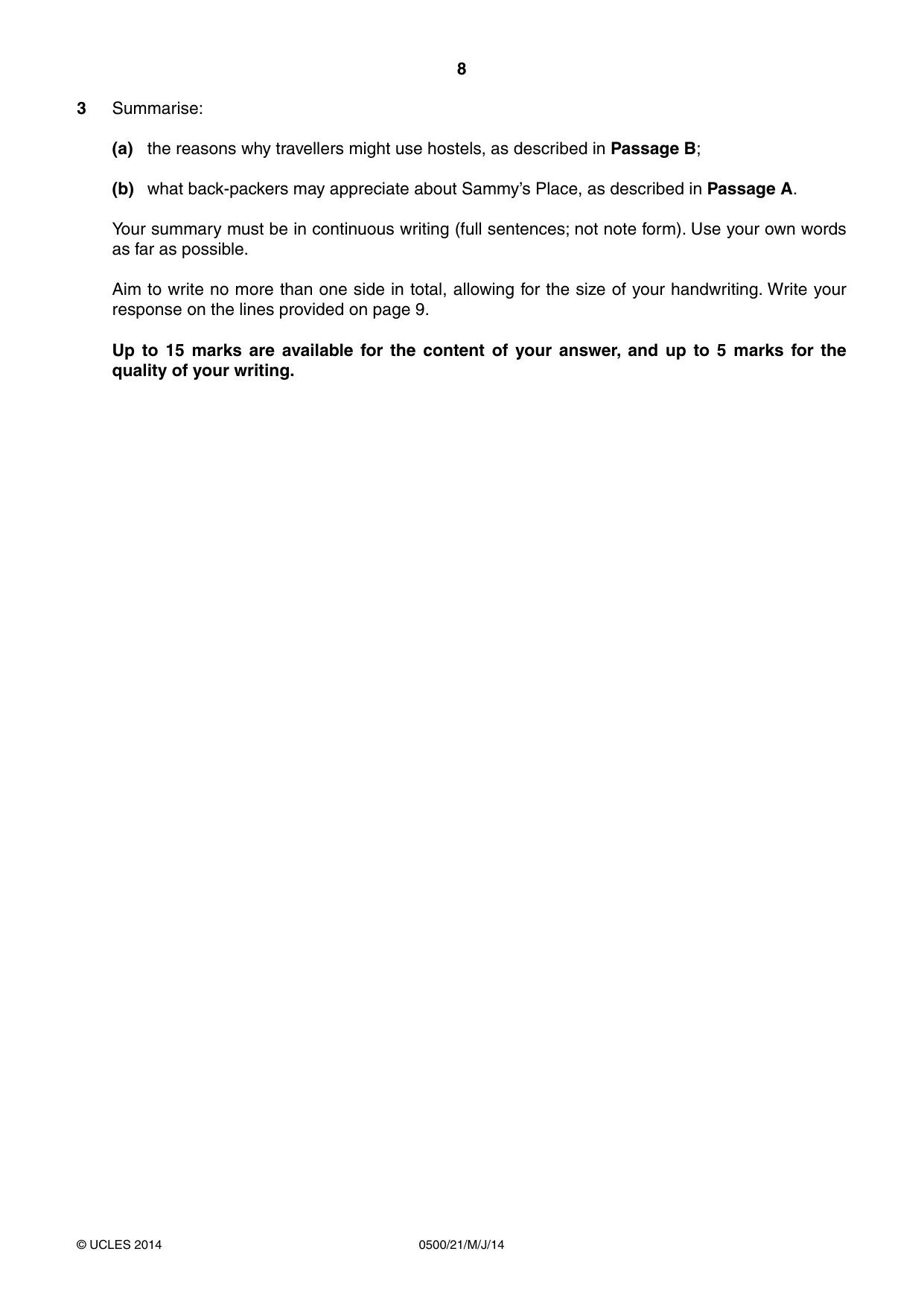
8 0500/21/M/J/14 © UCLES 2014 3 Summarise: (a) the reasons why travellers might use hostels, as described in Passage B; (b) what back-packers may appreciate about Sammy’s Place, as described in Passage A. Your summary must be in continuous writing (full sentences; not note form). Use your own words as far as possible. Aim to write no more than one side in total, allowing for the size of your handwriting. Write your response on the lines provided on page 9. Up to 15 marks are available for the content of your answer, and up to 5 marks for the quality of your writing.
Question paper, page 9
9 0500/21/M/J/14 © UCLES 2014 … … … … … … … … … … … … … … … … … … … … … … … … … … … [Total: 20]
Question paper, page 10
10 0500/21/M/J/14 © UCLES 2014 Additional Page If you use the following lined page to complete the answer(s) to any question(s), the question number(s) must be clearly shown. … … … … … … … … … … … … … … … … … … … … … … … … … …
Question paper, page 11
11 0500/21/M/J/14 © UCLES 2014 Additional Page If you use the following lined page to complete the answer(s) to any question(s), the question number(s) must be clearly shown. … … … … … … … … … … … … … … … … … … … … … … … … … …
Question paper, page 12
12 0500/21/M/J/14 © UCLES 2014 Permission to reproduce items where third-party owned material protected by copyright is included has been sought and cleared where possible. Every reasonable effort has been made by the publisher (UCLES) to trace copyright holders, but if any items requiring clearance have unwittingly been included, the publisher will be pleased to make amends at the earliest possible opportunity. Cambridge International Examinations is part of the Cambridge Assessment Group. Cambridge Assessment is the brand name of University of Cambridge Local Examinations Syndicate (UCLES), which is itself a department of the University of Cambridge. BLANK PAGE
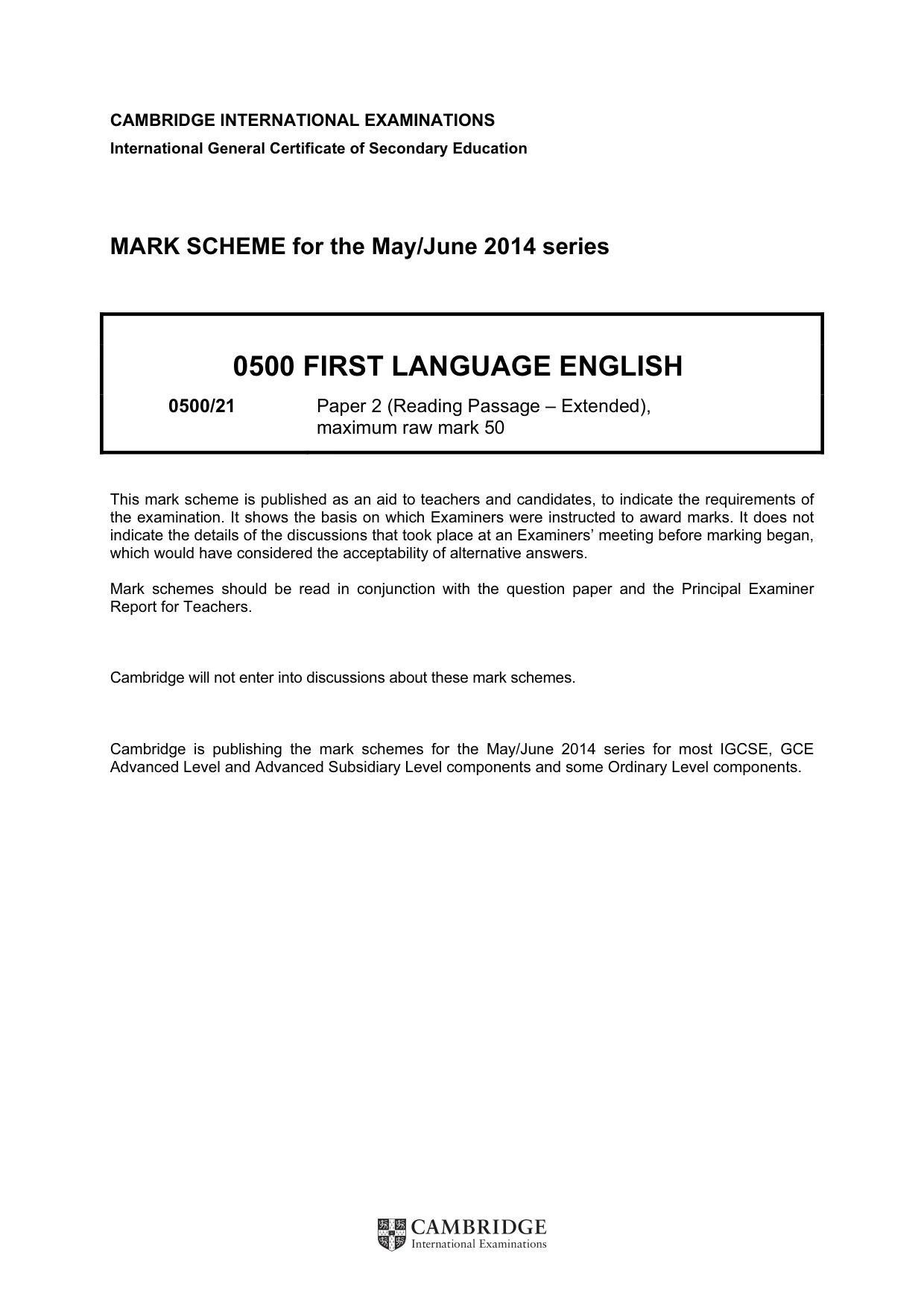
Mark scheme, page 1
CAMBRIDGE INTERNATIONAL EXAMINATIONS International General Certificate of Secondary Education MARK SCHEME for the May/June 2014 series 0500 FIRST LANGUAGE ENGLISH 0500/21 Paper 2 (Reading Passage – Extended), maximum raw mark 50 This mark scheme is published as an aid to teachers and candidates, to indicate the requirements of the examination. It shows the basis on which Examiners were instructed to award marks. It does not indicate the details of the discussions that took place at an Examiners’ meeting before marking began, which would have considered the acceptability of alternative answers. Mark schemes should be read in conjunction with the question paper and the Principal Examiner Report for Teachers. Cambridge will not enter into discussions about these mark schemes. Cambridge is publishing the mark schemes for the May/June 2014 series for most IGCSE, GCE Advanced Level and Advanced Subsidiary Level components and some Ordinary Level components.
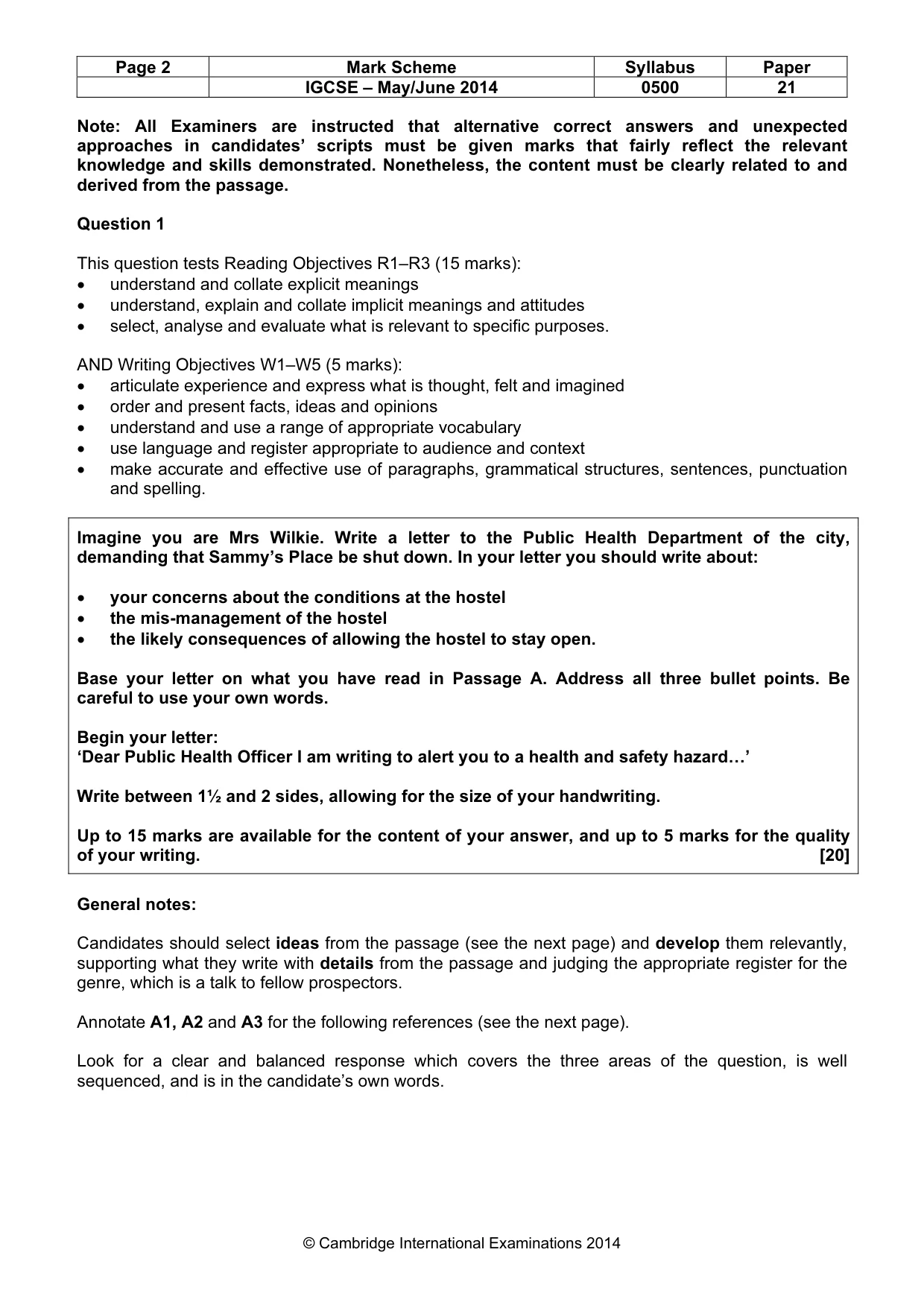
Mark scheme, page 2
Page 2 Mark Scheme Syllabus Paper IGCSE – May/June 2014 0500 21 © Cambridge International Examinations 2014 Note: All Examiners are instructed that alternative correct answers and unexpected approaches in candidates’ scripts must be given marks that fairly reflect the relevant knowledge and skills demonstrated. Nonetheless, the content must be clearly related to and derived from the passage. Question 1 This question tests Reading Objectives R1–R3 (15 marks): • understand and collate explicit meanings • understand, explain and collate implicit meanings and attitudes • select, analyse and evaluate what is relevant to specific purposes. AND Writing Objectives W1–W5 (5 marks): • articulate experience and express what is thought, felt and imagined • order and present facts, ideas and opinions • understand and use a range of appropriate vocabulary • use language and register appropriate to audience and context • make accurate and effective use of paragraphs, grammatical structures, sentences, punctuation and spelling. Imagine you are Mrs Wilkie. Write a letter to the Public Health Department of the city, demanding that Sammy’s Place be shut down. In your letter you should write about: • your concerns about the conditions at the hostel • the mis-management of the hostel • the likely consequences of allowing the hostel to stay open. Base your letter on what you have read in Passage A. Address all three bullet points. Be careful to use your own words. Begin your letter: ‘Dear Public Health Officer I am writing to alert you to a health and safety hazard…’ Write between 1½ and 2 sides, allowing for the size of your handwriting. Up to 15 marks are available for the content of your answer, and up to 5 marks for the quality of your writing. [20] General notes: Candidates should select ideas from the passage (see the next page) and develop them relevantly, supporting what they write with details from the passage and judging the appropriate register for the genre, which is a talk to fellow prospectors. Annotate A1, A2 and A3 for the following references (see the next page). Look for a clear and balanced response which covers the three areas of the question, is well sequenced, and is in the candidate’s own words.
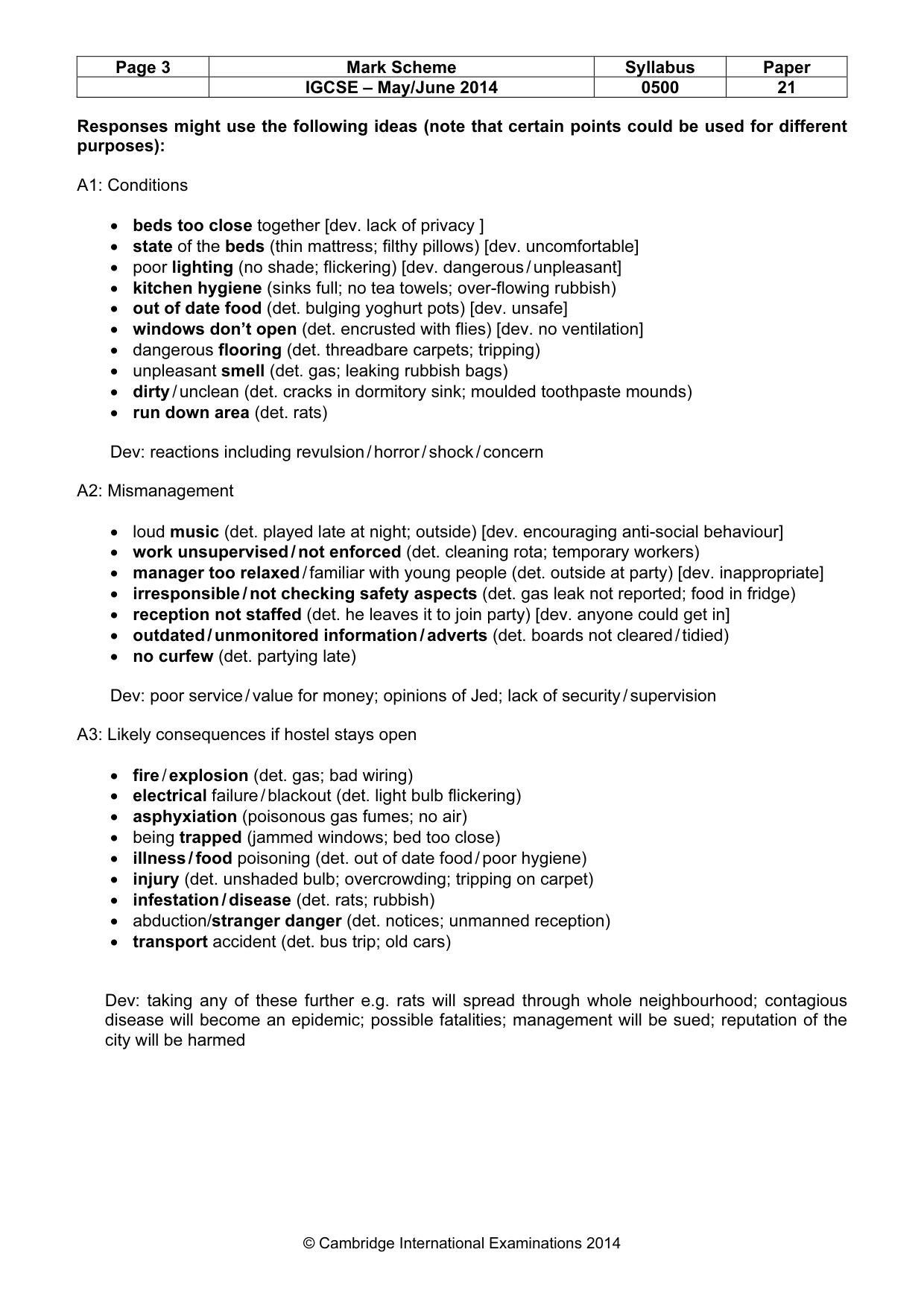
Mark scheme, page 3
Page 3 Mark Scheme Syllabus Paper IGCSE – May/June 2014 0500 21 © Cambridge International Examinations 2014 Responses might use the following ideas (note that certain points could be used for different purposes): A1: Conditions • beds too close together [dev. lack of privacy ] • state of the beds (thin mattress; filthy pillows) [dev. uncomfortable] • poor lighting (no shade; flickering) [dev. dangerous / unpleasant] • kitchen hygiene (sinks full; no tea towels; over-flowing rubbish) • out of date food (det. bulging yoghurt pots) [dev. unsafe] • windows don’t open (det. encrusted with flies) [dev. no ventilation] • dangerous flooring (det. threadbare carpets; tripping) • unpleasant smell (det. gas; leaking rubbish bags) • dirty / unclean (det. cracks in dormitory sink; moulded toothpaste mounds) • run down area (det. rats) Dev: reactions including revulsion / horror / shock / concern A2: Mismanagement • loud music (det. played late at night; outside) [dev. encouraging anti-social behaviour] • work unsupervised / not enforced (det. cleaning rota; temporary workers) • manager too relaxed / familiar with young people (det. outside at party) [dev. inappropriate] • irresponsible / not checking safety aspects (det. gas leak not reported; food in fridge) • reception not staffed (det. he leaves it to join party) [dev. anyone could get in] • outdated / unmonitored information / adverts (det. boards not cleared / tidied) • no curfew (det. partying late) Dev: poor service / value for money; opinions of Jed; lack of security / supervision A3: Likely consequences if hostel stays open • fire / explosion (det. gas; bad wiring) • electrical failure / blackout (det. light bulb flickering) • asphyxiation (poisonous gas fumes; no air) • being trapped (jammed windows; bed too close) • illness / food poisoning (det. out of date food / poor hygiene) • injury (det. unshaded bulb; overcrowding; tripping on carpet) • infestation / disease (det. rats; rubbish) • abduction/stranger danger (det. notices; unmanned reception) • transport accident (det. bus trip; old cars) Dev: taking any of these further e.g. rats will spread through whole neighbourhood; contagious disease will become an epidemic; possible fatalities; management will be sued; reputation of the city will be harmed
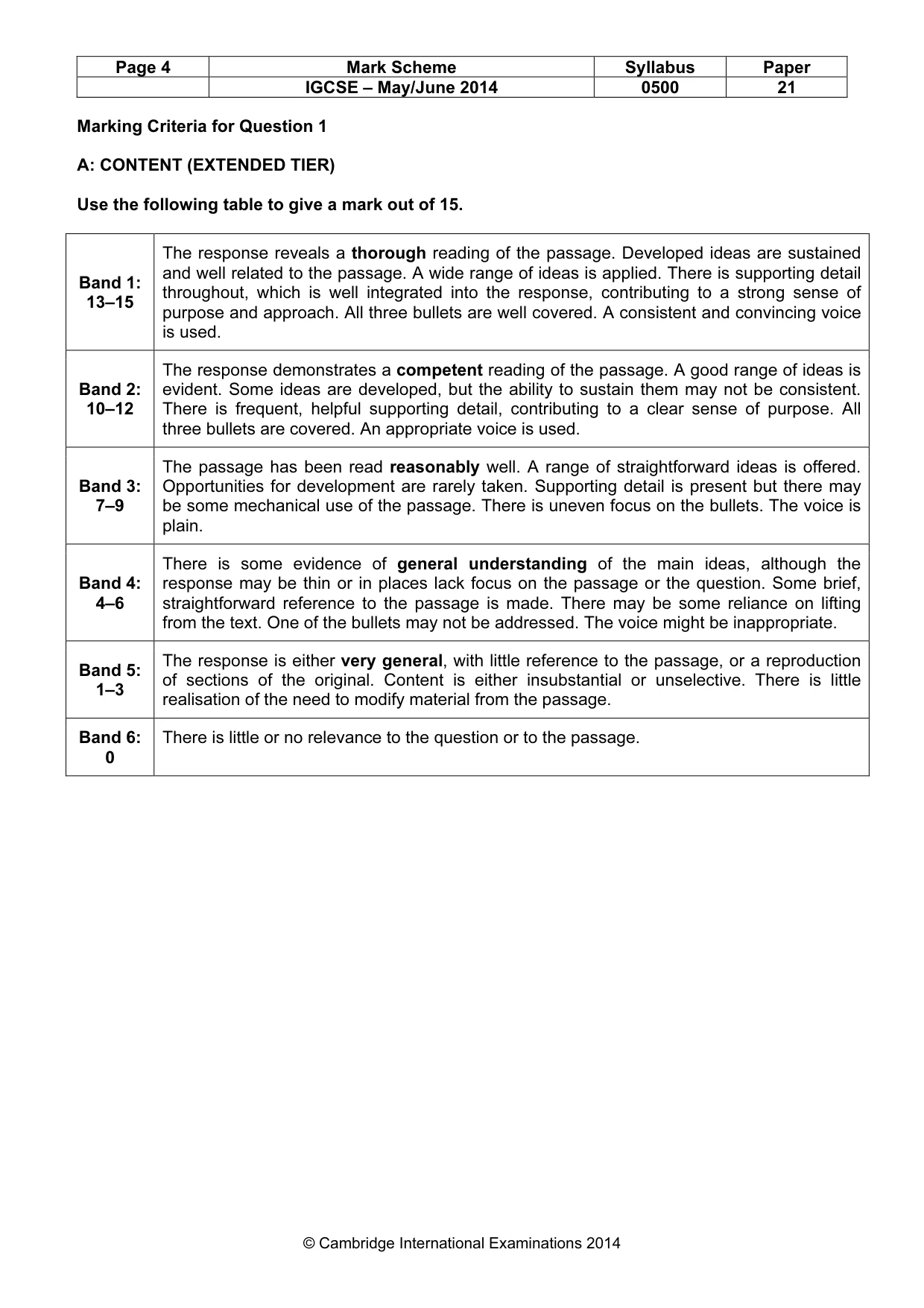
Mark scheme, page 4
Page 4 Mark Scheme Syllabus Paper IGCSE – May/June 2014 0500 21 © Cambridge International Examinations 2014 Marking Criteria for Question 1 A: CONTENT (EXTENDED TIER) Use the following table to give a mark out of 15. Band 1: 13–15 The response reveals a thorough reading of the passage. Developed ideas are sustained and well related to the passage. A wide range of ideas is applied. There is supporting detail throughout, which is well integrated into the response, contributing to a strong sense of purpose and approach. All three bullets are well covered. A consistent and convincing voice is used. Band 2: 10–12 The response demonstrates a competent reading of the passage. A good range of ideas is evident. Some ideas are developed, but the ability to sustain them may not be consistent. There is frequent, helpful supporting detail, contributing to a clear sense of purpose. All three bullets are covered. An appropriate voice is used. Band 3: 7–9 The passage has been read reasonably well. A range of straightforward ideas is offered. Opportunities for development are rarely taken. Supporting detail is present but there may be some mechanical use of the passage. There is uneven focus on the bullets. The voice is plain. Band 4: 4–6 There is some evidence of general understanding of the main ideas, although the response may be thin or in places lack focus on the passage or the question. Some brief, straightforward reference to the passage is made. There may be some reliance on lifting from the text. One of the bullets may not be addressed. The voice might be inappropriate. Band 5: 1–3 The response is either very general, with little reference to the passage, or a reproduction of sections of the original. Content is either insubstantial or unselective. There is little realisation of the need to modify material from the passage. Band 6: 0 There is little or no relevance to the question or to the passage.
Mark scheme, page 5
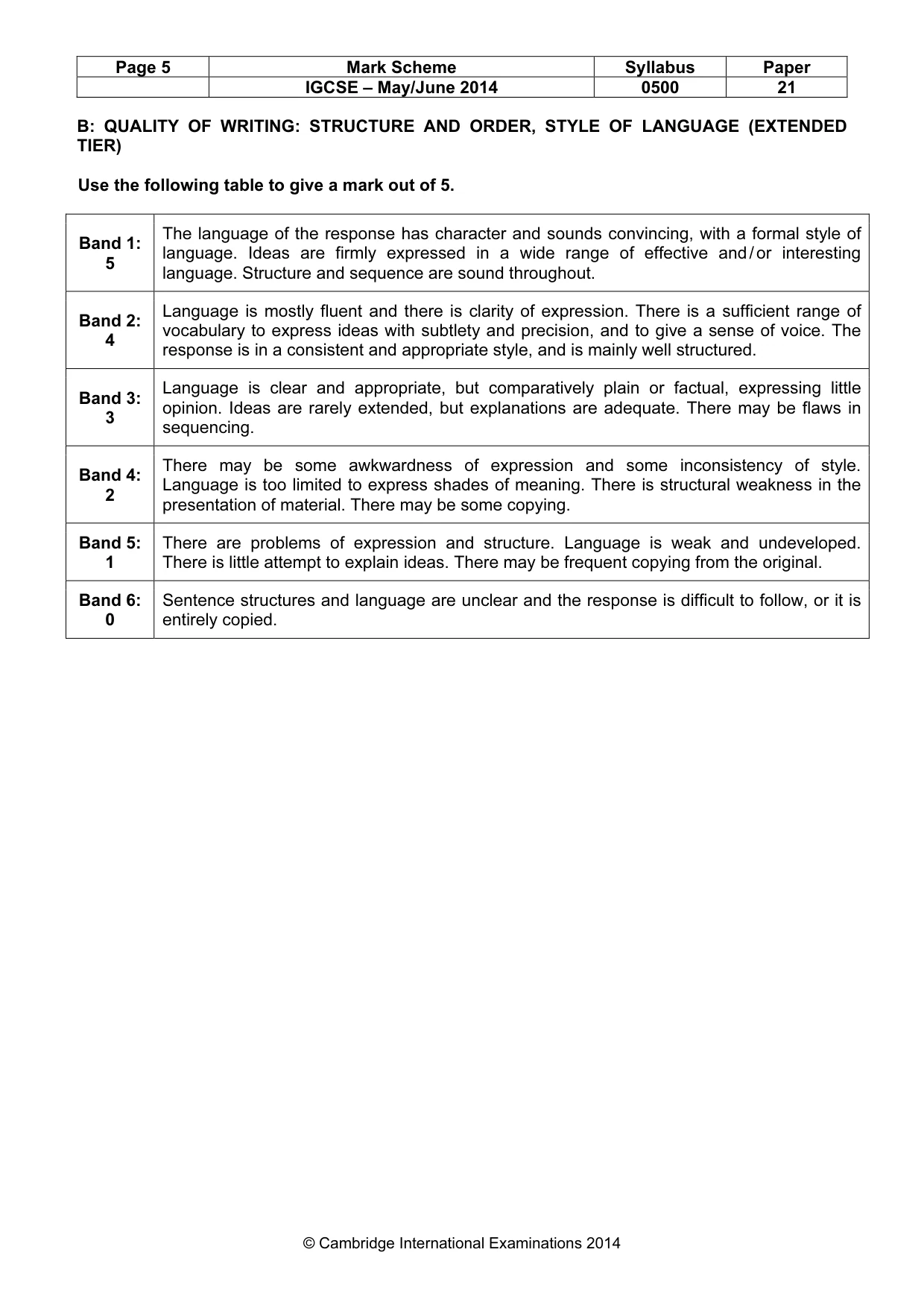
Page 5 Mark Scheme Syllabus Paper IGCSE – May/June 2014 0500 21 © Cambridge International Examinations 2014 B: QUALITY OF WRITING: STRUCTURE AND ORDER, STYLE OF LANGUAGE (EXTENDED TIER) Use the following table to give a mark out of 5. Band 1: 5 The language of the response has character and sounds convincing, with a formal style of language. Ideas are firmly expressed in a wide range of effective and / or interesting language. Structure and sequence are sound throughout. Band 2: 4 Language is mostly fluent and there is clarity of expression. There is a sufficient range of vocabulary to express ideas with subtlety and precision, and to give a sense of voice. The response is in a consistent and appropriate style, and is mainly well structured. Band 3: 3 Language is clear and appropriate, but comparatively plain or factual, expressing little opinion. Ideas are rarely extended, but explanations are adequate. There may be flaws in sequencing. Band 4: 2 There may be some awkwardness of expression and some inconsistency of style. Language is too limited to express shades of meaning. There is structural weakness in the presentation of material. There may be some copying. Band 5: 1 There are problems of expression and structure. Language is weak and undeveloped. There is little attempt to explain ideas. There may be frequent copying from the original. Band 6: 0 Sentence structures and language are unclear and the response is difficult to follow, or it is entirely copied.
Mark scheme, page 6
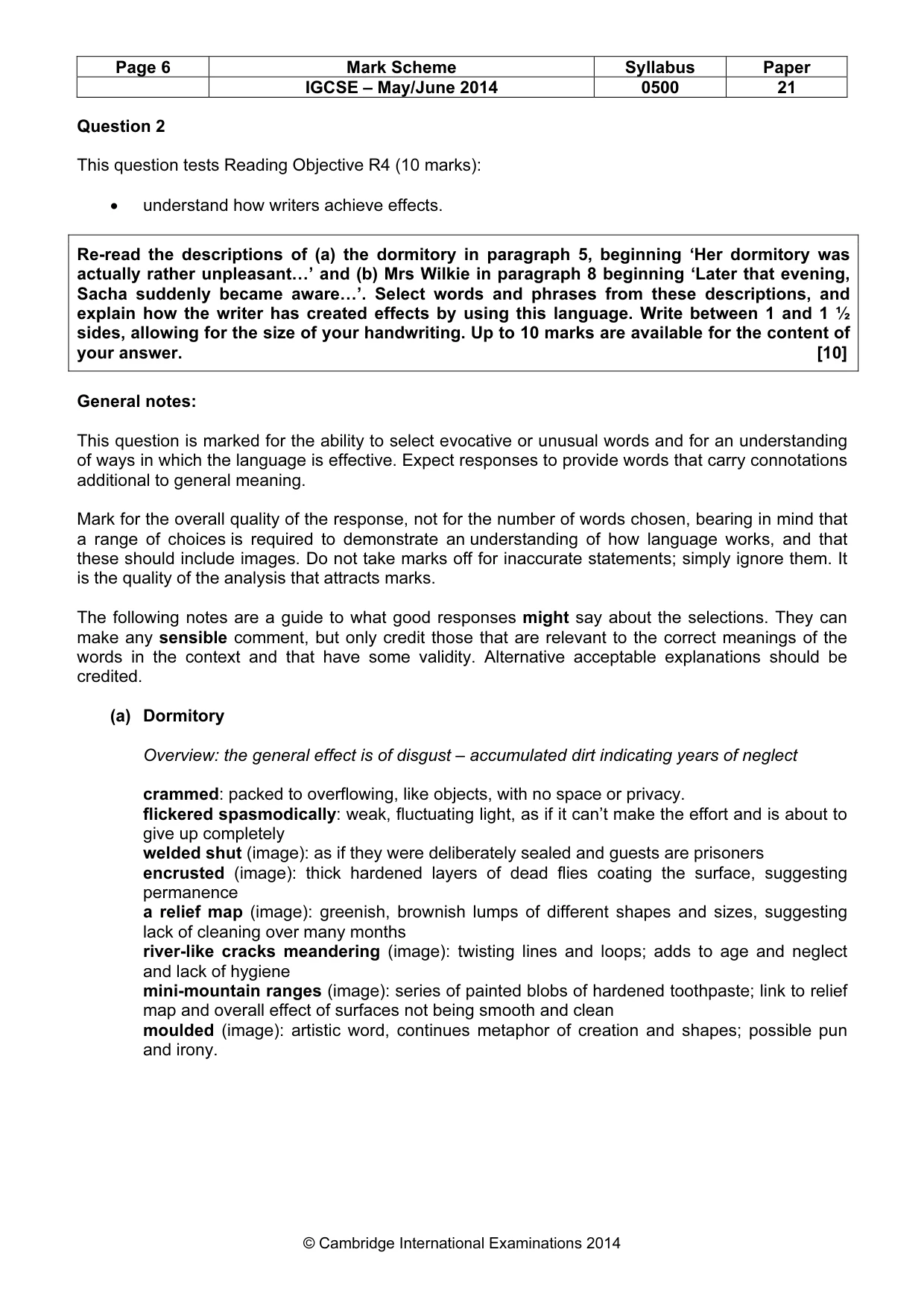
Page 6 Mark Scheme Syllabus Paper IGCSE – May/June 2014 0500 21 © Cambridge International Examinations 2014 Question 2 This question tests Reading Objective R4 (10 marks): • understand how writers achieve effects. Re-read the descriptions of (a) the dormitory in paragraph 5, beginning ‘Her dormitory was actually rather unpleasant…’ and (b) Mrs Wilkie in paragraph 8 beginning ‘Later that evening, Sacha suddenly became aware…’. Select words and phrases from these descriptions, and explain how the writer has created effects by using this language. Write between 1 and 1 ½ sides, allowing for the size of your handwriting. Up to 10 marks are available for the content of your answer. [10] General notes: This question is marked for the ability to select evocative or unusual words and for an understanding of ways in which the language is effective. Expect responses to provide words that carry connotations additional to general meaning. Mark for the overall quality of the response, not for the number of words chosen, bearing in mind that a range of choices is required to demonstrate an understanding of how language works, and that these should include images. Do not take marks off for inaccurate statements; simply ignore them. It is the quality of the analysis that attracts marks. The following notes are a guide to what good responses might say about the selections. They can make any sensible comment, but only credit those that are relevant to the correct meanings of the words in the context and that have some validity. Alternative acceptable explanations should be credited. (a) Dormitory Overview: the general effect is of disgust – accumulated dirt indicating years of neglect crammed: packed to overflowing, like objects, with no space or privacy. flickered spasmodically: weak, fluctuating light, as if it can’t make the effort and is about to give up completely welded shut (image): as if they were deliberately sealed and guests are prisoners encrusted (image): thick hardened layers of dead flies coating the surface, suggesting permanence a relief map (image): greenish, brownish lumps of different shapes and sizes, suggesting lack of cleaning over many months river-like cracks meandering (image): twisting lines and loops; adds to age and neglect and lack of hygiene mini-mountain ranges (image): series of painted blobs of hardened toothpaste; link to relief map and overall effect of surfaces not being smooth and clean moulded (image): artistic word, continues metaphor of creation and shapes; possible pun and irony.
Mark scheme, page 7
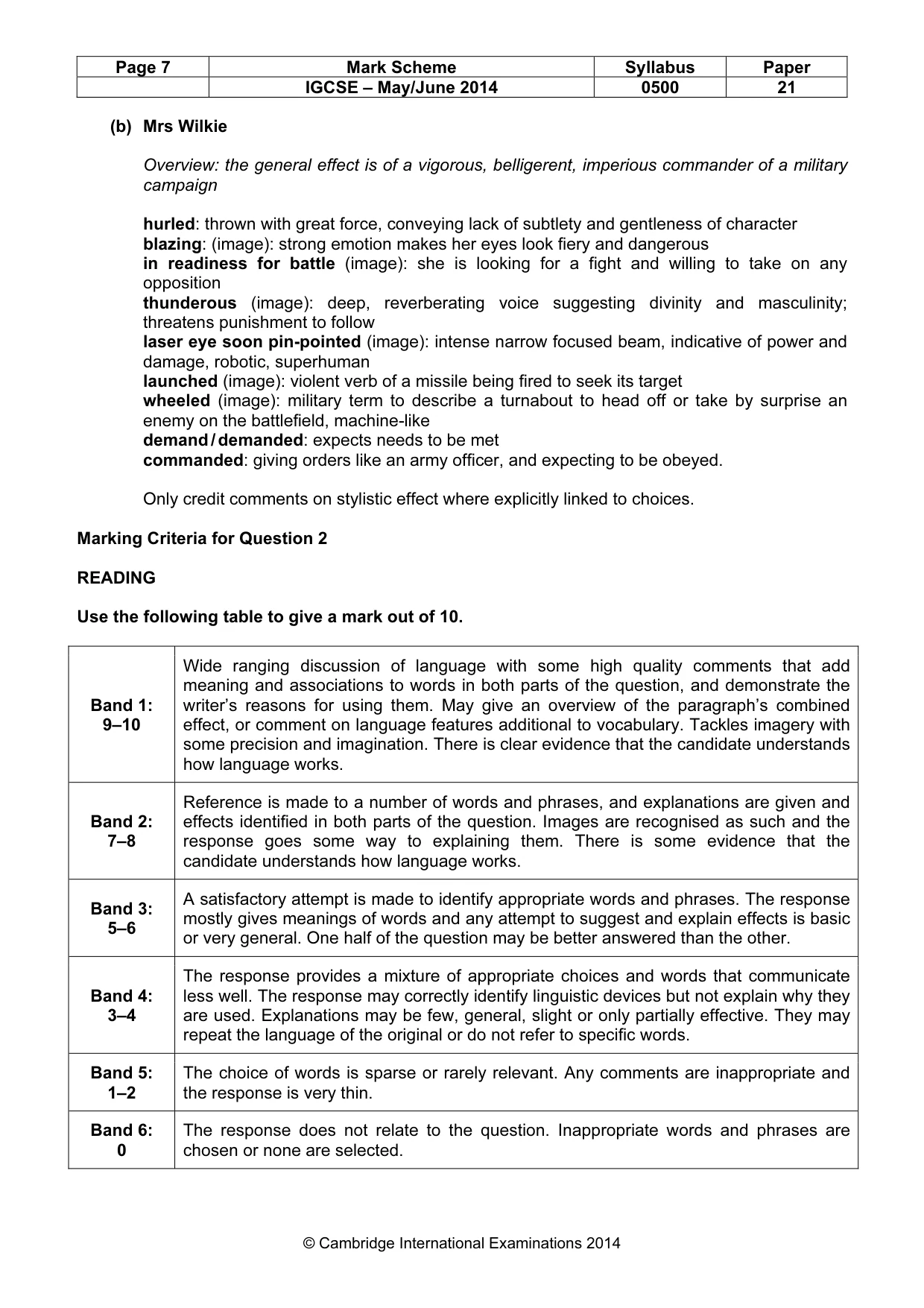
Page 7 Mark Scheme Syllabus Paper IGCSE – May/June 2014 0500 21 © Cambridge International Examinations 2014 (b) Mrs Wilkie Overview: the general effect is of a vigorous, belligerent, imperious commander of a military campaign hurled: thrown with great force, conveying lack of subtlety and gentleness of character blazing: (image): strong emotion makes her eyes look fiery and dangerous in readiness for battle (image): she is looking for a fight and willing to take on any opposition thunderous (image): deep, reverberating voice suggesting divinity and masculinity; threatens punishment to follow laser eye soon pin-pointed (image): intense narrow focused beam, indicative of power and damage, robotic, superhuman launched (image): violent verb of a missile being fired to seek its target wheeled (image): military term to describe a turnabout to head off or take by surprise an enemy on the battlefield, machine-like demand / demanded: expects needs to be met commanded: giving orders like an army officer, and expecting to be obeyed. Only credit comments on stylistic effect where explicitly linked to choices. Marking Criteria for Question 2 READING Use the following table to give a mark out of 10. Band 1: 9–10 Wide ranging discussion of language with some high quality comments that add meaning and associations to words in both parts of the question, and demonstrate the writer’s reasons for using them. May give an overview of the paragraph’s combined effect, or comment on language features additional to vocabulary. Tackles imagery with some precision and imagination. There is clear evidence that the candidate understands how language works. Band 2: 7–8 Reference is made to a number of words and phrases, and explanations are given and effects identified in both parts of the question. Images are recognised as such and the response goes some way to explaining them. There is some evidence that the candidate understands how language works. Band 3: 5–6 A satisfactory attempt is made to identify appropriate words and phrases. The response mostly gives meanings of words and any attempt to suggest and explain effects is basic or very general. One half of the question may be better answered than the other. Band 4: 3–4 The response provides a mixture of appropriate choices and words that communicate less well. The response may correctly identify linguistic devices but not explain why they are used. Explanations may be few, general, slight or only partially effective. They may repeat the language of the original or do not refer to specific words. Band 5: 1–2 The choice of words is sparse or rarely relevant. Any comments are inappropriate and the response is very thin. Band 6: 0 The response does not relate to the question. Inappropriate words and phrases are chosen or none are selected.
Mark scheme, page 8
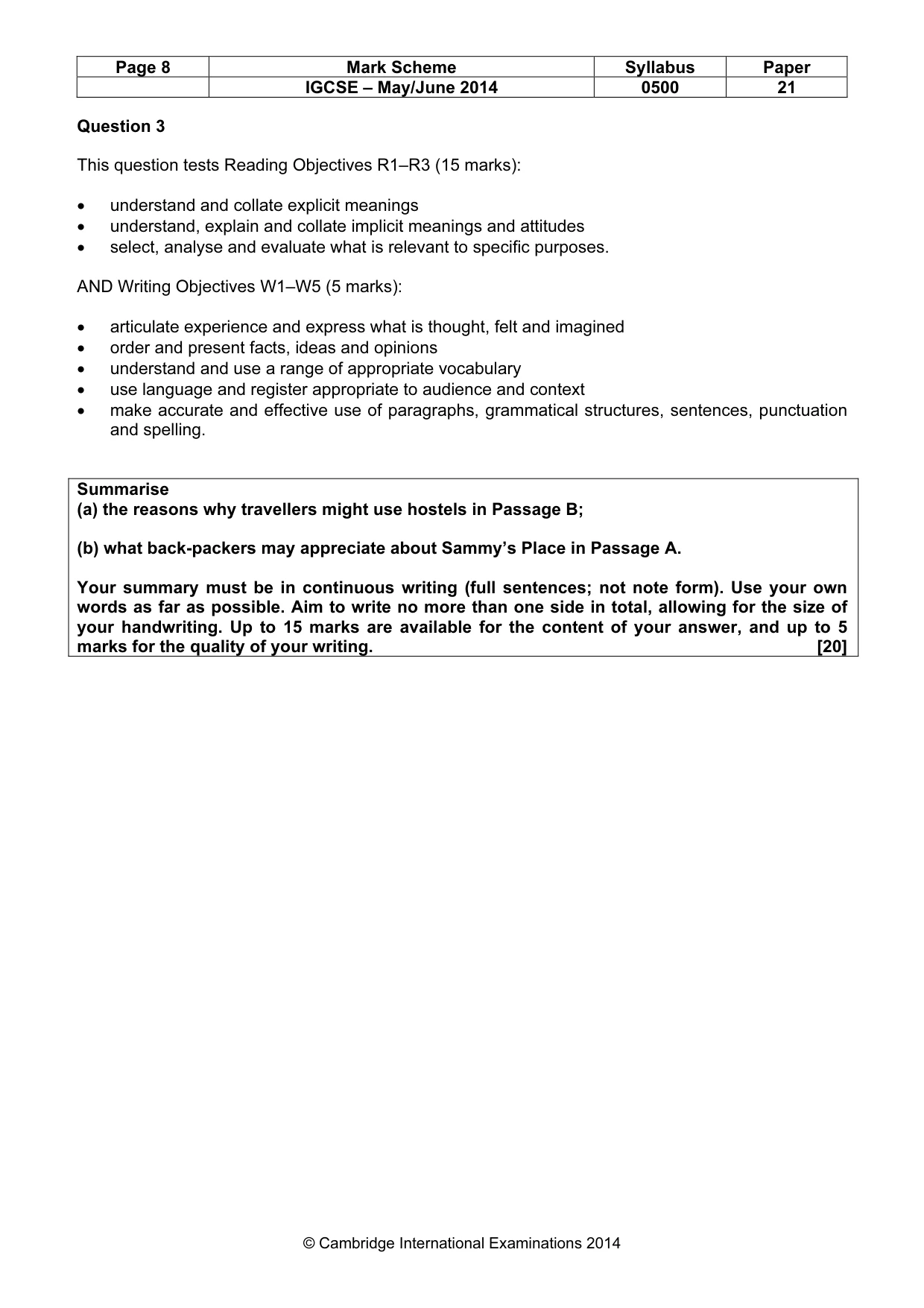
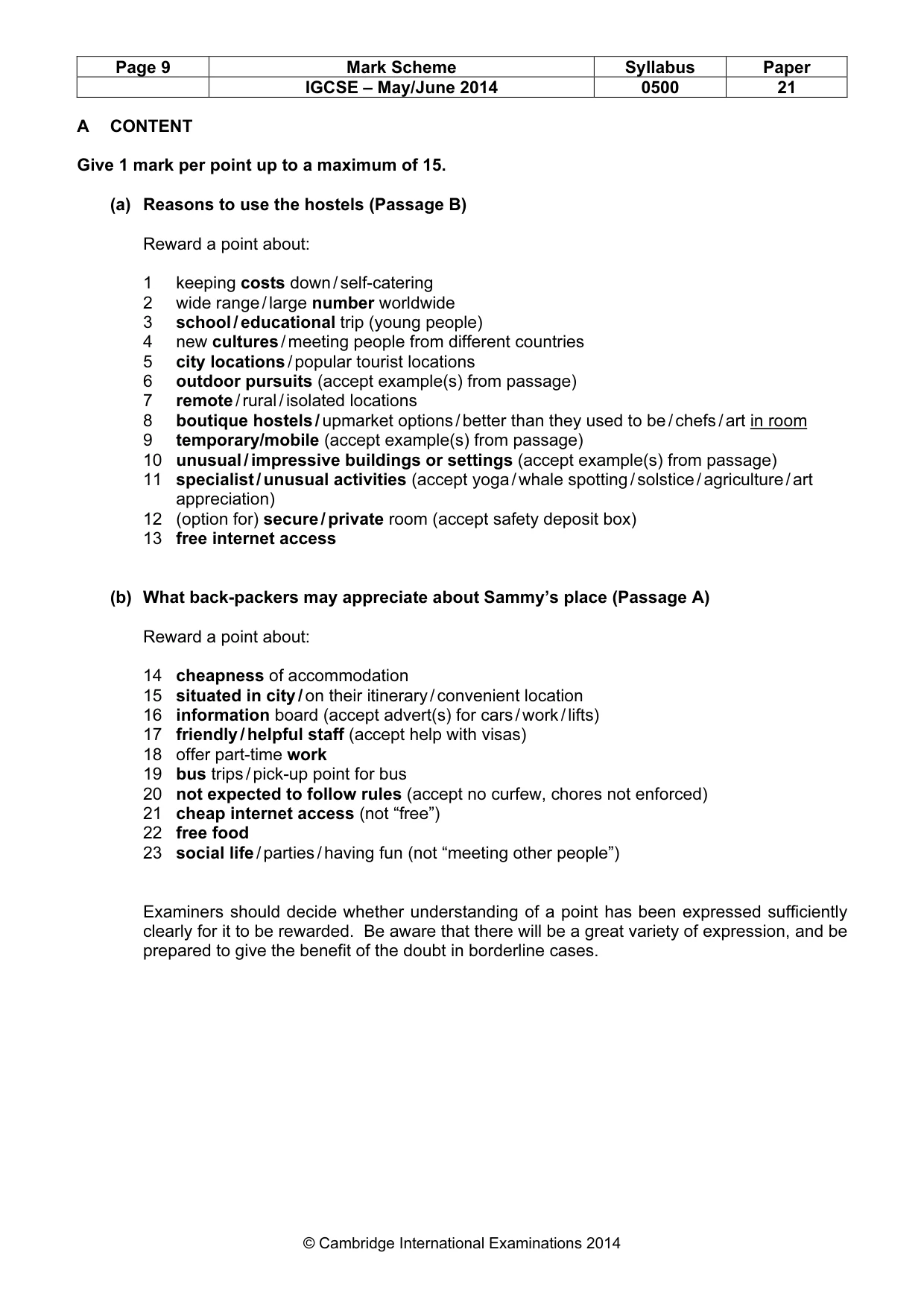
Page 8 Mark Scheme Syllabus Paper IGCSE – May/June 2014 0500 21 © Cambridge International Examinations 2014 Question 3 This question tests Reading Objectives R1–R3 (15 marks): • understand and collate explicit meanings • understand, explain and collate implicit meanings and attitudes • select, analyse and evaluate what is relevant to specific purposes. AND Writing Objectives W1–W5 (5 marks): • articulate experience and express what is thought, felt and imagined • order and present facts, ideas and opinions • understand and use a range of appropriate vocabulary • use language and register appropriate to audience and context • make accurate and effective use of paragraphs, grammatical structures, sentences, punctuation and spelling. Summarise (a) the reasons why travellers might use hostels in Passage B; (b) what back-packers may appreciate about Sammy’s Place in Passage A. Your summary must be in continuous writing (full sentences; not note form). Use your own words as far as possible. Aim to write no more than one side in total, allowing for the size of your handwriting. Up to 15 marks are available for the content of your answer, and up to 5 marks for the quality of your writing. [20]
Mark scheme, page 9
Page 9 Mark Scheme Syllabus Paper IGCSE – May/June 2014 0500 21 © Cambridge International Examinations 2014 A CONTENT Give 1 mark per point up to a maximum of 15. (a) Reasons to use the hostels (Passage B) Reward a point about: 1 keeping costs down / self-catering 2 wide range / large number worldwide 3 school / educational trip (young people) 4 new cultures / meeting people from different countries 5 city locations / popular tourist locations 6 outdoor pursuits (accept example(s) from passage) 7 remote / rural / isolated locations 8 boutique hostels / upmarket options / better than they used to be / chefs / art in room 9 temporary/mobile (accept example(s) from passage) 10 unusual / impressive buildings or settings (accept example(s) from passage) 11 specialist / unusual activities (accept yoga / whale spotting / solstice / agriculture / art appreciation) 12 (option for) secure / private room (accept safety deposit box) 13 free internet access (b) What back-packers may appreciate about Sammy’s place (Passage A) Reward a point about: 14 cheapness of accommodation 15 situated in city / on their itinerary / convenient location 16 information board (accept advert(s) for cars / work / lifts) 17 friendly / helpful staff (accept help with visas) 18 offer part-time work 19 bus trips / pick-up point for bus 20 not expected to follow rules (accept no curfew, chores not enforced) 21 cheap internet access (not “free”) 22 free food 23 social life / parties / having fun (not “meeting other people”) Examiners should decide whether understanding of a point has been expressed sufficiently clearly for it to be rewarded. Be aware that there will be a great variety of expression, and be prepared to give the benefit of the doubt in borderline cases.
Mark scheme, page 10
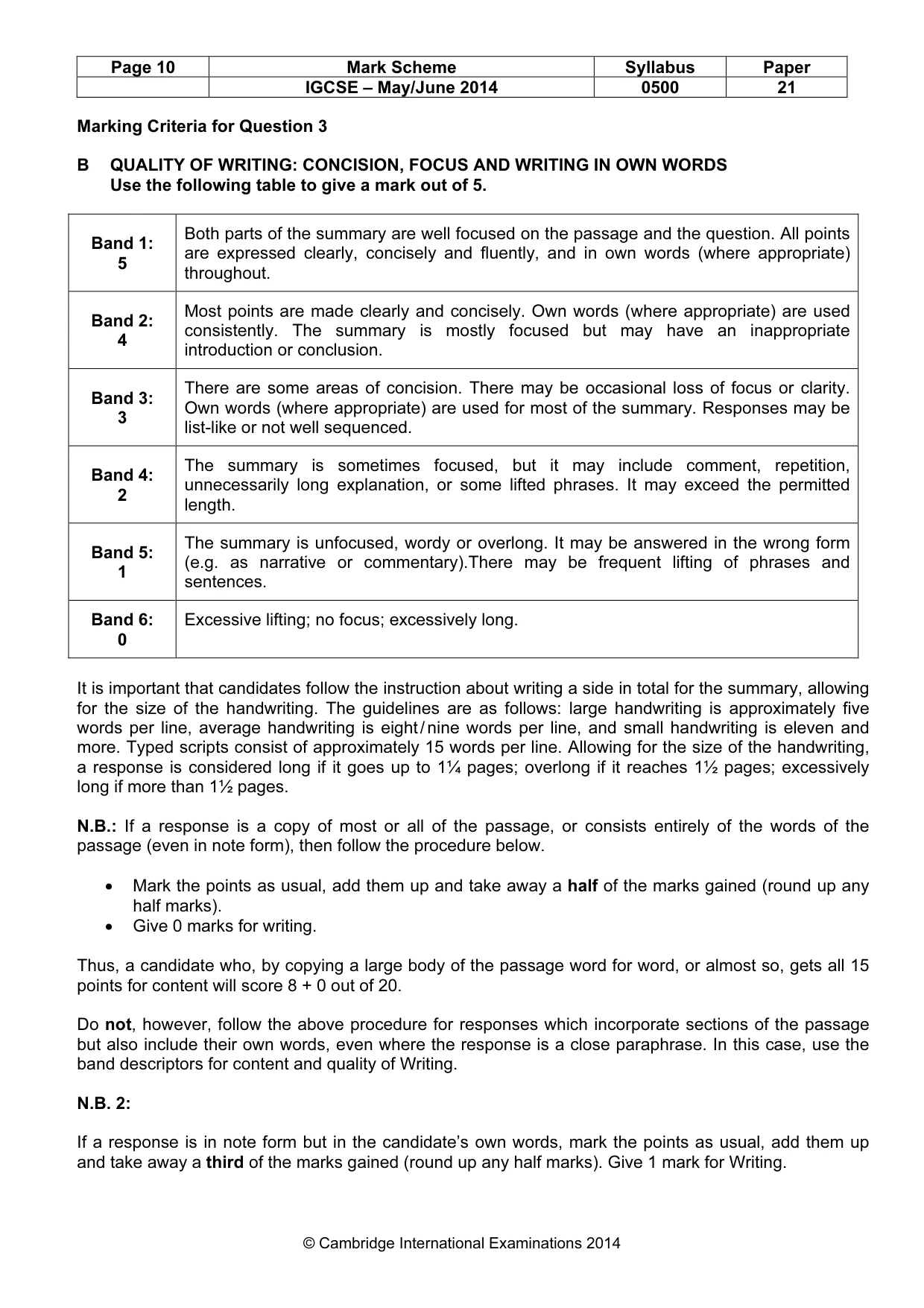
Page 10 Mark Scheme Syllabus Paper IGCSE – May/June 2014 0500 21 © Cambridge International Examinations 2014 Marking Criteria for Question 3 B QUALITY OF WRITING: CONCISION, FOCUS AND WRITING IN OWN WORDS Use the following table to give a mark out of 5. Band 1: 5 Both parts of the summary are well focused on the passage and the question. All points are expressed clearly, concisely and fluently, and in own words (where appropriate) throughout. Band 2: 4 Most points are made clearly and concisely. Own words (where appropriate) are used consistently. The summary is mostly focused but may have an inappropriate introduction or conclusion. Band 3: 3 There are some areas of concision. There may be occasional loss of focus or clarity. Own words (where appropriate) are used for most of the summary. Responses may be list-like or not well sequenced. Band 4: 2 The summary is sometimes focused, but it may include comment, repetition, unnecessarily long explanation, or some lifted phrases. It may exceed the permitted length. Band 5: 1 The summary is unfocused, wordy or overlong. It may be answered in the wrong form (e.g. as narrative or commentary).There may be frequent lifting of phrases and sentences. Band 6: 0 Excessive lifting; no focus; excessively long. It is important that candidates follow the instruction about writing a side in total for the summary, allowing for the size of the handwriting. The guidelines are as follows: large handwriting is approximately five words per line, average handwriting is eight / nine words per line, and small handwriting is eleven and more. Typed scripts consist of approximately 15 words per line. Allowing for the size of the handwriting, a response is considered long if it goes up to 1¼ pages; overlong if it reaches 1½ pages; excessively long if more than 1½ pages. N.B.: If a response is a copy of most or all of the passage, or consists entirely of the words of the passage (even in note form), then follow the procedure below. • Mark the points as usual, add them up and take away a half of the marks gained (round up any half marks). • Give 0 marks for writing. Thus, a candidate who, by copying a large body of the passage word for word, or almost so, gets all 15 points for content will score 8 + 0 out of 20. Do not, however, follow the above procedure for responses which incorporate sections of the passage but also include their own words, even where the response is a close paraphrase. In this case, use the band descriptors for content and quality of Writing. N.B. 2: If a response is in note form but in the candidate’s own words, mark the points as usual, add them up and take away a third of the marks gained (round up any half marks). Give 1 mark for Writing.