Cambridge IGCSE English - First Language 0500 — 2014 May/June Paper 1 · Variant 3
0500/13/M/J/14
The question paper and its mark scheme, free to read here and free to download. This is Cambridge’s own paper, exactly as it was sat.
Question paper12 pages
Mark scheme8 pages
Answers below. Sit the paper first if you are practising.
Paper as text
Question paper, page 1
This document consists of 9 printed pages, 3 blank pages and 1 Reading Booklet Insert. DC (HB (PK)) 79758/4 © UCLES 2014 [Turn over Cambridge International Examinations Cambridge International General Certificate of Secondary Education * 4 3 7 2 7 7 5 4 5 6 * FIRST LANGUAGE ENGLISH 0500/13 Paper 1 Reading Passage (Core) May/June 2014 1 hour 45 minutes Candidates answer on the Question Paper. READ THESE INSTRUCTIONS FIRST Write your Centre number, candidate number and name in the spaces provided. Write in dark blue or black pen. Do not use staples, paper clips, glue or correction fluid. DO NOT WRITE IN ANY BARCODES. Answer all questions in the space provided. If additional space is required, you should use the lined pages at the end of this booklet. The question number(s) must be clearly shown. Dictionaries are not permitted. The Reading Booklet Insert contains the reading passage for use with all questions on this Question Paper. The Insert is not assessed by the Examiner. The number of marks is given in brackets [ ] at the end of each question or part question.
Question paper, page 2
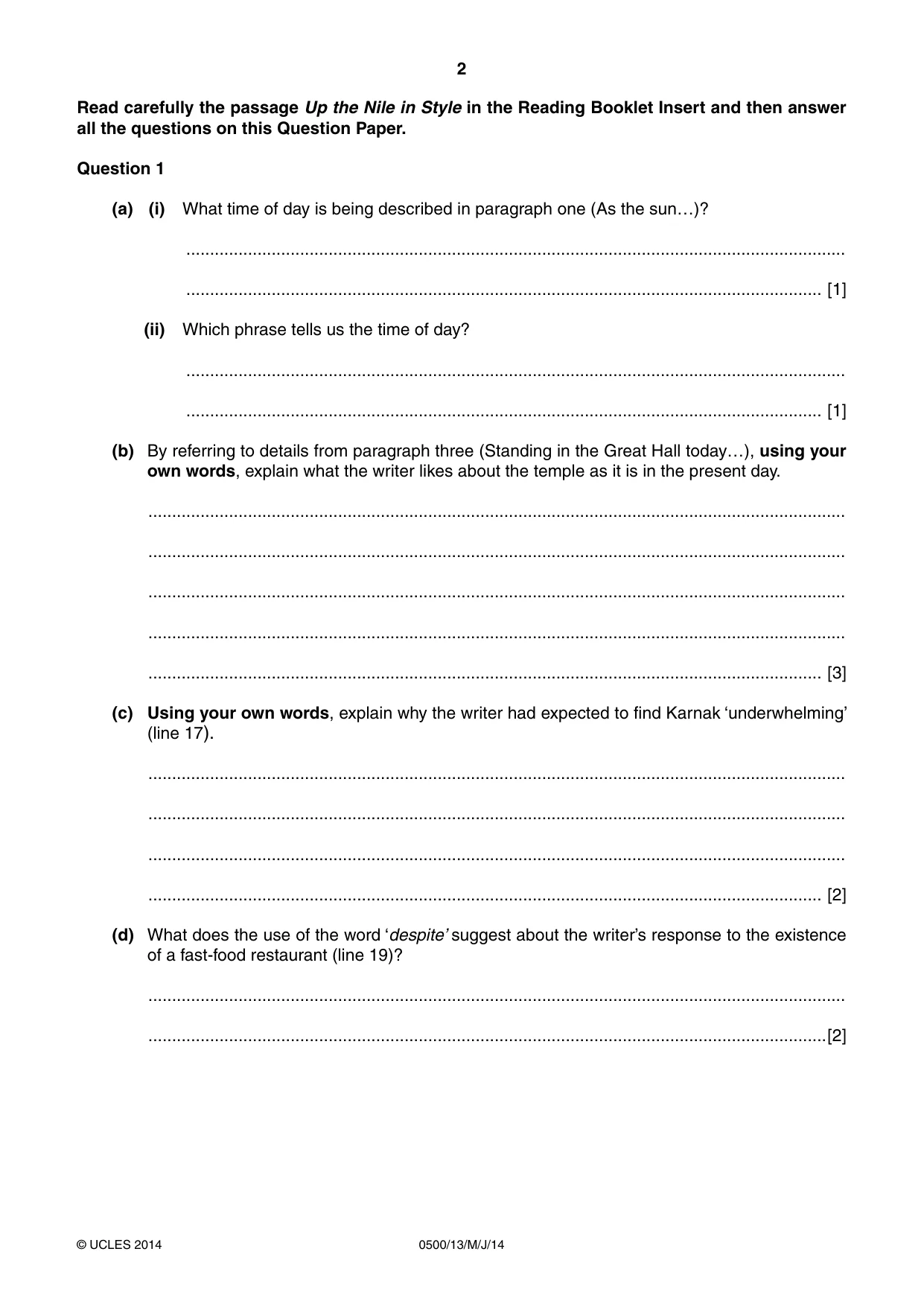
2 0500/13/M/J/14 © UCLES 2014 Read carefully the passage Up the Nile in Style in the Reading Booklet Insert and then answer all the questions on this Question Paper. Question 1 (a) (i) What time of day is being described in paragraph one (As the sun…)? … … [1] (ii) Which phrase tells us the time of day? … … [1] (b) By referring to details from paragraph three (Standing in the Great Hall today…), using your own words, explain what the writer likes about the temple as it is in the present day. … … … … … [3] (c) Using your own words, explain why the writer had expected to find Karnak ‘underwhelming’ (line 17). … … … … [2] (d) What does the use of the word ‘despite’ suggest about the writer’s response to the existence of a fast-food restaurant (line 19)? … …[2]
Question paper, page 3
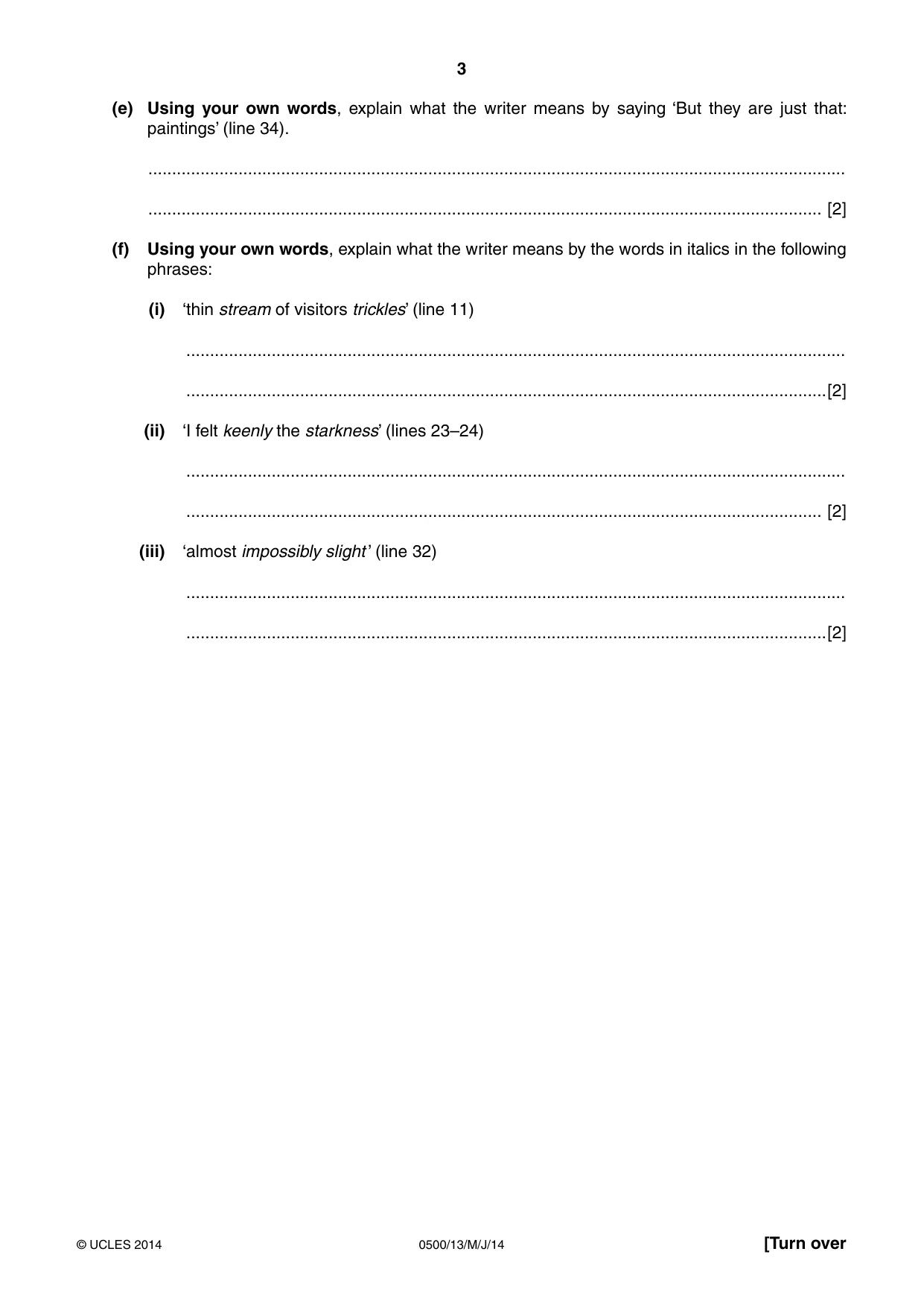
3 0500/13/M/J/14 © UCLES 2014 [Turn over (e) Using your own words, explain what the writer means by saying ‘But they are just that: paintings’ (line 34). … … [2] (f) Using your own words, explain what the writer means by the words in italics in the following phrases: (i) ‘thin stream of visitors trickles’ (line 11) … …[2] (ii) ‘I felt keenly the starkness’ (lines 23–24) … … [2] (iii) ‘almost impossibly slight ’ (line 32) … …[2]
Question paper, page 4
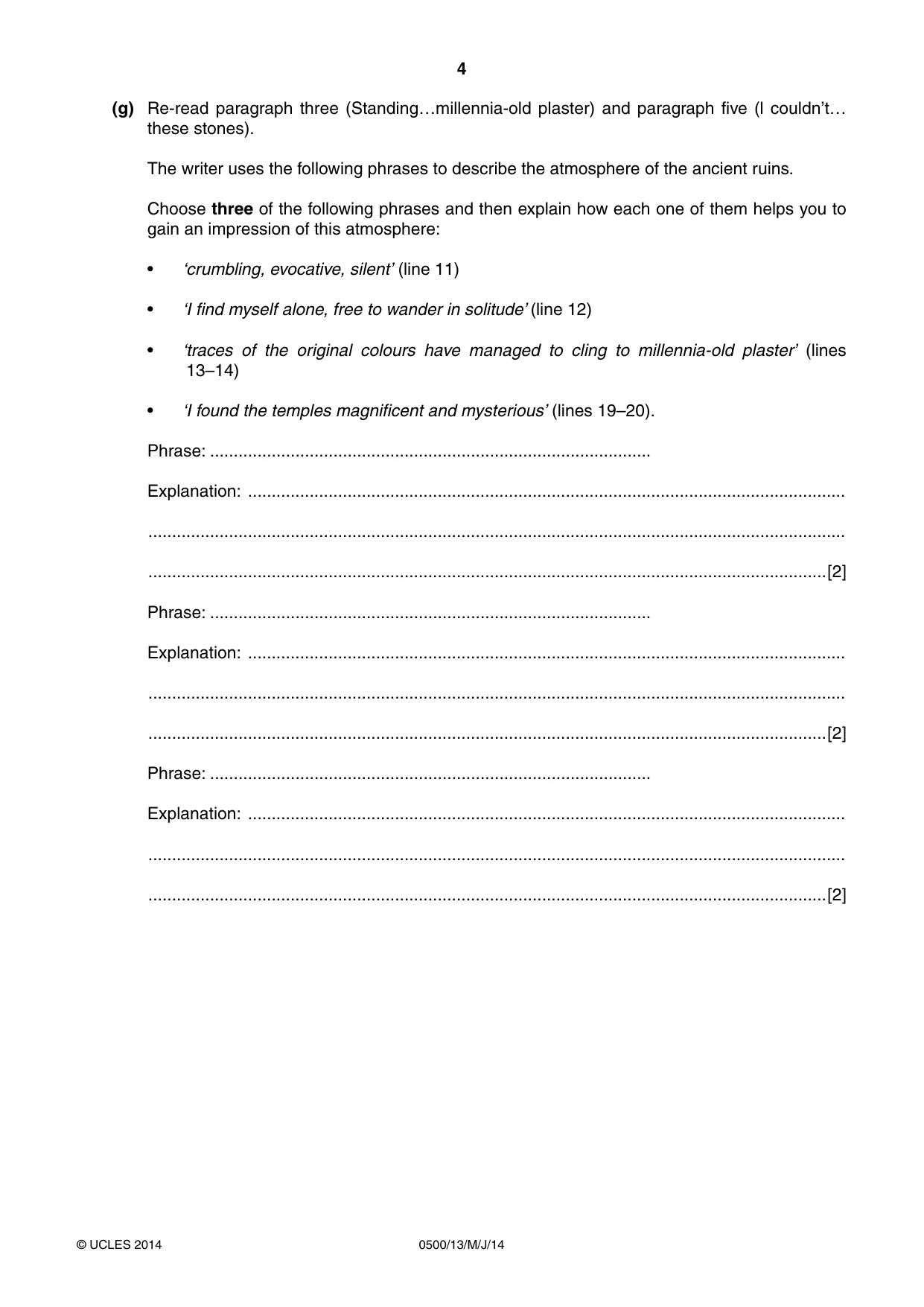
4 0500/13/M/J/14 © UCLES 2014 (g) Re-read paragraph three (Standing…millennia-old plaster) and paragraph five (l couldn’t… these stones). The writer uses the following phrases to describe the atmosphere of the ancient ruins. Choose three of the following phrases and then explain how each one of them helps you to gain an impression of this atmosphere: • ‘crumbling, evocative, silent’ (line 11) • ‘I find myself alone, free to wander in solitude’ (line 12) • ‘ traces of the original colours have managed to cling to millennia-old plaster’ (lines 13–14) • ‘I found the temples magnificent and mysterious’ (lines 19–20). Phrase: … Explanation: … … …[2] Phrase: … Explanation: … … …[2] Phrase: … Explanation: … … …[2]
Question paper, page 5
5 0500/13/M/J/14 © UCLES 2014 [Turn over (h) Re-read paragraphs one to five (As the sun … these stones.). Write a summary of what you learn about the architectural features of Karnak. Write a paragraph of about 50–70 words. … … … … … … … … … … … … … … [7] [Total: 30] [Turn over for Question 2]
Question paper, page 6
6 0500/13/M/J/14 © UCLES 2014 Question 2 You have been on a family holiday to Karnak and the Valley of the Kings. You were very impressed and want to persuade your headteacher that it would make a good school trip. Write a letter to the headteacher. You should include: • what you saw and what most impressed you • what you have learned • what your fellow students would gain from the visit. Begin your letter: ‘Dear Headteacher, I have just got back from my holiday in Egypt and would like you to…’. You should base your ideas on what you have read in the passage, but do not copy from it. Address each of the three bullet points. Write between 1 and 1½ sides, allowing for the size of your handwriting. Up to 10 marks are available for the content of your answer, and up to 10 marks for the quality of your writing. … … … … … … … … … … … … … … … … …
Question paper, page 7
7 0500/13/M/J/14 © UCLES 2014 … … … … … … … … … … … … … … … … … … … … … … … … … … … [Total: 20]
Question paper, page 8
8 0500/13/M/J/14 © UCLES 2014 Additional Page If you use the following lined page to complete the answer(s) to any question(s), the question number(s) must be clearly shown. … … … … … … … … … … … … … … … … … … … … … … … … … …
Question paper, page 9
9 0500/13/M/J/14 © UCLES 2014 Additional Page If you use the following lined page to complete the answer(s) to any question(s), the question number(s) must be clearly shown. … … … … … … … … … … … … … … … … … … … … … … … … … …
Question paper, page 10
10 0500/13/M/J/14 © UCLES 2014 BLANK PAGE
Question paper, page 11
11 0500/13/M/J/14 © UCLES 2014 BLANK PAGE
Question paper, page 12
12 0500/13/M/J/14 © UCLES 2014 Copyright Acknowledgements: Reading Passage 1 © Isabel Esterman; Up the Nile in Style; DestinAsian Magazine; February 2012. Permission to reproduce items where third-party owned material protected by copyright is included has been sought and cleared where possible. Every reasonable effort has been made by the publisher (UCLES) to trace copyright holders, but if any items requiring clearance have unwittingly been included, the publisher will be pleased to make amends at the earliest possible opportunity. Cambridge International Examinations is part of the Cambridge Assessment Group. Cambridge Assessment is the brand name of University of Cambridge Local Examinations Syndicate (UCLES), which is itself a department of the University of Cambridge. BLANK PAGE
Mark scheme, page 1
CAMBRIDGE INTERNATIONAL EXAMINATIONS International General Certificate of Secondary Education MARK SCHEME for the May/June 2014 series 0500 FIRST LANGUAGE ENGLISH 0500/13 Paper 1 (Reading Passage – Core), maximum raw mark 50 This mark scheme is published as an aid to teachers and candidates, to indicate the requirements of the examination. It shows the basis on which Examiners were instructed to award marks. It does not indicate the details of the discussions that took place at an Examiners’ meeting before marking began, which would have considered the acceptability of alternative answers. Mark schemes should be read in conjunction with the question paper and the Principal Examiner Report for Teachers. Cambridge will not enter into discussions about these mark schemes. Cambridge is publishing the mark schemes for the May/June 2014 series for most IGCSE, GCE Advanced Level and Advanced Subsidiary Level components and some Ordinary Level components.
Mark scheme, page 2
Page 2 Mark Scheme Syllabus Paper IGCSE – May/June 2014 0500 13 © Cambridge International Examinations 2014 Note: All Examiners are instructed that alternative correct answers and unexpected approaches in candidates’ scripts must be given marks that fairly reflect the relevant knowledge and skills demonstrated. Nonetheless, the content must be clearly related to and derived from the passage. Bulleted points provided in the mark scheme each indicate a point Forward slash / oblique ( / ) indicate alternate points Words underlined in the answers to the questions are required for the full mark(s) to be awarded. Words placed in brackets are not required for a correct answer. They are not sufficient alone to receive a mark.
Mark scheme, page 3
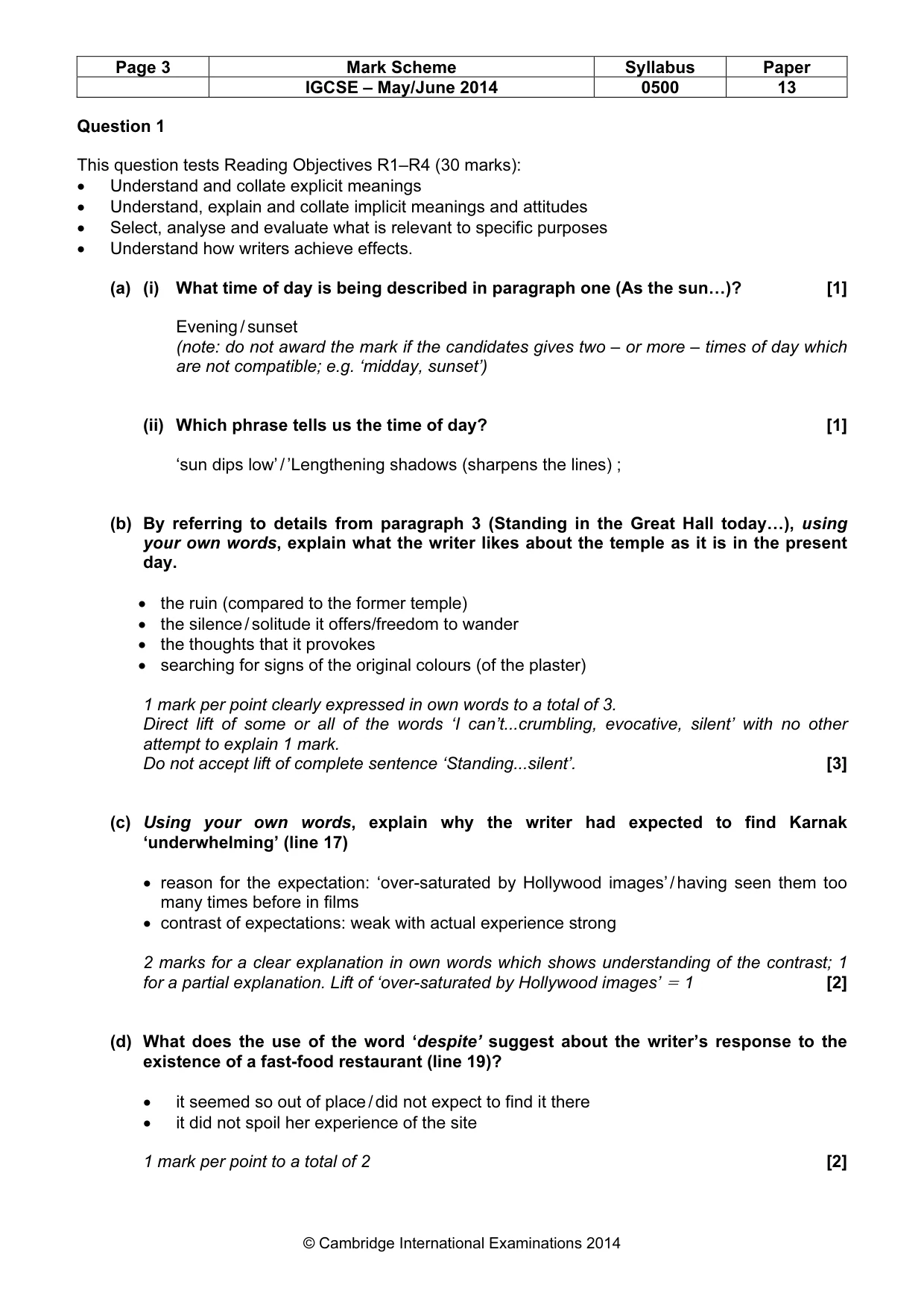
Page 3 Mark Scheme Syllabus Paper IGCSE – May/June 2014 0500 13 © Cambridge International Examinations 2014 Question 1 This question tests Reading Objectives R1–R4 (30 marks): • Understand and collate explicit meanings • Understand, explain and collate implicit meanings and attitudes • Select, analyse and evaluate what is relevant to specific purposes • Understand how writers achieve effects. (a) (i) What time of day is being described in paragraph one (As the sun…)? [1] Evening / sunset (note: do not award the mark if the candidates gives two – or more – times of day which are not compatible; e.g. ‘midday, sunset’) (ii) Which phrase tells us the time of day? [1] ‘sun dips low’ / ’Lengthening shadows (sharpens the lines) ; (b) By referring to details from paragraph 3 (Standing in the Great Hall today…), using your own words, explain what the writer likes about the temple as it is in the present day. • the ruin (compared to the former temple) • the silence / solitude it offers/freedom to wander • the thoughts that it provokes • searching for signs of the original colours (of the plaster) 1 mark per point clearly expressed in own words to a total of 3. Direct lift of some or all of the words ‘I can’t...crumbling, evocative, silent’ with no other attempt to explain 1 mark. Do not accept lift of complete sentence ‘Standing...silent’. [3] (c) Using your own words, explain why the writer had expected to find Karnak ‘underwhelming’ (line 17) • reason for the expectation: ‘over-saturated by Hollywood images’ / having seen them too many times before in films • contrast of expectations: weak with actual experience strong 2 marks for a clear explanation in own words which shows understanding of the contrast; 1 for a partial explanation. Lift of ‘over-saturated by Hollywood images’ R 1 [2] (d) What does the use of the word ‘despite’ suggest about the writer’s response to the existence of a fast-food restaurant (line 19)? • it seemed so out of place / did not expect to find it there • it did not spoil her experience of the site 1 mark per point to a total of 2 [2]
Mark scheme, page 4
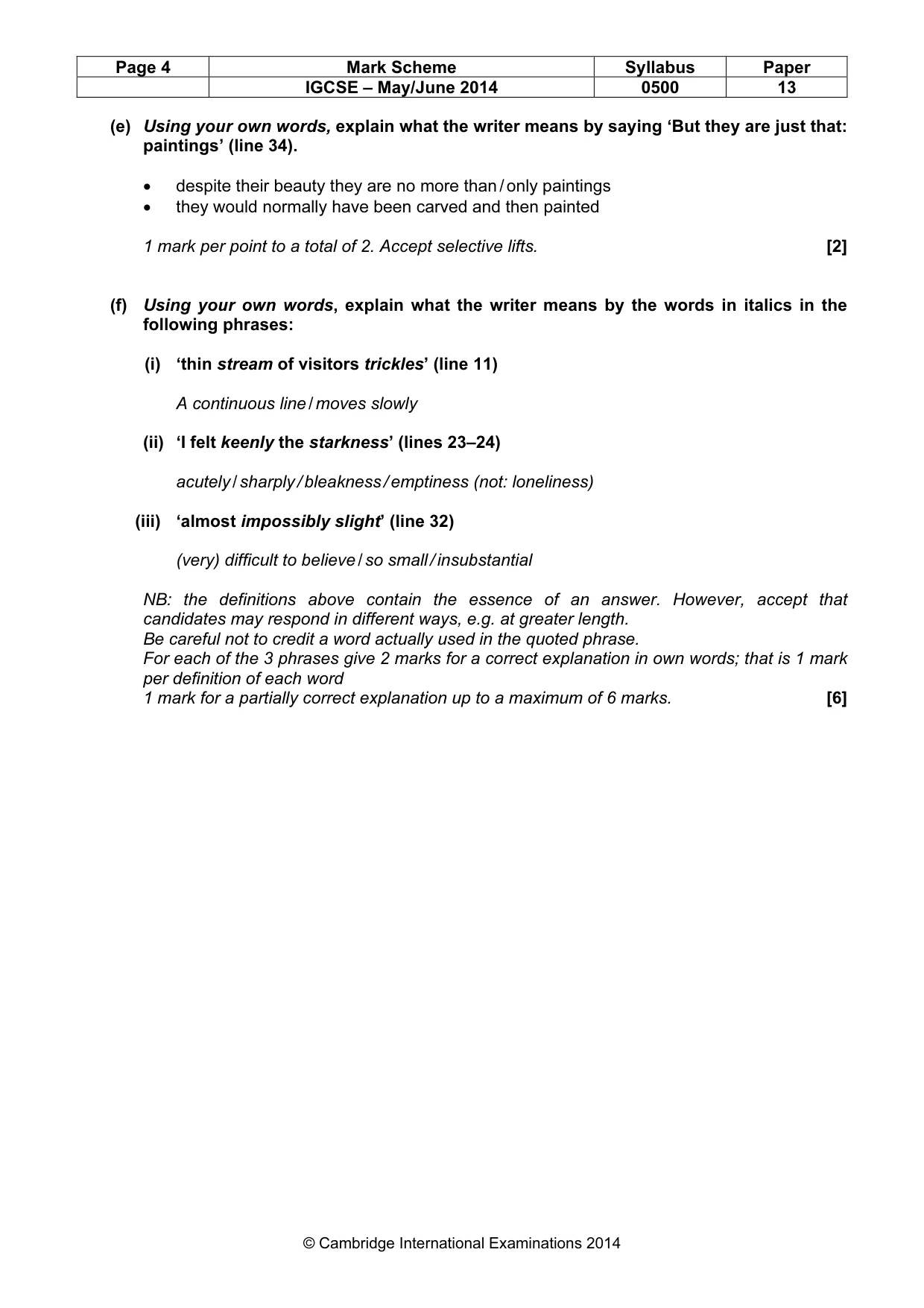
Page 4 Mark Scheme Syllabus Paper IGCSE – May/June 2014 0500 13 © Cambridge International Examinations 2014 (e) Using your own words, explain what the writer means by saying ‘But they are just that: paintings’ (line 34). • despite their beauty they are no more than / only paintings • they would normally have been carved and then painted 1 mark per point to a total of 2. Accept selective lifts. [2] (f) Using your own words, explain what the writer means by the words in italics in the following phrases: (i) ‘thin stream of visitors trickles’ (line 11) A continuous line / moves slowly (ii) ‘I felt keenly the starkness’ (lines 23–24) acutely / sharply / bleakness / emptiness (not: loneliness) (iii) ‘almost impossibly slight’ (line 32) (very) difficult to believe / so small / insubstantial NB: the definitions above contain the essence of an answer. However, accept that candidates may respond in different ways, e.g. at greater length. Be careful not to credit a word actually used in the quoted phrase. For each of the 3 phrases give 2 marks for a correct explanation in own words; that is 1 mark per definition of each word 1 mark for a partially correct explanation up to a maximum of 6 marks. [6]
Mark scheme, page 5
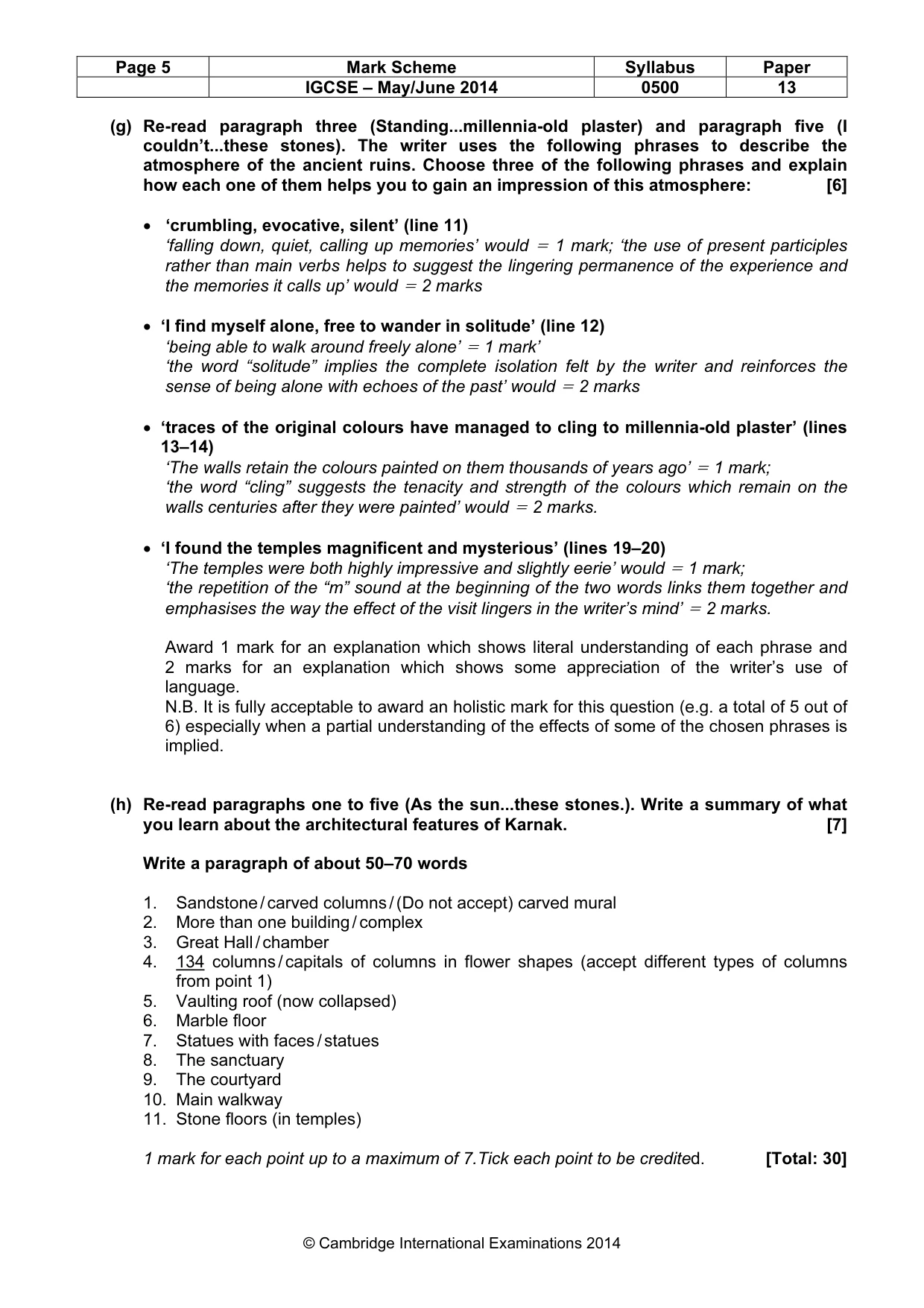
Page 5 Mark Scheme Syllabus Paper IGCSE – May/June 2014 0500 13 © Cambridge International Examinations 2014 (g) Re-read paragraph three (Standing...millennia-old plaster) and paragraph five (I couldn’t...these stones). The writer uses the following phrases to describe the atmosphere of the ancient ruins. Choose three of the following phrases and explain how each one of them helps you to gain an impression of this atmosphere: [6] • ‘crumbling, evocative, silent’ (line 11) ‘falling down, quiet, calling up memories’ would R 1 mark; ‘the use of present participles rather than main verbs helps to suggest the lingering permanence of the experience and the memories it calls up’ would R 2 marks • ‘I find myself alone, free to wander in solitude’ (line 12) ‘being able to walk around freely alone’ R 1 mark’ ‘the word “solitude” implies the complete isolation felt by the writer and reinforces the sense of being alone with echoes of the past’ would R 2 marks • ‘traces of the original colours have managed to cling to millennia-old plaster’ (lines 13–14) ‘The walls retain the colours painted on them thousands of years ago’ R 1 mark; ‘the word “cling” suggests the tenacity and strength of the colours which remain on the walls centuries after they were painted’ would R 2 marks. • ‘I found the temples magnificent and mysterious’ (lines 19–20) ‘The temples were both highly impressive and slightly eerie’ would R 1 mark; ‘the repetition of the “m” sound at the beginning of the two words links them together and emphasises the way the effect of the visit lingers in the writer’s mind’ R 2 marks. Award 1 mark for an explanation which shows literal understanding of each phrase and 2 marks for an explanation which shows some appreciation of the writer’s use of language. N.B. It is fully acceptable to award an holistic mark for this question (e.g. a total of 5 out of 6) especially when a partial understanding of the effects of some of the chosen phrases is implied. (h) Re-read paragraphs one to five (As the sun...these stones.). Write a summary of what you learn about the architectural features of Karnak. [7] Write a paragraph of about 50–70 words 1. Sandstone / carved columns / (Do not accept) carved mural 2. More than one building / complex 3. Great Hall / chamber 4. 134 columns / capitals of columns in flower shapes (accept different types of columns from point 1) 5. Vaulting roof (now collapsed) 6. Marble floor 7. Statues with faces / statues 8. The sanctuary 9. The courtyard 10. Main walkway 11. Stone floors (in temples) 1 mark for each point up to a maximum of 7.Tick each point to be credited. [Total: 30]
Mark scheme, page 6
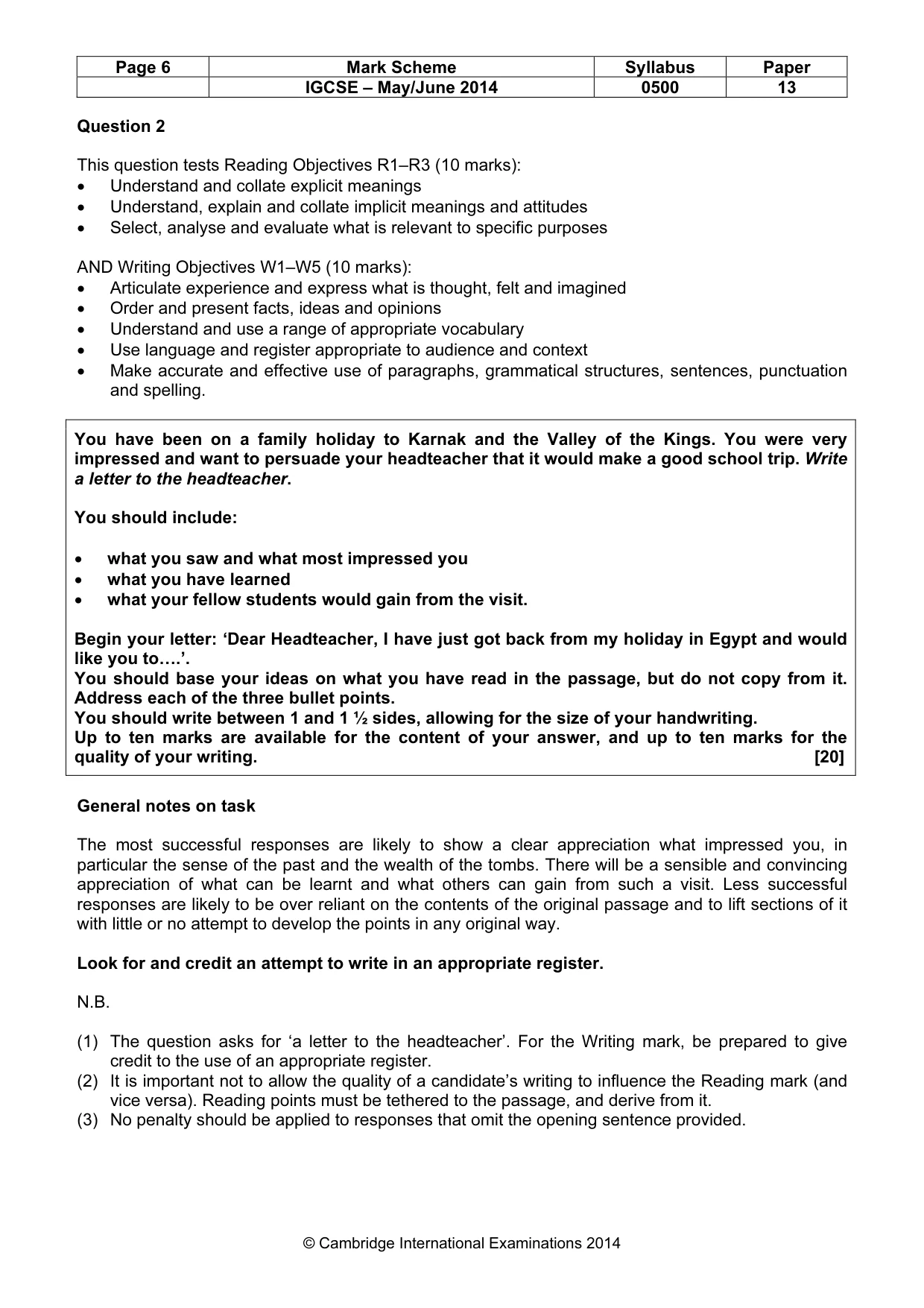
Page 6 Mark Scheme Syllabus Paper IGCSE – May/June 2014 0500 13 © Cambridge International Examinations 2014 Question 2 This question tests Reading Objectives R1–R3 (10 marks): • Understand and collate explicit meanings • Understand, explain and collate implicit meanings and attitudes • Select, analyse and evaluate what is relevant to specific purposes AND Writing Objectives W1–W5 (10 marks): • Articulate experience and express what is thought, felt and imagined • Order and present facts, ideas and opinions • Understand and use a range of appropriate vocabulary • Use language and register appropriate to audience and context • Make accurate and effective use of paragraphs, grammatical structures, sentences, punctuation and spelling. You have been on a family holiday to Karnak and the Valley of the Kings. You were very impressed and want to persuade your headteacher that it would make a good school trip. Write a letter to the headteacher. You should include: • what you saw and what most impressed you • what you have learned • what your fellow students would gain from the visit. Begin your letter: ‘Dear Headteacher, I have just got back from my holiday in Egypt and would like you to….’. You should base your ideas on what you have read in the passage, but do not copy from it. Address each of the three bullet points. You should write between 1 and 1 ½ sides, allowing for the size of your handwriting. Up to ten marks are available for the content of your answer, and up to ten marks for the quality of your writing. [20] General notes on task The most successful responses are likely to show a clear appreciation what impressed you, in particular the sense of the past and the wealth of the tombs. There will be a sensible and convincing appreciation of what can be learnt and what others can gain from such a visit. Less successful responses are likely to be over reliant on the contents of the original passage and to lift sections of it with little or no attempt to develop the points in any original way. Look for and credit an attempt to write in an appropriate register. N.B. (1) The question asks for ‘a letter to the headteacher’. For the Writing mark, be prepared to give credit to the use of an appropriate register. (2) It is important not to allow the quality of a candidate’s writing to influence the Reading mark (and vice versa). Reading points must be tethered to the passage, and derive from it. (3) No penalty should be applied to responses that omit the opening sentence provided.
Mark scheme, page 7
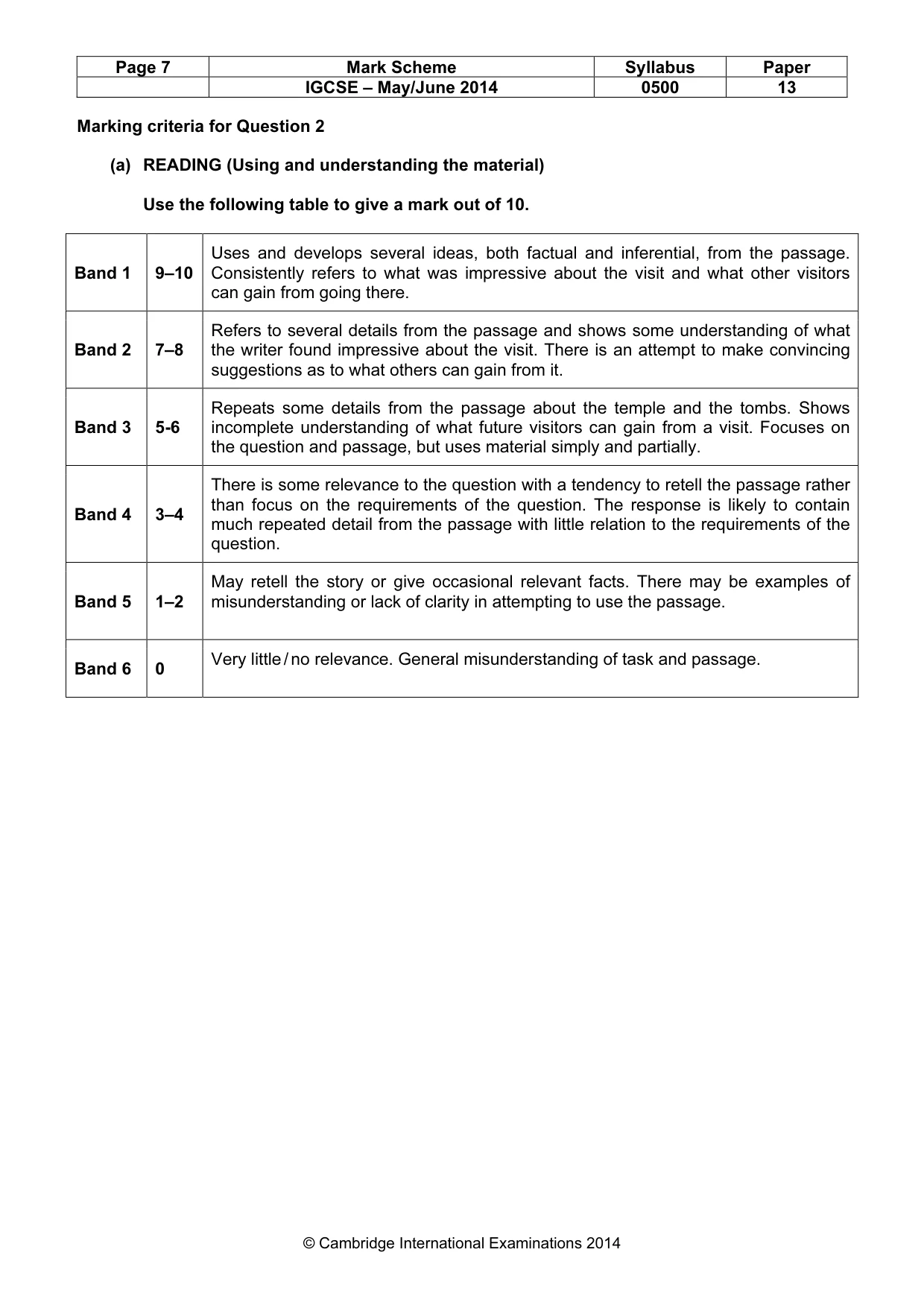
Page 7 Mark Scheme Syllabus Paper IGCSE – May/June 2014 0500 13 © Cambridge International Examinations 2014 Marking criteria for Question 2 (a) READING (Using and understanding the material) Use the following table to give a mark out of 10. Band 1 9–10 Uses and develops several ideas, both factual and inferential, from the passage. Consistently refers to what was impressive about the visit and what other visitors can gain from going there. Band 2 7–8 Refers to several details from the passage and shows some understanding of what the writer found impressive about the visit. There is an attempt to make convincing suggestions as to what others can gain from it. Band 3 5-6 Repeats some details from the passage about the temple and the tombs. Shows incomplete understanding of what future visitors can gain from a visit. Focuses on the question and passage, but uses material simply and partially. Band 4 3–4 There is some relevance to the question with a tendency to retell the passage rather than focus on the requirements of the question. The response is likely to contain much repeated detail from the passage with little relation to the requirements of the question. Band 5 1–2 May retell the story or give occasional relevant facts. There may be examples of misunderstanding or lack of clarity in attempting to use the passage. Band 6 0 Very little / no relevance. General misunderstanding of task and passage.
Mark scheme, page 8
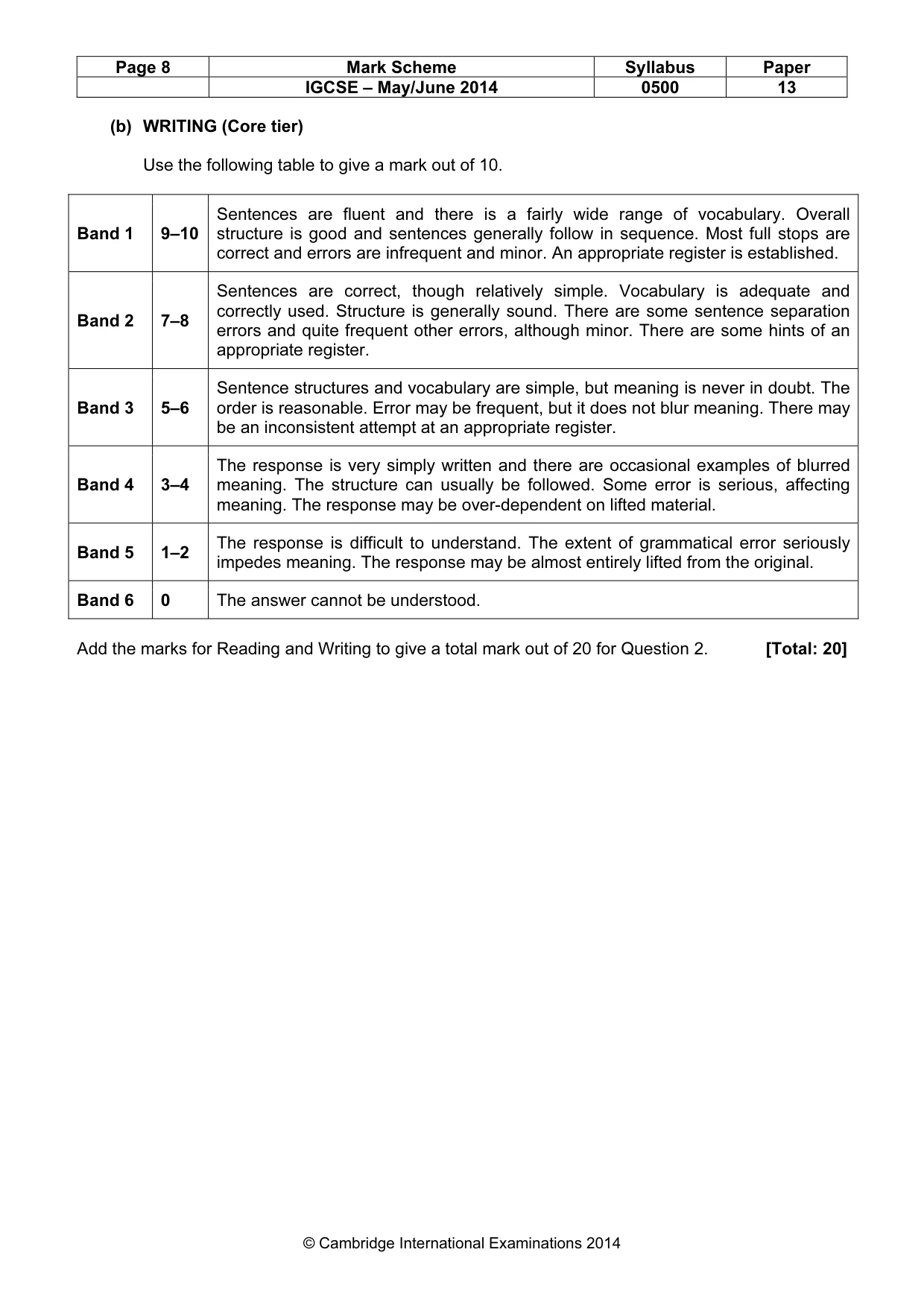
Page 8 Mark Scheme Syllabus Paper IGCSE – May/June 2014 0500 13 © Cambridge International Examinations 2014 (b) WRITING (Core tier) Use the following table to give a mark out of 10. Band 1 9–10 Sentences are fluent and there is a fairly wide range of vocabulary. Overall structure is good and sentences generally follow in sequence. Most full stops are correct and errors are infrequent and minor. An appropriate register is established. Band 2 7–8 Sentences are correct, though relatively simple. Vocabulary is adequate and correctly used. Structure is generally sound. There are some sentence separation errors and quite frequent other errors, although minor. There are some hints of an appropriate register. Band 3 5–6 Sentence structures and vocabulary are simple, but meaning is never in doubt. The order is reasonable. Error may be frequent, but it does not blur meaning. There may be an inconsistent attempt at an appropriate register. Band 4 3–4 The response is very simply written and there are occasional examples of blurred meaning. The structure can usually be followed. Some error is serious, affecting meaning. The response may be over-dependent on lifted material. Band 5 1–2 The response is difficult to understand. The extent of grammatical error seriously impedes meaning. The response may be almost entirely lifted from the original. Band 6 0 The answer cannot be understood. Add the marks for Reading and Writing to give a total mark out of 20 for Question 2. [Total: 20]