Cambridge IGCSE English - First Language 0500 — 2013 May/June Paper 3 · Variant 3
0500/33/M/J/13 · 50 marks · ≈56 min
The question paper and its mark scheme, free to read here and free to download. This is Cambridge’s own paper, exactly as it was sat.
Question paper12 pages
Mark scheme9 pages
Answers below. Sit the paper first if you are practising.
Paper as text
Question paper, page 1
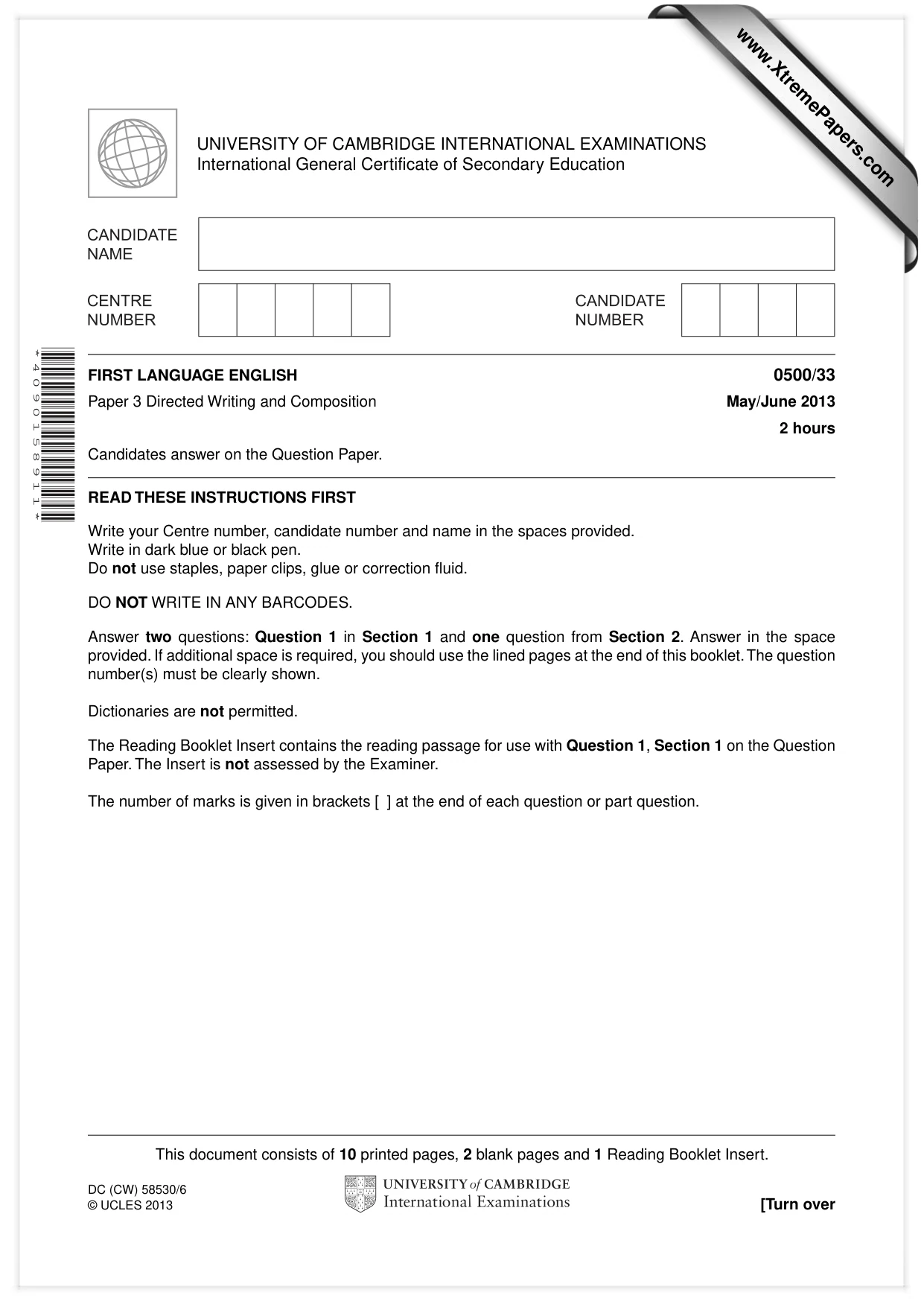
This document consists of 10 printed pages, 2 blank pages and 1 Reading Booklet Insert. DC (CW) 58530/6 © UCLES 2013 [Turn over UNIVERSITY OF CAMBRIDGE INTERNATIONAL EXAMINATIONS International General Certificate of Secondary Education * 4 0 9 0 1 5 8 9 1 1 * FIRST LANGUAGE ENGLISH 0500/33 Paper 3 Directed Writing and Composition May/June 2013 2 hours Candidates answer on the Question Paper. READ THESE INSTRUCTIONS FIRST Write your Centre number, candidate number and name in the spaces provided. Write in dark blue or black pen. Do not use staples, paper clips, glue or correction fluid. DO NOT WRITE IN ANY BARCODES. Answer two questions: Question 1 in Section 1 and one question from Section 2. Answer in the space provided. If additional space is required, you should use the lined pages at the end of this booklet. The question number(s) must be clearly shown. Dictionaries are not permitted. The Reading Booklet Insert contains the reading passage for use with Question 1, Section 1 on the Question Paper. The Insert is not assessed by the Examiner. The number of marks is given in brackets [ ] at the end of each question or part question. www.XtremePapers.com
Question paper, page 2
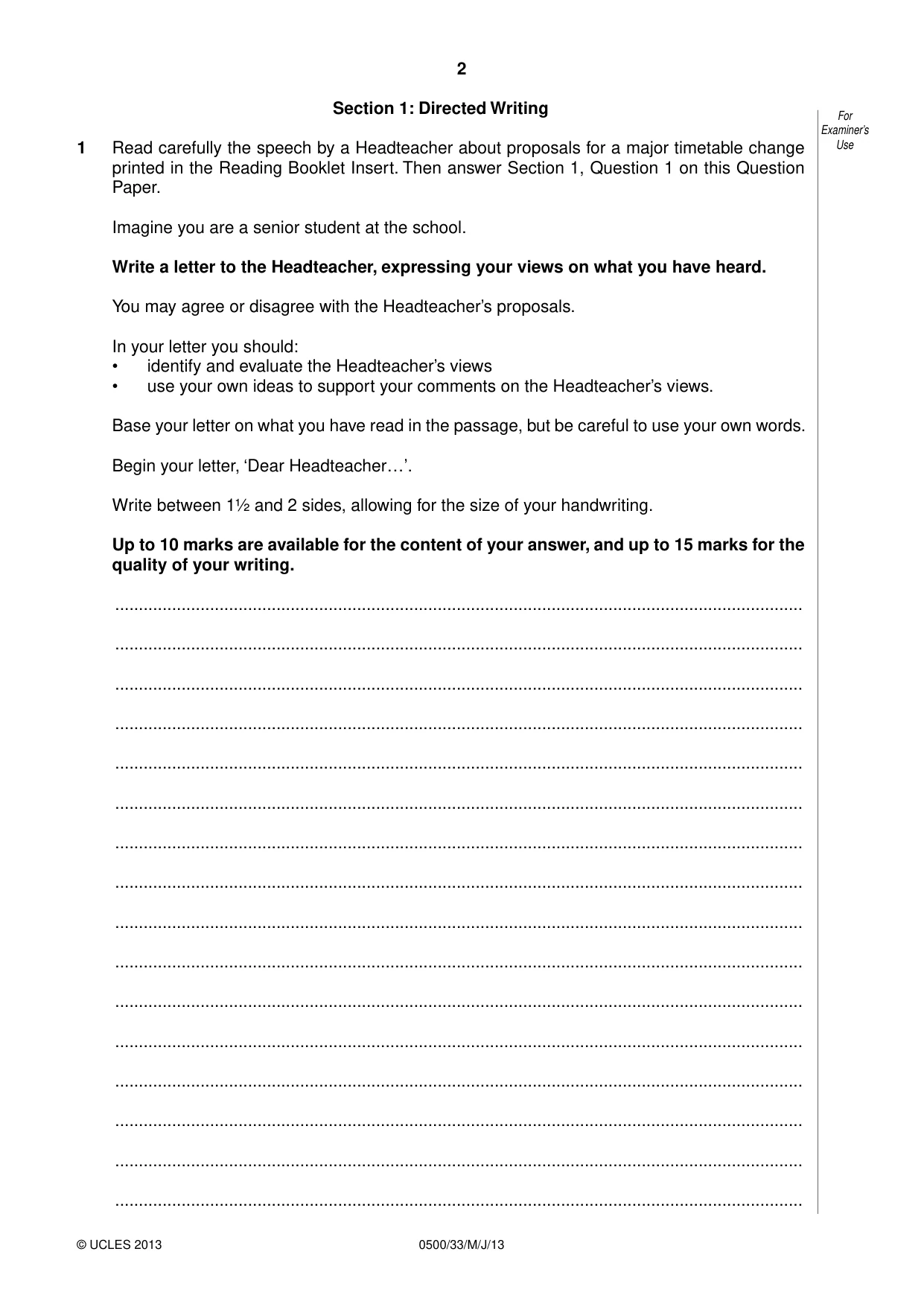
2 0500/33/M/J/13 © UCLES 2013 For Examiner’s Use Section 1: Directed Writing 1 Read carefully the speech by a Headteacher about proposals for a major timetable change printed in the Reading Booklet Insert. Then answer Section 1, Question 1 on this Question Paper. Imagine you are a senior student at the school. Write a letter to the Headteacher, expressing your views on what you have heard. You may agree or disagree with the Headteacher’s proposals. In your letter you should: • identify and evaluate the Headteacher’s views • use your own ideas to support your comments on the Headteacher’s views. Base your letter on what you have read in the passage, but be careful to use your own words. Begin your letter, ‘Dear Headteacher…’. Write between 1½ and 2 sides, allowing for the size of your handwriting. Up to 10 marks are available for the content of your answer, and up to 15 marks for the quality of your writing. … … … … … … … … … … … … … … … …
Question paper, page 3
3 0500/33/M/J/13 © UCLES 2013 [Turn over For Examiner’s Use … … … … … … … … … … … … … … … … … … … … … … … … … … … …
Question paper, page 4
4 0500/33/M/J/13 © UCLES 2013 For Examiner’s Use … … … … … … … … … … … … … … … … … … … … … … … … … … … [Total: 25]
Question paper, page 5
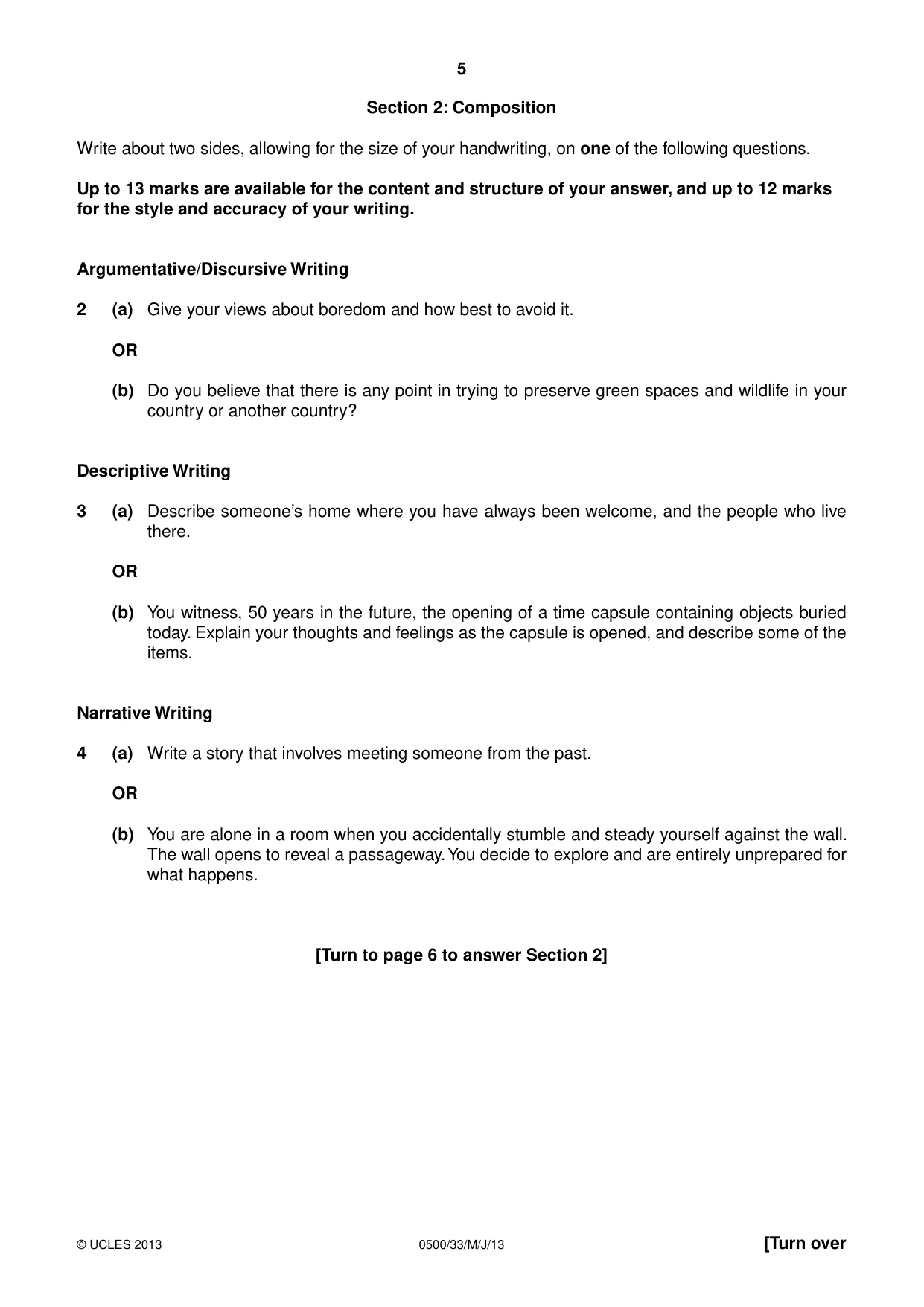
5 0500/33/M/J/13 © UCLES 2013 [Turn over Section 2: Composition Write about two sides, allowing for the size of your handwriting, on one of the following questions. Up to 13 marks are available for the content and structure of your answer, and up to 12 marks for the style and accuracy of your writing. Argumentative/Discursive Writing 2 (a) Give your views about boredom and how best to avoid it. OR (b) Do you believe that there is any point in trying to preserve green spaces and wildlife in your country or another country? Descriptive Writing 3 (a) Describe someone’s home where you have always been welcome, and the people who live there. OR (b) You witness, 50 years in the future, the opening of a time capsule containing objects buried today. Explain your thoughts and feelings as the capsule is opened, and describe some of the items. Narrative Writing 4 (a) Write a story that involves meeting someone from the past. OR (b) You are alone in a room when you accidentally stumble and steady yourself against the wall. The wall opens to reveal a passageway. You decide to explore and are entirely unprepared for what happens. [Turn to page 6 to answer Section 2]
Question paper, page 6
6 0500/33/M/J/13 © UCLES 2013 For Examiner’s Use Please write your chosen question number: (Question 2a, 2b, 3a, 3b, 4a or 4b) … … … … … … … … … … … … … … … … … … … … … … … … … … … …
Question paper, page 7
7 0500/33/M/J/13 © UCLES 2013 [Turn over For Examiner’s Use … … … … … … … … … … … … … … … … … … … … … … … … … … … …
Question paper, page 8
8 0500/33/M/J/13 © UCLES 2013 For Examiner’s Use … … … … … … … … … … … … … … … … … … … … … … … … … … … [Total: 25]
Question paper, page 9
9 0500/33/M/J/13 © UCLES 2013 For Examiner’s Use Additional page If you use the following lined page to complete the answer(s) to any question(s), the question number(s) must be clearly shown. … … … … … … … … … … … … … … … … … … … … … … … … … …
Question paper, page 10
10 0500/33/M/J/13 © UCLES 2013 For Examiner’s Use Additional page If you use the following lined page to complete the answer(s) to any question(s), the question number(s) must be clearly shown. … … … … … … … … … … … … … … … … … … … … … … … … … …
Question paper, page 11
11 0500/33/M/J/13 © UCLES 2013 BLANK PAGE
Question paper, page 12
12 0500/33/M/J/13 © UCLES 2013 Permission to reproduce items where third-party owned material protected by copyright is included has been sought and cleared where possible. Every reasonable effort has been made by the publisher (UCLES) to trace copyright holders, but if any items requiring clearance have unwittingly been included, the publisher will be pleased to make amends at the earliest possible opportunity. University of Cambridge International Examinations is part of the Cambridge Assessment Group. Cambridge Assessment is the brand name of University of Cambridge Local Examinations Syndicate (UCLES), which is itself a department of the University of Cambridge. BLANK PAGE
Mark scheme, page 1
CAMBRIDGE INTERNATIONAL EXAMINATIONS International General Certificate of Secondary Education MARK SCHEME for the May/June 2013 series 0500 FIRST LANGUAGE ENGLISH 0500/33 Paper 3 (Directed Writing and Composition), maximum raw mark 50 This mark scheme is published as an aid to teachers and candidates, to indicate the requirements of the examination. It shows the basis on which Examiners were instructed to award marks. It does not indicate the details of the discussions that took place at an Examiners’ meeting before marking began, which would have considered the acceptability of alternative answers. Mark schemes should be read in conjunction with the question paper and the Principal Examiner Report for Teachers. Cambridge will not enter into discussions about these mark schemes. Cambridge is publishing the mark schemes for the May/June 2013 series for most IGCSE, GCE Advanced Level and Advanced Subsidiary Level components and some Ordinary Level components. www.XtremePapers.com
Mark scheme, page 2
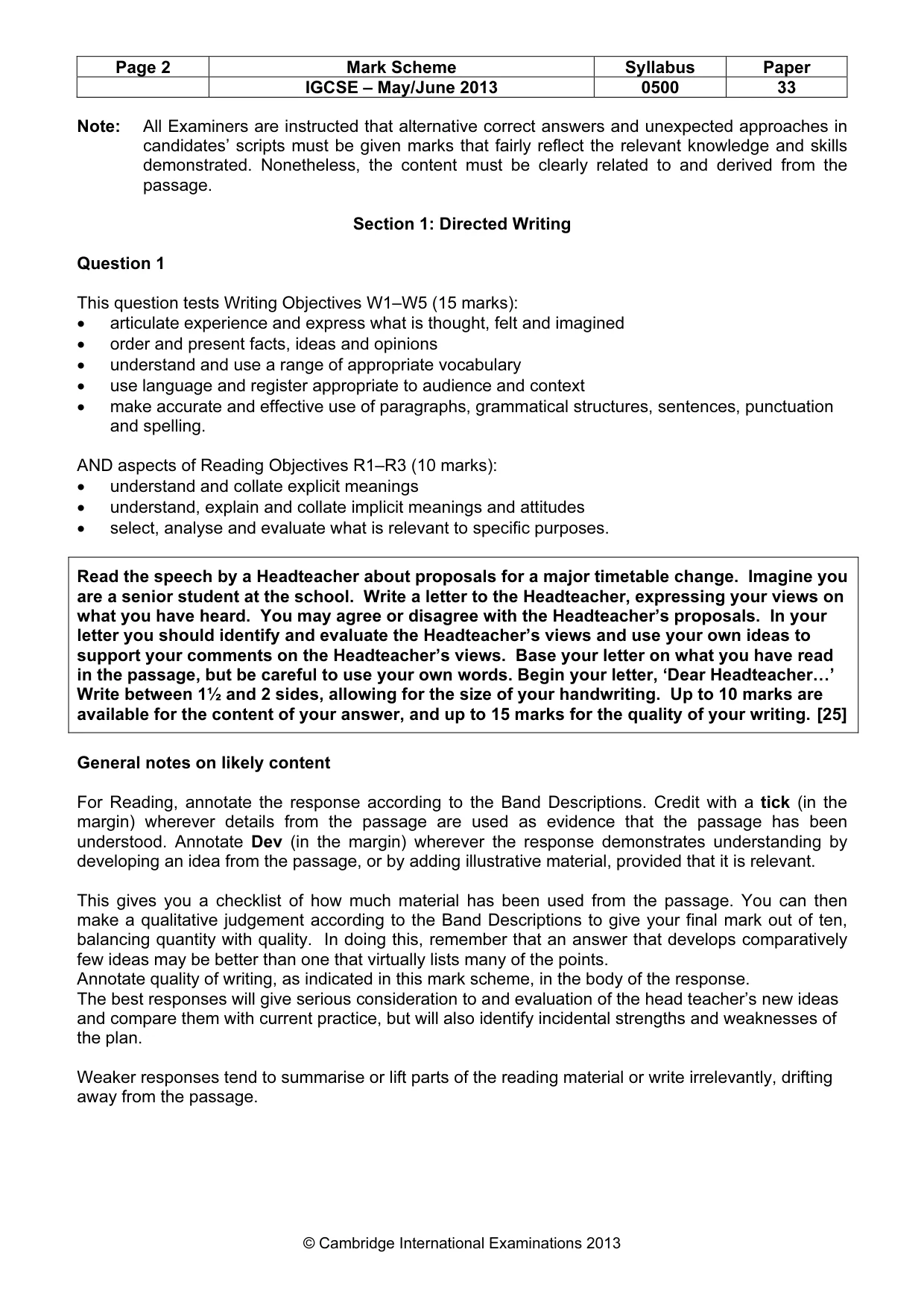
Page 2 Mark Scheme Syllabus Paper IGCSE – May/June 2013 0500 33 © Cambridge International Examinations 2013 Note: All Examiners are instructed that alternative correct answers and unexpected approaches in candidates’ scripts must be given marks that fairly reflect the relevant knowledge and skills demonstrated. Nonetheless, the content must be clearly related to and derived from the passage. Section 1: Directed Writing Question 1 This question tests Writing Objectives W1–W5 (15 marks): • articulate experience and express what is thought, felt and imagined • order and present facts, ideas and opinions • understand and use a range of appropriate vocabulary • use language and register appropriate to audience and context • make accurate and effective use of paragraphs, grammatical structures, sentences, punctuation and spelling. AND aspects of Reading Objectives R1–R3 (10 marks): • understand and collate explicit meanings • understand, explain and collate implicit meanings and attitudes • select, analyse and evaluate what is relevant to specific purposes. Read the speech by a Headteacher about proposals for a major timetable change. Imagine you are a senior student at the school. Write a letter to the Headteacher, expressing your views on what you have heard. You may agree or disagree with the Headteacher’s proposals. In your letter you should identify and evaluate the Headteacher’s views and use your own ideas to support your comments on the Headteacher’s views. Base your letter on what you have read in the passage, but be careful to use your own words. Begin your letter, ‘Dear Headteacher…’ Write between 1½ and 2 sides, allowing for the size of your handwriting. Up to 10 marks are available for the content of your answer, and up to 15 marks for the quality of your writing. [25] General notes on likely content For Reading, annotate the response according to the Band Descriptions. Credit with a tick (in the margin) wherever details from the passage are used as evidence that the passage has been understood. Annotate Dev (in the margin) wherever the response demonstrates understanding by developing an idea from the passage, or by adding illustrative material, provided that it is relevant. This gives you a checklist of how much material has been used from the passage. You can then make a qualitative judgement according to the Band Descriptions to give your final mark out of ten, balancing quantity with quality. In doing this, remember that an answer that develops comparatively few ideas may be better than one that virtually lists many of the points. Annotate quality of writing, as indicated in this mark scheme, in the body of the response. The best responses will give serious consideration to and evaluation of the head teacher’s new ideas and compare them with current practice, but will also identify incidental strengths and weaknesses of the plan. Weaker responses tend to summarise or lift parts of the reading material or write irrelevantly, drifting away from the passage.
Mark scheme, page 3
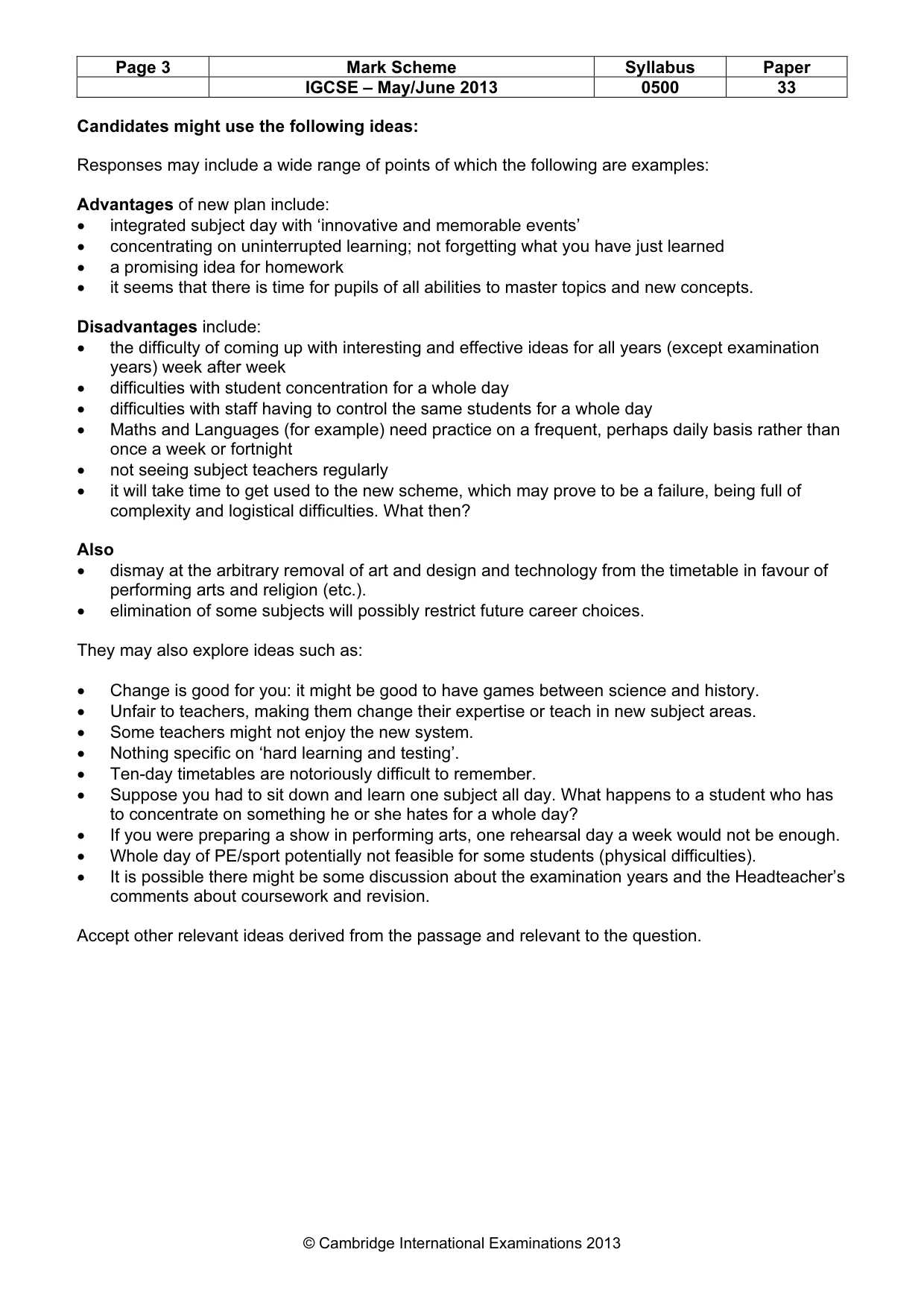
Page 3 Mark Scheme Syllabus Paper IGCSE – May/June 2013 0500 33 © Cambridge International Examinations 2013 Candidates might use the following ideas: Responses may include a wide range of points of which the following are examples: Advantages of new plan include: • integrated subject day with ‘innovative and memorable events’ • concentrating on uninterrupted learning; not forgetting what you have just learned • a promising idea for homework • it seems that there is time for pupils of all abilities to master topics and new concepts. Disadvantages include: • the difficulty of coming up with interesting and effective ideas for all years (except examination years) week after week • difficulties with student concentration for a whole day • difficulties with staff having to control the same students for a whole day • Maths and Languages (for example) need practice on a frequent, perhaps daily basis rather than once a week or fortnight • not seeing subject teachers regularly • it will take time to get used to the new scheme, which may prove to be a failure, being full of complexity and logistical difficulties. What then? Also • dismay at the arbitrary removal of art and design and technology from the timetable in favour of performing arts and religion (etc.). • elimination of some subjects will possibly restrict future career choices. They may also explore ideas such as: • Change is good for you: it might be good to have games between science and history. • Unfair to teachers, making them change their expertise or teach in new subject areas. • Some teachers might not enjoy the new system. • Nothing specific on ‘hard learning and testing’. • Ten-day timetables are notoriously difficult to remember. • Suppose you had to sit down and learn one subject all day. What happens to a student who has to concentrate on something he or she hates for a whole day? • If you were preparing a show in performing arts, one rehearsal day a week would not be enough. • Whole day of PE/sport potentially not feasible for some students (physical difficulties). • It is possible there might be some discussion about the examination years and the Headteacher’s comments about coursework and revision. Accept other relevant ideas derived from the passage and relevant to the question.
Mark scheme, page 4
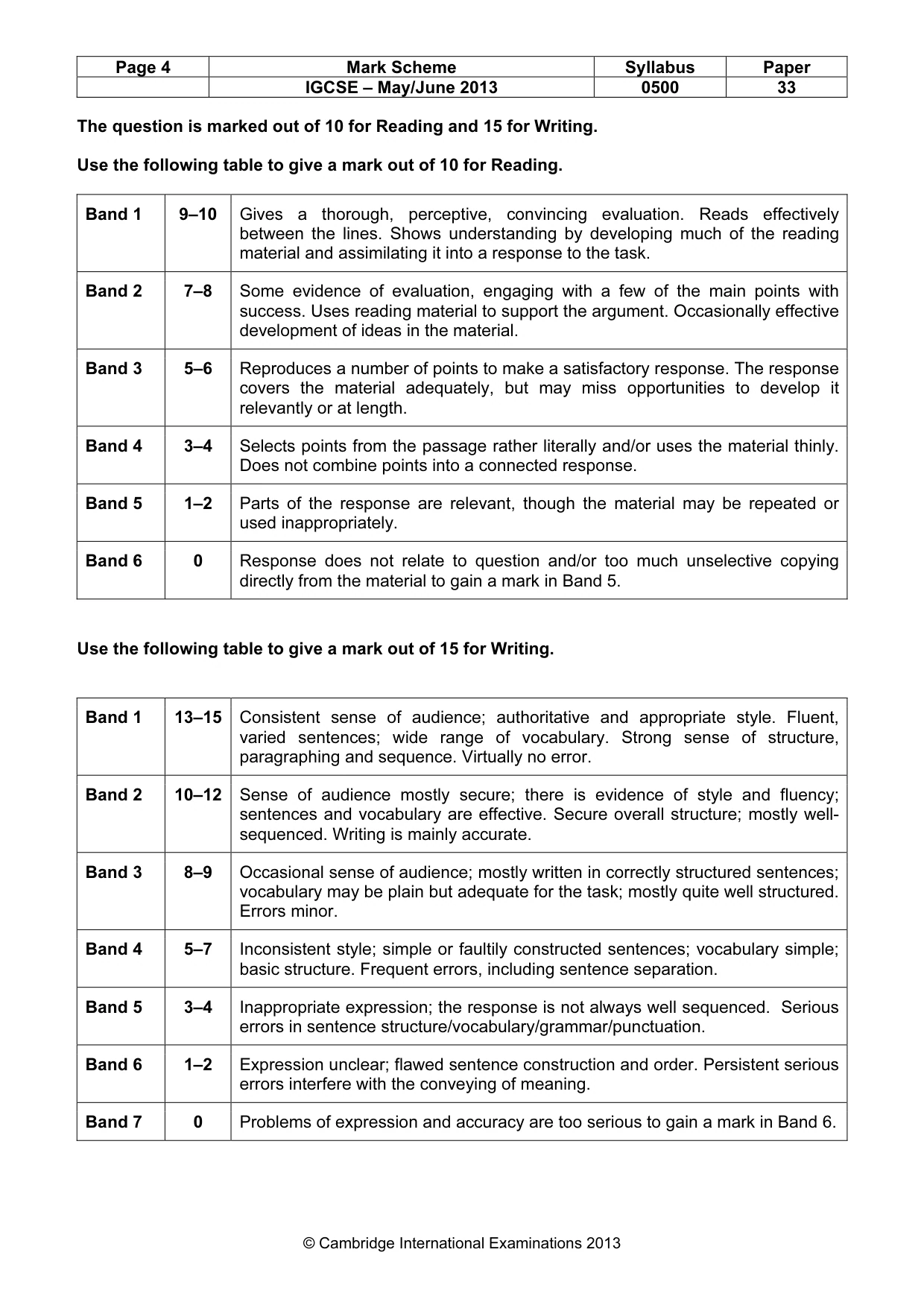
Page 4 Mark Scheme Syllabus Paper IGCSE – May/June 2013 0500 33 © Cambridge International Examinations 2013 The question is marked out of 10 for Reading and 15 for Writing. Use the following table to give a mark out of 10 for Reading. Band 1 9–10 Gives a thorough, perceptive, convincing evaluation. Reads effectively between the lines. Shows understanding by developing much of the reading material and assimilating it into a response to the task. Band 2 7–8 Some evidence of evaluation, engaging with a few of the main points with success. Uses reading material to support the argument. Occasionally effective development of ideas in the material. Band 3 5–6 Reproduces a number of points to make a satisfactory response. The response covers the material adequately, but may miss opportunities to develop it relevantly or at length. Band 4 3–4 Selects points from the passage rather literally and/or uses the material thinly. Does not combine points into a connected response. Band 5 1–2 Parts of the response are relevant, though the material may be repeated or used inappropriately. Band 6 0 Response does not relate to question and/or too much unselective copying directly from the material to gain a mark in Band 5. First variant Mark Scheme Use the following table to give a mark out of 15 for Writing. First variant Mark Scheme Band 1 13–15 Consistent sense of audience; authoritative and appropriate style. Fluent, varied sentences; wide range of vocabulary. Strong sense of structure, paragraphing and sequence. Virtually no error. Band 2 10–12 Sense of audience mostly secure; there is evidence of style and fluency; sentences and vocabulary are effective. Secure overall structure; mostly well- sequenced. Writing is mainly accurate. Band 3 8–9 Occasional sense of audience; mostly written in correctly structured sentences; vocabulary may be plain but adequate for the task; mostly quite well structured. Errors minor. Band 4 5–7 Inconsistent style; simple or faultily constructed sentences; vocabulary simple; basic structure. Frequent errors, including sentence separation. Band 5 3–4 Inappropriate expression; the response is not always well sequenced. Serious errors in sentence structure/vocabulary/grammar/punctuation. Band 6 1–2 Expression unclear; flawed sentence construction and order. Persistent serious errors interfere with the conveying of meaning. Band 7 0 Problems of expression and accuracy are too serious to gain a mark in Band 6.
Mark scheme, page 5
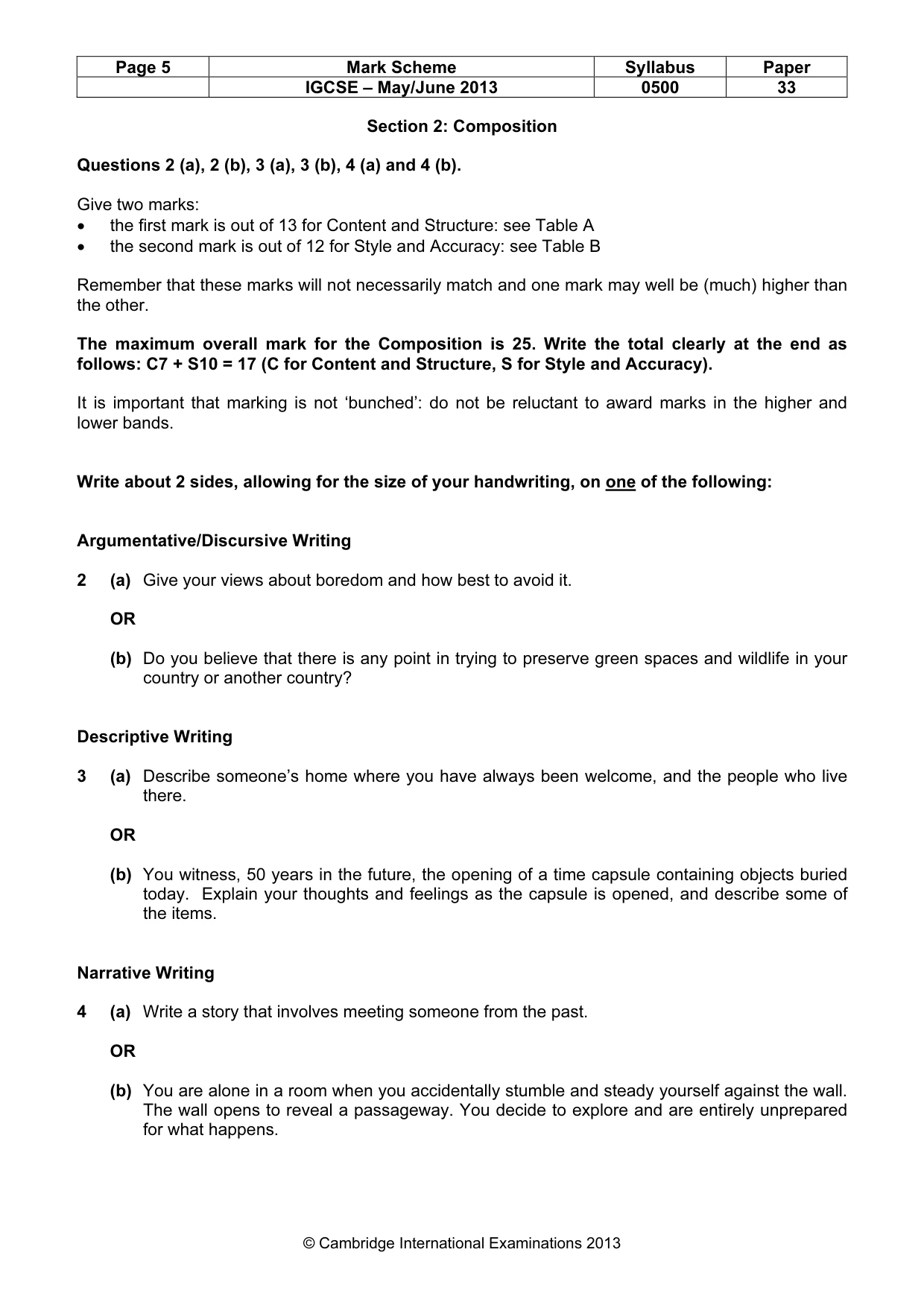
Page 5 Mark Scheme Syllabus Paper IGCSE – May/June 2013 0500 33 © Cambridge International Examinations 2013 Section 2: Composition Questions 2 (a), 2 (b), 3 (a), 3 (b), 4 (a) and 4 (b). Give two marks: • the first mark is out of 13 for Content and Structure: see Table A • the second mark is out of 12 for Style and Accuracy: see Table B Remember that these marks will not necessarily match and one mark may well be (much) higher than the other. The maximum overall mark for the Composition is 25. Write the total clearly at the end as follows: C7 + S10 = 17 (C for Content and Structure, S for Style and Accuracy). It is important that marking is not ‘bunched’: do not be reluctant to award marks in the higher and lower bands. Write about 2 sides, allowing for the size of your handwriting, on one of the following: Argumentative/Discursive Writing 2 (a) Give your views about boredom and how best to avoid it. OR (b) Do you believe that there is any point in trying to preserve green spaces and wildlife in your country or another country? Descriptive Writing 3 (a) Describe someone’s home where you have always been welcome, and the people who live there. OR (b) You witness, 50 years in the future, the opening of a time capsule containing objects buried today. Explain your thoughts and feelings as the capsule is opened, and describe some of the items. Narrative Writing 4 (a) Write a story that involves meeting someone from the past. OR (b) You are alone in a room when you accidentally stumble and steady yourself against the wall. The wall opens to reveal a passageway. You decide to explore and are entirely unprepared for what happens.
Mark scheme, page 6
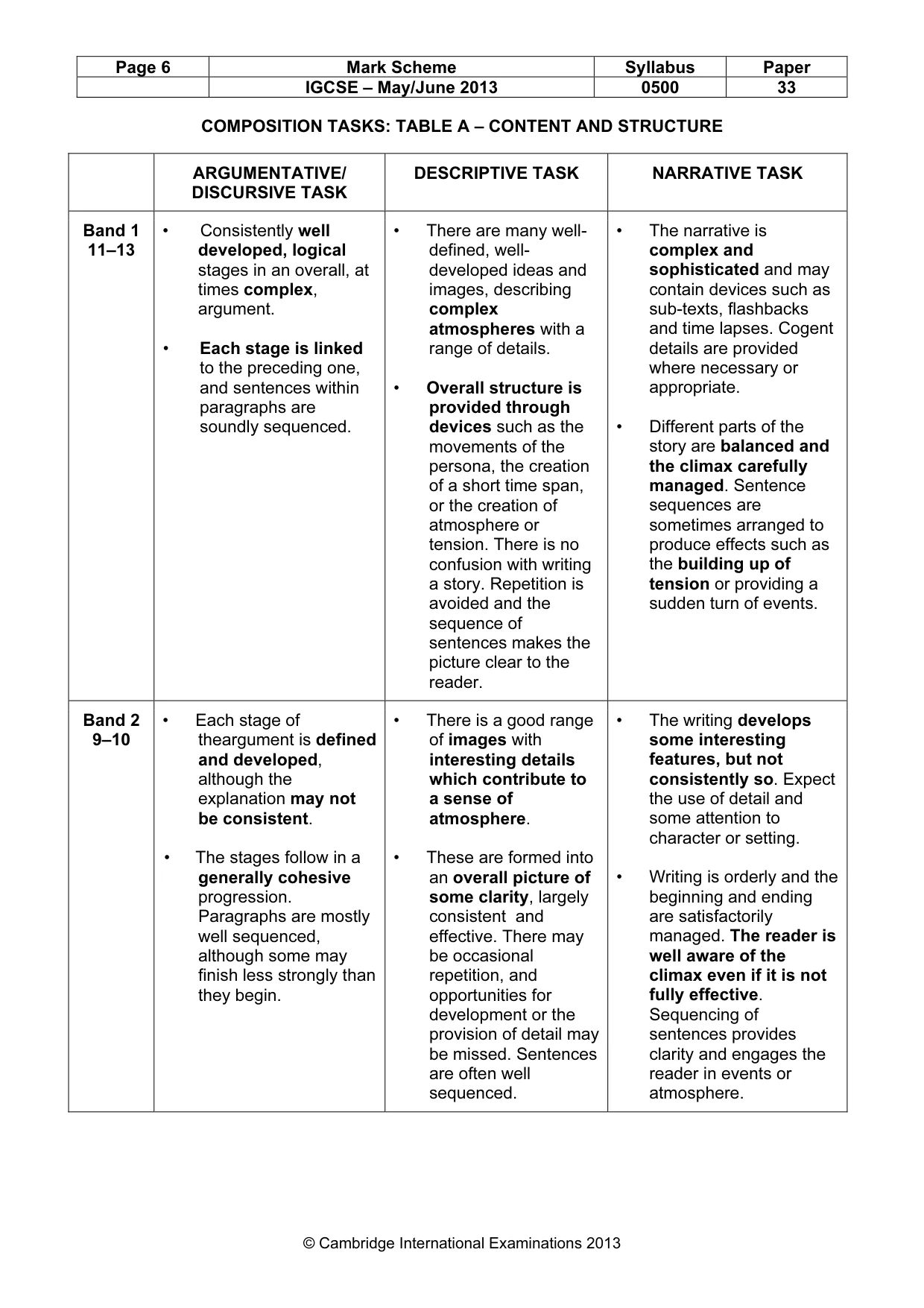
Page 6 Mark Scheme Syllabus Paper IGCSE – May/June 2013 0500 33 © Cambridge International Examinations 2013 COMPOSITION TASKS: TABLE A – CONTENT AND STRUCTURE ARGUMENTATIVE/ DISCURSIVE TASK DESCRIPTIVE TASK NARRATIVE TASK Band 1 11–13 • Consistently well developed, logical stages in an overall, at times complex, argument. • Each stage is linked to the preceding one, and sentences within paragraphs are soundly sequenced. • There are many well- defined, well- developed ideas and images, describing complex atmospheres with a range of details. • Overall structure is provided through devices such as the movements of the persona, the creation of a short time span, or the creation of atmosphere or tension. There is no confusion with writing a story. Repetition is avoided and the sequence of sentences makes the picture clear to the reader. • The narrative is complex and sophisticated and may contain devices such as sub-texts, flashbacks and time lapses. Cogent details are provided where necessary or appropriate. • Different parts of the story are balanced and the climax carefully managed. Sentence sequences are sometimes arranged to produce effects such as the building up of tension or providing a sudden turn of events. Band 2 9–10 • Each stage of theargument is defined and developed, although the explanation may not be consistent. • The stages follow in a generally cohesive progression. Paragraphs are mostly well sequenced, although some may finish less strongly than they begin. • There is a good range of images with interesting details which contribute to a sense of atmosphere. • These are formed into an overall picture of some clarity, largely consistent and effective. There may be occasional repetition, and opportunities for development or the provision of detail may be missed. Sentences are often well sequenced. • The writing develops some interesting features, but not consistently so. Expect the use of detail and some attention to character or setting. • Writing is orderly and the beginning and ending are satisfactorily managed. The reader is well aware of the climax even if it is not fully effective. Sequencing of sentences provides clarity and engages the reader in events or atmosphere.
Mark scheme, page 7
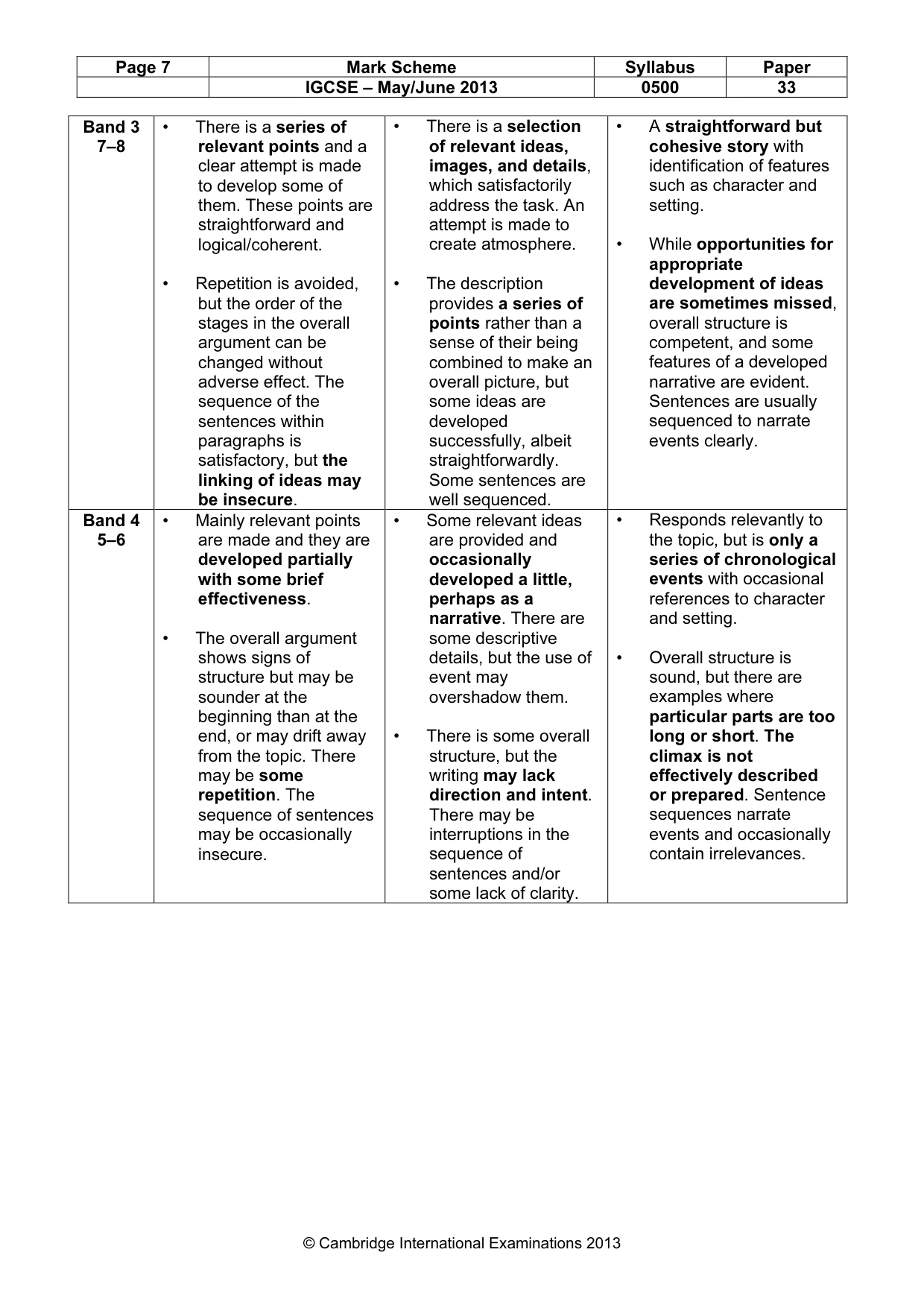
Page 7 Mark Scheme Syllabus Paper IGCSE – May/June 2013 0500 33 © Cambridge International Examinations 2013 Band 3 7–8 • There is a series of relevant points and a clear attempt is made to develop some of them. These points are straightforward and logical/coherent. • Repetition is avoided, but the order of the stages in the overall argument can be changed without adverse effect. The sequence of the sentences within paragraphs is satisfactory, but the linking of ideas may be insecure. • There is a selection of relevant ideas, images, and details, which satisfactorily address the task. An attempt is made to create atmosphere. • The description provides a series of points rather than a sense of their being combined to make an overall picture, but some ideas are developed successfully, albeit straightforwardly. Some sentences are well sequenced. • A straightforward but cohesive story with identification of features such as character and setting. • While opportunities for appropriate development of ideas are sometimes missed, overall structure is competent, and some features of a developed narrative are evident. Sentences are usually sequenced to narrate events clearly. Band 4 5–6 • Mainly relevant points are made and they are developed partially with some brief effectiveness. • The overall argument shows signs of structure but may be sounder at the beginning than at the end, or may drift away from the topic. There may be some repetition. The sequence of sentences may be occasionally insecure. • Some relevant ideas are provided and occasionally developed a little, perhaps as a narrative. There are some descriptive details, but the use of event may overshadow them. • There is some overall structure, but the writing may lack direction and intent. There may be interruptions in the sequence of sentences and/or some lack of clarity. • Responds relevantly to the topic, but is only a series of chronological events with occasional references to character and setting. • Overall structure is sound, but there are examples where particular parts are too long or short. The climax is not effectively described or prepared. Sentence sequences narrate events and occasionally contain irrelevances.
Mark scheme, page 8
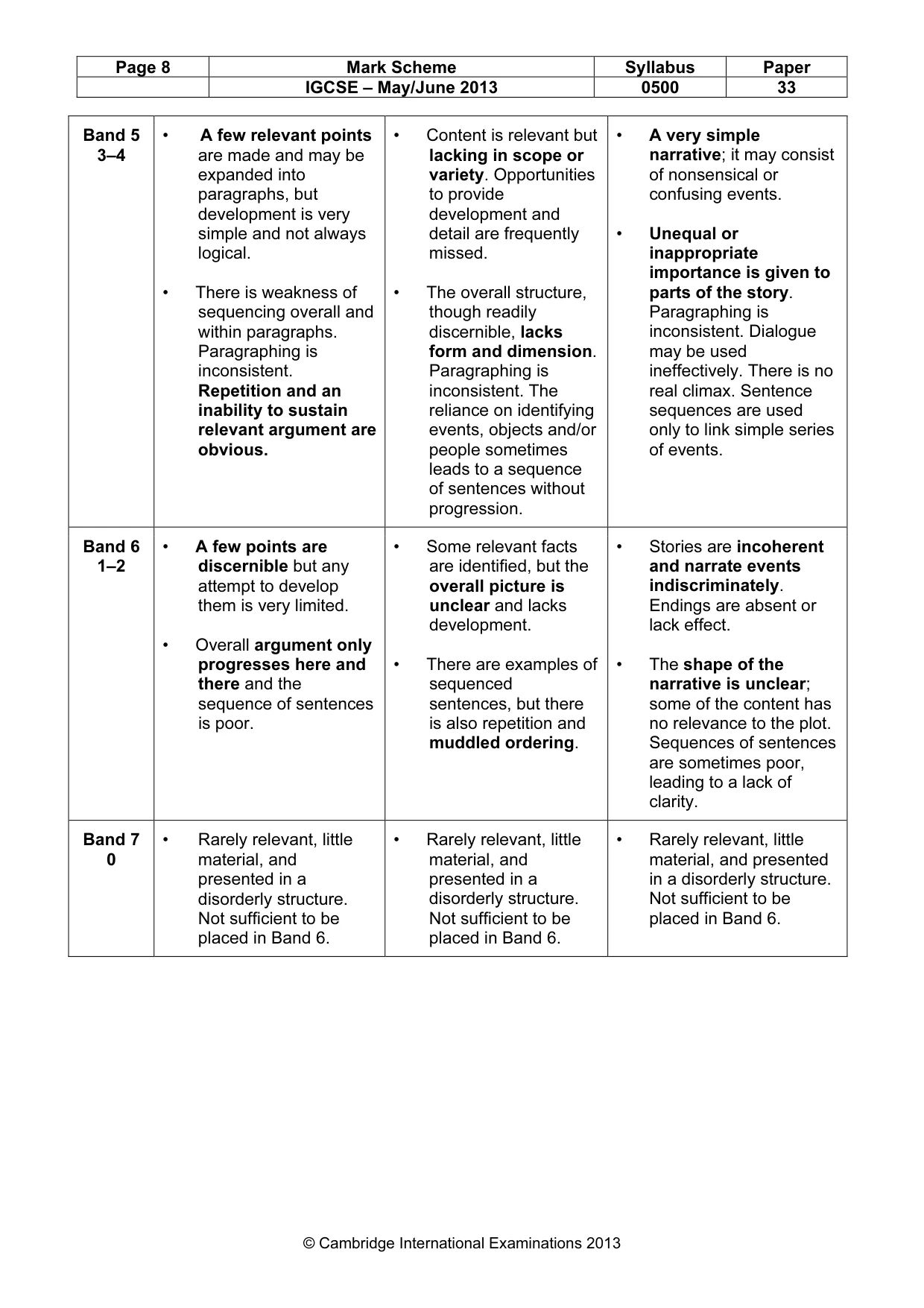
Page 8 Mark Scheme Syllabus Paper IGCSE – May/June 2013 0500 33 © Cambridge International Examinations 2013 Band 5 3–4 • A few relevant points are made and may be expanded into paragraphs, but development is very simple and not always logical. • There is weakness of sequencing overall and within paragraphs. Paragraphing is inconsistent. Repetition and an inability to sustain relevant argument are obvious. • Content is relevant but lacking in scope or variety. Opportunities to provide development and detail are frequently missed. • The overall structure, though readily discernible, lacks form and dimension. Paragraphing is inconsistent. The reliance on identifying events, objects and/or people sometimes leads to a sequence of sentences without progression. • A very simple narrative; it may consist of nonsensical or confusing events. • Unequal or inappropriate importance is given to parts of the story. Paragraphing is inconsistent. Dialogue may be used ineffectively. There is no real climax. Sentence sequences are used only to link simple series of events. Band 6 1–2 • A few points are discernible but any attempt to develop them is very limited. • Overall argument only progresses here and there and the sequence of sentences is poor. • Some relevant facts are identified, but the overall picture is unclear and lacks development. • There are examples of sequenced sentences, but there is also repetition and muddled ordering. • Stories are incoherent and narrate events indiscriminately. Endings are absent or lack effect. • The shape of the narrative is unclear; some of the content has no relevance to the plot. Sequences of sentences are sometimes poor, leading to a lack of clarity. Band 7 0 • Rarely relevant, little material, and presented in a disorderly structure. Not sufficient to be placed in Band 6. • Rarely relevant, little material, and presented in a disorderly structure. Not sufficient to be placed in Band 6. • Rarely relevant, little material, and presented in a disorderly structure. Not sufficient to be placed in Band 6.
Mark scheme, page 9
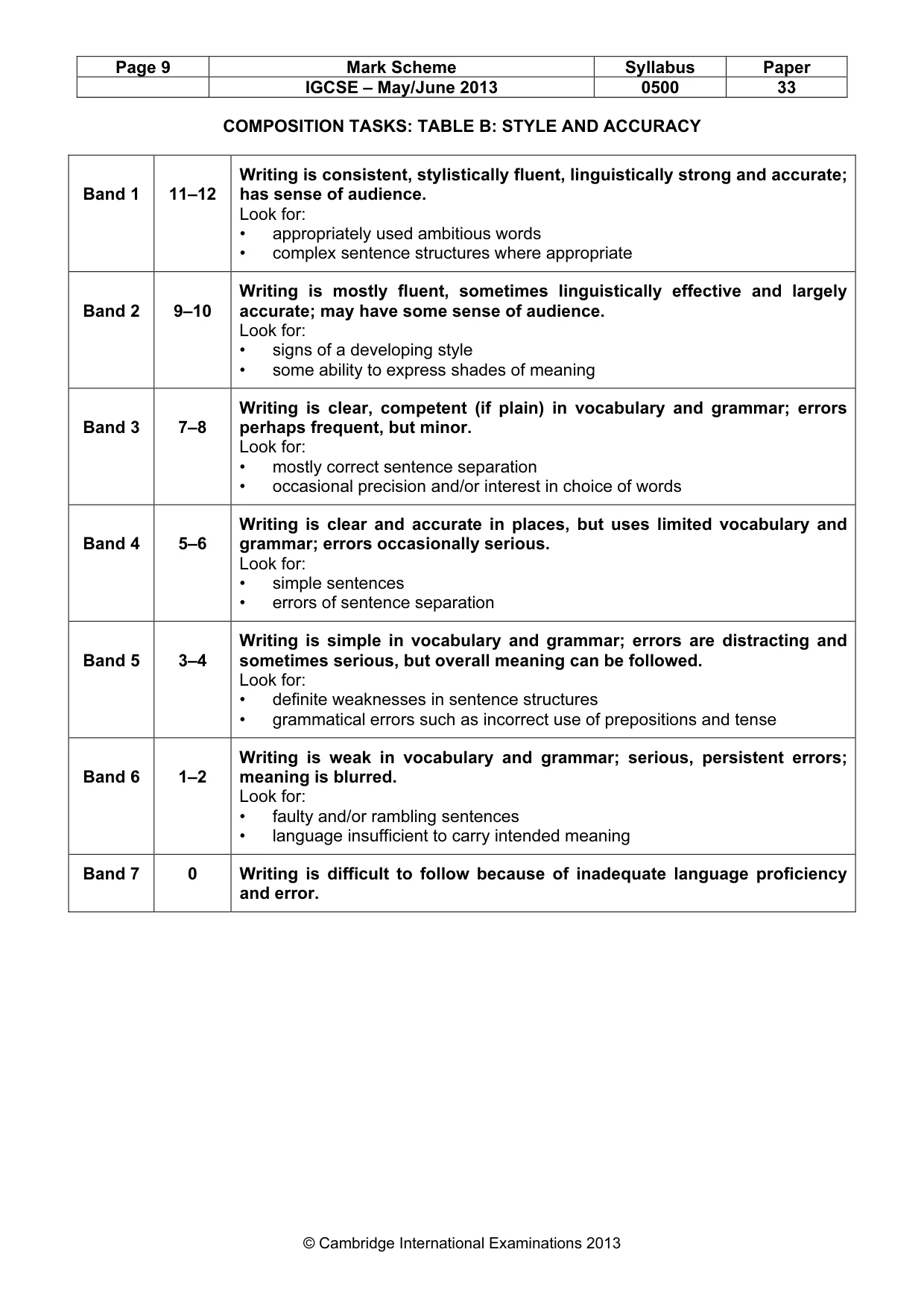
Page 9 Mark Scheme Syllabus Paper IGCSE – May/June 2013 0500 33 © Cambridge International Examinations 2013 COMPOSITION TASKS: TABLE B: STYLE AND ACCURACY Band 1 11–12 Writing is consistent, stylistically fluent, linguistically strong and accurate; has sense of audience. Look for: • appropriately used ambitious words • complex sentence structures where appropriate Band 2 9–10 Writing is mostly fluent, sometimes linguistically effective and largely accurate; may have some sense of audience. Look for: • signs of a developing style • some ability to express shades of meaning Band 3 7–8 Writing is clear, competent (if plain) in vocabulary and grammar; errors perhaps frequent, but minor. Look for: • mostly correct sentence separation • occasional precision and/or interest in choice of words Band 4 5–6 Writing is clear and accurate in places, but uses limited vocabulary and grammar; errors occasionally serious. Look for: • simple sentences • errors of sentence separation Band 5 3–4 Writing is simple in vocabulary and grammar; errors are distracting and sometimes serious, but overall meaning can be followed. Look for: • definite weaknesses in sentence structures • grammatical errors such as incorrect use of prepositions and tense Band 6 1–2 Writing is weak in vocabulary and grammar; serious, persistent errors; meaning is blurred. Look for: • faulty and/or rambling sentences • language insufficient to carry intended meaning Band 7 0 Writing is difficult to follow because of inadequate language proficiency and error.
What you needed in this session
Cambridge’s own grade thresholds for 2013 May/June, Paper 3 · Variant 3. A higher threshold means an easier paper — the bar moves with how the cohort did.