Cambridge IGCSE English - First Language 0500 — 2011 May/June Paper 3 · Variant 2
0500/32/M/J/11 · 50 marks · ≈56 min
The question paper and its mark scheme, free to read here and free to download. This is Cambridge’s own paper, exactly as it was sat.
Question paper4 pages
Mark scheme9 pages
Answers below. Sit the paper first if you are practising.
Paper as text
Question paper, page 1
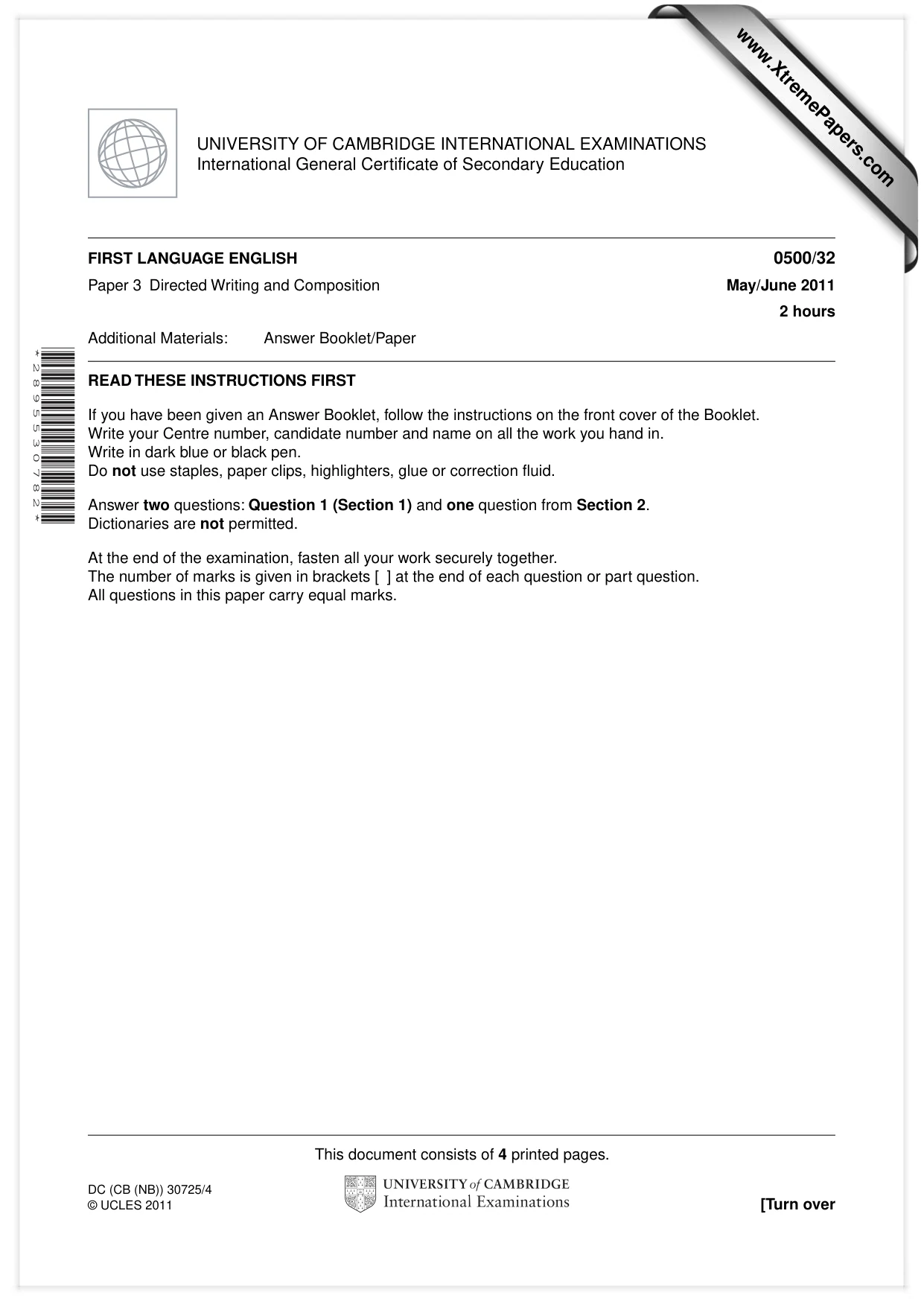
This document consists of 4 printed pages. DC (CB (NB)) 30725/4 © UCLES 2011 [Turn over UNIVERSITY OF CAMBRIDGE INTERNATIONAL EXAMINATIONS International General Certificate of Secondary Education FIRST LANGUAGE ENGLISH 0500/32 Paper 3 Directed Writing and Composition May/June 2011 2 hours Additional Materials: Answer Booklet/Paper READ THESE INSTRUCTIONS FIRST If you have been given an Answer Booklet, follow the instructions on the front cover of the Booklet. Write your Centre number, candidate number and name on all the work you hand in. Write in dark blue or black pen. Do not use staples, paper clips, highlighters, glue or correction fluid. Answer two questions: Question 1 (Section 1) and one question from Section 2. Dictionaries are not permitted. At the end of the examination, fasten all your work securely together. The number of marks is given in brackets [ ] at the end of each question or part question. All questions in this paper carry equal marks. * 2 8 9 5 5 3 0 7 8 2 * www.XtremePapers.com
Question paper, page 2
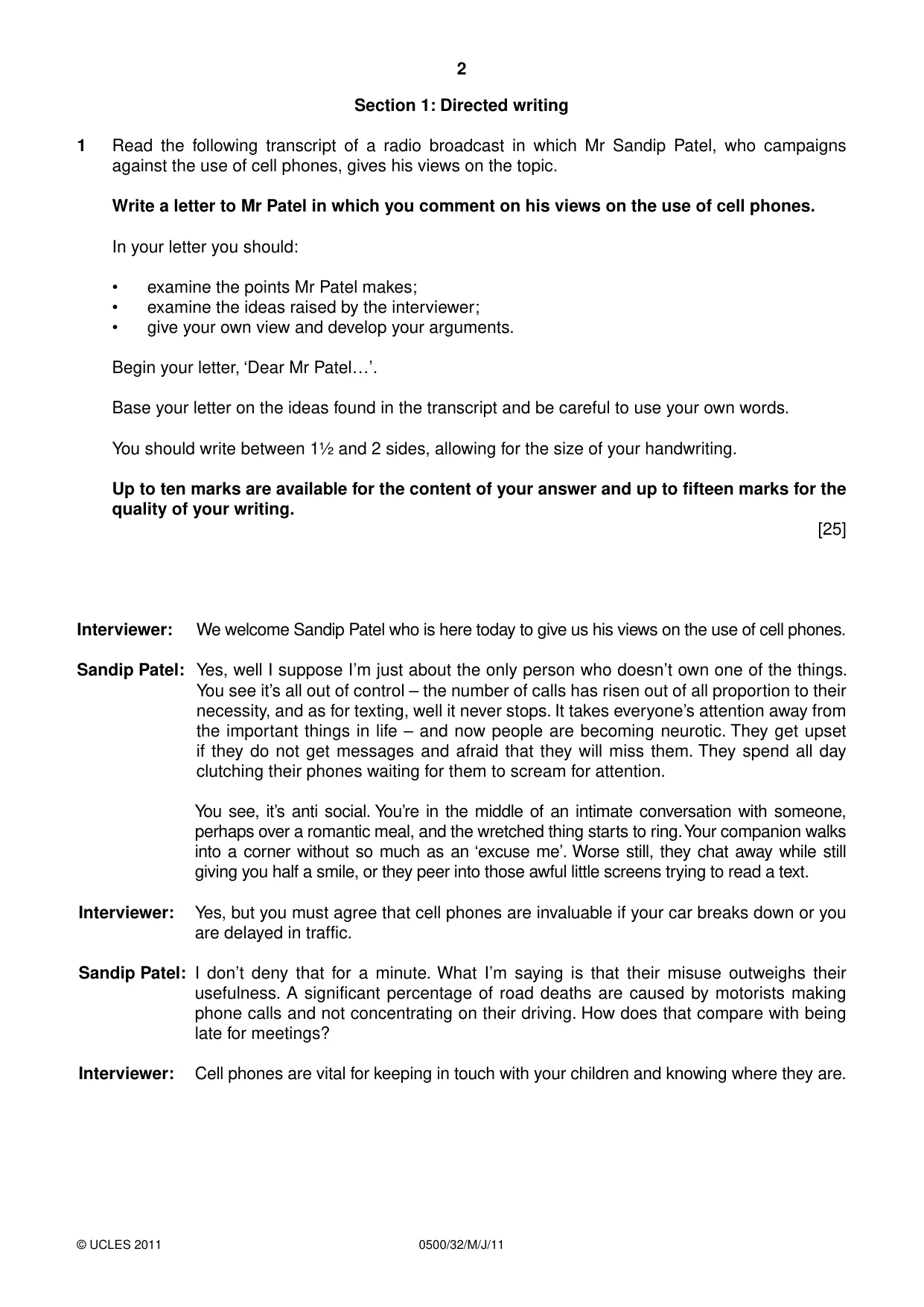
2 0500/32/M/J/11 © UCLES 2011 Section 1: Directed writing 1 Read the following transcript of a radio broadcast in which Mr Sandip Patel, who campaigns against the use of cell phones, gives his views on the topic. Write a letter to Mr Patel in which you comment on his views on the use of cell phones. In your letter you should: • examine the points Mr Patel makes; • examine the ideas raised by the interviewer; • give your own view and develop your arguments. Begin your letter, ‘Dear Mr Patel…’. Base your letter on the ideas found in the transcript and be careful to use your own words. You should write between 1½ and 2 sides, allowing for the size of your handwriting. Up to ten marks are available for the content of your answer and up to fifteen marks for the quality of your writing. [25] Interviewer: We welcome Sandip Patel who is here today to give us his views on the use of cell phones. Sandip Patel: Yes, well I suppose I’m just about the only person who doesn’t own one of the things. You see it’s all out of control – the number of calls has risen out of all proportion to their necessity, and as for texting, well it never stops. It takes everyone’s attention away from the important things in life – and now people are becoming neurotic. They get upset if they do not get messages and afraid that they will miss them. They spend all day clutching their phones waiting for them to scream for attention. You see, it’s anti social. You’re in the middle of an intimate conversation with someone, perhaps over a romantic meal, and the wretched thing starts to ring. Your companion walks into a corner without so much as an ‘excuse me’. Worse still, they chat away while still giving you half a smile, or they peer into those awful little screens trying to read a text. Interviewer: Yes, but you must agree that cell phones are invaluable if your car breaks down or you are delayed in traffic. Sandip Patel: I don’t deny that for a minute. What I’m saying is that their misuse outweighs their usefulness. A significant percentage of road deaths are caused by motorists making phone calls and not concentrating on their driving. How does that compare with being late for meetings? Interviewer: Cell phones are vital for keeping in touch with your children and knowing where they are.
Question paper, page 3
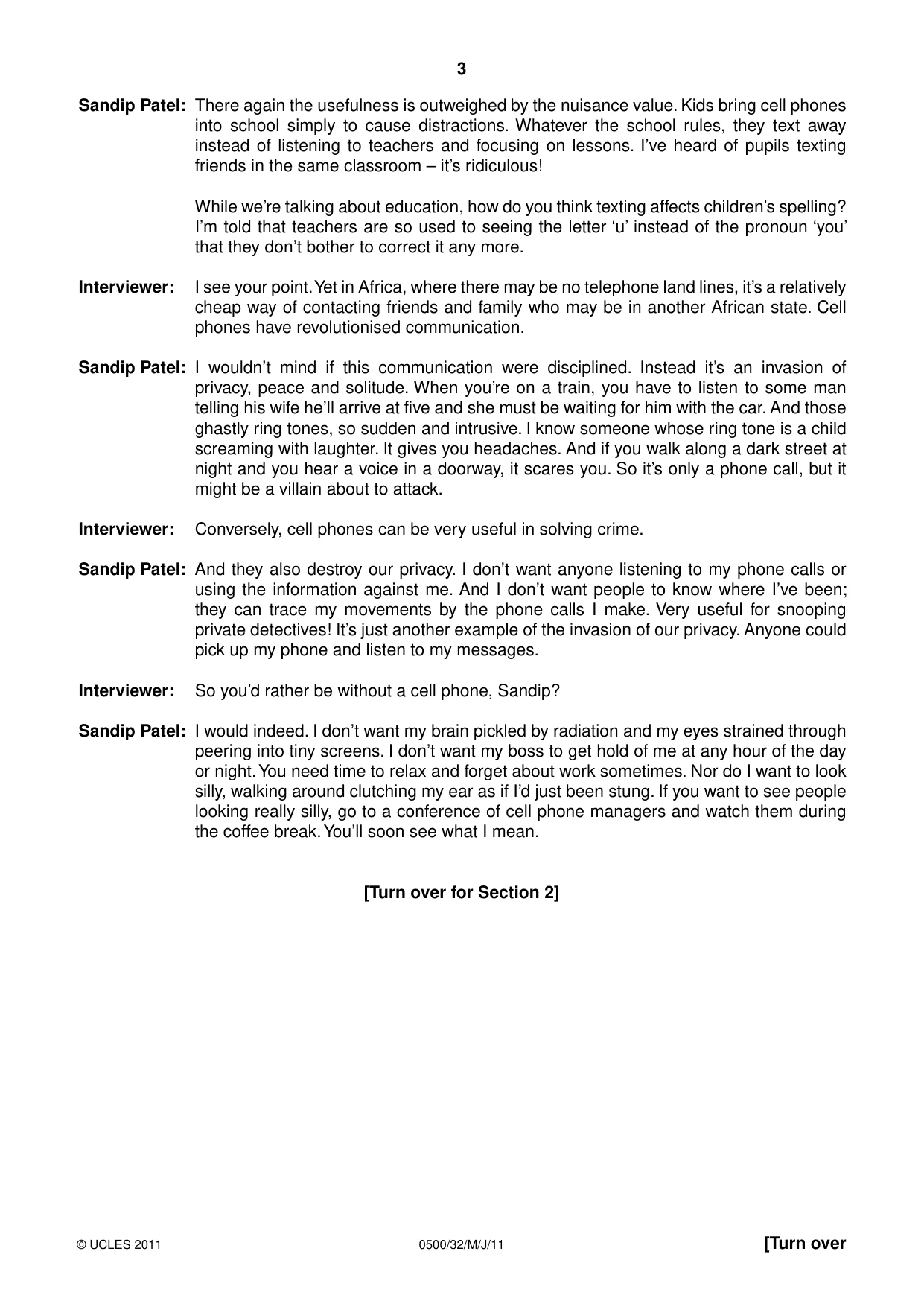
3 0500/32/M/J/11 © UCLES 2011 [Turn over Sandip Patel: There again the usefulness is outweighed by the nuisance value. Kids bring cell phones into school simply to cause distractions. Whatever the school rules, they text away instead of listening to teachers and focusing on lessons. I’ve heard of pupils texting friends in the same classroom – it’s ridiculous! While we’re talking about education, how do you think texting affects children’s spelling? I’m told that teachers are so used to seeing the letter ‘u’ instead of the pronoun ‘you’ that they don’t bother to correct it any more. Interviewer: I see your point. Yet in Africa, where there may be no telephone land lines, it’s a relatively cheap way of contacting friends and family who may be in another African state. Cell phones have revolutionised communication. Sandip Patel: I wouldn’t mind if this communication were disciplined. Instead it’s an invasion of privacy, peace and solitude. When you’re on a train, you have to listen to some man telling his wife he’ll arrive at five and she must be waiting for him with the car. And those ghastly ring tones, so sudden and intrusive. I know someone whose ring tone is a child screaming with laughter. It gives you headaches. And if you walk along a dark street at night and you hear a voice in a doorway, it scares you. So it’s only a phone call, but it might be a villain about to attack. Interviewer: Conversely, cell phones can be very useful in solving crime. Sandip Patel: And they also destroy our privacy. I don’t want anyone listening to my phone calls or using the information against me. And I don’t want people to know where I’ve been; they can trace my movements by the phone calls I make. Very useful for snooping private detectives! It’s just another example of the invasion of our privacy. Anyone could pick up my phone and listen to my messages. Interviewer: So you’d rather be without a cell phone, Sandip? Sandip Patel: I would indeed. I don’t want my brain pickled by radiation and my eyes strained through peering into tiny screens. I don’t want my boss to get hold of me at any hour of the day or night. You need time to relax and forget about work sometimes. Nor do I want to look silly, walking around clutching my ear as if I’d just been stung. If you want to see people looking really silly, go to a conference of cell phone managers and watch them during the coffee break. You’ll soon see what I mean. [Turn over for Section 2]
Question paper, page 4
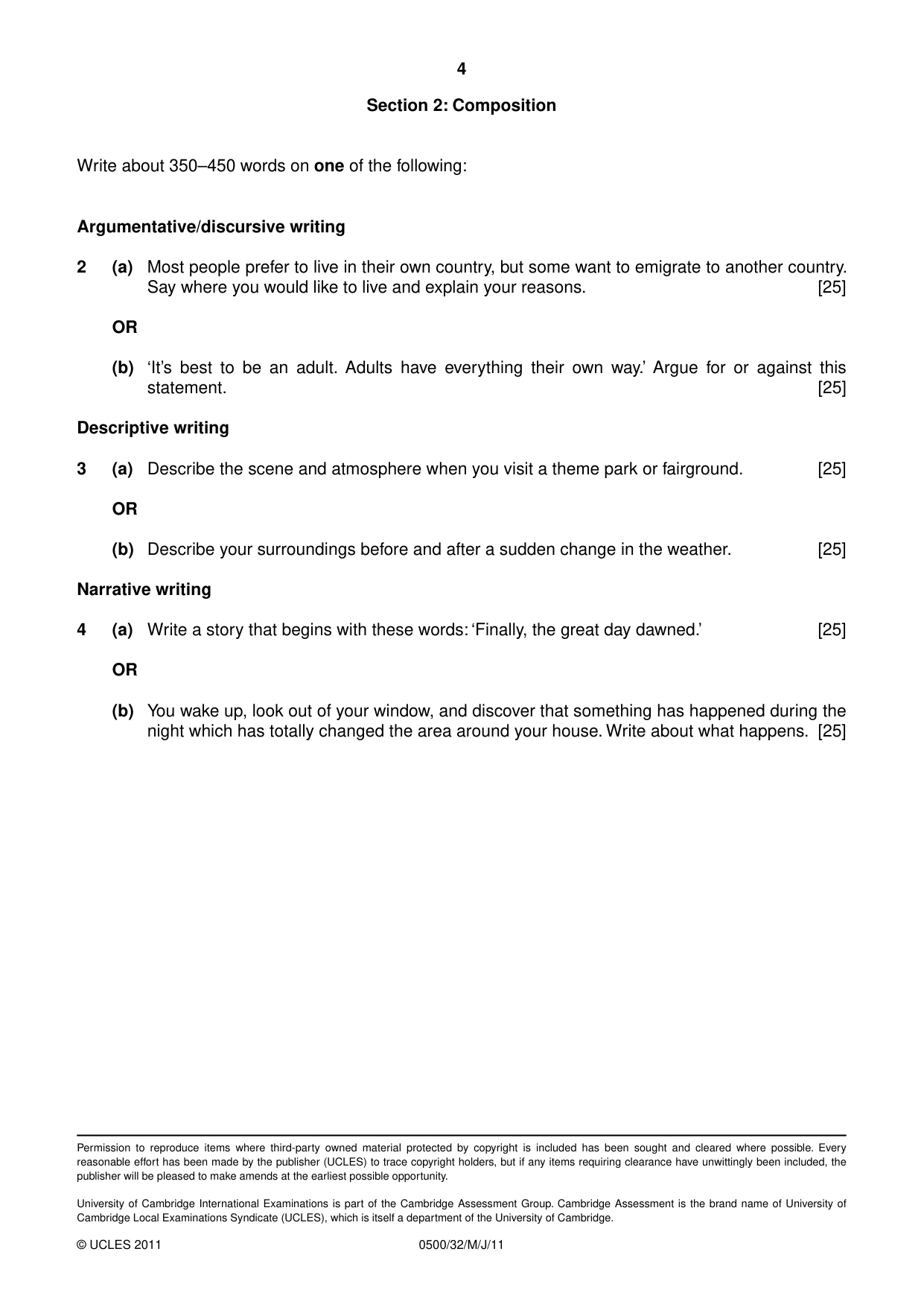
4 0500/32/M/J/11 © UCLES 2011 Section 2: Composition Write about 350–450 words on one of the following: Argumentative/discursive writing 2 (a) Most people prefer to live in their own country, but some want to emigrate to another country. Say where you would like to live and explain your reasons. [25] OR (b) ‘It’s best to be an adult. Adults have everything their own way.’ Argue for or against this statement. [25] Descriptive writing 3 (a) Describe the scene and atmosphere when you visit a theme park or fairground. [25] OR (b) Describe your surroundings before and after a sudden change in the weather. [25] Narrative writing 4 (a) Write a story that begins with these words: ‘Finally, the great day dawned.’ [25] OR (b) You wake up, look out of your window, and discover that something has happened during the night which has totally changed the area around your house. Write about what happens. [25] Permission to reproduce items where third-party owned material protected by copyright is included has been sought and cleared where possible. Every reasonable effort has been made by the publisher (UCLES) to trace copyright holders, but if any items requiring clearance have unwittingly been included, the publisher will be pleased to make amends at the earliest possible opportunity. University of Cambridge International Examinations is part of the Cambridge Assessment Group. Cambridge Assessment is the brand name of University of Cambridge Local Examinations Syndicate (UCLES), which is itself a department of the University of Cambridge.
Mark scheme, page 1
UNIVERSITY OF CAMBRIDGE INTERNATIONAL EXAMINATIONS International General Certificate of Secondary Education MARK SCHEME for the May/June 2011 question paper for the guidance of teachers 0500 FIRST LANGUAGE ENGLISH 0500/32 Paper 3 (Directed Writing and Composition), maximum raw mark 50 This mark scheme is published as an aid to teachers and candidates, to indicate the requirements of the examination. It shows the basis on which Examiners were instructed to award marks. It does not indicate the details of the discussions that took place at an Examiners’ meeting before marking began, which would have considered the acceptability of alternative answers. Mark schemes must be read in conjunction with the question papers and the report on the examination. • Cambridge will not enter into discussions or correspondence in connection with these mark schemes. Cambridge is publishing the mark schemes for the May/June 2011 question papers for most IGCSE, GCE Advanced Level and Advanced Subsidiary Level syllabuses and some Ordinary Level syllabuses. www.XtremePapers.com
Mark scheme, page 2
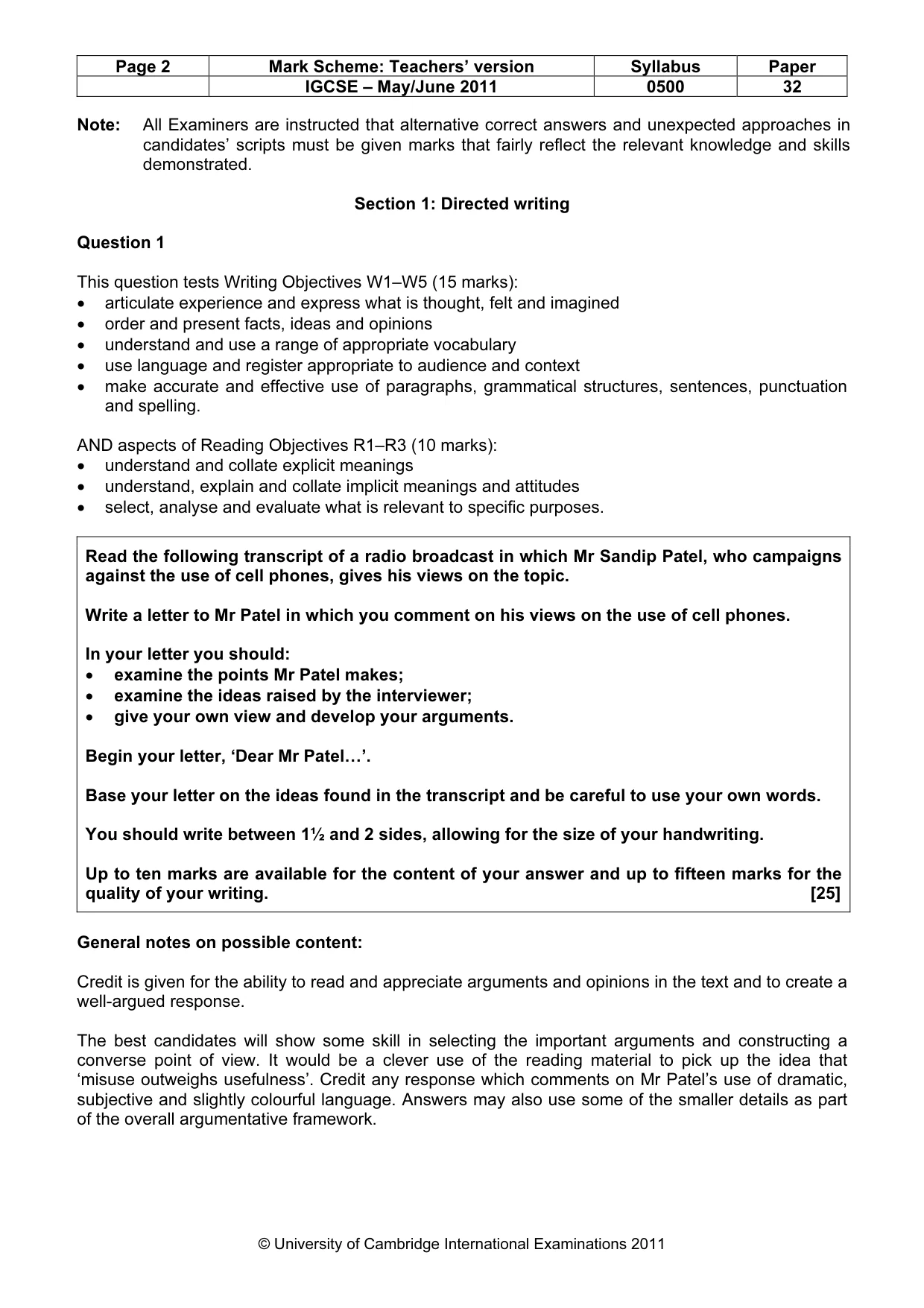
Page 2 Mark Scheme: Teachers’ version Syllabus Paper IGCSE – May/June 2011 0500 32 © University of Cambridge International Examinations 2011 Note: All Examiners are instructed that alternative correct answers and unexpected approaches in candidates’ scripts must be given marks that fairly reflect the relevant knowledge and skills demonstrated. Section 1: Directed writing Question 1 This question tests Writing Objectives W1–W5 (15 marks): • articulate experience and express what is thought, felt and imagined • order and present facts, ideas and opinions • understand and use a range of appropriate vocabulary • use language and register appropriate to audience and context • make accurate and effective use of paragraphs, grammatical structures, sentences, punctuation and spelling. AND aspects of Reading Objectives R1–R3 (10 marks): • understand and collate explicit meanings • understand, explain and collate implicit meanings and attitudes • select, analyse and evaluate what is relevant to specific purposes. Read the following transcript of a radio broadcast in which Mr Sandip Patel, who campaigns against the use of cell phones, gives his views on the topic. Write a letter to Mr Patel in which you comment on his views on the use of cell phones. In your letter you should: • examine the points Mr Patel makes; • examine the ideas raised by the interviewer; • give your own view and develop your arguments. Begin your letter, ‘Dear Mr Patel…’. Base your letter on the ideas found in the transcript and be careful to use your own words. You should write between 1½ and 2 sides, allowing for the size of your handwriting. Up to ten marks are available for the content of your answer and up to fifteen marks for the quality of your writing. [25] General notes on possible content: Credit is given for the ability to read and appreciate arguments and opinions in the text and to create a well-argued response. The best candidates will show some skill in selecting the important arguments and constructing a converse point of view. It would be a clever use of the reading material to pick up the idea that ‘misuse outweighs usefulness’. Credit any response which comments on Mr Patel’s use of dramatic, subjective and slightly colourful language. Answers may also use some of the smaller details as part of the overall argumentative framework.
Mark scheme, page 3
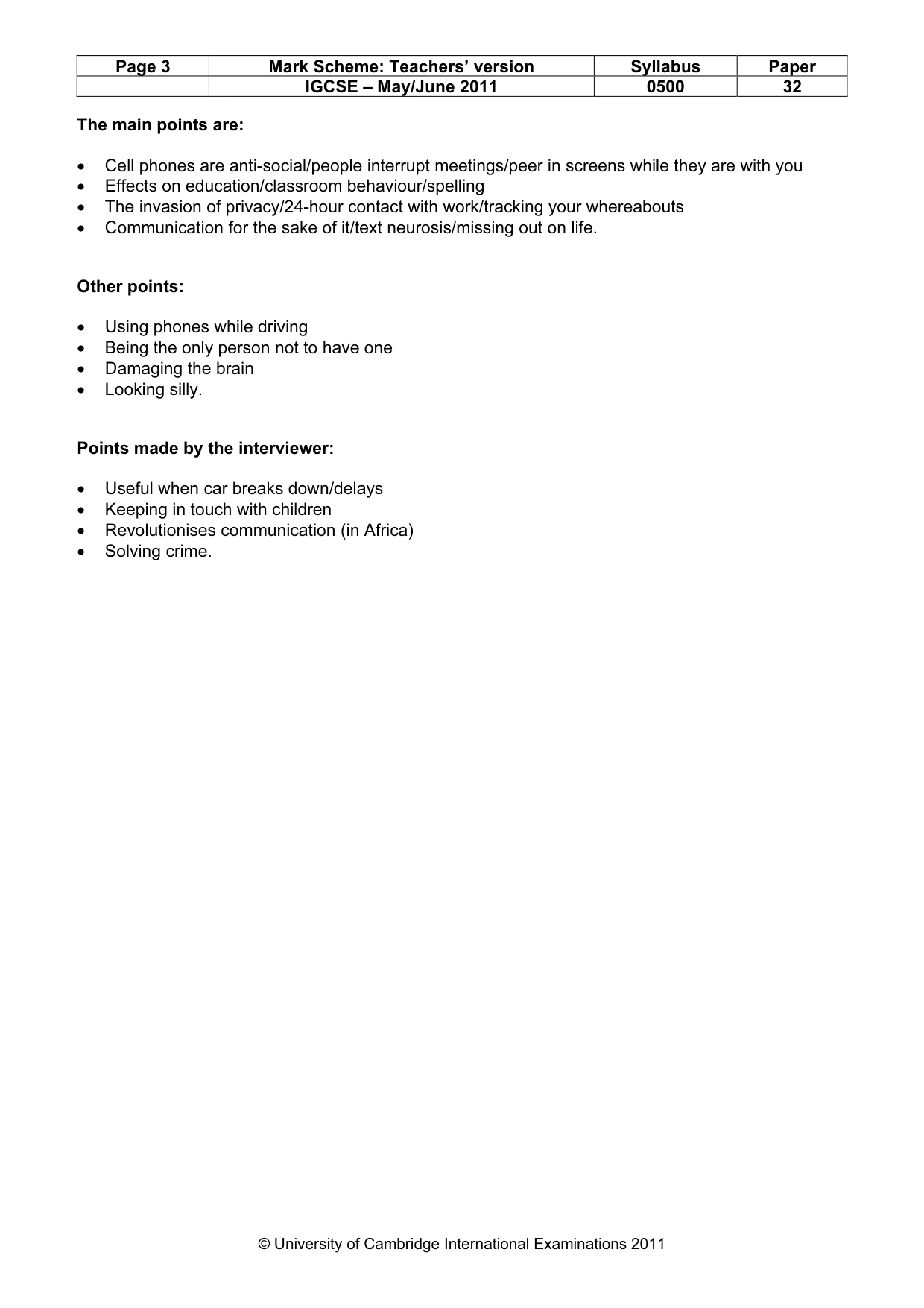
Page 3 Mark Scheme: Teachers’ version Syllabus Paper IGCSE – May/June 2011 0500 32 © University of Cambridge International Examinations 2011 The main points are: • Cell phones are anti-social/people interrupt meetings/peer in screens while they are with you • Effects on education/classroom behaviour/spelling • The invasion of privacy/24-hour contact with work/tracking your whereabouts • Communication for the sake of it/text neurosis/missing out on life. Other points: • Using phones while driving • Being the only person not to have one • Damaging the brain • Looking silly. Points made by the interviewer: • Useful when car breaks down/delays • Keeping in touch with children • Revolutionises communication (in Africa) • Solving crime.
Mark scheme, page 4
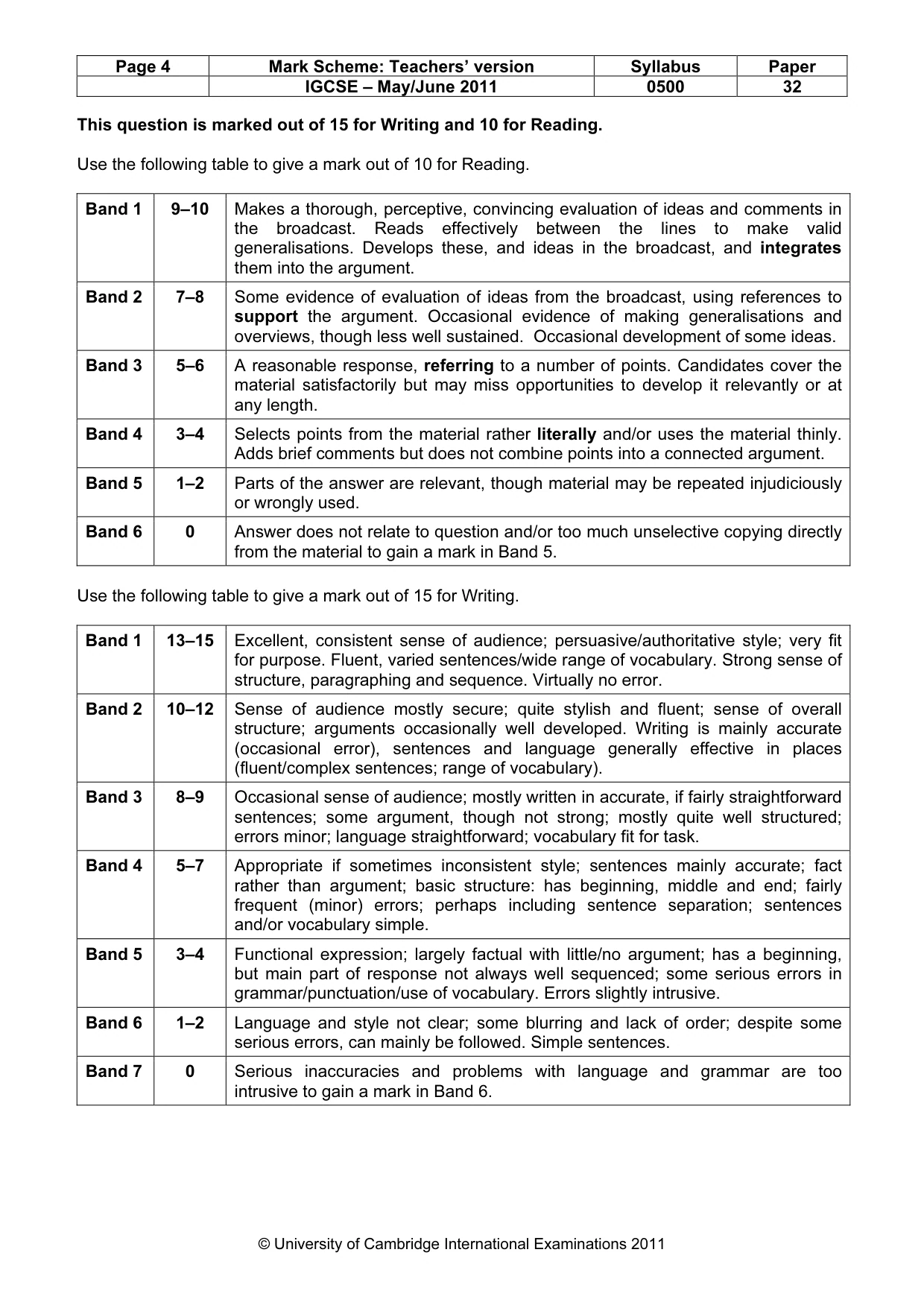
Page 4 Mark Scheme: Teachers’ version Syllabus Paper IGCSE – May/June 2011 0500 32 © University of Cambridge International Examinations 2011 This question is marked out of 15 for Writing and 10 for Reading. Use the following table to give a mark out of 10 for Reading. Band 1 9–10 Makes a thorough, perceptive, convincing evaluation of ideas and comments in the broadcast. Reads effectively between the lines to make valid generalisations. Develops these, and ideas in the broadcast, and integrates them into the argument. Band 2 7–8 Some evidence of evaluation of ideas from the broadcast, using references to support the argument. Occasional evidence of making generalisations and overviews, though less well sustained. Occasional development of some ideas. Band 3 5–6 A reasonable response, referring to a number of points. Candidates cover the material satisfactorily but may miss opportunities to develop it relevantly or at any length. Band 4 3–4 Selects points from the material rather literally and/or uses the material thinly. Adds brief comments but does not combine points into a connected argument. Band 5 1–2 Parts of the answer are relevant, though material may be repeated injudiciously or wrongly used. Band 6 0 Answer does not relate to question and/or too much unselective copying directly from the material to gain a mark in Band 5. First variant Mark Scheme Use the following table to give a mark out of 15 for Writing. Band 1 13–15 Excellent, consistent sense of audience; persuasive/authoritative style; very fit for purpose. Fluent, varied sentences/wide range of vocabulary. Strong sense of structure, paragraphing and sequence. Virtually no error. Band 2 10–12 Sense of audience mostly secure; quite stylish and fluent; sense of overall structure; arguments occasionally well developed. Writing is mainly accurate (occasional error), sentences and language generally effective in places (fluent/complex sentences; range of vocabulary). Band 3 8–9 Occasional sense of audience; mostly written in accurate, if fairly straightforward sentences; some argument, though not strong; mostly quite well structured; errors minor; language straightforward; vocabulary fit for task. Band 4 5–7 Appropriate if sometimes inconsistent style; sentences mainly accurate; fact rather than argument; basic structure: has beginning, middle and end; fairly frequent (minor) errors; perhaps including sentence separation; sentences and/or vocabulary simple. Band 5 3–4 Functional expression; largely factual with little/no argument; has a beginning, but main part of response not always well sequenced; some serious errors in grammar/punctuation/use of vocabulary. Errors slightly intrusive. Band 6 1–2 Language and style not clear; some blurring and lack of order; despite some serious errors, can mainly be followed. Simple sentences. Band 7 0 Serious inaccuracies and problems with language and grammar are too intrusive to gain a mark in Band 6. First variant Mark Scheme
Mark scheme, page 5
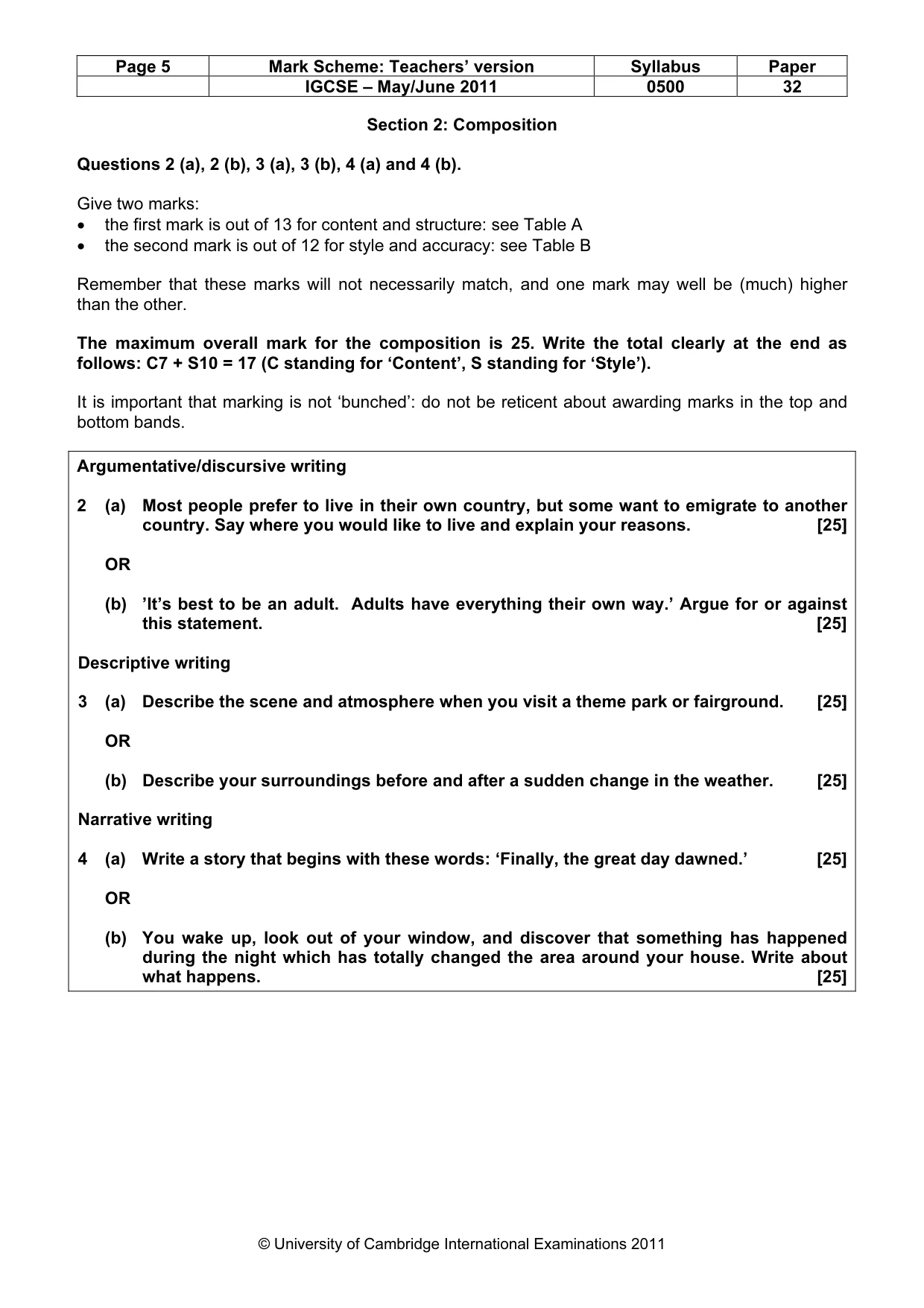
Page 5 Mark Scheme: Teachers’ version Syllabus Paper IGCSE – May/June 2011 0500 32 © University of Cambridge International Examinations 2011 Section 2: Composition Questions 2 (a), 2 (b), 3 (a), 3 (b), 4 (a) and 4 (b). Give two marks: • the first mark is out of 13 for content and structure: see Table A • the second mark is out of 12 for style and accuracy: see Table B Remember that these marks will not necessarily match, and one mark may well be (much) higher than the other. The maximum overall mark for the composition is 25. Write the total clearly at the end as follows: C7 + S10 = 17 (C standing for ‘Content’, S standing for ‘Style’). It is important that marking is not ‘bunched’: do not be reticent about awarding marks in the top and bottom bands. Argumentative/discursive writing 2 (a) Most people prefer to live in their own country, but some want to emigrate to another country. Say where you would like to live and explain your reasons. [25] OR (b) ’It’s best to be an adult. Adults have everything their own way.’ Argue for or against this statement. [25] Descriptive writing 3 (a) Describe the scene and atmosphere when you visit a theme park or fairground. [25] OR (b) Describe your surroundings before and after a sudden change in the weather. [25] Narrative writing 4 (a) Write a story that begins with these words: ‘Finally, the great day dawned.’ [25] OR (b) You wake up, look out of your window, and discover that something has happened during the night which has totally changed the area around your house. Write about what happens. [25]
Mark scheme, page 6
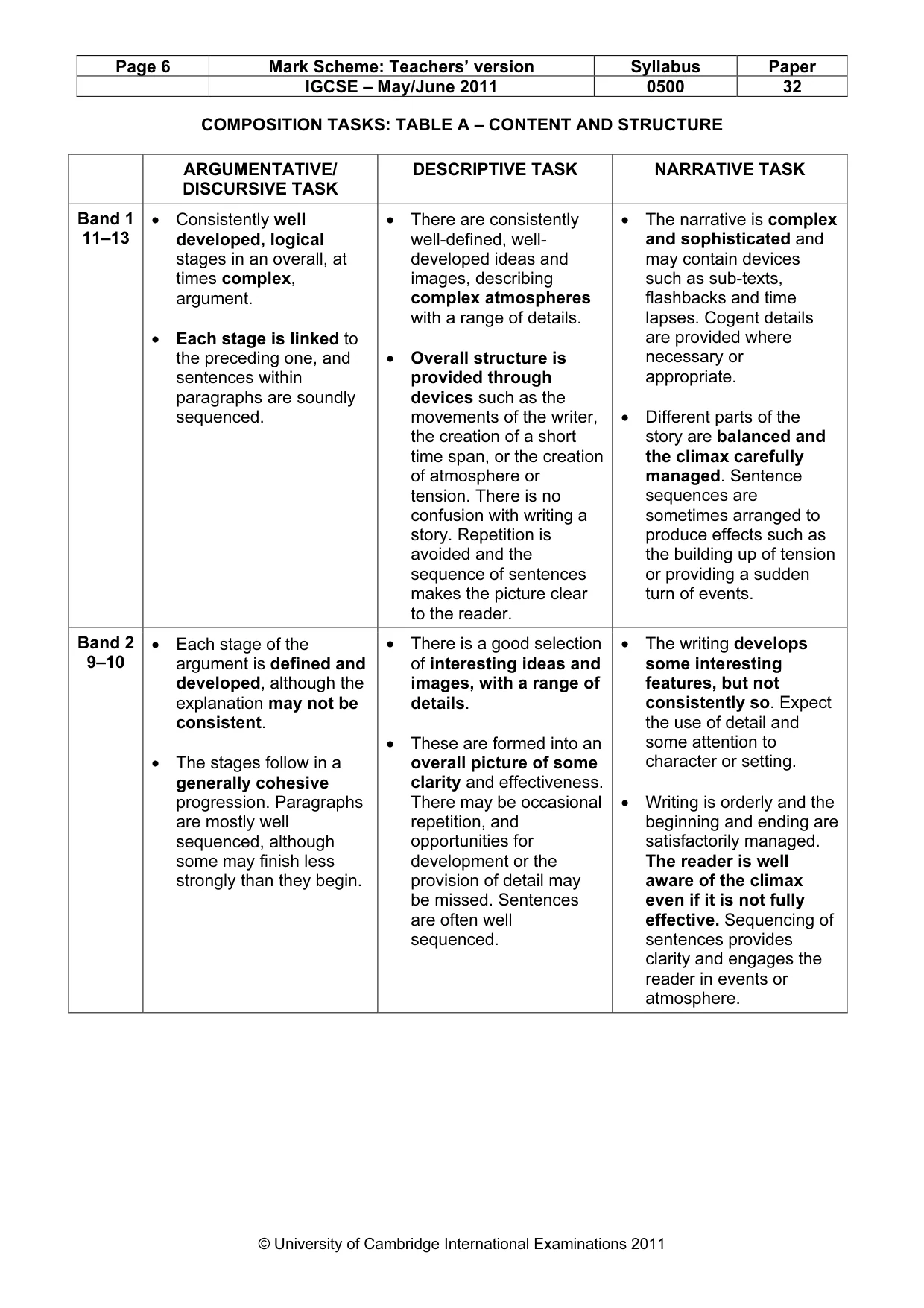
Page 6 Mark Scheme: Teachers’ version Syllabus Paper IGCSE – May/June 2011 0500 32 © University of Cambridge International Examinations 2011 COMPOSITION TASKS: TABLE A – CONTENT AND STRUCTURE ARGUMENTATIVE/ DISCURSIVE TASK DESCRIPTIVE TASK NARRATIVE TASK Band 1 11–13 • Consistently well developed, logical stages in an overall, at times complex, argument. • Each stage is linked to the preceding one, and sentences within paragraphs are soundly sequenced. • There are consistently well-defined, well- developed ideas and images, describing complex atmospheres with a range of details. • Overall structure is provided through devices such as the movements of the writer, the creation of a short time span, or the creation of atmosphere or tension. There is no confusion with writing a story. Repetition is avoided and the sequence of sentences makes the picture clear to the reader. • The narrative is complex and sophisticated and may contain devices such as sub-texts, flashbacks and time lapses. Cogent details are provided where necessary or appropriate. • Different parts of the story are balanced and the climax carefully managed. Sentence sequences are sometimes arranged to produce effects such as the building up of tension or providing a sudden turn of events. Band 2 9–10 • Each stage of the argument is defined and developed, although the explanation may not be consistent. • The stages follow in a generally cohesive progression. Paragraphs are mostly well sequenced, although some may finish less strongly than they begin. • There is a good selection of interesting ideas and images, with a range of details. • These are formed into an overall picture of some clarity and effectiveness. There may be occasional repetition, and opportunities for development or the provision of detail may be missed. Sentences are often well sequenced. • The writing develops some interesting features, but not consistently so. Expect the use of detail and some attention to character or setting. • Writing is orderly and the beginning and ending are satisfactorily managed. The reader is well aware of the climax even if it is not fully effective. Sequencing of sentences provides clarity and engages the reader in events or atmosphere.
Mark scheme, page 7
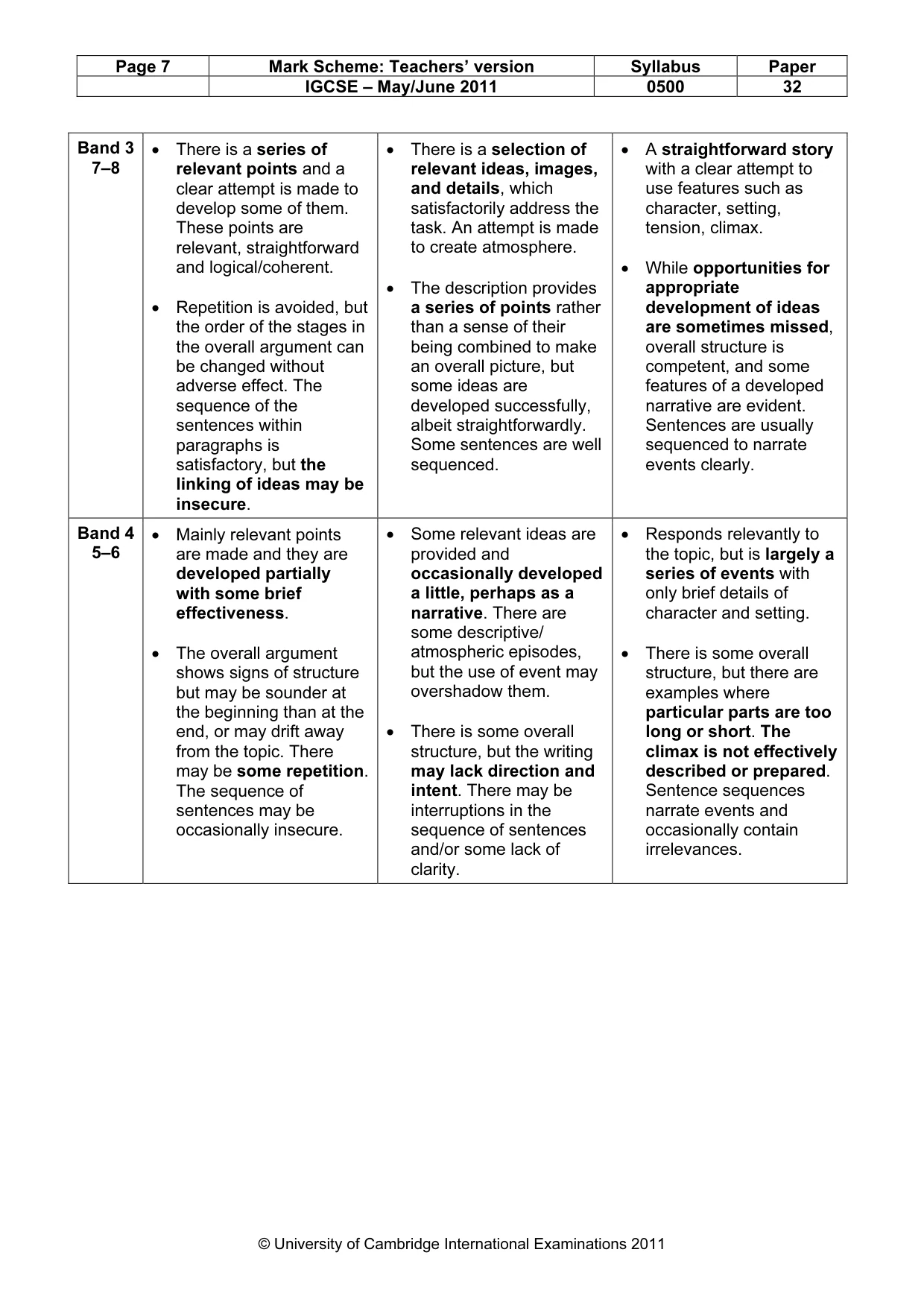
Page 7 Mark Scheme: Teachers’ version Syllabus Paper IGCSE – May/June 2011 0500 32 © University of Cambridge International Examinations 2011 Band 3 7–8 • There is a series of relevant points and a clear attempt is made to develop some of them. These points are relevant, straightforward and logical/coherent. • Repetition is avoided, but the order of the stages in the overall argument can be changed without adverse effect. The sequence of the sentences within paragraphs is satisfactory, but the linking of ideas may be insecure. • There is a selection of relevant ideas, images, and details, which satisfactorily address the task. An attempt is made to create atmosphere. • The description provides a series of points rather than a sense of their being combined to make an overall picture, but some ideas are developed successfully, albeit straightforwardly. Some sentences are well sequenced. • A straightforward story with a clear attempt to use features such as character, setting, tension, climax. • While opportunities for appropriate development of ideas are sometimes missed, overall structure is competent, and some features of a developed narrative are evident. Sentences are usually sequenced to narrate events clearly. Band 4 5–6 • Mainly relevant points are made and they are developed partially with some brief effectiveness. • The overall argument shows signs of structure but may be sounder at the beginning than at the end, or may drift away from the topic. There may be some repetition. The sequence of sentences may be occasionally insecure. • Some relevant ideas are provided and occasionally developed a little, perhaps as a narrative. There are some descriptive/ atmospheric episodes, but the use of event may overshadow them. • There is some overall structure, but the writing may lack direction and intent. There may be interruptions in the sequence of sentences and/or some lack of clarity. • Responds relevantly to the topic, but is largely a series of events with only brief details of character and setting. • There is some overall structure, but there are examples where particular parts are too long or short. The climax is not effectively described or prepared. Sentence sequences narrate events and occasionally contain irrelevances.
Mark scheme, page 8
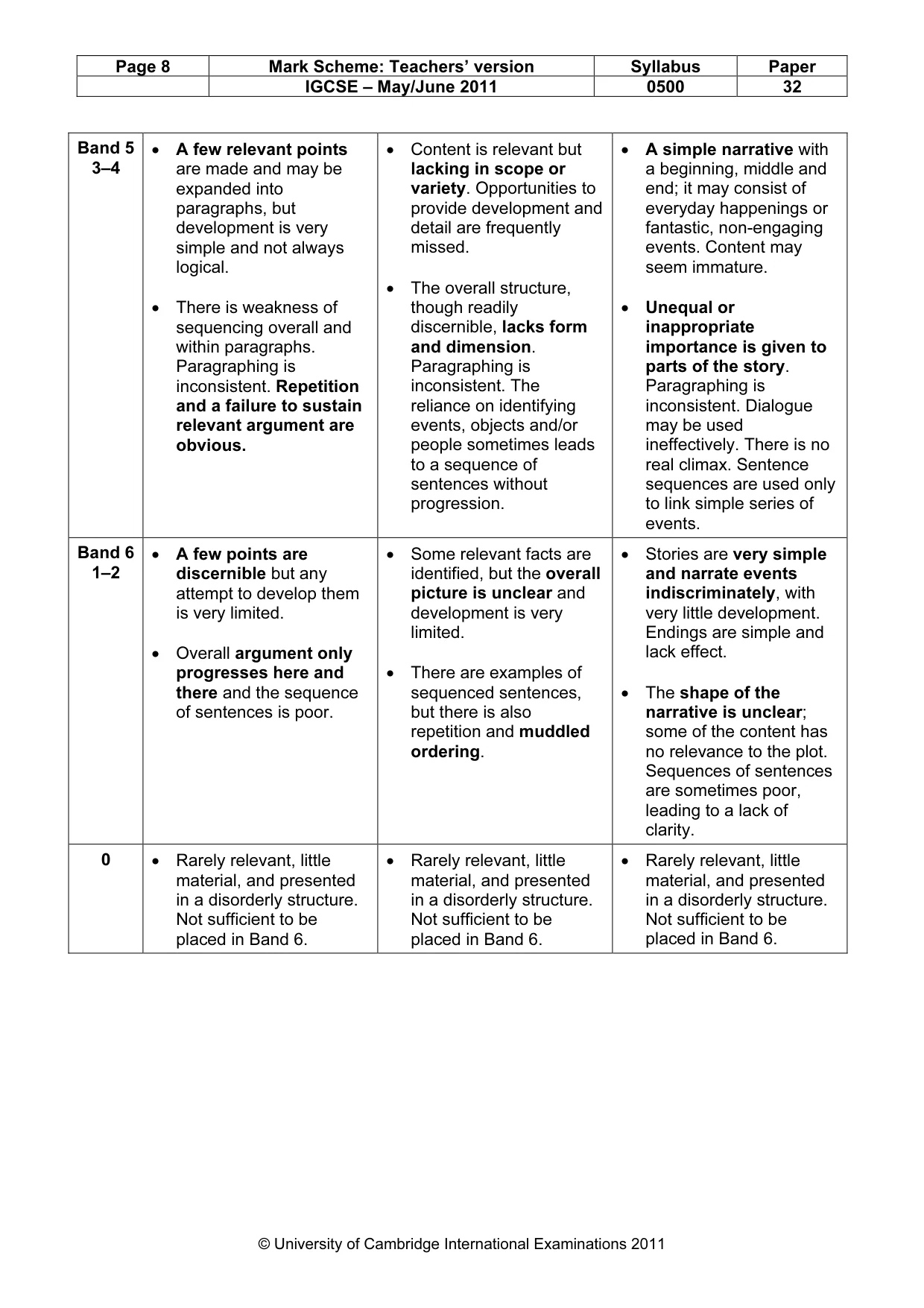
Page 8 Mark Scheme: Teachers’ version Syllabus Paper IGCSE – May/June 2011 0500 32 © University of Cambridge International Examinations 2011 Band 5 3–4 • A few relevant points are made and may be expanded into paragraphs, but development is very simple and not always logical. • There is weakness of sequencing overall and within paragraphs. Paragraphing is inconsistent. Repetition and a failure to sustain relevant argument are obvious. • Content is relevant but lacking in scope or variety. Opportunities to provide development and detail are frequently missed. • The overall structure, though readily discernible, lacks form and dimension. Paragraphing is inconsistent. The reliance on identifying events, objects and/or people sometimes leads to a sequence of sentences without progression. • A simple narrative with a beginning, middle and end; it may consist of everyday happenings or fantastic, non-engaging events. Content may seem immature. • Unequal or inappropriate importance is given to parts of the story. Paragraphing is inconsistent. Dialogue may be used ineffectively. There is no real climax. Sentence sequences are used only to link simple series of events. Band 6 1–2 • A few points are discernible but any attempt to develop them is very limited. • Overall argument only progresses here and there and the sequence of sentences is poor. • Some relevant facts are identified, but the overall picture is unclear and development is very limited. • There are examples of sequenced sentences, but there is also repetition and muddled ordering. • Stories are very simple and narrate events indiscriminately, with very little development. Endings are simple and lack effect. • The shape of the narrative is unclear; some of the content has no relevance to the plot. Sequences of sentences are sometimes poor, leading to a lack of clarity. 0 • Rarely relevant, little material, and presented in a disorderly structure. Not sufficient to be placed in Band 6. • Rarely relevant, little material, and presented in a disorderly structure. Not sufficient to be placed in Band 6. • Rarely relevant, little material, and presented in a disorderly structure. Not sufficient to be placed in Band 6.
Mark scheme, page 9
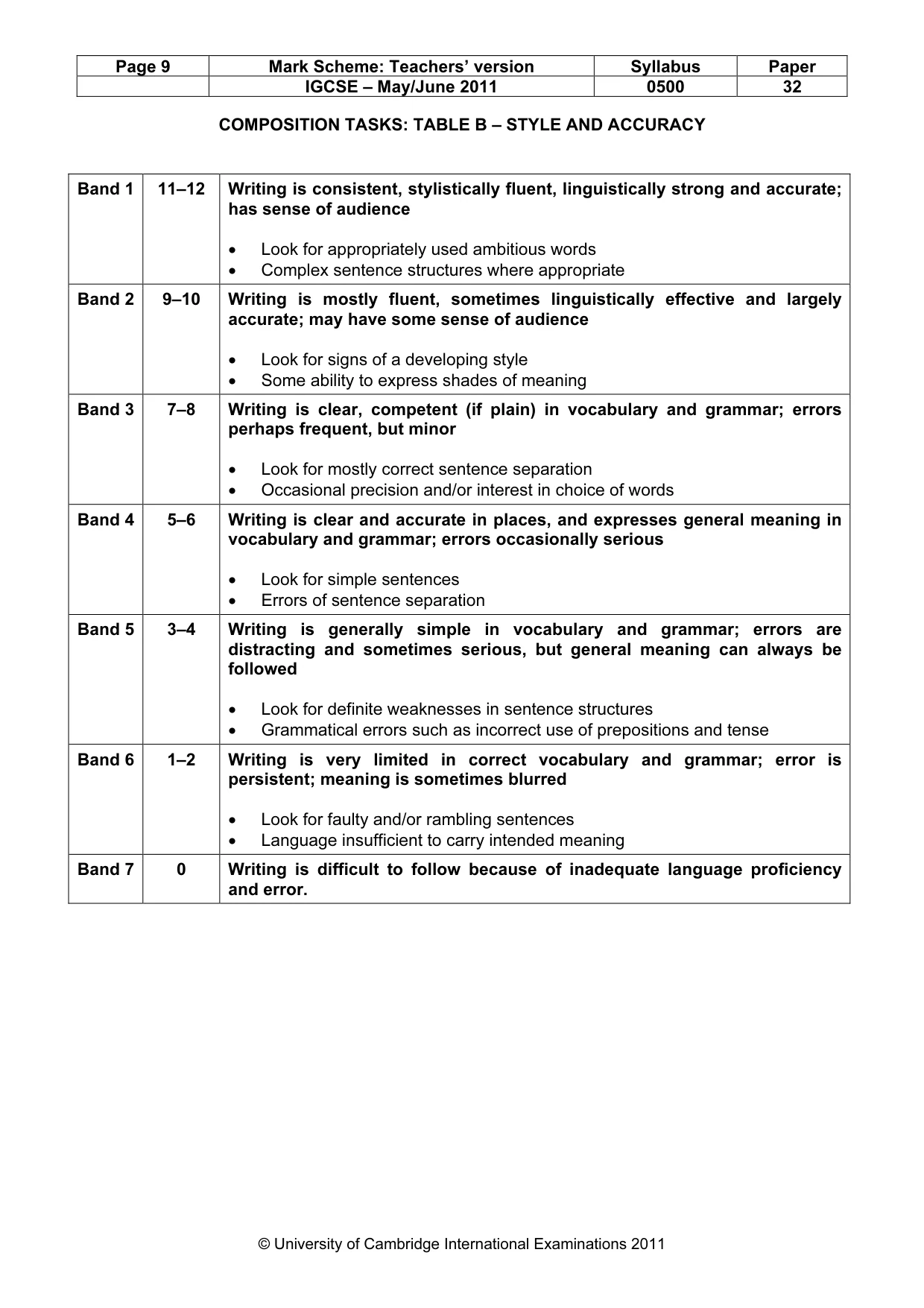
Page 9 Mark Scheme: Teachers’ version Syllabus Paper IGCSE – May/June 2011 0500 32 © University of Cambridge International Examinations 2011 COMPOSITION TASKS: TABLE B – STYLE AND ACCURACY Band 1 11–12 Writing is consistent, stylistically fluent, linguistically strong and accurate; has sense of audience • Look for appropriately used ambitious words • Complex sentence structures where appropriate Band 2 9–10 Writing is mostly fluent, sometimes linguistically effective and largely accurate; may have some sense of audience • Look for signs of a developing style • Some ability to express shades of meaning Band 3 7–8 Writing is clear, competent (if plain) in vocabulary and grammar; errors perhaps frequent, but minor • Look for mostly correct sentence separation • Occasional precision and/or interest in choice of words Band 4 5–6 Writing is clear and accurate in places, and expresses general meaning in vocabulary and grammar; errors occasionally serious • Look for simple sentences • Errors of sentence separation Band 5 3–4 Writing is generally simple in vocabulary and grammar; errors are distracting and sometimes serious, but general meaning can always be followed • Look for definite weaknesses in sentence structures • Grammatical errors such as incorrect use of prepositions and tense Band 6 1–2 Writing is very limited in correct vocabulary and grammar; error is persistent; meaning is sometimes blurred • Look for faulty and/or rambling sentences • Language insufficient to carry intended meaning Band 7 0 Writing is difficult to follow because of inadequate language proficiency and error.
What you needed in this session
Cambridge’s own grade thresholds for 2011 May/June, Paper 3 · Variant 2. A higher threshold means an easier paper — the bar moves with how the cohort did.