Cambridge IGCSE English - First Language 0500 — 2010 Oct/Nov Paper 3 · Variant 1
0500/31/O/N/10 · 50 marks · ≈56 min
The question paper and its mark scheme, free to read here and free to download. This is Cambridge’s own paper, exactly as it was sat.
Question paper4 pages
Mark scheme8 pages
Answers below. Sit the paper first if you are practising.
Paper as text
Question paper, page 1
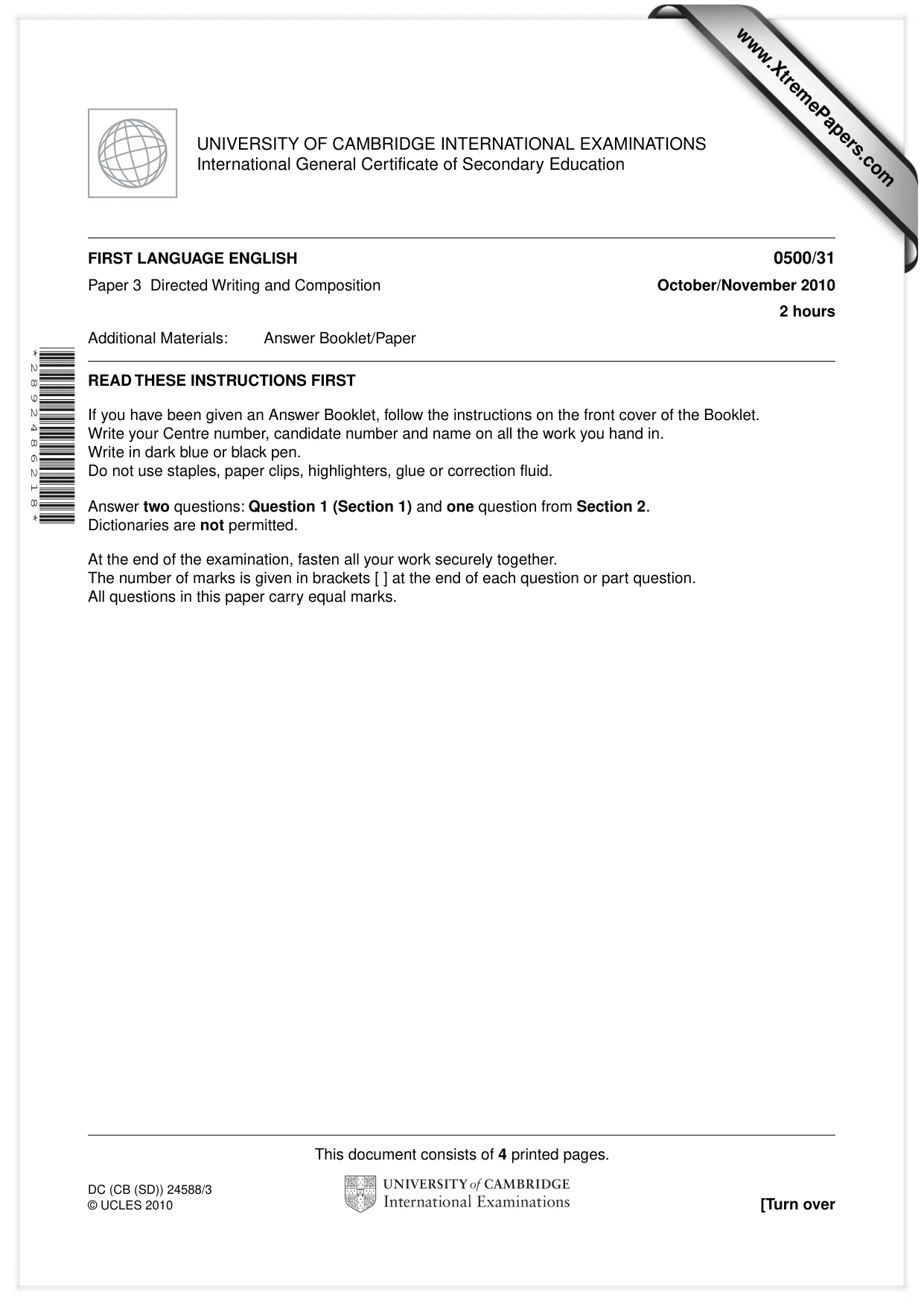
This document consists of 4 printed pages. DC (CB (SD)) 24588/3 © UCLES 2010 [Turn over UNIVERSITY OF CAMBRIDGE INTERNATIONAL EXAMINATIONS International General Certificate of Secondary Education * 2 8 9 2 4 8 6 2 1 8 * FIRST LANGUAGE ENGLISH 0500/31 Paper 3 Directed Writing and Composition October/November 2010 2 hours Additional Materials: Answer Booklet/Paper READ THESE INSTRUCTIONS FIRST If you have been given an Answer Booklet, follow the instructions on the front cover of the Booklet. Write your Centre number, candidate number and name on all the work you hand in. Write in dark blue or black pen. Do not use staples, paper clips, highlighters, glue or correction fluid. Answer two questions: Question 1 (Section 1) and one question from Section 2. Dictionaries are not permitted. At the end of the examination, fasten all your work securely together. The number of marks is given in brackets [ ] at the end of each question or part question. All questions in this paper carry equal marks. www.XtremePapers.com
Question paper, page 2
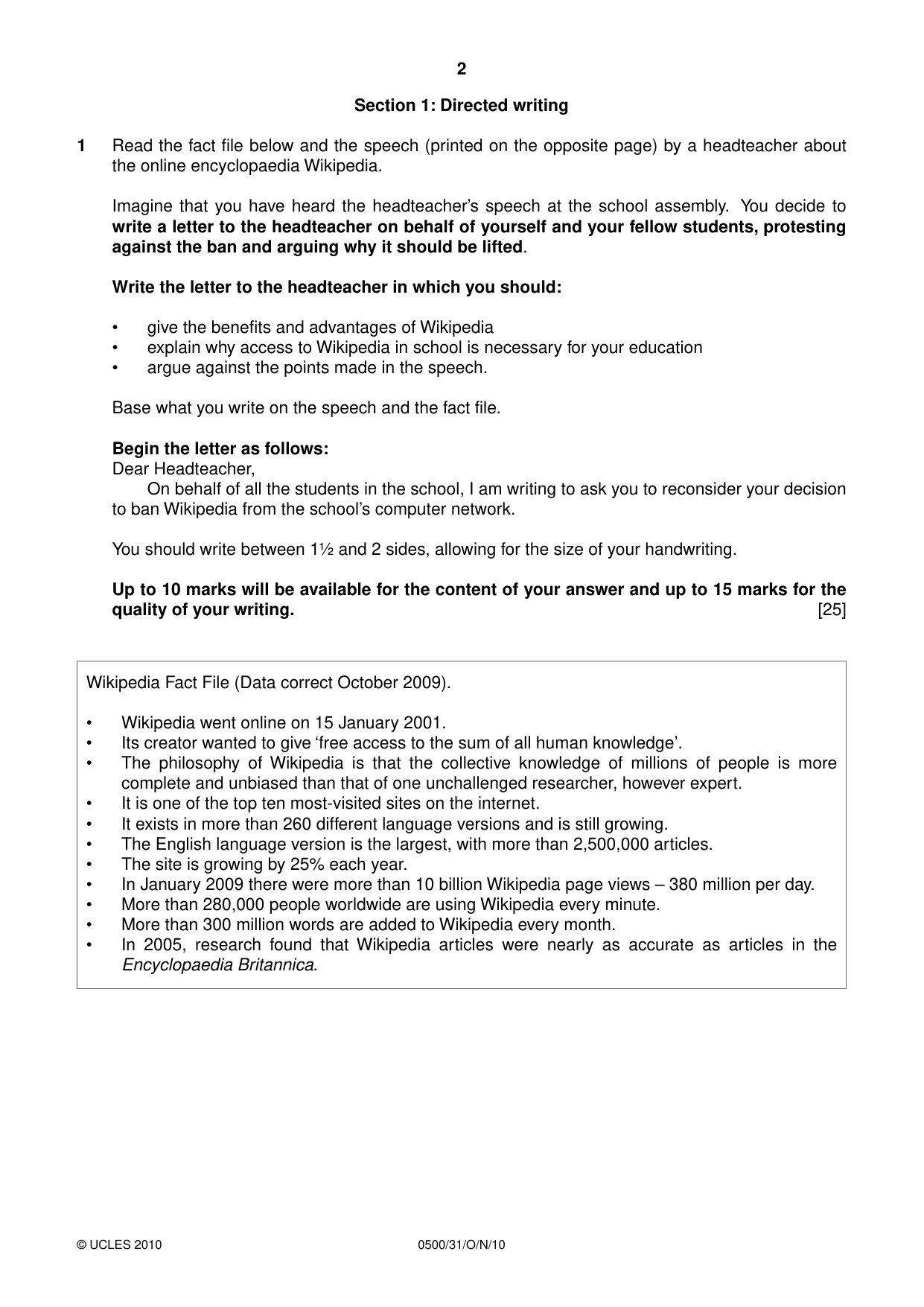
2 0500/31/O/N/10 © UCLES 2010 Section 1: Directed writing 1 Read the fact file below and the speech (printed on the opposite page) by a headteacher about the online encyclopaedia Wikipedia. Imagine that you have heard the headteacher’s speech at the school assembly. You decide to write a letter to the headteacher on behalf of yourself and your fellow students, protesting against the ban and arguing why it should be lifted. Write the letter to the headteacher in which you should: • give the benefits and advantages of Wikipedia • explain why access to Wikipedia in school is necessary for your education • argue against the points made in the speech. Base what you write on the speech and the fact file. Begin the letter as follows: Dear Headteacher, On behalf of all the students in the school, I am writing to ask you to reconsider your decision to ban Wikipedia from the school’s computer network. You should write between 1½ and 2 sides, allowing for the size of your handwriting. Up to 10 marks will be available for the content of your answer and up to 15 marks for the quality of your writing. [25] Wikipedia Fact File (Data correct October 2009). • Wikipedia went online on 15 January 2001. • Its creator wanted to give ‘free access to the sum of all human knowledge’. • The philosophy of Wikipedia is that the collective knowledge of millions of people is more complete and unbiased than that of one unchallenged researcher, however expert. • It is one of the top ten most-visited sites on the internet. • It exists in more than 260 different language versions and is still growing. • The English language version is the largest, with more than 2,500,000 articles. • The site is growing by 25% each year. • In January 2009 there were more than 10 billion Wikipedia page views – 380 million per day. • More than 280,000 people worldwide are using Wikipedia every minute. • More than 300 million words are added to Wikipedia every month. • In 2005, research found that Wikipedia articles were nearly as accurate as articles in the Encyclopaedia Britannica.
Question paper, page 3
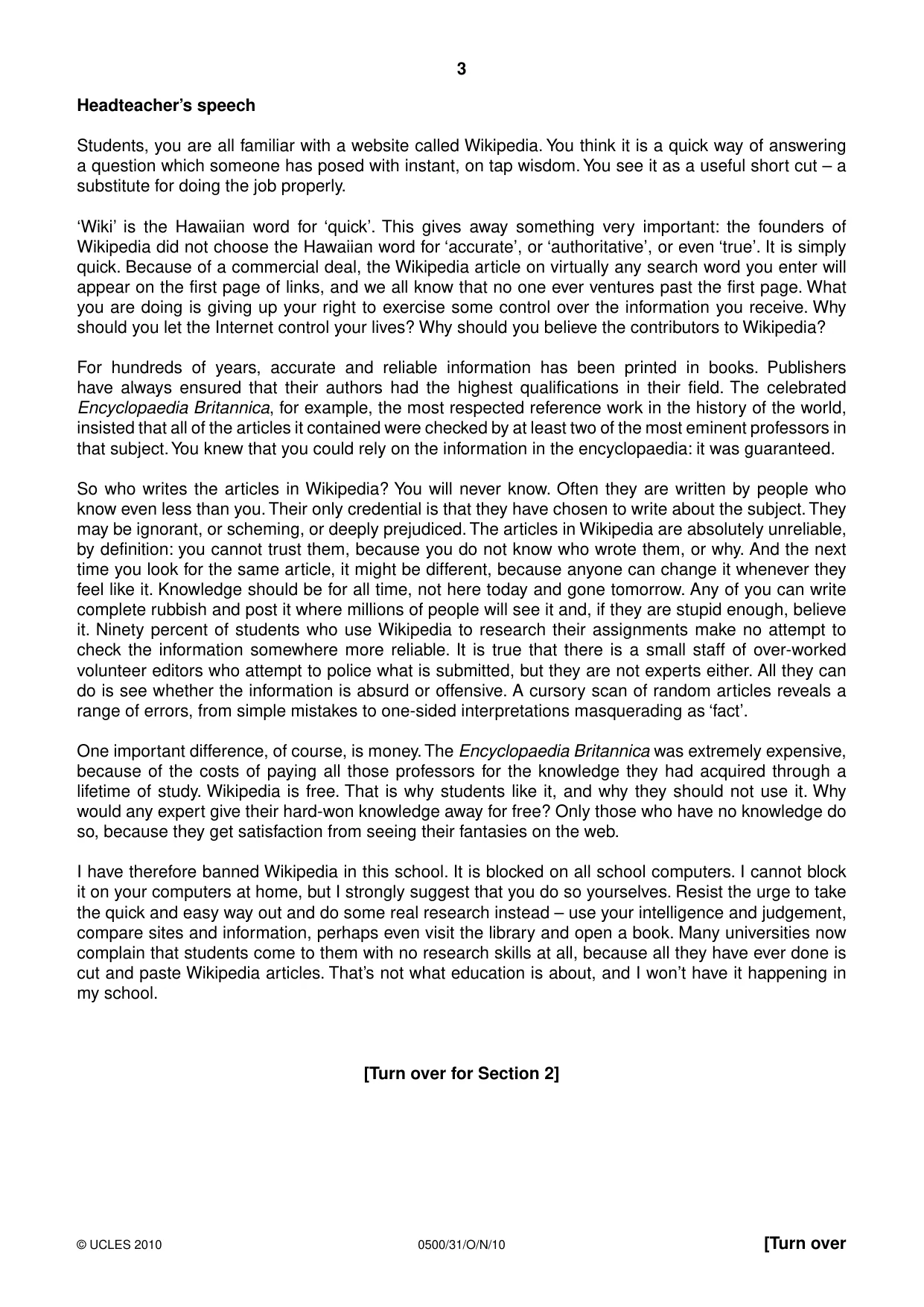
3 0500/31/O/N/10 © UCLES 2010 [Turn over Headteacher’s speech Students, you are all familiar with a website called Wikipedia. You think it is a quick way of answering a question which someone has posed with instant, on tap wisdom. You see it as a useful short cut – a substitute for doing the job properly. ‘Wiki’ is the Hawaiian word for ‘quick’. This gives away something very important: the founders of Wikipedia did not choose the Hawaiian word for ‘accurate’, or ‘authoritative’, or even ‘true’. It is simply quick. Because of a commercial deal, the Wikipedia article on virtually any search word you enter will appear on the first page of links, and we all know that no one ever ventures past the first page. What you are doing is giving up your right to exercise some control over the information you receive. Why should you let the Internet control your lives? Why should you believe the contributors to Wikipedia? For hundreds of years, accurate and reliable information has been printed in books. Publishers have always ensured that their authors had the highest qualifications in their field. The celebrated Encyclopaedia Britannica, for example, the most respected reference work in the history of the world, insisted that all of the articles it contained were checked by at least two of the most eminent professors in that subject. You knew that you could rely on the information in the encyclopaedia: it was guaranteed. So who writes the articles in Wikipedia? You will never know. Often they are written by people who know even less than you. Their only credential is that they have chosen to write about the subject. They may be ignorant, or scheming, or deeply prejudiced. The articles in Wikipedia are absolutely unreliable, by definition: you cannot trust them, because you do not know who wrote them, or why. And the next time you look for the same article, it might be different, because anyone can change it whenever they feel like it. Knowledge should be for all time, not here today and gone tomorrow. Any of you can write complete rubbish and post it where millions of people will see it and, if they are stupid enough, believe it. Ninety percent of students who use Wikipedia to research their assignments make no attempt to check the information somewhere more reliable. It is true that there is a small staff of over-worked volunteer editors who attempt to police what is submitted, but they are not experts either. All they can do is see whether the information is absurd or offensive. A cursory scan of random articles reveals a range of errors, from simple mistakes to one-sided interpretations masquerading as ‘fact’. One important difference, of course, is money. The Encyclopaedia Britannica was extremely expensive, because of the costs of paying all those professors for the knowledge they had acquired through a lifetime of study. Wikipedia is free. That is why students like it, and why they should not use it. Why would any expert give their hard-won knowledge away for free? Only those who have no knowledge do so, because they get satisfaction from seeing their fantasies on the web. I have therefore banned Wikipedia in this school. It is blocked on all school computers. I cannot block it on your computers at home, but I strongly suggest that you do so yourselves. Resist the urge to take the quick and easy way out and do some real research instead – use your intelligence and judgement, compare sites and information, perhaps even visit the library and open a book. Many universities now complain that students come to them with no research skills at all, because all they have ever done is cut and paste Wikipedia articles. That’s not what education is about, and I won’t have it happening in my school. [Turn over for Section 2]
Question paper, page 4
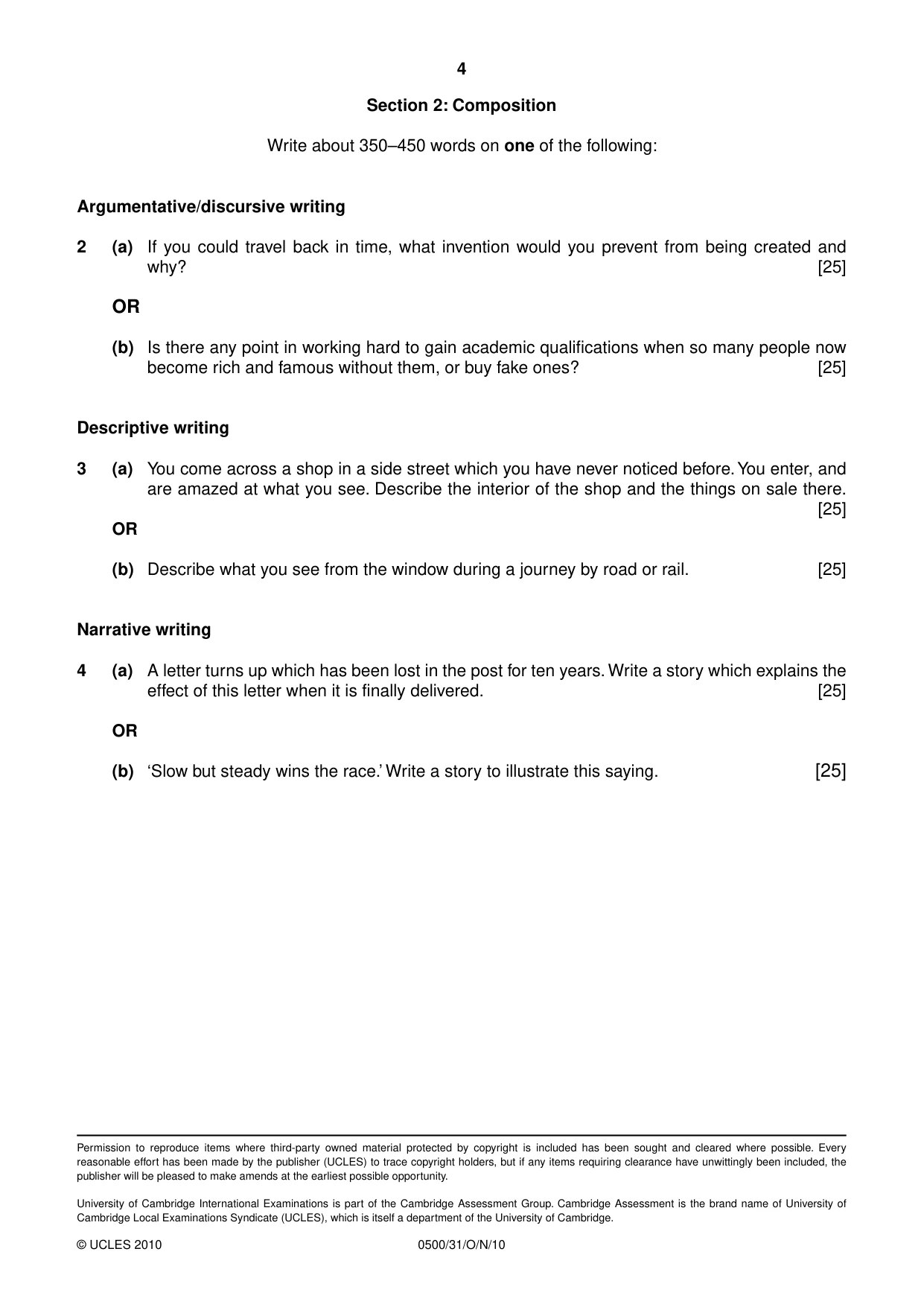
4 0500/31/O/N/10 © UCLES 2010 Section 2: Composition Write about 350–450 words on one of the following: Argumentative/discursive writing 2 (a) If you could travel back in time, what invention would you prevent from being created and why? [25] OR (b) Is there any point in working hard to gain academic qualifications when so many people now become rich and famous without them, or buy fake ones? [25] Descriptive writing 3 (a) You come across a shop in a side street which you have never noticed before. You enter, and are amazed at what you see. Describe the interior of the shop and the things on sale there. [25] OR (b) Describe what you see from the window during a journey by road or rail. [25] Narrative writing 4 (a) A letter turns up which has been lost in the post for ten years. Write a story which explains the effect of this letter when it is finally delivered. [25] OR (b) ‘Slow but steady wins the race.’ Write a story to illustrate this saying. [25] Permission to reproduce items where third-party owned material protected by copyright is included has been sought and cleared where possible. Every reasonable effort has been made by the publisher (UCLES) to trace copyright holders, but if any items requiring clearance have unwittingly been included, the publisher will be pleased to make amends at the earliest possible opportunity. University of Cambridge International Examinations is part of the Cambridge Assessment Group. Cambridge Assessment is the brand name of University of Cambridge Local Examinations Syndicate (UCLES), which is itself a department of the University of Cambridge.
Mark scheme, page 1
UNIVERSITY OF CAMBRIDGE INTERNATIONAL EXAMINATIONS International General Certificate of Secondary Education MARK SCHEME for the October/November 2010 question paper for the guidance of teachers 0500 FIRST LANGUAGE ENGLISH 0500/31 Paper 3 (Directed Writing and Composition), maximum raw mark 50 This mark scheme is published as an aid to teachers and candidates, to indicate the requirements of the examination. It shows the basis on which Examiners were instructed to award marks. It does not indicate the details of the discussions that took place at an Examiners’ meeting before marking began, which would have considered the acceptability of alternative answers. Mark schemes must be read in conjunction with the question papers and the report on the examination. • CIE will not enter into discussions or correspondence in connection with these mark schemes. CIE is publishing the mark schemes for the October/November 2010 question papers for most IGCSE, GCE Advanced Level and Advanced Subsidiary Level syllabuses and some Ordinary Level syllabuses. www.XtremePapers.com
Mark scheme, page 2
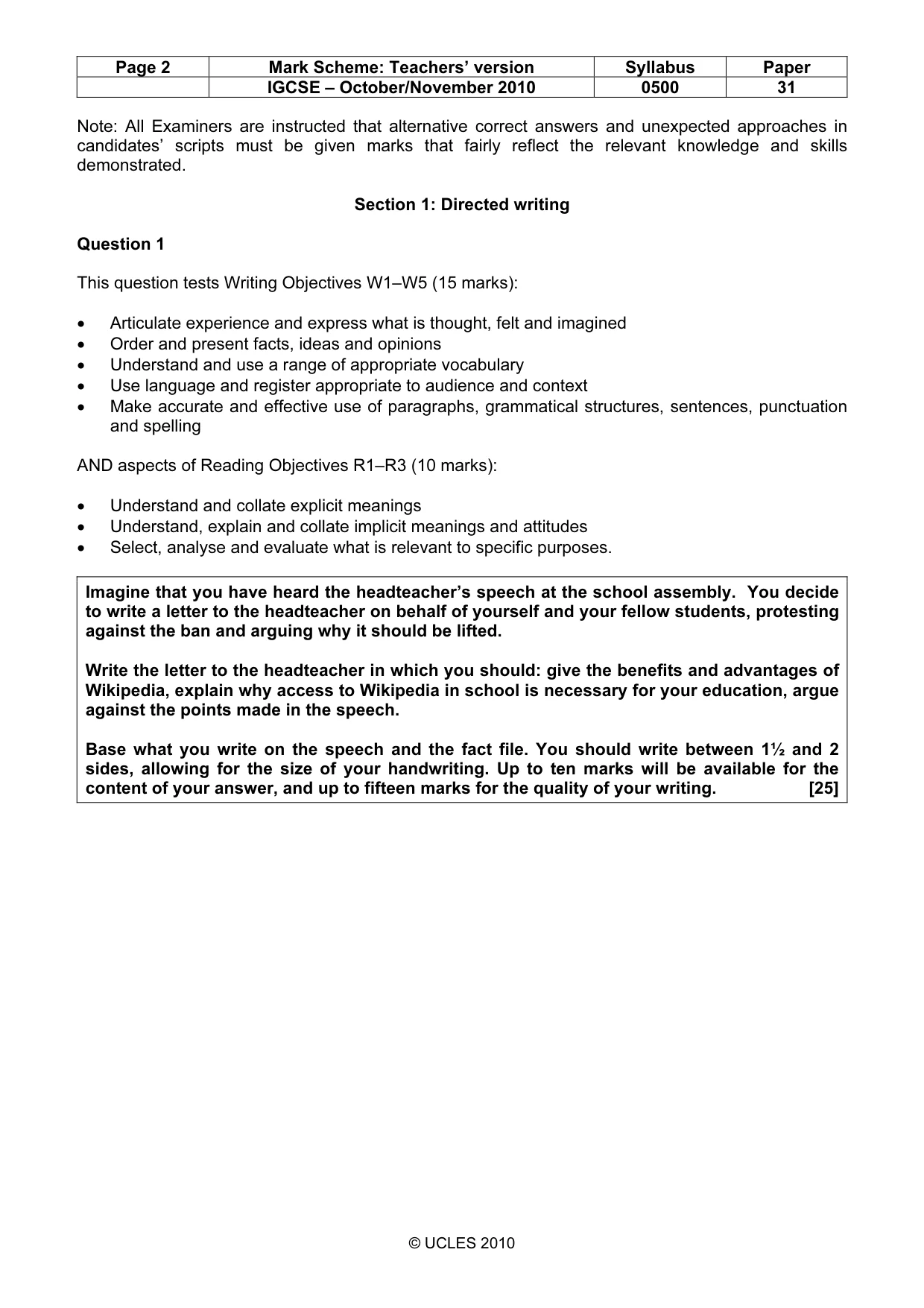
Page 2 Mark Scheme: Teachers’ version Syllabus Paper IGCSE – October/November 2010 0500 31 © UCLES 2010 Note: All Examiners are instructed that alternative correct answers and unexpected approaches in candidates’ scripts must be given marks that fairly reflect the relevant knowledge and skills demonstrated. Section 1: Directed writing Question 1 This question tests Writing Objectives W1–W5 (15 marks): • Articulate experience and express what is thought, felt and imagined • Order and present facts, ideas and opinions • Understand and use a range of appropriate vocabulary • Use language and register appropriate to audience and context • Make accurate and effective use of paragraphs, grammatical structures, sentences, punctuation and spelling AND aspects of Reading Objectives R1–R3 (10 marks): • Understand and collate explicit meanings • Understand, explain and collate implicit meanings and attitudes • Select, analyse and evaluate what is relevant to specific purposes. Imagine that you have heard the headteacher’s speech at the school assembly. You decide to write a letter to the headteacher on behalf of yourself and your fellow students, protesting against the ban and arguing why it should be lifted. Write the letter to the headteacher in which you should: give the benefits and advantages of Wikipedia, explain why access to Wikipedia in school is necessary for your education, argue against the points made in the speech. Base what you write on the speech and the fact file. You should write between 1½ and 2 sides, allowing for the size of your handwriting. Up to ten marks will be available for the content of your answer, and up to fifteen marks for the quality of your writing. [25]
Mark scheme, page 3
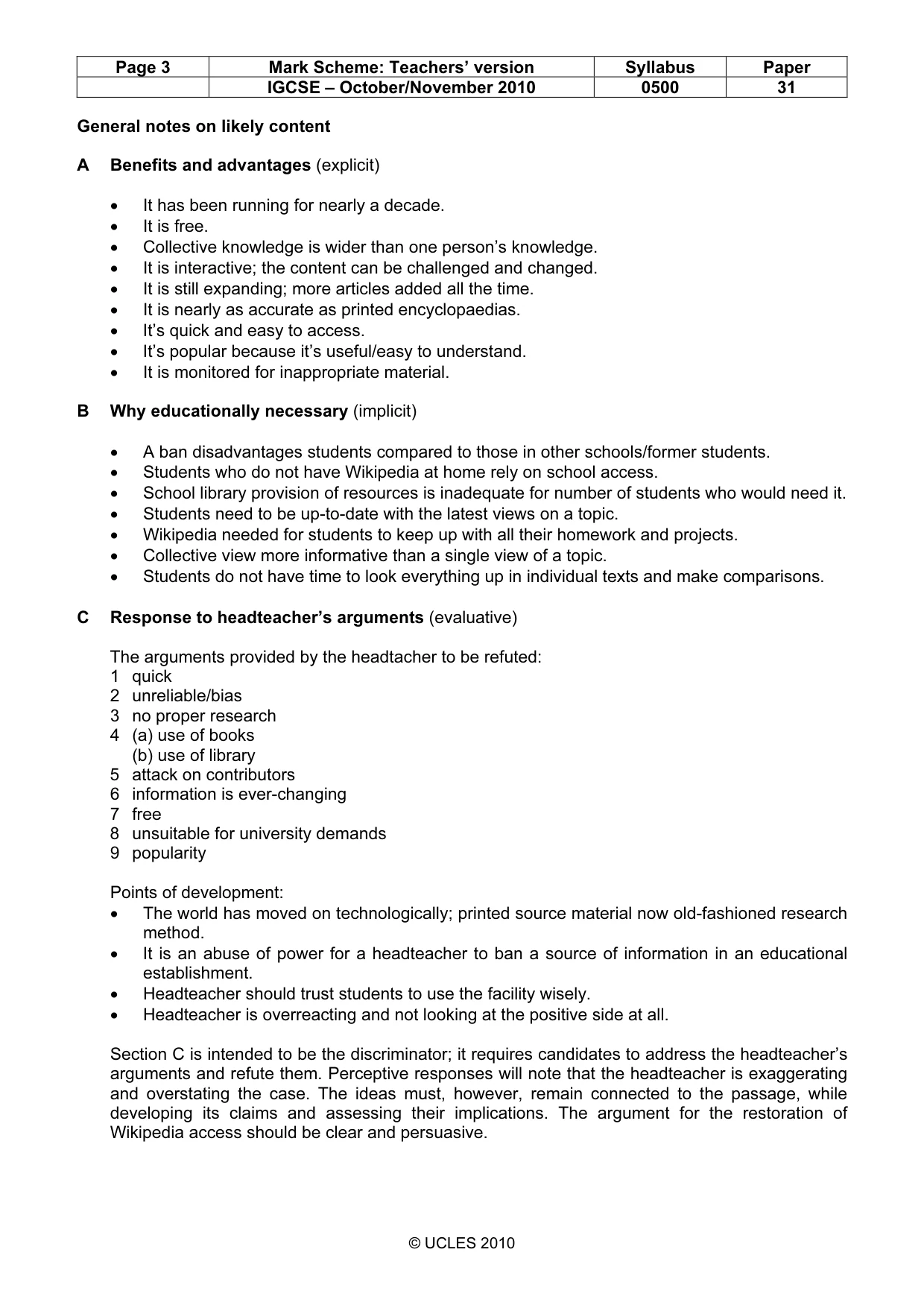
Page 3 Mark Scheme: Teachers’ version Syllabus Paper IGCSE – October/November 2010 0500 31 © UCLES 2010 General notes on likely content A Benefits and advantages (explicit) • It has been running for nearly a decade. • It is free. • Collective knowledge is wider than one person’s knowledge. • It is interactive; the content can be challenged and changed. • It is still expanding; more articles added all the time. • It is nearly as accurate as printed encyclopaedias. • It’s quick and easy to access. • It’s popular because it’s useful/easy to understand. • It is monitored for inappropriate material. B Why educationally necessary (implicit) • A ban disadvantages students compared to those in other schools/former students. • Students who do not have Wikipedia at home rely on school access. • School library provision of resources is inadequate for number of students who would need it. • Students need to be up-to-date with the latest views on a topic. • Wikipedia needed for students to keep up with all their homework and projects. • Collective view more informative than a single view of a topic. • Students do not have time to look everything up in individual texts and make comparisons. C Response to headteacher’s arguments (evaluative) The arguments provided by the headtacher to be refuted: 1 quick 2 unreliable/bias 3 no proper research 4 (a) use of books (b) use of library 5 attack on contributors 6 information is ever-changing 7 free 8 unsuitable for university demands 9 popularity Points of development: • The world has moved on technologically; printed source material now old-fashioned research method. • It is an abuse of power for a headteacher to ban a source of information in an educational establishment. • Headteacher should trust students to use the facility wisely. • Headteacher is overreacting and not looking at the positive side at all. Section C is intended to be the discriminator; it requires candidates to address the headteacher’s arguments and refute them. Perceptive responses will note that the headteacher is exaggerating and overstating the case. The ideas must, however, remain connected to the passage, while developing its claims and assessing their implications. The argument for the restoration of Wikipedia access should be clear and persuasive.
Mark scheme, page 4
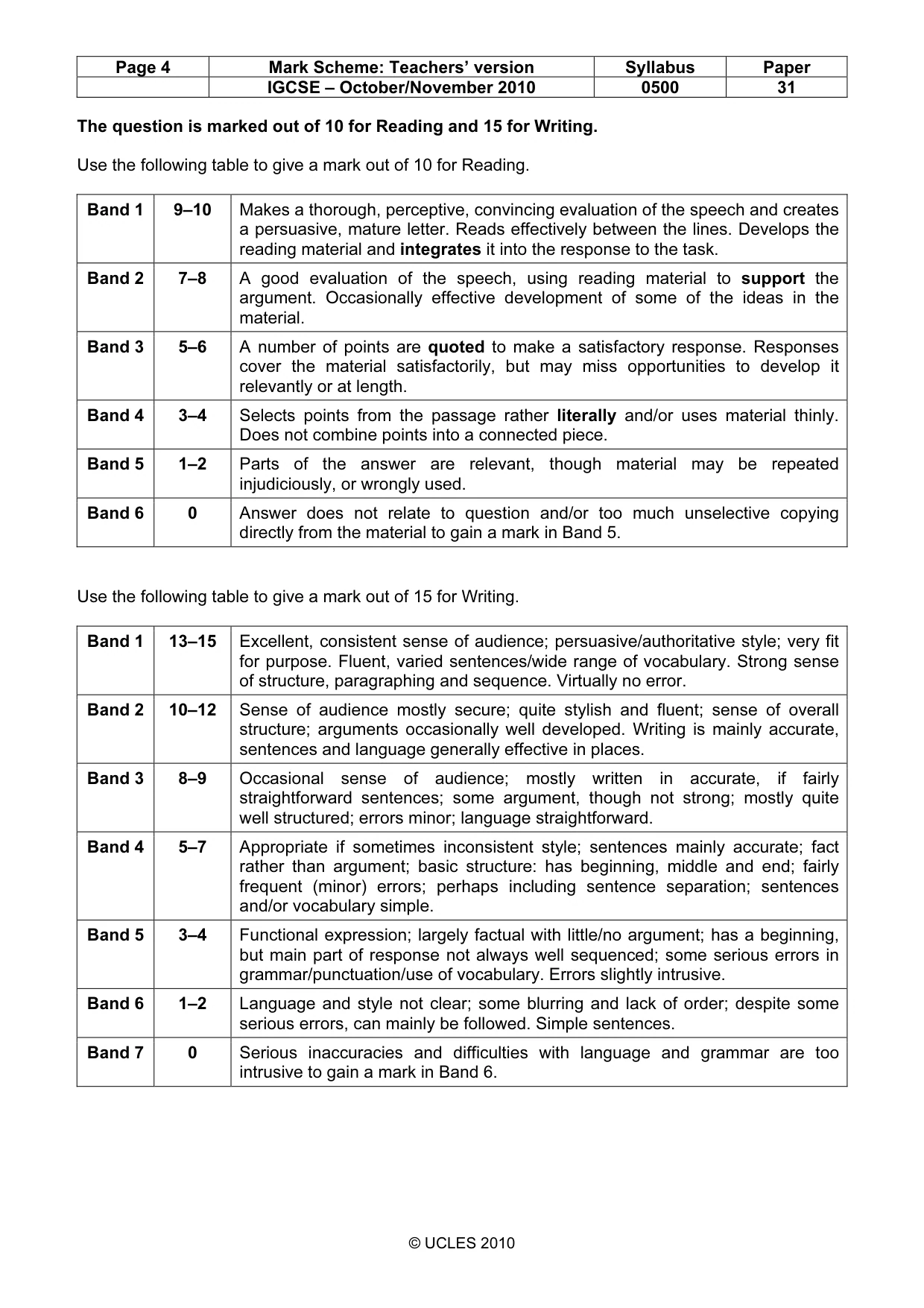
Page 4 Mark Scheme: Teachers’ version Syllabus Paper IGCSE – October/November 2010 0500 31 © UCLES 2010 The question is marked out of 10 for Reading and 15 for Writing. Use the following table to give a mark out of 10 for Reading. Band 1 9–10 Makes a thorough, perceptive, convincing evaluation of the speech and creates a persuasive, mature letter. Reads effectively between the lines. Develops the reading material and integrates it into the response to the task. Band 2 7–8 A good evaluation of the speech, using reading material to support the argument. Occasionally effective development of some of the ideas in the material. Band 3 5–6 A number of points are quoted to make a satisfactory response. Responses cover the material satisfactorily, but may miss opportunities to develop it relevantly or at length. Band 4 3–4 Selects points from the passage rather literally and/or uses material thinly. Does not combine points into a connected piece. Band 5 1–2 Parts of the answer are relevant, though material may be repeated injudiciously, or wrongly used. Band 6 0 Answer does not relate to question and/or too much unselective copying directly from the material to gain a mark in Band 5. Use the following table to give a mark out of 15 for Writing. Band 1 13–15 Excellent, consistent sense of audience; persuasive/authoritative style; very fit for purpose. Fluent, varied sentences/wide range of vocabulary. Strong sense of structure, paragraphing and sequence. Virtually no error. Band 2 10–12 Sense of audience mostly secure; quite stylish and fluent; sense of overall structure; arguments occasionally well developed. Writing is mainly accurate, sentences and language generally effective in places. Band 3 8–9 Occasional sense of audience; mostly written in accurate, if fairly straightforward sentences; some argument, though not strong; mostly quite well structured; errors minor; language straightforward. Band 4 5–7 Appropriate if sometimes inconsistent style; sentences mainly accurate; fact rather than argument; basic structure: has beginning, middle and end; fairly frequent (minor) errors; perhaps including sentence separation; sentences and/or vocabulary simple. Band 5 3–4 Functional expression; largely factual with little/no argument; has a beginning, but main part of response not always well sequenced; some serious errors in grammar/punctuation/use of vocabulary. Errors slightly intrusive. Band 6 1–2 Language and style not clear; some blurring and lack of order; despite some serious errors, can mainly be followed. Simple sentences. Band 7 0 Serious inaccuracies and difficulties with language and grammar are too intrusive to gain a mark in Band 6.
Mark scheme, page 5
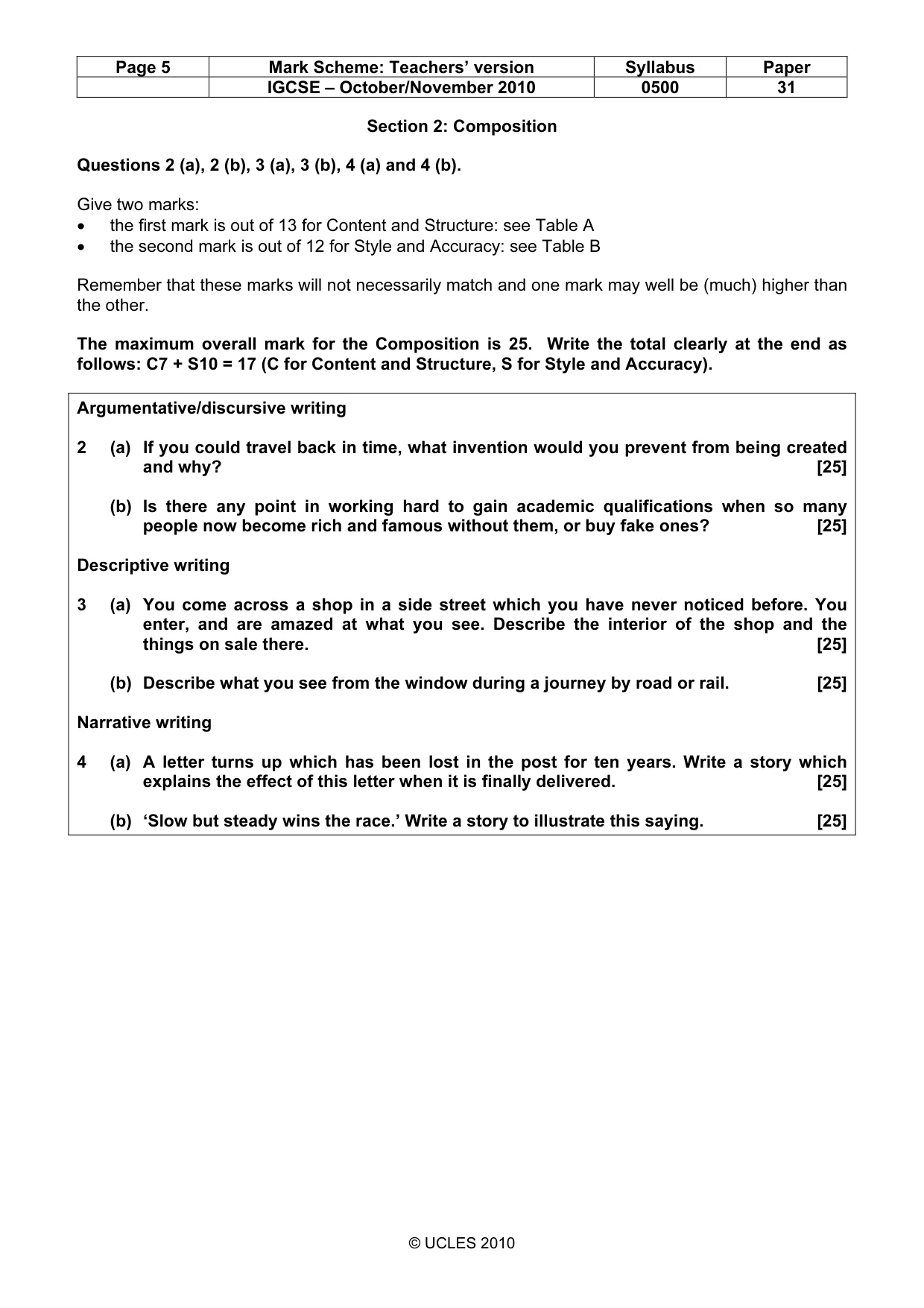
Page 5 Mark Scheme: Teachers’ version Syllabus Paper IGCSE – October/November 2010 0500 31 © UCLES 2010 Section 2: Composition Questions 2 (a), 2 (b), 3 (a), 3 (b), 4 (a) and 4 (b). Give two marks: • the first mark is out of 13 for Content and Structure: see Table A • the second mark is out of 12 for Style and Accuracy: see Table B Remember that these marks will not necessarily match and one mark may well be (much) higher than the other. The maximum overall mark for the Composition is 25. Write the total clearly at the end as follows: C7 + S10 = 17 (C for Content and Structure, S for Style and Accuracy). Argumentative/discursive writing 2 (a) If you could travel back in time, what invention would you prevent from being created and why? [25] (b) Is there any point in working hard to gain academic qualifications when so many people now become rich and famous without them, or buy fake ones? [25] Descriptive writing 3 (a) You come across a shop in a side street which you have never noticed before. You enter, and are amazed at what you see. Describe the interior of the shop and the things on sale there. [25] (b) Describe what you see from the window during a journey by road or rail. [25] Narrative writing 4 (a) A letter turns up which has been lost in the post for ten years. Write a story which explains the effect of this letter when it is finally delivered. [25] (b) ‘Slow but steady wins the race.’ Write a story to illustrate this saying. [25]
Mark scheme, page 6
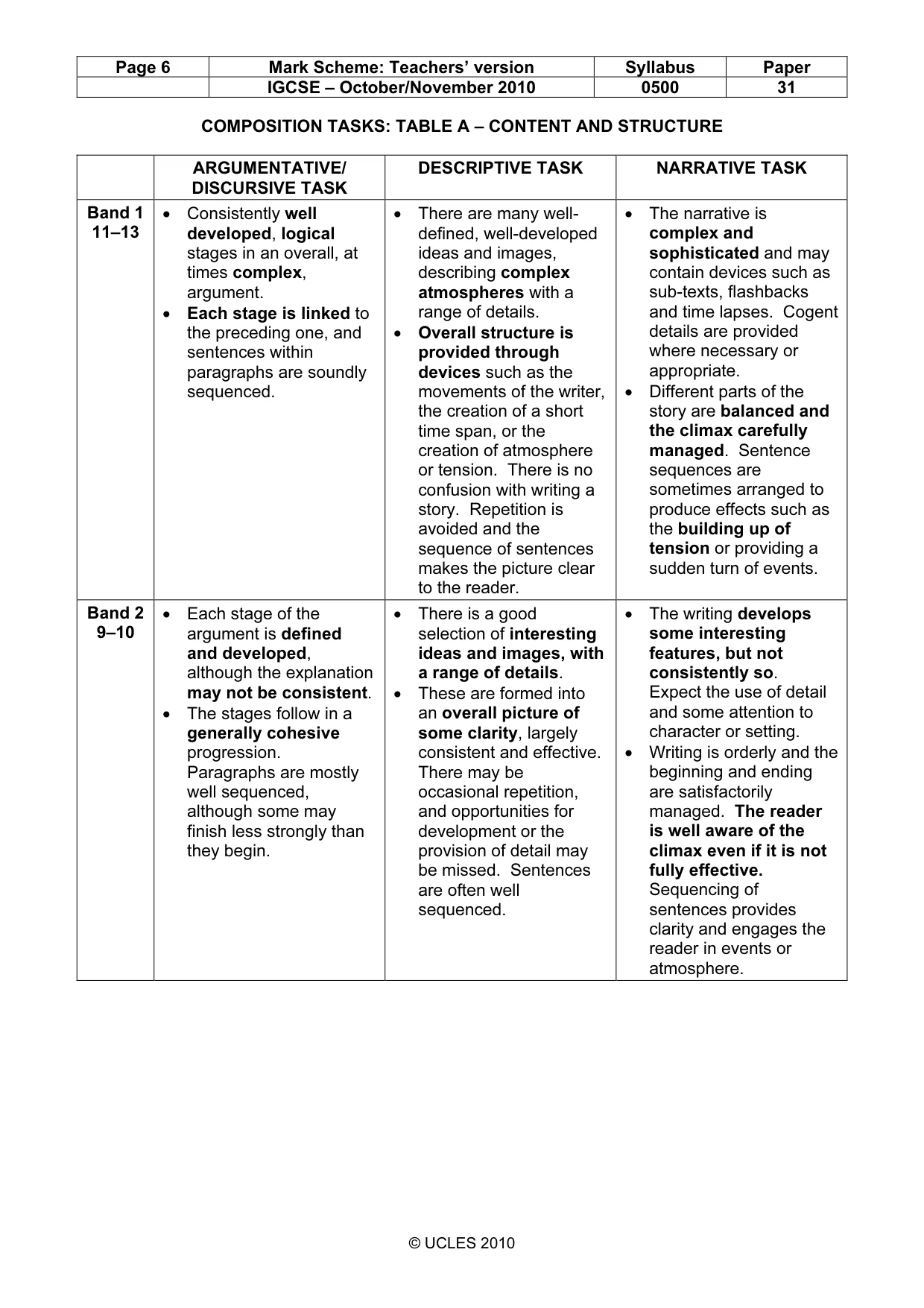
Page 6 Mark Scheme: Teachers’ version Syllabus Paper IGCSE – October/November 2010 0500 31 © UCLES 2010 COMPOSITION TASKS: TABLE A – CONTENT AND STRUCTURE ARGUMENTATIVE/ DISCURSIVE TASK DESCRIPTIVE TASK NARRATIVE TASK Band 1 11–13 • Consistently well developed, logical stages in an overall, at times complex, argument. • Each stage is linked to the preceding one, and sentences within paragraphs are soundly sequenced. • There are many well- defined, well-developed ideas and images, describing complex atmospheres with a range of details. • Overall structure is provided through devices such as the movements of the writer, the creation of a short time span, or the creation of atmosphere or tension. There is no confusion with writing a story. Repetition is avoided and the sequence of sentences makes the picture clear to the reader. • The narrative is complex and sophisticated and may contain devices such as sub-texts, flashbacks and time lapses. Cogent details are provided where necessary or appropriate. • Different parts of the story are balanced and the climax carefully managed. Sentence sequences are sometimes arranged to produce effects such as the building up of tension or providing a sudden turn of events. Band 2 9–10 • Each stage of the argument is defined and developed, although the explanation may not be consistent. • The stages follow in a generally cohesive progression. Paragraphs are mostly well sequenced, although some may finish less strongly than they begin. • There is a good selection of interesting ideas and images, with a range of details. • These are formed into an overall picture of some clarity, largely consistent and effective. There may be occasional repetition, and opportunities for development or the provision of detail may be missed. Sentences are often well sequenced. • The writing develops some interesting features, but not consistently so. Expect the use of detail and some attention to character or setting. • Writing is orderly and the beginning and ending are satisfactorily managed. The reader is well aware of the climax even if it is not fully effective. Sequencing of sentences provides clarity and engages the reader in events or atmosphere.
Mark scheme, page 7
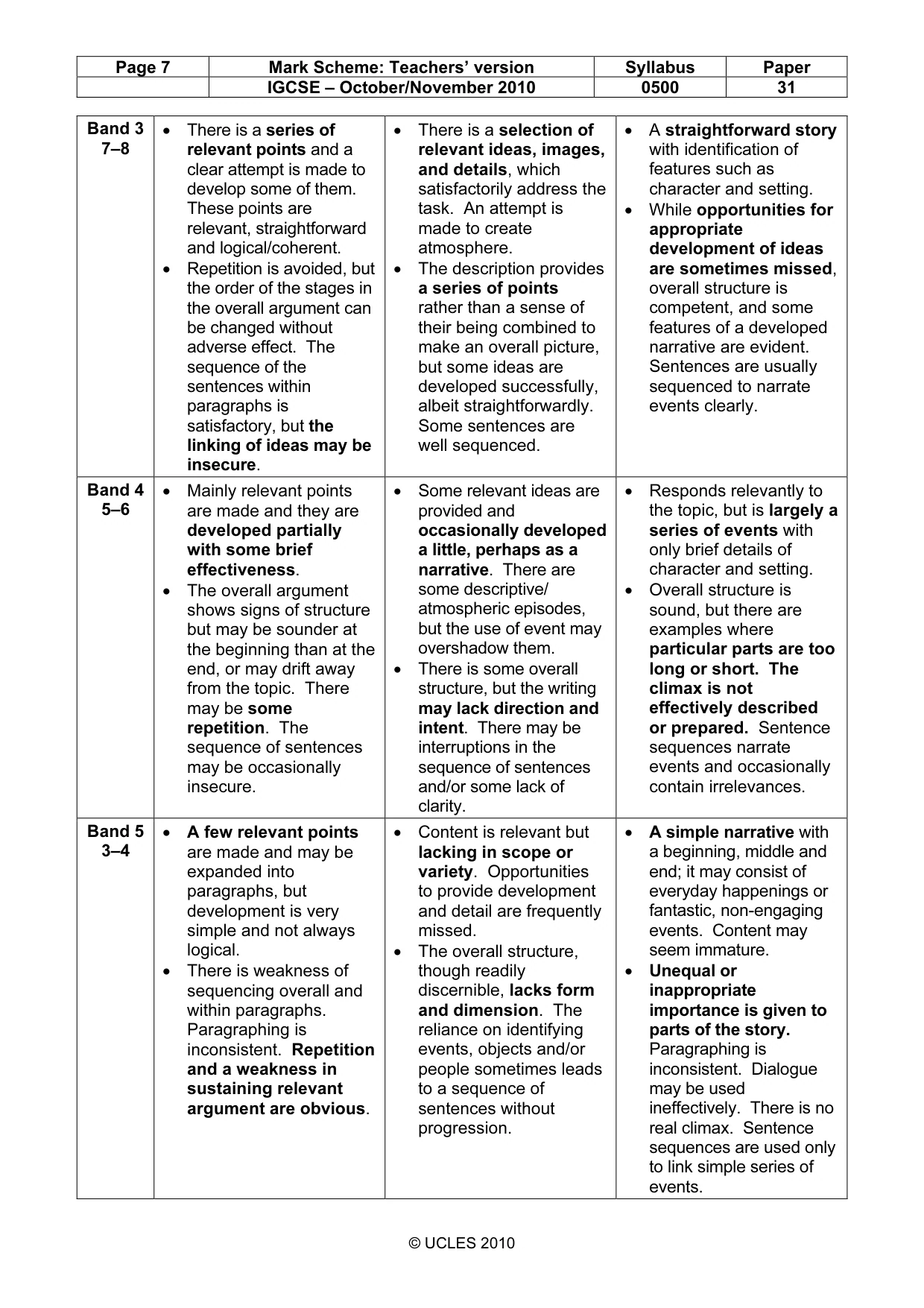
Page 7 Mark Scheme: Teachers’ version Syllabus Paper IGCSE – October/November 2010 0500 31 © UCLES 2010 Band 3 7–8 • There is a series of relevant points and a clear attempt is made to develop some of them. These points are relevant, straightforward and logical/coherent. • Repetition is avoided, but the order of the stages in the overall argument can be changed without adverse effect. The sequence of the sentences within paragraphs is satisfactory, but the linking of ideas may be insecure. • There is a selection of relevant ideas, images, and details, which satisfactorily address the task. An attempt is made to create atmosphere. • The description provides a series of points rather than a sense of their being combined to make an overall picture, but some ideas are developed successfully, albeit straightforwardly. Some sentences are well sequenced. • A straightforward story with identification of features such as character and setting. • While opportunities for appropriate development of ideas are sometimes missed, overall structure is competent, and some features of a developed narrative are evident. Sentences are usually sequenced to narrate events clearly. Band 4 5–6 • Mainly relevant points are made and they are developed partially with some brief effectiveness. • The overall argument shows signs of structure but may be sounder at the beginning than at the end, or may drift away from the topic. There may be some repetition. The sequence of sentences may be occasionally insecure. • Some relevant ideas are provided and occasionally developed a little, perhaps as a narrative. There are some descriptive/ atmospheric episodes, but the use of event may overshadow them. • There is some overall structure, but the writing may lack direction and intent. There may be interruptions in the sequence of sentences and/or some lack of clarity. • Responds relevantly to the topic, but is largely a series of events with only brief details of character and setting. • Overall structure is sound, but there are examples where particular parts are too long or short. The climax is not effectively described or prepared. Sentence sequences narrate events and occasionally contain irrelevances. Band 5 3–4 • A few relevant points are made and may be expanded into paragraphs, but development is very simple and not always logical. • There is weakness of sequencing overall and within paragraphs. Paragraphing is inconsistent. Repetition and a weakness in sustaining relevant argument are obvious. • Content is relevant but lacking in scope or variety. Opportunities to provide development and detail are frequently missed. • The overall structure, though readily discernible, lacks form and dimension. The reliance on identifying events, objects and/or people sometimes leads to a sequence of sentences without progression. • A simple narrative with a beginning, middle and end; it may consist of everyday happenings or fantastic, non-engaging events. Content may seem immature. • Unequal or inappropriate importance is given to parts of the story. Paragraphing is inconsistent. Dialogue may be used ineffectively. There is no real climax. Sentence sequences are used only to link simple series of events.
Mark scheme, page 8
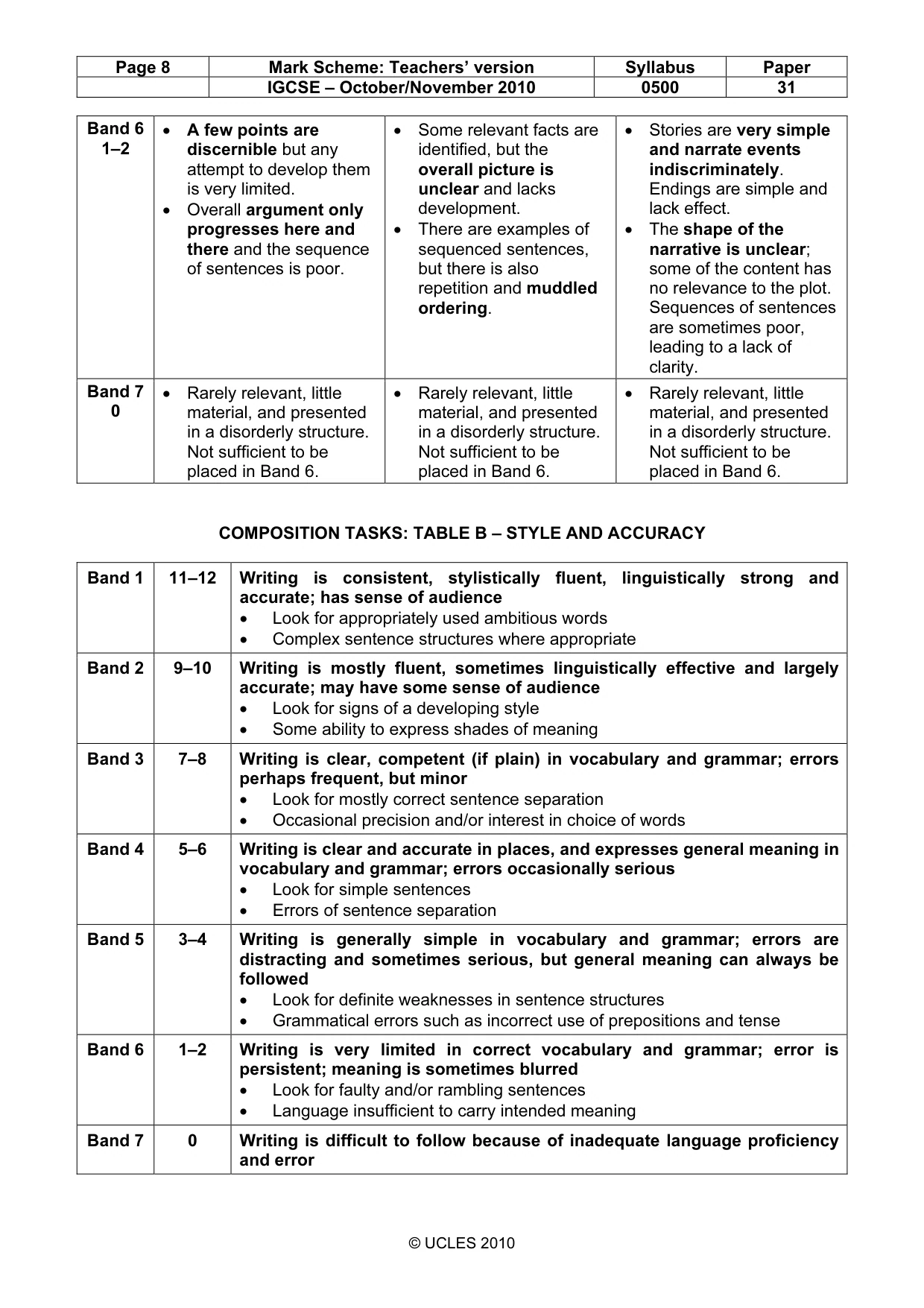
Page 8 Mark Scheme: Teachers’ version Syllabus Paper IGCSE – October/November 2010 0500 31 © UCLES 2010 Band 6 1–2 • A few points are discernible but any attempt to develop them is very limited. • Overall argument only progresses here and there and the sequence of sentences is poor. • Some relevant facts are identified, but the overall picture is unclear and lacks development. • There are examples of sequenced sentences, but there is also repetition and muddled ordering. • Stories are very simple and narrate events indiscriminately. Endings are simple and lack effect. • The shape of the narrative is unclear; some of the content has no relevance to the plot. Sequences of sentences are sometimes poor, leading to a lack of clarity. Band 7 0 • Rarely relevant, little material, and presented in a disorderly structure. Not sufficient to be placed in Band 6. • Rarely relevant, little material, and presented in a disorderly structure. Not sufficient to be placed in Band 6. • Rarely relevant, little material, and presented in a disorderly structure. Not sufficient to be placed in Band 6. COMPOSITION TASKS: TABLE B – STYLE AND ACCURACY Band 1 11–12 Writing is consistent, stylistically fluent, linguistically strong and accurate; has sense of audience • Look for appropriately used ambitious words • Complex sentence structures where appropriate Band 2 9–10 Writing is mostly fluent, sometimes linguistically effective and largely accurate; may have some sense of audience • Look for signs of a developing style • Some ability to express shades of meaning Band 3 7–8 Writing is clear, competent (if plain) in vocabulary and grammar; errors perhaps frequent, but minor • Look for mostly correct sentence separation • Occasional precision and/or interest in choice of words Band 4 5–6 Writing is clear and accurate in places, and expresses general meaning in vocabulary and grammar; errors occasionally serious • Look for simple sentences • Errors of sentence separation Band 5 3–4 Writing is generally simple in vocabulary and grammar; errors are distracting and sometimes serious, but general meaning can always be followed • Look for definite weaknesses in sentence structures • Grammatical errors such as incorrect use of prepositions and tense Band 6 1–2 Writing is very limited in correct vocabulary and grammar; error is persistent; meaning is sometimes blurred • Look for faulty and/or rambling sentences • Language insufficient to carry intended meaning Band 7 0 Writing is difficult to follow because of inadequate language proficiency and error
What you needed in this session
Cambridge’s own grade thresholds for 2010 Oct/Nov, Paper 3 · Variant 1. A higher threshold means an easier paper — the bar moves with how the cohort did.