Cambridge IGCSE English - First Language 0500 — 2010 May/June Paper 3 · Variant 3
0500/33/M/J/10 · 50 marks · ≈56 min
The question paper and its mark scheme, free to read here and free to download. This is Cambridge’s own paper, exactly as it was sat.
Question paper4 pages
Mark scheme9 pages
Answers below. Sit the paper first if you are practising.
Paper as text
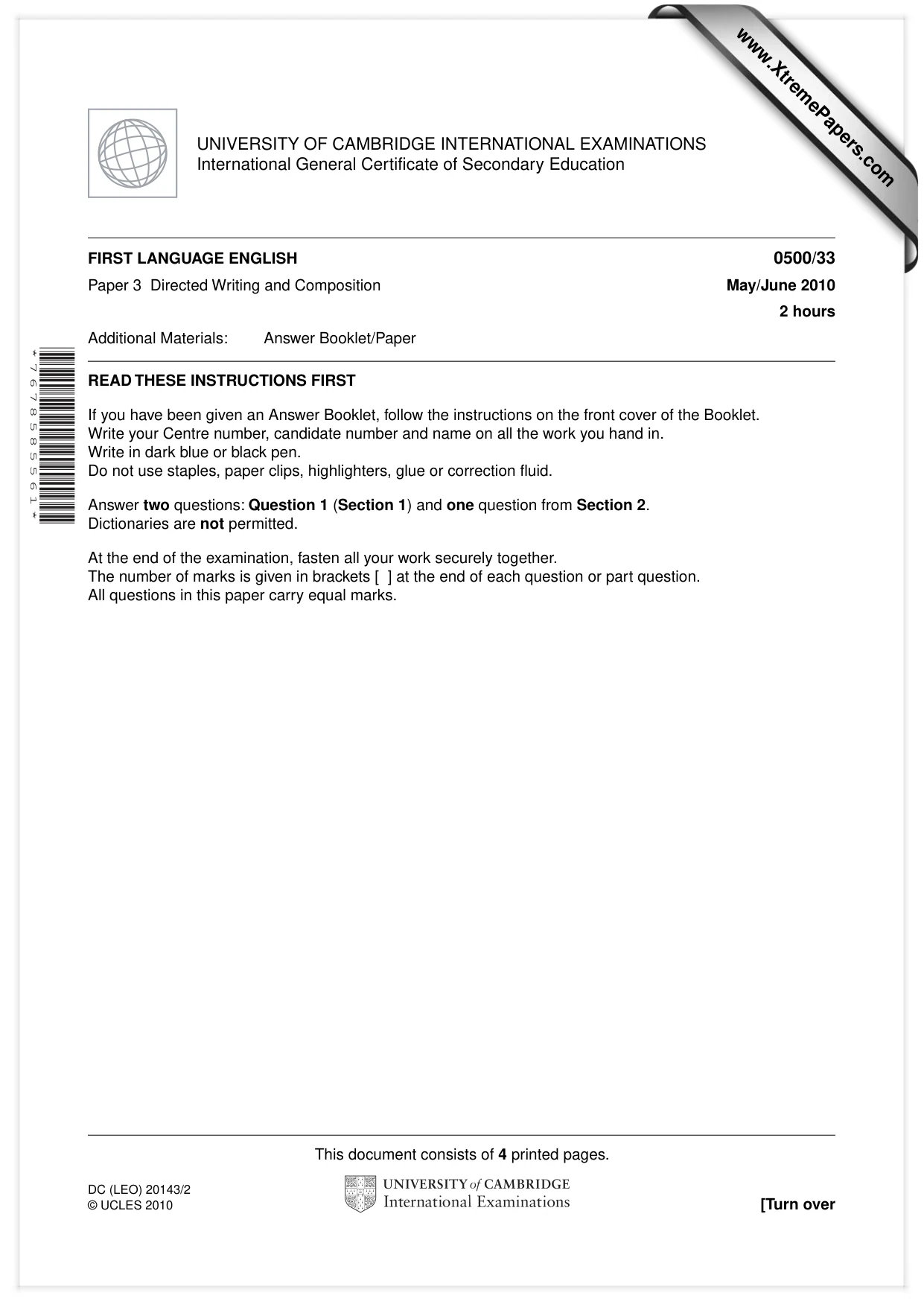
Question paper, page 1
This document consists of 4 printed pages. DC (LEO) 20143/2 © UCLES 2010 [Turn over UNIVERSITY OF CAMBRIDGE INTERNATIONAL EXAMINATIONS International General Certificate of Secondary Education * 7 6 7 8 5 8 5 5 6 1 * FIRST LANGUAGE ENGLISH 0500/33 Paper 3 Directed Writing and Composition May/June 2010 2 hours Additional Materials: Answer Booklet/Paper READ THESE INSTRUCTIONS FIRST If you have been given an Answer Booklet, follow the instructions on the front cover of the Booklet. Write your Centre number, candidate number and name on all the work you hand in. Write in dark blue or black pen. Do not use staples, paper clips, highlighters, glue or correction fluid. Answer two questions: Question 1 (Section 1) and one question from Section 2. Dictionaries are not permitted. At the end of the examination, fasten all your work securely together. The number of marks is given in brackets [ ] at the end of each question or part question. All questions in this paper carry equal marks. www.XtremePapers.com
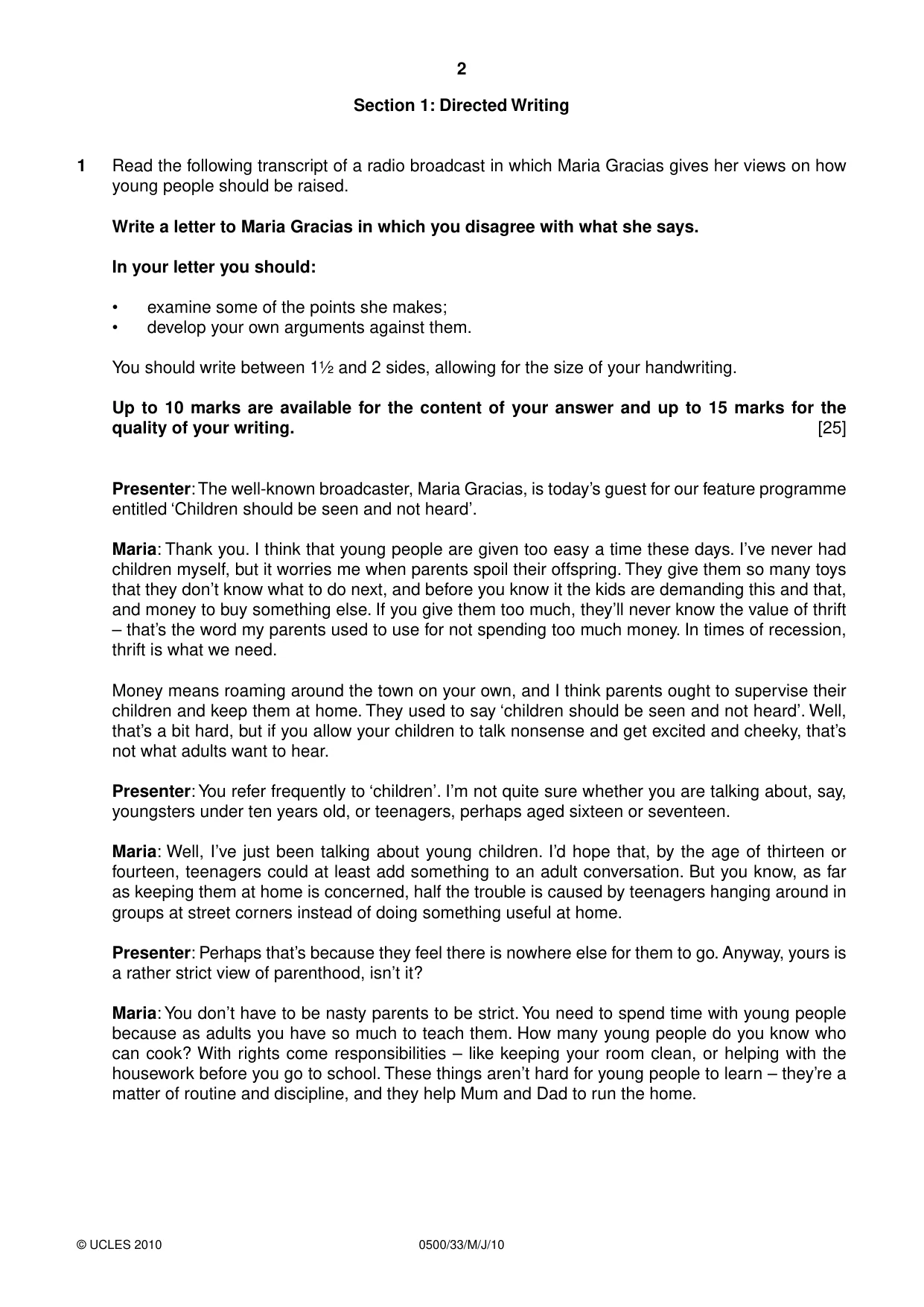
Question paper, page 2
2 0500/33/M/J/10 © UCLES 2010 Section 1: Directed Writing 1 Read the following transcript of a radio broadcast in which Maria Gracias gives her views on how young people should be raised. Write a letter to Maria Gracias in which you disagree with what she says. In your letter you should: • examine some of the points she makes; • develop your own arguments against them. You should write between 1½ and 2 sides, allowing for the size of your handwriting. Up to 10 marks are available for the content of your answer and up to 15 marks for the quality of your writing. [25] Presenter: The well-known broadcaster, Maria Gracias, is today’s guest for our feature programme entitled ‘Children should be seen and not heard’. Maria: Thank you. I think that young people are given too easy a time these days. I’ve never had children myself, but it worries me when parents spoil their offspring. They give them so many toys that they don’t know what to do next, and before you know it the kids are demanding this and that, and money to buy something else. If you give them too much, they’ll never know the value of thrift – that’s the word my parents used to use for not spending too much money. In times of recession, thrift is what we need. Money means roaming around the town on your own, and I think parents ought to supervise their children and keep them at home. They used to say ‘children should be seen and not heard’. Well, that’s a bit hard, but if you allow your children to talk nonsense and get excited and cheeky, that’s not what adults want to hear. Presenter: You refer frequently to ‘children’. I’m not quite sure whether you are talking about, say, youngsters under ten years old, or teenagers, perhaps aged sixteen or seventeen. Maria: Well, I’ve just been talking about young children. I’d hope that, by the age of thirteen or fourteen, teenagers could at least add something to an adult conversation. But you know, as far as keeping them at home is concerned, half the trouble is caused by teenagers hanging around in groups at street corners instead of doing something useful at home. Presenter: Perhaps that’s because they feel there is nowhere else for them to go. Anyway, yours is a rather strict view of parenthood, isn’t it? Maria: You don’t have to be nasty parents to be strict. You need to spend time with young people because as adults you have so much to teach them. How many young people do you know who can cook? With rights come responsibilities – like keeping your room clean, or helping with the housework before you go to school. These things aren’t hard for young people to learn – they’re a matter of routine and discipline, and they help Mum and Dad to run the home.
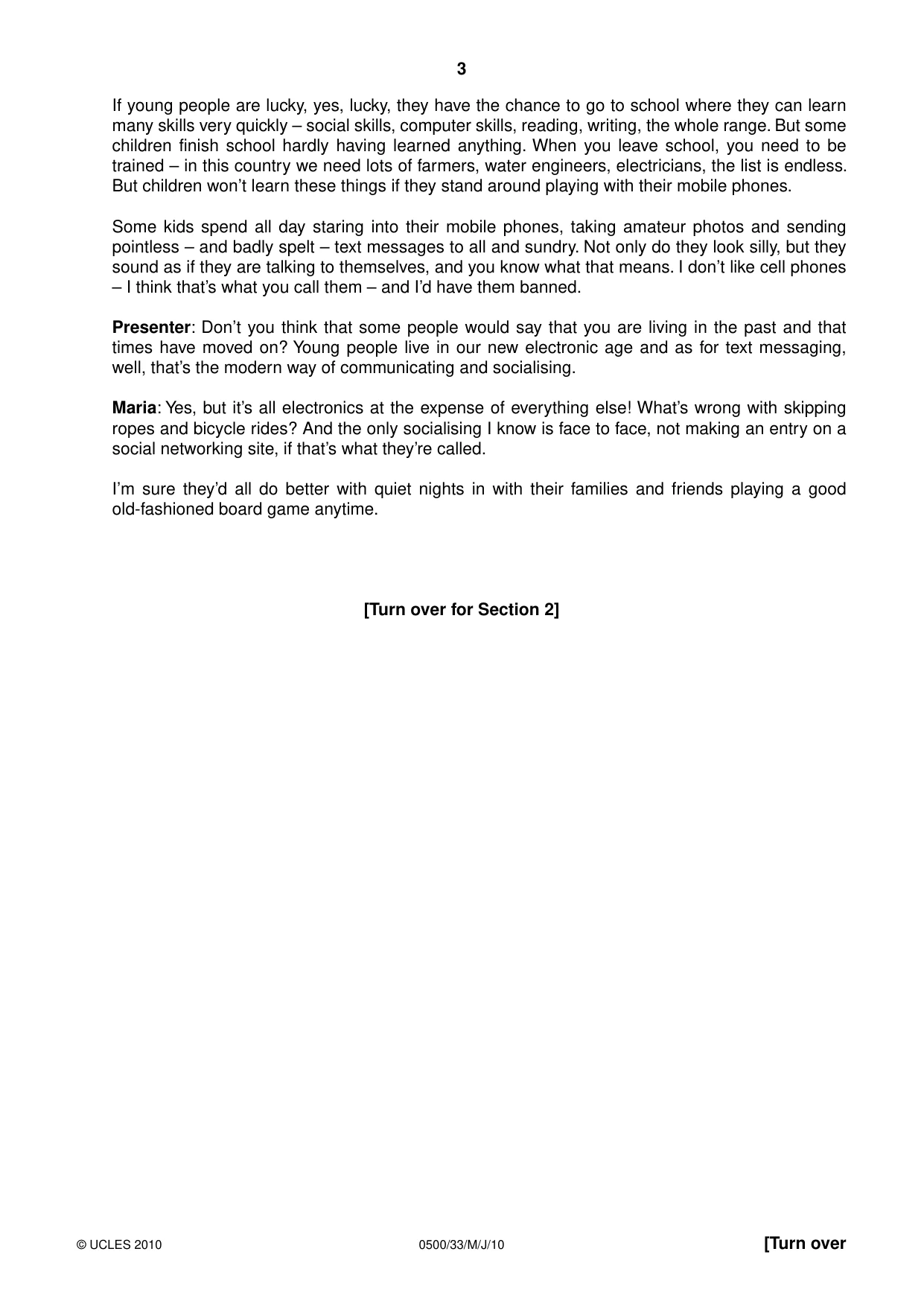
Question paper, page 3
3 0500/33/M/J/10 © UCLES 2010 [Turn over If young people are lucky, yes, lucky, they have the chance to go to school where they can learn many skills very quickly – social skills, computer skills, reading, writing, the whole range. But some children finish school hardly having learned anything. When you leave school, you need to be trained – in this country we need lots of farmers, water engineers, electricians, the list is endless. But children won’t learn these things if they stand around playing with their mobile phones. Some kids spend all day staring into their mobile phones, taking amateur photos and sending pointless – and badly spelt – text messages to all and sundry. Not only do they look silly, but they sound as if they are talking to themselves, and you know what that means. I don’t like cell phones – I think that’s what you call them – and I’d have them banned. Presenter: Don’t you think that some people would say that you are living in the past and that times have moved on? Young people live in our new electronic age and as for text messaging, well, that’s the modern way of communicating and socialising. Maria: Yes, but it’s all electronics at the expense of everything else! What’s wrong with skipping ropes and bicycle rides? And the only socialising I know is face to face, not making an entry on a social networking site, if that’s what they’re called. I’m sure they’d all do better with quiet nights in with their families and friends playing a good old-fashioned board game anytime. [Turn over for Section 2]
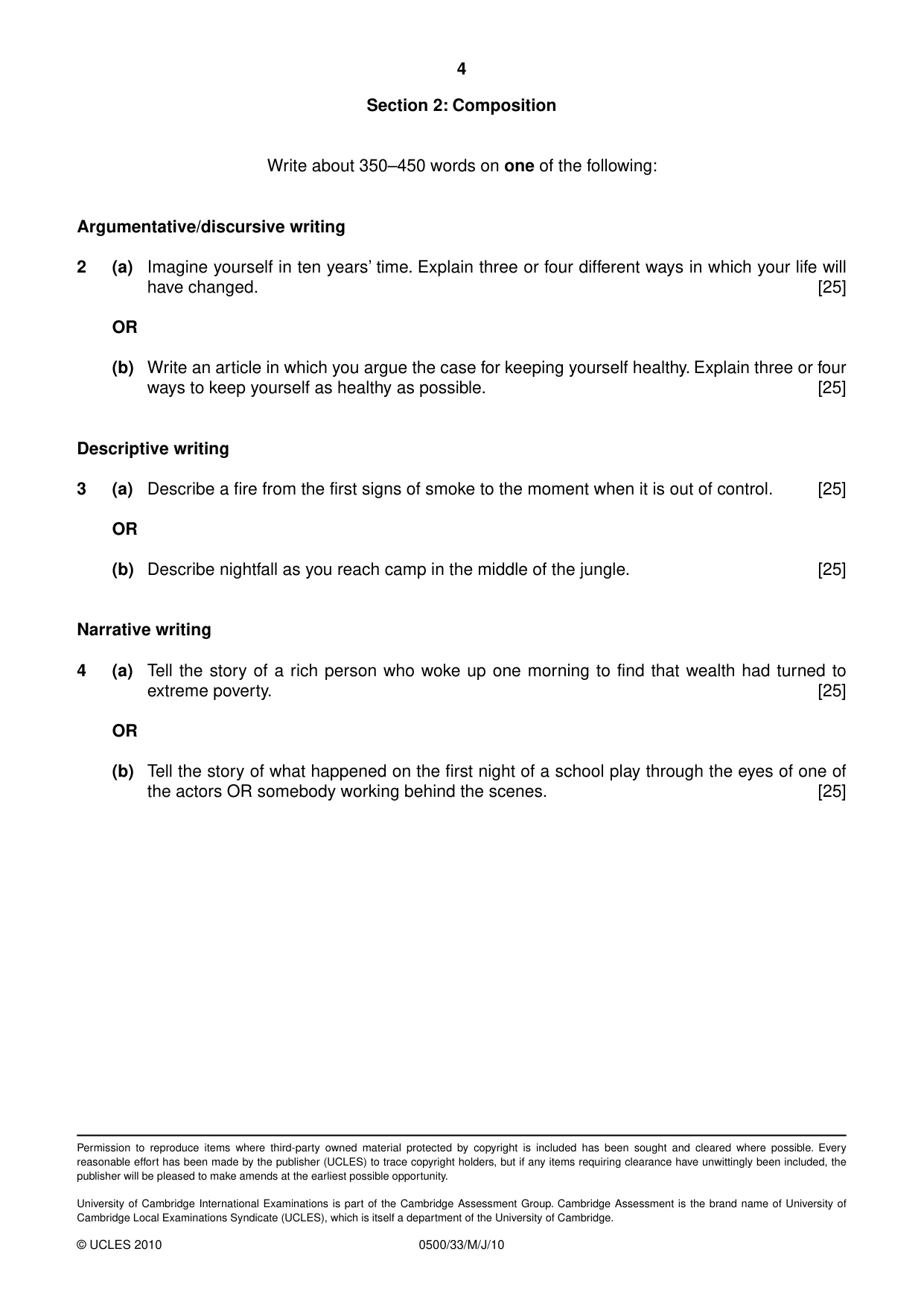
Question paper, page 4
4 0500/33/M/J/10 © UCLES 2010 Section 2: Composition Write about 350–450 words on one of the following: Argumentative/discursive writing 2 (a) Imagine yourself in ten years’ time. Explain three or four different ways in which your life will have changed. [25] OR (b) Write an article in which you argue the case for keeping yourself healthy. Explain three or four ways to keep yourself as healthy as possible. [25] Descriptive writing 3 (a) Describe a fire from the first signs of smoke to the moment when it is out of control. [25] OR (b) Describe nightfall as you reach camp in the middle of the jungle. [25] Narrative writing 4 (a) Tell the story of a rich person who woke up one morning to find that wealth had turned to extreme poverty. [25] OR (b) Tell the story of what happened on the first night of a school play through the eyes of one of the actors OR somebody working behind the scenes. [25] Permission to reproduce items where third-party owned material protected by copyright is included has been sought and cleared where possible. Every reasonable effort has been made by the publisher (UCLES) to trace copyright holders, but if any items requiring clearance have unwittingly been included, the publisher will be pleased to make amends at the earliest possible opportunity. University of Cambridge International Examinations is part of the Cambridge Assessment Group. Cambridge Assessment is the brand name of University of Cambridge Local Examinations Syndicate (UCLES), which is itself a department of the University of Cambridge.
Mark scheme, page 1
UNIVERSITY OF CAMBRIDGE INTERNATIONAL EXAMINATIONS International General Certificate of Secondary Education MARK SCHEME for the May/June 2010 question paper for the guidance of teachers 0500 FIRST LANGUAGE ENGLISH 0500/33 Paper 33 (Directed Writing and Composition), maximum raw mark 50 This mark scheme is published as an aid to teachers and candidates, to indicate the requirements of the examination. It shows the basis on which Examiners were instructed to award marks. It does not indicate the details of the discussions that took place at an Examiners’ meeting before marking began, which would have considered the acceptability of alternative answers. Mark schemes must be read in conjunction with the question papers and the report on the examination. • CIE will not enter into discussions or correspondence in connection with these mark schemes. CIE is publishing the mark schemes for the May/June 2010 question papers for most IGCSE, GCE Advanced Level and Advanced Subsidiary Level syllabuses and some Ordinary Level syllabuses. www.XtremePapers.com
Mark scheme, page 2
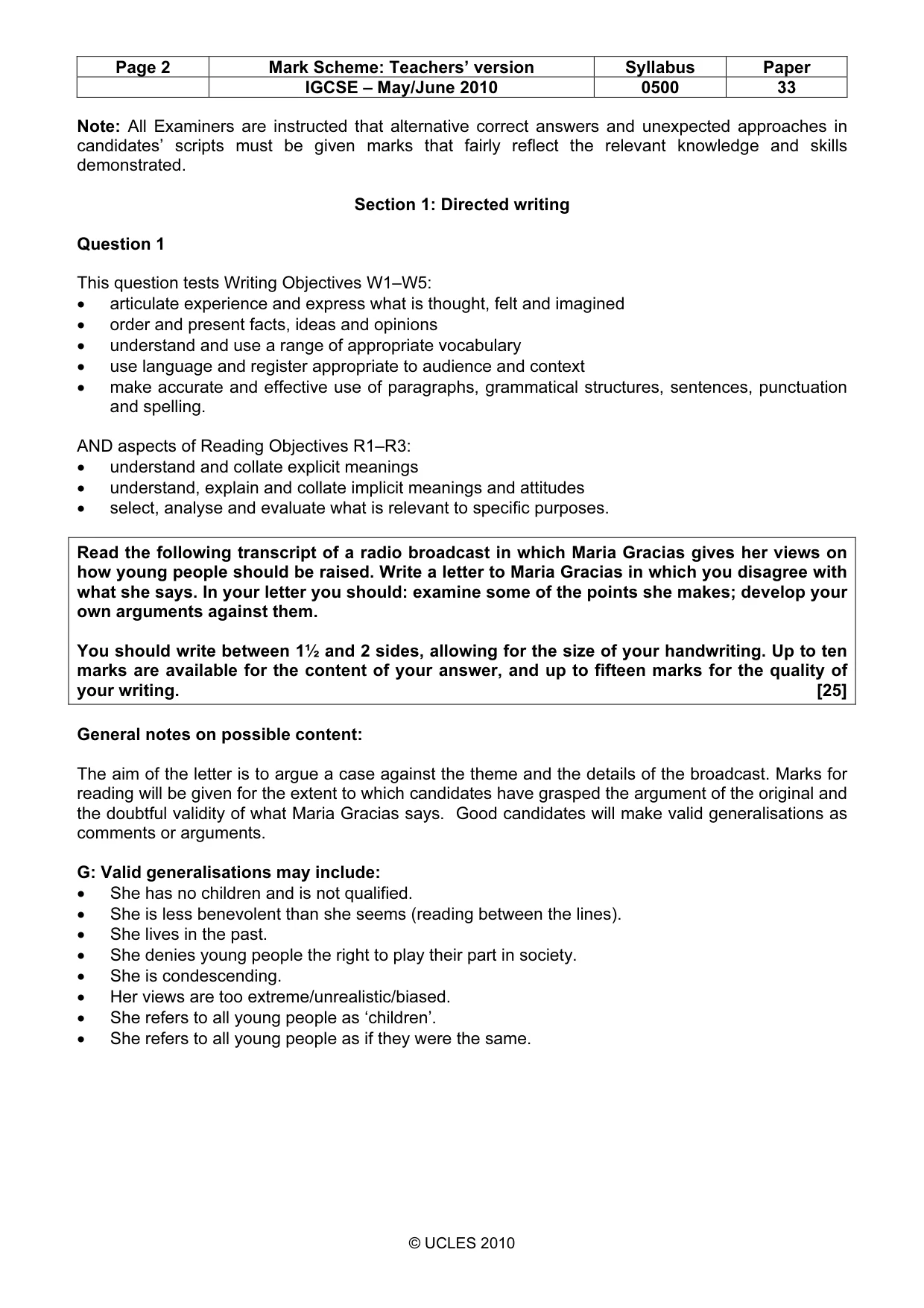
Page 2 Mark Scheme: Teachers’ version Syllabus Paper IGCSE – May/June 2010 0500 33 © UCLES 2010 Note: All Examiners are instructed that alternative correct answers and unexpected approaches in candidates’ scripts must be given marks that fairly reflect the relevant knowledge and skills demonstrated. Section 1: Directed writing Question 1 This question tests Writing Objectives W1–W5: • articulate experience and express what is thought, felt and imagined • order and present facts, ideas and opinions • understand and use a range of appropriate vocabulary • use language and register appropriate to audience and context • make accurate and effective use of paragraphs, grammatical structures, sentences, punctuation and spelling. AND aspects of Reading Objectives R1–R3: • understand and collate explicit meanings • understand, explain and collate implicit meanings and attitudes • select, analyse and evaluate what is relevant to specific purposes. Read the following transcript of a radio broadcast in which Maria Gracias gives her views on how young people should be raised. Write a letter to Maria Gracias in which you disagree with what she says. In your letter you should: examine some of the points she makes; develop your own arguments against them. You should write between 1½ and 2 sides, allowing for the size of your handwriting. Up to ten marks are available for the content of your answer, and up to fifteen marks for the quality of your writing. [25] General notes on possible content: The aim of the letter is to argue a case against the theme and the details of the broadcast. Marks for reading will be given for the extent to which candidates have grasped the argument of the original and the doubtful validity of what Maria Gracias says. Good candidates will make valid generalisations as comments or arguments. G: Valid generalisations may include: • She has no children and is not qualified. • She is less benevolent than she seems (reading between the lines). • She lives in the past. • She denies young people the right to play their part in society. • She is condescending. • Her views are too extreme/unrealistic/biased. • She refers to all young people as ‘children’. • She refers to all young people as if they were the same.
Mark scheme, page 3
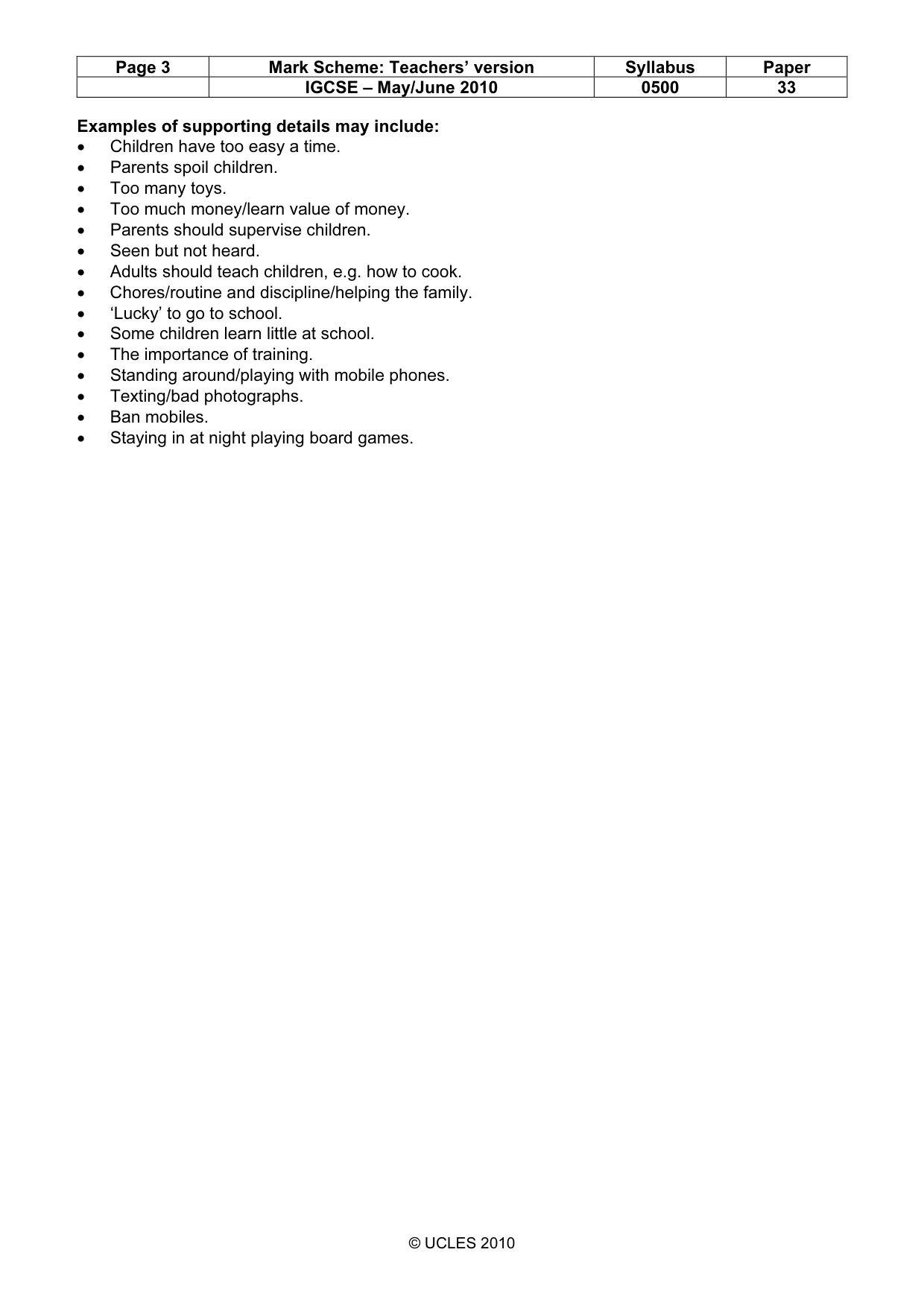
Page 3 Mark Scheme: Teachers’ version Syllabus Paper IGCSE – May/June 2010 0500 33 © UCLES 2010 Examples of supporting details may include: • Children have too easy a time. • Parents spoil children. • Too many toys. • Too much money/learn value of money. • Parents should supervise children. • Seen but not heard. • Adults should teach children, e.g. how to cook. • Chores/routine and discipline/helping the family. • ‘Lucky’ to go to school. • Some children learn little at school. • The importance of training. • Standing around/playing with mobile phones. • Texting/bad photographs. • Ban mobiles. • Staying in at night playing board games.
Mark scheme, page 4
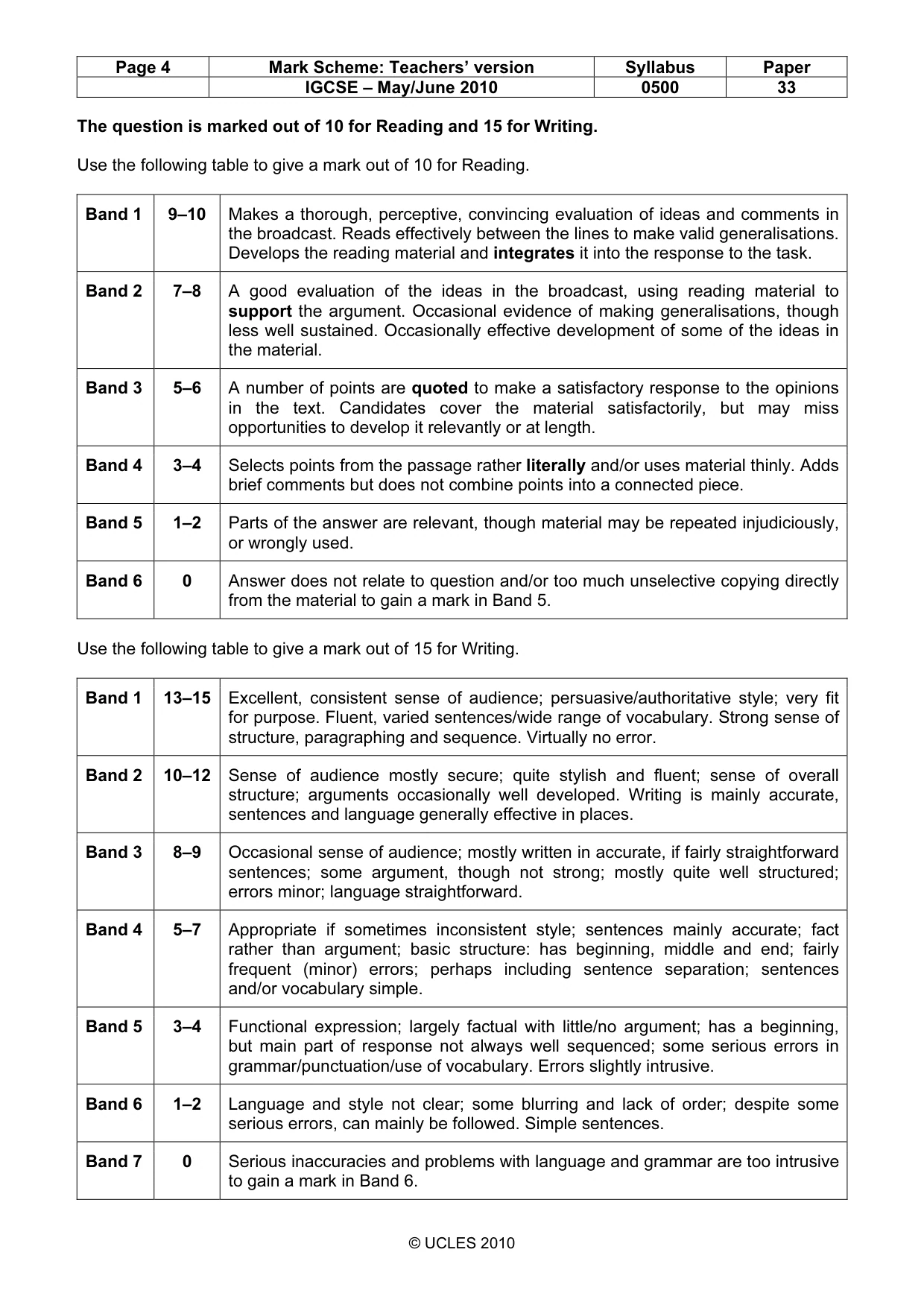
Page 4 Mark Scheme: Teachers’ version Syllabus Paper IGCSE – May/June 2010 0500 33 © UCLES 2010 The question is marked out of 10 for Reading and 15 for Writing. Use the following table to give a mark out of 10 for Reading. Band 1 9–10 Makes a thorough, perceptive, convincing evaluation of ideas and comments in the broadcast. Reads effectively between the lines to make valid generalisations. Develops the reading material and integrates it into the response to the task. Band 2 7–8 A good evaluation of the ideas in the broadcast, using reading material to support the argument. Occasional evidence of making generalisations, though less well sustained. Occasionally effective development of some of the ideas in the material. Band 3 5–6 A number of points are quoted to make a satisfactory response to the opinions in the text. Candidates cover the material satisfactorily, but may miss opportunities to develop it relevantly or at length. Band 4 3–4 Selects points from the passage rather literally and/or uses material thinly. Adds brief comments but does not combine points into a connected piece. Band 5 1–2 Parts of the answer are relevant, though material may be repeated injudiciously, or wrongly used. Band 6 0 Answer does not relate to question and/or too much unselective copying directly from the material to gain a mark in Band 5. Use the following table to give a mark out of 15 for Writing. Band 1 13–15 Excellent, consistent sense of audience; persuasive/authoritative style; very fit for purpose. Fluent, varied sentences/wide range of vocabulary. Strong sense of structure, paragraphing and sequence. Virtually no error. Band 2 10–12 Sense of audience mostly secure; quite stylish and fluent; sense of overall structure; arguments occasionally well developed. Writing is mainly accurate, sentences and language generally effective in places. Band 3 8–9 Occasional sense of audience; mostly written in accurate, if fairly straightforward sentences; some argument, though not strong; mostly quite well structured; errors minor; language straightforward. Band 4 5–7 Appropriate if sometimes inconsistent style; sentences mainly accurate; fact rather than argument; basic structure: has beginning, middle and end; fairly frequent (minor) errors; perhaps including sentence separation; sentences and/or vocabulary simple. Band 5 3–4 Functional expression; largely factual with little/no argument; has a beginning, but main part of response not always well sequenced; some serious errors in grammar/punctuation/use of vocabulary. Errors slightly intrusive. Band 6 1–2 Language and style not clear; some blurring and lack of order; despite some serious errors, can mainly be followed. Simple sentences. Band 7 0 Serious inaccuracies and problems with language and grammar are too intrusive to gain a mark in Band 6.
Mark scheme, page 5
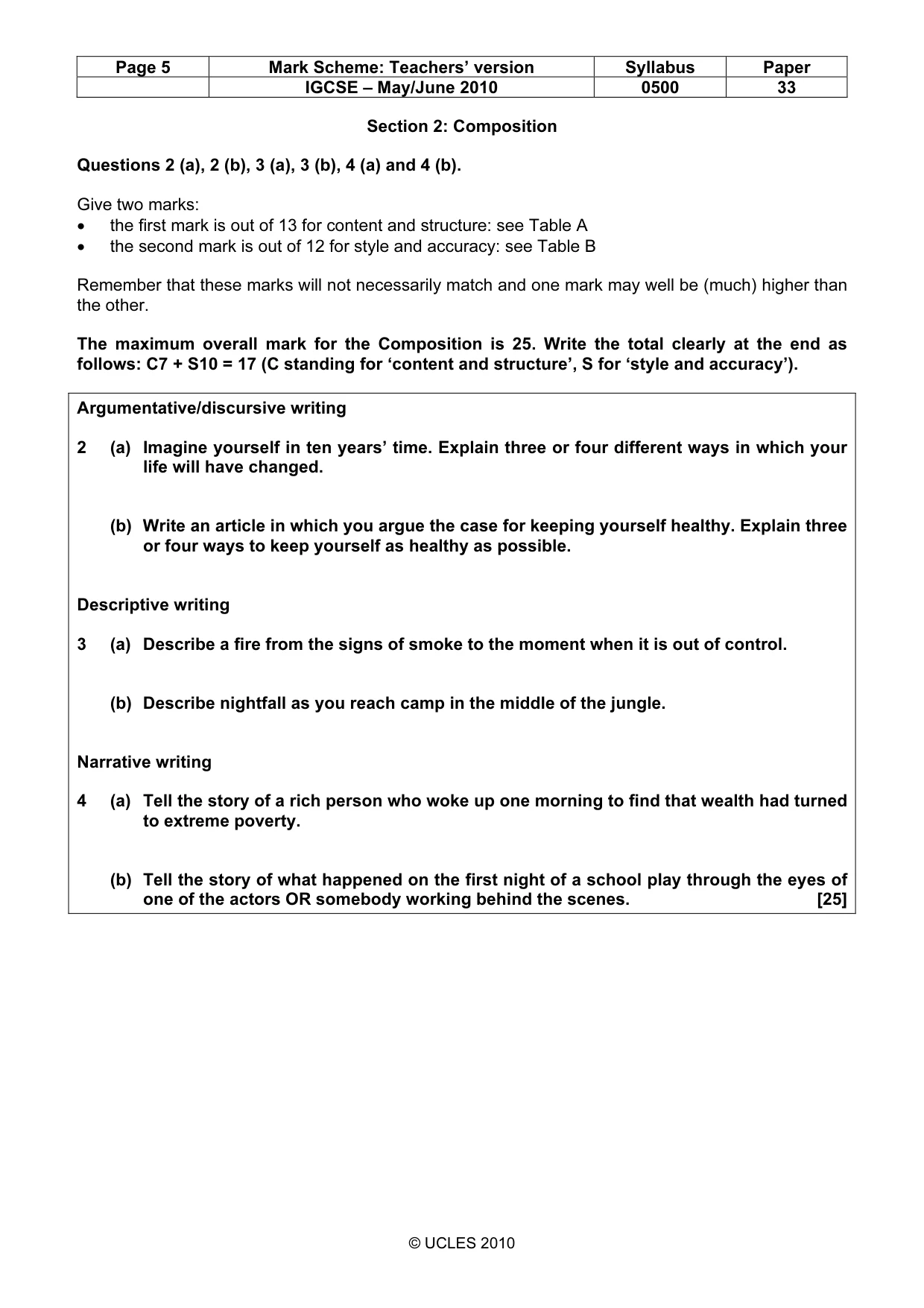
Page 5 Mark Scheme: Teachers’ version Syllabus Paper IGCSE – May/June 2010 0500 33 © UCLES 2010 Section 2: Composition Questions 2 (a), 2 (b), 3 (a), 3 (b), 4 (a) and 4 (b). Give two marks: • the first mark is out of 13 for content and structure: see Table A • the second mark is out of 12 for style and accuracy: see Table B Remember that these marks will not necessarily match and one mark may well be (much) higher than the other. The maximum overall mark for the Composition is 25. Write the total clearly at the end as follows: C7 + S10 = 17 (C standing for ‘content and structure’, S for ‘style and accuracy’). Argumentative/discursive writing 2 (a) Imagine yourself in ten years’ time. Explain three or four different ways in which your life will have changed. (b) Write an article in which you argue the case for keeping yourself healthy. Explain three or four ways to keep yourself as healthy as possible. Descriptive writing 3 (a) Describe a fire from the signs of smoke to the moment when it is out of control. (b) Describe nightfall as you reach camp in the middle of the jungle. Narrative writing 4 (a) Tell the story of a rich person who woke up one morning to find that wealth had turned to extreme poverty. (b) Tell the story of what happened on the first night of a school play through the eyes of one of the actors OR somebody working behind the scenes. [25]
Mark scheme, page 6
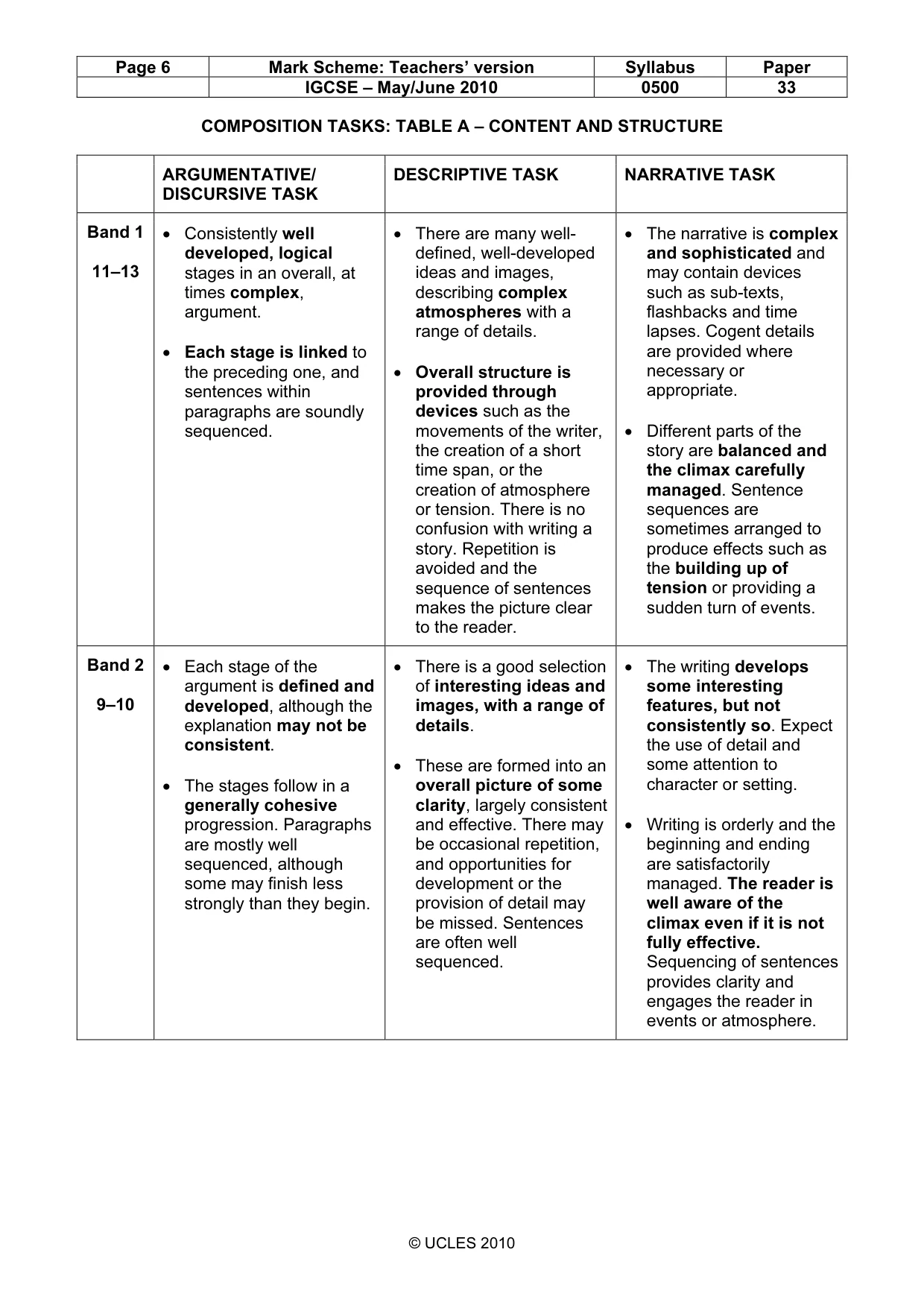
Page 6 Mark Scheme: Teachers’ version Syllabus Paper IGCSE – May/June 2010 0500 33 © UCLES 2010 COMPOSITION TASKS: TABLE A – CONTENT AND STRUCTURE ARGUMENTATIVE/ DISCURSIVE TASK DESCRIPTIVE TASK NARRATIVE TASK Band 1 11–13 • Consistently well developed, logical stages in an overall, at times complex, argument. • Each stage is linked to the preceding one, and sentences within paragraphs are soundly sequenced. • There are many well- defined, well-developed ideas and images, describing complex atmospheres with a range of details. • Overall structure is provided through devices such as the movements of the writer, the creation of a short time span, or the creation of atmosphere or tension. There is no confusion with writing a story. Repetition is avoided and the sequence of sentences makes the picture clear to the reader. • The narrative is complex and sophisticated and may contain devices such as sub-texts, flashbacks and time lapses. Cogent details are provided where necessary or appropriate. • Different parts of the story are balanced and the climax carefully managed. Sentence sequences are sometimes arranged to produce effects such as the building up of tension or providing a sudden turn of events. Band 2 9–10 • Each stage of the argument is defined and developed, although the explanation may not be consistent. • The stages follow in a generally cohesive progression. Paragraphs are mostly well sequenced, although some may finish less strongly than they begin. • There is a good selection of interesting ideas and images, with a range of details. • These are formed into an overall picture of some clarity, largely consistent and effective. There may be occasional repetition, and opportunities for development or the provision of detail may be missed. Sentences are often well sequenced. • The writing develops some interesting features, but not consistently so. Expect the use of detail and some attention to character or setting. • Writing is orderly and the beginning and ending are satisfactorily managed. The reader is well aware of the climax even if it is not fully effective. Sequencing of sentences provides clarity and engages the reader in events or atmosphere.
Mark scheme, page 7
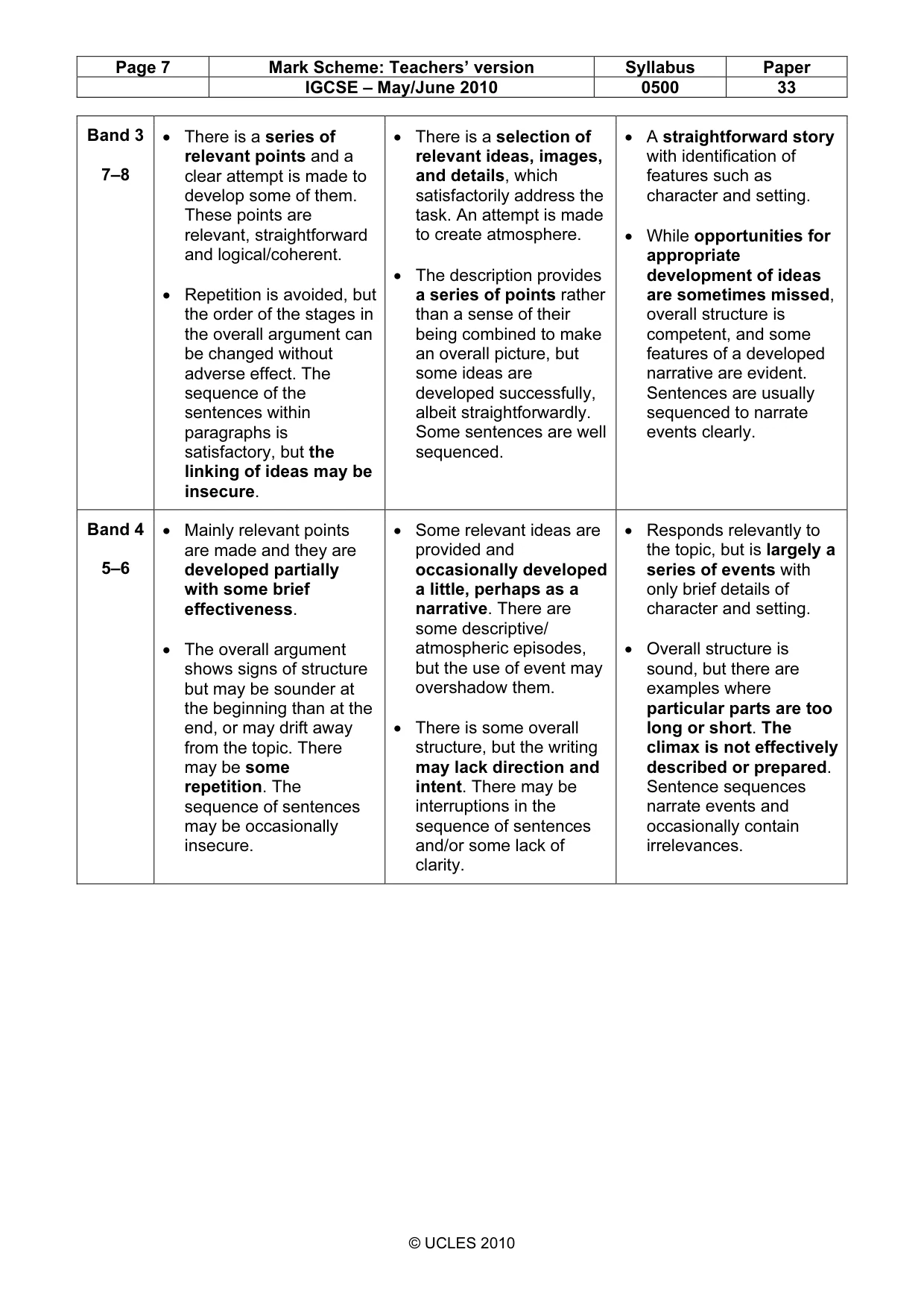
Page 7 Mark Scheme: Teachers’ version Syllabus Paper IGCSE – May/June 2010 0500 33 © UCLES 2010 Band 3 7–8 • There is a series of relevant points and a clear attempt is made to develop some of them. These points are relevant, straightforward and logical/coherent. • Repetition is avoided, but the order of the stages in the overall argument can be changed without adverse effect. The sequence of the sentences within paragraphs is satisfactory, but the linking of ideas may be insecure. • There is a selection of relevant ideas, images, and details, which satisfactorily address the task. An attempt is made to create atmosphere. • The description provides a series of points rather than a sense of their being combined to make an overall picture, but some ideas are developed successfully, albeit straightforwardly. Some sentences are well sequenced. • A straightforward story with identification of features such as character and setting. • While opportunities for appropriate development of ideas are sometimes missed, overall structure is competent, and some features of a developed narrative are evident. Sentences are usually sequenced to narrate events clearly. Band 4 5–6 • Mainly relevant points are made and they are developed partially with some brief effectiveness. • The overall argument shows signs of structure but may be sounder at the beginning than at the end, or may drift away from the topic. There may be some repetition. The sequence of sentences may be occasionally insecure. • Some relevant ideas are provided and occasionally developed a little, perhaps as a narrative. There are some descriptive/ atmospheric episodes, but the use of event may overshadow them. • There is some overall structure, but the writing may lack direction and intent. There may be interruptions in the sequence of sentences and/or some lack of clarity. • Responds relevantly to the topic, but is largely a series of events with only brief details of character and setting. • Overall structure is sound, but there are examples where particular parts are too long or short. The climax is not effectively described or prepared. Sentence sequences narrate events and occasionally contain irrelevances.
Mark scheme, page 8
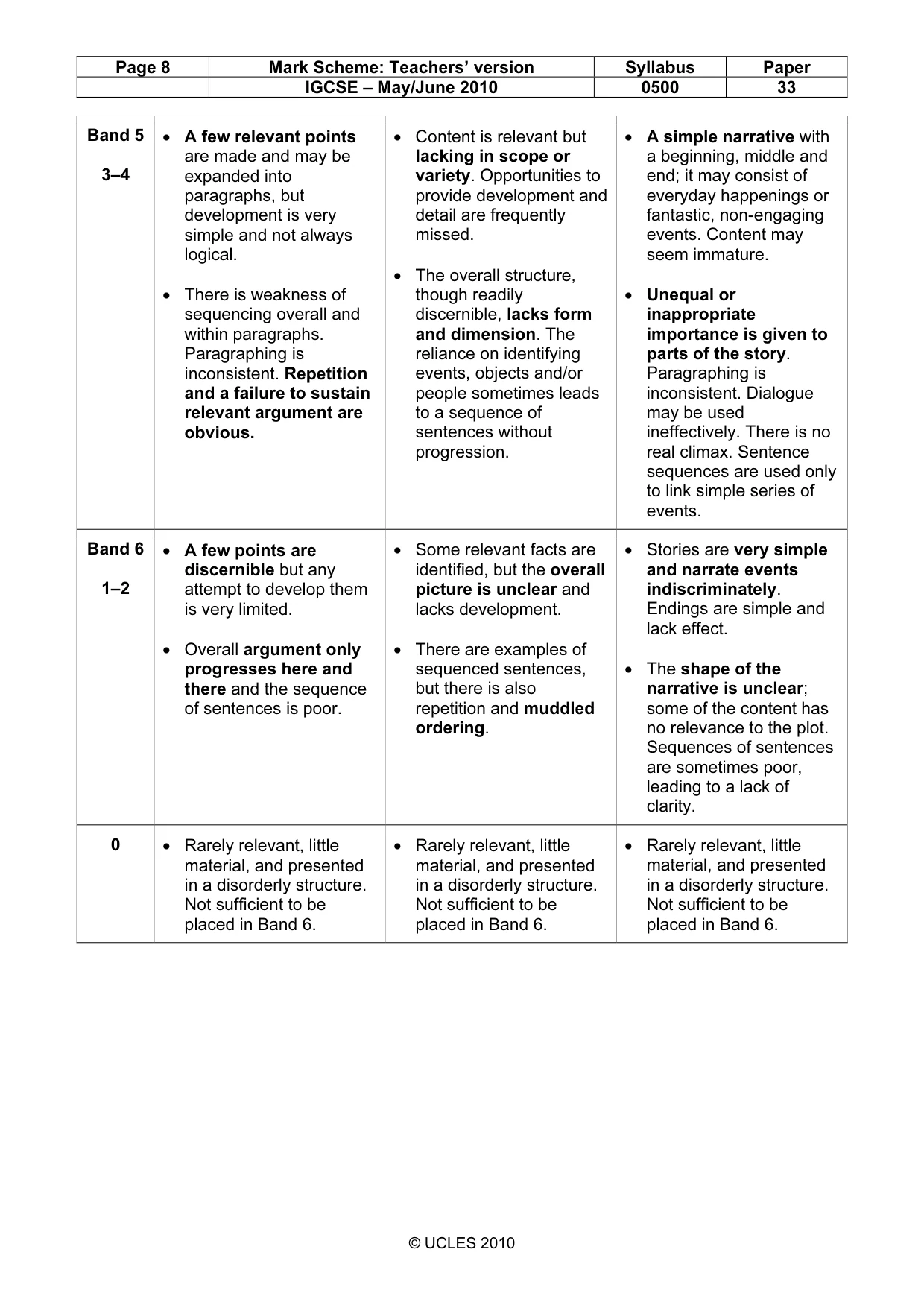
Page 8 Mark Scheme: Teachers’ version Syllabus Paper IGCSE – May/June 2010 0500 33 © UCLES 2010 Band 5 3–4 • A few relevant points are made and may be expanded into paragraphs, but development is very simple and not always logical. • There is weakness of sequencing overall and within paragraphs. Paragraphing is inconsistent. Repetition and a failure to sustain relevant argument are obvious. • Content is relevant but lacking in scope or variety. Opportunities to provide development and detail are frequently missed. • The overall structure, though readily discernible, lacks form and dimension. The reliance on identifying events, objects and/or people sometimes leads to a sequence of sentences without progression. • A simple narrative with a beginning, middle and end; it may consist of everyday happenings or fantastic, non-engaging events. Content may seem immature. • Unequal or inappropriate importance is given to parts of the story. Paragraphing is inconsistent. Dialogue may be used ineffectively. There is no real climax. Sentence sequences are used only to link simple series of events. Band 6 1–2 • A few points are discernible but any attempt to develop them is very limited. • Overall argument only progresses here and there and the sequence of sentences is poor. • Some relevant facts are identified, but the overall picture is unclear and lacks development. • There are examples of sequenced sentences, but there is also repetition and muddled ordering. • Stories are very simple and narrate events indiscriminately. Endings are simple and lack effect. • The shape of the narrative is unclear; some of the content has no relevance to the plot. Sequences of sentences are sometimes poor, leading to a lack of clarity. 0 • Rarely relevant, little material, and presented in a disorderly structure. Not sufficient to be placed in Band 6. • Rarely relevant, little material, and presented in a disorderly structure. Not sufficient to be placed in Band 6. • Rarely relevant, little material, and presented in a disorderly structure. Not sufficient to be placed in Band 6.
Mark scheme, page 9
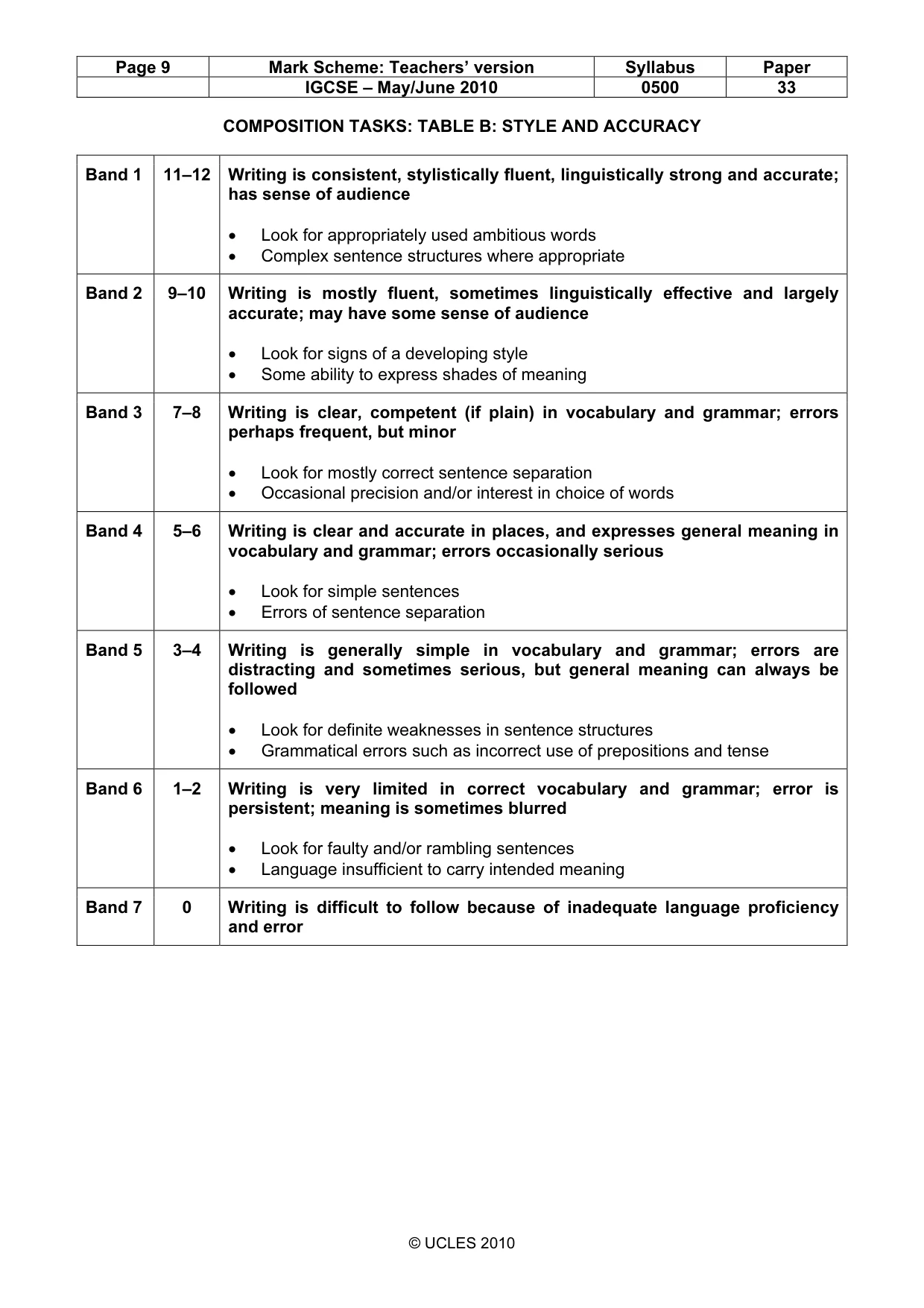
Page 9 Mark Scheme: Teachers’ version Syllabus Paper IGCSE – May/June 2010 0500 33 © UCLES 2010 COMPOSITION TASKS: TABLE B: STYLE AND ACCURACY Band 1 11–12 Writing is consistent, stylistically fluent, linguistically strong and accurate; has sense of audience • Look for appropriately used ambitious words • Complex sentence structures where appropriate Band 2 9–10 Writing is mostly fluent, sometimes linguistically effective and largely accurate; may have some sense of audience • Look for signs of a developing style • Some ability to express shades of meaning Band 3 7–8 Writing is clear, competent (if plain) in vocabulary and grammar; errors perhaps frequent, but minor • Look for mostly correct sentence separation • Occasional precision and/or interest in choice of words Band 4 5–6 Writing is clear and accurate in places, and expresses general meaning in vocabulary and grammar; errors occasionally serious • Look for simple sentences • Errors of sentence separation Band 5 3–4 Writing is generally simple in vocabulary and grammar; errors are distracting and sometimes serious, but general meaning can always be followed • Look for definite weaknesses in sentence structures • Grammatical errors such as incorrect use of prepositions and tense Band 6 1–2 Writing is very limited in correct vocabulary and grammar; error is persistent; meaning is sometimes blurred • Look for faulty and/or rambling sentences • Language insufficient to carry intended meaning Band 7 0 Writing is difficult to follow because of inadequate language proficiency and error
What you needed in this session
Cambridge’s own grade thresholds for 2010 May/June, Paper 3 · Variant 3. A higher threshold means an easier paper — the bar moves with how the cohort did.