Cambridge IGCSE English - First Language 0500 — 2009 Oct/Nov Paper 2 · Variant 1
0500/21/O/N/09 · 50 marks · ≈56 min
The question paper and its mark scheme, free to read here and free to download. This is Cambridge’s own paper, exactly as it was sat.
Question paper8 pages


Mark scheme10 pages
Answers below. Sit the paper first if you are practising.
Paper as text
Question paper, page 1
This document consists of 5 printed pages and 3 blank pages. IB09 11_0500_02/4RP © UCLES 2009 [Turn over *4846468868* UNIVERSITY OF CAMBRIDGE INTERNATIONAL EXAMINATIONS International General Certificate of Secondary Education FIRST LANGUAGE ENGLISH 0500/02 Paper 2 Reading Passages (Extended) October/November 2009 2 hours Additional Materials: Answer Booklet/Paper READ THESE INSTRUCTIONS FIRST If you have been given an Answer Booklet, follow the instructions on the front cover of the Booklet. Write your Centre number, candidate number and name on all the work you hand in. Write in dark blue or black pen. Do not use staples, paper clips, highlighters, glue or correction fluid. Answer all questions. Dictionaries are not permitted. At the end of the examination, fasten all your work securely together. The number of marks is given in brackets [ ] at the end of each question or part question. www.XtremePapers.com
Question paper, page 2
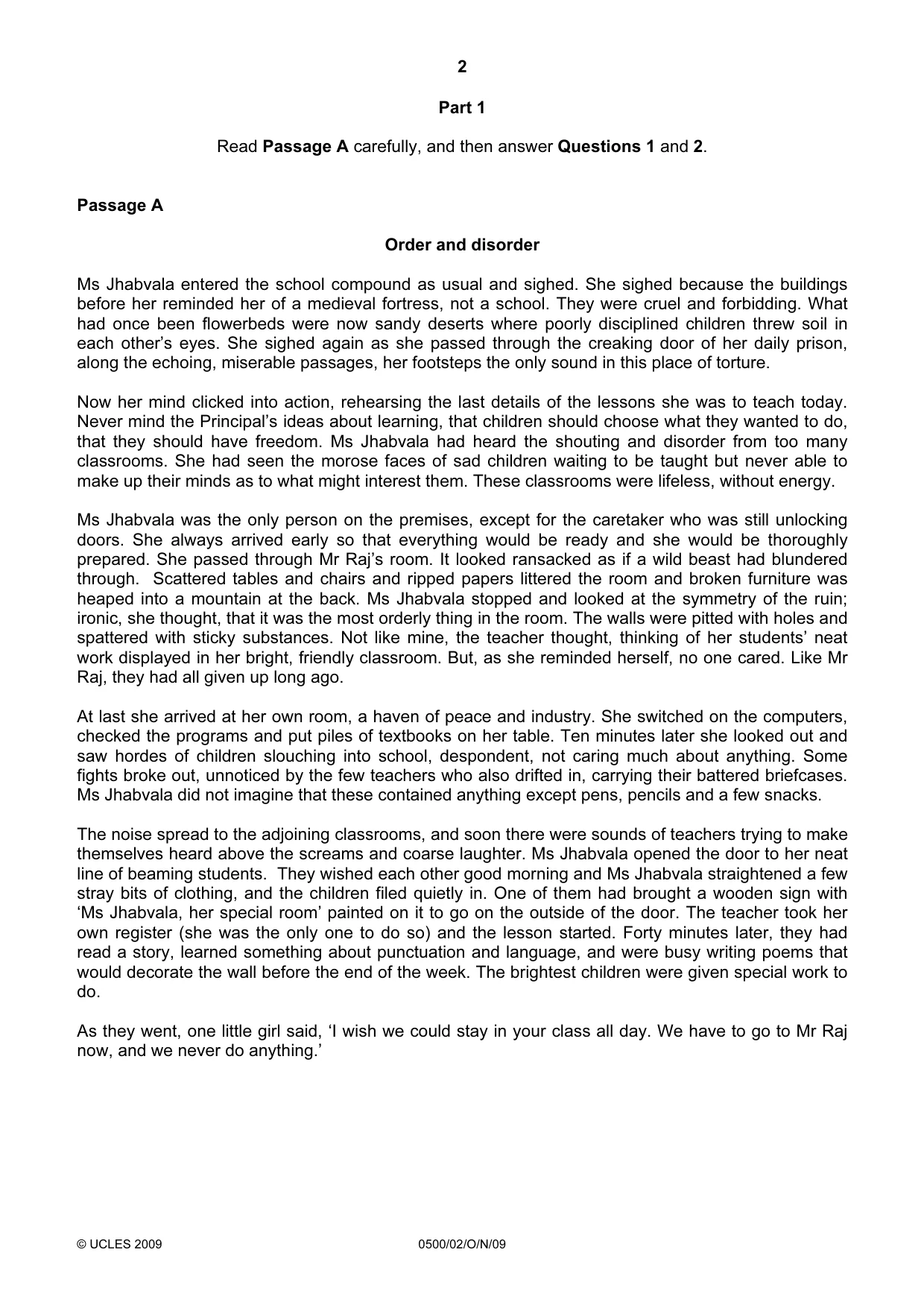
2 © UCLES 2009 0500/02/O/N/09 Part 1 Read Passage A carefully, and then answer Questions 1 and 2. Passage A Order and disorder Ms Jhabvala entered the school compound as usual and sighed. She sighed because the buildings before her reminded her of a medieval fortress, not a school. They were cruel and forbidding. What had once been flowerbeds were now sandy deserts where poorly disciplined children threw soil in each other’s eyes. She sighed again as she passed through the creaking door of her daily prison, along the echoing, miserable passages, her footsteps the only sound in this place of torture. Now her mind clicked into action, rehearsing the last details of the lessons she was to teach today. Never mind the Principal’s ideas about learning, that children should choose what they wanted to do, that they should have freedom. Ms Jhabvala had heard the shouting and disorder from too many classrooms. She had seen the morose faces of sad children waiting to be taught but never able to make up their minds as to what might interest them. These classrooms were lifeless, without energy. Ms Jhabvala was the only person on the premises, except for the caretaker who was still unlocking doors. She always arrived early so that everything would be ready and she would be thoroughly prepared. She passed through Mr Raj’s room. It looked ransacked as if a wild beast had blundered through. Scattered tables and chairs and ripped papers littered the room and broken furniture was heaped into a mountain at the back. Ms Jhabvala stopped and looked at the symmetry of the ruin; ironic, she thought, that it was the most orderly thing in the room. The walls were pitted with holes and spattered with sticky substances. Not like mine, the teacher thought, thinking of her students’ neat work displayed in her bright, friendly classroom. But, as she reminded herself, no one cared. Like Mr Raj, they had all given up long ago. At last she arrived at her own room, a haven of peace and industry. She switched on the computers, checked the programs and put piles of textbooks on her table. Ten minutes later she looked out and saw hordes of children slouching into school, despondent, not caring much about anything. Some fights broke out, unnoticed by the few teachers who also drifted in, carrying their battered briefcases. Ms Jhabvala did not imagine that these contained anything except pens, pencils and a few snacks. The noise spread to the adjoining classrooms, and soon there were sounds of teachers trying to make themselves heard above the screams and coarse laughter. Ms Jhabvala opened the door to her neat line of beaming students. They wished each other good morning and Ms Jhabvala straightened a few stray bits of clothing, and the children filed quietly in. One of them had brought a wooden sign with ‘Ms Jhabvala, her special room’ painted on it to go on the outside of the door. The teacher took her own register (she was the only one to do so) and the lesson started. Forty minutes later, they had read a story, learned something about punctuation and language, and were busy writing poems that would decorate the wall before the end of the week. The brightest children were given special work to do. As they went, one little girl said, ‘I wish we could stay in your class all day. We have to go to Mr Raj now, and we never do anything.’
Question paper, page 3
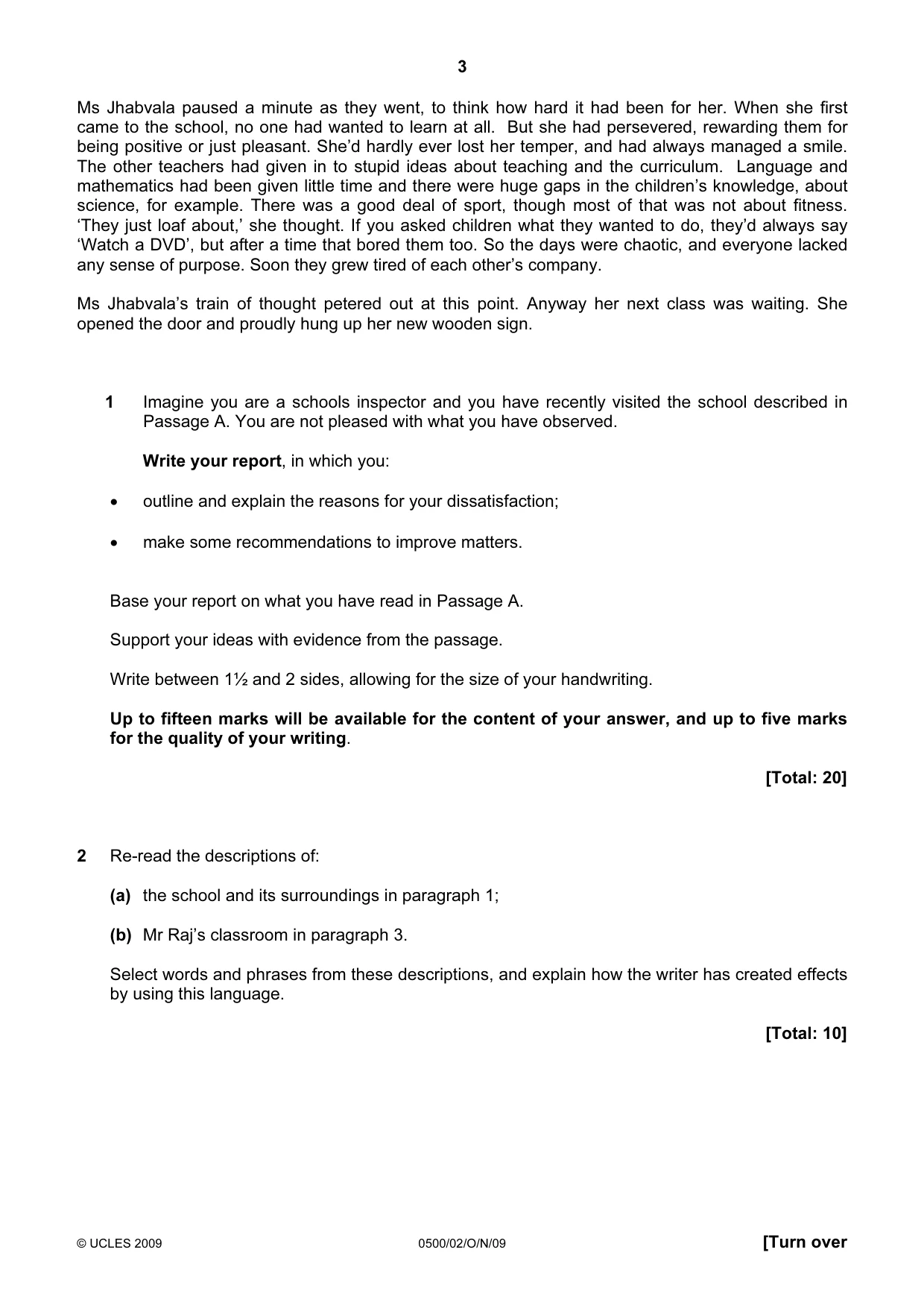
3 © UCLES 2009 0500/02/O/N/09 [Turn over Ms Jhabvala paused a minute as they went, to think how hard it had been for her. When she first came to the school, no one had wanted to learn at all. But she had persevered, rewarding them for being positive or just pleasant. She’d hardly ever lost her temper, and had always managed a smile. The other teachers had given in to stupid ideas about teaching and the curriculum. Language and mathematics had been given little time and there were huge gaps in the children’s knowledge, about science, for example. There was a good deal of sport, though most of that was not about fitness. ‘They just loaf about,’ she thought. If you asked children what they wanted to do, they’d always say ‘Watch a DVD’, but after a time that bored them too. So the days were chaotic, and everyone lacked any sense of purpose. Soon they grew tired of each other’s company. Ms Jhabvala’s train of thought petered out at this point. Anyway her next class was waiting. She opened the door and proudly hung up her new wooden sign. 1 Imagine you are a schools inspector and you have recently visited the school described in Passage A. You are not pleased with what you have observed. Write your report, in which you: • outline and explain the reasons for your dissatisfaction; • make some recommendations to improve matters. Base your report on what you have read in Passage A. Support your ideas with evidence from the passage. Write between 1½ and 2 sides, allowing for the size of your handwriting. Up to fifteen marks will be available for the content of your answer, and up to five marks for the quality of your writing. [Total: 20] 2 Re-read the descriptions of: (a) the school and its surroundings in paragraph 1; (b) Mr Raj’s classroom in paragraph 3. Select words and phrases from these descriptions, and explain how the writer has created effects by using this language. [Total: 10]
Question paper, page 4
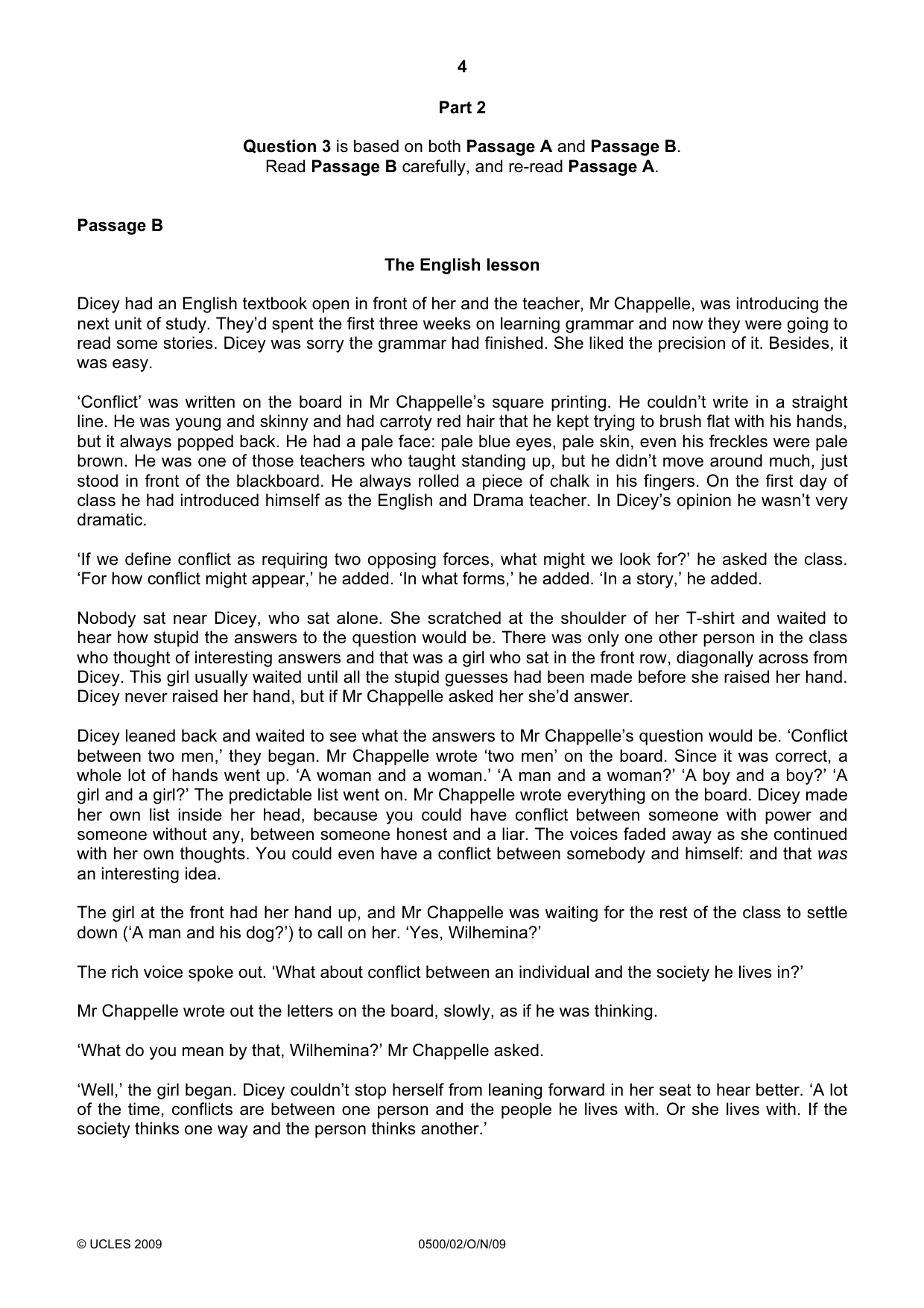
4 © UCLES 2009 0500/02/O/N/09 Part 2 Question 3 is based on both Passage A and Passage B. Read Passage B carefully, and re-read Passage A. Passage B The English lesson Dicey had an English textbook open in front of her and the teacher, Mr Chappelle, was introducing the next unit of study. They’d spent the first three weeks on learning grammar and now they were going to read some stories. Dicey was sorry the grammar had finished. She liked the precision of it. Besides, it was easy. ‘Conflict’ was written on the board in Mr Chappelle’s square printing. He couldn’t write in a straight line. He was young and skinny and had carroty red hair that he kept trying to brush flat with his hands, but it always popped back. He had a pale face: pale blue eyes, pale skin, even his freckles were pale brown. He was one of those teachers who taught standing up, but he didn’t move around much, just stood in front of the blackboard. He always rolled a piece of chalk in his fingers. On the first day of class he had introduced himself as the English and Drama teacher. In Dicey’s opinion he wasn’t very dramatic. ‘If we define conflict as requiring two opposing forces, what might we look for?’ he asked the class. ‘For how conflict might appear,’ he added. ‘In what forms,’ he added. ‘In a story,’ he added. Nobody sat near Dicey, who sat alone. She scratched at the shoulder of her T-shirt and waited to hear how stupid the answers to the question would be. There was only one other person in the class who thought of interesting answers and that was a girl who sat in the front row, diagonally across from Dicey. This girl usually waited until all the stupid guesses had been made before she raised her hand. Dicey never raised her hand, but if Mr Chappelle asked her she’d answer. Dicey leaned back and waited to see what the answers to Mr Chappelle’s question would be. ‘Conflict between two men,’ they began. Mr Chappelle wrote ‘two men’ on the board. Since it was correct, a whole lot of hands went up. ‘A woman and a woman.’ ‘A man and a woman?’ ‘A boy and a boy?’ ‘A girl and a girl?’ The predictable list went on. Mr Chappelle wrote everything on the board. Dicey made her own list inside her head, because you could have conflict between someone with power and someone without any, between someone honest and a liar. The voices faded away as she continued with her own thoughts. You could even have a conflict between somebody and himself: and that was an interesting idea. The girl at the front had her hand up, and Mr Chappelle was waiting for the rest of the class to settle down (‘A man and his dog?’) to call on her. ‘Yes, Wilhemina?’ The rich voice spoke out. ‘What about conflict between an individual and the society he lives in?’ Mr Chappelle wrote out the letters on the board, slowly, as if he was thinking. ‘What do you mean by that, Wilhemina?’ Mr Chappelle asked. ‘Well,’ the girl began. Dicey couldn’t stop herself from leaning forward in her seat to hear better. ‘A lot of the time, conflicts are between one person and the people he lives with. Or she lives with. If the society thinks one way and the person thinks another.’
Question paper, page 5
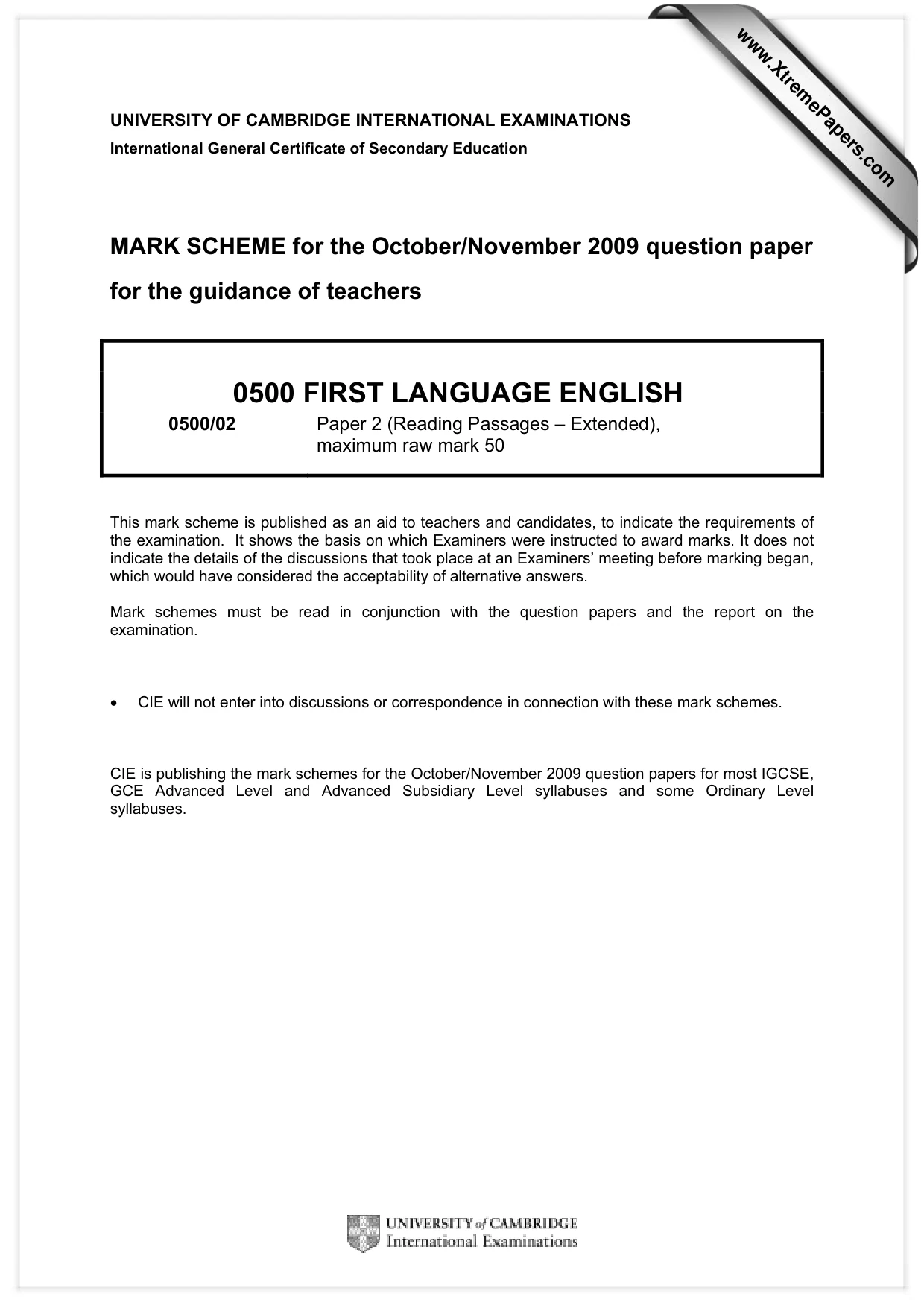
5 © UCLES 2009 0500/02/O/N/09 Mr Chappelle was listening carefully, you could tell. Dicey figured, from the way he wrote down everything everybody said, even when it repeated the same basic idea, that his brain didn’t work very fast. ‘Can you give us any examples?’ The rest of the class shifted in their seats, getting bored. Too bad for them, Dicey thought to herself. 3 Summarise: (a) the evidence that Mr Chappelle was not a very good teacher, from Passage B; (b) the evidence that Ms Jhabvala was an excellent teacher, from Passage A. Use your own words as far as possible. You should write about 1 side in total, allowing for the size of your handwriting. Up to fifteen marks will be available for the content of your answer, and up to five marks for the quality of your writing. [Total: 20]
Question paper, page 8
8 BLANK PAGE Copyright Acknowledgements: Question 3 Passage B © Voigt, Cynthia; Dicey's Song, pp 28-31, Merrilee Heifetz. Permission to reproduce items where third-party owned material protected by copyright is included has been sought and cleared where possible. Every reasonable effort has been made by the publisher (UCLES) to trace copyright holders, but if any items requiring clearance have unwittingly been included, the publisher will be pleased to make amends at the earliest possible opportunity. University of Cambridge International Examinations is part of the Cambridge Assessment Group. Cambridge Assessment is the brand name of University of Cambridge Local Examinations Syndicate (UCLES), which is itself a department of the University of Cambridge. 0500/02/O/N/09
Mark scheme, page 1
UNIVERSITY OF CAMBRIDGE INTERNATIONAL EXAMINATIONS International General Certificate of Secondary Education MARK SCHEME for the October/November 2009 question paper for the guidance of teachers 0500 FIRST LANGUAGE ENGLISH 0500/02 Paper 2 (Reading Passages – Extended), maximum raw mark 50 This mark scheme is published as an aid to teachers and candidates, to indicate the requirements of the examination. It shows the basis on which Examiners were instructed to award marks. It does not indicate the details of the discussions that took place at an Examiners’ meeting before marking began, which would have considered the acceptability of alternative answers. Mark schemes must be read in conjunction with the question papers and the report on the examination. • CIE will not enter into discussions or correspondence in connection with these mark schemes. CIE is publishing the mark schemes for the October/November 2009 question papers for most IGCSE, GCE Advanced Level and Advanced Subsidiary Level syllabuses and some Ordinary Level syllabuses. www.XtremePapers.com
Mark scheme, page 2
Page 2 Mark Scheme: Teachers’ version Syllabus Paper IGCSE – October/November 2009 0500 02 © UCLES 2009 Question 1 Note: All examiners are instructed that alternative correct answers and unexpected approaches in candidate scripts must be given marks that fairly reflect the relevant knowledge and skills demonstrated Imagine you are a schools inspector and you have recently visited the school described in Passage A. You are not pleased with what you have observed. Write your report, in which you: • outline and explain the reasons for your dissatisfaction; • make some recommendations to improve matters. Base your report on what you have read in Passage A. Support your ideas with evidence from the passage. Write between 1½ and 2 sides, allowing for the size of your handwriting. Up to 15 marks will be available for the content of your answer, and up to 5 marks for the quality of your writing. [20] This question tests Reading Objectives R1–R3 (15 marks): • understand and collate explicit meanings • understand, explain and collate implicit meanings and attitudes • select, analyse and evaluate what is relevant to specific purposes AND Writing Objectives W1–W5 (5 marks): • articulate experience and express what is thought, felt and imagined • order and present facts, ideas and opinions • understand and use a range of appropriate vocabulary • use language and register appropriate to audience and context • make accurate and effective use of paragraphs, grammatical structures, sentences, punctuation and spelling. General notes on possible content Candidates should select ideas from the passage (see below) and develop their own recommendations, supporting what they write with details from the passage. There is a lot of material here, so do not expect too much development. The recommendations may be quite brief. Mark B, P, S, and C for ideas identified from the passage (see below) and Dev for development (in margin). Mark d with a small tick in the text for supporting details. Mark R for recommendations. Look for a clear report, not in any particular format, but well structured and in the candidate’s own words. It needs to make narrative into report writing, so reward well expressed concerns. The content must be clearly related to and derived from the passage.
Mark scheme, page 3
Page 3 Mark Scheme: Teachers’ version Syllabus Paper IGCSE – October/November 2009 0500 02 © UCLES 2009 Candidates may use the following as concerns: B School buildings and their surroundings Classrooms: Use Mr Raj as an example of others; health and safety issues – broken furniture and the mess on the wall C Principal’s philosophy of ‘freedom’ Curriculum – which sacrifices Language and Mathematics and leaves gaps in knowledge; sport leads to ‘loafing about’ S Staff: Do not arrive early to school Do not take work home at night Appear to have given up Are not purposeful, but ‘drift’ Have to shout to be heard P Pupils: fight, shout, scream, don’t care, slouch, ‘wait to be taught’, sad, morose, ‘we never do anything’ Recommendations may be briefly applied to any of the above, for example, to improve the look of the flowerbeds, to re-introduce a properly structured teaching day, staff training, rewards and sanctions, classrooms to be tidied at night, improving the looks of classrooms and treating children fairly and firmly. Accept all sensible suggestions whether tacked on to the end or (better) assimilated into the report. Details from Ms Jhabwala’s practice may be used as recommendations. Important check: Candidates may lift expressions from the original, particularly the medieval fortress and details from Mr Raj’s classroom. Much of this indicates that candidates do not understand what they are writing. Candidates may also list details, but reward the use of own words, the way the details are selected and the grouping within the text. Random listing is not good. Layout Do not expect headings, but expect some ordering of ideas in paragraphs. Expect a formal style, but do not penalise the use of ‘I’.
Mark scheme, page 4
Page 4 Mark Scheme: Teachers’ version Syllabus Paper IGCSE – October/November 2009 0500 02 © UCLES 2009 A: CONTENT (EXTENDED TIER) Use the following table to give a mark out of 15. Band 1: 13–15 The answer reveals a thorough reading of the passage. A good range of ideas is applied to both parts of the question. There is an appropriate amount of supporting detail, which is well integrated into the report, contributing to a strong sense of purpose and approach. The response creates a consistent outsider’s attitude towards the school and the possibilities for improvement. Band 2: 10–12 There is evidence of a competent reading of the passage. The candidate does well to explain some of the reasons for concern. Some of these are developed, but the ability to sustain content may not be consistent. Expect some appropriate recommendations, although these may be less convincing. There is some supporting detail throughout. Band 3: 7–9 The passage has been read reasonably well, but the answer may not reflect the range and detail of the original. There may be evidence of a mechanical use of the passage. There is focus on the task and satisfactory reference, but opportunities for development are not always taken. Recommendations are simply formulated. Some supporting detail is used, but not consistently. Band 4: 4–6 Some reference to the passage is made without much inference or more than brief, factual development. Answers may be thin, lack original thought, or in places lack focus on the text, but there is some evidence of general understanding of the main points of the passage. Band 5: 1–3 Answers are either very general with little specific reference to the passage or a reproduction of sections of the original. Content is insubstantial and there is little realisation of the need to modify material from the passage. Band 6: 0 There is little or no relevance to the question or to the passage. B: QUALITY OF WRITING: STRUCTURE AND ORDER, STYLE OF LANGUAGE (EXTENDED TIER) Use the following table to give a mark out of 5. Band 1: 5 The language of the report has character and sounds convincing and consistently formal. There is a clear and effective introduction. Concerns are firmly expressed in a wide range of effective and/or interesting language. Structural presentation is sound throughout. Band 2: 4 Language is mostly fluent and there is clarity of expression. The introduction is formal and correct. There is a sufficient range of vocabulary to express concerns and give recommendations with some subtlety. The candidate attempts to write formally. The report is mainly well structured. Band 3: 3 Language is clear and appropriate, but comparatively plain, expressing little opinion. Introductions are plain and simple. Individual points are rarely extended, but explanations are adequate. There may be flaws in structural presentation. Band 4: 2 There may be some awkwardness of expression and some inconsistency of formal style. Introductions are weak. Language is too limited to express shades of meaning. Look for structural weakness in the presentation of material. Band 5: 1 There are problems of expression and structure. Language is weak and undeveloped. There may be no introduction. There is little attempt to explain ideas. There may be frequent copying from the original. Band 6: 0 Sentence structures and language are unclear and the work is difficult to follow.
Mark scheme, page 5
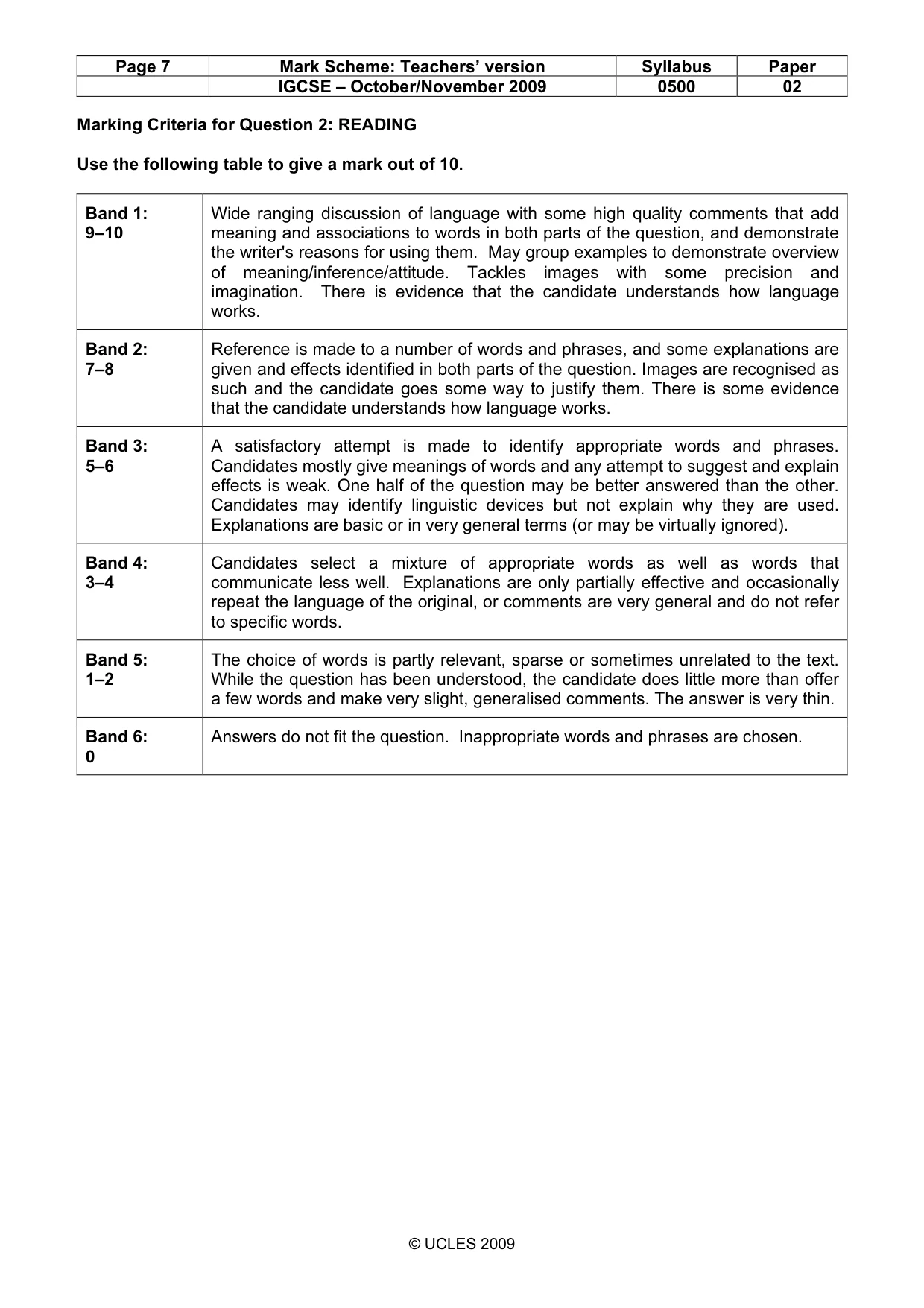
Page 5 Mark Scheme: Teachers’ version Syllabus Paper IGCSE – October/November 2009 0500 02 © UCLES 2009 Question 2 Re-read the descriptions of: (a) the school and its surroundings in paragraph 1; (b) Mr Raj’s classroom in paragraph 3. Select words and phrases from these descriptions, and explain how the writer has created effects by using this language. This question tests Reading Objective R4 (10 marks): • understand how writers achieve effects. General notes on likely content: This question is marked for the candidate's ability to select effective or unusual words and for an understanding of ways in which the language is effective. Expect candidates to select words that carry specific meaning, including implications, additional to general and to ordinary vocabulary. Alternative acceptable choices and explanations should be credited. Mark for the overall quality of the answer, not for the number of words chosen. The following notes are a guide to what good candidates might say about the words they have chosen. They are free to make any sensible comment, but only credit comments that are relevant to the correct meanings of the words and that have some viability. Candidates could score full marks for excellent comments on three words from each part of the question. Mark and credit what is positive. Do not take marks off for inaccurate statements – simply regard them as not worth credit. (a) The school and its surroundings in paragraph 1 Credit candidates who explore the idea that the school is a prison, and especially those who can extend their comments by explaining ‘medieval’ and ‘torture’. Reward those who suggest that the images are exaggerated. Make sure that candidates in Band 1 make valid comments about the images, starting with the image and applying it to the meaning in the passage. Fortress, a visual idea, usually impregnable, and certainly dark, but here it is said to be forbidding, suggesting that no one is welcome or allowed to enter. In addition, it is cruel, which is a more complex idea and which is related to torture. Good candidates will see that physical torture would be an inappropriate exaggeration, but they could say that it suggested mental torture. After all who would put a child into such a building? Arguing along this direction makes it easy to explain prison, which is ironic considering the Principal’s comments on freedom. Medieval is an easier word since it relates to the idea of fortress, but it might suggest something inappropriate to the twenty first century. Creaking, is the province of horror movies and a sound effect, and echoing, is about high vaults and emptiness. Miserable is an effective transferred epithet, which is what the person feels, not the object. The sandy deserts suggests death and sterility, which is what most of this school is about.
Mark scheme, page 6
Page 6 Mark Scheme: Teachers’ version Syllabus Paper IGCSE – October/November 2009 0500 02 © UCLES 2009 (b) Mr Raj’s classroom in paragraph 3 The general picture is one of extreme chaos, and it is exaggerated and unlikely to be real. Raj would have to be a ‘madman’, so reward anyone who goes into this use of language. It reminds one of a riot. A number of the words have related meanings, so reward candidates who group them together. Start with the wild beast image and imagine how a beast might move on the rampage and the damage it would do if let loose in a classroom. The picture is more effective than imagining, say a sheep! When the writer says it blundered, you get the impression of clumsy and violent movement. The rest of the description then falls into place. Candidates should draw attention to ripped and littered (and later, pitted and spattered) as words that have similar meanings and are half rhymed so that the reader gets the emphasis of wilful damage and untidiness. Pitted could suggest something as outrageous as gunfire, or at least some bored child making holes in the wall. Candidates must have a go at heaped into a mountain which together with symmetry gives a shape, but suggests that there was a good deal of the broken furniture. However, start from mountain and you see that it is all another exaggeration since in reality it was no more than a pile! Lastly, spattered with sticky substances gives a slightly disgusting effect, strengthened by the alliteration. Spattered suggests indiscriminate defacing of the wall and the reader is left to imagine the nature of the sticky substances, which only adds to the effectiveness of the expression.
Mark scheme, page 7
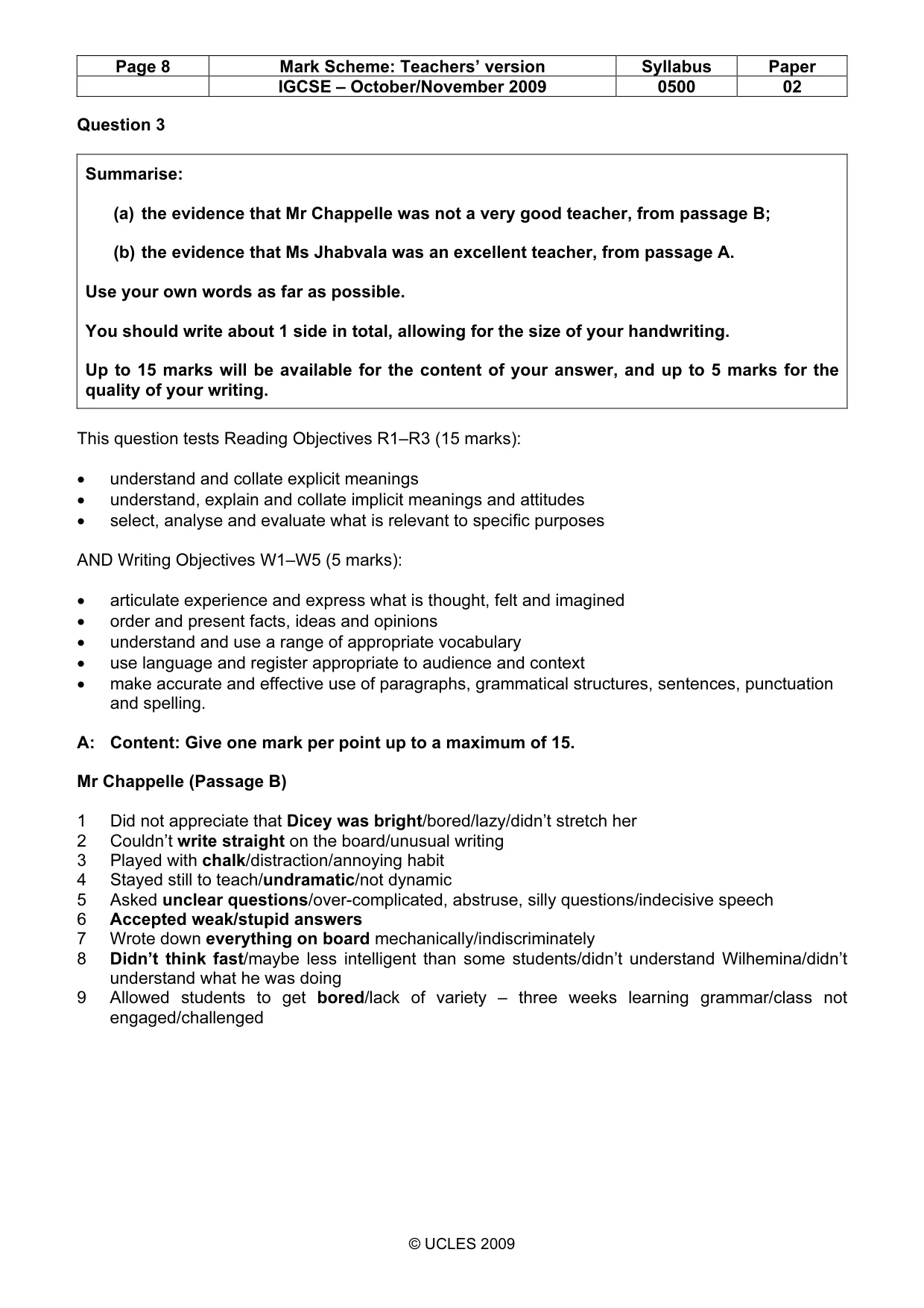
Page 7 Mark Scheme: Teachers’ version Syllabus Paper IGCSE – October/November 2009 0500 02 © UCLES 2009 Marking Criteria for Question 2: READING Use the following table to give a mark out of 10. Band 1: 9–10 Wide ranging discussion of language with some high quality comments that add meaning and associations to words in both parts of the question, and demonstrate the writer's reasons for using them. May group examples to demonstrate overview of meaning/inference/attitude. Tackles images with some precision and imagination. There is evidence that the candidate understands how language works. Band 2: 7–8 Reference is made to a number of words and phrases, and some explanations are given and effects identified in both parts of the question. Images are recognised as such and the candidate goes some way to justify them. There is some evidence that the candidate understands how language works. Band 3: 5–6 A satisfactory attempt is made to identify appropriate words and phrases. Candidates mostly give meanings of words and any attempt to suggest and explain effects is weak. One half of the question may be better answered than the other. Candidates may identify linguistic devices but not explain why they are used. Explanations are basic or in very general terms (or may be virtually ignored). Band 4: 3–4 Candidates select a mixture of appropriate words as well as words that communicate less well. Explanations are only partially effective and occasionally repeat the language of the original, or comments are very general and do not refer to specific words. Band 5: 1–2 The choice of words is partly relevant, sparse or sometimes unrelated to the text. While the question has been understood, the candidate does little more than offer a few words and make very slight, generalised comments. The answer is very thin. Band 6: 0 Answers do not fit the question. Inappropriate words and phrases are chosen.
Mark scheme, page 8
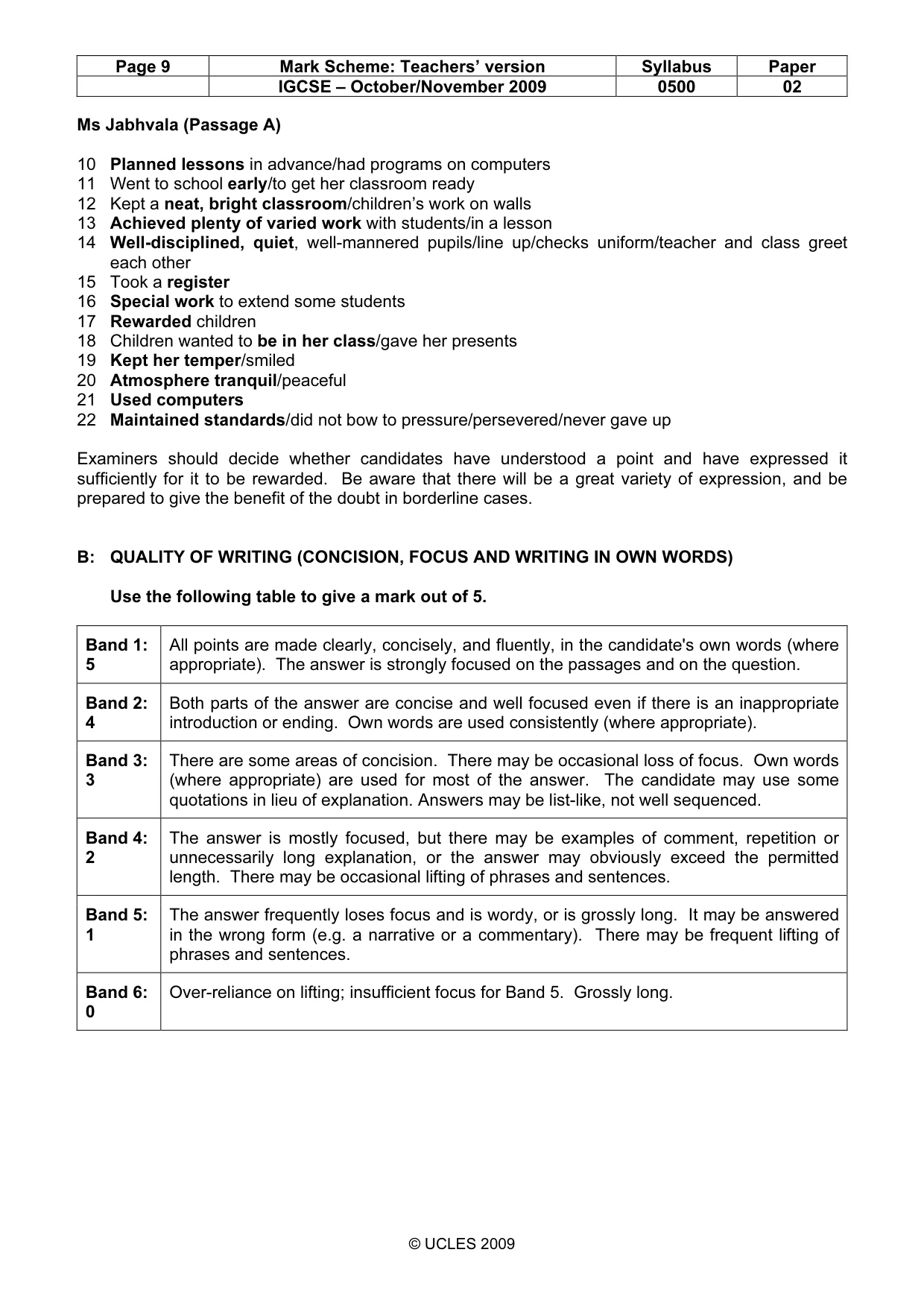
Page 8 Mark Scheme: Teachers’ version Syllabus Paper IGCSE – October/November 2009 0500 02 © UCLES 2009 Question 3 Summarise: (a) the evidence that Mr Chappelle was not a very good teacher, from passage B; (b) the evidence that Ms Jhabvala was an excellent teacher, from passage A. Use your own words as far as possible. You should write about 1 side in total, allowing for the size of your handwriting. Up to 15 marks will be available for the content of your answer, and up to 5 marks for the quality of your writing. This question tests Reading Objectives R1–R3 (15 marks): • understand and collate explicit meanings • understand, explain and collate implicit meanings and attitudes • select, analyse and evaluate what is relevant to specific purposes AND Writing Objectives W1–W5 (5 marks): • articulate experience and express what is thought, felt and imagined • order and present facts, ideas and opinions • understand and use a range of appropriate vocabulary • use language and register appropriate to audience and context • make accurate and effective use of paragraphs, grammatical structures, sentences, punctuation and spelling. A: Content: Give one mark per point up to a maximum of 15. Mr Chappelle (Passage B) 1 Did not appreciate that Dicey was bright/bored/lazy/didn’t stretch her 2 Couldn’t write straight on the board/unusual writing 3 Played with chalk/distraction/annoying habit 4 Stayed still to teach/undramatic/not dynamic 5 Asked unclear questions/over-complicated, abstruse, silly questions/indecisive speech 6 Accepted weak/stupid answers 7 Wrote down everything on board mechanically/indiscriminately 8 Didn’t think fast/maybe less intelligent than some students/didn’t understand Wilhemina/didn’t understand what he was doing 9 Allowed students to get bored/lack of variety – three weeks learning grammar/class not engaged/challenged
Mark scheme, page 9
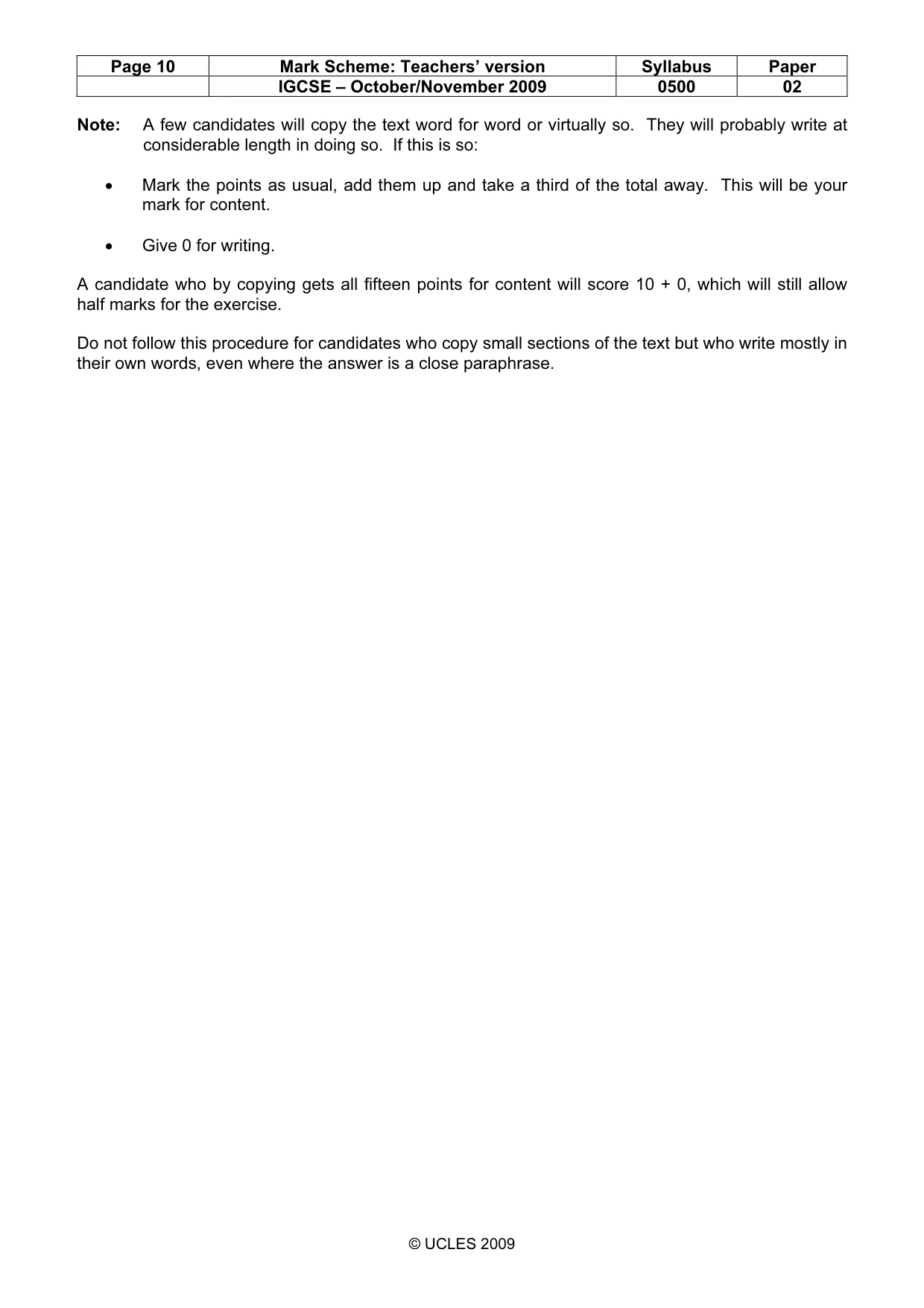
Page 9 Mark Scheme: Teachers’ version Syllabus Paper IGCSE – October/November 2009 0500 02 © UCLES 2009 Ms Jabhvala (Passage A) 10 Planned lessons in advance/had programs on computers 11 Went to school early/to get her classroom ready 12 Kept a neat, bright classroom/children’s work on walls 13 Achieved plenty of varied work with students/in a lesson 14 Well-disciplined, quiet, well-mannered pupils/line up/checks uniform/teacher and class greet each other 15 Took a register 16 Special work to extend some students 17 Rewarded children 18 Children wanted to be in her class/gave her presents 19 Kept her temper/smiled 20 Atmosphere tranquil/peaceful 21 Used computers 22 Maintained standards/did not bow to pressure/persevered/never gave up Examiners should decide whether candidates have understood a point and have expressed it sufficiently for it to be rewarded. Be aware that there will be a great variety of expression, and be prepared to give the benefit of the doubt in borderline cases. B: QUALITY OF WRITING (CONCISION, FOCUS AND WRITING IN OWN WORDS) Use the following table to give a mark out of 5. Band 1: 5 All points are made clearly, concisely, and fluently, in the candidate's own words (where appropriate). The answer is strongly focused on the passages and on the question. Band 2: 4 Both parts of the answer are concise and well focused even if there is an inappropriate introduction or ending. Own words are used consistently (where appropriate). Band 3: 3 There are some areas of concision. There may be occasional loss of focus. Own words (where appropriate) are used for most of the answer. The candidate may use some quotations in lieu of explanation. Answers may be list-like, not well sequenced. Band 4: 2 The answer is mostly focused, but there may be examples of comment, repetition or unnecessarily long explanation, or the answer may obviously exceed the permitted length. There may be occasional lifting of phrases and sentences. Band 5: 1 The answer frequently loses focus and is wordy, or is grossly long. It may be answered in the wrong form (e.g. a narrative or a commentary). There may be frequent lifting of phrases and sentences. Band 6: 0 Over-reliance on lifting; insufficient focus for Band 5. Grossly long.
Mark scheme, page 10
Page 10 Mark Scheme: Teachers’ version Syllabus Paper IGCSE – October/November 2009 0500 02 © UCLES 2009 Note: A few candidates will copy the text word for word or virtually so. They will probably write at considerable length in doing so. If this is so: • Mark the points as usual, add them up and take a third of the total away. This will be your mark for content. • Give 0 for writing. A candidate who by copying gets all fifteen points for content will score 10 + 0, which will still allow half marks for the exercise. Do not follow this procedure for candidates who copy small sections of the text but who write mostly in their own words, even where the answer is a close paraphrase.
What you needed in this session
Cambridge’s own grade thresholds for 2009 Oct/Nov, Paper 2 · Variant 1. A higher threshold means an easier paper — the bar moves with how the cohort did.