Cambridge IGCSE English - First Language 0500 — 2009 Oct/Nov Paper 1 · Variant 1
0500/11/O/N/09 · 50 marks · ≈56 min
The question paper and its mark scheme, free to read here and free to download. This is Cambridge’s own paper, exactly as it was sat.
Question paper4 pages
Mark scheme5 pages
Answers below. Sit the paper first if you are practising.
Paper as text
Question paper, page 1
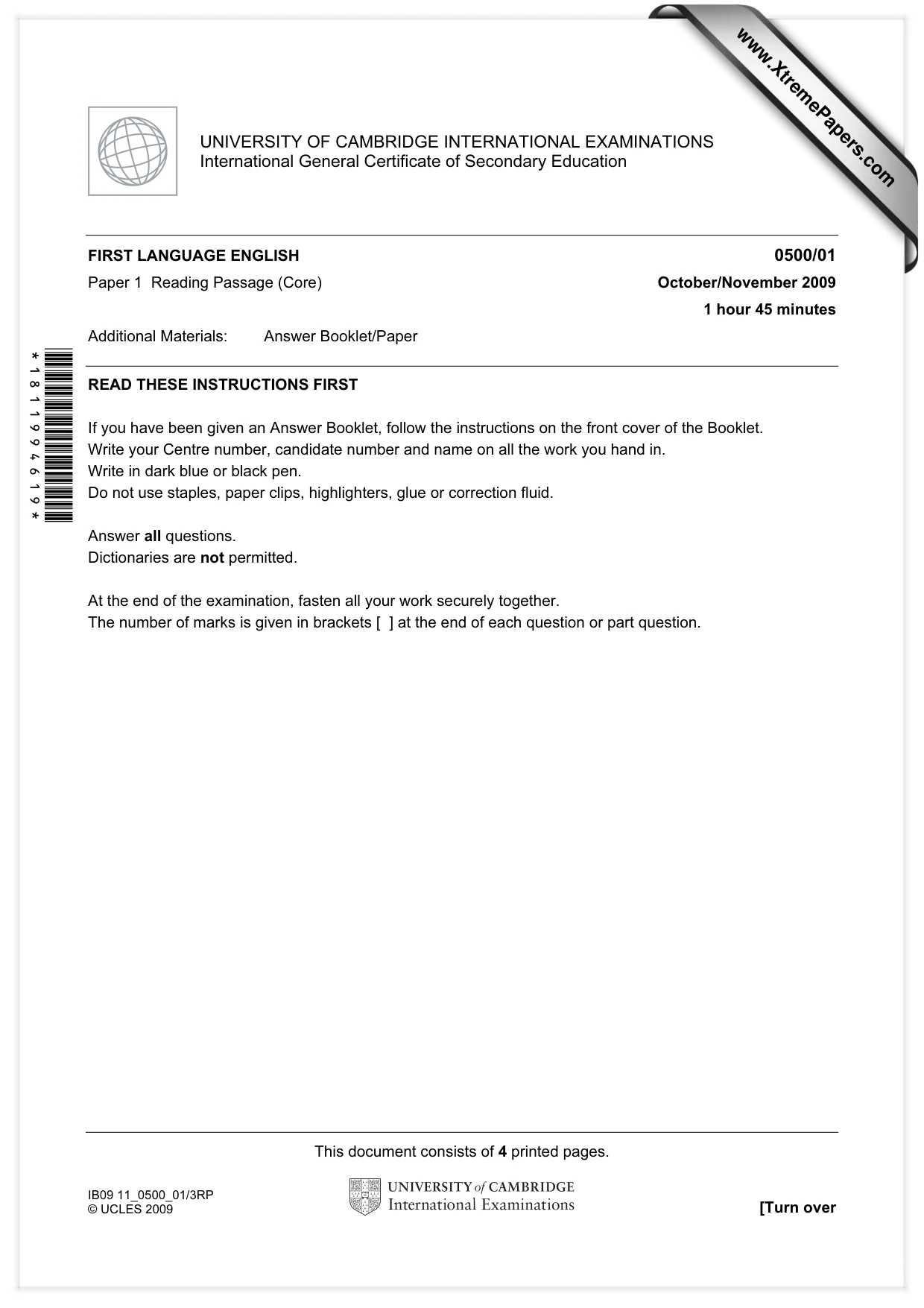
This document consists of 4 printed pages. IB09 11_0500_01/3RP © UCLES 2009 [Turn over *1811994619* UNIVERSITY OF CAMBRIDGE INTERNATIONAL EXAMINATIONS International General Certificate of Secondary Education FIRST LANGUAGE ENGLISH 0500/01 Paper 1 Reading Passage (Core) October/November 2009 1 hour 45 minutes Additional Materials: Answer Booklet/Paper READ THESE INSTRUCTIONS FIRST If you have been given an Answer Booklet, follow the instructions on the front cover of the Booklet. Write your Centre number, candidate number and name on all the work you hand in. Write in dark blue or black pen. Do not use staples, paper clips, highlighters, glue or correction fluid. Answer all questions. Dictionaries are not permitted. At the end of the examination, fasten all your work securely together. The number of marks is given in brackets [ ] at the end of each question or part question. www.XtremePapers.com
Question paper, page 2
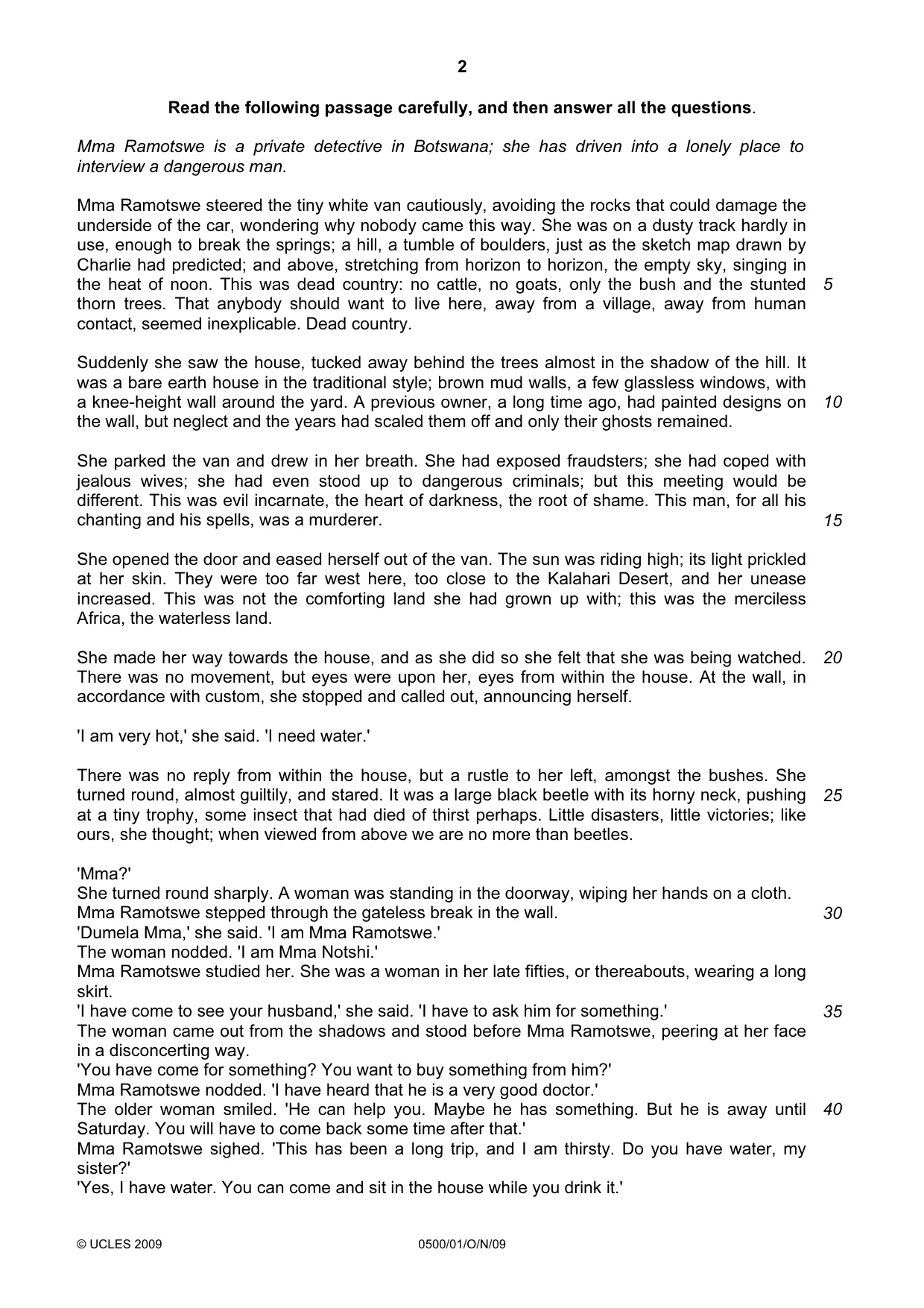
2 © UCLES 2009 0500/01/O/N/09 Read the following passage carefully, and then answer all the questions. Mma Ramotswe is a private detective in Botswana; she has driven into a lonely place to interview a dangerous man. Mma Ramotswe steered the tiny white van cautiously, avoiding the rocks that could damage the underside of the car, wondering why nobody came this way. She was on a dusty track hardly in use, enough to break the springs; a hill, a tumble of boulders, just as the sketch map drawn by Charlie had predicted; and above, stretching from horizon to horizon, the empty sky, singing in the heat of noon. This was dead country: no cattle, no goats, only the bush and the stunted thorn trees. That anybody should want to live here, away from a village, away from human contact, seemed inexplicable. Dead country. Suddenly she saw the house, tucked away behind the trees almost in the shadow of the hill. It was a bare earth house in the traditional style; brown mud walls, a few glassless windows, with a knee-height wall around the yard. A previous owner, a long time ago, had painted designs on the wall, but neglect and the years had scaled them off and only their ghosts remained. She parked the van and drew in her breath. She had exposed fraudsters; she had coped with jealous wives; she had even stood up to dangerous criminals; but this meeting would be different. This was evil incarnate, the heart of darkness, the root of shame. This man, for all his chanting and his spells, was a murderer. She opened the door and eased herself out of the van. The sun was riding high; its light prickled at her skin. They were too far west here, too close to the Kalahari Desert, and her unease increased. This was not the comforting land she had grown up with; this was the merciless Africa, the waterless land. She made her way towards the house, and as she did so she felt that she was being watched. There was no movement, but eyes were upon her, eyes from within the house. At the wall, in accordance with custom, she stopped and called out, announcing herself. 'I am very hot,' she said. 'I need water.' There was no reply from within the house, but a rustle to her left, amongst the bushes. She turned round, almost guiltily, and stared. It was a large black beetle with its horny neck, pushing at a tiny trophy, some insect that had died of thirst perhaps. Little disasters, little victories; like ours, she thought; when viewed from above we are no more than beetles. 'Mma?' She turned round sharply. A woman was standing in the doorway, wiping her hands on a cloth. Mma Ramotswe stepped through the gateless break in the wall. 'Dumela Mma,' she said. 'I am Mma Ramotswe.' The woman nodded. 'I am Mma Notshi.' Mma Ramotswe studied her. She was a woman in her late fifties, or thereabouts, wearing a long skirt. 'I have come to see your husband,' she said. 'I have to ask him for something.' The woman came out from the shadows and stood before Mma Ramotswe, peering at her face in a disconcerting way. 'You have come for something? You want to buy something from him?' Mma Ramotswe nodded. 'I have heard that he is a very good doctor.' The older woman smiled. 'He can help you. Maybe he has something. But he is away until Saturday. You will have to come back some time after that.' Mma Ramotswe sighed. 'This has been a long trip, and I am thirsty. Do you have water, my sister?' 'Yes, I have water. You can come and sit in the house while you drink it.' 5 10 15 20 25 30 35 40
Question paper, page 3
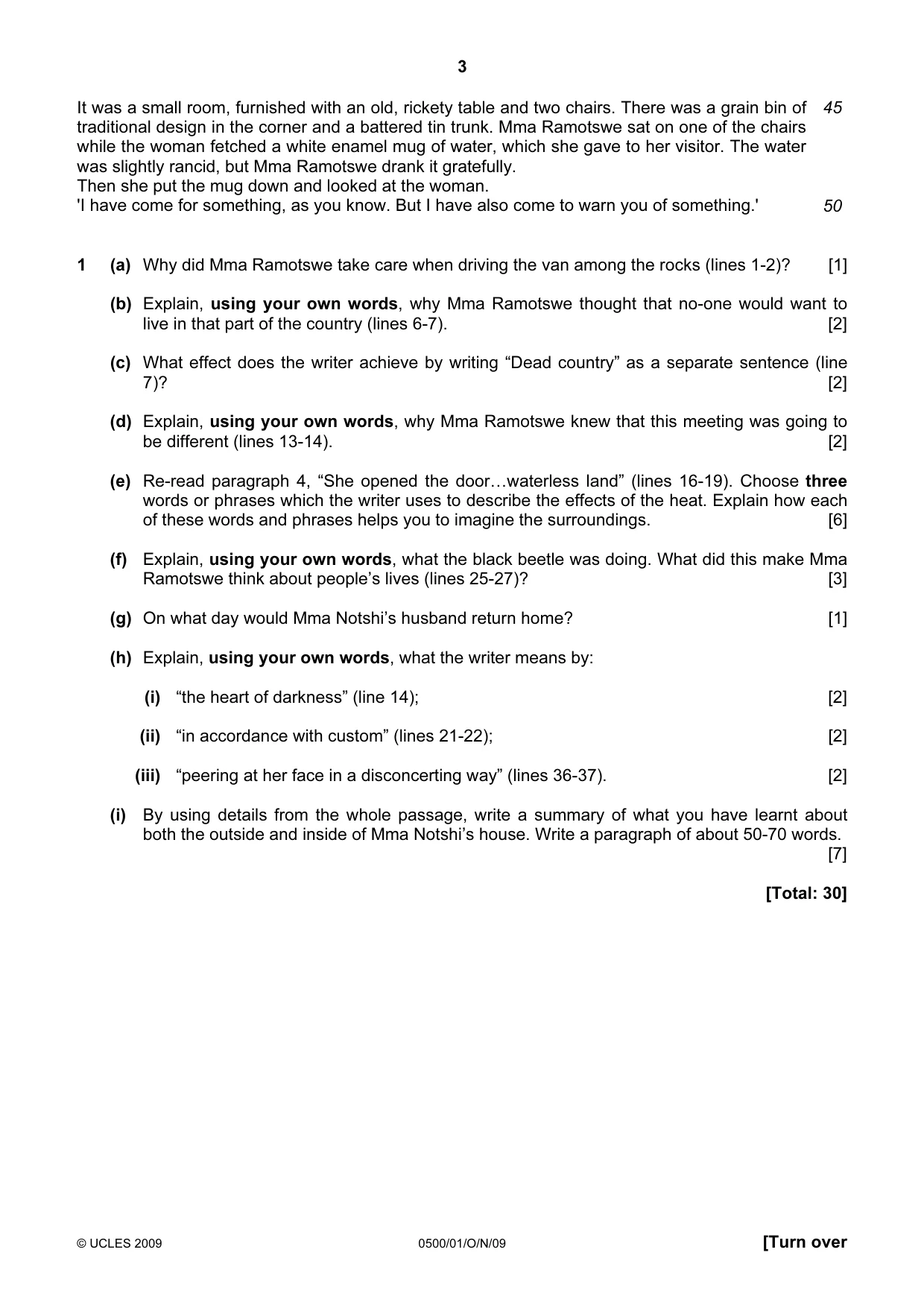
3 © UCLES 2009 0500/01/O/N/09 [Turn over It was a small room, furnished with an old, rickety table and two chairs. There was a grain bin of traditional design in the corner and a battered tin trunk. Mma Ramotswe sat on one of the chairs while the woman fetched a white enamel mug of water, which she gave to her visitor. The water was slightly rancid, but Mma Ramotswe drank it gratefully. Then she put the mug down and looked at the woman. 'I have come for something, as you know. But I have also come to warn you of something.' 45 50 1 (a) Why did Mma Ramotswe take care when driving the van among the rocks (lines 1-2)? [1] (b) Explain, using your own words, why Mma Ramotswe thought that no-one would want to live in that part of the country (lines 6-7). [2] (c) What effect does the writer achieve by writing “Dead country” as a separate sentence (line 7)? [2] (d) Explain, using your own words, why Mma Ramotswe knew that this meeting was going to be different (lines 13-14). [2] (e) Re-read paragraph 4, “She opened the door…waterless land” (lines 16-19). Choose three words or phrases which the writer uses to describe the effects of the heat. Explain how each of these words and phrases helps you to imagine the surroundings. [6] (f) Explain, using your own words, what the black beetle was doing. What did this make Mma Ramotswe think about people’s lives (lines 25-27)? [3] (g) On what day would Mma Notshi’s husband return home? [1] (h) Explain, using your own words, what the writer means by: (i) “the heart of darkness” (line 14); [2] (ii) “in accordance with custom” (lines 21-22); [2] (iii) “peering at her face in a disconcerting way” (lines 36-37). [2] (i) By using details from the whole passage, write a summary of what you have learnt about both the outside and inside of Mma Notshi’s house. Write a paragraph of about 50-70 words. [7] [Total: 30]
Question paper, page 4
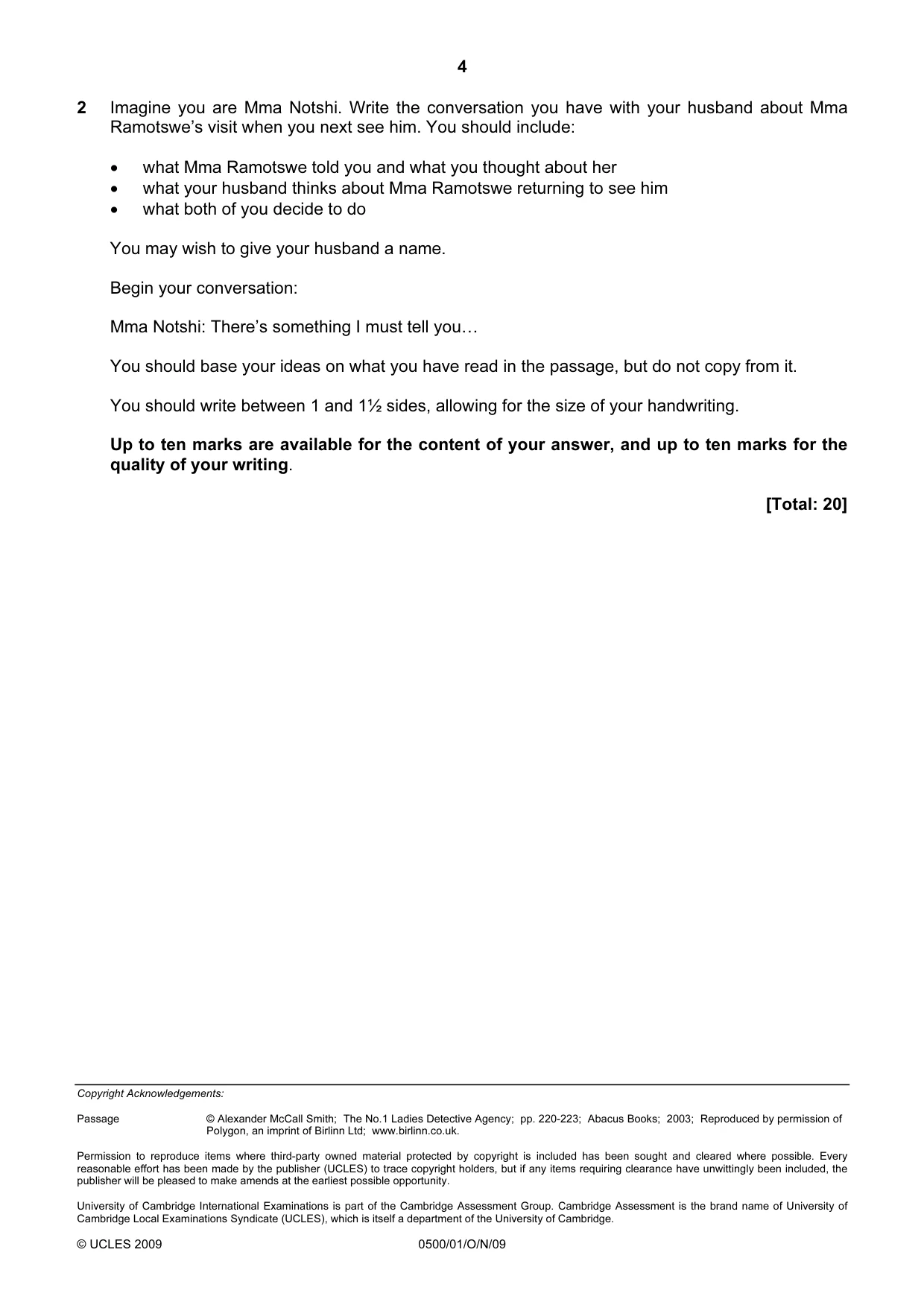
4 Copyright Acknowledgements: Passage © Alexander McCall Smith; The No.1 Ladies Detective Agency; pp. 220-223; Abacus Books; 2003; Reproduced by permission of Polygon, an imprint of Birlinn Ltd; www.birlinn.co.uk. Permission to reproduce items where third-party owned material protected by copyright is included has been sought and cleared where possible. Every reasonable effort has been made by the publisher (UCLES) to trace copyright holders, but if any items requiring clearance have unwittingly been included, the publisher will be pleased to make amends at the earliest possible opportunity. University of Cambridge International Examinations is part of the Cambridge Assessment Group. Cambridge Assessment is the brand name of University of Cambridge Local Examinations Syndicate (UCLES), which is itself a department of the University of Cambridge. © UCLES 2009 0500/01/O/N/09 2 Imagine you are Mma Notshi. Write the conversation you have with your husband about Mma Ramotswe’s visit when you next see him. You should include: • what Mma Ramotswe told you and what you thought about her • what your husband thinks about Mma Ramotswe returning to see him • what both of you decide to do You may wish to give your husband a name. Begin your conversation: Mma Notshi: There’s something I must tell you… You should base your ideas on what you have read in the passage, but do not copy from it. You should write between 1 and 1½ sides, allowing for the size of your handwriting. Up to ten marks are available for the content of your answer, and up to ten marks for the quality of your writing. [Total: 20]
Mark scheme, page 1
UNIVERSITY OF CAMBRIDGE INTERNATIONAL EXAMINATIONS International General Certificate of Secondary Education MARK SCHEME for the October/November 2009 question paper for the guidance of teachers 0500 FIRST LANGUAGE ENGLISH 0500/01 Paper 1 (Reading Passage – Core), maximum raw mark 50 This mark scheme is published as an aid to teachers and candidates, to indicate the requirements of the examination. It shows the basis on which Examiners were instructed to award marks. It does not indicate the details of the discussions that took place at an Examiners’ meeting before marking began, which would have considered the acceptability of alternative answers. Mark schemes must be read in conjunction with the question papers and the report on the examination. • CIE will not enter into discussions or correspondence in connection with these mark schemes. CIE is publishing the mark schemes for the October/November 2009 question papers for most IGCSE, GCE Advanced Level and Advanced Subsidiary Level syllabuses and some Ordinary Level syllabuses. www.XtremePapers.com
Mark scheme, page 2
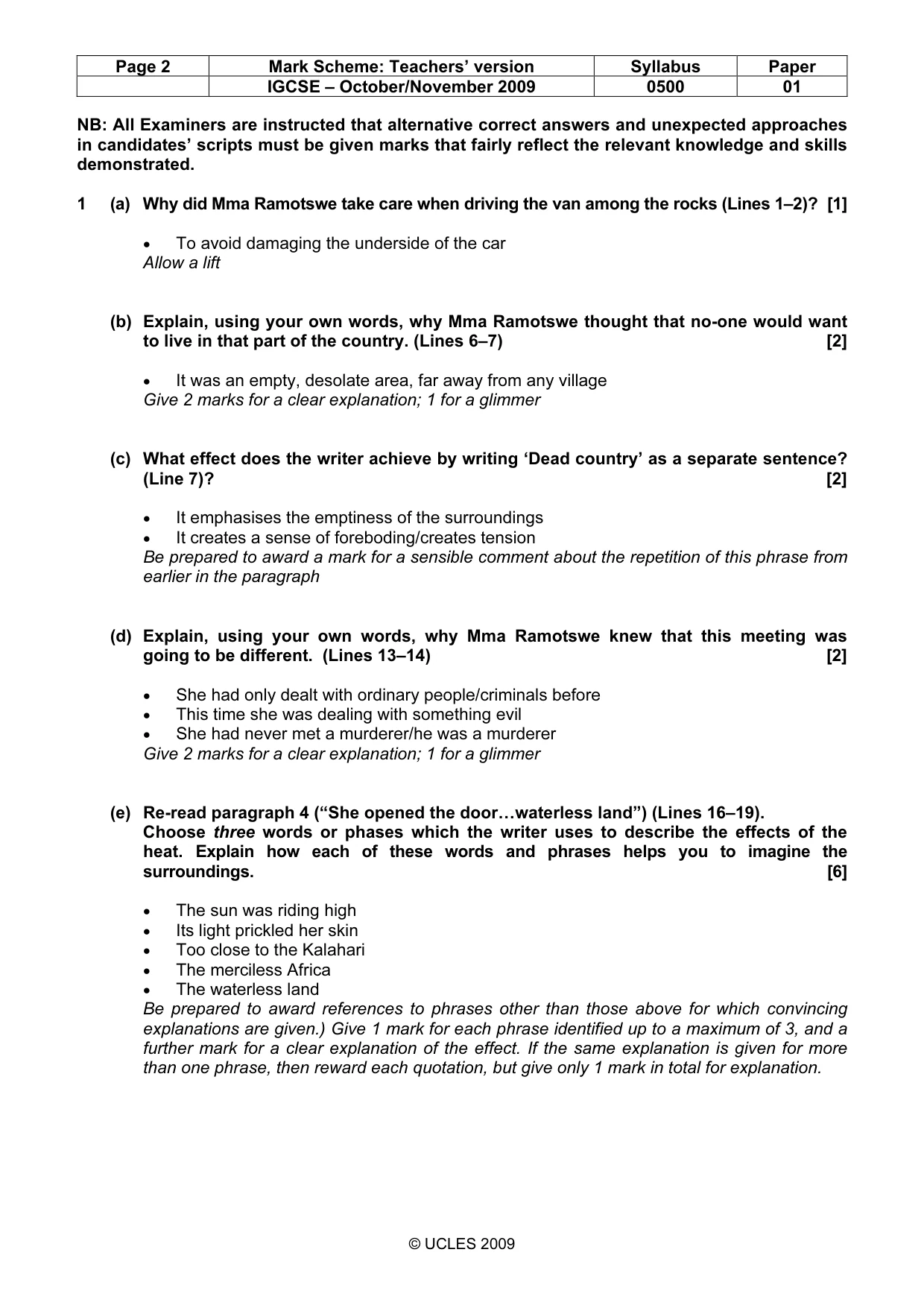
Page 2 Mark Scheme: Teachers’ version Syllabus Paper IGCSE – October/November 2009 0500 01 © UCLES 2009 NB: All Examiners are instructed that alternative correct answers and unexpected approaches in candidates’ scripts must be given marks that fairly reflect the relevant knowledge and skills demonstrated. 1 (a) Why did Mma Ramotswe take care when driving the van among the rocks (Lines 1–2)? [1] • To avoid damaging the underside of the car Allow a lift (b) Explain, using your own words, why Mma Ramotswe thought that no-one would want to live in that part of the country. (Lines 6–7) [2] • It was an empty, desolate area, far away from any village Give 2 marks for a clear explanation; 1 for a glimmer (c) What effect does the writer achieve by writing ‘Dead country’ as a separate sentence? (Line 7)? [2] • It emphasises the emptiness of the surroundings • It creates a sense of foreboding/creates tension Be prepared to award a mark for a sensible comment about the repetition of this phrase from earlier in the paragraph (d) Explain, using your own words, why Mma Ramotswe knew that this meeting was going to be different. (Lines 13–14) [2] • She had only dealt with ordinary people/criminals before • This time she was dealing with something evil • She had never met a murderer/he was a murderer Give 2 marks for a clear explanation; 1 for a glimmer (e) Re-read paragraph 4 (“She opened the door…waterless land”) (Lines 16–19). Choose three words or phases which the writer uses to describe the effects of the heat. Explain how each of these words and phrases helps you to imagine the surroundings. [6] • The sun was riding high • Its light prickled her skin • Too close to the Kalahari • The merciless Africa • The waterless land Be prepared to award references to phrases other than those above for which convincing explanations are given.) Give 1 mark for each phrase identified up to a maximum of 3, and a further mark for a clear explanation of the effect. If the same explanation is given for more than one phrase, then reward each quotation, but give only 1 mark in total for explanation.
Mark scheme, page 3
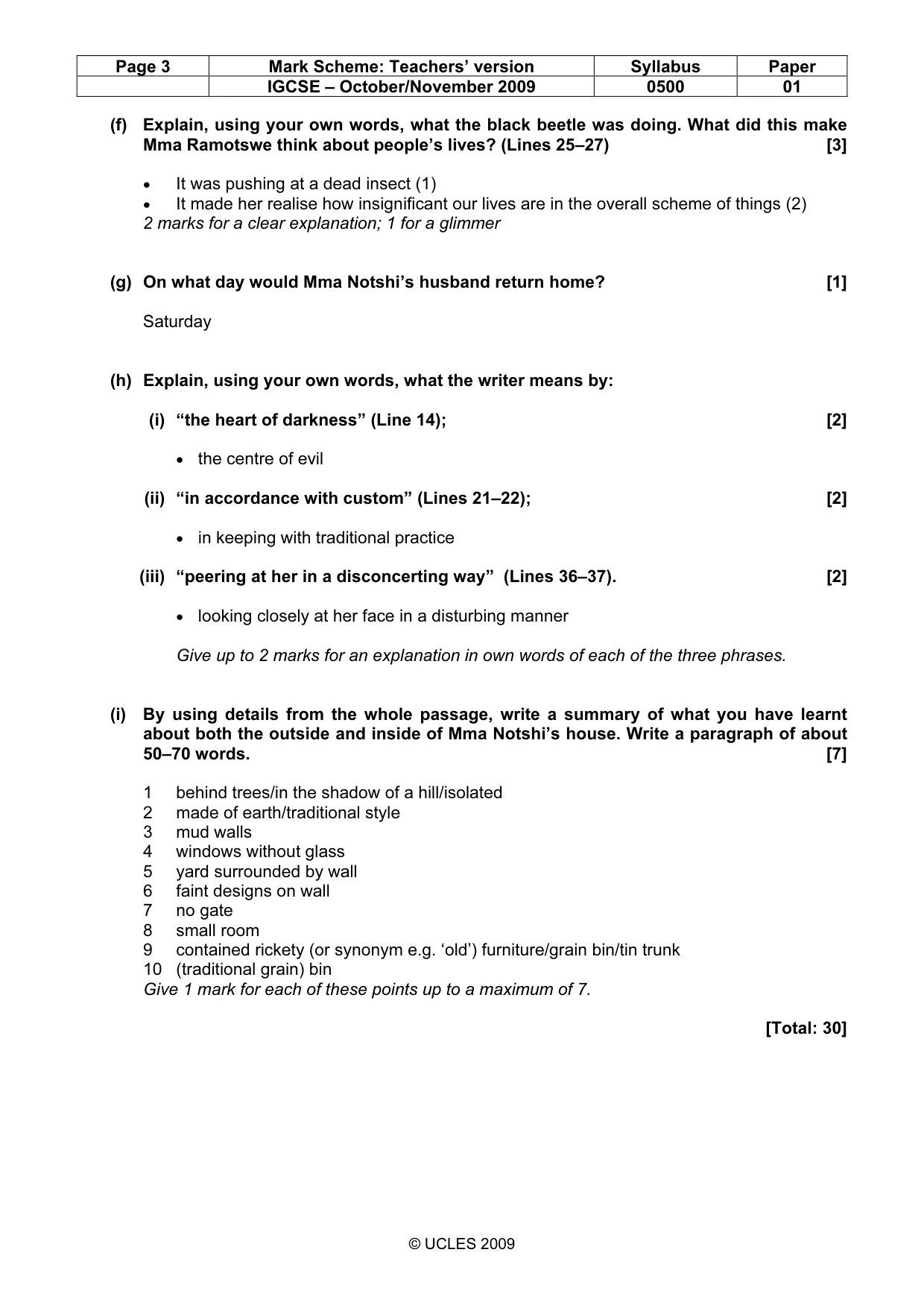
Page 3 Mark Scheme: Teachers’ version Syllabus Paper IGCSE – October/November 2009 0500 01 © UCLES 2009 (f) Explain, using your own words, what the black beetle was doing. What did this make Mma Ramotswe think about people’s lives? (Lines 25–27) [3] • It was pushing at a dead insect (1) • It made her realise how insignificant our lives are in the overall scheme of things (2) 2 marks for a clear explanation; 1 for a glimmer (g) On what day would Mma Notshi’s husband return home? [1] Saturday (h) Explain, using your own words, what the writer means by: (i) “the heart of darkness” (Line 14); [2] • the centre of evil (ii) “in accordance with custom” (Lines 21–22); [2] • in keeping with traditional practice (iii) “peering at her in a disconcerting way” (Lines 36–37). [2] • looking closely at her face in a disturbing manner Give up to 2 marks for an explanation in own words of each of the three phrases. (i) By using details from the whole passage, write a summary of what you have learnt about both the outside and inside of Mma Notshi’s house. Write a paragraph of about 50–70 words. [7] 1 behind trees/in the shadow of a hill/isolated 2 made of earth/traditional style 3 mud walls 4 windows without glass 5 yard surrounded by wall 6 faint designs on wall 7 no gate 8 small room 9 contained rickety (or synonym e.g. ‘old’) furniture/grain bin/tin trunk 10 (traditional grain) bin Give 1 mark for each of these points up to a maximum of 7. [Total: 30]
Mark scheme, page 4
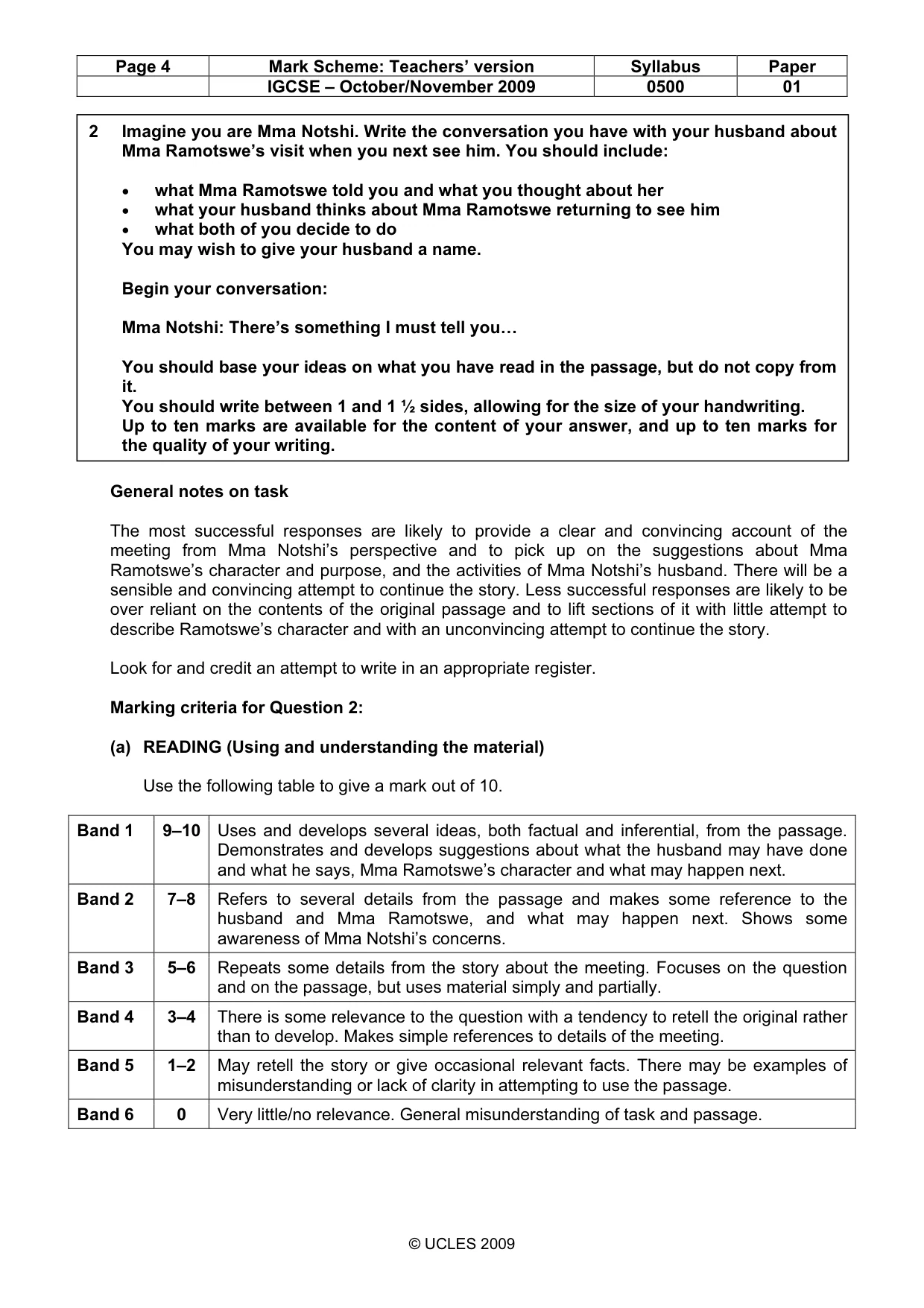
Page 4 Mark Scheme: Teachers’ version Syllabus Paper IGCSE – October/November 2009 0500 01 © UCLES 2009 General notes on task The most successful responses are likely to provide a clear and convincing account of the meeting from Mma Notshi’s perspective and to pick up on the suggestions about Mma Ramotswe’s character and purpose, and the activities of Mma Notshi’s husband. There will be a sensible and convincing attempt to continue the story. Less successful responses are likely to be over reliant on the contents of the original passage and to lift sections of it with little attempt to describe Ramotswe’s character and with an unconvincing attempt to continue the story. Look for and credit an attempt to write in an appropriate register. Marking criteria for Question 2: (a) READING (Using and understanding the material) Use the following table to give a mark out of 10. Band 1 9–10 Uses and develops several ideas, both factual and inferential, from the passage. Demonstrates and develops suggestions about what the husband may have done and what he says, Mma Ramotswe’s character and what may happen next. Band 2 7–8 Refers to several details from the passage and makes some reference to the husband and Mma Ramotswe, and what may happen next. Shows some awareness of Mma Notshi’s concerns. Band 3 5–6 Repeats some details from the story about the meeting. Focuses on the question and on the passage, but uses material simply and partially. Band 4 3–4 There is some relevance to the question with a tendency to retell the original rather than to develop. Makes simple references to details of the meeting. Band 5 1–2 May retell the story or give occasional relevant facts. There may be examples of misunderstanding or lack of clarity in attempting to use the passage. Band 6 0 Very little/no relevance. General misunderstanding of task and passage. 2 Imagine you are Mma Notshi. Write the conversation you have with your husband about Mma Ramotswe’s visit when you next see him. You should include: • what Mma Ramotswe told you and what you thought about her • what your husband thinks about Mma Ramotswe returning to see him • what both of you decide to do You may wish to give your husband a name. Begin your conversation: Mma Notshi: There’s something I must tell you… You should base your ideas on what you have read in the passage, but do not copy from it. You should write between 1 and 1 ½ sides, allowing for the size of your handwriting. Up to ten marks are available for the content of your answer, and up to ten marks for the quality of your writing.
Mark scheme, page 5
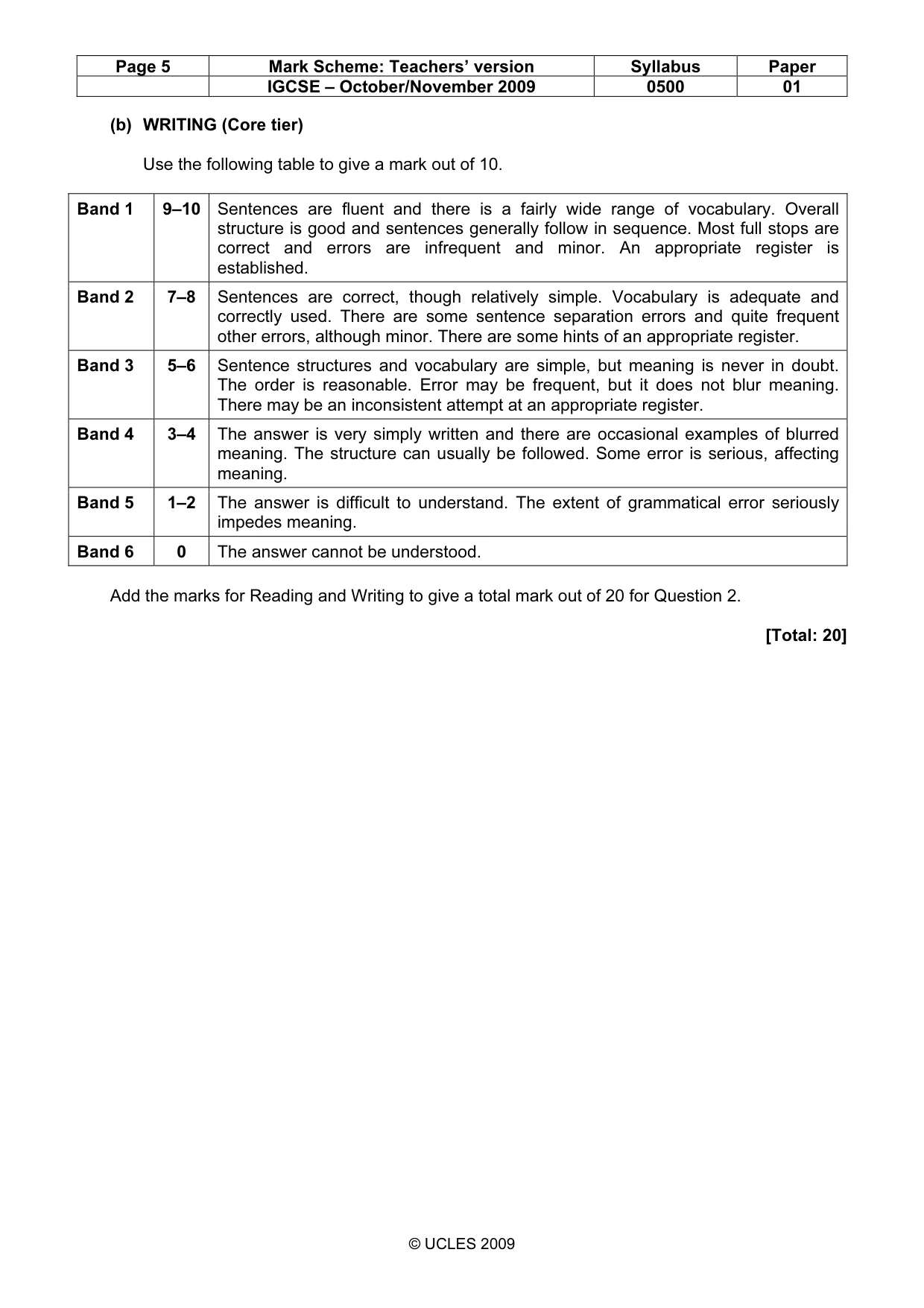
Page 5 Mark Scheme: Teachers’ version Syllabus Paper IGCSE – October/November 2009 0500 01 © UCLES 2009 (b) WRITING (Core tier) Use the following table to give a mark out of 10. Band 1 9–10 Sentences are fluent and there is a fairly wide range of vocabulary. Overall structure is good and sentences generally follow in sequence. Most full stops are correct and errors are infrequent and minor. An appropriate register is established. Band 2 7–8 Sentences are correct, though relatively simple. Vocabulary is adequate and correctly used. There are some sentence separation errors and quite frequent other errors, although minor. There are some hints of an appropriate register. Band 3 5–6 Sentence structures and vocabulary are simple, but meaning is never in doubt. The order is reasonable. Error may be frequent, but it does not blur meaning. There may be an inconsistent attempt at an appropriate register. Band 4 3–4 The answer is very simply written and there are occasional examples of blurred meaning. The structure can usually be followed. Some error is serious, affecting meaning. Band 5 1–2 The answer is difficult to understand. The extent of grammatical error seriously impedes meaning. Band 6 0 The answer cannot be understood. Add the marks for Reading and Writing to give a total mark out of 20 for Question 2. [Total: 20]
What you needed in this session
Cambridge’s own grade thresholds for 2009 Oct/Nov, Paper 1 · Variant 1. A higher threshold means an easier paper — the bar moves with how the cohort did.