Cambridge IGCSE English - First Language 0500 — 2009 May/June Paper 3 · Variant 1
0500/31/M/J/09
The question paper and its mark scheme, free to read here and free to download. This is Cambridge’s own paper, exactly as it was sat.
Question paper9 pages
Mark scheme19 pages
Answers below. Sit the paper first if you are practising.
Paper as text
Question paper, page 1
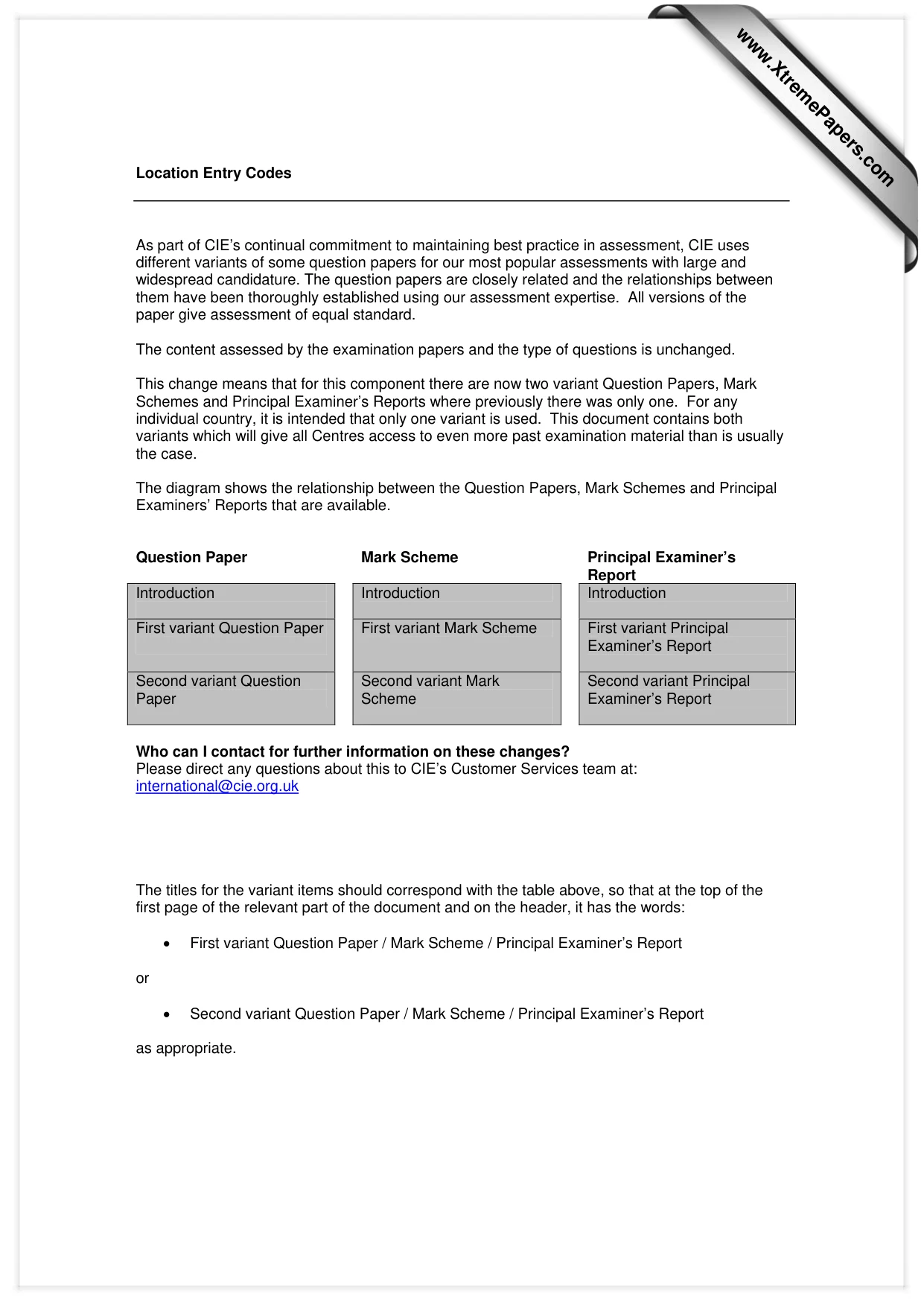
Location Entry Codes As part of CIE’s continual commitment to maintaining best practice in assessment, CIE uses different variants of some question papers for our most popular assessments with large and widespread candidature. The question papers are closely related and the relationships between them have been thoroughly established using our assessment expertise. All versions of the paper give assessment of equal standard. The content assessed by the examination papers and the type of questions is unchanged. This change means that for this component there are now two variant Question Papers, Mark Schemes and Principal Examiner’s Reports where previously there was only one. For any individual country, it is intended that only one variant is used. This document contains both variants which will give all Centres access to even more past examination material than is usually the case. The diagram shows the relationship between the Question Papers, Mark Schemes and Principal Examiners’ Reports that are available. Question Paper Mark Scheme Principal Examiner’s Report Introduction Introduction Introduction First variant Question Paper First variant Mark Scheme First variant Principal Examiner’s Report Second variant Question Paper Second variant Mark Scheme Second variant Principal Examiner’s Report Who can I contact for further information on these changes? Please direct any questions about this to CIE’s Customer Services team at: international@cie.org.uk The titles for the variant items should correspond with the table above, so that at the top of the first page of the relevant part of the document and on the header, it has the words: • First variant Question Paper / Mark Scheme / Principal Examiner’s Report or • Second variant Question Paper / Mark Scheme / Principal Examiner’s Report as appropriate. www.XtremePapers.com
Question paper, page 2
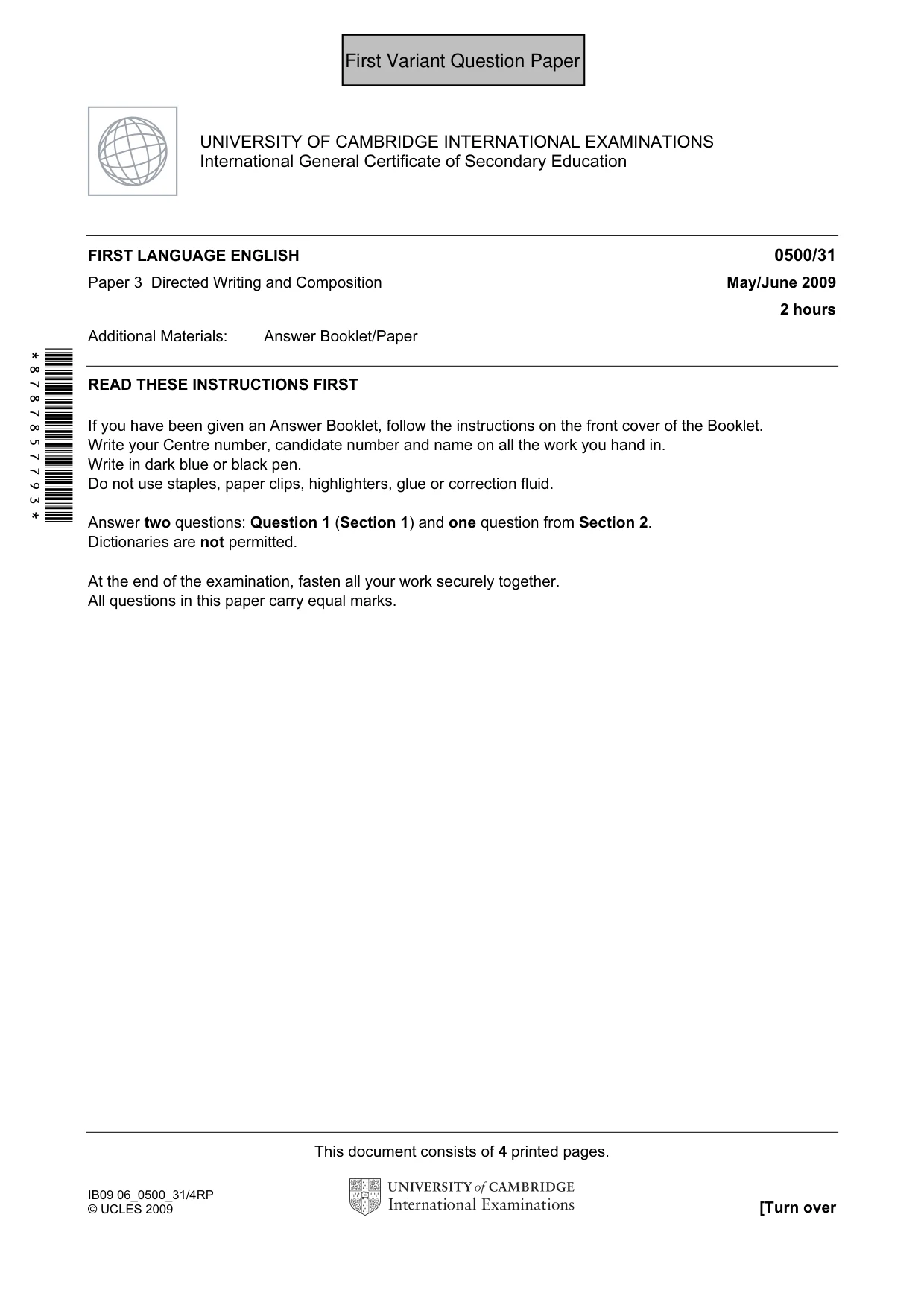
This document consists of 4 printed pages. IB09 06_0500_31/4RP © UCLES 2009 [Turn over *8787857793* UNIVERSITY OF CAMBRIDGE INTERNATIONAL EXAMINATIONS International General Certificate of Secondary Education FIRST LANGUAGE ENGLISH 0500/31 Paper 3 Directed Writing and Composition May/June 2009 2 hours Additional Materials: Answer Booklet/Paper READ THESE INSTRUCTIONS FIRST If you have been given an Answer Booklet, follow the instructions on the front cover of the Booklet. Write your Centre number, candidate number and name on all the work you hand in. Write in dark blue or black pen. Do not use staples, paper clips, highlighters, glue or correction fluid. Answer two questions: Question 1 (Section 1) and one question from Section 2. Dictionaries are not permitted. At the end of the examination, fasten all your work securely together. All questions in this paper carry equal marks. First Variant Question Paper
Question paper, page 3
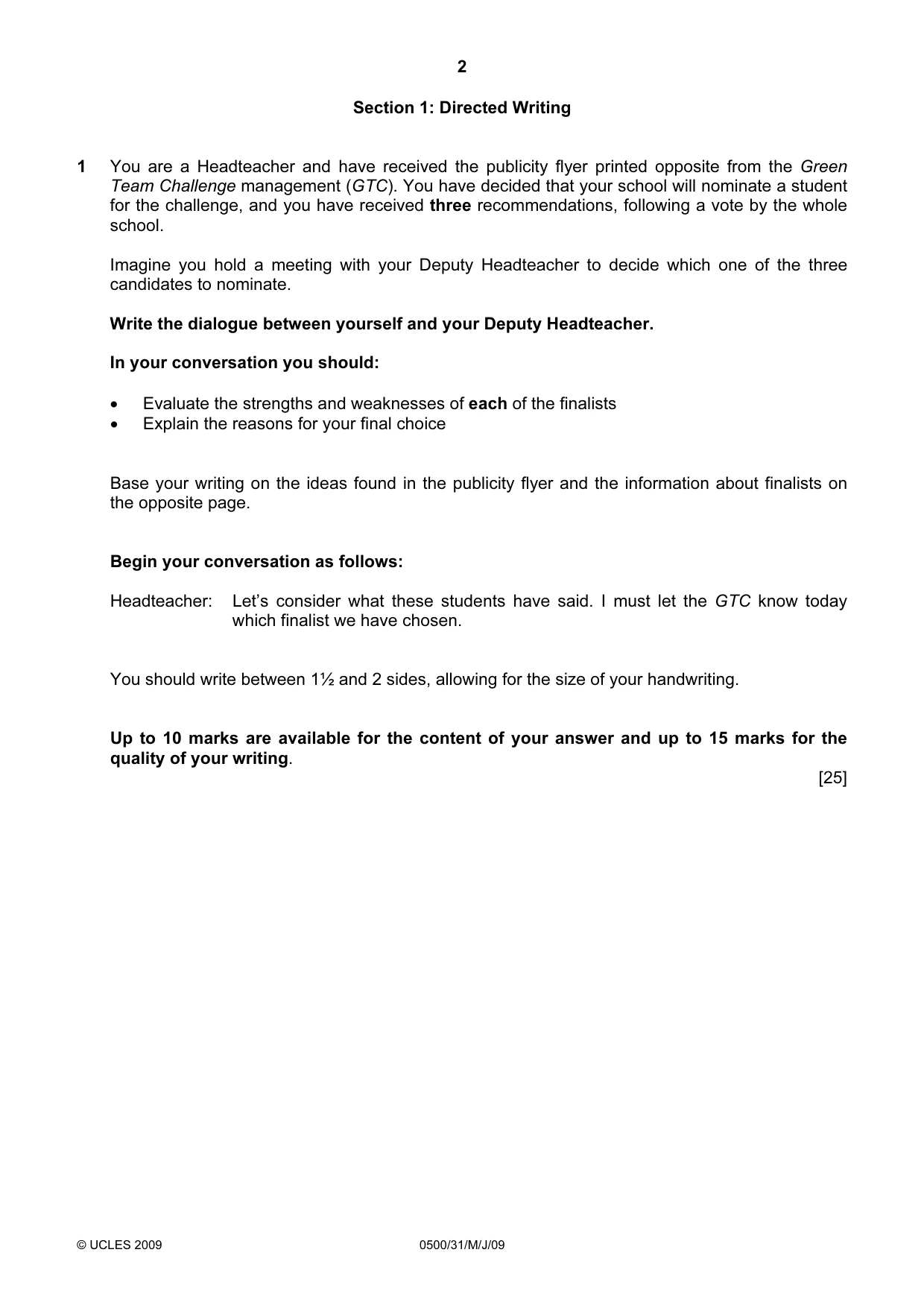
2 © UCLES 2009 0500/31/M/J/09 Section 1: Directed Writing 1 You are a Headteacher and have received the publicity flyer printed opposite from the Green Team Challenge management (GTC). You have decided that your school will nominate a student for the challenge, and you have received three recommendations, following a vote by the whole school. Imagine you hold a meeting with your Deputy Headteacher to decide which one of the three candidates to nominate. Write the dialogue between yourself and your Deputy Headteacher. In your conversation you should: • Evaluate the strengths and weaknesses of each of the finalists • Explain the reasons for your final choice Base your writing on the ideas found in the publicity flyer and the information about finalists on the opposite page. Begin your conversation as follows: Headteacher: Let’s consider what these students have said. I must let the GTC know today which finalist we have chosen. You should write between 1½ and 2 sides, allowing for the size of your handwriting. Up to 10 marks are available for the content of your answer and up to 15 marks for the quality of your writing. [25]
Question paper, page 4
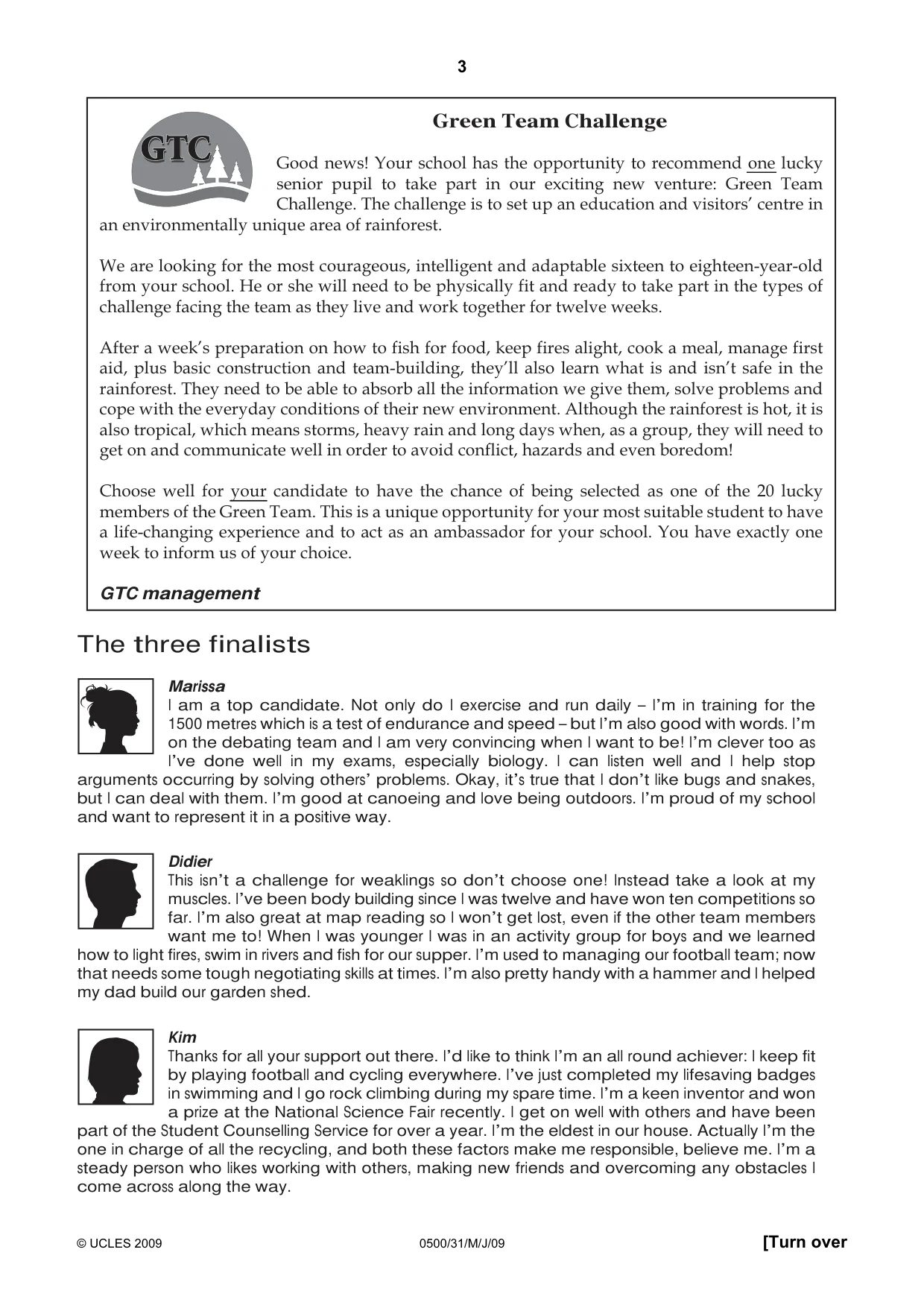
3 © UCLES 2009 0500/31/M/J/09 [Turn over Green Team Challenge Good news! Your school has the opportunity to recommend one lucky senior pupil to take part in our exciting new venture: Green Team Challenge. The challenge is to set up an education and visitors’ centre in an environmentally unique area of rainforest. We are looking for the most courageous, intelligent and adaptable sixteen to eighteen-year-old from your school. He or she will need to be physically fit and ready to take part in the types of challenge facing the team as they live and work together for twelve weeks. After a week’s preparation on how to fish for food, keep fires alight, cook a meal, manage first aid, plus basic construction and team-building, they’ll also learn what is and isn’t safe in the rainforest. They need to be able to absorb all the information we give them, solve problems and cope with the everyday conditions of their new environment. Although the rainforest is hot, it is also tropical, which means storms, heavy rain and long days when, as a group, they will need to get on and communicate well in order to avoid conflict, hazards and even boredom! Choose well for your candidate to have the chance of being selected as one of the 20 lucky members of the Green Team. This is a unique opportunity for your most suitable student to have a life-changing experience and to act as an ambassador for your school. You have exactly one week to inform us of your choice. GTC management Marissa I am a top candidate. Not only do I exercise and run daily – I’m in training for the 1500 metres which is a test of endurance and speed – but I’m also good with words. I’m on the debating team and I am very convincing when I want to be! I’m clever too as I’ve done well in my exams, especially biology. I can listen well and I help stop arguments occurring by solving others’ problems. Okay, it’s true that I don’t like bugs and snakes, but I can deal with them. I’m good at canoeing and love being outdoors. I’m proud of my school and want to represent it in a positive way. Kim Thanks for all your support out there. I’d like to think I’m an all round achiever: I keep fit by playing football and cycling everywhere. I’ve just completed my lifesaving badges in swimming and I go rock climbing during my spare time. I’m a keen inventor and won a prize at the National Science Fair recently. I get on well with others and have been part of the Student Counselling Service for over a year. I’m the eldest in our house. Actually I’m the one in charge of all the recycling, and both these factors make me responsible, believe me. I’m a steady person who likes working with others, making new friends and overcoming any obstacles I come across along the way. Didier This isn’t a challenge for weaklings so don’t choose one! Instead take a look at my muscles. I’ve been body building since I was twelve and have won ten competitions so far. I’m also great at map reading so I won’t get lost, even if the other team members want me to! When I was younger I was in an activity group for boys and we learned how to light fires, swim in rivers and fish for our supper. I’m used to managing our football team; now that needs some tough negotiating skills at times. I’m also pretty handy with a hammer and I helped my dad build our garden shed. The three finalists
Question paper, page 5
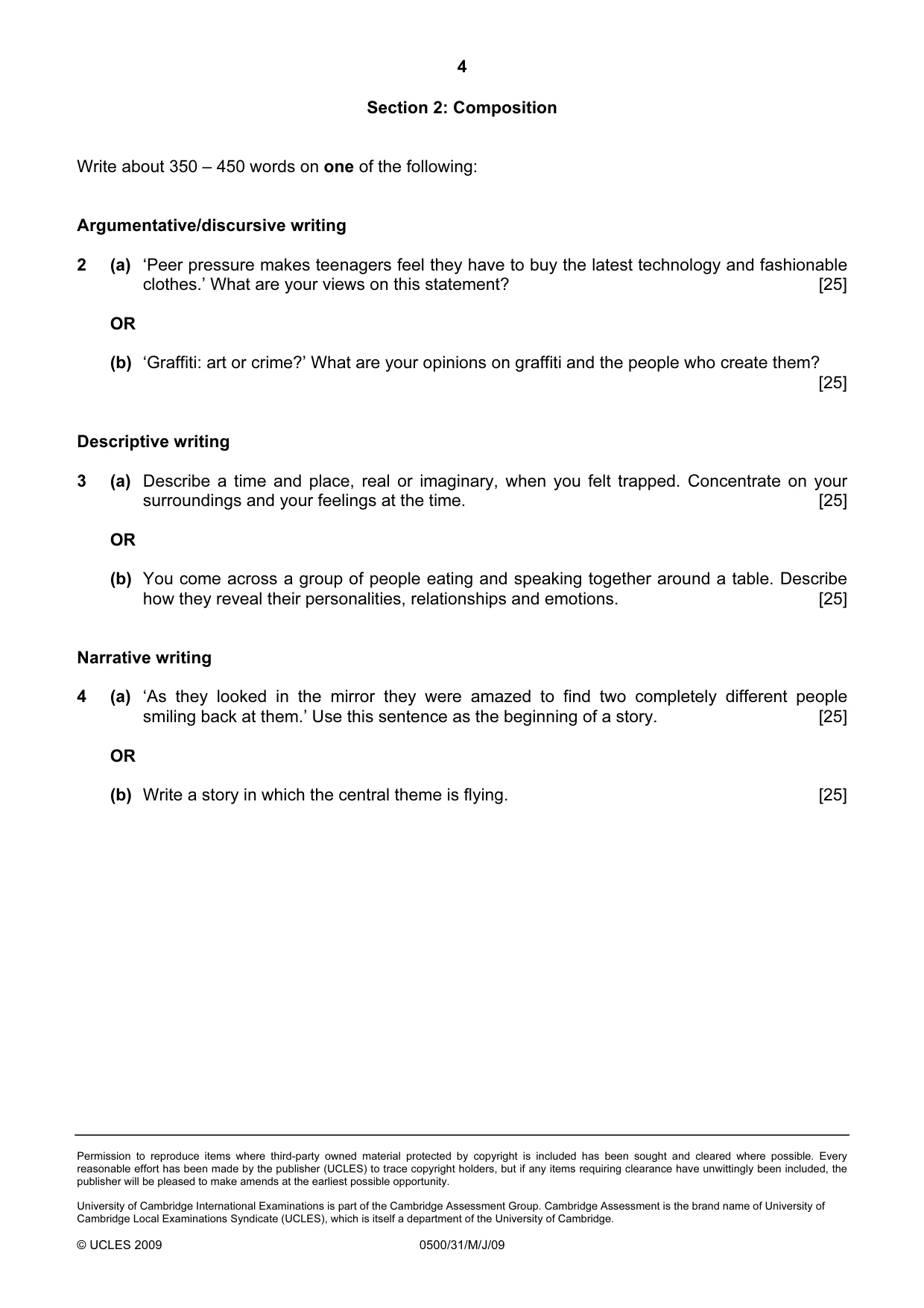
4 Permission to reproduce items where third-party owned material protected by copyright is included has been sought and cleared where possible. Every reasonable effort has been made by the publisher (UCLES) to trace copyright holders, but if any items requiring clearance have unwittingly been included, the publisher will be pleased to make amends at the earliest possible opportunity. University of Cambridge International Examinations is part of the Cambridge Assessment Group. Cambridge Assessment is the brand name of University of Cambridge Local Examinations Syndicate (UCLES), which is itself a department of the University of Cambridge. © UCLES 2009 0500/31/M/J/09 Section 2: Composition Write about 350 – 450 words on one of the following: Argumentative/discursive writing 2 (a) ‘Peer pressure makes teenagers feel they have to buy the latest technology and fashionable clothes.’ What are your views on this statement? [25] OR (b) ‘Graffiti: art or crime?’ What are your opinions on graffiti and the people who create them? [25] Descriptive writing 3 (a) Describe a time and place, real or imaginary, when you felt trapped. Concentrate on your surroundings and your feelings at the time. [25] OR (b) You come across a group of people eating and speaking together around a table. Describe how they reveal their personalities, relationships and emotions. [25] Narrative writing 4 (a) ‘As they looked in the mirror they were amazed to find two completely different people smiling back at them.’ Use this sentence as the beginning of a story. [25] OR (b) Write a story in which the central theme is flying. [25]
Question paper, page 6
This document consists of 4 printed pages. IB09 06_0500_32/3RP © UCLES 2009 [Turn over *4393483303* UNIVERSITY OF CAMBRIDGE INTERNATIONAL EXAMINATIONS International General Certificate of Secondary Education FIRST LANGUAGE ENGLISH 0500/32 Paper 3 Directed Writing and Composition May/June 2009 2 hours Additional Materials: Answer Booklet/Paper READ THESE INSTRUCTIONS FIRST If you have been given an Answer Booklet, follow the instructions on the front cover of the Booklet. Write your Centre number, candidate number and name on all the work you hand in. Write in dark blue or black pen. Do not use staples, paper clips, highlighters, glue or correction fluid. Answer two questions: Question 1 (Section 1) and one question from Section 2. Dictionaries are not permitted. At the end of the examination, fasten all your work securely together. All questions in this paper carry equal marks. Second Variant Question Paper
Question paper, page 7
2 © UCLES 2009 0500/32/M/J/09 Section 1: Directed Writing 1 You are a Headteacher and have received the publicity flyer printed opposite from the Green Team Challenge management (GTC). You have decided that your school will nominate a student for the challenge, and you have received three recommendations, following a vote by the whole school. Imagine you hold a meeting with your Deputy Headteacher to decide which one of the three candidates to nominate. Write the dialogue between yourself and your Deputy Headteacher. In your conversation you should: • Evaluate the strengths and weaknesses of each of the finalists • Explain the reasons for your final choice Base your writing on the ideas found in the publicity flyer and the information about finalists on the opposite page. Begin your conversation as follows: Headteacher: Let’s consider what these students have said. I must let the GTC know today which finalist we have chosen. You should write between 1½ and 2 sides, allowing for the size of your handwriting. Up to 10 marks are available for the content of your answer and up to 15 marks for the quality of your writing. [25]
Question paper, page 8
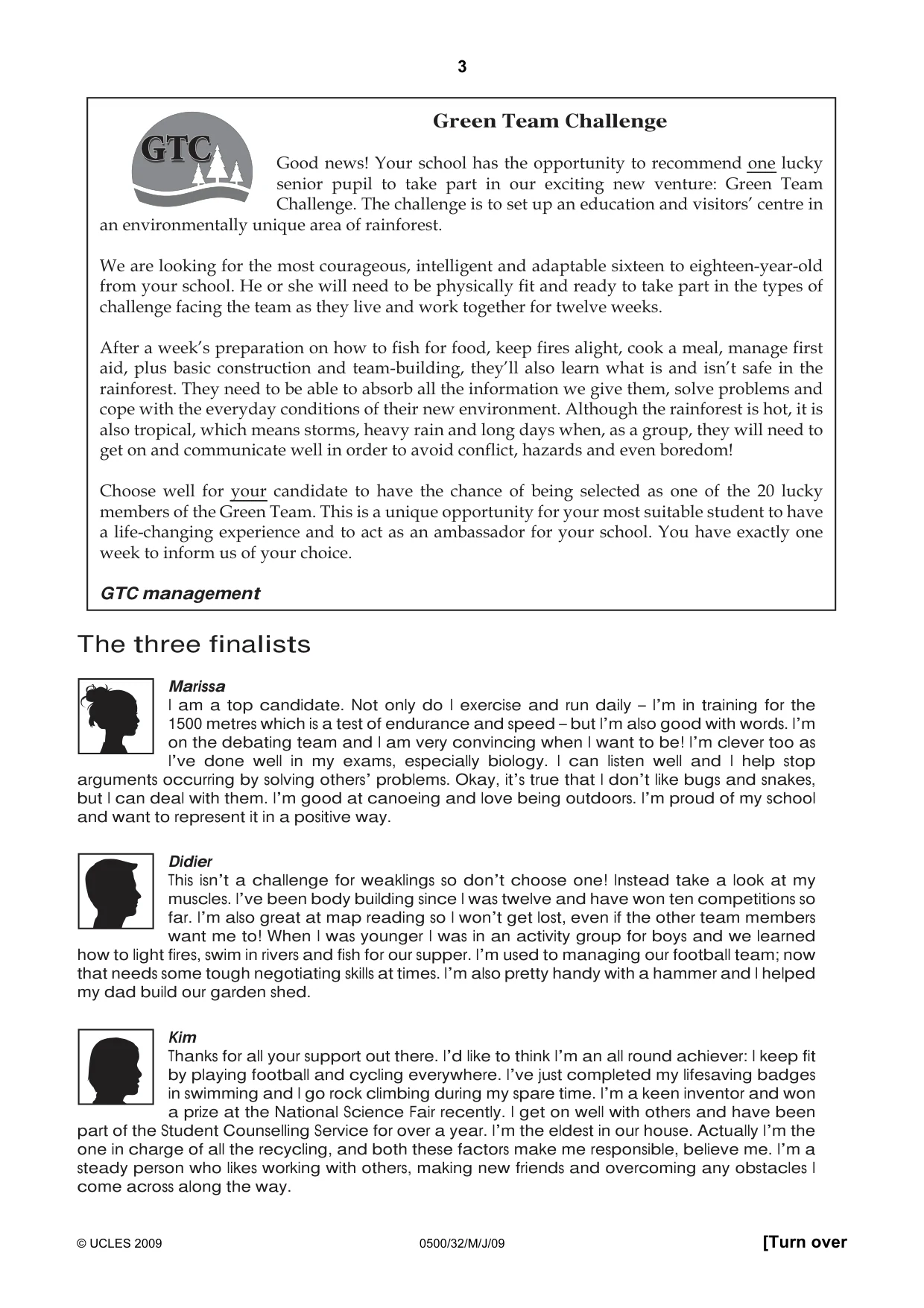
3 © UCLES 2009 0500/32/M/J/09 [Turn over Green Team Challenge Good news! Your school has the opportunity to recommend one lucky senior pupil to take part in our exciting new venture: Green Team Challenge. The challenge is to set up an education and visitors’ centre in an environmentally unique area of rainforest. We are looking for the most courageous, intelligent and adaptable sixteen to eighteen-year-old from your school. He or she will need to be physically fit and ready to take part in the types of challenge facing the team as they live and work together for twelve weeks. After a week’s preparation on how to fish for food, keep fires alight, cook a meal, manage first aid, plus basic construction and team-building, they’ll also learn what is and isn’t safe in the rainforest. They need to be able to absorb all the information we give them, solve problems and cope with the everyday conditions of their new environment. Although the rainforest is hot, it is also tropical, which means storms, heavy rain and long days when, as a group, they will need to get on and communicate well in order to avoid conflict, hazards and even boredom! Choose well for your candidate to have the chance of being selected as one of the 20 lucky members of the Green Team. This is a unique opportunity for your most suitable student to have a life-changing experience and to act as an ambassador for your school. You have exactly one week to inform us of your choice. GTC management Marissa I am a top candidate. Not only do I exercise and run daily – I’m in training for the 1500 metres which is a test of endurance and speed – but I’m also good with words. I’m on the debating team and I am very convincing when I want to be! I’m clever too as I’ve done well in my exams, especially biology. I can listen well and I help stop arguments occurring by solving others’ problems. Okay, it’s true that I don’t like bugs and snakes, but I can deal with them. I’m good at canoeing and love being outdoors. I’m proud of my school and want to represent it in a positive way. Kim Thanks for all your support out there. I’d like to think I’m an all round achiever: I keep fit by playing football and cycling everywhere. I’ve just completed my lifesaving badges in swimming and I go rock climbing during my spare time. I’m a keen inventor and won a prize at the National Science Fair recently. I get on well with others and have been part of the Student Counselling Service for over a year. I’m the eldest in our house. Actually I’m the one in charge of all the recycling, and both these factors make me responsible, believe me. I’m a steady person who likes working with others, making new friends and overcoming any obstacles I come across along the way. Didier This isn’t a challenge for weaklings so don’t choose one! Instead take a look at my muscles. I’ve been body building since I was twelve and have won ten competitions so far. I’m also great at map reading so I won’t get lost, even if the other team members want me to! When I was younger I was in an activity group for boys and we learned how to light fires, swim in rivers and fish for our supper. I’m used to managing our football team; now that needs some tough negotiating skills at times. I’m also pretty handy with a hammer and I helped my dad build our garden shed. The three finalists
Question paper, page 9
4 Permission to reproduce items where third-party owned material protected by copyright is included has been sought and cleared where possible. Every reasonable effort has been made by the publisher (UCLES) to trace copyright holders, but if any items requiring clearance have unwittingly been included, the publisher will be pleased to make amends at the earliest possible opportunity. University of Cambridge International Examinations is part of the Cambridge Assessment Group. Cambridge Assessment is the brand name of University of Cambridge Local Examinations Syndicate (UCLES), which is itself a department of the University of Cambridge. © UCLES 2009 0500/32/M/J/09 Section 2: Composition Write about 350 – 450 words on one of the following: Argumentative/discursive writing 2 (a) ‘It is the best of times and the worst of times’. Using this quotation as your starting point, write an essay discussing what you feel are the best and the worst parts of your life as a teenager. [25] OR (b) Do heroes still exist? Who do you think could still earn the title of ‘Hero’ or ‘Heroine’ in the present day? You may consider more than one example, but must explain why you believe the title is deserved. [25] Descriptive writing 3 (a) ‘The Performer’. Describe a performer or entertainer who amazed you or held your interest. . [25] OR (b) ‘Time capsule discovered in local field.’ Describe the contents of this sealed box of secrets from the past. [25] Narrative writing 4 (a) You come across an advertisement in the local paper – ‘Unwanted gift. Extremely large hot air balloon for sale, reasonable price. Call 87145 after 9pm on Monday’. Write a story based on these details. [25] OR (b) ‘The Uninvited Guest’. Write a story of suspense in which this title is central to the plot. [25]
Mark scheme, page 1
Location Entry Codes As part of CIE’s continual commitment to maintaining best practice in assessment, CIE has begun to use different variants of some question papers for our most popular assessments with extremely large and widespread candidature, The question papers are closely related and the relationships between them have been thoroughly established using our assessment expertise. All versions of the paper give assessment of equal standard. The content assessed by the examination papers and the type of questions are unchanged. This change means that for this component there are now two variant Question Papers, Mark Schemes and Principal Examiner’s Reports where previously there was only one. For any individual country, it is intended that only one variant is used. This document contains both variants which will give all Centres access to even more past examination material than is usually the case. The diagram shows the relationship between the Question Papers, Mark Schemes and Principal Examiner’s Reports. Question Paper Mark Scheme Principal Examiner’s Report Introduction Introduction Introduction First variant Question Paper First variant Mark Scheme First variant Principal Examiner’s Report Second variant Question Paper Second variant Mark Scheme Second variant Principal Examiner’s Report Who can I contact for further information on these changes? Please direct any questions about this to CIE’s Customer Services team at: international@cie.org.uk www.XtremePapers.com
Mark scheme, page 2
UNIVERSITY OF CAMBRIDGE INTERNATIONAL EXAMINATIONS International General Certificate of Secondary Education MARK SCHEME for the May/June 2009 question paper for the guidance of teachers 0500 FIRST LANGUAGE ENGLISH 0500/31 Paper 31 (Directed Writing and Composition), maximum raw mark 50 This mark scheme is published as an aid to teachers and candidates, to indicate the requirements of the examination. It shows the basis on which Examiners were instructed to award marks. It does not indicate the details of the discussions that took place at an Examiners’ meeting before marking began, which would have considered the acceptability of alternative answers. Mark schemes must be read in conjunction with the question papers and the report on the examination. • CIE will not enter into discussions or correspondence in connection with these mark schemes. CIE is publishing the mark schemes for the May/June 2009 question papers for most IGCSE, GCE Advanced Level and Advanced Subsidiary Level syllabuses and some Ordinary Level syllabuses. First variant Mark Scheme
Mark scheme, page 3
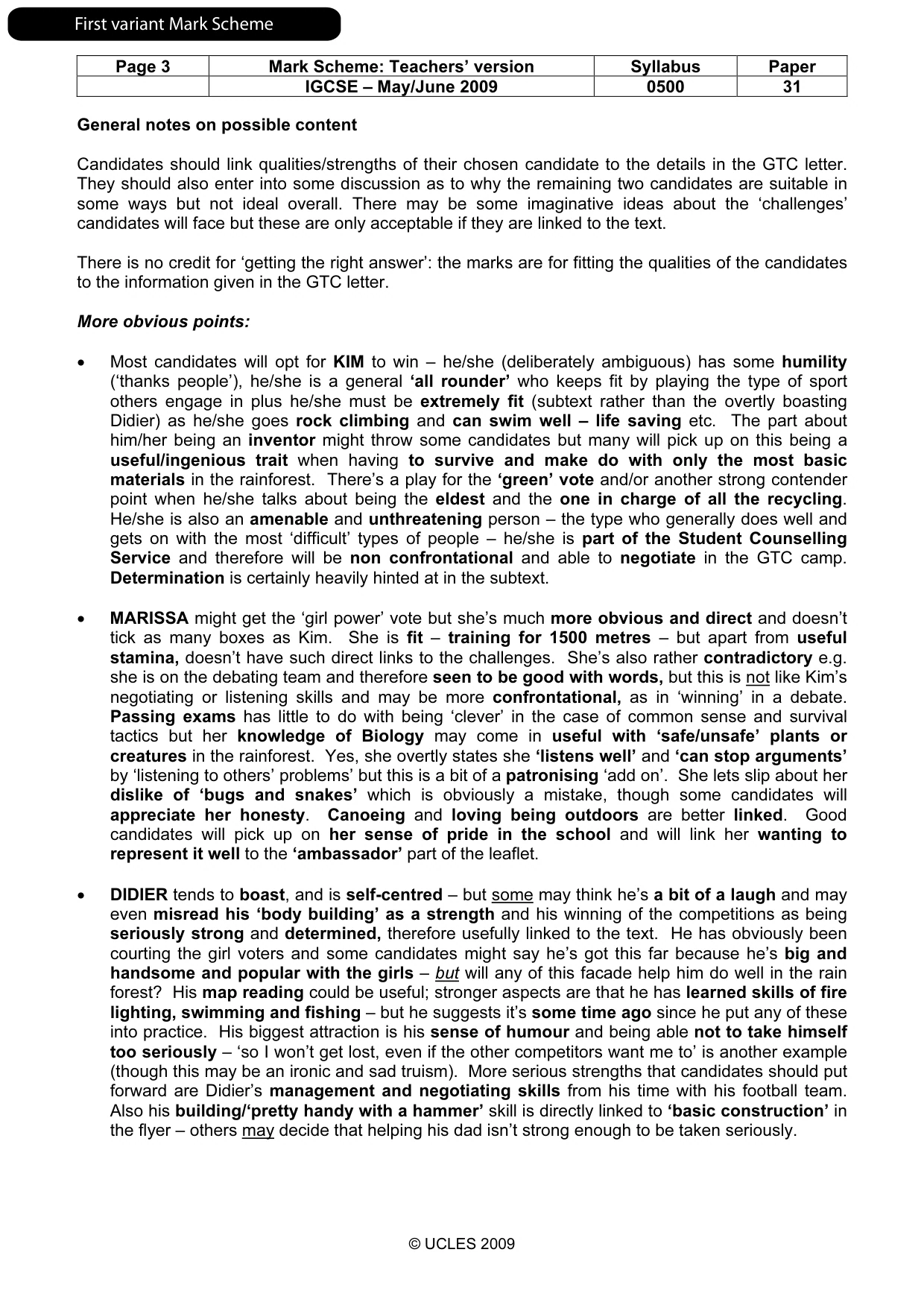
Page 2 Mark Scheme: Teachers’ version Syllabus Paper IGCSE – May/June 2009 0500 31 © UCLES 2009 Note: All Examiners are instructed that alternative correct answers and unexpected approaches in candidates’ scripts must be given marks that fairly reflect the relevant knowledge and skills demonstrated. Section 1: Directed Writing Question 1 This question tests writing objectives W1–W5: • articulate experience and express what is thought, felt and imagined • order and present facts, ideas and opinions • understand and use a range of appropriate vocabulary • use language and register appropriate to audience and context • make accurate and effective use of paragraphs, grammatical structures, sentences, punctuation and spelling AND aspects of reading objectives R1–R3: • understand and collate explicit meanings • understand, explain and collate implicit meanings and attitudes • select, analyse and evaluate what is relevant to specific purposes You are a Headteacher and have received the publicity flyer printed opposite from the Green Team Challenge management (GTC). You have decided that your school will nominate a student for the challenge, and you have received three recommendations, following a vote by the whole school. Imagine you hold a meeting with your Deputy Headteacher to decide which one of the three candidates to nominate. Write the dialogue between yourself and your Deputy Headteacher. In your conversation you should: • Evaluate the strengths and weaknesses of each of the finalists • Explain the reasons for your final choice Base your writing on the ideas found in the publicity flyer and the information about finalists on the opposite page. Begin your conversation as follows: Headteacher: Let’s consider what these students have said. I must let the GTC know today which finalist we have chosen. You should write between 1½ and 2 sides, allowing for the size of your handwriting. Up to 10 marks are available for the content of your answer and up to 15 marks for the quality of your writing. [25] First variant Mark Scheme
Mark scheme, page 4
Page 3 Mark Scheme: Teachers’ version Syllabus Paper IGCSE – May/June 2009 0500 31 © UCLES 2009 General notes on possible content Candidates should link qualities/strengths of their chosen candidate to the details in the GTC letter. They should also enter into some discussion as to why the remaining two candidates are suitable in some ways but not ideal overall. There may be some imaginative ideas about the ‘challenges’ candidates will face but these are only acceptable if they are linked to the text. There is no credit for ‘getting the right answer’: the marks are for fitting the qualities of the candidates to the information given in the GTC letter. More obvious points: • Most candidates will opt for KIM to win – he/she (deliberately ambiguous) has some humility (‘thanks people’), he/she is a general ‘all rounder’ who keeps fit by playing the type of sport others engage in plus he/she must be extremely fit (subtext rather than the overtly boasting Didier) as he/she goes rock climbing and can swim well – life saving etc. The part about him/her being an inventor might throw some candidates but many will pick up on this being a useful/ingenious trait when having to survive and make do with only the most basic materials in the rainforest. There’s a play for the ‘green’ vote and/or another strong contender point when he/she talks about being the eldest and the one in charge of all the recycling. He/she is also an amenable and unthreatening person – the type who generally does well and gets on with the most ‘difficult’ types of people – he/she is part of the Student Counselling Service and therefore will be non confrontational and able to negotiate in the GTC camp. Determination is certainly heavily hinted at in the subtext. • MARISSA might get the ‘girl power’ vote but she’s much more obvious and direct and doesn’t tick as many boxes as Kim. She is fit – training for 1500 metres – but apart from useful stamina, doesn’t have such direct links to the challenges. She’s also rather contradictory e.g. she is on the debating team and therefore seen to be good with words, but this is not like Kim’s negotiating or listening skills and may be more confrontational, as in ‘winning’ in a debate. Passing exams has little to do with being ‘clever’ in the case of common sense and survival tactics but her knowledge of Biology may come in useful with ‘safe/unsafe’ plants or creatures in the rainforest. Yes, she overtly states she ‘listens well’ and ‘can stop arguments’ by ‘listening to others’ problems’ but this is a bit of a patronising ‘add on’. She lets slip about her dislike of ‘bugs and snakes’ which is obviously a mistake, though some candidates will appreciate her honesty. Canoeing and loving being outdoors are better linked. Good candidates will pick up on her sense of pride in the school and will link her wanting to represent it well to the ‘ambassador’ part of the leaflet. • DIDIER tends to boast, and is self-centred – but some may think he’s a bit of a laugh and may even misread his ‘body building’ as a strength and his winning of the competitions as being seriously strong and determined, therefore usefully linked to the text. He has obviously been courting the girl voters and some candidates might say he’s got this far because he’s big and handsome and popular with the girls – but will any of this facade help him do well in the rain forest? His map reading could be useful; stronger aspects are that he has learned skills of fire lighting, swimming and fishing – but he suggests it’s some time ago since he put any of these into practice. His biggest attraction is his sense of humour and being able not to take himself too seriously – ‘so I won’t get lost, even if the other competitors want me to’ is another example (though this may be an ironic and sad truism). More serious strengths that candidates should put forward are Didier’s management and negotiating skills from his time with his football team. Also his building/‘pretty handy with a hammer’ skill is directly linked to ‘basic construction’ in the flyer – others may decide that helping his dad isn’t strong enough to be taken seriously. First variant Mark Scheme
Mark scheme, page 5
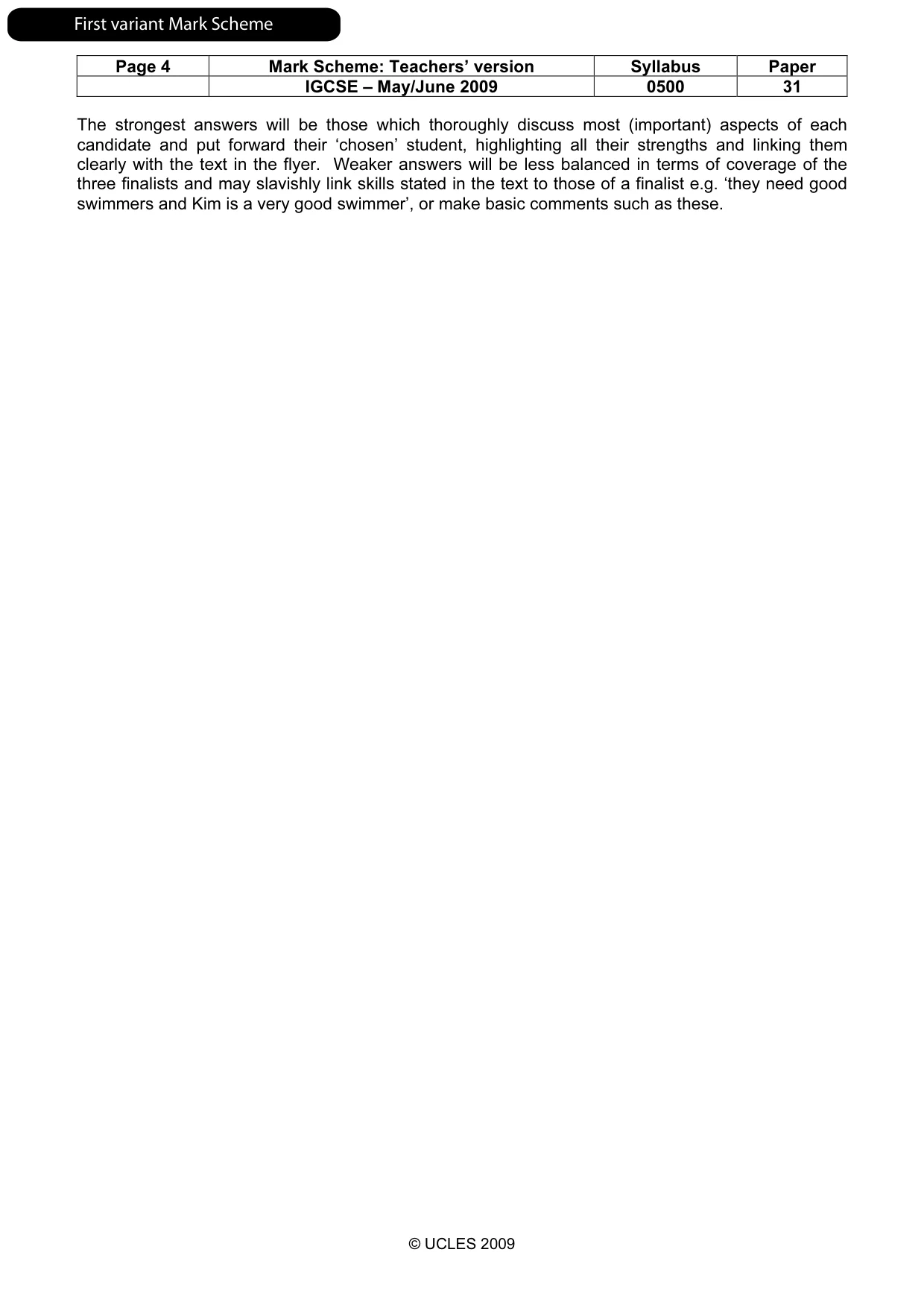
Page 4 Mark Scheme: Teachers’ version Syllabus Paper IGCSE – May/June 2009 0500 31 © UCLES 2009 The strongest answers will be those which thoroughly discuss most (important) aspects of each candidate and put forward their ‘chosen’ student, highlighting all their strengths and linking them clearly with the text in the flyer. Weaker answers will be less balanced in terms of coverage of the three finalists and may slavishly link skills stated in the text to those of a finalist e.g. ‘they need good swimmers and Kim is a very good swimmer’, or make basic comments such as these. First variant Mark Scheme
Mark scheme, page 6
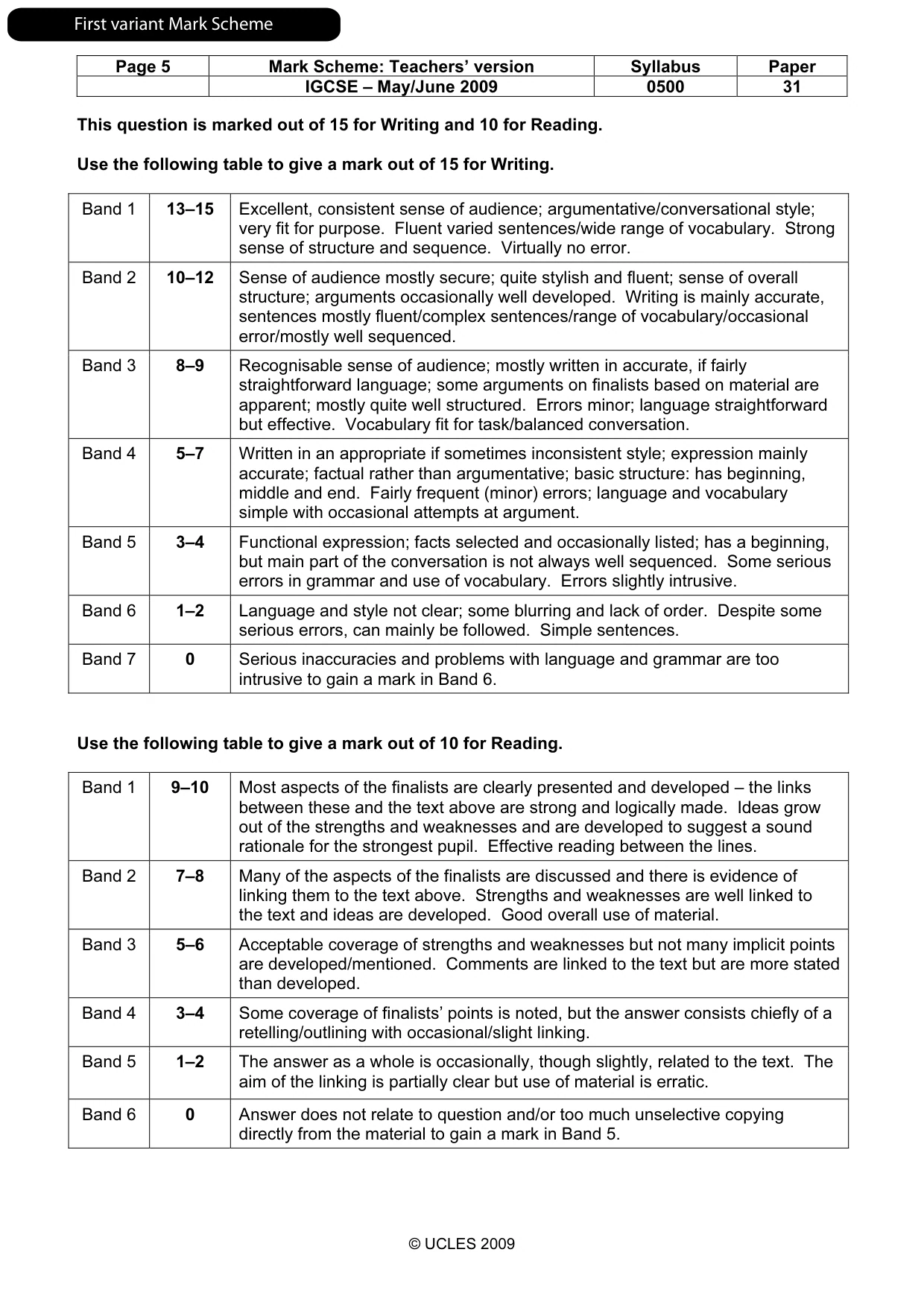
Page 5 Mark Scheme: Teachers’ version Syllabus Paper IGCSE – May/June 2009 0500 31 © UCLES 2009 This question is marked out of 15 for Writing and 10 for Reading. Use the following table to give a mark out of 15 for Writing. Band 1 13–15 Excellent, consistent sense of audience; argumentative/conversational style; very fit for purpose. Fluent varied sentences/wide range of vocabulary. Strong sense of structure and sequence. Virtually no error. Band 2 10–12 Sense of audience mostly secure; quite stylish and fluent; sense of overall structure; arguments occasionally well developed. Writing is mainly accurate, sentences mostly fluent/complex sentences/range of vocabulary/occasional error/mostly well sequenced. Band 3 8–9 Recognisable sense of audience; mostly written in accurate, if fairly straightforward language; some arguments on finalists based on material are apparent; mostly quite well structured. Errors minor; language straightforward but effective. Vocabulary fit for task/balanced conversation. Band 4 5–7 Written in an appropriate if sometimes inconsistent style; expression mainly accurate; factual rather than argumentative; basic structure: has beginning, middle and end. Fairly frequent (minor) errors; language and vocabulary simple with occasional attempts at argument. Band 5 3–4 Functional expression; facts selected and occasionally listed; has a beginning, but main part of the conversation is not always well sequenced. Some serious errors in grammar and use of vocabulary. Errors slightly intrusive. Band 6 1–2 Language and style not clear; some blurring and lack of order. Despite some serious errors, can mainly be followed. Simple sentences. Band 7 0 Serious inaccuracies and problems with language and grammar are too intrusive to gain a mark in Band 6. Use the following table to give a mark out of 10 for Reading. Band 1 9–10 Most aspects of the finalists are clearly presented and developed – the links between these and the text above are strong and logically made. Ideas grow out of the strengths and weaknesses and are developed to suggest a sound rationale for the strongest pupil. Effective reading between the lines. Band 2 7–8 Many of the aspects of the finalists are discussed and there is evidence of linking them to the text above. Strengths and weaknesses are well linked to the text and ideas are developed. Good overall use of material. Band 3 5–6 Acceptable coverage of strengths and weaknesses but not many implicit points are developed/mentioned. Comments are linked to the text but are more stated than developed. Band 4 3–4 Some coverage of finalists’ points is noted, but the answer consists chiefly of a retelling/outlining with occasional/slight linking. Band 5 1–2 The answer as a whole is occasionally, though slightly, related to the text. The aim of the linking is partially clear but use of material is erratic. Band 6 0 Answer does not relate to question and/or too much unselective copying directly from the material to gain a mark in Band 5. First variant Mark Scheme
Mark scheme, page 7
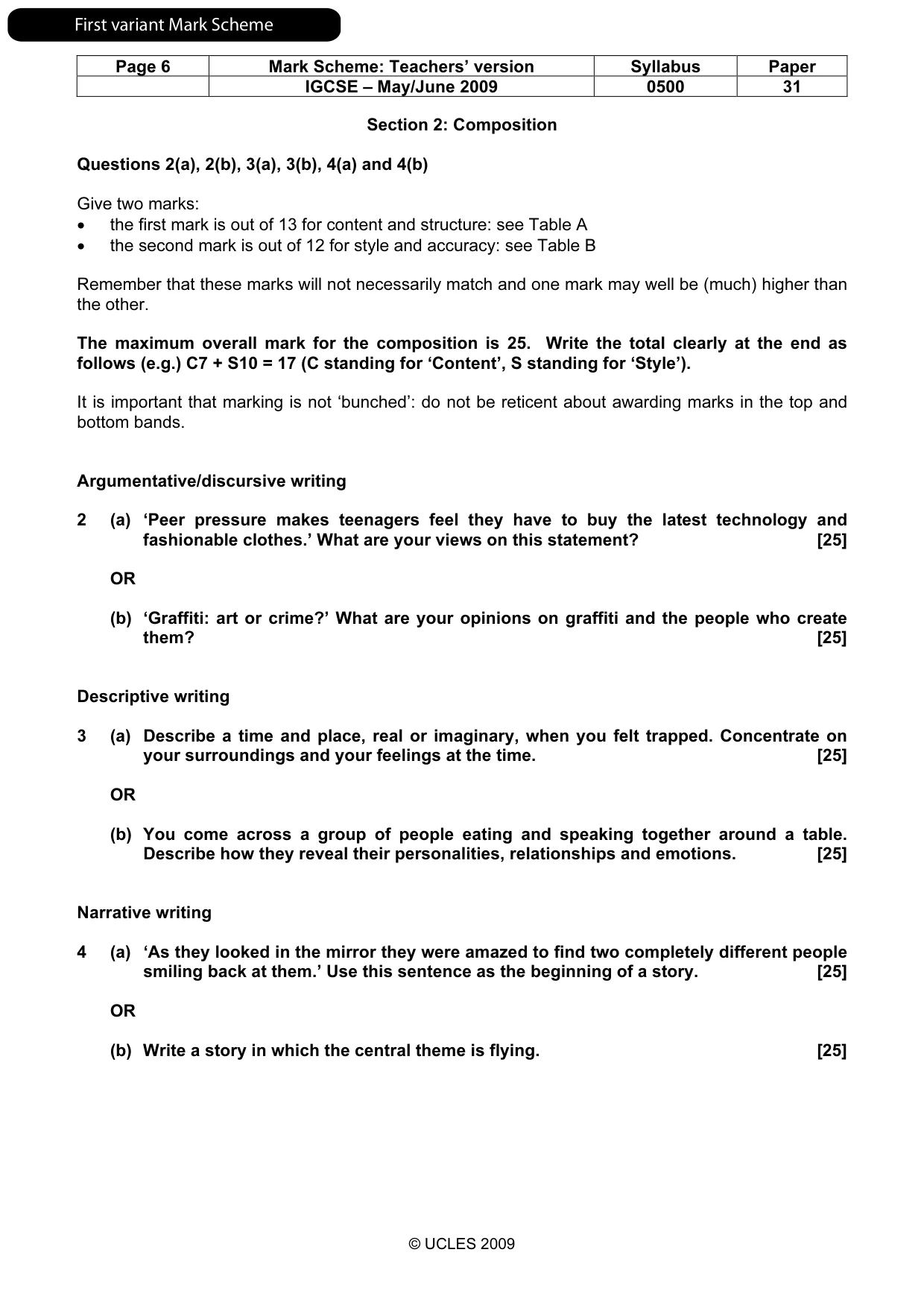
Page 6 Mark Scheme: Teachers’ version Syllabus Paper IGCSE – May/June 2009 0500 31 © UCLES 2009 Section 2: Composition Questions 2(a), 2(b), 3(a), 3(b), 4(a) and 4(b) Give two marks: • the first mark is out of 13 for content and structure: see Table A • the second mark is out of 12 for style and accuracy: see Table B Remember that these marks will not necessarily match and one mark may well be (much) higher than the other. The maximum overall mark for the composition is 25. Write the total clearly at the end as follows (e.g.) C7 + S10 = 17 (C standing for ‘Content’, S standing for ‘Style’). It is important that marking is not ‘bunched’: do not be reticent about awarding marks in the top and bottom bands. Argumentative/discursive writing 2 (a) ‘Peer pressure makes teenagers feel they have to buy the latest technology and fashionable clothes.’ What are your views on this statement? [25] OR (b) ‘Graffiti: art or crime?’ What are your opinions on graffiti and the people who create them? [25] Descriptive writing 3 (a) Describe a time and place, real or imaginary, when you felt trapped. Concentrate on your surroundings and your feelings at the time. [25] OR (b) You come across a group of people eating and speaking together around a table. Describe how they reveal their personalities, relationships and emotions. [25] Narrative writing 4 (a) ‘As they looked in the mirror they were amazed to find two completely different people smiling back at them.’ Use this sentence as the beginning of a story. [25] OR (b) Write a story in which the central theme is flying. [25] First variant Mark Scheme
Mark scheme, page 8
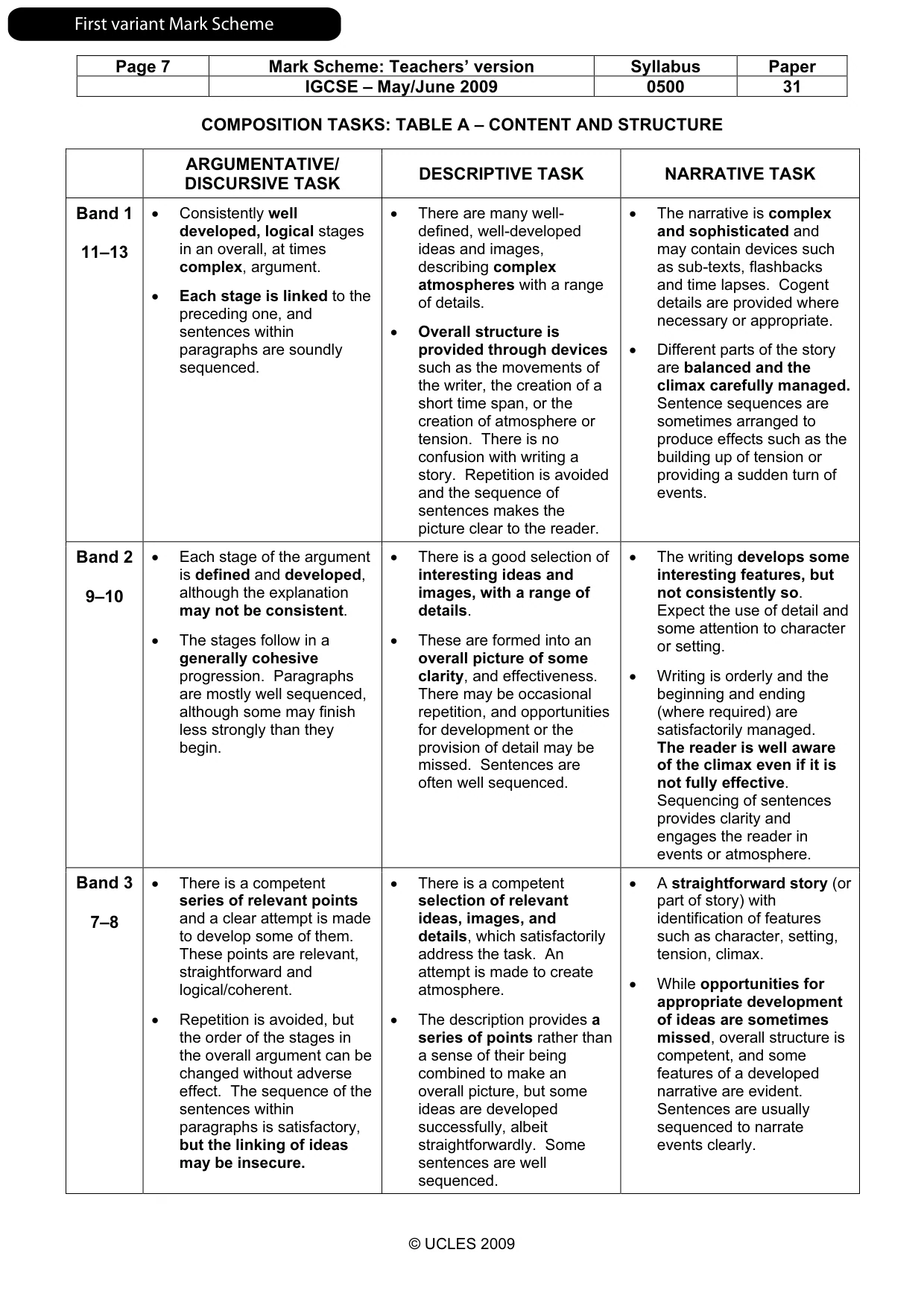
Page 7 Mark Scheme: Teachers’ version Syllabus Paper IGCSE – May/June 2009 0500 31 © UCLES 2009 COMPOSITION TASKS: TABLE A – CONTENT AND STRUCTURE ARGUMENTATIVE/ DISCURSIVE TASK DESCRIPTIVE TASK NARRATIVE TASK Band 1 11–13 • Consistently well developed, logical stages in an overall, at times complex, argument. • Each stage is linked to the preceding one, and sentences within paragraphs are soundly sequenced. • There are many well- defined, well-developed ideas and images, describing complex atmospheres with a range of details. • Overall structure is provided through devices such as the movements of the writer, the creation of a short time span, or the creation of atmosphere or tension. There is no confusion with writing a story. Repetition is avoided and the sequence of sentences makes the picture clear to the reader. • The narrative is complex and sophisticated and may contain devices such as sub-texts, flashbacks and time lapses. Cogent details are provided where necessary or appropriate. • Different parts of the story are balanced and the climax carefully managed. Sentence sequences are sometimes arranged to produce effects such as the building up of tension or providing a sudden turn of events. Band 2 9–10 • Each stage of the argument is defined and developed, although the explanation may not be consistent. • The stages follow in a generally cohesive progression. Paragraphs are mostly well sequenced, although some may finish less strongly than they begin. • There is a good selection of interesting ideas and images, with a range of details. • These are formed into an overall picture of some clarity, and effectiveness. There may be occasional repetition, and opportunities for development or the provision of detail may be missed. Sentences are often well sequenced. • The writing develops some interesting features, but not consistently so. Expect the use of detail and some attention to character or setting. • Writing is orderly and the beginning and ending (where required) are satisfactorily managed. The reader is well aware of the climax even if it is not fully effective. Sequencing of sentences provides clarity and engages the reader in events or atmosphere. Band 3 7–8 • There is a competent series of relevant points and a clear attempt is made to develop some of them. These points are relevant, straightforward and logical/coherent. • Repetition is avoided, but the order of the stages in the overall argument can be changed without adverse effect. The sequence of the sentences within paragraphs is satisfactory, but the linking of ideas may be insecure. • There is a competent selection of relevant ideas, images, and details, which satisfactorily address the task. An attempt is made to create atmosphere. • The description provides a series of points rather than a sense of their being combined to make an overall picture, but some ideas are developed successfully, albeit straightforwardly. Some sentences are well sequenced. • A straightforward story (or part of story) with identification of features such as character, setting, tension, climax. • While opportunities for appropriate development of ideas are sometimes missed, overall structure is competent, and some features of a developed narrative are evident. Sentences are usually sequenced to narrate events clearly. First variant Mark Scheme
Mark scheme, page 9
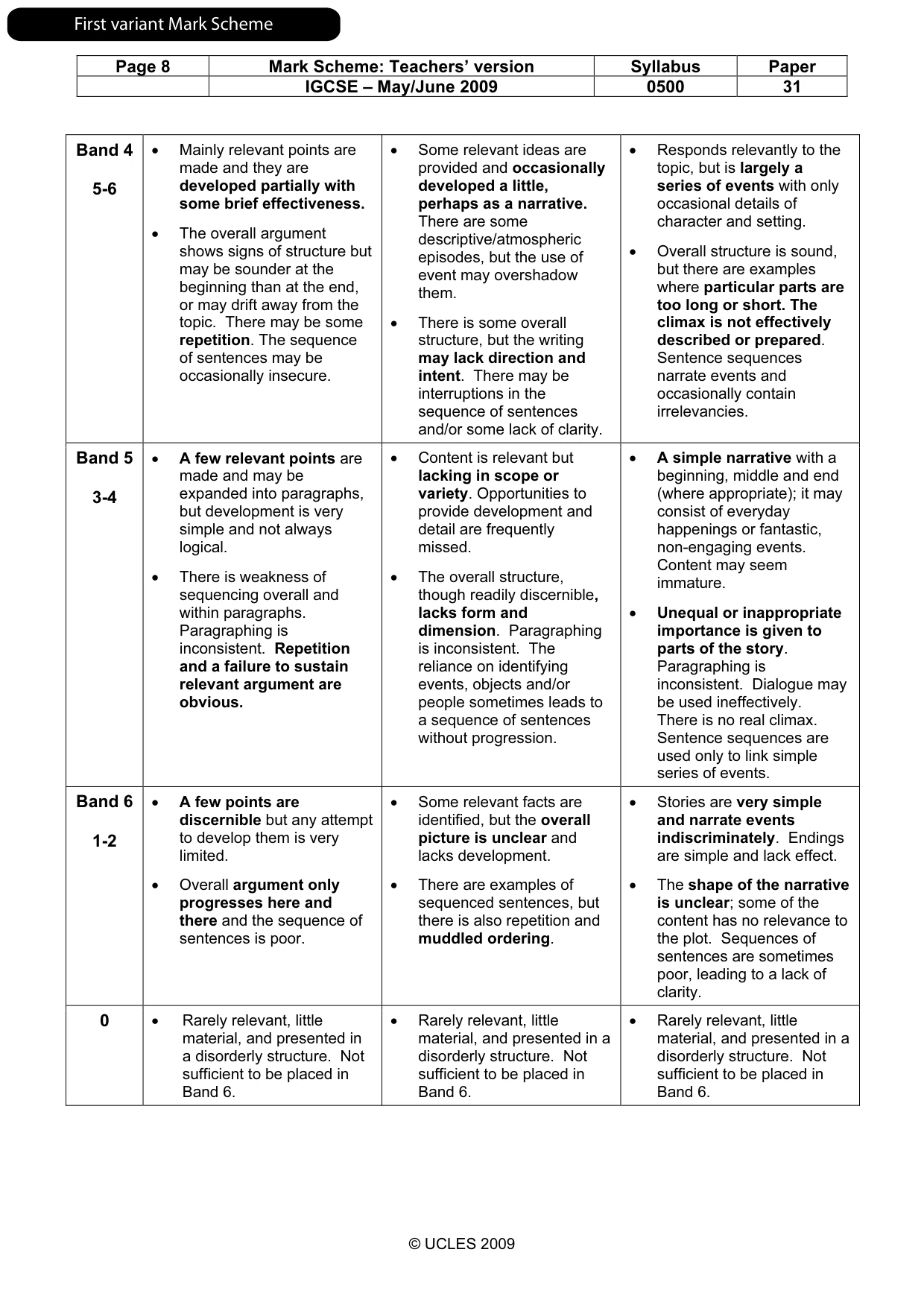
Page 8 Mark Scheme: Teachers’ version Syllabus Paper IGCSE – May/June 2009 0500 31 © UCLES 2009 Band 4 5-6 • Mainly relevant points are made and they are developed partially with some brief effectiveness. • The overall argument shows signs of structure but may be sounder at the beginning than at the end, or may drift away from the topic. There may be some repetition. The sequence of sentences may be occasionally insecure. • Some relevant ideas are provided and occasionally developed a little, perhaps as a narrative. There are some descriptive/atmospheric episodes, but the use of event may overshadow them. • There is some overall structure, but the writing may lack direction and intent. There may be interruptions in the sequence of sentences and/or some lack of clarity. • Responds relevantly to the topic, but is largely a series of events with only occasional details of character and setting. • Overall structure is sound, but there are examples where particular parts are too long or short. The climax is not effectively described or prepared. Sentence sequences narrate events and occasionally contain irrelevancies. Band 5 3-4 • A few relevant points are made and may be expanded into paragraphs, but development is very simple and not always logical. • There is weakness of sequencing overall and within paragraphs. Paragraphing is inconsistent. Repetition and a failure to sustain relevant argument are obvious. • Content is relevant but lacking in scope or variety. Opportunities to provide development and detail are frequently missed. • The overall structure, though readily discernible, lacks form and dimension. Paragraphing is inconsistent. The reliance on identifying events, objects and/or people sometimes leads to a sequence of sentences without progression. • A simple narrative with a beginning, middle and end (where appropriate); it may consist of everyday happenings or fantastic, non-engaging events. Content may seem immature. • Unequal or inappropriate importance is given to parts of the story. Paragraphing is inconsistent. Dialogue may be used ineffectively. There is no real climax. Sentence sequences are used only to link simple series of events. Band 6 1-2 • A few points are discernible but any attempt to develop them is very limited. • Overall argument only progresses here and there and the sequence of sentences is poor. • Some relevant facts are identified, but the overall picture is unclear and lacks development. • There are examples of sequenced sentences, but there is also repetition and muddled ordering. • Stories are very simple and narrate events indiscriminately. Endings are simple and lack effect. • The shape of the narrative is unclear; some of the content has no relevance to the plot. Sequences of sentences are sometimes poor, leading to a lack of clarity. 0 • Rarely relevant, little material, and presented in a disorderly structure. Not sufficient to be placed in Band 6. • Rarely relevant, little material, and presented in a disorderly structure. Not sufficient to be placed in Band 6. • Rarely relevant, little material, and presented in a disorderly structure. Not sufficient to be placed in Band 6. First variant Mark Scheme
Mark scheme, page 10
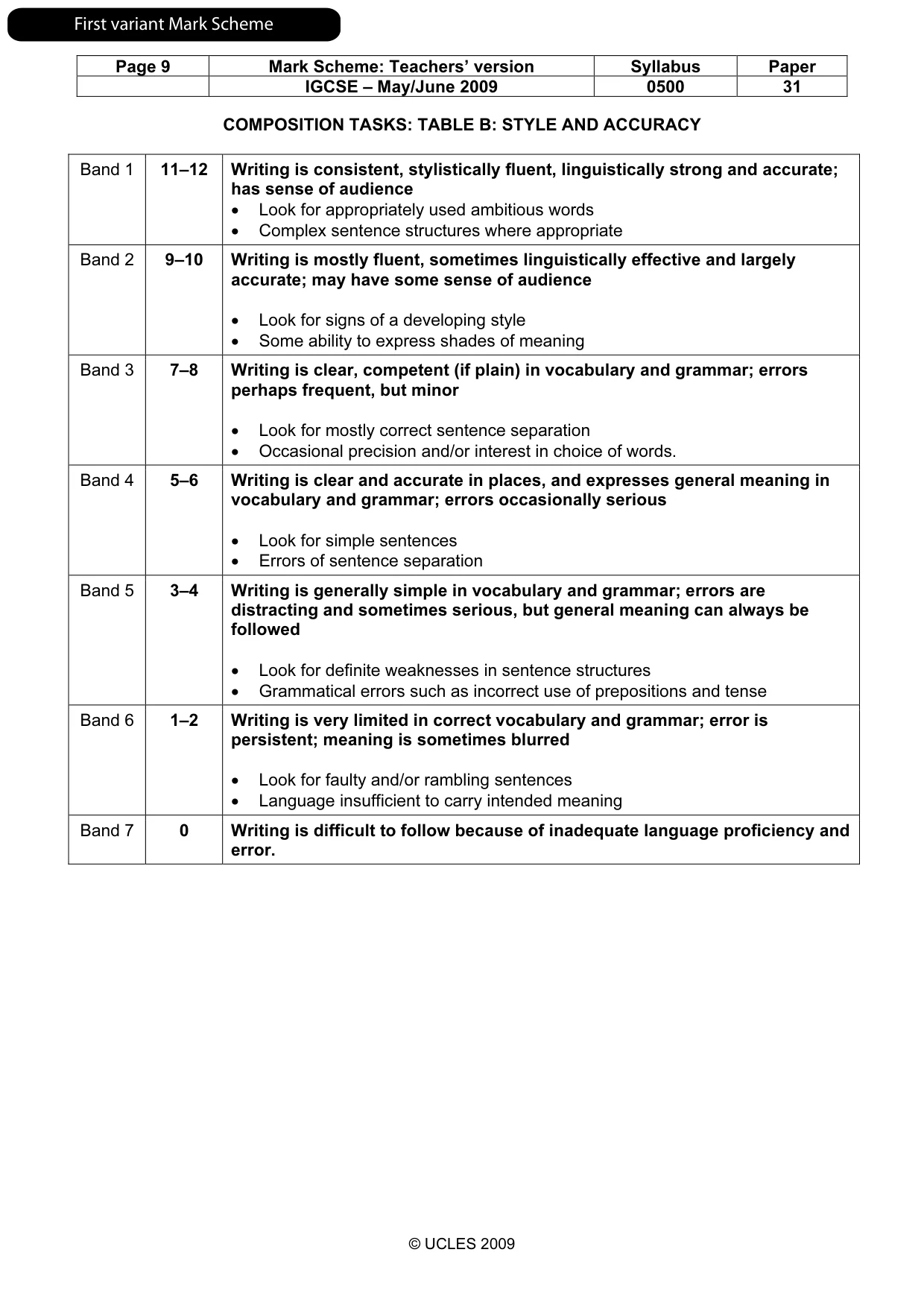
Page 9 Mark Scheme: Teachers’ version Syllabus Paper IGCSE – May/June 2009 0500 31 © UCLES 2009 COMPOSITION TASKS: TABLE B: STYLE AND ACCURACY Band 1 11–12 Writing is consistent, stylistically fluent, linguistically strong and accurate; has sense of audience • Look for appropriately used ambitious words • Complex sentence structures where appropriate Band 2 9–10 Writing is mostly fluent, sometimes linguistically effective and largely accurate; may have some sense of audience • Look for signs of a developing style • Some ability to express shades of meaning Band 3 7–8 Writing is clear, competent (if plain) in vocabulary and grammar; errors perhaps frequent, but minor • Look for mostly correct sentence separation • Occasional precision and/or interest in choice of words. Band 4 5–6 Writing is clear and accurate in places, and expresses general meaning in vocabulary and grammar; errors occasionally serious • Look for simple sentences • Errors of sentence separation Band 5 3–4 Writing is generally simple in vocabulary and grammar; errors are distracting and sometimes serious, but general meaning can always be followed • Look for definite weaknesses in sentence structures • Grammatical errors such as incorrect use of prepositions and tense Band 6 1–2 Writing is very limited in correct vocabulary and grammar; error is persistent; meaning is sometimes blurred • Look for faulty and/or rambling sentences • Language insufficient to carry intended meaning Band 7 0 Writing is difficult to follow because of inadequate language proficiency and error. First variant Mark Scheme
Mark scheme, page 11
UNIVERSITY OF CAMBRIDGE INTERNATIONAL EXAMINATIONS International General Certificate of Secondary Education MARK SCHEME for the May/June 2009 question paper for the guidance of teachers 0500 FIRST LANGUAGE ENGLISH 0500/32 Paper 32 (Directed Writing and Composition), maximum raw mark 50 This mark scheme is published as an aid to teachers and candidates, to indicate the requirements of the examination. It shows the basis on which Examiners were instructed to award marks. It does not indicate the details of the discussions that took place at an Examiners’ meeting before marking began, which would have considered the acceptability of alternative answers. Mark schemes must be read in conjunction with the question papers and the report on the examination. • CIE will not enter into discussions or correspondence in connection with these mark schemes. CIE is publishing the mark schemes for the May/June 2009 question papers for most IGCSE, GCE Advanced Level and Advanced Subsidiary Level syllabuses and some Ordinary Level syllabuses. Second variant Mark Scheme
Mark scheme, page 12
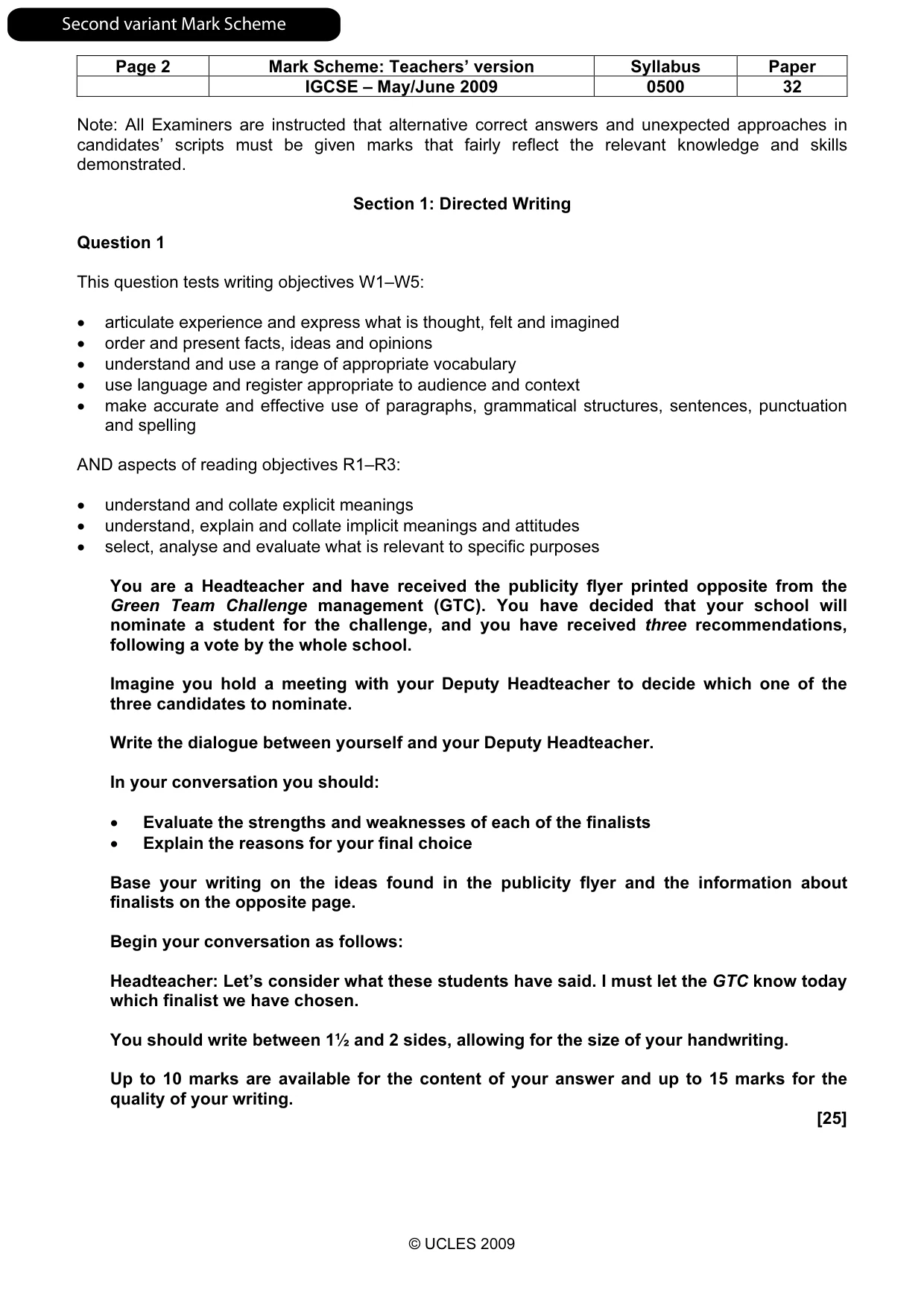
Page 2 Mark Scheme: Teachers’ version Syllabus Paper IGCSE – May/June 2009 0500 32 © UCLES 2009 Note: All Examiners are instructed that alternative correct answers and unexpected approaches in candidates’ scripts must be given marks that fairly reflect the relevant knowledge and skills demonstrated. Section 1: Directed Writing Question 1 This question tests writing objectives W1–W5: • articulate experience and express what is thought, felt and imagined • order and present facts, ideas and opinions • understand and use a range of appropriate vocabulary • use language and register appropriate to audience and context • make accurate and effective use of paragraphs, grammatical structures, sentences, punctuation and spelling AND aspects of reading objectives R1–R3: • understand and collate explicit meanings • understand, explain and collate implicit meanings and attitudes • select, analyse and evaluate what is relevant to specific purposes You are a Headteacher and have received the publicity flyer printed opposite from the Green Team Challenge management (GTC). You have decided that your school will nominate a student for the challenge, and you have received three recommendations, following a vote by the whole school. Imagine you hold a meeting with your Deputy Headteacher to decide which one of the three candidates to nominate. Write the dialogue between yourself and your Deputy Headteacher. In your conversation you should: • Evaluate the strengths and weaknesses of each of the finalists • Explain the reasons for your final choice Base your writing on the ideas found in the publicity flyer and the information about finalists on the opposite page. Begin your conversation as follows: Headteacher: Let’s consider what these students have said. I must let the GTC know today which finalist we have chosen. You should write between 1½ and 2 sides, allowing for the size of your handwriting. Up to 10 marks are available for the content of your answer and up to 15 marks for the quality of your writing. [25] Second variant Mark Scheme
Mark scheme, page 13
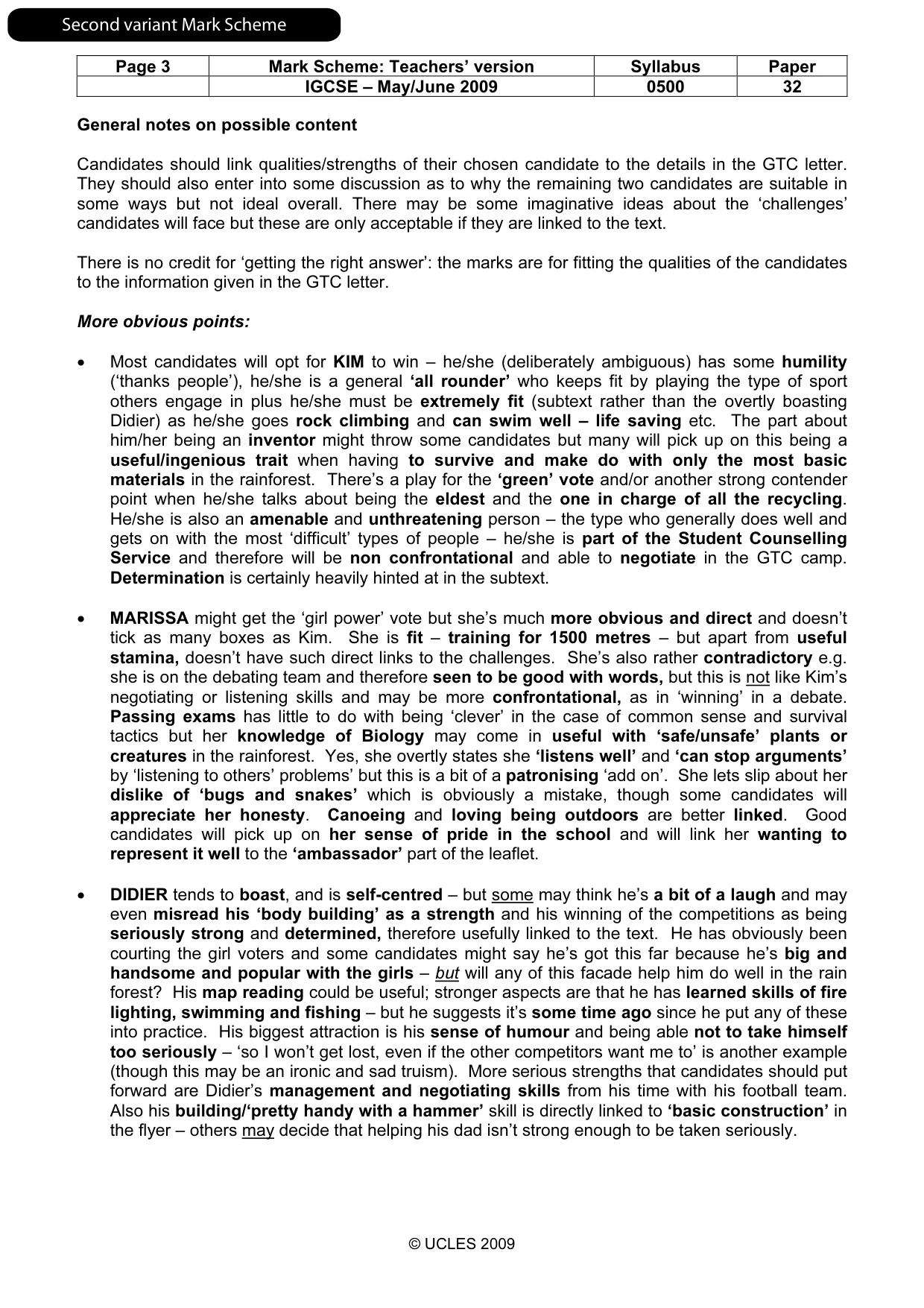
Page 3 Mark Scheme: Teachers’ version Syllabus Paper IGCSE – May/June 2009 0500 32 © UCLES 2009 General notes on possible content Candidates should link qualities/strengths of their chosen candidate to the details in the GTC letter. They should also enter into some discussion as to why the remaining two candidates are suitable in some ways but not ideal overall. There may be some imaginative ideas about the ‘challenges’ candidates will face but these are only acceptable if they are linked to the text. There is no credit for ‘getting the right answer’: the marks are for fitting the qualities of the candidates to the information given in the GTC letter. More obvious points: • Most candidates will opt for KIM to win – he/she (deliberately ambiguous) has some humility (‘thanks people’), he/she is a general ‘all rounder’ who keeps fit by playing the type of sport others engage in plus he/she must be extremely fit (subtext rather than the overtly boasting Didier) as he/she goes rock climbing and can swim well – life saving etc. The part about him/her being an inventor might throw some candidates but many will pick up on this being a useful/ingenious trait when having to survive and make do with only the most basic materials in the rainforest. There’s a play for the ‘green’ vote and/or another strong contender point when he/she talks about being the eldest and the one in charge of all the recycling. He/she is also an amenable and unthreatening person – the type who generally does well and gets on with the most ‘difficult’ types of people – he/she is part of the Student Counselling Service and therefore will be non confrontational and able to negotiate in the GTC camp. Determination is certainly heavily hinted at in the subtext. • MARISSA might get the ‘girl power’ vote but she’s much more obvious and direct and doesn’t tick as many boxes as Kim. She is fit – training for 1500 metres – but apart from useful stamina, doesn’t have such direct links to the challenges. She’s also rather contradictory e.g. she is on the debating team and therefore seen to be good with words, but this is not like Kim’s negotiating or listening skills and may be more confrontational, as in ‘winning’ in a debate. Passing exams has little to do with being ‘clever’ in the case of common sense and survival tactics but her knowledge of Biology may come in useful with ‘safe/unsafe’ plants or creatures in the rainforest. Yes, she overtly states she ‘listens well’ and ‘can stop arguments’ by ‘listening to others’ problems’ but this is a bit of a patronising ‘add on’. She lets slip about her dislike of ‘bugs and snakes’ which is obviously a mistake, though some candidates will appreciate her honesty. Canoeing and loving being outdoors are better linked. Good candidates will pick up on her sense of pride in the school and will link her wanting to represent it well to the ‘ambassador’ part of the leaflet. • DIDIER tends to boast, and is self-centred – but some may think he’s a bit of a laugh and may even misread his ‘body building’ as a strength and his winning of the competitions as being seriously strong and determined, therefore usefully linked to the text. He has obviously been courting the girl voters and some candidates might say he’s got this far because he’s big and handsome and popular with the girls – but will any of this facade help him do well in the rain forest? His map reading could be useful; stronger aspects are that he has learned skills of fire lighting, swimming and fishing – but he suggests it’s some time ago since he put any of these into practice. His biggest attraction is his sense of humour and being able not to take himself too seriously – ‘so I won’t get lost, even if the other competitors want me to’ is another example (though this may be an ironic and sad truism). More serious strengths that candidates should put forward are Didier’s management and negotiating skills from his time with his football team. Also his building/‘pretty handy with a hammer’ skill is directly linked to ‘basic construction’ in the flyer – others may decide that helping his dad isn’t strong enough to be taken seriously. Second variant Mark Scheme
Mark scheme, page 14
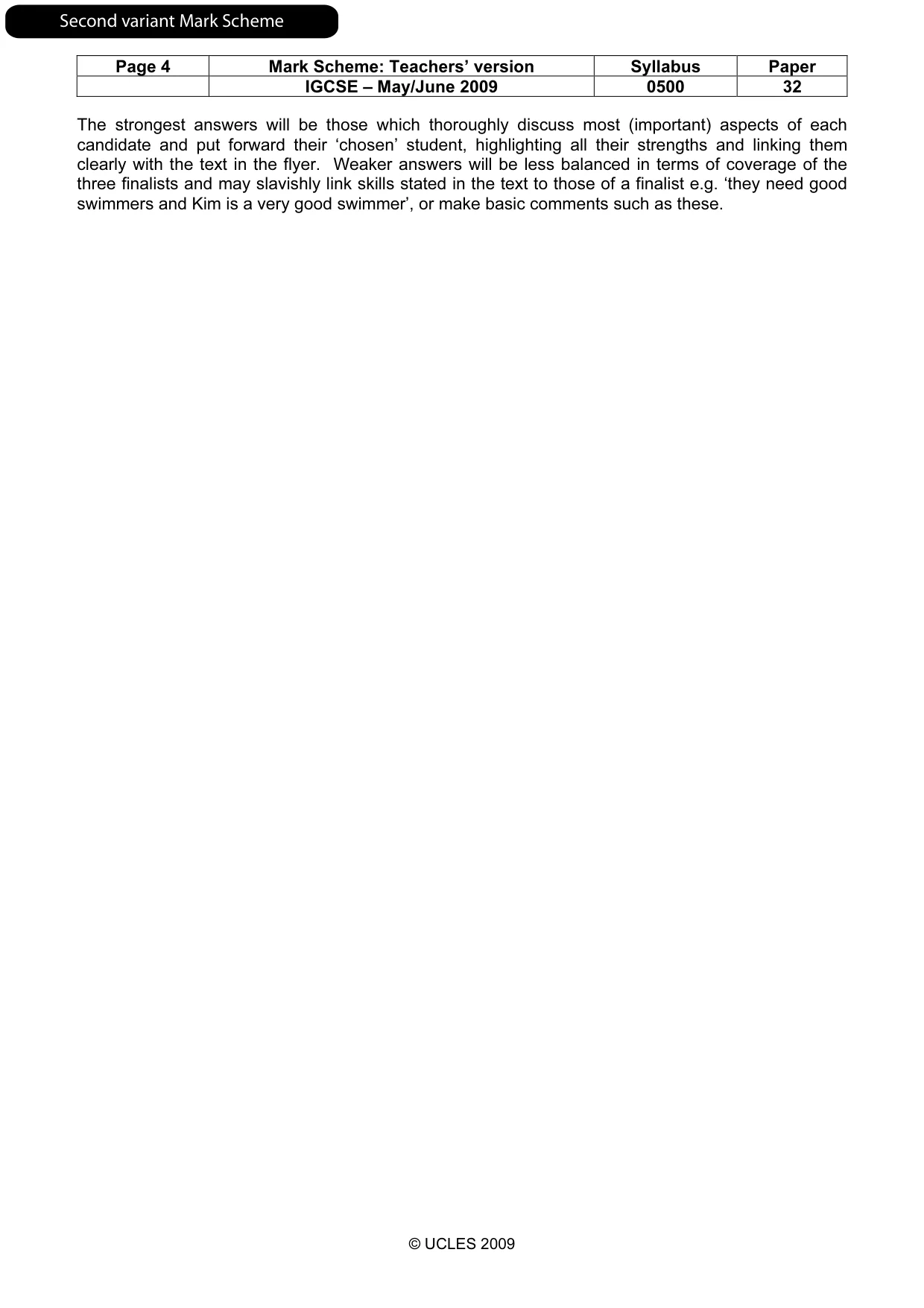
Page 4 Mark Scheme: Teachers’ version Syllabus Paper IGCSE – May/June 2009 0500 32 © UCLES 2009 The strongest answers will be those which thoroughly discuss most (important) aspects of each candidate and put forward their ‘chosen’ student, highlighting all their strengths and linking them clearly with the text in the flyer. Weaker answers will be less balanced in terms of coverage of the three finalists and may slavishly link skills stated in the text to those of a finalist e.g. ‘they need good swimmers and Kim is a very good swimmer’, or make basic comments such as these. Second variant Mark Scheme
Mark scheme, page 15
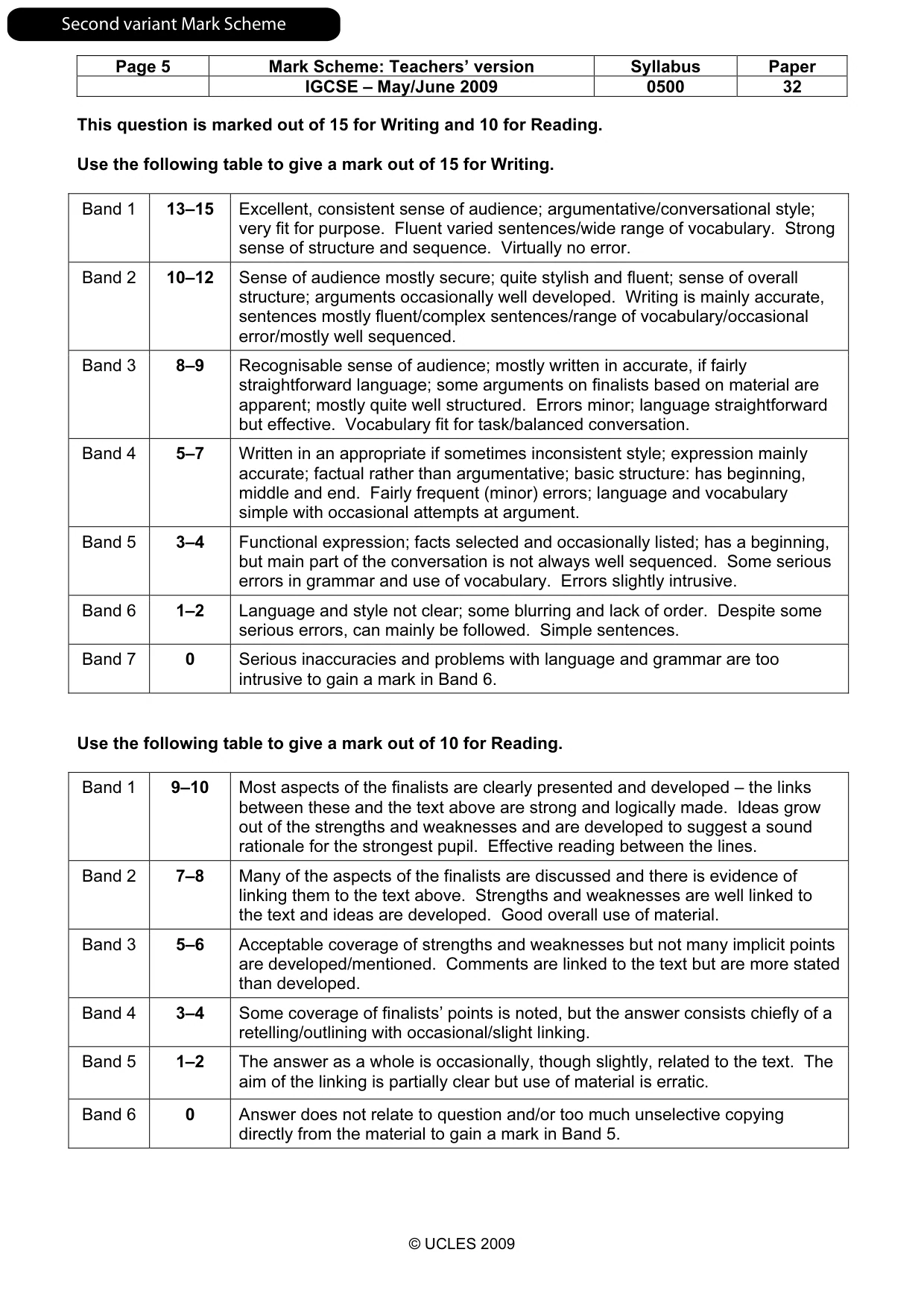
Page 5 Mark Scheme: Teachers’ version Syllabus Paper IGCSE – May/June 2009 0500 32 © UCLES 2009 This question is marked out of 15 for Writing and 10 for Reading. Use the following table to give a mark out of 15 for Writing. Band 1 13–15 Excellent, consistent sense of audience; argumentative/conversational style; very fit for purpose. Fluent varied sentences/wide range of vocabulary. Strong sense of structure and sequence. Virtually no error. Band 2 10–12 Sense of audience mostly secure; quite stylish and fluent; sense of overall structure; arguments occasionally well developed. Writing is mainly accurate, sentences mostly fluent/complex sentences/range of vocabulary/occasional error/mostly well sequenced. Band 3 8–9 Recognisable sense of audience; mostly written in accurate, if fairly straightforward language; some arguments on finalists based on material are apparent; mostly quite well structured. Errors minor; language straightforward but effective. Vocabulary fit for task/balanced conversation. Band 4 5–7 Written in an appropriate if sometimes inconsistent style; expression mainly accurate; factual rather than argumentative; basic structure: has beginning, middle and end. Fairly frequent (minor) errors; language and vocabulary simple with occasional attempts at argument. Band 5 3–4 Functional expression; facts selected and occasionally listed; has a beginning, but main part of the conversation is not always well sequenced. Some serious errors in grammar and use of vocabulary. Errors slightly intrusive. Band 6 1–2 Language and style not clear; some blurring and lack of order. Despite some serious errors, can mainly be followed. Simple sentences. Band 7 0 Serious inaccuracies and problems with language and grammar are too intrusive to gain a mark in Band 6. Use the following table to give a mark out of 10 for Reading. Band 1 9–10 Most aspects of the finalists are clearly presented and developed – the links between these and the text above are strong and logically made. Ideas grow out of the strengths and weaknesses and are developed to suggest a sound rationale for the strongest pupil. Effective reading between the lines. Band 2 7–8 Many of the aspects of the finalists are discussed and there is evidence of linking them to the text above. Strengths and weaknesses are well linked to the text and ideas are developed. Good overall use of material. Band 3 5–6 Acceptable coverage of strengths and weaknesses but not many implicit points are developed/mentioned. Comments are linked to the text but are more stated than developed. Band 4 3–4 Some coverage of finalists’ points is noted, but the answer consists chiefly of a retelling/outlining with occasional/slight linking. Band 5 1–2 The answer as a whole is occasionally, though slightly, related to the text. The aim of the linking is partially clear but use of material is erratic. Band 6 0 Answer does not relate to question and/or too much unselective copying directly from the material to gain a mark in Band 5. Second variant Mark Scheme
Mark scheme, page 16
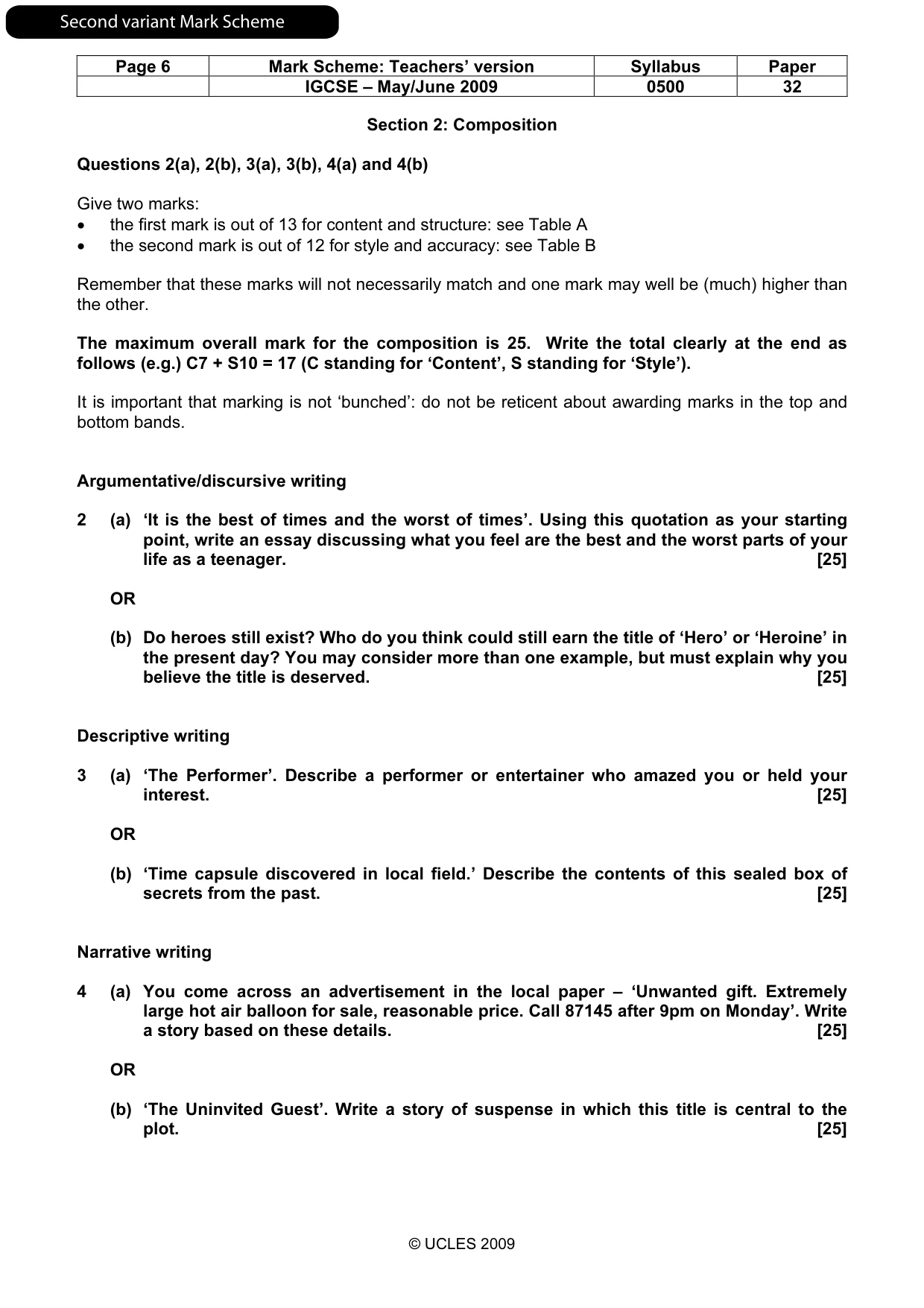
Page 6 Mark Scheme: Teachers’ version Syllabus Paper IGCSE – May/June 2009 0500 32 © UCLES 2009 Section 2: Composition Questions 2(a), 2(b), 3(a), 3(b), 4(a) and 4(b) Give two marks: • the first mark is out of 13 for content and structure: see Table A • the second mark is out of 12 for style and accuracy: see Table B Remember that these marks will not necessarily match and one mark may well be (much) higher than the other. The maximum overall mark for the composition is 25. Write the total clearly at the end as follows (e.g.) C7 + S10 = 17 (C standing for ‘Content’, S standing for ‘Style’). It is important that marking is not ‘bunched’: do not be reticent about awarding marks in the top and bottom bands. Argumentative/discursive writing 2 (a) ‘It is the best of times and the worst of times’. Using this quotation as your starting point, write an essay discussing what you feel are the best and the worst parts of your life as a teenager. [25] OR (b) Do heroes still exist? Who do you think could still earn the title of ‘Hero’ or ‘Heroine’ in the present day? You may consider more than one example, but must explain why you believe the title is deserved. [25] Descriptive writing 3 (a) ‘The Performer’. Describe a performer or entertainer who amazed you or held your interest. [25] OR (b) ‘Time capsule discovered in local field.’ Describe the contents of this sealed box of secrets from the past. [25] Narrative writing 4 (a) You come across an advertisement in the local paper – ‘Unwanted gift. Extremely large hot air balloon for sale, reasonable price. Call 87145 after 9pm on Monday’. Write a story based on these details. [25] OR (b) ‘The Uninvited Guest’. Write a story of suspense in which this title is central to the plot. [25] Second variant Mark Scheme
Mark scheme, page 17
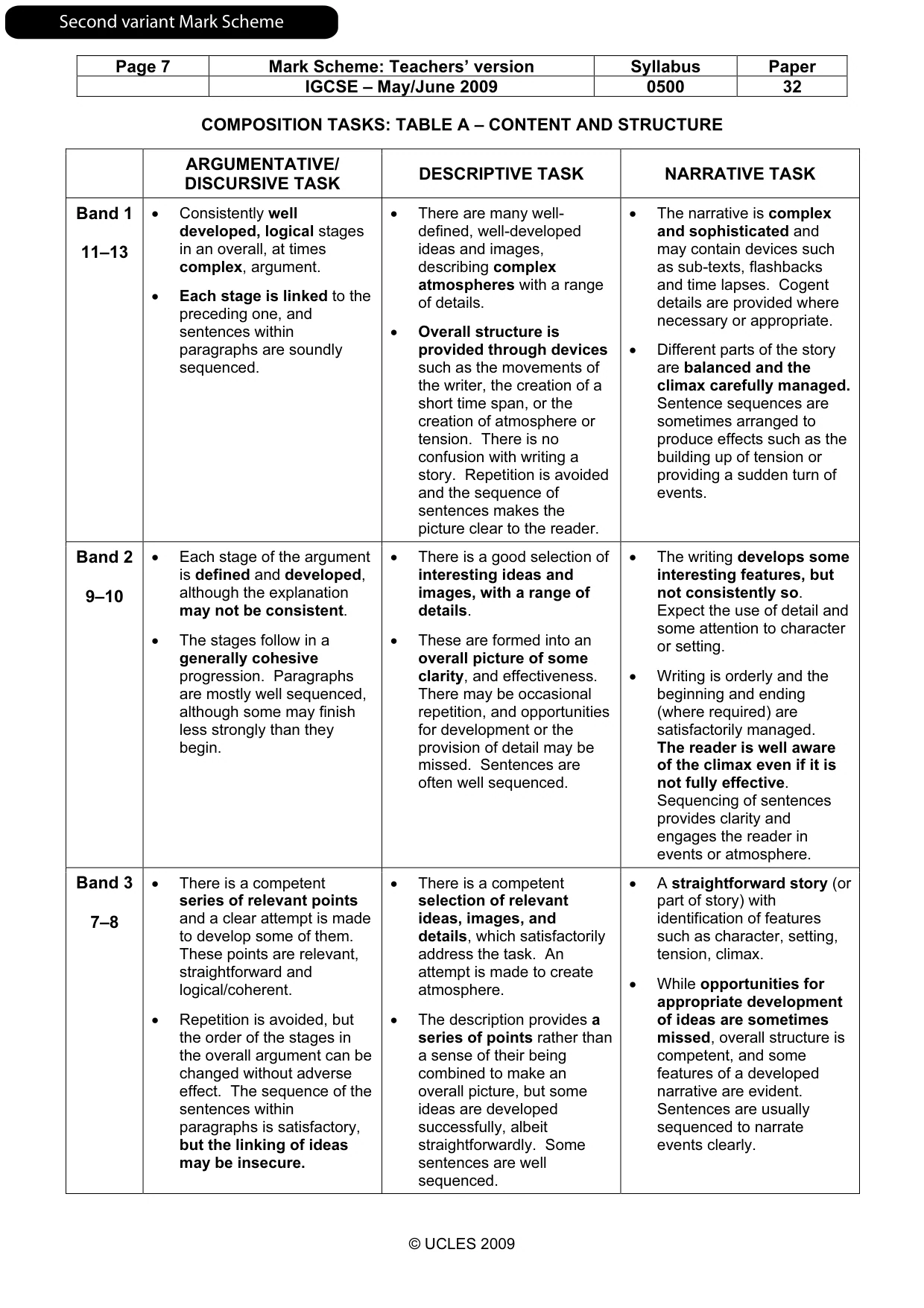
Page 7 Mark Scheme: Teachers’ version Syllabus Paper IGCSE – May/June 2009 0500 32 © UCLES 2009 COMPOSITION TASKS: TABLE A – CONTENT AND STRUCTURE ARGUMENTATIVE/ DISCURSIVE TASK DESCRIPTIVE TASK NARRATIVE TASK Band 1 11–13 • Consistently well developed, logical stages in an overall, at times complex, argument. • Each stage is linked to the preceding one, and sentences within paragraphs are soundly sequenced. • There are many well- defined, well-developed ideas and images, describing complex atmospheres with a range of details. • Overall structure is provided through devices such as the movements of the writer, the creation of a short time span, or the creation of atmosphere or tension. There is no confusion with writing a story. Repetition is avoided and the sequence of sentences makes the picture clear to the reader. • The narrative is complex and sophisticated and may contain devices such as sub-texts, flashbacks and time lapses. Cogent details are provided where necessary or appropriate. • Different parts of the story are balanced and the climax carefully managed. Sentence sequences are sometimes arranged to produce effects such as the building up of tension or providing a sudden turn of events. Band 2 9–10 • Each stage of the argument is defined and developed, although the explanation may not be consistent. • The stages follow in a generally cohesive progression. Paragraphs are mostly well sequenced, although some may finish less strongly than they begin. • There is a good selection of interesting ideas and images, with a range of details. • These are formed into an overall picture of some clarity, and effectiveness. There may be occasional repetition, and opportunities for development or the provision of detail may be missed. Sentences are often well sequenced. • The writing develops some interesting features, but not consistently so. Expect the use of detail and some attention to character or setting. • Writing is orderly and the beginning and ending (where required) are satisfactorily managed. The reader is well aware of the climax even if it is not fully effective. Sequencing of sentences provides clarity and engages the reader in events or atmosphere. Band 3 7–8 • There is a competent series of relevant points and a clear attempt is made to develop some of them. These points are relevant, straightforward and logical/coherent. • Repetition is avoided, but the order of the stages in the overall argument can be changed without adverse effect. The sequence of the sentences within paragraphs is satisfactory, but the linking of ideas may be insecure. • There is a competent selection of relevant ideas, images, and details, which satisfactorily address the task. An attempt is made to create atmosphere. • The description provides a series of points rather than a sense of their being combined to make an overall picture, but some ideas are developed successfully, albeit straightforwardly. Some sentences are well sequenced. • A straightforward story (or part of story) with identification of features such as character, setting, tension, climax. • While opportunities for appropriate development of ideas are sometimes missed, overall structure is competent, and some features of a developed narrative are evident. Sentences are usually sequenced to narrate events clearly. Second variant Mark Scheme
Mark scheme, page 18
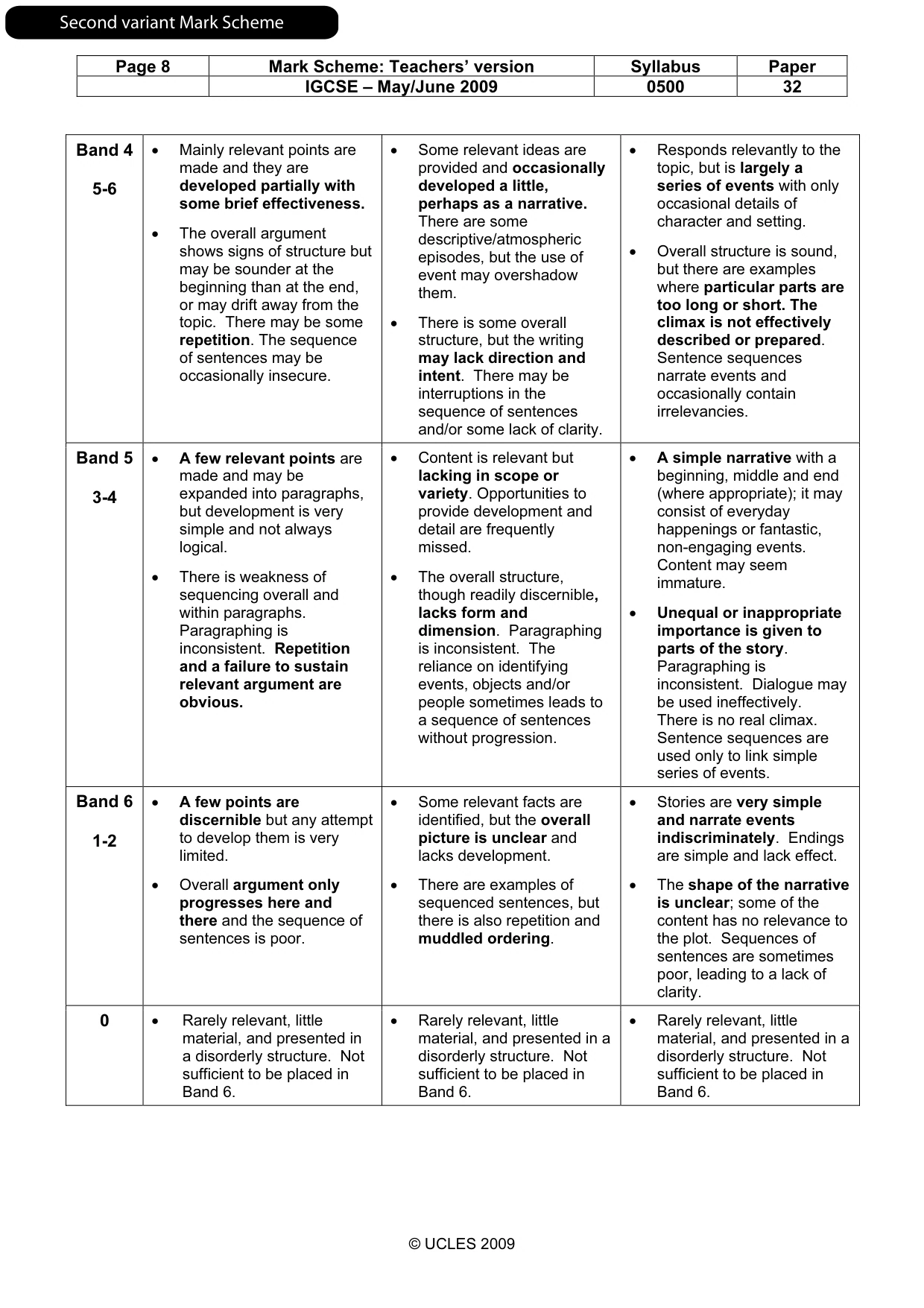
Page 8 Mark Scheme: Teachers’ version Syllabus Paper IGCSE – May/June 2009 0500 32 © UCLES 2009 Band 4 5-6 • Mainly relevant points are made and they are developed partially with some brief effectiveness. • The overall argument shows signs of structure but may be sounder at the beginning than at the end, or may drift away from the topic. There may be some repetition. The sequence of sentences may be occasionally insecure. • Some relevant ideas are provided and occasionally developed a little, perhaps as a narrative. There are some descriptive/atmospheric episodes, but the use of event may overshadow them. • There is some overall structure, but the writing may lack direction and intent. There may be interruptions in the sequence of sentences and/or some lack of clarity. • Responds relevantly to the topic, but is largely a series of events with only occasional details of character and setting. • Overall structure is sound, but there are examples where particular parts are too long or short. The climax is not effectively described or prepared. Sentence sequences narrate events and occasionally contain irrelevancies. Band 5 3-4 • A few relevant points are made and may be expanded into paragraphs, but development is very simple and not always logical. • There is weakness of sequencing overall and within paragraphs. Paragraphing is inconsistent. Repetition and a failure to sustain relevant argument are obvious. • Content is relevant but lacking in scope or variety. Opportunities to provide development and detail are frequently missed. • The overall structure, though readily discernible, lacks form and dimension. Paragraphing is inconsistent. The reliance on identifying events, objects and/or people sometimes leads to a sequence of sentences without progression. • A simple narrative with a beginning, middle and end (where appropriate); it may consist of everyday happenings or fantastic, non-engaging events. Content may seem immature. • Unequal or inappropriate importance is given to parts of the story. Paragraphing is inconsistent. Dialogue may be used ineffectively. There is no real climax. Sentence sequences are used only to link simple series of events. Band 6 1-2 • A few points are discernible but any attempt to develop them is very limited. • Overall argument only progresses here and there and the sequence of sentences is poor. • Some relevant facts are identified, but the overall picture is unclear and lacks development. • There are examples of sequenced sentences, but there is also repetition and muddled ordering. • Stories are very simple and narrate events indiscriminately. Endings are simple and lack effect. • The shape of the narrative is unclear; some of the content has no relevance to the plot. Sequences of sentences are sometimes poor, leading to a lack of clarity. 0 • Rarely relevant, little material, and presented in a disorderly structure. Not sufficient to be placed in Band 6. • Rarely relevant, little material, and presented in a disorderly structure. Not sufficient to be placed in Band 6. • Rarely relevant, little material, and presented in a disorderly structure. Not sufficient to be placed in Band 6. Second variant Mark Scheme
Mark scheme, page 19
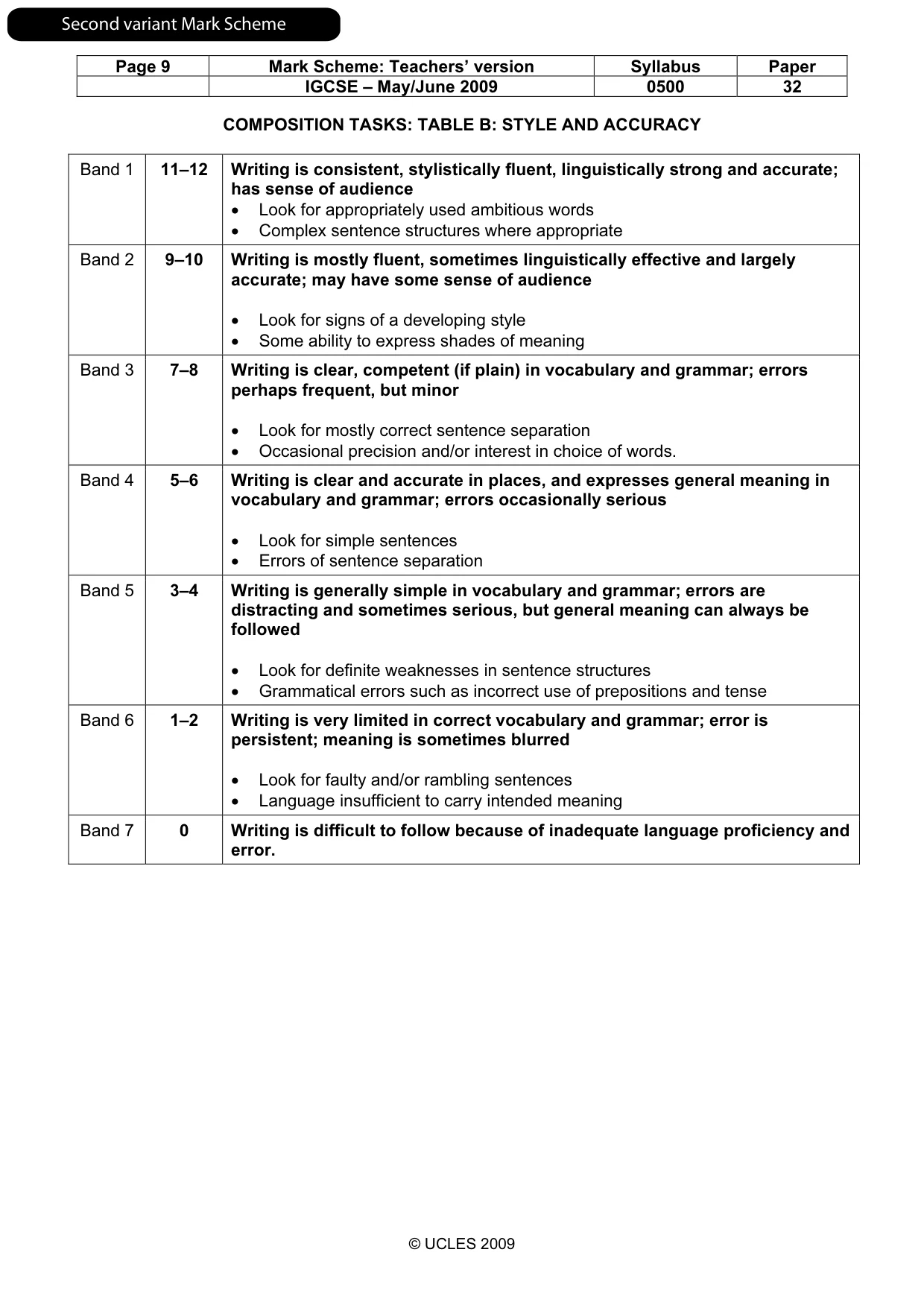
Page 9 Mark Scheme: Teachers’ version Syllabus Paper IGCSE – May/June 2009 0500 32 © UCLES 2009 COMPOSITION TASKS: TABLE B: STYLE AND ACCURACY Band 1 11–12 Writing is consistent, stylistically fluent, linguistically strong and accurate; has sense of audience • Look for appropriately used ambitious words • Complex sentence structures where appropriate Band 2 9–10 Writing is mostly fluent, sometimes linguistically effective and largely accurate; may have some sense of audience • Look for signs of a developing style • Some ability to express shades of meaning Band 3 7–8 Writing is clear, competent (if plain) in vocabulary and grammar; errors perhaps frequent, but minor • Look for mostly correct sentence separation • Occasional precision and/or interest in choice of words. Band 4 5–6 Writing is clear and accurate in places, and expresses general meaning in vocabulary and grammar; errors occasionally serious • Look for simple sentences • Errors of sentence separation Band 5 3–4 Writing is generally simple in vocabulary and grammar; errors are distracting and sometimes serious, but general meaning can always be followed • Look for definite weaknesses in sentence structures • Grammatical errors such as incorrect use of prepositions and tense Band 6 1–2 Writing is very limited in correct vocabulary and grammar; error is persistent; meaning is sometimes blurred • Look for faulty and/or rambling sentences • Language insufficient to carry intended meaning Band 7 0 Writing is difficult to follow because of inadequate language proficiency and error. Second variant Mark Scheme