Cambridge IGCSE English - First Language 0500 — 2009 May/June Paper 1 · Variant 1
0500/11/M/J/09 · 50 marks · ≈56 min
The question paper and its mark scheme, free to read here and free to download. This is Cambridge’s own paper, exactly as it was sat.
Question paper4 pages
Mark scheme5 pages
Answers below. Sit the paper first if you are practising.
Paper as text
Question paper, page 1
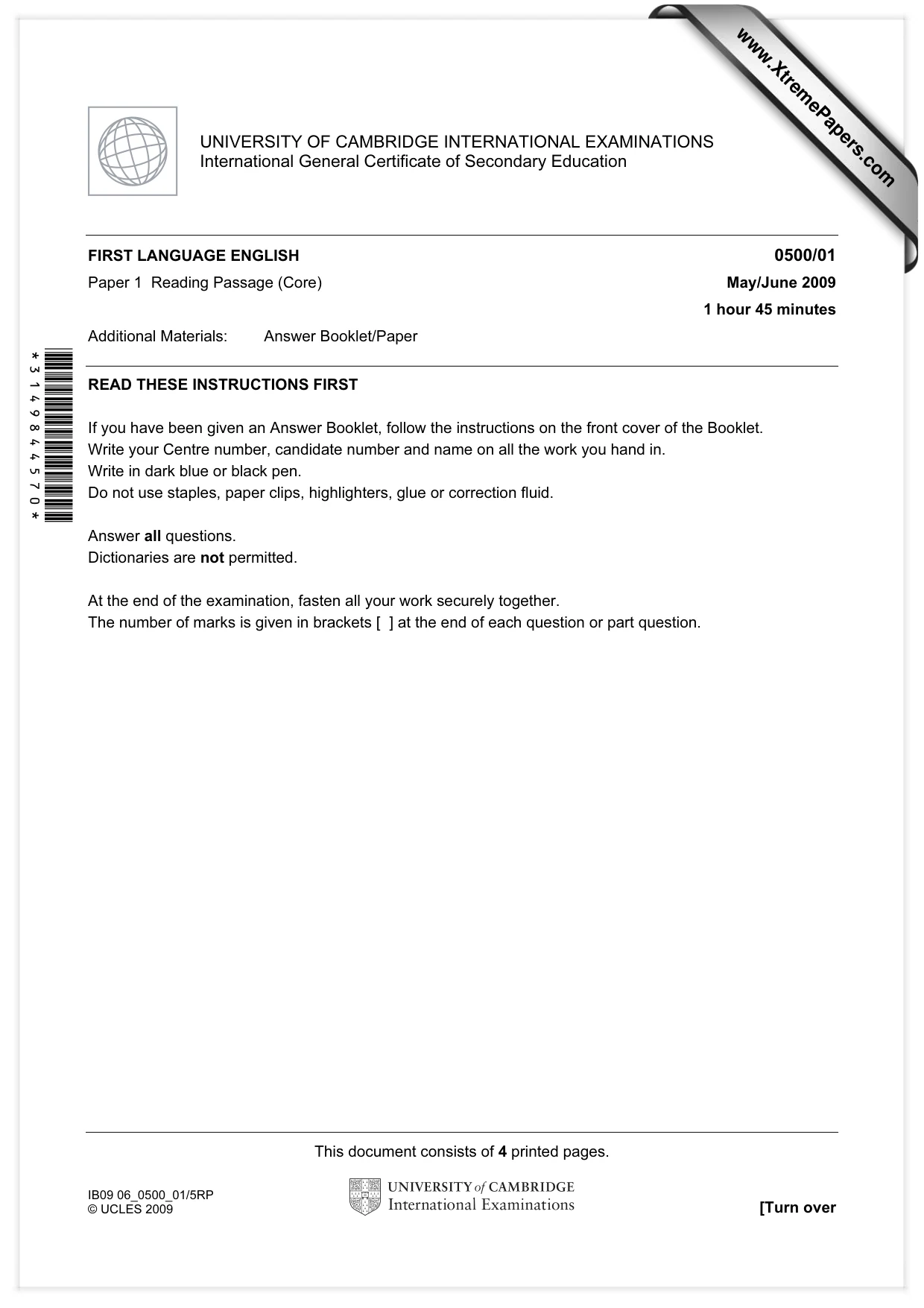
This document consists of 4 printed pages. IB09 06_0500_01/5RP © UCLES 2009 [Turn over *3149844570* UNIVERSITY OF CAMBRIDGE INTERNATIONAL EXAMINATIONS International General Certificate of Secondary Education FIRST LANGUAGE ENGLISH 0500/01 Paper 1 Reading Passage (Core) May/June 2009 1 hour 45 minutes Additional Materials: Answer Booklet/Paper READ THESE INSTRUCTIONS FIRST If you have been given an Answer Booklet, follow the instructions on the front cover of the Booklet. Write your Centre number, candidate number and name on all the work you hand in. Write in dark blue or black pen. Do not use staples, paper clips, highlighters, glue or correction fluid. Answer all questions. Dictionaries are not permitted. At the end of the examination, fasten all your work securely together. The number of marks is given in brackets [ ] at the end of each question or part question. www.XtremePapers.com
Question paper, page 2
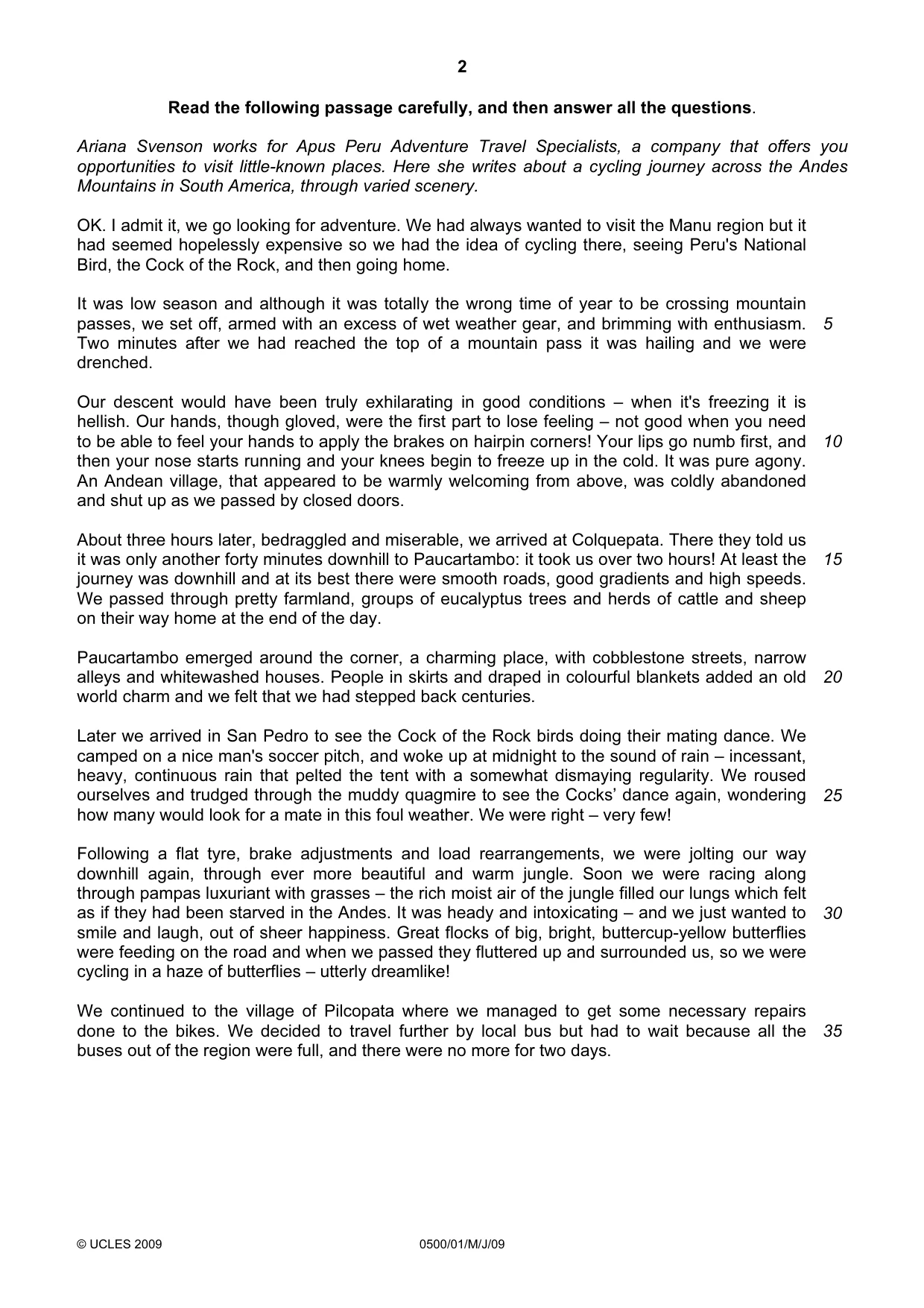
2 © UCLES 2009 0500/01/M/J/09 Read the following passage carefully, and then answer all the questions. Ariana Svenson works for Apus Peru Adventure Travel Specialists, a company that offers you opportunities to visit little-known places. Here she writes about a cycling journey across the Andes Mountains in South America, through varied scenery. OK. I admit it, we go looking for adventure. We had always wanted to visit the Manu region but it had seemed hopelessly expensive so we had the idea of cycling there, seeing Peru's National Bird, the Cock of the Rock, and then going home. It was low season and although it was totally the wrong time of year to be crossing mountain passes, we set off, armed with an excess of wet weather gear, and brimming with enthusiasm. Two minutes after we had reached the top of a mountain pass it was hailing and we were drenched. Our descent would have been truly exhilarating in good conditions – when it's freezing it is hellish. Our hands, though gloved, were the first part to lose feeling – not good when you need to be able to feel your hands to apply the brakes on hairpin corners! Your lips go numb first, and then your nose starts running and your knees begin to freeze up in the cold. It was pure agony. An Andean village, that appeared to be warmly welcoming from above, was coldly abandoned and shut up as we passed by closed doors. About three hours later, bedraggled and miserable, we arrived at Colquepata. There they told us it was only another forty minutes downhill to Paucartambo: it took us over two hours! At least the journey was downhill and at its best there were smooth roads, good gradients and high speeds. We passed through pretty farmland, groups of eucalyptus trees and herds of cattle and sheep on their way home at the end of the day. Paucartambo emerged around the corner, a charming place, with cobblestone streets, narrow alleys and whitewashed houses. People in skirts and draped in colourful blankets added an old world charm and we felt that we had stepped back centuries. Later we arrived in San Pedro to see the Cock of the Rock birds doing their mating dance. We camped on a nice man's soccer pitch, and woke up at midnight to the sound of rain – incessant, heavy, continuous rain that pelted the tent with a somewhat dismaying regularity. We roused ourselves and trudged through the muddy quagmire to see the Cocks’ dance again, wondering how many would look for a mate in this foul weather. We were right – very few! Following a flat tyre, brake adjustments and load rearrangements, we were jolting our way downhill again, through ever more beautiful and warm jungle. Soon we were racing along through pampas luxuriant with grasses – the rich moist air of the jungle filled our lungs which felt as if they had been starved in the Andes. It was heady and intoxicating – and we just wanted to smile and laugh, out of sheer happiness. Great flocks of big, bright, buttercup-yellow butterflies were feeding on the road and when we passed they fluttered up and surrounded us, so we were cycling in a haze of butterflies – utterly dreamlike! We continued to the village of Pilcopata where we managed to get some necessary repairs done to the bikes. We decided to travel further by local bus but had to wait because all the buses out of the region were full, and there were no more for two days. 5 10 15 20 25 30 35
Question paper, page 3
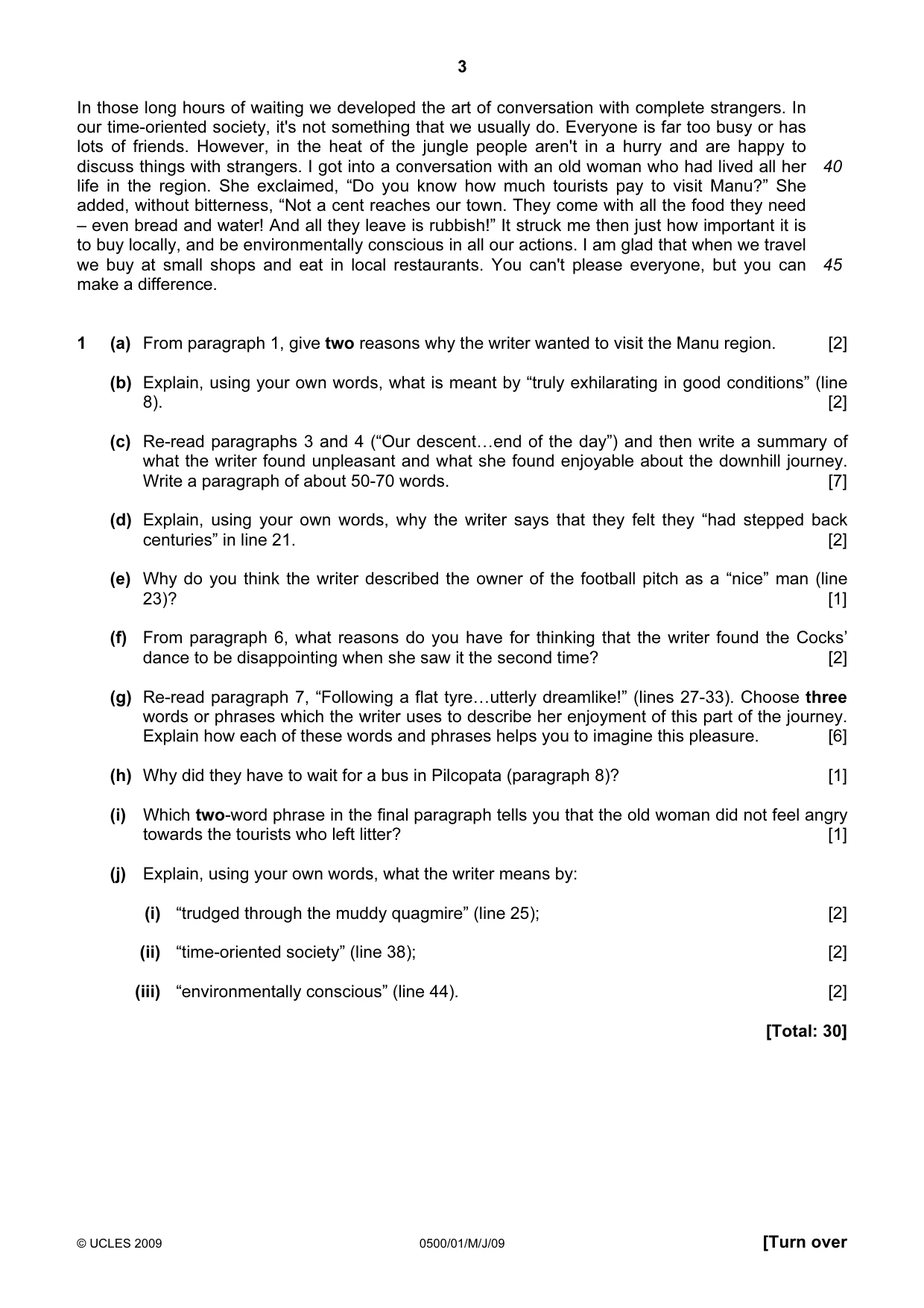
3 © UCLES 2009 0500/01/M/J/09 [Turn over In those long hours of waiting we developed the art of conversation with complete strangers. In our time-oriented society, it's not something that we usually do. Everyone is far too busy or has lots of friends. However, in the heat of the jungle people aren't in a hurry and are happy to discuss things with strangers. I got into a conversation with an old woman who had lived all her life in the region. She exclaimed, “Do you know how much tourists pay to visit Manu?” She added, without bitterness, “Not a cent reaches our town. They come with all the food they need – even bread and water! And all they leave is rubbish!” It struck me then just how important it is to buy locally, and be environmentally conscious in all our actions. I am glad that when we travel we buy at small shops and eat in local restaurants. You can't please everyone, but you can make a difference. 40 45 1 (a) From paragraph 1, give two reasons why the writer wanted to visit the Manu region. [2] (b) Explain, using your own words, what is meant by “truly exhilarating in good conditions” (line 8). [2] (c) Re-read paragraphs 3 and 4 (“Our descent…end of the day”) and then write a summary of what the writer found unpleasant and what she found enjoyable about the downhill journey. Write a paragraph of about 50-70 words. [7] (d) Explain, using your own words, why the writer says that they felt they “had stepped back centuries” in line 21. [2] (e) Why do you think the writer described the owner of the football pitch as a “nice” man (line 23)? [1] (f) From paragraph 6, what reasons do you have for thinking that the writer found the Cocks’ dance to be disappointing when she saw it the second time? [2] (g) Re-read paragraph 7, “Following a flat tyre…utterly dreamlike!” (lines 27-33). Choose three words or phrases which the writer uses to describe her enjoyment of this part of the journey. Explain how each of these words and phrases helps you to imagine this pleasure. [6] (h) Why did they have to wait for a bus in Pilcopata (paragraph 8)? [1] (i) Which two-word phrase in the final paragraph tells you that the old woman did not feel angry towards the tourists who left litter? [1] (j) Explain, using your own words, what the writer means by: (i) “trudged through the muddy quagmire” (line 25); [2] (ii) “time-oriented society” (line 38); [2] (iii) “environmentally conscious” (line 44). [2] [Total: 30]
Question paper, page 4
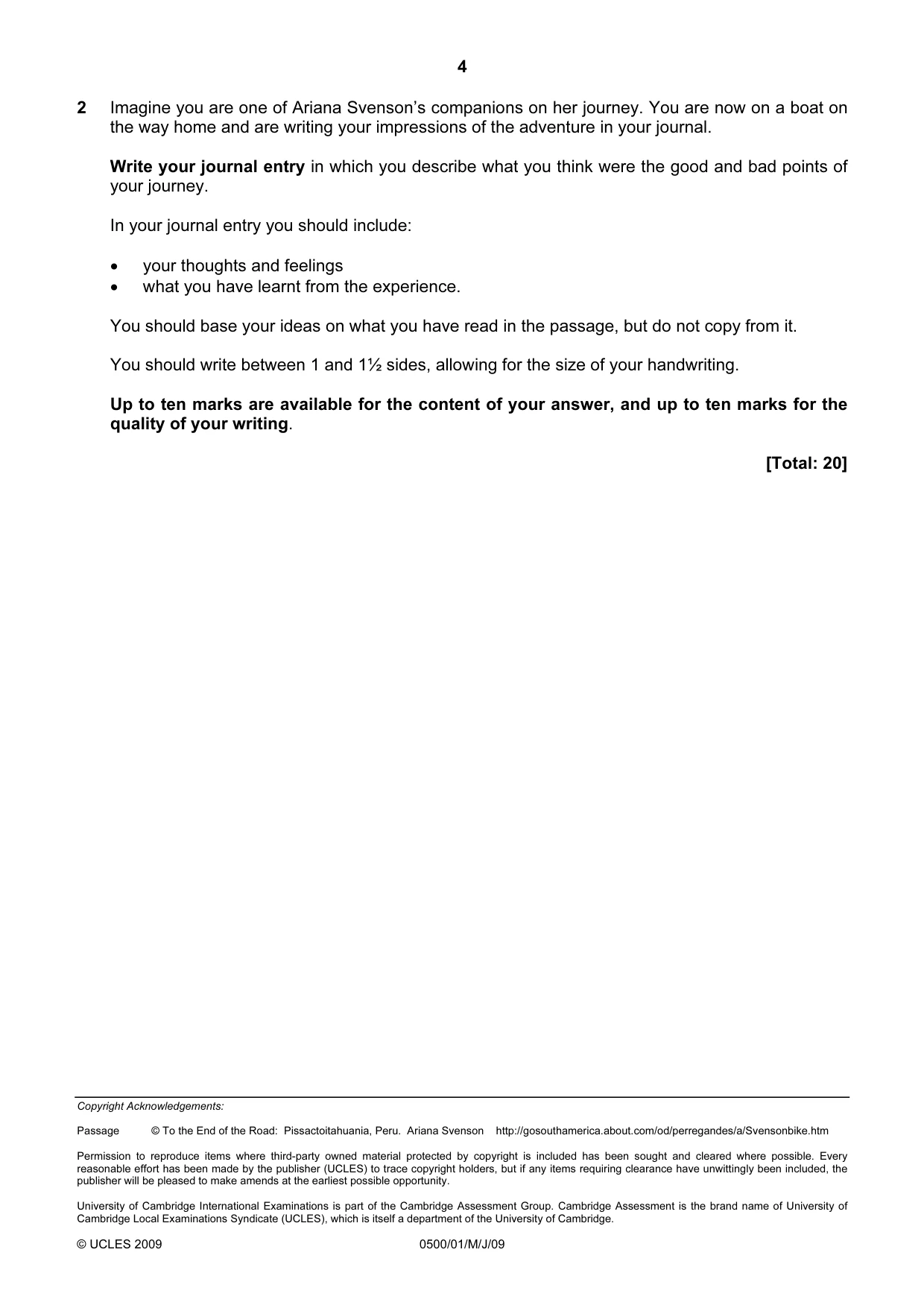
4 Copyright Acknowledgements: Passage © To the End of the Road: Pissactoitahuania, Peru. Ariana Svenson http://gosouthamerica.about.com/od/perregandes/a/Svensonbike.htm Permission to reproduce items where third-party owned material protected by copyright is included has been sought and cleared where possible. Every reasonable effort has been made by the publisher (UCLES) to trace copyright holders, but if any items requiring clearance have unwittingly been included, the publisher will be pleased to make amends at the earliest possible opportunity. University of Cambridge International Examinations is part of the Cambridge Assessment Group. Cambridge Assessment is the brand name of University of Cambridge Local Examinations Syndicate (UCLES), which is itself a department of the University of Cambridge. © UCLES 2009 0500/01/M/J/09 2 Imagine you are one of Ariana Svenson’s companions on her journey. You are now on a boat on the way home and are writing your impressions of the adventure in your journal. Write your journal entry in which you describe what you think were the good and bad points of your journey. In your journal entry you should include: • your thoughts and feelings • what you have learnt from the experience. You should base your ideas on what you have read in the passage, but do not copy from it. You should write between 1 and 1½ sides, allowing for the size of your handwriting. Up to ten marks are available for the content of your answer, and up to ten marks for the quality of your writing. [Total: 20]
Mark scheme, page 1
UNIVERSITY OF CAMBRIDGE INTERNATIONAL EXAMINATIONS International General Certificate of Secondary Education MARK SCHEME for the May/June 2009 question paper for the guidance of teachers 0500 FIRST LANGUAGE ENGLISH 0500/01 Paper 1 (Reading Passage – Core), maximum raw mark 50 This mark scheme is published as an aid to teachers and candidates, to indicate the requirements of the examination. It shows the basis on which Examiners were instructed to award marks. It does not indicate the details of the discussions that took place at an Examiners’ meeting before marking began, which would have considered the acceptability of alternative answers. Mark schemes must be read in conjunction with the question papers and the report on the examination. • CIE will not enter into discussions or correspondence in connection with these mark schemes. CIE is publishing the mark schemes for the May/June 2009 question papers for most IGCSE, GCE Advanced Level and Advanced Subsidiary Level syllabuses and some Ordinary Level syllabuses. www.XtremePapers.com
Mark scheme, page 2
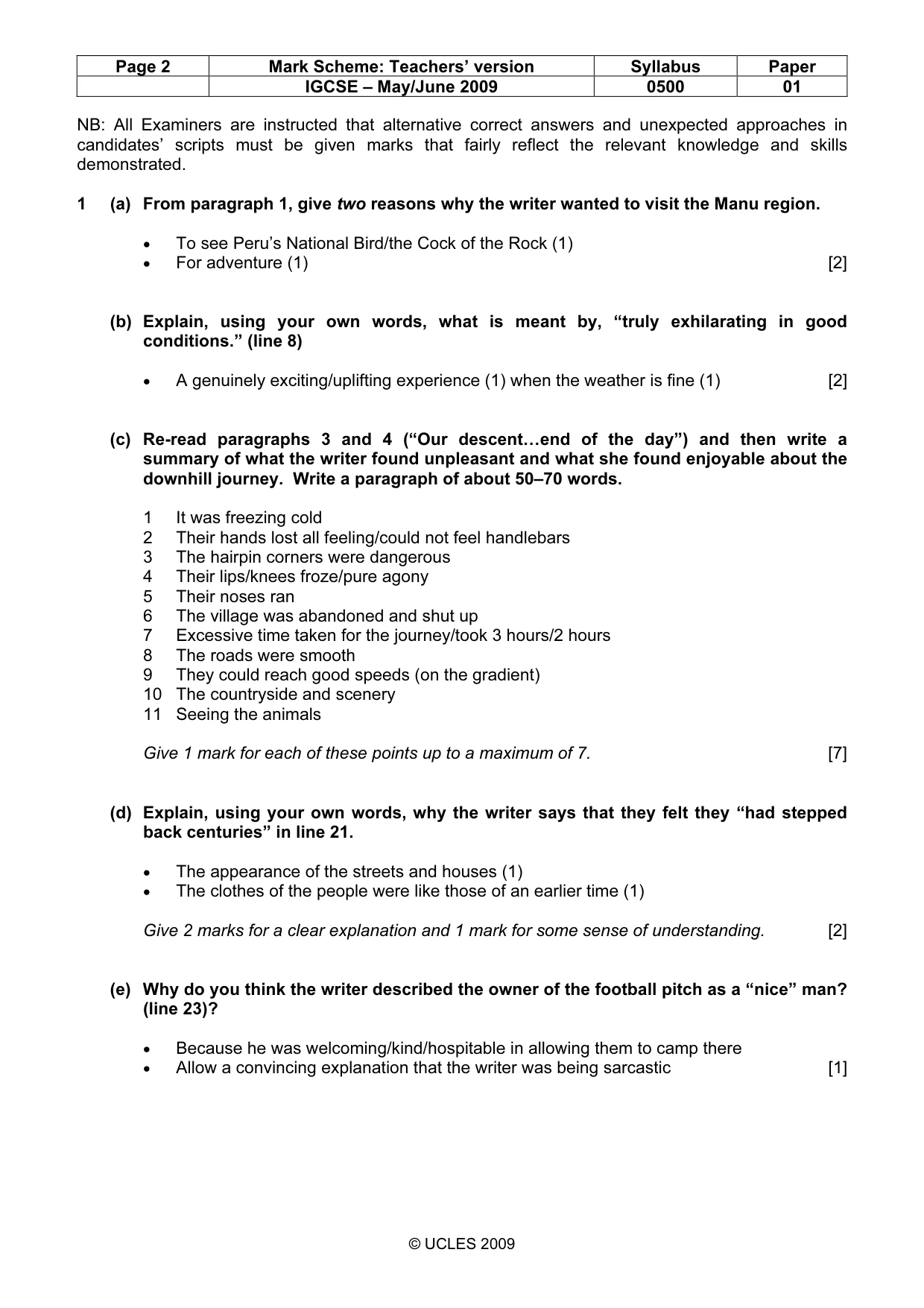
Page 2 Mark Scheme: Teachers’ version Syllabus Paper IGCSE – May/June 2009 0500 01 © UCLES 2009 NB: All Examiners are instructed that alternative correct answers and unexpected approaches in candidates’ scripts must be given marks that fairly reflect the relevant knowledge and skills demonstrated. 1 (a) From paragraph 1, give two reasons why the writer wanted to visit the Manu region. • To see Peru’s National Bird/the Cock of the Rock (1) • For adventure (1) [2] (b) Explain, using your own words, what is meant by, “truly exhilarating in good conditions.” (line 8) • A genuinely exciting/uplifting experience (1) when the weather is fine (1) [2] (c) Re-read paragraphs 3 and 4 (“Our descent…end of the day”) and then write a summary of what the writer found unpleasant and what she found enjoyable about the downhill journey. Write a paragraph of about 50–70 words. 1 It was freezing cold 2 Their hands lost all feeling/could not feel handlebars 3 The hairpin corners were dangerous 4 Their lips/knees froze/pure agony 5 Their noses ran 6 The village was abandoned and shut up 7 Excessive time taken for the journey/took 3 hours/2 hours 8 The roads were smooth 9 They could reach good speeds (on the gradient) 10 The countryside and scenery 11 Seeing the animals Give 1 mark for each of these points up to a maximum of 7. [7] (d) Explain, using your own words, why the writer says that they felt they “had stepped back centuries” in line 21. • The appearance of the streets and houses (1) • The clothes of the people were like those of an earlier time (1) Give 2 marks for a clear explanation and 1 mark for some sense of understanding. [2] (e) Why do you think the writer described the owner of the football pitch as a “nice” man? (line 23)? • Because he was welcoming/kind/hospitable in allowing them to camp there • Allow a convincing explanation that the writer was being sarcastic [1]
Mark scheme, page 3
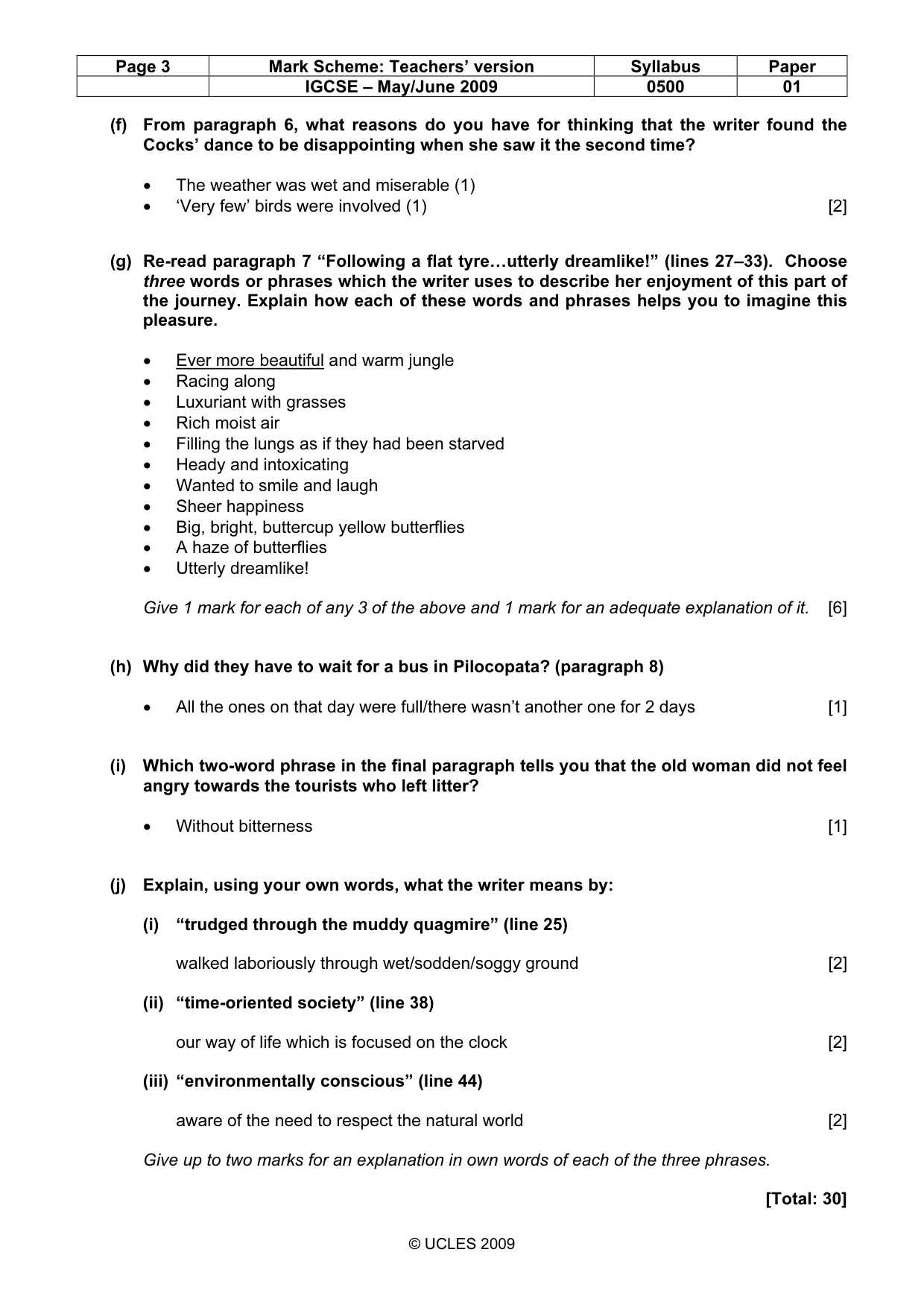
Page 3 Mark Scheme: Teachers’ version Syllabus Paper IGCSE – May/June 2009 0500 01 © UCLES 2009 (f) From paragraph 6, what reasons do you have for thinking that the writer found the Cocks’ dance to be disappointing when she saw it the second time? • The weather was wet and miserable (1) • ‘Very few’ birds were involved (1) [2] (g) Re-read paragraph 7 “Following a flat tyre…utterly dreamlike!” (lines 27–33). Choose three words or phrases which the writer uses to describe her enjoyment of this part of the journey. Explain how each of these words and phrases helps you to imagine this pleasure. • Ever more beautiful and warm jungle • Racing along • Luxuriant with grasses • Rich moist air • Filling the lungs as if they had been starved • Heady and intoxicating • Wanted to smile and laugh • Sheer happiness • Big, bright, buttercup yellow butterflies • A haze of butterflies • Utterly dreamlike! Give 1 mark for each of any 3 of the above and 1 mark for an adequate explanation of it. [6] (h) Why did they have to wait for a bus in Pilocopata? (paragraph 8) • All the ones on that day were full/there wasn’t another one for 2 days [1] (i) Which two-word phrase in the final paragraph tells you that the old woman did not feel angry towards the tourists who left litter? • Without bitterness [1] (j) Explain, using your own words, what the writer means by: (i) “trudged through the muddy quagmire” (line 25) walked laboriously through wet/sodden/soggy ground [2] (ii) “time-oriented society” (line 38) our way of life which is focused on the clock [2] (iii) “environmentally conscious” (line 44) aware of the need to respect the natural world [2] Give up to two marks for an explanation in own words of each of the three phrases. [Total: 30]
Mark scheme, page 4
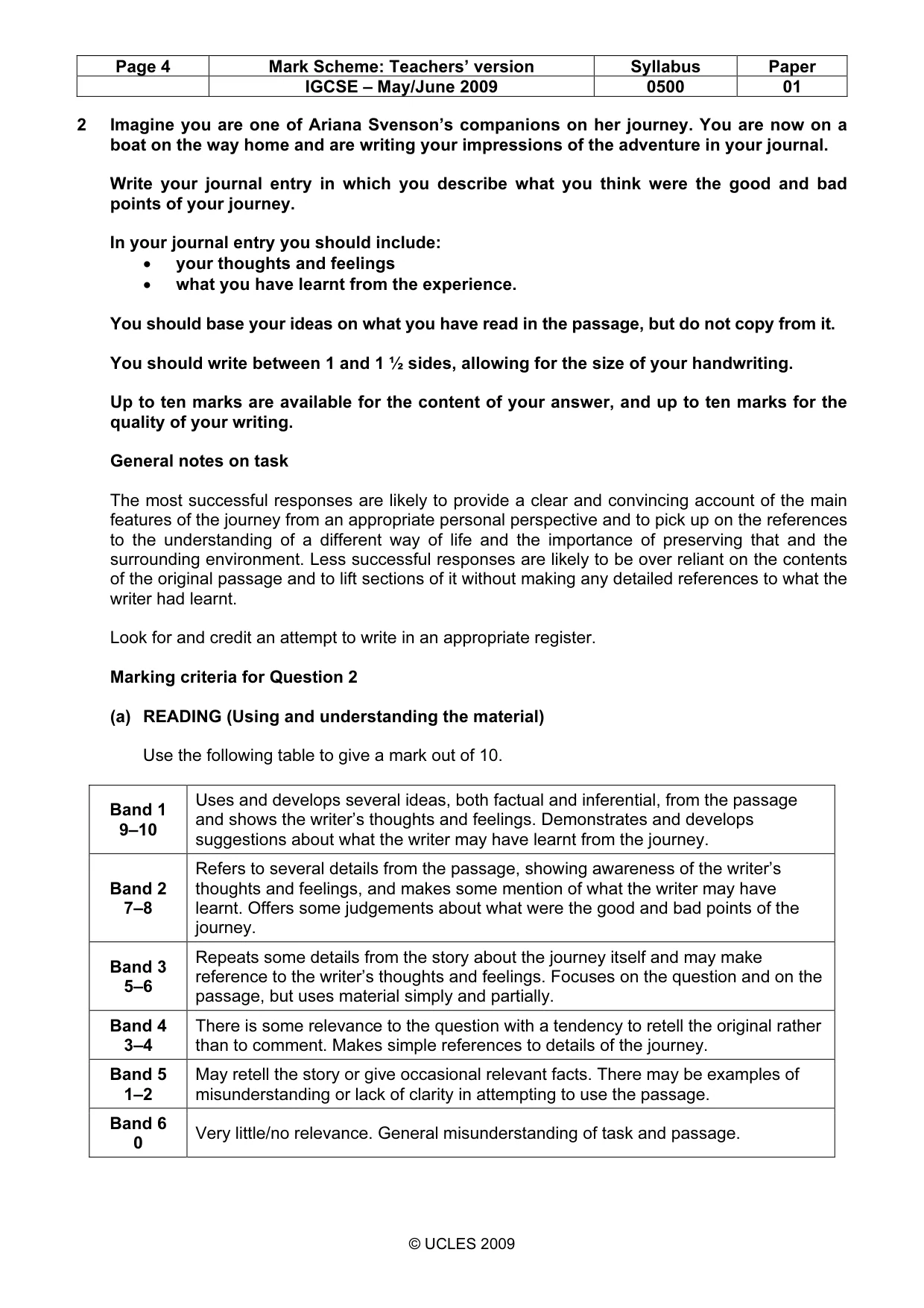
Page 4 Mark Scheme: Teachers’ version Syllabus Paper IGCSE – May/June 2009 0500 01 © UCLES 2009 2 Imagine you are one of Ariana Svenson’s companions on her journey. You are now on a boat on the way home and are writing your impressions of the adventure in your journal. Write your journal entry in which you describe what you think were the good and bad points of your journey. In your journal entry you should include: • your thoughts and feelings • what you have learnt from the experience. You should base your ideas on what you have read in the passage, but do not copy from it. You should write between 1 and 1 ½ sides, allowing for the size of your handwriting. Up to ten marks are available for the content of your answer, and up to ten marks for the quality of your writing. General notes on task The most successful responses are likely to provide a clear and convincing account of the main features of the journey from an appropriate personal perspective and to pick up on the references to the understanding of a different way of life and the importance of preserving that and the surrounding environment. Less successful responses are likely to be over reliant on the contents of the original passage and to lift sections of it without making any detailed references to what the writer had learnt. Look for and credit an attempt to write in an appropriate register. Marking criteria for Question 2 (a) READING (Using and understanding the material) Use the following table to give a mark out of 10. Band 1 9–10 Uses and develops several ideas, both factual and inferential, from the passage and shows the writer’s thoughts and feelings. Demonstrates and develops suggestions about what the writer may have learnt from the journey. Band 2 7–8 Refers to several details from the passage, showing awareness of the writer’s thoughts and feelings, and makes some mention of what the writer may have learnt. Offers some judgements about what were the good and bad points of the journey. Band 3 5–6 Repeats some details from the story about the journey itself and may make reference to the writer’s thoughts and feelings. Focuses on the question and on the passage, but uses material simply and partially. Band 4 3–4 There is some relevance to the question with a tendency to retell the original rather than to comment. Makes simple references to details of the journey. Band 5 1–2 May retell the story or give occasional relevant facts. There may be examples of misunderstanding or lack of clarity in attempting to use the passage. Band 6 0 Very little/no relevance. General misunderstanding of task and passage.
Mark scheme, page 5
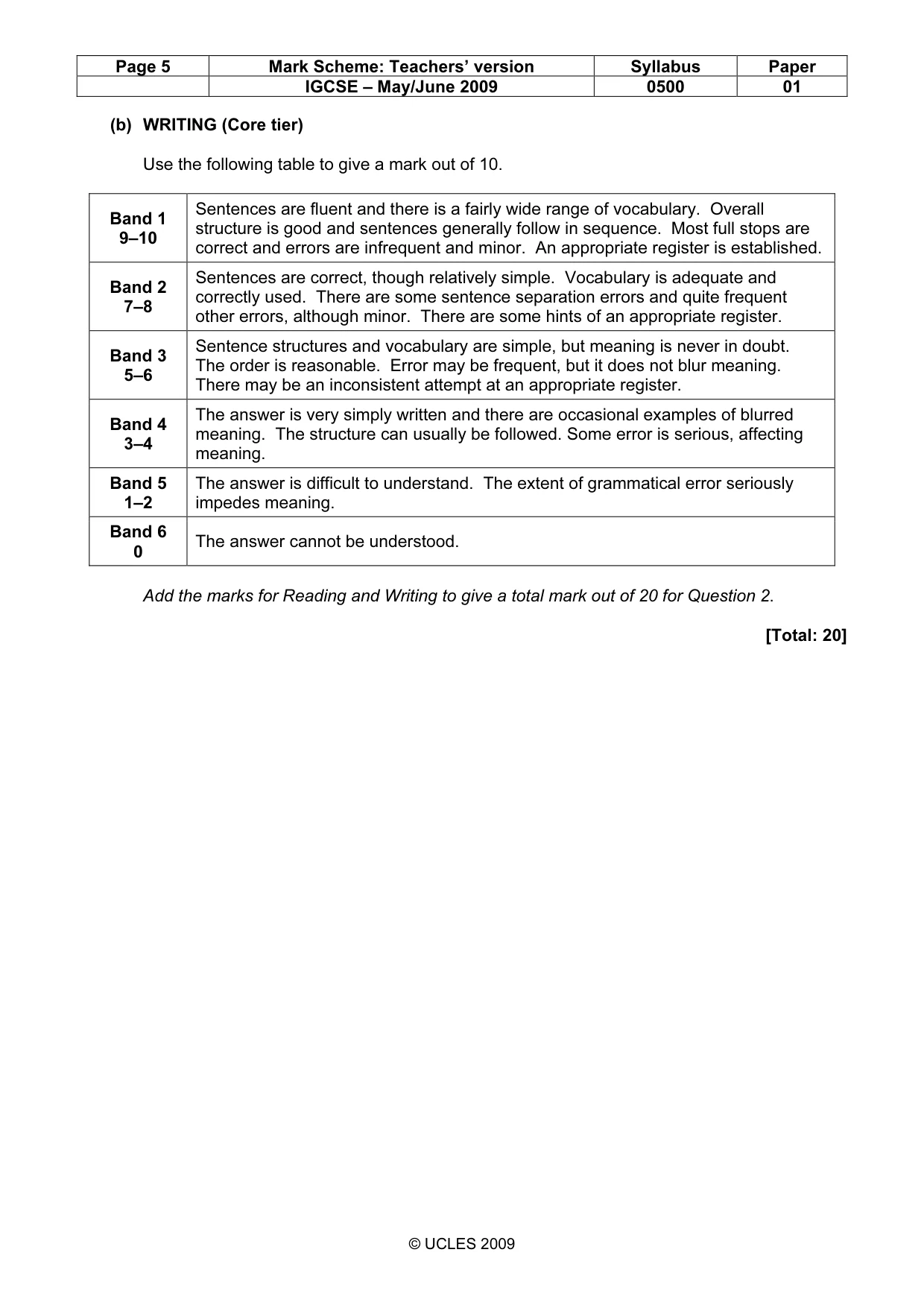
Page 5 Mark Scheme: Teachers’ version Syllabus Paper IGCSE – May/June 2009 0500 01 © UCLES 2009 (b) WRITING (Core tier) Use the following table to give a mark out of 10. Band 1 9–10 Sentences are fluent and there is a fairly wide range of vocabulary. Overall structure is good and sentences generally follow in sequence. Most full stops are correct and errors are infrequent and minor. An appropriate register is established. Band 2 7–8 Sentences are correct, though relatively simple. Vocabulary is adequate and correctly used. There are some sentence separation errors and quite frequent other errors, although minor. There are some hints of an appropriate register. Band 3 5–6 Sentence structures and vocabulary are simple, but meaning is never in doubt. The order is reasonable. Error may be frequent, but it does not blur meaning. There may be an inconsistent attempt at an appropriate register. Band 4 3–4 The answer is very simply written and there are occasional examples of blurred meaning. The structure can usually be followed. Some error is serious, affecting meaning. Band 5 1–2 The answer is difficult to understand. The extent of grammatical error seriously impedes meaning. Band 6 0 The answer cannot be understood. Add the marks for Reading and Writing to give a total mark out of 20 for Question 2. [Total: 20]
What you needed in this session
Cambridge’s own grade thresholds for 2009 May/June, Paper 1 · Variant 1. A higher threshold means an easier paper — the bar moves with how the cohort did.