Cambridge IGCSE English - First Language 0500 — 2008 Oct/Nov Paper 2 · Variant 1
0500/21/O/N/08 · 50 marks · ≈56 min
The question paper and its mark scheme, free to read here and free to download. This is Cambridge’s own paper, exactly as it was sat.
Question paper8 pages


Mark scheme8 pages
Answers below. Sit the paper first if you are practising.
Paper as text
Question paper, page 1
This document consists of 5 printed pages and 3 blank pages. IB08 11_0500_02/5RP © UCLES 2008 [Turn over *9755120562* UNIVERSITY OF CAMBRIDGE INTERNATIONAL EXAMINATIONS International General Certificate of Secondary Education FIRST LANGUAGE ENGLISH 0500/02 Paper 2 Reading Passages (Extended) October/November 2008 2 hours Additional Materials: Answer Booklet/Paper READ THESE INSTRUCTIONS FIRST If you have been given an Answer Booklet, follow the instructions on the front cover of the Booklet. Write your Centre number, candidate number and name on all the work you hand in. Write in dark blue or black pen. Do not use staples, paper clips, highlighters, glue or correction fluid. Answer all questions. Dictionaries are not permitted. At the end of the examination, fasten all your work securely together. The number of marks is given in brackets [ ] at the end of each question or part question. www.XtremePapers.com
Question paper, page 2
2 © UCLES 2008 0500/02/O/N/08 Part 1 Read Passage A carefully, and then answer Questions 1 and 2. Passage A This is an account of the disastrous eruption of the volcano Vesuvius, and what happened at that time to an eighteen-year-old student and his uncle. Vesuvius Across the Bay of Naples in Italy, the volcano Mount Vesuvius dominates your view from almost every angle. It stands like a sentinel over the cluster of towns that huddle in its fertile foothills. Behind sheets of mist it is ghostlike; in the warm sunshine it is magnificent, but it always seems to brood secretively over the surrounding land and sea, full of silent menace. The disastrous eruption in the year 79 was one of the world’s most famous natural catastrophes. Then, of course, there were no rescue teams, no earth-moving apparatus and no emergency hospitals. Those people who could escape did so, and attributed the explosion to the gods and to the giants who had recently been seen ranging over the mountains. Anyway, there could have been no rescue, since the city of Pompeii was covered with 29 metres of small pumice stones and volcanic ash. Anyone who stayed behind or who revisited the site in the next day or two was either smothered or killed by a cloud of poisonous gases and dust. It was estimated that 20,000 died there. Another victim of the explosion was the smaller seaside town of Herculaneum. Unlike Pompeii, this was buried in a mudslide, which then solidified, preserving a good deal of the town. 1,600 years later, both towns were discovered and painstakingly excavated, revealing houses with their roofs on, decorated pavements, wall paintings, theatres and shops. Many bodies were found which had turned to statues as they died. We are fortunate in having an account of the eruption of Vesuvius which was written by an eighteen- year-old student called Pliny. He observed what happened from a comparatively safe distance before he was forced to escape. His uncle, known as Pliny the Elder, was a famous academic who wrote an encyclopedia called Natural History and other books on subjects such as a history of all the wars between the Romans and the Germans (in twenty volumes) and the use of missiles while on horseback. However, he was also famous for his service to the state. He had experienced military service in Germany and had held administrative posts in Spain. He was, at that time, in charge of the Roman navy in the Bay of Naples. He therefore called for a boat so that he could find out more about the little-known science of volcanoes. He had barely set off when a neighbour found herself trapped at the water’s edge. He realised the gravity of the situation, called for more boats and made it his priority to rescue the stranded citizens. His nephew, the young Pliny, decided to stay in the house and finish the homework that Pliny the Elder had given him. From there he wrote about the eruption as follows: ‘I cannot give a more exact description of the shape of the cloud than by comparing it to that of a pine tree, for it shot up to a great height in the form of a trunk which formed itself at the top into several branches. The cloud was at one moment white and at another moment spotted, as if it had carried up earth and cinders.’ Later, when the young Pliny realised he must escape, he described how the wheels of the carts could not hold steady on the piles of small stones. From where they were they could see ‘the sea sucked back, as if it was driven by the convulsions of the earth. Behind us, a black and dreadful cloud burst out in gusts of fiery, snakelike vapour. Now and again, the cloud yawned open to reveal long, fantastic flames, like flashes of lightning, but much larger.’ What a fearful experience for an eighteen-year-old!
Question paper, page 3
3 © UCLES 2008 0500/02/O/N/08 [Turn over Meanwhile, Pliny’s uncle had reached comparative safety further round the bay, with his friend Pomponius. He went to bed, exhausted. Pomponius reported that ‘His breathing (as he was pretty fat) was heavy and sonorous, and was heard by those who attended him outside his bedroom door.’ Later the next day, Pliny the Elder became unwell, drank copious amounts of water, and requested another rest. Soon after, he collapsed and died, whether from the weakness of his heart, or the results of inhaling toxic gas, nobody knew. The young man must have missed his uncle, whom he admired for his never-ending quest for knowledge as much as for his executive powers. He had also lost his teacher. At least the younger Pliny survived the volcano and became a politician, serving his country well. 1 Imagine you are a reporter, writing from the area. Write the newspaper report which would have appeared a week after the eruption of Vesuvius. Use the following headline: Tragic death of respected Naval Commander: Eruption causes terror and destruction in Bay of Naples Base your report on what you have read in Passage A. Write your report in modern English. Do not use columns. Write between 1 ½ and 2 sides, allowing for the size of your handwriting. Up to 15 marks will be available for the content of your answer, and up to 5 marks for the quality of your writing. [Total: 20] 2 Re-read the descriptions of: (a) Vesuvius in paragraph 1; (b) the clouds in paragraphs 5 and 6. Selecting words and phrases from these paragraphs to support your answer, explain the effects the writer creates in using these descriptions. [Total: 10]
Question paper, page 4
4 © UCLES 2008 0500/02/O/N/08 Part 2 Question 3 is based on both Passage A and Passage B. Read Passage B and re-read Passage A. Passage B In this passage the writer describes a journey to the Kamchatka Peninsula, one of the most volcanically active regions on Earth. Russia’s Frozen Inferno Late last summer I spent a month studying volcanic eruptions with an international team that included French explorers, a German photographer called Carsten Peter, and a Russian guide named Feodor Farberov. Carsten has spent his life documenting volcanoes with a camera. The closer he gets to the volcano, the happier he is. Not so Feodor, a 39-year-old, stolid, muscular, bearded mountaineer. He was born in a village at the foot of Klyuchevskoy and grew up with the dangers and discomforts of volcano research. ‘Volcanic ash covered everything,’ he recalled. ‘Our water, our air, even our food tasted of sulphur.’ Having seen ‘enough eruptions for a lifetime,’ Feodor now likes his mountains cold, quiet and covered with snow for skiing. Bezymianny, one of the dozen volcanoes that make up the peninsula’s group, was thought to be dormant until 1955, when it suddenly began to shake and swell and spew. On March 30th 1956, it exploded, enveloping the area in a shroud of ash. Within two days the ash reached Alaska, and two days later it was detected over the British Isles. The explosion flattened trees 15 miles away. Like the eruption of Mount St. Helens, it started with a giant avalanche, then blew out sideways, leaving a huge horseshoe-shaped crater. We hiked through soft ash, sinking knee-deep at times, climbed heaps of shattered rock, and scrambled in and out of rocky gorges. Through wind and whipping clouds we climbed to the crater’s broken rim and looked over. The inner cliffs dropped hundreds of feet to a circular channel, ringing a new mountain rising from the ruins of the old – a huge dome of smoking rock with its summit towering over us. On the floor of the channel sprawled a field of ice and snow, blackened by cinders and split by crevasses that gaped white in the enveloping mists. As we clung to the sharp edge, the dome threw down showers of rock from its steep sides. When large boulders hit the ice below, they left white wounds in the dark surface. Another of Kamchatka’s volcanoes is Mutnovsky. It is a complex structure with multiple active craters. In March 2000, steam blasts rocked one of the craters, and, within it, a glacier began to collapse. A large section of the glacier vanished, and a green acidic lake appeared in the middle of the broken ice. This kind of activity indicates that Mutnovsky is heating up and signals the possibility of even greater eruptions. We set out just after dawn to follow a river up into that crater. Our path led across slopes of wet, slippery ash, past narrow openings in the rocks belching steam. Scrambling across the glacier, its surface a mass of dirty ice and cinders, we skirted the lake and climbed to a narrow divide. Standing on ice, we felt the hot breath of volcanic gases. Around us rose the steep crater walls lined with red and yellow deposits of sulphur. Slabs of glacier peeled off and crashed into the sour, pea-green water. Carsten was ecstatic. When he and one of the other explorers decided to crawl under the glacier into a dark ice cave formed by a river of warm water, I followed. Feodor just shook his head.
Question paper, page 5
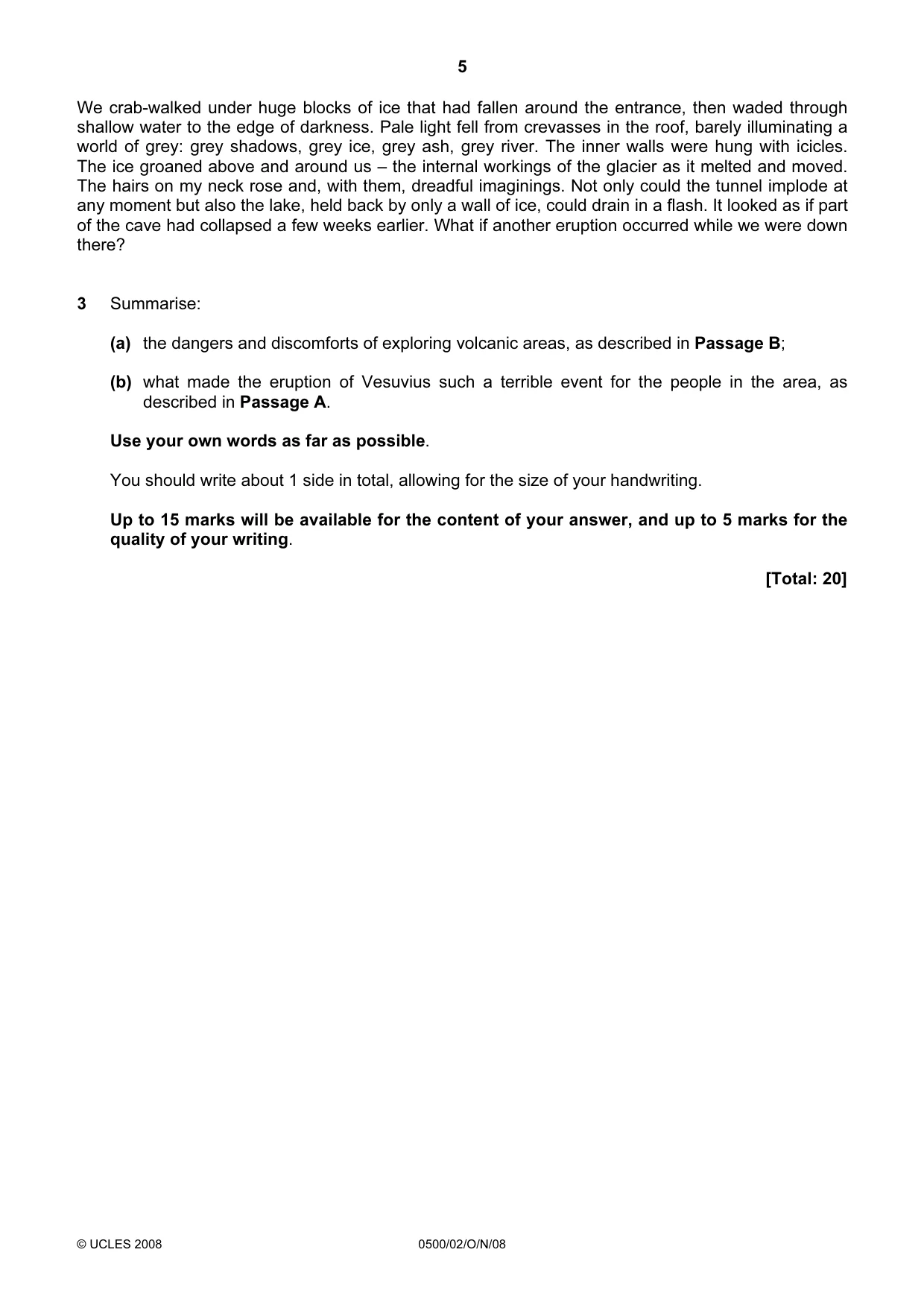
5 © UCLES 2008 0500/02/O/N/08 We crab-walked under huge blocks of ice that had fallen around the entrance, then waded through shallow water to the edge of darkness. Pale light fell from crevasses in the roof, barely illuminating a world of grey: grey shadows, grey ice, grey ash, grey river. The inner walls were hung with icicles. The ice groaned above and around us – the internal workings of the glacier as it melted and moved. The hairs on my neck rose and, with them, dreadful imaginings. Not only could the tunnel implode at any moment but also the lake, held back by only a wall of ice, could drain in a flash. It looked as if part of the cave had collapsed a few weeks earlier. What if another eruption occurred while we were down there? 3 Summarise: (a) the dangers and discomforts of exploring volcanic areas, as described in Passage B; (b) what made the eruption of Vesuvius such a terrible event for the people in the area, as described in Passage A. Use your own words as far as possible. You should write about 1 side in total, allowing for the size of your handwriting. Up to 15 marks will be available for the content of your answer, and up to 5 marks for the quality of your writing. [Total: 20]
Question paper, page 8
8 Copyright Acknowledgements: Passage B © Jeremy Schmidt; National Geographic Magazine, August 2001. Permission to reproduce items where third-party owned material protected by copyright is included has been sought and cleared where possible. Every reasonable effort has been made by the publisher (UCLES) to trace copyright holders, but if any items requiring clearance have unwittingly been included, the publisher will be pleased to make amends at the earliest possible opportunity. University of Cambridge International Examinations is part of the Cambridge Assessment Group. Cambridge Assessment is the brand name of University of Cambridge Local Examinations Syndicate (UCLES), which is itself a department of the University of Cambridge. 0500/02/O/N/08 BLANK PAGE
Mark scheme, page 1
UNIVERSITY OF CAMBRIDGE INTERNATIONAL EXAMINATIONS International General Certificate of Secondary Education MARK SCHEME for the October/November 2008 question paper 0500 FIRST LANGUAGE ENGLISH 0500/02 Paper 2 (Reading Passage – Extended), maximum raw mark 50 This mark scheme is published as an aid to teachers and candidates, to indicate the requirements of the examination. It shows the basis on which Examiners were instructed to award marks. It does not indicate the details of the discussions that took place at an Examiners’ meeting before marking began. All Examiners are instructed that alternative correct answers and unexpected approaches in candidates’ scripts must be given marks that fairly reflect the relevant knowledge and skills demonstrated. Mark schemes must be read in conjunction with the question papers and the report on the examination. • CIE will not enter into discussions or correspondence in connection with these mark schemes. CIE is publishing the mark schemes for the October/November 2008 question papers for most IGCSE, GCE Advanced Level and Advanced Subsidiary Level syllabuses and some Ordinary Level syllabuses. www.XtremePapers.com
Mark scheme, page 2
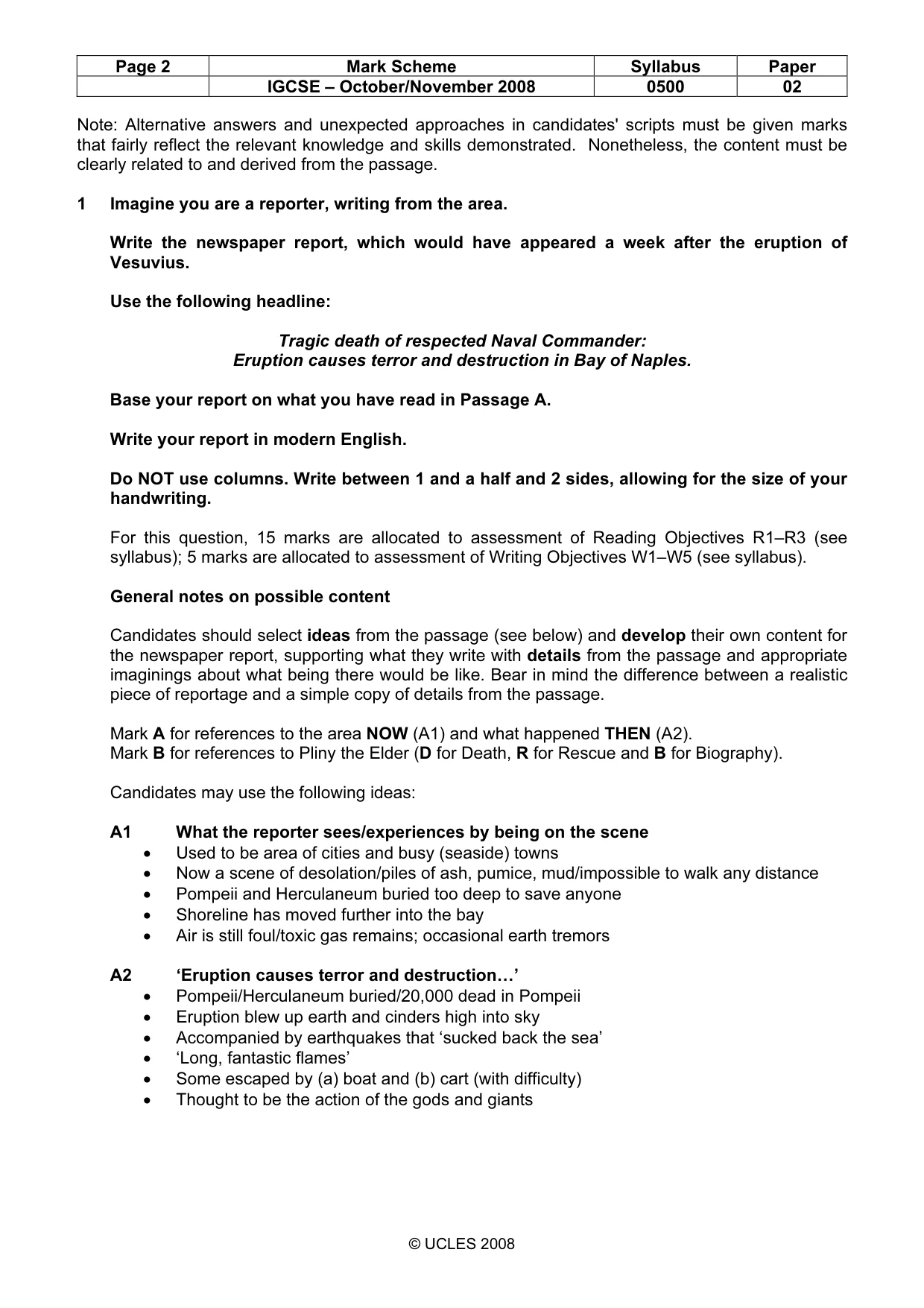
Page 2 Mark Scheme Syllabus Paper IGCSE – October/November 2008 0500 02 © UCLES 2008 Note: Alternative answers and unexpected approaches in candidates' scripts must be given marks that fairly reflect the relevant knowledge and skills demonstrated. Nonetheless, the content must be clearly related to and derived from the passage. 1 Imagine you are a reporter, writing from the area. Write the newspaper report, which would have appeared a week after the eruption of Vesuvius. Use the following headline: Tragic death of respected Naval Commander: Eruption causes terror and destruction in Bay of Naples. Base your report on what you have read in Passage A. Write your report in modern English. Do NOT use columns. Write between 1 and a half and 2 sides, allowing for the size of your handwriting. For this question, 15 marks are allocated to assessment of Reading Objectives R1–R3 (see syllabus); 5 marks are allocated to assessment of Writing Objectives W1–W5 (see syllabus). General notes on possible content Candidates should select ideas from the passage (see below) and develop their own content for the newspaper report, supporting what they write with details from the passage and appropriate imaginings about what being there would be like. Bear in mind the difference between a realistic piece of reportage and a simple copy of details from the passage. Mark A for references to the area NOW (A1) and what happened THEN (A2). Mark B for references to Pliny the Elder (D for Death, R for Rescue and B for Biography). Candidates may use the following ideas: A1 What the reporter sees/experiences by being on the scene • Used to be area of cities and busy (seaside) towns • Now a scene of desolation/piles of ash, pumice, mud/impossible to walk any distance • Pompeii and Herculaneum buried too deep to save anyone • Shoreline has moved further into the bay • Air is still foul/toxic gas remains; occasional earth tremors A2 ‘Eruption causes terror and destruction…’ • Pompeii/Herculaneum buried/20,000 dead in Pompeii • Eruption blew up earth and cinders high into sky • Accompanied by earthquakes that ‘sucked back the sea’ • ‘Long, fantastic flames’ • Some escaped by (a) boat and (b) cart (with difficulty) • Thought to be the action of the gods and giants
Mark scheme, page 3
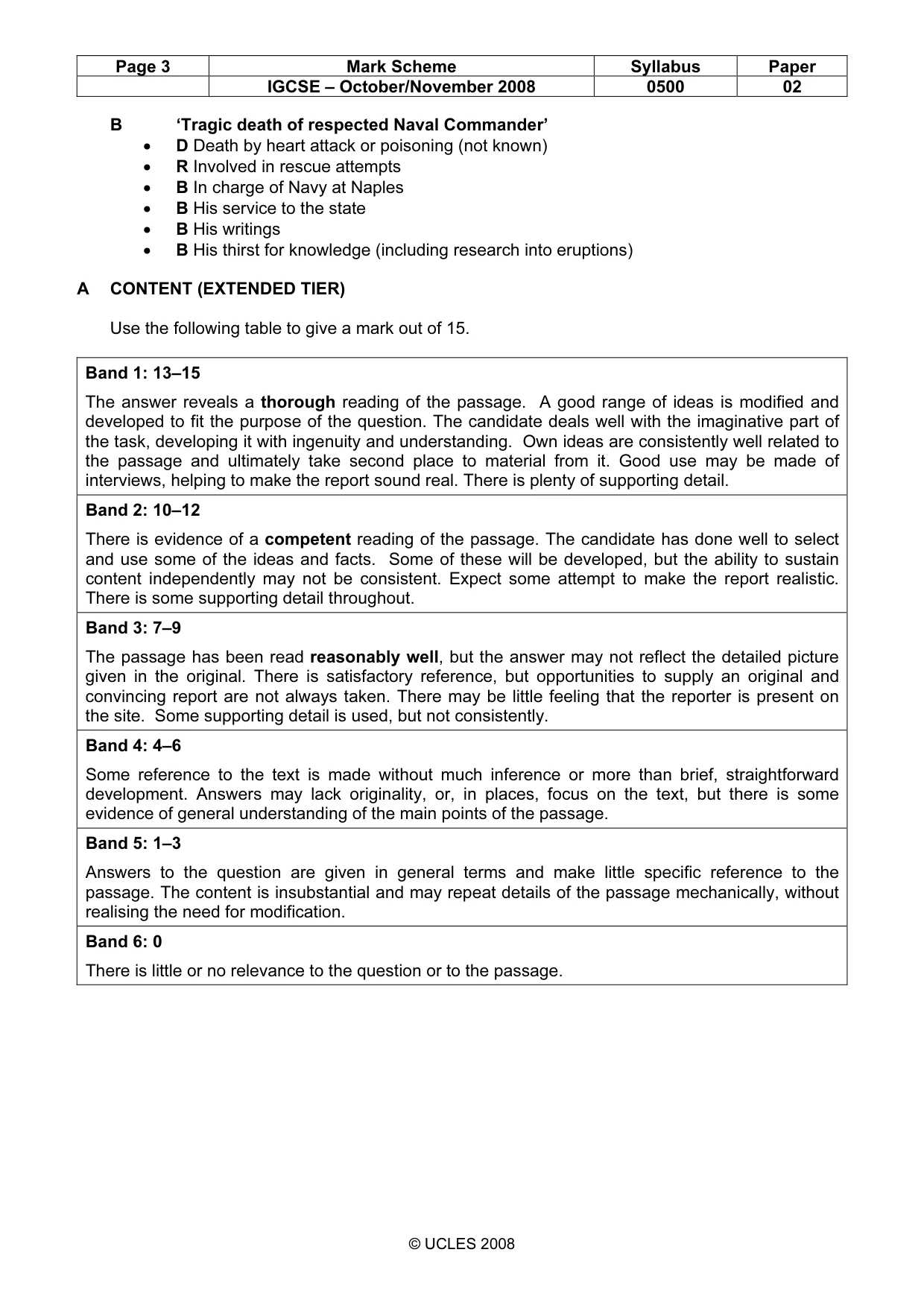
Page 3 Mark Scheme Syllabus Paper IGCSE – October/November 2008 0500 02 © UCLES 2008 B ‘Tragic death of respected Naval Commander’ • D Death by heart attack or poisoning (not known) • R Involved in rescue attempts • B In charge of Navy at Naples • B His service to the state • B His writings • B His thirst for knowledge (including research into eruptions) A CONTENT (EXTENDED TIER) Use the following table to give a mark out of 15. Band 1: 13–15 The answer reveals a thorough reading of the passage. A good range of ideas is modified and developed to fit the purpose of the question. The candidate deals well with the imaginative part of the task, developing it with ingenuity and understanding. Own ideas are consistently well related to the passage and ultimately take second place to material from it. Good use may be made of interviews, helping to make the report sound real. There is plenty of supporting detail. Band 2: 10–12 There is evidence of a competent reading of the passage. The candidate has done well to select and use some of the ideas and facts. Some of these will be developed, but the ability to sustain content independently may not be consistent. Expect some attempt to make the report realistic. There is some supporting detail throughout. Band 3: 7–9 The passage has been read reasonably well, but the answer may not reflect the detailed picture given in the original. There is satisfactory reference, but opportunities to supply an original and convincing report are not always taken. There may be little feeling that the reporter is present on the site. Some supporting detail is used, but not consistently. Band 4: 4–6 Some reference to the text is made without much inference or more than brief, straightforward development. Answers may lack originality, or, in places, focus on the text, but there is some evidence of general understanding of the main points of the passage. Band 5: 1–3 Answers to the question are given in general terms and make little specific reference to the passage. The content is insubstantial and may repeat details of the passage mechanically, without realising the need for modification. Band 6: 0 There is little or no relevance to the question or to the passage.
Mark scheme, page 4
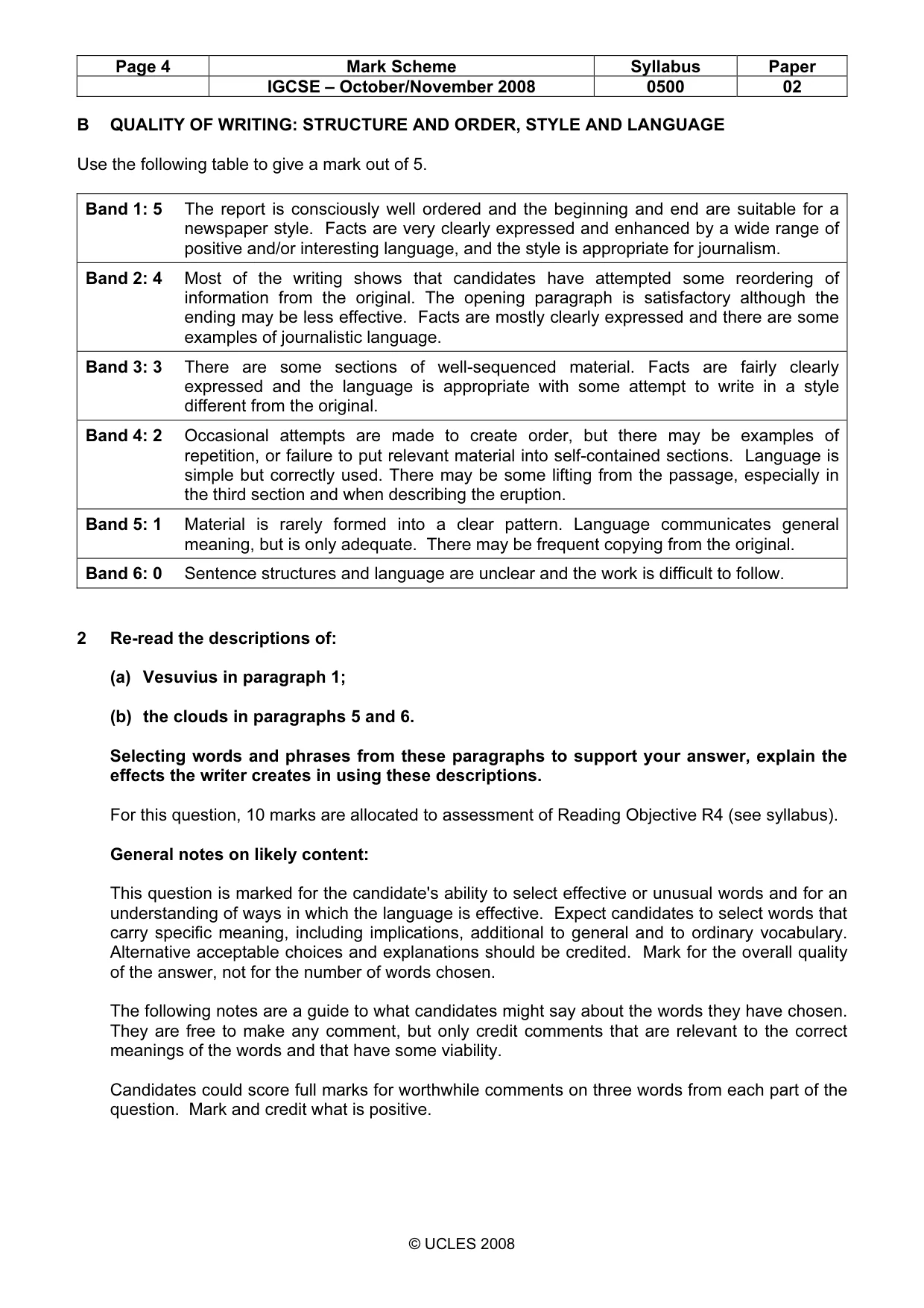
Page 4 Mark Scheme Syllabus Paper IGCSE – October/November 2008 0500 02 © UCLES 2008 B QUALITY OF WRITING: STRUCTURE AND ORDER, STYLE AND LANGUAGE Use the following table to give a mark out of 5. Band 1: 5 The report is consciously well ordered and the beginning and end are suitable for a newspaper style. Facts are very clearly expressed and enhanced by a wide range of positive and/or interesting language, and the style is appropriate for journalism. Band 2: 4 Most of the writing shows that candidates have attempted some reordering of information from the original. The opening paragraph is satisfactory although the ending may be less effective. Facts are mostly clearly expressed and there are some examples of journalistic language. Band 3: 3 There are some sections of well-sequenced material. Facts are fairly clearly expressed and the language is appropriate with some attempt to write in a style different from the original. Band 4: 2 Occasional attempts are made to create order, but there may be examples of repetition, or failure to put relevant material into self-contained sections. Language is simple but correctly used. There may be some lifting from the passage, especially in the third section and when describing the eruption. Band 5: 1 Material is rarely formed into a clear pattern. Language communicates general meaning, but is only adequate. There may be frequent copying from the original. Band 6: 0 Sentence structures and language are unclear and the work is difficult to follow. 2 Re-read the descriptions of: (a) Vesuvius in paragraph 1; (b) the clouds in paragraphs 5 and 6. Selecting words and phrases from these paragraphs to support your answer, explain the effects the writer creates in using these descriptions. For this question, 10 marks are allocated to assessment of Reading Objective R4 (see syllabus). General notes on likely content: This question is marked for the candidate's ability to select effective or unusual words and for an understanding of ways in which the language is effective. Expect candidates to select words that carry specific meaning, including implications, additional to general and to ordinary vocabulary. Alternative acceptable choices and explanations should be credited. Mark for the overall quality of the answer, not for the number of words chosen. The following notes are a guide to what candidates might say about the words they have chosen. They are free to make any comment, but only credit comments that are relevant to the correct meanings of the words and that have some viability. Candidates could score full marks for worthwhile comments on three words from each part of the question. Mark and credit what is positive.
Mark scheme, page 5
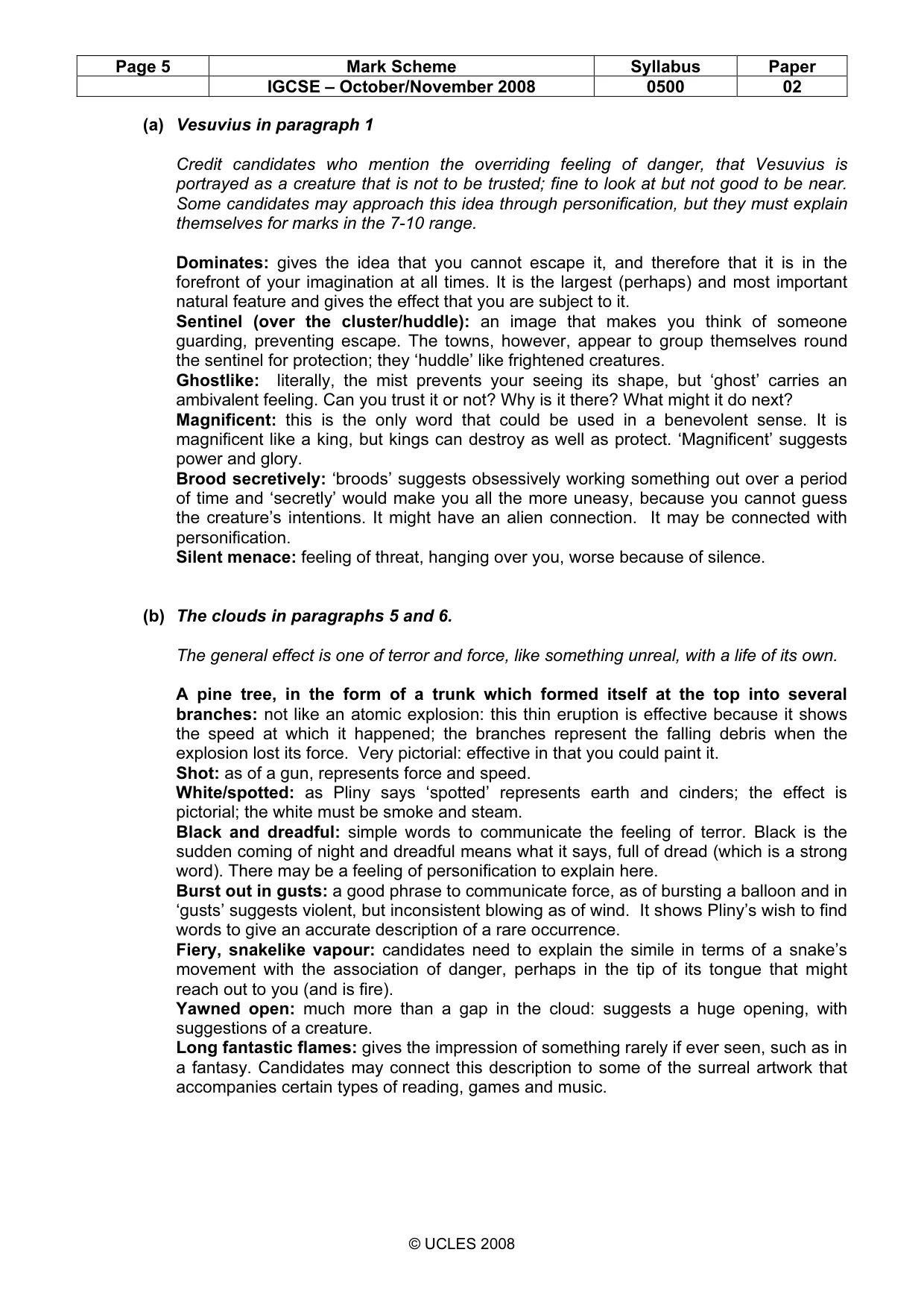
Page 5 Mark Scheme Syllabus Paper IGCSE – October/November 2008 0500 02 © UCLES 2008 (a) Vesuvius in paragraph 1 Credit candidates who mention the overriding feeling of danger, that Vesuvius is portrayed as a creature that is not to be trusted; fine to look at but not good to be near. Some candidates may approach this idea through personification, but they must explain themselves for marks in the 7-10 range. Dominates: gives the idea that you cannot escape it, and therefore that it is in the forefront of your imagination at all times. It is the largest (perhaps) and most important natural feature and gives the effect that you are subject to it. Sentinel (over the cluster/huddle): an image that makes you think of someone guarding, preventing escape. The towns, however, appear to group themselves round the sentinel for protection; they ‘huddle’ like frightened creatures. Ghostlike: literally, the mist prevents your seeing its shape, but ‘ghost’ carries an ambivalent feeling. Can you trust it or not? Why is it there? What might it do next? Magnificent: this is the only word that could be used in a benevolent sense. It is magnificent like a king, but kings can destroy as well as protect. ‘Magnificent’ suggests power and glory. Brood secretively: ‘broods’ suggests obsessively working something out over a period of time and ‘secretly’ would make you all the more uneasy, because you cannot guess the creature’s intentions. It might have an alien connection. It may be connected with personification. Silent menace: feeling of threat, hanging over you, worse because of silence. (b) The clouds in paragraphs 5 and 6. The general effect is one of terror and force, like something unreal, with a life of its own. A pine tree, in the form of a trunk which formed itself at the top into several branches: not like an atomic explosion: this thin eruption is effective because it shows the speed at which it happened; the branches represent the falling debris when the explosion lost its force. Very pictorial: effective in that you could paint it. Shot: as of a gun, represents force and speed. White/spotted: as Pliny says ‘spotted’ represents earth and cinders; the effect is pictorial; the white must be smoke and steam. Black and dreadful: simple words to communicate the feeling of terror. Black is the sudden coming of night and dreadful means what it says, full of dread (which is a strong word). There may be a feeling of personification to explain here. Burst out in gusts: a good phrase to communicate force, as of bursting a balloon and in ‘gusts’ suggests violent, but inconsistent blowing as of wind. It shows Pliny’s wish to find words to give an accurate description of a rare occurrence. Fiery, snakelike vapour: candidates need to explain the simile in terms of a snake’s movement with the association of danger, perhaps in the tip of its tongue that might reach out to you (and is fire). Yawned open: much more than a gap in the cloud: suggests a huge opening, with suggestions of a creature. Long fantastic flames: gives the impression of something rarely if ever seen, such as in a fantasy. Candidates may connect this description to some of the surreal artwork that accompanies certain types of reading, games and music.
Mark scheme, page 6
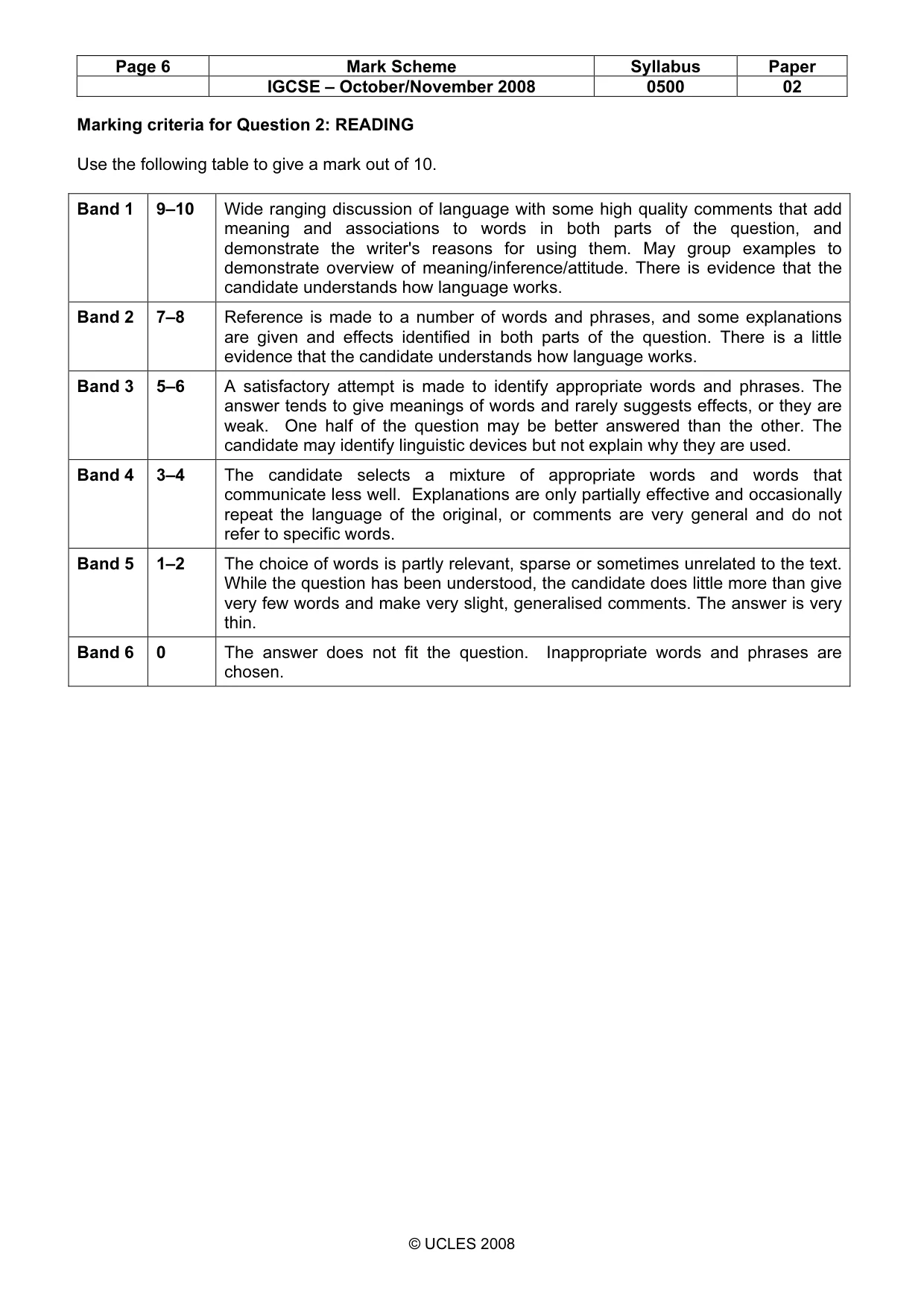
Page 6 Mark Scheme Syllabus Paper IGCSE – October/November 2008 0500 02 © UCLES 2008 Marking criteria for Question 2: READING Use the following table to give a mark out of 10. Band 1 9–10 Wide ranging discussion of language with some high quality comments that add meaning and associations to words in both parts of the question, and demonstrate the writer's reasons for using them. May group examples to demonstrate overview of meaning/inference/attitude. There is evidence that the candidate understands how language works. Band 2 7–8 Reference is made to a number of words and phrases, and some explanations are given and effects identified in both parts of the question. There is a little evidence that the candidate understands how language works. Band 3 5–6 A satisfactory attempt is made to identify appropriate words and phrases. The answer tends to give meanings of words and rarely suggests effects, or they are weak. One half of the question may be better answered than the other. The candidate may identify linguistic devices but not explain why they are used. Band 4 3–4 The candidate selects a mixture of appropriate words and words that communicate less well. Explanations are only partially effective and occasionally repeat the language of the original, or comments are very general and do not refer to specific words. Band 5 1–2 The choice of words is partly relevant, sparse or sometimes unrelated to the text. While the question has been understood, the candidate does little more than give very few words and make very slight, generalised comments. The answer is very thin. Band 6 0 The answer does not fit the question. Inappropriate words and phrases are chosen.
Mark scheme, page 7
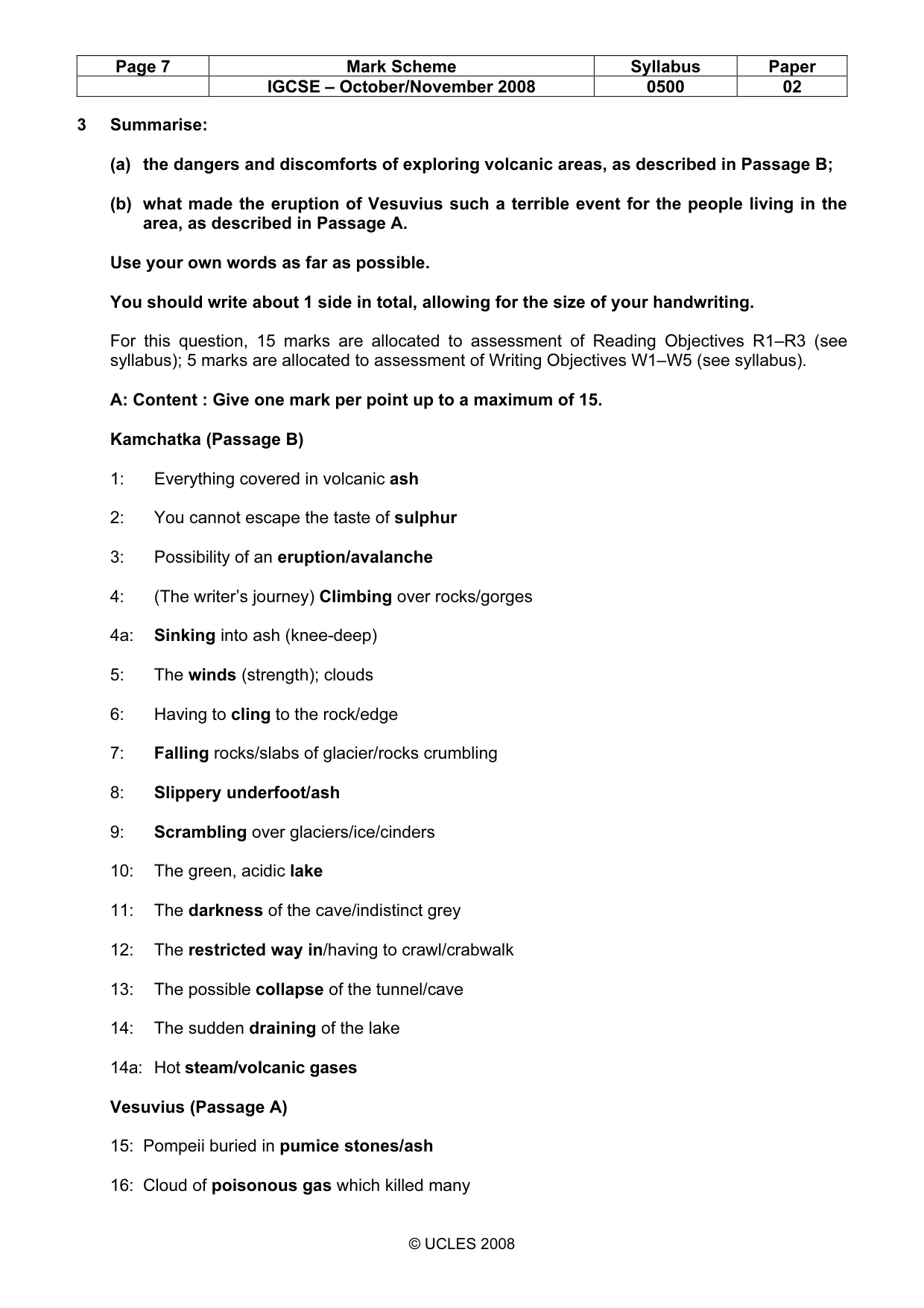
Page 7 Mark Scheme Syllabus Paper IGCSE – October/November 2008 0500 02 © UCLES 2008 3 Summarise: (a) the dangers and discomforts of exploring volcanic areas, as described in Passage B; (b) what made the eruption of Vesuvius such a terrible event for the people living in the area, as described in Passage A. Use your own words as far as possible. You should write about 1 side in total, allowing for the size of your handwriting. For this question, 15 marks are allocated to assessment of Reading Objectives R1–R3 (see syllabus); 5 marks are allocated to assessment of Writing Objectives W1–W5 (see syllabus). A: Content : Give one mark per point up to a maximum of 15. Kamchatka (Passage B) 1: Everything covered in volcanic ash 2: You cannot escape the taste of sulphur 3: Possibility of an eruption/avalanche 4: (The writer’s journey) Climbing over rocks/gorges 4a: Sinking into ash (knee-deep) 5: The winds (strength); clouds 6: Having to cling to the rock/edge 7: Falling rocks/slabs of glacier/rocks crumbling 8: Slippery underfoot/ash 9: Scrambling over glaciers/ice/cinders 10: The green, acidic lake 11: The darkness of the cave/indistinct grey 12: The restricted way in/having to crawl/crabwalk 13: The possible collapse of the tunnel/cave 14: The sudden draining of the lake 14a: Hot steam/volcanic gases Vesuvius (Passage A) 15: Pompeii buried in pumice stones/ash 16: Cloud of poisonous gas which killed many
Mark scheme, page 8
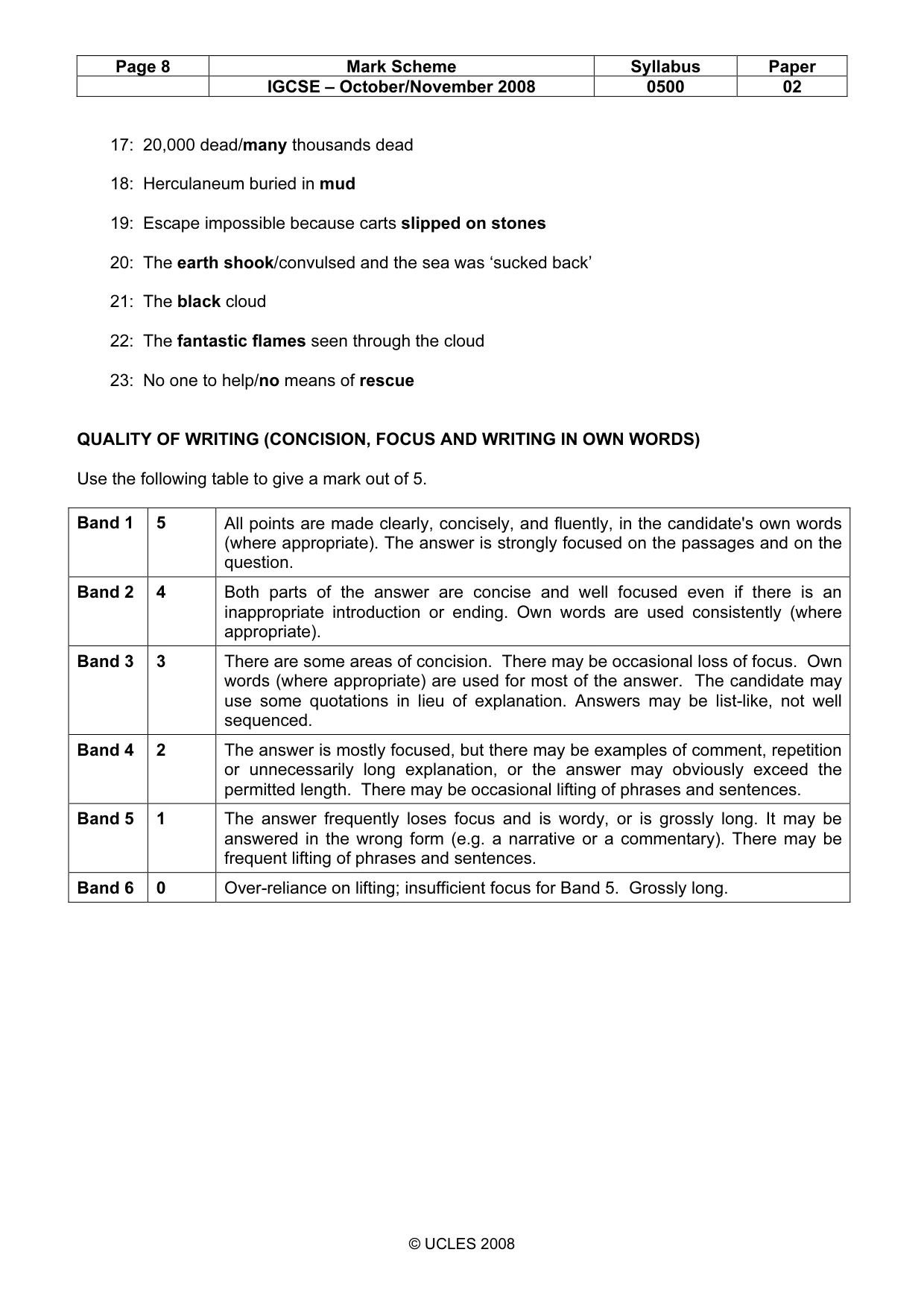
Page 8 Mark Scheme Syllabus Paper IGCSE – October/November 2008 0500 02 © UCLES 2008 17: 20,000 dead/many thousands dead 18: Herculaneum buried in mud 19: Escape impossible because carts slipped on stones 20: The earth shook/convulsed and the sea was ‘sucked back’ 21: The black cloud 22: The fantastic flames seen through the cloud 23: No one to help/no means of rescue QUALITY OF WRITING (CONCISION, FOCUS AND WRITING IN OWN WORDS) Use the following table to give a mark out of 5. Band 1 5 All points are made clearly, concisely, and fluently, in the candidate's own words (where appropriate). The answer is strongly focused on the passages and on the question. Band 2 4 Both parts of the answer are concise and well focused even if there is an inappropriate introduction or ending. Own words are used consistently (where appropriate). Band 3 3 There are some areas of concision. There may be occasional loss of focus. Own words (where appropriate) are used for most of the answer. The candidate may use some quotations in lieu of explanation. Answers may be list-like, not well sequenced. Band 4 2 The answer is mostly focused, but there may be examples of comment, repetition or unnecessarily long explanation, or the answer may obviously exceed the permitted length. There may be occasional lifting of phrases and sentences. Band 5 1 The answer frequently loses focus and is wordy, or is grossly long. It may be answered in the wrong form (e.g. a narrative or a commentary). There may be frequent lifting of phrases and sentences. Band 6 0 Over-reliance on lifting; insufficient focus for Band 5. Grossly long.
What you needed in this session
Cambridge’s own grade thresholds for 2008 Oct/Nov, Paper 2 · Variant 1. A higher threshold means an easier paper — the bar moves with how the cohort did.